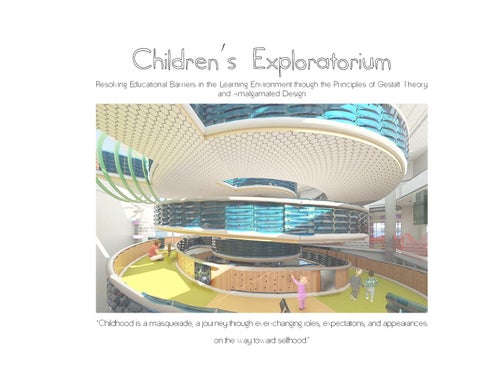
Children's Explo ratoriu m Resolving Educational Barriers in the Learning Environment through the Principles of Gestalt Theory and Amalgamated Design
“Childhood is a masquerade, a journey through ever-changing roles, expectations, and appearances on the way toward selfhood.�
Program
Original Square Footages
Program
Original Square Footages
4340
1736 6076
Circulation(40%)
Concept Development
The concept deconstruction is of the skeleton structure of the chameleon. I took its form and developed further on the design elements. Words describe the feel I want from the experience of the museum.
Schematic Design
Buildings were given to the students according to their program; however, the building they originally gave me was at the incorrect square footage. These block diagrams were displaying my first building type.
Schematic Design
Play space sketches
Preliminary Sketches
Sketches of possible experiential exhibits, anthropology wall exhibit, and ramp experiences
Code Research
-
-
-
SECTION OF RAMP NOT TO SCALE
DET AIL OF RAILING AND ART DISPLAY
Design Development
Design Development
PROXEMICS
Heights of the child allow for flexible uses of the adapting exhibitions, art studios, and play spaces. Proxemics of play for introverted and extroverted explorerers within a learning environment. Design must adapt to multiple learning styles and be flexible with the different perceptial minds of children.
Synthesis: Solution
The solution to designing an authentic learning enviornment for chldren and adults to connect their perceptual
views to their world was to design an interactive children’s museum. This embraces the 21st Century learning module of exploration, play, and creativity for the child, by adapting to ever-changing experiential spaces. Adaptive learning environments ignite the curiosity of children as they challenge their senses and bodies through perception and dialogue; their imaginations, infused by adults, allows for the essential connection of the mind with understanding. This process will draw upon various psychological influences, including gestalt therapy and somaesthetics, which bridge the gap of perceptual awareness within the learned environment for children and adults. Solution: Somaesthetics, using the body as a learning instrument to adapt to diverse environments.