18.07 — 22.11.2026
RUI CALÇADA BASTOS
SECOND SLEEP
SECOND SLEEP
The exhibition begins with what would usually remain outside painting: a cloth used in the studio. Before any landscape, before any horizon, before any recognisable image, Rui Calçada Bastos places us before an element that accompanied the making of the work without being intended to be seen. There is a quiet displacement in this gesture: what once served a purpose and remained at the margins now exists as a heightened presence. Entitled Pintura [Painting], the work is no longer merely a residue or a tool; it becomes a kind of primal painting — the place where what the work does not show, yet is also made of, has settled.
From this opening gesture, Second Sleep unfolds as a path through images, objects and forms that seem to exist in a state of transition. Nothing appears entirely stable: landscape, matter and image remain on a threshold, between what appears and what is still changing. Across painting, sculpture, drawing, photography and sound, the exhibition draws near to an uncertain time, in which each work seems to come to rest only briefly before moving again. The works are presented not as certainties but as possibilities: provisional forms of thought in space.
There is, in this movement, a precise relation to slowness. Rui Calçada Bastos speaks of painting as a practice that requires
time: not only to make, but to see; not only to guide the image, but to recognise what the image itself allows. Letting things happen does not mean relinquishing decision; it means accepting that form can also be found when something slips beyond control. This sense of duration runs through the entire exhibition: it is present in the painted surfaces and extends into the objects, which likewise ask for an attentive, unhurried gaze.
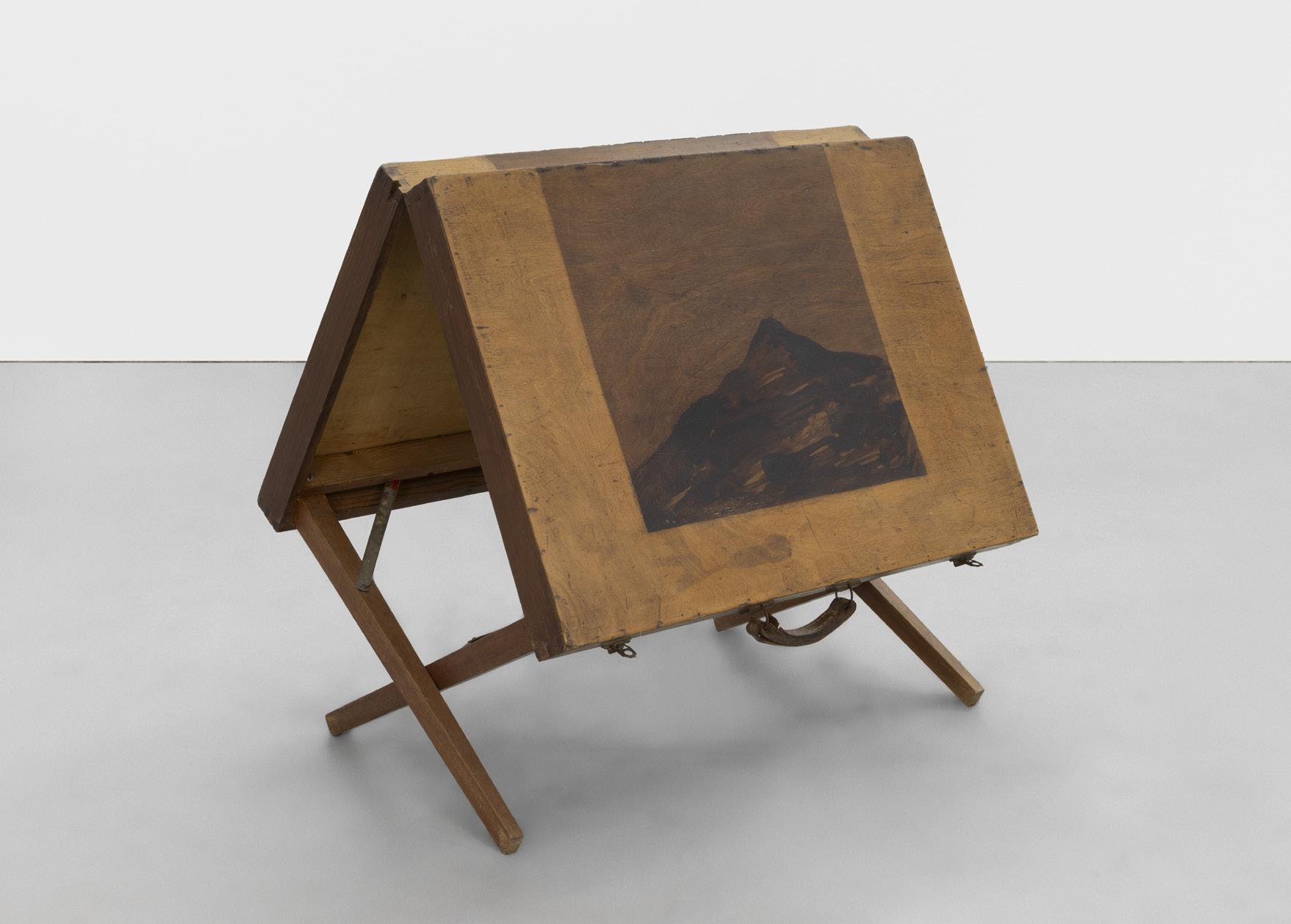
Travel runs through these works like a discreet line. It insinuates itself into the tables that fold, suitcases and structures that seem able to close or move elsewhere, but also by the intervals between the works. It returns in mountains and horizons, in images crossed by falling light and night, as though each landscape still held the possibility of another path.
In Mendigos e Altivos [Proud Beggars], the reference to Albert Cossery gives a particular dimension to this relation to renunciation. The work invokes not a social condition but a form of freedom: a refusal to turn everything into possession, conquest or accumulation. Within this field, O segredo não é levar a montanha inteira [The Secret Is Not to Carry the Whole Mountain] appears as a silent phrase along the path. It does not determine a reading, but leaves open a simple intuition: to cross
without possessing; to pass through a landscape without turning it into a burden.
Perhaps Second Sleep approaches this kind of detachment. Not an abandonment of the body, but a displaced, slower attentiveness. A second sleep: already after the first fall, already within another light. Here, the image is not immediately given. It emerges as a crossing: never arriving all at once, never allowing itself to be fully fixed.
At the end, Untitled (Ladakh, Indian Tibet), a photograph made in 1991 during a journey to Indian Tibet, does not close the path; it returns it to its beginning. The image becomes an open-ended return, returning to the exhibition one final form of movement. In response to a fourteen-page letter, Pedro Morais replied to Rui Calçada Bastos with a single sentence: “Do not dwell for more than one night in the same place.” Perhaps Second Sleep inhabits precisely this interval: between what we pass through and what we do not carry with us, allowing wonder to find us along the way.
Cláudia Ramos
MAIN GALLERY
Room 1
1 Pintura, 2026
Towel with paint and museum glass, 112 × 84 × 33 cm
Room 2
2 Sem título, 2025
Drypoint on carbon paper and Fabriano paper, 300 gsm. 28,5 × 36,5 cm
3 Volte-Face, 2026
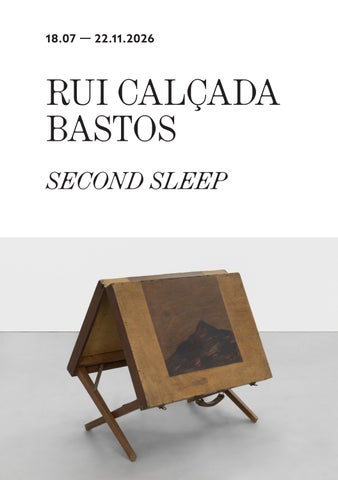
Folding wooden table and vieuxchêne wood stain, 70 × 70 × 62 cm
4 A Noite na Terra, 2026
Oil on canvas, 150 × 100 cm
5 Dicionário de truques, 2026
Wooden base and six wooden drawers, 119 × 46 × 46 cm
6 Sem título, 2026
Oil on canvas, 135,5 × 144 cm
7 Paisagem para um vagabundo, 2026
Oil on canvas, 160 × 180 cm
8 Sem título, 2026
Oil on canvas, 33 × 41 cm
9 Sem título, 2026
Oil on canvas, 33 × 41 cm
10 Sem título, 2026
Oil on canvas, 33 × 41 cm
11 Sem título, 2026
Oil on canvas, 33 × 41 cm
12 Sem título, 2026
Oil on canvas, 33 × 41 cm
13 Sem título, 2026
Oil on canvas, 33 × 41 cm
14 Sem título, 2026
Oil on canvas, 33 × 41 cm
15 Dolce Vita, 2026
Metal handle on wood and museum glass, 73 × 70 × 24 cm
16 Um passo gigante, 2026
Pair of boots, two pieces of coral and museum glass
17 Room with a View, 2026
Oil on canvas, 160 × 235 cm
Room 3
18 Vagabundo, 2026
Metal handle, six copies of O Vagabundo and museum glass, 50 × 70 × 49,5 cm
19 O segredo não é levar a montanha inteira, 2026
Oil on cardboard suitcase, 30 × 20 × 8 cm
20 Mendigos e Altivos, 2026
Wooden suitcase and loudspeaker, 185 × 40 × 15 cm
Room 4
21 Céu limpo, 2026
Wooden table and cerulean blue pigment, 34 × 52 × 32 cm
22 Kabul, 2026 Oil on canvas, 160 × 180 cm
23 Vale, 2026 Oil on canvas, 160 × 180 cm
24 Ladakh — Tibete Indiano, 1991 Inkjet print on 315 gsm baryta paper, 150 × 98,8 cm.
Almada City Council Mayor and Culture Councilor
Inês de Medeiros
Social Development
Municipal Director
Eduardo Quinta Nova
Culture Department
Director
Rute Moura
Head of the Contemporary Art Centre
Nuno Moura
Curated by Cláudia Ramos
Production and installation
Ana Taipas
Paulo Ramos
Communication
Paula Freire
Administration Support
Carla Novais
Educational Service
Ana Sofia Godinho
Mário Rainha Campos
Sílvia Moreira
Mestre Rogério Ribeiro
Documentation and Research Centre
Ana Margarida Martins
Collection Management
Maria Miguel Cardoso
Botanical Garden
Sónia Francisco
Hugo Ribeiro
Front-of-House
Anabela Almeida
Fernando Simões
Hélder Gonçalves
Júlia Garcia
Tatiana Marques
Victor Borges
Support
Emília Ferreira
Installation support
Divisão de Manutenção de Equipamentos Municipais da CMA
Translation
José Roseira
Graphic design vivóeusébio
Graphic materials production
Original Pixel
CASA DA CERCA
Rua da Cerca, 2800-050 Almada
Т. 212 724 950 casadacerca@cm-almada.pt www.cm-almada.pt/casa-da-cercacentro-de-arte-contemporanea
facebook @festadacasadacerca instagram @casadacerca
OPENING HOURS
From Monday to Sunday. Closed on holidays.
Summer schedule 1 APR – 30 SEP 10:15 am-8:00 pm
Winter schedule 1 OCT – 31 MAR 10:15 am-5:30 pm