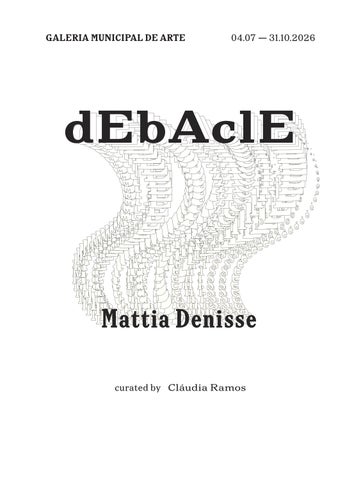
curated by Cláudia Ramos
dEbAclE: A Journey in the “Dead Man’s Seat” 1
Sitting in a car, in what the Portuguese call the “dead man’s seat” — the front passenger seat, beside the driver — a term that has always fascinated me for its ghostly resonance. I watch the landscape slip past. It passes through me. I am fleeing, certainly, but without knowing exactly what from, or where to. Watching the landscape slip by is hypnotic; I drift in and out of sleep, losing all sense of time and of the boundary between dream and reality. Without noticing, I slide from a dreamlike landscape into a real one; the two begin to blur. In the dream, the gaze zooms in on incongruous details. Nothing can, or should, stop me. The landscape leaves fleeting traces, imprecise memories, with no time for detail. To flee, at any cost. Dawn or dusk. At night, darkness hides me; by day, I hide myself.
Arthur Dessine
1 The expression “dead man’s seat” is a literal translation of the Portuguese lugar do morto, commonly used to refer to the front passenger seat beside the driver.
dEbAclE sits firmly within Mattia Denisse’s broader trajectory, extending a practice in which drawing, writing and image are not arranged hierarchically, but brought into close proximity. Across his work, drawing comes close to writing not only as a medium, but as a way of thinking: a surface on which meaning accumulates without settling, where repetition does not clarify so much as displace, and where each image seems to function as a fragment of a narrative that never quite comes together as a whole.
The opening section of the exhibition offers a kind of “fantastic history of camouflage”: a group of images concerned with concealment, mimicry and the possibility of disappearing. Camouflage appears here less as a motif than as a condition. To see is also to hide; to appear is to risk exposure. The landscape never fully reveals itself, and the subject moving through it is never entirely visible. Between shadow and exposure, a continuous tension is sustained — not dramatic, but persistent.
From here, this logic is intensified by a continuous device that calls on travelling in its double sense: physical displacement and the cinematic movement. This is not about observing landscapes, but about passing through them. The succession of images does not amount to an inventory of catastrophes, even if it evokes territories marked by forms of rupture — natural, historical or imagined. What emerges instead is a mode of perception: an unstable state of attention in which looking no longer implies mastery.
The title, dEbAclE, condenses this condition. Derived from the French débâcle — which refers to the breaking up and thawing of a watercourse — it points not only to ruin or failure, but also to a moment of flow, when accumulated matter is suddenly released. This double movement, between collapse and displacement, runs through the entire work: the landscapes are not fixed, but crossed by forces; they are not settings, but surfaces in transformation.
It is in this context that the idea of the “dead man’s seat” takes on greater weight. More than a physical position, it names a way of seeing: to see without driving, to move forward without determining the route. The viewer is placed in this position — not as the sovereign subject of the gaze, but as a body exposed to movement, carried along a path it does not control. The work does not lend itself to detached contemplation; it asks instead for a certain vulnerability.
This vulnerability is reinforced by the constant oscillation between states: wakefulness and sleep, memory and projection, reality and fiction. The images seem to emerge in an interval where time is suspended, where the landscape might be remembered as much as imagined. This gap — between what is seen and what is recognised — is not an error: it is the very movement of the work. This is where drawing operates: not to stabilise, but to hold things open.
In this sense, drawing becomes a form of crossing. Not an isolated image, but a long sentence, a flow, a passage. Each element belongs to a continuum in which repetition builds rhythm rather than conclusion. Like a leporello — a book that keeps unfolding — here too there is no clear beginning and no single direction: only a route that takes shape in the time of the body.
In the “dead man’s seat”, to see is already to give up control. And it is in this gesture — between exposure, displacement and indeterminacy — that the work finds its intensity.
Solve et coagula
Fantastic History of Camouflage, 2025
Acrylic and oil on canvas
160 × 119 cm
The Ostrich Technique
Fantastic History of Camouflage, 2025–2026
Oil on canvas
160 × 119 × 3.5 cm
Nymphéas VS Hiroshima
Recto Verso and Vice Versa, 2024–2025
Oil on Arches 300 g/m² paper
76 × 56 cm
dEbAclE
2026
Oil on Arches Oil paper and micro-corrugated cardboard
Variable dimensions
GALERIA MUNICIPAL DE ARTE
Almada City Council
Mayor and Culture Councilor
Inês de Medeiros
Social Development
Municipal Director
Eduardo Quinta Nova
Culture Department Director
Rute Moura
Head of Division of the Contemporary Art Centre
Nuno Moura
Front-of-House
Elsa de Sousa
Filipe Barbosa
EXHIBITION
Curated by
Cláudia Ramos
Production
Ana Taipas
Paulo Ramos
Communication Paula Freire
Administration support
Carla Novais
Educational Service
Ana Sofia Godinho
Elsa de Sousa
Translation
José Roseira
GALERIA
MUNICIPAL DE ARTE
Av. Nuno Alvares Pereira 74 A 2800-177 Almada
T. 212 724 724 casadacerca@cm-almada.pt
Installation
Ana Taipas
Paulo Ramos Divisão de Manutenção do Edificado e Apoio às Atividades Municipais
Printing Original Pixel
Acknowledgements CRIA.
Felipe Feijão Francisca Bagulho
Gracal Mário e Zé Mário Silva Vasco Costa vivóeusébio
OPENING HOURS
Tuesday to Saturday: 11am-1pm / 2pm-7pm
Closed on Sundays, Mondays and public holidays