GALERIA MUNICIPAL DE ARTE
19.11.2026 — 20.03.2027
LEKA MENDES
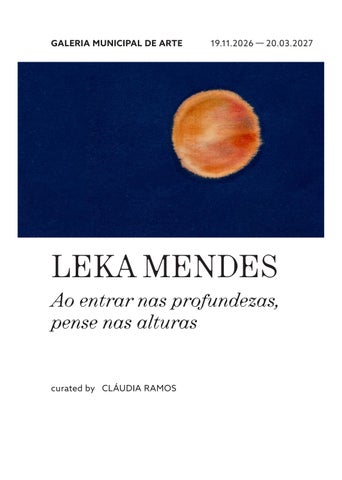
Ao entrar nas profundezas, pense nas alturas curated by CLÁUDIA RAMOS
Light takes about eight minutes to travel from the Sun to Earth. Every day, plants take in this energy from space and turn it into organic matter. In doing so, they help shape the atmosphere we breathe and, over millions of years, have altered the conditions for life on the planet. The space between earth and sky teems with activity, a ceaseless transmutation that leaves its mark on matter. The exhibition takes its title from an inscription on the miners’ bell in Freiberg, Germany, where the naturalist and explorer Alexander von Humboldt studied. On his expeditions, the same curiosity that drew his eye to a tiny organism led him to study mountains, oceans and celestial phenomena. His understanding of nature grew out of his attention to its particulars and to the connections he found between them. The words on the bell find an echo in Leka Mendes’s research, in her attention to the many forms nature takes at different scales. Travelling through the Atacama Desert, Iceland and the arid landscapes of Morocco, Mendes found in photography a way of looking at a landscape and coming to know it, of attending to what makes each place distinct and to the marks time has left in its very substance. She collected small amounts of earth, stones and other things she found along the way. Our experience of a place extends well beyond what we can take away with us. Later, her walks through the city yielded other materials, among them building rubble, textile scraps, plastics and fragments that no longer serve the purpose for which they were made. Industrialised nature gives us back what we have made of it, a kind of archaeology of the present, perhaps the fossils of a time we are still living through. In the studio, the found materials shed their former functions. Textile scraps become the stuff of imagined landscapes. The choice of fragments, the way they are cut, the action of bleach on
3
certain fabrics, and the work of needle and thread all help shape these images. Each fragment retains qualities of its own that the artist can work with, work against or transform. The materials resist and surprise her, and some of their possibilities only become apparent in the making. What emerges owes something to the image she had in mind and something to what the material itself allows her to discover. On the first floor of the gallery, the drawings and studies form a kind of atlas. They bring together fragments of an enquiry that makes no attempt to impose a definitive order on things. Drawing sets forms alongside one another, tests correspondences and lets one image call up another. Each study takes on new meanings in the company of the others, forming relationships that need never be fixed. To see these studies simply as preliminaries to the works would be to overlook the field of possibilities that remains open here. As we descend to the floor below, we encounter cosmic and terrestrial landscapes that seem to belong to a natural world we have yet to know. Small organisms take on the dimensions of celestial bodies, and surfaces evoke distant territories. The landscapes share the gallery with a curious community of creatures. Among them are arachnoids made with wire scourers, a hen with hammers for legs, a Burriga, combining an ant and a donkey, and a Besoruga, born from the union of a beetle and a tortoise, among many others. In this singular bestiary, invention extends to both bodies and names, bringing together species, objects and materials that would hardly ever meet in nature. As we make our way through the gallery, the landscapes seem to offer themselves to the creatures. Our gaze draws the works together, imagining places for the animals and tracing relationships
4
that shift as we move. A landscape we contemplate from a distance can become a place where we imagine a life unfolding. In his book The Life of Plants: A Metaphysics of Mixture, Emanuele Coccia invites us to understand beings through their participation in the world they inhabit and continually help to constitute. In Mendes’s exhibition, this relationship takes shape without presupposing a natural order. It grows out of the proximity of works that retain their autonomy even as they allow us to imagine other ways of living together. Earth’s history is written on a scale far beyond any human measure, yet in our brief time here we have added materials that may long outlast our use of them. What we make and discard does not simply vanish from the world. It remains, accumulates, inscribes itself in the Earth’s crust, taking part in transformations we cannot fully foresee. What other forms of existence might arise from what we leave behind?
5
1
Parede de estudos [Wall of Studies] Works on paper and fabric Dimensions variable
10 Polvo Serra [Saw Octopus], 2026 Saw and suede 55 cm (diameter)
2
Manta [Manta Ray], 2026 Suede, velvet and canvas 38 × 49 cm
11
3
Estudos [Studies], 2026 Pastel and pencil on paper and fabric Dimensions variable
4
5
6
7
8
9
6
Memória de Vulcão [Volcano Memory], 2026 Pastel, bleach, canvas and fruit netting on collaged canvas 38 × 49 cm Baratão [Big Cockroach], 2026 Ribbed steel reinforcing bar, suede and pastel 50 × 110 × 150 cm Luz na Floresta [Light in the Forest], 2026 Pigment, bleach and leather on collaged canvas 210 × 190 cm Besoruga, 2026 Ribbed steel reinforcing bar and sequin fabric 14 × 50 × 28 cm Jardim Celeste [Celestial Garden] (triptych), 2026 Pigment, bleach, wool, leather and metal on collaged canvas 160 × 294 cm Galinha [Hen], 2026 Ribbed steel reinforcing bar, suede and pastel 85 × 76 × 44 cm
Estrela do Mar 01 [Starfish 01], 2026 Steel wire brush and suede 37 cm (diameter)
20 Gliese, 2026 Canvas, bleach and pigment 21 × 31 cm 21 Joana Tartaruga [Joana Turtle], 2026 Pastel on suede 32 × 41 cm
12 Estrela do Mar 02 [Starfish 02], 2026 Steel wire brush and suede 19 cm (diameter)
22 Antena vermelha [Red Antenna], 2026 Pigment, bleach and leather on collaged canvas 61 × 45 cm
13 Estrela do Mar 03 [Starfish 03], 2026 Steel wire brush and suede 18 cm (diameter)
23 Baleia [Whale], 2026 Pigment and bleach on collaged canvas 53 × 181 cm
14 Luagarto, 2026 Suede and paper 66 × 22 cm
24 Polvo [Octopus], 2026 Canvas, bleach and pigment 17 × 16 cm
15 Lesma Ibérica [Iberian Slug], 2026 Pigment, bleach and leather on collaged canvas 22 × 48 cm
25 Bolhas Siderais (Vagar) [Sidereal Bubbles (Drift)], 2026 Pigment and bleach on collaged canvas 86 × 100 cm
16 Cobrinto, 2026 Bleach on canvas and canvas collage on canvas 24 × 34 cm
26 Burriga, 2026 Ribbed steel reinforcing bar, iron, suede and pastel 40 × 25 × 56 cm
17 Aracnoide 01 [Arachnoid 01], 2026 Ribbed steel reinforcing bar and steel scourer 22 × 25 × 25 cm
27 Enguias [Eels] (3 parts), 2026 Mesh from bath sponges 155 × 13 cm
18 Aracnoide 02 [Arachnoid 02], 2026 Ribbed steel reinforcing bar and steel scourer 72 × 55 × 35 cm
28 Janela [Window] (diptych), 2026 Pigment and bleach on collaged canvas 158 × 302 cm
19 Caramujo [Snail], 2026 Collaged canvas, suede, bleach and pastel 62 × 58 cm
3 2
1
4
Floor 0
28 27
26
25 24 23
22 21 20 19
5
17 6
9 7
8
18 16 15 14 13 12 11 10
Floor -1
7
GALERIA MUNICIPAL DE ARTE
Almada City Council Mayor and Culture Councilor Inês de Medeiros
EXHIBITION
Social Development Municipal Director Eduardo Quinta Nova
Production Ana Taipas Paulo Ramos
Installation Ana Taipas Paulo Ramos Divisão de Manutenção do Edificado e Apoio às Atividades Municipais
Culture Department Director Rute Moura
Communication Paula Freire
Graphic Design vivóeusébio
Administration support Carla Novais
Printing Original Pixel
Head of Division of the Contemporary Art Centre Nuno Moura Front-of-House Elsa de Sousa Filipe Barbosa
Curated by Cláudia Ramos
Educational Service Ana Sofia Godinho Elsa de Sousa Translation José Roseira
GALERIA MUNICIPAL DE ARTE Av. Nuno Álvares Pereira 74 A 2800-177 Almada T. 212 724 724 casadacerca@cm-almada.pt
OPENING HOURS Tuesday to Saturday: 11am-1pm / 2pm-7pm Closed on Sundays, Mondays and public holidays