The
Bridge
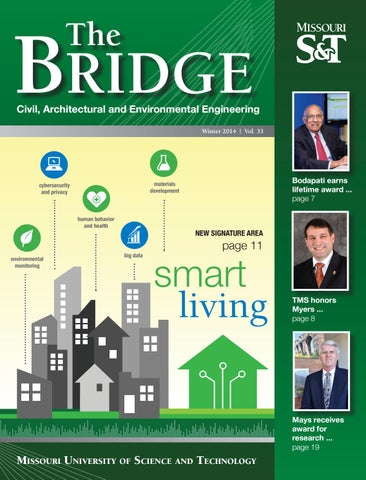
Civil, Architectural and Environmental Engineering Winter 2014 | Vol. 33
human behavior and health
environmental monitoring
Bodapati earns lifetime award ... page 7
materials development
cybersecurity and privacy
NEW SIGNATURE AREA big data
page 11
smart living
TMS honors Myers ... page 8
Mays receives award for research ... page 19 B Missouri University of Science and Technology The
ridge | Civil, Architectural & Environmental Engineering |
1
Message from the chair William P. Schonberg, Ph.D., P.E. Greetings from Rolla, Missouri! I hope that everyone is surviving the onslaught of the latest polar vortex, or, preferably, not affected by it! As this issue of The Bridge went to press, I learned that 15 of our civil and architectural engineering students under the direction of our own Dr. Stuart Baur, Dr. Diana Ahmad, professor of history at Missouri S&T, and Ms. Rebecca Rost, Hist’05, preservation planner and grants manager for the Missouri State Historic Preservation Office, had just visited a historic site near Licking, Mo. The purpose of their visit was to evaluate the structural integrity of
The Piney River Heritage Farm is one of the oldest surviving, fully intact farmsteads in Missouri. The site contains some very well preserved buildings including a log barn rumored to have the tallest two story log pen in the state of Missouri. The original farmhouse looks much like it did when it was first built around the time of the Civil War. According to Dr. Baur, “The preliminary investigations showed that while most of the structures are in need of some repair, the original buildings, including their stone foundations, remain strong. The findings from the student workday will help the Forest Service, MoBARN and other stakeholders to determine the best process for preserving the site.”
"Like" the Heritage & Historic Preservation facebook page to learn more. www.facebook.com/HHPreservItNPS
the Piney River Heritage Farm. The group met with members of the Missouri Barn Alliance and Rural Network (MoBARN), a nonprofit organization who has committed to stabilizing the early 19th-20th century farmstead. Students conducted the fieldwork necessary to assess the structural integrity of ten historic buildings on that site. They worked in three teams and studied each building, taking as many measurements and pictures and as possible to thoroughly document their existing condition. Is that cool, or what? Not only will our engineering students solve the technological problems of the future, they are also working with colleagues from other disciplines to preserve our past!
The Piney River Heritage Farm is owned by the USDA Forest Service. The Forest Service has joined efforts with MoBARN, a local partner named Wilson Elliot, and Kevin Skibiski, CE’76, of Horner Shifrin to begin the process of stabilizing and rehabilitating the site with the intent of someday opening it to the public. MoBARN and Wilson Elliot hope that one day visitors will be able to enter the actual buildings to better learn about and understand life in Missouri in the mid-1800s.
Hands-on, real life projects like this one are of tremendous benefit to our students — they are able to supplement their ‘book learning’ with field work and other hands-on activities. Your kind support and many words of encouragement over the years have allowed us to undertake projects such as these, projects where our students see how material learned in class can be applied in real-world situations. You will find more information on this exciting project in the next issue of The Bridge! Best wishes to all for an enjoyable winter, and if your travels take you near Rolla, please feel free to drop in and visit … we’d love to see you! — William P. Schonberg, Ph.D., P.E. Rolla, Missouri, November 2014
The
Bridge in this issue 4 ‘Smart’ rocks
S&T researchers are developing “smart” rocks that will give engineers an accurate, easy and cost-effective tool to monitor a bridge’s foundation, in real time. Dr. William Schonberg discussed the dangers of space debris in October at the Saint Louis Zoo. The lecture was sponsored by the Academy of Science of St. Louis.
DEPARTMENT ADMINISTRATION ................................................................... Department Chair William P. Schonberg, Ph.D., P.E. Associate Chair Joel Burken, Ph.D., P.E., BCEE Assistant Chairs Civil: Genda Chen, Ph.D., P.E., F.ASCE Architectural: Stuart Baur, Ph.D., A.I.A. Environmental: Mark Fitch, Ph.D. Graduate Program: Cesar Mendoza, Ph.D. Undergraduate Advising Center Director Eric Showalter, Ph.D., P.E.
7 Rolla grads play key roles in I-70 Bridge Construction
A number of Rolla graduates were involved in building the new Stan Musial Veterans Memorial Bridge, which crosses the Mississippi River connecting downtown St. Louis and southwestern Illinois via Interstate Highway 70.
16 New Academy members
Eight new members were inducted into the Academy of Civil Engineers during a ceremony held in April.
Rebecca Jacobsen, a senior in civil engineering from Defiance, Mo., was named Missouri S&T’s 2014 Homecoming Queen.
Like us on Facebook!
www.facebook.com/MissouriSandTCArE The Bridge | Civil, Architectural & Environmental Engineering |
3
Researchers study
‘SMART’
ROCKS for detecting bridge damage By Linda Fulps
It’s hard to gauge how structurally sound a bridge is when its foundation is buried in a riverbed deep below the water’s surface. New “smart” rocks that are being developed by researchers at Missouri S&T will give engineers an accurate, easy and cost-effective tool to monitor a bridge’s foundation, in real time.
4
| The Bridge | Civil, Architectural & Environmental Engineering
The leading cause of bridge collapse in the U.S. is scour, an erosion process where water flow carries away river bed deposits and creates scour holes around the bridge pier or abutment. Floods intensify these scour effects and can quickly make the bridge unstable. Smart rocks placed at the base of bridge foundations are designed to roll to the deepest point of a scour hole and act as field agents to relay scour depths. “It’s a simple, but very useful, concept,” says Dr. Genda Chen, principle investigator and professor of structural engineering and the Robert W. Abbett Distinguished Chair in Civil Engineering at Missouri S&T. “The rock
Photo by Sam O'Keefe
follows the trail of the scour hole’s progression — as it goes deeper and deeper, the rock will also sink deeper and deeper. One reason we call it ‘smart’ is because the rock can represent the maximum depth of the hole.” Chen is collaborating on the project with Dr. David Pommerenke, professor of electrical and computer engineering, and Dr. Rosa Zheng, associate professor of electrical and computer engineering. The project is sponsored by the Research and Innovative Technology Administration of the U.S. Department of Transportation and the Missouri Department of Transportation. The researchers are testing three smart rock technologies: passive, active and semi-active. Passive smart rocks have an embedded magnet that can be read by a remote magnetometer. Active smart rocks have embedded electronics, including a pressure sensor, gyroscope, timer, battery indicator and individual identification, which transmit data through wireless communication. Semi-active smart rocks include a free-to-rotate magnet that can be controlled with electronic circuitry. “Engineers sometimes complain that these type of devices give them so much data, they don’t know what to do with it all,” says Chen. “These smart rocks can give engineers critical information they need, when they need it.” Chen says during normal operations, readings are usually taken every six months to a year. “But scour develops very rapidly during flood season,” he says. “If the engineer feels like there might be a new development, they can take a reading at that moment, without being overwhelmed with continual data processing and storage.” The technology is also cost-effective, says Chen. “You can use this data to evaluate the foundation’s stability without having to send a diver down there.” Engineers routinely place large rocks around the bridge foundation to protect the soil below from being eroded away by the current, a technique called riprap. “No one really knows how effective riprap is during flood season,” says Chen. “With the muddy water, you don’t know what’s going on. But if we mix a
An example of a passive smart rock containing a magnet suspended in liquid is in the foreground. Active smart rocks have embedded electronics. In the background is a concrete-encased smart rock that is about the size of a basketball and weighs about 50 lbs.
few smart rocks with the natural rocks around the foundation, the movement of the smart rocks will indicate the performance of the riprap system, and will also tell the engineer if there’s a problem with scour.” A major concern for scour monitoring is how well the technology holds up during a flood event. “There is a lot of technology that works very well in the lab, but it cannot be applied in field conditions because of damage from strong currents,” Chen says. The researchers are seeing good results with smart rocks deployed in 2012 at Missouri’s Gasconade River Bridge and Roubidoux Creek Bridge. The rocks will last forever and the battery survives about five-to-10 years, depending on how often data is collected, Chen says. The researchers hope to partner with state departments of transportation for further studies. “We’d like to engage a few state DOTs to employ a number of smart rocks in their bridges so we can start taking data before and after the flood season to see whether rocks have moved or not,” he says. “About 60 percent of collapsed bridges in the U.S. are due to hydraulic reasons, of which scour plays a major part,” says Chen.
The Bridge | Civil, Architectural & Environmental Engineering |
5
A top 5 finish for S&T’s
BIG BEAM TEAM A team of civil engineering students from Missouri S&T and the University of MissouriKansas City finished first in their region and fifth in the nation in a “big beam” competition. The Missouri S&T-UMKC team finished first in its region (Zone 3) and fifth in the national competition in the 2014 Big Beam Contest, an annual collegiate competition sponsored by Precast/Prestressed Concrete Institute. A team from Oregon State University won the national event. Teams in the competition design an 18-foot-long, pre-stressed and pre-cast concrete beam, which is then tested and evaluated for predicted structural behavior, including member strength, cracking load, section ductility and cost. Student teams fabricate the beams with the help of PCI producer members. The Missouri S&T-UMKC team worked with Coreslab Structures Inc. of Kansas City, Kansas. Missouri S&T members of the Big Beam Team are Hayder Alghazali and Eli Hernandez of Rolla, Missouri; Alex Griffin of Chesterfield, Missouri; and Kaylea Smith of Blue Springs, Missouri. All four are graduate students in civil engineering at S&T. Dr. John Myers, professor of structural engineering at S&T, and Dr. Ganesh Thiagarajan, professor of civil and mechanical engineering at UMKC, serve as co-advisors to the team. “For the past three years, we have done this competition as a collaborative effort with UMKC,” says Myers. “It has been very rewarding to see students from two separate campuses come together. It’s a great example of campus collaboration and is a rare approach to student competition events.”
6
| The Bridge | Civil, Architectural & Environmental Engineering
Missouri S&T’s Big Beam Team pictured from left to right: Dr. John Myers, team co-advisor, Eli Hernandez, Hayder Alghazali and Kaylea Smith. Not pictured is Alex Griffin.
Rolla grads play key roles in I-70 Bridge Construction
Stan Musial Veterans Memorial Bridge Photo courtesy of MoDot (flickr.com)
A number of Rolla graduates were involved in building the new Stan Musial Veterans Memorial Bridge, which crosses the Mississippi River connecting downtown St. Louis and southwestern Illinois via Interstate Highway 70. The bridge opened to traffic on Feb. 9, 2014. On July 26, ironworkers reached a milestone by positioning the 80-foot-long, 30,000-pound final floor beam. According to Randy Hitt,
Pictured from left: Ken Berry, CE’94, quality control inspector with Shalom Services; Chris Kelly, CE’03, quality assurance inspector with MoDOT; Kenny Bassler, EE’11, electrical project manager with Paynecrest; Randy Hitt, CE’87, bridge inspector with MoDOT; Chris Morgan, CE’02, quality assurance inspector with MoDOT; Henry Woods, CE’97, quality assurance inspector with MoDOT; Ron Leible, CE’87, utilities engineer with Crawford, Murphy & Tilly; John Grana, CE’85, resident engineer with MoDOT; Tom Tavernaro, CE’87, project manager with Alberici Corp., Massman Construction and Traylor Bros. Not pictured is Jeff Church, CE’84, deputy project director with the Illinois Department of Transportation.
CE’87, bridge project director with the Missouri Department of Transportation, a poster of Joe Miner was placed on the last piece of structural steel to celebrate the “Rolla heritage of the engineers working on the project.” “The cable-stayed bridge with a 1,500-foot main span is the third-longest in the United States,” says Hitt.
Bodapati earns ASCE award for lifetime achievement Dr. Narayan Bodapati, an adjunct professor in the Missouri S&T Engineering Education Center in St. Louis, has been named the 2014 recipient of the American Society of Civil Engineers (ASCE) Region 7 Lifetime Achievement Award. He was recognized in September at the region’s annual dinner held in St. Louis.
Bodapati
Bodapati has a nearly 40-year career in industry and is a professor emeritus and former chair of the construction department in the School of Engineering at Southern Illinois University Edwardsville.
In 2013, Bodapati received the Professional Recognition Award from ASCE for his substantial contributions to the engineering profession and the St. Louis Section. Bodapati earned a bachelor of science degree in civil engineering from the University of Mysore in Mysore, India. He also earned a master of science degree in design technology and a Ph.D. in building technology from the University of Manchester Institute of Science and Technology, Manchester, U.K.
The Bridge | Civil, Architectural & Environmental Engineering |
7
New vice provost and dean College of Engineering and Computing Dr. Ian Ferguson became vice provost and dean of the College of Engineering and Computing at Missouri S&T in August. A native of Scotland, Ferguson came to S&T from the University of North Carolina (UNC) at Charlotte, where he served as professor and chair of electrical and computer engineering. He was also a cluster group leader for renewables and energy efficiency and a member of the implementation team of UNC Charlotte’s Energy Production and Infrastructure Center (EPIC), which addresses the needs of the region’s energy industry. At UNC Charlotte, Ferguson led a department of 41 faculty, five support staff, 460 undergraduate students and 230 graduate students, including 70 Ph.D. students. Under his direction, the department’s research funding increased from $2 million to more than $5.5 million. Ferguson
“Dr. Ferguson brings a strong record of academic leadership, teaching, research and collaboration to S&T, as well as a broad range of interests that transcend the traditional bounds of engineering,” says Missouri S&T Chancellor Cheryl B. Schrader. “He has leadership experience in industry as well as the academic setting, and has demonstrated great success in collaborating with faculty from various disciplines.” Ferguson holds a Ph.D. in compound semiconductors and a master of science degree in optoelectronics and laser devices from University of St. Andrews in Scotland and a bachelor of science degree in physics from Heriot Watt University in Scotland. Prior to joining UNC Charlotte, Ferguson held faculty and research positions at Georgia Institute of Technology, Imperial College in London and Northwestern University in Chicago. Ferguson’s research expertise is in the development of compound semiconductor materials and devices for sensors, illumination, solar power and spintronics. He’s received research funding from the National Science Foundation, Air Force Office of Scientific Research, Office of Naval Research, NASA and other federal agencies, as well as from industry.
Myers named Fellow of The Masonry Society Dr. John J. Myers, professor of structural engineering at Missouri S&T, was awarded Fellow Membership status in The Masonry Society (TMS). Myers was honored for his contributions to the scholarly and educational advancement in the masonry field. Fellow membership is one of the highest awards that can be bestowed on a TMS member and is granted only rarely for exceptional service by individuals who have been members of TMS for more than 10 years. Myers also received the Professional Recognition Award from the St. Louis Section of the American Society of Civil Engineers (ASCE) at a 8
celebration honoring the chapter’s 100-year anniversary. Myers, is also director of the Structural Engineering Research Laboratory (SERL) at Missouri S&T. He studies structures and highperformance concrete (HPC) behavior and durability performance; fiber-reinforced polymers (FRP) in structural repair and strengthening applications especially as they relate to concrete and masonry structures, and their durability performance; development of environmentally sensitive construction materials; and hybrid materials and enhanced systems for blast-resistant structures.
| The Bridge | Civil, Architectural & Environmental Engineering
By Mary Helen Stoltz
Myers, who has more than 10 years of industry experience as a practicing structural engineer, joined the Missouri S&T faculty in the spring of 1999. He is a registered professional engineer in Missouri, Pennsylvania and Maryland. Myers earned master of science and Ph.D. degrees in civil engineering from the University of Texas at Austin in 1994 and 1998, respectively. He earned a bachelor of science degree in architectural engineering with a structural engineering emphasis from the Pennsylvania State University in 1987. He is a Fellow of the American Society of Civil Engineers and a Fellow of the American Concrete Institute.
NEW FACULTY IN THE DEPARTMENT
TRANSFORMING ENGINEERING EDUCATION
Wen Deng
Hefu Pu
Julian Wang
Grace Yan
::::::::::::::::::::::::::::::::::::::::
::::::::::::::::::::::::::::::::::::::::
::::::::::::::::::::::::::::::::::::::::
::::::::::::::::::::::::::::::::::::::::
Degree: Ph.D., Geosciences, Iowa State University, 2010
Degree: Ph.D., Geotechnical Engineering, University of California, San Diego, 2014
Geotechnical Engineering
Research Interests: Multiphase flow, chemical and thermal transport, and microbial growth in porous and fractured media. I aim to achieve my study applications in the areas of geo-resource recovery, waste sequestration and environmental remediation through interdisciplinary collaboration. Last Stop: Longhorn at The University of Texas at Austin What you like most about teaching: “I love to interact with my students. Passing my life experiences and knowledge on to them. I also like the students to challenge me so I learn more.” 3 things you can’t live without: My smart wife, delicious food and my iPhone.
Geotechnical Engineering
Research Interests: Energy-related geo-engineering, coupled thermo-hydromechanical analysis, numerical simulation in geomechanics, ground improvement, slope stability and retaining walls. Last Stop: Graduate Research Assistant at UC San Diego What you like most about teaching: “I like working with students! It’s rewarding because you’re training the next generation of intellectual leaders.” 3 things you can’t live without: My iPhone, laptop and running.
Architectural Engineering Degree: Ph.D., Architecture, Texas A&M University, 2013 Research Interests: Building science and technology, sustainable building design, smart building and envelopes, BIM and healthcare design. Last Stop: Lawrence Berkeley National Laboratory What you like most about teaching: “Putting practical experience into theory and technology through teaching courses.” 3 things you can’t live without: Daydreams, design and movies.
Structural Engineering
Degree: Ph.D., Engineering Mechanics, Harbin Institute of Technology, China, 2006 Research Interests: Resilient infrastructural systems in multi-hazard environments, structural health monitoring and damage detection and wireless sensor networks. Last Stop: Assistant professor in Civil Engineering at University of Texas at El Paso What you like most about teaching: “It’s exciting and rewarding to see our students get great job offers before they graduate.” 3 things you can’t live without: Work, playing with Eva (my 2-year-old baby girl) and biking.
The Bridge | Civil, Architectural & Environmental Engineering |
9
SPAR Lab Inauguration AND DISTINGUISHED LECTURE SERIES
Missouri Concrete Conference
::::::::::::::::::::::::::::::::::::::::::::::::::::::: The Missouri Concrete Conference, directed by faculty member David Richardson (’71, ’73, ’84), was held at Missouri S&T in May. Twenty-three presentations were given, including ones by alumni Rick Holesinger (’85, ’11) and Jason Blomberg (’97). Attendance totaled 117.
Annual Asphalt Conference
Pictured at the grand opening from left to right are Chuanrui Guo, Zhaochao Li, Fan Liang, Tiantian Li, Hongya Qu, Dr. Genda Chen, Fujian Tang, Mostafa Fakharifar, John A. Cain and Yi Bao.
In October, a ribbon-cutting ceremony was held to inaugurate the System and Process Assessment Research (SPAR) Laboratory in the Butler-Carlton Civil Engineering Hall atrium. The SPAR Lab is the result of interdisciplinary collaborations among civil engineering, electrical engineering, materials science and engineering, computer science, and chemistry faculty over the past 10 years and is led by Dr. Genda Chen, the Robert W. Abbett Distinguished Chair in Civil Engineering at Missouri S&T. The SPAR Lab is capable of exploring both scientifically intriguing and pragmatically challenging solutions to aging infrastructure problems in the U.S. and supporting conceptualization, development, experimentation and implementation of key measurement technologies. The SPAR Lab takes a problem-driven, technology-based approach and pioneers the “lab-on-sensor” design concept of sensors to address assessment and maintenance issues faced today. In connection with the SPAR Lab, a new “Distinguished Lecture Series” was established this Fall. The series is designed to provoke intellectual discussions on scientific and engineering advances, innovative solutions and grand challenges in the area of monitoring, assessment and management of infrastructure subjected to multiple hazards (earthquakes, winds/hurricanes/ tornados, fires, floods, etc.). The series hosts two to four speakers of national and international renown each year to give presentations to the campus community on a topic of their choice that relates to the theme of the lecture series. Invited speakers include members of the National Academy of Engineering and program directors of national funding agencies.
10
| The Bridge | Civil, Architectural & Environmental Engineering
::::::::::::::::::::::::::::::::::::::::::::::::::::::: In December, the department conducted the 56th Annual Asphalt Conference. Twenty presentations were made, including those by alumni Brent Whitwell (’05, ’06), Steve Jackson (’07), and Dave Marshall (’01). The Asphalt Conference was directed by David Richardson (’71, ’73, ’84). Attendance totaled 225.
Superpave certification courses held
::::::::::::::::::::::::::::::::::::::::::::::::::::::: During the 2013-2014 season, five different types of certification courses were held at Missouri S&T: one Superpave QC/QA full certification short course (five-day), three Superpave QC/QA re-certification short courses (two-day), one Binder Test course (one-day), two Aggregate Consensus Tests courses (one-day), and two TSR courses (one-day), for a total of nine courses. A total of 195 engineers, inspectors and contractors were enrolled. The courses were directed and taught by faculty member David Richardson (’71, ’73, ’84). Other instructors included, Steve Jackson (’07) and Mike Lusher (’96, ’04). Approximately 2,800 individuals have gone through the training and certification at S&T since 1998.
NEW SIGNATURE AREA
smart living Smart Living has been identified as one of four signature areas of research in which Missouri S&T is positioned to become a national leader. The signature area was developed by civil, architectural and environmental engineering professor Glenn Morrison with Sanjay Madria and Bruce McMillin, both professors of computer science. They are working to combine Missouri S&T’s research strengths in sustainable energy research, architectural design, environmental sustainability and transportation infrastructure, through secure computing, sensing, and network communications. In smart living, these technologies are informed by behavioral and environmental psychology, sociology, and urban infrastructure to develop a more secure, sustainable society. The built environment is rapidly changing and adapting to shifts in energy availability, climate and advances in construction materials, urban densification and massive amounts of information now available from our cyber infrastructure. Yet the needs of people are falling far behind these advancements. For safe, healthy and productive homes and workplaces, living environments have to adapt to people first. To meet these challenges, the Smart Living signature area brings together environmental monitoring, cybersecurity and
Pictured at the Solar Village from left to right are Dr. Sanjay Madria, Dr. Bruce McMillin and Dr. Glenn Morrison.
privacy, human behavior and health, big data, materials development and others. Research that supports the Smart Living signature area is already taking place at S&T and in the department. Morrison is evaluating how building materials can improve air quality in buildings passively— without the added energy of excessive ventilation or filtration.
Madria in computer science has been installing sensors and enhancing the cyber infrastructure of houses in S&T’s solar village. Combining strengths of many departments across campus, the Solar Village will act as a platform for testing these ideas in buildings with advanced design, sensing and controls. With this human-centered approach, S&T will lead the way to Smart Living.
The Bridge | Civil, Architectural & Environmental Engineering |
11
TI ME DO W N U N DER Dr. Joel Burken recently returned from a fellowship at the University of Canterbury in Christchurch, New Zealand. The Erskine Fellows Program was established to bring international scholars to UC to teach courses and bring unique experiences to UC students. The program also encourages Fellows to experience the amazing country of New Zealand and serve as ambassadors. “I was honored to be contacted about the program and the trip was a great experience for me and for my family. Colleagues and friends went out of their way to make us feel welcome and make sure we had a great Kiwi experience.” While at UC, Burken taught courses in ecological engineering and environmental engineering design in the Department of Civil and Natural Resources Engineering. For the design course, he looked at the new infrastructure approach on wastewater treatment in the region, largely driven by the 2011 earthquake that was devastating to the entire Christchurch area.
Dr. Joel Burken pictured with his wife, Hope, and their three children, Olivia, Eli and Mya.
“I had heard about the quakes, but to see firsthand the impact they had on the city that will take decades to overcome, that was a real learning experience for me as well as the students. Due to the quakes, a regional redesign on water and wastewater infrastructure is underway, and will span over many of the students’ careers. Large buildings are still waiting to be torn down as they re-think how to rebuild the majority of their city center.”
Oerther selected as Jefferson Science Fellow By Linda Fulps
Dr. Daniel B. Oerther, the John A. and Susan Mathes Chair of Environmental Engineering at Missouri S&T, was selected as a Jefferson Science Fellow for 20142015. He and 12 others began their one-year assignments in Washington, D.C., in August. The Jefferson Science Fellows Program was established in 2003 by the Office of the Science and Technology Adviser to the U.S. Secretary of State. It is designed to further build capacity for science, technology and engineering expertise within the U.S. Department of State and U.S. Agency for International Development.
Dr. Daniel Oerther, his wife, Sara, and their two children, Barney and Emma, pictured in front of the U.S. Capitol.
12
“I have witnessed first-hand Dr. Oerther’s ability to successfully juggle classroom teaching, mentor students, probe complex research topics and stretch himself in service to our institution and the citizens of Missouri,” says Missouri S&T Chancellor Cheryl B. Schrader. “His appointment raises the visibility of Missouri S&T to our
| The Bridge | Civil, Architectural & Environmental Engineering
country’s leaders, and his partnership with the Department of State will increase our international engagement and opportunities for research grant funding.” Oerther earned Ph.D. and master of science degrees in environmental engineering from the University of Illinois at UrbanaChampaign, in 2002 and 1998, respectively. He also holds a bachelor of science degree in environmental engineering and a bachelor of arts in biological sciences, both from Northwestern University. He is a licensed professional engineer and is board certified by the American Academy of Environmental Engineers and Scientists (AAEES). In his collaborations with engineers, scientists, health care professionals and policy makers, Oerther works to ensure universal access to water and sanitation, to combat the obesity epidemic and malnutrition, and to eliminate extreme poverty through entrepreneurship.
Fundamentals of Rheology and Applications on Cement-Based Materials
RE-CAST Short Course
A group of 40 students, faculty and industry professionals gathered in July at Missouri S&T for a four-day accelerated short course on the Fundamentals of Rheology and Applications on Cement-Based Materials. The workshop offered participants classroom lectures and hands-on laboratory experiences, including an introduction to state-of-the-art rheometers.
Students from the RE-CAST consortium universities attended the workshop, which allowed students working on joint projects to meet face-to-face, as well as network with students from other universities across the country working on similar RE-CAST focus areas.
The workshop was led by three faculty members from the RE-CAST team. They were:
1. Basic principles of rheology and rhemetry and measurement systems. 2. Rheology of cement-based materials. 3. Importance of rheolgy in concrete research and applications, as demonstrated by different practical studies.
• Dr. Kamal Khayat, Vernon and Maralee Jones Professor of Civil Engineering, Missouri S&T • Dr. David Lange, Narbey Khachaturian Faculty Scholar and Professor, University of Illinois at Urbana-Champaign • Dr. Dimitri Feys, Assistant Professor, Civil Engineering, Missouri S&T
The workshop lectures were divided into three parts:
Students also participated in two labs. Lab One
“ We consider this event a great success for the RE-CAST Center and hope to use it as a stepping stone for offering future workshops for students and transportation professionals.” — Dr. Kamal Khayat, RE-CAST Director
This lab involved a demonstration of the concepts of different rheological properties and aggregate packing density and how to measure them. Students determined the rheological properties of ketchup and high range water reducing admixture and estimated optimal packing density of different aggregate combinations.
Lab Two
Participants measured the rheological properties of various flowable concrete mixtures by means of the ConTec Viscometer 5, the ICAR rheometer, the ConTec 4-SCC rheometer, as well as standard workability test methods. The influence of different concrete constituent materials was evaluated.
The Bridge | Civil, Architectural & Environmental Engineering |
13
Third Annual
Transportation
Infrastructure Conference
Four keynote speakers addressed issues ranging from transportation policy to crack sensing technologies for transportation infrastructure at the third annual Missouri S&T/MoDOT Transportation Infrastructure Conference held in October. Keynote speakers were: ■ D avid Ahlvers, state construction and materials engineer, MoDOT (Capturing Innovation at the DOT) ■ H ani Nassif, professor and co-director, Rutgers Infrastructure Monitoring and Evaluation (RIME) Group, Rutgers University (Structural Health Monitoring for the Assessment of Cracking Potential in Concrete Structures) ■ M ark Luther, technical service engineer, Holcim (U.S.) Inc. (New Specification Development: Type IL Cement for Concrete) ■ R oss Anderson, senior vice president, Bowman, Barrett & Associates (The O'Hare Airport Modernization Program: Engineering Challenges) This year’s conference hosted over 100 attendees and showcased recent findings of projects supported by the Center for Transportation Infrastructure and Safety (CTIS), a national University Transportation, in the areas of advanced construction materials, non-destructive testing and structural health monitoring of transportation infrastructure. The event also included a post-conference tour of the newly inaugurated Advanced Construction Materials Laboratory (ACML) and some of the other outstanding research facilities at S&T, notably the high-bay structural engineering research laboratory. “We hope that this technology transfer event will continue to grow and to foster further exchange between S&T researchers, industry and government agencies, with the ultimate goal of building S&T’s recognition at the national level in the area of transportation infrastructure engineering,” says Conference Chair, Dr. Kamal Khayat, the Vernon and Maralee Jones Endowed Professor of Civil Engineering and the Director of the Center for Infrastructure Engineering Studies (CIES) at Missouri S&T.
14
| The Bridge | Civil, Architectural & Environmental Engineering
Sneed to serve as ACI 318-19 subcommittee member Dr. Lesley Sneed, associate professor of structural engineering, has been appointed to serve as a subcommittee member of American Concrete Institute (ACI) Committee 318 Structural Concrete Building Code. This committee develops and maintains building code requirements and addresses design requirements for specific member types, such as beams, columns, walls and diaphragms. She will be a member of Subcommittee 318-0E, Section and Member Strength. Her six-year term became effective Oct. 1, 2014. ACI relies on the work of over 3,000 volunteers who serve on committees to develop the latest codes and reports related to concrete. With 99 chapters, 65 student chapters, and nearly 20,000 members spanning over 120 countries, ACI is charged with providing knowledge related to the best use of concrete. To learn more about ACI, please visit www.concrete.org. CONNECT WITH US .............................. Email: care@mst.edu Mail: The Bridge 211 Butler-Carlton Hall 1401 N. Pine St. Rolla, MO 65409-0030 Call: (573) 341-4461 Letters should include the writer’s full name, address, email and daytime phone number. Copy may be edited for clarity and space.
Khayat receives award Dr. Kamal H. Khayat, the Vernon and Maralee Jones Chair of Civil Engineering at Missouri S&T, received the G.H. Tattersall Award in August during Concrete Week in Iceland. Concrete Week brings together three conferences at Harpa Concert Hall, namely the 23rd Nordic Rheology Conference of Suspension Rheology, the XXII Nordic Concrete Research Symposium and the 2014 Eco-Crete Conference. The three conferences are combined to give attendees a unique opportunity to explore different specific subjects of rheology, sustainability and concrete science. International experts gather from multiple fields to share the results of cutting-edge research and develop ideas.
Dr. Kamal Khayat, right, and Dr. Dimitri Feys, left, presented the keynote speech on the topic of “Recent Advances in Pumping of High-Performance Concrete.” Here they are in the rugged terrain of Icelandic countryside near a geothermal field.
Charles E. Dare (1938-2014)
Dr. Charles E. Dare, retired professor of civil engineering at Missouri S&T, passed away Oct. 27, 2014. After graduating from University High School in Iowa City, Iowa, in 1956, Dare earned bachelor’s degrees in general science and mechanical engineering, a master’s degree and a Ph.D. in industrial and management engineering from the University of Iowa. His early career included jobs in Colorado, Iowa and Illinois. In 1977, Dr. Dare began his career at S&T. During his time here, he taught a variety of traffic and transportation courses, served as an advisor to countless students, served as the faculty sponsor of the Institute of Transportation Engineers, established the Department Undergraduate Student Advising Center, and was director of the Transportation Technical Assistance Office for several years. Dr. Dare was a member of the American Society of Civil Engineers, Chi Epsilon, the Institute of Transportation Engineers, and the Transportation Engineering Association of Metropolitan St. Louis. He retired from S&T in 1997 as a full professor. The Charles E. and Jane A. Dare Endowed Scholarship was established to help full-time civil engineering undergraduate students with a high need for financial aid. If you would like to make a contribution in his memory, you may contact Sue Wallace by phone at 573-466-3202 or email wallacesue@mst.edu.
WIZARDLY MINERS The 2014 Homecoming theme was The Wizardly World of Miners, based on the Harry Potter series. Two civil engineering alumni were honored at the Miner Alumni Association’s Legends Luncheon held in October. They were:
Dreiling
• Randall Dreiling of St. Louis who received the Frank H. Mackaman Volunteer Service Award. Dreiling, vice president and senior structural engineer at Design Nine, earned a bachelor of science degree in civil engineering from S&T in 1981. • Dr. Robert R. Holmes Jr. of Rolla, Missouri, who received the Alumni Achievement Award. Holmes, a national flood hazard specialist and coordinator at the U.S. Geological Survey and adjunct professor of civil engineering at S&T, earned bachelor of science and master of science degrees in civil engineering from S&T in 1987 and 1989, respectively.
Holmes
The Bridge | Civil, Architectural & Environmental Engineering |
15
Academy of
Civil Engineers
Benavides
Francisco “Frank” M. Benavides
of St. Louis is executive director of PENTA Engineering Corp.; principal consultant of PEC Consulting Group LLC; and executive director of PENTA India Cement & Minerals Pvt. Ltd. He earned a bachelor of science in civil engineering from S&T in 1970, and an MBA from Northwestern University Kellogg School of Management. A founder of PENTA and member of its board of directors, Benavides has provided the company with strategic direction and employee development for 27 years. His engineering experience includes technical and economic feasibility studies for major capital investments for the minerals and energy industries; plant valuations; management of engineering and construction projects, including the planning, coordination and supervision of construction and commissioning of process equipment. He is a licensed professional engineer in seven states and is registered 16
Benton
with the U.S. National Council of Examiners for Engineering and Surveying. He holds memberships in numerous organizations, including the Society of Mining Engineers and the Manufacturing Technical Committee of the Portland Cement Association. He is also the Consul of Peru for Missouri.
_______________________
Reginald H. Benton
of Jacksonville, Illinois, president of Benton & Associates Inc., earned a bachelor of science degree in civil engineering from S&T in 1979. His more than 34 years of experience includes working for consulting engineering firms and the Illinois Department of Transportation. Benton is fortunate to be a second-generation engineer, beginning his practical experience on the survey crew and other duties at Benton & Associates from 5th grade through college graduation. As a Benton & Associates principal and
| The Bridge | Civil, Architectural & Environmental Engineering
Eight new members were inducted into the Academy of Civil Engineers during a ceremony held in April. The Academy honors the following civil engineers for their contributions to the profession, leadership and involvement with S&T.
Burke
president, he has ultimate responsibility for the quality, schedule and budget for a wide range of projects. Benton also serves as senior structural engineer for the firm, designing bridges, buildings, swimming pools and special structures associated with water and wastewater treatment. Benton is a licensed professional engineer in Illinois and Missouri, and is a licensed structural engineer in Illinois. He has served on the boards of United Way, Sherwood-Eddy YMCA, Elm City Rehabilitation and Kiwanis, and he currently serves on the Passavant Area Hospital board and as an elder at First Presbyterian Church in Jacksonville. He has held leadership positions with the American Society of Civil Engineers Central Illinois Section, American Council of Engineering Companies of Illinois, and Illinois Society of Professional Engineers (ISPE). He was named “Young Engineer
of the Year” by ISPE and a “Fellow” by American Council of Engineering Companies.
_______________________
Michael W. Burke
of St. Charles, Missouri., an executive vice president for J.S. Alberici Constructors Inc., earned bachelor of science and master of science degrees in civil engineering from S&T in 1991 and 1992, respectively. He is responsible for Alberici’s steel fabrication subsidiary, Hillsdale Fabricators, in addition to leading Alberici’s North American Water and Waster Construction Division including two water and waste water subsidiaries in Atlanta and Topeka, Kansas. Burke has worked on large projects in the U.S., Grand Bahama, Aruba, Portugal, Newfoundland, Saskatchewan and Alberta, Canada, with responsibilities for both design and project management. He was involved in the fabrication and erection of
the structural steel used in the Indianapolis Colts’ Lucas Oil Stadium. A licensed professional engineer in Missouri, Burke has served on the boards of the American Institute of Steel Construction and Associated General Contractors.
as president. He has also served on the Miner Alumni Association’s Executive Board from 2005 to 2011. He received the S&T Civil Engineering Exemplary Young Alumni Award in 1998. Frerking is a licensed professional engineer in Missouri.
_______________________
_______________________
John Frerking
Dale L. Houdeshell
of Columbia, Missouri, business development manager for Engineering Surveys and Services, earned a bachelor of science degree in civil engineering from S&T in 1987. He began his career as a sales engineer at CSR-Hydro Conduit in Kansas City. In 1996, he joined Burns & McDonnell as project development manager for the firm’s Infrastructure Division. In his current position since 2012, Frerking is responsible for planning and implementing strategies to grow the company’s market share with public sector clients. Over the years, he has chaired committees for the Missouri Society of Professional Engineers (MSPE); KC Metro and Missouri Chapters of the American Public Works Association; and the Engineers’ Club of Kansas City, including serving as president from 2004 to 2005. John has been active in the Miner Alumni Association’s Kansas City Section for many years, including serving
Frerking
of Lake St. Louis, Missouri., director of public works for the City of Clayton, earned a bachelor of science degree in civil engineering from S&T in 1972. He began his career with Bogina Architect Engineers Inc., in Lenexa, Kansas, and held positions as director of streets and engineering, city engineer and manager of public works services in several Midwest communities. Houdeshell retired from the City of Manhattan, Kansas, in January to return to the St. Louis area. In Manhattan, he was responsible for managing development review; infrastructure design and construction; water, wastewater and storm water enterprise funds; and a capital improvement and sustainability program. He also provided technical guidance for the Manhattan Regional Airport upgrade, Flint Hills Discovery Center Museum, local parks and pools, and the Department of Homeland Security’s National Bio and Agro-Defense facility.
In his current position, Houdeshell is responsible for managing development review; infrastructure design and construction; facilities maintenance; fleet maintenance; forestry; and a capital improvement program. He has held positions with Kansas Society of Professional Engineers (KSPE), American Public Works Association, Transportation Engineers Association of Metro St. Louis and MSPE St. Louis Chapter. Houdeshell is an ASCE Fellow and received the Government Engineer of the Year Award in 2013 from KSPE. Other awards include: Order of the Engineer, Public Works Leadership Fellow, Top 10 Public Works Leaders of the Year and Outstanding Engineer in Government. He is a licensed professional engineer in Missouri and Kansas.
_______________________
Ralph C. Jones
of Overland Park, Kansas, chairman of the board and CEO of Structural Engineering Associates Inc., earned a bachelor of science degree in civil engineering from S&T in 1980 and a master of science degree in civil engineering from the University of Missouri-Columbia in 1985. Since joining Structural Engineering Associates in 1986, he has served as field inspector,
resident project representative and designer. He is currently the principal in charge of field operations including inspections, structural investigations, building forensics, masonry restoration design and concrete repair design. Jones has held several positions with the International Concrete Repair Institute (ICRI) including president of the Great Plains Chapter. He received the ICRI Project Award of Excellence in the masonry category in 2008 for his work on the Masonry Renovation of the Historic Quad at Missouri State University. He also received the ICRI Award of Merit in the water structure category in 2009 for the repair and waterproofing of the Kauffman Baseball Stadium Fountains. He has been a member of the Downtown Kiwanis Club of Kansas City for over 25 years and served as president of the Kiwanis Student Assistance Program from 1995 to 2003, which assists high school students who are living on their own to stay in school and receive their high school diplomas.
_______________________
Alard “Al” Kaplan
of Houston, owner of Energy Projects Consulting, earned a bachelor of science degree in civil engineering (cum laude) from S&T in 1972. His career began at Mobil Oil, where he managed (continued on the next page)
Houdeshell
Jones
Kaplan
The Bridge | Civil, Architectural & Environmental Engineering |
17
Academy of Civil Engineers offshore and liquefied natural gas (LNG) projects in Indonesia, the Netherlands, the United Kingdom and Qatar. He served as vice president for major projects with Marathon Oil Corp., and after retiring in 2008, set up an independent consulting firm. He has since served as acting head of wind projects for BP U.S., an advisory board member for an Algae to Biodiesel Co. and is currently LNG project manager for the Mozambique LNG Project with Anadarko Petroleum Corp. His consulting business has had recent projects in West Africa, the Gulf of Mexico and Australia. Kaplan has served on the board of directors of the Construction Industries Institute
and on the Project Management Practices Advisory Board at Texas A&M University. He has authored several technical papers on LNG production and transport and holds related U.S. patents.
_______________________
Sanjeev Kumar
of Carbondale, Illinois, chair, professor and Distinguished Teacher in the civil and environmental engineering department at Southern Illinois University (SIU) Carbondale, earned master of science and Ph.D. degrees in civil engineering from Missouri S&T in 1993 and 1996, respectively. He began his professional practice
(continued...)
career in India and then joined Geotechnology Inc. in St. Louis in 1994. He joined SIU as an assistant professor in 1998. He has received more than $2 million in research grants, and has published 36 articles in professional journals and more than 60 articles in conference proceedings. He has completed more than 100 engineering projects as a project engineer, manager, peer-reviewer or consultant. He has received numerous outstanding teaching awards, including the Engineering Excellence Award, Outstanding Faculty Research Award, Professional Recognition Award (ASCE), Distinguished Scholar
Kumar
(Phi Kappa Phi), Distinguished Fellow from the Institute of Hospital Engineers (India) and the S&T Civil Engineering 2003 Exemplary Young Alumni Award. He has served on many of ASCE’s national committees and has chaired the Committee on Continuing Education.
Former athletes inducted Two former student-athletes from civil engineering were inducted into the Academy of Miner Athletics in October. They were:
Pictured from left to right are: Paul Wolfgeher, CE’83, Dennis Hines, USMA’06, MS EMgt’14, Charles Thurmon, CE’86, and Daniel Miller, CE’09.
Degree awarded U.S. Army Capt. Dennis Hines recently earned a master of science in engineering management from Missouri S&T. Congratulating him on his achievement are Miner Alumni of the U.S. Army Corps of Engineers Resident Office located on Tinker Air Force Base in Oklahoma.
18
| The Bridge | Civil, Architectural & Environmental Engineering
JoAnne Steineman, a project manager in the design and construction office at Missouri S&T, was a member of the Lady Miner softball team in her undergraduate academic career. Steineman, who served as a team captain for the 1991 softball team, earned a bachelor of science degree in civil engineering in 1992. She is a registered engineer in the state of Missouri and a LEED AP in design and construction. Scott Stephens, a bridge engineer for the Missouri Department of Transportation’s Northwest district in Chillicothe, Missouri, spent 15 years working with the power division at Black & Veatch before joining MoDOT. He earned a bachelor of science degree in civil engineering in 1985. A four-year starter and three-time all-conference selection as a tight end for the Miner football team, Stephens was a member of two Missouri Intercollegiate Athletic Association championship teams, including the 1980 team that finished the year undefeated and ranked 10th in NCAA Division II.
Mays honored for his research on water resources and hydrosystems Dr. Larry Mays, professor of civil and environmental engineering in the School of Sustainable Engineering and the Built Environment at Arizona State University, received the American Society of Civil Engineering (ASCE) Julian Hinds Award for his research on water resources and hydrosystems in June in Portland, Ore. It is the highest honor for water resources planning and systems analysis researchers in ASCE. Mays grew up in Pittsfield, Ill. He earned bachelor of science and master of science degrees in civil engineering from S&T in 1970 and 1971, respectively. He served in the U.S. Army from 1970 to 1973 and was stationed at the Lawrence Livermore National Laboratory in California. Mays received his Ph.D. in civil engineering from the University of Illinois at Urbana-Champaign in 1976. His career as a professor has spanned more than 38 years, beginning at the University of Texas in Austin in 1976, followed by the last 25 years at Arizona State University. He served as Chair of the Civil and Environmental Engineering Department from August 1989 to July 1996. Prior to that, he was director of the Center for Research in Water Resources at the University of Texas at Austin. The award citation, from the society’s Environmental and Water Resources Institute, states that Mays is being recognized “for his research on water resources and hydrosystems engineering, addressing optimization and risk/reliability analysis for their design, management and operation and his authoritative text and
reference books that have had worldwide impact.” Mays was nominated by Kevin E. Lansey, head of the department of civil engineering and engineering mechanics at the University of Arizona’s College of Engineering. “Mays research on risk methods, although now commonplace, linking simulation and optimization tools was groundbreaking in the late 1980s,” Lansey wrote. “He provided a basis for risk-based hydraulic design. Many of these concepts are now incorporated in the Corps of Engineers risk-based design approach.” Lansey also wrote that graduate student mentoring has been a major focus of Mays’ career, and that he had supervised completion of 31 doctoral students and many masters students. He has been the author, co-author or editor-in-chief of 23 books. His text and reference books are used around the world, and include such titles as Applied Hydrology, Water Resources Engineering, Hydraulic Design Handbook, Groundwater Hydrology, and Hydrosystems Engineering and Management. Mays is a fellow of ASCE, and also a fellow of the International Water Resources Association. He has been a representative to the Universities Council on Water Resources and has served as a member and president of the Council’s Board of Directors. He has been elected a Diplomat of the American Academy of Water Resources Engineers and in 1999 received a Distinguished Alumnus Award from the department of civil engineering at the University of Illinois at Urbana-Champaign.
Mays
An avid photographer of ancient water systems around the world, he has published a book on this topic titled Ancient Water Technologies. He has traveled extensively around the world, most recently in Jordan to photograph ancient water systems. His interests also include alpine skiing, fly fishing, scuba diving, gardening, welding and woodworking. He presently lives in Mesa, Arizona, and Pagosa Springs, Colorado.
The Bridge | Civil, Architectural & Environmental Engineering |
19
Missouri University of Science and Technology Civil, Architectural and Environmental Engineering 211 Butler-Carlton Hall, 1401 N. Pine St. Rolla, Missouri 65409-0030
NONPROFIT ORG U.S. POSTAGE
PAID
ROLLA MO PERMIT # 170
Moving?
Please notify us of your new address: 573-341-4461 or care@mst.edu Printed on Recycled Paper
DANGER
The nation’s aging infrastructure needs YOUR attention! Missouri S&T has committed to hire eight faculty members in the signature area of advanced materials for sustainable infrastructure and has also invested in the specialized equipment needed to develop next-generation construction materials.
Now we need YOU to commit and
help us build the Advanced Construction Materials Laboratory (ACML). This expansion of Butler-Carlton Hall will streamline faculty and research projects that are currently spread over multiple buildings on campus. The expansion will foster collaboration among investigators, enhance the breadth of interdisciplinary research activities and develop close working relationships with industry partners. Contact Sue Wallace with university advancement for more information at 573-466-3202 or email wallacesue@mst.edu.
20
| The Bridge | Civil, Architectural & Environmental Engineering