The
Bridge
Civil, Architectural and Environmental Engineering Spring 2013 | Vol. 30
From trash into treasure... page 4
Improving wellness... page 16
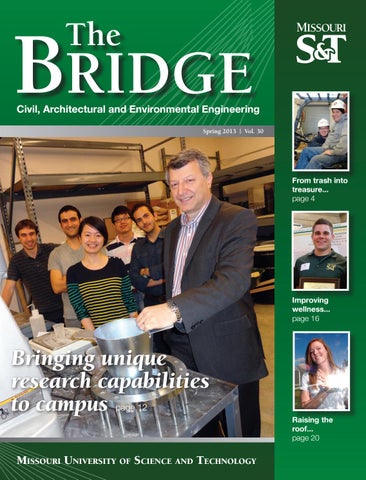
Bringing unique research capabilities to campus page 12
Raising the roof... page 20
B Missouri University of Science and Technology The
ridge | Civil, Architectural & Environmental Engineering |
1
Vision 2020 Greetings from Rolla, Missouri! For this issue, it is my pleasure to turn this page over to professor Joel Burken. As associate department chair, Joel had the responsibility to spearhead the department’s strategic planning initiative over the last two years. Joel worked with faculty, alumni and the university administration to develop a bold plan to move the department into the next chapter of its storied history. In the following paragraphs, Joel presents a synopsis of this plan, expanding on the preliminary information we shared with you back in 2011. As always, we welcome your input and participation, and hope that you will join us on this exciting journey! William P. Schonberg, Department Chair ________________________________ Thanks for the introduction, Bill. The Vision 2020 and strategic planning efforts have positioned us to set out on a path that will improve our educational and research programs by targeting the needs of future students and of our profession for decades to come. From here on, our efforts will be focused on setting up our department to meet our four strategic goals: 1. E nhance our educational programs and delivery methods by offering our students innovative programs and opportunities such as integrated BS + MS programs and required experiential learning activities. 2. R ecruit an even greater number of top students by making admission to our programs more competitive, offering increased scholarship support to students who enroll in new programs (such as our integrated BS + MS program), and
2
establishing competitive fellowships for graduate students. 3. P romote interdisciplinary teaching and research collaborations within the department and across campus by investing in faculty development to support the department’s education and research portfolios. 4. N urture knowledge creation and technology transfer to drive transformative change through faculty and student research that demonstrates academic distinction, value to industry and the promise of breakthrough discoveries in targeted technical areas. By meeting these specific goals, we envision a future where our alumni will continue our traditions of the past. The unwritten, but often spoken, motto of our department has long been “to produce street-ready engineers.” While we embrace that role, we also realize that for our students and our program to maintain and also advance our reputation for excellence, we must consider far more than the streets of St. Louis, Kansas City and rural Missouri. The action items and objectives we have developed to meet the goals as stated above wrap around simple ideas: attract and retain the best people (faculty and students) and then provide the programs to engage and develop their talents into awesome careers. Indeed this is a very basic recipe. Some specific actions include establishing a Professor of the Practice position in our department to ensure that students have a solid foundation and in-depth experiences in the practice of engineering beyond the classroom environment. We also look to build incentive programs and support for outstanding
| The Bridge | Civil, Architectural & Environmental Engineering
young faculty, to help them reach their potential as they pursue of scientific and technological breakthroughs. New educational programs will offer students the opportunity to combine BS degree programs with MS or even MBA programs in a 5-year course of study. And, all students will be required to have either experiential learning experiences such as co-ops or internships, or an international experience such as participating in an Engineers Without Borders project or a study abroad semester. These programs are not viewed as merely an ‘add on’ to the current educational programs. Rather, they are to be integrated into the education of our future graduates in an enrichment fashion, so that the true leaders of our profession will have a head start when they embark on their careers. Vision 2020 sets a view of the future, but actions will make this future a reality. In the coming months and years we will endeavor to secure the resources and establish the programs necessary to make these actions, and therefore our vision of the future, come to fruition. You are invited to view our plan on the department’s website (care.mst.edu), where you will also find information on how you can join us on this exciting road into the future! Joel G. Burken Associate Department Chair ________________________________
Correction In the Winter 2012 issue of The Bridge, the article on the Pooker Family Endowed Scholarship misstated the name of Matthew’s mother. Her name is Lois, not Louise. We apologize for the error.
Photo by B.A. Rupert
The
Bridge in this issue
Earth Day The 12th annual Rolla Earth Day celebration was held Monday, April 22, at S&T. The theme this year was “Tomorrow’s Earth is Today’s Responsibility” and featured local vendors, games and a fashion show. DEPARTMENT ADMINISTRATION Department Chair William P. Schonberg, Ph.D., P.E. Associate Chair Joel Burken, Ph.D., P.E., BCEE Assistant Chairs Civil: Ronaldo Luna, Ph.D., P.E. Architectural: Stuart Baur, Ph.D., A.I.A. Environmental: Mark Fitch, Ph.D. Graduate Program: Cesar Mendoza, Ph.D. Undergraduate Advising Center Director Eric Showalter, Ph.D., P.E. ______________________________________________
CONNECT WITH US You can reach us by: email (care@mst.edu) or mail (The Bridge, Civil, Architectural, and Environmental Engineering, Butler-Carlton Hall, 1401 N. Pine St., Rolla, MO 65409-0030) or call 573-341-4461. Letters should include the writer’s full name, address, email and daytime phone number. Copy may be edited for clarity and space.
FEATURES:
4 Trash into treasure
S&T’s aspiration to own a large research-graded flume was matched with University of California, Santa Barbara’s desire to close their lab and dispose of their equipment.
13 Investing in the future
The department is looking ahead to the next phase in construction materials research — a major expansion onto the department’s existing structural engineering research laboratory.
Going to nationals The Steel Bridge Team competed in April at Southern Illinois University Edwardsville in Edwardsville, Ill. Outcome: first in construction speed, first in construction economy and second in structural efficiency, which gave the team a second-place finish overall. View the team’s website at: http://web.mst.edu/~sbridge
Up next: headed for the national competition, which will be held the last week of May in Seattle at the University of Washington. The Bridge | Civil, Architectural & Environmental Engineering |
3
One
university’s is another’s When Cesar Mendoza learned a California university wanted to “trash” a 75-foot experimental flume, the associate professor of water resources engineering jumped at the chance to recycle the indispensable tool into a treasure for Missouri S&T. Experimental flumes create an artificial stream in the hydraulics laboratory and display nearly any hydraulic phenomenon involving a continuous free surface. Since 2002, S&T had hoped to acquire a larger, research flume to replace its 20-foot-long, 1-foot-wide and 1.5-foot-high demonstration flume that was capable of only recirculating water.
4
| The Bridge | Civil, Architectural & Environmental Engineering
So in October 2010, when Mendoza learned that the ocean engineering program within the department of mechanical engineering at the University of California, Santa Barbara would be closing, he became an active suitor for the 75-foot-long flume. “Our need to own a large research-graded flume was matched with their desire to close their lab and dispose of their equipment,” Mendoza says. Through Mendoza’s efforts, S&T was selected to receive the flume from the UCSB Engineering Research Center. From the official donation date in June 2012, it took five months to work out the details and relocate the monolith from Santa Barbara to Rolla.
Preparing to move the flume through the narrow doorway and up the sloping corridor.
heavy pieces had to be maneuvered through a narrow, sloping corridor that connects the two labs. “It was necessary to implement a complex rigging operation due to the unavoidable severe space restrictions and the precision required for its execution,” Mendoza says. “The move was worthy of an episode of the TV series, ‘Mega Movers.’” On Dec. 13, the team executed a very well-thought-out plan and executed it flawlessly. Currently, the two parts of the flume have been reassembled and the refurbishing process is underway. Researchers can hardly wait to get started using the new tool. (continued on the next page)
S&T’s newly acquired flume is unloaded in the High Bay Lab and then later moved up the hallway to its final destination in the Hydraulics Lab.
First, the flume was disassembled into two parts: one was 40 feet long and weighed 16,000 pounds; the other was 35 feet long and weighed 19,000 pounds. Second, Transportation Logistics Management of Denver used two large trailers and a large moving truck to move the two pieces and the ancillary components. Upon arrival at S&T, the flume parts were temporarily parked in the High Bay Structures Laboratory to prepare them for their final destination, the Hydraulics Laboratory. Then, the
Dane Shaw, pictured left, and John Bullock, right, embraced the challenge of moving the flume through the sloping corridor along with Gary Abbott, Scott Parker and Bill Frederickson.
The Bridge | Civil, Architectural & Environmental Engineering |
5
In addition to hands-on demonstrations, laboratory work and special projects for students, the 75-foot flume can also be used to perform research projects on stream flow hydraulics, channel morphodynamics, river engineering, sediment transport, erosion problems, stream restoration, simulation of benthic environments, stream bed remediation, stream eco-hydraulics, and to pursue research in cooperation with interested government agencies, like the USGS. For more information about the flume or to make contributions to this new department project, please contact Cesar Mendoza by email at mendozac@mst.edu or call 573-341-4463.
About the flume • The flume is a steel structure with the sides made of glass. • It has a total length of 75 feet, along with a working channel that is 70 feet long, 3.5 feet wide and 3 feet deep. • When empty, the total weight of the flume is 35,000 lbs. • A tilting mechanism allows the flume to be tilted from a 0 to 5 percent slope. • Water depths can be controlled with the use of a downstream vertical sluice gate. • The discharge in the flume can be varied up to 7 cfs (cubic feet per second) once connected to the laboratory supply line. • The flume will be capable of transporting water and sediments. • The flume has instrumentation carriages. • The original design and construction of the flume was done by Project Engineers Co., Inc. in West Sacramento, Calif., in 1985. • Value: $500,000 6
| The Bridge | Civil, Architectural & Environmental Engineering
CE234
Water resources ENGINEERING Dealing with Earth’s most precious commodity The importance of water to human existence cannot be overstated. People need water for nearly all aspects of life, from the basic need to hydrate the human body to producing electrical power and manufactured goods. Almost everything on the planet somehow involves water. Too little means an inadequate supply for the ecosystem, human consumption and agriculture. Too much means homes and businesses are flooded. Unclean water causes disease and damage to the ecosystem. In the Water Resources Engineering course CE234, taught by adjunct professor Robert Holmes, students are provided instruction and hands-on experience for engineering and scientific principles that address many of these water-related issues. In the classroom, students gain insight, understanding and experience. Students learn about methods used to predict flood elevations from rainfall. In the lab, they perform tests to determine friction losses in various types of water distribution pipes. In the field, they learn about and practice methods to measure streamflow on rivers and streams.
Adjunct professor Robert Holmes and CE234 students at the Little Piney River near Newburg, Mo., conduct streamflow measurements.
The end goal of the course is to provide students with an opportunity to understand the elementary principles of water distribution, open-channel flow and hydrologic processes, while gaining a deep appreciation of the importance and complexity of water resources engineering and management.
The Bridge | Civil, Architectural & Environmental Engineering |
7
Missouri S&T a finalist in 2013 Climate Leadership Awards Missouri S&T was one of five Ph.D.-granting universities in the nation to be selected as finalists in the Second Nature 2013 Climate Leadership Awards. The Climate Leadership Awards is an annual competition among U.S. colleges and universities that are signatories of the American College & University Presidents’ Climate Commitment. The awards program is sponsored by Second Nature, a national nonprofit that seeks to create a sustainable society by transforming higher education, and Planet Forward, a media company that publishes news, opinion, and insight about energy, climate, and sustainability.
Photo by B.A. Rupert
Missouri S&T’s selection as a finalist is associated with two innovations in sustainability: • The university’s Solar Village, a neighborhood of four student-designed solar homes inhabited by students and faculty, and • Missouri S&T’s geothermal energy project, which when completed in 2014, will reduce the campus's carbon footprint by 25,000 tons per year and cut energy use in half. This year, the award program’s fourth, drew the largest and most competitive pool of nominations to date. Second Nature will partner with Planet Forward, a web-to-television initiative that documents and shares energy, climate, and sustainability advances, on a public voting competition featuring the Finalists’ climate leadership and campus innovations during Earth Month (April 2013). “The caliber of this year’s nominations is unparalleled,” said ACUPCC director Ashka Naik. “The depth and breadth of climate leadership and sustainability education programs demonstrated by these finalists is a reflection of their deep commitment to truly innovative solutions for a sustainable future.” In late spring, award winners will be chosen, independent of the video voting competition, by members of the Second Nature Board not affiliated with ACUPCC signatory schools. More information on the awards is at www.secondnature.org/awards. Other Ph.D.-granting universities competing with S&T for the honor are Georgia Institute of Technology, Indiana State University, Portland State University, and State University of New York College of Environmental Science and Forestry.
8
| The Bridge | Civil, Architectural & Environmental Engineering
The awards featured a public, online voting component. Each of the finalists produced a video that promoted its specific sustainability efforts. Voting was open during Earth Month, April 2013. Last year’s voting competition drew more than 70,000 video views and 14,000 votes.
Stirrat awarded professional degree
MoDOT funds pavement preservation project
Missouri S&T awarded six honorary professional degrees during winter commencement ceremonies held in December. Bryan A. Stirrat, president of Tetra Tech BAS, was a recipient of one of those degrees.
A student uses ground-penetrating radar to map the pavement subsurface.
The Missouri Department of Transportation (MoDOT) has funded a project with the university to enhance its pavement management system. The project will focus on developing a pavement maintenance process that will allow for the selection of appropriate maintenance treatments based on optimization of performance and cost for each project. The total project funding is $1.5 million, including matching funds from NUTC and the University of Missouri at Columbia. Five faculty members and research staff from S&T are involved in the project. They include: project PI David Richardson and co-PI’s Michael Lusher, Ronaldo Luna, Lesley Sneed and Neil Anderson. Those from the Columbia campus include: co-PI’s Brent Rosenblad and Andrew Boeckmann. Eight graduate and undergraduate students are also participating. The two-year project will be comprised of six Tasks. Task 1 involves historical data mining and production of data; Task 2 is concerned with the development of pavement performance models and pavement treatment models; Task 3 is an assessment of available non-destructive pavement evaluation techniques; Task 4 involves field use of several promising non-destructive evaluation techniques; Task 5 involves the evaluation of maintenance materials plus the development of pavement treatment triggers and a selection process of candidate treatments; and Task 6 will be the creation of a re-calibration process for models and triggers.
Stirrat earned a bachelor of science degree in civil engineering from Missouri S&T in 1967. He also earned master of science degrees in petroleum engineering and environmental engineering from the University of Southern California. Stirrat founded Bryan A. Stirrat and Associates, a consulting firm specializing in solid waste engineering and environmental remediation, and BAS Construction Co. He co-founded Geologic Associates, a geotechnical engineering company. BAS acquired KFM Engineering and WEC Engineering and then was acquired by Tetra Tech. Tetra Tech BAS is a wholly owned subsidiary of Tetra Tech. A member of the S&T Academy of Civil Engineers, Stirrat and his wife, Jeanne, live in Diamond Bar, Calif.
Annual Asphalt Conference The department of civil, architectural, and environmental engineering conducted the 55th Annual Asphalt Conference on Dec. 4-5, 2012. Eighteen presentations were made, including those by departmental alumni Mike Lusher (’96, ’04), Brent Whitwell (’05, ’06), Steve Jackson (’07), Jason Blomberg (’97), and Joe Schroer (’81), The conference was directed by Dave Richardson (’71). Attendance totaled 235.
The Bridge | Civil, Architectural & Environmental Engineering |
9
❚ New professor
Bootheel focus of scholarship established by CE alumnus
Dimitri Feys materials engineering
Photo by B.A. Rupert
The department of civil, architectural and environmental engineering at Missouri S&T is pleased to welcome Dimitri Feys as an assistant professor in materials engineering this spring. Feys earned his civil engineering degree, which is a combined bachelor’s and master’s degree, from Ghent University in Belgium in 2004. He then pursued his Ph.D. research at the same institute, concentrating on the rheological properties and pumping of self-consolidating concrete (SCC). After completing his Ph.D. in 2009, he started as a post-doctoral fellow at the Université de Sherbrooke, in Canada, under the supervision of professor Kamal Khayat. Feys actively serves on various national and international scientific committees. He was a member of the organizing committee of the fifth and sixth International RILEM Symposium of Self-Consolidating Concrete in Ghent, Belgium, and Montreal, Canada. Feys’ current research focuses on the mix design and behavior of highly workable concrete in the fresh state, including rheology. His other research interests include: the rheology of complex materials and suspensions, suspension flow and sedimentation, fluid mechanics and flow modeling. He is also working on advanced concrete mix design procedures that incorporate concrete placement considerations and the properties of hardened concrete, including special concrete made with recycled materials and advanced sustainability.
10
| The Bridge | Civil, Architectural & Environmental Engineering
The Bootheel Alumni Endowed Scholarship was established by Joseph F. and Mary Reichert in December 2012 through the Miner Alumni Association. Joe, CE’59, a long-time supporter of MSM-UMR-S&T, passed away in February 2013. The Reichert family has requested that memorials be sent to Missouri S&T to support the new scholarship. The purpose of the new endowed fund is to assist S&T in recruiting undergraduate students by offering scholarships to graduates of high schools in six counties that comprise Missouri’s Bootheel: Pemiscot, Dunklin, Stoddard, New Madrid, Mississippi and Scott. Recipients will be selected by Missouri S&T’s Office of Student Financial Assistance. Only students who are graduates of high schools in these six counties and who are enrolled as undergraduate students at S&T may qualify for this scholarship. Joe was a member of the Academy of Civil Engineers. He was a long-time volunteer for the Miner Alumni Association, and in 2004, he received the Mackaman Volunteer Service Award. Joe and Mary were inducted into the Order of the Golden Shillelagh at S&T in 2009. Joe was a Professional Engineer for Kansas City, Superintendent of Streets, Project Manager and a Professional Registered Land Surveyor. He was a lifetime member of the American Society of Civil Engineers, Missouri Society of Professional Engineers, American Public Works Association; and a member of the National Society of Professional Engineers. To support the endowment fund, please send contributions to: The Miner Alumni Association, 1200 N. Pine Street, Rolla, MO 65409-0650. Please direct questions about the fund to Paula McBurnett, senior development officer, 1-800-392-4112 or paulam@mst.edu.
EPA RainWorks
second prize
Students accept their award over a teleconference presentation with contest leaders in Washington, D.C. For a list of everyone that participated go online: http://water.epa.gov/infrastructure/greeninfrastructure.
maintenance, and environmental health and safety. This collaboration allowed the team to phase their projects to coincide with planned demolition and construction activities.
Missouri S&T was awarded second prize among small institutions in EPA’s first-ever Campus RainWorks Challenge competition. The competition was created by EPA to inspire the next generation of landscape architects, planners and engineers to develop innovative green infrastructure systems that mitigate the impacts of urban stormwater while supporting vibrant and sustainable communities. The goals of the design plan were: • To improve campus stormwater management in order to mitigate eutrophication and sedimentation in Frisco Lake, a recreational and ecological resource for S&T students. • To select cost-effective technologies that can be integrated into existing plans for university projects. The team’s design plan recommends the phased implementation of three green infrastructure projects in the campus’s northeast quadrant, each selected for its potential to
cost-effectively reduce and treat stormwater runoff, minimize operation and maintenance costs, and provide an educational experience for students. The team developed designs for five green infrastructure projects, but identified the green roof, rain garden, and permeable pavement projects as the most cost-effective. The team selected highly visible sites for all three projects, and calculated the anticipated runoff reduction, pollutant removal, and cost of each project to identify the most costeffective practices. The team’s plan was unique among the entries received in seeking input from campus planners and decision makers to coordinate their proposal with planned university improvements and reduce project costs. In addition to presenting their designs to faculty and students, the team consulted with the chancellor and the departments of physical facilities, landscaping and
S&T’s team was comprised of 22 students from a diversity of disciplines, including: engineering, art history, biology, business, economics and finance, education, graphic design, and history. As a second prize winner, the team will receive a $1,500 cash award and $8,000 for faculty research on green infrastructure.
Charles Beauvais, pictured right with Chancellor Schrader, went above and beyond to lead the team’s efforts.
The Bridge | Civil, Architectural & Environmental Engineering |
11
Advanced materials research
REACHES NEW HEIGHTS The year 2012 marked a year of significant change in the Center for Infrastructure Engineering Studies (CIES) at S&T. Under the new leadership of Kamal Khayat, the center has been re-vitalized with the acquisition of new equipment
concrete mixing area, and a clean room was created to house several pieces of dust-sensitive specialized equipment. This new laboratory will enable the development, manufacturing and
purchase the equipment that is being housed in this space. This equipment grant has allowed the acquisition of 35 highly specialized pieces of material testing equipment. The largest and most unique piece of equipment, which will be delivered to S&T in June 2013, is a unique dual-mixer concrete batching plant consisting of two planetary motion high shear mixers with 750-L and 250-L output capacities. This custom designed system will allow for the production of “à la carte” cementbased materials and consistency in producing concrete for casting large specimens for structural testing, a capability that is currently unavailable on the S&T campus. In addition to the concrete batch plant, the following specialized pieces of equipment have been aquired:
Pictured from left to right: Mahdi Valipour, Weina Meng, Iman Mehdipour, Joel Mauger, Kamal Khayat and Qi Cao.
and the rennovating of existing facilities to bring unique research capabilities to campus. The center is evolving at full speed with the vision of becoming a focal point for infrastructure material research in the national arena. Over the past year, the CIES staff have undertaken a labor-intensive effort to transform the previously under-utilized laboratory space in the basement of the Engineering Research Laboratory into a new Advanced Construction Materials Laboratory. The area has been cleaned out, repainted and re-organized in order to utilize this space to its fullest potential. A new gutter system was installed for a 12
implementation of innovative and sustainable materials for civil infrastructure, with an emphasis on cement-based materials. Examples of the type of studies this facility will allow include: projects on the design and performance of a number of innovative materials, including self-consolidating concrete (SCC) for bridge elements, high volume fly ash concrete (HVFAC) for infrastructure construction, and roller compacted concrete (RCC) for rigid concrete pavement for highways, rural roads and airfield pavements. In May 2012, Khayat secured a $2.28 million grant from the U.S. Department of Transportation to
| The Bridge | Civil, Architectural & Environmental Engineering
■ Concrete mixers •E irich intensive mixer with 100-L output •3 drum mixers with variable speed and capacity •O mni high-sheer mixer with 10-L capacity •H obart mortar mixers with 5- and 20-L capacity ■ State-of-the-art rheology infrastructure equipment •C ontec 5 and ICAR viscometers for concrete and Contec 6 for paste and grout •M odular compact rheometer 302 and FANN 35 for paste •G yratory compactor for stiff concrete ■ Material characterization equipment • Mercury intrusion porosimeter • Isothermal calorimeters • Maturity monitoring device • Cement characterization devices (continued on page 21)
Investing in the future Advanced Construction Materials Laboratory Expansion Project Missouri S&T has always been a forward-looking institution, dedicated not only to preserving the past, but also to embracing the future. Now we are looking ahead to the next phase of our advanced construction materials laboratory — an expansion onto the department’s structural engineering research laboratory that will create a new home for the advancement of construction materials development by significantly adding to the facilities involved in the testing, monitoring and evaluation of new and repaired structures. Kamal Khayat, the Vernon & Maralee Jones Chair of Civil Engineering and director of the Center for Infrastructure Studies (CIES), recently secured a $2.28 million grant from the U.S. Department of Transportation to purchase equipment that would be housed in the expansion. Currently there is no space available on campus to house most of this new equipment. Khayat, along with department chair Bill Schonberg and director of the structural engineering high-bay laboratory John Myers, is leading this laboratory expansion effort in Butler-Carlton Civil Engineering Hall with the addition of a 16,000 GSF Advanced Construction Materials Laboratory. This expansion is about much more than extending the high-bay structures lab — it is about enhancing student experiences and addressing the ever-changing infrastructure needs of the state, the nation and the world. Estimated cost of the proposed Advanced Construction Materials Laboratory
is $7 million and will require private support to make it a reality. The Design This much-needed expansion will not only house the recently acquired state-of-the-art equipment, but will also provide an interactive area that will promote educational and experiential learning for undergraduate and graduate students. There will be a conference room overlooking the lab that will showcase our activities to campus visitors, public agencies and industry partners. These expanded facilities will also consolidate teaching and research functions that are currently spread over multiple buildings. Specifically, the new space will foster collaboration among faculty members on projects of mutual interest. New Technologies Our new Advanced Construction Materials Laboratory will grant students and researchers the ability to develop innovative and sustainable cement-based materials. The development of these “green” technologies would ultimately lead to cost savings, extension of service life and reduction of the carbon footprint of construction activities. (continued on page 21) The Bridge | Civil, Architectural & Environmental Engineering |
13
water, food and wellness
Students conduct
RESEARCH
in India Photos by Sarah Oerther
14
| The Bridge | Civil, Architectural & Environmental Engineering
Amanda Holmes
Katelyn Denby
Six students from Missouri S&T traveled to western India to conduct research related to global sustainable development. The two-week trek was part of an independent research course led by Daniel Oerther, the John A. and Susan Mathes Chair of Environmental Engineering at S&T. “I love leading student teams to other countries,” says Oerther, who spent six months in the country as a Fulbright scholar in 2006. “Travel overseas provides our students with an improved knowledge of communication, life-long learning and teamwork.”
Darrell Wallace
“The first issue we had was getting all the testing equipment through airport security,” Voth-Gaeddert says. “Once in-country, this was not a problem.” Darrell Wallace of Lee’s Summit, Mo., a junior in civil engineering, worked with 10 families in India to help parents better understand their children’s eating habits. Parents received smartphones that had calorie apps and were asked to track their kids’ nutrition and exercise. “I was excited to learn more about India and how I could help the people there,” Wallace says.
With a broad focus on sustainability and wellness, students explored their own areas of expertise and interest before, during and after the trip.
“ I was excited to learn more about India and how I could help the people there.”
Environmental engineering students Katelyn Denby of Edwardsville, Ill., and Amanda Holmes of Rolla, Mo., studied how they could fight obesity and poverty by optimizing gardening. They developed software that assisted people in making healthy eating choices by calculating the best produce for the individuals to grow based on a variety of factors, such as the climate and personal preferences.
“The research focused on three facets: water, food and wellness,” Denby says. “While each of these aspects came from a specific research project, it sounded like we would have the opportunity to work a little on each one.” Lee Voth-Gaeddert of Hesston, Kan., a senior in civil engineering, and Alexander Korff of Dodge City, Kan., a senior in environmental engineering, tested the rural area’s well water. They established a small team from the local university to assist with tracking levels of harmful contaminants through the dry and wet seasons.
— darrell wallace Rebecca Holmes of Rolla, Mo., served as an assistant and communication director during the trip. Holmes graduated in December from S&T with a bachelor’s degree in history. While in India, she conducted outreach and posted entries on the team’s Rolla Local to Global India blog. (http://rollalocal2globalindia.wordpress.com/) “In this way, our students from S&T lived and worked side-by-side with students from India,” Oerther says. “What a benefit for S&T students to learn about the culture of India through side-by-side collaboration with middle-class Indian students collectively working to solve the challenges of developing villages in India.”
The Bridge | Civil, Architectural & Environmental Engineering |
15
Wallace shares his research Darrell Wallace, a senior in civil engineering from Lee’s Summit, Mo., presented his latest research project, “Validating Smartphone Apps to Improve Wellness in Missouri and India,” to Missouri state legislators in March. More than 10 students participated in the annual Undergraduate Research Day at the Capitol. This event welcomes undergraduate students from all four campuses in the University of Missouri System. Wallace worked on his research project under the direction of faculty mentor Daniel Oerther, the John A. and Susan Chair of Environmental Engineering at S&T. The purpose of Undergraduate Research Day at the Capitol is to inform Missouri’s lawmakers about research that is occurring at Missouri universities. Darrell Wallace at the Capitol
Returning to Guatemala Three students with S&T Engineers Without Borders traveled to Nahualate, Guatemala (a large agricultural community), in January to continue the group’s partnership with this village. This was the chapter’s sixth trip to the country. Since 2008, S&T students have been working with the village to develop a water distribution project. A 430-footdeep well, drilled through volcanic and alluvium deposits, was recently completed. The new well will eventually connect to an elevated steel tank and 14 miles of PVC pipe to create the potable water network. S&T students have completed the preliminary design for the elevated steel tank, which will have a capacity of 50 cubic meters. While in Guatemala, the students met with in-country contractors to solicit construction bids, says Ronaldo Luna, professor of geotechnical engineering at S&T, who accompanied the students. Students who traveled to Guatemala were: •R yan Hoff of St. Paul, Mo., a senior in mechanical engineering •M ark Hogan of Holts Summit, Mo., a sophomore in environmental engineering • Marisa Zelip of Belleville, Ill., a junior in mechanical engineering 16
| The Bridge | Civil, Architectural & Environmental Engineering
“The water distribution network has reached final design, and construction drawings are being finalized,” Luna says. Todd Williams of M3 Engineering Group in St. Louis supervised the designs, which were completed by members of S&T’s EWB chapter. Williams, a 1995 civil engineering graduate of Missouri S&T, accompanied members of the S&T chapter during a previous surveying trip in January 2010. Once completed, the system will serve the village’s 2,200 residents, Luna says. “I have learned countless things from my work with EWB,” says Hoff. “I want to help the community help themselves to give them safe water, something I have grown up taking for granted.”
Photo by B.A. Rupert
Burken to direct Environmental Research Center
erc.mst.edu
ERC by the numbers: • $2.4 Million in Funding • 74 Journal Articles • 52 Invited Lectures • One Patent Granted
Joel Burken, professor of civil and environmental engineering at Missouri S&T, has been named director of the Environmental Research Center. The Environmental Research Center brings together researchers from a wide variety of academic fields to address environmental issues, including those related to the so-called “emerging” contaminants category. Emerging contaminants include chemicals that are becoming of greater concern due to their impact on humans and the environment. They include pollutants from municipal, agricultural and industrial wastewater sources, as well as pharmaceutical and personal care products, to name a few. A member of the S&T faculty since 1997, Burken also serves as associate chair of the civil, architectural and environmental engineering department at S&T. He also served as president of the Association of Environmental Engineering and
Science Professors in 2011-2012. In 2007, the organization presented Burken with its Outstanding Teaching of Environmental Engineering and Science Award. The award honors individuals who are making outstanding contributions to the teaching of environmental engineering, both at the individual’s home institution and beyond. At Missouri S&T, Burken conducts research on how trees and other plants can be used to reduce water and soil pollution while cutting overall cleanup costs. Burken’s work, known as “phytoremediation,” also led to a new method to detect pollutants in the environment by testing plant tissues. That approach is known as “phytoforensics.” His work in phytoforensics recently received the
top 2012 Technology Award from Network for Industrially Contaminated Land in Europe (NICOLE) for a project titled “Pollution Investigation by Trees,” which includes 26 international collaborators. Burken has been honored numerous times for his teaching and academic pursuits. He received the Rudolph Hering Medal from the American Society of Civil Engineers in 1998 and 2007. In 2000, Burken received a Faculty Early Career Development (CAREER) Award from the National Science Foundation. He also has been presented with S&T’s Faculty Excellence Award six times, and in 2012 received the Alumni Merit Award from Missouri S&T’s Miner Alumni Association. Burken earned bachelor’s, master’s and doctorate degrees in civil and environmental engineering from the University of Iowa in 1991, 1993 and 1996, respectively.
The Bridge | Civil, Architectural & Environmental Engineering |
17
Learning by doing
in
Brazil
At Missouri S&T, the idea of a student missing the annual St. Pat’s celebration is pretty rare. Missing that and spring break is unheard of. But that is exactly what Daniel Oerther and three of his students did. The group spent the latter half of March conducting research and field work in Para, Brazil. The group was based at the confluence of the Tapajós and Amazon rivers. The students’ research focused on measuring the effectiveness of the current clean-water filters that were already in place in the local village. Oerther’s research centered on understanding small-scale agriculture, black earth (terra preta, or terra prêta do índio,
dark soils found in the Amazon Basin), and linking these topics back to the local community gardens in Rolla, Mo. Joining Oerther on the trip was Tommy Goodwin, a senior in biological sciences from Niangua, Mo., Andrew Schranck, a senior in architectural and civil engineering from Alton, Ill., and Lee Voth-Gaeddert, a graduate student in environmental engineering from Hesston, Kan. “I really admire these students and their dedication to learning through experience,” says Oerther, the John A. & Susan Mathes Chair of Environmental Engineering and an Alcoa Fulbright Endowed Chair at Missouri S&T. “These guys not only gave up St. Pat’s and spring break, they also gave up almost all their creature comforts to better the lives of others.” This marked Oerther’s second research trip to Brazil and his first with students accompanying him. “I am very interested to get their perspectives of the location in Brazil,” Oerther says. “It was exciting to see how the students integrated with the local community. No one had any real background in Portuguese and I know that the students wished they understood the language, not because of being intimidated, but
Tommy Goodwin measures the effectiveness of clean-water filters.
18
| The Bridge | Civil, Architectural & Environmental Engineering
Pictured from left to right are: Lee Voth-Gaeddert, Tommy Goodwin and Andrew Schranck.
because they wanted to really interact and learn from the people.” S&T prioritizes undergraduate research opportunities and Brazil is a new experience for all of these students. Oerther points out that it is a fitting location for S&T students, seeing as it is one of the largest producers of the aluminum ore bauxite. “Taking students on a study abroad trip like this is great,” Oerther expounds. “I am a big proponent of learning by doing, and this all ties into the university mission of experiential learning.”
St. Pat's 2013
Queen of Love and Beauty Three lovely ladies from civil, architectural and environmental engineering were nominated as 2013 Queen of Love and Beauty candidates during the 105th “Best Ever” St. Patrick’s Day in Rolla. These ladies were nominated by various student organizations at S&T. They also held a place of honor on the queen’s float during the 2013 St. Pat’s Parade. The three candidates were: • Sarah Ward, a senior in civil engineering from Ballwin Mo., representing the Residential College Association • Molly Prickett, a graduate student in environmental engineering from Kearney, Mo., representing the Student Union Board • Emily Vandivert, a senior in architectural engineering from Maryville, Mo., representing Delta Sigma Phi
Knights of St. Patrick
Fitch gets his green on The St. Pat’s Celebration Committee selected Mark Fitch, associate professor and assistant chair of environmental engineering at S&T, to be listed among the 2013 honorary Knights of St. Patrick. The new knights were honored during a public coronation Friday, March 15, in Leach Theatre of Castleman Hall on campus. About Fitch: He is the president-elect of the Faculty Senate, faculty advisor to the Tau Kappa Epsilon fraternity, faculty advisor to the Water Environment Federation student society and junior faculty advisor to the S&T chapter of Engineers Without Borders. His research interests include mitigating the impact of mining and biofiltration for the control of air pollution. He holds both a bachelor of science degree and a Ph.D. from the University of Texas and joined the S&T faculty in 1996.
Three CArE students were selected to become Student Knights of St. Patrick during the 105th St. Pat’s celebration in Rolla. There were 35 knights total for 2013. The three chosen were: • Andrew During, a senior in civil engineering from Hazelwood Mo., representing Tau Kappa Epsilon • Jordan Swing, a senior in civil engineering and architectural engineering from St. Charles, Mo., representing Lambda Sigma Pi • Tabitha Fiske, a senior in civil engineering from Summersville, Mo., representing Omega Sigma
The Bridge | Civil, Architectural & Environmental Engineering |
19
Meet Emily Vandivert
solar house team
From: Maryville, MO Year: Senior Major: Architectural Engineering
Photo by B.A. Rupert
Why did you join the Solar House Team? I joined Solar House because I am very interested in sustainable building design. I also think the fact we actually build a house we design is super awesome. What is your favorite part about being on the team? The people I am able to work and interact with on a daily basis are incredible. I learn so much every day from my peers and professionals outside the classroom. What is your role on the team? Nothing. Just kidding... I am the project manager for the team. I make sure everyone stays on task and we meet our deadlines. Effective communication is key as I work with university faculty and outside sponsors. What "Solar House" advice would you give to the general public? Solar panels are great, but not the only option to increase the efficiency of your home. Building insulation and orientation and window type play key roles in the overall building envelope and can be implemented in the design phase without much added cost. Random fact about yourself. Ready. Go! I can eat a copious amount of watermelon.
20
| The Bridge | Civil, Architectural & Environmental Engineering
Raise the roof on the future Missouri S&T’s Solar House Team is building the future one wall, window and solar panel at a time. The team will put their talents to the test this fall when they transport Chameleon House to California for the U.S. Department of Energy's Solar Decathlon. Winning the competition will require more than flawless execution of a visionary blueprint. It will also require our team to travel. Affording transportation, lodging and food can be difficult for students. That is why we are asking for your support. • $1,500 will sponsor one student’s full participation • $500 will lodge the team for one night •$ 250 will buy gas for a van transporting the team • $100 will feed four students for one day If you would like to donate, you can mail your check to: Emily Vandivert, 1051 N. Bishop Ave., 116 Kummer Student Design Center, Rolla, MO 65409-1410 or go online at http://solarhouse.mst.edu/donate.html.
Investing in the future (continued from pg. 13)
The Architects S&T contracted with the St. Louis-based firm of Hastings+Chivetta Architects, Inc. in 2012, to develop a concept for this laboratory expansion. Programming and design activities occurred over several months including three on-campus visits by the design team to conduct stakeholder workshops and survey existing conditions.
Project Support The new state-of-the-art facility will be one-of-a-kind in the country. It will give S&T investigators the opportunity to connect their research with other leading universities. It will also help build S&T’s reputation as one of the nation’s leading research universities.
To help build a future for advanced construction materials R&D at S&T, alumni support is essential. If you are interested in hearing more about or in participating in this exciting opportunity, please contact Bill Schonberg at 573-341-4787 or Kamal Khayat at 573-341-6223.
Our faculty has
Materials Research (continued from pg. 12)
■ Durability testing equipment • Air-void system •C hloride-ion permeability, electrical conductivity and resistivity for corrosion of rebars Environmental chambers • Frost durability • De-icing salt scaling • Alkali–silica reactivity • Creep/shrinkage •C ontrol temperature and humidity ■ Non-destructive testing equipment •P ortable ultrasonic NDT digital tester • Impact echo •R emote sensing vibrometer •A ccoustic emission system
got talent Engineers Without Borders hosted the Missouri S&T Faculty Talent Show on Friday, March 8. It was a definitely a show that kept viewers entertained and amazed. Our talented professors sang and danced to all kinds of music — from Hip Hop, Reggae and Folk to Gangnam Style. There were also a few “S&T Emmy’s” presented such as “Best Professor in a Comedic Role” and “Best Hairstyle in a Classroom Series.”
Photos by Terry Barner
The Bridge | Civil, Architectural & Environmental Engineering |
21
And the winners are... Three civil, architectural and environmental engineering faculty members received campus awards this past February for their outstanding performance. Each honoree received a stipend funded by industry and alumni contributions. Below are the winners pictured with Chancellor Cheryl B. Schrader. Photos by B.A. Rupert
FACULTY EXCELLENCE AWARD Jeffery Volz, assistant professor of architectural engineering, was chosen as one of five faculty members on campus to receive a 2012 Faculty Excellence Award. This award recognizes excellence in all areas of teaching, service and research.
RESEARCH AWARD John Myers, associate professor of structural engineering, was chosen to receive a Research Award for 2012. This award is given annually and recognizes excellence in research activities.
SERVICE AWARD Joel Burken, department associate chair and professor of environmental engineering, received a Service Award for 2012. This award is given annually to recognize professors who go “above and beyond” in service to the campus.
22
| The Bridge | Civil, Architectural & Environmental Engineering
Faculty receive Outstanding Teaching Awards Three faculty members in CArE received Outstanding Teaching Awards for 2011-2012. Receiving awards were: Glenn Morrison, associate professor of environmental engineering, David Richardson, CE‘71, associate professor of materials engineering and Jeffery Volz, assistant professor of architectural engineering. Winners were recognized at a ceremony held in November. Outstanding Teaching Awards are given each year to faculty members by the Outstanding Teaching Award Committee, which bases its selections on student evaluations. Richardson has received 11 Outstanding Teaching Awards total. This places him second behind retired faculty member, William Andrews, who has won a total of 13 awards.
Prakash presented Bharat Jyoti Award Shamsher Prakash, professor emeritus, was presented the Bharat Jyoti Award by the India International Friendship Society at an award ceremony held in New Delhi, India on Jan.12, by the Governor of Sikkim. He was cited for his exemplary services to the people of both India and the United States, as well as developing scientific programs in Yoga, and Peace of mind, and adopting school children in India for full support in their education based on “Performance and Need.” He had earlier been bestowed the distinguished membership of the ASCE in October 2010.
Munger
Bayless
Senne
“Every man’s work, whether it be literature or music or pictures or architecture or anything else, is always a portrait of himself.” — Samuel Butler — Throughout their more than five decades of dedicated service and academic leadership as professors in the civil, architectural and environmental engineering program at Missouri S&T, Jerry Bayless, Paul Munger and Joseph Senne have painted a self-portrait as well as created a unique landscape for the field of civil engineering.
Endowed Scholarship and the Joseph H. Senne Endowed Civil Engineering Scholarship.
As with any great portrait, these three men have expressed their character, altered their perspective and have broken a few rules along the way. They have inspired and mentored students, strengthened research, served the campus community and enhanced the reputation of this institution. Their broad and colorful strokes have touched the lives of many students and their work is on display each and every day around the world in the alumni who reflect their images.
Paul and Frieda Munger Endowed Scholarship Recipients are full-time undergraduate students with preferences given to students majoring in civil, architectural or environmental engineering who have graduated from Hannibal (Mo.) High School.
To express their gratitude and genuine love for these professors, friends, family and alumni of the department have come together to establish endowed scholarships in each of their names. These scholarships are permanent funds that provide annual financial assistance to students, both on a need and merit basis.
Jerry R. Bayless Endowed Scholarship Fund Recipients are students pursuing a bachelor’s degree in civil engineering.
Joseph H. Senne Endowed Civil Engineering Scholarship Recipients are students intending to pursue a bachelor’s degree in civil engineering, with preference given to entering freshmen. To find out more about how you can add to one of these existing creations, contact Paula McBurnett, senior development officer, at 1-800-392-4112, email paulam@mst.edu, or mail to Development Office, 214 Castleman Hall, 400 W. 10th St., Rolla, MO 65409-0460.
The titles of these “masterpieces” include: the Jerry R. Bayless Endowed Scholarship Fund, the Paul and Frieda Munger
The Bridge | Civil, Architectural & Environmental Engineering |
23
Missouri University of Science and Technology Civil, Architectural and Environmental Engineering 211 Butler-Carlton Hall, 1401 N. Pine St. Rolla, Missouri 65409-0030
NONPROFIT ORG U.S. POSTAGE
PAID
ROLLA MO PERMIT # 170
Moving?
Please notify us of your new address: 573-341-4461 or bridge@mst.edu Printed on Recycled Paper
Environmental engineering students are taking an empty space and making it useful with the new green roof atop Emerson Electric Company Hall.
Volunteer Time: More than 50 students, faculty members and community volunteers donated their time to help plant. Heading the Project: Grace Harper, master's student in environmental engineering Donated Goods: GAF Materials Corporation
24
| The Bridge | Civil, Architectural & Environmental Engineering
PlantingGreen