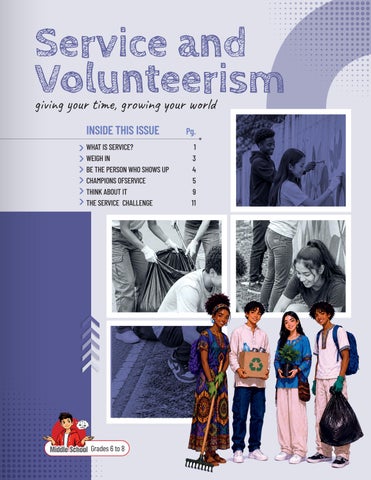
Service and Volunteerism
giving your time, growing your world INSIDE THIS ISSUE
Pg.
WHAT IS SERVICE? WEIGH IN BE THE PERSON WHO SHOWS UP CHAMPIONS OFSERVICE THINK ABOUT IT THE SERVICE CHALLENGE
1 3 4 5 9 11
Middle School Grades 6 to 8
giving your time, growing your world
1
Service and Volunteerism giving your time, growing your world
MIddle School Grades 6 to 8 Middle
What is service?
START HERE
Service means using your time, energy, and talents to meet a real need and make life better for someone else, expecting nothing in return. Volunteerism is service you choose freely: nobody assigns it, nobody pays you, and nobody has to thank you. You do it because you decided the need matters. Service is not about grand gestures or waiting until you are older. You serve when you carry, clean, teach, welcome, or stay to help, and you volunteer when you give an hour nobody required. The need gets met. The community gets stronger. So do you. Look around any school and you will see it: the student who stays to stack chairs, the one who explains the homework twice without sighing, the one who carries the box nobody asked about. Service has a thousand small faces, and all of them start the same way: someone saw a need and decided it was theirs.
giving your time, growing your world
1
WHAT SERVICE IS
Seeing a need and acting without being asked.
Giving time and effort freely, expecting nothing back.
Helping in small, steady ways that add up. Working with people, not just for them. Finishing what you started, even when nobody is watching.
WHAT SERVICE IS NOT
Doing good only when there is a reward or a grade.
One big show of helping, then disappearing.
Deciding what people need without asking them.
Feeling sorry for people instead of standing with them.
Waiting until you are older, richer, or less busy.
START WITH YOURSELF
Think of a time someone helped you without being asked. No payment, no prize, just help. What did it change for you? That is what your time can do for someone else. Service and Volunteerism
2
THE MOST IMPORTANT PAGE
Weigh in Weighing in means you pause and think before you choose. Imagine a scale. On one side is keeping your time for yourself. On the other is giving an hour of it to someone who needs it. Serving costs something. You give a Saturday morning, your energy, your attention. So what do you get? More than you spend. Helping lifts the helper: your mood rises, you feel useful, and strangers become people who know your name. You collect skills no class can grade. The scale tips because service pays both sides.
TWO CHOICES, TWO VERY DIFFERENT OUTCOMES WHEN YOU CHOOSE TO SERVE
WHEN YOU KEEP YOUR TIME TO YOURSELF
A need gets met, and someone’s week gets lighter.
The need stays, and someone carries it alone.
You feel useful, and your mood and health rise with it.
Free time fills up with scrolling, and the boredom stays.
You learn skills no class can grade: leading, organizing, showing up.
You stay unpracticed at the skills life will ask of you.
Your community learns it can count on you.
Your community never learns your name.
ONE QUESTION THAT HELPS
When you see a need, ask yourself: what is one small thing I could do about it this week? Not solve it all. One small thing. Most service begins that small.
giving your time, growing your world
3
THE SERVICE METHOD
Be the person who shows up Service starts with seeing. Most needs are not announced; they sit quietly in front of everyone until someone looks. These four steps turn noticing into help that actually helps.
1
SEE IT
2
ASK FIRST
3
START SMALL
4
SHOW UP AGAIN
Look for the need nobody claims: the mess after the event, the person carrying too much, the task that is nobody’s job. Needs hide in plain sight.
Ask what would help before you jump in. "What would make this easier?" Help that matches the need is help that works.
Do one thing you can finish today: one hour, one box, one chair, one person. Small and finished beats big and imaginary.
Come back next week. Repeated small service is what communities are built on, and it is what people remember about you.
Remember the steps: See it · Ask first · Start small · Show up again Service and Volunteerism
4
WHO KEEPS A COMMUNITY RUNNING?
Champions of service
Champions of service are easy to miss, because they rarely make a show of it. They are the people who quietly keep a school, a family, and a neighborhood running. You have met all of them.
THE FIRST MOVER Starts while everyone else waits: the first chair, the first bag, the first hello. Going first is the whole superpower.
THE ASKER Finds out what would actually help before jumping in, so the help fits the need instead of getting in the way.
THE QUIET HELPER
Serves where nobody is watching and never mentions it afterward. The work gets done; the credit does not matter.
THE FINISHER Stays until the job is done, not until it stops being fun. People plan around them because they always come through.
THE REGULAR Comes back, same day, same time, week after week, until people can count on them without asking.
WHAT MAKES A CHAMPION
Not the size of the act, and not applause. Champions are made of small acts of service, repeated until people can count on them. Pick your champion and start this week. COMING UP Three stories of champions in action: at school, next door, and at work.
giving your time, growing your world
5
STORY 1
The ones who stayed WITH SERVICE
The gym is done before dark. At the next event, staying to help is just what people do, because somebody made it normal. Mia stops waiting for adults to ask.
WITHOUT SERVICE
T
he spring fair ends and the gym empties in five minutes. Mr. Soto the custodian and two teachers stand looking at three hundred folding chairs. Mia is halfway out the door when she sees them. She turns around and starts folding. Her friend Leo groans, then joins her. Two more students see them and stay too. Twenty minutes later the gym is clear, and Mr. Soto knows four students by name. THINK IT THROUGH What is the need at your school that everyone sees and nobody claims? What would it take to be the first one to move?
The three adults work into the evening, like they do after every event. Students learn that the mess is always someone else’s problem, and the school feels like a hotel instead of a home. THE SERVICE METHOD SEE IT. Three people, three hundred chairs, and everyone else walking past. ASK FIRST. "Where do these go?" so the help lands where it is needed. START SMALL. One stack of chairs. Then another. SHOW UP AGAIN. At the next event, Mia stays without thinking about it, because it is who she is now.
WHY IT WORKS Helping spreads. When one person steps up, the people nearby copy it, and the whole room changes. One student who stays creates a school where staying is normal. Service and Volunteerism
6
STORY 2
The morning walk WITH SERVICE
Canela gets her walk, and Mr. Rivas gets ten minutes of conversation, some days the only ones. When the cast comes off, he walks with Danny on Fridays. Two strangers in March are friends by May.
E
very morning Danny passes Mr. Rivas walking his old dog, Canela. One week, no Mr. Rivas. Then Danny sees him at the window, his leg in a cast. Danny could wave and keep going. Instead he rings the bell and asks one question: "Want me to take Canela out on my way to school?" It costs him ten minutes a day.
WITHOUT SERVICE
Canela waits by the door all day. Mr. Rivas watches from the window, feeling like a burden to everyone. The cast comes off in six weeks; the loneliness lasts longer. THE SERVICE METHOD SEE IT. The dog who is not being walked is a need nobody announced. ASK FIRST. "Want me to take her out?" instead of assuming what Mr. Rivas needs. START SMALL. Ten minutes a day, on the way to school anyway. SHOW UP AGAIN. Every morning, six weeks. The repetition is the service.
THINK IT THROUGH Who in your building, your block, or your family is carrying something alone right now? What ten-minute help could you offer this week?
WHY IT WORKS Helping lifts the helper. Ten minutes of real help leaves you with more energy, not less, and turns a stranger into someone who knows your name. The best help is the kind you chose to give. giving your time, growing your world
7
STORY 3 · COLLEGE AND CAREER READINESS
The job that was nobody’s WITH SERVICE
Classes start on time and everyone’s Saturday gets better. When the center picks junior counselors for summer camp, the coordinator does not have to think: Dani, the one who fixed the equipment room. The name has a reputation attached.
WITHOUT SERVICE
Classes keep starting late. Coaches keep blaming each other. Dani stays one more name on the volunteer list, indistinguishable from the rest. THE SERVICE METHOD SEE IT. The problem everyone complains about and nobody owns. ASK FIRST. "Would it help if I organized this?" so the fix matches how the coaches work. START SMALL. One room, one Saturday, one checklist. SHOW UP AGAIN. Dani checks the room every week, so the system survives.
D
ani volunteers on Saturdays at the community center. The equipment room is chaos: balls everywhere, cones missing, classes starting late while coaches dig. It is nobody’s job to fix it. Dani spends one Saturday sorting, labeling bins, and taping a checklist to the door. Nobody asked. That is the point.
THINK IT THROUGH What is the "nobody’s job" in a place where you spend time, your school, your team, your building? What would fixing it say about you?
WHY THIS IS CAREER READINESS Employers read service as evidence: initiative, reliability, teamwork. The person who takes the job nobody owns is the first person anyone thinks of when a bigger job opens up. Service is a resume you can build for free, starting now. Service and Volunteerism
8
MAKE IT YOURS
Think about it You do not have to write anything down. Just think about these, or talk them over with a partner or your class.
1
Who served you this year without being asked? What did it change for you?
2
Which champion of service have you already been, without calling it that? Which one do you want to be next?
3
Where does your school or neighborhood need someone to go first? Why has nobody moved yet?
4
What kind of neighbor, classmate, and teammate do you want to be known as? What small service starts that reputation this week?
giving your time, growing your world
9
VOICES ON SERVICE “I thought volunteering was something you do for other people. Then I noticed I was the one who stopped dreading Saturdays.” An eighth grade volunteer
“Students who serve walk taller. They stop asking whether they matter, because they can see that they do.” A middle school teacher
“We do not need students to be heroes. We need them to fold chairs, ask good questions, and come back next week.” A community center coordinator
Service and Volunteerism
10
ARE YOU READY?
The service challenge Pick one challenge and try it for a week. Service is a habit you build by doing, not a word you memorize.
SEE ONE NEED Find one need nobody claims, at school, at home, or on your block, and do one small thing about it. Notice what changes.
GIVE ONE HOUR Volunteer one hour of your week: a food drive, a library shelf, a younger kid who needs homework help. One hour, all the way through.
TEAM UP Invite a friend to serve with you. Helping is contagious, and two people make a habit stick.
THE BIG IDEA
Service is not reserved for people with extra time and special skills. It is for people willing to see a need, start small, and come back. That is you.
HOW DID YOUR WEEK GO? Think about one moment when you saw a need and did something about it.
5
Excellent
4
Good
3
Okay
2
Getting there
1
Try again
See it. Start small. Come back. That is service. giving your time, growing your world
11
SERVICE AND VOLUNTEERISM Character Under Construction
TM