MICHAELMAS
2025
ECO-CLIFTON CELEBRATING POSITIVE SUSTAINABILITY NEWS
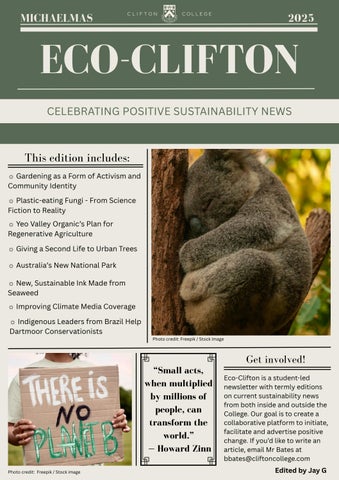
This edition includes: ☼ Gardening as a Form of Activism and Community Identity ☼ Plastic-eating Fungi - From Science Fiction to Reality ☼ Yeo Valley Organic’s Plan for Regenerative Agriculture ☼ Giving a Second Life to Urban Trees ☼ Australia’s New National Park ☼ New, Sustainable Ink Made from Seaweed ☼ Improving Climate Media Coverage ☼ Indigenous Leaders from Brazil Help Dartmoor Conservationists Photo credit: Freepik / Stock image
Get involved! “Small acts, when multiplied by millions of people, can transform the world.” — Howard Zinn Photo credit: Freepik / Stock image
Eco-Clifton is a student-led newsletter with termly editions on current sustainability news from both inside and outside the College. Our goal is to create a collaborative platform to initiate, facilitate and advertise positive change. If you’d like to write an article, email Mr Bates at bbates@cliftoncollege.com
Edited by Jay G
ECO-CLIFTON
MICHAELMAS 2025
Improving Climate Media Coverage
Photo credit: Freepik / Stock image
For decades, the global perception of climate change has been clouded by misinformation and denial, from scientific debates to political arguments. From a paper published in 2021 by Cornell Chronicle, a well-established newspaper, we see an overwhelming consensus amongst the scientific community, with over 99% of studies confirming that human activity is primarily responsible for climate change, leaving little doubt that the climate crisis is no longer a matter of belief.
However, despite many public surveys showing a large concern for climate change, there has been little action taken on it. Recently, researchers from Germany and Denmark polled 130,000 people across 125 countries, and over 60% of people were willing to contribute a portion of their personal income to climate causes. From these results, they concluded that raising awareness on the global support of climate action was likely the most effective way of a unified response to climate change. Other surveys show that almost 90% of people are concerned about climate change, desiring their governments to take stronger climate action. So why haven’t they taken action yet? Despite the overwhelming numbers that support taking action on climate change, many believe that they are in the minority, a social phenomenon known as ‘pluralistic ignorance’, where people believe that their own opinions are not widely held. In a study held by psychologist Cynthia Franz in 2022, she wrote that ‘The lack of public discussion reinforces the norm that others are not concerned and hampers the likelihood of collective organisation.’, alluding to the fact that there is little information about climate change revolving around the news and online media platforms, which Cynthia suggests is making people believe that others do not share their opinions, which discourages them from taking action. Media coverage also plays an important part in influencing decisions. In the past, climate change media coverage has been dominated by political drama and superficial information, creating confusion and doubt over the climate issue, leading some people to believe that climate change is still a ‘faraway’ issue. To combat this, CCN (Covering Climate Now) has released The 89 Percent Project, dedicated to improving climate journalism, and uniting public opinion on climate change, with many well-established news outlets, including The Guardian, Time magazine, Reuters and Al Jazeera backing the initiative.
Photo credit: Freepik / Stock image
Since the launch of The 89 Percent Project in April, hundreds of millions of people have noticed the cause. Many hope that this project will be an influential factor in pushing for more climate action before COP 30, the annual United Nations Climate Change Conference. But to push for change, they need even more people to get involved - spreading awareness and information with family, friends, and even political leaders. The more people who support climate action, the harder it will be for governments to ignore the issue. By Ryan H
ECO-CLIFTON
MICHAELMAS 2025
Indigenous Leaders from Brazil Help Dartmoor Conservationists One of the most pressing issues of the century is climate change. With global temperatures rising, ice caps melting in the Arctic and animals being displaced from their habitats by vast amounts of deforestation, it would be easy to get bogged down in the negatives and lose hope for change. But an exchange between indigenous tribes from the Amazon and Dartmoor conservationists has helped spark hope for rainforest recovery and restoration across the world. The indigenous leaders from the Asháninka and Guarani tribes arrived in Dartmoor as an act of solidarity for rainforest conservation. The staff from the Woodland Trust were joined by the leaders in Buckland Wood, a 100-hectare swathe of temperate rainforest situated in Devon’s Dart valley. The Woodland Trust has announced a £2.8 million appeal to buy the forest so they can restore it and return it to its former glory. The forest is one of only two locations in the UK that are home to an internationally rare lichen, and has the potential to house endangered species such as dormice, bats and otters. The meeting began with traditional prayers from the Asháninka people, who originate from the BrazilianPeruvian border and are known for their traditional sustainable agroforestry practices. The prayers brought together the groups from two different sides of the globe but showed that, as humans, we can all unite for a common cause: to keep the environment and its animals safe and thriving. The groups also found common purpose in their fight against the damaging effects of rainforest fragmentation. The process of fragmentation sees large continuous areas of rainforest broken into smaller isolated patches by human activities such as road construction, agriculture and the outward expansion of cities into rural areas. Overall, the meeting was a great chance to share different perspectives and valuable knowledge about rainforest conservation. The Asháninka’s leader also spoke of the need for restoring people’s relationship with nature. He spoke of his belief that a much deeper spiritual connection with nature would go hand in hand with helping rainforest restoration. After the visit, Woodland Trust’s rainforest recovery project officer, Sam Manning, said, “As a forest conservationist, today was one of the most emotionally moving days of my life, and listening to the wisdom of the Guarani and Asháninka on the river bank was, in particular, deeply moving and inspiring.”
Photo credit: Freepik / Stock image
This meeting between the two very different communities was a step forward in the right direction. With more meetings like these, the world can become more cohesive and unified over climate issues, especially the ones surrounding our rainforests. Taking two different outlooks on the conservation of rainforests and combining them is surely a recipe for climate success.
By Lola S
ECO-CLIFTON
MICHAELMAS 2025
Giving a Second Life to Urban Trees Urban trees are essential components of the quality of life in city environments. Whether it’s reducing air pollution, inducing a cooling effect, or increasing the well-being of people, trees dramatically impact our daily lives. Commonly cut down for reasons such as urban development, construction and disease, they end up leaving behind significant amounts of wood. However, what happens to this wood once it is cut down? Photo credit: Freepik / Stock image
It is estimated that around 21,900 urban trees are felled annually across the whole of the UK. The largest portion of this wood is chipped and used in biomass power plants, where it is burnt to produce low-carbon electricity. In addition to this, wood is commonly turned into wood chips, processed into mulch, firewood or lumber. This results in a very small percentage of waste wood ending up in landfill, where it would usually decompose and release methane, a strong atmospheric pollutant, which contributes to climate change. According to Community Wood Recycling, a nationwide network of social enterprises recycling wood, wood recycling in the UK has experienced a massive increase from only 2% being recycled in 1990 to more than 90% in 2023. While this figure remains outstanding, only around 7% of this recycled wood is repurposed into higher-value products. Repurposing urban wood provides so many benefits to the environment and the economy. It provides resources for the never-ending demand for timber, all while conserving the natural resources that would otherwise be burnt and release CO2 into the atmosphere. By increasing this practice, we would be reducing the demand for new timber and easing the pressure on rural forests and ecosystems. Fallen and Felled, a London-based timber company, repurposes London’s fallen trees into hardwood timber and furniture. The founder, Bruce Saunders, a furniture maker, was shocked when he found out more than 90% of hardwood timber used in the UK is imported, while thousands of usable trees are felled annually around London. One day, he spotted a tree being felled close to his home and asked the tree surgeon if he could take it to turn into timber, which the worker gladly let him do. From then on, Bruce developed his business in 2018 and saved over 120 felled trees in 2023 from being chipped and burnt. As a company, Fallen and Felled strives to increase awareness and educate people on the importance of repurposing materials, especially with the rising severity of climate change. However, while repurposing urban wood is a much-needed practice that should be made more accessible/common, it comes with certain barriers. When trees are grown in urban environments, they can grow at much faster rates due to having less competition for sunlight than they would usually have in a forest. This leads to the wood typically having more aberrations and colour in its timber, which can reduce its value. In addition, it’s difficult for companies to rely solely on urban wood because of the limited and unpredictable supply, often more expensive than traditional timber. This rise in price comes from the complex processing and extra labour needed to harvest and treat the wood for things such as removing nails and other foreign objects.
Photo credit: Freepik / Stock image
Ultimately, repurposing urban wood offers a sustainable solution to the vast quantity of waste wood collected. It decreases the amount of carbon released into the atmosphere while creating long-lasting products. Embracing this practice could consequently decrease the pressure on timber plantations and the surrounding ecosystems, all while preventing good-quality timber from going to waste.
By Emeline V
ECO-CLIFTON
MICHAELMAS 2025
Gardening as a Form of Activism and Community Identity
Photo credit: Freepik / Stock image
Gardening as Resistance Though gardening is often associated with elderly people tending to their flowers, it is so much more than that. Gardening can be political - a quiet, hands-on form of activism that challenges inequality, food insecurity and disconnection from the land. Across cities like London and even conflict zones like Gaza, people are reclaiming land to grow both food and community. In an age of environmental crisis and social division, an increasing number of people are turning to the soil, not only to grow food but to grow community, resilience and resistance. Gardening isn’t just about plants - it can be about power, identity and belonging too.
Global Roots: Gardens as Acts of Defiance Across the world, people are using gardening as an act of defiance. In Kharkiv, on Ukraine’s frontline, people led by Anastasiya Volkova are planting permaculture gardens in war zones as symbols of hope and survival. In Zambia, the Ubuntu Learning Trust, led by Mugove Walter Niyaka, is reconnecting communities to ancient agricultural traditions and simultaneously rehabilitating degraded farmland. These examples demonstrate that gardens thrive even under pressure, proving that gardening is a universal tool for empowerment. This also connects to climate resilience and the reclaiming of autonomy from industrial systems. To grow food is to reclaim control in a world where so much feels uncertain. UK Context: LION in London LION (Land In Our Names) is based in South London and was founded by Josina Calliste. It connects BPOC (Black and People of Colour) communities to land ownership, agriculture and ecological education. Calliste is a black woman from inner London - a demographic rarely reached by mainstream green campaigns. She found respite from work burnout through the May Project - a community interest company that helps local people engage with growing their own food. She enjoyed it, but questioned the underrepresentation of BPOC in agriculture and land inequality; 50% of land is owned by a mere 1% of the population. So she formed LION to challenge racial and social exclusion, giving underrepresented groups access to spaces historically dominated by others. For many urban residents, particularly from marginalised backgrounds, gardening has become a way to reclaim identity - to see themselves not just as guests of the land, but as its rightful stewards. Community Gardens as Safe Spaces LION was allocated its own growing space: the Dandelion garden in Peckham. This soon grew to more than just a space for growing food, but also for conversation, cultural exchange and healing. Gardening served as a medium for dialogue - difficult conversations happen more naturally when people work with their hands. Community gardens are more than just green spaces - they’re living classrooms for cooperation, empathy and empowerment, where new communities take root. Why Gardening Matters Now Gardening as activism is more important now in 2025 than ever before. Environmental crises are deepening and urban inequality is growing; however, gardening offers a tangible way to act locally, inclusively and regeneratively. It also reminds us that sustainability starts with connections to places, people and our planet. Gardens act as seeds of change for a more just and sustainable world, and whether in a war-torn field in Ukraine or a London allotment, every seed sown is an act of hope rooted in the soil. By Flower Y
ECO-CLIFTON
MICHAELMAS 2025
Turning the Tide - A Global Goal to Save Our High Seas What are we saving?
Photo credit: Freepik / Stock image
You’ve most likely heard of the term ‘Blue Planet’ - it's a rather gripping name for a BBC documentary, but it is also a fitting name for the Earth, which we all call home. Water covers roughly 71% of our planet’s surface. Our oceans sustain life and regulate our climate; without them, trying to nurture life and ecosystems would simply be futile. The Convention on the High Seas was signed in 1958, and titled 64% of the world’s oceans as ‘High Seas’. This title means they go beyond any country’s national borders and do not fall under any national jurisdiction. Consequently, this leaves them vulnerable to over-exploitation as they are open to being utilized by any nation for industrial fishing, oil drilling, deep sea mining and research. When overdone, these activities can have profound negative impacts on marine ecosystems and therefore lead to biodiversity loss. According to Greenpeace UK, less than 1% of high seas are partially or fully protected.
How are we saving them? Back in 2005, Greenpeace UK hosted a briefing on the need for a Global Ocean Treaty. They drew up a bold rescue plan, which would create a vast network of ocean sanctuaries that would occupy 30% of the world’s oceans. Greenpeace had the ambition to complete this plan by 2030, leading to it being better known as 30 by 30. Within these sanctuaries, industrial activities such as mining and fishing would be illegal. However, this is no easy feat; if Governments intend to achieve their 30 by 30 goal, they will need to put 12 million square kilometres (an area larger than Canada) off limits to destructive activity every year until 2030. 75 Governments have now ratified (formally consented to) the Global Ocean Treaty, and this number is continuously increasing, with 145 countries now having signed the treaty. This important milestone was reached on the 19th September 2025, which kick-started the 120-day countdown until the treaty comes into effect on January 17th 2026. What does the future look like? The future is bright, but change of this calibre is not easy and takes time and dedication from NGOs, Governments and individuals. Unfortunately, the UK was not one of the first 60 nations to ratify the treaty, despite being instrumental in its negotiations. The government should finish passing this treaty into law by the end of 2025. Excitingly, the very first Ocean COP is scheduled to take place late next year, this is where a collection of representatives from UN Governments will meet to discuss the treaty. This is a massive turning point for our oceans and a big stepping stone, leading us into the conservation work required by governments and organisations on a global scale in order to save and protect our planet and natural world from destruction.
Photo credit: Freepik / Stock image
ECO-CLIFTON
MICHAELMAS 2025
Turning the Tide - A Global Goal to Save Our High Seas How do I learn / do more? You can support Greenpeace, a UK Charity that helped propose and implement the treaty, and also aim to implement similar initiatives in the future by visiting their website: www.greenpeace.org.uk, here, you can find more information on how they are helping save and conserve the environment, as well as information regarding how to volunteer, support and donate to them. They have a shop where you can buy merchandise, with all profits going towards charitable causes. You can sign the open letter, aimed at the UK Government, regarding protecting the Sargasso Sea, by implementing an Ocean Sanctuary: https://action.greenpeace.org.uk/sargasso-open-letter marily responsible for climate change, leaving little doubt that the climate crisis is no longer a matter of belief.
Photo credit: Freepik / Stock image
Or, you could further research the treaty yourself, as well as other ways International Governments and Organisations are intending to conserve our oceans. Good places to start could be the National Oceanic and Atmospheric Administration Website and the National Geographic website. If you prefer visual/auditory learning, The High Seas Alliance and The London School of Economics (LSE) both have very informative and interesting videos posted on their YouTube channels.
If you would prefer more short-form content, OceanX has a TikTok account that posts about important challenges facing our oceans and how they can be overcome. Netflix’s 2021 film titled Seaspiracy is a gripping documentary about the environmental impact of fishing and makes for both informative and interesting entertainment. The Speak Up For Blue Podcast is available on all major streaming platforms and dives into how we can better protect and care for our oceans as individuals. By Imogen D
ECO-CLIFTON
MICHAELMAS 2025
Yeo Valley Organic’s Plan for Regenerative Agriculture Decades of industrial farming have impacted the planet and serious questions are being raised about the future of food production. The company Yeo Valley Organic led the way in bringing organic foods to the masses and is now trying to lay the groundwork for a second innovation: ‘regenerative agriculture, to help protect the planet.’
Photo credit: Freepik / Stock image
At the centre of regenerative farming, there are a few core principles: keeping soil undisturbed, covered in vegetation, rich in living roots and full of diverse crops. These features lock up carbon while restoring the soil's diverse ecosystem of bugs, fungi, and microbes. These, in turn, keep crops fed and watered, without any chemical fertilisers.
There are a range of ways to farm regeneratively and some of the most common ones Yeo Valley implements are: mob grazing, companion planting, and agroforestry. Companion planting is when crops that benefit each other are grown together, which facilitates crop resilience. For example, when peas, barley, and oats are grown together, the peas are able to fix nitrogen levels in the ground for other crops, which introduces better soil health. This not only increases soil health but also boosts biodiversity, reduces pests, and allows for higher yields without further chemical input. Another important technique is mob grazing. This is when the livestock often gets moved between different pastures to mimic the wild behaviour of herbivores. It means that the grass is healthier and more abundant with nourished soil microbes. Finally, agroforestry is where agriculture is blended with tree cultivation on an almost unprecedented scale. The goal is to maximise carbon drawdown, lift biodiversity and offer livestock some shelter from extreme weather. Their Yeo Valley’s target is set on 1000 acres, which one day will make the silvopasture one of the biggest in Britain. Yeo Valley believe that all life starts with soil and that the solution lies within it. Soils help grow 95% of their produce; however, over the past 150 years, half of the topsoil has been lost. Yeo Valley are working with expert partners and farmer-led enterprise, the Farm Carbon Toolkit, to work with more like-minded farmers to understand the real impact on soil carbon and how this can help with the climate crisis. The FCT will measure the soil carbon stocks on their farms and deliver a mentoring programme on soil health and soil carbon sequestration. This will take five years, which is the minimum time frame to measure carbon sequestration in soil. The company believes that carbon sequestration in soils, through regenerative organic farming, offers enormous potential to reduce atmospheric carbon levels, which are driving ongoing global warming. Although these measures might sound like a regression, it is important to understand that it is the future, where profit comes not at the cost of nature but in harmony with it. It is important to think of regenerative not as old world and low yielding, but as something that will improve farming and the health of the land as it becomes more productive, carrying more animals. The charity World Wide Fund For Nature (WWF) suggests that by 2030, regenerative farming methods could slash the UK's greenhouse gas emissions equivalent to taking almost a million cars off the road. So the main barrier to widespread adoption is the mindset. Not only has the company become more diverse in cattle breeding, in fields and crops, but it has also increased its product range. Although dairy remains their mainstay, organic beef burgers have joined the lineup as well. However, it made sense as they were raising beef cattle on their farm, which allows them to expand further than dairy. Farmer Mead says, “It's a natural extension to showcase products from a farming system that we believe in.” By Sarah P
ECO-CLIFTON
MICHAELMAS 2025
New, Sustainable Ink Made from Seaweed In a world where artists, ecologists, and innovators are constantly seeking new ways to heal the planet, a novel idea is emerging from the depths of the sea: ink made from seaweed. The concept is the brainchild of Art For Your Oceans (AFYO), and it is all part of a joint initiative by the World Wide Fund for Nature (WWF) and art curators, Artwise. Their mission is to raise funds and awareness for ocean conservation by combining artistry with ecological purpose. One of the main techniques of AFYO is producing a biodegradable ink derived from farmed seaweed, arguably the first of its kind in terms of sustainability and intention. What makes this ink particularly compelling is its source, seaweed that's farmed regeneratively. Rather than extracting from wild populations, the cultivation is designed to restore balance, support marine ecosystems, and function as a scalable resource for eco-friendly materials. Photo credit: Freepik / Stock image Seaweed farms are increasingly recognised not just for their material potential, but for their ecological benefits. Underwater “forests” of kelp and other macroalgae act as important carbon sinks, providing shelter for marine life and mitigating coastal erosion. In places like Scotland, crofters (small-scale farmers) are already cultivating seaweed, contributing to a localised model of marine restoration. AFYO enlisted 16 artists, including luminaries like Antony Gormley and Anya Gallaccio, to experiment with this seaweed ink. The artists were encouraged to use it in their own styles and to explore the intersections of art, ocean health, and materiality. Anya Gallaccio mixed ground stones and mollusc shells into her seaweed ink to create textured abstract seascapes. Their collective work was exhibited in May 2025 at Sotheby's in London, where the pieces were auctioned to support AFYOs' conservation projects. The event not only spotlighted the artistic value of seaweed ink, but also turned each sale into direct funding for ocean protection initiatives. Producing seaweed ink at scale demands consistent supply chains, quality control, and infrastructure for regional seaweed farming. By choosing materials that restore rather than degrade, creations can actively contribute to ecological resilience. Beyond ink, the potential of seaweed is broad. As an alternative to fossilderived materials, it offers a route toward more sustainable, regenerative economies. Projects like AFYO help bring these possibilities into the public eye, combining aesthetic appeal with environmental activism. As the seaweed movement gains momentum, from coastal farms to design studios, the ripple effects could be profound. Artists who once relied on petroleum-based inks may find new inspiration in ocean-derived pigments. Conservationists may gain revenue sources. And the sea itself might receive more care, one drop of ink at a time. The seaweed ink project stands as more than an artistic endeavour, it symbolises a shift in how creativity can contribute to regeneration rather than consumption. By turning to nature for both inspiration and materials, artists and scientists alike are helping to rewrite the story of production and waste. Each brushstroke or printed line made with seaweed ink becomes a quiet act of advocacy, reminding us that innovation doesn't always mean invention from scratch; it can mean rediscovering the wisdom already held with the natural world. By Madison S
Photo credit: Freepik / Stock image
ECO-CLIFTON
MICHAELMAS 2025
Australia’s New National Park ‘The creation of the Great Koala National Park is one of the most significant conservation achievements in decades, made possible through the persistence of communities and advocacy groups who refused to give up’ Friends of the Koala Charity.
Photo credit: Freepik / Stock image
Why are national parks so important? They are not only open areas for public use - but they also provide habitats and ecosystems for our animals and environment to sustain and grow. National parks protect and encompass thousands and thousands of species across the globe - and need to be protected due to their large impacts on species populations and food chains.
The Great Koala National Park will be the largest protected area in New South Wales, spanning 467,000 hectares and is home to an estimated 12,000 koalas. The Australian government classified koalas as endangered in 2022, following dangerous declines due to habitat loss, fragmentation and degradation. This is hoped to be restored after the banning of logging within the park’s limits. The park will also lead to the further protection of other native animals and plant species within its boundaries. “The park will generate around 100 new positions” said Friends of the Koala, “along with additional opportunities in tourism, conservation, and Indigenous-led land management.” This was stated after the backlash from the logging sector, which argued their jobs may be affected by the ban. However, the impact of the National Park outweighs this concern, as shown by the NSW Legislative Council Committee Inquiry, which found that koalas would become extinct in New South Wales before 2050 if no action was taken. With a mean estimate of 12,111 koalas in the area, the Great Koala National Park will provide large areas of connected and high-quality habitat to protect this significant koala population and aim to replenish their numbers. Koalas are the focus of the new national park; however, 66 threatened fauna species and 37 threatened flora species have been recorded in the area. These threatened species, including southern greater gliders, yellow-bellied gliders and glossy black cockatoos, as well as spider orchids - not previously recorded in any other national park estate - will be encouraged to thrive and recover in the national park. The park will also protect precious old-growth forest and important water catchments, such as Bellingen and Nambucca, making the park a critical refuge for species in a warming climate. Photo credit: Freepik / Stock image
Therefore, this new National Park is predicted to have a lasting and monumental effect on the wildlife and species of Australia, and is projected to help increase their numbers drastically. This achievement will be monumental for conservation and persuasion with public opinions, hopefully being the first of many new projects to protect our ecosystems globally. By Alana P
ECO-CLIFTON
MICHAELMAS 2025
Plastic-eating Fungi - From Science Fiction to Reality How we should manage the ever-increasing quantities of plastic waste we generate has been one of the burning questions that has plagued scientists and environmentalists alike for decades. Despite the progress we have made in reducing our reliance on single use plastic, illustrated by changes like the 79% decrease in the purchase of plastic carrier bags in the UK since 201, these efforts do nothing to curb the environmental impact of the 4.9 billion metric tons (approximately 60% of all plastic ever produced) that is already in landfills around the world.
Photo credit: Freepik / Stock image
Luckily for us, a potential solution has emerged from the research of the US-based biotech firm, HIRO Technologies, the use of plastic-eating fungus! While it may initially sound like a tool borrowed from a sci-fi villain, it is becoming an increasingly viable solution to our plastic pollution problem. While we were already aware of 184 strains of fungus and 55 strains of bacteria that are able to break down plastics. However this technology was not previously viable. any of these microorganisms were only capable of breaking down polycaprolactone, a biodegradable polyester otherwise known as PCL. PLCis not present in the majority of the plastics we use on a daily basis as it’s low melting point limits it to niche applications such as solvent additives and 3D printing. Additionally, the majority of well-known plastic-digesting fungi can only function in hyperspecific conditions, as they are native to habitats such as the Amazon or certain coastlines. HIRO technologies has bypassed these significant issues by genetically modifying mushroom DNA in order to create one of the first shelf-stable, adaptable, food-safe forms of plastic-eating fungi. HIROTechnologies has decided to use its revolutionary blend of pestalotiopsis microspora to create the world's first biodegradable nappies. While it doesn’t seem like the most obvious or glamorous use of this groundbreaking technology, it is simply a fact of life that we all need nappies at a young age. It may also come as a shock to many people that nappies are actually among the slowest decomposing forms of plastic waste, taking approximately 400 to 500 years to decompose. That means that the nappies we used as infants are likely to outlive not only our children and grandchildren but the next 13 to 17 generations of our families! Fungal-based sustainability solutions are innovative and could potentially play a pivotal role in the removal of plastic waste. However, they will inevitably face challenges. Such as public acceptance of fungally enhanced products, regulatory approval surrounding genetic modification, and the potential ecological risk of releasing large volumes of fungi into the environment. Despite this, the future of fungal biotechnologies is bright. t is highly probable that they can play a pivotal role in landfill remediation, the cleaning of soil that has been contaminated with microplastics. They could also help treat the polyester-based textiles that result from fast fashion waste, and on-site plastic decomposition in countries where communities cannot access waste disposal infrastructure. Who would’ve thought that fungus, something we often hope will play no role in our lives, may be the unlikely hero that will save us from the plastic crisis. By Amy F