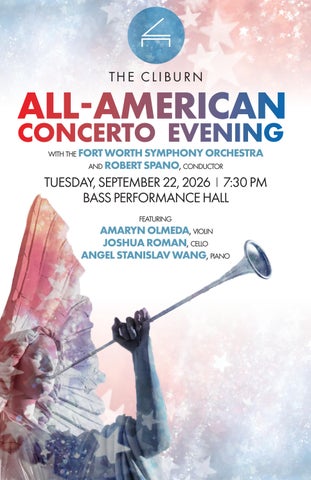
ALL-AMERICAN
CONCERTO EVENING with the FORT WORTH SYMPHONY ORCHESTRA and ROBERT SPANO, conductor
TUESDAY, SEPTEMBER 22, 2026 I 7:30 PM BASS PERFORMANCE HALL featuring
AMARYN OLMEDA, violin JOSHUA ROMAN, cello ANGEL STANISLAV WANG, piano
ALL-AMERICAN
CONCERTO EVENING UNDERWRITERS Anonymous Meta Alice Keith Bratten Foundation
SPONSORS
TABLE OF CONTENTS PAGE
2026–2027 Concert Schedule The All-American Concerto Evening About Amaryn Olmeda About Joshua Roman About Angel Stanislav Wang About Robert Spano About the Fort Worth Symphony Orchestra Program Notes About the Cliburn Cliburn Board of Directors Cliburn Administration
2–3 4–5 6 7 8 9 10 12 16 18 19
Patrons must be 8 years of age or older to attend Cliburn Concerts. Photography and recording are strictly prohibited. All phones and other electronic equipment must be turned off.
CLIBURN CALENDAR
C L I BCLIBURN U R NCONCERTS C O NCLIBURN C E R SESSIONS TS CLIBURN FESTIVAL CLIBURN FAMILY CONCERTS
SEPTEMBER 2026
22 ALL-AMERICAN CONCERTO EVENING FORT WORTH SYMPHONY ORCHESTRA AMARYN OLMEDA, Violin JOSHUA ROMAN, Cello ANGEL STANISLAV WANG, Piano Bass Performance Hall
OCTOBER 2026
8
17
YEKWON SUNWOO, piano 2017 CLIBURN GOLD MEDALISTist Kimbell Art Museum
THE MAGIC OF BEETHOVEN Kimbell Art Museum
NOVEMBER 2026
4
BRIDGET KIBBEY’S BACH TO BRAZIL
BRIDGET KIBBEY, harp RUBÉN RENGEL, violin SAMUEL TORRES, percussion
18 DANIIL TRIFONOV, piano Kimbell Art Museum
Tannahill’s Music Hall
28 GET YOUR TICKETS NOW CLIBURN.ORG/CONCERTS
‘TWAS THE NIGHT BEFORE CHRISTMAS Fort Worth Stockyards Station
2026–2027 CLIBURN SCHEDULE JANUARY 2027
27 STERLING ELLIOTT, cello ELLIOT WUU, piano Kimbell Art Museum
FEBRUARY 2027
2
25–28
CLIBURN FESTIVAL: LUNAR NEW YEAR Modern Art Museum of Fort Worth
A NIGHT OF CABARET with MIKAELA BENNETT, soprano Tannahill’s Music Hall
MARCH 2027
APRIL 2027
3
25 2025 CLIBURN BRONZE MEDALISTis
THE LEGENDARY LIFE OF ANNIE OAKLEY National Cowgirl Museum & Hall of Fame
14
22
EVREN OZEL, piano Kimbell Art Museum
ANNA GENIUSHENE + LUKAS GENIUŠAS piano duo Tannahill’s Music Hall
MAY 2027
J'NAI BRIDGES,
mezzo-soprano
Kimbell Art Museum
JUNE 2027
6 STELLA CHEN, violin GILLES VONSATTEL, piano Kimbell Art Museum
10–19 CLIBURN INTERNATIONAL COMPETITION FOR YOUNG PIANISTS SMU & Meyerson Symphony Center
ALL-AMERICAN
CONCERTO EVENING FORT WORTH SYMPHONY ORCHESTRA ROBERT SPANO, conductor AMARYN OLMEDA, violin JOSHUA ROMAN,cello ANGEL STANISLAV WANG, piano
Tuesday, September 22, 2026 I 7:30 p.m. Nancy Lee and Perry R. Bass Performance Hall COPLAND
An Outdoor Overture
BARBER
Violin Concerto, op. 14 Allegro Andante Presto in moto perpetuo Amaryn Olmeda, violin
intermission BATES
Cello Concerto Con moto – Grazioso – Con moto Serene Léger Joshua Roman, cello
GERSHWIN
Rhapsody in Blue Angel Stanislav Wang, piano
Amaryn Olmeda and Angel Stanislav Wang appear by arrangement with Opus 3 Artists. Joshua Roman appears by arrangement with the Cliburn Agency. Robert Spano appears by exclusive representation with Kirshbaum Associates Inc. Steinway & Sons is the official piano of the Cliburn. Please silence all electronic devices. No recording is allowed. PAGE
This concert is underwritten by the Meta Alice Keith Bratten Foundation and Anonymous. This concert is sponsored by Beavers Wealth Management of Raymond James and BNSF. Support provided by the Ann Frasher Hudson Performance Piano Endowment Fund.
5
ABOUT AMARYN OLMEDA Winner of first prize and the audience choice award at the 24th Annual Sphinx Competition, American violinist Amaryn Olmeda is a rising star sought after for her bold and expressive performances as a soloist and collaborator. Violinist.com says of Amaryn, “…her commanding stage presence, infallible technique, and interpretive ability already rival that of international concert stage veterans.” Highlights of the 2025–2026 season include debut performances with the Dallas Symphony Orchestra, Calgary Philharmonic, Tallahassee Symphony, Modesto Symphony, Williamsburg Symphony, and Shreveport Symphony, as well as return appearances with the Buffalo Philharmonic, Des Moines Symphony, Stockton Symphony, and Auburn Symphony. Amaryn will also debut in recital at Vivo Performing Arts in Boston. Amaryn made her Lincoln Center solo debut on the 2024 Summer for the City Series. Later that season, she returned for her solo debut at David Geffen Hall on the New York Philharmonic’s Kravis Nightcap Series with violinist Hilary Hahn and principal ballet dancer Tiler Peck. She made her Carnegie Hall solo debut on the Sphinx Virtuosi tour at the age of 14, garnering rave reviews. Recent highlights include debuts with the Philadelphia Orchestra, Cleveland Orchestra, Houston Symphony, Buffalo Philharmonic, Seattle Symphony, Charlotte Symphony, Omaha Symphony, and the San Francisco Chamber Orchestra at their New Year’s Concert Series, earning her a nomination for the San Francisco Classical Voice Audience Choice Awards. In 2023, she recorded Carlos Simon’s Between Worlds on Deutsche Grammophon, praised by The Strad as “an impressive reading by the young musician.” In 2022, Amaryn performed for the San Francisco Conservatory Gala with Yuja Wang. At 13, Amaryn became the first member of the San Francisco Conservatory of Music and the Opus 3 Artist’s Artist Apprentice Program. Born in 2008, Amaryn currently studies at the New England Conservatory of Music with Miriam Fried. She previously studied with Ian Swensen at the San Francisco Conservatory of Music. Amaryn performs on a violin by Nicola Bergonzi in Cremona, circa 1796, on generous loan from Reuning & Sons Violins.
PAGE
6
Photo credit: Marco Borggreve
ABOUT JOSHUA ROMAN Joshua Roman is a cello soloist whose multifaceted career spans performance, composition, curation, and interdisciplinary collaboration. Praised for his “effortlessly expressive tone… and playful zest for exploration” (The New York Times), Roman has built a career defined by exceptional artistry, adventurous programming, wideranging collaborations, and a commitment to connecting artists and audiences through music. Highlights of Roman’s 2026–2027 season include concerto appearances with the Columbus, Princeton, and Portland symphony orchestras; returns to Carnegie Hall’s Well-Being Concerts and the Minnesota Beethoven Festival; continued trio performances with violinist Tessa Lark and double bassist Edgar Meyer; and the release of a new album on Phenotypic Recordings in spring 2027 featuring his chamber music compositions, with performances by collaborators including Yo-Yo Ma and the JACK Quartet. Roman is an advocate for the growing field of neuroarts and the role of artists and patients in research and care. Upcoming highlights exploring the intersection of music and well-being include residencies and appearances with Johns Hopkins University’s International Arts + Mind Lab, the Oslo Freedom Forum, and the Lake Nona Impact Forum. Central to Roman’s current artistic work is Resonance, a collaborative project featuring Chilean guitarist and vocalist Camila Meza and Trinidadian percussionist Zane Rodulfo. Resonance is the next chapter of Roman’s Immunity project and acclaimed 2024 solo album, expanding his exploration of vulnerability and healing into one of connection, creativity, and shared experience. Roman has collaborated with artists including Bill T. Jones, Somi, and Anna Deavere Smith, and has appeared as soloist with orchestras including the Los Angeles Philharmonic, San Francisco Symphony, Toronto Symphony Orchestra, BBC Scottish Symphony Orchestra, New World Symphony, and Mariinsky Orchestra. He served as principal cellist of the Seattle Symphony from age 22 to 24.
PAGE
Photo credit: Shervin Lainez
7
ABOUT ANGEL STANISLAV WANG Praised for his expressive depth, commanding technique, and artistic individuality, Angel Stanislav Wang has quickly drawn international attention as a rare and compelling new voice. His major accolades include the Silver Medal at the 17th International Tchaikovsky Competition, becoming the youngest finalist at the 2025 Van Cliburn International Piano Competition, and winning first prize at the International Rachmaninov Piano Competition. At just 23, he has already earned over 35 international awards. A captivating performer with a growing global following, Angel has performed at world-renowned venues including Carnegie Hall, Vienna’s Musikverein, Bass Performance Hall in Fort Worth, the Mariinsky Theatre in St. Petersburg, and the Great Hall of the Moscow Conservatory. Highlights of his recent and upcoming concerto appearances include the Grieg Piano Concerto with the Russian National Orchestra for its 35th anniversary concert in Moscow, a sold-out performance of the Britten Piano Concerto with the St. Petersburg Philharmonic, Rachmaninov Piano Concerto No. 3 with Carlos Miguel Prieto and Orquesta Sinfónica de Minería in Mexico City, and Rachmaninov’s Rhapsody on a Theme of Paganini with Moon Doh and the Pacific Symphony and also with Sebastian Weigle and Orchestra del Teatro Comunale di Bologna. His 2026–2027 recital tour includes concerts for major series in the United States, including the Aspen Music Festival, Performing Arts Houston, La Jolla Music Society, The Soraya at California State University Northridge, Steinway Society–Bay Area, The Philip Lorenz International Keyboard Concerts in Fresno, Kravis Center in West Palm Beach, Grand Piano Series at Artis-Naples, and the American Liszt Society Festival at the Lied Center in Lincoln, Nebraska. Angel has also appeared at leading international festivals such as the Rheingau Musik Festival, Piano Loop Festival, Rafael Orozco Piano Festival, and the Shostakovich International Music Festival, earning acclaim for performances that combine poetic sensitivity with technical brilliance. Born in Los Angeles in 2003, Angel began piano at 5 under his mother’s guidance. He studied at the Moscow Conservatory under Professor Natalia Trull, and now pursues an artist diploma at The Juilliard School in New York, studying with Emanuel Ax and Yoheved Kaplinsky. Angel is a Steinway Artist.
PAGE
8
Photo credit: Masha Murzha
ABOUT ROBERT SPANO Robert Spano, conductor, pianist, composer, and teacher, is known worldwide for the intensity of his artistry and distinctive communicative abilities, creating a sense of inclusion and warmth among musicians and audiences. Music director of the Fort Worth Symphony Orchestra since August 2022, Spano will continue there through July 2031, shaping the artistic direction of the orchestra and driving its continued growth. He is music director of the Washington National Opera, and after 20 seasons as music director of the Atlanta Symphony Orchestra, he now serves as its music director laureate. He is also principal guest conductor of the Rhode Island Philharmonic Orchestra & Music School, where he previously served as principal conductor. In his fifth season as music director of the Fort Worth Symphony Orchestra, Spano leads six weeks of symphonic programs, including Mahler’s Sixth Symphony and a world premiere by Christopher Theofanidis. With Washington National Opera, Spano leads the company premiere of John Adams’s Nixon in China and a new production of Mozart’s Idomeneo, as well as the one-night concert event We the People. Other highlights of the season include his annual return to the Atlanta Symphony Orchestra, featuring a world premiere by Adam Schoenberg, as well as a week with the Rhode Island Philharmonic. As a guest conductor, he appears with the Kansas City Symphony, the KBS Symphony Orchestra (Seoul), the Prague Symphony Orchestra, and in June 2027, conducts the opening concert of the Round Top Festival Institute in Texas. With a discography of critically acclaimed recordings for Telarc, Deutsche Grammophon, and ASO Media, Robert Spano has garnered four GRAMMY® Awards and eight nominations with the Atlanta Symphony. Spano’s latest recording as a pianist and composer is Songs of Orpheus with mezzo-soprano Kelley O’Connor, released in August 2025 on Sono Luminus. Spano is on faculty at Oberlin Conservatory and has received honorary doctorates from New England Conservatory of Music, Bowling Green State University, the Curtis Institute of Music, Emory University, and Oberlin. Maestro Spano is a recipient of the Georgia Governor’s Award for the Arts and Humanities and is one of two classical musicians inducted into the Georgia Music Hall of Fame.
PAGE
Photo credit: Jason Thrasher
9
ABOUT THE FORT WORTH SYMPONY ORCHESTRA
Photo credit: Karen Almond
Robert Spano, Music Director Dame Jane Glover, Principal Guest Conductor Harris Han, Assistant Conductor Miguel Harth-Bedoya, Music Director Laureate John Giordano, Conductor Emeritus
PAGE
10
The Fort Worth Symphony Orchestra under Music Director Robert Spano is deeply committed to uniting its community through presenting over 120 performances, education, and outreach concerts, reaching an audience of more than 150,000 annually. Since its beginnings in 1912, the FWSO has been an essential thread in the city’s cultural fabric and the very foundation of Fort Worth’s performing arts. The FWSO has performed at Carnegie Hall and the John F. Kennedy Center for the Performing Arts as part of SHIFT: A Festival of American Orchestras. The FWSO has released 13 recordings—with several being world premiere releases—garnering international acclaim. The FWSO has embraced creative collaborations through residencies, partnerships, and commissions. As the principal resident company of the acoustically superb Nancy Lee and Perry R. Bass Performance Hall, the Orchestra performs a full season of concerts featuring internationally acclaimed guest artists and works by living composers. The Orchestra performs and partners with Jake Heggie, Texas Ballet Theater, Atlanta-based glo, Fort Worth Opera, the Cliburn, Fort Worth Botanic Garden, The Old Trout Puppet Workshop, and Performing Arts Fort Worth. The FWSO keeps exceptional musical experiences at the heart of its community.
ABOUT THE FORT WORTH SYMPONY ORCHESTRA Violin I Michael Shih, Concertmaster Mrs. Mercedes T. Bass Chair Mr. Sid R. Bass Chair Swang Lin, Associate Concertmaster Ahra Cho, Associate Concertmaster Eugene Cherkasov, Assistant Concertmaster Mollie & Garland Lasater Chair Jennifer Y. Betz Qiong Hulsey Ivo Ivanov Nikayla Kim Izumi Lund Ke Mai Kimberly Torgul Albert Yamamoto Violin II Adriana Voirin DeCosta, Principal Steven Li, Associate Principal Ordabek Duissen, Assistant Principal Symphony League of Fort Worth Chair Molly Baer Sue Jacobson Wing Yan Kwok Matt Milewski Kathryn Perry Tatyana Smith Ertan Torgul Andrea Tullis Viola DJ Cheek, Principal Anna Kolotylina, Associate Principal HeeSun Yang, Assistant Principal Joni Baczewski Sorin Guttman Aleksandra Holowka Dmitry Kustanovich, Daniel Sigale Cello Allan Steele, Principal Mrs. Mercedes T. Bass Chair Mr. Sid R. Bass Chair Keira Fullerton, Associate Principal Colin Hill, Assistant Principal BNSF Railway Foundation Chair John Belk Deborah Brooks** Shelley Jessup Jenny Kwak Annamarie Reader
Piccolo Gabe Fridkis Mara Goree Oboe Jennifer Corning Lucio, Principal Nancy L. & William P. Hallman Jr. Chair Tamer Edlebi, Assistant Principal Virginia McDowell English Horn Virginia McDowell Clarinet Stas Chernyshev, Principal Rosalyn G. Rosenthal Chair* Ivan Petruzziello, Assistant Principal Greg Hamilton E-Flat Clarinet Ivan Petruzziello Bass Clarinet Greg Hamilton Bassoon Vacant Position, Principal Mr. & Mrs. Lee M. Bass Chair Cara Owens, Assistant Principal Kody Harrington Contrabassoon Kody Harrington Horn Gerald Wood, Principal Elizabeth H. Ledyard Chair Alton F. Adkins, Associate Principal Drs. Jeff and Rosemary Detweiler Chair Kelly Cornell, Associate Principal Aaron Pino Blake Moreland
Bass Trombone Justin Bain Mr. & Mrs. Lee M. Bass Chair Tuba Edward Jones, Principal* Timpani Seth McConnell, Principal Madilyn Bass Chair Percussion Keith Williams, Principal Shirley F. Garvey Chair Nicholas Sakakeeny, Assistant Principal Adele Hart Chair Deborah Mashburn** Harp Vacant Position, Principal Bayard H. Friedman Chair Keyboard Shields-Collins Bray, Principal Rildia Bee O’Bryan Cliburn & Van Cliburn Chair Stage Manager Penny Smith Orchestra Personnel Managers Savanna Cardenas Orchestra Librarians Christopher Hawn David Sterrett Thomas Zuber * In Memory of Manny Rosenthal ** Extended Core Orchestra Member The Concertmaster performs on the 1710 Davis Stradivarius violin. The associate Concertmaster performs on the 1685 Eugenie Stradivarius violin.
Trumpet Kyle Sherman, Principal Cody McClarty, Assistant Principal Dorothy Rhea Chair Oscar Garcia-Montoya Trombone Joseph Dubas, Principal Mr. & Mrs. John Kleinheinz Chair Jacob Muzquiz, Assistant Principal Justin Bain PAGE
Bass William Clay, Principal Mr. & Mrs. Edward P. Bass Chair Paul Unger, Assistant Principal Jeff Hall Julie Vinsant William Gowen
Flute Jake Fridkis, Principal Shirley F. Garvey Chair Gabe Fridkis, Assistant Principal Mara Goree
11
PROGRAM NOTES BY BUDDY BRAY An Outdoor Overture Aaron Copland (1900–1990) By the mid-1930s, Aaron Copland—himself in his mid-30s—was undergoing an important change in his approach to composition. Works like his Symphony for Organ and Orchestra (1924), his Piano Concerto (1926), and especially his Piano Variations (1930) had brought wide attention to him within the musical community, even though they were of a fierce rhythmic and harmonic complexity. What these works had not necessarily brought him, though, was wide acceptance by the concert-going public. That fact, plus his involvement with the social problems of 1930s America, caused him to reevaluate his place as an American composer and as a citizen. He became more interested in writing music that was both understandable by a wide public and useful to musical practitioners at all levels. By 1938, when Alexander Richter commissioned Copland to write a short work for his orchestra at the High School of Music and Art in New York, Copland knew exactly what to do. The previous year, he had written a short opera, his first, called The Second Hurricane, specifically designed for students at New York’s Henry Street Settlement School. If Copland’s opera is infrequently performed, his effort for Richter’s High School Orchestra has found a place in the standard repertoire and is still frequently encountered. He called it An Outdoor Overture, and it is a tour of the hallmarks that we still associate with Copland’s music and American concert music in general: motives and melodies built by unambiguous means, a rhythmic vitality that grows more fervent as the work unfolds, and a craggy, rough-hewn way with orchestration. Across its nine minutes, the work is filled with Copland’s native optimism; it sounds outdoorsy and utterly American. An Outdoor Overture was premiered—indoors—at New York’s High School of Music and Art on December 16, 1938. It is scored for 2 flutes and piccolo, 2 oboes, 2 clarinets, 2 bassoons, 4 horns, 2 trumpets, 3 trombones, timpani, xylophone, cymbals, triangle, bass drum, snare drum, celesta, piano, and strings. Approximate duration: 9 minutes
PAGE
12
PROGRAM NOTES BY BUDDY BRAY Violin Concerto, op. 14 Samuel Barber (1910–1981) Listen to Samuel Barber’s Violin Concerto, and you will immediately understand what made him so beloved among singers: particularly in its first two movements, it is music of aching beauty and lyricism. His melodies don’t even seem particularly crafted; they just seem to unfold naturally, and they beg to be sung. That was not enough for violinist Iso Briselli, on whose behalf it was commissioned by Philadelphia philanthropist Samuel Fels. Briselli had envisioned a virtuoso work for himself, and was disappointed when Barber showed him those exquisite first two movements. Perhaps that is why the third movement, a hair-raising perpetuum mobile, is music of such consuming virtuosity that it still makes soloists sweat and orchestras sit up straight. Not even that satisfied Iso Briselli, though. He then complained that the third movement seemed to bear little relation to what came before it. (Maybe he was right about that. It is a startling gearshift.) Samuel Fels paid for the work, as he had promised to do, but Iso Briselli never played it. It was instead premiered by violinist Albert Spalding in 1941, with the Philadelphia Orchestra conducted by Eugene Ormandy. It quickly entered the standard repertoire, and is still performed with great frequency worldwide. The concerto is scored for solo violin, 2 flutes, 2 oboes, 2 clarinets, 2 oboes, 2 bassoons, 2 horns, 2 trumpets, timpani, snare drum, piano, and strings. Approximate duration: 25 minutes
PAGE
13
PROGRAM NOTES BY BUDDY BRAY Cello Concerto Mason Bates (b. 1977) Mason Bates is not a new name to Fort Worth concertgoers: his White Lies for Lomax was one of the required pieces at the Thirteenth Van Cliburn International Piano Competition in 2009, and his orchestral music was frequently championed here by conductor Miguel Harth-Bedoya. His career has spanned several venues. In addition to his wide catalog of orchestral music, he has also worked extensively in electronica (he has even been a DJ), and he has written two operas: The (R)evolution of Steve Jobs (2017) and, for the Metropolitan Opera, The Amazing Adventures of Kavalier and Klay (2025). Mr. Bates’ Cello Concerto is the product of a consortium commission among three orchestras (Seattle Symphony, Columbus Symphony Orchestra, and the Los Angeles Chamber Orchestra) and is the result of his friendship with boundarybreaking cellist Joshua Roman. Mr. Bates picks up the story: “This cello concerto began with a friendship. Joshua Roman is beloved by just about everyone who meets him, and I am no exception. Immediately apparent is his unusual combination of enlightened prodigy and everyman approachability (he’s from Oklahoma). I noticed this when we first crossed paths in New York, where we were thrown together at the inaugural YouTube Symphony in New York to improvise an electroacoustic duo at Le Poisson Rouge. That shotgun wedding left me mesmerized at his unmatched musicianship and technique, and soon I was composing a fiendishly difficult solo work for him to premiere on his series at Town Hall. He played it from memory. That experience proved to be a great warm-up for this concerto. The piece begins plaintively, with Josh floating over a restless orchestra, and the lyricism only expands in the central slow movement. But by the final movement, the rhythmic energy wins the day, and at one point Josh even plays with a guitar pick. This is, after all, the same fellow who played arrangements of Led Zeppelin at Town Hall, so I had to send him out with a bang.” After its consortium premieres in 2014, the work was performed in Berkeley, Oklahoma City, and Fort Worth, and it continues to find a wide public. The concerto is scored for solo cello, 2 flutes (with piccolo and alto flute), 2 oboes, clarinets (with bass clarinet), 2 bassoons (with contrabassoon), 4 horns, 3 trumpets, 3 trombones, tuba, timpani, an extensive percussion battery, piano, celesta, harp, and strings. PAGE
14
Approximate duration: 25 minutes
PROGRAM NOTES BY BUDDY BRAY Rhapsody in Blue George Gershwin (1898–1937) Is there another piece more essential to American concert life than Rhapsody in Blue? Musicologists and composers love to carp about its perceived shortcomings, and pianists love to pretend that it’s beneath their notice. None of that has ever mattered to audiences, though. It never fails to produce a rousing ovation, and that’s been true since its premiere performance 102 years ago. It is irresistible. George Gershwin had no idea that he was about to catch lightning in a bottle. He was pressed into service by veteran bandleader Paul Whiteman, who envisioned a concert called “An Experiment in Modern Music,” in which he would legitimize jazz composers by putting them on the concert stage. Gershwin demurred at first; he didn’t think he had time enough to deliver anything worthy. A blind item in a newspaper column changed all that, though. It declared that Gershwin was hard at work on a “jazz concerto” for Whiteman’s concept evening at Aeolian Hall, the date of which was only five weeks hence. Suddenly there was no time to waste, even though Gershwin had, only days before, declined to take on the project. Gershwin set himself to work on January 7, 1924, and worked feverishly to deliver his new piece to Ferde Grofé, who would flesh out the orchestration for Whiteman’s band. Grofé made similar haste about his work, and the piece was premiered on February 12. It was an immediate hit because, after all, it really does have everything: brilliant, rhythmic piano writing, one bluesy tune after another, and that signature opening clarinet glissando, whose wail announces that some fun is about to be had. Ferde Grofé’s 1942 orchestration calls for solo piano, 2 flutes, 2 oboes, 2 clarinets (and bass clarinet), 2 bassoons, 3 saxophones, 3 horns, 3 trumpets, 3 trombones, tuba, timpani, suspended cymbal, bass drum, snare drum, tam-tam, triangle, glockenspiel, cymbals, banjo, and strings. Approximate duration: 15 minutes
PAGE
15
The Cliburn advances classical piano music throughout the world.
Aristo Sham (gold), Fort Worth Mayor Mattie Parker, Vitaly Starikov (silver), Evren Ozel (bronze), Jacques Marquis (president & CEO), and Jeff King (board chairman) at the 2025 Competition Grand Finale in Sundance Square Plaza. (Credit: Brandon Wade)
ABOUT THE CLIBURN The Cliburn’s international competitions, education programs, and concert series embody an enduring commitment to artistic excellence and the discovery of new artists. The Van Cliburn International Piano Competition (eighteenth edition, May/June 2029) is widely considered “the instrument’s Olympics” (The Guardian, June 2025) and “one of the most prestigious contests in classical music” (The New York Times, June 2022). From its origins in 1962 through today, it has remained dedicated to sharing music with the largest international audience possible and to launching the careers of its winners. Known for excellence and innovation in the digital space, the Cliburn is one of the most-watched events in classical music: video views over the past four years have topped 100 million across 200 countries. The Cliburn is a proven catalyst to significant worldwide touring careers for its winners, with a laureate roster that—in the past 25 years alone—includes Olga Kern, Joyce Yang, Haochen Zhang, Nobuyuki Tsujii, Yeol Eum Son, Vadym Kholodenko, Beatrice Rana, Yekwon Sunwoo, Yunchan Lim, and Aristo Sham. This track record of success brings an elite group of 18- to 30-year-old pianists to Fort Worth every four years to compete for the coveted medals. The total Cliburn prize package is worth an estimated $2 million and includes comprehensive and personalized career management, concert bookings, artistic support, and bolstered publicity efforts. The Cliburn additionally produces the Cliburn International Competition for Young Pianists (fourth edition June 2027) in Dallas, Texas to encourage tomorrow’s great artists, to provide a valuable forum for them to express themselves, and to give them an entrance to the next step of their journeys. In June 2028, the Cliburn further expands its programming with the inaugural Cliburn International Competition for Conductors in Houston, Texas, becoming the first major international conducting competition in North America. Over a four-year cycle, the Cliburn contributes to Texas’ cultural landscape with over 170 classical music performances for 150,000 attendees through competitions, free community concerts, and its signature Cliburn Concerts series. It presents 1,000 Cliburn in the Classroom in-school, interactive music education programs for more than 200,000 area elementary students.
LEARN MORE ABOUT ALL CLIBURN PROGRAMS AT
PAGE
CLIBURN.ORG
17
CLIBURN BOARD OF DIRECTORS BOARD Michelle Marlow*, Chairman Sally Gavras Christopher Beavers*, Randall C. Gideon vice chairman Averi Goff Gregory L. McCoy*, treasurer Jeffrey R. Grable Melissa Shahbaz*, secretary Stephanie Haley Lisa T. Anderson* Rebecca Hillard* Susanne Avondet E. Randall Hudson* Suzanne Bahan Raymond B. Kelly Susanna B. Bartolomei* Jeffrey B. King Mercedes T. Bass Teresa King Brandon L. Bledsoe Marsha H. Kleinheinz Natalie Boerder* Bill Lorimer Miles Bratton Barbara E. Lott Michelle Brookshire Gaylord G. Lummis Mary Beth Chalk Louella B. Martin Kimberly W. Darden* Leslie Moritz David M. Eberstein Denise C. Mullins Demetrius Fuller Laura P. O’Brien
Kristy L. Odom Scott Orr* Andrea M. Palmer Martha Prioleau Kurt A. Schaal Sam Shiverick Matt Stoner Warren L. Strickland Jonathan T. Suder Mary Katherine Tetirick* Carla K. Thompson* Molly Van Amburgh Shelby White Natalie A. Wilkins* Jennifer W. Williamson J. W. Wilson* *Executive Committee
EX-OFFICIO MEMBERS Alli D’Acosta, President, Junior League of Fort Worth, Inc. Mitch Whitten, President and Chief Executive Officer, Visit Fort Worth Jacques Marquis, President and Chief Executive Officer, Cliburn Steve Montgomery, President and Chief Executive Officer, Fort Worth Chamber of Commerce Mattie Parker, Mayor, City of Fort Worth Daniel W. Pullin, Chancellor, Texas Christian University Marc Reed, Director, Texas Christian University School of Music Amy Hardison Tully, Dean, Texas Christian University College of Fine Arts Sun Park, President, Fort Worth Piano Teachers Forum
VAN CLIBURN ADVISORY COUNCIL
PAGE
18
Gaylord G. Lummis, Chairman Timothy Adair Kaydee Bailey Sue Chalk T. Gary Cole, Jr. Rose Anne Cranz Mitzi Davis Martine H. Gorski Ann House Elisabeth Bishop Hyder
Kathryn C. Laughlin Lauri A. Lawrence Eddie M. Lesok Suzanne Levy Priscilla W. Martin Shirley M. McIntyre Anna Melissa Philpott Dana Porter Beth J. Rivers Gretchen Smith Whit Smith
Sara Sterling Kristin Sullivan Jerry Thiel Sandra Tuomey Wes Turner Mary Elizabeth Van Meter Martha Williams Suzy Williams Sandi Wilson
CLIBURN ADMINISTRATION EXECUTIVE OFFICE Jacques Marquis
President and CEO
jmarquis@cliburn.org
ARTISTIC PLANNING & OPERATIONS Sandra Doan Nicole Paglialonga Lacy McCoy Gillian Boley Eli Miller
Director of Artistic Planning sdoan@cliburn.org Associate Director of Education npaglialonga@cliburn.org Artistic Operations and Project Manager lmccoy@cliburn.org Associate Booking and Artist Manager gboley@cliburn.org Artistic Planning and Operations Coordinator emiller@cliburn.org
MARKETING & COMMUNICATIONS Kimberly Blouin Garrett Owen Abby Tatrow Anna Grace Salter Kendall Tetirick
Director of Marketing Communications and Digital Content Manager Marketing Manager Communications Associate Digital Marketing Consultant
DEVELOPMENT / FINANCE Alissa Ford Kay Howell Madison Jones Danielle McCown Abigail Pham Claire Serafin Tracie Walker Chloe Keen
Chief Financial Officer Director of Donor Relations Institutional Giving Manager. Development Senior Associate Finance Administrator Records and Systems Administrator Office Administrator Donor Relations Associate
kblouin@cliburn.org gowen@cliburn.org atatrow@cliburn.org agsalter@cliburn.org ktetirick@cliburn.org
aford@cliburn.org khowell@cliburn.org mjones@cliburn.org dmccown@cliburn.org apham@cliburn.org cserafin@cliburn.org twalker@cliburn.org ckeen@cliburn.org
MAIN OFFICE
201 Main Street, Suite 100 I Fort Worth, Texas 76102 817.738.6536 I generalinformation@cliburn.org I cliburn.org
PAGE
19
3 THREE ALL-NEW
MAGICAL, MUSICAL EXPERIENCES FOR THE WHOLE FAMILY!
October 17, 2026 Kimbell Art Museum
November 28, 2026 Fort Worth Stockyards Station
SUBSCRIBE & SAVE GET YOUR TICKETS NOW
April 3, 2027 National Cowgirl Museum & Hall of Fame
DOWNTOWN VIBES
COWTOWN DRIVES Enjoy the sweet sounds of easy, car-free travel on Trinity Metro! Take a TEXRail ride to Downtown Fort Worth for a day of shopping, dining, and more. Or visit the Stockyards for boot-scootin’ live music and western fun with the Orange Line! Find your ride at RIDETRINITYMETRO.org/ANYRIDE.