THE LEADING PUBLICATION FOR THE HOSPITALITY SECTOR & LICENSED TRADE Issue 332
www.CLHNews.co.uk
RETURN TO PROFIT! Let us help guide you to putting your Restaurant, Hotel or Pub business BACK into Profit. We work "hands-on" with you and your Team, in your business, to make that happen.
Maximise your Profit Margins Minimise your Operating Costs Resolve any Operational Issues To find out how David Hunter can use his 30 plus years of experience in the Hospitality sector to help you INCREASE THE PROFIT from YOUR business, call NOW for an informal chat on:
07831 407984 or
01628 487613
CLHNews
CLHNews
CLHNews
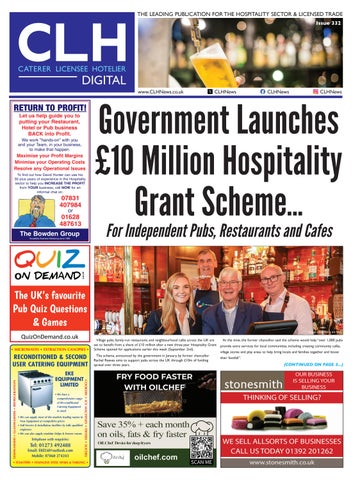
Government Launches £10 Million Hospitality Grant Scheme… For Independent Pubs, Restaurants and Cafes
The Bowden Group Hospitality Business Mentoring since 1989
Image credit: Pub is the Hub
RECONDITIONED & SECOND USER CATERING EQUIPMENT
The scheme, announced by the government in January, by former chancellor Rachel Reeves aims to support pubs across the UK through £10m of funding spread over three years.
EKE EQUIPMENT LIMITED • We have a comprehensive range of Re-conditioned Catering Equipment in stock • We can supply most of the markets leading names in New Equipment at competitive prices • Full Service & Installation facilities by fully qualified engineers • We can also supply modular fridge & freezer rooms
Telephone with enquiries:
Tel: 01273 492488
Email: EKELtd@outlook.com Mobile: 07860 274243
COOKERS • ICE MACHINES • FRYERS • SLICERS
DISHWASHERS • GLASSWASHERS • REFRIGERATION
• MICROWAVES • EXTRACTION CANOPIES •
Village pubs, family-run restaurants and neighbourhood cafés across the UK are set to benefit from a share of £10 million after a new three-year Hospitality Grant Scheme opened for applications earlier this week (September 2nd).
• TOASTERS • STAINLESS STEEL SINKS & TABLING •
At the time, the former chancellor said the scheme would help “over 1,000 pubs provide extra services for local communities, including creating community cafés, village stores and play areas to help bring locals and families together and boost their footfall”.
(CONTINUED ON PAGE 3...)
2
CLH DIGITAL
Issue 332
Editor's Viewpoint
Welcome to the latest issue of CLH News
A WELCOME DROP IN THE OCEAN?
PUBLISHED BY RBC Publishing Ltd 3 Carlton Mount 2 Cranborne Road Bournemouth Dorset BH2 5BR
Once again, we take our good news where we find it. This week it comes in the shape of the new £10 million Hospitality Grant Scheme, opened for applications this week, aimed at helping pubs, restaurants and cafés diversify, train staff and bring empty premises back to life. Any relief, no matter how small, is welcome.
TELEPHONE:
01202 552333
But let's be honest: in the grander scheme of things, it's not enough. More must follow.
FAX: 01202 552666
The nation wants more hospitality, not less. EDITOR
Peter Adams
www.CLHNews.co.uk
And it’s not all down to the present government. Over the past decade, from 2015 to 2025, the UK has lost a net total of around 6,150 pubs, falling from roughly 50,800 to 44,650 operating venues.
Closures have consistently and comprehensively outpaced openings. And that's before we even mention the catastrophic run of policy decisions over the last two years that have piled cost upon cost onto an already fragile sector. Grants are all well and good, and let’s not bite the hand that feeds, but my point is this: for the sector to genuinely thrive and grow, it doesn't need periodic grants handed out once the backlash gets too loud to ignore. It needs sustained tax cuts. Predictable, permanent, structural support — not a drip-feed of one-off pots that make headlines but don't move the dial on the fundamentals of running a pub, restaurant or café in this country. There is a genuine bright spot to report, and it's one the sector earned for itself. The UK pub trade enjoyed a strong summer, with wet-led, drink-focused pubs the standout winners — a combination of prolonged hot weather and the men's FIFA World Cup proving a potent draw. Pubs and bars with outdoor space benefited most, and the period saw a notable drop in business insolvencies in the early weeks of summer. That recovery happened in spite of government policy, not because of it. It was the great British summer, a major football tournament, and the enduring pull of a decent beer garden that did the heavy lifting — not Westminster, but hopefully we are at the
@CLHNews threshold of sector support and a £10 million grant is a good start. On a personal note, a big shout-out is due to Martin Devlin, general manager of the Fletcher Moss in Didsbury, who threw himself out of a plane at 15,000 feet to raise £4,568 for Francis House Children's Hospice. A brilliant effort, and exactly the kind of story we love to tell. We also publish a title for the adult social care sector, and the fundraising stories flow in constantly from care homes up and down the country. Sadly, we don't see nearly as much of that from hospitality. That's not to say the sector isn't doing its bit — it plainly is — but it doesn't shout about it, and that's a pity. We want to share the good news. So, whatever fundraiser you're planning or staging, let us shout about it for you. With our readership, we can help you get the recognition — and the donations — you deserve. And once again, well done, Martin. I would recommend readers sign up to our regular newsletter, which will deliver all the latest news directly to your inbox. You can sign up at www.catererlicensee.com/sign-up/ I can always be contacted at edit@catererlicensee.com
The Caterer, Licensee & Hotelier News Group is published by RBC Publishing Ltd, 3 Carlton Mount, 2 Cranborne Road, Bournemouth, Dorset, BH2 5BR. Contributions are welcome for consideration, however, no responsibility will be accepted for loss or damage. Views expressed within this publication are not necessarily those of the publisher or the editorial team. Whilst every care is taken when compiling this publication to ensure accuracy, the publisher will assume no responsibility for any effects, errors or omissions therefrom. All rights reserved, reproduction is forbidden unless written permission is obtained. All material is assumed copyright free unless otherwise advised.
CLHNews CLHNews
EDITOR Peter Adams
SALES EXECUTIVES David Bartlett Guy Stephenson
PRODUCTION & DESIGN Matthew Noades
Published by Published by
Issue 332
CLH DIGITAL
3
Government Launches £10 Million Hospitality Grant Scheme (CONTINUED FROM FRONT COVER)
and crafts activities, enabling pubs to expand their role as vital local hubs.
The fund is designed to support projects that help new hospitality ventures get off the ground, bring vacant premises back into productive use, and deliver training programmes that equip people with the skills, confidence and work ethic needed to build lasting careers in the sector.
The grant scheme comes as part of the Government’s commitment to deliver economic growth in every postcode and ensure communities across the country can share in that success.
TANGIBLE RESULTS The scheme builds on early pilot funding that has already delivered tangible results. Non-profit organisation The Right Course used pilot money to convert two prison staff restaurants and kitchens into a dedicated hospitality training facility, giving inmates hands-on experience in a realistic, high-street-style working environment. Separately, the Hospitality Sector Council teamed up with innovation lab L Marks to connect hospitality businesses with leading technology firms, uncovering new ways to boost productivity that have already saved hours of work and cut costs across the industry.
BOOST OPPORTUNITIES Minister for the Future of Work, Kate Dearden said:” Hospitality venues are where communities come together and where many people get their first experience of work. They create jobs and help our towns and neighbourhoods to thrive.
It follows on from the announcement that pubs, clubs and live music venues are set to receive a 20% cut to their business rates bills from April, saving the typical pub an estimated £1,000 next year. According to Pub is The Hub, publicans who have already diversified their businesses have reported a range of significant benefits, both commercially and within their communities. The charity said the introduction of a new community service or activity tends to generate positive PR and word of mouth for a pub, helping it appeal to a growing number of consumers who actively want to support businesses with a strong social conscience. Pub is The Hub said its in-house media team offers publicans dedicated PR support around the launch of new services, helping raise the profile of their pub in local, regional and trade press. The charity noted that adding new dimensions to a pub’s offering can make roles more appealing to prospective employees, while also helping to motivate and retain existing team members.
“This funding will back local businesses to grow, boost opportunities for people across the UK and support growth in every part of the country.”
Diversifying into services that support the local community, Pub is The Hub said, gives pubs a purpose beyond profit – something it described as rewarding for both licensees and their staff.
This move recognises the vital role hospitality plays in supporting local economies and communities across the UK. This includes providing many people with their first jobs, helping them develop key skills to build successful careers within and outside the industry.
New services and activities, along with support for local suppliers, can also help pubs build broader relationships with people and organisations in their area, according to the charity, with many new projects also benefiting local traders.
PUB IS THE HUB
Pub is The Hub added that licensees have reported a “halo effect” after diversifying, with new projects often leading to further involvement in community events and initiatives.
£3m of the grant funding has been specifically earmarked to support Pub is The Hub – an independent non-profit organisation helping pubs in rural and deprived areas to diversify their services and activities. This includes adding village stores, community cafes, play areas and arts
CREATE OPPORTUNITIES Jane O’Riordan, Co-Chair of the Hospitality Sector Council, said: “We
WE DO THE CHEFSWEAR, SO YOU CAN DO THE WORK
FIND OUT MORE cleanservices.co.uk/clh
Looking for professional, compliant chefs’ uniforms and workwear laundry services you can rely on? Look no further.
welcome the launch of this grant scheme, which builds on a successful pilot and demonstrates what can be achieved when government and industry work together. The flexible funding will help support innovative projects that boost productivity and sustainability, create opportunities for young people and those furthest from the labour market, and deliver the shared priorities of the Hospitality Sector Council and the wider sector.” Pub is The Hub Chief Executive, John Longden OBE said, “Access to this new support from the Hospitality Grant Scheme is warmly welcomed as it will help inspire local publicans to diversify to create much needed local services and activities in their rural, remote or deprived areas.
VITAL ROLE BIST, together with the Treasury, has recognised the vital role that publicans and pubs play as essential small local businesses, that make positive contributions to local communities. The scheme will also encourage the leveraging of other match private and public funding to support these small businesses. “ “This funding will help give long-term certainty to publicans to create new services and activities in their pubs which will deliver a wider social value and create a foundation for well-being in their local areas. “Pub is The Hub has been very thankful of the support and donations from within the pub and hospitality industry over the past 25 years and looks forward to working in collaboration with the BIST and the sector moving forward.” Labour MP Jonathan Reynolds has welcomed the Scheme, saying the investment will help new businesses get started, expand training opportunities and generate growth across the country. Taking to social media he said: “This scheme is so important. Money will be invested into projects that help get new hospitality businesses up and running, support training programmes, and generate growth in every postcode.”
4
CLH DIGITAL
Issue 332
The Perfect Marriage of Sunshine and Soccer Boosted Summer Takings. But What Next? By Berit Block, Senior Director of International Marketing at Constant Contact (www.constantcontact.com/uk) Hot summer weather, garden parties, and the men’s World Cup all conspired together to help the UK economy bounce back unexpectedly in June. The latest figures from the ONS released earlier this month show that monthly economic growth rose by 0.3%, happily defying expectations that cash-strapped households would keep their wallets firmly shut as the cost-of-living crisis took firmer hold. In June, everybody wanted to get out and enjoy the sunshine, flocking to the country’s pubs and hospitality venues. The on-trade was the clear beneficiary, but the surge in footfall also gave a much-needed lift to local high streets and independent businesses, helping the economy clock a total 0.4% growth across the second quarter of the year. (Relative) success in the World Cup also provided a timely national mood booster. However, as the summer cheer fades, families and small businesses face real pressure with experts warning a tough autumn could lie ahead. Volatile energy prices and trepidation around the upcoming October budget means many are wondering how long the feelgood factor can last. Restaurants, hotels and caterers now need to navigate the shift from summer boom to uncertain autumn. UK consumers massively value what smaller scale, local or boutique hospitality businesses offer: they choose them for the quality and personal experience that’s harder to get at the big chains. Yet nearly half of UK consumers are cutting back on spending at independent venues due to rising costs, and over a third say they’ll only choose small if the price is comparable. When the economy tightens, hospitality businesses need to ignite their marketing to bring in the crowds. The great news is that operators are responding with the creativity and resilience they’ve always shown. 75% of UK small business owners now identify as creators, using social media as their front door and AI to stay visible and competitive.
DISCOVERY AND TRUST IN THE DIGITAL AGE For restaurants, pubs and independent hospitality brands, statistics from a recent Constant Contact report shows that word of mouth (51.3%) remains the most important discovery channel, with social media (47.7%)
now firmly established as the digital front door. UK consumers also vet businesses through reviews (26.9%) and transparent pricing (20.5%). The top loyalty drivers are consistency (41.7%) and personalisation (26.1%). This shift underscores the rise of the hospitality Creator: owners and operators are using storytelling and social platforms not just to entertain, but to build trust. While we’re seeing many new kinds of UK operators embrace the idea of owner-creator to stay visible and competitive, many hospitality business owners don’t want to be marketers, don’t have the time to spend on marketing, or the funds to hire an agency. The good news is that AI-powered tools can help with all of this at accessible price points; often starting at no more than a cup of coffee per month. Whether that’s crafting and scheduling emails or creating social media posts, a new kind of hospitality marketing is emerging, one that is simple, efficient, and doesn’t take valuable time away from running a business.
AI: FINE FOR THE “BORING STUFF” While AI adoption across all businesses including hospitality is accelerating, 30.9% of consumers remain sceptical about it and 33.7% feel uncomfortable with its use. With this in mind, UK consumers have shown pragmatism, with 47.7% approving of AI for the "boring stuff" like looking up opening times, location and menu information, and 31.1% happy to use it for processing bookings or reservations. But transparency matters: globally, 47.4% say AI-generated content should be clearly labelled. That last figure is the one hospitality operators shouldn't skip past. The smartest use of AI right now isn't replacing the personal touch that made guests choose an independent venue in the first place, it's using it to get to that personal touch faster. A first draft of a newsletter or a social post can be generated in seconds; the value is added in the next step, when the operator reads it back, drops in the detail only they'd know (tonight's specials, a local reference, the weather finally being right for the terrace), and makes sure it actually sounds like their venue rather than a template. Labelling AI-assisted content clearly, rather than quietly, is part of that same trust-building exercise: with a third of UK consumers still uneasy about AI, transparency does more for loyalty than concealment ever would. The expectations placed on hospitality businesses have never been higher, and they are meeting the challenge by fundamentally changing how they work. The explosive growth of AI adoption, jumping to 87 percent in the U.S. alone, proves that owners are actively relying on this technology to succeed. By embracing AI to automate tasks and analyse data, hospitality businesses are buying back their time. The businesses that will win this autumn are the ones using that time on things AI can't do: knowing their regulars by name, reading the room, and building the kind of trust that keeps people coming back when budgets are tight.
Desborough Community Pub Reopens Following Transformational £260,000 Refurbishment Popular community pub, the George on High Street in Desborough recently reopened following a transformational combined investment of £260,000 from experienced licensee Vanessa Amoako and Admiral Taverns, the UK’s leading community pub company. This refurbishment has breathed a new lease of life into the George to elevate and modernise the overall look and feel of the pub – whilst still retaining its original, characterful features. This has ultimately enabled the licensee to further cement it as the go-to community hub for local residents. Passionate licensee Vanessa Amoako brings a wealth of knowledge and expertise to the pub having worked at the George for more than a decade before taking over as the licensee six years ago. The George is a true family pub with Vanessa’s daughters Jodie and Sophie supporting their mother in the day to day running of the pub. Going forward Vanessa is committed to building on the pub’s reputation of being a family-friendly hub that brings people together and supports all aspects of community life. Vanessa Amoako, licensee at the George, commented: “It’s been amazing to watch our plans for the pub come to life over the past number of weeks. We’re really proud of the new look and it’s been fantastic to welcome both new and old faces through the door since we reopened. This is a true family pub, not just
because of the team behind it, but because of our wonderful customers who really are like a second family. I’d like to thank our team at the pub for all their hard work throughout the renovation and since we reopened. I’d also like to thank the team at Admiral Taverns for their support throughout the project, as well as the local community, who have always been our strongest champions.” Going forward, Vanessa will be hosting a busy schedule of regular entertainment for the community to enjoy including quiz nights, live music and karaoke. In addition, as part of her mission to giving back to the local community, they will also be supporting regular fundraising events for local good causes. The pub is owned by Admiral Taverns, the UK’s leading community pub company with c. 1,350 pubs across England, Scotland and Wales. Jenna Trudgill, Business Development Manager at Admiral Taverns, added: “I’m thrilled to see the George open again after such a fantastic transformation, where Vanessa, Jodie, Sophie and the whole team have put in an incredible amount of hard work to make sure every detail is just right. It’s also been brilliant to see the two generations working side by side and the passion they all have for the pub trade. On behalf of everyone at Admiral Taverns, I want to wish the entire team at the George all the best for the future.”
Robert's Dorset - Reliable Stock, Fast Delivery, Great-Tasting Products Have you struggled for stock over the past 6-9 months, whether it’s for a warming machine, pots for you shelves or jars for self-serve, so many companies can't supply you because they have little or no stock as they don't make anything, At Robert's Dorset we make our crackling 6 days a week, in multiple flavours. Why are we different, the best way is to read our reviews on Amazon, TIKTOK, our Website or to pop into any of the 600+ stores, farm shops, petrol stations we supply and ask them. Every flavour is allergen free, yes that includes gluten free and we are 100% Keto but we also produce a high-quality peanut in10
flavours. Due to current demand you are looking at 7 days from orders placed. If you need stock don't delay, it's simple, email or call, we will get back to you the same day, with a price list and account form. Contact us via phone 01202 875280 email: trade@robertsdorset.com or go to our retail website: www.robertsdorset.com/trade-enquiries/ and complete trade application form. See the advert on the facing page for further information.
Issue 332
CLH DIGITAL
5
Hospitality Firms Warned To Review Labour Supply Chains Ahead Of Major Right To Work Shake-Up Hospitality businesses relying on subcontractors, agency labour and complex workforce supply chains are being urged to review their compliance procedures now, with sweeping changes to Right to Work rules due to come into force on 1 October 2026.
Hospitality firms could also find themselves exposed where they sit higher up the contractual chain and fail to implement the necessary compliance measures. To establish a statutory excuse against liability, businesses are expected to need robust contractual controls, processes for verifying workers’ identities, and measures to manage substitution arrangements.
The new rules, introduced under the Border Security, Asylum and Immigration Act 2025, will significantly expand Right to Work obligations beyond traditional employees and could expose firms to civil penalties of up to £60,000 per illegal worker if they fail to carry out the required checks.
Failure to comply could result in:
The changes mean businesses may no longer be able to rely on the assumption that individuals classed as self-employed or engaged via subcontracting arrangements fall outside the regime. Instead, liability could extend across labour supply chains, placing greater scrutiny on how workers are supplied, managed and verified.
Businesses that assume a worker is outside the regime simply because they are described as self-employed could be taking a significant risk.”
Mandeep Khroud, Head of Immigration at Irwin Mitchell, said: “Many hospitality firms operate through subcontractor networks and flexible labour arrangements. From 1 October, businesses will need to look much more closely at who is actually carrying out work on site and whether appropriate Right to Work checks have been completed.”
Under the new framework, Right to Work obligations are expected to apply to a wider range of arrangements, including:
“The Home Office has made clear that it will focus on the reality of working arrangements rather than the labels used in contracts.
• Individual subcontractors • Individuals engaged under worker contracts • Certain outsourced labour arrangements • Platform-based and online matching services • Contracts containing substitution rights
• Civil penalties of up to £60,000 per illegal worker • Criminal sanctions in serious cases • Suspension or revocation of sponsorship licences • Public naming by the Home Office Mandeep added: “With just one month until implementation, hospitality firms should be reviewing subcontractor arrangements, auditing onboarding processes and mapping their labour supply chains. Organisations that leave preparations until October may find themselves exposed to significant financial and reputational risks.” Experts are advising hospitality businesses to use the remaining weeks before the changes take effect to review contracts, assess workforce structures and ensure they have appropriate systems in place to verify the immigration status of anyone carrying out work on their projects.
Greene King Reaches 2 Million Loyalty Customers Landmark Greene King has reported that two million pub customers have now signed up to its loyalty and rewards programme, which can be used at the bar and on the app. The milestone has been achieved in less than a year following the launch of the new smart, integrated Greene King app. It also marks the next phase of the loyalty development journey with the introduction of ‘Missions’ which will nudge customer behaviour through setting targets to unlock rewards. The Greene King app is free, easy to use and has everything in one place to enhance customers’ pub experiences, combining pub venue search and booking, and order and payment functionality with exclusive rewards and special offers. A highlight for sports fans is the 10% off matchday discount on selected Premier League and Championship games showing in Greene King’s pubs each week of the football season.
The app is designed to make pub visits smoother and more enjoyable by reducing queuing, providing easy access to menus, and offering personalised rewards. It supports all Greene King brands across 1,600 Managed Pubs. Clair Preston-Beer, Greene King’s chief commercial and digital officer said: “This is an exciting time as we see our customers continue to enjoy the benefits of our app, loyalty and rewards. The summer of sport and pay day weekend offers have driven more sign-ups and more awareness, and customers are loving the rewards and offers which they can unlock. Thanks to insight into customer behaviour, we have a greater understanding on how we can connect and reward their loyalty with our pubs and brands. Having an integrated app allows customers to easily browse menus and book drinks, dining and sports, and this is a further evolution with options to drive loyalty through exclusive rewards and offers.”
6
CLH DIGITAL
Issue 332
How the Employment Rights Act 2025 Will Transform the Hospitality Sector By Ethan Diver, Solicitor at Taylor Walton Solicitors (www.taylorwalton.co.uk) Action points for employers • Review sickness and absence policies and ensure that managers are aware of absence reporting and record keeping requirements. • Ensure that payroll systems are using the latest SSP eligibility thresholds. • Review workplace budgets to account for higher SSP costs.
STATUTORY PATERNITY LEAVE
Action points for employers
The new right
• Audit existing zero hours arrangements and consider whether zero hours contracts remain commercially viable for the business. • Advance rota planning will become particularly important. Managers with rota responsibilities should be trained on the new rights and made aware of the risks of amending rotas at short notice. • Account for additional costs for having to offer guaranteed hours and compensate workers for late shift cancellations.
Since 6 April 2026, employees have been entitled to two weeks’ paternity leave from the first day of employment, replacing the previous requirement of 26 weeks’ service before becoming eligible. However, notably, employees will still require 26 weeks’ service to be eligible for statutory paternity pay, as under the previous law.
Implications for the hospitality sector The Employment Rights Act (ERA) 2025 represents one of the most significant changes to employment law in a generation. The reforms which are designed to improve employee rights, job security and working conditions, will be particularly significant for hospitality businesses, where shift-based staffing models rely on flexibility. This poses a number of challenges for employers in the sector, including higher employment costs, more onerous administrative requirements and less operational flexibility. The changes are being introduced in phases, with several changes having taken effect in early 2026 and further changes scheduled for late 2026 and 2027.
STATUTORY SICK PAY (SSP) The new right
This change means that more employees will become entitled to paternity leave. This may create additional pressures on rotas and workplace planning, particularly in hospitability environments where staff are likely to work variable shifts and hours.
Action points for employers • Update family leave policies to reflect the new law and, in particular, encourage employees to give as much notice as possible when taking paternity leave. • Ensure that managers understand these policies and there is a clear process for receiving and recording family leave requests.
GUARANTEED HOURS FOR LOW-HOURS AND ZERO HOURS WORKERS The new right
Since 6 April 2026, SSP has been payable from the first day of sickness absence, replacing the previous three-day “waiting period”. The lowerearnings threshold has also been removed, meaning that lower-paid workers can now qualify for SSP.
Implications for the hospitality sector This is particularly relevant to the hospitality sector, where workers frequently work variable shifts and are paid close to National Minimum Wage. The change in law means that more workers will become entitled to SSP more frequently, in addition to the cost of arranging cover for absent workers where required.
Zero hours arrangements have traditionally afforded hospitality businesses significant flexibility to increase or reduce staffing requirements in response to short-term business demands. The new obligations mean that employers will be unable to operate so flexibly, or it will be more expensive for them to do so.
The ERA 2025 introduces a new right for workers to be offered guaranteed working hours based on the hours that they regularly work over a previous reference period. The duration of this reference period is subject to regulations but expected to be 12 weeks. The Act will also introduce new rights to reasonable notice of a shift and compensation where a shift is cancelled or curtailed at short notice. Again, the applicable notice requirements are subject to regulations expected soon. These changes are scheduled to take effect in 2027, although a precise date has not been provided.
Implications for the hospitality sector
UNFAIR DISMISSAL The new right From 1 January 2027, employees will only require six months’ continuous service to bring an unfair dismissal claim, compared to the current two years’ service requirement. The maximum cap on compensatory awards will also be removed.
Implications for the hospitality sector This will have major implications for all employers. Until now, it has been commonplace for employers to apply six-month (or longer) probationary periods and follow relaxed dismissal procedures before employees obtain two years’ service. Under the new law, employers will have much less time to decide whether to retain a new starter before they acquire unfair dismissal protection, and the consequences of an unfair dismissal could be more expensive.
Action points for employers • Review and reduce probationary periods to less than six months. • Review recruitment and probation procedures to ensure detailed and accurate performance records are kept throughout the probationary period. • Ensure that managers are adequately trained on dismissal procedures. Whilst these reforms are undoubtedly significant for the hospitality sector, businesses which review their workforce models, contracts and procedures now will be better positioned to deal with the changes as they continue to be implemented.
JD Wetherspoon Confirms Six New Pub Openings Across the UK for September JD Wetherspoon has confirmed a further six pub openings across England and Scotland throughout September 2026, continuing a busy year of expansion for the budget pub operator.
The Crewe site is understood to occupy a former Beefeater restaurant, redeveloped as part of a multi-million-pound investment, with the opening expected to create around 70 local jobs.
The company, which currently operates in excess of 800 venues nationwide, has already opened several new sites in 2026, including outlets in Cornwall, Bath and Blackpool. The latest confirmations bring the chain’s near-term opening pipeline to twelve pubs in total.
Further openings confirmed for later in 2026 Beyond September, Wetherspoon has confirmed three further openings before the end of the year: • Piccadilly Hall, Piccadilly (The Trocadero, 30 Shaftesbury Avenue, London, W1D 7EP) – 13 October • The William Chambers, Edinburgh (30a Chambers Street, EH1 1HU) – 3 November • The Benjamin Franklin, Charing Cross (11 Strand, London, WC2N 5HR) – 24 November The Charing Cross site, sited beside the mainline and Underground station, gained planning consent from Westminster City Council earlier in the year following an appeal, having initially been refused over
September openings The six pubs due to open next month are: • The Marshfield Bank Farm House, Crewe (Coppenhall Lane, Woolstanwood, CW2 8SD) – opening 1 September • The Red Gown, St Andrews University Students’ Association – opening 4 September • The Heath Hotel, Southampton (Beaulieu Road, Dibden Purlieu, SO45 4PW) – opening 8 September • The Belle Vue, Manchester Airport (Terminal 2, airside) – opening 15 September • The Cranborne Hundred, Ferndown (Ringwood Road, BH22 9BB) – opening 16 September • The Fletton Brick, Bedford (Marsh Leys Cottages, Kempston, MK42 7FY) – opening 29 September
noise concerns. The continued rollout comes despite a wider period of rationalisation for the group, which has closed a number of underperforming sites in recent years alongside its ongoing programme of new openings.
Eat My Logo
branding images, printed directly into fondant icing. Customers can buy the finished product or just the fondant toppers to add to their own decorations.
Based in Chorley, Lancashire the team at Eat My Logo Limited strive to make brands tasty. Every week they send tens of thousands of branded food items to business around the UK to help them promote their brand in a fun and tasty way.
A growing confectionary range offers a choice of traditional sweets, packed in small eco friendly bags that are branded with your own brand or logo. You can also choose from tubs, jars and tubes.
With a wide range of products that include cakes and biscuits, confectionary and chocolate, there is plenty to choose from to meet the needs of your business. Eat My Logo bake their own cake and biscuit ranges, many of which are decorated with high quality edible
Their chocolatiers create delicious, branded chocolate bars and chocolate boxes using high quality couverture chocolate. These unique chocolate products are ideal hotel room favours, whether branded with an edible logo or a small pack of truffles.
With low minimum order quantities and competitive prices, they can offer a great range of products to add that extra special touch to your hospitality offering. For 25% OFF YOUR FIRST ORDER, please register your details via the QR code. www.eatmylogo.co.uk emlsales@eatmylogo.co.uk 01772 472 580 See the advert on page 2 for details.
Issue 332
CLH DIGITAL
7
Busier Pubs and Longer Visits Fail to Lift Summer Bank Holiday Pint Sales UK pubs and bars were busier and consumers stayed longer over the Summer Bank Holiday weekend, but stronger engagement failed to translate into increased draught beer and cider sales, according to the latest data from The Oxford Partnership and Vianet. Across the four-day Bank Holiday period, from Friday 28th to Monday 31st August, pubs sold an estimated 25.4 million pints, compared with 26.4 million during the equivalent weekend in 2025, a 3.9% year-on-year decline.
heavy rain, thunderstorms and strong winds in some parts of the country, with temperatures generally around the low 20s. The change was particularly visible across drinks categories. Total Lager declined 5.4%, while Cider fell 10.6% and Flavoured Beer dropped 17.6% year-on-year. Craft was also down 10.6% and Ale declined 3.2%. Stout was the clear exception, growing 12.3% year-on-year and emerging as the only category measured to record growth. Premium Lager proved comparatively resilient, declining just 1.5%.
The fall came despite notably stronger consumer engagement. Average dwell time increased by 13 minutes, from 141 to 154 minutes, while occupancy rose from 62.1% to 66.1%. Occupancy was ahead of last year on every day of the weekend, suggesting that the challenge was not attracting consumers into venues, but converting those visits into the same level of draught consumption.
Alison Jordan, CEO of The Oxford Partnership, said: “The Summer Bank Holiday demonstrates why footfall alone doesn’t tell the whole story of hospitality performance. Pubs were fuller, people stayed longer and the occasion still generated a significant uplift compared with a typical weekend but consumers simply didn’t drink as much draught beer and cider as they did last year.
The Bank Holiday nevertheless remained an important trading occasion for the sector. Rate of sale was 17.3% higher than an average Friday-to-Monday period, equivalent to an additional 114 pints per outlet. Sunday and Bank Holiday Monday delivered the strongest uplifts, at 45.7% and 46.3% respectively versus an average equivalent day.
“What is particularly interesting is the change in category mix. Stout growing by more than 12% while cider and flavoured beer declined sharply suggests the cooler, wetter conditions influenced not just how much people drank, but what they chose to drink.
Weather appears to have played an important role in both overall performance and what consumers chose to drink. While the 2025 Bank Holiday was predominantly dry and increasingly warm, this year’s weekend saw
“For suppliers and operators, understanding these changes in behaviour is increasingly important. The opportunity is not simply to get consumers into venues, but to understand what drives their choices once they’re there.”
Market Taverns Appoints Miles Slade as CEO as Pub Group Embarks on New Phase of Growth Market Taverns has announced the promotion of Miles Slade to Chief Executive Officer, effective 1 September 2026, as the independent London pub group prepares to accelerate investment in its estate and pursue further expansion. Miles joined Market Taverns as Managing Director in February 2026, bringing extensive hospitality experience from senior roles with RedCat Pub Company, Urban Pubs & Bars and JD Wetherspoon. Since joining, he has led a strategic review of the business, identifying opportunities to enhance the existing estate and establish a clear platform for future development. The resulting investment programme will see a number of Market Taverns’ pubs reinvested in and enhanced, with a focus on the overall guest experience, individual pub propositions and the continued development of their distinctive identities. Alongside investment in the existing estate, Market Taverns is also looking at opportunities to expand its London portfolio, with a focus on acquiring pubs that fit the group’s independent approach and offer the potential for further development. Commenting on his appointment, Miles Slade, Chief Executive Officer of Market Taverns, said, “Market
Taverns has all the ingredients of a great independent pub business, and exceptional collection of individual London pubs, talented people and a clear sense of what makes an independent pub special. My first few months have been about understanding the business, the estate and the opportunities in front of us. We now have an exciting plan for the next stage. We will be investing in our existing pubs, developing our food offer and, importantly, looking for the right opportunities to grow the estate. “Our ambition is to build a stronger, more successful business without compromising what makes Market Taverns distinctive. We want to grow, but we will do so selectively and with a real focus on quality, ensuring every pub we operate has its own character and place within its community.” Rolf Munding, Owner of Market Taverns, said, “Miles has made a significant contribution to Market Taverns since joining the business and has brought a clear strategic focus to the next stage of its development. His experience, energy and understanding of the pub sector make him the right person to lead the business as we invest in the estate and look at new opportunities for growth. We have an exciting period ahead and I’m looking forward to seeing the plans come to life.”
8
CLH DIGITAL
Issue 332
Average Food Hygiene Rating for Hotels, B&Bs and Guesthouses Revealed Across the UK, as Over 95% Score a 4 or a 5 zero-rated pubs recorded in this year's data. When looking at all food businesses together, the top-scoring region was the South West, with an average rating of 4.69 from over 21,000 premises. This was followed by the North East (4.66), Northern Ireland (4.65) and the East Midlands (4.64). London had the lowest average rating in the study, with a score of 4.39, though the area had by far the most establishments, with almost 37,000 premises (36,804) contributing to the rating. East Counties town Ipswich and North West seaside town Southport topped the individual rankings, with a highly impressive 4.92 out of 5, closely followed by Chichester (4.91), Stockton-on-Tees (4.86), and Lincoln (4.85). The bottom three were Wigan (4.06), Bolton (4.03), and Walsall (4.03). The average food hygiene rating for hotels, B&Bs and guesthouses across the UK has been revealed, thanks to a report from leading online training provider High Speed Training. The report, which analysed Food Standards Agency (FSA) data for food businesses across England, Scotland, Northern Ireland and Wales, found that the average food hygiene rating for hotels, B&Bs and guesthouses was an impressive 4.79. An outstanding 84.90% (8,914 establishments) received the top score of 5. This marks a slight improvement on the 2025 High Speed Training report, where the score was 4.78, showing that this sector's already high standards continue to rise. In total, a combined 10,030 establishments, or 95.53% of the category, scored a high rating of either 4 or 5. Hotels, B&Bs and guesthouses performed exceptionally well compared to other business types. Their average of 4.79 is significantly higher than restaurants, cafes and canteens, which received an average score of 4.59 in the 2026 analysis. Just 4.47% establishments in the hotel sector scored a 3 or below, less than half the figure seen in the restaurant category (10.56%). Only 7 hotels, B&Bs or guesthouses (0.07%) received a zero for their hygiene rating. This is a tiny fraction compared to the 278 (0.24%) zerorated restaurants, 166 (0.33%) zero-rated takeaways, and 50 (0.11%)
The Food Hygiene Rating Scheme (FHRS) is a partnership with local authorities in England, Wales and Northern Ireland that was launched in 2010. It replaced a number of regional schemes, with the aim of providing hygiene information clearly and more effectively across the UK. Following regular inspections, ratings are devised based on the standard of food handling hygiene, the physical condition of the premises and facilities and food safety management practices. These ratings are then made available on the Food Standards Agency (FSA) website and are usually visible from outside of the premises, often presented in a window near the entrance. In Wales and Northern Ireland, it is compulsory for businesses to display their food hygiene rating. However, in England it is currently just considered best practice. High Speed Training’s report is now in its 5th consecutive year, and over this time, average ratings across England, Wales and Northern Ireland have increased, from an average of 4.49 in 2022 to 4.58 in 2026. The average rating rose each year, apart from 2024, when it fell slightly to 4.47. All but one of the analysed regions improved their rating from 2022 to 2026, with the West Midlands and the North East sharing the biggest increase in average rating, a rise of 0.10.
The only region to record a drop in average rating over the 5-year period was Northern Ireland, dropping by 0.04, though it is worth noting that Northern Ireland has been a strong performer in the context of all the regions analysed, taking the top region spot twice and never dropping out of the top 3 since 2022. Dr Richard Anderson, Director of Learning at High Speed Training, said: “Food safety and robust hygiene practices should be of paramount importance to food businesses, and to the customers who use them. Over the last 5 years, we have seen trends broadly improve across the whole of the UK, which is a really positive sign. These ratings are a direct reflection of how safely and hygienically that establishment operates, and we urge businesses and customers to take them seriously. “For businesses that perform well, a high rating is a real selling point. However, establishments with a low hygiene rating can be extremely offputting for customers, and may have a significant impact on reputation and profitability.” “Our report shows that, on average, standards remain high across the UK, and have improved from 2025. This commitment to correct food hygiene training for staff, alongside robust food management procedures and everyday good practices are crucial to not only performing well as a business, but attracting and retaining customers. “We would urge customers to always check the food hygiene ratings of establishments they wish to dine at, as it allows them to make an informed decision when choosing where to eat.” To view the report in full, and to see how your area compares to others, please visit www.highspeedtraining.co.uk/hub/food-hygiene-ratings-report
Northern Irish Brewers Pour Their Beer in Parliament as They Can’t Easily Be Sold in NI Despite being more than 300 miles away, independent brewers from Northern Ireland (NI) found it easier to have their beers served in Parliament than they do in their local pubs back home.
Principle. In Great Britain, small breweries can apply directly for a premises licence, allowing 46% of GB independent brewers to run thriving community taprooms. Meanwhile, recent figures from SIBA show NI lost a fifth of its breweries in the first six months of 2026 alone – the highest rate of closures in the UK.
Representatives of NI’s independent breweries flew their beers into Westminster on Wednesday (2 September) to raise awareness of the severe market restrictions preventing their growth. This means that 99% of beer sold in NI is from imported Global brands leaving the 17 remaining small independent breweries in NI with little choice but to export.
“It’s often easier for a beer drinker to get their hands on a Northern Irish beer in London or Manchester than it is in Belfast,” said William Mayne, Managing Director of Bullhouse Brewery. “Consumers are losing out, local pubs can’t stock local products, and small producers are being pushed to the brink. While developers get free licenses for hotels, local manufacturers are locked out. We need real reform of the licensing laws to create a level playing field and support local manufacturing.
They called on MPs and the NI Minister to support urgent changes to the 124-year-old licensing system. Under NI’s Surrender Principle, an existing license must be surrendered before granting a new one. In many parts of NI, obtaining a new license is impossible. Where available, a license costs a minimum of £120,000, with some recent transactions exceeding £1 million – a figure only achievable by signing exclusive supply agreements to unlock funding from Global beer conglomerates. In contrast, developers investing £500,000 in an upstairs 10-room apart-hotel receive a license allowing them to operate as a pub on the ground floor, outside the Surrender Principle. Whilst a brewery investing £1 million into local manufacturing would be forced to attempt to secure a license via the Surrender
“MPs got a chance to enjoy the world-class beers being produced in Northern Ireland, ironically, it’s easier to serve our beer in the Palace of Westminster than to a pub in my local town, Newtownards. Consumers in Northern Ireland want our products and we will continue calling for reform until we can satisfy local demand and provide much needed consumer choice.”
Logicall Wireless Solutions - Temperature Monitoring Manual temperature checks are costly, time-consuming, and prone to error. Staff need to take readings regularly, log them accurately, and spot potential issues before they escalate. But what happens if a fridge or freezer breaks down overnight? You won’t know until the next day—and by then, you’ve already lost stock and a day’s trade. That’s thousands in potential losses, all because manual checks can’t catch problems in real time. Automated temperature monitoring is the obvious solution. Smart sensors continuously track your fridges and freezers, alerting you instantly if temperatures rise or equipment fails. You stay audit-ready, paperless, and confident that your stock—and your customers—are safe. The cost? From just £40 per month, a small investment that can save thousands. One
breakdown avoided can more than pay for a year of monitoring by preventing wasted stock and lost sales. Make the switch to digital monitoring today—and unlock the full benefits of Logicall’s ecosystem. Beyond temperature, our solution includes energy monitoring, leak detection, digital HACCP checks, and much more. Protect your business, save time, cut costs, and simplify compliance—all with a single, smart system. 01672 569374 info@logicall.co www.logicallmonitoring.co.uk
Issue 332
CLH DIGITAL
9
Leaders Call For Support as Rising Costs and Falling Visits Hammer Confidence Hospitality leaders’ optimism remains low despite a boost from the football World Cup and hot weather, the latest Business Confidence Survey from NIQ and Zonal reveals. The poll shows just 35% of leaders feel optimistic about prospects for their business over the next 12 months. It is a drop of 2 percentage points from the last survey in May, and 16 percentage points down from the start of 2026. The number of leaders feeling optimistic about the future of hospitality in general is virtually flat quarter-on-quarter at 21%.
to rise further this year amid uncertainty about geopolitics and the impact of heatwaves on production. Nearly as many (67%) are concerned about VAT, and high energy prices and interest rates are among many other worries. The Business Confidence Survey indicates that challenges are especially acute in the independent hospitality sector at the moment. Just 16% of leaders of single-site operators are optimistic about the prospects for their business in the next year.
Footfall, sales and profits squeezed
Karl Chessell, Director – Hospitality Operators and Food, EMEA at NIQ, said:
While football fans packed pubs during England’s long run at the World Cup, the tournament was much less beneficial to restaurants and other venues not screening games. Around two in five (41%) leaders say their footfall has declined recently – more than the number (34%) who say it has increased. Excessive heat may also have cut some consumers’ trips to eat and drink out.
“The World Cup and hot weather should have boosted hospitality this Summer, but any benefits have been outweighed by relentless challenges. Falling visits and rising costs are a hugely damaging combination and it is no surprise to see that leaders’ confidence is running so low – especially among smaller businesses. With conflicts and the climate fuelling market volatility, there is little respite in sight on inflation.
Fewer visits and cautious consumer spending have increased the pressure on venues’ sales and profits, the Business Confidence Survey shows. Only 41% of leaders reported that their quarterly revenue had increased year-on-year, despite higher prices in most venues. Just over half (52%) said either that their profitability had dropped, or that their business was currently running at a loss or unviable. Relief needed on taxes and inflation Fragile confidence levels highlight the urgent need for greater support for hospitality. Leaders have welcomed the government’s relief on business rates for pubs, clubs and music venues, and are hopeful that more help will follow from new Prime Minister Andy Burnham. Nearly half (47%) of leaders surveyed by NIQ and Zonal said they were optimistic that the new leadership will benefit hospitality, while 26% are pessimistic. However, much more support is needed across a range of areas including taxes and high inflation in labour, energy and food costs, the survey shows. Leaders said their employment costs have risen by an average of 10.7% per person in just two years, and 85% say higher labour costs are a concern for their business. The same proportion (85%) have seen their electricity, gas and / or oil prices increase in the last three months, following energy shocks related to constricted oil supply. Meanwhile, more than two thirds (69%) are concerned by inflation in food and drink prices, which are likely
More positively, there are encouraging signs of support from the new Prime Minister, and the forthcoming Budget could be a lifeline for thousands of hospitality businesses and jobs. From VAT to rates to National Insurance contributions to alcohol duty, there are many levers that the government can immediately pull to ease the pressure on operators. Doing so would quickly unlock investment and new jobs and help kickstart the economic growth that the country needs.” Tim Chapman, Chief Commercial Officer at Zonal, said: “What is most striking about this research is that, despite the challenging operating environment, just how much operators are continuing to invest where they can – in their estates, in their teams, in technology, and in the experiences that keep guests coming back. That being said, there’s no hiding from the fact that confidence in the sector is flat at best. Recent Government moves, however, such as business rates relief, are creating some optimism as we look to rest of 2026 and beyond. Hopes appear to be further boosted by the possibility of a VAT cut for the sector in this autumn’s budget – something which the sector has fought long and hard for and which is very well supported by both operators and consumers alike.”
FOR ALL THE LATEST NEWS FROM THE HOSPITALITY SECTOR VISIT WWW.CATERERLICENSEE.COM
10
CLH DIGITAL
Issue 332
What’s Next For Luxury? Bin The Bling! By Mark Britton Jones, Senior Lecturer at Glion Institute of Higher Education London (www.glion.edu) For over a century, luxury has been a mirror reflecting society’s aspirations, anxieties and selfimage. In the late 19th century, during America’s socalled Gilded Age, the surface shimmered with gold; yet beneath it lay inequality, corruption and a relentless hunger for status. The name itself was a warning: gilded, not golden. A thin veneer masking something far less flattering. In many ways, the past two decades of luxury consumption have echoed that same gilded impulse. Flashy logos, monogrammed everything, and the unmistakable grammar of ‘conspicuous consumption’ – a phrase coined by economist Thorstein Veblen in reference to the public display of wealth as a form of social signalling. Luxury fashion maisons built empires on this logic, plastering their initials across handbags, sneakers and even water bottles. The message was clear: “If you’ve got it, flaunt it”. But something has shifted. Many of today’s luxury consumers – whether newly affluent or simply more mature in taste – have begun to reject the bling. They are turning away from the ostentatious and towards something quieter, deeper and infinitely more meaningful. The codes of luxury, once again, are being rewritten.
FROM CONSPICUOUS TO CONSIDERED: THE RISE OF DISCREET LUXURY In these less-than-Roaring ’20s, luxury consumers are no longer satisfied with loud branding or the paradox of mass-market ‘exclusivity’. They want craftsmanship, sensual materials and objects that whisper rather than shout. They also demand personalisation, customisation and, above all, authentic exclusivity – not the kind that can be bought off a shelf, but the kind that feels earned, intimate and rare. This shift is not merely aesthetic; it is philosophical. The new luxury mindset aligns with Coco Chanel’s enduring observation: “Luxury is the opposite of vulgarity.” Where once logos served as social armour, now they feel gauche. Where once the goal was visibility, now it is discernment. The typical consumer wants to be perceived as ‘old money’, even if they are decidedly ‘new’. They want to signal taste, not wealth; knowledge, not noise (much more on luxury and status signalling here). This is luxury as a cultural code, not merely a commodity.
THE EXPERIENCE ECONOMY – AND BEYOND
Joseph Pine and James Gilmore’s seminal concept of the Experience Economy has never felt more relevant. The new luxury consumer is buying memories, transformations and identity.
While global luxury fashion brands have established a presence there – and can certainly sustain it – the real appetite lies elsewhere, in the form of:
This drives them towards investing in:
• Fine wines and fine dining • Architecturally stunning homes with bespoke interiors • Luxury travel that prioritises privacy and authenticity • Unique, curated experiences over mass-market glamour A striking example of this new luxury ethos is Crown Towers Perth, the only hotel in Australia to hold a Forbes Travel Guide Five-Star rating.
• Exclusive hotel and resort stays • Gastronomic journeys led by chefs who treat cuisine as art • Wellness and spa retreats that promise renewal rather than indulgence • Private jet and yacht experiences that offer privacy, control and freedom • Travel that evokes a bygone era of elegance, ritual and impeccable service For the most evolved consumer, Pine and Gilmore’s next frontier – the so-called Transformative Economy – is the true destination. Here, luxury is not about what you own or even what you experience, but who you become. It aligns seamlessly with Maslow’s highest tier: self-actualisation.
It does not rely on fake gold, theatrical staging, or the clichés of ‘traditional luxury’. Instead, it offers something far more compelling: simplicity, elegance and an unwavering commitment to service excellence.
In this way, luxury becomes intertwined with our life’s journey.
This is luxury without pretense, perfectly aligned with the new consumer.
GEN Z: THE VALUES-DRIVEN LUXURY VANGUARD
THE INVISIBLE VELVET ROPE: EXCLUSIVITY REIMAGINED
While older consumers may be maturing into this new sensibility, Generation Z is picking up and running with it. Now an important luxury customer segment in its own right, this new generation – digitally native, globally connected and socially conscious – demands that luxury brands stand for something beyond beauty.
Even in New York, where luxury hotels once competed to emulate Europe’s grand dames, the trailblazers today are those that offer intimacy rather than spectacle. Their lobbies feel like private members’ clubs, not bustling public spaces. Their receptions are discreet, their service anticipatory.
They seek: • Sustainability as a non-negotiable factor • Transparency in sourcing, labour and environmental impact • Responsible business practices that reflect their worldview • Authenticity over artifice • Brands that align with their identity, not the other way around For Gen Z, luxury is not a badge of superiority; it must reflect their values. They are willing to spend, but only when the brand’s ethics match their own. This is a profound shift and one that will reshape the industry for decades.
INDIA: THE NEXT GREAT LUXURY FRONTIER Much has been written about the slowdown in Chinese luxury spending, but the industry’s gaze has already shifted to India, a market whose relationship with luxury stretches back millennia. Maharajas, artisans and centuries of craftsmanship have created a cultural foundation to which luxury is intrinsic. India’s rapidly expanding class of high-net-worth individuals is attracting the attention of luxury fashion, automotive and jewellery brands. Yet this market presents a challenge: flashy branding and bling do not resonate with a culture that has long valued refinement, heritage and artistry. To succeed in India, brands must understand that the cultural codes of luxury must be interpreted, not imported.
PERTH: A QUIET CAPITAL OF ‘NEW LUXURY’ Geographically distant from the traditional luxury capitals, Perth in Western Australia has emerged as an unexpected powerhouse. With one of the world’s highest concentrations of centi-millionaires and self-made millionaires, Perth’s wealth is understated but no less substantial.
Walk in unannounced and you may be gently asked: “Do you have a reservation?” or “Are you a member?” This is not exclusion for exclusion’s sake. It is the creation of boundaries; the invisible velvet rope that signals privacy, privilege and belonging. It is luxury as a curated community, away from the crowds.
BIN THE BLING: THE FUTURE IS QUIET, PERSONAL AND PROFOUND To conclude, I very much feel that luxury is entering a new era, one that rejects the superficiality of the Gilded Age and the excesses of logodriven consumption. While some may cling to the fool’s gold and cut glass of decades past (perhaps the last Baby Boomers still sporting their fake tans?), the market has moved on as new generations have taken prominence. The new luxury consumer is: • Discerning • Values-driven • Experience-oriented • Transformation seeking • Quietly confident They understand that true luxury is not about being seen, it is about being understood. This is why I feel strongly that in our world today bling is not just outdated; it is irrelevant. The future belongs to brands, destinations and experiences that offer depth, craftsmanship, meaning and exclusivity that cannot be mass-produced. Luxury, once again, is becoming what it was always meant to be: A celebration of the exceptional, not the excessive.
Star Pubs Launches Real Ale Support To Coincide With Cask Ale Week
Star Pubs has collaborated with 30 brewers from around the UK to create a free cask ale training playbook designed to address publicans’ most common concerns about cask and drive sales.
Called Hello Cask, the training is part of a wider package of cask ale support provided by Star Pubs – including a guest ale programme aligned to emerging new trends – that has helped its pubs outperform the market yearto-date. Its launch coincides with Cask Ale Week, which Star Pubs is also marking by releasing Marmalade Best2, a limited-edition ale aiming to raise up to £20,000 for leading loneliness charity Marmalade Trust3 and highlight the role of the great British pub in bringing people together. Marmalade Best is being brewed exclusively for Star Pubs and HEINEKEN UK on trade customers by Timothy Taylor’s. For every pint sold during the three months it is available, 20p per pint sold will go to Marmalade Trust, which Star Pubs has supported since 2023. Research amongst participating brewers into common barriers to stocking cask ale has determined the topics covered in the Hello Cask training. It debunks myths about the difficulty of delivering cask with modules such as a step-by-step guide to conditioning, common cask mistakes and tips & tricks to ensuring consistent top quality. With ease of use in mind, the training comes in bite-sized chunks that can be accessed by publicans and their staff at any time. To keep it engaging, the content is presented in a variety of formats from checklists to videos filmed at breweries.
Says Caren Geering, Central Operations Director for Star Pubs: “We know publicans are busy – with Hello Cask they can benefit from training without the need to leave their pubs, including sessions filmed in breweries. Thanks to the participation of brewers around the UK, the training provides a truly national approach to the cask category. “In a cost-of-living crisis, customers are seeking out quality and an experience they can’t replicate at home when they choose where to go out. A great cask ale offer will deliver this. Nearly 70% of our estate currently stocks cask ale. We’re committed to getting even more on board and to supporting our pubs in achieving the perfect pour – it’s the way to outperform the market in any drinks category.
“We’re starting to see green shoots of growth in the cask sector with younger pub goers and women discovering it, particularly in high street venues. Over time we expect this trend to take off in community pubs. More fruity flavours, such as the citrus notes of Marmalade Best, are proving particularly popular with the younger demographic. Cask is a product that people love to talk about and lends itself to discussion, making it the ideal drink to raise funds to aid people experiencing loneliness.” Adds Andrew Leman, Head Brewer at Timothy Taylor’s: “Working with Star Pubs to create Marmalade Best has been a real joy for our brewing team. We set out to craft a beer that balances bright citrus aromatics with the depth and smoothness people love in Timothy Taylor’s cask ales – and Marmalade Best delivers exactly that. Its vibrant, zesty profile strikes a chord with drinkers, and will help drive increased interest and demand for quality cask across the bar.”
Issue 332
CLH DIGITAL
11
New Campaign Calls for the Chancellor to Drop the Tap Tax Independent brewers are urging the Chancellor to Drop the Tap Tax in his Budget next month to support local community pubs and breweries. They have launched a new national campaign asking pub goers, beer drinkers and supporters to sign a petition at www.droptaptax.com calling for the tax on pub beer to be lowered. Supporters can also use the site to contact their local MP and encourage them to back the campaign. “Our pubs and breweries are tapped out and we lost 137 breweries last year and two pubs a day were closing at the beginning of this year,” said Andy Slee, Chief Executive of the Society of Independent Brewers and Associates (SIBA) which is leading the campaign. “The Chancellor has the power to lower the tax on beer sold in our pubs in his Budget which would be a real boost for our community pubs and independent breweries. We’re encouraging pub goers, beer drinkers and others to show their support by signing the petition and contacting their MP to urge the Chancellor to Drop the Tap Tax in October.”
Using a mechanism called Draught Relief, the Chancellor can lower alcohol duty specially on beer sold in pubs via hand pulls and keg taps. Its currently set at a 13.9% differential and independent brewers believe that an extended rate of 30% or more could support jobs, help grow the economy and see more pints being served. With seven out of 10 pints produced by independent breweries sold either directly at the brewery taproom or at local pubs within 40 miles, getting the Chancellor to Drop the Tap Tax could make a real difference to the future of community pubs and brewers. “Beer is an essential part of the pub experience, representing about 60% of all drinks they sell,” commented Anthony Hughes, SIBA chairman and founder of Lincoln Green Brewing Company. “Yet they face one of the highest beer duty rates in Europe. If the Chancellor wants to see growth in every postcode and our pubs thriving, then the best place to start is with lowering tax on pub beer.” The campaign petition can be found at www.droptaptax.com and publicans, brewers and hospitality venues can download posters and share the petition on social media using the hashtag #DropTapTax. It runs up to the Autumn Budget which will be held on Wednesday 28 October 2026.
Knaresborough Community Pub To Reopen Following Refurbishment Popular community pub, the Mother Shipton Inn in Low Bridge, has officially reopened on Thursday 27th August, following a combined investment of £250,000 with Admiral Taverns. The refurbishment breathes a new lease of life into the Mother Shipton Inn to elevate and modernise the overall look and feel of the pub – ultimately enabling the manager to further cement it as the goto community hub for local customers.
together and supports all aspects of community life. Matt commented: I’m absolutely thrilled with how the refurbishment came along. Every detail has been carefully considered to ensure that the Mother Shipton Inn feels fresh and exciting, while still retaining the warmth and character that makes this place so special for the community.
The Mother Shipton Inn dates back to the 17th century, when it was originally constructed as a gatehouse. It was converted into an inn in the 18th century and named in honour of Ursula Sontheil, the legendary Yorkshire prophetess better known as Mother Shipton.
I have loved every minute of my time at the Mother Shipton Inn so far and I would like to thank everyone, from my family and friends, our customers and of course the team at Admiral Taverns, for all their ongoing support. I look forward to everything the future holds for this fantastic community pub!”
Internally, the pub has been refurbished and features a mix of upgraded fixtures and fittings, creating a refreshed and comfortable setting for customers. The kitchen has also been updated, providing improved facilities to support the pub’s food offering.
Going forward, he will be hosting a busy schedule of regular entertainment for the community to enjoy including a quiz night every Thursday from 7pm. In addition, as part of his mission to give back to the local community, he will also be raising money for Knaresborough food bank on the opening night.
Externally, the pub includes brand-new lighting and signage and can provide seating for up to 100 customers, offering plenty of space for relaxed drinks and dining in the open air.
Ian Lester, Business Development Manager at Admiral Taverns, added: “It has been an absolute pleasure working alongside Matt throughout this refurbishment journey. Watching his vision come to life has been incredibly rewarding.
Manager Matt Chapman, brings a wealth of knowledge and expertise to the pub. Local to the area, he understands the community and is keen to create a welcoming pub that serves both familiar and new faces. Going forward the manager is also committed to creating a dog and family friendly hub that brings people
Available in Big Value 1Kilo Bag
On behalf of myself and everyone at Admiral Taverns, I wish Matt and the entire team at the Mother Shipton Inn the best of luck in the future.”
12
CLH DIGITAL
Issue 332
Differentiation and Value Drive Growth as UK Foodservice Market Enters a More Selective Expansion Phase The latest Lumina Intelligence’s Operator Data Index reveals that growth in the UK foodservice market is becoming increasingly concentrated among brands with strong points of differentiation, despite continued economic pressures and cautious consumer spending. While the total UK eating out market is forecast to reach £103.2bn in 2026, growth is expected to remain modest at +2.1%, with consumer confidence still fragile and operators facing ongoing cost pressures. Against this backdrop, the strongest-performing brands are those offering clear consumer appeal through premium experiences, distinctive propositions, strong value credentials or highly scalable formats. The trend is visible across all major foodservice channels. In restaurants, premium and differentiated operators are outperforming the wider market, with Dishoom forecast to grow turnover by +11.8% and Hickory’s Smokehouse by +24.2% in 2026. Meanwhile, the restaurant market overall is expected to grow turnover by just +1.0% while outlet numbers decline. In QSR, challenger brands continue to gain momentum, with Popeyes forecast to achieve turnover growth of
+51.5% and Wingstop +45.5%, significantly outperforming the wider QSR market, which is forecast to grow by +2.6%. The same pattern is emerging in pubs and bars, where experienceled operators are delivering some of the strongest performances. The Lounges is forecast to grow turnover by +15.4%, while premium and experiential concepts such as Little Door & Co and Flight Club continue to expand In coffee and food-to-go, premium operators are also pulling ahead. Gail’s Artisan Bakery is forecast to increase turnover by +22.1%, while Joe & The Juice is expected to grow by +20.3%, highlighting continued consumer demand for quality-led propositions despite wider spending pressures. “The latest Operator Data Index shows that consumers are becoming increasingly selective about where they spend their money,” said Lumina Intelligence’s Insight Manager Adrian Kowalski. “Brands that offer a clear reason to visit, whether through quality, experience, flavour innovation or value, are continuing to outperform a market that remains challenging overall.”
Didsbury Pub Manager Takes To The Skies To Raise Thousands For Children’s Hospice A South Manchester pub manager has confronted his fear of heights by freefalling 15,000 feet in a skydive to raise £4,568 for Francis House Children’s Hospice. Martin Devlin, general manager of the Fletcher Moss in Didsbury, has called Didsbury his home for more than three decades and has managed the Hydes Brewery-owned pub for the past 14 years. Community support and fundraising come hand in hand at the South Manchester pub that hosts weekly quiz nights, acoustic nights and a Christmas Eve and New Year’s Eve party night with ticket sales in aid of the hospice that provides respite care and support to the families of children with life-shortening or life-threatening conditions. Martin’s support of Francis House has taken him from the comfort of the bar to abseiling down the Trafford Palazzo Tower and jumping out of a plane. “I was on holiday lying on a beach and thinking I need to do something this year for Francis House. I looked to the sky and I thought, skydive,” says Martin. “I’m scared of heights and abseiling down the tower at the Trafford Centre a few years ago was probably the scariest thing I have done. It just seems so unnatural to stand on the edge of a building and when they say, ‘lean back’, you just think that’s not right!” Despite his initial fears, Martin described his dive from the skies above Lancaster as a ‘relaxing and enjoyable’ experience. He said: “The adrenaline took over from the nerves and the weather was lovely. There were other people around doing it and you’re watching them go up and come down all the time, and you can see how much they enjoyed it. “I was most scared about the freefall, but that’s the bit I enjoyed the most. When the shoot opened and we spun round I did feel a bit sick, but the instructor said to look at the horizon, and you can see Blackpool Tower and the Lake District. The nerves kicked in when I could see the ground and I knew I was going to land on it, but apart from that I loved it. If someone said do it for charity I would do it again.” Over the years, Martin, his customers, friends and family have raised approximately £30,000 for the hospice, including selling knitted chicks on the bar for the charity’s Easter appeal. He added: “Everyone’s support has been wonderful because Francis House is a local charity and everybody
loves that. I think that’s why the skydive has been so positive because people know the hospice. People have spoken to me about Francis House and how great it is for the area and for the people and kids that go there.” Martin has seen for himself the work of the hospice after attending a public open day, taking a tour of the impressive facilities and experiencing the home from home environment. “You can see why the money is required, it’s such a lovely place. I’ve got a family friend whose daughter goes there for respite and she loves it. It brings a glow to her, and she’s got a little community of friends she knows there. It’s important that we all support places like Francis House. There isn’t any funding from the government, so they need the support of the community and people are prepared to support local charities. “We held a raffle after the skydive and I told everyone it costs £5.8 million a year to run the hospice. On the day of my skydive the total raised was almost £4,000 and that sounds like a phenomenal amount but it’s just six hours of the 365 days of funding it needs.” The Fletcher Moss was recently named among England’s ‘500 Best Pubs’ by The Daily Telegraph. An honour that Martin puts down to the hard work of the team as well as its timeless charm as a proper British pub and beautifully kept cask ales. Customers, family and friends rallied in support of Martin and his skydive. The raffle raised more than £700 with prizes kindly donated by local businesses including Gail’s Bakery, Little Pigs Butchers, The Cheese Hamlet and Rudy’s Pizza. One customer donated a Manchester United kit, and Hydes Brewery and other suppliers also donated prizes. “We’re a Manchester brewer with 44 pubs so we’re predominantly in the heart of the community and people like to support a local charity. Some regular customers sponsored me for £100, £60 or £50 each, which was really generous.” Martin is already thinking about his next fundraising challenge: “I was talking to a customer and said I was contemplating doing a wing walk. That’s a big step up and I’d have to lose some weight for that. I’m never going to be a marathon runner, but it’s about trying to push yourself all of the time.” To take part in a skydive for Francis House go to https://www.francishouse.org.uk/get-involved/events/skydive/
Old Mout Cider Introduces Spiced Clementine & Cranberry To Help Operators Tap Into Festive Demand HEINEKEN UK is launching a brand-new flavour from its premium cider brand, Old Mout Cider. Old Mout Cider Spiced Clementine & Cranberry is a 4% ABV limited-edition winter flavour designed to help operators tap into growing demand for premium seasonal serves and drive incremental sales throughout the autumn and winter months. Rolling out across the on-trade from 7th September in 500ml bottles and available until February 2027, Old Mout Cider Spiced Clementine & Cranberry has been created specifically to offer operators a versatile seasonal serve opportunity during key trading moments, from Halloween and Bonfire Night through to Christmas party season and New Year's celebrations. Combining bright clementine, tangy cranberry and warming spice notes, the new flavour can be served chilled over ice as a refreshing premium cider or gently heated and served as a mulled cider, giving venues the flexibility to maximise sales across a range of drinking occasions. Participating outlets will also have access to branded heated urns and mugs from November, helping bring the mulled cider serve to life and add theatre behind the bar. With every 500ml bottle capable of delivering two mulled cider serves, operators can unlock additional profit opportunities while offering consumers a warming and memorable winter drinks experience. The launch comes at a time when consumers continue to seek premium, occasion-led drinks experiences during the festive season. In winter 2025, Premium Flavoured Cider was one of the biggest value sales winners in the on-trade, coming only second to Stout, while mulled cider
ranked as the fourth most popular festive alcoholic drink, highlighting a strong opportunity for operators to capitalise on established consumer demand. Ieuan Evans, Senior Brand Manager of Old Mout Cider at HEINEKEN UK, said: "With Old Mout Cider Spiced Clementine & Cranberry, we wanted to tap into a unique flavour profile that will drive additional demand throughout the autumn and winter months, extending cider's relevance beyond its traditional summer drinking occasions. "The versatility of this new flavour means venues can serve it chilled or as a warming mulled cider, helping them cater to a wider range of occasions throughout the festive period. Combined with the theatre of a hot serve and the strength of the Old Mout brand, we're giving operators an easy way to premiumise their drinks offer, enhance the customer experience and maximise sales during some of the biggest trading moments of the year." Old Mout Cider Spiced Clementine & Cranberry will be supported by a consumer-facing social media campaign across Meta and TikTok from September through to December 2026. Featuring creator-led content focused on festive serves and seasonal drink inspiration, the activity will help drive awareness and consideration among Gen Z and Millennial consumers throughout the key winter trading period. Operators can order Old Mout Cider Spiced Clementine & Cranberry directly through HEINEKEN UK's eazle platform or via participating wholesale partners.
Issue 332
Scotland Must Turn Strong Tourism Demand Into Economic Growth As Tourism Body Sets Out Government Asks The Scottish Tourism Alliance (STA) is calling on the Scottish Government to create the conditions for tourism and hospitality to grow, as strong international demand underlines the sector’s potential to contribute more to Scotland’s economy. Ahead of the announcement of the Scottish Government’s Programme for Government, the STA has set out three key asks to support growth in a sector that has seen a generally positive summer, despite continued cost pressures and a softer domestic market. Recent VisitBritain figures show flight bookings to Scotland up 15%, compared with falls of 5% to London airports and 4% to the rest of England. Visa card spending was also up 19% year-on-year in Scotland in the first quarter of 2026, compared with 3% in England. The international picture contrasts with a softer domestic market. Feedback from tourism businesses suggests spending is down, particularly among families, with bookings also being made later. That picture is reinforced by recent research from The Knowledge Bank, Scotland Food & Drink’s insight hub, which found that 58% of Scots are cutting back on meals and drinks in hospitality venues as cost-ofliving pressures continue to affect household spending. The STA says that while Scotland’s strong international performance is extremely encouraging, continued cost-of-doing-business pressures mean many tourism and hospitality businesses remain vulnerable. Marc Crothall MBE, Chief Executive of the Scottish Tourism Alliance, said: “It’s been a good summer for the majority of tourism businesses, and the strength of our international market is extremely encouraging. These latest figures show Scotland continuing to perform strongly, and there is no indication that our appeal as a destination has dipped. “But that doesn’t mean everything is rosy. The domestic market is softer, particularly when it comes
to family spending; bookings are coming later, and the cost of doing business continues to bite hard. “We have a huge opportunity for tourism to contribute even more to Scotland’s economic growth, but we need to give businesses the conditions to do that. We need Government to nurture that growth and avoid further regulatory and tax burdens which negatively impact Scotland’s competitiveness.” The STA’s first Programme for Government ask is to nurture the tourism and hospitality sector rather than stifle growth, with a commitment not to place further regulatory or tax burdens on businesses, or introduce policies which negatively impact Scotland’s competitiveness. It is also asking the Scottish Government to work proactively with the sector to identify, shape and deliver ambitious policies which support sustainable and responsible growth. Its second ask is to begin developing a Scottish Tourism and Hospitality Growth Plan, building on the industry’s strengths and positioning tourism and hospitality as a key export and future industry for Scotland. The plan would also help inform the next five-year Scottish National Tourism Strategy from 2031 onwards. The third is to urgently invest in people. As net migration continues to decline and businesses struggle to recruit and retain workers, the STA is calling for more targeted skills development, apprenticeship places at all levels, clear career pathways and more multilingual learning opportunities. Marc added: “We already know that people want to come to Scotland. The opportunity now is to capitalise on that demand and make sure we deliver the quality of experience people expect when they get here. “Our tourism and hospitality sector has considerable untapped potential as a growth industry and a key export for Scotland, and it’s important that we work in partnership with Government to unlock that potential and ensure the sector can continue to grow in a sustainable and responsible way.”
Builders Arms Marks New Beginnings After £300k Refresh The Builders Arms in Potters Bar has reopened following a £300,000 investment by leading pub company Punch Pubs & Co. The investment was designed to enhance every aspect of the guest experience and cement the pub’s position as the town’s leading destination for food, drink and entertainment. Located in a residential area of the Hertfordshire commuter town, the wellestablished community pub has undergone a thoughtful refresh throughout, including a refresh to its courtyard garden. The transformation supports the pub’s ambition to become the first choice for local guests seeking great food, quality drinks and a vibrant calendar of events. Leading the way is new Management Partner, Kate Williams and her husband James, who have had a lifelong dream to move from the USA to England and take on a pub of their own. Having made that dream a reality, the duo are thrilled to be at the
helm of The Builders Arms and to be embedding the pub back into the heart of the community. “The community has welcomed us with open arms,” Kate said, “and we are over the moon to be here. We are lucky to have retained many of the former team members, and so our guests will still be welcomed by familiar, friendly faces. “During my time abroad, I longed for the community feeling that cannot be matched like that of your local pub. We aim to create a space where all feel welcome and love to gather.”
CLH DIGITAL
13
14
CLH DIGITAL
Issue 332
Scotland’s Beer and Pub industry Supports 64,000 Jobs Contributing £2.5 Billion to Economy, Report Reveals In 2025, Scotland’s beer and pub industry contributed almost £2.5 billion to the Scottish economy, supported more than 64,000 jobs and generated nearly £1.3 billion in wages, according to a major new report.
Scotland has been more than 50 per cent higher than in England, putting jobs, investment and valued community venues at risk. “We need both the Scottish and UK governments to recognise the economic and social return that comes from supporting beer and pubs. Holyrood must deliver a fairer and more sustainable business rates system and avoid placing further unnecessary costs on businesses. Westminster must ensure that beer duty, employment taxes and the wider tax burden allow pubs and breweries to invest, grow and create jobs.
The independent report was produced by Oxford Economics and commissioned by the Scottish Beer and Pub Association. It finds that the industry generated £2.472 billion in Gross Value Added, supported 64,200 jobs and paid £1.290 billion in wages across Scotland during 2025. The report demonstrates that the impact of beer and pubs extends far beyond individual premises. It includes the contribution made by breweries and pubs, beer sales through the wider hospitality sector, and activity supported throughout retail and industry supply chains. It also provides detailed estimates for Scotland’s electoral regions and individual Holyrood constituencies. Across Scotland’s electoral regions, the sector supported an average of approximately £309 million in GVA, 8,000 jobs and £161 million in wages, underlining its strategic importance to communities in every part of the country. The findings also highlight the beer and pub industry’s particularly important role in providing employment opportunities for younger people. More than half of Scottish workers directly employed by the sector were aged between 16 and 24. This was more than four times the equivalent proportion across the wider Scottish economy. The Scottish Beer and Pub Association said the figures demonstrate the wider social value of pubs and brewing, particularly at a time when there is increasing concern about young people struggling to gain an initial foothold in the labour market.
“With the right support from both governments, our sector can continue to drive economic growth, provide opportunities for young people and remain at the heart of communities across Scotland.” Emma McClarkin, Chief Executive of the Scottish Beer and Pub Association, said: “This report puts beyond doubt the enormous contribution that Scotland’s beer and pub industry makes to our economy and our communities. “The sector supports more than 64,000 jobs, generates almost £2.5 billion for the Scottish economy and pays nearly £1.3 billion in wages. These are jobs and investment spread throughout Scotland, from our largest cities to our smallest rural and island communities. “Perhaps most striking is the role the industry plays in providing opportunities for young people. For thousands of Scots, a pub, brewery or hospitality business offers that crucial first step into employment, helping them to build skills, confidence and a lasting career. “But we cannot take this contribution for granted. Scotland’s pubs continue to face intense pressure from rising costs, taxation and an increasingly complex regulatory environment. The closure rate for pubs in
Research published by the Scottish Beer and Pub Association earlier in 2026 found that 293 Scottish pubs had closed permanently over the preceding five years, equivalent to 6.4 per cent of the country’s pubs, compared with 4.1 per cent in England. The Scottish Beer and Pub Association is calling for a coordinated approach from both governments to create a stable environment in which pubs and breweries can plan, invest and grow. At Holyrood, that must include action to address the disproportionate business rates burden on licensed hospitality and a commitment to fully assess the cumulative impact of new regulation and costs. At Westminster, the Association is calling for a competitive beer-duty regime and a reduction in the wider tax pressures that directly affect employment and investment, including lowering of VAT. The Association said that supporting the sector would help protect not only pubs and breweries, but also the thousands of jobs and businesses sustained through their supply
Hall & Woodhouse Announces Record Profits The independent family brewer and pub company, Hall & Woodhouse, has confirmed that Underlying Profit Before Tax increased by a further 16% (2025 – 25%, 2024 – 50%) to £9.3million (2025 – £8.1million) in the year to 31st January 2026. Total Profit After Tax increased to £8.9million (2025 – £4.1million), principally due, in addition to improved trading, to a reduced taxation charge and accounting for an insurance payment receipt for the fire at the Osborne View, Fareham. Net Debt increased slightly to £36.9million (2025 – £35.5million), notwithstanding capital expenditure of £19.1million (2025 – £16.5million). With £55 million of banking facilities in place, Hall & Woodhouse has plenty of headroom to continue to invest in its Houses, its Brands, and its Team. A final dividend was paid of 220p per Ordinary Share (2025 – 210p) giving a total for the year of 420p (2025 – 390p). Anthony Woodhouse, Chairman of Hall & Woodhouse, said: “Our Managed Houses had a good year with growth principally driven by acquisitions and investment schemes across our estate, including at The Barn, Woolacombe, The Dolphin, Beer, The Quay, Poole, and The Seven Stars, Petersfield. “We also opened our latest new build pub, H&W Crowthorne, which traded comfortably ahead of expectations. Margins and labour productivity benefitted from a broad range of initiatives. “Our Business Partner model delivered another solid year with profits in line with the prior year. The quality of the estate, the calibre of our Business Partners and the strength of the support that we provide underpin a highly stable, cash generative and valuable business. “While persistent negative media commentary about our industry has made recruitment of new Business Partners more challenging, the quality of our available pubs and the attractiveness of our offer continue to draw ambitious, high performing entrepreneurs. “Volumes in the Brewery increased by 4%. Our craft keg ale range, Outland from the Badger Brewery, per-
formed very well in our Houses with the rapid growth in volumes, particularly for Outland Stout, more than outweighing the decline in Badger cask ale. The Premium Bottled Ale market in the off trade continues to be under pressure from falling volumes and tight margins. The Badger range performed solidly in this context. “An important pillar of our purpose is to ‘enrich our communities’ both internally and externally. For example, our internal leadership and apprentice programmes are having a dramatic impact on performance, increased internal promotions and team retention, we were listed as a Sunday Times Best Places to Work Employer for the third year in a row, and our donations and fundraising for local good causes are now nudging £1million per year. “As a longstanding family business, we are proud to be a force for good. However, punitive employment taxes, employment rights legislation, unlevel playing fields on VAT versus supermarkets and on business rates versus online businesses and Inheritance Tax changes all act as disincentives and make it harder to behave in this positive way. The recently announced reduction in business rates is a small, but welcome, step in the right direction, but much more needs to be done to unleash the full growth potential of the hospitality industry. “I would like to praise and thank our MD, Matt Kearsey, and the Team for producing another remarkable performance; they have devised and are executing a compelling strategy. This has put us in an enviably strong position as we approach our 250th birthday in 2027. In relation to the latter, it was an honour to start our 250th year with the visit of Their Majesties The King and The Queen in July 2026 to unveil our ‘Cheers to our first 250 years’ logo. “Finally, I would like thank Ann Elliot as she steps down shortly from the Board after six years for her contribution to the company. She has been an excellent ‘voice of the guest’ in meetings, given us the benefit of her marketing expertise, and challenged and supported us on our journey to continue to build a truly inclusive culture.”
Delamere Launches 97ml Oat Drink For Hospitality Industry Delamere has announced the launch of a new 97ml oat drink following the success of its semi-skimmed milk mini bottles in the hospitality and foodservice industries. Designed for hospitality settings, such as hotel room trays, breakfast buffets and on-board catering, the bottles can be used to add to hot drinks or pour over cereal. The oat drink has been developed to offer a plant-based alternative to cows’ milk, enabling accommodation and foodservice providers to cater to different dietary requirements and evolving consumer preferences. The ambient product has a shelf life of up to six months and once opened, it can be treated as fresh milk and stored in the fridge.
menting responsible waste management practices. Available now, the new oat drink can be purchased directly through Brakes and via wholesalers nationwide. Dan Yates, national account manager at Delamere, said: “Our mini milk bottles are already a trusted choice in hotels and hospitality settings, so the creation of a plant-based oat drink in the same format felt like the natural next step when adding to the range. “Sustainable, premium and convenient, we’re confident that it will soon be a staple part of the guest experience.”
Each bottle contains 3-4 servings and can be re-closed and stored by guests, eliminating the single-use plastic associated with milk pots and sticks and saving time on repeat deliveries of fresh milk to rooms.
Located in Knutsford, Cheshire, Delamere has been producing award-winning dairy products for more than 40 years. It supplies an extensive range of speciality goat and cows’ milk based products to retail, wholesale and independent customers across the UK and in over 20 markets around the world.
The premium glass bottles, capped with an aluminium lid, are fully recyclable, supporting outlets in imple-
For sales enquiries or more information please contact dan@delameredairy.co.uk
16
CLH DIGITAL
Issue 332
How To Prepare For Tipping Reforms By Rebecca Hughes, Associate in the employment team at Birketts LLP (www.birketts.co.uk) Consultation should be genuine, considered and conducted in good faith, with sufficient time allowed, but the process is advisory rather than binding. Employers are not required to follow every suggestion made by workers, provided they can demonstrate that they have complied with the requirements of fairness and transparency. Consultation requires workers to be informed, given a proper opportunity to express views, and have those views genuinely considered before the policy is finalised or reviewed. It does not give workers a veto over the employer’s preferred approach. The current draft Code leaves the employer responsible for the final policy, although that decision may later be challenged in the employment tribunal if it is unfair, non-transparent, discriminatory or procedurally defective.
From late 2026 (now delayed from October 2026 and the exact date yet to be confirmed), reforms introduced under the Employment Rights Act 2025 will make it mandatory for employers to consult with workers when developing or revising their written tipping policies. In June, the Government published a draft revised Code of Practice to reflect these statutory changes. Following criticism from unions, however, the draft Code was unexpectedly withdrawn in July prior to gaining Parliamentary approval. The Government has now stated that it will be conducting a further consultation on the draft Code prior to the reforms taking effect “by the end of 2026”. At this stage, it is not clear what further revisions will be made to the draft Code. The reforms introduce new procedural requirements on employers in the hospitality sector to demonstrate that tipping arrangements have been developed through an open and transparent process. Workers should have a meaningful opportunity to influence how tips are distributed. Employers will therefore be expected to seek workers’ views, keep records of consultation and review tipping arrangements periodically – once every three years as a minimum. Consultation must be carried out with trade union or workers’ representatives, or directly with the workers if there are no such representatives.
A FAIR AND TRANSPARENT TIPPING POLICY The current draft revised Code does not require equal shares for all workers, but it does require a clear, objective and justifiable allocation method. Relevant factors to consider may include role, hours worked, basic pay, seniority, length of service, performance and customer intention, but the employer must also consider the overall fairness of the scheme. The draft Code also makes clear that employers should be careful not to disadvantage less visible groups, such as back-of-house staff, and must avoid direct or indirect discrimination. Tipping policies should be simple to understand, and employers should be able to explain, in plain English, why the chosen allocation model is fair for their particular business.
WHAT DOES ‘CONSULTATION’ MEAN? Unite criticised the Government’s approach on the basis that the draft revised Code only required ‘consultation’ rather than giving workers full control over the allocation of tips. To what extent this will be strengthened remains to be seen.
While Unite’s criticism of the draft Code is perhaps understandable – given the Government’s pre-election commitment to ensure “workers decide how tips are allocated” – it does not mean that employers would have free rein to decide their own tipping policy. Employers must consult properly, publish an anonymised summary of views expressed, maintain a written policy, keep tipping records and ensure the scheme is fair. Employment tribunals must take the Code into account where relevant.
GIVING LOW-PAID AND PRECARIOUS WORKERS A VOICE The Government’s consultation response recognised that some workers may lack the confidence, time or knowledge of employment rights to pursue formal processes, particularly where they are employed temporarily. It also recorded worker concerns about lack of written policies, unfair allocation and employers retaining tips – even though retention of qualifying tips by employers is already prohibited. The current draft Code expressly warns that a simple majority vote should not be treated as the default or preferred consultation mechanism, particularly where it could disadvantage minority groups or less visible workers. The consultation response gives the example of larger front-of-house groups potentially outvoting smaller back-of-house teams, which could produce a result that feels democratic on the face of it but is not necessarily fair. Adopting a more structured consultation process will mean ensuring all groups are heard, not just the most vocal or numerous. The process should be conducted using representatives where appropriate, providing clear written information and allowing enough time for responses. Employers should be prepared to explain why particular suggestions have or have not been adopted. This is also consistent with the Government’s stated aim of preserving flexibility while improving worker voice.
WHAT SHOULD EMPLOYERS IN THE HOSPITALITY SECTOR DO NOW? The revised Code is now expected to come into effect by the end of 2026, after further consultation and subject to Parliamentary approval and commencement regulations. Employers should be ready to update their policy once the final version is confirmed. The Government has also said it will continue working with stakeholders and will provide additional non-statutory guidance. These reforms represent an evolution of existing tipping law but will not change the current enforcement mechanisms or penalties. Employers are likely to retain some flexibility over how tips are distributed, but there will be a stronger focus on consultation and transparency. For employers, early preparation will help ensure that tipping arrangements remain compliant and are less likely to be challenged when the new rules take effect.
NTIA Welcomes Accelerated Action to Protect Women and Girls and Tackle Sexual Violence The Night Time Industries Association (NTIA) has welcomed the Government’s decision to accelerate the rollout of specialist rape and sexual offence teams across all police forces in England and Wales, bringing the deadline forward by 18 months to December 2027.
“I strongly welcome the decision to accelerate the rollout of specialist rape and sexual offence teams across every police force in England and Wales. Bringing forward this vital work, alongside stronger protection orders and more intensive management of perpetrators, demonstrates the urgency needed to tackle these crimes head-on.
The announcement forms part of a wider package of measures to tackle violence against women and girls, including £13.3 million for specialist Protection Order Teams and the further rollout of intensive offender management programmes. For the night-time economy, where the safety and confidence of women and girls remains a fundamental priority, NTIA believes stronger specialist policing, effective enforcement and closer partnership working with businesses will be critical to delivering meaningful and lasting change.
“For the night-time economy, this is also a critical issue. We have a responsibility as an industry to work closely with police, government and communities to create safer environments, ensure concerns are acted upon quickly and effectively, and give people confidence that when they come forward they will be taken seriously.
Michael Kill, CEO of the Night Time Industries Association (NTIA), said: “As a father of two daughters, this is an issue that is deeply personal to me. Every woman and girl should have the right to live, work and socialise without fear of violence, harassment or sexual assault.
“We must tackle this head-on, efficiently and collaboratively. That means protecting victims and survivors, relentlessly pursuing perpetrators and working together to prevent abuse before it escalates. “This is about more than enforcement; it is about lasting cultural change. Our sector stands ready to play its part in ensuring women and girls can live, work and enjoy our night-time economy safely and without fear.”
LittlePod's Next Chapter: Wellbeing and Happiness Take Centre Stage The team at LittlePod have spent the last 16 years focusing on the importance of vanilla to the environment. Having established a thriving forest orchard in Indonesia, where the LittlePod farmers’ pioneering polyculture system is bearing fruit in more ways than one, the natural ingredients company’s emphasis has switched from planet to people. Introducing Wellbeing and Happiness with LittlePod! “It’s time for the next chapter in the LittlePod story,” said Janet Sawyer MBE BEM, LittlePod’s managing director and founder. “In 2025, I wrote my second book – Real Vanilla, Nature’s Unsung Hero – and with our forest orchard in Bali having proved so successful, we are excited to be focusing our efforts elsewhere this year.
tives – all with wellbeing and happiness at their heart. “The team will be working on recipe development with Master Chef Peter Gorton, launching a LittlePod podcast, and, perhaps most excitingly, embracing our sporting side with a top-secret project that is in the pipeline here. “I can’t say anything further about this last one, but all will be revealed in due course. Please do be sure to keep following LittlePod to find out more!” Winners of the King’s Award for Enterprise (Sustainable Development), LittlePod’s longrunning Campaign for Real Vanilla continues to go from strength to strength both at home and abroad.
“LittlePod continues to care for the environment – of course – and the team will still work closely with our farmers to protect, preserve and regenerate the rainforest.
Having long exported their responsibly-sourced ingredients to countries all over the world, further international expansion in planned for 2026, with the appointment of the company’s first European Sales Manager, Jakub Miniewski.
“But closer to home, we are set to embark on a number of exciting projects and initia-
See page 11 or littlepod.co.uk / sales@littlepod.co.uk / 01395 232022
18
CLH DIGITAL
Issue 332
Traditional Brands in Growth as Cask Ale Week Approaches Gen Z and younger millennials, broadly those aged 18 – 35, are as likely to enjoy a pint of Old Peculier as they are a trendy craft beer.
as long as I can remember, and it’s great to see his favourite beers still on the bar, and to carry on the family tradition with a pint.
New research ahead of this year’s Cask Ale Week (September 17 to 27), shows that the fastest growing ales are all beers that have been on the bar for decades – if not centuries.
“During the long hot summer we’ve had, I’ve preferred pale ales and cooler-served beers, but hopefully there’ll be a few interesting darker beers on the bar by the time Cask Ale Week comes around.”
The fastest growing cask ale is the veteran Bass brand. The famous Bass red triangle was Britain’s first registered trademark, and the beer was first brewed in Britain’s beer ‘capital’ Burton-upon-Trent, almost 250 years ago in 1777. Bass owner Budweiser Brewing Group (BBG) has worked with hospitality industry insight company The Oxford Partnership to track the changing age demographics of Bass drinkers. Warren White, Bass brand manager, says: “Bass has always been a cask ale with broad appeal to beer drinkers. What this research shows is that since 2024/25 the age mix in pubs serving Bass has changed, with more under 35s, and particularly more in the 18–24 and 25–29 age groups, drinking in Bass pubs.”
TOP 5 FASTEST GROWING CASK ALE BRANDS BY VALUE • Bass • Timothy Taylor Landlord • Wadworth 6X • St Austell Tribute • Theakstons XB
Source: CGA by NIQ OPMS P05 (16/05/26) Adam Russell, commercial director of Wiltshire-based brewer Wadworth, whose 6X ale is also seeing strong growth, says: “There’s definitely a trend amongst younger drinkers to look for cask ales with provenance and heritage. They know Wadworth 6X as a brand their dad – or maybe even their granddad – drank, and they want to revive and continue that family tradition.” Millennial cask ale drinker Beth Dean, 34, of Parkstone, Dorset, said: “We have a great taproom near us, the Barking Cat Ale House, which regularly wins CAMRA awards. My dad has been a cask ale drinker for
Phillip Montgomery, business unit director, CGA by NIQ, which measures drinks sales in pubs, says: “For the past five years, really since the end of the Covid lockdown, cask ale has felt a bit like a beer style that was being left behind, especially by younger drinkers. However, in the same way that stout has seen a revival in fortunes, we’re also starting to see an upturn in interest in cask ale amongst younger drinkers, and it’s often traditional brands and well-established regional favourites that bring them into the cask category.” The figures also show that cask ale retains a strong regional following, with Timothy Taylor Landord the top seller in Scotland and the North, Greene King IPA in East Anglia, and Fuller’s London Pride in London and the South East. More than 10,000 pubs will be taking part in Cask Ale Week, with many offering free tasters to encourage more Gen Zs and Millennials to try cask beer. Other activities include beer festivals, local ale trails, pub quizzes and special limited edition beers. For details see www.caskaleweek.co.uk
Ask for Clive Takes Over Soho for a Defiant Celebration of Pride, Nightlife and Identity Soho was loud, proud and unmistakably alive earlier this week, as hundreds packed into Thirst Bar on Greek Street for Ask for Clive’s Out For Pride UK Tour – a night that brought together drag star Bimini, LGBTQ+ campaigners and nightlife leaders in a powerful show of support for the venues and communities that make Soho what it is. The event, which united operators, campaigners and community voices, sent a clear message to the trade: Pride doesn’t end when the bunting comes down, and neither should the industry’s commitment to protecting the spaces where LGBTQ+ communities have always found a home. Against the backdrop of an increasingly heated debate about the future of London’s West End, the night was both celebration and call to action.
have increasingly warned that London’s licensing environment risks squeezing the life out of its night-time economy. But if the recent headlines have painted a picture of a Soho at risk of becoming quieter and more sanitised, Tuesday night’s event offered a powerful alternative vision. Ask for Clive’s Out For Pride campaign takes that principle beyond Pride month itself. Its message to venues is deliberately straightforward: visible allyship matters all year round, and LGBTQ+ customers should know that when they walk through the door, they belong. Silvana Kill Chair Ask For Clive / COO NTIA said: “Tonight showed exactly why places like Soho matter. These aren’t simply streets full of bars, clubs and restaurants. They’re places where people find community, where culture is created and where generations of LGBTQ+ people have found the freedom to be themselves.
Recent weeks have seen national attention turn to Westminster City Council’s draft licensing policy, including proposals to discourage “high volume vertical drinking” and encourage greater use of seating and table service. The proposals “Of course Soho has to work for everybody who lives, works and spends time here. But managing a suchave prompted criticism from hospitality operators and the Mayor of London, while Westminster has cessful night-time district cannot mean slowly removing everything that makes it a night-time district in the strongly rejected suggestions that it intends to ban standing in pubs, saying its objective is to manage overfirst place. crowding and excessive drinking rather than diminish nightlife. Image credit: Ask for answer Clive isn’t to sanitise Soho. It’s to work together to make it safer, stronger, more inclusive and “The Speakers reflected on Soho’s extraordinary history as a home for LGBTQ+ people, independent venues, sustainable while fiercely protecting the character that makes people from all over the world want to hospitality, music, creativity, outsiders and subcultures — and warned against allowing one of the world’s come here.” most famous nightlife districts to slowly lose the very qualities that made it special. The discussion also reflected a point increasingly heard across London’s hospitality sector: nightlife is not The message from the room wasn’t that Soho should stand still. It was that its future must be built with an inconvenience attached to Soho, it is part of Soho’s cultural and economic infrastructure. That argument the communities, workers and businesses that give the area its life. has also featured in London’s wider policy debate, with CEO NTIA Michael Kill telling the London The debate is particularly timely. Earlier this summer, controversy also followed a decision by the Soho Assembly earlier this year that Soho should be regarded as an area of strategic importance for nightlife. Society to adopt a more restrictive position on new and extended hospitality licences, while operators
We Invented the Wipe in Every KFC Meal. Now We’re Reinventing Table Sanitising PDI has transformed everyday hygiene for generations. We invented the original “hint of lemon” hand wipe, fondly remembered as part of the KFC dining experience. Today, that same spirit of innovation is being applied to one of hospitality’s most familiar routines: sanitising tables. Despite advances in cleaning technology, many businesses still rely on a spray bottle and reusable cloth. This method depends on staff applying enough product, covering the full surface and allowing the correct contact time. During a busy service, inconsistency can easily creep in. Reused cloths may also transfer bacteria, viruses and allergens between surfaces if not replaced or disinfected correctly. Healthcare environments have long recognised these limitations. Ready-touse, pre-saturated wipes deliver a measured amount of solution directly to the surface, without mixing, dilution or separate equipment. Using a fresh wipe for each task also helps reduce the risk of cross-contamination. The same principle makes sense in hospitality, where tables are sanitised frequently, quickly and by different
team members. Wipes can simplify training, standardise practice across shifts and locations, and make effective sanitising easier. This approach is supported by Food Standards Agency guidance, which recommends using disposable cloths, including wipes, wherever possible and discarding them after each task. It warns that dirty cloths can spread bacteria and allergens very easily. Sani Professional® Protect 360° sanitising wipes bring this established infection-prevention principle to hospitality. Plastic-free, dermatologically tested and food-safe, they combine consistency and convenience with more responsible material choices. By supporting faster table turnaround, Protect 360° helps teams focus on customers, service and the moments that matter most. The wipe changed the dining experience once. Now it is ready to reinvent table sanitising. Request your FREE Protect 360° samples by emailing samples@sanipro-intl.com.
22
CLH DIGITAL
Issue 332
Festive Ordering
The 12 Christmas Days Hospitality Can't Afford to Lose Christmas is undoubtedly one of the most lucrative seasons for the hospitality sector, as friends, families and colleagues head to restaurants, pubs and hotels to enjoy the festive season. According to an NIQ RSM Hospitality Business Tracker managed hospitality groups achieved 2.9% like-for-like growth in December 2025. To capitalise on this major revenue generation opportunity, many hospitality operators will encourage group bookings and pre-orders from guests to streamline operations. However, the process of managing this for many operators is fraught with manual, administrative friction. This erodes productivity, customer service and revenue. Christmas doesn't create new operational problems for hospitality operators. It exposes the ones they already have. Patrick Clover, Founder and CEO of Stampede, explains how fixing this process reduces the chaos often experienced in the run up to peak season. With benefits experienced across front of house (FOH), back of house and by customers.
THE PROBLEM WITH THE CURRENT CUSTOMER JOURNEY Take a restaurant booking for a party of 15 in August. The party organiser calls the venue to discuss dates, menus and deposits. The restaurant then sends back a menu in either PDF or spreadsheet format. On the surface this approach seems sensible. However, there are hidden costs to this approach. Weeks of back and forth over both phone and email follow. Last minute changes to orders, dietary restrictions, accessibility
arrangements and special requests are all dealt with in an email chain and spreadsheets. There is often no reliable way to tell which version of the spreadsheet is the correct one, or whether a manager’s note or if the guest’s note should take precedence. Now consider this scenario over the Christmas holidays. A manager in charge of eight sites could potentially have hundreds of live group booking threads in their inbox. It’s not just administrative confusion that this method can cause. There are knock on effects to having a manual approach to group bookings. When numbers firm up late, the kitchen orders produce, ingredients and so on based on estimates rather than facts, resulting in either food waste, or a shortfall on a busy night. Manual handling of allergens or dietary restrictions information could result in risks that no operator wants to take on either. Relying on one manager’s email inbox is a bottleneck. It delays replies, costing a venue lucrative bookings: because that party booked with the venue that wrote back. On the day of the booking there are also additional manual steps that require FOH staff to arrive early and key in orders, notes and allergens by hand. That’s a lot of moving parts all prone to errors and mistakes.
IMPROVING PRODUCTIVITY WITH GUEST ENGAGEMENT Venues can introduce organisational clarity, accuracy and productivity enhancements into their businesses with an all-in-one guest engagement platform. From there they can manage pre-bookings and payments from guests within one system. With this kind of system, our busy eight-site manager now has one place to view all enquiries, and the deposit and details associated with each one. Another benefit of this kind of approach is that each guest picks their own meal from a shared link and adds their own dietary requirements, access needs and special requests. This is then saved straight to the parent booking as they go, so the manager watches the numbers come through in real time instead of chasing them. Additionally, because the PoS is part of the same platform the pre-orders are already on the tab before the evening staff arrive. Nobody needs to come in an hour early to key in 15 covers by hand, and then again for the three other parties booked that night. This means that there are fewer chances for mistakes
to be made. What the kitchen orders and produces is what the guests submitted. That's hours back per site every week in December, spent with the guests instead of the screen.
THE TIME WON BACK Anecdotally, this approach could give restaurants, pubs and bars around 2-3 hours back per day. This equates to around 8-12 business days across a daily, packed-out venue throughout December. Aside from potential time back, storing event information in one platform – accessible by laptops, tablets and smartphones – shows everyone the same necessary information to serve guests efficiently. FOH teams can prepare tables in advance and seat guests promptly. Teams spend less time checking orders and have more visibility of guest information, including dietary requirements (e.g. allergens). They can plan for wheelchair access and highchairs/booster seats. Having this information in advance enables management teams to plan resourcing better too, during a season when restaurants rely on more temporary staff. Further, access to this information in advance allows the kitchen to order stock more accurately for the day ahead, minimising food waste. And, on the day, kitchens can manage their food orders and production more efficiently too, based on event requirements and what is actually taking place in the venue that day.
CONCLUSION Every Christmas event/booking and pre-order likely generates administration long before it generates revenue. And, in the run up to, and during Christmas, operators are often short on time and spend valuable resources on managing bookings, instead of improving processes that give them time back to dedicate to welcoming and serving guests well. In a time when the hospitality industry is under increasing pressure, it is vital for restaurants, pubs and bars to establish how they can improve productivity and operations for maximum revenue and profits to be achieved. After all, Christmas revenue is inevitable – but the question is, how much of that revenue are restaurants willing to give way to underperforming processes?
Bidfood Serves Up Its Biggest Festive Deals Programme In A Decade To Help Customers Plan Ahead For Christmas Bidfood is helping customers get ahead of the festive rush with the launch of its biggest Christmas deals programme in ten years, offering more than 400 seasonal deals to support menu planning, cost control and festive trading.
By encouraging earlier planning and pre-ordering, the campaign helps customers secure key festive products, manage costs more confidently and reduce the last-minute pressure that can come with the Christmas rush.
At the heart of the campaign is an expanded Christmas pre-order range, which has grown from 100 to 150 products, giving operators even more choice when planning their festive menus.
Katie Sillars, Head of Commercial Growth Initiatives at Bidfood said:
Customers who pre-order selected seasonal favourites can also benefit from a further 10% discount against standard Christmas deal prices. Building on the success of Bidfood’s 2025 Christmas pre-order, which saved customers just under £230,000 in total, this year’s 2026 pre-order offer is set to be bigger and better than ever. From festive favourites to value-led seasonal lines, the programme has been designed to give operators the tools to plan earlier, build appealing Christmas menus and make confident purchasing decisions during one of the busiest trading periods of the year.
“Christmas is a huge opportunity for our customers, but we know it can also be one of the most demanding times of the year. That’s why we’ve built a campaign that makes festive planning easier, more flexible and more cost-conscious. “With more than 400 festive deals and a bigger pre-order range than ever before, customers have more choice, more value and more ways to get ahead before the season gets into full swing. “It’s all about helping operators feel prepared, protect their margins and deliver festive menus their customers will love.” Find out more by visiting https://view.bidfood.co.uk/christmas/bidfood-christmas-deals-2026/
Christmas 2026: Creating Memorable Hospitality Spaces Through Festive Venue Dressing As the festive season approaches, hospitality venues are once again preparing to welcome guests looking to celebrate. While exceptional food and service remain essential, the atmosphere of a venue often plays an equally important role in creating memorable experiences and encouraging repeat visits. Thoughtful venue dressing helps transform familiar spaces into warm, inviting environments that capture the magic of Christmas. Whether it's a cosy country pub, fine dining restaurant or luxury hotel, festive decor provides an opportunity to reinforce a business's identity while encouraging customers to spend more time enjoying the ambience. A well-dressed venue doesn't have to rely on extravagant displays. Carefully selected Christmas trees, complemented by coordinated garlands and wreaths, can establish a festive focal point from the moment guests arrive. Extending decorative elements throughout bars, dining areas, reception spaces and entrances creates a consistent look that feels considered rather than overwhelming. Lighting also has a significant influence on the guest experience. Warm fairy lights, illuminated displays and candlelight can soften dining spaces, add depth to decor and create an atmosphere that suits every occasion. Combining lighting with decorative candles and elegant table accessories helps elevate festive dining without requiring a complete redesign of the venue.
This year's festive styling continues to embrace distinctive colour palettes that allow operators to tailor their decor to suit their brand. Jewelled Bliss celebrates deep burgundy, luxurious gold and elegant warm greens, creating a rich, layered aesthetic that feels opulent and welcoming. Silver Frost offers a fresh, contemporary alternative, pairing whites with silvers and soft greys to evoke the beauty of a winter landscape. For venues seeking timeless sophistication, Noel Navy combines navy tones with metallic accents to deliver a modern interpretation of traditional Christmas styling. Whichever palette businesses choose, consistency is key. Carrying colours and materials across trees, wreaths, table decorations, candles and lighting creates a cohesive visual journey that enhances the overall guest experience. Planning ahead is equally important. Ordering decorations early allows venues to secure stock, schedule installations and ensure everything is ready before the festive rush begins. It also provides time to refresh tired displays or introduce new decorative elements to keep returning guests engaged. Ultimately, successful festive venue dressing is about creating an atmosphere that complements the occasion. By combining coordinated decorations, ambient lighting and thoughtfully chosen seasonal colourways, hospitality businesses can create inviting spaces that encourage celebration and strengthen customer loyalty. For festive decorations from one supplier, contact Alliance Online via hello@allianceonline.co.uk to view their full catalogue of Christmas options, or visit our website and shop online.
Getting Ready for the Christmas Season Ben Cotts, Key Account Manager at Lanchester Wines, looks at the wine trends set to shape the festive trading period and explains why no- and low-alcohol drinks deserve just as much attention as traditional favourites. Sorry to drop the C word while it's still warm and sunny, but now is the time to start planning for Christmas. For pubs, bars, hotels and restaurants, the festive season can make a significant difference to annual turnover, and getting the drinks offer right is a key part of maximising the opportunity. As the weather (eventually) turns colder, consumers naturally gravitate towards richer, warmer styles of wine. Classic varietals such as Shiraz and Malbec will continue to drive sales, but we're seeing customers become more specific in what they're looking for. Rather than simply ordering a Shiraz, they're increasingly interested in provenance and regional identity, whether that's a Barossa Shiraz, a Rioja Reserva or a Valpolicella Ripasso. Italian reds, in particular, are proving popular as we head into the winter months. They
Premiumisation also remains resilient. While value is still important, consumers
offer the ripe fruit and generosity consumers are looking for while bringing something
continue to trade up for wines that feel authentic and offer a sense of discovery. We're
a little different to the table. A Primitivo di Manduria, for example, delivers the weight
seeing growing interest in DOCG sparkling wines such as Prosecco Superiore,
and richness of a full-bodied Shiraz but with a softer, more approachable style and a
Portuguese regional varieties including Touriga Nacional, and Spanish wines with a
distinctly Italian character.
strong regional story. For operators, smart buying remains essential, balancing quality and character with the need to protect margins in a challenging cost environment. No Christmas drinks offer is complete without giving proper consideration to the no- and lowalcohol category. For many groups, one guest is driving and often influencing where the group stays, dines and celebrates. Looking after nondrinkers is no longer a bolt-on consideration; it's an important part of the overall customer experience. Venues should offer the same sense of occasion, choice and quality that they provide to wine and cocktail drinkers rather than relying on a limited selection of soft drinks. The nonalcoholic category has evolved significantly in recent years and consumers now expect credible alternatives. A quality alcohol-free sparkling wine is particularly important during the festive season when celebrations are at their peak. Products such as Champagne producer Famille Moutard's M 0% offer the complexity and ceremonial feel associated with traditional sparkling wine, while Tommy Bacco 0% provides a fresh, aromatic alternative inspired by generations of Italian winemaking. The key is to make nonalcoholic options feel like a considered choice rather than a compromise. Ultimately, Christmas is about creating memorable experiences. Whether that's through a premium bottle of wine with a festive meal or a sophisticated alcohol-free alternative, operators who offer quality, choice and a sense of occasion will be best placed to make the most of the season.
01207 52 1234 sales@lanchesterwines.co.uk www.lanchesterwines.co.uk
26
CLH DIGITAL
Issue 332
Hospitality Technology
Good Hospitality Depends on Good Communication In hospitality, good communication is something customers rarely notice – environment. until it goes wrong. There is nothing for the customer to configure. No app to download, QR Whether it is a restaurant, hotel, food hall or busy catering operation, code to scan or mobile number to provide. The system isn't dependent on communication between staff can directly affect the customer experience. the guest having a smartphone, sufficient battery charge, Wi-Fi or mobile Delayed food, customers waiting unnecessarily or staff searching for colreception. They are handed a pager and it does its job. leagues can quickly turn an otherwise good experience into a disappointing The same principle applies behind the scenes. one. Communication between the kitchen and front of house can make a conTechnology has provided hospitality operators with countless ways to siderable difference to service. Waiting staff repeatedly returning to the pass improve communication. Apps, smartphones, Wi-Fi and sophisticated EPOS to see whether an order is ready wastes time. Calling across a restaurant systems all have their place. But sometimes the most effective solution is creates unnecessary noise, while food left waiting can affect temperature, also one of the simplest. presentation and ultimately the customer's experience. Dedicated paging is a good example. The new LRS SP6 waiter and staff pager has been developed with preciseFor more than three decades, Long Range Systems (LRS) has specialised in ly this environment in mind. on-site paging technology. Its systems can be found across hospitality and Used with an LRS transmitter in the kitchen or at the pass, the system other service industries, and for many operators the LRS name has become allows staff to call the appropriate waiter when an order is ready. Until that an industry standard for guest and staff paging. moment, waiting staff can remain on the restaurant floor doing what they In a busy hospitality environment, equipment needs to be reliable, straight- do best – looking after customers. forward to use and capable of surviving the realities of everyday service. The SP6 represents the latest generation of LRS staff paging technology. It For customers, the LRS CS6 guest pager provides a simple solution to an incorporates a rechargeable lithium-ion battery, vibration alerts and four equally simple problem: nobody enjoys standing around waiting. LCD indicators that can convey different messages. Its internal design has also been substantially simplified compared with the previous SP4, reducing Instead of asking guests to remain close to reception, a collection point or the number of components and potential points of failure. restaurant entrance, the CS6 gives them freedom to move away. When their table, order or service is ready, bright flashing LEDs and vibration attract That emphasis on reliability matters. their attention without adding another source of noise to an already busy Hospitality businesses inevitably consider cost, but the cheapest equip-
ment isn't necessarily the least expensive over its working life. Range, battery performance, durability, UK radio compliance, technical support and expected service life are all worth considering when choosing a professional paging system. A system that fails during a busy Saturday evening is unlikely to feel like a bargain. This is perhaps why dedicated paging has survived while so much hospitality technology has changed around it. It doesn't attempt to replace personal service; instead, it helps staff deliver it. The CS6 gives waiting customers greater freedom. The SP6 helps kitchen and front-of-house teams communicate without unnecessary journeys or disruption. Both address everyday operational problems that can make a substantial difference to service. Hospitality will continue to embrace new technology, as it should. But progress doesn't always mean another app, screen or subscription. After more than 30 years developing paging solutions, Long Range Systems continues to demonstrate why its equipment has become an industry standard: good communication doesn't need to be complicated. It simply needs to work. See the advert on the facing page for further information.
Efficiency at the Heart of Hospitality: Why 3R EPOS is the Operator’s Choice In an industry where margins are under constant pressure and guest expectations are higher than ever, the right operational foundation isn't just a luxury - it’s a lifeline. For modern hospitality operators, the goal is simple: reduce administrative friction to focus entirely on the guest experience. Built on over 60 years of combined industry experience, 3R EPOS offers a bespoke approach to point-of-sale and payment processing. Powered by CES Touch, a market-leading software designed specifically for the daily realities of the hospitality floor. 3R EPOS provides systems that arrive ready to go, pre-configured to minimise setup time and allow businesses to hit the ground running from day one. Beyond processing transactions, CES Touch provides a comprehensive management suite. Real-time stock conINNOVATIVE LABELLING SOLUTIONS INNOVATIVE LABELLING SOLUTIONS
FOOD SAFETY
FOOD SAFETY LABELLING IS CHANGING — IS YOUR KITCHEN READY?IS CHANGING — FOOD SAFETY LABELLING ISFood YOUR KITCHEN READY? labelling may seem like a small task. But when it is repeated hundreds or thousands of times, the time, inconsistency and FOOD SAFETY
potential for human error can quickly add up. PREPsafe believes there is a smarter way. Food labelling may seem like a small task. But when it is repeated hundreds or thousands of times, the time, inconsistency and potential for human error can quickly add up. PREPsafe believes there is a smarter way. Write the product. Write the date. Write the Check theproduct. time. Write the Apply thedate. label. Check the time. Repeat. Apply the label. When this happens thousands of times a Repeat. month, how much time is your kitchen When this happenson thousands ofand times a actually spending labelling — how much room is time thereisfor human error? month, how much your kitchen actually spending on labelling — and how much room is there for human error?
From product selection to printed label in seconds with PREPsafe From product selection to printed label in seconds with PREPsafe
WHAT IF FOOD LABELLING COULD BE SIMPLER? WHAT IF FOOD LABELLING COULD BE SIMPLER?
Using the PREPsafe app and connected printer, kitchen teams create clear, consistent food safety labels in seconds — replacing a repetitive handwritten process with a Using the PREPsafe app and connected printer, kitchen teams create clear, consistent simple digital solution. But PREPsafe isn’t stopping at digital labelling. The label itself is food safety labels in seconds — replacing a repetitive handwritten process with a getting smarter. simple digital solution. But PREPsafe isn’t stopping at digital labelling. The label itself is getting smarter.
NEW
NEW
NEW
NEW
Removable. Waterproof. With a temperature indicator. Removable. Waterproof. Tough, waterproof material designed to withstand water without With a temperature indicator.
Removing old labels from reusable containers. Removing old labels from If you’ve ever scrubbed adhesive residue from a container, you’ll reusable containers.
ripping or tearing — with an indicator built into the label. A simple visual for busy teams, designed without adding another piecewithout of Tough,check waterproof material to withstand water equipment. ripping or tearing — with an indicator built into the label. A simple visual check for busy teams, without adding another piece of equipment. TURNS GREEN BELOW 5°C TURNS GREEN BELOW 5°C
understand why this matters. Dissolvable Labels are designed to dissolve exposed to water, simplifying thea process when If you’vewhen ever scrubbed adhesive residue from container, you’ll containers washed and reused. understandare why this matters. Dissolvable Labels are designed to dissolve when exposed to water, simplifying the process when containers washed andITreused. LABEL IT.are WASH IT. LET DISSOLVE. LABEL IT. WASH IT. LET IT DISSOLVE.
THREE INNOVATIONS. ONE OBJECTIVE.
NO SUBSCRIPTION FEES.
Make food safety easier for the people who actually work in the kitchen. PREPsafe is THREE INNOVATIONS. ONE OBJECTIVE. designed for restaurants, cafés, hotels, catering businesses and franchise operators — and Make food safety easier for the people actually in the kitchen. PREPsafe is for multi-site groups, standardising thewho process helpswork create consistency between locations designed forstaff restaurants, and simplify training.cafés, hotels, catering businesses and franchise operators — and for multi-site groups, standardising the process helps create consistency between locations and simplify staff training.
Customers simply purchase the labels NO SUBSCRIPTION FEES. they use — with no ongoing Customers simply purchase labels subscription for the labellingthe system. they use — with no ongoing subscription for the labelling system.
SO, WHY ARE WE STILL DOING IT THE HARD WAY? See what PREPsafe can do for your kitchen. Explore the system, discover the new label range or arrange a demonstration.
www.prepsafe.com
WEBSITE
GOOGLE PLAY
APP STORE
PREPsafe UK Ltd PREPsafe UKFloor, Ltd 1000 Great West Road, Brentford, TW8 9DW The Millie, 1st
020 3960 8787 · 07777 420001 020 3960 uksales@prepsafe.com 8787 · 07777 420001
The Millie 1st Floor 1000 Great West Road Brentford TW8 9DW
uksales@prepsafe com
trol and detailed financial reporting allow managers to move away from guesswork, offering the clarity needed to identify high-margin items and minimise waste. Integrated loyalty features and modules for tableside ordering further empower businesses to cultivate a database of regulars while driving operational efficiency. In today’s economic climate, transaction costs are a critical consideration. By offering competitive merchant rates and a variety of hardware - from fixed terminals to portable units for tableside service - the focus remains on speed and security. What truly sets 3R EPOS apart is their commitment to partnership. With UKbased support, free on-site installation, and a rapid hardware replacement guarantee, they ensure that the "open" sign stays in the window. In a trade where downtime equals lost revenue, having a reliable, human-centric support network paired with the robust capabilities of CES Touch is the ultimate competitive advantage for any venue, from boutique hotels to bustling restaurants. To discover a solution tailored to your venue, visit www.3repos.com or call 01992 574 650.
28
CLH DIGITAL
Issue 332
Bar and Cellar Equipment Why Good Cellar Management Matters: Protecting Beer Quality, Profitability and the Customer Experience For many pubs, bars, hotels and restaurants, the cellar is one of the most important areas of the business – yet it can also be one of the easiest to overlook.
Cellar doors should also be kept closed as much as possible, helping the cooling system maintain a consistent environment.
Out of sight of customers, the cellar is often regarded simply as a place where beer, cider, spirits and other stock are stored. In reality, effective cellar management is fundamental to product quality, waste reduction, hygiene, stock control and, ultimately, customer satisfaction.
CLEAN LINES ARE ESSENTIAL
For businesses selling draught beer, even small lapses in cellar standards can have a noticeable impact on what reaches the customer's glass.
QUALITY STARTS IN THE CELLAR Beer is a carefully produced food and drink product, and its condition can be affected by how it is stored and dispensed. This is particularly important for cask ale, which remains a living product and requires careful handling after it reaches the premises. Temperature, stock rotation, cellar cleanliness, equipment maintenance and dispense procedures all play a role in maintaining its character. Cask Marque recommends that cask beer is stored and dispensed within a temperature range of around 10–14°C, with 11–13°C commonly used as the target range. The organisation's assessments consider temperature alongside appearance, aroma and taste when evaluating beer quality. The precise requirements can vary according to the beer and the brewer's instructions, so operators should always follow the guidance supplied by their brewery or drinks supplier. Temperature control is not simply about preventing beer from becoming warm. Excessively cold storage can also affect certain cask beers, while excessive heat can accelerate deterioration. A reliable, regularly checked thermometer should therefore be an essential piece of cellar equipment.
Few aspects of cellar management are more important than dispense hygiene. Beer and cider lines provide a route from the cellar to the customer's glass, meaning any build-up of yeast, deposits or microorganisms can directly affect the quality of the drink being served. The British Beer & Pub Association (BBPA) states that cleanliness of dispense equipment is essential for maintaining quality and presentation and recommends cleaning beer and cider dispense systems at least every seven days. Regular cleaning should therefore be treated as a routine operational responsibility rather than something undertaken only when a problem becomes apparent. Staff should know which cleaning procedure applies to the equipment in their premises, use the appropriate products and follow manufacturer and supplier instructions. Records of cleaning can also provide a useful management tool, particularly where several members of staff share responsibility for the cellar.
HOUSEKEEPING IS NOT OPTIONAL A professional cellar should be treated with the same care and attention given to other operational areas of a hospitality business. Floors, walls, shelving, equipment and storage areas should be kept clean, while spillages should be dealt with promptly. Food should not be stored in areas intended for beer and drinks stock unless appropriate arrangements are in place. Gas cylinders must be stored securely and safely, and staff should understand the relevant procedures for handling cellar gases and dispense equipment.
Cask Marque's current cellar-management programme assesses a range of areas including cellar temperature, stock rotation, equipment, gas storage and dispense hygiene, reflecting the fact that good beer quality depends upon a combination of practices rather than a single intervention.
EQUIPMENT NEEDS REGULAR ATTENTION A cellar can be immaculately clean and correctly stocked but still deliver poor beer if its equipment is not properly maintained. Cooling systems, beer lines, dispense equipment, couplings, taps, pumps and associated components all need appropriate maintenance. Any unusual noises, leaks, temperature fluctuations, excessive foaming or changes in beer quality should be investigated rather than ignored. Cooling systems and dispense arrangements should also be suitable for the products being sold. Cask and keg beers can have different storage and dispense requirements, and operators should not assume that one configuration will be appropriate for every product.
TRAINING MAKES THE DIFFERENCE One of the biggest challenges facing operators is ensuring that cellar responsibilities do not become a task that "everyone" assumes somebody else is doing. A clearly designated person should have responsibility for cellar standards, even where the work itself is shared among the wider team. Training should cover the basics of temperature control, stock rotation, line cleaning, equipment checks, hygiene, safe gas handling and identifying common beer faults. Importantly, training should not be limited to new employees. Refresher training is valuable, particularly when equipment changes, new products are introduced or standards begin to slip. Cask Marque continues to provide cellar-management training and describes its cellar assessment as covering 11 key areas intended to help ensure beer is consistently served in good condition.
A SIMPLE DAILY ROUTINE Effective cellar management does not necessarily
require complicated procedures. A straightforward daily checklist can include: Checking cellar temperature and recording the result. Inspecting stock for damage, leaks or products approaching their relevant dates.
THE COMMERCIAL CASE For operators working with tight margins, cellar management should not be viewed simply as another compliance or housekeeping exercise. Good practice can help reduce waste, minimise product losses and protect the quality of drinks for which customers are paying a premium. Cask Marque has previously reported that improved cellar practices can increase yields and that better beer quality can support increased beer sales. While the precise financial benefit will vary considerably between businesses, the principle is straightforward: product that is stored and dispensed correctly is less likely to be wasted or returned and more likely to provide the experience customers expect. The customer is also unlikely to distinguish between a brewing problem and a cellar-management problem. If a pint arrives flat, cloudy when it should be clear, excessively foamy, too warm or otherwise below expectations, the pub is ultimately where the customer experience is judged.
FROM BACK-OF-HOUSE TO BUSINESS-CRITICAL The cellar may be hidden from customers, but its influence is visible every time a drink is served. For operators, good cellar management is therefore about much more than keeping a room tidy. It is about protecting the quality of stock, maintaining hygiene, supporting efficient operations, controlling waste and ensuring that customers receive the product they have ordered in the condition intended. In an increasingly competitive hospitality market, those fundamentals matter. The best cellar is rarely the one with the most sophisticated equipment or the largest drinks range. It is the one that is consistently clean, correctly managed, properly maintained and overseen by people who understand that what happens behind the cellar door has a direct bearing on what happens at the bar.
Protecting Pints Protects Profits Beer Quality Experts Avani Solutions shares why a quality pint is as much a commercial opportunity as it is a firstrate customer experience. For pubs, hotels, restaurants and licensed venues, delivering a consistently excellent pint is about much more than customer satisfaction. The way beer quality is managed behind the bar can have a direct impact on waste, yield and profitability. Professional beer line cleaning and bar hygiene play an important role. Traditional approaches result in unnecessary beer loss during cleaning, while inconsistent procedures affect dispense quality and increase wastage. As a proven specialist beer quality partner, Avani can help operators introduce a more controlled approach, maintain high standards – consistently, while reducing the amount of valuable product going down the drain. For operators facing continued pressure on margins, the benefits of having Avani work alongside, can be significant. Reducing waste means getting more saleable pints from every keg, improving yields and helping lower the cost of dispense. At the same time, wellmaintained lines and clean dispense equipment support better beer quality, giving customers the fresh and flavourful pint they expect when drinking out. However, equipment and cleaning processes are only part of the picture. The people behind the bar are critical to maintaining standards day after day. That is why our service is supported by practical training, helping teams understand everything from correct glass care and dispense practices to bar hygiene and the importance of maintaining beer quality. Training also gives employees the confidence to iden-
tify potential quality issues early, helping prevent avoidable waste and ensuring standards remain consistent between professional service visits. We offer entry level training with our award-nominated WasteWatchers!® workshop. For bar supervisors, operations or cellar managers our Beerista™ course is much more in depth it looks at the causes of dispense faults, and the issues causing a less than perfect pint. For licensees, hoteliers and hospitality operators, beer quality is not only a customer experience priority but a commercial opportunity. By combining professional hygiene from cellar to bar and dispense, wastereduction expertise and staff training, operators can protect the quality of every pint while improving operational efficiency. In a market where every pint – and every pound – matters, better beer management can make a measurable difference to the bottom line. We’re here to show you just how much, by protecting your profits pint by pint. Call us on 01638 563237 or email info@avanisolutions.co.uk
FlowBridge gives you visibility across the final mile, from keg, through the dispense system, to the glass. FlowBridge has been designed to give venues serving draught and cask ales complete visibility across every site and every pint served. Delivering real-time data on cellar conditions, dispense performance and line condition directly to management teams, FlowBridge enables operators to identify issues quickly and take action before they impact beer quality, increase waste or affect the customer experience. From cellar to glass, FlowBridge gives you the visibility to manage your draught operation. Easy reconciliation from pour to till Match you pour revenue to your actual till revenue Out-of-Hours Alerts Know when beer is being poured outside permitted trading or serving times. Pour Performance Identify abnormal pours and potential dispense issues before they become costly problems. Temperature Monitoring Monitor cellar and dispense temperatures to help protect beer quality and reduce waste. Line-Cleaning Visibility Record cleaning activity and provide management with visibility of when cleaning has been completed. Equipment Alerts Know when cellar or dispense equipment requires attention.
DON'T JUST MANAGE YOUR BEER. MANAGE THE DATA BEHIND IT. FlowBridge turns your draught system into a connected, measurable operation. Whether you operate one venue or hundreds, FlowBridge provides the information needed to identify problems
Remote Management
earlier, reduce unnecessary waste and
Access your draught operation remotely
understand what's really happening
through the Brew Overwatch portal.
between the keg and the customer's glass.
BETTER VISIBILITY | BETTER CONTROL | BETTER BEER | BETTER BUSINESS Improve beer quality | Reduce beer waste | Increase keg yield Protect your brand | Improve your customer's experience www.flowbridgetech.co.uk Draught Technology. Connected. Measurable. Managed.
Powered by Brew Overwatch™
30
CLH DIGITAL
Issue 332
Bar and Cellar Equipment
Joining Forces to Provide Unparalleled On-Premise Draft Profitability and Control i-Keg and Clear Brew are proud to announce an exciting new partnership bringing together two industry specialists to accelerate the rollout of the i-Keg FlowBridge beer management platform across the UK hospitality sector. Following the early success of FlowBridge, and overwhelmingly positive feedback from venues already using the system, this collaboration marks a significant step forward in delivering smarter, data-driven beer management at scale. Clear Brew has been a trusted name in professional beer line cleaning since 2006, delivering a fully managed, labour-inclusive service to venues across the UK. Their experienced technicians help operators maintain consistently high beer quality while reducing waste, cutting costs, and protecting profitability. By combining Clear Brew’s nationwide service expertise with i-Keg’s innovative FlowBridge technology, this partnership creates a powerful, end-to-end solution for operators. Through this collaboration, FlowBridge will now be introduced to over 4,000 venues, covering more than 50,000 beer lines a major milestone in transforming how operators monitor performance, maintain quality, and maximise profitability behind the bar. FlowBridge provides real-time insight into beer flow, line performance, and temperature control, alongside
Adams - The Bottled Gas Specialist Adams Gas are specialist bottled gas distributors and suppliers based in Kent. We have been distributing bottled gas throughout the UK via our large stockist network, for over 25 years. We offer a local delivery service for bottled gas in Kent, East Sussex and South London. Adams Gas can offer a cost-effective beer and cellar gas solutions for all small, medium and large businesses looking for a better bottled beer, pub and cellar gas services. With our own cylinders filled at our own filling depot, you can count on us as gas suppliers to offer the right service, at the right price, when you need it. We can also offer this product on a re-seller basis to breweries, beer wholesalers and shipping companies throughout the UK. We also Supply:
Cellar Handling and Cask Racking Solutions EASYRACK is a leading supplier of high-quality cellar handling equipment and cask racking solutions designed to improve efficiency and safety in your brewery, pub, or beverage storage facility. We provide a wide range of products, from keg handling and cask racking solutions to drop mats and more.
Cellar Handling and Cask Racking Solutions We understand the unique challenges of cask racking and cellar management. That’s why we offer durable and reliable equipment to optimize your operations, including:
powerful reporting tools and revenue indicators via the Brew OverWatch portal. When paired with Clear Brew’s professional beer line cleaning service, operators gain complete visibility and control from line hygiene to sales performance. “This partnership is about more than scaling a product, it’s about raising the bar for the entire industry. By combining real-time data with on-the-ground expertise, we’re giving operators the tools they need to improve quality, reduce waste, and drive profitability in a way that simply hasn’t been possible before.” – Greg Whitehorne, i-Keg Ltd. “We’ve spent nearly two decades helping venues maintain beer quality through professional line cleaning. Partnering with i-Keg allows us to go even further pairing our service with live performance data to give customers complete confidence in every pint they serve.” – Stephen Trezona, Clear Brew Ltd. This is more than just growth—it’s about raising standards across the industry, improving quality, and helping venues make better, more informed decisions every day. The future of smarter beer management Visit www.i-keg.com • Food Grade Co2 gas cylinders for Coca-Cola Frozen, Fanta Frozen, Tango Ice Blast, and Slushy Jack’s frozen drinks machines • CO2 for Glass Frosting. Food grade liquid Co2 for instantly cooling glasses Simply attach your machine to our cylinder for fast effective delivery of food grade Co2 strait into your glass! Adams Gas have been proud bottled gas suppliers to the UK for over two decades. We endeavour to provide our customers with premium quality gas to best suit their requirements. You can discuss your queries with us by phone on 01843 220 596 or free phone 0800 195 4445. Alternatively, you can send an email to sales@adamsgas.co.uk or simply fill out and submit our online contact form and a member of our team will be in touch as soon as possible. We look forward to hearing from you. • Cask racking systems: Maximise your cellar space and ensure safe storage of your casks with our robust racking solutions. • Freestanding Autotilts: Insure full usage of barrel contents so nothing is wasted! • Keg handling equipment: Effortlessly move and manage your kegs. • Drop mats: Protect your valuable stock and minimise noise with our range of durable drop mats. See the advert on this page or visit www.easy-rack.co.uk for further details.
The Bottled Gas Specialist www.adamsgas.co.uk
From click to delivery, we've got you covered Adams Gas offers cost-effective Cellar Gas solutions for all small, medium and large businesses looking for a better bottled beer, pub and cellar gas service. Our own cylinders are filled at our own filling depot, providing the right service, at the right price, when you need it.
PAY A ONE OFF REFUNDABLE BOTTLE DEPOSIT AND SIMPLY PAY FOR GAS AS YOU GO.
sales@adamsgas.co.uk | 01843 220 596 | 0800 195 4445
Issue 332
CLH DIGITAL
31
Outdoor Spaces Making Outdoor Space Work Harder for Hospitality Businesses In today’s hospitality market, every square metre counts. Outdoor areas are no longer seasonal add-ons; they are valuable revenue-generating spaces that can significantly increase capacity, customer satisfaction, and profitability when designed correctly. Global Canopies specialise in the design, supply, and installation of premium outdoor dining cover solutions for hotels, restaurants, pubs, cafés and leisure venues across the UK. Our expertise helps hospitality businesses transform underused terraces, patios, beer gardens, and courtyards into attractive, weather-protected spaces that can be enjoyed throughout the year. We offer a range of solutions tailored to each venue. Our giant commercial parasols provide flexible shade and weather protection, with integrated heating and LED lighting enabling comfortable daytime and evening use. For larger spaces, retractable roof structures create truly versatile environments, allowing guests to enjoy alfresco dining in fine weather while providing shelter at the touch of a button when conditions change. Louvre roof sys-
tems offer another sophisticated solution, with adjustable aluminium blades that regulate sunlight, ventilation, and rainfall protection, creating a comfortable outdoor environment whatever the season. The result is an outdoor space that works all year round. Guests can enjoy open-air dining and drinks during warm summer months, while remaining protected from wind, rain, and cooler temperatures during autumn and winter. By extending the usability of outdoor areas, hospitality operators can increase covers, host more events, reduce seasonality, and generate additional revenue from spaces that might otherwise sit empty for much of the year. Whether you are planning a new outdoor dining destination or upgrading an existing space, Global Canopies can help you maximise its potential. Call: 0330 133 9115 Email: hello@global-canopies.com / francis@global-canopies.com www.global-canopies.com
Save Now On Outdoor Furniture Made Printed Pub Banners: The Secret Weapon for Successful Pub Promotion For Year-Round Enjoyment All the outdoor contract grade furniture we supply at Trent Furniture is designed for allyear-round use if it’s cared for appropriately. Right now, we have fantastic offers across our range. Aluminium is an excellent choice if you’re looking for a sturdy and stable solution. Our water-resistant Alma Aluminium Table currently has 15% off, and whether you choose a square or a round tabletop, you can be assured the ‘post forming’ technique used in its manufacture prevents water getting into the core of the top and causing warping. Both pair perfectly with the Monaco Aluminium Stacking Chair which has a 10% discount
and also comes in durable wood effect or synthetic wicker in a choice of colours. Made from strong yet lightweight stackable steel, the Venice range is another excellent choice for tough but chic outdoor furniture. Simply designed in goes-with-anything grey, it has a matching side chair and armchair, all currently with 10% off. Easy to store when not in use, all this furniture has the added benefit of looking just as good indoors in a wide range of venues including clubs, bars and cafés. To order or find out more about our offers on outdoor furniture please visit www.trentfurniture.co.uk or call 0116 286 4911
First impressions matter, especially in the hospitality industry. Before a customer samples your food, orders a drink or experiences your atmosphere, they'll often make a decision based on what they see from the street. That's where professionally printed pub banners come into their own, transforming blank walls, fences and railings into powerful advertising space that works around the clock. From traditional village pubs to bustling city bars, printed banners remain one of the most affordable and effective ways to promote events, increase footfall and boost sales. Whether it's live music, quiz nights, seasonal menus, televised sporting events or beer garden promotions, a bold, professionally printed banner can stop people in their tracks and encourage them to walk through the door. Unlike digital advertising that disappears after a few seconds, a printed banner keeps working day and night.
unpredictable British weather while maintaining exceptional print quality.
Positioned outside your venue, it reaches local residents, passing traffic and visitors without ongoing advertising costs. It's simple, effective marketing that continues to deliver results long after it's been installed. Quality is everything when it comes to outdoor signage. A faded or poorly produced banner can send the wrong message, while vibrant colours, sharp graphics and durable materials help create a professional image that reflects the quality of your business. That's why thousands of pubs, clubs and hospitality venues trust HFE Signs to produce banners that are built to withstand the
Printed pub banners are incredibly versatile. Summer BBQs, Christmas parties, Sunday lunches, charity fundraisers, comedy nights, cocktail evenings and live entertainment can all be promoted with professionally designed banners that capture attention from a distance. Better still, banners are easy to replace as your promotions change throughout the year, ensuring your venue always looks fresh and inviting. As competition continues to grow within the hospitality industry, making your venue stand out has never been more important. Professionally printed pub banners offer exceptional value for money, immediate visibility and long-lasting durability, making them one of the smartest marketing investments any pub can make. Check out HFE Signs and special offers here: www.hfe-signs.co.uk
Make Your Outdoor Space Work Harder Transform unused outdoor areas into attractive, revenue-generating spaces all year round. Premium outdoor solutions for hotels, restaurants, pubs, cafés and leisure venues.
Commercial Parasols Shade, heating and LED lighting
Retractable Roofs Flexible shelter at the touch of a button
Louvre Roofs Adjustable protection from sun and rain
Why invest in outdoor space? 3 Increase seating and revenue 3 Extend your trading season 3 Create spaces for dining, drinks and events 3 Make patios, terraces and beer gardens work harder 0330 133 9115 | hello@global-canopies.com
www.global-canopies.com
32
CLH DIGITAL
Issue 332
Products and Services
CLEAN Do The Workwear, So You Can Do The Work CLEAN Linen & Workwear are one of the UK's most trusted laundry companies. They supply tailored workwear solutions provided by real people. Their comprehensive laundry network means they can service customers throughout England and Wales, providing chefswear, workwear and linen rental services. Whether you operate from a single-site hotel, pub or restaurant or have multiple locations, CLEAN can tailor a workwear rental solution to suit your business requirements. They offer various uniform options to support the entire kitchen brigade, from Executive Chefs to Kitchen Porters. With their workwear rental service, you can say goodbye to the hassle of purchasing, storing, and maintaining chef and kitchen uniforms. Instead, enjoy the convenience of a hassle-free rental system that provides freshly laundered garments whenever your team need them. By renting with CLEAN, you can avoid upfront purchase costs, spread the payments over your contract, and ensure quality and
care with every wash. Delivery is free, and there are no hidden charges; contracts even include repairs. Each item of clothing can be branded and tailored to the wearer with logos and embroidery. Their managed service prevents issues compiling when supplying your team with work clothes; a convenient locker valet service helps distribute and store uniforms, and they tackle minor repairs early to extend the service life of a uniform. Ultimately, this avoids costly replacements wherever possible as it reduces uniform losses, and uniforms only need replacing when a repair is not safe or cost-effective. With CLEAN's workwear rental and laundry service, business owners can focus on what matters most — running their business — while CLEAN takes care of the rest. To find out more: www.cleanservices.co.uk or see the advert on page 3.
Sharpening Innovation from Sweden Fry Food Faster with OilChef
In a professional kitchen, sharpness isn’t a luxury — it’s a necessity. From the first prep of the day to the final plating at night, chefs count on their knives to deliver precision. That’s where the Tormek T-2 Pro Kitchen Knife Sharpener comes in — a sharpening solution trusted by culinary professionals around the world.
Backed by over 50 years of sharpening expertise, and developed for the intensity of the commercial kitchen, the Tormek T-2 Pro Kitchen Knife Sharpener gives chefs full control over their edge. The machine is gentle on knives — it sharpens, not shortens. Thanks to the slow-rotating diamond grinding wheel and high-precision guide, it only removes minimal steel, preserving the life of your knives while delivering exceptional sharpness. What sets the Tormek T-2 Pro Kitchen Knife Sharpener apart is its blend of simplicity and professional-grade results. No guesswork. No overheating.
Just consistent, razor-sharp edges — time after time. With its lownoise operation and compact design, it integrates seamlessly into even the busiest culinary spaces — and is also suitable for sharpening other blades commonly used in food preparation.
The Tormek T-2 Pro Kitchen Knife Sharpener is designed to handle a wide range of kitchen knives — from large chef’s knives to small paring blades — and can also be used to sharpen other common kitchen blades, including mandoline blades and S-blades. No matter the task, a properly sharpened knife is essential for efficiency and control. The Tormek T-2 doesn’t just sharpen knives — it elevates the entire kitchen workflow. See the advert on page 9 or tormek.com | Phone: +46 581-147 90 | Email: info@tormek.se
OiLChef is a true industry disruptor, shaking up the oil and fat industry to the benefit of the food service industry, food processing and food manufacturing industry and their clients!
Your customers will enjoy a better flavor profile as the food quality is enhanced because the product remains lighter in colour, crispier, less oily and this increases the hold time of all foods.
The award winning OiLChef device is simply self-installed inside your fryer and only takes 3 seconds to insert and only needs replacing every 3 years. This device can increase the life of your oils and fats by as much as three-fold. The technology works at a molecular level to keep the cooking fluid thinner, allowing more efficient heat transfer and acts as a preservative, slowing down the ageing process.
Virtually maintenance free, with no breakable parts, OiLChef is a must have for your deep-frying operation.
This enables operators to fry food faster at a lower temperature and save money on energy. Many pubs, hotels, fat food chains and takeaways enjoy these significant savings across the UK and as the one of the most famous golf clubs in the world say ”seeing is believing – and we are believing!”
With a money back guarantee and 3-year warranty, contact OiLChef today and try for yourself and take advantage of free telephone support, and a variety of payment options to suit all budgets. Visit www.oilchef.com or see the advert on the front page for details.
Seasonal Snacking: Why Pub Operators Should Refresh Their Bar Snack Offer Throughout the Year For many pub operators, bar snacks are often viewed as a dependable but relatively small revenue stream. However, changing consumer habits suggest they deserve far more strategic attention. ‘’Our Pork Snack range gives our customers seasonal flexibility, Pork Crunch in the beer garden with a cold pint makes sense. Traditional Pork Scratchings seem to gain popularity as the nights draw in’’, so says Alex Morrisey, marketing director at Snack brands.
In fact 50% of snack purchases did not plan to purchase a snack before entering the pub according to research by KP snack partners. ‘’My advice would be to use baskets on the bar for your Pork Scratchings and other snacks, and even advertise drink and snack combinations for an attractive price, it’s a simple thing but can have a big impact’’.
Well considered snack offerings represent a practical opportunity to increase dwell time, improve spend per head and enhance the overall drinking experience. Industry data suggests that 40% of snack purchasers consume three or more drinks.
As consumer habits continue to evolve, seasonal snacks offer pubs a simple yet effective way to enhance the customer experience, encourage impulse purchases and increase spend per visit.
Stocking brilliant snacks isn’t automatically going to lead to good sales, even the best snack range can underperform if customers cannot easily see it.
You can view Snack Brands full range by visiting www.snackbrands.co.uk and get in touch to sign up as a retail customer for exclusive prices.
‘’I go in so many venues where snack offerings are unclear’’, says Alex.
See the advert on page 11 for details.
Extra Security with CardsSafe
CardsSafe is a cost-effective technology designed to securely retain customer credit, debit and ID cards while customers run tabs. With CardsSafe, caterers, pubs, bars and restaurants can securely retain bank cards, deterring dine and dash and allowing staff to upsell while keeping tabs. As a result of improving security, managers can maximise profit, increase spending, and reduce losses.
It’s a fact that hospitality and leisure customers want their bank cards kept secure when they run a tab. Leaving a bank card in a till or folder is irresponsible and not good practice. Ensuring that customers’ credit or debit cards are professionally handled while they enjoy a meal and drink should be a top priority at every venue. CardsSafe is practical and easy to use, requiring minimal training and installation. The wireless CardsSafe units, which hold up to ten cards, can be conveniently placed behind the bar and work alongside existing POS. The units
provide extra security for venues offering alfresco dining, setting the company apart from the competition. Debbie, Director of The Deers Hut in Hampshire, explains, "The CardsSafe system is great for servicing customers who enjoy our outside areas". CardsSafe Ltd.'s technology has been a trusted part of customer service for numerous restaurants, hotels, bars and golf courses for over twenty years. The system provides an added layer of security for both the venue and the customer. The bar tab-keeping units signify to customers that the venue prioritises their card security, a testament to the long-standing success of CardsSafe technology. For more information, visit www.cardssafe.com or call 0845 500 1040. See the advert on the Hospitality Technology feature on page 26.
Kitchen Equipment and Fit Out
Issue 332
CLH DIGITAL
33
commercial heavy-duty product. Induction for prime cooking is still relatively fresh to be accepted into the general commercial kitchen environment, however the By David Chesshire, National Accounts Manager, Blue Seal (www.blue-seal.co.uk) big energy savings and high efficiency far outweighs the cost of changing the cookware and initial higher cost Blue Seal Ltd are very mindful of the future equipment requirements for efficiency, carbon footprint and sus- outlay for the product. This cost will no doubt reduce and become more competitive as the trend & demand tainability, with this ever-changing food industry and the cost of gas and electric usage. for induction manufacture inevitably increases. We currently produce a new range of free-standing & bench models of heavy-duty induction hobs with two Induction equipment also avoids the additional very or four zones. Each hob has the versatility of 3.5KW or 5Kw round zone generators for focussed power or costly legislation requirement involved with gas canopy 5kw power full area zones to accept multiple pans across the cooking area. The induction technology is extraction/make up air and interlock systems. incredibly responsive, with hardened 6mm thick glass cooking surfaces. When you compare the efficiency of using induction Blue Seal R&D are conscious of the ever-increasing demand for induction product, and we have now over gas, the induction is at approx. 90% efficient comlaunched our new induction- convection ranges, and wok induction hobs. pared to approx. 45% efficiency for gas. This is achieved by the magnetic fields heating up the entire surface of the cookware with virtually all of the energy transferred Many commercial chefs are trained at college with gas appliances and do love the instant heat & control of into the pan. Where gas disperses the heat, licking around the sides of the cookware more so, losing energy gas. However, they are slowly breaking this habitual comfort and being convinced to make the change, once into the ambient air around the pan. they experience using Induction, the fantastic responsiveness, instant heat direct to the pan & superb controllability, speaks for itself. Using induction massively reduces heat transfer into the air flow, lowers the overall temperature in the kitchen promoting a more comfortable working environment, as well as the practicality of a simple wipe down The induction technology lends itself to a myriad of concepts, especially QSR restaurants where they need of the glass cooking area at the end of a shift, which is very appealing to an operator. The appliances are much quick heat up on demand, which is also remarkably simple for the operator to use and maintain. safer to use, reducing injury potential as well as being very simple to service & maintain. The feature benefits of induction far outweigh the initial out lay, which is currently still relatively high for
Focus On Blue Seals New Induction Technology
Temporary Kitchen & Equipment Hire Making Sure Commercial Kitchens have Proper Ventilation Mobile Kitchens Ltd specialises in the hire of temporary catering facilities and foodservice equipment. Ideal for events or to provide temporary catering facilities during your kitchen refurbishment, our versatile units and equipment offer an efficient and economical solution to the caterers’ needs. Production Kitchens, Preparation Kitchens, Warewashing Units, Dry Store Units, Cold Rooms and Restaurant Units are available as individual units in their own right or they can be linked together on site to form a complete complex. Alternatively, we can offer modular, open-plan facilities, usually for larger, longer-term hires. We offer a free design service, and project management from concept through to delivery and installation on site, plus full technical support throughout the hire period. The standard specification of our Medium
Production Kitchen unit includes a six burner oven range, salamander grill, twin basket fryer, undercounter fridge, undercounter freezer, hot cupboard, double bowl sink unit with integral hand wash basin, storage racking, plus ample power points to plug in Microwaves, Food Processors, Toasters etc. Internal equipment can be interchanged, and clients can effectively specify their preferred layout. We have many tried and tested design layouts and would be pleased to put forward our recommendations for your project. So, if you’re planning a refurbishment or need to cater for an event then why not give us a call and we’ll be happy to provide advice and put forward a competitive proposal. For further information or to arrange a site visit, email: sales@mk-hire.co.uk or call us on 0345 812 0800, or visit our website: www.mk-hire.co.uk See the advert on page 2.
Air Vent Technology offers three ranges of high temperature fans designed for installation into commercial kitchens. The “QBK,” the “QMFHT,” and the “STR/MOS” They can handle operating temperatures between 80ºC and 180ºC with performances from 0.10 m³/sec to 7.45 m³/sec, single and three-phase. For maximum durability, the motors are out of airstream, preventing overheating, reducing exposure to dirt and grease, and minimising maintenance and cleaning. All have acoustic linings to reduce noise breakout.
The "QBK" range comprises six fans and five sizes, single and three-phase. They have energy efficient, direct drive fans with backward curved centrifugal impellers. "QBK" units have flexible airflow configurations - straight through or 90º bends. Cases are of robust extruded aluminium frame in double skinned galvanised steel with a plastisol coated finish. All are fitted with energy saving controls. Attenuators, cowls, flexible duct connectors and weatherproof kits are available. The "QBK" range will operate in temperatures of up to 120ºC with performances from
0.10m3/sec to 2.97m3/sec.
The “QMF-HT” range comprises nine sizes - single and three phase, four and six pole motors. They are continuous running in temperatures up to 180ºC with performances from 0.10 m³/sec to 3.40 m³/sec and are for ducted or direct installation. They easy to install horizontally or vertically, inside or out. The “STR/MOS”are continuous running in temperatures of up to 80ºC and can be installed internally and externally. There are two sizes, each with two motor ratings giving a performance of between 2.00 m³/sec to 7.45 m³/sec. The “STR/MOS” are versatile with seven spigot options which can be set at installation. Air Vent Technology can design custom ventilation systems using these high-temperature fans to ensure optimal performance for any situation. Tel: +44(0)1264 356415 Email: enquiries@airventtechnology.co.uk Web: www.airventtechnology.co.uk
34
CLH DIGITAL
Issue 332
Kitchen Equipment and Fit Out Saniflo Launches New Range Of Grease Traps For Hospitality Sector From portable and mobile applications through to large-scale commercial and hospitality installations, Saniflo now offers a comprehensive and updated range of grease traps and separators designed to remove fats, oils and grease (FOG) from wastewater before they enter the drainage system. The Water Industry Act 1991, Section 11, makes it an offence to discharge anything into a public sewer that could obstruct flow or damage the sewer system and FOG is specifically recognised as a major cause of blockages and fatbergs. Using a grease trap or separator eliminates FOG solidification in pipework - helping to prevent blockages, reduce costly maintenance, eliminate unpleasant odours and reduce environmental pollution. Installation of a correctly specified grease trap enables commercials businesses to be fully compliant with the regulations. Saniflo has a range of solutions for every catering scenario.
SANIGREASE T24 A compact, lightweight grease trap designed for temporary or mobile applications where space is limited. Weighing just 4kgs, it is manufactured from durable polyethylene and can be installed under a sink and
intended for daily emptying. It features a total volume of 24 litres and sludge trap volume of 8 litres and is ideal for: • Food trucks and mobile catering units • Pop-up kitchens • Temporary catering facilities • Mobile dishwashing stations • Small commercial food preparation areas
SANIGREASE S SERIES
SANIGREASE T SERIES A hygienic stainless-steel grease trap range designed for installation beneath restaurant and commercial kitchen sinks. With 4 units in the range that are denominated according to covers served, the T40, for example, is designed for up to 40 covers and has 39 litres capacity, whilst the largest T100 serves up to 100 covers and has a 82 litre capacity. The corrosion resistant units are mounted on feet for easy cleaning and are suitable for permanent kitchen installations. With fast maintenance access for quick servicing, the T Series is suitable for: • Restaurants
• Cafés • Commercial kitchens • Hospitality venues • Catering operations with under-sink installation requirements A larger-capacity grease separator range designed specifically for busy commercial kitchens requiring higher grease-handling capabilities. The range consists of five nominal sizes, the NS2 to the NS15 with sludge trap volumes from 200-1500 litres, separator volumes from 450 – 1800 Litres and total volumes from 650 – 3300 litres. Manufactured from rotationally moulded recyclable polyethylene for above ground installation, the width of the unit ensures it can easily fit through standard internal door sizes for ease of access and quick installation. The S Series is available in various capacities for: • Large restaurants • Hotel kitchens • Commercial catering facilities • Schools and universities • Care homes • Food production and preparation facilities
SANIGREASE SU SERIES An underground grease separator system for larger commercial applications, the Sanigrease SU range comprises 5 models - SU 1, SU 1.5, SU 2, SU 3 and SU 4, with volumes from 340 litres to 1500 litres. Each robust rotomoulded recyclable polyethylene tank features an integrated sludge trap and reinforced pedestrian-rated access cover, as well as optional alarm monitoring. Ideal for discreet installation, the SU Series is perfect for: • Large restaurants • Hotels • Food manufacturing facilities • Commercial developments • New-build hospitality projects • Sites requiring underground grease management solutions For more information or for flow rate calculations for your hospitality premises, the technical team at Saniflo is available to answer any questions during working hours. Visit www.sfasaniflo.co.uk for further information.
Williams Launches New Coldroom Embodied Carbon Calculator
Williams has launched a new Coldroom Embodied Carbon Calculator, the first of its kind in the UK commercial refrigeration industry. It provides quick and easy access to verified embodied carbon figures for bespoke coldroom configurations. The Williams Coldroom Embodied Carbon Calculator enables users to generate verified embodied carbon figures for bespoke coldroom configurations using CIBSE verified component data.
Developed by Williams' engineering and IT teams, the online tool means designers, consultants and operators can configure a coldroom by selecting the number of compartments, dimensions and door and floor specifications. The calculator then generates an embodied carbon figure, supporting carbon reporting and informed purchasing decisions.
As the leading foodservice refrigeration manufacturer, Williams recognises the growing demand for transparent sustainability information. The company was among the first manufacturers in the sector to publish embodied carbon figures, calculated using the CIBSE TM65 methodology, following feedback from business partners and end users seeking reliable, independently verified carbon data.
refrigeration.
The new Coldroom Embodied Carbon Calculator builds on this commitment to transparency. Every component used within the calculator has a CIBSE verified embodied carbon value, allowing the overall figure for each bespoke coldroom configuration to be generated from verified data. As part of the company’s ongoing sustainability efforts, Williams’ UK delivery fleet is carbon neutral, with all Scope 1,2 and 3 emissions measured and offset to recognised certification standards.
CIBSE certified embodied carbon figures are already available across Williams' core ranges, including Jade cabinets and counters, blast chillers, chef drawers, bottle coolers and Amber cabinets, with additional product families currently being developed.
The Coldroom Embodied Carbon Calculator is now available on the Williams Refrigeration website at tinyurl.com/coldroomcarboncalculator.
The results show Williams’ embodied carbon figures to be among the lowest in the industry, highlighting its position as a leader in sustainable
To learn more about Williams extensive product range visit www.williams-refrigeration.co.uk
Williams Refrigeration offers a comprehensive range of commercial refrigeration including gastronorm cabinets and counters, specialist bakery equipment, coldrooms, multidecks and blast chillers.
Kitchen Equipment and Fit Out
Issue 332
CLH DIGITAL
33
How Much Time Is Your Team Spending on Hand Polishing Cutlery and Glassware? Ask almost any restaurant, hotel or pub operator what keeps them awake at night and there's a good chance labour costs will be near the top of the list. Finding good staff is difficult enough. Making the best use of the team you already have is often an even bigger challenge. One area that rarely gets much attention is the wash-up area. At the end of service, it's common to see members of staff standing polishing cutlery or glassware by hand. It's something the hospitality industry has done for years, so most businesses simply accept it as part of the job. But when you stop and think about it, how much time is actually being spent on polishing? If a member of staff spends just one hour per day polishing cutlery and glasses, that's 365 hours over the course of a year. For many businesses, the figure is much higher. Of course, presentation matters. Guests notice dirty glasses, watermarks and poorly presented cutlery. Nobody wants to compromise on standards. The challenge is finding a way to maintain those standards without tying up valuable staff time. This is one of the reasons professional polishing systems have become
increasingly popular across the hospitality industry.
can polish a glass in as little as five seconds.
Instead of spending time polishing by hand, staff can focus on jobs that add value to the business and improve the customer experience.
Many customers choose our all-inclusive rental option, which includes servicing, maintenance, training and support. Others prefer outright purchase. The important thing is that businesses can choose the option that works best for them.
At The Cutlery Polisher Company, we work with everyone from independent restaurants and pubs to large hotel groups, contract caterers and event venues. Despite their differences, they all tend to tell us the same thing after installing a polisher: "We wish we'd done it sooner." The reason is rarely just about the labour saving.
It's about knowing that every knife, fork, wine glass and champagne flute is presented to the same standard every time. Our range includes Nicem cutlery polishers capable of processing 20007000 pieces per hour, along with the Cuttlers GP360 Glass Polisher, which
This Warwick based company offers nationwide coverage for all your commercial catering needs: free site surveys, quotations and designs (CAD), quality bespoke and standard fabrications, specialist knowledge of catering ventilation systems including input air, odour reduction (carbon filtration and ESP) and sound attenuation. Affiliated members of Constructionline and CHAS, Caterquip Ventilation have a strong hold in the marketplace often advising industry professionals on ventilation systems to a DW172 specification & BSEN:6173. They have strong relationships with all leading kitchen equipment suppliers, and they offer a kitchen design service to help you build your ideal kitchen.
The management team at Fridge Seals Direct have over 30 years of experience in the refrigeration industry and have each spent many of those
How much time is your team spending hand polishing every week? And what could they be doing instead?
It's about taking pressure off the team during busy periods.
Caterquip Ventilation Ltd is proud to be celebrating their 25th Anniversary this year.
Fridge Seals Direct proud to be UK's no1 supplier of replacement fridge and freezer seals. We fabricate for a wide variety of commercial fridge & freezers.
The question is simple.
It's about consistency.
Caterquip - Specialists in Ventilation Systems
Fridge Seals Direct
The hospitality industry will always be about people. Technology isn't there to replace them. It's there to help them work more efficiently and spend more time where they make the biggest difference: looking after guests.
To arrange a FREE On-Site Trial, contact The Cutlery Polisher Company on 01474 873 892 or info@thecutlerypolisher.co.uk or visit www.thecutlerypolisher.co.uk. See the advert on the back cover for further information.
Projects undertaken have included Olympic Villages, Basildon Hospital, The Mitre Hotel at Hampton Court, The Truck Stop at Anglesey, The Lodge at Old Hunstanton, Colleges, Schools, Hotels, Restaurants and Public Houses. They ensure their systems are compliant with the current guidelines whilst maintaining an efficient and dynamic facility. With extensive knowledge of manufacturing and installing ventilation systems, they can help you design the best kitchen within the space available. Call: 01926 887167, visit: www.caterquipventilation.co.uk, email: info@caterquipventilation.co.uk
years installing gaskets and hardware for a range of styles, brands and sizes of fridges. From restaurant kitchens to food warehouses - we have experience in dealing with fridge & freezers of all sizes and scales. To learn more about fridge seals, be sure to explore our range of extensive guides on how to replace a refrigerator door seals. Otherwise, find your specific guides in how to identify, measure, install or maintain your fridge or freezer door seal. Our reputation in the industry along with our commitment to providing a
high-quality gasket without having to buy from the factory allows us to have competitive pricing and fast turnaround time. Try us out, order your door gaskets from us and discover a better way to do business. We are here to help you. www.fridgesealsdirect.co.uk
• Be ready for your inspections • Damaged fridge seals are unhygienic • Make your fridge more energy efficient with a good seal on your fridge • We provide custom seals for cold rooms, discontinued models, and units with no identification information • Next-day delivery service • Discounted prices on large orders
WhatsApp, phone, and email support
07936807320 sales@fridgesealsdirect.co.uk
fridgesealsdirect.co.uk
Design and Refit Why Interior Design and Refurbishment Matter More Than Ever in Hospitality For hospitality operators, the appearance of a venue is about far more than making a good first impression. Interior design and refurbishment can influence how customers feel, how long they stay, how effectively a venue operates and, ultimately, whether they decide to return.
That does not necessarily mean attempting to fit in as many tables as possible. An overly dense layout can damage comfort, service efficiency and the perceived quality of an establishment.
Retaining original architectural features can also provide a venue with a distinctive identity that would be difficult to recreate with newly manufactured materials.
Instead, operators should consider the balance between customer seating, circulation, waiting areas, bar space, storage and operational requirements.
Energy efficiency can form part of the wider project, with lighting, heating, ventilation and equipment all worth considering as part of a comprehensive review.
A well-planned redesign may also reveal opportunities to introduce different zones within the same premises. A pub, for example, could incorporate quieter areas for dining alongside more informal spaces for drinking and socialising.
Sustainability should, however, be approached practically. Materials need to be suitable for the demanding conditions of hospitality, and environmental credentials should not come at the expense of hygiene, durability, safety or operational performance.
Against this backdrop, operators cannot afford to overlook the environment in which customers eat, drink and socialise.
Flexibility can be particularly valuable, allowing the same area to accommodate different customer requirements at different times of the day.
DON'T FORGET THE STAFF
CREATING AN IDENTITY
Refurbishment is an investment, not simply an expense
A successful hospitality interior should communicate something about the business before a member of staff has even spoken to a customer.
The financial implications of a refurbishment naturally require careful consideration, particularly when operators are already dealing with significant pressures on costs.
In an increasingly competitive hospitality market, where consumers are becoming more selective about discretionary spending, the physical environment has become an important part of the overall proposition. Recent industry data highlighted by UKHospitality showed that UK foodservice customer traffic fell by 2.3% in the first quarter of 2026, with pub and casual dining traffic falling by 8%.
For a traditional pub, that might mean retaining architectural character while introducing contemporary touches. A cocktail bar may deliberately opt for a more dramatic and atmospheric environment, while a neighbourhood restaurant could place greater emphasis on warmth, comfort and familiarity. The objective is not necessarily to follow every design trend. Indeed, constantly chasing fashions can leave an establishment looking dated surprisingly quickly. Instead, refurbishment should begin with a clear understanding of the venue's identity, target customer and commercial proposition. Materials, colours, lighting, furniture, signage, artwork and layout can all contribute to that identity. When these elements work together, the result is an environment that feels considered rather than simply decorated.
DESIGN SHOULD SUPPORT THE CUSTOMER JOURNEY Good interior design is not purely visual. It should also make the customer experience easier and more enjoyable. The journey begins at the entrance. Customers should be able to understand where to go, where to wait and how the space operates without unnecessary confusion. Inside, the positioning of tables, chairs, the bar, service areas and circulation routes can have a significant impact on the atmosphere. A beautifully designed room can quickly become uncomfortable if tables are overcrowded or customers and staff are continually crossing each other's paths.
However, viewing refurbishment solely as a capital expense can overlook its potential longer-term benefits.
Poorly designed back-of-house areas can create unnecessary walking, congestion and frustration. Conversely, practical service routes, adequate storage, suitable staff facilities and well-positioned equipment can make daily operations considerably more efficient.
A redesigned venue can help reposition a business, attract a different customer demographic, support premium pricing or give an established operation a renewed sense of purpose.
The relationship between front and back of house is particularly important. A beautiful restaurant floor will not perform at its best if staff are struggling to move efficiently between the kitchen, bar and tables.
There can also be operational benefits. Replacing worn furniture, improving lighting, upgrading flooring or redesigning service areas can make the working environment more practical for employees as well as more attractive to customers.
Consulting employees before a refurbishment can therefore reveal practical problems that may not be obvious from a conventional design survey.
The most effective projects therefore establish clear objectives before work begins. Is the aim to increase covers? Improve customer dwell time? Create a stronger evening trade? Modernise a tired venue? Improve accessibility? Reduce maintenance requirements? Strengthen the brand? The answer should influence every subsequent design decision.
DURABILITY MATTERS Hospitality environments are subjected to considerably more wear and tear than most domestic interiors. Furniture, flooring, upholstery, wall finishes and fittings need to withstand frequent use, cleaning and the inevitable accidents associated with busy food and drink operations. Choosing materials purely because they look attractive can therefore prove costly if they deteriorate rapidly.
The same principle applies to acoustics. A room that looks impressive but becomes excessively noisy at peak times may undermine the dining or drinking experience.
Durability should be considered alongside appearance, maintenance requirements, cleaning regimes and replacement costs. A slightly higher initial investment in appropriate commercial-grade materials may make sound financial sense if it extends the lifespan of the installation.
The strongest refurbishment projects consider how a venue will actually function from opening through to closing time, rather than concentrating solely on how it looks in photographs.
This is particularly important for venues that operate seven days a week and have little opportunity to close for repairs.
MAKING EACH SQUARE METRE WORK HARDER Refurbishment also presents an opportunity to examine whether the existing layout is delivering the best possible commercial return. Hospitality operators pay for every square metre of their premises, so inefficiently used space can represent a significant missed opportunity.
Customers may be the most visible beneficiaries of good design, but employees also spend considerably more time inside a hospitality venue than most guests.
ACCESSIBILITY SHOULD BE PART OF THE BRIEF A modern hospitality environment should be designed with a broad range of customers in mind. Accessibility should not be treated as a specialist addition made at the end of a project. Entrances, circulation routes, seating arrangements, toilets, signage and lighting can all affect how comfortably different customers can use a venue. A genuinely inclusive design approach can also benefit customers with temporary mobility difficulties, older customers, families with young children and anyone who may find busy or poorly organised environments challenging. The objective is straightforward: create a venue that is welcoming and usable for as many people as reasonably possible.
A LONG-TERM APPROACH Interior design should ultimately be viewed as part of the wider business strategy. The strongest hospitality venues tend to have environments that feel authentic to their offer, work effectively for staff, provide customers with comfort and atmosphere, and remain sufficiently adaptable to changing demands.
SUSTAINABILITY AND REFURBISHMENT
For operators considering refurbishment, the starting point should therefore not simply be the question: "What will make this venue look better?"
Environmental considerations are increasingly relevant to refurbishment decisions too.
A more useful question is: "What does this business need its premises to achieve?"
Rather than automatically replacing everything, operators can consider whether existing elements can be repaired, refinished, reused or incorporated into a new design.
Once that is established, design becomes much more than decoration. It becomes a commercial tool capable of supporting customer experience, operational efficiency, brand identity and long-term investment.
Choosing The Right Lift Solution For Hospitality Venues For many businesses, manual handling remains a daily challenge. Carrying goods between floors increases the risk of workplace injuries and places strain on the back, neck and shoulders. Installing a dumbwaiter or goods lift can help reduce reliance on manual handling and create a safer and more efficient working environment. Understanding the difference between dumbwaiters and goods lifts Although both dumbwaiters and goods lifts are designed to transport items between floors, they serve different purposes and are suited to different environments. A dumbwaiter is a compact service lift designed to move smaller items quickly and efficiently, with a common load capacity of 50 to 100kg. They are commonly used in restaurants and hotels to transport prepared meals, crockery, drinks and other lightweight goods. By reducing the need for staff to carry trays or supplies up and down stairs, dumbwaiters can improve service efficiency while reducing physical strain. Goods lifts are designed for heavier and bulkier loads. With much higher load capacities, ranging from 300 – 500kg for platform goods lifts and up to 2000kg for heavy-duty goods lifts, which can also accommo-
date up to two people, goods lifts provide a practical solution for venues with more demanding operational requirements. For example, moving stock deliveries, laundry trolleys and cleaning equipment.
SUPPORTING SAFER MANUAL HANDLING PRACTICES The best lift solution depends on the type of goods being moved and the layout of the building. A restaurant over multiple floors can benefit from a dumbwaiter, while a hotel may require a goods lift to support housekeeping operations and deliveries. Stannah provides a practical guide to help hospitality businesses identify manual handling risks and improve workplace safety. The guide includes advice on recognising hazards and improving lifting techniques. It also features a downloadable manual handling risk assessment template and a ready-made business case, helping employers demonstrate the value of investing in safer lifting solutions. Download the free manual handling guide at www.stannahlifts.co.uk/knowledge-hub/guides/manual-handling
MST Auctioneers Ltd MST AUCTIONEERS Ltd specialise in handling & auctioning a wide variety of goods. We act for Insolvency Practitioners, Receivers, Bailiffs and Solicitors as well as large PLCs.
We are members of The National Association of Auctioneers and Valuers (NAVA). For the past 25 years, we've provided a unique disposal service tailored to suit, liquidators, banks, receivers as well as private and corporate vendors. We carry out probate valuations and conduct complete house and commercial clearances. We have the largest Auction venue in the South of England. Our regular monthly Auctions occupy 45,000 sq.ft. of undercover space, selling over 2500 lots from 3 rostrums over two days. We also hold regular Auctions ”On Site” and "On Line" Visit www.mstauctioneers.co.uk for further information.
36
CLH DIGITAL
Issue 332
Design and Refit Warm Up Your Venue With Cosy Furniture For The Season Here at Trent Furniture, we offer a vast range of relaxed and comfortable seating for drinks, dining and everything in between. Whether you choose classic brown faux leather or warming Autumn or Cappuccino checks, the Portobello Tub Chair will soon become your venue’s go-to place to relax in a cosy corner. Alternatively, opt for the Brown Faux Leather Bordeaux Tub Chair, which comes in a choice of light or dark oak legs, with 10% off for a limited time. On colder evenings, cus-
tomers will also make a beeline for the Ohio Sofa, which is available as a two or threeseater and pairs perfectly with the Ohio Armchair to create a soft and welcoming space with a saving of 10%. Our comfortable and hardwearing upholstered dining chairs are a great way to create a warm and pleasant environment in your dining area. Again with 10% off, the bestselling Sorrento Chair is available in six shades of faux leather and five chic upholstery options, while the Abbruzzo Chair is offered in rich brown leather with light or dark oak legs and the highly popular Cappuccino and Autumn checks. Fill in our contact form or give us a call on 0116 286 4911.
The Perfect Night’s Sleep for Your Guests At HotelContractBeds, we’ve been supplying the hospitality industry with premium contract beds and mattresses for over 40 years. Whether you're running a boutique B&B, a busy hotel chain, or student accommodation, we offer a bespoke service that ensures you get the perfect beds to suit your needs.
✓ FREE UK Delivery – Reliable weekly deliveries for your convenience ✓ Competitive Prices – Exceptional quality without the premium price tag Our zip & link beds offer ultimate fl exibility, allowing rooms to convert from twin to double in minutes—perfect for hotels As specialist UK manufacturcatering to varied guest needs. ers, we take pride in delivering high-quality, durable, From luxury hotel mattresses to budget-friendly and comfortable beds that meet strict UK & EU fi options, we cater to all types of commercial accomre safety regulations (BS 7177:2008 – Crib 5), ensur- modation. ing your guests sleep safely and soundly. Join thousands of satisfi ed customers across the Why Choose HotelContractBeds? UK who trust HotelContractBeds for unmatched quality, comfort, and service. ✓ Premium Quality Beds & Mattresses – Zip & Link,
Please mention the Caterer, Licensee & Hotelier News when replying to advertising
Divan, Bed Bases & More… ✓ No Minimum Order Value – Whether you need one bed or a whole hotel’s worth
Ready to upgrade your guest experience? Visit HotelContractBeds.co.uk today or call us (01234 834693) to discuss your requirements!
Issue 332
CLH DIGITAL
Design and Refit Noisy Pubs and Restaurants Risk Losing Gen Z Customers, Research Finds New research by Oscar Acoustics has found that two-thirds (66%) of UK adults would use an acoustic comfort rating when deciding where to eat and drink.
in live venues. Three Hackney venues, Paper Dress Vintage, SJQ and Vortex Jazz Club, underwent acoustic treatment as part of a partnership with Sownd Affects, supported by Arts Council England.
The survey of 2,000 UK adults suggests noise may be a hidden factor behind Alice Passey, Owner of falling alcohol sales among SJQ, commented: "The younger drinkers. Support transformation is amazfor an acoustic rating, simiing. My staff previously lar to a food hygiene experienced difficulty in ROVI, Ottolenghi - Oscar Elite acoustic plaster. Adam Luszniak photography score, is highest among focusing and mental 25-34-year-olds (76%) and fatigue after a busy, noisy 18-24-year-olds (71%), compared with 59% of over-55s. shift. They can now easily hear and communicate with customers.” Poor acoustics don't just affect atmosphere. In hospitality venues, excess noise has been linked to faster staff Poor acoustic environments are estimated to cost UK turnover, more front-of-house errors and shorter dwell businesses over £40 billion a year through lost productimes, all of which hit revenue directly. tivity, staff turnover and customer dissatisfaction. Ben Hancock, Managing Director of Oscar Acoustics, said: "Consumers are already making acoustic judgements. They just haven’t had a formal framework to express them before. Venues that invest in acoustic quality now will have a clear advantage as that changes." Oscar Acoustics has already proven the model works
Mayfair Furniture Mayfair Furniture will be celebrating 12 years this year of providing the UK’s fastest and affordable commercial furniture. Supplying all kinds of establishments from high end hotel chains to small local takeaways. We keep in stock a huge variety of items ready for immediate dispatch, and can fulfil a wide range of bespoke orders. We deliver to all areas of the UK, Ireland & Europe. We are not just a supplier; we understand that from time to time hospitality and leisure establish-
Oscar Acoustics has partnered with Sownd Affects to launch Sownd Certification, the first independent framework assessing real-world acoustic performance and end-user comfort in venues. Operators wanting to find out more can visit www.oscar-acoustics.com/sownd-certification/ ments like to give themselves a fresh new look. That's why not only do we supply contract furniture, but when it's time for your establishment to go through a refurbishment we also offer a complete clearance service. We'll organise everything from a suitable time and date, professional clearance staff to remove contract furniture whether fitted or unfitted. Along with our sister company Caterfair who provides commercial catering equipment for your kitchens we are the ideal people to speak to when you are looking to refurbish. 01733 310115 sales@mayfairfurniture.co.uk www.mayfairfurniture.co.uk
Please mention the Caterer, Licensee & Hotelier News when replying to advertising
37
38
CLH DIGITAL
Issue 332
Property and Professional New Customer Service Survey Shows Gulf Between Hospitality Business Belief and Customer Experience A new report by Moneypenny, the leading customer conversations company, shows that across every form of contact, hospitality companies scored themselves significantly higher for customer service than customers do.
evening support between 5 pm and 9 pm. The survey also showed that out-of-hours availability makes customers more likely to feel reassured (35%), complete an enquiry or purchase (27%) and choose or stick with a business (25%).
How different business communication channels meet customer expectations: Channel
UK consumers
UK hospitality Gap decision-makers
Social media
34%
72%
+38pp
Web form
38%
70%
+32pp
Messaging apps
52%
81%
+29pp
AI receptionist
25%
45%
+20pp
Chatbots
27%
46%
+19pp
66%
85%
+19pp
Phone
70%
87%
+17pp
Live chat
56%
68%
+12pp
The research was conducted among 200 hospitality businesses and 5000 consumers to understand the gap between business and customer perceptions.
THE ONE-SHOT ECONOMY The survey showed that 70% of consumers say they're likely to choose the business that responds first. It also showed that 73% of hospitality businesses believe a customer will try a company again if
Unfortunately, most hospitality businesses surveyed cite staffing and cost as the reason they can't extend cover, as the top barriers to offering out-of-hours support were:
they don’t receive a response to an enquiry, yet only 23% of consumers say they would keep trying, while around 1 in 5 or more would stop trying or go elsewhere.
SPEED OF RESPONSE, PROFESSIONALISM, AND HUMAN REASSURANCE BEAT PERSONALISATION When asked what matters most on first contact, both hospitality businesses and consumers rated clarity, speed of response and professionalism as important, but there was a big perception gap in the importance of personalisation, with 85% of hospitality businesses rating it as important, compared with only 68% of consumers saying this.
AFTER-HOURS ADVANTAGE The survey showed that 40% of consumers say support between 9 am and 5 pm would best meet their needs, while 26% would prefer early
• Staffing or resourcing: 42% • Cost or affordability: 41% • Technology limitations: 20% • Customer demand doesn’t justify it: 21% The report also highlights a broader experience challenge, with 1 in 10 consumers unable to recall a single memorable customer service experience, reinforcing how difficult it has become for brands to stand out. Jesper With-Fogstrup, Group Chief Executive Officer for Moneypenny, commented: “We spoke to a broad cross-section of hospitality businesses, from hotels to guesthouses and pubs, and what’s striking is how consistent these perception gaps are across the board. These aren’t isolated issues; they span the full spectrum of hospitality businesses, regardless of size or specialty. Many businesses believe they’re delivering a high standard of service, yet guests are telling a different story. In today’s ondemand world, where guests are driven by speed and convenience, responsiveness and real-time communication are no longer a ‘nice to have’ - they are fundamental to winning trust, securing bookings and driving growth. Those that fail to respond quickly risk losing clients before the conversation has even begun.” For more information visit www.moneypenny.co.uk
Rising Compliance Risk: What the New Visa Rules Mean for Hospitality By Sunny Sandhu, Senior Immigration Associate, A Y & J Solicitors (www.ayjsolicitors.com) World Cup screenings, warmweather weekends and peak holiday demand have brought a welcome increase in trade for pubs, restaurants and hotels. Venues are extending opening hours, adding extra shifts and adjusting rotas to cope with demand. For most operators, the immediate priority is simple: keep the tills ringing while the trade is there to be taken. However, the same staffing and payroll changes that help a hospitality business manage a busy summer can also expose gaps between what sponsored workers are being paid and what the business told the Home Office it would pay them. Since 8 April 2026, those gaps have become more difficult to overlook.
WHY PAYROLL COMPLIANCE HAS CHANGED The Skilled Worker salary rules changed on 8 April 2026. Under the updated requirements, the salary paid to a sponsored worker in each pay period must meet the applicable going rate for every hour worked during that period. The Home Office can also compare the salary recorded on a worker’s Certificate of Sponsorship with payroll information held by HM Revenue and Customs. These checks may take place without an employee making a complaint and without the business first receiving a physical compliance visit. This does not mean that one unusual payslip will automatically result in a sponsor licence being revoked. The rules allow salaries to be assessed over short rolling periods. For workers paid monthly, for example, the amount paid over any three-month period must equal at least one quarter of the required annual salary. However, operators can no longer assume that meeting an annual salary figure will be sufficient if the worker’s hourly rate, hours worked or pay during individual periods does not meet the relevant requirements.
THAT DISTINCTION MATTERS IN HOSPITALITY. A sponsored employee may be contracted for one working pattern but work substantially longer hours during a busy month. A salaried manager may cover additional late shifts. Payroll may record those hours incorrectly or fail to distinguish between guaranteed salary and variable pay-
ments.
which a problem can be identified.
The business may still believe that the worker earns the correct annual salary. The Home Office may see a pay period in which the salary does not match the hours worked or the information recorded on the Certificate of Sponsorship.
The Home Office can use HMRC payroll information to check whether a sponsored worker is receiving the salary recorded on their Certificate of Sponsorship. A discrepancy may therefore come to light without the business receiving advance warning or a visit.
WHY HOSPITALITY BUSINESSES ARE PARTICULARLY EXPOSED
Enforcement has also intensified. Home Office figures show that 3,100 Skilled Worker sponsor licences were revoked during 2025, the highest annual total recorded. A further 1,545 were revoked during the first three months of 2026.
Hospitality businesses rarely operate with perfectly consistent working patterns. Demand changes with the weather, sporting events, school holidays, conferences and local events. During a busy period, operators may: • extend opening hours; • add overtime to existing rotas; • move managers between locations; • change an employee’s responsibilities; • use agency or casual workers at short notice; or • rely more heavily on tips, bonuses, service charges and shift payments. Each decision may make commercial sense. However, some changes can affect sponsor compliance if they are not properly recorded, reported or reflected in payroll. Overtime and variable payments require particular attention. Sponsored salary calculations generally rely on guaranteed basic gross pay and certain guaranteed payments treated in the same way as basic pay. Overtime, bonuses, shift allowances and payments that depend on fluctuating hours will not normally correct a shortfall in the required sponsored salary. Recent compliance reviews carried out by A Y & J Solicitors, an SRAregulated and Legal 500-ranked UK immigration law firm advising businesses on sponsor licences and Skilled Worker compliance, suggest that problems often arise not because an employer has deliberately underpaid a worker, but because payroll practices, working hours and sponsorship records have gradually stopped matching. Yash Dubal, Director of A Y & J Solicitors, said: “The greatest risk for hospitality operators is often the gap between what was originally recorded and what is happening in practice. A worker’s hours, duties or pay arrangements may change gradually during busy periods, but the sponsorship record remains the same. By the time the difference is identified, the business may already be responding to Home Office scrutiny.”
A sponsor licence can be suspended or revoked for several reasons, including: • underpaying sponsored workers; • failing to report relevant employment changes; • maintaining incomplete personnel records; • employing someone without the correct permission; or • sponsoring a role that is not genuine. Illegal working creates a separate risk. Employers can face civil penalties of up to £60,000 for each illegal worker.
WHY EXISTING SPONSORED WORKERS ARE BECOMING HARDER TO REPLACE The recruitment options available to hospitality businesses have narrowed substantially. Home Office statistics show that Skilled Worker visa grants to main applicants in food preparation and hospitality trades fell by 82% to 939 in the year ending March 2026. The number had previously reached 11,542 in the year ending June 2024. Since 22 July 2025, a role must normally be skilled to graduate level to qualify for the Skilled Worker route, unless the occupation appears on an approved shortage list or a transitional provision applies. Many hospitality occupations, including chefs and catering and bar managers, are classified below graduate level. Existing workers sponsored before 22 July 2025 may be able to continue under transitional provisions, provided they have maintained continuous Skilled Worker permission and satisfy the remaining requirements. For an operator, this means that losing a sponsor licence has consequences beyond the financial cost of responding to an investigation.
ENFORCEMENT IS NO LONGER LIMITED TO A SITE VISIT
Sponsored employees may have their immigration permission shortened and may eventually have to stop working for the business. At the same time, the employer may no longer be able to recruit overseas replacements for the same roles.
Sponsor compliance was once commonly associated with a Home Office officer arriving at the premises and asking to inspect personnel files.
The sponsored employees already working within a hospitality business may therefore be considerably more difficult to replace than when they were originally recruited.
Site visits remain possible, but they are no longer the only way in
(CONTINUED ON FOLLOWING PAGE...)
Issue 332
CLH DIGITAL
39
Property and Professional (Continued from previous page)
ing on different responsibilities or covering a substantially different working pattern.
mal report, a change of employment application or a wider compliance review.
FIVE CHECKS OPERATORS SHOULD COMPLETE THIS SUMMER
Some changes can be accommodated within the existing sponsorship. Others must be reported or may require a new Certificate of Sponsorship and visa application.
The experience of A Y & J Solicitors in reviewing sponsor records indicates that early intervention is usually less disruptive than responding after a suspension notice has been issued. Once the Home Office has raised concerns, the business may have limited time to explain the discrepancy and provide supporting evidence.
1. Compare payroll against every Certificate of Sponsorship
Salary reductions, changes to a worker’s normal work location and other specified changes generally need to be reported through the Sponsor Management System within ten working days.
Review each sponsored worker’s gross basic pay, contracted hours, actual hours and pay frequency. For monthly paid workers, examine every rolling three-month period rather than relying only on the annual total. Check that the worker meets both the applicable annual salary requirement and the required going rate for the hours worked.
4. Check right to work records and agency arrangements
Do not assume that the salary written into the employment contract proves compliance if the payslips and working records show something different.
Where agency workers are used, the employing agency will normally be responsible for conducting the statutory right to work check. However, hospitality businesses should not simply assume that the correct process has been followed.
2. Separate guaranteed salary from variable payments Check how overtime, bonuses, service charges, shift allowances and other additions are recorded on the payslip. A worker’s total earnings may appear sufficient while their qualifying sponsored salary remains too low. Payroll teams should understand which payments count towards the immigration salary requirement and which do not.
Operators must retain compliant right to work evidence for the people they employ and sponsor.
Contracts should clearly allocate responsibility, and the operator should obtain appropriate written confirmation from the supplying agency.
A BUSY SEASON SHOULD NOT BECOME A COMPLIANCE PROBLEM Revenue, rotas, payroll and sponsor compliance can no longer be treated as separate areas of the business. The staffing decisions made during the busiest weeks of the year may be the same decisions the Home Office later examines through HMRC payroll data. The businesses that finish the summer with both strong trading results and an intact sponsor licence will be those that recognise this connection early. For operators employing sponsored workers, the question is no longer simply whether the annual salary appears correct. It is whether every payslip, hour worked, employment change and Sponsor Management System report tells the same story.
5. Investigate gaps before the Home Office does
3. Review changes to hours, duties and locations
If payroll records, working hours, job descriptions or Sponsor Management System reports do not match, identify the reason before making retrospective changes.
Busy periods often result in managers working at another branch, tak-
Some issues can be corrected or explained. Others may require a for-
>>>>>>>>> This article is a general guide and does not constitute legal advice. Immigration rules and Home Office guidance may change. Advice should be obtained based on the specific circumstances of the business and its workers.
What the New NPPF Means for Pubs Across the UK
By Paul Wakefield, partner in the legal planning team at law firm, Shakespeare Martineau (www.shma.co.uk)
The new National Planning Policy Framework (NPPF) has been released, coming into force with immediate effect, with implications for pubs and the wider UK hospitality sector. The changes include increased protections for pubs from being turned into housing or offices under planning law. While the reforms make these conversions more difficult, they’re unlikely to be the silver bullet for the intense pressures that the sector has faced in recent years; changes to business rates, staffing expenses and post-pandemic societal shifts. However, the protections do signal a clear government focus in protecting the future of the hospitality sector, by balancing housebuilding progress with the retention of community facilities. Policy HC6 in the updated NPPF introduces this focus on protecting facilities such as pubs, shops and essential services. Before planning permission is granted for a change of use of an existing pub, it must be proven as no longer commercially viable, with evidence that efforts to market the property as a pub have been unsuccessful for at least 12 months. Alternatively, the facility may be redeveloped if it will be replaced with equivalent or improved provision in a similar location. It’s also possible that, if there is enough alternative provision of the same service locally, the pub may be redeveloped as it would not significantly impact public access to community facilities. It’s important for the sector to know that the new NPPF doesn’t make it impossible to redevelop a pub. For owners who are facing significant financial pressure and looking for alternative options, there is a clear established process that needs to be followed first before planning permission for redevelopment can happen. It also provides increased protections to ensure adequate efforts are made to sustain the pub, before proceeding to closure and alternative uses.
However, the new NPPF goes as far as it can by influencing how easy it is for a pub to be converted for alternative uses, protecting these facilities as a result. Looking at the NPPF more broadly, changes to the planning system to hopefully fast-track more homes could have significant benefits for the hospitality sector. The government’s balanced focus on housing delivery and retention of community facilities is a positive signal for the sector’s future. Increased housing boosts local populations, and is likely to create more demand for community facilities like pubs. For businesses that may have been on the borderline of commercial viability, this could be the determining factor that saves them from permanent closure. Housing delivery and community facilities shouldn’t be seen as competing priorities, and the new NPPF recognises that they go hand-in-hand when redeveloping areas. The revised NPPF provides a stronger safety net for the sector through clearer tests for viability and alternative routes before closure, whilst continuing to ensure that facilities are protected from the impact of new, neighbouring developments. However, whether this will directly translate into reduced pub closures is yet to be seen and will depend on factors beyond planning policy itself, such as how the government will continue to balance housing progress with the protection of hospitality businesses through its wider political agenda.
THE WEST COUNTRY SPECIALISTS
The new NPPF continues its recognition of the agent of change principle, in which established businesses, such as pubs, are protected from new, neighbouring developments. In these cases, the responsibility lies with the developer to mitigate impact and ensure existing community facilities won’t face restrictions due to issues such as noise complaints. This demonstrates the government’s focus on increasing protections for existing hospitality businesses, even as communities change and develop. However, it’s no secret that the sector has faced mounting pressure in recent years from both policy changes and societal shifts. The impact of the pandemic lingers, as remote and hybrid working patterns have become the new normal, meaning many pubs are struggling with reduced footfall. Alongside this, changes to business rates, employer National Insurance Contributions and operating costs have all meant pub owners are struggling to keep their doors open. The planning system cannot address these wider pressures.
EXMOOR NATIONAL PARK
NR DARTMOUTH, DEVON
TAUNTON, SOMERSET
Stunning Free Of Tie Village Inn
Waterside Wine & Tapas Bar
Popular Town Centre Bistro
Lovely Bar & Restaurant Areas 116+
Easy To Run With Low Overheads
2 Bedroom Apartment
10 Quality Ensuite Letting Rooms
Unique Business With Potential
Strong Turnover & Profits
3 Bed Owners and a 1 Bed Cottage
Cosy 20 Covers & Bar Servery
Trading Just 5 Evenings A Week
Outbuildings & Car Park 20+
Stunning Panoramic Views
LH £40,000
Why Use a Specialist Hospitality Consultant? Answer: because we can help your business to succeed. With over 30 years of industry experience in the Hospitality sector, The Bowden Group’s Managing Consultant David Hunter will work with you to address the following elements: Profitability, Operational Strategy, Staff Management, Marketing and The Future of your business. Our experts will analyse your entire operation and also its key operating figures if they are available. We then help you to identify strategies to manage costs and overheads associated with the core Profitability of running a Hospitality business. The largest overhead, even higher than Cost of Sales, is the Labour cost, so, with detailed analysis of your wages and being able to understand ‘’the way
your business actually works’’ we can ensure that you are maximising the labour usage in your business.
4877
LH £49,950
4878
Bar & Dining Areas For 60+
LH £60,000
2190
DARTMOUTH, DEVON
EXETER & EAST DEVON
SOUTH DEVON VILLAGE
Unique Creperie & Wine Bar/Cafe
Coffee Roasting Business & Outlets
Unique Holiday Let & Owner’s Home Successful & Profitable Business
Easy To Run With Low Overheads
Profitable Multi-Site Business
Profitable Business With Potential
Fully Fitted & Equipped
11 Ensuite Guest Bedrooms
Full Handover & Training Available
Outstanding Investment Opportunity
Renowned & Popular Business
Cosy 14 Covers, Servery & Kitchen
LH £45,000
2183
Tremendous Potential For Growth
LH £250,000
2195
Separate 2 Bed Owner’s Home
FH £825,000
6024
Budgeting, Forecasting, Menu Management, Stock Controls, Purchasing, and controlling Variable Costs are just a few of the other areas that David Hunter, your Restaurant Consultant, will work on with you, and improve with you. Managing people brings with it a whole set of new skills that are now needed more than ever. From ‘’Managing the Managers’’ through to Service and Kitchen staff, your team needs careful and skilful Management, Motivation, guidance and Development. If your business is actually struggling, or if you just feel that it could be doing some things better, give David Hunter a quick call on 07831 407984 to arrange a ‘’Free of Charge’’ initial consultation (please quote CLH Offer), when David will discuss with you what could be achieved if you ask us to work with you.
EXETER CITY CENTRE
DORSET VILLAGE
DORSET VILLAGE
Profitable Fish & Chip Shop
Detached Thatched Country Pub
Village Inn With 6 Letting Rooms
Close To College & University
3 Bed Owner’s Accommodation
Bar & Dining Areas 70, Gardens 100+
Fully Fitted & Equipped
2 Bar Areas, Restaurant, Skittle Alley
4/5 Bedroom Owner’s Accommodation
Easy Hours, Favourable Overheads
Impressive Gardens, Car Park
Stunning Sought After Dorset Village
Genuine Potential
Quintessential Country Freehouse
High Turnover Award Winning Business
FH £300,000
FH £625,000
LH £99,950
2193
THINKING OF SELLING? CALL FOR A FREE VALUATION
4880
4866
01392 201262 www.stonesmith.co.uk