THE LEADING PUBLICATION FOR THE HOSPITALITY SECTOR & LICENSED TRADE Issue 328
www.CLHNews.co.uk
RETURN TO PROFIT! Let us help guide you to putting your Restaurant, Hotel or Pub business BACK into Profit. We work "hands-on" with you and your Team, in your business, to make that happen.
Maximise your Profit Margins Minimise your Operating Costs Resolve any Operational Issues To find out how David Hunter can use his 30 plus years of experience in the Hospitality sector to help you INCREASE THE PROFIT from YOUR business, call NOW for an informal chat on:
07831 407984 or
01628 487613
CLHNews
CLHNews
CLHNews
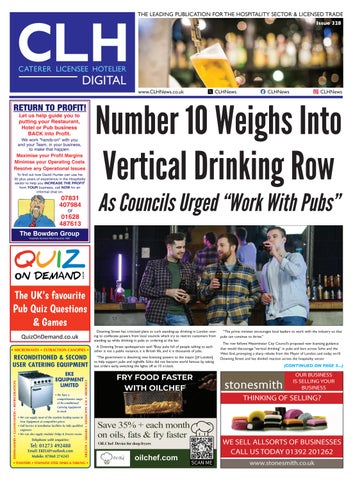
Number 10 Weighs Into Vertical Drinking Row As Councils Urged “Work With Pubs”
The Bowden Group Hospitality Business Mentoring since 1989
Downing Street has criticised plans to curb standing-up drinking in London vowing to confiscate powers from local councils which try to restrict customers from standing up while drinking in pubs or ordering at the bar. A Downing Street spokesperson said: “Busy pubs full of people talking to each other is not a public nuisance, it is British life, and it is thousands of jobs.
RECONDITIONED & SECOND USER CATERING EQUIPMENT
“The government is devolving new licensing powers to the mayor [of London] to help support pubs and nightlife. Soho did not become world famous by taking last orders early, switching the lights off at 10 o’clock.
EKE EQUIPMENT LIMITED • We have a comprehensive range of Re-conditioned Catering Equipment in stock • We can supply most of the markets leading names in New Equipment at competitive prices • Full Service & Installation facilities by fully qualified engineers • We can also supply modular fridge & freezer rooms
Telephone with enquiries:
Tel: 01273 492488
Email: EKELtd@outlook.com Mobile: 07860 274243
COOKERS • ICE MACHINES • FRYERS • SLICERS
DISHWASHERS • GLASSWASHERS • REFRIGERATION
• MICROWAVES • EXTRACTION CANOPIES •
• TOASTERS • STAINLESS STEEL SINKS & TABLING •
“The prime minister encourages local leaders to work with the industry so that pubs can continue to thrive.” The row follows Westminster City Council’s proposed new licensing guidance that would discourage “vertical drinking” in pubs and bars across Soho and the West End, prompting a sharp rebuke from the Mayor of London, and today no10 Downing Street and has divided reaction across the hospitality sector.
(CONTINUED ON PAGE 3...)
2
CLH DIGITAL
Issue 328
Editor's Viewpoint
Welcome to the latest issue of CLH News EDITOR
Peter Adams
"Discourage excessive drunkenness and encourage the pro- tion, business rates, National Insurance, wage increases and STANDING vision countless other financial pressures. Many operators have had of more seating... in place of open bar space that ROOM little choice but to reduce staffing levels simply to remain caters for high volume vertical drinking." ONLY? THE One struggles to imagine a responsible publican reading the viable. Against that backdrop, any suggestion that alcohol and food "discourage excessive drunkenness" without raising an "VERTICAL phrase should routinely be provided by waiter or waitress service eyebrow. DRINKING" Can anyone point to a pub that actively encourages exces- alone appears detached from commercial reality. At precisely the same time, the Government is consulting ROW sive drunkenness? on measures covering guaranteed hours, minimum-hour RAISES Licensed operators already work within one of the most thresholds, reasonable notice of shift changes and compensaheavily regulated sectors in the country. It is an offence to tion for cancelled shifts. BIGGER serve someone who is drunk, and landlords have long underQUESTIONS stood both their legal responsibilities and their wider duty of Each proposal, viewed individually, has understandable
Every so often a story emerges that leaves those of us who have spent our working lives in hospitality scratching our heads and wondering how we got here. This week's controversy over so-called "vertical drinking" is one such example. For those outside the trade, "vertical drinking" is nothing more sinister than the industry's long-established term for people standing while enjoying a drink—at the bar, in an open area of a pub, or perhaps outside on the pavement on a warm afternoon. Following a fierce public backlash, Westminster City Council has now insisted there is "no plan" to ban standing in pubs. Council leaders say the draft policy was widely misunderstood and that its intention was simply to help manage overcrowded pavements around a relatively small number of licensed premises. That explanation may well be entirely genuine. However, it does raise another question. How did a proposal capable of generating such a predictable reaction reach the public domain without clear explanation of its purpose? Any experienced communications professional would surely have anticipated the headlines. A simple statement explaining the limited scope of the consultation could have prevented much of the confusion. Instead, what many people first encountered was wording suggesting pubs should:
care to customers and their communities.
objectives.
The implication that the trade somehow needs reminding not to promote drunkenness risks missing the reality of modern hospitality.
Yet hospitality is unlike a factory production line. Demand changes with the weather, sporting events, transport disruption and countless other unpredictable factors. Flexibility has always been fundamental to how the sector operates. Many employers fear that increasing rigidity in employment rules could ultimately discourage recruitment rather than encourage it.
There is another uncomfortable truth that rarely receives the same attention. While city-centre pubs inevitably attract headlines about visible binge drinking, research has consistently shown that the majority of regular heavy alcohol consumption now takes place behind closed doors. Cheaper supermarket pricing, larger measures poured at home and the absence of social oversight have fundamentally changed drinking habits over the past two decades. Pubs are highly regulated environments. Home drinking is not. The draft guidance also suggests greater emphasis on seating, table service and reducing open bar space. Again, that may sound perfectly reasonable on paper. But anyone who has actually worked in hospitality understands the practical realities. Many pubs, bars and licensed venues were designed around customers ordering at the bar. There is also the unavoidable issue of staffing. Over the past two years, hospitality businesses have absorbed wave after wave of rising costs—energy, food infla-
This is why it is so important that those shaping policy genuinely understand the businesses they seek to regulate. Perhaps Westminster's consultation has been misunderstood. Perhaps the headlines have exaggerated its intentions. If so, then that is unfortunate, but the episode nevertheless highlights a wider concern. Too often proposals affecting hospitality appear to be drafted without sufficient appreciation of how pubs, bars and restaurants actually function on a day-to-day basis. The result is confusion, unnecessary controversy and a growing perception among operators that decisions are being made about the industry rather than with it. The British pub has survived wars, recessions, smoking bans, financial crises and a global pandemic because it continues to evolve while remaining rooted in community and common sense. Let's hope that same common sense prevails whenever policies affecting our sector are considered in the future. I can always be contacted at edit@catererlicensee.com
The Caterer, Licensee & Hotelier News Group is published by RBC Publishing Ltd, 3 Carlton Mount, 2 Cranborne Road, Bournemouth, Dorset, BH2 5BR. Contributions are welcome for consideration, however, no responsibility will be accepted for loss or damage. Views expressed within this publication are not necessarily those of the publisher or the editorial team. Whilst every care is taken when compiling this publication to ensure accuracy, the publisher will assume no responsibility for any effects, errors or omissions therefrom. All rights reserved, reproduction is forbidden unless written permission is obtained. All material is assumed copyright free unless otherwise advised.
PUBLISHED BY RBC Publishing Ltd 3 Carlton Mount 2 Cranborne Road Bournemouth Dorset BH2 5BR
TELEPHONE:
01202 552333 FAX: 01202 552666
www.CLHNews.co.uk @CLHNews CLHNews CLHNews
EDITOR Peter Adams
SALES EXECUTIVES David Bartlett Guy Stephenson
PRODUCTION & DESIGN Matthew Noades
Published by Published by
Issue 328
CLH DIGITAL
3
Number 10 Weighs Into Vertical Drinking Row (CONTINUED FROM FRONT COVER)
2019.
REDUCE SPACE
“This resilience is based on a strong demand base, supported by domestic and international visitors, restaurants, bars, pubs and live entertainment. It is also driven by the billions of pounds of investment made by landlords and developers who recognise the enormous contribution which the sector plays in place making.
The draft policy, currently under consultation, calls for venues to reduce the amount of open bar space used for standing drinkers and instead encourage more seating, with orders taken via table service rather than at the bar. Under the proposals, food and drink sales would generally be handled by waiting staff rather than through traditional over-the-bar service. The proposed strategy adds that the council will “drive sustainable growth and wider economic benefits” to operators, but only where licensing objectives are met. One of its main objectives is to “discourage excessive drunkenness and encourage the provision of more seating in premises that serve alcohol for people to sit and enjoy a drink and order food by table service in place of open bar space that caters for high volume vertical drinking.”
FAILING OPERATORS London mayor Sadiq Khan has strongly criticised the draft policy, describing it as symptomatic of licensing rules that work against the interests of the night-time economy. A City Hall spokesperson said restrictive approaches to licensing were failing operators at a time when venues most needed backing, and pointed to new powers due to be granted to the Mayor’s office that would allow City Hall to call in local licensing decisions and have greater input into policy affecting London’s hospitality and nightlife sectors.
HARM CONFIDENCE James Shorthouse, Head of Specialist Markets, Colliers, said: "London is consistently listed as one of the top global cities, recognised internationally as the world’s most economically and culturally influential hubs. Hotels, F&B and entertainment are some of the key drivers of London’s success, and the city’s hospitality sector has recovered beyond pre-pandemic levels, reaching £46 billion in 2023 compared with £43 billion in
“New markets have emerged, including the £1.3bn transformation of Olympia into a 2.25million sq ft cultural, entertainment and creative district, and the re-imagining of the leisure and F&B offer in Canary Wharf after the Elizabeth Line opened it up to a much wider market which has led to an area that was previously largely ignored at weekends now becoming a truly 7 day a week destination. “The draft London Plan recently published by the Mayor recognises the importance of the sector, but is in stark contrast to the draft licensing policy publish today by Westminster Council which seeks to block new pubs and bars in Soho and large parts of the West End, and to “encourage” existing businesses to provide more seating and move to table service in place of vertical drinking spaces. “Contradictory messaging like this can only harm the confidence of investors and indeed customers, and add yet more cost to the burden that operators across the whole sector are burdened with."
HOSTILE STANCE Sacha Lord, formerly Greater Manchester’s Night-Time Economy Adviser under Mayor Andy Burnham, is highly critical of the move, accusing Westminster of taking an unusually hostile stance toward hospitality businesses compared with other UK authorities, and likening the restrictions to pandemic-era rules. Westminster oversees one of the country’s densest concentrations of licensed premises, with roughly 500 pubs alone across Soho, Covent Garden, Mayfair and the wider West End, forming part of a boroughwide total of around 4,000 licensed venues.
CUSTOMER FLOW
WE DO THE CHEFSWEAR, SO YOU CAN DO THE WORK
FIND OUT MORE cleanservices.co.uk/clh
Looking for professional, compliant chefs’ uniforms and workwear laundry services you can rely on? Look no further.
Tim Barnes, Westminster’s deputy leader and cabinet member for growth and planning, rejected suggestions that the council intends to outlaw standing in pubs, calling such claims a misreading of the draft guidance based on selectively quoted clauses. He said the intention was to help venues manage customer flow so that pavements outside premises do not become overcrowded and so that excessive drinking does not create disturbance for others nearby. Barnes pointed to the council’s Cumulative Impact Zone policy, an established framework already used to manage licensing in areas of high activity, alongside London-wide planning considerations set by the Mayor’s office. He stressed that every licensing application is assessed on its individual merits, noting that new venues continue to open in Westminster, including a recently approved extension allowing the Leicester Square McDonald’s to trade 24 hours a day, a decision granted despite objections raised by the Mayor’s police representatives. The council said it rejects fewer than 1.5% of licence applications and wants to see a thriving, profitable hospitality sector across the borough. Barnes added that Westminster remains willing to work with the Mayor’s office on licensing matters and highlighted a newly launched council campaign promoting nights out in Soho. The draft policy remains open for consideration, with further debate expected as the council weighs feedback from operators, industry bodies and City Hall.
DEFENDER OF PUBS Andy Burnham has previously vowed to be "a defender" for British pubs and recently announced plans to cut business rates by 20% for pubs, clubs and live music venues across England from April next year. The prime minister described pubs as being "at the heart of high streets" and said it was "really important to signal" at the start of his premiership that he would support them. Mr Burnham insisted he would "speak up for them and act".
4
CLH DIGITAL
Issue 328
The Business Case For Making Wellbeing A Hospitality Operational Priority By Jonathan Cooper, Founder and Director of The Director's Helpline (www.thedirectorshelpline.org) When service ends, the lights go dark and the till is cashed up, the inner turmoil of running a restaurant, pub or bar is far from over. The loneliness of running a business, especially in hospitality right now, often means you’re overworked and stressed, burying your head in the sand when it comes to crucial admin. That’s because as economic pressures continue to impact consumer spending, owners are feeling the strain. Pubs, hotels, restaurants and other licensed venues must contend with escalating overheads, tight margins and cautious customers, making business efficiency and cost control more important than ever. The pressures facing independent businesses are well documented. But the mental health toll on owners needs far greater attention.
THE PRESSURE IS MOUNTING In a fast-paced hospitality environment, stress and burnout can have far-reaching consequences. Managers experiencing high levels of stress are more likely to make poor decisions, communicate less effectively, provide lower levels of customer service and pose greater health and safety risks. During busy shifts, these issues can quickly impact team performance, guest satisfaction and ultimately a venue's profitability. While these pressures are being felt throughout the hospitality sector, the problems are sadly not unique. Data from The Director’s Helpline puts the emotional strain in concrete figures, with two thirds of UK directors experiencing it, a quarter saying they are close to burn out, and 31% lacking the confidence to make key business decisions. These numbers paint a picture of what those leading the hospitality industry are feeling, paired with surviving service, dealing with customers, staff and the relentless pace – and when financial pressures are layered on top, the strain can become very difficult to manage.
THE PRICE OF INACTION
important administrative or compliance responsibilities can fall down the list. When leaders are stretched too thin, it also becomes harder to provide the support and direction that employees need, which can contribute to higher staff sickness and turnover. This is not a reflection of poor leadership or a lack of capability. Rather, it is a natural consequence of operating under prolonged pressure without adequate support. This is why safeguarding the mental wellbeing of business owners should be viewed as an operational priority, not simply a personal concern. Top tips for hospitality leadership Managers and owners can help ease their mental load through establishing new habits and processes that help spread some of their responsibility to others. We recommend: • Build a peer network of fellow hospitality business owners who understand the industry's unique pressures. Isolation is a key contributor to burnout, while shared experiences can provide valuable support and perspective. • Identify and prioritise the decisions that require owner-level judgement, such as business strategy, key financial decisions, compliance and staffing matters, while delegating routine operational tasks where possible. • Set aside regular time for finances and compliance, rather than waiting for issues to become urgent. • Seek an outside perspective before making high-pressure business decisions. • Monitor your own wellbeing by keeping track of factors such as sleep, mood and energy levels, alongside key business performance metrics. • Maintain robust financial forecasting to improve visibility over cash flow, costs and future business performance. Knowing your business’s financial situation sooner rather than later, will allow you to make more informed decisions when needed. • Seek support early, whether from an accountant, mentor, peer or industry support service. Asking for help is a sign of good leadership, not weakness.
OPERATIONAL AS WELL AS PERSONAL Running a successful hospitality business requires leaders to look after their own mental wellbeing. Doing so provides the foundation for sound financial planning, effective regulatory compliance and smooth day-to-day operations. By prioritising their wellbeing, owners and managers are better equipped to make clear decisions, support their teams and lead with confidence. Close to a quarter of owners have reported being near to burnout, and over half feel they are going it alone. But that doesn’t have to be the case. Greater peer support, clearer delegation, dedicated time for review, and the confidence to ask for help before problems escalate could help the hospitality industry avoid these outcomes going forward.
In hospitality, where strong leadership underpins both customer experience and business success, protecting Left unaddressed, this pressure rarely remains confined to an owner’s personal wellbeing. Instead, it can begin the wellbeing of those at the helm is an operational necessity, not just a luxury. to affect the wider business. Hard decisions are left untouched, difficult conversations are postponed, and
Finalists Announced for NACC Care Chef of the Year 2026 Competition The National Association of Care Catering (NACC) has announced the 12 finalists who will be competing for this year’s NACC Care Chef of the Year crown in October. Three semi-finals took place on 21st, 22nd and 23rd July, with members from across the NACC regions competing in the South, Midlands and North of the country. The close-fought regional semi-finals saw the contestants use their skills to create a delicious, attractively presented and nutritionally balanced two-course menu in 90 minutes. Their chosen main and dessert needed to be suitable for service users in a care setting, with the combined food cost for both courses coming in at no more than £4.50 per head based on three portions, reflecting the tight budgets care chefs often have to contend with. The menu also had to feature at least one product from headline sponsor Unilever Food Solutions’ sector-relevant catering range. Head Judge Steve Munkley MBE, Vice President of the Craft Guild of Chefs, and his team of experienced judges were looking for clear nutritional understanding of the dishes being prepared, plus culinary flair through flavours, menu balance and visual appeal, as well as waste management and hygiene best practice. The chefs who impressed the judges most will compete again at a grand final on 14th October at Loughborough College. They are: • Nigel Cooke, Head Chef, Eastcote Park and Oakley Grange, Cinnamon Care Collection
• Matthew Dodge, Executive Chef, Loveday & Co • Richard Glover, Group Catering Manager, Ashbouren Lodge Care Home, Milford Care • Gareth Johns, Chef, Heathland House, Cinnamon Care Collection • Majlinda Ndoj, Chef Manager, Birchstone Care, White Oaks (Compass Group UK & I) • Darren Nelson, Head Chef, Trymview Hall, Care UK • Max Neumann, Head Chef, PJ Care • Tomasz Niedzwiecki, Chef Manager, Richmond Villages (part of Bupa) • Giuseppe Priolo, Head Chef, Cinnamon Care Collection • Graham Watson, Head Chef, Lauder Lodge, Care UK • Tristan Welch, Executive Chef, KYN • Steven Wright, Group Executive Chef, Caring Homes Head Chef Steve Munkley said: “We saw some phenomenal dishes in the semi-finals; I can tell you the standard was lifted to another level this year! Out of 12 excellent finalists, the winner will be whoever is on their game at the grand final.” Neel Radia, National Chair of the NACC, said: “Huge congratulations to our 2026 Care Chef of the Year finalists. This competition aims to raise the profile of care catering by demonstrating the high standards and wide skill set that chefs in the care sector display every day to deliver a fantastic meal experience for their service users. I’m delighted to say we have just witnessed the most amazing passion, flair and nutritional knowledge from all the chefs who took part in the semi-finals and I can’t wait to see our 12 talented and inspirational finalists pull out all the stops in October!”
FOR ALL THE LATEST NEWS FROM THE HOSPITALITY SECTOR VISIT WWW.CATERERLICENSEE.COM
Issue 328
CLH DIGITAL
5
World Cup Lifts Pubs, But Restaurant Sales Dip In Flat June For Hospitality Britain’s managed pub groups got a modest boost from early World Cup matches in June while other segments struggled for growth, the latest NIQ RSM Hospitality Business Tracker reveals.
For the third month in a row, trading in London was slightly ahead of the rest of the country. Groups’ like-for-like sales rose by 1.0% within the M25 but were exactly flat beyond the M25.
The Tracker, produced by NIQ, powered by CGA intelligence, in association with RSM, shows pubs’ like-for-like sales were up by 1.9% year-on-year, making June their best month of the year so far. As well as welcoming England and Scotland fans to watch group-stage games, pubs benefited from periods of warm weather in many parts of the country.
Karl Chessell, director – hospitality operators and food, EMEA at NIQ, said: “June’s numbers complete a modest first half of the year for hospitality in which any real-terms growth was very hard-earned. The combination of the World Cup and sunshine was a boost to pubs, and we can expect strong July results after England’s progress in the tournament. However, big events and the heat tend to work less well for restaurants, who are besieged by high costs at the moment. It’s encouraging to see topline growth, which indicates that operators and investors have enough long-term confidence to open new premises.”
However, other hospitality channels found it harder to generate footfall, as many consumers set aside spending for the World Cup or stayed at home. Restaurant groups’ sales were down by 0.7% year-on-year, making June their second-worst month of 2026. Bar groups’ sales dropped by 5.8% to extend a long run of negative numbers.
Saxon Moseley, head of leisure and hospitality at RSM UK, said:
The net result for hospitality was a virtually flat June, with sector-wide sales rising just 0.2% ahead of last year. Growth hovered less than one percentage point either side of flat throughout the first half of 2026, and it has now been below the UK’s rate of inflation, as measured by the Consumer Prices Index, for 14 straight months. It was a brighter June for hospitality groups on a total sales basis, the NIQ RSM Hospitality Business Tracker shows. Adding in venues that have been opened in the last 12 months, sales rose by 3.8% in June—fractionally ahead of inflation.
“Wet led pubs were the real winners of the World Cup with strong like-for-like growth bolstered by the hot weather, underscoring the importance of experience-led spending in the current climate. RSM’s latest Consumer Outlook highlights that discretionary spending remains constrained and highly selective. Good news for one segment of the hospitality market invariably means others coming under pressure, with restaurants, bars and on-the-go outlets all losing ground in June. As we look ahead to the second half of the year, operators will be hoping that Andy Burnham delivers on his promise to reform business rates and put more cash in consumers’ pockets.”
Punch Pubs & Co Acquires The Vine Inn Pub in Retford Punch Pubs & Co has added to its growing portfolio with the acquisition of The Vine Inn in Retford. The town centre pub will continue to be run by veteran Publican Kenny Hunt, who has been behind the bar for over three decades. Speaking about the acquisition, Punch Pubs & Co Acquisitions Manager, Henry Boshier, commented: “This is an exciting opportunity for Punch, and I’m delighted to welcome The Vine into our Punch family. As always, it remains our priority to ensure this pub continues to thrive at the heart of its community, under the continued leadership and guidance of Kenny, who I do not doubt will continue to see the pub through to success.”
A long-standing feature of the town’s High Street, The Vine features an open-plan social space and a barstool-lined bar with darts boards and pool tables at the rear. Known for its lively entertainment schedule and live sports, it attracts both regular visitors to the town and locals alike. Punch Pubs Operations Manager, David Hill added: “I have known Kenny for many years, he’s a great guy and he has done a superb job in creating a welcome atmosphere at the pub over the last 32 years. I’m looking forward to working with him again.” Image credit: Punch Pubs & Co
6
CLH DIGITAL
Issue 328
The Hospitality Industry Doesn't Have a VAT Problem. It Has a Profitability Problem Opinion piece by Dev Biswal, Restaurateur and Hospitality Consultant Every few years, the hospitality industry returns to the same debate: reduce VAT, cut tax and save restaurants. A lower rate of VAT would undoubtedly help many businesses, but after operating restaurants every day I believe we are asking the wrong question. The real issue is not how much tax restaurants pay. It is whether many restaurants are commercially viable before tax is even calculated. That is the elephant in the room. A business that loses money before VAT is added will still struggle after a VAT reduction. Tax relief treats a symptom; it does not cure the disease. Hospitality has faced a perfect storm. Energy prices remain well above historical norms for many commercial users. Food inflation has fundamentally changed menu costing. National Living Wage increases, higher National Insurance costs and recruitment pressures have driven labour costs upwards. Many operators are also servicing debt accumulated during and after the pandemic. There is another growing burden that receives far less attention: technology costs. Modern hospitality businesses rely on EPOS systems, online reservation platforms, payment processing, Wi-Fi, accounting software, payroll software, HR systems, delivery platforms, marketing subscriptions, cybersecurity and digital compliance. Individually these subscriptions may appear manageable, but together they create thousands of pounds of annual overhead before a single customer walks through the door.
As a restaurant owner, I worry far more about empty tables than VAT. A full restaurant can absorb many rising costs. An empty restaurant cannot. Government policy should therefore focus not only on helping businesses survive but also on increasing demand by revitalising town centres, investing in tourism, improving transport links and creating reasons for people to visit our high streets. Commercial energy deserves far greater attention. Restaurants cannot simply switch equipment off. Refrigeration, extraction systems, ovens, freezers, dishwashers and ventilation operate for long hours every day. Hospitality needs a long-term commercial energy strategy that gives businesses certainty rather than constant volatility. Business rates also require modernisation. Independent restaurants now compete not only with neighbouring businesses but with delivery-only kitchens and multinational digital platforms. The tax system should reflect today's trading environment. Hospitality creates employment, trains young people, supports British farmers, fishermen, food producers, wholesalers, logistics companies and tourism. Every successful restaurant generates economic activity far beyond its own turnover. Helping hospitality succeed is an investment in local economies, not simply support for one industry. Rather than asking only 'Should VAT be reduced?', I would encourage the Government to ask a bigger question: 'How do we make hospitality businesses commercially sustainable for the next twenty years?' I believe the answer includes a long-term commercial energy strategy, comprehensive business rates reform, policies that increase town-centre footfall, support for British food production, investment in tourism, sensible adoption of technology and an economic environment that restores consumer confidence. If those fundamentals improve, profitability improves. If profitability improves, investment follows. Jobs follow. Tax revenues follow. The hospitality industry does not simply need tax relief. It needs a long-term strategy for sustainable profitability.
New Chapter as Mayfair’s Oldest Pub Set for Refurb Mayfair’s oldest surviving pub is set to begin an exciting new chapter as the Coach and Horses undergoes a major refurbishment designed to enhance the customer experience while preserving the character and heritage that have defined it for almost 300 years. Just a stone’s throw from Berkeley Square, the Grade II-listed Coach and Horses in Hill Street has welcomed generations of customers since 1744, earning its reputation as one of London’s most authentic and characterful traditional pubs. The pub closed on Saturday (August 1), and will reopen on Tuesday, August 25 following completion of the refurbishment. Independent family brewer and pub company Shepherd Neame has carefully planned the project to celebrate the pub’s rich heritage while sensitively refreshing it for the future.
lets will also be fully refurbished as part of the project. The reopening will also see the launch of a new food offer centred around speciality flatbreads and charcuterie boards, complementing Shepherd Neame’s range of award-winning Kentish ales and lagers, premium English wines, spirits and soft drinks. Shepherd Neame’s Retail Operations Director Shane Godwin said: “The Coach and Horses is one of London’s great historic pubs, and we’re delighted to be investing in its future. “Our aim is to preserve everything that makes this pub so special while creating an experience that reflects modern Mayfair. The refurbishment will respect the building’s remarkable heritage while enhancing the food and drink offer, improving customer comfort and ensuring the Coach and Horses continues to thrive for generations to come.
Externally, the building will undergo a complete redecoration, “We look forward to welcoming customers back when we Image credit: Shepherd Neame featuring a bespoke handcrafted swing sign and a traditional red reopen later this month to enjoy the next chapter in the story of lantern above the entrance. The pub’s iconic barrels will remain at Mayfair’s oldest surviving pub.” the heart of its outdoor space, complemented by new heated awnings to ensure customers can enjoy the The project forms part of Shepherd Neame’s ongoing investment in its premium London estate, following terrace throughout the seasons. refurbishments at the Hoop and Grapes, The Tom Cribb, The Westminster Arms, The White Horse and Inside, refreshed décor, new flooring, wall finishes and carefully chosen furniture will create a warm and Bower and the acquisition of the Bishops Finger in Smithfield. welcoming environment, while the pub’s much-loved listed bar will be carefully preserved. The customer toi-
Yummy Collection Celebrates 20th Anniversary & Reveals New Identity Yummy Collection, the operator behind The Somers Town Coffee House, Above and The Victoria, has announced a new brand identity, changing its name to ‘Hoste’. The move comes as the business celebrates its 20th anniversary. Inspired by old Germanic English, the word ‘Hoste’ better embodies the Group’s dedicated approach to ensuring warm, welcoming hospitality and the care they show to their people, their guests and their process. Over 20 years, the group has evolved into a range of unique venues spanning a collection of neighbourhood pubs, restaurants and cocktail spaces, all with their own unique, independent offer. All always inspired by the passion of great hospitality, brilliant people, sustainable British produce and excellent customer experiences. Yummy Pubs was founded by Anthony Pender, Jason Rowlands and Tim Foster 20 years ago. Since 2022 the Group has been known as Our Yummy Collection with Pender solely at the helm and leading the Group with its key London locations The Somers Town Coffee House in Euston and The Victoria in Bow. The Group has been expanding and growing since. As well as The Tallyman opening this September, Hoste will also be working towards another opening in 2027 within the King’s Cross
Tribeca development – with more information to be announced in the coming months. As well as evolving the Group’s consumer-facing offer, the business will continue to focus on the development and reward of individuals in the team. Matthew Ward who been a partner in The Victoria since 2023 will assume the role of Operations Director, with the business continuing to allocate shares to team members who care and are key to the businesses ongoing success and growth. Paul Pavli, former Managing Director of Punch, will join the team as full partner and founder alongside Pender & Ward after supporting the business as an active advisor over the past three years. Anthony Pender, Founder of Hoste, said: “It’s been a once in a lifetime experience having the honour to found and lead this business into what it is today. We’ve been expanding our collection of venues and dedicating a lot of energy to ensure each one feels gloriously independent and unique. We have a truly amazing and inspirational team that makes each and every one of our venues special, and this will continue to be a vital part of what Hoste is. We have exciting things on the horizon, and we can’t wait to share more soon.”
Issue 328
CLH DIGITAL
7
Operators Urged To Respond To Zero Hours Consultation UKHospitality is urging operators to make their voice heard in the Government’s consultation on changes to zero hours contracts and shifts under the Employment Rights Act.
CORE PROPOSALS IN THE CONSULTATION • Guaranteed Hours: Employers must offer regular zero-hours or low-hours workers a guaranteed contract reflecting hours worked during a reference period (the government’s preferred reference length is 12 weeks. • Hours Thresholds: The consultation explores setting a low-hours weekly threshold—ranging between 8 and 48 hours, with a preferred sweet spot of 8 to 20 hours—to determine who qualifies for guaranteed offers and notice protections. • Reasonable Notice: Workers on zero or low-hours contracts must receive adequate, timely notice of shift rosters and alterations to shift start or end times. • Short-Notice Compensation: Employers are required to provide proportionate financial compensation for shifts that are cancelled, moved, or cut short unexpectedly. • Inclusion of Agency Workers: The rules extend protections to agency staff to prevent businesses from exploiting temporary labour loopholes. The live consultation is seeking views on proposals that will oblige businesses to offer guaranteed hours contracts to eligible employees on zero hours contracts, provide reasonable notice of shift patterns and introduce compensation for cancelled or changed shifts. While its response continues to be finalised, UKHospitality will be making clear that: • The proposals as they stand will act as a barrier to the number of jobs and hours offered by hospitality businesses. This risks increasing job instability, as opposed to the Government’s stated aims of providing more certainty for employees.
• Given the extreme financial pressure facing hospitality businesses and the increased and costly administrative burden from the proposed changes, implementation should not commence before October 2028. • The threshold at which a worker is eligible for guaranteed hours contracts should be set at eight hours per week or fewer, to genuinely reflect low hours. • To be eligible, workers must work regularly – at least 10 out of every 12 weeks and at least 20% more than their contracted hours. • The reference period for guaranteed hours should be sufficiently long enough to account for seasonal trading, set at either at 26 or 52 weeks. Hospitality operators are encouraged to respond to the consultation, which can be found here, ahead of the deadline on Tuesday 25 August. UKHospitality members can be supported with further guidance available on the UKHospitality website. Allen Simpson, Chief Executive of UKHospitality, said: “One of hospitality’s defining qualities is its ability to offer anyone the opportunity to work, regardless of their background, qualifications or circumstances. “There are many significant changes to employment law as part of the Employment Rights Act but how zero hours contracts and shifts will be managed in the future is undoubtedly one of the most significant. “If Government does not get this right, it risks creating barriers to employment, particularly for young people, and restricting the ability of businesses to adapt to their customers’ needs. “UKHospitality has been undertaking an extensive consultation with its members to ensure that our response is reflective of the entire hospitality sector, but it’s critical the Government hears from individual operators, too. “I would encourage all operators to respond to this important consultation to make their voice heard.”
Portsmouth Community Pub Reopens Following Transformational £130,000 Refurbishment Popular community pub The Meon on Meon Road in Milton, Portsmouth will officially reopen at midday on Saturday 8th August following an impressive investment of £130,000 from Admiral Taverns, the UK’s leading community pub company.
past few weeks. I hope customers old and new will love the new look when they visit. I’ve enjoyed my time at The Meon so far, and I am now excited for the future of this great pub.
Licensee Rachel Pitt hopes the refurbishment will bring a new lease of life to the pub, with a modernised feel and fresh look – whilst still retaining its original, characterful features – enabling the pub to continue its tradition of being the go-to community hub for local residents.
“We are massive supporters of Portsmouth FC and can’t wait for the start of the season. We also have a highly successful football team as well as a thriving golf society to welcome back. The Meon has always been successful due to our loyal customers, and I hope this will continue for many years to come. Our fantastic team of bar staff can’t wait to welcome everyone back into the pub”
Internally, the pub has undergone a complete refurbishment to include new fixtures, decor and bespoke darts area. Externally, the Meon has been completely refreshed to include new lighting and a fresh coat of paint to welcome visitors. Rachel has been the licensee at The Meon for over eleven years and going forward, she is committed to maintaining the community spirit and sports focused style of the pub. Rachel commented: “It’s been amazing to see the transformation of the pub over the
Stuart Watts, Business Development Manager at Admiral Taverns, added: “It’s brilliant to see the Meon opening its doors again after such a fantastic transformation, where Rachel and the team have put in an incredible amount of hard work to make sure every detail is just right. This pub is a vital part of the local community, and I have no doubt that the team here will be looking after locals for a long time to come. On behalf of everyone at Admiral Taverns, I want to wish Rachel and the entire team all the best for the future.”
8
CLH DIGITAL
Issue 328
How To Prepare For Tipping Reforms By Rebecca Hughes, Associate in the employment team at Birketts LLP (www.birketts.co.uk) Consultation should be genuine, considered and conducted in good faith, with sufficient time allowed, but the process is advisory rather than binding. Employers are not required to follow every suggestion made by workers, provided they can demonstrate that they have complied with the requirements of fairness and transparency. Consultation requires workers to be informed, given a proper opportunity to express views, and have those views genuinely considered before the policy is finalised or reviewed. It does not give workers a veto over the employer’s preferred approach. The current draft Code leaves the employer responsible for the final policy, although that decision may later be challenged in the employment tribunal if it is unfair, non-transparent, discriminatory or procedurally defective.
From late 2026 (now delayed from October 2026 and the exact date yet to be confirmed), reforms introduced under the Employment Rights Act 2025 will make it mandatory for employers to consult with workers when developing or revising their written tipping policies. In June, the Government published a draft revised Code of Practice to reflect these statutory changes. Following criticism from unions, however, the draft Code was unexpectedly withdrawn in July prior to gaining Parliamentary approval. The Government has now stated that it will be conducting a further consultation on the draft Code prior to the reforms taking effect “by the end of 2026”. At this stage, it is not clear what further revisions will be made to the draft Code. The reforms introduce new procedural requirements on employers in the hospitality sector to demonstrate that tipping arrangements have been developed through an open and transparent process. Workers should have a meaningful opportunity to influence how tips are distributed. Employers will therefore be expected to seek workers’ views, keep records of consultation and review tipping arrangements periodically – once every three years as a minimum. Consultation must be carried out with trade union or workers’ representatives, or directly with the workers if there are no such representatives.
A FAIR AND TRANSPARENT TIPPING POLICY The current draft revised Code does not require equal shares for all workers, but it does require a clear, objective and justifiable allocation method. Relevant factors to consider may include role, hours worked, basic pay, seniority, length of service, performance and customer intention, but the employer must also consider the overall fairness of the scheme. The draft Code also makes clear that employers should be careful not to disadvantage less visible groups, such as back-of-house staff, and must avoid direct or indirect discrimination. Tipping policies should be simple to understand, and employers should be able to explain, in plain English, why the chosen allocation model is fair for their particular business.
WHAT DOES ‘CONSULTATION’ MEAN? Unite criticised the Government’s approach on the basis that the draft revised Code only required ‘consultation’ rather than giving workers full control over the allocation of tips. To what extent this will be strengthened remains to be seen.
While Unite’s criticism of the draft Code is perhaps understandable – given the Government’s pre-election commitment to ensure “workers decide how tips are allocated” – it does not mean that employers would have free rein to decide their own tipping policy. Employers must consult properly, publish an anonymised summary of views expressed, maintain a written policy, keep tipping records and ensure the scheme is fair. Employment tribunals must take the Code into account where relevant.
GIVING LOW-PAID AND PRECARIOUS WORKERS A VOICE The Government’s consultation response recognised that some workers may lack the confidence, time or knowledge of employment rights to pursue formal processes, particularly where they are employed temporarily. It also recorded worker concerns about lack of written policies, unfair allocation and employers retaining tips – even though retention of qualifying tips by employers is already prohibited. The current draft Code expressly warns that a simple majority vote should not be treated as the default or preferred consultation mechanism, particularly where it could disadvantage minority groups or less visible workers. The consultation response gives the example of larger front-of-house groups potentially outvoting smaller back-of-house teams, which could produce a result that feels democratic on the face of it but is not necessarily fair. Adopting a more structured consultation process will mean ensuring all groups are heard, not just the most vocal or numerous. The process should be conducted using representatives where appropriate, providing clear written information and allowing enough time for responses. Employers should be prepared to explain why particular suggestions have or have not been adopted. This is also consistent with the Government’s stated aim of preserving flexibility while improving worker voice.
WHAT SHOULD EMPLOYERS IN THE HOSPITALITY SECTOR DO NOW? The revised Code is now expected to come into effect by the end of 2026, after further consultation and subject to Parliamentary approval and commencement regulations. Employers should be ready to update their policy once the final version is confirmed. The Government has also said it will continue working with stakeholders and will provide additional non-statutory guidance. These reforms represent an evolution of existing tipping law but will not change the current enforcement mechanisms or penalties. Employers are likely to retain some flexibility over how tips are distributed, but there will be a stronger focus on consultation and transparency. For employers, early preparation will help ensure that tipping arrangements remain compliant and are less likely to be challenged when the new rules take effect.
Printed Pub Banners: The Secret Weapon Behind Every Successful Pub Promotion First impressions matter, especially in the hospitality industry. Before a customer samples your food, orders a drink or experiences your atmosphere, they'll often make a decision based on what they see from the street. That's where professionally printed pub banners come into their own, transforming blank walls, fences and railings into powerful advertising space that works around the clock.
fessionally designed banners that capture attention from a distance. Better still, banners are easy to replace as your promotions change throughout the year, ensuring your venue always looks fresh and inviting. Consistency is another major factor in successful marketing. By incorporating your pub's logo, colours and branding into every banner, you create a recognisable identity that customers remember. HFE Signs works with businesses across the UK to produce custom banners that not only advertise promotions but also strengthen long-term brand recognition.
From traditional village pubs to bustling city bars, printed banners remain one of the most affordable and effective ways to promote events, increase footfall and boost sales. Whether it's live music, quiz nights, seasonal menus, televised sporting events or beer garden promotions, a bold, professionally printed banner can stop people in their tracks and encourage them to walk through the door.
Many publicans are surprised by just how much passing trade a professionally printed banner can generate. A clear message such as "Beer Garden Open", "Food Served All Day" or "Live Music Tonight" can be enough to encourage an impulse visit that turns into a loyal customer.
Unlike digital advertising that disappears after a few seconds, a printed banner keeps working day and night. Positioned outside your venue, it reaches local residents, passing traffic and visitors without ongoing advertising costs. It's simple, effective marketing that continues to deliver results long after it's been installed.
businesses of every size with eye-catching promotional displays that are designed to get noticed.
Quality is everything when it comes to outdoor signage. A faded or poorly produced banner can send the wrong message, while vibrant colours, sharp graphics and durable materials help create a professional image that reflects the quality of your business. That's why thousands of pubs, clubs and hospitality venues trust HFE Signs to produce banners that are built to withstand the unpredictable British weather while maintaining exceptional print quality.
One of the biggest advantages of working with HFE Signs is flexibility. Whether you need a single custom banner for a one-off event or complete event branding featuring multiple banners, mesh fencing, stage graphics and promotional displays, every order is produced to the same high standard. This makes it easy for pubs to create consistent branding across beer gardens, entrances, car parks and outdoor event spaces without compromising on quality.
With over 5,500 five-star customer reviews, HFE Signs has built one of the strongest reputations in the UK signage industry. Every month, the company produces thousands of custom printed banners, supplying
Printed pub banners are incredibly versatile. Summer BBQs, Christmas parties, Sunday lunches, charity fundraisers, comedy nights, cocktail evenings and live entertainment can all be promoted with pro-
As competition continues to grow within the hospitality industry, making your venue stand out has never been more important. Professionally printed pub banners offer exceptional value for money, immediate visibility and long-lasting durability, making them one of the smartest marketing investments any pub can make. With over 5,500 five-star reviews, thousands of custom banners printed every month, and the ability to supply everything from a single banner to complete event branding, HFE Signs continues to help pubs across the UK attract more customers, promote more events and create lasting impressions—one banner at a time. Check out HFE Signs and special offers here: www.hfe-signs.co.uk
FOR ALL THE LATEST NEWS FROM THE HOSPITALITY SECTOR VISIT WWW.CATERERLICENSEE.COM
Issue 328
CLH DIGITAL
9
Expanded Holiday Tax Will Hike Costs For Families UKHospitality Warns UKHospitality has warned that Government plans to extend tourist tax powers to every strategic authority in England could put 33,000 hospitality jobs at risk, wipe £2.2 billion off national GDP, and add £100 to the cost of the average family holiday. The warning comes after the Government set out its intention, in its ‘Rewiring the State’ policy paper, to ensure every area of England has a strategic authority in place by 2028 — with each newly empowered to introduce a holiday tax. In response, UKHospitality has written to the Prime Minister proposing an alternative ‘holiday bonus’ scheme, under which central government revenues would be devolved to local authorities based on visitor numbers, mirroring existing approaches to income tax and business rates. The trade body argues such a model would incentivise tourism and support growth, rather than imposing a blanket tax that risks jobs, investment and the sector’s recovery. Allen Simpson, Chief Executive of UKHospitality, said: “As we warned would be the case, proposed holiday
tax powers for Mayors are being swiftly expanded to every strategic authority in England. “It’s clear the Government is now intending to implement a nationwide holiday tax, making family holidays more expensive during a cost-of-living crisis. “I am pro-devolution, but I am not in favour of an extra tax that will cost 33,000 jobs. “The solution is simple. Treat hospitality the same as every other sector. Instead of devolving taxation powers, devolve central government revenues to local authorities through a holiday bonus instead. “Rewarding local authorities with fixed revenue per visitor night, for example, incentivises tourism and drives economic growth, rather than costing jobs, deterring visitors and making family holidays more expensive. “The cost of lost VAT and increased benefits through reduced economic activity and employment will in many areas outweigh the revenues raised by a tax. A holiday bonus is the right kind of devolution – more revenue and control for local communities, without the lost jobs caused by a holiday tax.”
Long-Serving Publicans Retire After 35 Years of Service Two much-loved publicans are retiring from The Safe Harbour in Fowey after decades of service running pubs with St Austell Brewery. Graham Allen is calling time on an impressive 35-year career with the independent Cornish family-run business, where his journey began at the Britannia Inn in Chacewater before he spent a decade working as a chef at The Customs House in Padstow. For the past 16 years, he has run The Safe Harbour, helping make it a popular destination for locals and visitors alike. Joining him in retirement is his partner Gill Pascoe, who became part of The Safe Harbour team seven years ago after a 35-year career in education. Having retired from schools, she swapped the classroom for pub life and quickly became an integral part of The Safe Harbour team.
Together, Graham and Gill have been praised for their commitment to the business and the local community, becoming wellknown ambassadors for both The Safe Harbour and St Austell Brewery. Clive Greene, Head of Tenanted Estate at St Austell Brewery said: “Graham and Gill have made an enormous contribution to The Safe Harbour and the wider community. Their warmth, dedication and hard work have helped make the pub what it is today, and they will be greatly missed by guests, colleagues and local residents. We wish them both a long, happy and well-deserved retirement.” Image Credit: St Austell Brewery
10
CLH DIGITAL
Issue 328
Why a Lack of AI Readiness Could Be Holding Your Hotel Back, And How to Fix It
Article supplied by Access Hospitality (www.theaccessgroup.com)
AI is redefining hotel operations, but as implementation becomes more widespread, experts say that the businesses best prepared to use it effectively are the ones that will come out on top.
connected. Hotels should review their technology landscape, identify gaps in how information is shared and prioritise systems that integrate easily with other platforms. Without this foundation, any AI implemented may fail to deliver its full potential.
While their research has indicated that more than half (53%) of hoteliers now view AI as useful in their day-to-day roles, AI hospitality tech company Access Hospitality warns that a lack of readiness could be preventing businesses from utilising AI to its full potential.
2. Keep your content accurate and visible With AI search traffic generating 11.4% higher conversions than organic search*, your digital content needs to be clear, consistent and up to date to ensure your hotel is featured in AI search responses.
They have shared why AI readiness is so important for hotels in 2026, alongside their top three tips for best achieving it.
WHY A LACK OF AI READINESS COULD BE HOLDING YOUR HOTEL BACK Hotel teams talk about AI constantly, yet many still struggle to explain what being AI-ready actually looks like in practice. It’s not about installing a chatbot or turning on automated pricing, but whether your systems, data, and staff can actually support AI tools once they go live. Many hotels buy software first and figure out the rest later, unaware that it could be holding them back from unlocking its full potential. In fact, research by Access Hospitality has indicated that disconnected systems account for an average of 13% of all operational expenditure wasted in the hospitality sector. Champa Magesh, Managing Director at Access Hospitality, comments: "In recent months, AI conversations in the hotel industry have shifted from adoption to readiness.
Image: Magnific
“As many hotels are already using AI in some form, and staff are increasingly understanding its benefits, the real differentiator is how effectively they use it. That means having connected systems, trusted data and teams with the confidence to use AI to reduce admin, improve decision-making and give staff more time to focus on delivering exceptional guest experiences."
HOW TO IMPROVE YOUR HOTEL’S AI READINESS 1. Create a strong data foundation AI can only work effectively when your data is accurate, accessible and
Frequently review your website, booking channels and third-party listings to ensure key information such as room types, amenities, policies and services is accurate and aligned across platforms. Clear and consistent content improves your visibility across both traditional and AI search, helping potential guests to discover your business.
3. Train your team While more than half (53%) of hotel staff feel that AI is useful to their job role*, it will deliver the greatest value to teams if they know how to use it effectively. As 65% of hotel staff see training and development as important*, this can give your teams the confidence to use AI to automate routine tasks, reduce admin and free up more time for guest interactions in their dayto-day roles.
Brains Brewery Campaign Raises A Glass To Dads As It Becomes One Of Its Most Successful Ever Brains Brewery is celebrating the success of its latest campaign after it became the company’s second most-viewed social media video in just one week. Dad Was Right, which focuses on the stories and traditions that deserve to be passed down to family members, generated more than 19,000 social media interactions in its first week of launch. It comes close to the iconic campaign by SA Brain & Co Ltd, which featured a surprise male voice choir performance to celebrate the Wales vs England RBS Six Nations rugby match in 2015. The campaign video, which was released on Father’s Day, features Steve and Sam Smalley, a father-and-son duo who both work at Brains Brewery but still make time to enjoy a pint of SA together. It’s a simple moment, but one that reflects the heritage, connection and shared experiences that have always been at the heart of the Brains brand. Rooted in real stories, Dad Was Right celebrates the traditions, wisdom and moments that connect generations. At Brains, it is a tribute to the advice, rituals and shared experiences that are often passed from parent to child – many of which become even more meaningful over time.
Steve said: “It was a real privilege to be part of this campaign because it reflects something that’s genuinely important to us. Working alongside Sam and then being able to enjoy an SA together after work is something we don’t take for granted. The campaign reminds us that it’s often the simplest traditions that mean the most.” Sam added: “Being involved has been really special. The campaign is about family, heritage and those moments that stay with you. It’s great that our own story could help bring that message to life, and hopefully it encourages others to appreciate the advice and traditions they’ve inherited from their own dads.” Sara Leigh Webber, Head of Marketing at Brains Brewery said: “We’re delighted by the response to Dad Was Right. The campaign has clearly resonated with people because it’s authentic and rooted in real relationships. “Dad Was Right is all about celebrating the moments that bring us together – the advice, the laughs, and the shared rituals that define relationships between fathers, sons, daughters and families across Wales. Steve and Sam’s story is a brilliant example of what Brains stands for – heritage, connection, and enjoying great beer together.”
Keep Your Beer Pouring Perfectly and Your Profits Up When your beer tastes good, your customers are more likely to stay longer, and/or return another time. If your beer starts to misbehave, you put that revenue at risk. Whether you are looking for beer dispense emergency services or need regular maintenance for ensuring excellent beer, Avani Solutions are the partner you need. Whether you're running a hotel, a restaurant or a pub, you'll be trying your best to serve great beer as you juggle all the other elements of providing top notch hospitality. The last thing you want is to be fighting a frothing beer tap, tipping a tainted pint down the drain or dealing with a disappointed guest who's returned to the bar complaining of a 'dodgy pint' (or half!). Some good news, we are determined that one day every pint served will be perfect - and we're dedicated to helping you be part of that mission. We're sometimes referred to as a 'line cleaning company' – but line cleaning is only one part of what we do, we do so much more than that! We are trusted to -: • Troubleshoot issues with dispense.
• Re-set and re-calibrate your system with our ProSpec service. • Provide SOS rescue cleans. • Maintain your dispense system for you, including on behalf of a brewer. • Give peace of mind with ProClean - our 28-day extended line clean. • Deliver data-driven insight, to inform you of any faults, as well as highlighting trends and beer quality results. • Training and consultancy. Our services can help you to lower costs, increase efficiency and also improve sustainability. We empower you to keep the beer (and cider) pouring to the highest standards and protect your profits by doing so. We walk alongside venues and are always there when you need us, like a supporting handrail, so you don't have to worry about your beer and can focus on delivering the best customer experience. Contact us today to find out how we can become your best partner when it comes to bar and cellar services. Call us on 01638 563237. See the advert on page 7.
Issue 328
CLH DIGITAL
11
Hospitality Job Cuts Continue Despite Services Sector Growth The UK’s services sector reported renewed growth last month, but employment across hospitality and other consumer-facing industries kept falling — extending a jobs slump that has now lasted almost two years, new data shows. Figures from S&P Global Market Intelligence revealed that private sector employment has been cut for the 22nd consecutive month, with pubs, restaurants, cafés, hairdressers and professional services firms among those continuing to reduce headcount. The decline in jobs comes despite an uptick in overall business activity. The UK’s composite purchasing managers’ index — a closely watched leading indicator of economic performance — rose to 52.2 in July, comfortably above the 50-point threshold that separates growth from contraction. The gap between rising output and falling employment has drawn comparisons with previous downturns. Analysts noted that the current run of job losses has now outlasted the employment fallout seen during both the 2008 financial crisis and the collapse of the dotcom bubble.
“SOBERING” FIGURES FOR HOSPITALITY Tim Moore, economics director at S&P Global Market Intelligence, said the resilience in trading had not been enough to halt the losses. “A rebound in both activity and new business could not prevent a further decline in staffing numbers, with job losses seen for the twenty-second consecutive month,” he said. The continued cuts follow Chancellor Rachel Reeves’ first Budget in October 2024, which introduced a £26 billion increase in employer taxes. Businesses have since pointed to a combination of pressures behind their
reluctance to hire, including above-inflation rises to the minimum wage — particularly for younger workers — higher employer National Insurance contributions, rising wage bills more broadly, and additional compliance burdens introduced under the Employment Rights Act. Official figures show the toll this has taken on the labour market. Since Labour came to power, the unemployment rate has climbed from 4.4 per cent to 4.9 per cent — equivalent to around 150,000 more people out of work. That figure does not capture the wider pool of economically inactive people, such as those who have moved into education, retirement, or who are not actively seeking employment.
SECTOR CALLS FOR SUPPORT Allen Simpson, chief executive of UKHospitality, said the figures reflected what operators have been warning about for months. “These figures are sobering, though sadly not surprising,” he said. “The past two Budgets have inflicted more than £5 billion of additional annual costs onto hospitality businesses.” He added that the sector’s ability to provide entry-level opportunities was being undermined at a time of rising youth unemployment. “At the same time, we have record numbers of unemployed young people… denied the chance to earn their first salary in their local pub or restaurant,” Mr Simpson said. The findings will add to pressure on the Treasury ahead of the Autumn Budget, with hospitality leaders continuing to call for a reduction in the tax and regulatory burden facing operators as the sector struggles to translate a pickup in trade into job creation.
New Site for The Coconut Tree in Next Chapter For Group Sri Lankan restaurant group The Coconut Tree, will open a new restaurant in central Bristol this August. This marks the first site to be launched since a change of ownership in 2025, following two members of the founding team, Praveen Thangiah and Shamil Fernando, taking control of the company. Formerly FIKA Cafe, the new site on Broad Quay will offer the same authentic Sri Lankan flavours that have ensured the group was chosen to appear on Come Dine with Me: The Professionals, is consistently highly reviewed on Trip Advisor and has won plaudits from the likes of Jay Rayner. It will include outside dining for more than 50 people and three virtual darts lanes inside, set in a drinks area. The Coconut Tree has had a presence in Bristol for a number of years, having opened its first site in the city in 2018. The new Broad Quay location will be a sister to Bristol’s Gloucester Road site. New owners, Thangiah and Fernando, have vowed to renew their focus on the core business of delivering a delicious, affordable Sri Lankan menu packed with flavour alongside original cocktails (or Cocotails) with a relaxed island vibe. There are currently six other sites across the UK: Gloucester Road (Bristol), Cheltenham, Oxford, Bath, Bournemouth, and Reading – all offering traditional Sri Lankan hospitality. Having been part of The Coconut Tree’s journey for many years, Thangiah and Fernando stepped up from
within the business to become its new owners, bringing with them a wealth of experience. The move followed a challenging period for the hospitality sector, during which rising operating costs and reduced consumer spending created significant pressure across the industry. The Coconut Tree was affected by these market conditions, ultimately resulting in the company entering administration in November 2025. The administration process was managed in a way that ensured no suppliers, employees, or local business partners were left out of pocket, reflecting the company’s commitment to those who have supported the business throughout its entire journey. The administrators were responsible for appointing Thangiah and Fernando as the new owners as they were the only potential owners who were able to commit to retaining all staff. Fernando, comments, “The Coconut Tree has been a huge part of our lives for many years. We bought the business because we care deeply about it and the people behind it, and believe in our authentic Sri Lankan food and drink.” Thangiah added, “We’re keeping the essence of The Coconut Tree the same, and our focus is on creating a more sustainable business for the future. Our restaurants are supported by an experienced team that has been the heart of The Coconut Tree for many years. We’d like to thank everyone for their support as we open our seventh site.”
commercial heavy-duty product. Induction for prime cooking is still relatively fresh to be accepted into the general commercial kitchen environment, however the By David Chesshire, National Accounts Manager, Blue Seal (www.blue-seal.co.uk) big energy savings and high efficiency far outweighs the cost of changing the cookware and initial higher cost Blue Seal Ltd are very mindful of the future equipment requirements for efficiency, carbon footprint and sus- outlay for the product. This cost will no doubt reduce and become more competitive as the trend & demand tainability, with this ever-changing food industry and the cost of gas and electric usage. for induction manufacture inevitably increases. We currently produce a new range of free-standing & bench models of heavy-duty induction hobs with two Induction equipment also avoids the additional very or four zones. Each hob has the versatility of 3.5KW or 5Kw round zone generators for focussed power or costly legislation requirement involved with gas canopy 5kw power full area zones to accept multiple pans across the cooking area. The induction technology is extraction/make up air and interlock systems. incredibly responsive, with hardened 6mm thick glass cooking surfaces. When you compare the efficiency of using induction Blue Seal R&D are conscious of the ever-increasing demand for induction product, and we have now over gas, the induction is at approx. 90% efficient comlaunched our new induction- convection ranges, and wok induction hobs. pared to approx. 45% efficiency for gas. This is achieved by the magnetic fields heating up the entire surface of the cookware with virtually all of the energy transferred Many commercial chefs are trained at college with gas appliances and do love the instant heat & control of into the pan. Where gas disperses the heat, licking around the sides of the cookware more so, losing energy gas. However, they are slowly breaking this habitual comfort and being convinced to make the change, once into the ambient air around the pan. they experience using Induction, the fantastic responsiveness, instant heat direct to the pan & superb controllability, speaks for itself. Using induction massively reduces heat transfer into the air flow, lowers the overall temperature in the kitchen promoting a more comfortable working environment, as well as the practicality of a simple wipe down The induction technology lends itself to a myriad of concepts, especially QSR restaurants where they need of the glass cooking area at the end of a shift, which is very appealing to an operator. The appliances are much quick heat up on demand, which is also remarkably simple for the operator to use and maintain. safer to use, reducing injury potential as well as being very simple to service & maintain. The feature benefits of induction far outweigh the initial out lay, which is currently still relatively high for
Focus On Blue Seals New Induction Technology
12
CLH DIGITAL
Issue 328
Rising Compliance Risk: What the New Visa Rules Mean for Hospitality By Sunny Sandhu, Senior Immigration Associate, A Y & J Solicitors (www.ayjsolicitors.com) World Cup screenings, warm-weather weekends and peak holiday demand have brought a welcome increase in trade for pubs, restaurants and hotels. Venues are extending opening hours, adding extra shifts and adjusting rotas to cope with demand. For most operators, the immediate priority is simple: keep the tills ringing while the trade is there to be taken. However, the same staffing and payroll changes that help a hospitality business manage a busy summer can also expose gaps between what sponsored workers are being paid and what the business told the Home Office it would pay them. Since 8 April 2026, those gaps have become more difficult to overlook.
WHY PAYROLL COMPLIANCE HAS CHANGED The Skilled Worker salary rules changed on 8 April 2026. Under the updated requirements, the salary paid to a sponsored worker in each pay period must meet the applicable going rate for every hour worked during that period. The Home Office can also compare the salary recorded on a worker’s Certificate of Sponsorship with payroll information held by HM Revenue and Customs. These checks may take place without an employee making a complaint and without the business first receiving a physical compliance visit. This does not mean that one unusual payslip will automatically result in a sponsor licence being revoked. The rules allow salaries to be assessed over short rolling periods. For workers paid monthly, for example, the amount paid over any three-month period must equal at least one quarter of the required annual salary. However, operators can no longer assume that meeting an annual salary figure will be sufficient if the worker’s hourly rate, hours worked or pay during individual periods does not meet the relevant requirements.
THAT DISTINCTION MATTERS IN HOSPITALITY.
• sponsoring a role that is not genuine. Illegal working creates a separate risk. Employers can face civil penalties of up to £60,000 for each illegal worker.
WHY EXISTING SPONSORED WORKERS ARE BECOMING HARDER TO REPLACE The recruitment options available to hospitality businesses have narrowed substantially. Home Office statistics show that Skilled Worker visa grants to main applicants in food preparation and hospitality trades fell by 82% to 939 in the year ending March 2026. The number had previously reached 11,542 in the year ending June 2024. Since 22 July 2025, a role must normally be skilled to graduate level to qualify for the Skilled Worker route, unless the occupation appears on an approved shortage list or a transitional provision applies. Many hospitality occupations, including chefs and catering and bar managers, are classified below graduate level. Existing workers sponsored before 22 July 2025 may be able to continue under transitional provisions, provided they have maintained continuous Skilled Worker permission and satisfy the remaining requirements. For an operator, this means that losing a sponsor licence has consequences beyond the financial cost of responding to an investigation. Sponsored employees may have their immigration permission shortened and may eventually have to stop working for the business. At the same time, the employer may no longer be able to recruit overseas replacements for the same roles. The sponsored employees already working within a hospitality business may therefore be considerably more difficult to replace than when they were originally recruited.
FIVE CHECKS OPERATORS SHOULD COMPLETE THIS SUMMER 1. Compare payroll against every Certificate of Sponsorship Review each sponsored worker’s gross basic pay, contracted hours, actual hours and pay frequency. For monthly paid workers, examine every rolling three-month period rather than relying only on the annual total. Check that the worker meets both the applicable annual salary requirement and the required going rate for the hours worked.
A sponsored employee may be contracted for one working pattern but work substantially longer hours during a busy month. A salaried manager may cover additional late shifts. Payroll may record those hours incorrectly or fail to distinguish between guaranteed salary and variable payments.
Do not assume that the salary written into the employment contract proves compliance if the payslips and working records show something different.
The business may still believe that the worker earns the correct annual salary. The Home Office may see a pay period in which the salary does not match the hours worked or the information recorded on the Certificate of Sponsorship.
Check how overtime, bonuses, service charges, shift allowances and other additions are recorded on the payslip.
WHY HOSPITALITY BUSINESSES ARE PARTICULARLY EXPOSED Hospitality businesses rarely operate with perfectly consistent working patterns. Demand changes with the weather, sporting events, school holidays, conferences and local events. During a busy period, operators may: • extend opening hours; • add overtime to existing rotas; • move managers between locations; • change an employee’s responsibilities; • use agency or casual workers at short notice; or • rely more heavily on tips, bonuses, service charges and shift payments. Each decision may make commercial sense. However, some changes can affect sponsor compliance if they are not properly recorded, reported or reflected in payroll. Overtime and variable payments require particular attention. Sponsored salary calculations generally rely on guaranteed basic gross pay and certain guaranteed payments treated in the same way as basic pay. Overtime, bonuses, shift allowances and payments that depend on fluctuating hours will not normally correct a shortfall in the required sponsored salary. Recent compliance reviews carried out by A Y & J Solicitors, an SRA-regulated and Legal 500-ranked UK immigration law firm advising businesses on sponsor licences and Skilled Worker compliance, suggest that problems often arise not because an employer has deliberately underpaid a worker, but because payroll practices, working hours and sponsorship records have gradually stopped matching. Yash Dubal, Director of A Y & J Solicitors, said: “The greatest risk for hospitality operators is often the gap between what was originally recorded and what is happening in practice. A worker’s hours, duties or pay arrangements may change gradually during busy periods, but the sponsorship record remains the same. By the time the difference is identified, the business may already be responding to Home Office scrutiny.”
ENFORCEMENT IS NO LONGER LIMITED TO A SITE VISIT Sponsor compliance was once commonly associated with a Home Office officer arriving at the premises and asking to inspect personnel files. Site visits remain possible, but they are no longer the only way in which a problem can be identified. The Home Office can use HMRC payroll information to check whether a sponsored worker is receiving the salary recorded on their Certificate of Sponsorship. A discrepancy may therefore come to light without the business receiving advance warning or a visit. Enforcement has also intensified. Home Office figures show that 3,100 Skilled Worker sponsor licences were revoked during 2025, the highest annual total recorded. A further 1,545 were revoked during the first three months of 2026. A sponsor licence can be suspended or revoked for several reasons, including: • underpaying sponsored workers; • failing to report relevant employment changes; • maintaining incomplete personnel records; • employing someone without the correct permission; or
2. Separate guaranteed salary from variable payments
A worker’s total earnings may appear sufficient while their qualifying sponsored salary remains too low. Payroll teams should understand which payments count towards the immigration salary requirement and which do not. 3. Review changes to hours, duties and locations Busy periods often result in managers working at another branch, taking on different responsibilities or covering a substantially different working pattern. Some changes can be accommodated within the existing sponsorship. Others must be reported or may require a new Certificate of Sponsorship and visa application. Salary reductions, changes to a worker’s normal work location and other specified changes generally need to be reported through the Sponsor Management System within ten working days. 4. Check right to work records and agency arrangements Operators must retain compliant right to work evidence for the people they employ and sponsor. Where agency workers are used, the employing agency will normally be responsible for conducting the statutory right to work check. However, hospitality businesses should not simply assume that the correct process has been followed. Contracts should clearly allocate responsibility, and the operator should obtain appropriate written confirmation from the supplying agency. 5. Investigate gaps before the Home Office does If payroll records, working hours, job descriptions or Sponsor Management System reports do not match, identify the reason before making retrospective changes. Some issues can be corrected or explained. Others may require a formal report, a change of employment application or a wider compliance review. The experience of A Y & J Solicitors in reviewing sponsor records indicates that early intervention is usually less disruptive than responding after a suspension notice has been issued. Once the Home Office has raised concerns, the business may have limited time to explain the discrepancy and provide supporting evidence.
A BUSY SEASON SHOULD NOT BECOME A COMPLIANCE PROBLEM The World Cup and summer trading period offer hospitality businesses a valuable commercial opportunity. Operators should make the most of it. But revenue, rotas, payroll and sponsor compliance can no longer be treated as separate areas of the business. The staffing decisions made during the busiest weeks of the year may be the same decisions the Home Office later examines through HMRC payroll data. The businesses that finish the summer with both strong trading results and an intact sponsor licence will be those that recognise this connection early. For operators employing sponsored workers, the question is no longer simply whether the annual salary appears correct. It is whether every payslip, hour worked, employment change and Sponsor Management System report tells the same story. >>>>>>>>> This article is a general guide and does not constitute legal advice. Immigration rules and Home Office guidance may change. Advice should be obtained based on the specific circumstances of the business and its workers.
14
CLH DIGITAL
Issue 328
UK Diners Swap Restaurants for Coffee Shops as Cost Pressures Bite, New Data Shows British consumers are increasingly deserting full-service restaurants in favour of coffee shops and food-to-go outlets, according to new spending analysis from data specialist CACI.
Perhaps the most striking finding relates to who is behind the shift. Rather than a regional pattern, CACI’s demographic breakdown points to an affluence-led change in behaviour, with the biggest increases in spend per visit coming from lower-income consumer groups.
The research, which examined six months of transaction data comparing the first half of 2026 with the same period last year, found that restaurants were the only major food and beverage category to see spending fall year-on-year, dropping by 3%.
Within CACI’s “Low Income Living” Acorn classification, average transaction values at cafés and coffee shops rose by 5.2% year-on-year — the largest increase recorded across any demographic segment. Both the “Low Income Living” and “Stretched Society” groups also posted 6% growth in food-to-go spend per transaction and 2.8% growth in pubs and bars, outperforming all other groups on this measure.
Cafés and coffee shops, meanwhile, saw spending climb by 5%, while food-to-go outlets posted growth of 2%. CACI said the figures point not to consumers giving up on eating out altogether, but to a more selective approach to where they choose to spend their money.
The data suggests many diners on tighter budgets are not cutting back on eating out entirely, but are instead trading down to better-quality café or food-to-go options in place of a traditional restaurant meal.
FEWER VISITS, NOT LOWER SPEND Although average transaction values at restaurants rose by 2% year-on-year, broadly tracking inflation, the overall fall in spend suggests fewer people are actually walking through restaurant doors.
“AN OPPORTUNITY, NOT A CRISIS”
Coffee shops have emerged as clear winners from the shift. Newer entrants outpaced the wider market by some distance, with Grind up 17% and Blank Street up 13%. Established chains also performed well, with Starbucks growing 6% and Costa 4%.
Martha Dobbs, senior consultant at CACI, said the findings reflect a broader, affordability-driven reshaping of how and where the nation eats and drinks, with less affluent consumers leading a reallocation of spending rather than an outright retreat from eating out.
The food-to-go sector told a more varied story. Expansion-minded brands such as Wingstop, Farmer J and Atis all recorded strong growth, while longer-established high street names including KFC, Itsu, Tortilla and Papa Johns saw sales decline.
Dobbs argued the picture need not be bleak for restaurant operators, describing the trend instead as a chance for the sector to rethink how it demonstrates value to increasingly cost-conscious customers.
CACI noted particularly fierce competition within the fried chicken sector, where growing operators like Wingstop appear to be taking market share directly from rivals. The analysts expect this pressure to intensify further with the imminent UK launch of US chain Raising Cane’s.
LESS AFFLUENT HOUSEHOLDS DRIVING THE CHANGE
She pointed to Pizza Express’s new quick-service format, which opened in Brixton this spring, as an example of how established restaurant brands can adapt their offer to changing consumer habits. Ultimately, Dobbs suggested, restaurants’ strongest card remains the quality of the dining experience itself — and operators that lean into that experiential edge may be best placed to win back customers who have traded down.
Finalists Announced for The 2026 Be Inclusive Hospitality Spotlight Awards Be Inclusive Hospitality (BIH) has announced the finalists for the fifth annual BIH Spotlight Awards, recognising exceptional Black and ethnic minority talent across hospitality, food and drink in the UK.
next generation of industry talent. Founder of Be Inclusive Hospitality, Lorraine Copes, said: “The BIH Spotlight Awards celebrate some of the very best talent in our sector, but they also shine a light on the breadth of opportunities that hospitality offers. This year’s finalists demonstrate that there is no single route into our industry or to success. Whether you aspire to be a chef, restaurateur, general manager, people professional, or drinks expert, hospitality offers rewarding careers for people with a wide range of skills, ambitions and backgrounds. I hope these finalists inspire the next generation to see what is possible.”
This year’s finalists include Michelin-starred West African restaurant Chishuru, a Cantonese institution in Blackpool, Michael Wan’s Mandarin, a MasterChef champion Jhané Gibson, and professionals from some of the UK’s leading hospitality businesses, reflecting the diversity and breadth of the UK hospitality sector. Following a rigorous judging process, an independent panel of hospitality leaders selected finalists recognised for their accomplishments, leadership, and innovation. This year’s judges included Shereen Ritchie, Managing Director of Kuvi Hospitality; Clement Ogbonnaya MBE, Founder of the Village People Pub Company; Laure Bornet, SVP of International Growth at OpenTable; and Junior Lewis, Global Hospitality Client Consultant at Caterer.com, alongside other senior industry leaders. The shortlist comprises 60 finalists across 15 categories, representing seven regions of the UK and more than ten cuisines. It brings together talent from major restaurant and hotel groups alongside independent restaurants, bars and hospitality businesses, celebrating established leaders, emerging professionals and the
Laure Bornet, SVP International Growth at OpenTable, said: “Hospitality is at its best when every kind of talent can be seen, celebrated and championed, and that’s exactly what the BIH Spotlight Awards do. This year’s finalists showcase the creativity, leadership and ambition driving our sector forward, and at a time of real pressure for the industry, backing them matters more than ever. That’s why we’re proud to return to partner with Be Inclusive Hospitality in building a more representative and inclusive future for hospitality.” The 2026 Finalist list can be seen at https://tinyurl.com/5n7e9fss
Delamere Launches 97ml Oat Drink For Hospitality Industry Delamere has announced the launch of a new 97ml oat drink following the success of its semi-skimmed milk mini bottles in the hospitality and foodservice industries. Designed for hospitality settings, such as hotel room trays, breakfast buffets and on-board catering, the bottles can be used to add to hot drinks or pour over cereal. The oat drink has been developed to offer a plant-based alternative to cows’ milk, enabling accommodation and foodservice providers to cater to different dietary requirements and evolving consumer preferences. The ambient product has a shelf life of up to six months and once opened, it can be treated as fresh milk and stored in the fridge. Each bottle contains 3-4 servings and can be re-closed and stored by guests, eliminating the single-use plastic associated with milk pots and sticks and saving time on repeat deliveries of fresh milk to rooms. The premium glass bottles, capped with an aluminium lid, are fully recyclable, supporting outlets in imple-
menting responsible waste management practices. Available now, the new oat drink can be purchased directly through Brakes and via wholesalers nationwide. Dan Yates, national account manager at Delamere, said: “Our mini milk bottles are already a trusted choice in hotels and hospitality settings, so the creation of a plant-based oat drink in the same format felt like the natural next step when adding to the range. “Sustainable, premium and convenient, we’re confident that it will soon be a staple part of the guest experience.” Located in Knutsford, Cheshire, Delamere has been producing award-winning dairy products for more than 40 years. It supplies an extensive range of speciality goat and cows’ milk based products to retail, wholesale and independent customers across the UK and in over 20 markets around the world. For sales enquiries or more information please contact dan@delameredairy.co.uk
16
CLH DIGITAL
Issue 328
“VAT’S THE PROBLEM”: Hospitality Operator Puts Its Message On Every Staff Shirt A hospitality operator has taken its support for a lower VAT rate off the picket line and onto the shop floor — literally stitching the message into its staff uniforms. Greedy Gordon’s has unveiled new workwear carrying the slogan “VAT’S THE PROBLEM” across the back, in a move the business says is not a marketing gimmick but a statement of survival. The operator says every member of staff will now wear the message daily, arguing that hospitality needs a permanent 10% VAT rate to remain viable. In a social media post announcing the uniform, the business framed the issue in stark terms, asking whether it would still be trading this time next year, and describing the campaign as being about protecting jobs, supporting British farmers, fishermen and suppliers, and keeping independent pubs and restaurants serving their communities. Greedy Gordon’s said it was proud to stand alongside the British Institute of Innkeeping (BII) and Punch Pubs & Co, among thousands of other hospitality businesses, in calling for the change, and urged others in the trade and the public to add their name to the campaign petition. The move comes as the #VATsTheProblem campaign, spearheaded by chef Tom Kerridge and backed by trade bodies including UKHospitality, the British Beer and Pub Association, the BII, CODE Hospitality and Hospitality Ulster, continues to gather momentum, with the petition recently passing 300,000 signatures. The campaign argues that the UK’s 20% VAT rate for hospitality is among the highest in Europe, well above rates of 10% in France, Spain and Italy, and 7% in Germany, and is calling on government to bring the UK into line with a 10% rate for the sector.
Sector research conducted by UKHospitality, the BBPA, the BII and Hospitality Ulster has pointed to mounting financial strain across the trade, with a majority of operators surveyed citing VAT, food and drink inflation, and rising staffing costs — driven by increases to the National Minimum Wage and employer National Insurance Contributions — as the biggest challenges they currently face. Some surveys conducted as part of the campaign have suggested that as many as one in six hospitality businesses believe they are at risk of closure within the next year. What sets Greedy Gordon’s approach apart is its decision to make the campaign visible to every customer, every day, through its front-of-house teams — rather than confining it to social media posts or trade press coverage. By putting the slogan on staff uniforms, the operator is betting that direct, repeated visibility to the public will help keep pressure on government where petitions and open letters alone may not. Operators considering similar action may find it a low-cost way to engage customers directly in the debate, turning everyday service interactions into moments of visibility for a cause that campaigners argue affects the whole hospitality supply chain, from producers and suppliers through to the businesses and staff who serve customers on the high street. Hospitality operators wishing to add their support to the campaign can sign the petition via VAT’S The Problem campaign page.
Free Festival Toolkit Launched to Help Pubs Capitalise on Soaring Demand for Event-Led Trading With more consumers actively seeking out events in hospitality venues, HEINEKEN UK has launched a new Beerfest Manager’s Guide and supporting marketing resources to help and encourage more operators to tap into the beer festival opportunity, and drive footfall particularly during quieter times of year. The guide comes as research shows more than two thirds (68%) of consumers visit hospitality venues for events at least once a month, demonstrating strong and sustained demand for experience-led occasions. Events also help attract larger groups, with 30% of consumers attending themed events as part of a group of five or more people, creating valuable opportunities to increase visits, dwell time and spend, particularly during quieter midweek trading periods. Developed by HEINEKEN UK, the Beerfest Manager’s Guide provides practical advice for venues looking to launch their own beer festival-style event, from guided tasting sessions to more flexible formats that allow guests to explore at their own pace. The guide has been tailored to be as accessible as possible for publicans with events geared to the taps they already have, supplemented by packaged options to fill gaps where needed. Free to download from www.eazle.co.uk/huk/en/beerfest-activation-guide alongside a suite of editable promotional assets, the guide is designed to help operators create engaging beer festival experiences that drive footfall, encourage discovery and generate incremental sales. The free toolkit includes event planning guidance, beer tasting resources and ready-made marketing mate-
rials to help operators launch and promote their own Beerfest events. Consumer appetite for discovery continues to grow, with 15% of consumers saying sampling is an important factor when choosing a drink and 14% actively looking for tasting notes[3]. By encouraging trial and exploration, operators can build confidence in different beer styles and drive repeat purchases beyond the event itself. Serena Smith, Head of On-Trade Category at HEINEKEN UK, said: “Today’s consumers are looking for reasons to go out, and events remain one of the most effective ways for pubs to create excitement and drive visits. “Beer festivals offer a fantastic opportunity for operators to bring people together, encourage discovery and showcase the quality and diversity of their beer range. “The Beerfest guide has been designed to be simple, flexible and accessible for venues of all sizes. For operators, it’s a straightforward way to turn beer into an experience rather than just a purchase, creating occasions that drive footfall, increase engagement and give customers a reason to return. “The opportunity isn’t simply to sell more beer; it’s to create memorable experiences that encourage people to stay longer, discover something new and come back again. Beer remains one of the biggest drivers of sales in hospitality, and by helping consumers discover something new, operators can turn a single event into long-term loyalty.”
Efficient Labelling Allows You To Focus On Food, Not Faults Brother UK’s trusted labelling solutions have long helped restaurants, hotels, and caterers take control of stock rotation — delivering consistency, compliance, and cost-savings through intuitive technology that’s quick to learn and makes a measurable impact. At the heart of this is Brother’s TD-2D range of professional label printers — compact, versatile, and designed to fit seamlessly into busy kitchen environments. Ideal for everything from crowded prep benches to mobile trolleys. Optional battery packs and carry handles for added flexibility, and selected models support linerless label printing, helping to reduce waste and eliminate non-recyclable backing paper. Built for realworld conditions, the TD-2D range performs reliably even when used with wet hands. Combined with Brother’s partnerships with leading food independent software vendors (ISVs), the solution automates expiry tracking, reduces food waste, and eliminates handwritten errors — all while saving valuable time and improving consistency during peak service periods. In fast-paced hospitality settings with short shelf lives and shifting teams, reliable labelling is essential. Stock rotation solutions help maintain food safety, quality, and compliance, while other labelling solutions — including ingredient and allergen labelling for food pre-packed for direct sale (PPDS) — ensure allergens and ingredients are clearly identified, helping operators meet legal labelling obligations such as Natasha’s Law and protect cus-
tomers with allergies. Simon Brennan, senior business manager for Specialist Print Solutions at Brother UK, said: “Kitchen teams work fast, under pressure and can’t afford mistakes – especially when it comes to food safety. That’s where our labelling solution comes in. “By replacing handwritten day-dot stickers with a Brother TD-2D device, kitchens can print clear, consistent labels in seconds. It’s a faster, safer way to manage stock rotation, reduce food waste, and stay compliant with Food Standards Agency guidelines — ensuring food safety and quality even when shifts change or service peaks. “And because our devices are compact, portable and support linerless printing, they’re built for real kitchen conditions – reducing clutter, cutting waste and keeping staff moving. It’s labelling that chefs can trust, helping them focus on food, not faults.” To find out how your kitchen can save time, reduce waste and improve compliance, visit brother.co.uk/stock-rotation
18
CLH DIGITAL
Issue 328
Lunch is the Biggest Growth Opportunity as Britain's Eating Habits Shift The British eating day is consolidating around its centre, according to new consumer research, with lunch becoming the fastest-growing meal occasion as breakfast and late-night eating fall into decline.
it altogether. Among 18-24-year-olds, breakfast skipping rises to 30%, highlighting a significant generational shift away from the traditional threemeal structure.
The latest Emerging Trends report from consumer intelligence business, Vypr, found that while dinner remains the cornerstone of the British weekday, lunch is experiencing the strongest growth of any meal. Nearly one in five consumers (19%) say they eat lunch more often than they did a year ago, compared with 14% who report eating dinner more frequently.
The research suggests the UK's eating day is effectively being compressed, with consumers eating later in the morning, earlier in the evening and reducing food occasions at both ends of the day. This changing behaviour is already influencing the market. In recent months, major QSR operators including Greggs, Pizza Hut and Pret A Manger have independently converged on lunchtime meal deals priced at around the £5 mark, signalling a shared commercial belief that lunchtime is becoming the day's most competitive occasion.
The trend is particularly pronounced among younger adults, with 33% of 25-34-year-olds and 30% of 18-24-year-olds saying they now eat lunch more often than a year ago. This is the key demographic responsible for much of the UK's out-of-home food spending.
The research also found that Britain's eating habits are becoming more structured than commonly assumed. Nearly four in ten adults (39%) eat two proper meals on a weekday, while 37% eat three, suggesting consumers are replacing traditional meal occasions with fewer, more intentional eating moments supplemented by planned snacks.
Despite the changing patterns, dinner remains Britain's most important meal. Almost three-quarters (74%) of adults eat dinner on a typical weekday, while 62% identify it as their most important meal. However, the report suggests the real commercial opportunity lies elsewhere. While the dinner occasion is not slowing down, consumer eating habits are increasingly concentrating around the middle of the day. This is creating new opportunities for restaurants, cafés, pubs and QSR operators to strengthen their lunchtime offering and to stay competitive against meal deal buyers. By contrast, breakfast is losing momentum. Almost a quarter (24%) of consumers say they now eat breakfast less often than a year ago, while 17% report eating a smaller breakfast and 13% say they have started skipping
Joel Dixon, hospitality lead at Vypr, said: “For years, breakfast has been a core growth occasion, but consumers are now telling us a different story. Britain's eating day is shifting towards the middle. The lunchtime offering is focussed on menu, price and promotion with meal deals helping to increase trade. “Breakfast offerings need to be more innovative and on trend to capture the audiences and operators able to do this will drive incremental sales. Healthier options, such as high protein, high fibre, and added functionality including collagen and matcha will all appeal.”
Proper Pubs Honours Community Champions at Annual Awards Gala Proper Pubs, the community wet-led operator division of Admiral Taverns, celebrated the outstanding achievements of its pub operators at its ‘Proper Pubs Awards Gala’, held in Chesterfield on Thursday 30th July 2026.
• Outstanding Achievement Award, Annie Kane, Queens Park Café and Victoria in Glasgow Nathan Wall, Managing Director of Proper Pubs, commented:
“Our pubs sit at the cornerstone of their local communities, providing a space for people to connect and come together to support good causes. Our operators go above and beyond every day. Not only do they run exceptional pubs, but they are also community heroes who champion local good causes and host events that bring people together. These awards are a fantastic way to celebrate the dedication, innovation and community spirit shown by our operators, who embody the very best of the great British local.
The annual awards gala brought together operators from across Proper Pubs’ estate of more than 200 pubs in England, Scotland and Wales, recognising those who have gone above and beyond for their communities over the past year. Eleven prestigious awards were presented on the night, with the overall ‘Proper Pub of the Year’ title going to the Y Pentan in Mold, which also took home the ‘Sales Performance Pub of the Year’ award. The full list of winners is as follows: • Proper Pubs Pub of the Year, Y Pentan in Mold • New Proper Pub of the Year, Empire in Grimsby • New Operator of the Year, Travellers Rest in Featherstone • Sports Pub of the Year, Parkhall Tavern in Mansfield o Highly Commended, Queens Park Café in Glasgow • Marketing and Events Pub of the Year, Mitre in Chorley o Highly Commended, Queens in Bredbury
• Community Pub of the Year, Ashmore in Wolverhampton o Highly commended, Rhoden in Oswaldtwistle • The Gold Standard (Audit) Pub of the Year, Princes Feathers in Hinkley • Sales Performance Pub of the Year, Y Pentan in Mold • Entertainment Pub of the Year, Pineapple in Shaw o Highly Commended, Town Hall Tavern in Oldham • Gaming Pub of the Year, Wonder in Tividale
I am incredibly proud of everything our teams have achieved this year, and it has been an honour to celebrate them through these awards. Each winner and highly commended pub is a testament to the passion, commitment and hard work required to run successful pubs that are also thriving community pubs. I would like to once again congratulate all our winners and highly commended pubs, and I’d also like to extend my thanks to every single operator across our estate for your tireless work in making Proper Pubs such a special part of people’s lives.”
Saving Time, Improving Turnaround: Why Ready-to-Use Wipes Are Changing Hospitality Cleaning In hospitality, every second counts. With ongoing labour shortages and increasing pressure to maximise productivity, operators are looking for practical ways to streamline routine tasks without compromising hygiene standards. Industry research continues to show that staffing and productivity remain major challenges across hospitality, making operational efficiency more important than ever. One area often overlooked is table sanitising. Traditional spray disinfectant and blue roll processes require multiple steps: preparation, application, a 30-second contact time, wiping, and disposal. Based on comparative cleaning assessments, this means a table is ready for use again in approximately 42 seconds. By comparison, ready-to-use sanitising wipes simplify the process. With no contact time waiting period and no secondary wipe-off step, tables are ready in just 11 seconds.
The impact is significant. Across 100 tables, the traditional method requires around 70 minutes, while ready-to-use wipes take only 18 minutes, a saving of 52 minutes. For busy restaurants, cafés and quick-service operators, that’s nearly an hour of staff time reclaimed for serving customers, maintaining standards and enhancing the guest experience. In an industry where efficiency drives profitability, smarter cleaning processes can deliver measurable operational gains. At Sani Professional®, we've developed Protect 360° plastic-free sanitising wipes to help hospitality operators reduce cleaning time and improve table turnaround without adding complexity to daily routines. By simplifying the sanitising process, teams can spend less time waiting and more time focusing on customers, service and operational efficiency. Request your FREE Protect 360° samples by emailing samples@sanipro-intl.com.
20
CLH DIGITAL
Issue 328
Top Chefs Back Scheme Funding Student Visits To Michelin-Starred Restaurants A first-of-its-kind funding scheme designed to enrich college learners’ experience has been launched by not-for-profit awarding body iCQ Awards and sector skills council People 1st International, in direct response to guidance from Ofsted. The Future Stars Scheme will provide grants to fund impactful extracurricular activities and vital equipment for college learners, with money available for initiatives including masterclasses and skills workshops with industry professionals, connecting apprentices with ethical and sustainable food production, and discovery days with leading suppliers. The boost for colleges and apprentices comes at a critical time. The hospitality sector continues to face widespread staffing shortages, while persistently high dropout rates on catering and hospitality courses – well above the national average – threaten the pipeline of future talent the industry depends on. Dennis Twomey, Managing Director at iCQ Awards, explains the thinking behind the Scheme: “The key to building a sustainable pipeline of talent starts with raising aspirations and inspiring students early on in their careers. “Our hope is that Future Stars will enable colleges to provide unique and meaningful experiences that resonate with learners, making a lasting impression that shapes their careers long-term. “Providing every learner with high-quality, professional wear is equally as vital. The right tools of the trade can make all the difference, demonstrating to learners they are valued and supported from day one.”
maître de will get the same opportunities. “Going behind the scenes in a Michelin-starred kitchen for the very first time or getting up close to sustainable food production, for example, are the sort of career affirming experiences that will inspire ambitious young hospitality professionals to sustain a career for the long-term. “Opening up these experiences and making them more accessible to college learners is a fantastic initiative that will help to give future generations a much-needed leg up as they seek to breakthrough in the industry.” Michael Turner agrees. The ex-Savoy, multi-award-winner, who is currently Executive Chef at Willett’s at The Cadogan in Chelsea, comments: “Having completed an apprenticeship myself, I know firsthand how important it is to give young people the right opportunities at the very start of their careers. “Hospitality has given me incredible opportunities, and it’s our responsibility to ensure the next generation has the same chance to succeed. “Initiatives like Future Stars help remove barriers for aspiring hospitality professionals by providing the support, confidence and experiences that can inspire lifelong careers. Investing in young talent is one of the most important things we can do to secure the future of our industry.”
Top chefs have vocalised their support for the scheme.
Aymen Fetouak, Head of Professional Development at the Institute of Hospitality, comments: “Ensuring young people enter the profession with the right skills, aspiration and professionalism from day one is essential for the future of hospitality.
Luke Holder, a longtime business partner of Angela Hartnett and chef director of Hartnett Holder & Co at Lime Wood hotel in Hampshire, comments:
“It is vital that we recognise and nurture emerging talent early, giving the next generation the confidence, support and opportunities they need to thrive.
“For many chefs, including myself, it was those formative early years which helped cultivate my lifelong passion for food.
“Future Stars is an investment in the future talent pipeline that’s so vital to the industry’s long-term success.”
“It is essential to light that spark to launch a long and successful career in the industry, and I count myself incredibly lucky that I got to work in some amazing kitchens early on in my career. “Looking back, those early years were full of pivotal lightbulb moments which really helped me to hone my abilities and shape my identity as a chef, but it’s by no means a given that every budding young chef or aspiring
The £10,000 fund is open to People 1st accredited college restaurants and college restaurants who hold or who are eligible to apply for an AA College Rosette amongst others. The deadline for applications midnight on 31 October. For full eligibility requirements and to apply visit: https://icqawards.co.uk/future-stars
Butcombe Group’s H1 Growth Powered by Sales and Estate Investment Pub operator and brewer Butcombe Group has unveiled financial results for the first half year of trading in 2026, revealing an exceptionally resilient period for the group despite challenging trading conditions. Highlights for the 26-week period from 1st February to 1st August 2026 include: • Group Managed LFL growth of 5.2% against double digit growth last year • Sales and volume growth in all three categories with LFLs of Food 4.7%, Drink 5.7% and Accommodation 5.2%. • Weddings delivered revenue growth of 37% versus the same period last year. • Butcombe Brewing and Drinks has had an excellent start to the year with strong growth vs last year driven by excellent performances in the Free Trade +7% and Off Trade +11% Following consecutive years of sector-leading growth, Butcombe Group has delivered a 5.2% increase in like-for-like sales across its managed pub division in H1 2026. Volume and sales growth were recorded across all three core operational categories, with food delivering 4.7% LFL growth, drink reaching 5.7%, and accommodation achieving 5.2%. Alongside their retail performance, the business earned prominent industry accolades across the period being named Best Pub Employer 2026 at The Publican Awards and earning recognition in The Sunday Times Best Places to Work 2026 list. Trading across the estate benefited from great early summer weather with the group’s outdoor space capacity, representing approximately 50% of total covers, enabling pubs to capture high seasonal demand. Whilst a limited number of sports orientated pubs delivered some stand out performances during the world cup, the tournament had a limited impact on the wider group overall. Of greater importance has been the warm spring and summer combining with quality of our offer and amenities, with the UK managed pub division delivering 11.5 % LFL growth in the four weeks ending 1st August. Early summer trading also yielded strong results for accommodation and the Channel Islands, both of which benefited from rising costs and travel friction associated with international destinations, positioning the group well for the peak school holiday period. Jersey Free Trade grew by 7% year-on-year in the four weeks ending 1st August. Strategic reinvestment in the estate remained a central driver of growth during the first half of the year.
Three major redevelopments were completed on time and are trading in line with or ahead of expectations at The Brown Cow in Fulham, The Mayflower in Lymington, and The Dundas Arms in Kintbury. A fourth major development is currently underway at The Methuen Arms in Corsham, creating a premium barn space on site, to service accelerating demand for weddings, private events, and special occasions. This targeted capital allocation directly supported strategic growth in key dayparts, with morning sales increasing by 17% and weddings delivering 37% growth versus the same period last year. The Butcombe Brewing Co and Drinks business has continued to grow with an especially strong performance in the UK Free Trade growing 7% with product innovation, such as the upcoming collaboration with Hawkstone expected to drive further listings and rate of sale in the free trade in the second half of the year. In the Off-Trade, revenue surged by 11%, driven in part by significant listing growth of both Butcombe Original, since the product’s format extension to cans, and Goram Zero, Butcombe’s award-winning low alcohol beer, which is set to enter 200 M&S stores. Jonathan Lawson CEO, Butcombe Group said, “It has been a highly encouraging half year, with all areas of the business delivering results that our teams should be very proud of. “Consistent growth in recent years has allowed the business to make significant investments in the estate, evolving to meet growing consumer demand for special occasions, weddings, and premium accommodation. “I’m particularly encouraged given that these results have been delivered under trying conditions due to both our own government’s policies and global macroeconomic factors. I am now on the sixth Prime Minister since I joined Butcombe in 2019 and my request has not changed for Andy Burnham versus any of his predecessors. We need to see a clear plan for growth in the economy and the government needs to see hospitality as a provider of growth for the country, not a cash cow for taxation with a disproportionate cost base, which deters investment and employment. “As a business, we are optimistic for the second half of the year, with strong early bookings for Christmas. We are also now well into planning for next year and a continuation of our multi-year growth trajectory with new sites playing a part in that growth. The new Prime Minster has the ability to assist this growth for us and the sector if he delivers on his promises and recognises the economic engine hospitality can be”.
Issue 328
Cider in Summer
CLH DIGITAL
21
New Insights Reveal Economic Impact and Future Growth Potential Of British Cider Brand new consumer and industry insight from the National Association of Cider Makers (NACM), aims to highlight the deep roots that cider has in British culture and the scope of the opportunity ahead of it. The study lays out the national success story that is UK cider, showing that cider contributes £2.7bn to UK GDP; supports 65,000 jobs and £1.4Bn in wages. It also uncovers the love British consumers have for cider and the scale of the opportunity to grow the category even further. From a survey of over 1,250 UK adults and four consumer focus groups, NACM found that: • Of those that drink alcohol, four in 10 drink cider at least monthly • Among all drinkers, just under six in 10 consider cider when choosing an alcoholic beverage • 70% of those surveyed said what they liked about cider most, is that it is refreshing • 35% of consumers say they mainly drink it “at the pub”, with a quarter saying they mainly drink it “at bars or clubs” or “at barbecues” (both 25%) When asked “compared to other alcoholic drinks you usually drink,” cider came out higher than other drinks in all categories, including taste, quality and value for money. Significantly, one-third of non-cider drinkers say they would consider trying cider in the future; almost a fifth of people (18%) like that cider is easy to share with others, and nearly three in five (59%) consumers say they’d prefer cider to come from a British producer. Excitingly, over half (54%) of those surveyed said they would consider trying Low and No cider in the future. In addition, Low and No cider emerged
as the most appealing option for non-drinkers considering such drinks, ahead of beer, wine, and cocktails. With over half (58%) of respondents to the survey confirming that they have reduced their alcohol consumption over the last year, this could be another key area to drive category growth.
Build your cider range across three tiers: a high-volume standard draught option, one or two premium draught lines, and a refrigerated packaged range that spans apple, fruit, and alcohol-free variants. This tiered structure allows consumers to trade up and gives your team clear upselling opportunities.
Fenella Tyler, CEO of the NACM, said: “Cider is a truly great British story, one of success, innovation, craft, community, and deep-rooted tradition. It is written in our landscapes, sustained by apple growers and makers, and savoured by millions – the UK remains both the world’s biggest producer and consumer of cider, something us Brits should be very proud of.
VISIBILITY
“This latest study shows the scope and scale of cider and the opportunity in front of us. It is clear that increasing trial presents a road to grow significant sales for cider makers of all sizes across the UK. Our focus is to now bring together people from across the trade to help consumers to discover the great quality and breadth of styles British cider has to offer, and British Cider Week will be our first opportunity to do this.”
STAFF TRAINING
STRATEGIC RECOMMENDATIONS: MAXIMISING CIDER REVENUE THIS SUMMER
SPORTS EVENTS
The following framework offers practical, actionable guidance for operators seeking to maximise cider revenue across the peak spring and summer trading window.
DUAL STRATEGY Operate simultaneously with a strong draught offer — at minimum a premium apple and a dark fruit variant — and a chilled, well-stocked bottle range. The draught line drives volume; the bottle range drives variety and occasions. Neither should come at the expense of the other.
RANGE ARCHITECTURE
Sheppy’s - Master Cider Makers Sheppy’s Cider is one of the UK’s oldest independent cider producers and a respected name in traditional cider making. Based in Taunton, Somerset, a county renowned for its rich cider heritage, the company has been crafting award-winning ciders for more than 200 years. Across six generations, the Sheppy family has combined time-honoured techniques with modern innovation to create high-quality ciders enjoyed throughout the UK and beyond. At the heart of the business is Three Bridges Farm near Taunton, where apples are grown, pressed, fermented and bottled or kegged on site. Sheppy’s remains committed to using quality cider apples and traditional production methods, helping to preserve the authentic character and flavour of Somerset cider. This dedication to craftsmanship has earned the company numerous awards and a loyal following among cider enthusiasts. Among its standout products is the award-winning Sheppy’s 200 Range, created to celebrate more than two centuries of cider-making expertise. A medium, lightly sparkling cider, Sheppy’s 200 offers a refreshing balance of
Cold, visible ciders sell. Ensure refrigerated displays are prominently positioned, well-lit, and clearly labelled. Use chalkboards to highlight premium options, seasonal specials, or no-alcohol alternatives. Impulse purchase decisions are made at the bar — make the right choice obvious. A front-of-house team that can describe the difference between cider variants — their flavour profiles, ideal serves, and food pairings — is a commercial asset. Brief bar staff at the start of each shift on featured products and provide the language for confident upselling. Cider is a preferred accompaniment during major sporting occasions. The spring and summer calendar — incorporating key football, cricket, tennis, and racing events — provides a series of high-footfall trading occasions. Promote your cider range actively around these events through social media, signage, and tailored promotions.
FOOD PAIRING Train staff to suggest cider pairings with food orders. Mention it on menus. The statistic that nearly half of on-trade cider serves accompany a food order is an opportunity to increase average covers. A suggested pairing costs nothing to implement and directly lifts both food and drink revenue.
sweetness and crisp apple character. Its smooth, approachable style has made it a popular choice for both seasoned cider drinkers and those discovering traditional cider for the first time. The 200 Range is available in a variety of formats to suit every occasion, including keg, 500ml bottles and the recently launched 440ml can. The introduction of cans provides added convenience while delivering the same quality and flavour that have made the cider a success. Combining heritage with practicality, the new format is ideal for festivals, picnics, barbecues and social gatherings. Beyond cider production, Sheppy’s welcomes visitors to its farm, offering the opportunity to explore the orchards, learn about the cider-making process and experience Somerset’s rich cider culture first-hand. By blending centuries of expertise with innovative products such as the 200 Range, Sheppy’s continues to honour its heritage while meeting the evolving tastes and expectations of today’s consumers. Visit www.sheppyscider.com/trade for further information.
22
CLH DIGITAL
Issue 328
Outdoor Dining Designs for Operators With Limited Space By Hilary Chadwick, Founder and Co-Partner of Chadwick Design (www.chadwick-design.com) A small outdoor area can be a profit leak or one of the hardestworking parts of a hospitality venue. The difference is rarely the footprint. It is the planning. Many operators look at a narrow pavement, compact courtyard or small terrace and ask one question first: how many tables can we fit? That is where the problem starts. Outdoor dining designs for operators with limited space cannot be treated like indoor furniture moved outside. When every square metre is under pressure, poor planning becomes obvious quickly. Staff squeeze between chairs, customers feel exposed, heaters block movement, and a space that looked good before service becomes frustrating once it is full. The cost is commercial. A badly planned outdoor area can slow table turnover, create accessibility issues, weaken the guest experience and waste valuable trading space. That matters in a hospitality market still facing high operating costs and more cautious customer spending. The smarter approach is to design compact outdoor dining as a fully functioning part of the venue. Clear movement, adaptable furniture, weather planning, compliance and atmosphere all need to work together. When they do, even a narrow frontage can create valuable extra covers while making the venue feel more welcoming from the street.
DESIGN FOR MOVEMENT BEFORE ADDING COVERS The main risk with a small outdoor dining area is trying to maximise seats before understanding how people will move through the space. A layout can look tidy on a floor plan, but service is more demanding in practice. Staff need room to carry food, drinks, menus, payment devices and cleared plates without constantly weaving around chairs or interrupting guests. Before choosing furniture, measure the actual usable space. That means the area left after door swings, steps, licence boundaries, planters, bins, columns and pedestrian routes are accounted for. If the space is on a public highway, operators may need a pavement licence for removable furniture such as tables and chairs. Access and safe movement should shape the layout from the start, not be corrected later. Once you know how much space you truly have, focus on the route staff will use repeatedly during service. A clear path between the venue and the outdoor tables can be more valuable than adding a couple of cramped seats, particularly if those seats make every order, payment and table clear-down slower.
Perimeter seating can help. Benches, wall seating and banquettes reduce the unpredictable spread of chair legs, bags and coats. Small square two-person tables are also useful because they can stand alone or be joined for larger groups. The aim is profitable density, not maximum density. Diners notice when an outdoor space has been packed rather than designed.
CHOOSE FURNITURE THAT EARNS ITS FOOTPRINT In a compact outdoor dining area, furniture is operational equipment. A chair that cannot be stacked, cleaned quickly or moved by one person becomes a burden. A table with a wide base may look stable, but if it stops chairs from tucking in neatly, it wastes space throughout service. The best commercial outdoor furniture supports staff as much as guests. For restaurants, cafés and pubs with limited outdoor seating, two-person tables often form the most efficient base layout. They suit solo diners, couples, quick lunches and drinks-led visits, while still allowing staff to combine tables when needed. Stackable chairs remain one of the strongest choices for operators who need to reset quickly, respond to weather or clear the area at closing. Lightweight does not mean flimsy. Contract-grade aluminium, powder-coated steel, treated timber and high-quality synthetic rattan can all perform well if specified for commercial use. One simple test helps: Does this furniture help staff serve faster or help guests sit more comfortably? If not, it may be clutter.
DESIGN FOR WEATHER WITHOUT OVERCOMPLICATING THE SPACE Outdoor dining in the UK cannot be designed only for warm afternoons. A commercially useful area needs to work across changing conditions without becoming cramped or unsafe. Shade is the first layer. Parasols suit some layouts, but central poles can obstruct movement in tight areas. Wall-mounted awnings, slim canopies, cantilever parasols or shade sails may protect more of the trading space without taking up as much floor area. Shelter needs restraint. Side screens, planting and barriers can soften wind and define the boundary, but too much enclosure can make a small area feel boxed in. A compact dining space should feel protected, not trapped. Heating also needs careful thought. Patio heaters can extend trading hours, but they take up space, require safe placement and add running costs. Poorly positioned heaters, trailing cables and heavy bases create avoidable service problems. Lighting should do more than create atmosphere. Staff need enough light to work safely, customers need to read menus, and the space
should look open and inviting from the street.
CREATE ATMOSPHERE WITHOUT LOSING SPACE A small outdoor dining space is also a live advertisement. People walking past make quick judgments. Does it look comfortable? Is it clean? Does it feel part of the venue or like a temporary overspill? Smaller spaces often work best when the design is controlled. Planters can define the boundary while adding softness. Menu boards can draw attention without blocking entrances. Branded barriers may be useful, but if they dominate the view, the space can feel more like a holding area rather than a dining experience. Vertical design is valuable because it adds character without stealing floor space. Wall-mounted planting, façade lighting and overhead details can create atmosphere while keeping the ground clear. Restraint matters. If an object does not improve comfort, service, visibility or atmosphere, it probably does not belong in a limited outdoor footprint.
BUILD COMPLIANCE INTO THE PLAN EARLY Outdoor dining is not only a design decision. It is an operational and regulatory one. Operators should check local authority requirements before investing in furniture, barriers, awnings or semi-permanent fixtures. In England, the pavement licensing regime became permanent from 31 March 2024, but local rules, fees, consultation processes and conditions still matter. Alcohol permissions, planning rules, fire safety, smoking policies, noise limits and accessibility may also affect how the area can be used. Accessibility should not be left until the end. Clear routes, stable surfaces, suitable table heights and space for wheelchair users should shape the layout from the start. Cleaning and closing routines matter too. Outdoor tables collect dust, leaves and street debris faster than indoor furniture. Staff need simple processes for wiping, sweeping, securing furniture, storing cushions and dealing with bad weather.
CONCLUSION Limited space does not have to limit outdoor dining. The best outdoor dining designs for operators with limited space begin with movement, not decoration. They protect staff routes, use flexible furniture, manage weather, support accessibility and make the venue more visible from the street. A narrow pavement, compact courtyard or small terrace will never behave like a large beer garden. It should not try to. Its value lies in being precise, adaptable and easy to operate. When every square metre has a clear role, a limited outdoor area can become a genuinely useful extension of the venue.
Chefs' Buyers Guide
Fry Food Faster with OilChef OiLChef is a true industry disruptor, shaking up the oil and fat industry to the benefit of the food service industry, food processing and food manufacturing industry and their clients! The award winning OiLChef device is simply self-installed inside your fryer and only takes 3 seconds to insert and only needs replacing every 3 years. This device can increase the life of your oils and fats by as much as three-fold. The technology works at a molecular level to keep the cooking fluid thinner, allowing more efficient heat transfer and acts as a preservative, slowing down the ageing process. This enables operators to fry food faster at a lower temperature and save money on energy. Many pubs, hotels, fat food chains and takeaways enjoy these significant
savings across the UK and as the one of the most famous golf clubs in the world say ”seeing is believing – and we are believing!” Your customers will enjoy a better flavor profile as the food quality is enhanced because the product remains lighter in colour, crispier, less oily and this increases the hold time of all foods. Virtually maintenance free, with no breakable parts, OiLChef is a must have for your deep-frying operation. With a money back guarantee and 3-year warranty, contact OiLChef today and try for yourself and take advantage of free telephone support, and a variety of payment options to suit all budgets. Visit www.oilchef.com or see the advert on the front page for details.
The Smart Switch: Why More Kitchens Are Moving to High Oleic Oils In the heat of a professional kitchen, oil does a lot of heavy lifting. From deep-frying to dressings, it’s the invisible backbone of flavour, texture, and consistency. But not all oils are created equal — and many chefs are now quietly making a change that’s transforming both their food and their bottom line. High Oleic Sunflower Oil (HOSO) is emerging as the smarter choice for busy kitchens. Its unique composition means it stays liquid at room temperature — so it’s easy to work with, whether you’re portioning for prep or blending for sauces. It’s also naturally high in monounsaturated fats, supporting a healthier approach to frying and cooking without compromising on flavour. Where HOSO truly shines, however, is in efficiency and longevity. Thanks to its exceptional resistance to oxidation, it can withstand high temperatures and prolonged use without breaking down. The result? Less frequent oil changes, consistent food quality, and measurable savings
on kitchen costs — all while reducing waste. Sustainability-minded caterers are also taking note. Sourced from crops grown with lower environmental impact and processed without the need for tropical cultivation, HOSO offers a cleaner, more responsible alternative for modern operations that value traceability and stewardship. For professional kitchens striving for better performance, better food, and better value — it’s time to think high oleic. To learn more or find your nearest distributor, contact FlavOil today. Visit https://flavoil.co.uk/ See the advert on page 2 for further information.
Issue 328
CLH DIGITAL
23
Chefs' Buyers Guide LittlePod's Next Chapter: Wellbeing and Happiness Take Centre Stage The team at LittlePod have spent the last 16 years focusing on the importance of vanilla to the environment. Having established a thriving forest orchard in Indonesia, where the LittlePod farmers’ pioneering polyculture system is bearing fruit in more ways than one, the natural ingredients company’s emphasis has switched from planet to people. Introducing Wellbeing and Happiness with LittlePod! “It’s time for the next chapter in the LittlePod story,” said Janet Sawyer MBE BEM, LittlePod’s managing director and founder. “In 2025, I wrote my second book – Real Vanilla, Nature’s Unsung Hero – and with our forest orchard in Bali having proved so successful, we are excited to be focusing our efforts elsewhere this year.
tives – all with wellbeing and happiness at their heart. “The team will be working on recipe development with Master Chef Peter Gorton, launching a LittlePod podcast, and, perhaps most excitingly, embracing our sporting side with a top-secret project that is in the pipeline here. “I can’t say anything further about this last one, but all will be revealed in due course. Please do be sure to keep following LittlePod to find out more!” Winners of the King’s Award for Enterprise (Sustainable Development), LittlePod’s longrunning Campaign for Real Vanilla continues to go from strength to strength both at home and abroad.
“LittlePod continues to care for the environment – of course – and the team will still work closely with our farmers to protect, preserve and regenerate the rainforest.
Having long exported their responsibly-sourced ingredients to countries all over the world, further international expansion in planned for 2026, with the appointment of the company’s first European Sales Manager, Jakub Miniewski.
“But closer to home, we are set to embark on a number of exciting projects and initia-
littlepod.co.uk / sales@littlepod.co.uk / 01395 232022
Elevate Efficiency with Heler Foods New Pre-Portioned Foodservice British Cheese Slices Range In today’s high-pressure foodservice landscape, balancing speed, consistency, and margin control is the ultimate challenge. As labour pressures mount and the demand for premium, high-volume menu items, such as gourmet burgers, toasties, and food-to-go, continues to climb, kitchen efficiency is no longer optional; it is a competitive necessity.
Whether enhancing a signature smash burger, a breakfast bap, or a cold deli sandwich, Heler Foods provides the reliability required for fast-paced service. The range includes White Mild Cheddar, White Mature Cheddar, Coloured Cheddar, and Red Leicester, offering flexibility across diverse hot and cold applications.
Heler Foods now offers a pragmatic, high-performance solution designed specifically for the rigours of commercial kitchens: a versatile range of preportioned cheese slices. Supplied in precise 20g portions in 1kg punnets, these Red Tractor approved natural cheese slices are engineered to streamline operations, while eliminating the inconsistencies of manual prep.
PRACTICAL, PRODUCTIVE PACKAGING
OPERATIONAL EXCELLENCE IN EVERY SLICE By removing the need for slicing and weighing, our ready-to-use format significantly reduces handling time and minimises food waste. This allows your team to maintain strict portion control across every serve, ensuring that costs are managed without compromising on the quality or the premium melt that your customer’s demand.
Packed in convenient 1kg punnets (50 x 20g slices), our packaging is designed for ease of use in busy environments. By integrating these pre-cut solutions into your workflow, you can boost throughput and support laboursaving initiatives, ensuring your kitchen remains productive during peak periods. Choose Heler Foods for dependable, versatile ingredients that deliver strong on-plate appeal, provenance and consistent results, every time. www.helerfoods.com/foodservice E; KatelynR@helerfoods.com
24
CLH DIGITAL
Issue 328
Products and Services
CLEAN Do The Workwear, So You Can Do The Work
CLEAN Linen & Workwear are one of the UK's most trusted laundry companies. They supply tailored workwear solutions provided by real people. Their comprehensive laundry network means they can service customers throughout England and Wales, providing chefswear, workwear and linen rental services. Whether you operate from a single-site hotel, pub or restaurant or have multiple locations, CLEAN can tailor a workwear rental solution to suit your business requirements. They offer various uniform options to support the entire kitchen brigade, from Executive Chefs to Kitchen Porters.
hidden charges; contracts even include repairs. Each item of clothing can be branded and tailored to the wearer with logos and embroidery. Their managed service prevents issues compiling when supplying your team with work clothes; a convenient locker valet service helps distribute and store uniforms, and they tackle minor repairs early to extend the service life of a uniform. Ultimately, this avoids costly replacements wherever possible as it reduces uniform losses, and uniforms only need replacing when a repair is not safe or cost-effective.
With their workwear rental service, you can say goodbye to the hassle of purchasing, storing, and maintaining chef and kitchen uniforms. Instead, enjoy the convenience of a hassle-free rental system that provides freshly laundered garments whenever your team need them. By renting with CLEAN, you can avoid upfront purchase costs, spread the payments over your contract, and ensure quality and care with every wash. Delivery is free, and there are no
With CLEAN's workwear rental and laundry service, business owners can focus on what matters most — running their business — while CLEAN takes care of the rest. To find out more: www.cleanservices.co.uk or see the advert on page 3.
Extra Security with CardsSafe CardsSafe is a cost-effective technology designed to securely retain customer credit, debit and ID cards while customers run tabs. With CardsSafe, caterers, pubs, bars and restaurants can securely retain bank cards, deterring dine and dash and allowing staff to upsell while keeping tabs. As a result of improving security, managers can maximise profit, increase spending, and reduce losses.
cards, can be conveniently placed behind the bar and work alongside existing POS. The units provide extra security for venues offering alfresco dining, setting the company apart from the competition. Debbie, Director of The Deers Hut in Hampshire, explains, "The CardsSafe system is great for servicing customers who enjoy our outside areas". CardsSafe Ltd.'s technology has been a trusted part of customer service for numerous restaurants, hotels, bars and golf courses for over twenty years. The system provides an added layer of security for both the venue and the customer. The bar tab-keeping units signify to customers that the venue prioritises their card security, a testament to the long-standing success of CardsSafe technology.
It’s a fact that hospitality and leisure customers want their bank cards kept secure when they run a tab. Leaving a bank card in a till or folder is irresponsible and not good practice. Ensuring that customers’ credit or debit cards are professionally handled while they enjoy a meal and drink should be a top priority at every venue. CardsSafe is practical and easy to use, requiring minimal training and installation. The wireless CardsSafe units, which hold up to ten
For more information, visit www.cardssafe.com or call 0845 500 1040.
How Water Heating from Adveco Can Bridge Hospitality’s Sustainability Gap The UK hospitality sector faces a monumental retrofit challenge. The UK Green Building Council estimates that 80% of current non-domestic buildings will still be operational in 2050. With many of these structures relying on aging gas systems, facility managers face a dilemma: undergo a punishingly expensive electric conversion or stick with inefficient, endof-life hardware.
throughout the UK. And it delivers high thermal efficiency, up to 98%, for cost-effective operation. And, because it can run on natural gas/hydrogen blends ‘out of the box’ the purchase is future proofed, opening other options for energy transition in years to come. But the next generation of water heating isn't just about hardware; it’s about data. Onboard monitoring and Wi-Fi connectivity allow for proactive maintenance through Building Management Systems (BMS). Features like LeakSense® detection can identify when an appliance is nearing its end-of-life, preventing costly downtime in business-critical environments like hotels, restaurants, bars, gyms and spas.
While full decarbonisation is the end goal, the capital and operational costs of low-carbon electric systems, such as those implementing high temperature heat pumps, can still be prohibitive. Modern, high-efficiency gas water heaters offer a pragmatic middle ground. They allow for a staggered transition, which begins by improving energy efficiencies, reducing energy demands and costs without requiring drastic changes to a building’s fabric or footprint.
By leveraging these advanced systems, hospitality organisations can navigate toward sustainability at a manageable pace. High-temperature, lower-cost gas heating remains a viable pathway through the 2030s and 2040s, providing the bridge needed until zero-carbon alternatives become more cost-effective and widely understood.
Modern gas solutions, such as Adveco’s Astute® range, solve traditional retrofit hurdles through specific design choices including universal connectivity to align with existing pipework and versatile flueing options and condensing technology. With double porcelain coatings and advanced power anodes Astute resists corrosive soft water so can be installed
See the advert on page 5 for further information or visit: www.adveco.co
South West Coffee Co. - Your Partner in Coffee
We can help you make the most of your coffee and hot drinks service, ensuring high levels of customer satisfaction and loyalty – together with increased profits. We offer a wide range of Bean-to-Cup and Traditional Barista coffee machines, all at competitive prices and with a range of rental, finance and leasing options available.
We have our own in-house engineering team and guarantee the highest levels of customer service, ensuring downtime is kept to an absolute minimum. Wholesale customers get discounted service charges, further enhancing the overall value of working with us. In 2025 we opened our Showroom & Academy in central Exeter, offering you the
opportunity to try various machines and see which one would suit your business best. We’re also SCA qualified to train your teams to the highest standards. For further information call our sales manager, Lee, on 07960 291340 or email lee@swcoffeeco.com www.swcoffeeco.com See the advert on page 2 of this issue.
PLEASE MENTION CLH NEWS WHEN RESPONDING TO ADVERTISING
Hospitality Technology
Issue 328
CLH DIGITAL
25
Efficiency at the Heart of Hospitality: Why 3R EPOS is the Operator’s Choice In an industry where margins are under constant pressure and guest expectations are higher than ever, the right operational foundation isn't just a luxury - it’s a lifeline. For modern hospitality operators, the goal is simple: reduce administrative friction to focus entirely on the guest experience.
ciency. In today’s economic climate, transaction costs are a critical consideration. By offering competitive merchant rates and a variety of hardware - from fixed terminals to portable units for tableside service - the focus remains on speed and security.
Built on over 60 years of combined industry experience, 3R EPOS offers a bespoke approach to point-of-sale and payment processing. Powered by CES Touch, a marketleading software designed specifically for the daily realities of the hospitality floor. 3R EPOS provides systems that arrive ready to go, pre-configured to minimise setup time and allow businesses to hit the ground running from day one.
What truly sets 3R EPOS apart is their commitment to partnership. With UK-based support, free on-site installation, and a rapid hardware replacement guarantee, they ensure that the "open" sign stays in the window. In a trade where downtime equals lost revenue, having a reliable, human-centric support network paired with the robust capabilities of CES Touch is the ultimate competitive advantage for any venue, from boutique hotels to bustling restaurants.
Beyond processing transactions, CES Touch provides a comprehensive management suite. Real-time stock control and detailed financial reporting allow managers to move away from guesswork, offering the clarity needed to identify high-margin items and minimise waste. Integrated loyalty features and modules for tableside ordering further empower businesses to cultivate a database of regulars while driving operational effi-
To discover a solution tailored to your venue, visit www.3repos.com or call 01992 574 650. See the advert on page 9.
Is Cheffing Losing Its Bright Young Futures to Admin Stress and Paperwork? What was once a place for creative, hardworking youth to flourish, could now be falling to the same exclusionary stagnance as so many other once thriving industries. Unlike many professions, hospitality takes in new workers from as young as schooling age, offering individuals the opportunity to develop their careers and excel regardless of academic credentials. Where the schooling system may fail neurodiverse individuals, hospitality has historically gained some of its brightest stars, from Heston Blumenthal to MasterChef UK semi-finalist Vanessa D’Souza. Indeed, Dyslexia, ADHD and Autism are reportedly prevalent in the hospitality workforce, with an estimated 1 in 2 workers being neurodiverse (1). As standards for hospitality businesses rise, it's no wonder more and more are leaving the profession, overwhelmed by complicated admin and excessive paperwork (2). Leafe provides a solution. The hygiene compliance app, Leafe, is designed specifically to streamline user experience, gamifying necessary but often overwhelming, temperature records, delivery checks and cleaning checklists, amongst other features. Virtually type-free, Leafe simplifies operational management at every tier;
managers can set up clear, concise routines for both Front and Back of House, monitor team progress and ensure compliance. The mounting burden of paperwork is a bottleneck for both business growth and professional development. For a business to scale, consistency is key; however, when admin demand leads to inconsistent record-keeping, the entire organisation’s reputation and legal standing are put at risk. Leafe bridges this gap by transforming complex compliance into an intuitive, digital process, ensuring administrative friction never stalls operational excellence. Leafe Pro even offers personalised HACCP and safety document creation, ensuring literacy levels never damage your chances of a 5 hygiene rating. See the advert below or visit www.leafeapp.com/lpclh 1. (Burnt Chef, 2022) 2. (RSPH, 2019)
26
CLH DIGITAL
Issue 328
Bar and Cellar Equipment
Pulling Power: Why Cellar and Bar Management Still Decides Who Wins in the On-Trade In an industry where margins are tight and customers are quicker than ever to vote with their feet, the humble cellar remains one of the most underrated rooms in any pub. Front of house gets the design budget, the social media attention and the management focus. But ask any experienced licensee where the real difference between an average pub and a great one is made, and many will point you straight back downstairs. Good cellar and bar management isn't a back-office chore. It's a discipline that touches everything from profitability and compliance to brand reputation and customer loyalty — and in a market still recovering from years of cost pressure, energy bills and recruitment headaches, it's an area operators can no longer afford to treat as an afterthought.
THE PINT IN THE GLASS IS THE WHOLE BUSINESS For many pubgoers, draught beer and cider remain the product that defines whether they come back. A pint that's hazy, flat, too warm, or tainted by an off-flavour doesn't just lose that sale — it can lose a regular customer for good, and in the age of online reviews, it can lose dozens more who never set foot through the door. Industry figures have long suggested that poor-quality draught dispense costs the sector significantly in wasted product and lost repeat custom each year. Whatever the precise number, the principle holds: cellar management isn't a cost centre, it's a revenue protection strategy. Every pint poured down the drain because a line wasn't cleaned, or every keg that goes off because the cellar ran too warm, is money the business will never get back.
TEMPERATURE, PRESSURE AND THE BASICS THAT GET OVERLOOKED The fundamentals of cellar management are well established, yet they're still where most problems originate. Temperature control sits at the top of the list. Most cask ales should be cellared at around 11–13°C, while keg beers and lagers typically need to be served colder, often in the 3–6°C range depending on the brand. A cellar that drifts outside these ranges — particularly during summer heatwaves or as a result of an ageing cooling unit — will produce inconsistent pints regardless of how well the rest of the operation is run. Daily temperature checks, properly maintained cellar cooling equipment, and prompt servicing when units start to underperform should be non-negotiable. Gas pressure is the second pillar. Incorrect CO2 or mixed-gas pressure leads to flat or over-gassed beer, wasted product through excessive foaming, and inconsistent pour times that frustrate both staff and customers during busy sessions. Pressure should be checked against brewery specifications for each individual product, not set once and forgotten. Line cleaning is arguably the area most prone to corner-cutting, despite being a legal and contractual requirement in most supply agreements. The standard recommendation across the trade is that beer lines should be cleaned every seven days using an approved cleaning fluid, with full line strips and inspections carried out periodically to check for damage, kinks or python issues. Dirty lines are the single biggest cause of off-flavours, and they're also a food safety and hygiene risk that environmental health officers will scrutinise closely.
STOCK ROTATION AND REDUCING WASTE
rectly, or left out in direct sunlight before being cellared can be damaged or destabilised before they're even tapped — meaning quality issues can begin well before the product reaches the bar.
COMPLIANCE ISN'T OPTIONAL Beyond quality and profit, there's a regulatory dimension that licensees cannot ignore. Cellars fall under food hygiene and health and safety legislation, covering everything from manual handling of heavy kegs to gas safety, given that CO2 systems present a genuine asphyxiation risk in poorly ventilated spaces. Gas alarms, proper ventilation, and staff training on safe cellar practice aren't bureaucratic box-ticking — they are there because cellar accidents, while relatively rare, can be serious. Pest control, cleanliness standards, and accurate cleaning records also feed directly into food hygiene ratings, which increasingly influence customer choice as diners and drinkers check scores before booking a table or choosing a venue.
TRAINING: THE DIFFERENCE BETWEEN KNOWING AND DOING Much of this is well documented in trade literature and supplier guidance, yet the gap between knowing best practice and consistently applying it often comes down to staff training and accountability. High turnover in bar staff means cellar knowledge can walk out the door with an experienced team member, leaving newer staff to muddle through without proper understanding of why these processes matter. Operators who invest in structured training — whether through brewery-provided courses, accredited cellar management qualifications, or simply clear, written standard operating procedures — tend to see the benefit reflected in consistency of product and reduced wastage. Assigning clear ownership of cellar duties, rather than leaving it as a vague shared responsibility, also tends to improve standards significantly.
PRACTICAL TIPS FOR TIGHTER CELLAR AND BAR STANDARDS A few practical habits can make a measurable difference: • Keep a daily cellar log. Recording temperature, pressure checks and any issues creates accountability and gives an early warning system for equipment problems before they affect product quality. • Stick to a strict seven-day line cleaning schedule, and don't skip it during quiet periods — residue builds up regardless of throughput. • Train more than one person on cellar duties so standards don't collapse when a key staff member is off or leaves. • Check delivery condition on arrival, rejecting damaged kegs or casks rather than risking later quality complaints. • Service cooling and gas equipment regularly, rather than waiting for a breakdown during a busy weekend service. • Talk to your supplier or brewery. Most offer free cellar audits, training resources and troubleshooting support — an underused resource for many smaller operators. • Treat the cellar as part of front-of-house standards, not a separate world. A pub's reputation for a great pint is built downstairs as much as it's served at the bar.
THE BOTTOM LINE
Cellar management is also inventory management. First-in, first-out stock rotation sounds obvious, but it's easy to lose discipline during busy trading periods or when deliveries are crammed into limited storage space. Wasted or out-of-date stock erodes margin just as effectively as theft or breakage, and in a sector where gross profit on drinks is often the cushion that makes the rest of the business viable, every barrel matters.
In a trading environment where every penny of margin counts and customer expectations around quality remain high, cellar and bar management deserves the same strategic attention as menu development, marketing or refurbishment. It's not the most visible part of the business, but it's often the most decisive. Get it right, and it becomes a quiet, consistent driver of repeat custom. Get it wrong, and no amount of front-of-house polish will compensate for a pint that simply isn't good enough.
Operators should also keep a close eye on delivery handling. Kegs and casks that are dropped, rolled incor-
For licensees looking to sharpen their operation in the months ahead, the cellar is a sensible place to start.
Joining Forces to Provide Unparalleled On-Premise Draft Profitability and Control i-Keg and Clear Brew are proud to announce an exciting new partnership bringing together two industry specialists to accelerate the rollout of the i-Keg FlowBridge beer management platform across the UK hospitality sector. Following the early success of FlowBridge, and overwhelmingly positive feedback from venues already using the system, this collaboration marks a significant step forward in delivering smarter, data-driven beer management at scale. Clear Brew has been a trusted name in professional beer line cleaning since 2006, delivering a fully managed, labour-inclusive service to venues across the UK. Their experienced technicians help operators maintain consistently high beer quality while reducing waste, cutting costs, and protecting profitability. By combining Clear Brew’s nationwide service expertise with i-Keg’s innovative FlowBridge technology, this partnership creates a powerful, end-to-end solution for operators. Through this collaboration, FlowBridge will now be introduced to over 4,000 venues, covering more than 50,000 beer lines a major milestone in transforming how operators monitor performance, maintain quality, and maximise profitability behind the bar. FlowBridge provides real-time insight into beer flow, line performance, and temperature control, alongside
powerful reporting tools and revenue indicators via the Brew OverWatch portal. When paired with Clear Brew’s professional beer line cleaning service, operators gain complete visibility and control from line hygiene to sales performance. “This partnership is about more than scaling a product, it’s about raising the bar for the entire industry. By combining real-time data with on-the-ground expertise, we’re giving operators the tools they need to improve quality, reduce waste, and drive profitability in a way that simply hasn’t been possible before.” – Greg Whitehorne, i-Keg Ltd. “We’ve spent nearly two decades helping venues maintain beer quality through professional line cleaning. Partnering with i-Keg allows us to go even further pairing our service with live performance data to give customers complete confidence in every pint they serve.” – Stephen Trezona, Clear Brew Ltd. This is more than just growth—it’s about raising standards across the industry, improving quality, and helping venues make better, more informed decisions every day. The future of smarter beer management Visit www.i-keg.com See the advert on page 28.
Issue 328
CLH DIGITAL
27
Bar and Cellar Equipment
Cutting Waste, Saving Energy and Boosting Sales: A Smarter Approach to Draught Dispense By James Woodman, Director of Heineken SmartDispense® (smartdispense.heineken.co.uk) Though it may be early days, a sense of hope and optimism is gradually returning to the hospitality industry. Venues are busy again, sales are up and as demand increases, so does the need for efficiency behind the bar.
system MOT that keeps bars running smoothly. At a time when the industry is under so much strain, we shouldn’t underestimate the value of giving back capacity for staff to focus on what matters most - customer service.
As landlords, bar owners, and venue managers are shifting gears to manage higher volumes of turnover, there is a need for tangible support and practical solutions across the sector to sustain momentum and fuel a trajectory of growth.
Naturally, our technology has evolved over the last decade, alongside the trade outlets we’ve supported through that time. We’re constantly developing in consultation with our customers - gathering insights from their daily operations to understand how we can better meet their needs. Their feedback and collaboration is critical to the development process.
When we launched SmartDispense® in 2014, our primary purpose was to add a touch of quality to an already thriving sector. That extra touch of operational excellence to ensure the quality and consistency of a draft pour was second to none. As the landscape has changed, it’s become clear that our system offers much more to those that use it. By its very nature, our cellar management and drinks dispense technologies reduce the burden that everyday tasks place on outlet management teams. After 12 years of working closely with our partner venues and operators, we’ve learnt that pouring the perfect pint starts long before a tap is opened. Be it changing a keg, cleaning the lines, or optimising the cooling system, meticulous preparation behind the bar makes a difference that consumers can taste. We’ve seen the real-world impact in action - our customers regularly report increased sales and anecdotal evidence that the punters love the change SmartDispense® creates for their draught ciders and beers. But, it’s not just the product where our technology makes a difference and the benefi ts are felt not just by consumers, but by our customers themselves as well.
We’ve elevated all aspects of our system to become far slicker and more adaptable, allowing us the flexibility to offer a bespoke setup that can be tailored to the specifi c needs of the customer and venue. Our partners also told us they were struggling with rising energy costs, so we adapted our technology further. Our Cellar Manager and Remote Manager offerings deliver more than a 30% reduction in cellar electricity usage. The new intelligent cooling monitoring systems are designed to maintain consistent operating temperatures, all whilst reducing energy bills for venues. We’re proud of the impact our SmartDispense® draught dispense technology has on the day-to-day operations of our partner pubs, bars, and venues - by driving efficiencies and reducing wastage, it offers a long-term, reliable solution for operators.
Our bespoke draft solutions create a dramatic reduction in wastage - up to 18,000 pints a year for a 10-tap outlet with a three-pint pull. Figures on that scale show why our technology is invaluable to our partners. A more efficient system yields higher volumes and leads to greater sales.
As the buzz of activity returns to venues, we have an important role to play to ensure that hospitality staff continue to see higher demands as a positive opportunity. By minimising the operational burden we can allow our customers the breathing room to serve their clientele with quality and efficiency. Our sector is nothing without its people and we’re right behind them in preserving the excellent service British hospitality is famous for.
We also save invaluable time for strained hospitality staff - 156 hours per year to be exact. Our specialists go above and beyond -not only taking care of cleaning and maintenance tasks, but delivering a 52-point full-
We take care of what happens behind the bar to allow teams the chance to show-up, front-of-house, when it counts.
PLEASE MENTION CLH NEWS WHEN RESPONDING TO ADVERTISING
28
CLH DIGITAL
Issue 328
Bar and Cellar Equipment Cellartech Solutions Launches Premium Hospitality Water Service For more than a decade, Cellartech Solutions has built its reputation as a trusted technical partner to pubs, bars, restaurants, hotels and hospitality venues across the UK. Known for delivering expert cellar cooling, drinks dispense installation, maintenance and technical support services, the company is now expanding its offering with the launch of Cellartech Water – a fully managed still and sparkling water solution designed specifically for the hospitality industry. As venues continue to face rising operating costs, increasing sustainability pressures and changing customer expectations, premium filtered water has become an important part of the modern hospitality experience. Cellartech Water has been developed to help operators provide exceptional still and sparkling water on tap while reducing their reliance on bottled water. The service combines stylish dispense fonts, advanced filtration technology and professional installation with ongoing maintenance and support from Cellartech’s nationwide team of experienced engineers. Unlike many providers who focus solely on equipment supply, Cellartech Water is built around a managed service model, giving venues complete peace of mind. “Hospitality operators want solutions that are reliable, cost-effective and professionally supported,” says the Cellartech team. “We recognised that many venues were looking for a premium water offering but wanted the reassurance of dealing with a company that already understands hospitality operations.” The benefits extend beyond presentation. By switching from bottled water to a professionally managed still and sparkling water system, venues can significantly reduce storage requirements, lower delivery costs and decrease single-use plastic consumption. At the same time, guests receive high-quality chilled water presented in a way that reflects the standards of the venue. The launch represents a natural progression for Cellartech Solutions, a company already trusted by hospitality operators for technical services that keep businesses running smoothly. The business has established itself as a specialist provider of drinks dispense systems, cellar cooling solutions, preventative maintenance programmes
Adams - The Bottled Gas Specialist Adams Gas are specialist bottled gas distributors and suppliers based in Kent. We have been distributing bottled gas throughout the UK via our large stockist network, for over 25 years. We offer a local delivery service for bottled gas in Kent, East Sussex and South London. Adams Gas can offer a cost-effective beer and cellar gas solutions for all small, medium and large businesses looking for a better bottled beer, pub and cellar gas services. With our own cylinders filled at our own filling depot, you can count on us as gas suppliers to offer the right service, at the right price, when you need it. We can also offer this product on a re-seller basis to breweries, beer wholesalers and shipping companies throughout the UK. We also Supply:
and reactive technical support. With a team of skilled engineers and years of experience working in demanding hospitality environments, Cellartech Solutions understands that reliability is essential. Whether maintaining beer dispense systems, servicing cellar cooling equipment or supporting a venue’s water system, the company’s focus remains the same – delivering dependable technical expertise backed by responsive customer service. Cellartech Water has been designed to complement this approach. Customers benefit from a complete package that includes system design, installation, filtration management, sanitisation, maintenance and technical support. This allows operators to focus on delivering great customer experiences while Cellartech manages the technical requirements behind the scenes. The company believes the future of hospitality water lies in combining sustainability, profitability and premium presentation. Stylish chrome and gold dispense fonts, bespoke branding options and fully managed service agreements allow venues to create a premium guest experience while improving operational efficiency. As the hospitality sector continues to evolve, Cellartech Solutions remains committed to investing in services that help operators improve quality, reduce costs and meet changing consumer expectations. With the launch of Cellartech Water, the company is bringing the same technical expertise, service standards and hospitality-focused approach that have made it a trusted name in drinks dispense and cellar services to an exciting new category. For hospitality operators looking to enhance their water offering, reduce bottled water costs and work with a trusted technical partner, Cellartech Water represents a refreshing new solution. To learn more, visit www.cellartechsolutions.com or contact the team on 01572 729364.
• Food Grade Co2 gas cylinders for Coca-Cola Frozen, Fanta Frozen, Tango Ice Blast, and Slushy Jack’s frozen drinks machines • CO2 for Glass Frosting. Food grade liquid Co2 for instantly cooling glasses Simply attach your machine to our cylinder for fast effective delivery of food grade Co2 strait into your glass! Adams Gas have been proud bottled gas suppliers to the UK for over two decades. We endeavour to provide our customers with premium quality gas to best suit their requirements. You can discuss your queries with us by phone on 01843 220 596 or free phone 0800 195 4445. Alternatively, you can send an email to sales@adamsgas.co.uk or simply fill out and submit our online contact form and a member of our team will be in touch as soon as possible. We look forward to hearing from you.
The Bottled Gas Specialist www.adamsgas.co.uk
From click to delivery, we've got you covered Adams Gas offers cost-effective Cellar Gas solutions for all small, medium and large businesses looking for a better bottled beer, pub and cellar gas service. Our own cylinders are filled at our own filling depot, providing the right service, at the right price, when you need it.
PAY A ONE OFF REFUNDABLE BOTTLE DEPOSIT AND SIMPLY PAY FOR GAS AS YOU GO.
sales@adamsgas.co.uk | 01843 220 596 | 0800 195 4445
30
CLH DIGITAL
Issue 328
Bar and Cellar Equipment
Nice Ice, Baby – Blizzard's Ice Options Are Growing! Reliable and affordable are two words that don't often go hand in hand. At Blizzard, however, we pride ourselves on delivering high-quality products at accessible price points, bringing professional refrigeration solutions to a wider market without compromising on performance. It's a commitment we stand behind with a comprehensive 3-year warranty across our entire refrigeration range as standard. In recent years, expanding our ice production portfolio has been a major focus for the brand. Following the successful launch of our first ice cubers in 2024, the collection has continued to grow, now including modular cubers, integral and modular flakers, and our brand-new ice and water dispenser – providing a complete ice solution for a wide variety of hospitality and catering environments. Better still, every Blizzard ice machine is designed with practicality in mind, featuring hygienic ABS interiors with rounded corners to make cleaning quick and straightforward. Combined with low water consumption designed to align with WRAS guidelines, the range delivers efficiency alongside performance.
BIM ICE CUBERS Whether you're looking for the perfect cube to complement a refreshing soft drink or ice that confidently says, "Trust me, I'm cold!" on a hot summer's day, the Blizzard BIM range has you covered. Available in a variety of sizes and production capacities, the BIM range includes compact 25kg integral units that fit neatly beneath a counter, right
through to powerful 230kg modular models designed for high-demand environments. Whatever your requirements, there's a BIM ice cuber to suit your operation. And while our higher-capacity machines are classed as modular units, we make life easier by supplying both the ice machine and storage bin as standard, helping you get up and running with minimal hassle.
BFI ICE FLAKERS A recent addition to the Blizzard portfolio, the BFI ice flaker range fills an important gap in our offering—whether that's for crafting premium cocktails, presenting fresh seafood, or displaying produce at its very best. Producing consistently high-quality flaked ice, these versatile machines are available in both integral and modular configurations, giving operators the flexibility to choose the setup that best fits their space and operational requirements. Like the rest of the Blizzard ice range, they are designed to be easy to maintain and simple to keep hygienically clean.
BID ICE & WATER DISPENSER Let's face it—nobody likes warm water, and even "cold-ish" doesn't quite hit the mark. If it's not ice cold, it's not for us. The BID Ice & Water Dispenser provides a simple, cost-effective answer for customer-facing environments, allowing users to dispense both chilled water and ice at the touch of a button. Finished in a sleek combination of black and stainless steel, it complements the rest of the Blizzard range and
fits seamlessly into both front-ofhouse and back-of-house settings. Perfect for hotels, leisure facilities, staff areas, and self-service hospitality locations, the BID offers convenient refreshment while helping operators maintain a professional appearance and efficient service.
FIND THE RIGHT ICE SOLUTION From compact undercounter cubers to high-capacity modular systems, flakers, and self-service dispensing, Blizzard now offers an ice-making option for virtually every application. With reliable performance, easy-clean hygienic interiors, low water consumption, and the reassurance of a 3-year warranty as standard, Blizzard continues to prove that professional ice production doesn't have to come with a premium price tag. So, if you're in the market for a new ice machine and worried the cost might leave you cold, take a closer look at Blizzard's growing ice range. You may be surprised at just how affordable the right solution can be. Contact your Blizzard distributor today to find the perfect ice machine for your business. Visit www.blizzardequipment.com for further information.
Cellar Handling and Cask Racking Solutions Universal Dispense Systems
EASYRACK is a leading supplier of high-quality cellar handling equipment and cask racking solutions designed to improve efficiency and safety in your brewery, pub, or beverage storage facility. We provide a wide range of products, from keg handling and cask racking solutions to drop mats and more.
designs to meet your requirement and these are available in a full range of finishes and branding options.
Cellar Handling and Cask Racking Solutions We understand the unique challenges of cask racking and cellar management. That’s why we offer durable and reliable equipment to optimize your operations, including: • Cask racking systems: Maximise your cellar space and ensure safe storage of your casks with our robust racking solutions. • Freestanding Autotilts: Insure full usage of barrel contents so nothing is wasted!
• Keg handling equipment: Effortlessly move and manage your kegs. • Drop mats: Protect your valuable stock and minimise noise with our range of durable drop mats. See the advert on this page or visit www.easy-rack.co.uk for further details.
With over 60 years experience of UK manufacturing for the beverage dispense industry, Universal Dispense Systems (UDS) have an unrivalled reputation in the design and manufacture of a large range of dispense fonts, taps and beverage dispense systems which are designed and manufactured in the UK and exported worldwide. From the clean lines of the Eco Tube Font to the hand-crafted Artisan range of fonts, there is something to fit every theme and concept. If you require a bespoke font, we are able to create customer specific
Our range of fonts have been specifically designed and hand-crafted at our London based manufacturing facility to meet the ever-growing need for brands to stand out from the crowd. Reflecting the heritage of both established and craft beer brands along with providing stylish fonts that are at home in today`s marketplace. Our range of stainless-steel taps are available in free flow or with flow control capabilities. All our taps are precision engineered using the highest quality materials and manufactured at our purpose-built engineering facility in London. Contact us here for more information or a quotation- sales@universaldispensesystems.com
32
CLH DIGITAL
Issue 328
Outdoor Spaces Turn Underused Conservatories Into Comfortable, Profitable Spaces All Year Round For many hotels, pubs, restaurants and hospitality venues, a conservatory should be one of the most valuable spaces on site. It offers natural light, extra covers, a relaxed dining atmosphere and the potential to host guests in a more inviting setting. Yet for many operators, these rooms are often too hot in summer, too cold in winter and difficult to use consistently throughout the year.
usable conservatory can provide additional dining covers, private event space, breakfast seating, lounge areas or a more appealing setting for afternoon teas, functions and seasonal promotions. In a sector where every square metre matters, reclaiming an existing room can be a cost-effective alternative to major building work. Installation is typically completed in just 1-2 days, helping minimise disruption to day-to-day operations. The finished ceiling creates a clean, modern look that enhances the space while maintaining the benefits of a bright, welcoming room.
CI Group helps hospitality businesses transform uncomfortable conservatories into practical, year-round spaces with its specialist conservatory insulation solution.
With energy efficiency, customer experience and revenue generation high on the agenda for hospitality businesses, improving an existing conservatory can be a smart investment.
Designed to improve thermal performance, the system helps regulate temperature by reducing heat loss during colder months and limiting heat buildup when the sun is at its strongest. The result is a more comfortable environment for guests, staff and customers, helping venues make better use of space that may currently be underperforming.
To find out how CI Group can help your venue create a more comfortable and commercially useful space, contact the team today. Call 0800 180 4000 or visit www.ci.group
For hospitality operators, this can mean more than improved comfort. A
Weatherproof Your Beer Garden With Save On Bestselling Outdoor Tables A Commercial Gazebo From Gala Tent For pubs looking to get more out of their outdoor space this summer, Gala Tent offers a large range of high quality commercial gazebos and marquees built to handle the demands of the hospitality trade. Based in South Yorkshire, Gala Tent has spent more than two decades manufacturing and supplying pop-up gazebos, marquees and event shelters to businesses across the UK. Its commercial range is designed for repeated use, with heavyduty aluminium and steel frames, waterproof roofs and reinforced fittings that hold up across a full season of trading. For beer gardens, the appeal is practical. A pop-up gazebo can be set up in a matter of minutes by a couple of staff, moved around the garden as needed, and packed away or stored when the space is needed for something
else. Sizes run from compact 3m x 3m units up to larger structures that can cover seating areas, bars and stages for events. Branding is straightforward too. Roofs and walls can be printed with a pub's name, logo or sponsor, turning a working shelter into part of the venue's frontage and helping draw passing trade. With UK-based manufacturing, large stock holdings and next working day delivery, Gala Tent can supply venues quickly through the busy summer months, along with replacement parts and accessories to keep structures in service year after year. To see the full commercial range, request a quote or talk through what would suit your venue, visit galatent.co.uk or call 01709 242454.
Looking for outdoor tables for this summer and many more to come? At Trent Furniture, we’re offering fantastic discounts on some of our most popular designs for a limited time.
Our aluminium tables are a practical, stylish choice for both indoor and outdoor spaces, and right now you can enjoy 15% off across the range. Whether you choose the rectangular Rossa Aluminium Stacking Table, the Alma Square Aluminium Table or Alma Round Aluminium Table, you can expect stylish design combined with waterproof, UV light-resistant contract grade quality. Prefer a wooden finish? The Capra Square Table and Capra Round Table are also available with 15% off. With a synthetic teak top and
sturdy aluminium base, they’re built to handle demanding outdoor hospitality settings while delivering a smart, contemporary finish. For a coordinated look, pair with the Monaco Wood Effect Stacking Chair, now with 10% off.
The Bolero Table is a smart choice for a modern, minimal look. Made from lightweight brown polypropylene, it stacks up to five high and currently has 10% off. You can also save 10% on the grey steel Venice Table, with parasol hole and complete the set with the matching Venice Side Chair and Venice Armchair which have 10% off too. To order or find out more about our outdoor furniture offers please visit www.trentfurniture.co.uk or call us on 0116 286 4911
34
CLH DIGITAL
Issue 328
Kitchen Equipment and Fit Out
How Much Time Is Your Team Spending on Hand Polishing Cutlery and Glassware? Ask almost any restaurant, hotel or pub operator what keeps them awake at night and there's a good chance labour costs will be near the top of the list. Finding good staff is difficult enough. Making the best use of the team you already have is often an even bigger challenge. One area that rarely gets much attention is the wash-up area. At the end of service, it's common to see members of staff standing polishing cutlery or glassware by hand. It's something the hospitality industry has done for years, so most businesses simply accept it as part of the job. But when you stop and think about it, how much time is actually being spent on polishing? If a member of staff spends just one hour per day polishing cutlery and glasses, that's 365 hours over the course of a year. For many businesses, the figure is much higher. Of course, presentation matters. Guests notice dirty glasses, watermarks and poorly presented cutlery. Nobody wants to compromise on standards. The challenge is finding a way to maintain those standards without tying up valuable staff time. This is one of the reasons professional polishing systems have become
increasingly popular across the hospitality industry.
can polish a glass in as little as five seconds.
Instead of spending time polishing by hand, staff can focus on jobs that add value to the business and improve the customer experience.
Many customers choose our all-inclusive rental option, which includes servicing, maintenance, training and support. Others prefer outright purchase. The important thing is that businesses can choose the option that works best for them.
At The Cutlery Polisher Company, we work with everyone from independent restaurants and pubs to large hotel groups, contract caterers and event venues. Despite their differences, they all tend to tell us the same thing after installing a polisher: "We wish we'd done it sooner." The reason is rarely just about the labour saving.
It's about knowing that every knife, fork, wine glass and champagne flute is presented to the same standard every time. Our range includes Nicem cutlery polishers capable of processing 20007000 pieces per hour, along with the Cuttlers GP360 Glass Polisher, which
This Warwick based company offers nationwide coverage for all your commercial catering needs: free site surveys, quotations and designs (CAD), quality bespoke and standard fabrications, specialist knowledge of catering ventilation systems including input air, odour reduction (carbon filtration and ESP) and sound attenuation. Affiliated members of Constructionline and CHAS, Caterquip Ventilation have a strong hold in the marketplace often advising industry professionals on ventilation systems to a DW172 specification & BSEN:6173. They have strong relationships with all leading kitchen equipment suppliers, and they offer a kitchen design service to help you build your ideal kitchen.
The management team at Fridge Seals Direct have over 30 years of experience in the refrigeration industry and have each spent many of those
How much time is your team spending hand polishing every week? And what could they be doing instead?
It's about taking pressure off the team during busy periods.
Caterquip Ventilation Ltd is proud to be celebrating their 25th Anniversary this year.
Fridge Seals Direct proud to be UK's no1 supplier of replacement fridge and freezer seals. We fabricate for a wide variety of commercial fridge & freezers.
The question is simple.
It's about consistency.
Caterquip - Specialists in Ventilation Systems
Fridge Seals Direct
The hospitality industry will always be about people. Technology isn't there to replace them. It's there to help them work more efficiently and spend more time where they make the biggest difference: looking after guests.
To arrange a FREE On-Site Trial, contact The Cutlery Polisher Company on 01474 873 892 or info@thecutlerypolisher.co.uk or visit www.thecutlerypolisher.co.uk. See the advert on the back cover for further information.
Projects undertaken have included Olympic Villages, Basildon Hospital, The Mitre Hotel at Hampton Court, The Truck Stop at Anglesey, The Lodge at Old Hunstanton, Colleges, Schools, Hotels, Restaurants and Public Houses. They ensure their systems are compliant with the current guidelines whilst maintaining an efficient and dynamic facility. With extensive knowledge of manufacturing and installing ventilation systems, they can help you design the best kitchen within the space available. Call: 01926 887167, visit: www.caterquipventilation.co.uk, email: info@caterquipventilation.co.uk
years installing gaskets and hardware for a range of styles, brands and sizes of fridges. From restaurant kitchens to food warehouses - we have experience in dealing with fridge & freezers of all sizes and scales. To learn more about fridge seals, be sure to explore our range of extensive guides on how to replace a refrigerator door seals. Otherwise, find your specific guides in how to identify, measure, install or maintain your fridge or freezer door seal. Our reputation in the industry along with our commitment to providing a
high-quality gasket without having to buy from the factory allows us to have competitive pricing and fast turnaround time. Try us out, order your door gaskets from us and discover a better way to do business. We are here to help you. www.fridgesealsdirect.co.uk
• Be ready for your inspections • Damaged fridge seals are unhygienic • Make your fridge more energy efficient with a good seal on your fridge • We provide custom seals for cold rooms, discontinued models, and units with no identification information • Next-day delivery service • Discounted prices on large orders
WhatsApp, phone, and email support
07936807320 sales@fridgesealsdirect.co.uk
fridgesealsdirect.co.uk
Issue 328
CLH DIGITAL
35
Design and Refit Maintaining the Look That Keeps Customers Coming Back In today's hospitality landscape, customers often make up their minds long before they've sampled a meal or ordered a drink. Online reviews, social media posts and the ever-present "court of public opinion" mean every detail of a venue is under greater scrutiny than ever before. From the condition of seating to the appearance of tables, flooring and décor, the physical environment has become as much a part of the customer experience as the menu itself. For pubs, bars, restaurants, cafés and licensed venues, maintaining furnishings isn't simply about appearances—it's a commercial investment that directly influences customer satisfaction, dwell time, repeat business and ultimately profitability.
FIRST IMPRESSIONS MATTER MORE THAN EVER The old saying that you never get a second chance to make a first impression has never been more relevant. Customers frequently share photographs of venues online, while review platforms regularly feature comments about comfort, cleanliness and ambience alongside food and service. Scuffed tabletops, torn upholstery, unstable chairs or faded outdoor furniture can quickly undermine an otherwise excellent dining or drinking experience. Conversely, attractive, well-maintained furnishings immediately communicate professionalism, quality and attention to detail. Before customers have interacted with staff or sampled the menu, they have already formed an opinion based on what they see.
drinks or linger over dessert. Well-planned layouts create natural flow for both customers and staff, reducing congestion while maximising seating capacity. Different furniture styles can transform the character of a venue, from a cosy traditional pub to a contemporary gastropub or vibrant cocktail bar.
matically improve the overall appearance of a venue.
Every table, chair, booth and bar stool contributes to the overall identity of the business.
Key considerations include:
CREATING A STRONG BRAND IDENTITY Successful hospitality businesses understand that consistency builds recognition. Furnishings play a significant role in reinforcing a venue's brand personality and attracting its desired audience. A country inn may favour warm timber finishes and upholstered seating to create a welcoming atmosphere, while a modern city bar may opt for sleek materials and minimalist designs. Family-friendly restaurants often require flexible, durable seating arrangements, whereas premium dining establishments may prioritise luxurious comfort and elegant finishes. The furniture should support the story the venue wants to tell.
AN INVESTMENT THAT DELIVERS IMMEDIATE IMPACT While major refurbishments can require significant investment and lengthy closures, replacing tired furniture is often one of the quickest and most cost-effective ways to revitalise a venue.
Furniture does far more than provide somewhere to sit. It defines the atmosphere of a venue and influences how customers interact with the space.
New tables and chairs instantly refresh the appearance of a hospitality business without altering its layout or operational procedures. Customers notice updated furnishings immediately, helping existing venues feel fresh and contemporary while signalling that management continues to invest in the customer experience.
Comfortable seating encourages guests to relax, enjoy another round of
Even selective replacement of the most heavily used furniture can dra-
Furniture Shapes the Customer Experience
Mayfair Furniture Mayfair Furniture will be celebrating 12 years this year of providing the UK’s fastest and affordable commercial furniture. Supplying all kinds of establishments from high end hotel chains to small local takeaways. We keep in stock a huge variety of items ready for immediate dispatch, and can fulfil a wide range of
BALANCING STYLE WITH PRACTICALITY Choosing furniture for a hospitality venue often involves balancing aesthetics with operational efficiency.
• Comfort for the intended duration of customer visits. • Ease of cleaning and maintenance. • Durability under intensive daily use. • Flexibility to accommodate different group sizes. • Compatibility with the venue's overall design and branding. • Efficient use of available floor space. Operators should also consider future adaptability, selecting furniture that can continue to complement evolving décor or changing customer expectations.
A REFLECTION OF STANDARDS In an era where every customer can instantly publish their opinion online, the condition of a venue's furnishings has become a visible reflection of its overall standards. Well-maintained, attractive furniture enhances ambience, strengthens brand identity and encourages customers to stay longer and return more frequently. Combined with excellent food, drinks and service, it helps create the memorable experiences that drive positive reviews and valuable word-of-mouth recommendations. For hospitality operators looking to refresh their premises without undertaking a full refurbishment, investing in quality commercial furniture remains one of the simplest and most effective ways to breathe new life into a venue—creating an environment that not only looks inviting but continues to perform for years to come.
bespoke orders. We deliver to all areas of the UK, Ireland & Europe. We are not just a supplier; we understand that from time to time hospitality and leisure establishments like to give themselves a fresh new look. That's why not only do we supply contract furniture, but when it's time for your establishment to go through a refurbishment we also offer a complete clearance service. We'll organise everything from a suitable time and date, professional clearance staff to remove contract furniture whether fitted or unfitted. Along with our sister company Caterfair who provides commercial catering equipment for your kitchens we are the ideal people to speak to when you are looking to refurbish. 01733 310115 sales@mayfairfurniture.co.uk www.mayfairfurniture.co.uk
36
CLH DIGITAL
Issue 328
Design and Refit Save 30% on Bestselling Stackable Chairs! Now is the time to stock up on stackable chairs, with an unmissable 30% available for a limited period on some of our all-time customer favourites.
and the padded seat is upholstered in a durable and easy-to-maintain black flatweave fabric, designed to keep your guests comfortable for years to come.
Perfect for weddings, events or clubhouses, the Ascot Stacking Chair offers contract grade quality at an amazing price. With a strong steel frame, high density foam and easy-glide plastic feet, its lightweight design means it’s easy to store up to 10 high. Choose from black, silver or gold frames and green, blue or red fabric for the perfect colour combination for your venue.
For a more bespoke solution to match your décor scheme, opt for the Oxford Steel Stacking Chair. Again available in a choice of gold, silver or black frame, this attractive and versatile stacking chair is available in a huge range of upholstery options including faux leather and patterned, plain and checked hard-wearing flatweave.
If you’re looking for a sleek and chic black stacking chair, the Islington Stacking Chair comes in a choice of silver or black frame,
To find out more about these great offers and other unmissable deals in our summer sale, please fill in our contact form or give us a call on 0116 286 4911.
Café Culture - Pavement Profit We create appealing and comfortable outdoor seating areas for your clients supplying everything required including:• planters with real or faux plants • cafe banners and restaurant screens • lighting • heating • classic neon signage • parasols installed and repaired • lenticular bladed roofed shelters • tables and chairs
Our hardy planters are built to order using rot proof artificial wood planks. This unique material is not only completely waterproof but is formed from UK factory waste plastics and materials that would otherwise have gone into landfill. They will last you countless years and are a genuine recyled investment. From our workshops in Kent we deliver UK wide and are happy to visit and survey your site to to discuss your needs and prepare a drawing and quotation outlining what could be done, all within your available budgets. We firmly believe the better you look on the outside, the more customers will come to the inside so contact us on 01733 559437 or sales@cafeculture.biz
MST Auctioneers Ltd MST AUCTIONEERS Ltd specialise in handling & auctioning a wide variety of goods. We act for Insolvency Practitioners, Receivers, Bailiffs and Solicitors as well as large PLCs.
We are members of The National Association of Auctioneers and Valuers (NAVA). For the past 25 years, we've provided a unique disposal service tailored to suit, liquidators, banks, receivers as well as private and corporate vendors. We carry out probate valuations and conduct complete house and commercial clearances. We have the largest Auction venue in the South of England. Our regular monthly Auctions occupy 45,000 sq.ft. of undercover space, selling over 2500 lots from 3 rostrums over two days. We also hold regular Auctions ”On Site” and "On Line" Visit www.mstauctioneers.co.uk for further information.
Issue 328
CLH DIGITAL
Design and Refit Capricorn Contract Furnishings Capricorn Contract Furnishings are now firmly established as one of the countrys largest stockist and supplier of quality contract furnishings to cafes, bars , restaurants , pubs, clubs and hotels.
view an extensive range of furniture ideally suited for the leisure market. Here you can relax and let Capricorn help and advise you with your requirements. Opening hours for the showroom are appointment only
Capricorn are based in a large showroom and distribution warehouse on the outskirts of Exeter in Devon. From within the distribution area we are able to offer a next day delivery service on thousands of products including tables , chairs , stools and lounge furniture.
We are able to offer a full polishing and upholstery service so many items can be custom made to the customers requirements .
Customers are encouraged to visit our large showroom to
For more information or a Capricorn Contract Furnishings catalogue and price list contact Brian Pengelly on 07767 387 962 or visit www.ccf-ltd.uk
The Perfect Night’s Sleep for Your Guests At HotelContractBeds, we’ve been supplying the hospitality industry with premium contract beds and mattresses for over 40 years. Whether you're running a boutique B&B, a busy hotel chain, or student accommodation, we offer a bespoke service that ensures you get the perfect beds to suit your needs.
✓ FREE UK Delivery – Reliable weekly deliveries for your convenience ✓ Competitive Prices – Exceptional quality without the premium price tag Our zip & link beds offer ultimate fl exibility, allowing rooms to convert from twin to double in minutes—perfect for hotels As specialist UK manufacturcatering to varied guest needs. ers, we take pride in delivering high-quality, durable, From luxury hotel mattresses to budget-friendly and comfortable beds that meet strict UK & EU fi options, we cater to all types of commercial accomre safety regulations (BS 7177:2008 – Crib 5), ensur- modation. ing your guests sleep safely and soundly. Join thousands of satisfi ed customers across the Why Choose HotelContractBeds? UK who trust HotelContractBeds for unmatched quality, comfort, and service. ✓ Premium Quality Beds & Mattresses – Zip & Link, Divan, Bed Bases & More… ✓ No Minimum Order Value – Whether you need one bed or a whole hotel’s worth
Ready to upgrade your guest experience? Visit HotelContractBeds.co.uk today or call us (01234 834693) to discuss your requirements!
Please mention the Caterer, Licensee & Hotelier News when replying to advertising
37
38
CLH DIGITAL
Issue 328
Property and Professional
Don’t Let World Cup Demand Catch Your Pub Short Pub bookings for England’s World Cup campaign have surged.
Speed matters too.
This is a huge trading moment for pubs, bars and hospitality businesses across the UK. Analysis from Euro 2024 showed England group games delivered a 42% year-on-year sales uplift, with UKHospitality predicting a similar boost during this World Cup.
Capify can get you funding the same day or within 24 hours, subject to approval. So when bookings rise, demand spikes and the opportunity is there, you do not have to sit and wait while the moment passes.
That is great news.
The World Cup could be one of the biggest hospitality opportunities of the year. The pubs and venues that benefit most will be the ones that are ready before the rush arrives.
But only if your business is ready for it. More customers means more opportunity, but it also means more pressure. More stock behind the bar. More food in the kitchen. More staff on shift. More supplier invoices to cover. More cash tied up before the takings come in. People think business finance is just about needing money. Sometimes it is about timing. You have money coming in, but you need to move before it lands. Or you can see the opportunity in front of you, but you cannot afford to wait for traditional funding.
Ready with the stock. Ready with the staff. Ready with the space. Ready with the cash flow to make the most of it.
That is where Capify can help. We provide fast, flexible business funding for UK hospitality businesses that need to act quickly. Whether you need to buy extra stock, prepare your beer garden, bring in temporary staff, upgrade equipment, cover supplier costs or give yourself more breathing room through a busy trading period, we look at the real situation behind the application.
And if you have been rejected elsewhere, that does not mean the conversation is over. We work with business owners who have been turned away by other lenders. Poor credit does not have to be a problem. Every application is reviewed by a real person, which means we look beyond a flat spreadsheet and consider what is actually happening in your business.
Because business pressure is not always a sign that something has gone wrong. Sometimes it is a sign that something is about to go very right. If your hospitality business needs funding to make the most of the World Cup surge, Capify could help you move now. Apply today at capify.co.uk and see how much your business could access. See the advert on page 13 for further details.
Grant Funding Available To Help Pubs Add New Services and Activities Pub is The Hub may be able to offer grants of up to £6,000 to publicans in rural, remote, or deprived areas, who want to offer additional services and/or activities in their pubs to help local communities.
Pub is The Hub chief executive John Longden OBE said: “In isolated rural and deprived areas, adding a service such as a village store, community café or running activities such as craft workshops or theatre at the local pub can be a great way to support people living locally.”
These can include a range of services from community cafes, village stores, and allotments, to activities such as theatre and craft workshops, to help bring people together to combat social isolation and loneliness.
Publican Rhiannon Metters of The Halfway, Tal-Y-Coed, Wales has opened a village store and a marquee events space with help from Pub is The Hub.
The not-for-profit organisation, founded by HM King Charles III when he was Prince of Wales, offers independent specialist advice to publicans and their communities on service diversification and activities, so they can provide viable local services at the heart of their communities.
“We are situated in an isolated rural community with the pub being the hub of the area. It is so important that we support local people ensuring they do not feel isolated and alone. With the nearest supermarket being 20 mins away the village store here in this isolated rural area is such a support to people in the local community,” she said.
Pub is The Hub recently revealed it will be helping and advising more pubs to diversify their local services and activities after receiving access to Government funding. The Department for Business and Trade has committed £440,000 to help Pub is The Hub deliver over 40 projects including village stores, community cafes, allotments and play areas in pubs across the country.
As well as helping the publicans to engage further with their local community, projects can also add social value to an area. For every £1 spent on a new project through the Pub is The Hub, £8.28 of social value is created.
Finding Your Perfect Hospitality Investment For over three decades, Stonesmith has established itself as the South West's premier business transfer agent, specialising in the sale of licensed, hospitality, and catering businesses throughout Devon, Cornwall, Somerset, and Dorset. Whether you're an aspiring publican seeking your first freehold pub, an experienced hotelier looking to expand your portfolio, or an entrepreneur wanting to enter the thriving restaurant sector, Stonesmith's unrivalled local expertise makes them the natural choice for navigating the Westcountry's dynamic hospitality market.
THE WEST COUNTRY SPECIALISTS
SOMERSET/DORSET BORDERS
EXMOOR NATIONAL PARK
DARTMOUTH, DEVON
Quality Free Of Tie Village Pub
Stunning Free Of Tie Village Inn
Unique Creperie & Wine Bar/Cafe
3 Letting Rooms & 2 Bed Owner’s
Lovely Bar & Restaurant Areas 116+
Easy To Run With Low Overheads
Bar & Dining Areas 80, Gardens 50+
10 Quality Ensuite Letting Rooms
Profitable Business With Potential
Extremely Well Fitted & Equipped
3 Bed Owners and a 1 Bed Cottage
Full Handover & Training Available
Private Landlord & Sensible Rent
Outbuildings & Car Park 20+
Cosy 14 Covers, Servery & Kitchen
LH £25,000
4883
LH £40,000
4877
LH £45,000
DEVON VILLAGE
EXETER CITY CENTRE
SOUTH WEST TOWN
Profitable Fish & Chip Shop
Extremely Profitable Pub & Hotel
Bar & Dining Areas 72+, Kitchens
Close To College & University
Successful High Turnover Business
3/4 Quality Letting Rooms
Fully Fitted & Equipped
Spacious Trade Areas (130+)
Owners 2/3 Bed Accommodation
Easy Hours, Favourable Overheads
12 Ensuite Letting Bedrooms
Impressive Turnover & Profits
4875
Genuine Potential
LH £99,950
LH £335,000
Answer: because we can help your business to succeed. With over 30 years of industry experience in the Hospitality sector, The Bowden Group’s Managing Consultant David Hunter will work with you to address the fol-
4886
lowing elements: DORSET VILLAGE
TAUNTON, SOMERSET
DEVON/CORNWALL BORDER
Popular Town Centre Bistro
Immaculate Detached Guest House
Village Inn With 6 Letting Rooms
2 Bedroom Apartment
5 Attractive Ensuite Letting Rooms
Bar & Dining Areas 70, Gardens 100+
Strong Turnover & Profits
2 Bedroom Owners Accommodation
4/5 Bedroom Owner’s Accommodation
Trading Just 5 Evenings A Week
Gardens, Car Park & Garages
Stunning Sought After Dorset Village
Bar & Dining Areas For 60+
Impressive Lifestyle Home & Income
High Turnover Award Winning Business
FH £550,000
FH £625,000
LH £60,000
2190
THINKING OF SELLING? CALL FOR A FREE VALUATION
6021
Thinking of selling or buying? Visit www.stonesmith.co.uk
Why Use a Specialist Hospitality Consultant?
Renowned & Popular Business
2193
Choosing Stonesmith means partnering with specialists who genuinely understand the hospitality sector's nuances—from licensing requirements and valuation complexities to the seasonal dynamics that define Westcountry trade.
2183
Immaculate Devon Village Inn
LH £7,500
The team at Stonesmith understands that no two hospitality businesses are alike. From traditional country pubs and coastal hotels to contemporary restaurants and boutique guest houses, each property
presents unique opportunities and challenges. Their approach centers on listening to clients' individual needs and crafting bespoke marketing strategies that align with specific objectives. This personalized service, combined with their deep knowledge of the regional market, ensures that both buyers and sellers receive guidance tailored precisely to their circumstances.
4866
01392 201262 www.stonesmith.co.uk
Profitability, Operational Strategy, Staff Management, Marketing and The Future of your business. Our experts will analyse your entire operation and also its key operating figures if they are available. We then help you to identify strategies to manage costs and overheads associated with the core Profitability of running a Hospitality business. The largest overhead, even higher than Cost of Sales, is the Labour cost, so, with detailed analysis of your wages and being able to understand ‘’the way
your business actually works’’ we can ensure that you are maximising the labour usage in your business. Budgeting, Forecasting, Menu Management, Stock Controls, Purchasing, and controlling Variable Costs are just a few of the other areas that David Hunter, your Restaurant Consultant, will work on with you, and improve with you. Managing people brings with it a whole set of new skills that are now needed more than ever. From ‘’Managing the Managers’’ through to Service and Kitchen staff, your team needs careful and skilful Management, Motivation, guidance and Development. If your business is actually struggling, or if you just feel that it could be doing some things better, give David Hunter a quick call on 07831 407984 to arrange a ‘’Free of Charge’’ initial consultation (please quote CLH Offer), when David will discuss with you what could be achieved if you ask us to work with you.
THE WEST COUNTRY SPECIALISTS
! D L
! D L
SO
! D L
SO
TELSTAR HOTEL EXETER, DEVON
! D L
SO
TAYLORS RESTAURANT TAVISTOCK, DEVON
OLD INN NR WINCANTON, SOMERSET
! D A SMALL SELECTION L O S OF THE BUSINESSES SOLD BY STONESMITH
SO
HEAVY TREE CAFE EXETER, DEVON
! D L
SO
BLOCK CAFE TAUNTON, SOMERSET
Call us for a free valuation if you are thinking about selling your business.
! D L
! D L
SO
SO
SLOPING DECK RESTAURANT DARTMOUTH, DEVON
THINKING OF SELLING? CALL FOR A FREE VALUATION
MUDDIFORD INN NR BARNSTAPLE, DEVON
ORCHARD INN NR FROME, SOMERSET
01392 201262 www.stonesmith.co.uk