







EDITOR
Peter Adams
For the second week running, it falls to me to lead with a genuinely encouraging story — and what a story it is.
Our lead this week concerns the FIFA World Cup 2026, now just a fortnight or so away, and the commercial opportunity it presents to pubs, bars and the wider licensed on-trade.
The research from The Oxford Partnership and the booking data from Zonal, which you'll find covered in full as our lead, paint a compelling picture: an estimated £898 million spending boost heading the industry's way, with 12.4 million fans expected to watch matches at their local.
The lion's share of that revenue, as we reported last week, will flow through pub and bar tills.
And if anyone needs reminding of just how transformative a major tournament can be, cast your mind back to UEFA Euro 2024.
That tournament generated an estimated £1 billion in additional revenue for pubs, bars and local venues across the country.
Fans — yours truly included — turned out in record numbers, and the spike in food and drink sales throughout that summer was quite remarkable.
The day of the final alone, England versus Spain, saw the BBPA estimate an extra ten million pints poured, translating to somewhere between £48 million and £120 million in additional sales in a single day. 9Never seen the Hop here in Bournemouth so busy)!
Some venues reportedly shifted over a thousand pints on the Sunday night — against an average week-night trade of twenty or thirty. Extraordinary numbers.
So yes, the World Cup is, commercially speaking, a massive earner — and operators would do well to heed the advice in our lead story about front-loading their preparation.
The research is clear: the money is made in the build-up, not the aftermath. Get your atmo-
sphere right, your bookings managed, and your staffing levels sorted before kick-off.
On a lighter note — there was a time, back in the day, when a publication like ours could knock out a World Cup Wall Planner for readers, send it out as a supplement, and watch it become the most- looked at item in the back bar all summer.
Lovely idea. Bit of a minefield now, unfortunately. Copyright is a minefield we can do entirely without, so on that front, you're on your own!
Moving on, and on the subject of the government's recent 5% VAT reduction for children's meals — I said last week this felt like window dressing from an administration currently very much in the firing line, and I stand by that.
Any initiative is welcome, of course, but the limitations are becoming apparent. Many operators run "kids eat free" promotions that render the relief largely irrelevant to them; others don't cater for children at all and are simply left out of the loop entirely.
It should have been a full, across-the-board VAT reduction — done properly and not halfheartedly.
That said, I did enjoy reading about The Blue Stoops in Kensington, who have responded with considerable wit by launching what they're calling The Chancellor's Children's Menu — a satirical grown-up children's menu, priced at £25, featuring decidedly non-nugget fare, making the pointed case that VAT relief should apply to all diners, not just the under-twelves.
Bravo to them for the creativity. I do hope, however, that they're not on the receiving end of a "jobsworth" visit as a result. You know how these things can go.
Beyond the World Cup, I suspect we're also in for a bumper staycation season this summer — and Bournemouth this bank holiday weekend rather proved the point.
Our beach was packed. Truly, genuinely packed. The town was gridlocked for much of the bank holiday weekend, the seafront was heaving, and the local hospitality trade will, I hope, have done very well out of it.
Though I would say this to Bournemouth Council: get your act together on traffic management. It was chaos, and that reflects badly on the town as a destination.
A meaningful VAT reduction — a real one, not a targeted gesture — would have made a tangible and positive difference to every operator in that town and hundreds like it across the country this summer.
The opportunity is there. Here's hoping someone in government is paying attention. I would encourage all our readers to vist our website at www.catererlicensee.com to sign up for our twice weekly e-newsletter.
I can always be contacted at edit@catererlicensee.com
The Caterer, Licensee & Hotelier News Group is published by RBC Publishing Ltd, 3 Carlton Mount, 2 Cranborne Road, Bournemouth, Dorset, BH2 5BR. Contributions are
for consideration, however, no responsibility will be accepted for loss or damage. Views expressed within this publication are not necessarily those of the publisher or the editorial team. Whilst every care is taken when compiling this publication to ensure accuracy, the publisher will assume no responsibility for any effects, errors or omissions therefrom. All rights reserved, reproduction is forbidden unless written permission is obtained. All material is assumed copyright free unless otherwise advised.


The implication for operators is stark: the traditional assumption that a big match generates sustained evening trade — with fans lingering long into the night — is no longer supported by the evidence. BEFORE KICK-OFF OPPORTUNITY
"The assumption has often been that World Cup occasions generate spending throughout the evening and beyond the match itself," said Alison Jordan, CEO at The Oxford Partnership. "The evidence suggests something different. The commercial opportunity is increasingly concentrated before kick-off. Consumers are becoming more deliberate. They want convenience, atmosphere and certainty that the experience will be worth leaving home for."
The research, which also incorporated a nationally representative survey of UK consumers, identified three emerging audience groups that operators would do well to understand. "Venue Seekers" are those who actively want to watch in a pub or bar setting and require little persuasion. "Home Defaults" are driven primarily by convenience and cost, and are unlikely to venture out regardless of incentive. But it is the third group — characterised as "Selective Participants" — that represents the true commercial battleground.
“SELECTIVE PARTICIPANT”
Almost three in ten consumers surveyed remained undecided about where they would watch, suggesting that a sizeable and reachable audience can still be influenced by the right offer.
With many World Cup matches due to kick off at 9pm and 10pm UK time owing to the North American host nations' time zones, the bar for drawing consumers out of their homes is higher than ever. Price sensitivity, journey time and quality of experience all weigh heavily in the calculus of the Selective Participant.
The Oxford Partnership data reinforces the importance of pre-match atmosphere as the decisive driver: four in five venue-goers expect to arrive before kick-off, with 36% planning to arrive one to two hours ahead of play.
Reservations Surge
Alongside the Oxford Partnership findings, hospitality technology provider Zonal has released booking data that tells an equally compelling story — and one that partly challenges the walk-in assumption.
Reservations at pubs for England's opening World Cup fixture have surged by 184% compared to a typical trading day, while bookings across the wider hospitality sector are up 64% year-on-year. The data points to a












growing willingness among fans to secure their spot in advance for marquee occasions, even if the broader majority still arrive without a reservation.
Zonal's figures also reveal that the appetite for live tournament football extends well beyond England matches. Bookings for the opening fixture of the tournament — Mexico vs South Africa on 11th June — showed a 51% uplift in hospitality reservations overall, with pubs specifically recording a 63% increase against the equivalent date in 2025. For the industry, this is a signal that smart operators can generate meaningful trade from the entire tournament calendar, not merely from home-nation fixtures.
Tim Chapman, Chief Commercial Officer, Zonal, commented: “Major sporting events such as the FIFA World Cup 2026 continue to be a significant driver of bookings, bringing people together and creating key trading moments for the hospitality sector.
“With weeks still to go until the first games kick off, and demand set to increase as the event approaches, this early uplift in bookings is a welcome sign for hospitality.
“The increase we’re seeing demonstrates how important it is for venues to plan ahead and capitalise on demand, ensuring they can deliver a great experience while maximising capacity.”
The British Beer and Pub Association has also moved to support operators directly, publishing updated guidance — compiled in partnership with UKHospitality, the British Institute of Innkeepers and the National Police Chiefs' Council — to help publicans navigate the practicalities of hosting a major tournament.
The guidance covers staffing levels, licensing considerations and the creation of safe environments for customers, and is endorsed by the Institute of Licensing, National PubWatch and Best Bar None.
Emma McClarkin, Chief Executive of the British Beer and Pub Association said: “The pub has and always will be the home of live sport, and there is no better place to enjoy watching a game of football than at your local with friends and other fans.
“With the World Cup fast approaching we want to help pubs prepare the best they can to make the absolute most of the opportunity to draw in customers and provide a brilliant experience for them.
“We are really pleased to be able to provide this guidance alongside industry partners to ensure that the tournament can be enjoyed safely and successfully in venues across the UK.”


The most substantive shift in UK employment law in decades – driven by the Employment Rights Act 2025 - is already exposing how unprepared many employers are for heightened legal risk, according to HR and payroll solutions provider Cintra (www.cintra.co.uk)
From July, the reduction of the unfair dismissal qualifying period to six months means employers can no longer rely on extended probation as a risk buffer. At the same time, tougher requirements for demonstrating ‘all reasonable steps’ to prevent harassment mean tribunals are scrutinising not just intent, but evidence, process and preventative action – with compensation uplifts of up to 25% at stake.
According to Sarah Gray, Director of HR at Cintra, the reforms are already driving a sharp change in employer exposure. “This isn’t necessarily about employers getting it wrong, rather, it’s about behaviours that were tolerated for years no longer being defensible. Informal management, overlong probation periods, dusty policies. Those are the things now landing employers in trouble and what catches them out isn’t what the employee did, it’s how the employer handled it.”
EARLY WARNING SIGNS FROM THE FRONTLINE
Cintra reports a clear uptick in advisory demand linked directly to the legislation, with several repeat risk patterns emerging:
A high proportion of employers operating probation periods exceeding six months, often without structured review or documented performance management.
Regular identification of HR policies that have not been reviewed for five to ten years, despite major legislative change.
An increase in cases where dismissal risk is driven by procedural error rather than employee behaviour.
Growing demand for preventative compliance guidance, as employers attempt to audit gaps before issues escalate.
Gray warns that many employers still underestimate how quickly minor missteps can evolve into costly disputes. “We see time and again that businesses believe they’re compliant because they ‘did the right thing’. But tribunals judge actions and evidence, they do not judge intention. Even when there is clear justification to dismiss, failing to follow the correct process can still result in financial penalties.”
According to Cintra, one of the most underestimated changes is the expanded requirement on employers to proactively prevent workplace harassment. Historically, many organisations relied on static policies or one-off training modules. That approach is no longer sufficient.
“A policy and a training video are not a defence anymore,” says Gray. “Employers must be able to demonstrate that they’ve assessed risk, taken proactive preventive steps, and embedded those measures into day-today practice. If they can’t evidence that, tribunal exposure increases immediately.”
The financial implications are significant, particularly for mid-sized businesses without in-house HR teams. Gray notes that once a complaint escalates, costs are no longer about whether the employer was ‘right’, only how expensive the failure becomes. “Once something reaches tribunal territory, it’s no longer about avoiding cost,” Gray notes. “Instead, the focus should be on controlling how much it will cost. The real opportunity is stopping issues before they escalate.”
Cintra says the reforms are accelerating a broader behavioural change among employers, from reactive HR to proactive risk management. Rather than seeking advice only once issues escalate, more organisations are now requesting compliance audits, probation framework reviews and early-stage guidance.
“The employers who cope best with this shift are the ones who treat HR like any other business risk,” Gray adds. “Clean processes, up-to-date policies and early intervention reduce exposure. But ignoring the change is no longer an option.”
Cintra expects advisory demand to continue rising through the second half of 2026 as tribunals begin applying the new rules in practice – exposing legacy HR approaches that have gone unchallenged for years.
Ardent Pub Group has been recognised as one of the top ten best mediumsize places to work in the UK, ranking in The Sunday Times Best Places to Work 2026, published.
The accolade places Ardent among 567 organisations across the UK recognised for outstanding workplace culture, employee engagement and overall experience. The group – which operates The Cadogan Arms in Chelsea, The George in Fitzrovia and The Hound in Chiswick – is listed in the Top Ten Best Medium-Size Places to Work, which covers organisations of 50 to 249 employees.
The recognition comes at a moment of significant momentum for Ardent.
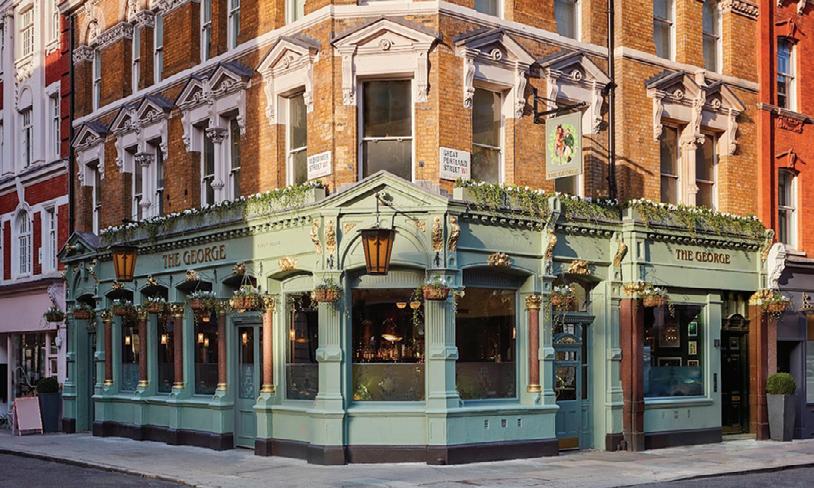
Since relaunching under its new name following a management buyout led by Founder and Managing Director Dominic Jacobs in December 2025, the group has reported 20% year-on-year sales growth and a 40% year-on-year uplift in EBITDA. Ardent is targeting new openings across London and beyond over the next three to five years.
Dominic Jacobs, Founder and Managing Director of Ardent Pub Group, said: “This means a great deal to us. Ardent is built entirely on people – the teams who show up every day and make the experience what it is. To be recognised at this level is a reflection of their commitment and the culture we have worked hard to build together. As we grow, protecting and evolving that culture remains central to everything we do.”
Criterion Capital has announced a landmark partnership with JD Wetherspoon to open the operator’s first-ever venue in London’s Theatreland, within the iconic London Trocadero at 30 Shaftesbury Avenue.
The new venue, Piccadilly Hall, takes its name from the historic Piccadilly Hall which once occupied part of the Trocadero site and gave Piccadilly Circus its name. In the early 17th century, tailor Robert Baker bought a large tract of land in the area, where he built a factory and mansion, marked on several antique maps. It was here that he made fashionable decorative collars known as “piccadills” or “piccadillies”, which later became associated with one of London’s best-known areas.
Backed by a multi-million pound investment, Piccadilly Hall will form part of Criterion’s wider strategy to reposition the Trocadero and surrounding estate as a major hospitality and entertainment destination in the heart of the West End.
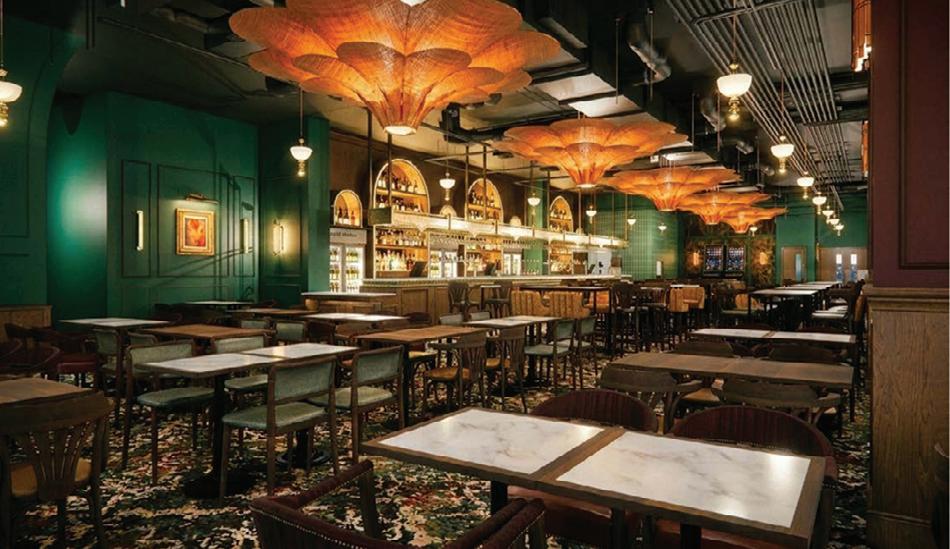
Set to become one of the largest Wetherspoon venues in central London, the opening represents a significant addition to London’s hospitality landscape and a major milestone in the continued evolution of Theatreland.
Spanning more than 3,600 sq ft with capacity for around 280 covers, the venue will operate from 7:00am to midnight, seven days a week, offering an all-day food and drink menu from breakfast through to evening. The scheme is expected to create more than 100 jobs while strengthening the West End’s position as one of London’s leading hospitality and cultural destinations.
Wetherspoon will also join the expanding Zedwell & More guest membership programme, providing hotel
guests with exclusive discounts and offers across hospitality, retail and leisure experiences throughout London. The programme spans Zedwell locations at the neighbouring London Pavilion – home to the world’s largest capsule hotel with almost 1,000 beds – as well as Tottenham Court Road, Knightsbridge, Park Lane and Greenwich. Together, the network represents one of central London’s most significant hotel guest ecosystems, generating a substantial customer base for the leading pub brand.
Saskia Jiggens, Group Head of Communications and Engagement at Criterion Capital, commented: “The London Trocadero has long played an important role in the story of the West End, and the opening of Piccadilly Hall marks an exciting new chapter for this global destination. This partnership with JD Wetherspoon will bring a vibrant new hospitality venue to the heart of Piccadilly, adding to the Trocadero’s carefully curated mix of occupiers and welcoming theatre-goers, local residents, hotel guests and visitors from around the world. We are thrilled to see this landmark building continue to reflect the energy, accessibility and international appeal of the West End.”
Tim Martin, Founder and Chairman at JD Wetherspoon, said: “We are delighted to be opening our first venue in Theatreland in partnership with Criterion Capital. The West End is one of the world’s great hospitality destinations, attracting millions of visitors each year, and we believe this site is exceptionally well suited to the Wetherspoon model of offering good-quality food and drink at reasonable prices in well-managed and historically interesting buildings. The scale of Piccadilly Hall, together with its connection to the wider Zedwell hotel network, makes this one of the most significant openings for Wetherspoon in London for many years. We have always believed that pubs and hospitality venues play an important role in local economies by creating jobs, supporting tourism and providing accessible social spaces for a wide range of customers and we look forward to becoming part of this vibrant area of the West End.”
Be Inclusive Hospitality has renewed its call for operators to contribute to a sector wide survey as part of its new Better Hospitality campaign, backed by hospitality leaders and organisations from across the industry.
Better Hospitality is a landmark campaign designed to build a fairer, stronger, more inclusive hospitality industry. With a focus on race and ethnicity, it addresses inequities in pay, progression, and workplace experience that limit potential and weaken the sector. Uniting robust research, industry expertise, and practical employer standards, the campaign gives employers insight, tools, and collective leadership to build inclusive workplaces, elevate talent, and strengthen organisational performance.
The survey is now live, and everyone working in hospitality is encouraged to share their views. Exploring pay disparities, career pathways, and progression barriers across the industry, the survey findings will inform the development of a set of new Equity &

Progression Standards for employers. You can take the Better Hospitality survey here
A diverse Leadership Group has formed to support the campaign, bringing together senior leaders from all areas of the sector, committed to measurable change. The Better Hospitality report launches in September to support informed commitment to a fairer, stronger, more inclusive hospitality industry.
Lorraine Copes, CEO & Founder, Be Inclusive Hospitality, commented: “By gathering robust insight and working with senior leaders and employers to meet practical standards, we can create the conditions for fair progression, better workplaces, and a stronger industry. The Better Hospitality survey is a crucial first step, and we need to hear voices from every corner of hospitality. We encourage everyone working in the sector to take the short survey and help contribute to the change ahead.”
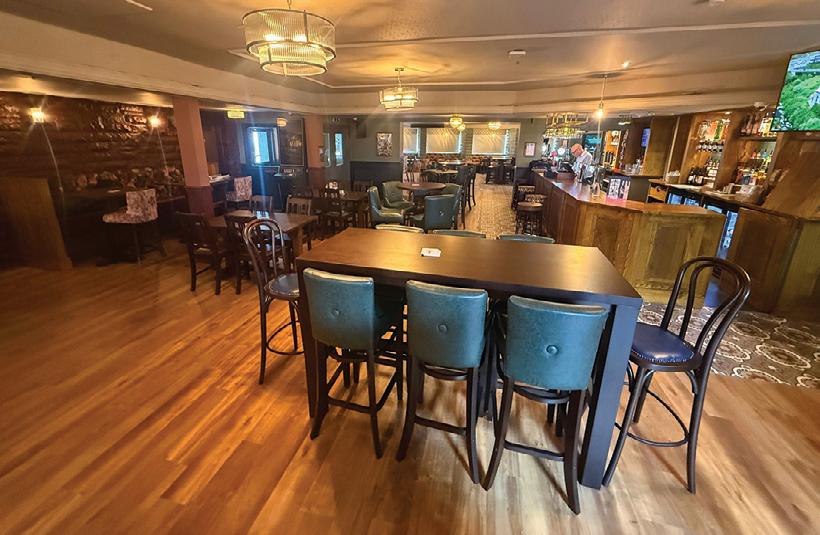
The Saltersgill, located in Middlesbrough, officially reopened on Thursday 21st May following a transformational investment of more than £360,000. The pub is part of Proper Pubs, the award-winning community wet-led operator division of Admiral Taverns, which operates more than 200 pubs across England, Scotland and Wales.
Inside, the pub has been completely transformed to include brand new flooring, fixtures and fittings throughout, as well as eight flat screen televisions fitted with Sky and TNT Sports. In addition, the pub has been revamped to include two new dart boards and pool table in the games area for customers to enjoy. Outside, The Saltersgill offers brand-new lighting and signage to greet customers as well as a refurbished garden seating around 80 people.
Les Harker, Operator of The Saltersgill, said: “It’s been amazing watching the refurbishment come to life at The Saltersgill. The pub looks terrific, and it was a joy to reopen and show off its brand-new look to the community. We’ve already had great feedback from customers so overall I’d say the reopening was a huge success and I can’t wait for what the future holds.
“Once again, I’d like to thank the Proper Pubs team for all their support throughout this journey, and I look forward to making the community proud!”
Nikki Greenhalgh, Operations Director for Proper Pubs, said: “It’s been a pleasure to have Les at the helm of The Saltersgill for the past 20 years and we are delighted that the opening night was a great success! On behalf of myself and the Proper Pubs team, we’d like to thank Les for all his hard work and we wish him the very best for the future!”
Bringing people together in local areas and creating vibrant social hubs which support their communities is very important to us so we are glad that we were able to make this happen.”
Proper Pubs is always looking for ways to support its communities through an annual schedule of events and fundraising initiatives. This year over Easter it collected 21,619 easter eggs to donate to local charities and in 2025 operators collected 20,500 selection boxes to donate to local charities and communities in need for Christmas, as well as raising £80,255 for Admiral Taverns’ charity partner, Claire House Hospice.
Furthermore, last year, Proper Pubs also successfully donated enough food to local foodbanks across the UK to feed 1,300 people for a week and has also been recognised in the UK-wide defibrillator installation campaign which has already saved 11 lives.

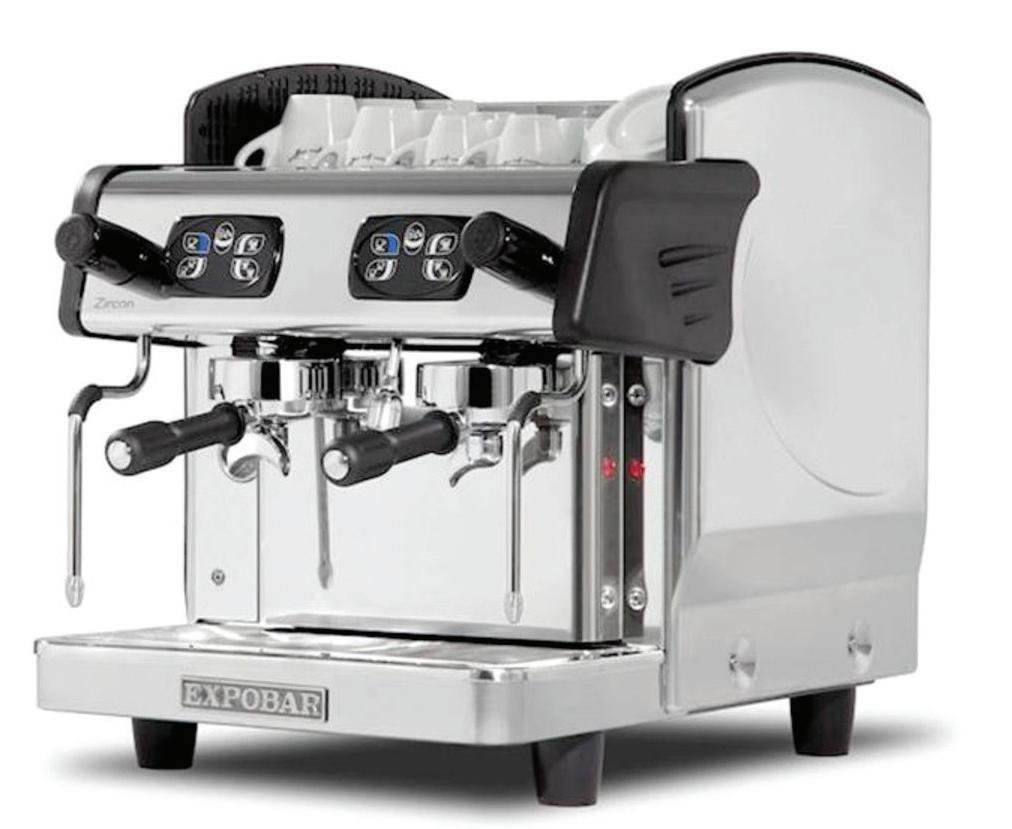
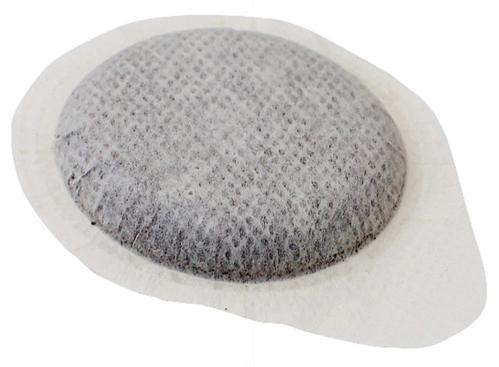
Coffee pods are not to be confused with capsules
They are specialized, individually wrapped filter paper pods containing 7 grams of top quality coffee, just like you get when a barista makes a coffee
Our pods are available in both 7 grams and double-shot 14 grams, perfect for making 2 coffees at once or a large 14 gram shot. The taste is sublime with no barista skills needed
By Samarah Daher, studying at Swiss Hotel Management School (SHMS) -
For decades, a hotel's reputation was something that took years to build. It was shaped by stars, awards, and happy guests. Brands' messages were carefully managed — the kind of credentials that, unless there was a catastrophe, took equally as long to erode. Hotels controlled their own narratives, but unfortunately this is no longer the case.
Today, a single guest post, one uploaded at midnight from a room with a leaking tap, can reach thousands of people before the manager clocks in for their morning shift. In the digital age, reputation has stopped being something hotels can manage closely, because one bad experience, shared at the right moment, can unravel years of carefully built trust. And the uncomfortable reality is that hotels rarely see it coming until it is already too late.
And for an industry that runs on trust, there’s real consequences in this.
GUESTS ARE NOW THE PUBLISHERS
Where trust was once conferred by institutions — the Michelin Guide, AA ratings, travel writers, with clear parameters that management could closely control — it is now up to ordinary guests armed with a smartphone. Most people will read reviews before they book, and a stranger's bad experience will stick in their minds. The peer has replaced the expert.
And the numbers back this up. A 2024 survey found that consumers prioritise online reviews over family recommendations or corporate marketing when making booking decisions. On TripAdvisor alone, 26 million reviews were posted in 2020. The probability of a reputational crisis, with the sheer number of reviews being published, is not a question of if but it is a question of when.
And unlike a critic whose review might appear in a magazine months later, an unhappy guest can share their experience globally in minutes, and it stays online long after they've checked out. A delayed check-in, a dismissive response at reception, a bathroom that doesn't match how it looks on the website, it is in these moments that would once have been forgotten are now permanent, and public.
WHEN ONE COMPLAINT BECOMES A CRISIS
Social media has changed the nature of complaints because negative and emotionally charged posts are 1.91 times more likely to be shared, and there is, currently, no way to verify whether a review is factual before it is amplified. Content spreads quickly, with public opinion often established before the facts are even confirmed. Hotels regularly find themselves losing control of a narrative before management or marketing knows there is a problem.
This becomes an even wider issue when considering how quicky an individual, stand-alone incident can become symbolic. For example, a hotel in Miami faced exactly this when a guest posted his experience with a virtual front desk which was staffed from India. And while the original complaint was about the service the guest received, quickly the comments shifted to focus more on the job displacement and what the hotel, and brand, stood for. So now, the situation wasn’t a case of defending one operational decision but had to defend its entire identity.
This is why reputation is often to referred to as “the risk of risks”. It starts as a consequence of something else and grows into something far larger and out of reach. Research on a New York hotel that had a bed bug crisis found that a spike in negative reviews had a direct and measurable impact on bookings. And often, damage doesn’t stop there; rebranding, staff turnover, legal fees, losing partnerships etc, all costs money – and it touches every part of the business.
Unfortunately, reputational risks cannot be eliminated, but organisations need to that it seriously to significantly reduce exposure. And the starting point is deceptively simple: fix problems before guests leave. Businesses need to train their staff to resolve complaints quickly and empathetically in order to protect business. Research shows that guests are less likely to post negative reviews, and more likely to post positive ones, when issues are resolved quickly and quietly. In order for this to happen, staff need to be given the resources and authority to do this at their own discretion, without small problems needing to be escalated up management chains.
In-stay feedback also matters. Meaningful guest experience surveys, completed before checkout, create the opportunity to catch dissatisfaction while it is still a private matter. Because any concerns that surface following the survey can be followed up and resolved before the guest walks out the door.
And then beyond the stay itself, hotels should be keeping up to date with what is being said about them. Having a trained social team, or even using AI tools to flag mentions, means that emerging complaints will be caught early before they spiral out of control.
Understanding that prevention is the most effective form of risk management is part of the way, but it can only work if leadership and management treat it as a genuine priority. It means that every operational decision now carries reputational implications that play out in front of the public, digitally. The Miami virtual check-in example is a reminder that guests are constantly evacuating their experience, and now also your values. While perception has always mattered in hospitality, there has been a change in the speed and permanence which it can be won and lost. In a digital world, where guests can publish every moment of their experience, managing reputation is no longer different to managing guest experience. The two are now the exact same thing.
Public voting continues for the 4th annual Turkish Restaurant & Takeaway Awards (TURTA), celebrating the finest culinary talent within the UK’s vibrant Turkish food sector.
Following a highly competitive nationwide nomination process driven by widespread public engagement, the selected establishments reflect a deep connection with the local communities they serve.
The complete list of nominated businesses is now live on the BritTradeAwards Semi-Finals Portal: https://www.brittradeawards.org/4_TURTA_semifinals

Turkish cuisine has a rich, storied history in the UK. Its journey began in the 1940s with the opening of the historic Istanbul Restaurant in Soho, London. The cuisine experienced a massive boom in the 1960s, catalysed by the launch of the UK’s very first doner kebab shop in North London in 1966. Over the subsequent two decades, Turkish food achieved rapid, widespread growth. Today, it is deeply integrated into British culture, standing alongside fish and chips as a true staple of mainstream British society.
From city centres to local high streets, Turkish restaurants and takeaways have become a cornerstone of the UK’s hospitality landscape, offering accessible, high-quality dining to a broad and diverse audience. Beyond their culinary appeal, these businesses make a significant contribution to the UK economy. They create vital jobs, support local supply chains, and sustain independent entrepreneurship. Many are multi-genera-
tional, family-run enterprises reflecting long-term resilience, dedication, and commercial commitment.
“The incredible public response to this year’s nominations underscores the deep-rooted connection between these exceptional businesses and the communities they serve. Turkish hospitality has truly woven itself into the fabric of British high streets.” Said Idris Okuduci on behalf of TURTA Awards
“Winning at TURTA has been transformative for our family business. It validated generations of hard work and ignited an even greater passion among our team to share our culinary heritage with our loyal customers.” Mehmet Nezir Korkut / Great British Doner, Winner of 2025.
The awards are currently in the public voting phase, giving customers and supporters the opportunity to back their favourite establishments and help determine who progresses to the final stage. Public voting is officially open and can be accessed here: https://www.brittradeawards.org/turta_vote
The grand category winners will be announced at the high-profile TURTA Gala Lunch on 21 June 2026 at the prestigious JW Marriott Grosvenor House, London.
The landmark event will bring together leaders from the hospitality sector, key policymakers, and community representatives to celebrate excellence and recognise the businesses shaping the future of Turkish gastronomy in the UK.
For the UK hospitality sector, the pressure is on to reach Net Zero by 2050, with industry bodies like UKHospitality pushing for aggressive targets, including the elimination of direct emissions (Scopes 1 and 2) by 2030 and all avoidable supply chain emissions (Scope 3) by 2040. It’s a challenge that can feel complicated, frustrating, but is ultimately necessary for a sustainable future.
Hot water is the lifeblood of hotels and restaurants, but it's also a carbon heavyweight. Historically, gas was the default choice for its low cost, but it is increasingly at odds with climate regulations. Conversely, while electric water heaters offer zero on-site emissions, their higher running costs can be a bitter pill for high-demand businesses to swallow. Adveco suggests that the smartest path forward isn’t a choice between gas or electric, but a strategic hybrid approach. By integrating multiple technologies, businesses can achieve environmental goals without compromising their bottom line.
Air source heat pumps (ASHPs) can generate up to 70% of domestic hot water (DHW) system energy as preheat, significantly reducing the load on electric boilers and slashing

carbon emissions. Hybrid systems, such as Adveco FUSION, can also incorporate electric immersion backups, ensuring an uninterrupted hot water supply—a non-negotiable for guest satisfaction.
Solar thermal, as a ‘true renewable,’ can offset up to 30% of annual DHW energy requirements, offering a low-maintenance solution with a rapid return on investment. It can also work with both electric and gas-fired appliances, like Adveco’s Astute smart water heater range. Decarbonisation isn't just about swapping out old hardware; it’s about bespoke, intelligent design. Moving beyond like-for-like replacements to integrated systems—complete with thermal storage and optimised controls—allows hospitality venues to future-proof their operations against evolving regulations.
With trusted technological partners, the journey to Net Zero becomes a strategic evolution, securing long-term viability in a greener economy. https://adveco.co/
Disappointing weather and fragile consumer confidence pushed OnPremise drinks sales down year-on-year in the first half of May, NIQ’s Daily Drinks Tracker shows.
The Tracker, powered by CGA intelligence, shows average sales in managed venues in the week to Saturday 9 May were 3.1% behind the same period in 2025. This was followed by an even deeper loss of 10.2% in the following seven days to Saturday 16 May.
The slow start to May means pubs, bars and suppliers have had negative growth in 13 of the first 19 weeks of 2026, and in four of the last five. Parts of Britain have faced sustained periods of wetter-than-usual weather this year, keeping drinkers at home when they might otherwise have gone out. Consumers’ spending has also been held back by mounting concerns about inflation in key household costs, which have worsened since the conflict in the Middle East drove up oil prices.
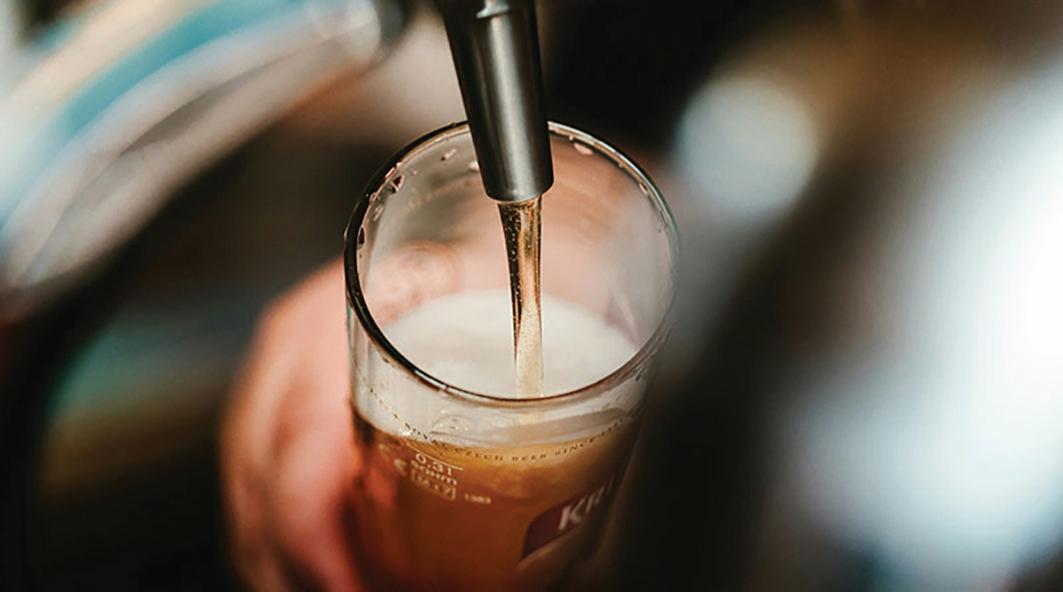
The latest Daily Drinks Tracker shows sales were down on each of the 12 days from Tuesday 5 to Saturday 16 May. Brighter days of the fortnight coincided with warmer weather and important football fixtures including the Champions League Semi-finals and FA Cup Final. But in between those better spots, trading dropped by as much as double-digits on three straight days from Monday 11 to Wednesday 13 May.
Football helped to make beer the best of the major drinks categories over the fortnight. Its sales outperformed the market as a whole, dropping 1.5% and 7.2% in the weeks to 9 and 16 May respectively. However, there were bigger losses in other key categories like cider (down 7.7% and 25.5%), soft drinks (down 4.5% and 10.8%) and wine (down 4.7% and 8.7%). Spirits (down 13.5% and 17.6%) had another very tough fortnight, with some drinkers chasing what they perceive to be better value in longer serves like beer.
The disappointing sales leave the On-Premise hoping for a sunny Bank Holiday weekend to bring people out of home and release built-up demand for pubs and bars.
Rachel Weller, NIQ powered by CGA’s commercial lead, UK & Ireland, said: “A challenging May, on the back of a soft start to the year, is a real cause for concern for the On-Premise. There are important mitigating factors, like the disappointing weather and war in the Middle East, but that’s little comfort to pubs, bars and suppliers. Many consumers remain ready to spend on drinking out, but for the millions of households feeling the pinch on spending, costs are front of mind at the moment. Businesses will have to provide top value for money and compelling reasons to step out of home over the summer season.”
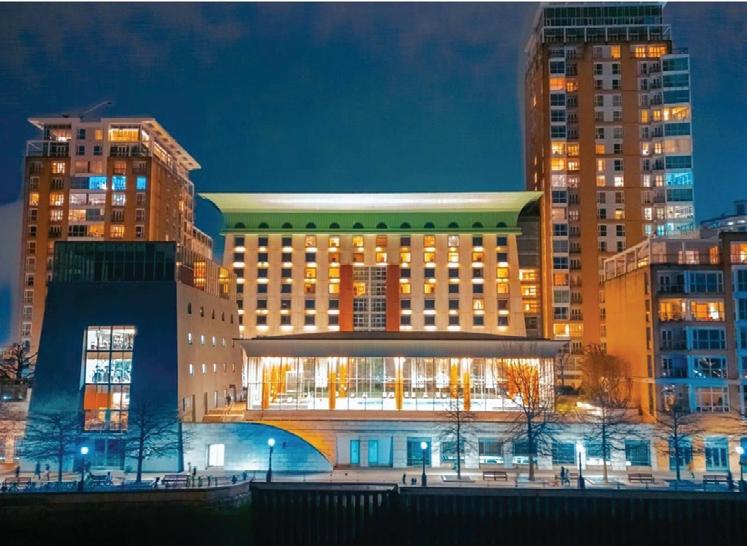
IHG Hotels & Resorts (IHG) has announced the signing of Canary Riverside Plaza, Vignette Collection by IHG – the brand’s first property in London and second in the UK&I. Developed in partnership with Yianis Group, the signing also marks IHG’s debut in Canary Wharf, one of London’s most established and wellconnected business districts.
Scheduled to open in summer 2026, Canary Riverside Plaza, Vignette Collection by IHG will offer 142 guestrooms and suites with views across the River Thames and the City, alongside a restaurant and bar, flexible meeting and events space for up to 200 guests, and access to an adjacent health club and spa. Located in Canary Wharf, one of London’s leading financial and professional services districts, the hotel is well positioned to serve corporate and leisure demand, benefiting from strong connectivity across the capital and to key international gateways in an area that continues to evolve as a dynamic commercial and lifestyle hub.
Willemijn Geels, Vice President, Development, Europe, IHG Hotels & Resorts, said: “We’re proud to be deepening our partnership with Yianis Group – a key contributor to the growth of our Luxury & Lifestyle portfolio in the UK&I. Building on our signing of InterContinental Manchester, together we have a shared
commitment to bring distinctive hotels to key locations and we are creating a strong pipeline of high-quality developments. This latest project not only highlights IHG’s exciting growth of its Luxury & Lifestyle portfolio in the UK’s capital, but it also showcases the importance of this partnership.
“With Vignette Collection, we’re able to work with exceptional properties that retain their individuality and distinct style while benefiting from IHG’s global scale and enterprise platform, and London is a natural next step for the brand as we continue to expand in key gateway cities.”
John Christodoulou, Chairman, Yianis Group, added: “We are proud to be introducing Vignette Collection to London with Canary Riverside Plaza. The brand’s focus on individuality and character strongly aligns with our vision for the hotel, and we were particularly drawn to its ability to celebrate the unique identity of each property while benefiting from the strength of a global brand. Canary Wharf provides a dynamic and well-established setting for this development, and we are excited to be creating a landmark destination within this important part of the city. We look forward to continuing our partnership with IHG Hotels & Resorts and delivering a distinctive experience for guests.”

The implementation of Martyn's Law is a significant milestone for the UK’s hospitality sector, with legislation expected to come fully into force in 2027.
For those less familiar with the update, Martyn’s Law (also known as the Terrorism Protection of Premises Act 2025) seeks to improve public safety by requiring hospitality, leisure, entertainment, retail, and other venues to plan for and respond to terrorist threats. The law comes as a result of the 2017 Manchester Arena bombing and seeks to better protect staff and visitors through improving security measures, evacuation plans, and organisation preparedness. Venue and event organisations are encouraged to use this time to understand and prepare for their new legal obligations.
The legislation is built upon a tiered system based on capacity size of a venue. Pubs, restaurants, bars, and smaller events venues with capacity between 200-799 people come under the “standard tier”. Larger venues and events with capacity above 800 fall into the enhanced tier, where additional safety measures will apply.
The most recently published guidance contains advice on which operators can begin to make their plans. Positive news for many operators: the much-needed updated information focuses more on the pragmatic steps standard tier venues should take rather than costly infrastructure upgrades.
Operators will be expected to have:
• Clear evacuation procedures
The ability to implement a rapid lockdown
• Effective methods to communicate quickly with customers and staff during an incident.
These measures were designed to be achievable for hospitality venues of all sizes without placing additional financial burden on businesses already managing tight margins.
Although enforcement won’t be until 2027 earliest, it is in all venues’ interests to ensure they are fully prepared. Martyn’s Law has been creat-
By Karl Pardoe, Account Executive, Genetec (www.genetec.com)
ed to encourage a culture of preparedness across all public facing venues and rethink the way we collectively plan for the worst-case scenario; over-preparedness is always best.
For hospitality operators, these changes should be similarly aligned with existing responsibilities surrounding fire safety and health and safety. Martyn’s Law simply aims to bring a more structured approach to managing the risks associated with deliberate acts of harm.
Operators should be considering these key questions:
• Are staff sufficiently trained to deal with emergencies?
• Are evacuation routes clearly identified?
• Is surveillance and building technology updated and fully functioning? By implementing these steps now, venues can ensure they are fully prepared for next year and can also spread any associated costs over time.
One of the central themes of the new guidance is the importance of people; comprehensive emergency plans are only as effective as the people implementing them. Staff awareness and training is crucial – teams should be familiar with emergency procedures and confident in their roles. Regular briefings and scenario-based exercises can help with this. It is imperative to create a culture where security is part of regular
operations whilst not compromising the customer experience. The best designed processes should ideally be invisible to guests whilst providing reassurance that safety is paramount.
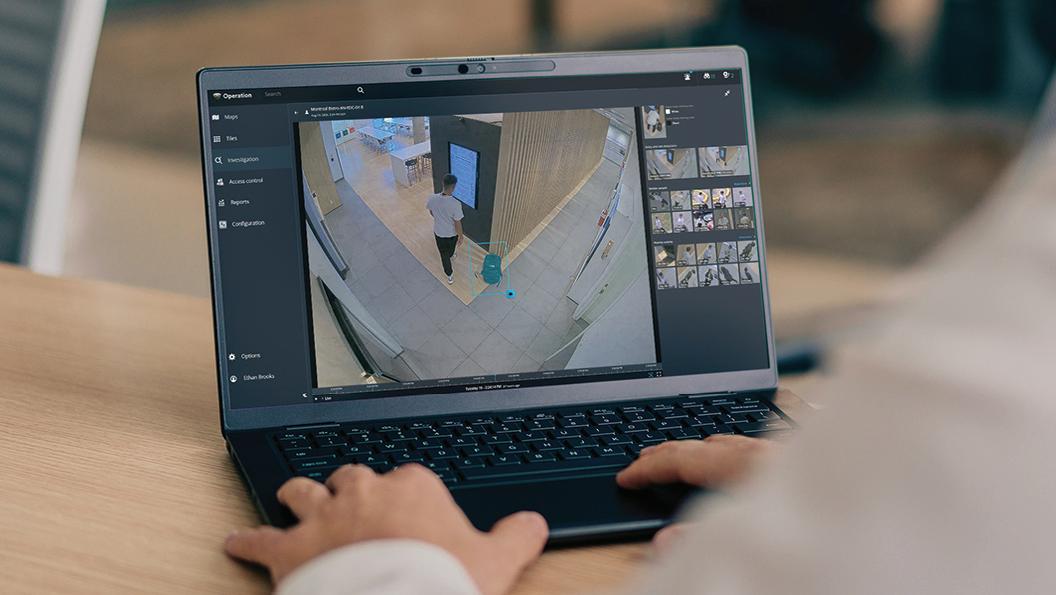
While standard tier venues are not required to introduce extensive new security equipment, many operators are taking this opportunity to review their existing systems. Security technologies such as CCTV, access control, and communication tools can play an important supporting role when integrated effectively. Combining these elements into a single, unified system can significantly improve situational awareness and response times.
During a rare occasion where an incident may be evolving, the ability to access real-time information in an efficient, single interface can help operators make better decisions under intense conditions. Unified security systems also reduce the complexity of manging multiple systems under high pressure.
Operators may also want to consider how information from security systems would be shared with emergency services during an emergency. Traditionally, this has relied on manual processes, however, modern cloud-based solutions can enable faster, more secure and accountable sharing of important digital evidence.
As more information continues to be released in the lead-up to the official implementation deadline, it is likely that plans and requirements will continue to evolve. However, the core principles of Martyn’s Law are unlike to change: improved planning, better communication, and a clear focus on protecting people.
For hospitality, leisure, and entertainment, it is clear that preparation should begin now and the earlier the better. Early action will not only reduce future pressure but also help operators to build confidence among staff and customers alike.
Ultimately, Maryn’s Law represents a positive shift in how public safety is approached and offers the chance to strengthen resilience and enhance operational readiness to ensure venues play a proactive role in protecting the communities they serve.
Over 60 riders from across the pub and hospitality sector are gearing up for a 270km cycling challenge to raise vital funds for industry charities LTC and Only A Pavement Away, taking place from 4th - 6th June 2026 in Norfolk.
Over the three days, the team of riders which includes publicans, brewers and sector suppliers, will cycle around 55 miles per day, covering three scenic routes: Norwich to Thetford, Thetford to King’s Lynn, and King’s Lynn back to Norwich. The team will also visit some exceptional pubs along the route highlighting their essential role in their communities.
This year’s ride steps up the distance from last year’s challenge, which saw 60 riders cycle 220km across the Lake District and raise a record-breaking £110,000. This is the fourth Pedalling To Pubs Challenge which has grown in size every year and has already raised £250,000 for our two sector charities. Their work has never been more important supporting people across our sector who are facing real hardship. For the third year in a row, 2026’s headline sponsor is Polaris, with the ride also supported by partners, Thatchers Cider, Lucky Saint and the British Institute of Innkeeping (BII).
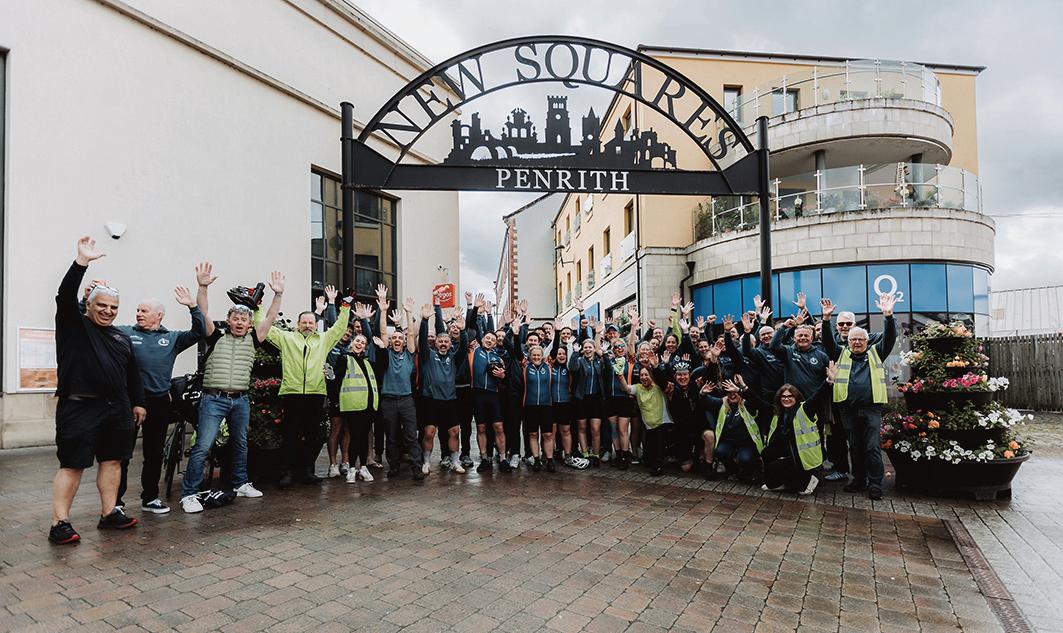
The second day of the challenge (5th June) will see all the riders wearing bright orange socks. Orange socks have become a key symbol across recent industry fundraising challenges and initiatives, representing the shared effort and determination shown by all those taking part. The Wear Orange for Hospitality initiative, led by sector champion Hamish Stoddart, invites supporters from across the industry to get involved by purchasing and wearing a pair of orange socks.
This is a simple and affordable way for individuals, teams and corporate groups to show their support for the Pedalling To Pubs riders. It helps drive awareness of those struggling across the sector and how to support them. More information on how to purchase orange socks can be found here and all monies raised will go towards the final fundraising total.
Pedalling To Pubs aims to surpass last year’s record-breaking fundraising total of over £100k for LTC and Only A Pavement Away. The funds raised go directly towards helping these charities continue their essential work of providing practical advice, wellbeing support, financial assistance, and life-changing employment opportunities for people across the industry.
Steve Alton, Lead Rider and CEO at the BII, said: “With just one week to go, anticipation is really building for this year’s Pedalling To Pubs challenge. This year’s 270km Norfolk route raises the bar once again. It’s a brilliant opportunity for pub and hospitality professionals to come together, push themselves, and raise vital funds for two charities that make a real difference. Please donate if you can, as your support will make all the difference to those who need it.”
Chris Welham, CEO at LTC, said: “With the start line fast approaching, the focus now is on the challenge ahead and the difference we can make together. 65 riders with myself included will take on three demanding days of cycling across Norfolk, all united by a shared purpose. This is about far more than the distance - it’s about raising vital funds for LTC and Only A Pavement Away and supporting people across our industry who are facing real hardship. Thank you to everyone who has supported us so far, your generosity is helping us continue to transform lives and support those who need it most.”
Greg Mangham, Founder and voluntary CEO at Only A Pavement Away, said: “As the challenge draws closer, it’s fantastic to see the continued support behind Pedalling To Pubs from across the industry. Initiatives like this are vital to the work we do, as the funds raised help us provide meaningful support and create real opportunities for people in need of a second chance in hospitality. Wishing all the riders the very best as they take on Norfolk next week - your dedication is truly inspiring, and we’re incredibly grateful for the support that makes our efforts possible.”
To find out more or to donate, visit https://pedallingtopubs.org.uk/pedalling-to-pubs-2026/
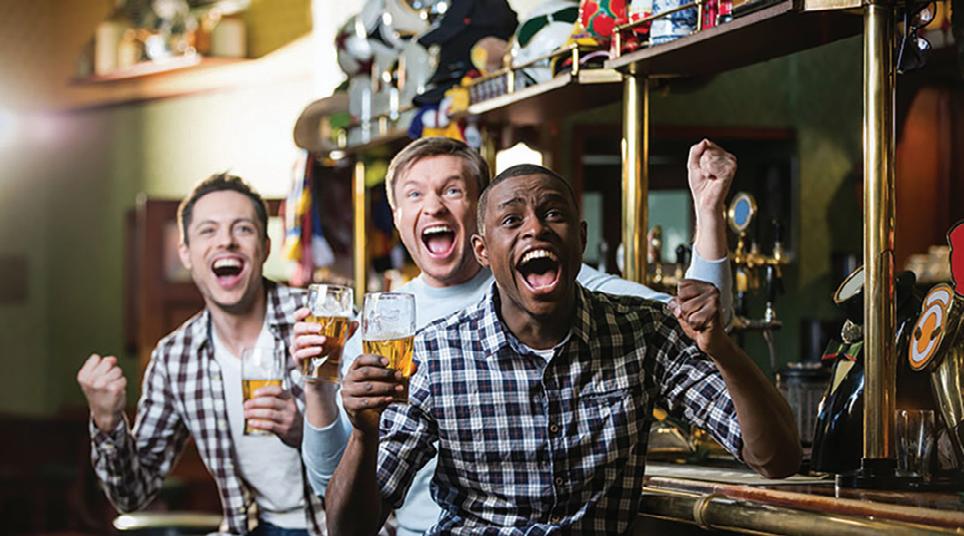
With less than a month to go until the FIFA World Cup begins, pubs across Scotland are preparing to welcome fans for what will be Scotland’s first World Cup finals appearance in 28 years.
To support licensees ahead of the tournament, the Scottish Beer & Pub Association has published updated operational guidance for venues planning to show matches this summer. The guidance is designed to help pubs deliver a safe, well-run and enjoyable experience for customers during a competition that runs from 11 June to 19 July 2026.
The document brings together practical advice for publicans on key areas such as licensing, staffing, managing busy services, and creating safe environments for customers, with an emphasis on early planning and close local coordination. It also includes a breakdown of the local licensing decisions by respective licensing boards across the country.
Produced by the Scottish Beer & Pub Association in partnership with Police Scotland, the guidance encour-
ages licensing authorities, the licensed trade and the police to work together to ensure a safe and successful tournament. It is also supported by Best Bar None Scotland, BII Scotland, Scottish Alcohol Industry Partnership, Institute of Licensing, Night Time Industries Association, Scottish Hospitality Group, Scottish Licensed Trade Association, and UK Hospitality-Scotland. Paul Togneri of the Scottish Beer & Pub Association said: “This summer’s World Cup is a landmark moment — it’s Scotland’s first finals since 1998, and pubs will be at the heart of how fans come together to enjoy it. We want as many people as possible to have a brilliant time in their local, and that means planning ahead.
“Our guidance is practical, Scotland-focused support for operators — covering licensing, staffing and sensible steps to manage busy matchdays safely. We’re also encouraging early engagement with Licensing Standards Officers and Police Scotland, so everyone is working to the same plan and the tournament is enjoyed responsibly in communities across the country.”
A London pub has launched what may be Britain’s most grown up children’s menu – featuring snails, anchovies and a special ‘tax break tart’ – in a challenge to the UK Government’s controversial announcement of a temporary cut to VAT on children’s meals over the school summer holidays.
From 25 June, The Blue Stoops in Kensington will serve The Chancellor’s Children’s Menu, a dedicated menu for diners featuring diminutive dishes more often associated with grown-up gastronomy than the average kids’ tea. The menu will change regularly, reflecting the pub’s seasonal food offer, but example dishes include wild burgundy snail salad, anchovy butter toast and now the ‘tax break tart’’.
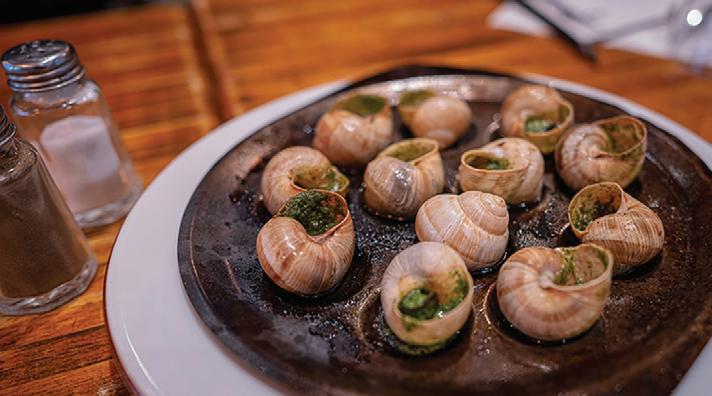
The launch follows Chancellor Rachel Reeves’ announcement that certain children’s meals will be subject to a temporary reduced VAT rate of 5%, down from 20%, from 25 June to 1 September 2026. Under the guidance, eligibility depends on whether a meal is marketed, presented and priced as a chil-
dren’s meal, rather than simply who eats it. It is at the discretion of a venue whether children’s meals are served to people over the age of 12 or not.
Owners at The Blue Stoops argue the policy raises a bigger question for hospitality – if lower VAT can make eating out more affordable for families, why should the relief stop at children’s menus?
Jamie Allsopp, founder of Blue Stoops said: “The hospitality industry has been crying out for cuts to VAT to support an industry that has been hammered in recent years – so while this move is of course welcome, it does not go far enough.
“We believe the cuts should be applicable to all diners and not just children. That’s why we’ve launched The Chancellor’s Children’s Menu, to ensure everybody can feel the benefit of this new policy, and enjoy some of the best seasonal ingredients prepared by London’s finest chefs at a price that is fair, reasonable, and equitable.”


For any organisation storing chilled or frozen goods, temperature control is not a back-office task. It directly affects safety, compliance, stock protection and, in some sectors, the quality of research or patient care. Food businesses, for example, have clear responsibilities around chilled storage. The Food Standards Agency states that chilled food must be kept at 8°C or below, with fridges ideally operating at 5°C or below. Temperature checks and accurate records are a core part of showing due diligence.
However, many businesses still rely on manual checks, basic thermometers and paper-based logs. While these methods can work in simple environments, they leave gaps. A fridge may fail overnight. A freezer door may be left open between checks. A power cut may go unnoticed until stock has already been compromised. For organisations holding high-value or sensitive goods, those gaps can quickly become expensive. Chris Potts, Marketing Director, ANT Telecom, explains why temperature monitoring needs to move beyond the clipboard.
The problem with manual temperature checks is that they depend on someone being available and remembering to take the reading. If this is done then the next step is to record it correctly. If an issue does occur they then need to react to it in a timely manner. In a busy workplace, this process is very easily forgotten or disrupted.
Of course, there are solutions to this. A thermometer with an audible alarm is a popular solution, and can help - but only if someone is close enough to hear it. This doesn’t, however, solve the record-keeping burden as staff still need to write down readings, maintain logs and provide evidence during audits or inspections.
Manual monitoring essentially creates three common risks. The first is a delayed response. If a fault happens outside working hours, the alarm may not be acted upon until the next day. The second is human error, with checks missed or recorded incorrectly. The third is limited visibility, especially for businesses managing multiple fridges, freezers or sites. These risks may be manageable for smaller operations. But for larger organisations, or those storing high-value food, pharmaceuticals, samples or other temperature-sensitive goods, they can become a serious operational weakness.
There are many risks for businesses if they get temperature monitoring wrong, some of which carry serious consequences. There is not just a visible cost, but a reputational cost that some businesses may never recover from. If temperature control creates a food safety risk for example then bacteria could spread and make customers ill. For healthcare businesses and pharmaceutical companies incorrect storage conditions can compro-
By Chris Potts, Marketing Director at ANT Telecom
mise medicines, samples or research materials, which could cost people their lives. This is why businesses need a clear process for monitoring temperatures, escalating alerts and recording the action taken.
FROM MANUAL TO CONTINUOUS MONITORING
One way to navigate this problem effectively is to install an automated temperature monitoring system to ensure continuous monitoring 24/7. This works by inserting wireless sensors in the fridge and freezers to constantly measure temperatures around the clock.
If a temperature moves outside of its designed threshold, alerts can be sent to the right people by phone call, SMS or email. Just as importantly, temperature data can be recorded automatically, creating a digital audit trail that supports compliance and removes much of the manual administration. This is perhaps most valuable when the business is out of hours. Automated alerts give teams the chance to move stock, check the appliance, close a door, investigate a power issue or call out maintenance before goods are lost.
For multi-site businesses, cloud-based monitoring can also provide a central view of appliances across different locations. This helps teams identify recurring issues, compare performance and spot equipment that may need attention.
As with everything in life, there is no one size fits all system. And businesses will need to invest in systems that best fit their organisation. So, when selecting which technology works best for a business, it is recommended to consider which technology best suits the operating environment. As well as this, businesses should factor in the value of goods being stored, the number of appliances needed, whether there are any compliance requirements and the resources available to manage checks.
The questions to ask are: How often are temperatures checked? Who is responsible for recording them? What happens if an alarm sounds overnight? How quickly could staff respond to a breach? Are records easy to access during an audit? How much stock could be lost if an appliance failed unnoticed?
The answers often reveal whether automated monitoring would provide better protection than a manual check. Alarm management is another important factor. Systems should allow thresholds and escalation routes to be set in a way that reflects real working practices. Too many unnecessary alerts can lead to alarm fatigue, where staff begin to ignore notifications. Too few alerts can leave the business exposed. The balance matters. Scalability also needs consideration. A business monitoring one fridge today may need to monitor multiple appliances, locations or environmental conditions in future. Selecting an approach that can grow with the organisation avoids unnecessary replacement costs later.
TO CONCLUDE…
Basic thermometers, manual checks and logs certainly have a place in smaller lower risk environments. But when storage requirements become more complex and businesses face greater pressure to prove compliance these processes will always struggle to keep pace. Automated temperature monitoring is not about replacing responsibility. It is about giving teams better information, faster alerts and more reliable records. For any organisation storing perishable, sensitive or high-value goods, the question is not simply whether the fridge is cold enough during a scheduled check, it is whether the business would know quickly enough if it wasn’t.
The 40 semi-finalists are: -

The Craft Guild of Chefs has officially unveiled the semi-finalists for National Chef of the Year as the competition reaches its next exciting stage.
Following a strong set of entries this year, a select group of chefs from across the UK have been chosen to go forward to the live semi-finals, which will take place in both Sheffield and London on 24th June and 1st July respectively.
As part of this milestone moment in the competition, each successful chef will have received a personalised National Chef of the Year jacket from chef wear partner, Bragard. Throughout the day, competitors have been sharing their achievement across social media, celebrating their place in the UK’s most respected culinary competition.
Anastasios Neofitos, Haar Restaurant
Andy Wright, Country House Weddings
Asen Ibrov, Restaurant Associates
Ashley Randle, The Cockle
Barry Gamble, Aegon / Aramark
Benhur Gaikwad, Farlam Hall Hotel and Restaurant
Bilal Al Helou, Machynys Peninsula Golf club
Billy Frost, The White Hart Hotel
Brian James, Thornbury Castle
Byron Franklin, Mark Poynton at Caistor Hall
Camilla Deyla, Helene Darroze at the Connaught
Craig Edgell, Craig Edgell Margate Chef Catering & Hospitality
Craig Gibb, Borthwick Castle
Daniel Conlon, Rafters Restaurant
David Millar, Carlowrie Castle
Dennis Easton, BaxterStorey
Gavin Sinden, Absolute Taste
Grahame Wickham, Gordon Ramsay at the Mere
Harry Quinn, Pichet Restaurant
Jack Edgar, The Atlantic Hotel
Karl O'Dell, Cord Restaurant
Lee Parsons, The Parsons Table Restaurant
Leon Sharp, Pennyhill Park
Luciano Lucioli, LUCIOLI CATERING SERVICES
Marnix Taghon, Pyro
Matthew Blowing, Purslane Restaurant
Matthew Lees, The Fat Duck
Nathan Cooper, BaxterStorey
Oliver Dovey, BaxterStorey
Ross Cochrane, Mara Wine Bar
Ruth Hansom, Hansom Restaurant
Scott John-Hodgson, Solstice & House of Tides by Kenny Atkinson
Scott Pepper, The Chancery Rosewood
Sean Parkes, Station Road @ The Lovat Hotel
Stephen Andrews, Fish and Forest Steven Clover, Chelsworth Peacock Ltd
Toby Redgrave, Lifehouse Spa & Hotel
Tom Bennetts, Driftwood Spars
Tom Heywood, Pignut & the Hare
Vladimir Hromek, Cambridge Dining Co. - Catering and Event Management
David Mulcahy, Vice President of the Craft Guild of Chefs and National Chef of the Year director, added:
“We know how much effort and detail is needed in simply entering this competition and we never take that for granted so would like to thank every chef who put a menu forward this year. Everyone who entered will receive personalised feedback from the judging panel as we know this helps them learn from the experience and if they didn’t get through, they can come back even stronger. The online process is rigorous with every judge scoring independently. This ensures we get a wide variety of perspectives at the blind-judging stage. We’re excited to welcome this year’s semi-finalists to Sheffield College and Capital City College in Westminster before we take the top ten chefs to our prestigious final at Le Cordon Bleu
London.”
Mark Birchall, chef patron of Moor Hall and National Chef of the Year Chair of Judges, said:
“Reaching the semi-finals of National Chef of the Year is a huge achievement. It was interesting to see how the chefs interpreted the original brief and brought their own ideas to the table. I’m looking forward to seeing the level of creativity and skill on display in the next stage when the chefs tackle a new brief and we get to watch them cook in one of the four heats. I’ve got a fabulous panel of judges joining me at the live cook-offs, so I know it’s going to be a memorable day for every competitor.”
For the semi-final, competitors will be tasked with producing a two-course menu for four covers within two hours, inspired by this year’s overarching theme of ‘Our Sustainable Future’. The main course will be a plated fish dish suitable for a light summer lunch, showcasing seasonality and balance. Using a whole jumbo plaice and mussels supplied by Flying Fish, together with violet artichokes, dishes should be complemented with summer vegetables, herbs and coastal flavours. A green side salad must also accompany the dish.
For the dessert course, semi-finalists must produce an elegant tart featuring British berries, paired with a sorbet, ice cream or parfait. Chefs will have the freedom to personalise the dish, demonstrating originality, balance and refined presentation. Renowned pastry consultant, Cherish Finden will join the judging panel for this element of the competition.
More than 6,000 retail premises have disappeared from England and Wales over the last five years as high streets adapted to major structural changes following the pandemic, although the analysis suggests the pace of contraction may now be beginning to stabilise according to a new report by global tax firm Ryan.
The analysis found the total number of retail premises across England and Wales fell from 513,855 at the end of 2020 to 507,810 by the end of 2025 a net reduction of 6,045 retail properties.
That equates to more than 23 retail premises disappearing every week over the five-year period.
Unlike traditional shop closure data, the figures do not simply reflect temporarily vacant units or retailers entering administration. Instead, they point towards retail premises that have permanently disappeared from the retail landscape altogether, having either been demolished or converted into alternative types of use.
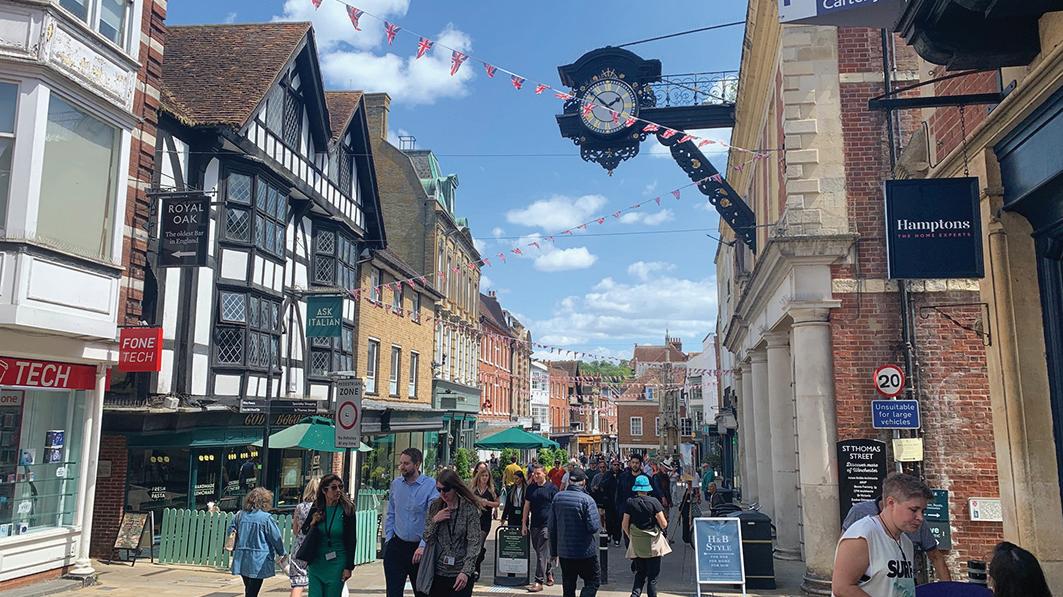
London recorded the largest five-year regional reduction, with 1,266 retail premises disappearing over the five-year period, followed by the South East (-1,191), North West (-719) and North East (-672).
Ryan’s analysis also identified early signs that the pace of contraction may now be stabilising. The total num-
al retail floorspace in many locations.
ber of retail premises across England and Wales increased by 723 between the end of 2024 and the end of 2025. Property numbers increased across every region of England and Wales, with the exception of the North West (-41), suggesting parts of the sector were now beginning to rebalance following significant structural contraction seen since the pandemic.
The figures come as Ryan’s 2026 Annual Business Rates Review, a benchmark report, highlighted that the retail sector saw a 9.3% increase in rateable values at the 2026 business rates revaluation despite significant structural changes across the retail landscape between valuation dates.
Alex Probyn, Practice Leader for Europe and Asia-Pacific Property Tax at Ryan, said: “The pandemic accelerated structural changes that were already emerging across the retail sector, including changing consumer behaviour, hybrid working patterns and a reduced reliance on tradition-
“Many locations were arguably over-retailed before Covid and high streets have evolved towards more mixed-use environments, with retail space being rebalanced alongside growing demand for residential, leisure, hospitality and service-led uses.
Red Engine, the hospitality group behind global competitive socialising sensations Flight Club and Electric Shuffle, has announced a double triumph.
The hospitality group’s Social Darts activity bar, Flight Club, has officially hit one billion darts thrown across its global estate, and Red Engine has secured a spot on the Sunday Times Best Places to Work 2026 list for the third consecutive year.
The one-billionth dart milestone follows a landmark period for Flight Club, which at the end of last year celebrated a decade since opening its first venue in Shoreditch in 2015. Over the last ten years, the brand has transformed the hospitality landscape, welcoming more than 15 million guests in the UK alone.
Red Engine’s inclusion in the prestigious Sunday Times Best Places to Work list for 2026 is recognition for the group’s sustained commitment to workplace culture during a period of rapid estate growth. The nationwide employee survey-based award celebrates the UK’s top employers achieving excellence in wellbeing, inclusivity, and workplace support across diverse demographics.
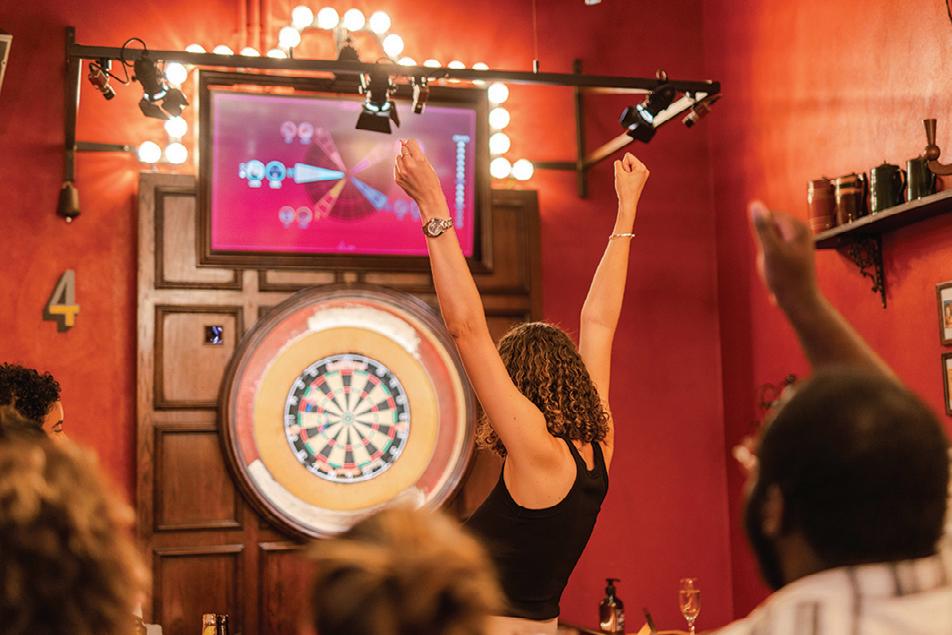
Steve Moore, CEO and Founder of Red Engine, commented, “If someone had told us a decade ago, when we were testing prototypes in a shed, that our tech would eventually process one billion dart throws, we
would have laughed them out of the room. Seeing that final digit roll over on the dartometer was completely surreal. It’s a massive milestone that belongs entirely to the millions of guests who chose to share their birthday parties, date nights, and post-work drinks and everything in between with us.
“This moment is made doubly special with our recognition as a Sunday Times Best Place to Work for the third year in a row. It’s the ultimate validation of the culture we’ve built. We started with a simple dream of creating joy for groups of people, and seeing our team and our guests bring that to life at this kind of scale is incredibly humbling.”
Along with these latest success milestones for Red Engine, the tech-led hospitality group is also celebrating continued growth. Earlier this month, Red Engine launched Flight Club Reading in the town’s vibrant Station Hill development, marking the brand’s 16th UK venue and 32nd globally. While the hospitality sector navigates many ongoing headwinds, the everything-in-house, tech-led, premium competitive socialising model that Red Engine has created for Flight Club and Electric Shuffle demonstrates great resilience as the brands continue to capture consumer loyalty and spend. The group recorded 12% revenue growth for FY2025, with sales rising to £89.8M (up from £80.4M in FY24). Total global system sales, including international franchise partners, rose 25% to reach £146M.
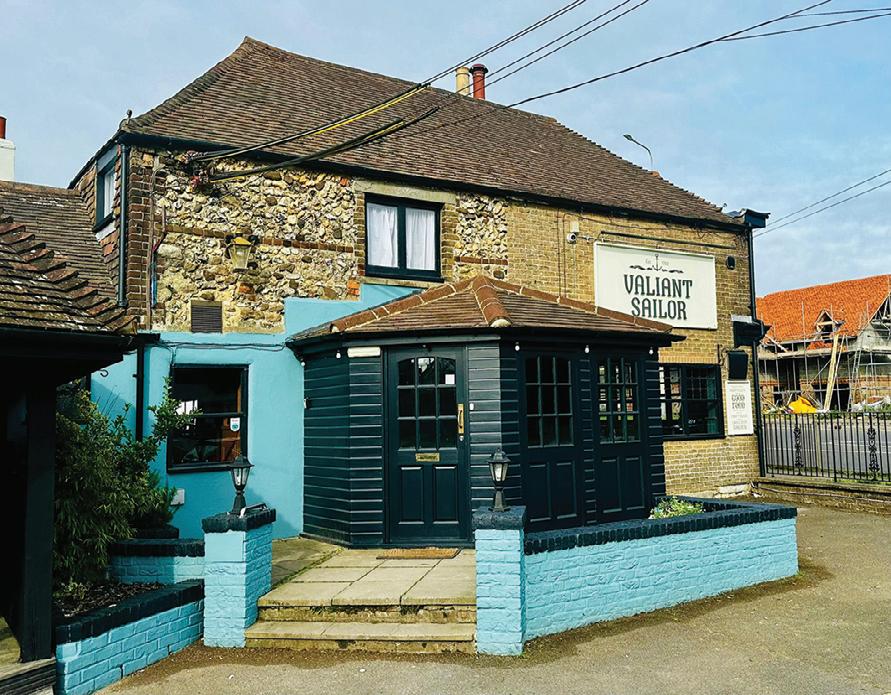
Popular community pub the Valiant Sailor on New Dover Road in Folkestone officially reopened yesterday (24th May) following a combined investment of £208,695 from experienced licensee Mark Smith and Admiral Taverns.
This refurbishment will breathe a new lease of life into the Valiant Sailor to elevate and modernise the overall look and feel of the pub, whilst still retaining its original characterful features and classic nautical theme, ultimately enabling the licensee to further cement it as the go-to community hub for local residents.
Licensee, Mark Smith brings a wealth of knowledge and expertise to the pub having worked in the hospitality industry since he was a teenager and having also obtained a degree in event management from Bournemouth University. Mark has been steering the ship at the Valiant Sailor for over six months and in this time has cemented the pub as a destination for great food and community building.
Mark commented: “It has been an amazing journey so far, watching my vision come to life and I’m grateful for Admiral’s guidance in achieving this. The support from the local community has
also been incredible and I can’t wait to welcome them back through the doors. I would like to extend a huge thank you to my whole team at the pub and everyone at Admiral Taverns for their support. I look forward to serving up delicious food and good times here for many years to come.”
To celebrate the reopening, The Valiant Sailor will be hosting a party to welcome the community back to the pub on Saturday the 30th of May. This will be a whole day celebration with the Mayor of Folkestone, Cllr Jackie Meade officially opening the pub, followed by great food and live music.
Going forward, Mark will be hosting a busy schedule of regular entertainment for the community to enjoy including bingo, darts competitions, quiz nights and paint and sip nights. In addition, as part of his mission to give back, he will continue to support the local community, by hosting fundraising events in aid of local good causes.
Paul Gornall, Business Development Manager at Admiral Taverns, added: “It’s fantastic to see the Valiant Sailor’s transformation completed, alongside the launch of a great new menu. I look forward to seeing Mark and his team thrive for many years to come. On behalf of everyone at Admiral Taverns we wish Mark and his team the very best of luck for the future.”
New legislation to ban upwards-only rent reviews (UORRs) for commercial property are unlikely to save the high street and may not achieve government aims, according to a legal expert at Morr & Co LLP.
The much-heralded English Devolution and Community Empowerment Act 2026 has now received Royal Assent and is expected to come into force in 2027.
It will significantly change commercial property leases, applying to all business tenancies, such as those that fall within the Landlord and Tenant Act of 1954.
The hope is that it could halt spiralling rent for businesses whose negotiating power is limited by UORRs, which ensure rents can only go up, not down at review.

But Nick Leavey, commercial property partner at law firm Morr & Co, has significant doubts the impact will be as powerful as many hope, having studied the impact of similar legislation in Ireland.
He said: “The government’s proposed ban on upwards-only rent reviews is undoubtedly well-intentioned, particularly at a time when so many businesses on the high street are already under pressure.
“But I would be surprised if it ends up having the dramatic impact that some people are expecting.
“For decades, upwards-only rent reviews have been standard practice in commercial leases. They have generally favoured landlords and investors because they provide certainty that rents will not reduce over time.
“On the face of it, removing that mechanism sounds like it should help tenants, particularly retailers, hospitality operators and leisure businesses facing rising costs and changing consumer habits.
“The reality, though, is that the commercial property market is usually very good at adapting.”
Nick expects landlords to find workarounds, including fixed annual increases which give tenants certainty but not necessarily lower rents.
He also sees potential for shorter leases becoming more common as landlords consider the risks of a lease which is no longer guaranteed to rise in value each year.
“That could add costs for tenants, including legal, surveyor, admin and stamp duty costs,” he said.
Nick points to evidence in Ireland, where UORRs were banned in 2010 through similar legislation.
He said: “The experience in Ireland suggests the market will adapt its behaviour rather than fundamentally change direction.
“The much wider challenge for the high street is driven by a range of issues, from online retail to hybrid working, rising operational costs and changing consumer behaviour.
“Against that backdrop, this reform may end up being more of a small adjustment to how leases are structured than the game-changing intervention some are hoping for.”
Nick’s advice to landlords and tenants is to prepare for change but without major expectations.
He said: “The regime is going to be different. For landlords, they may need to agree rent increases up front, which means tenants at least have certainty across the lease. But the idea of rents going down seems very unlikely.
“I don’t think this legislation is going to help tenants as much as it is intended to.”
The Michelin Guide Great Britain & Ireland is to retire its Green Star sustainability accolade, bringing to a close a scheme that for several years identified restaurants demonstrating exemplary environmental and ethical credentials across their operations.
The announcement confirms what had been the subject of increasing conjecture within the trade for some months, with a number of operators — including businesses that had previously held the distinction — openly speculating that the programme was due for revision or discontinuation.
The Green Star, which carried no prerequisite for a restaurant to hold any other Michelin accolade, recognised venues taking a considered approach to issues including food waste reduction, the sourcing of seasonal and locally grown produce, regenerative growing practices, staff welfare, and community engagement.

Assessors weighed a broad range of criteria, with no fixed formula determining the outcome.
The 37 Green Star holders currently listed across Great Britain and Ireland will retain their designations until the close of this year, after which the accolade will be formally discontinued as part of a gradual winddown.
In place of the Green Star, Michelin is launching an editorial initiative called Mindful Voices, described by the guide as a vehicle to spotlight and amplify the work of chefs, hoteliers and wine producers who are reshaping practice within their respective sectors. The initiative will make its debut at next month’s Michelin Guide Nordics ceremony, taking place in Copenhagen.
Crucially, Mindful Voices will not function as a formal award. There will be no accompanying icon, badge or logo — distinguishing it markedly from the certification-based model of the Green Star. The guide says the shift reflects a desire to tell a richer, more expansive story that moves beyond the confines of food and drink alone.
Gwendal Poullennec, International Director of the Michelin Guide, said the new initiative would give a platform to those changing the way their industries operate.
“This new framework draws directly from what our inspection teams witness first-hand,” he said. “Encounters and experiences that are transforming how things are done and that deserve to be shared. The Michelin Guide will amplify and give full resonance to these voices from the worlds of gastronomy, hospitality and wine, so that they can be heard, wherever they may be.”
A new report has revealed a dramatic surge in egg imports often produced to significantly lower food safety and hen welfare standards, creating what industry leaders warn is an urgent and escalating risk for UK consumers, retailers, manufacturers, and foodservice operators.
The Shell Shocked report, which also highlights the lack of effective border control inspections to prevent inferior products from entering the UK, has prompted the British Egg Industry Council (BEIC) to urge the Government to take immediate action to stop these eggs flooding the British market.
According to the report, UK egg imports have risen 60% since 2021, increasing from approximately 1 billion to 1.6 billion eggs per year. Ukraine has emerged as a major source of this growth, with exports to the UK rising 65.6% in 2025 alone. These products, most of which are produced in conventional battery cages, illegal here since 2012, are increasingly competing with British eggs produced under the world-leading British Lion Code of Practice.

Shell Shocked also highlights how this surge has coincided with a se3ries of egg-related food safety incidents across Europe. Recent examples include 123 confirmed illnesses in the UK in late 2025, traced to a single imported egg distributor (origin unconfirmed), banned antibiotic residues found in Ukrainian eggs entering European markets; ongoing Salmonella investigations in Sweden linked to Ukrainian imports; and more than 200 UK cases in 2024 associated with imported Polish eggs.
Nick Allen, Chief Executive of the BEIC, said: “This report highlights the real and urgent risks that inferior imports pose for consumers and the wider food industry.
“Any consumer would be appalled at what the Government is doing to undermine their safety. More than 90% of eggs produced in the UK are covered by the British Lion Code of Practice, one of the most comprehensive food safety schemes in the world. British farmers have invested hundreds of millions of pounds to
meet these standards, including vaccination against Salmonella and not using conventional battery cages.
“Allowing lower-standard imports to undercut UK egg producers is not protectionism, it risks undermining consumer safety, public confidence in eggs and the resilience of our domestic food supply.
“It is time for the Government to act in the interests of consumers and ensure that any eggs and egg products entering the UK meet our standards, starting with stronger controls at the border.”
Food safety expert, Dr Lisa Ackerley, who reviewed import controls for the report, added:
“Most consignments are not physically inspected, testing is risk-triggered rather than systematic, and sampling frequencies are not publicly disclosed. As a result, contamination or residues may only be identified once illness occurs or overseas alerts are issued, meaning product may already be in kitchens, factories or on shelves.
“It is also worth noting that British Lion eggs are Food Standards Agency approved for vulnerable groups to consume runny, while imports are not. That is a serious food safety risk for imports.”
The Shell Shocked report calls on retailers, manufacturers, and foodservice operators to urgently review their sourcing policies for eggs and egg ingredients, strengthen traceability requirements, and ensure they are not inadvertently compromising consumer safety.
It also calls on the Government to align import standards with UK food safety and hen welfare rules and introduce systematic testing and effective inspections at the border to ensure eggs entering the UK meet the same high standards required under the British Lion Code of Practice.

Mews (www.mews.com), the hospitality operating system, and hotel commerce platform SiteMinder (www.siteminder.com), have partnered to create the hotel industry’s first fully-integrated best-inclass distribution solution. Introduced today at Mews Unfold in Amsterdam, the solution will see SiteMinder’s distribution capability natively embedded within the Mews Operating System, marking the first time that hotels of any size can access the industry’s largest distribution network without leaving the platform their property runs on.
Managing operations and distribution from one platform will remove friction from hotels’ day-to-day. Availability, rates, inventory and other content will be handled in one place, closing a gap that hotels have had to bridge manually between two systems. Hotels will move faster, with rate, inventory and content changes flowing straight through to every connected channel.
The integrated solution represents Mews and SiteMinder’s shared vision of one connected workflow, where rates flow instantly through the world's largest distribution network and the results return to the same operating system the rate was set in. Nothing is lost in translation, there is no lag, and there are no mismatched numbers. The feedback loop shortens, and hoteliers move at a speed and scale that wasn't possible before. Underpinning it all, AI that gets smarter the more it is used.
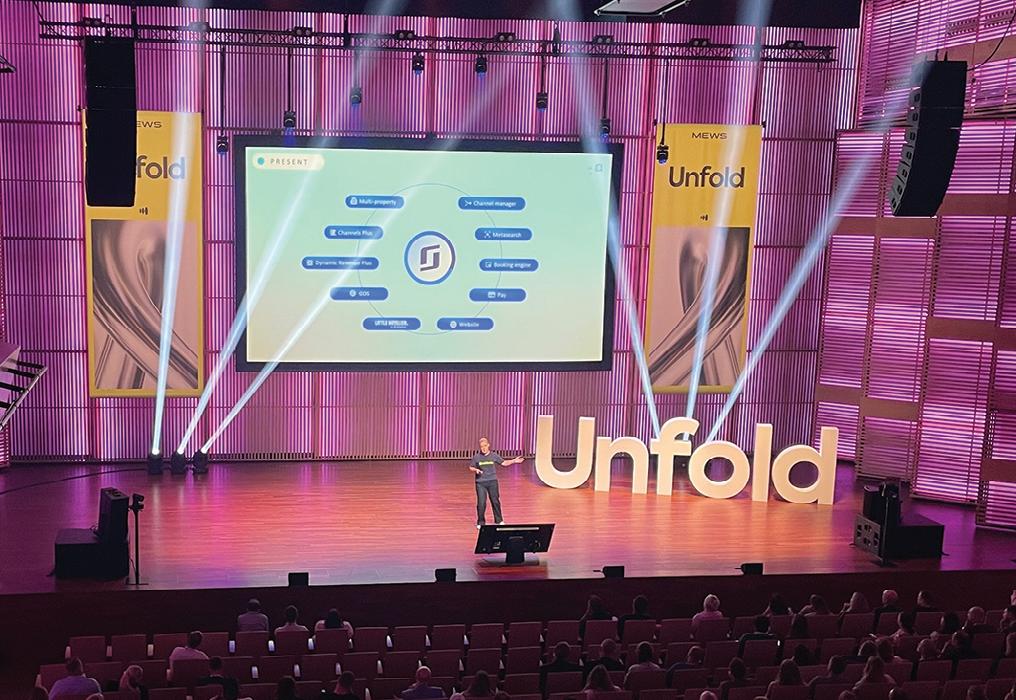
This kind of capability only comes from a deep partnership that goes beyond surface-level integrations. By building at the API level, Mews and SiteMinder are creating an experience that wouldn’t otherwise be possible. For Mews, SiteMinder's distribution engine completes an operating system that already runs revenue, operations and the guest journey. For SiteMinder, it marks an evolution of its platform, which over the last twenty
years has established itself as the premier commerce solution for hotels and is used by more than 53,000 globally today, for distribution, revenue optimisation and intelligence.
“When something is already the best in the world, we don't try to rebuild it. SiteMinder is the best at distribution. Our job is to bring what hotels need into one place, with AI working across every layer. For hotels, the result is simple: one operating system, one contract, one place to manage everything from how guests find you to how your property runs. It’s pricing, distribution and performance all in one place," says Richard Valtr, Founder of Mews.
The simpler experience for hotels is likely to increase their speed-tomarket and, critically, encourage greater adoption of technology within the hotel industry. Recent research by SiteMinder reveals that 65% of hoteliers believe faster, fully integrated systems could unlock at least 6% more annual revenue – representing billions in opportunity across the $1.2 trillion global accommodation sector.
“SiteMinder has always stood for accessibility and choice, and so this partnership with Mews is a natural evolution of our platform. We have long admired Mews for their innovation and strong product vision. By integrating our distribution engine with a progressive platform like theirs, we are opening up our platform for hoteliers to access SiteMinder in the way that best fits how they choose to work,” says Sankar Narayan, CEO and Managing Director at SiteMinder.
Nearly 3,000 hotels already run both Mews and SiteMinder side by side, managing operations in one and distribution in the other. Over the coming months, those hotels will move to Mews Channel Manager powered by SiteMinder, accessed directly inside Mews.
Clermont Hotel Group (CHG) has launched a partnership with RADA Business, the commercial arm of The Royal Academy of Dramatic Art, to deliver specialist performance training to its 1700 team members to enhance guest interaction and experience.
This specialist training initiative underscores CHG’s commitment to redefining hospitality through immersive, story-led experiences, placing people, performance and guest connection at its heart to deliver moments that resonate beyond the stay.
To bring this vision to life, the group has engaged RADA Business to design and deliver a Summer Skills Fest training programme, which includes three separate presentation skills workshops open to individuals or teams within the business.
A specialist training programme was also delivered to more than 50 newly
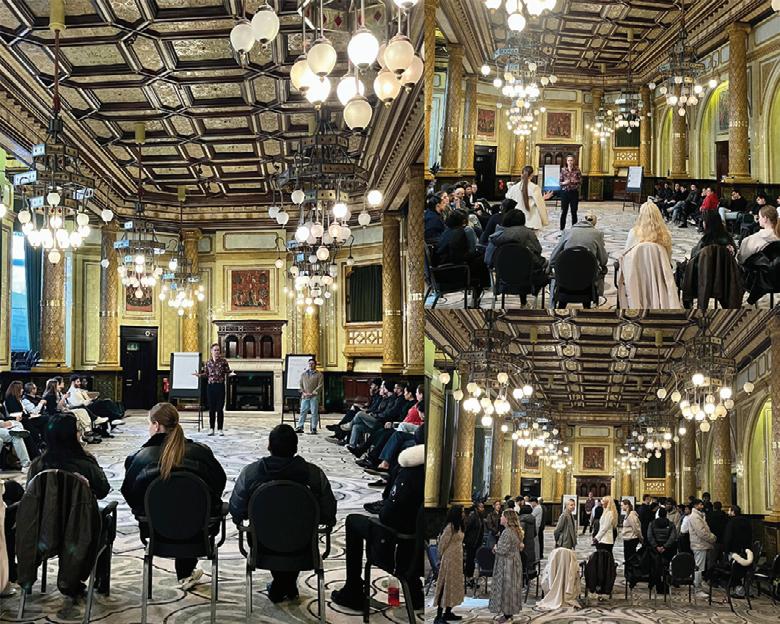
recruited front-of-house team members in preparation for the opening of Gordon Ramsay Hell’s Kitchen which launched at The Cumberland Hotel this April.
“This new approach to training demonstrates how we are re-thinking hospitality as an experience, not just a service,” said Amanda Hall, Head of Talent and Organisational Development for the group. “By partnering with RADA Business, we are empowering our teams to create something truly special, where every interaction contributes to a story our guests can feel part of.”
“At its heart, great hospitality is about human connection,” said Helen Slater, MD, RADA Business. “Our training is about helping people to show up as their best selves at work, using theatre-based principles: a grounded presence, clarity of message, and interactive storytelling. In this case, it is about enabling service professionals to bring a brand story to life, consistently, for every guest.”
Moderation is no longer a niche behaviour. Today’s on trade consumer is increasingly conscious about when, how and how much they drink, yet crucially, they still want to participate in social occasions. For operators, that presents an opportunity rather than a threat.
As a wine business, we firmly believe that zero alcohol options work best when they sit alongside full strength wines, not instead of them. A well curated 0% sparkling offer keeps mixed occasion tables together, protects dwell time and ensures no guest feels excluded from a celebratory moment.
Two standout examples in our portfolio are Tommy Bacco 0% Sparkling from Tombacco in Italy, usually known for its Prosecco. And Moutard M0% Sparkling from Famille Moutard in France, usually known for its high end Champagne and Burgundy wines.
Tommy Bacco 0% brings Italian flair to the category. Made from premium grape must, it delivers freshness, balance and persistence rather than overt sweetness. Importantly, it looks and serves like sparkling wine, making it an easy swap. Its quality credentials were recognised

Article supplied by Lanchester Wines (www.lanchesterwines.co.uk)
with a Silver award at the People’s Choice Drinks Awards, reinforcing that alcohol free no longer means compromise.
From France, Moutard M0% reflects the pedigree of a historic Champagne house applying the same care and expertise to a zero alcohol expression. Crisp, refined and food friendly, it offers operators a credible alcohol free option that sits comfortably on premium wine lists. Consumer data consistently shows that around half of on trade drinkers are now moderating their alcohol intake, driven by health, lifestyle and financial considerations. Many are not abstaining completely, but alternating between alcoholic and alcohol free serves over the course of an occasion.
For operators, the message is clear: offering high quality 0% sparkling alongside wine keeps guests engaged, supports inclusive hospitality and protects revenue. Done well, alcohol free doesn’t dilute the wine offer, it strengthens it.
The Rose & Crown, located in Westhoughton in Bolton officially reopened on Thursday 21st May following a
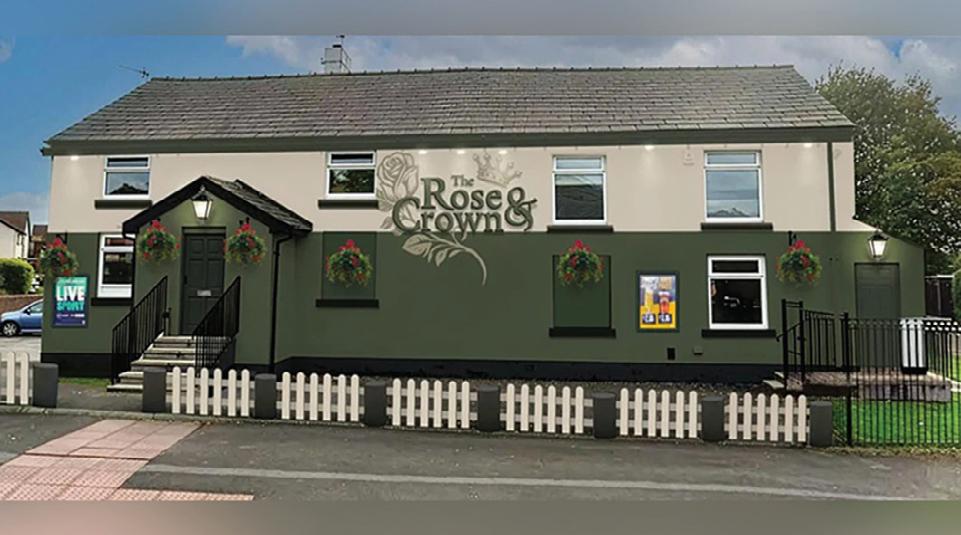
By Ben Cotts, Lanchester Wines

As the UK hospitality sector prepares for another busy summer season, operators are once again focused on maximising outdoor trading, improving service efficiency and meeting evolving consumer expectations. While glass bottles remain central to any quality wine list, wine on tap is increasingly being used alongside them as a practical way to support seasonal demand, particularly in high volume and alfresco settings.
At Lanchester Wines, we work closely with venues that successfully combine traditional bottled wine service with keg wines to create flexible, profitable wine programmes that adapt to changing trading patterns without compromising quality or choice.
Outdoor trading presents unique challenges for wine service. Increased footfall, faster turnaround and limited storage space can all put pressure on teams during peak summer days. Wine on tap offers a practical solution in these environments, allowing pubs, bars and terraces to serve wine by the glass quickly and consistently.
Dispensing wine from a keg speeds up service at busy bars and outdoor counters, helping reduce queues and maintain momentum. Many venues retain premium bottled listings for table service, while using keg wines in beer gardens or terrace areas, ensuring customers can enjoy wine in the format that best suits the occasion.
Summer heat can be challenging for wine storage, particularly in outdoor or temporary bar setups. Key Keg systems keep wine protected from oxygen throughout service, preserving freshness even during extended periods of warm weather. This reassurance allows operators to offer wine by the glass more freely across the day, from lunchtime through to evening trade.
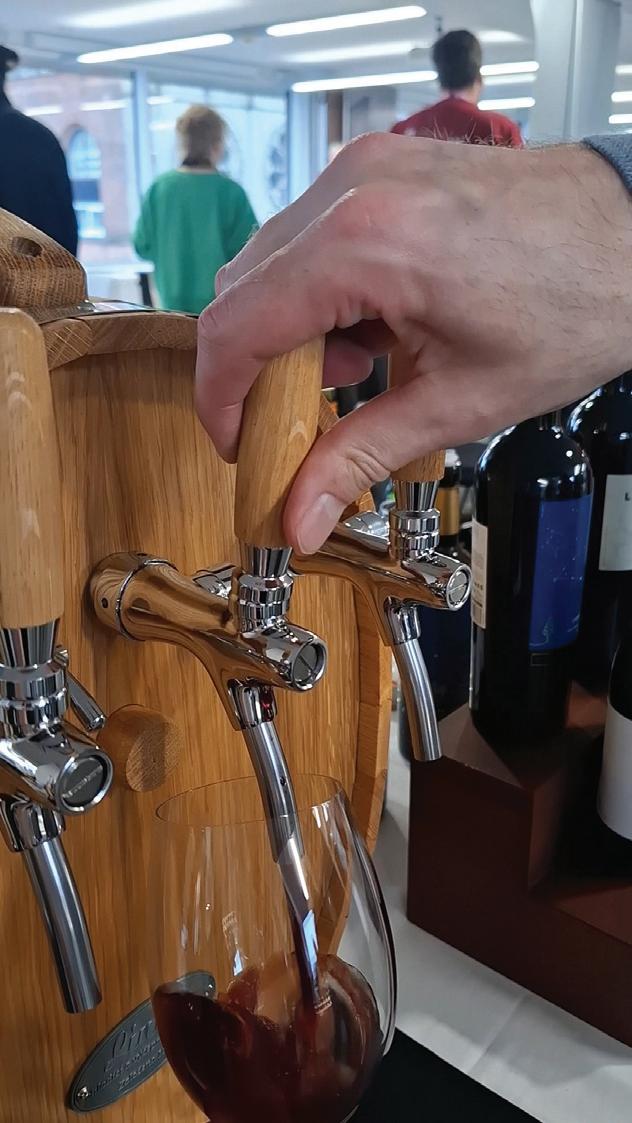
It also opens up the opportunity to list styles that work beautifully chilled in summer, with reliability and consistency across every serve.
Wine on tap also gives operators more freedom when building by the glass wine lists. It opens up the opportunity to offer indigenous or regional varietals at a more accessible price, encouraging guests to trade up or explore beyond familiar choices.
For many venues, keg wine supports a relaxed, informal style of drinking, offering wines that you will find yourself drinking in tavernas and enotecas whilst holidaying across the Med. These are approachable, food friendly wines designed for enjoyment rather than ceremony, well suited to casual dining, sharing plates and sociable outdoor settings.
Sustainability is now an important consideration for both operators and consumers. Wine on tap offers a clear sustainability advantage, with one 20 litre keg replacing the equivalent of around 26 glass bottles, significantly reducing packaging and transport weight.
At the same time, bottled wine continues to play an essential role, particularly for premium selections, special occasions and provenance led listings. For many operators, the most effective approach is a balanced one, using different formats to suit different needs.
Seasonal trading often brings influxes of new or temporary staff. Wine on tap helps simplify training and service during these periods. Consistent portion control, reduced handling and faster pours all help teams work confidently and efficiently during busy summer service.
From a management perspective, tighter stock control and minimal wastage make keg wine a valuable tool during high turnover periods.
Lanchester Wines’ 20 litre keg range has been developed with versatility in mind, featuring approachable styles such as Pinot Grigio, Sauvignon Blanc, Merlot and Malbec, alongside lighter, aperitif style options including Bianco Frizzante and Glera. These wines sit comfortably alongside bottled lists and pair well with seasonal menus.
Wine on tap is not about replacing bottles, but about building a wine offer that works harder across all parts of the business. With the right balance, operators can deliver speed, sustainability and consistency while retaining depth, theatre and choice.
For venues planning for summer, keg wine has become a valuable addition, helping future proof the wine offer, whatever the weather brings.

The latest Lumina Intelligence Menu Tracker data reveals a hospitality sector operating with increased caution, as operators across restaurants, pubs and coffee shops adapt menu strategies to protect margins in an uncertain demand environment.
Across restaurants and pubs, operators are prioritising cost control and margin protection over expansion. Menus are being actively streamlined, with growth deliberately constrained as brands focus on simplifying operations and navigating an uncertain demand environment. Rather than increasing core menu prices, operators are quietly driving incremental spend through sides, desserts and extras. These categories offer higher margins and are perceived as discretionary, allowing consumers to trade up without feeling penalised.
New product development is doing much of the heavy lifting on profitability. By introducing premium priced new dishes, operators are refreshing menus and improving margins while keeping same line inflation low on core items and maintaining value perceptions.
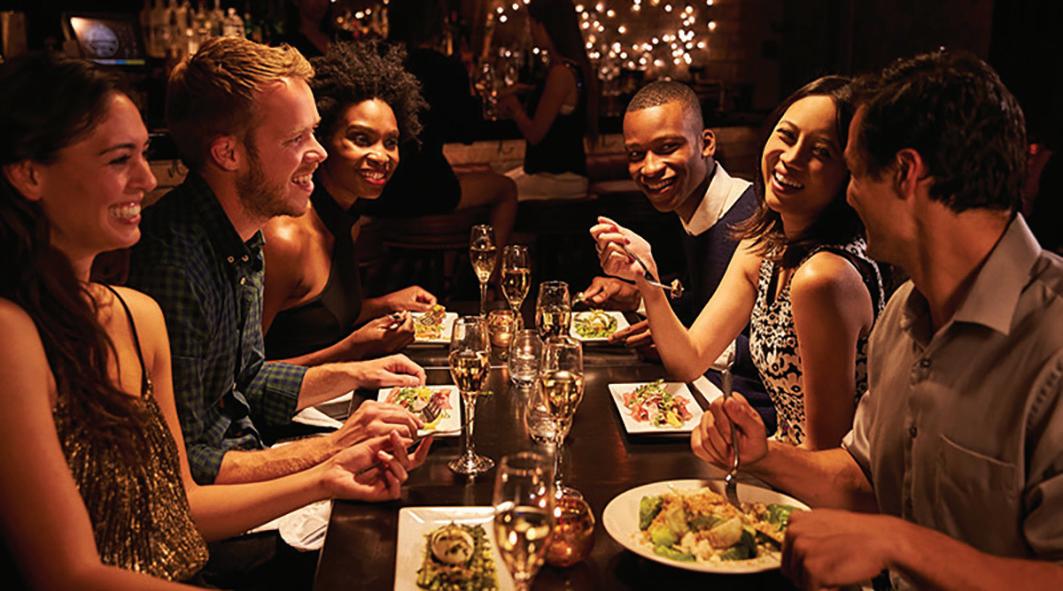
Pubs are evolving food ranges towards indulgent mains, premium sides and desserts to support all day and treat led visits, including afternoon and non alcoholic occasions. At the same time, drinks menus continue to narrow, reinforcing a shift towards food led, all day relevance.
Coffee shops remain the clear outlier
In contrast to the wider market, coffee and sandwich shops continue to expand menus and push price more assertively. Indulgence led bakery items, comfort mains and dessert style drinks are driving growth, underpinned by stronger pricing power and competitive pressure.
“Overall, the latest Lumina Intelligence Menu Tracker data highlights a sector focused on resilience rather than expansion.” commented Insight Lead Linda Haden. “With demand unpredictable and cost pressures ongoing, operators are taking a more surgical approach, protecting core prices while using innovation, sides and treats to unlock incremental value.”
The Worldchefs Congress & Expo 2026 held in Wales from May 1619 has been declared an “unbelievable experience” by the president of the biggest global culinary event.
Andy Cuthbert, president of the World Association of Chefs’ Societies (Worldchefs), the largest international membership organisation in the food and beverage industry, said: “The last four days here in Wales have been extraordinary – it’s a time I will cherish as president.”
More than 1,200 people attended the 41st congress and expo - the first time it had been held in the UK in its 98-year history – which was hosted by the Culinary Association of Wales (CAW) at International Convention Centre Wales (ICC Wales), Newport with support with chefs from the Home Nations.
Themed ‘Pasture, Passion, Plate’, the event gave delegates a chance to network with the world’s top chefs, hear a stellar line-up of speakers, watch talented competitors in the Global Chefs Challenge Finals and visit a wide range of exhibits in the Expo village.

The event brought together chefs, educators and hospitality professionals from nearly 100 countries for four days of learning, networking and global culinary exchange.
To bring the curtain down on the congress, CAW ambassador Katherine Jenkins, OBE, Welsh superstar classical singer and co-founder of Cygnet Gin, received a standing ovation after singing ‘When you return to Wales’.
“This song was especially written for the occasion as a small, heartfelt reminder that wherever in the world your travels may take you, you will always have a welcome here in Wales,” she told delegates.
She thanked Worldchefs for holding the event in Wales and said she hoped the delegates had enjoyed their time in the country.
She had bottles of Cygnet Gins specially engraved for the winners of the four Global Chefs Challenge Finals held during the event.
Mr Cuthbert said: “We have had an unbelievable experience here in Wales, topped off by a beautiful song from Katherine Jenkins. The organisation, comradery and support we have received have been just flawless.
“We all work in the industry and I run big events back home in Dubai, so I know what takes to pull off something of this size. The location and proximity to other hotels was perfect and ICC Wales as a venue is absolutely spot-on.
“Overall, it has been a wonderful event and, as president, I could not be happier with the end result.”
He thanked CAW president Arwyn Watkins, OBE, Peter Fuchs, culinary director of The Celtic Collection and ICC Wales and the hotels, in which delegates stayed, for their hospitality.
Mr Watkins said: “We had more than 1,200 delegates over the four days, 580 people attend the gala dinner. Never did I think we would achieve this here in Wales and we have done it to put the country on the world stage – unbelievable!”
He thanked everyone, including sponsors, suppliers, delegates and competitors for contributing to the success of a once-in-a-lifetime event.
Mr Fuchs added: “I spoke to many delegates who didn’t realise that we have this fantastic convention centre here in Wales. It was many years in the making, but we finally managed to get the Worldchefs Congress & Expo here.
“I have to say that my culinary team, under the direction of ICC Wales executive head chef Gavin McDonagh, have done a fantastic job. Without them, we could not have delivered what we have done for the congress.”
Given the rise in multichannel ordering in recent years we are seeing growing demand for customer collection and third-party delivery, resulting in the need for versatile printers to print food and drink ingredient labels, food orders, clear permanent and repositionable delivery and customer collection labels as well as bag seals.
With more focused legislation around accurate ingredients and allergy identification for pre-packed food and drinks, label printers increasingly have a range of tasks to perform resulting in the emergence of versatile multifunctional printers that can respond and adapt to any environment and application.
Integrating printers into the food preparation process which allow different sizes and types of labels to be printed from one easy-to-use device; variable length food and allergy labels, nutrition information alongside food delivery orders and labels, means businesses can meet today’s requirements as well as future-oriented labelling applications.
In line with growing demand for versatile omnichannel labelling solutions, Star has significantly expanded its Cloud-connected label printer range. These solutions meet the requirements of both local printing as well as printing from central databases, while providing simple set-up and provisioning of wireless printers to facilitate printing ‘out-of-the-box’.
For
offers two distinct models; an entry-level model with tear bar for printing traditional liner backed die cut labels and a multifunctional model which features an auto cutter for printing traditional pre-formatted die cut labels, high adhesive permanent and semi-permanent linerless labels as well as receipts. These include labels such as permanent food and allergy labels for food storage, customer collection and delivery labels in addition to customer orders.
The compact mC-Label2 printer is ideal where space is limited and thanks to its IP22-rated design the printer can be used safely in a variety of environments. At less than 10cm wide and with a unique front-loading design for easy paper loading, the mC-Label2 fits neatly on or under the counter, on a shelf or where workspace is limited.
Despite its compact size, the mC-Label2 can accommodate high-capacity media rolls up to 102mm in diameter, reducing the frequency of paper roll changes. Paper width is fully adjustable from 25mm to 60mm, while the high-resolution 300dpi print head ensures small format text, barcodes and graphics are clear and legible, even in paper saving mode. The larger mC-Label3 printer is ideal for wider media up to 80mm.
The number of hospitality businesses entering insolvency remained alarming in the first quarter of the year, reflecting challenging trading conditions for the industry.
Some 762 accommodation and food service companies, including hotels, restaurants and pubs, closed in the three months to March 2026 down 3.7% on Q4 2025. March, showing 268 company insolvencies, was broadly flat on February, according to government data. Offering little cheer, the number of monthly hospitality insolvencies has remained consistently over 250 so far this year, after posting 207 for December.
The Buchler Phillips Hospitality Index of insolvencies, which has tracked monthly figures since January 2014, eased very slightly from 187.3 in December to 180.6 in March. It peaked in August 2023 at 273.4 with a spike in the sector’s business closures.
High profile operators closing high street units have included TGI Fridays UK, which entered administration again while preserving 33 units in a pre-pack; The Revel Collective, the operator behind Revolution bars; and Greene King, which in March announced plans to sell dozens of pubs and convert around 150 units into fran-
chised or tenanted units.
Recurring factors cited by analysts include late-night trade weakness and younger consumers drinking less. The most vulnerable formats have been ‘experiential’ or themed chains, and cocktail bars.
Commenting on the latest figures, Jo Milner, Managing Director of Buchler Phillips, said:
“Hospitality is staying near the top of the insolvency table for the time being. The sector is finding it hard to adapt to a higher cost base and there’s no easy route to recovery, even when an upturn in consumer spending finally arrives.”
Pubs, hotels and restaurants are bearing an estimated £3-4bn of additional costs, not least because of the increase in employers’ National Insurance contributions. Operators are being forced to lift prices by up to 10% on average, against a background of already depressed trading. Last year, more than three-quarters of a million hospitality employees were shunted into employers’ NIC for the first time.
Greene King has agreed to sell its Old Speckled Hen beer portfolio to SA Damm as part of a major shift in its brewing strategy that will see the business withdraw from the UK off-trade market.
The financial details of the agreement have not been disclosed, but the move signals a significant change in direction for the Suffolk-based brewer and pub operator as it looks to concentrate on supplying its pubs and the wider on-trade sector.
Greene King said the decision reflects ongoing pressures in the UK cask ale market and forms part of a wider plan to streamline operations ahead of the opening of its new brewery in Bury St Edmunds next year.
Once the new facility becomes operational, the company will cease brewing Greene King-branded beers for UK supermarket and retail customers. Production for export markets will also come to an end, with the brewer instead prioritising supply to pubs and hospitality venues across the UK.
The sale ensures the Old Speckled Hen range – including Old Golden Hen and Old Crafty Hen – will continue to be available in retail channels under Damm’s ownership. The portfolio currently represents more than half of Greene King’s off-trade beer sales.
Nick Mackenzie, chief executive of Greene King, said the company was returning its focus to the area
where it believes it has the strongest position.
He said: “Brewing beer in Bury St Edmunds to be enjoyed in pubs has been at the heart of our business for more than two centuries. By sharpening our focus on the on-trade, we are aligning our brewing operations with where customers most enjoy our beers and supporting the long-term growth of the business.”
Greene King confirmed that the strategy change will not affect Belhaven Brewery in Scotland, with Belhaven beers continuing to be sold through both retail and export channels.
Damm described the acquisition as an important addition to its UK beer portfolio and said the brands would eventually be brewed at its Bedford brewery following a transition period.
Luke White, managing director of Damm’s UK operations, said the agreement strengthens the brewer’s presence in the British ale category while reconnecting its Bedford site with its historic brewing heritage.
The move comes at a time when brewers across the UK are reassessing their route-to-market strategies amid changing consumer habits, rising costs and continued pressure on traditional ale sales.
Recent research conducted by the LTC (Licensed Trade Charity) and KAM reveals the growing impact of workplace pressure, stress and sleep disruption on both employees and business performance across the hospitality sector.
The latest LTC Wellbeing at Work Report highlights that absenteeism is costing the industry a staggering £306 million annually, with a third of all sick days linked to poor mental wellbeing. On average, employees in the sector take the equivalent of 3 sick days (or 24 hours) across a year, resulting in significant disruption to teams, placing added pressure on remaining staff, and ultimately impacting service consistency for customers.
Presenteeism – the number of ‘days lost’ in terms of productivity due to working while in poor mental or physical health – continues to be a major factor impacting people and performance in hospitality, with almost seven million work days lost each year. Employees who are struggling but still attending work are more likely to experience reduced focus, lower energy levels and decreased engagement, which can directly affect the quality of service and overall guest experience.
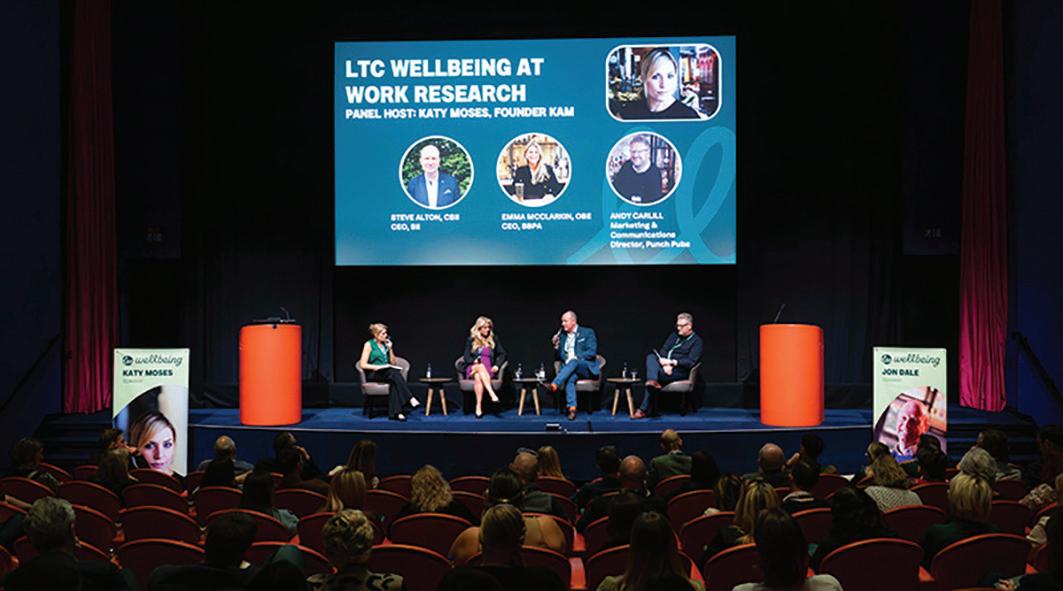
The report also reveals that one in three pub and bar industry employees say that they have suffered ‘challenges’ over the last 12 months, a slight improvement on last year’s figure of 72%, highlighting how hospitality businesses prioritising wellbeing support is having a positive impact across the sector.
This year, there has also been a rise in employees taking work stress home with them, impacting work-life balance, productivity, and sleep – with sleep emerging as a new top factor negatively impacting employee wellbeing this year. In fact, 48% of respondents said work-related stress has affected their sleep in the last 3 months with 1 in 4 saying sleep disruption has significantly impaired their ability to function effectively while in the workplace. 1-in-10 employees went on to say they’re ‘not fully effective’ and/or ‘not working at their best’
either all or most of the time.
In response to these findings, LTC has launched its Supporting Better Sleep for Hospitality Teams guide, a highly relevant practical guide to help hospitality managers understand how sleep and fatigue impact team performance and take proactive steps to better support their workforce through smarter working practices, increased recovery times, and stronger wellbeing support. The practical guide was shared exclusively with attendees at the LTC Wellbeing Conference and will be made more widely available to the industry in the coming weeks.
Chris Welham, CEO at LTC, said: “While the increasing financial pressures on businesses in hospitality are well documented, we also need to bring to life the impact this is having on people, teams and lives outside of work. Although it’s encouraging to see improvement in the number of employees reporting challenges over the past year slightly down, stress remains a significant issue, and this year’s findings show it’s no longer staying in the workplace but following people home and affecting their ability to rest, recover and perform at their best.
“Sleep has emerged as a critical but often overlooked factor in wellbeing, and when it’s disrupted, it impacts everything from staff turnover to productivity to morale and service.
“That’s why it’s so important we equip managers with practical tools to better support their teams. By working together as an industry, we can create healthier environments that support people not just at work, but beyond it too.”
Downnload the LTC Wellbeing at Work Report to explore the findings and access practical insights to better support your teams: https://www.licensedtradecharity.org.uk/wellbeing-research/.
The UK has the highest property tax burden of any major economy, according to new analysis published in global tax firm Ryan’s 2026 Annual Business Rates Review, as rising business rates bills intensify pressure on investment across the UK.
Ryan’s benchmark report finds the UK ranks first globally for property taxes as a share of gross domestic product (GDP), second for total property tax revenues, and among the highest for property taxes as a share of overall tax revenues, based on analysis of the latest available comparable international data.
Taken together, these measures provide a composite view of both the scale, intensity and fiscal reliance on property taxation, a combination on which the UK ranks more highly than any other major economy
This places the UK in a structurally more exposed position than its international peers, with property taxation acting as a core and growing source of taxation revenue.
The findings come as business rates receipts are forecasted to rise to £37.1 billion across the UK for 2026/27, up from £33.6 billion the previous year, following the revaluation of business rates in England, Wales & Scotland.
Alex Probyn, Practice Leader for Europe and Asia-Pacific Property Tax at Ryan, said: “The UK sits at the very top of global rankings for property tax. That is not a marginal difference but it reflects a system where property is taxed more heavily than in any other comparable economy.”
“The result is that business property is carrying a disproportionate share of the overall tax burden, and that is beginning to weigh heavily on investment, particularly in sectors that rely on physical assets and long-term capital.”
The analysis by Ryan highlights how property taxation has become deeply embedded within the UK’s fiscal model, limiting the scope for reform without wider tax changes and increasing the risk that businesses bear a growing share of the burden.
While revaluations are intended to redistribute liabilities rather than increase the overall tax take, Ryan’s analysis shows that receipts continue to rise due to inflation-linked increases, policy changes and the withdrawal of pandemic-era reliefs.
Probyn added: “This is not simply a question of valuation methodology. It is a structural issue. Property taxes in the UK are the highest by international standards, and the system is designed in a way that continues to increase the yield over time.”
“That creates a clear tension between the need to raise revenue and the need to support investment. That balance has to be addressed.”

The report also warns that the impact of the 2026 revaluation will be felt across multiple sectors, with sharp increases in liabilities feeding through into higher operating costs, reduced investment capacity and, ultimately, higher prices for consumers.
Ryan said the focus for businesses now shifts to managing liabilities under the new rating list, with early engagement in the Check, Challenge, Appeal process critical to ensuring tax bills are accurate.
US casual dining brand Rōti Modern Mediterranean, has launched in the UK with three London kitchens now live exclusively on Uber Eats and the introduction of a new global brand moment, Global Rōti Day.
Following strong growth across the US, Rōti is bringing its modern Mediterranean menu to London, introducing a health-focused, flavour-led dining option built around quality ingredients and customisable bowls.
With kitchens now live in Kentish Town, Shoreditch and Nine Elms, the expansion establishes the brand’s first presence in the UK and introduces Rōti to central London neighbourhoods ahead of further growth.
To mark the launch, Rōti is introducing Global Rōti Day on 19th May, a new annual celebration designed to invite new guests to experience the brand. The event will feature a buy one, get one free offer across all bowls, including chefcurated bowls and build-your-own bowls, alongside a £5 bounce-back offer for guests to use on a future
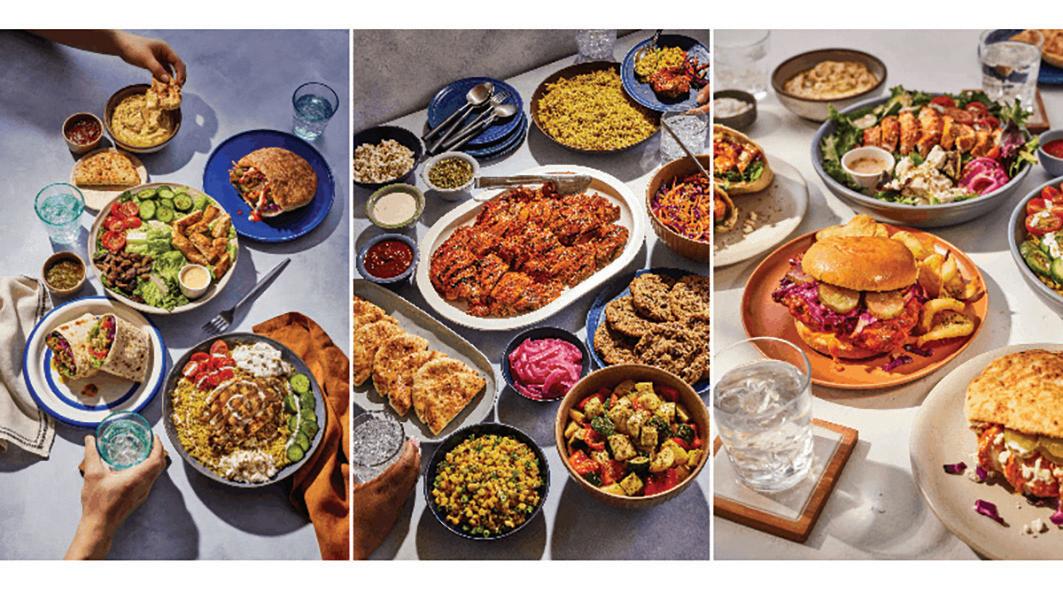
order.
In the UK, the offers will be available exclusively via Uber Eats and will run from 19th May through to 31st May as an extended promotion for new London guests discovering the brand for the first time.
“What makes Rōti work is simple: bold flavours, real hospitality and consistency,” said Matthew Walls. “We’ve seen strong momentum in the US, and London is an exciting next step for the brand as we introduce our modern Mediterranean offering to a new audience.”
Across the US and now the UK, Rōti is known for its chef-driven bowls built around fresh ingredients, balanced flavours and a contemporary take on Mediterranean-inspired food designed for everyday eating.
“Rōti is resonating strongly with guests who want flavourful, better-for-you food that fits into their lifestyle,” said Somia Farid Silber. “Launching in the UK allows us to bring that experience to one of the world’s most dynamic food markets.”
Young & Co.’s Brewery, P.L.C. has reported a record financial performance for the 52 weeks ended 30 March 2026, with revenue surpassing the half a billion pound mark for the first time as the premium pub operator continued to outperform against a challenging backdrop for the UK hospitality sector.
The London-focused pub group posted total revenue of £508.2 million, up 4.6% year-on-year, while statutory profit before tax more than doubled to £41.1 million from £18.1 million the previous year.
Adjusted profit before tax rose 2.9% to £53.1 million, with adjusted EBITDA increasing 1.4% to £115.2 million. Operating profit climbed sharply by 56.5% to £59.3 million.
Young’s said strong like-for-like revenue growth of 4.7% was driven by favourable spring weather, a record Christmas trading period and continued investment in premium food, drink and accommodation offerings.
The business maintained what it described as a “sector-leading” adjusted operating margin of 14.0%, despite ongoing inflationary pressures including higher National Insurance contributions, increases in the National Living Wage and rising food costs.
Net debt continued to reduce significantly, with pre-IFRS 16 net debt falling by £24.1 million to £224.2 million. The company’s leverage ratio improved to 2.0x adjusted EBITDA pre-IFRS 16, down from 2.4x the previous year.
Young’s also announced a recommended final dividend of 12.22 pence per share, taking the total dividend for the year to 24.44 pence, an increase of 6.0% year-on-year.
During the year, the group launched a £10 million share buyback programme covering its A ordinary and non-voting ordinary shares. By the period end, 975,027 shares had been repurchased for £6.1 million.
Trading momentum has continued into the new financial year, with total revenue for the first five weeks of the new period up 7.9%, while like-for-like sales increased 3.4% against strong prior year comparatives.
Post year-end, Young’s completed the acquisition of Cubitt House London Pubs on 22 April 2026, adding a portfolio of eight premium leasehold pubs and pubs with rooms across west London, with a ninth site currently in development.
The company also marked a significant corporate milestone by moving from AIM to the Main Market of the London Stock Exchange on 28 April 2026.
Commenting on the results, Chief Executive Simon Dodd said: “I am delighted to announce another exceptional set of results, reflecting a record-breaking 12 months for the business. We achieved a significant milestone, surpassing half a billion pounds in revenue, with multiple pubs across the estate delivering record performances throughout the year.”
Dodd highlighted the group’s investment in outdoor trading spaces, premium drinks and locally sourced seasonal food as key contributors to performance, alongside strong Christmas trading and continued capital investment across the estate, including projects at The Stag in Belsize Park and the iconic Half Moon in Putney.
He added: “We are optimistic about the future, and are off to a strong start in the new financial year. The business has positive momentum, we are investing well and our acquisition strategy is on track.”
Emma Bernardez, Partner and Head of Hospitality at accountancy firm HaysMac said: “Leading pub figures have successively pointed to an atmosphere of uncertainty, and Young’s final results this morning were no different. Consistent cost pressures have hit the hospitality industry since the pandemic. That this is continuing appears to be a natural consequence of the government failing to take a more strategic, comprehensive approach, heightened in the midst of ongoing geopolitical headwinds.
“It’s hard to see how this situation can be sustainable in the long term, when even the biggest names are highlighting the strain of a laundry list of financial challenges, including business rates, inflation, reduced consumer spending, and maybe now even an impending energy crisis.
“Young’s results are a rare bright spot in the midst of wider economic uncertainty, leveraging more ‘premiumisation’, and well-invested pubs to try and limit the headwinds that the sector is facing. And certainly, a summer of sport and good weather is a tantalising prospect to draw an often fickle consumer base back towards the attraction of pub socialising.
“Hospitality is a resilient sector, as Young’s results specifically pointed to, and with high numbers of forward bookings for the summer ahead, there may be further hope for Young’s and the wider sector.”
In an industry where margins are under constant pressure and guest expectations are higher than ever, the right operational foundation isn't just a luxury - it’s a lifeline. For modern hospitality operators, the goal is simple: reduce administrative friction to focus entirely on the guest experience.
Built on over 60 years of combined industry experience, 3R EPOS offers a bespoke approach to point-of-sale and payment processing. Powered by CES Touch, a marketleading software designed specifically for the daily realities of the hospitality floor. 3R EPOS provides systems that arrive ready to go, pre-configured to minimise setup time and allow businesses to hit the ground running from day one.
Beyond processing transactions, CES Touch provides a comprehensive management suite. Real-time stock control and detailed financial reporting allow managers to move away from guesswork, offering the clarity needed to identify high-margin items and minimise waste. Integrated loyalty features and modules for tableside ordering further empower businesses to cultivate a database of regulars while driving operational effi-
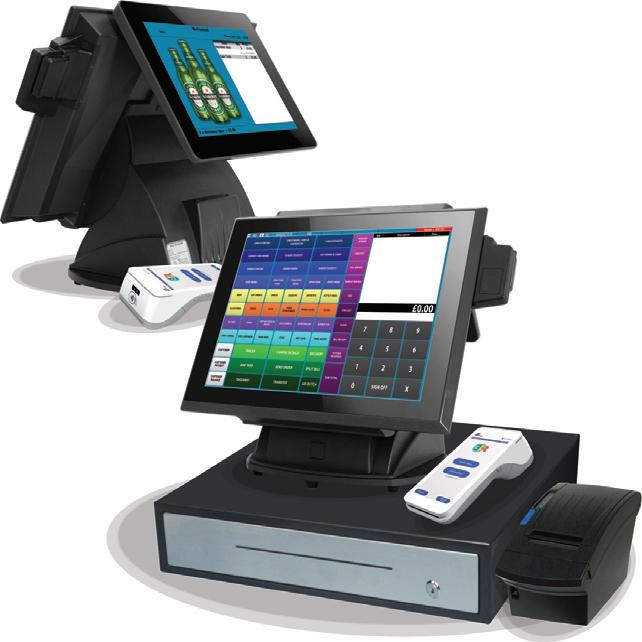
ciency.
In today’s economic climate, transaction costs are a critical consideration. By offering competitive merchant rates and a variety of hardware - from fixed terminals to portable units for tableside service - the focus remains on speed and security. What truly sets 3R EPOS apart is their commitment to partnership. With UK-based support, free on-site installation, and a rapid hardware replacement guarantee, they ensure that the "open" sign stays in the window. In a trade where downtime equals lost revenue, having a reliable, human-centric support network paired with the robust capabilities of CES Touch is the ultimate competitive advantage for any venue, from boutique hotels to bustling restaurants.
To discover a solution tailored to your venue, visit www.3repos.com or call 01992 574 650. See the advert on page 9.
What was once a place for creative, hardworking youth to flourish, could now be falling to the same exclusionary stagnance as so many other once thriving industries. Unlike many professions, hospitality takes in new workers from as young as schooling age, offering individuals the opportunity to develop their careers and excel regardless of academic credentials. Where the schooling system may fail neurodiverse individuals, hospitality has historically gained some of its brightest stars, from Heston Blumenthal to MasterChef UK semi-finalist Vanessa D’Souza. Indeed, Dyslexia, ADHD and Autism are reportedly prevalent in the hospitality workforce, with an estimated 1 in 2 workers being neurodiverse (1). As standards for hospitality businesses rise, it's no wonder more and more are leaving the profession, overwhelmed by complicated admin and excessive paperwork (2).

Leafe provides a solution. The hygiene compliance app, Leafe, is designed specifically to streamline user experience, gamifying necessary but often overwhelming, temperature records, delivery checks and cleaning checklists, amongst other features. Virtually type-free, Leafe simplifies operational management at every tier;

managers can set up clear, concise routines for both Front and Back of House, monitor team progress and ensure compliance.
The mounting burden of paperwork is a bottleneck for both business growth and professional development. For a business to scale, consistency is key; however, when admin demand leads to inconsistent record-keeping, the entire organisation’s reputation and legal standing are put at risk. Leafe bridges this gap by transforming complex compliance into an intuitive, digital process, ensuring administrative friction never stalls operational excellence. Leafe Pro even offers personalised HACCP and safety document creation, ensuring literacy levels never damage your chances of a 5 hygiene rating.
See the advert below or visit www.leafeapp.com/lpclh
1. (Burnt Chef, 2022)
2. (RSPH, 2019)

The team at LittlePod have spent the last 16 years focusing on the importance of vanilla to the environment.
Having established a thriving forest orchard in Indonesia, where the LittlePod farmers’ pioneering polyculture system is bearing fruit in more ways than one, the natural ingredients company’s emphasis has switched from planet to people.
Introducing Wellbeing and Happiness with LittlePod!
“It’s time for the next chapter in the LittlePod story,” said Janet Sawyer MBE BEM, LittlePod’s managing director and founder. “In 2025, I wrote my second book – Real Vanilla, Nature’s Unsung Hero – and with our forest orchard in Bali having proved so successful, we are excited to be focusing our efforts elsewhere this year.
“LittlePod continues to care for the environment – of course – and the team will still work closely with our farmers to protect, preserve and regenerate the rainforest.
“But closer to home, we are set to embark on a number of exciting projects and initia-

tives – all with wellbeing and happiness at their heart.
“The team will be working on recipe development with Master Chef Peter Gorton, launching a LittlePod podcast, and, perhaps most excitingly, embracing our sporting side with a top-secret project that is in the pipeline here.
“I can’t say anything further about this last one, but all will be revealed in due course. Please do be sure to keep following LittlePod to find out more!”
Winners of the King’s Award for Enterprise (Sustainable Development), LittlePod’s longrunning Campaign for Real Vanilla continues to go from strength to strength both at home and abroad.
Having long exported their responsibly-sourced ingredients to countries all over the world, further international expansion in planned for 2026, with the appointment of the company’s first European Sales Manager, Jakub Miniewski.
littlepod.co.uk / sales@littlepod.co.uk / 01395 232022
In a professional kitchen, sharpness isn’t a luxury — it’s a necessity. From the first prep of the day to the final plating at night, chefs count on their knives to deliver precision. That’s where the Tormek T-2 Pro Kitchen Knife Sharpener comes in — a sharpening solution trusted by culinary professionals around the world.
Backed by over 50 years of sharpening expertise, and developed for the intensity of the commercial kitchen, the Tormek T-2 Pro Kitchen Knife Sharpener gives chefs full control over their edge. The machine is gentle on knives — it sharpens, not shortens. Thanks to the slow-rotating diamond grinding wheel and high-precision guide, it only removes minimal steel, preserving the life of your knives while delivering exceptional sharpness.
What sets the Tormek T-2 Pro Kitchen Knife Sharpener apart is its blend of simplicity and professional-grade results. No guesswork. No overheating. Just consis-
tent, razor-sharp edges — time after time. With its low-noise operation and compact design, it integrates seamlessly into even the busiest culinary spaces — and is also suitable for sharpening other blades commonly used in food preparation.
The Tormek T-2 Pro Kitchen Knife Sharpener is designed to handle a wide range of kitchen knives — from large chef’s knives to small paring blades — and can also be used to sharpen other common kitchen blades, including mandoline blades and S-blades.
No matter the task, a properly sharpened knife is essential for efficiency and control. The Tormek T-2 doesn’t just sharpen knives — it elevates the entire kitchen workflow.
tormek.com | Phone: +46 581-147 90 | Email: info@tormek.se
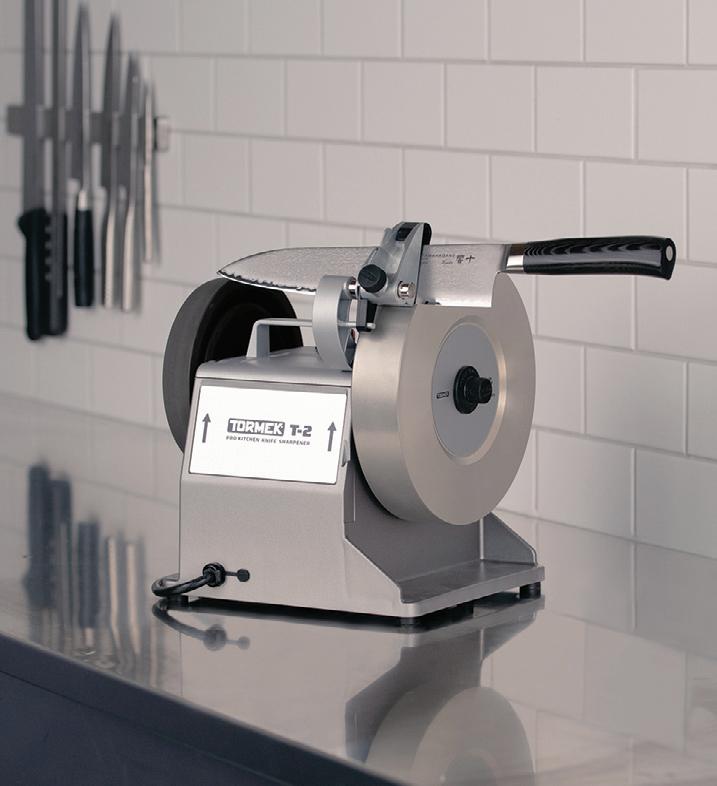

Reducing food waste is no longer simply a question of good housekeeping; it is a commercial, environmental, and reputational priority for professional kitchens.
Rising disposal costs, growing legislative pressure and ever-more environmentally aware customers mean operators must adopt smarter, more responsible waste strategies. This is where technologies such as the Meiko Green BioMaster® are making a measurable difference.
BioMaster transforms unavoidable food waste into a manageable, hygienic and environmentally responsible output at the point of production. By breaking down food waste and reducing its volume significantly, the system enables kitchens to cut waste collections, lower transport costs and reduce associated carbon emissions, all without adding complexity to busy operations.
What distinguishes the BioMaster is its integration into daily kitchen workflows. Waste is disposed of where it is generated, eliminating the need for exter nal bins, manual handling and the associated hygiene risks. Fully enclosed processing helps maintain a clean and safe foodservice environment, while auto-
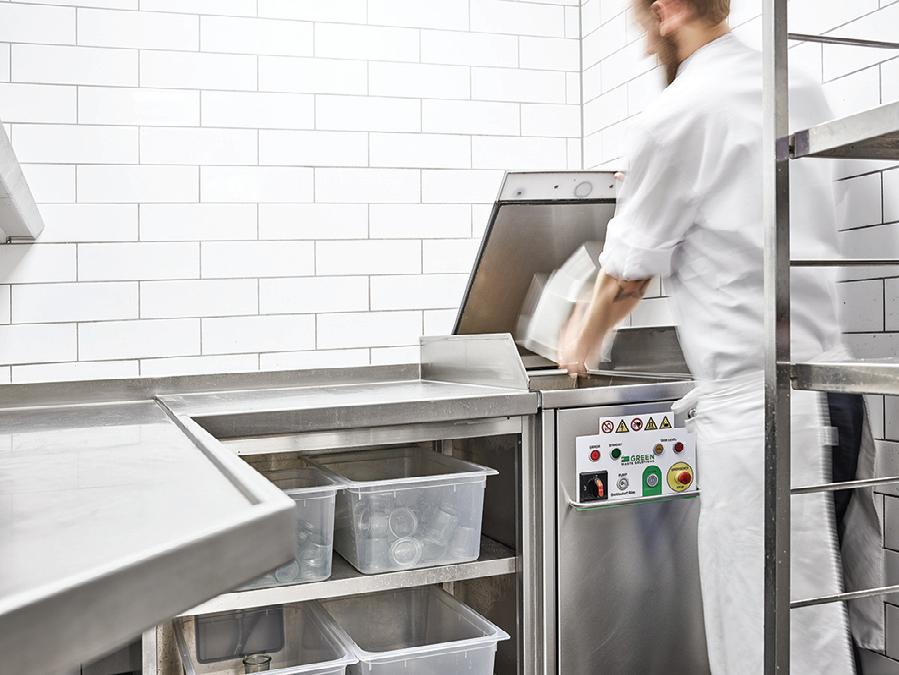
mated operation ensures consistency without additional staff workload.
From hotels and restaurants to pubs and contract catering, the BioMaster allows operators to futureproof their waste infrastructure. As legislation tightens around food waste separation and reporting, on-site treatment provides reassurance that compliance is built into the operation.
Equally important is the opportunity food waste systems provide for sustainability reporting. Accurate data capture and clear reductions in waste volumes allow businesses to demonstrate tangible environmental progress, a critical factor for investors, clients and consumers alike.
In an industry where margins are tight and sustainability expectations are rising, tackling food waste effectively is one of the few initiatives that delivers operational, financial and environmental returns simultaneously. With solutions such as the Meiko Green BioMaster, food waste becomes not just a challenge to manage, but a valuable opportunity to lead by example.
Read more here: www.meiko-uk.co.uk
First Mile, the UK’s leading recycling and waste management provider celebrated the hospitality & catering and entertainment sectors' highestperforming recycling businesses as part of its annual Recycling Standard campaign.
In the past year, First Mile worked with more than 30,000 businesses across the UK, welcoming 8,000 new customers, collecting 207,540 tonnes of waste and recycling 94,128 tonnes. Hospitality continues to be one of the most dynamic sectors within its network, with hotels, restaurants, pubs, cafés and entertainment venues increasing the number of separated waste streams and driving higher recycling rates in response to evolving regulation and customer expectations.
The top three hospitality & catering and events businesses by recycling tonnage are ATG Entertainment Limited, which recycled 3,468 tonnes; Gail’s Bakery, which recycled 2,279 tonnes; and Caffè Nero (Nero Holdings Ltd), which recycled 1,079 tonnes.
Together, these organisations represent the highest-volume hospitality recyclers in the First Mile network, demonstrating the scale of impact that consistent, data-driven recycling can deliver across theatres, hotels, cafés and bakery estates nationwide.
From managing high footfall in theatre venues to handling significant volumes of food waste and coffee grounds in busy city centre locations, these businesses face unique operational challenges. The performance of this year’s top three reflects sustained investment in back-of-house processes, staff engagement and the expansion of specialist services including food waste, glass, coffee cups and cook-
ing oil recycling.
Within the scheme, accreditation levels are awarded based on verified recycling rates and the number of services used. Gold-accredited customers achieve an 80 per cent or higher recycling rate alongside four or more services, or three or more services where one of these is food recycling.
One of these services must be general waste, which is required to be zero to landfill. Silver accreditation recognises businesses achieving a recycling rate of 50 per cent or above with at least two services. Zero to Landfill status is awarded to customers with recycling rates of up to 49 per cent whose general waste is diverted from landfill.
Gold-performing hospitality businesses typically operate streamlined waste systems across multiple sites, implement clear front-of-house and back-ofhouse separation, and introduce initiatives to influence both staff and customer behaviour. They also comply with the government’s Simpler Recycling regulations, which came into effect in April 2025, requiring mixed recycling and food waste collections alongside residual waste.
Talking about the scheme, Bruce Bratley, First Mile founder and CEO, said: “Hospitality businesses operate in fast-paced, high-pressure environments, yet the leaders in this sector show that recycling can be embedded into day-to-day operations at scale. Our Recycling Standard is built on real operational data, giving businesses a clear picture of performance and a credible way to demonstrate progress. It is fantastic to see operators like ATG Entertainment Limited, Gail’s Bakery and Caffè Nero setting the benchmark for the sector.”
Visit www.thefirstmile.co.uk for more information.
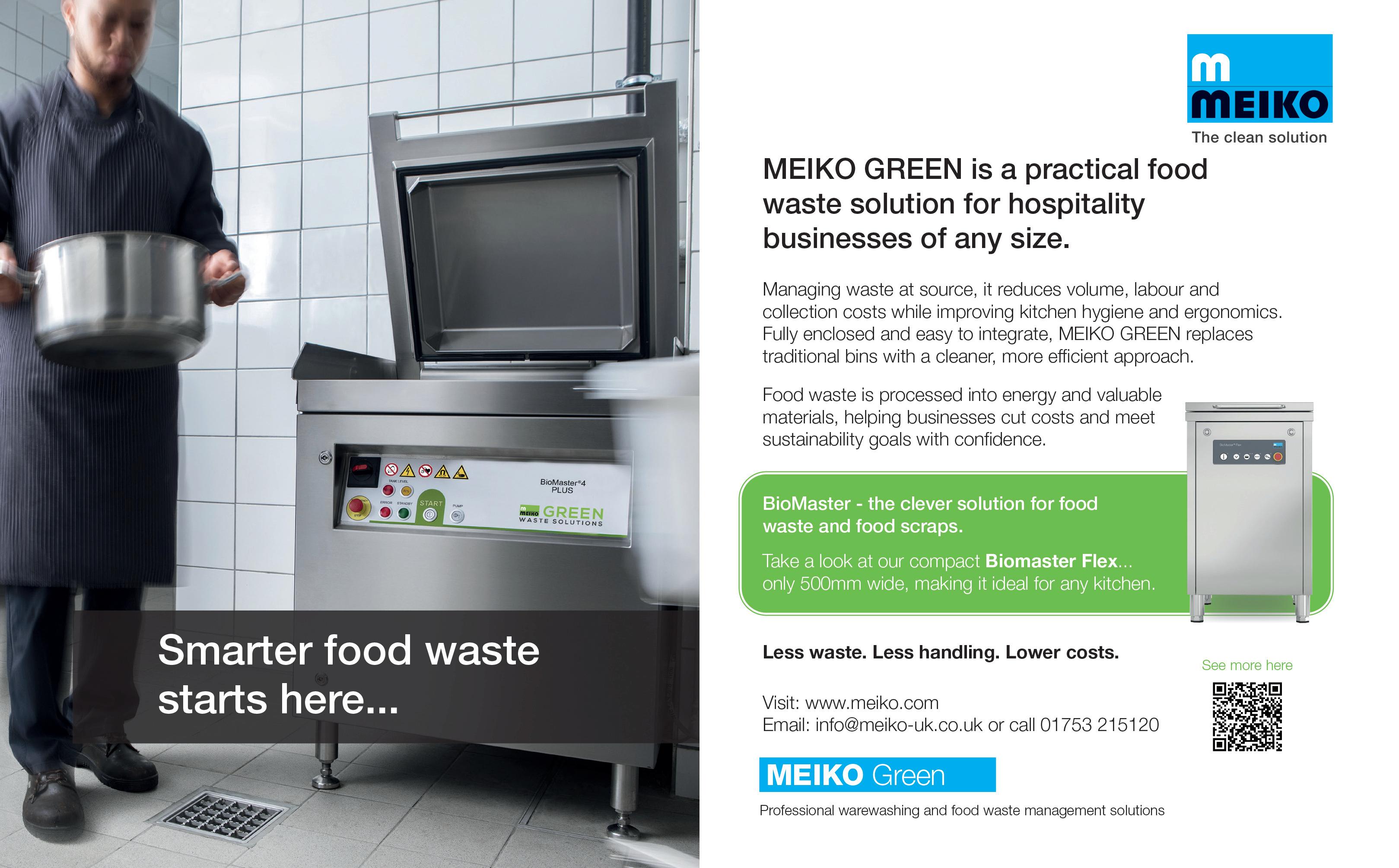

The purpose of a food hygiene inspection is of course to ensure that a food business is preparing, handling, and storing food safely so it does not pose a risk to public health.
A recent survey by Virtual College has highlighted that 40% of people avoid venues with a food hygiene rating of 3 or less and 19% choose where to eat based on food hygiene ratings more than the menu.
The Food Hygiene Rating Scheme (FHRS) is one of the most common signs in restaurant, takeaway and café windows and is one of the best ways a customer can judge the cleanliness and quality of the establishment.
Katherine Pavling, Head of Product at Virtual College, explains, “A hygiene inspection involves individuals arriving, typically unannounced, on the site of a food vendor to check the cleanliness of premises and equipment, how food is handled and cooked, whether it is stored at safe temperatures, and if measures are in place to prevent contamination. The aim is for the inspectors to see how the business operates under normal, everyday conditions rather than a prepared set of conditions, to assure it is safe for public health.
“Inspections aren’t solely about monitoring cleanliness of the site, it also includes checks on staff hygiene, training, and the business’s food safety system, often based on HACCP principles, to make sure risks are properly identified and controlled.”
By Katherine Pavling, Head of Product at Virtual College
A food safety system based on HACCP principles (Hazard Analysis and Critical Control Points) is a legal requirement for businesses in England that helps to identify potential hazards in food handling and putting controls in place to prevent those risks.
Katherine says, “In practice, this means things like setting rules for cooking temperatures, keeping food stored correctly, cleaning regularly, training staff, and keeping records to prove everything is being done properly. During a hygiene inspection, the inspector will look at these procedures and records and check that staff are following them in practice and ensuring hazards are properly identified, monitored, and controlled to keep food safe.”
Importantly, businesses are able to act if they feel a rating does not accurately reflect their standards. Katherine says, “There’s a right to challenge or appeal the outcome of an inspection, as well as the opportunity to request a re-inspection once improvements have been made. This ensures the system remains fair, while still holding businesses accountable to the compliance measures designed to protect public health.”
“While the law doesn’t require a specific training qualification, it does require that all food handlers are adequately trained or supervised, which means they need to understand safe food handling, hygiene practices, and allergen awareness relevant to their role.
“Most businesses support this through recognised courses, such as Achieving a Five Star Food Hygiene Rating training by Virtual College, which provides practical guidance on how inspections are scored, how to meet hygiene standards, and how to achieve top ratings.
“The most important is that businesses have a clear and effective food safety management system in place, and that staff are properly trained appropriately to follow it in practice.”
Around 90% of consumers check online reviews before choosing a restaurant, and they’re increasingly candid about what disappoints them. Cleanliness is one of the fastest ways to trigger negative feedback, especially when expectations aren’t met.
A quick scan of TripAdvisor highlights comments like:
“Our table looked clean, although sticky.”
It’s a small detail, but one that carries weight. Sticky tables instantly signal poor hygiene to guests, even in venues that otherwise appear spotless.
In many cases, the issue isn’t whether tables are being cleaned, but how. Commonly used sanitising sprays containing quaternary ammonium compounds (quats) can leave behind an invisible residue. Over time, this builds up, particularly when damp cloths are reused across tables or when heat and
humidity come into play. The result is a surface that looks clean, but feels anything but.
For operators, the risk is reputational. Guests may say nothing in the moment, yet share their experience online, influencing future bookings and loyalty.

Reducing residue starts with better surface hygiene practices: cleaning before sanitising, using residue-free products designed for food-contact surfaces, avoiding dilution errors, and allowing surfaces to fully air dry.
When nearly every guest is checking reviews, perceived cleanliness matters just as much as compliance.
At Sani Professional®, we’ve developed Protect 360° biodegradable sanitising wipes to solve this challenge sustainably. Their plant-based active formula cleans effectively and dries residue-free, helping hospitality teams deliver a spotless, guest-ready finish every time.
Request your FREE Protect 360° samples by writing an email to samples@sanipro-intl.com
Tork has released new guidance aimed at helping pubs, restaurants and hotels transform their washrooms into assets to enhance user satisfaction and benefit business performance. Based on research which shows that 73% of people will not return to a washroom after a bad experience, Tork’s “Washroom Guide”, available on its website, provides recommendations on improving inclusive hygiene, environmental sustainability and operational efficiency. According to the survey, a negative washroom experience at a venue can also lead to: 23% of people spending less time there, 13% avoid eating and drinking and 10% will choose not to return to that venue.
“Our data shows that when washroom users and cleaners’ needs aren’t met, a business can suffer as people spend less time and/or money there,” said Olivia Slater, Commercial Director, Professional Hygiene at Essity. “With three in four people concerned about washroom hygiene,[1] and one in two likely to face barriers to meeting their needs, small, targeted updates to the washroom – the most visited room in a facility –can make a substantial difference for both users and cleaning staff, ultimately benefitting the business.”
Recommendations:
1. LEAN INTO INCLUSIVE HYGIENE
Washroom users said that when the following “must have” elements are provided, which exemplify inclusive hygiene, the majority (59%) of people say a business can improve its positive image:
• Toilet paper and paper hand towels in dispensers that are easy to grasp (67% said these are a “must have”)
• Spaces and design elements that enable privacy (63%)
• Disposal bins in the stall for personal items including incontinence and menstrual products (60%)
• Physical accessibility – including grab bars and ramps – for everyone (58%)
• The availability of paper hand towels (57%)
• Features in public washrooms that enable caregivers to meet their needs (40%) such as changing tables
2. PROMOTE SUSTAINABILITY
Respondents reported experiencing, without limitation, diagnosed or self-diagnosed physical/cognitive conditions, e.g. eczema, chronic pain, general anxiety, claustrophobia.
The washroom is an overlooked place for reducing environmental impact by businesses, yet 67% of people want washroom managers to prioritise environmental sustainability.[2]
Tork recommends the following actions:
• Promote sustainability practices with signs in the washroom
• Ensure teams understand the importance of responsible sourcing and look for third-party certified products using training and educational assets.
• Control consumption with one-at-a time dispensing to reduce waste.
• Support sustainability goals – avoid landfill with recyclable packaging and
recycling schemes like Tork PaperCircle® paper towel recycling.
3. SUPPORT EMPLOYEE EFFICIENCY
Investing in washroom features and supporting cleaning teams can improve business revenue. To empower cleaning staff, many of whom feel unsupported1 and enhance guest experiences, Tork recommends:
• Working smarter with data-driven cleaning that identifies service needs in a facility.
• Installing high-capacity dispensers that reduce the need for frequent refills, allowing cleaning staff to focus more on cleaning rather than refilling.
• Using compressed towels for refills to serve more guests before cleaners need to refill again.
• Sourcing products with ergonomic packaging including Tork Easy Handling® packaging for easier carrying, opening and disposal.
Olivia continued “By addressing these critical aspects, hospitality businesses can help washroom users and cleaners meet their basic needs and deliver an experience that meets the needs of as many as possible. Investing thoughtfully in inclusive hygiene, sustainability, and operational support not only meets evolving public expectations but also improves business performance.”
Tork helps businesses realise the benefit of sustainable hygiene with a focus on four key areas materials & packaging, use & waste, carbon and hygiene for all. It also provides free training and educational assets. For more steps businesses can take, visit: www.torkglobal.com

New data has revealed the most searched for allergens by consumers making a decision on where and what to eat when dining out.
Allergymenu.app looked at its annual data to highlight current consumer behaviours in relation to food allergies and intolerances. Its aim is to help businesses in the hospitality sector understand the concerns and priorities of customers managing food allergies.
It found that gluten was the most searched for allergen amounting to over 58% of all searches, with milk (16.8%), peanuts (17.9%) and tree nuts (16.8%) being the other most searched allergens. Over 136,000 searches were analysed.
The volume and consistency of searches captured from Allergymenu.app confirms that food allergies and intolerances are not niche concerns and play a central role on where and what customers chose to eat.
Recent statistics from the Food Standards Agency highlight six percent of the adult population in the UK has a clinically recognised food allergy. That’s around 2.4 million adults.
It also found more than 30% of adults reported some types of adverse reactions when eating food. The allergy search behaviour shows users typically engage with allergy searches at the point of decision-
making, before entering a venue or placing an order, suggesting accessible and easy-to-understand allergy information can directly influence footfall and conversion.
Juliet Moran, founder of Allergymenu.app said: “This analysis highlights that food allergies are a big concern for customers eating out within the UK hospitality sector. The prominence of gluten, milk, peanuts and tree nuts shows when the biggest concern is. Searches for these accounted for over three quarters of all searches.
“What this data reinforces is the need for food businesses to prioritise easily accessible and detailed information for these allergens so customers can make an informed choice based on their requirements. They can also be reassured the establishment is taking its legal responsibility seriously.
Juliet continues: “Ensuring accurate, detailed and easily accessible information to meet legislative requirements is the minimum. Many consumers manage multiple allergens which increases the importance of robust allergen management systems.
“This is where the role of digital tools plays its part. The data shows many allergy searches are made during a visit to the customer’s website, as shown in the website referral data.
“Transparent allergen information can directly influence customer confidence, venue selection, and overall dining experience. The allergen information becomes a key component of customer service and trust-building.
“Systems which reduce ambiguity, standardise allergen communication and minimise reliance on verbal explanations can help lower the risk of serious incidents and support staff.
Juliet concludes: “Our hope after publishing this data is that food businesses and industry bodies will improve allergen communication which will boost customer confidence and reduce the risk of avoidable incidents. Ultimately, a hospitality environment that meets both regulatory obligations and the real-world needs of allergy-aware consumers.”


With the UK Free From market now worth £4.2bn1 and an estimated 2.9 million consumers following a gluten free diet2 demand for high quality free from options has never been greater. For caterers and hotel operators meeting these dietary needs without compromising on taste or quality is essential and that's exactly where PureOaty delivers.
The award-winning range offers gluten free, oat-based products that work brilliantly across catering environments. Whether you're running a breakfast station with our porridge oats or using our oat drinks for hot beverages, PureOaty provides versatile, crowd-pleasing and 100% allergen free solutions for every service occasion.
What sets us apart starts on the farm. Our pure, British oats are grown by us and a network of local farmers within a 70-mile radius of our Cambridgeshire farm, then produced and milled in our dedicated allergen free facility. The result is a product that tests at under <5ppm of gluten - four times purer than the industry standard, giving you genuine peace of mind.
That commitment to quality carries through to our finished products, Our oat drinks contain just four simple ingredients, with absolutely no preservatives or added sugars. They're actually less processed than dairy milk, fruit juice and even beer! And for customers who want a nutritional boost, our Creamy and Enriched variant is fortified with essential vitamins and calcium.
And none of that comes at the expense of taste. The PureOaty portfolio is Great Taste accredited, with our most recent stars awarded to PureOaty Tea-rrific Oat Drink and PureOaty Porridge Oats. Independent proof that free from and genuinely delicious can go hand in hand.
To find out how PureOaty can work across your menu, get in touch with the Glebe Farm Foods team today! Visit www.glebefarmfoods.co.uk or email office@glebefarmfoods.co.uk
1 https://ofplus.com/sector-updates/free-from-sector-update/ 2 Coeliac Society 2024

CLEAN Linen & Workwear are one of the UK's most trusted laundry companies. They supply tailored workwear solutions provided by real people. Their comprehensive laundry network means they can service customers throughout England and Wales, providing chefswear, workwear and linen rental services. Whether you operate from a single-site hotel, pub or restaurant or have multiple locations, CLEAN can tailor a workwear rental solution to suit your business requirements. They offer various uniform options to support the entire kitchen brigade, from Executive Chefs to Kitchen Porters.
With their workwear rental service, you can say goodbye to the hassle of purchasing, storing, and maintaining chef and kitchen uniforms. Instead, enjoy the convenience of a hassle-free rental system that provides freshly laundered garments whenever your team need them. By renting with CLEAN, you can avoid upfront pur-

chase costs, spread the payments over your contract, and ensure quality and care with every wash. Delivery is free, and there are no hidden charges; contracts even include repairs. Each item of clothing can be branded and tailored to the wearer with logos and embroidery. Their managed service prevents issues compiling when supplying your team with work clothes; a convenient locker valet service helps distribute and store uniforms, and they tackle minor
Having worked with hospitality businesses for over two decades, from hotels to pub chains, sports venues, bars and restaurants, we’re often engaged in the conversation – how do operators best protect themselves from dine and dash?
Technology can be a valuable ally in the fight against such opportunism. CardsSafe is designed to securely store a customer's bank cards while they run a tab. It’s the ideal deterrent for anyone contemplating walking out without paying because their card is safely tucked behind the bar in a CardsSafe unit. The system securely stores bank cards and facilitates easy tab-keeping. Rather than insisting on advance payment, businesses can keep tabs and upsell. CardsSafe has been a trusted partner in the hospitality and leisure industries, assisting with bar tabs and significantly boosting profits. Renowned establishments, including Young’s Pubs, Hilton Hotels, and numerous golf courses, have been reaping the benefits of
for years.
Deers Hut pub in Liphook, Hampshire, first came to CardsSafe in 2013 to seek help with a large volume of bar tabs for both indoor and outdoor customers. One of the primary motivations for using CardsSafe was to stay on top of where their customers were located outside. Deborah Steel, the Director, told us, "The CardsSafe system is great for servicing customers who enjoy our outdoor areas." CardsSafe is
For decades, pork scratchings have occupied a humble but beloved corner of British pub culture, typically sealed in small packets behind the bar, dependable, salty and old-school.
But in the more relaxed, post covid era, pubs, bars and restaurants are increasingly turning to bulk snack servings to boost the average spend of their customers.
Snack Brands offer a bulk 1kg bag of Uncle Alberts Porkshire Pig Pork Scratchings at just £16.75 and have seen a growth in the bulk business from venues up and down the country.
‘’Loose servings elevate the customers experience, they can be placed in a nice dish or presented with a range of other snacks’’, says Alex, sales director at Snack Brands. ‘’We recommend our customers offer an 80g serving with a RSP of £2.45, giving them a POR of 34%’’.
Alex goes onto say, ‘’we recognize that some venues prefer using the heated machines and our scratchings are perfect if this is the avenue venues want to go down’’.
We can help you make the most of your coffee and hot drinks service, ensuring high levels of customer satisfaction and loyalty – together with increased profits. We offer a wide range of Bean-to-Cup and Traditional Barista coffee machines, all at competitive prices and with a range of rental, finance and leasing options available. We have our own in-house engineering team and guarantee the highest levels of customer service, ensuring downtime is kept to an absolute minimum. Wholesale customers get discounted service charges, further enhancing the overall value of working with us.
In 2025 we opened our Showroom & Academy in central Exeter, offering you the
The rise of craft beer and premium spirits has played a big role in this shift, drinkers are becoming increasingly interested in pairing flavours and loose pork scratchings fit naturally into this world.
Loose servings also tap into a growing trend of small plate menu offerings, a bowl of scratchings placed in the centre of the table invites conversation and communal eating in a way that individual packets don’t.
The return of loose pork scratchings might seem minor but it reflects something larger about British food culture today, there is a renewed appreciation for traditional snacks and a determination to refine them without losing their identity.
See the advert on the inside front cover for further information or visit www.snackbrands.co.uk

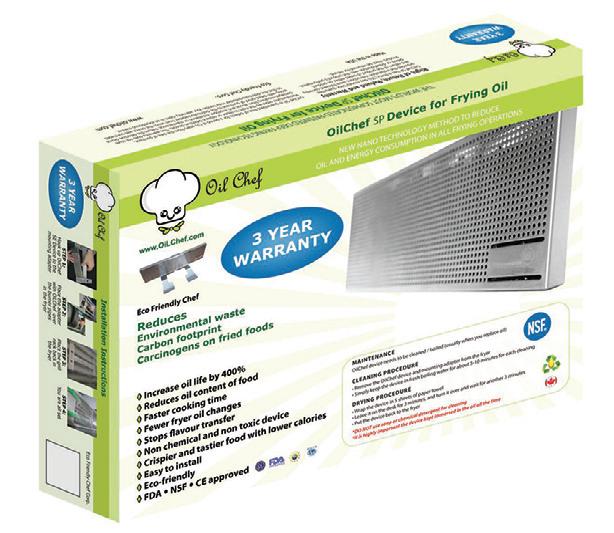
product remains lighter in colour, crispier, less oily and this increases the hold time of all foods.
Virtually maintenance free, with no breakable parts, OiLChef is a must have for your deep-frying operation.
With a money back guarantee and 3-year warranty, contact OiLChef

— yet the decisions made at fit-out stage will shape efficiency, compliance and costs for years to come.
For pub and restaurant operators embarking on a new build, refurbishment or change of use, the commercial kitchen is rarely the most glamorous element of the project — but it is almost certainly the most consequential. Get it wrong and no amount of front-of-house charm or marketing spend will compensate. Get it right and you lay the groundwork for a smooth, profitable food operation from day one.
The challenge is that commercial kitchen design demands the simultaneous navigation of regulatory compliance, workflow logic, equipment specification, utilities infrastructure and long-term operational needs — often within tight footprints and tighter budgets. Here, we outline the key considerations operators should address before a single piece of equipment is ordered.
The foundation of any successful kitchen design is the workflow — the logical progression from goods-in through preparation, cooking, plating and service, with waste and washing-up operating in the opposite direction. In practice, this means avoiding cross-contamination by keeping raw and ready-to-eat food preparation zones physically separate, and ensuring that clean and dirty routes do not intersect.
Most professional kitchen designers apply zonal planning principles: a goods-in and dry store area, a cold storage zone, dedicated preparation areas, a cooking suite, a pass, and a pot wash and dishwash section. Even in smaller pub kitchens, adhering to this logic — however compressed the layout — significantly reduces food safety risk and improves throughput during service.
"The most common and costly mistake operators make is purchasing equipment before finalising the layout. Specification must follow design, not precede it."
Extraction is frequently underestimated at planning stage and disproportionately expensive to correct after installation. A canopy extraction system must be sized correctly for the heat and moisture output of the cooking equipment beneath it, and replacement air (make-up air) must be supplied in adequate volume to prevent negative pressure — a common cause of extraction failure and uncomfortable working conditions.
Building regulations in England, Wales and Scotland require kitchen ventilation to meet specific air change rates, and Local Authority Environmental Health Officers will assess extraction adequacy during inspections. Operators in older buildings should commission a structural survey before specifying extraction, as ductwork routing through historic fabric can involve unforeseen complications and cost.
Before finalising an equipment specification, operators must understand the capacity of existing utilities. A commercial kitchen running a six-burner range, combi oven, fryer bank and salamander simultaneously will place significant demands on both gas and electrical supply. A gas capacity survey by a Gas Safe registered engineer and an electrical load assessment by a qualified electrician should be commissioned early — upgrading supply infrastructure is expensive and time-consuming.
Water supply and drainage are equally important. Pot wash and dishwash areas require adequate hot water supply and correctly sized waste drainage. Grease traps or grease management systems are now a standard requirement of most commercial leases and are increasingly enforced by water authorities to prevent fats, oils and grease entering public sewers.
Equipment selection should be driven by menu analysis and projected covers, not by what a neighbouring venue uses or what a supplier is promoting. Over-specification wastes capital and energy; under-specification creates operational bottlenecks and shortens equipment lifespan through overuse.
Combination ovens (combis) have become the workhorse of the modern pub kitchen, offering steam, convection and combination cooking modes that maximise output from a compact footprint. Operators should also consider induction cooking where gas supply is limited, noting the lower ambient heat output — a meaningful factor for staff welfare and air conditioning costs.
All equipment should carry CE or UKCA marking, and where gas appliances are specified, they must meet current Gas Appliance Regulations. Operators should request equipment data sheets prior to purchase to confirm utility connection requirements.
Every commercial kitchen serving food to the public must comply with Regulation (EC) No 852/2004 on food hygiene as retained in UK law, the Food Safety Act 1990, and relevant guidance from the Food Standards Agency. At fit-out stage, this means specifying appropriate surface materials — sealed concrete, stainless steel and food-grade tiles for walls and floors — with coving at floor-wall junctions, no exposed timber, and surfaces that can withstand commercial cleaning chemicals.
Adequate refrigeration must be specified to maintain food at or below 8°C (and ideally 5°C), with freezers operating at -18°C or below. All refrigeration should be monitored, and new installations should consider digital temperature logging systems as standard.
With energy costs remaining elevated, the efficiency ratings of commercial kitchen equipment now materially affect profitability. When comparing equipment, operators should look beyond purchase price to total cost of ownership — energy consumption data (measured in kWh), duty cycle information and maintenance intervals. The Foodservice Equipment Association (FEA) publishes guidance on energy-efficient procurement, and some local energy providers offer commercial kitchen efficiency surveys.
Working with professionals
A well-executed kitchen fit-out almost always involves a professionals and contractors working in coordination. Operators who attempt to manage these trades independently, without professional design input, consistently encounter the most expensive and time-consuming problems.
Seeking quotes from multiple professional kitchen design & refurbishment companiies and engaging an environmental health consultant during the design phase rather than after the build, represent straightforward steps that deliver significant returns in reduced remedial costs and faster sign-off from regulatory authorities.
The kitchen is not a back-of-house afterthought. It is the commercial heart of every food-led pub and restaurant — and the operators who treat it as such from the very earliest stages of a project are consistently those who build the most resilient and profitable operations.
When it comes to commercial kitchens, cleanliness isn’t just a about presentation – it’s a matter of safety, compliance and operational efficiency.
Two critical areas often overlooked are kitchen extract systems and deep cleaning routines. Neglecting either can lead to serious fire hazards, hygiene issues and costly long-term issues.
Kitchen extract systems, responsible for ventilating heat and smoke, are prone to grease buildup. This accumulation doesn’t just hamper airflow – it dramatically increases the risk of fire. Regular professional extract cleaning removes flammable residues and ensures your ventilation operates efficiently.
At Jasun Envirocare, our Kitchen Extract Cleaning Service helps reduce fire risks, improves hygiene and ensures you stay aligned with insurance and inspection standards. It’s not just recommended – it’s essential.
Equally important is a full-spectrum kitchen deep clean. Surface-level tidying may suffice for appearances, but bacteria and grime often linger in hidden corners and all over equipment.


Atosa Catering offer a wide variety of catering equipment for the commercial kitchen, and pride themselves on being a one stop shop for all your catering needs.
Based in the midlands, the Atosa distribution centre is a purpose-built innovative building with access to our office facilities, an immersive kitchen to allow our clients to experience and stress test our products in a ‘live’ environment, and over 63,000 sq ft of warehousing space, ensuring we are holding high levels of stock and can react quickly to any orders placed, with plans to open a second distribution centre in Scotland to increase our service offering and further support our clients in the North and Scotland. Atosa have expertise in Refrigeration and Hot Cooking, with a product portfolio including Combi Ovens, Blast Chillers, Bottle Coolers, Horizontal Gas, Electric Cooking, Upright Refrigeration and Counter Refrigeration.

An innovator within the hospitality space, Atosa were one of the first companies to offer the option of an extended warranty up to 5 years. (t’s and c’s apply.)
Atosa products can be found in a variety of establishments from local cafes and takeaways to high-end 5-star restaurants and everywhere in-between.
Atosa has experienced huge growth in the past few years which has been due to their mantra of ‘Premium Products at Non-Premium Prices’, alongside the outstanding service which they provide, and listening to their core audience, reacting appropriately and constantly evolving their product portfolio in sync with their customers’ requirements.
Recent additions include the Combi Oven, which is available in 5, 7 and 10 Grids in both a GN1/1 and GN 2/1, which has proven a huge success with outstanding feedback from our customers, who appreciate its versatile functionality, and consistency of performance. We have also introduced a new range of Wi-Fi enabled refrigeration, hot banquet trollies and sushi showcase units, as well as many others. atosauk.com | enquiries@atosauk.com | 01604 700853
Caterquip Ventilation Ltd is proud to be celebrating their 25th Anniversary this year.
This Warwick based company offers nationwide coverage for all your commercial catering needs: free site surveys, quotations and designs (CAD), quality bespoke and standard fabrications, specialist knowledge of catering ventilation systems including input air, odour reduction (carbon filtration and ESP) and sound attenuation. Affiliated members of Constructionline and CHAS, Caterquip Ventilation have a strong hold in the marketplace often advising industry professionals on ventilation systems to a DW172 specification & BSEN:6173.
They have strong relationships with all leading kitchen equipment suppliers, and they offer a kitchen design service to help you build your ideal kitchen.
Fridge Seals Direct proud to be UK's no1 supplier of replacement fridge and freezer seals. We fabricate for a wide variety of commercial fridge & freezers.
The management team at Fridge Seals Direct have over 30 years of experience in the refrigeration industry and have each spent many of those years installing gaskets and hardware for a range of styles, brands and sizes of fridges.

Projects undertaken have included Olympic Villages, Basildon Hospital, The Mitre Hotel at Hampton Court, The Truck Stop at Anglesey, The Lodge at Old Hunstanton, Colleges, Schools, Hotels, Restaurants and Public Houses. They ensure their systems are compliant with the current guidelines whilst maintaining an efficient and dynamic facility.
With extensive knowledge of manufacturing and installing ventilation systems, they can help you design the best kitchen within the space available.
Call: 01926 887167, visit: www.caterquipventilation.co.uk, email: info@caterquipventilation.co.uk
From restaurant kitchens to food warehouses - we have experience in dealing with fridge & freezers of all sizes and scales. To learn more about fridge seals, be sure to explore our range of extensive guides on how to replace a refrigerator door seals. Otherwise, find your specific guides in how to identify, measure, install or maintain your fridge or freezer door seal.

Our reputation in the industry along with our commitment to providing a high-quality gasket without having to buy from the factory allows us to have competitive pricing and fast turnaround time. Try us out, order your door gaskets from us and discover a better way to do business. We are here to help you. www.fridgesealsdirect.co.uk

• Be ready for your inspections
• Damaged fridge seals are unhygienic
• Make your fridge more energy efficient with a good seal on your fridge
• We provide custom seals for cold rooms, discontinued models, and units with no identification information
• Next-day delivery service
• Discounted prices on large orders WhatsApp, phone, and email support 07936807320
sales@fridgesealsdirect.co.uk

As the days grow longer and the first pints spill into sunlit beer gardens, Britain’s pubs and hotels enter their most important trading season. Spring and summer are no longer just “busy periods” — they’re the defining months that shape customer loyalty, brand identity, and revenue for the year ahead.
Across the UK, hospitality venues are embracing a powerful shift: the outdoor experience. Beer gardens, terraces, and alfresco spaces are no longer an afterthought — they are now central to customer expectations. Well-designed outdoor areas can increase capacity, boost dwell time, and drive higher spend per visit, all while creating memorable guest experiences that keep people coming back.
But there’s a crucial element many venues overlook… Visibility. First impressions. That split-second decision to walk in.

A great beer garden hidden from view is a missed opportunity. High-impact pub banners transform your outdoor space into a magnet for passing footfall — turning curious glances into paying customers.
From promoting “Cold Pints in the Sun” to advertising live music, BBQ events, or seasonal menus, banners act as bold, flexible marketing tools that work around the clock. In a competitive market with thousands of pubs vying for attention, standout signage isn’t optional — it’s essential.
Even a simple, well-placed banner can:
• Attract new customers from the street
• Reinforce your brand identity
• Highlight seasonal offers and events
• Guide customers into your outdoor space
• The Go-To Size for Maximum Impact
When it comes to visibility, size matters — and the most popular choice for pubs across the UK is the 8ft x 3ft banner. It’s the perfect balance of bold presence and practical placement, ideal for fences, railings, and beer garden boundaries.
Better still, these high-impact banners are available from just £40.25 + VAT, making them one of the most

cost-effective marketing tools you can invest in this season.
Even more value:
• Free delivery when you order two
• Free professional design service to make your banner stand out
It’s a simple, affordable way to upgrade your outdoor space and attract more customers without stretching your budget.
BUILT FOR THE BRITISH SUMMER (RAIN INCLUDED)
British weather is famously unpredictable — but modern banner materials are built to handle it. Durable PVC and weather-resistant inks ensure your message stays sharp and vibrant, whether it’s blazing sunshine or a sudden downpour.
That means your marketing never stops working — even when the clouds roll in.
TURNING OUTDOOR SPACE INTO A DESTINATION
Today’s most successful pubs don’t just have beer gardens — they brand them. Thoughtfully designed outdoor areas, combined with strong visual signage, create a clear identity and a sense of place. Customers don’t just stumble in — they choose you.
Clear, attractive signage helps customers instantly understand what you offer and feel confident stepping inside, especially during busy summer months when competition is at its peak.
MAKE THIS SPRING & SUMMER COUNT
If you’re investing in your outdoor space this season, don’t stop at furniture and flowers. Make sure people know it’s there.

�� Discover durable, eye-catching options here: https://www.hfe-signs.co.uk/pub-hotel-banners.php
Because when the sun is shining and the drinks are flowing, the pubs that stand out are the ones that get seen first.
This season, turn your beer garden into your most powerful marketing tool.
See the advert on page 3 for the latest offers.

A cold drink in a beer garden is the first thing many people imagine when looking forward to warmer days ahead. Here at Trent Furniture, we offer a wide range of durable contract-grade furniture designed to withstand anything the great British summer can throw at it. A cornerstone of the range is our bestselling Chunky Picnic Table.
Here’s just a few reasons why this bestselling table is a solid investment for your outdoor space:
• Versatility: No-one wants a small group taking up a large table, so the Chunky Picnic Table is available in sizes to seat 4, 6 or 8 in comfort.
• Superior quality: Chunky by name, chunky by nature, our picnic table is constructed from fully dip treated 4cm thickness spruce wood for dependable durability.
Extra Strength: Galvanised metal fixings and a strong double strut across the A-frame reinforces the table’s durability and suitability for commercial use.
• Sustainability: The timber used to construct the Chunky Picnic Table is sustainably sourced.
• Easy assembly: Your tables will arrive flat packed, with assembly taking two people around 10 minutes.
Comfort: You can choose to have an umbrella hole to provide shade. Also, rounded edges and corners offer a pleasant and comfortable experience.
• Value: Starting at £145.90, our Chunky Picnic Table offers the contract-grade quality you need at a budgetfriendly price point.
• Flexibility: Although the beer garden or outdoor seating area is the natural home of the Chunky Picnic Table, this comfortable and stylish table is increasingly popular in indoor settings such as large commercial venues as well as bars and restaurants with outdoor rooms and conservatories.
If you would like to find out more about the Chunky Picnic Table and the rest of our range of outdoor furniture, please call us on 01162 864911 or email sales@trentfurniture.co.uk
As the days lengthen and temperatures begin — however tentatively — to climb, British pub operators face one of their most significant commercial opportunities of the year. Spring and summer collectively represent the peak trading period for the licensed on trade, with footfall rising sharply as customers seek out venues that offer not just good drink and food, but a genuinely welcoming atmosphere. The question for many operators, particularly those managing tighter margins, is how to make their venues shine without embarking on a costly full-scale refurbishment. The good news is that a well-targeted, strategic approach to freshening up your pub can yield impressive results at a fraction of the price.
Your exterior is your silent salesperson. A customer walking past a pub with peeling paintwork, tired hanging baskets and faded signage will unconsciously form a negative association before they have even stepped inside. Conversely, a well-maintained, inviting frontage signals quality, pride of ownership and — critically — that people are welcome. Start with a fresh coat of paint on fascias, window frames and external woodwork. Choose your colour palette carefully: heritage tones such as deep greens, navy blues or warm burgundies are perennially popular and rarely date. Power-wash external walls, paving and any permanent signage — the difference can be remarkable for minimal cost. Ensure your pub
sign is clean, legible and well-lit; if it has been years since it was updated, this modest investment pays dividends in brand recognition.
Window boxes and hanging baskets, refreshed seasonally, add warmth and character that is almost impossible to replicate through expensive fixtures alone. Work with a local nursery or garden centre for costeffective planting schemes, and consider hardy perennials alongside seasonal colour to reduce ongoing maintenance.
INTERIOR REFRESH: HIGH IMPACT, CONTROLLED COST
Interior refurbishment need not mean gutting and rebuilding. A targeted approach — focusing on the elements customers interact with most directly — delivers the greatest perceptible improvement per pound spent. Begin with the bar itself: polish or refinish the bar top if worn, replace tired bar stools, and ensure all optics, fonts and glassware are pristine. A clean, well-organised bar communicates professionalism before a single drink is poured.
Lighting is transformative and frequently overlooked. Switching from cold, fluorescent overhead lighting to warm LED alternatives — particularly in dining and lounge areas — fundamentally changes the atmosphere of a space. Dimmer switches add flexibility for different trading periods. Accent lighting on artwork, shelving or back-bar displays adds sophistication with minimal installation complexity.
Soft furnishings — cushions, bench pads, curtains — age faster than
Mayfair Furniture will be celebrating 12 years this year of providing the UK’s fastest and affordable commercial furniture. Supplying all kinds of establishments from high end hotel chains to small local takeaways. We keep in stock a huge variety of items ready for immediate dispatch, and can fulfil a wide range of bespoke orders. We deliver to all areas of the UK, Ireland & Europe.
hard fixtures and are relatively inexpensive to replace. A cohesive, freshly upholstered seating area in quality fabric communicates care and investment even in an otherwise traditional interior. For communal or games areas, ensure furniture is sturdy, well-maintained and appropriately scaled for the space.
SERVICE AND ATMOSPHERE: THE INVISIBLE REFURBISHMENT
No amount of fresh paint or new furniture will retain customers if the service experience falls short. Spring is an ideal time to revisit your team's training, particularly around seasonal menu knowledge, upselling and pace of service — all of which tend to be stretched as volumes increase through summer. Consider a pre-season briefing session that energises the team and ensures everyone is aligned on standards. Finally, ensure your toilets are exemplary. It sounds unglamorous, but toilet quality remains one of the most cited indicators of overall venue standards among customers. A freshly painted, well-stocked and fragranced WC sends a powerful signal about how a pub views its guests. It costs very little to get right — and an enormous amount to recover from if neglected.
The pubs that emerge from this season with genuine commercial momentum will be those that recognised the opportunity early, acted decisively — and understood that the finest refurbishment of all is the one a customer simply feels, without ever being able to name.
We are not just a supplier; we understand that from time to time hospitality and leisure establishments like to give themselves a fresh new look. That's why not only do we supply contract furniture, but when it's time for your establishment to go through a refurbishment we also offer a complete clearance service. We'll organise everything from a suitable time and date, professional clearance staff to remove contract furniture whether fitted or unfitted. Along with our sister company Caterfair who provides commercial catering equipment for your kitchens we are the ideal people to speak to when you are looking to refurbish.
01733 310115
sales@mayfairfurniture.co.uk
www.mayfairfurniture.co.uk


As the World Cup approaches, let’s hope success on the field leads to a big boost for the hospitality industry! With most of the group games for England and Scotland taking place late at night, it’s time to think about how to maximise your space to cater for all those nocturnal goal celebrations during the extended licensing hours!
The good news is that here at Trent Furniture, we’ve got a great range of traditional furniture that combines classic style with lightweight flexibility. When groups are getting together, bar stools are a must. High stools such as the Tall Brass Rail Stool are perfect for getting a bird’s eye view of the match, and with 15% off much of the range, now is the perfect time to invest. Low stools are the ultimate way to offer punters flexible seating, and again we have a great range, with a fantastic 20%
off the hard top and button top designs of our bestselling Small Wooden Stool and Small Shaker Stool.

Alternatively, our extensive range of easy-to-store stackable chairs is a perfect solution for busy periods. The York Crossback Stacking Chair is a popular option for pubs as it combines traditional wooden style with lightweight stackability. You can even add a seat pad for added comfort! Or why not go for a stackable chair that can be used both indoors and out, such as the Plaza Chair , constructed from rust-resistant aluminium and hardwearing goes-with-anything synthetic black rattan.
To find out more about our great range of lightweight, flexible furniture, available well before the first match kicks off, please email us at sales@trentfurniture.co.uk or give us a call on 0116 286 4911

Have you recently taken over premises, just fancy a change or need to replace your tired old fixed seating and fixtures? At Drakes, we can help you realise your dreams with our bespoke furniture design service. Every week we build new tailor-made furniture up and down the UK, working with owners to come up with design concepts for fixed seating, booths and even bars and fixtures. We can take ideas from you, or your interior designer, or we can design something ourselves, all done efficiently, with professional quality and on time within budget.
Our service provides a unique opportunity to make your establishment stand out from others and add additional comfort for your customers.
We have been providing bars, pubs, restaurants, cafes, clubs, and hotels with high-quality furniture and fixtures for decades. We employ over 15 joiners, upholsterers, polishers and designers who are capable of installing fixed seating
MST AUCTIONEERS Ltd specialise in handling & auctioning a wide variety of goods.
We act for Insolvency Practitioners, Receivers, Bailiffs and Solicitors as well as large PLCs.

and bespoke joinery, new bars and full refurbishments, or simply making stools for the front of the bar, or providing quality tables that last. Our dedicated team are either timeserved officially trained craftsmen or externally based professionals.
Got you interested? We are available for a chat on 01422 839 690. If you prefer, email us at sales@askdrake.com, and of course please visit our website www.askdrake.com

We are members of The National Association of Auctioneers and Valuers (NAVA). For the past 25 years, we've provided a unique disposal service tailored to suit, liquidators, banks, receivers as well as private and corporate vendors. We carry out probate valuations and conduct complete house and commercial clearances. We have the largest Auction venue in the South of England. Our regular monthly Auctions occupy 45,000 sq.ft. of undercover space, selling over 2500 lots from 3 rostrums over two days.
We also hold regular Auctions ”On Site” and "On Line" Visit www.mstauctioneers.co.uk for further information.

Capricorn Contract Furnishings are now firmly established as one of the countrys largest stockist and supplier of quality contract furnishings to cafes, bars , restaurants , pubs, clubs and hotels.
Capricorn are based in a large showroom and distribution warehouse on the outskirts of Exeter in Devon. From within the distribution area we are able to offer a next day delivery service on thousands of products including tables , chairs , stools and lounge furniture.
Customers are encouraged to visit our large showroom to
view an extensive range of furniture ideally suited for the leisure market. Here you can relax and let Capricorn help and advise you with your requirements. Opening hours for the showroom are appointment only
We are able to offer a full polishing and upholstery service so many items can be custom made to the customers requirements .
For more information or a Capricorn Contract Furnishings catalogue and price list contact Brian Pengelly on 07767 387 962 or visit www.ccf-ltd.uk
At HotelContractBeds, we’ve been supplying the hospitality industry with premium contract beds and mattresses for over 40 years. Whether you're running a boutique B&B, a busy hotel chain, or student accommodation, we offer a bespoke service that ensures you get the perfect beds to suit your needs.
As specialist UK manufacturers, we take pride in delivering high-quality, durable, and comfortable beds that meet strict UK & EU fi re safety regulations (BS 7177:2008 – Crib 5), ensuring your guests sleep safely and soundly.
Why Choose HotelContractBeds?
✓ Premium Quality Beds & Mattresses – Zip & Link, Divan, Bed Bases & More…
✓ No Minimum Order Value – Whether you need one bed or a whole hotel’s worth
✓ FREE UK Delivery – Reliable weekly deliveries for your convenience
✓ Competitive Prices – Exceptional quality without the premium price tag
Our zip & link beds offer ultimate fl exibility, allowing rooms to convert from twin to double in minutes—perfect for hotels catering to varied guest needs. From luxury hotel mattresses to budget-friendly options, we cater to all types of commercial accommodation.
Join thousands of satisfi ed customers across the UK who trust HotelContractBeds for unmatched quality, comfort, and service.
Ready to upgrade your guest experience? Visit HotelContractBeds.co.uk today or call us (01234 834693) to discuss your requirements!

&

By Russell Howe, Group VP

The UK Employment Rights Act has dominated headlines, with much of the public debate focusing on zero hours contracts and changes to statutory sick pay. But tucked away in the legislation is a lesser-known clause with outsized consequences for frontline-heavy, shift work industries like hospitality, where fluctuating hours are commonplace.
Under the Act, businesses must now give workers “reasonable notice” when shifts are changed or cancelled. If they fail to do so, they will be required to compensate the affected employees. For hospitality operators already battling rising labour costs, tight margins, and ongoing recruitment challenges, providing frontline managers with real-time workforce visibility and more accurate labour planning has never been more critical.
For many shift workers, particularly in hospitality, last minute changes have long been part of working life. Rotas are often adjusted at short notice and shifts cancelled close to start times, and workers have long been expected to take that uncertainty in stride.
This kind of flexibility has helped businesses respond to fluctuating demand. Over time, however, it has also meant that many employers have grown used to giving their people very little notice when schedules need to change.
We know shift workers are central to day-to-day operations and hospitality customer service as frontline brand ambassadors—and now the way their schedules are managed is under much closer scrutiny. Unfortunately, many UK organisations are not equipped to efficiently comply with the law or easily provide audit reports if their scheduling practices come into questions.
UKG and YouGov surveyed 2,000 workers in January – February this year, which showed how fragmented shift communication still is. One-third of shift workers receive updates via WhatsApp, text or email, while a further 26% still rely on physical noticeboards or verbal messages. This patchwork of channels makes it hard for staff to keep track of the latest rota, and even harder for employers to maintain consistency across teams and locations to match labour demand or give employees easy self-scheduling and shift swapping options. Additionally, with 64% of shift workers receiving updates through tools that provide no clear audit trail, many
hospitality businesses lack dependable records of when changes were issued or acknowledged. As legal expectations around notice increase, this absence of verifiable evidence leaves employers exposed to compliance risks and uncertainty when disputes arise.
Legal requirements set the parameters, but employee expectations often reveal a more nuanced understanding of what is acceptable within the industry. While “reasonable notice” is currently undefined by the law, what is clear is the gap between employee expectations and current scheduling practices. In the same survey, 1 in 3 shift workers say they one week’s notice of changes is considered reasonable, with a further 27% preferring two weeks or more as employees push for more visible scheduling timelines.
With restaurants and hotels already facing annual staff turnover rates of 70 and 80% according to reports, and poor retention estimated to cost the hospitality sector £272 million each year, a lack of advance notice and giving employees the shifts they want also makes it harder to keep the staff they have. Against this backdrop, employers cannot afford to overlook employee preferences.
Clearer notice requirements will offer employers a chance to rethink how shifts are managed day to day. Hospitality brands that use transparent technology for shift needs and scheduling can see fluctuating demand in real-time and reallocate staff to areas that have a surge in demand, or even schedule their people to work across multiple locations. That starts with moving away from paper rotas, group chats and last-minute messages towards something that connects time, attendance, scheduling, absence, skills and certification, and employee preference data in real time.
When schedules, attendance and vacation data sit in one compliant digital platform, workers have a better sense of what their week looks like, and managers have clearer oversight when shift changes are required before they miss the “reasonable notice” cutoff. With only 23% of shift workers reporting that they are compensated for last-minute shift cancellations, this will be a major change for the employers of the other 77%.
As workers’ rights reforms create new requirements around advance notice, hospitality operators will need to rethink how they organise and record shift changes. Systems built around text, email, verbal or sign-posted notice are difficult to defend when missing notice periods carry costs and legal consequences.
Technology, like an AI-led workforce operating platform, has a role to play in helping organisations comply with changing regulations and, more importantly, run operations more efficiently and provide a better employee experience. Workforce management tools make it easier for managers to plan further ahead, whether for busier periods or to align staffing with demand, or maintain clear records of rota updates. They also bring more consistency to day-to-day operations, replacing ad hoc processes with clearer workflows that give both managers and employees a better view of what’s coming.
Moving workforce data from manual, fragmented reconciliation to transparent real-time intelligence via technology-supported systems will help businesses meet today’s requirements – and stay prepared for whatever compliance changes come next.
By Jamie Blackmore, Lecturer at Glion Institute

Periods of market volatility often trigger calls for transformation in hotel commercial strategy. Yet in reality, the most effective response to unpredictable demand patterns is rarely reinvention. Instead, it is a disciplined return to the fundamentals of revenue management – executed with clarity, consistency and strategic intent.
At present, one of the most critical areas requiring renewed focus is segmentation clarity. Without a precise understanding of customer behaviour by segment and source market, including booking windows and price sensitivity, pricing decisions inevitably become reactive rather than strategic. When hotels lack this clarity, revenue strategies become driven by short-term signals rather than meaningful demand insight, which ultimately weakens rate positioning and long-term performance.
Equally important is a more dynamic approach to pace and booking window analysis. The traditional cadence of weekly pick-up reviews is no longer sufficient in an environment where forward visibility can change rapidly. Demand signals, short-term inflection points and shifts in booking behaviour now require continuous monitoring, particularly as geopolitical disruption and uneven recovery across global markets continue to influence travel patterns.
Inventory discipline also remains essential. Rate integrity should be protected through data-led conviction rather than optimism. Too often, hotels adopt long-lead pricing that exceeds realistic market positioning, only to discount aggressively closer to arrival in order to stimulate demand. This pattern not only erodes credibility with customers but also destabilises average daily rate (ADR) performance over time. Longlead pricing must therefore remain market-appropriate and aligned with the property’s positioning.
Technology, of course, plays a critical role in enabling these decisions.
Automation is now indispensable within modern revenue management practice. However, its value lies in informing strategy rather than replacing human judgement. Revenue management systems excel at identifying patterns and optimising within defined parameters, but they cannot interpret broader commercial intent. Strategic repositioning, brand evolution, competitive dynamics and the implications of geopolitical disruption remain fundamentally human decisions.
The role of leadership is therefore to establish clear strategic direction and allow automation to operate within those boundaries. Artificial intelligence adds value when it enhances real-time demand interpretation and accelerates decision-making, but indiscriminate adoption risks introducing unnecessary complexity. The most effective approach combines computational efficiency with commercial insight.
Distribution strategy represents another area where discipline is often lacking. Channel mix directly influences net ADR and margin, yet many hotels continue to manage distribution tactically rather than strategically. Channel presence should reflect the segments and source markets a hotel intends to attract. Simply increasing distribution exposure does not automatically improve profitability and may instead introduce additional acquisition cost and operational complexity.
Higher-cost intermediaries can play a valuable role during softer demand periods, supporting occupancy when needed. However, without careful management they can also displace lower-cost direct demand and compress margins. Promotional activity must therefore be evaluated on true incrementality rather than volume alone. One persistent weakness across the industry remains inconsistent long-lead pricing, where delayed market positioning followed by short-lead discounting conditions customers to wait before booking and ultimately weakens rate integrity.
At the same time, revenue management must increasingly operate as an integrated commercial function rather than a standalone discipline. As guest expectations evolve, collaboration between revenue management, marketing and operations becomes central to driving total revenue performance.
Marketing activity, for instance, should align with forecasted need peri-
ods and demand compression rather than follow rigid campaign calendars. When promotional activity is disconnected from demand signals, it risks undermining pricing strategy rather than supporting it.
Operational alignment is equally important. Decisions around arrival patterns, length-of-stay controls and upsell initiatives influence both profitability and the guest experience. Beyond rooms revenue, there is considerable untapped opportunity in coordinated food and beverage packaging, event space utilisation, ancillary pricing and structured prearrival upsell strategies. Hotels that align pricing, marketing and operational planning around total revenue optimisation consistently outperform those operating in functional silos.
Looking ahead over the next 12 to 24 months, the real differentiator between high-performing hotels and the rest will not necessarily be technology. Most properties now operate broadly similar commercial platforms, and in many cases technological complexity has increased without delivering proportional strategic benefit.
What will matter more is commercial clarity. High-performing hotels will demonstrate disciplined thinking, a deep understanding of their audiences and the confidence to make decisions grounded in core principles.
This includes adopting a longer-lead perspective on pricing strategy. Rather than reacting to short-term fluctuations, leading hotels will position rates earlier and make measured adjustments as demand evolves. Performance evaluation will also broaden beyond Revenue Per Available Room to include acquisition cost, contribution and margin by segment and channel. Greater value will be created by integrating insights from existing systems – including PMS, RMS, CRM and digital analytics –rather than continuously layering new tools onto already complex technology stacks.
Ultimately, the competitive advantage in uncertain markets will not come from chasing every new system or trend. It will come from composure, consistency and strategic conviction. In an environment defined by uncertainty, the hotels that return to the fundamentals – and execute them with discipline – will be the ones best positioned to outperform.
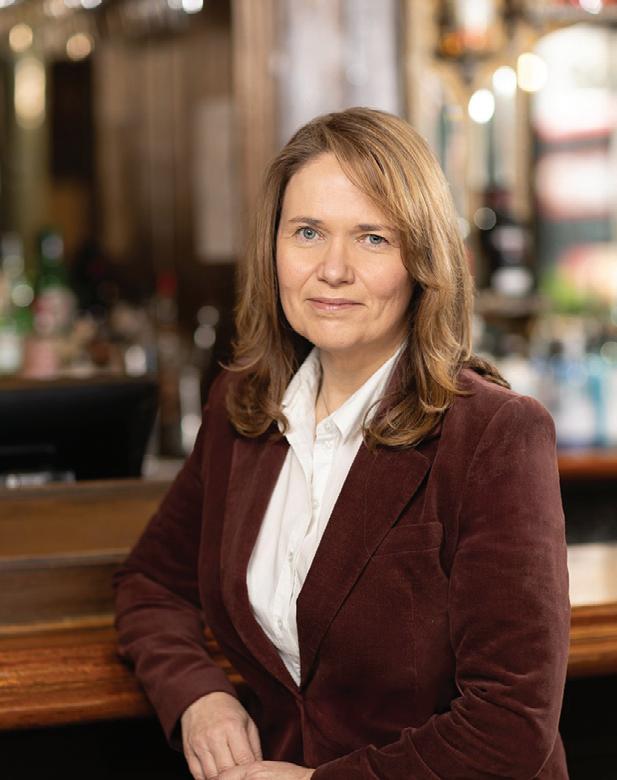
Running a tied pub can be an unpredictable business, and tenants must react to market developments and unexpected events, like tax and legal changes. Margins shift, forecasts change, and tenants must juggle multiple pressures. In this environment, fair conversations with the pub company’s Business Development Manager (BDM) will be more important than ever. But anyone in business knows how important it is to keep a paper trail of a promise or agreement made verbally.
The regulated pub companies must ensure their BDM deals fairly with tied tenants, and the Pubs Code gives vital protections to those tenants when having key conversations. The BDM, or anyone representing the pub company, must make notes of discussions which relate to business planning, repairs or rent negotiations. These notes must then be sent to the tenant within 14 days to check. The tenant must be asked to respond within 7 days if they do not agree with any aspect of them.
This is not just admin. Tied tenants have the right to have all commitments, promises and action points recorded and provided to them while their memory is still fresh. These notes form part of the official record of the relationship between pub company and tenant, so that clear, reliable BDM notes can be a point of reference down the line. This makes BDM meetings, and the notes that follow them, an important formal protection for tenants. The PCA has created a new short video about this right, which is part of our new series of bite-sized video guides about key Code protections.
So, for example, if a BDM verbally promises marketing support, it must appear in the notes. If it doesn’t, that could be a breach of the Code. The Code Compliance Officer (CCO) is employed by the pub company to verify compliance with the Code and can be the first port of call for a tied tenant who is concerned they have not received appropriate meeting notes. The CCO must report breaches of the Code to the PCA, and to ensure maximum transparency the PCA publishes details of pub company breaches in its searchable database, so reported failures to provide BDM notes on time can be identified.
Most tied tenants say their BDM relationship works well. The PCA’s 2025 tied tenant survey found that 70% of tenants are satisfied with their BDM relationship, and 72% think their BDM provides accurate notes of discussions. Most BDM notes are issued promptly though automated systems. The PCA team regularly accompa-
Why Use a Specialist Hospitality Consultant? Answer: because we can help your business to succeed.

With over 30 years of industry experience in the Hospitality sector, The Bowden Group’s Managing Consultant David Hunter will work with you to address the following elements:
Profitability, Operational Strategy, Staff Management, Marketing and The Future of your business.
Our experts will analyse your entire operation and also its key operating figures if they are available. We then help you to identify strategies to manage costs and overheads associated with the core Profitability of running a Hospitality business.
The largest overhead, even higher than Cost of Sales, is the Labour cost, so, with detailed analysis of your wages and being able to understand ‘’the way
your business actually works’’ we can ensure that you are maximising the labour usage in your business.
Budgeting, Forecasting, Menu Management, Stock Controls, Purchasing, and controlling Variable Costs are just a few of the other areas that David Hunter, your Restaurant Consultant, will work on with you, and improve with you.
Managing people brings with it a whole set of new skills that are now needed more than ever. From ‘’Managing the Managers’’ through to Service and Kitchen staff, your team needs careful and skilful Management, Motivation, guidance and Development.
If your business is actually struggling, or if you just feel that it could be doing some things better, give David Hunter a quick call on 07831 407984 to arrange a ‘’Free of Charge’’ initial consultation (please quote CLH Offer), when David will discuss with you what could be achieved if you ask us to work with you.
For over three decades, Stonesmith has established itself as the South West's premier business transfer agent, specialising in the sale of licensed, hospitality, and catering businesses throughout Devon, Cornwall, Somerset, and Dorset. Whether you're an aspiring publican seeking your first freehold pub, an experienced hotelier looking to expand your portfolio, or an entrepreneur wanting to enter the thriving restaurant sector, Stonesmith's unrivalled local expertise makes them the natural choice for navigating the Westcountry's dynamic hospitality market.
nies BDMs on visits to tied pub tenants, to see how discussions work in practice, hearing on a recent visit about Marston’s work to improve its process to make it more user friendly and ensure that meeting notes are shared automatically with the tenant once the document is completed.
Proper note-keeping of BDM meetings is not optional—it is a legal requirement. The PCA exists to protect tied tenants' rights under the Code and can take action to ensure that pub companies comply. A failure to take and share notes of these key business discussions was the subject of a recent report on breaches by Star Pubs. The PCA issued a formal, written censure to Star on review of the evidence gathered after Star reported that, owing to systematic errors, some BDM meeting notes between 2019-24 had not been provided within 14 days or, in some cases, at all.
Star informed the PCA that it had taken remedial measures to prevent a repeat of the breach, including retraining BDMs through regional development programmes. Star has now transitioned to a new IT system for the completion of BDM notes for onboarded tenants. The PCA will be looking closely at this year’s tied tenant survey results to see the level of tied tenant satisfaction with the BDM relationship across all six of the regulated pub companies. Fieldwork for that survey kicked off in January and results will be published in early June.
The right to notes of discussions about rent negotiations, repairs and business planning also applies to applicants who are negotiating to take on a tied pub. This is important given that this is the time when matters like deals, discounts, rent and repairs may be thrashed out face-to-face or over the phone. Early accuracy prevents later disputes about what was said and can provide protection for tenants if things go wrong. The pub company must ensure that these discussions and agreements are recorded in writing and that the record is sent to the prospective tenant. This is one part of how the Pubs Code supports tied tenants to get off to the right start. The PCA is currently working with the regulated pub companies to understand their approaches to complying with this duty.
The Pubs Code requires that pub companies must provide appropriate training for BDMs about their duties under the Code. Good notes support better business planning for tenants and provide confidence, clarity and control, helping to create a transparent, professional relationship with the pub company.
This article is intended to aid understanding of the Pubs Code and its impact. Nothing in it should be understood to be a substitute for the pubs code legal framework.
For more information on the Pubs Code and Pubs Code Adjudicator, including comprehensive resources for tied tenants, visit www.pubscodeadjudicator.org.uk.
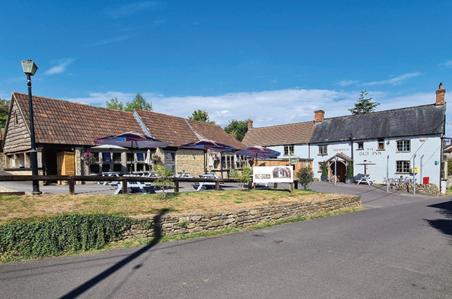
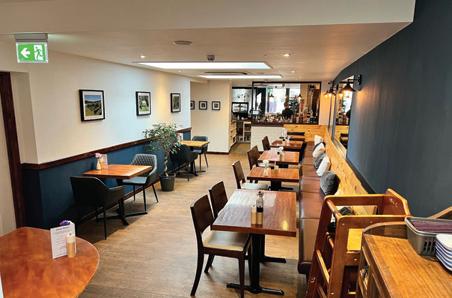

The team at Stonesmith understands that no two hospitality businesses are alike. From traditional country pubs and coastal hotels to contemporary restaurants and boutique guest houses, each property presents unique opportunities and challenges. Their approach centers on listening to clients' individual needs and crafting bespoke marketing strategies that align with specific objectives. This personalized service, combined with their deep knowledge of the regional market, ensures that both buyers and sellers receive guidance tailored precisely to their circumstances.

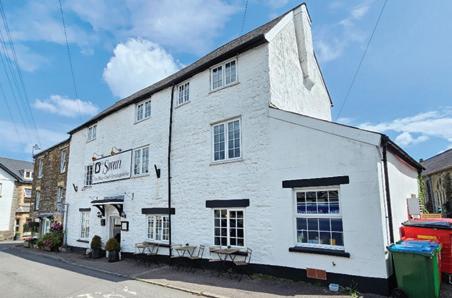
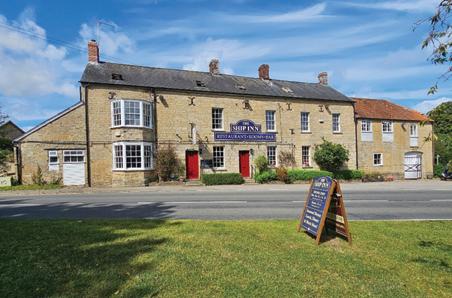
Choosing Stonesmith means partnering with specialists who genuinely understand the hospitality sector's nuances—from licensing requirements and valuation complexities to the seasonal dynamics that define Westcountry trade.
Thinking of selling or buying? Visit www.stonesmith.co.uk