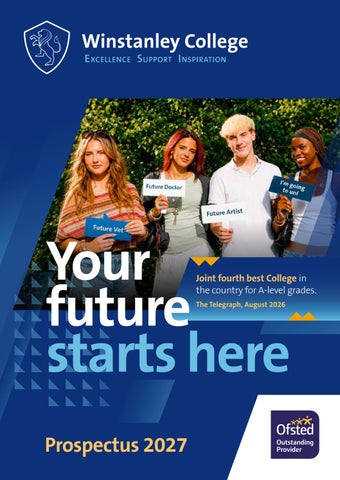
Your future starts here
Joint fourth best College in the country for A-level grades. The Telegraph, August 2026
Prospectus 2027
Joint fourth best College in the country for A-level grades (The Telegraph, August 2026^) with an average of 80% Distinction* -Distinction across all vocational courses.
Important Dates
2026/27
Open Events • Saturday, 3 October 2026: 9:30am – 12:30pm
Find out more:
• Wednesday, 21 October 2026: 5:00pm – 8:00pm
www.winstanley.ac.uk/apply
• Thursday, 12 November 2026: 5:00pm – 8:00 pm
Contact our admissions team:
• Wednesday, 13 January 2027: 5:00pm – 8:00pm • Thursday, 24 June 2027: 5:00pm – 8:00pm
Virtual Applicant Evening
admissions@winstanley.ac.uk or 01695 628610
• Wednesday, 17 March 2027: 5:00pm – 6:00pm
Year 11 Taster Day • Thursday, 1 July 2027
Applications open in September Application Deadline: Friday, 5 February 2027
Please see our website for more details on these events and booking information.
^ Published in The Telegraph, 20 August 2026, all data is from the 2024-25 academic year. Disclaimer: Information in this prospectus is correct at time of going to print but can be subject to change.
Contents Welcome from the Principal
02
Welcome from our Student Governor
03
Ofsted ‘Outstanding’
04 – 05
Teaching is our Passion
08
Equality, Diversity and Inclusion
09
Student Journey
10 – 11
Why Winstanley is for you
12 – 13
A Day in the Life of Dhilan
14 – 15
We’re proud of our Students
16 – 17
University Destinations
18 – 19
Support at Winstanley
20 – 21
‘Inspiring Futures’ Programme
24 – 31
Winstanley Alumni
34 – 35
Our Learning Culture
36
You do You
37
Picking the Right Subjects for You
38
Entry Requirements for Winstanley College
39
Introducing V-levels
40 – 41
Subjects
42 – 139
Transport
142 – 145
Getting to know our Campus
146
Getting here
147
FAQs
148 – 149
Key Information and Policies
150 – 151
Social Media
152
“ Students describe the College as one big community that they are immensely proud to belong to.” Ofsted, 2025
01
Welcome from the
Principal Our job is to work with you to unlock your potential. We want you to be the best you can be and we will do everything we can to help you achieve your goals.
We are thrilled with our most recent Ofsted inspection report, which acknowledges that students are proud to attend Winstanley and find our community to be welcoming, inclusive and friendly.
Inspiration
You will receive outstanding academic and pastoral support during your time here. We offer a rich and inspiring curriculum, which will be enhanced by individualised support and opportunities to get involved in a range of enriching extracurricular activities, such as volunteering, work experience, sport, performance, the Duke of Edinburgh’s Award Scheme, World Challenge and the Student Union. We will also work hard to prepare you for life after Winstanley, whether this is higher education, an apprenticeship or employment. We hope you will come and visit us at one of our open events, where you will have an opportunity to talk to students and staff about what it’s like to be part of the Winstanley community.
Excellence
Support
Thank you for your interest in Winstanley College, we look forward to meeting you soon. Best wishes, Simon Lett Principal
02
Student Governor On behalf of everyone here, I’d like to welcome you on becoming part of our College community. Starting somewhere new can feel both exciting and daunting, but you’ll quickly discover that Winstanley is a place where you’ll be supported by amazing teachers, challenged by the subjects and encouraged to reach your full potential by the College’s welcoming community. Whether you’re pursuing your academic goals, discovering new interests, or building friendships, there are countless opportunities to make the Winstanley College experience your own. I encourage you to get involved beyond the classroom with the wide choice of extracurricular sports, clubs and societies on offer. Some of the most memorable moments at College come from the opportunities you choose to take alongside your studies. It’s the opportunities for personal growth that make College so enjoyable.
Joshua Neave Year 11 is an exciting opportunity to discover what you can achieve. Stay organised, work consistently and never be afraid to ask for help. Get involved in school life, support your friends and believe in yourself. The effort you put in now will open doors to your future.
03
Ofsted
Outstanding
We are proud of our exceptional achievement following our most recent Ofsted inspection, where we were rated ‘Outstanding’ in all areas.
Excellence
Support
Inspiration
This result firmly establishes us as one of the top Sixth Form Colleges in the country. Inspectors commended Winstanley as being “one big community,” describing it as a welcoming, inclusive, and caring environment where students feel a strong sense of belonging. They recognised the extensive range of extracurricular activities that help students broaden their knowledge of the world to help them progress confidently to their next destination. The report highlights the high quality of teaching at the College, noting that teachers present information skilfully, give effective feedback and place a strong emphasis on study skills.
04
As a result, students achieve highly on their A-level and vocational courses, with around two-thirds attaining the highest grades. Inspectors also praised the outstanding support available for students with special educational needs and/or disabilities, which ensures they perform as well as, if not better than, their peers. The College’s strong partnerships with employers and universities were also commended, as was its effective careers guidance.
To read the full Ofsted report, please scan the QR code:
Outstanding areas: • The Quality of Education • Personal Development • Behaviour and Attitudes • Educational Programmes for Young People • Provision for Learners with High Needs • Leadership and Management
“ Students leave College as mature and independent young people who move on to higher education or to employment with great confidence.” “ Students say that everyone embraces and celebrates difference and that they can be who they want to be.” “ Staff support students with SEND including high needs, very effectively.” “ Teachers are very well-qualified, experienced and enthusiastic practitioners who motivate students to give their best.” “ Students participate frequently in an extensive range of high-quality additional activities. These include clubs and societies, as well as subject-related activities that extend their learning.” “ Leaders inspire students to fulfil their potential.” Ofsted, 2025
05
Arham Rasheed Previous school: Cheadle Hulme High School
At Winstanley I study: Chemistry, Maths, Physics and AS Further Maths
My enrichment activities: I’ve had the chance to get involved in lots of academic enrichment activities, including Ritangle, UKMT, the Astrophysics Olympiad and the College’s STEM Poster Challenge, where I researched how biomimicry has inspired inventions like the James Webb Space Telescope. I’ve also played volleyball and taken part in debates, which have helped me build my confidence and develop new skills.
My plans for the future: To study astrophysics or engineering at university.
My favourite thing about Winstanley: The unlimited amount of support Winstanley provides for the students ensuring they are their best selves for the challenges they will face during their time at College.
What surprised me about Winstanley: The diversity of people you meet. I’ve met so many people from different walks of life and backgrounds, and we’ve all managed to get to know each other and become friends.
06
Ava Flannery Previous school: St Peters Catholic High School
At Winstanley I study: Applied Science Diploma and Psychology
My enrichment activities: Alongside my lessons, I’ve had loads of opportunities to get involved in different experiences, like listening to guest speakers, visiting Chester Zoo with Psychology and going to careers fairs. It’s helped me learn more about my subjects and think about what I want to do in the future.
My plans for the future: I plan to take a gap here before going to university to study pharmaceutical sciences.
My favourite thing about Winstanley: My favourite thing about Winstanley is definitely the sense of community. There are so many clubs and groups you can get involved in, and you meet loads of new people. It’s a really friendly place and it’s helped me make new friends and become much more confident.
What surprised me about Winstanley: I was surprised by the amount of course options as someone who didn’t want to do three A-levels there are so many vocational options to study.
07
Our teachers are highly trained academic specialists. They are committed to the success of our students, guiding and supporting them to achieve the highest possible grades.
Teaching is our Our teachers design teaching, learning and assessment to be varied, engaging, supportive and aspirational. We will always support and challenge you to achieve your best. We work in collaboration with you to make sure you develop the skills you need to progress onto your chosen career path.
“ Teachers take a highly organised approach to how they assess students’ work and give feedback.”
Excellence
Support
Inspiration
Passion Ofsted, 2025
08
Equality, Diversity
and Inclusion
Being a student at Winstanley means being part of an inclusive, diverse and welcoming community.
We value your individuality and unique voice, and encourage all students to play an active role in shaping the College to reflect the needs and priorities of the student body.
Get Involved
Here are just a few examples of some of the current societies:
There are many ways in which you can actively help to drive forward equality, diversity and inclusion at Winstanley. You can run for office in the Student Union and work alongside the Equality, Diversity and Inclusion Coordinator and Student Experience Coordinator to organise events and develop awareness campaigns. You can train to be a Mental Health Ambassador to implement health and wellbeing initiatives at the College.
· African Caribbean Society
You can participate in annual College events, including Culture Day and Winstanley Pride. You can also join a range of student-led societies to make friends, run events and fundraise for charities that matter to you.
At Winstanley you’ll find the support to be your authentic self, as well as numerous opportunities to participate and have your say in raising awareness and helping to drive continued positive change.
· Gender Equality Society · Muslim Society · Christian Union · LGBTQ+ Society · Connections Group for neurodivergent young people.
If you don’t find the society or support group that you’d like to see, tell us and we can work together to make it happen!
09
Student
Journey
Application to Winstanley In most schools, Winstanley staff will give a short presentation to Year 11 students before Christmas, advising of the application process. Students and their parents/carers will then be invited to attend an Open Event to look round the College and discuss course choices with staff.
SEPTEMBER TO DECEMBER 2026
1
Attend a presentation by the College at your high school.
2
isit the College website at V www.winstanley.ac.uk.
Inspiration
3
Support
4
5
Excellence
6
10
Start thinking about your subject choices: visit our course search page. hoose an Open Event from: C Saturday, 3 October, Wednesday, 21 October or Thursday, 12 November 2026. Complete your online application form via the Winstanley College website. This goes live at the end of September. Book your course discussion at the end of the online application form. Two dates are available before Christmas: Wednesday, 18 November or Thursday, 10 December 2026.
If you wish to apply to the College, you can book an individual course discussion via the College website www.winstanley.ac.uk. Offers of places are usually made at your course discussion and enrolment takes place in August, following the publication of GCSE results.
JANUARY TO FEBRUARY 2027
1
2
MARCH TO APRIL 2027
We have one final Open Event on Wednesday, 13 January 2027.
1
Complete your online application form and make sure you have booked your course discussion.
2 3
The remaining two dates are: Thursday, 21 January or Thursday, 11 February 2027.
3
Attend Virtual Applicant Evening: Wednesday, 17 March 2027. Prepare for your GCSEs. Keep up to date with the latest College news via our social media.
losing date for applications C is Friday 5 February 2027.
For help choosing the right subjects
Winstanley College Entry Policy
Appeals for special consideration will be heard by the Admissions Panel if received before GCSE results are published.
A full list of entry requirements will be published in September on the College website. Visit www.winstanley.ac.uk for more details.
Special Consideration
If you have any queries about courses or admissions, please contact the admissions team on 01695 628610 or admissions@winstanley.ac.uk.
Requests for special consideration should normally be accompanied by support from the applicant’s school and be made in writing to the Deputy Principal, Deborah Owen. admissionsappeals@winstanley.ac.uk
MAY TO JUNE 2027
1
2
3
Book your August enrolment appointment online on either GCSE results day, Thursday, 19 August or Friday, 20 August 2027.
Only in exceptional circumstances is the College able to hear appeals made after GCSE results have been published. Please note that normally, the College will give preference to Year 11 school leavers.
JULY 2027
1 2
Attend College Taster Day on Thursday, 1 July 2027. Don’t forget to complete your online pre-enrolment form and have a great summer.
AUGUST 2027
1
Collect your GCSE results and come to your enrolment appointment. * Dates are subject to change, please check our website.
You will be asked to complete an online pre-enrolment form and reserve a seat on one of our Private Coaches. Attend Summer Open Evening on Thursday, 24 June 2027.
11
Why Winstanley
is for you
Table-topping Results
Excellence
Support
Inspiration
We have an exceptional reputation for academic achievement and regularly compete at the top of the national performance tables.
An Award-Winning Experience We have won countless prestigious regional and national awards, including ‘College of the Year’ (Educate North Awards), ‘Most Inspirational Sixth Form College’ (Educate Awards) and ‘Sixth Form College of the Year’ (Times Educational Supplement). We were also recently re-accredited with the AcSEED Award for Mental Health and Wellbeing, as well as being the SFCA Runner Up for Health and Wellbeing. Our Information advice and guidance is Matrix accredited and we are Silver Award winners for Investors in Diversity and Bronze Award holders for the RACE Charter Mark. Our science and technology are also nationally recognised through our awarded ‘Cyber Gold’ and ‘STEM assured’ status.
12
Clubs, Societies and Activities We have a fantastic programme of enrichment activities for you to enjoy and experience outside your lessons. This includes certified courses, such as First Aid and Sign Language as well as the Student Union, History Society, Sport, Performing Arts, work experience and much more!
Travel Opportunities From China to Mozambique, Australia to Los Angeles, Winstanley students have been to the four corners of the world. Where would you like to go?
Inspirational Teaching Our subjects are delivered by dedicated teachers who are passionate about helping you to be inspired by your studies and achieve outstanding outcomes.
Experience the College atmosphere by visiting us at one of our Open Events.
“ My daughter’s school had a sixth form and so she was torn between staying there or coming to College. We are all so glad she chose to break away; Winstanley has opened up many new opportunities and has prepared her for life at university.” Parent Survey comment
A Caring College
Our Facilities
Not only do we look after your brains, we care about your emotional wellbeing! We offer the best support while you are here. We will give you excellent individual guidance and support to make sure that you reach your full potential For further information, please contact our support team on support@winstanley.ac.uk
The College campus has a university feel with high-quality specialist teaching facilities, extensive space for independent learning and social spaces for taking a break.
Subject Choices Fancy doing Art with Philosophy? Dance with Physics? Virtually any combination of subjects is possible. In fact, we have over 11,000 different combinations for you to choose from!
It’s Fun! Students tell us that it’s hard work but that they have lots of fun while they are here.
Our Students The most important ingredient to making Winstanley special is our students. They are confident, mature, highly motivated and with high aspirations. Come and join our diverse, vibrant, exciting community and form friendships that will last a lifetime.
13
A Day in the Life of
Dhilan
Excellence
Support
Inspiration
We love to help you with our outstanding academic support and enrichment, but we also love giving you the freedom to make the College day your own.
14
Travel I drive down to Bolton Rail Station before getting a train to Wigan Wallgate and then changing train to Orrell which is only a short walk away from College. It is a good chance to catch up with my train friends who I don’t often hang out with around College but do still love spending time with.
Further Maths Further Maths is my favourite A-level by far. The key to success is a good sense of intuition, pure grit, resilience and a love for the game. Despite the difficult curriculum the teaching is top notch and support is always there for me. The cohort of students is also very welcoming and we all back each other to succeed.
Free Period I normally spend my free either catching up on work or socialising with friends. Occasionally we’ll go to the music department and do band practice in the studios which are open all day.
07:30
08:35
I arrive at College and make my way to S Block, where I hang out with my friends and socialise or catch up on some last minute work.
09:00
10:40
11:40
12:40
Extended Project Qualification (EPQ) I am also currently completing my EPQ qualification on ‘Chaos Theory’ and ‘How it challenges the classical scientific worldview’. This includes deep research, thorough analysis and critical understanding of advanced topics, which do not overlap with your College curriculum. It is challenging but if you enjoy what you’re doing it does become rewarding.
Home At 15:45 lessons end and I walk to Orrell Rail Station where I catch a train to Hindley and drive home to Bolton.
Arrive
Physics Physics is another A-level which I take. It combines a mix of basic mathematical reasoning and advanced understanding of concepts. We explore a plethora of topics like quantum mechanics, gravitational fields and electric circuits.
Lunch At lunch I will either just relax in S Block with my friends or we play football on the College fields outside. I will either get food from the canteen or bring in my own packed lunch.
13:45
14:45
15:45
Economics Economics is a very diverse subject. You go from learning about small firms and how they maximise revenue, to macroscopic economies and how they function and develop. The content and concepts are actually quite straightforward, the main challenge is synthesising information and applying it to your own knowledge.
15
872
A*/A grades achieved by our students each year (3 year avg)
80+ students secured places at Oxbridge over last 4 years
33.5% of A-level entries A*-A (3 year avg)
61.5% of grades A*-B (3 year avg)
99.1% A-level pass rate A*-E (3 year avg)
Excellence
Support
Inspiration
We’re proud of our
Students
Start with us, stay with us
Attendance
Winstanley College has one of the highest retention on A-level courses in the North West.
Attendance in College is outstanding. Our students enjoy and engage in their studies.
The College significantly beats Sixth Form Colleges nationally for retention and achievement rates.
We add value Our students achieved the highest average points score per A-level entry, across all Sixth Form Colleges in Greater Manchester.
16
85.1% of students across vocational courses achieving D*D*-DD (3 year avg)
41.9% of Art Foundation students achieving the highest grade (3 year avg)
63.2% of students across vocational courses achieving D*-D (3 year avg)
150+
Winstanley students have gained entry onto medicine/ dentistry/veterinary science at degree level over the last 5 years
17
University Destinations 2025 250+ students received places at Russell Group universities
Scan the QR code to see the full list of 2025 destinations
Over 90%
800+
students typically progress to university each year
of graduating Winstanley College students were awarded a First or Upper Second-Class degree in the academic 2024-25 year
North West (483) Edge Hill University: 67 Accounting Creative Writing Computing (games Programming) Criminology Geography Health and Social Wellbeing History Sport & Exercise Science Law Medicine Mechanical Engineering Nursing (Adult and Child) Nutrition and Health Primary Education with QTS Professional Policing
Excellence
Support
Inspiration
Lancaster University: 70 Accountancy and Finance Biomedical Science Business Economics Earth and Environmental Science English Literature Fine Art French Studies and German Studies Global Religions and Philosophy Law Marketing (Study Abroad) Mathematics Medicine and Surgery Natural Sciences Peace Studies and International Relations Pharmacology Physics, Astrophysics and Cosmology Software Engineering Sports and Exercise Science
Liverpool John Moores University: 58 Computer Games Development Creative Writing and Film Studies
18
Criminology Cyber Security Events Management Forensic, Policing and Investigations Geography Graphic Design and Illustration Mental Health Nursing Pharmaceutical and Cosmetic Science Quantity Surveying Sport Journalism Software Engineering
Geography Geology History History and Politics Law Law with Business Marketing with a Year in Industry Mathematics Medicine Physics with Astronomy Psychology Sociology with Social Policy
Manchester Metropolitan University: 71
University of Manchester: 52
Accounting and Finance Art Foundation Biomedical Science with Foundation Year Computing Criminology English and Film Chemistry Cyber Security Events Management Geography Physiotherapy Primary Education with QTS Textiles in Practice
Architecture Biochemistry Civil and Structural Engineering Computer Science Criminology Cognitive Neuroscience and Psychology Economics Education English Literature and History History Information Technology Mathematics Midwifery Optometry Planning and Real Estate Physics with Astrophysics Politics and Modern History Social Anthropology
University of Central Lancashire: 24 Archaeology Illustration Motorsports Engineering Psychology Professional Policing Forensic Science
Liverpool University: 107 Dental Surgery Economics Engineering English English Literature Environmental Science Finance and Data Analytics with a Year in Industry
Wales (11) Aberystwyth University: 2 Fine Art Physics
Bangor University: 5 Geography Law Music Physical Geography and Oceanography Zoology
Cardiff University: 4 Diagnostic Radiography and Imaging Pharmacy Physiotherapy Psychology
South West (11) University of Bath: 1 Architecture with Professional Placement
University of Salford: 34
University of Bristol: 4
Aeronautical Engineering Civil Engineering Computer Science Electrical and Electronic Engineering Journalism Physiotherapy Prosthetics and Orthopaedics Quantity Surveying Social Work Sociology Television and Radio Production
Aerospace Engineering Biology English Social Policy
University of Exeter: 12 Animal Behaviour with study abroad Economics Law Medicine Neuroscience Zoology
Scotland (8)
North East (59)
Yorkshire (96)
University of Edinburgh: 3
Durham University: 32
Leeds Arts University: 1
Italian and Spanish Medicine Earth Science
Accounting and Finance Chemistry Criminology Economics English Literature Engineering Geography Liberal Arts Physics and Astronomy Politics Psychology
Graphic Design
Newcastle University: 21
Biochemistry Biology Chemical Engineering Computer Science Cultural and Media Studies English Language and Literature English Literature Environmental Science Fashion Marketing Geography Graphic and Communication Design History and Sociology Interdisciplinary Science with Foundation Year Law Linguistics Linguistics and Philosophy Mathematics Medicine Modern Languages Music
University of Glasgow: 3 Zoology English Literature Neuroscience
University of St Andrews: 2 Medieval History Biochemistry
Biomedical Sciences Civil and Structural Engineering Economics International Business Management Law Marketing and Management Mathematics Medicine and Surgery Psychology
Northumbria University: 6 Criminology and Forensics International Relations and Politics Law Psychology Tourism and Event management
Leeds Beckett University: 9 Criminology International Business Music Performance and Production Physiotherapy Sport and Exercise Science
University of Leeds: 34
Neuroscience Philosophy and Politics Philosophy, Ethics and Religion Physics Psychology
Sheffield Hallam University: 4 Business Geography Paramedic Science
University of Sheffield: 18 Aerospace Engineering Biomedical Engineering Business Management Computer Science Japanese Studies Physics with Astrophysics
University of York: 29 Actuarial Science Biomedical Science Chemistry Computer Science Computer Science with Cyber Security Engineering English Language and History Law Philosophy, Politics and Economics Psychology Mathematics Sociology
Midlands (36) Loughborough University: 5 Business Aeronautical Engineering Geography Graphic Design Sport Science
University of Birmingham: 3 Politics and International Relations Geology and Physical Geography Psychology
University of Nottingham: 15
20
Architecture Chemical Engineering Electrical and Electronic
Engineering Environmental Science History Law Pharmacy Mathematics Management Medical Physiology and Therapeutics
University of Warwick: 13 Accounting and Finance Computer Science Chemistry Classical Civilisation Data Science Film and Literature History Maths Psychology
Oxbridge offers for 2026
London (10)
Oxbridge (15) University of Cambridge: 8
University of Oxford: 7
Computer Science Engineering Geography History of Art Medicine Modern and Medieval Language Natural Sciences
Earth Sciences English Language and Literature English and French Mechanical Engineering Geography Physics
Royal Holloway, University of London: 2
University of Westminster London: 1
Politics Law with Foundation Year
Photography
Imperial College, London: 2 Civil Engineering Mathematics
London School of Economics:1 Philosophy, Politics and Economics
UCL (University College London): 2 International Social and Political Studies Politics and International Relations
University of the Arts: 2 Fashion Design and Development Photography
19
Support at Winstanley Your academic journey and personal wellbeing is important to us. Supporting your Journey The support from your teachers is intended to assist with your learning and help you achieve the very best. In the classroom, teachers will encourage and challenge you to meet your full potential. In each department teachers will reinforce learning, provide support and ensure you have access to study spaces to help you learn.
Supporting your Learning We provide personalised support for students with learning differences and disabilities, physical or sensory impairments, and health conditions. Where needed, our dedicated Learning Support team works with students to identify and remove barriers to learning, helping them to access all aspects of college life and achieve their full potential.
Excellence
Support
Inspiration
We are committed to creating an inclusive and accessible environment across our campus, in our classrooms, and throughout the wider College experience. Reasonable adjustments, specialist equipment, and tailored support can be put in place to meet individual needs. Our staff are trained in inclusive teaching practices, ensuring that learning is accessible and engaging for all students.
20
Alongside academic success, we recognise the importance of wellbeing, connection, and belonging. We support students to build confidence, develop positive relationships, and feel happy and valued as part of our College community. Through personalised support and guidance, we help students develop the skills, resilience, and independence needed to thrive at College and successfully progress to their next steps.
Pastoral Support When you enrol, you will be assigned to a Guidance Group and a Personal Tutor who will play a vital role in your College life. Your Personal Tutor’s priority is to ensure that you settle into College, have a happy and fulfilling experience and succeed in your studies. Through regular one-to-one and Guidance Group sessions, your Personal Tutor will get to know you well and become a focal point for support. Senior Tutors, Assistant Senior Tutors and the Assistant Principal for Student Support will support complex needs.
“ Leaders inspire students to fulfil their potential.” Ofsted, 2025
Student Wellbeing All students are supported individually whenever they need it. You may need additional support with your transition from school, financial support or general information about the College. There is a Nurture Room which is available to those who may require a quieter space away from the busier areas of College. We have three counsellors and students can self-refer for appointments, or your Personal Tutor can do this for you. In addition, MHST (Mental Health Support Team), Rocky, our therapy dog and Hillvale Animals, can offer appointments at times to suit you. The Progression and Welfare Manager works with students to complete individual support or medical plans where needed and offers drop-ins or regular appointments.
“ Leaders ensure that all staff working with students with high needs have specialist training.” Ofsted, 2025
If you have any queries throughout your application please contact our welfare team on support@winstanley.ac.uk who will be happy to help.
“ Students are very respectful and caring for each other. They show high levels of tolerance and understanding across the diverse student population. For example, students benefit from a very active LGBT+ society that is supported and encouraged by leaders and managers. During Black History Month, students celebrated Black British history by promoting prominent Black British individuals from across society.” Ofsted, 2025
21
Gabriella Isaac Previous school: Rainford High School
At Winstanley I study: Applied Science, Health Studies and Modern History
My enrichment activities: Alongside the support I get in the classroom, Winstanley brings in lots of speakers from external organisations to broaden our understanding of our subjects. For example, I’ve attended talks from the RNIB and Care UK, which have given me a better understanding of careers in health and social care.
My plans for the future: I plan to study occupational therapy at university in the future.
My favourite thing about Winstanley: I really appreciate the support available at College, as the teachers are always willing to help. The extra study sessions they provide enable me to complete my work with confidence whilst accessing support whenever I need it. This makes the workload feel more manageable and achievable.
What surprised me about Winstanley: The level of independence at Winstanley has really surprised me. I’m expected to manage my own free time and workload, which has helped me become more organised, responsible and confident in my learning.
22
Kieran Holt Previous school: Bolton School
At Winstanley I study: Chemistry, Maths and Physics
My enrichment activities: I play for the College 1st XI football team. This season, we won the North West Colleges League and the North West 7-a-side competition, and finished third in the national finals. It was an amazing experience, and I made loads of great friends and memories along the way.
My plans for the future: To study engineering at a Russell Group university or a degree apprenticeship.
My favourite thing about Winstanley: The freedom and mutual respect given to and from the teachers.
What surprised me about Winstanley: The high standards and the number of talented students there are here.
23
‘Inspiring Futures’
Programme
Excellence
Support
Inspiration
At Winstanley College, we believe that education is about far more than achieving excellent grades.
‘Inspiring Futures’ brings together the full range of opportunities available beyond the classroom, ensuring every student is fully prepared, confident and ambitious about their destinations after College.
Whether students plan to progress to university, apprenticeships, or employment, ‘Inspiring Futures’ offers a structured and supportive framework to help them explore their options, develop essential life and employability skills, and gain valuable real-world experience.
24
‘Inspiring Futures’ encompasses careers education and guidance, progression support including our Oxbridge and MDV programmes, work experience opportunities, and enrichment activities through our ‘ESI’ (Excellence, Support and Inspiration) offer. Students also benefit from the extensive support and opportunities provided within curriculum areas, including guest speakers, educational trips and visits and specialist courses that enrich their learning.
Students can choose from a wide range of opportunities, including:
Sport
• Virtual and in-person work experience placements
We pride ourselves on offering a large and diverse range of sports, whether it’s competing for a College team or just for fun, there is something for everyone.
• Employer-led projects and workshops • Careers events, talks and networking opportunities • University and apprenticeship preparation
You can participate in these sports competitively:
• Personal development and leadership opportunities
• Men’s Football (A and B Team)
• Volunteering and enrichment activities through ESI
• Netball (A and B Team)
• Subject-specific trips, competitions and clubs
• Women’s Football
• Employability courses designed to develop transferable workplace skills.
• Volleyball (men’s, women’s and mixed)
Through their involvement, students can work towards Bronze, Silver and Gold ‘Inspiring Futures’ awards, recognising their commitment, engagement and personal development. All achievements and experiences are formally recorded and celebrated, helping students strengthen university, apprenticeship and job applications. ‘Inspiring Futures’ is designed to ensure that every student leaves Winstanley College not only academically successful, but also informed, experienced and ready to thrive in their future career and life journey.
Performing Arts There are some amazing opportunities for students who are interested in Performing Arts. You don’t even have to be studying a Performing Arts subject to take part! Every year the College puts on a several live shows including The National Youth Theatre Connections Festival, our annual Dance show and much more. Previous musicals have included ‘Our House’, ‘Little Shop of Horrors’, ‘The Little Mermaid’ and ‘Rock of Ages’.
• Mixed Hockey • Men’s and Women’s Rugby League • Badminton • AoC Championships; Athletics, Cricket (mixed), Swimming, Table Tennis and Tennis. If you just want to play for fun we have a wide range of other sports available from pickleball, basketball, table-tennis and many more! We also organise fiveaside and dodgeball competitions throughout the year. We have our own fully equipped gym which is completely free.
These are a great opportunity for anyone who likes to act, dance, sing or play an instrument to get involved. You can also get involved as stage managers, sound engineers and even help create props and costumes! We also have a number of music events throughout the year from Jazz to Classical shows and these are often managed by students.
25
‘Inspiring Futures’ Programme Trips In recent years we have won the British Council International Schools Gold Award. This award is in recognition of our excellent commitment to educating students on playing an effective role in a global community.
Apart from Antarctica, a Winstanley student has stepped foot on every continent in the world.
Excellence
Support
Inspiration
World Challenge
World Challenge World Challenge is a skills-based experiential learning programme, allowing challengers to travel to farflung parts of the globe. As part of these expeditions, challengers complete project work; for example, construction and teaching, spending time trekking through mountains and jungle terrain as well as having some time for rest and relaxation. Staff and students have completed trips to places such as the Galapagos Islands, Ecuador, Venezuela, Ethiopia, Madagascar, Mozambique, Sri Lanka, China, Thailand, Nepal and most recently Vietnam in July 2026.
26
2027
Costa Rica
Our students travel the world, broadening their minds and gaining invaluable experience of cultures and countries. Here is just a selection of the countries Winstanley students have visited.
Istanbul London Spain Barcelona Madrid Salamanca
Prague
Brussels
Laos
France Vietnam
United States Los Angeles New York Washington
Singapore Germany Augsburg Munich Nuremburg Stuttgart
South America Ecuador Galapagos Islands Venezuela
Sri Lanka China Australia
Africa
Morocco
Eswatini Ethiopia Gambia Ghana Mozambique Uganda
India Borneo Thailand
27
‘Inspiring Futures’ Programme 20
Oxbridge offers in 2026
45 MDV offers 2026
Oxbridge We have a comprehensive Oxbridge preparation programme, run by experienced staff. This programme helps you achieve your academic aspirations throughout the entire application process; from writing an outstanding personal statement to admissions tests and mock interview practice.
Excellence
Support
Inspiration
What makes us unique is our Oxbridge Alumni Network, which puts you in contact with former Winstanley students who are now current Oxbridge students or graduates. They are always happy to provide advice and guidance, giving you the confidence to make a successful application. Another key aspect of our programme is residential trips to both Oxford and Cambridge, which allow you to experience these unique institutions. Due to our contacts, we can often be granted exclusive access to areas tourists are not privy to, including the famous library at Queen’s College, Oxford.
Cambridge University’s HE+ Project We are also in the privileged position to be the hub College for the area for Cambridge University’s HE+ Project, which means we have a direct link with Sidney Sussex College, Cambridge.
28
The project involves academic tutorials from Cambridge University staff, a residential trip to Cambridge and a competition to produce an academic piece of work.
Social Mobility We were recently recognised for our commitment to supporting learners from all communities and enhancing life chances of young people. The judges acknowledged the College’s efforts to include social mobility in its Strategic Plan. In particular, they commended a research project looking at the links between social mobility and enrichment opportunities, as well as CPD for teaching and pastoral staff on supporting students in applying to prestigious universities and apprenticeships. We have also helped disadvantaged students with Oxbridge aspirations to gain a Foundation Year place at Oxford and Cambridge Universities. The scheme offers students with high academic potential a place on a one year pre-degree course with the intention that they will begin an undergraduate degree the following year.
Medicine, Dentistry and Veterinary Science (MDV)
Joel Bark
Our experienced MDV coordinator leads the programme which provides:
Joel Bark is currently a fourth-year medical student at the University of Sheffield, working towards his ambition of becoming a surgeon.
• Mock interviews • UCAT test preparation tutorials • MDV work shadowing placements • Specialist MDV personal statement workshops
Medicine, University of Sheffield
Joel’s journey highlights how dedication, combined with the right support, can lead to success in highly competitive fields like medicine.
• Alumni mentoring scheme • Regular talks by universities and MDV professionals.
Joel says: “ The MDV (Medicine, Dentistry and Veterinary Science) programme at Winstanley played a huge role in helping me prepare for applying to medical school. It really supported me in developing my personal statement, preparing for interviews and understanding what a career in healthcare involves. Having that guidance made the whole process feel much more manageable and gave me the confidence to apply.” “ My advice to anyone considering medicine is to make the most of every opportunity available to you – whether that’s work experience, wider reading or enrichment programmes like MDV. It’s a competitive process, so showing genuine interest, being well-prepared and staying resilient really makes a difference.”
DID YOU KNOW? There are almost 200 former Winstanley students currently studying for a Medicine, Dentistry or Veterinary Science degree at universities across the UK and beyond. Our vibrant MDV programme provides students with all the guidance, tuition and experience required to be awarded places at the country’s leading universities.
29
‘Inspiring Futures’ Programme EPQ (Extended Project Qualification) The EPQ is an opportunity for students to undertake a research programme to develop experience and knowledge beyond A-level courses. EPQ is excellent preparation for university.
STEM (Science Technology Engineering and Mathematics) Our STEM Club brings together students who have an interest in the fields of science, technology, engineering, and mathematics. The club provides opportunities to: • Network with students who have similar interests • Participate in exciting and informative STEM activities • Access to a mentor in the industry.
Reflecting on the experience, Alana said: “ Whilst the workload was difficult on top of A-level commitments and the project load was daunting, being able to get a qualification in something I deeply enjoy was incredibly unique. The project is really what you make of it, and I gained valuable experience in creative writing that will be useful for my degree path!”
Excellence
Support
Inspiration
Alana Jackson Alana Jackson, who studied A-level English Literature, Psychology and Theatre Studies at Winstanley College, completed her EPQ by combining her passion for creative writing, illustration and social history.
She used this research to create a professionally illustrated 15-page graphic novel chapter centred around the famous 1970 Miss World protest and the social changes of the era.
Her project focused on creating a pilot chapter for an original graphic novel designed to educate and entertain young adults through the story of two women navigating friendship, feminism and identity in 1970s Britain.
Alongside developing her historical knowledge, Alana refined her skills in creative writing, graphic novel scripting and digital illustration, producing a final piece that successfully balanced education, storytelling and visual design.
Inspired by a desire to explore overlooked aspects of history, Alana carried out extensive research into second-wave feminism, the Women’s Liberation Movement and the experiences of LGBTQ+ women during the 1970s.
Through her EPQ, Alana developed valuable research, referencing and creative skills while producing a project closely aligned to her ambition of studying Creative Writing at university and pursuing a future in storytelling and publishing.
30
Apprenticeship and Employability Programme (AEP)
Some of our workshops and events include:
Many students are now recognising the importance of work-related learning in today’s competitive economy. Our specialist Careers team, alongside our Vocational Coordinator and Guidance Tutors, will work with employers and training providers to find apprenticeship and employment opportunities for you, supporting you through the recruitment and selection process.
• CV writing and making a successful application
Our bespoke programme consists of a comprehensive series of events, workshops and individual support sessions for students to participate in throughout their two years of study. The programme will guide students through every aspect, including finding out about the different types of apprenticeships available, where to look for opportunities and employment vacancies and how to be successful in the application process.
• Skills – ‘What am I good at?’ • The importance of work experience • A day in the life of an apprentice • ‘Mock’ interviews • Meaningful encounters with a variety of employment sectors. We have a designated Work Experience Coordinator who will source and place you on a relevant work placement to help you make decisions about the field or industry you might want to work in. We also offer a series of events to help students make informed decisions about their future career, including talks from industry experts, former students who are now working in particular fields and crossCollege events like our Careers and Apprenticeship Fair. We regularly work with some of the country’s largest and leading institutions, like the NHS, Unilever and AJ Bell to give students a real insight into the opportunities available. And you can ‘drop in’ to the Careers Hub at any time if you need some support and guidance with your future plans.
• Access to an online ‘Student Passport’ where you can carry out a skills analysis, develop a CV and apply for new work placements and virtual experiences that become available • Monthly Careers Bulletins and Teams platform so you can keep up-to-date with the latest news, opportunities and information
Careers Hub
• Themed employment fairs meeting professionals from industry.
We pride ourselves on providing outstanding careers support for our students, consistently achieving the Gatsby benchmarks. The eight benchmarks are a national framework for good careers guidance, created to support schools and Colleges in providing students with the best possible careers education, information, advice and guidance. There is plenty of help available at Winstanley to support you in discovering what is right for you and to give you the information you need to shape your future.
During the year we have a number of visiting speakers, a careers and apprenticeship fair and a HE event to help with your decision-making. We also regularly invite industry experts to keep students informed about what’s happening in the local and regional area. Students also get the opportunity to find out about ‘hidden jobs’, industry roles that they may not be aware of and could be interested in.
Some of the support we offer includes: • A well-resourced and welcoming Careers Hub where you can drop in or make an appointment to speak to a specialist Careers Adviser • A Work Experience Coordinator, who will help to source and place you on relevant and meaningful work experience
DID YOU KNOW? We were runners up in the Sixth Form Colleges Association ‘Careers and Employability Award’, 2025.
31
Samuel Fakoya Previous school: Lowton C of E High School
At Winstanley I study: Biology, Chemistry, Maths and EPQ
My enrichment activities: Alongside my studies, I played volleyball and badminton, founded the College’s Medical Ethics Club and competed in the Young Analyst Competition, where my team solved a real-world chemistry problem. I also researched genetics for the STEM Poster Challenge, took part in Olympiads for all of my subjects, completed the in-house Maths Premiership and attended an Oxford residential, which gave me a great insight into university life and was a really enjoyable experience. I’m also a member of the Youth Parliament.
My plans for the future: I hope to study Medicine at university, ideally at Imperial College London, and become a doctor. I’m particularly interested in genetics and would love to specialise as a clinical geneticist, although I’m also considering becoming a GP.
My favourite thing about Winstanley: The timetable makes it easy to build lasting friendships, as you often see the people with the same block as people multiple times throughout the week. There are plenty of places to socialise, from the field and gym to cafés and lunch clubs, while quieter spaces like the library and silent stairs for those who are more introverted. There’s genuinely something for everyone.
What surprised me about Winstanley: The level of independence surprised me the most. Students are encouraged to pursue their interests through independent research, create their own clubs, and take responsibility for their own learning, with teachers providing support rather than constant supervision.
32
Lilia Flynn Previous school: St Bede’s Catholic High School
At Winstanley I study: Art, Craft and Design, Modern History and Psychology
My enrichment activities: Outside of College, I dance, so I joined the College dance club to make new friends, perform in the shows and continue improving my dance technique.
My plans for the future: After I finish my A-levels, I’m hoping to complete the Art Foundation course at Winstanley before going on to study Art or Fashion at university. Another option I’m considering is taking a gap year to travel before going to university to study a degree in Sociology and Philosophy.
My favourite thing about Winstanley: My favourite thing about Winstanley is the facilities. I love being able to use the art rooms during my free periods to work on my projects and being inspired by all the amazing artwork created by other students. I also really appreciate how supportive the teachers are and how much they want us to achieve the best grades we possibly can.
What surprised me about Winstanley: How much independence you get compared to high school. It really helps you become more responsible and prepares you for university or the world of work.
33
Winstanley
Alumni
Amy says: “ Teaching is more than just a job – it’s an opportunity to inspire, support and guide young people through life. While it can be challenging, the positive impact you can have on even one child’s life is incredible. My advice is to follow your dreams, embrace leadership opportunities and do everything with passion. Believe you can make a difference and you will. Teaching will always be the best job in the world.”
Amy Green
Amy Green attended Deanery CofE High School before studying Physical Education, Philosophy & Religion, English Language & Literature and Psychology at Winstanley College. She went on to achieve a BA (Hons) in English and Sports Science from Loughborough University, a PGCE in English and a Master’s in Teaching & Learning from Edge Hill University.
DID YOU KNOW?
Excellence
Support
Inspiration
Assistant Principal, Hope Academy
Since leaving Winstanley, Amy has built an impressive career in education. She began as an English teacher at Hindley High School in Wigan, where she also took on a pastoral leadership role supporting Year 9 students. She then became Assistant Head of English at Holy Cross Catholic High School in Chorley before moving to Wright Robinson College in Manchester as a Lead Practitioner. After travelling across Asia and Australia, Amy joined Hope Academy in Newton-le-Willows, where she progressed through roles including Head of Year 7, Associate Assistant Principal and Senior Mental Health Leader. She is now Assistant Principal, leading Personal Development while continuing to teach English.
We have alumni all over the world including Australia, USA and even Brazil. Many of our former students return to College to share their experience and advise current students on possible career routes.
34
Nick Hilton Partner at Workman LLP Nick Hilton studied at Winstanley College from 1998 to 2000, taking A-levels in English Language, Business Management, History and Communication. He then progressed to the University of Leeds to study Corporate Communications and Law, laying the foundations for a successful career in the commercial property sector. Since graduating, Nick has spent more than 20 years with Workman LLP, one of the UK’s leading commercial property management companies.
Starting as a Graduate Surveyor in 2003, he progressed to become a Partner, working with major property investors and helping manage some of the UK’s most recognisable commercial assets, including offices, shopping centres and retail parks. His role has seen him work with clients, occupiers and local communities across the country to create successful places where people can work, shop and enjoy their leisure time. One of his career highlights has been leading a company-wide rebrand and culture transformation programme, helping shape the future of the business and support more than 1,200 colleagues.
Nick says: “ You don’t need to have a detailed career plan when you leave college. Focus on building strong communication skills, stay curious and take opportunities that help you learn. The people who succeed are often those who build relationships, work hard and are willing to step outside their comfort zone. Be open to new challenges – some of the best opportunities come from unexpected places.”
Adetinuke Adewoyin Undergraduate, Durham University Adetinuke Adewoyin is a recent Winstanley College alumna, having studied here from 2021 to 2023. During her time at College, she took A-levels in Economics, Business and Mathematics, alongside an Extended Project Qualification (EPQ). She is currently studying Accounting at Durham University and is already gaining valuable industry experience through a placement year. Since leaving Winstanley, Adetinuke has taken important steps towards a career in Corporate Finance.
As part of her degree, she successfully secured a placement year with Grant Thornton, where she works as a Corporate Finance Assistant, gaining hands-on experience within a leading professional services firm. Prior to this role, she completed an internship with Whitbread, developing her commercial awareness and professional skills. Adetinuke plans to return to Durham University to complete her final year before pursuing a career in Corporate Finance after graduation. One of the highlights of her journey so far has been the opportunity to work within the industry, applying her academic knowledge in a professional environment and building a strong foundation for her future career.
Adetinuke says: “ Apply for as many opportunities as you can. Every application, internship, placement or work experience helps you grow and prepares you for the opportunity that’s meant for you. Stay persistent, keep learning and don’t be discouraged by setbacks – they’re all part of the journey.”
35
Our
Learning Culture
Winstanley students work hard, enjoy studying and take advantage of the wide range of cross-College activities. Our students tell us that they enjoy the College’s relaxed but focused atmosphere, as well as having more independence than they do at school. Teachers will treat you as a young adult. Students bring with them a learning culture where it is normal to enjoy learning, study hard, do well and develop a passion for your courses.
We have numerous student study areas allowing you to complete much of your independent study during the College day. When you start with us, your Personal Tutor will guide you through what it means to be an independent learner; how to organise your time, manage your workload and when you should be asking for help. We specialise in providing you with the support, facilities and resources you need to prepare for the next steps in your career.
Our three non-negotiables are: 1. Arrive on time to class ready to learn 2. Engage with your own learning in lessons
Excellence
Support
Inspiration
3. Engage with your own learning outside of lessons.
“ Teachers deliver ambitious curriculums that prepare students very effectively for their next steps in education or employment.”
36
Ofsted, 2025
You
do You
As you embark on a new chapter at Winstanley College, you may not have decided yet what career you want. This is fine – we will support you in your next steps. We want to help you pick the right subjects. This will ensure you enjoy and are successful during your two years with us before heading off to the university, apprenticeship or job of your choice.
More course information
What subjects will you choose? We hope this guidance helps you make the right subject choices for you. • • • •
What are you good at? Are you considering new subjects? Are you planning to study a degree? Do you have a career in mind?
Speak to friends and family members about your subject choices but remember, these are your choices and you should not be persuaded or put off by another person’s experience.
37
Picking the Right Subjects
for You
At Winstanley College, students can build a study programme that matches their interests, strengths and future ambitions. We will help and advise you to make sure that your study programme is built around you and your future. There are a range of combinations outlined below but start by asking yourself whether you want to study one subject in depth (T-level) or more than one subject (A- Levels, V-levels or Advanced Vocational subjects all of which can be combined).
Students can choose from A-levels, Extended Certificates, Diplomas and, new for 2027, V-levels. Students seeking a fully vocational route may choose the T-level in Media, Broadcast and Production, which is equivalent in size to three A-levels/Vocational equivalents. The diagrams below show some of the ways qualifications can be combined to create a full programme of study.
Choose From:
Excellence
Support
Inspiration
A-levels • Accountancy • Art and Design • Biology • Business • Chemistry • Classics • Computer Science • Dance • Economics • English Language • English Language and Literature • English Literature • Film Studies • French • Further Mathematics • Geography • Geology • Graphics.
• History (20th Century) • History (Medieval) • Law • Mathematics • Media Studies • Music • Philosophy • Philosophy and Religion • Photography • Physical Education • Physics • Politics • Psychology • Sociology • Spanish • Statistics • Textiles • Theatre Studies.
Extended Certificates (1 A-level Equivalent) • Applied Science • Health Studies • Music Performance • Sound Engineering • Criminology (Diploma).
38
Diplomas (2 A-level equivalent) • Art and Design • Digital Music and Audio Production • Performing Arts.
Planned V-levels* (1 A-level equivalent) • Digital Systems and Data* • Finance and Accounting*.
T-level (3 A-level equivalent) • Media, Broadcast and Production. Students who have not achieved a Grade 4 or above in GCSE English and/or Mathematics will continue to study these qualifications alongside their main programme. * Planned for September 2027. Availability remains subject to approval, funding and final qualification specifications. See page 34 for more information. Please note: Courses are subject to change. Please visit the College website for the latest information.
A full programme of study consists of 3 units A-level: 1 unit
Extended Cert: 1 unit
V-level: 1 unit
Diploma: 2 units
Examples of a full programme: 3 units
OR A-level: 1 unit
A-level: 1 unit
A-level: 1 unit
Diploma: 2 units
A-level: 1 unit
V-level: 1 unit
V-level: 1 unit
A-level: 1 unit
A-level: 1 unit
A-level: 1 unit
Extended Cert: 1 unit
Diploma: 2 units
V-level: 1 unit
T-level Standalone Programme Equivalent to 3 A-levels
Students wishing to study four units can discuss this at their course discussion. All students studying Further Maths, must study four units. All students take part in the ‘Inspiring Futures’ programme and have the opportunity to complete an Extended Project Qualification (EPQ) alongside their main programme of study.
Entry Requirements
for Winstanley College
For requirements for individual subjects, please scan the QR code below. NB: Entry Requirements are subject to change, please check our website for the latest information. Late applications may be placed on a waiting list.
Appeals and support Students may appeal if they do not meet the required points, especially in cases of health or welfare issues. Appeals must be supported with evidence and submitted before GCSE results are published. If a student has worked with external agencies (e.g., health, social care), this should be disclosed during application to ensure continued support.
Entry Requirements 2027
Contact admissionsappeals@winstanley.ac.uk for more information.
39
Introducing
V-levels
Excellence
Support
Inspiration
As part of its commitment to providing innovative, future-focused learning opportunities, Winstanley College is excited to introduce V-levels from September 2027. Planned V-levels for 2027*
Flexible Study Programmes
V-levels are new qualifications designed to combine academic study with industry-relevant knowledge and skills. They are intended to help students prepare for university, apprenticeships and employment by developing specialist expertise in areas where there is growing demand for highly skilled professionals.
V-levels are intended to complement other qualifications, enabling students to build a programme that reflects their interests, strengths and future aspirations.
Unlike T-levels, which make up a full study programme equivalent to three A-levels, V-levels are designed to be studied alongside other qualifications and are equivalent to one A-level. They could be combined with A-levels, Diplomas, Extended Certificates or other V-levels to create a personalised programme equivalent in size to three A-levels. To see examples of how V-levels may fit into a wider study programme, see Picking the Right Subjects for You (page 38-39).
40
For more information about programme combinations, see ‘Picking the Right Subjects for You’ (page 38-39).
Important Information* At the time of publishing (Summer 2026) the specifications for V-levels were still in development, therefore the information provided is broad. Specifications and assessment details are due to be published in the Autumn of 2026. Please visit the College website for the latest information.
Digital Systems and Data The proposed V-level in Digital Systems and Data is designed for students interested in technology, computing and the growing importance of data in today’s digital world. Students develop an understanding of how digital systems are designed, managed and used, alongside the skills needed to collect, analyse and interpret data. The qualification supports progression to university courses, apprenticeships and careers in areas such as data analytics, software development, cyber security and digital technology.
Finance and Accounting The proposed V-level in Finance and Accounting is aimed at students who are interested in business, finance and the management of financial information. Students develop an understanding of financial principles, accounting practices and the role finance plays within organisations. The qualification provides a strong foundation for progression to university, apprenticeships and careers in accounting, banking, financial services and business management.
41
Accounting
The study of Accounting, including financial and management accounting.
Why study Accounting? If you are interested in a career in Accounting or Finance, then Accounting is the course for you. A-level Accounting will provide you with the skills needed to go directly into a career in accounting and finance – either direct through apprenticeships (either at local firms or big multinationals) or further study at university.
Students mainly choose to go further in Accounting – either at university studying an accounting/ finance/business related degree or through an apprenticeship (school leaver programme) at either local firms or ‘Big 4’ accountancy firms such as Deloitte, KPMG, EY or PwC.
Subject combinations
What will I study?
Accounting goes well with any combination of subjects, but particularly lends itself to Business, Economics, Maths and Further Maths.
You will learn how to do the things that accountants do daily. Year one is more about Financial Accounting, whereas year two brings in more Management Accounting topics.
What support is available?
Topic areas include (but are not limited to): • Introduction to the role of an accountant • Types of business organisation • Introduction to and adjustments to final accounts • Source documents, books of prime entry and the division of the ledger • Double-entry bookkeeping • Cash books and bank reconciliation statements • Control accounts • Correction of errors • Accounting concepts and their application • Limited company accounts • Ratios • Budgeting
As a department we offer continual support to our students, whether it is highly specialised exam support, answer structure or application. We have teachers that are experienced in the subject and ensure that all students reach their full potential and staff are always available should you need additional help or support.
What extracurricular activities are available? We offer talks from employers, including workshops on applications to their apprenticeships and we are in discussion with employers about offering ‘a day in the life of an accountant’ trips for our students. We also participate in the ICAEW BASE competition, taking part in the national competition against other Colleges.
Excellence
Support
Inspiration
• Marginal costing.
Which exam board and how will I be assessed? AQA. You will undertake two exams at the end of Year 13, however you will be regularly assessed (including end of topic assessments) throughout the course to ensure you are fully prepared for this.
Where could it take me? Accounting is one of the only subjects that is geared towards employment in a specific industry, be it an apprenticeship in accounting or finance or further study at university (and then potentially through graduate schemes). We have links with accounting firms and encourage students to undertake work experience in their own time to develop their skills.
42
DID YOU KNOW? After two to four years’ experience, the average Chartered Accountant can expect to earn around £56,000. Many students go straight into employment through higher apprenticeships and earn while they learn!
“ I enjoy how accounting combines calculations with rules, as it challenges me to think and apply my knowledge in different ways. I like that each lesson brings a new challenge and keeps the subject interesting. I hope to pursue an apprenticeship in the finance industry to apply my skills in a real-world context.” Alex Kenward Former High School: Bolton School for Boys
For more course information scan the QR code
43
Applied Science
The practical application of Biology, Chemistry and Physics.
Why study Applied Science?
• Scientific procedures and techniques (unit 4)
You will cover a broad range of topics and skills from Biology, Chemistry and Physics. There is also a large amount of practical work in this subject which will enable you to develop your laboratory skills and work safely and accurately in a workbased environment.
Course content for the Applied Human Science Diploma covers:
We run two different courses at Winstanley College. The AAQ Applied Science Extended Certificate Pearson BTEC course is equivalent to one A-level and the Applied Human Science Diploma OCR Cambridge Technical course is equivalent to two A-levels*.
• Science investigation skills (unit 5) OR contemporary issues in science (unit 6).
• Science fundamentals (unit 1) • Laboratory techniques (unit 2) • Control of hazards in the laboratory • Microbiology • Product testing techniques.
What will I study?
Plus an extra four coursework units and one extra examination (unit 3) to further your understanding of the scientific principles of all science subjects and the wider impact of science within society.
Course content for the AAQ Applied Science Extended Certificate has five units:
* (Diploma dependent on government reforms, unconfirmed at time of going to print).
• Biology (unit 1) • Chemistry (unit 2) • Physics (unit 3)
Inspiration
DID YOU KNOW?
Excellence
Support
Vocational courses have far more practical work than any of the individual pure science subjects. Students studying an Applied Science course at Winstanley College are most likely to finish the course with a Distinction* or Distinction.
44
Which exam board and how will I be assessed? AAQ-Pearson Edexcel Units 1-3 are externally assessed by examination. Units 4-6 are internally assessed. Diploma - OCR Cambridge Technical Qualification Units 1-3 are assessed via written examinations. All other units are assessed via coursework marked internally.
Where could it take me? Students have taken up places on undergraduate courses at a wide variety of universities, while others have taken up highly sought-after apprenticeships. Both courses can take you on to a variety of careers including nursing, sports science, physiotherapy, health care, primary education, midwifery, laboratory technician and much more.
Subject combinations Students who undertake this course don’t usually take any pure science subjects, so this is a great course if you are planning on taking Physical Education, Health Studies, Engineering, Sociology, Criminology or Psychology and would like Applied Science to back them up.
What support is available? We provide you with one-to-one or group tutorials, course booklets, access to video lessons, practical skills sessions, quizzes, further reading and a bank of key questions to test yourself on. You will receive help with choosing which university and course is right for you; we’ll support your development of interview skills.
What extracurricular activities are available? Biology Olympiad, Nuffield Bursary Scheme, educational visits to university and research laboratories, Biology Book Club, STEM Club and guest speakers.
“ I enjoy Applied Science because it combines scientific theory with practical investigation, allowing me to see how science is used in real-world situations. The course has helped me build confidence in my analytical and problem-solving skills while giving me a strong foundation for a wide range of future opportunities.” Sakura Wilson Former High School: St Edmund Arrowsmith Catholic High School
For more course information scan the QR code
45
Art and Design
NEW
The BTEC Level 3 National Diploma in Art and Design is a two year course designed for creatively ambitious learners who want to specialise in expressive, hands-on visual art. Equivalent to two A-levels, this qualification offers a deep and practical exploration of traditional and contemporary art and design practices.
Why study Art and Design? This course is perfect for students who enjoy working with physical materials and want to explore their creativity through sculpture, painting, drawing, installation, and mixed-media approaches. You will develop conceptual thinking, visual language, and technical confidence in both 2D and 3D formats. The creative industries is a growing sector, especially in this region. Whether you want to become a fine artist, designer, craftsperson, or architect, this pathway will prepare you for progression into higher education or creative employment.
What will I study? You will complete eight units in total: six mandatory units and two optional units. Mandatory units:
Inspiration
The BTEC Level 3 National Diploma in Art and Design is assessed through a combination of internal and external assessments, designed to reflect real-world art and design practice. Three units are externally assessed by Pearson.
Where could it take me? This Diploma is excellent preparation for our Art Foundation course or Higher Education courses in Fine Art, Sculpture, Ceramics, Architecture, 3D Design, Product Design, Set Design, Game Design or Animation. It also opens up pathways into creative apprenticeships or entry-level roles in the creative industries.
Subject combinations Creative courses can be studied alongside any combination of courses. Most popular are A-level Graphics, Photography, Textiles, Media, Film and Performing Arts courses.
• Unit 2: Critical and contextual studies in art and design – explore the historical and cultural influences that shape art and design practices
What support is available?
• Unit 4: Materials, techniques and processes in art and design – experiment with traditional and contemporary media across 2D and 3D disciplines
Support
This course is accredited by Pearson Edexcel.
• Unit 1: Visual recording and communication – build strong observational and expressive skills through drawing, painting, photography, and 3D studies
• Unit 3: The creative process – learn how to generate, explore, and refine creative ideas
• Unit 5: Developing an art and design portfolio – create a professional portfolio suitable for university or job applications • Unit 7: Developing and realising creative intentions – undertake a major self-directed project to demonstrate your specialism and personal voice. Optional units include: • Photographic materials, techniques and processes • Graphics materials, techniques and processes • Fine art materials, techniques and processes • 3D design materials, techniques and processes
Excellence
Which exam board and how will I be assessed?
• Textiles materials, techniques and processes • Fashion materials, techniques and processes • Design craft materials, techniques and processes.
46
When you enrol, we will make sure that you are receiving all the support you need, such as extra time in your exams, help with written analysis/ annotation or practical support from our two specialist art technicians. Studios are always available in your independent study time. If you are keen to pursue a creative future, you will receive help with choosing your progression route.
What extracurricular activities are available? In recent years students have enjoyed reference gathering trips to Berlin, Morocco, Madrid, London, Liverpool and Manchester. Throughout the year and across the courses and disciplines there are opportunities to enter internal and external competitions and live briefs. At the end of the second year, you also have the chance to present your highly creative and individual work in our summer exhibition.
“ The Art and Design Diploma offers students the opportunity to explore a wide range of creative disciplines while developing their own artistic style and interests. It is an ideal course for creative thinkers who enjoy expressing ideas visually and want to prepare for further study or careers in the creative industries.” Stefan Isaacson Head of Faculty – Creative and Performing Arts
DID YOU KNOW? Approximately one in five Art students across the department take our Art Foundation route to top universities or the workplace.
For more course information scan the QR code
47
Why study Art, Craft and Design? Do you enjoy many aspects of Art, Craft and Design practice and would like to pursue a varied course? Are you a student who is already focused on a specific pathway? If so then this is the course for you. You will be introduced to a wide range of exciting drawing techniques designed to give you confidence and build up your skills. You will also be able to opt into a series of workshops in drawing, printmaking, 3D techniques, colour, paint and digital media that will help to extend your skills, enrich your creativity and discover where your strengths and interests lie.
What will I study? The course provides a stimulating and creative environment, giving you the opportunity to develop and understand a broad range of art activities. You will be taught in a high spec designated studio with access to everything from VR technology to the newly refurbished 3D workshop. You will work towards an exhibition of work at the end of your second year which always highlights the talent, individual personalities, and wideranging interests of our young creatives.
Inspiration
Art, Craft and Design
Realise your creative potential on our diverse Art, Craft and Design course.
Excellence
Support
DID YOU KNOW? 57% of Winstanley College Art, Craft and Design students achieve an A*-A grade.
48
Which exam board and how will I be assessed? Eduqas (WJEC) Component 1 – Personal investigation (60%). Component 2 – Externally set assignment (40%). Internally marked and externally moderated.
Where could it take me? We welcome students whose aspirations may lie in industries as diverse as fine art, architecture, illustration, animation, games design, fashion, product design or sculpture.
Subject combinations Creative courses can be studied alongside any combination of courses. Most popular are Graphics, Photography, Textiles, any English course, Psychology, Sociology, IT, Media, Film, Performing Arts courses, Maths and Physics, with architecture in mind.
What support is available? When you enrol we will make sure that you are receiving all the support you need, such as extra time in your exams, help with written analysis/ annotation or practical support from our two specialist Art Technicians. Studios are always available in your independent study time. If you are keen to pursue a creative future, you will receive help with choosing which university and which course is right for you.
What extracurricular activities are available? In recent years students have enjoyed reference gathering trips to, Morocco, Berlin, Madrid, London, Liverpool and Manchester. Throughout the year and across the courses and disciplines there are opportunities to enter internal and external competitions and live briefs. At the end of the second year, you also have the chance to present your highly creative and individual work in a summer exhibition.
“ I enjoy the creative freedom to express my ideas through my artwork, supported by teachers who encourage me to push myself. I like being able to develop my interests and experiment with different approaches. I hope to work in heritage, designing exhibitions in museums or historical homes.” Elizabeth Bennett Former High School: Hope Academy
For more course information scan the QR code
49
Biology
The study of living organisms and their interactions.
Why study Biology? Are you fascinated by how the human body works? How exactly do plants and animals live and die? Do you want to develop your understanding of biological functions well beyond that which you learned at GCSE? You’ll find Biology both familiar from GCSE and very different as you continue to journey into the complexities and intricacies of life. You’ll integrate theory and practical work.
What will I study? We have written our scheme of work to include eleven units across the two years of the course. Year 1 • Unit 1 – Biological molecules • Unit 2 – Cells • Unit 3 – DNA: structure and function • Unit 4 – Exchange of substances • Unit 5 – Biodiversity • Unit 6 – Ecosystems and sampling. Year 2 • Unit 7 – Cellular biochemistry • Unit 8 – The nervous system • Unit 9 – Gene expression • Unit 10 – Gene technology
Cambridge University, Loughborough University and LJMU. Many non-health-related courses also benefit from a good grounding in data analysis and experimental technique, so students could go into a wide variety of roles in the future.
Subject combinations Chemistry and Maths are the most common combination of subjects. There are many subjects that have links with Biology, including Psychology, Physical Education, Geography, Geology and Dance.
What support is available? We provide you with one-to-one or group tutorials, course booklets, access to video lessons, practical skills sessions, quizzes, further reading and a bank of key questions to test yourself on. You will receive help with choosing which university and course is right for you and we’ll support your development of interview skills.
What extracurricular activities are available? Biology Olympiad, Nuffield Bursary Scheme, educational visits to university and research laboratories, Biology Book Club, STEM Club and guest speakers.
• Unit 11 – The endocrine system.
Which exam board and how will I be assessed?
Excellence
Support
Inspiration
AQA It is assessed via three two-hour written examinations. Students also receive a practical endorsement for the lab and field work completed during the course.
Where could it take me? Biology can take you anywhere depending on the combination of courses you choose. Students who take Biology with Chemistry and Maths often go on to take courses in Medicine, Dentistry, Veterinary Science and other healthcare-related courses. Students have attended universities as varied as: the University of Liverpool, the University of Manchester, Imperial College London, Oxford University,
50
DID YOU KNOW? Biology is one of the most versatile A-level subjects, leading to an extremely broad range of future careers. Students taking Biology have access to on-demand video lessons on our You Tube channel, which are a fantastic revision resource.
“ I enjoy exploring the complex processes that make living organisms function, from DNA replication to entire ecosystems. The practical work brings these concepts to life and encourages me to keep asking questions and expanding my knowledge. Biology is a fascinating subject that helps you understand the world around you, and I would recommend it to anyone who enjoys science, problem-solving and discovering how life works.” Holly Winstanley Former High School: St Peter’s Catholic High School
For more course information scan the QR code
51
Why study the Business Diploma? Young people taking their first steps towards a new career need the right blend of technical and academic skills in order to become the highly skilled, work-ready individuals employers and universities look for. This vocational qualification is designed to help you succeed and develop the skills and confidence you will need to step into your future. Equivalent to two A-levels, the course is an excellent introduction to the business sector and giving learners an edge when progressing to higher education and employment*.
What will I study? The Business Diploma combines traditional teaching methods with online resources. Assignments are linked to real world businesses that students actually visit, research and evaluate. You will also have the opportunity to set up and run your own business event, develop, plan and pitch a new business idea and develop and evaluate a marketing campaign based on a given brief.
Inspiration
Business Diploma
Showcase your skills and apply your business knowledge in an appropriate, work-related context. • Exploring a business • Developing a marketing campaign • Personal and business finance • Managing an event • International business • Principals of management • Recruitment and selection • Pitching a new business idea. * (Diploma dependent on government reforms, unconfirmed at time of going to print).
Which exam board and how will I be assessed? Pearson Edexcel The course offers a combination of assessment styles. Internal assignments (55% of the course). Externally assessed assignments and written exams (45% of the course).
DID YOU KNOW? Over 95% of students achieve Distinction* or Distinction grades. This year students had to develop a marketing campaign for an esports company as part of the course.
Support Excellence
Units of study include:
52
Where could it take me? Many students go on to study business-related courses at university including Business Management, Human Resources, Accountancy & Finance and Marketing. There have been successful students gaining accountancy and business apprenticeships with global companies such as MBDA, Deloitte, KPMG, Ernst and Young, Goldman Sachs, Astra Zenica, Tesco and Network Rail.
Subject combinations As this is a two A-level equivalent course you must take an additional subject. Popular subject combinations include Psychology, Media, IT or Criminology.
What extracurricular activities are available? The wide variety of activities include the opportunity to continue our tradition of success in the nationally recognised Young Enterprise Company Programme. There are also a large number of external talks from local business owners, university lecturers and past students who now work for large multinational businesses. A competitive spirit is also encouraged through the Student Investor Stock Market Challenge. Recent trips have been made to London, the Port of Liverpool, Patak’s, Bank of England, Warburton’s, Jaguar Land Rover and Amazon.
What support is available? As a department we offer continual support to our students, whether it is highly specialised assignment support, answer structure or application. We strive to ensure that all students reach their full potential and staff are always available should you need additional help or support.
“ I enjoy the balance between coursework and theory, which helps me to develop a wide range of skills and work independently. I also value the supportive and positive environment created by my teachers. I hope to move into a marketing role and eventually become a business leader.” Isabella Tuddenham Former High School: Deyes High School
For more course information scan the QR code
53
Business
The study of business activity, functions and strategy.
Why study Business?
Subject combinations
Want a relevant and interesting experience? If you do, then A-level Business is for you. You will be equipped with an understanding of the business world, where you are likely to spend your working life. The course will provide an intelligent, flexible way of thinking with the application of your learning of problem-solving and decision-making in business contexts: think of it as the start of your management training. You will start your studies in the first year by focusing on the skills and characteristics entrepreneurs need when setting up their own business and will develop your knowledge of marketing, finance, operations and human resources, before looking at how businesses gain a competitive advantage and compete globally in the second year.
Business goes well with any other course option, including Economics, as they are quite distinctive.
What will I study? Decision-making is a key theme throughout the course. Business is about making strategic decisions to enhance competitiveness and is studied through four main themes: • Marketing and people • Managing business activities • Business decisions and strategy • Global business.
Which exam board and how will I be assessed?
What support is available? As a department we offer continual support to our students, whether it is highly specialised exam support, answer structure or application. We strive to ensure that all students reach their full potential and staff are always available should you need additional help or support.
What extracurricular activities are available? The wide variety of activities include the opportunity to continue our tradition of success in the nationally recognised Young Enterprise Company Programme. There are also external talks from local business owners, university lecturers and past students who now work for large multinational businesses, focused on topics such as franchising, setting up a business and management accounting. A competitive spirit is also encouraged through the Student Investor Stock Market Challenge. To gain first-hand experience of real-world businesses, recent trips have been made to London, the Port of Liverpool, Patak’s, Bank of England, Warburton’s, Jaguar Land Rover and Amazon.
Pearson Edexcel Three, two-hour exams at the end of the second year.
Excellence
Support
Inspiration
Where could it take me? Many students go on to study business-related courses at university including Business Management, Human Resources, Accountancy and Finance and Marketing. The course leads to careers in international business, managing a practice, engineering project management, leisure management, accounting, actuarial science, marketing and media. If you are considering employment after your A-levels, then Business will help you gain apprenticeships and sponsored degrees. We also offer students the opportunity to work with local and national businesses to solve their specific problems and implement strategies.
54
DID YOU KNOW? The majority of business students go on to study at their first-choice Russell Group University. Over half of all students taking A-level Business achieve A*-B grades.
“ I enjoy how A-level Business combines theory with practical skills that can be applied to a wide range of careers, including teamwork, leadership and analytical thinking. I particularly enjoy the interactive nature of the course, especially when collaborating with classmates and researching real businesses and current events.” Jie Chen Former High School: Merchant Taylor’s School
For more course information scan the QR code
55
Chemistry
Through chemistry we are able to explain biological and physical phenomena that cannot be understood through one science alone.
Why study Chemistry? This course will allow you to develop:
Which exam board and how will I be assessed?
• Essential knowledge and understanding of different areas of the subject and how they relate to each other
OCR, Specification A
• A deep appreciation of the skills, knowledge and understanding of scientific methods
• Periodic table, elements and physical chemistry.
• Competence and confidence in a variety of practical, mathematical and problem-solving skills
• Unified Chemistry.
• Enthusiasm for the subject, including further study and careers associated with the subject • An understanding of how society makes decisions about scientific issues and how the sciences contribute to the success of the economy and society.
What will I study? Content is split into six teaching modules: • Development of practical skills in Chemistry • Foundations in Chemistry • Periodic table and energy • Core organic Chemistry • Physical Chemistry and transition elements
Three written exams: • Synthesis and analytical techniques.
Where could it take me? The possibilities are endless! We have students who become doctors, lawyers, teachers, accountants, engineers and more. By completing chemistry, you will be fully prepared for a very large number of degree opportunities. Typical courses include the science-based examples such as Chemistry, Biochemistry, Genetics and Forensic Science. It is also a crucial and essential prerequisite for Medicine, Dentistry and Veterinary Science.
Subject combinations Chemistry combines well with Biology, Maths, Physics, Physical Education, Geology, Psychology and Health Studies.
Inspiration
• Organic Chemistry and analysis.
Excellence
Support
DID YOU KNOW?
56
We are proud of the large number of students who take our subject and go on to study at Oxbridge Universities and/ or take challenging courses, such as Medicine, Dentistry or Veterinary Science.
What support is available? The course is run through extensive topic booklets which combine theory work, practice questions and exam past paper resources to ensure you are prepared for all the possible outcomes. • We have support sessions during lunchtimes and ask students to work in the labs during their study periods to support their progress • We have a huge bank of online resources which can take you through the whole course and develop your understanding, as well as your independent learning skills
What extracurricular activities are available? There is the opportunity to be involved in the International Chemistry Olympiad (Upper Sixth) and the national Cambridge Chemistry competitions (Lower Sixth ) alongside participating in the Royal Society of Chemistry Analysis competition. We regularly invite guest speakers and have arranged trips to Liverpool University, UCLAN Chemistry department where we have been able to use their outreach activities to produce and test our own organic compounds.
• We have videos to take you through the whole course • We complete question by question analysis of exams to help you develop the exam skills required for success and understand exactly which areas of the work need sharpening up.
“ I enjoy Chemistry because it helps explain how the world works at a molecular level and combines problem-solving with practical investigation. I particularly enjoy carrying out experiments and applying scientific theory to real-life situations. Chemistry has developed my analytical thinking and resilience, making it an exciting and rewarding subject to study.” Zahra Bhatti Former High School: Hope Academy
For more course information scan the QR code
57
Classical Civilisation
NEW
The study of ancient Greek and Roman civilisation.
Why study Classical Civilisation? If you’re interested in the ancient world and how it has shaped modern society, you’ll enjoy exploring the cultures, beliefs and values of the Greeks and Romans through epic stories, drama, history, philosophy, politics and art. Classical studies develop strong academic and employability skills as you interpret ancient sources, debate ideas and construct well-supported arguments. You’ll gain a deeper understanding of how the ancient world continues to influence literature, language, politics and popular culture.
What will I study? You’ll be co-taught by literature and history specialists, giving you a broad and balanced understanding of the ancient world. All texts are studied in English translation – you do not need to have studied Latin or Greek previously. On the literary side, you’ll study epic poetry about the heroes of the classical world: Homer’s Odyssey and Virgil’s Aeneid. You’ll also explore Greek theatre, studying the plays themselves and how drama was staged and experienced by ancient audiences.
Excellence
Support
Inspiration
On the history side, you’ll study the politics of Late Roman Republic, exploring Roman beliefs, values and political thought, as well as the causes of conflict, the role of powerful individuals and the factors that led to the collapse of the Republic and the rise of Empire.
Which exam board and how will I be assessed? OCR. Assessment is entirely by examination at the end of the course, with three written exams on each of the course’s major topics (Odyssey/Aeneid, Greek Theatre, the Late Republic).
Where could it take me? Classical Civilisation students go on to study degrees not just in Classics but English, History, Philosophy, Archaeology, Drama, History of Art, Law and Politics.
58
It is a versatile qualification highly valued by universities and employers because it develops strong academic skills, including critical thinking, independent research and clear written communication. Career pathways include teaching, law, journalism, publishing, heritage and museum work, marketing, and the creative industries. But UCAS data shows that students studying Classics also go on to study in Medicine, Veterinary Science and Chemistry.
Subject combinations Classical Civilisation combines particularly well with History, English, Philosophy, Politics and Modern Foreign Languages, but it also works successfully alongside STEM subjects. Students who enjoy essay-based subjects often find Classical Civilisation complements their studies, while STEM students value it as a contrasting humanities subject that strengthens analytical and writing skills.
What support is available? One to one support is always available. We run revision in the months leading up to exams, but our study planners will help you organise and prepare before that point by supporting you with weekly tasks and targets for independent study. We have a wide range of resources on paper and online to support your learning and help you manage notetaking, new concepts, reading and essay writing.
What extracurricular activities are available? Students will have opportunities to enrich their studies through trips to museums, galleries and classical sites, theatre visits to see Greek drama in performance, and lectures and workshops linked to the ancient world. These activities help bring the ancient world to life and deepen understanding beyond the classroom.
“ Classical Civilisation is a fascinating subject that explores the literature, mythology, history and culture of the ancient world. Students enjoy debating big ideas, analysing epic stories and discovering how the ancient Greeks and Romans continue to influence modern society.” Phil Duckworth Teacher
DID YOU KNOW? A-level Classical Civilisation develops critical thinking, essay writing and analytical skills whilst exploring the ancient world.
For more course information scan the QR code
59
Why study Computer Science? A-level Computer Science offers you the opportunity to study an exciting and ever-changing STEM subject. Students looking for a career in technology need to have skills that are currently in-demand by employers and we will assist you by teaching Java, a language commonly used across the UK by high-profile universities and software houses. Studying Computer Science will require you to think logically to analyse problems and gain experience of developing software solutions. You will also develop practical skills by designing, developing and testing your own software. For V-level in Digital Systems and Data (see page 40-41).
What will I study? You will study architecture, communication and applications including hardware, networks, data transmission, data representation, operating systems and data security. You will also be able to discuss the need for software systems and the consequences of computer use on society.
Inspiration
Computer Science
The study of algorithms, machines and computation.
Which exam board and how will I be assessed? Eduqas WJEC There are two theory exams plus a piece of coursework, which incorporates programming, which is worth 20% of the final grade.
Where could it take me? Our students progress to some of the top Computer Science universities in the country including Warwick, York, Birmingham, Manchester, Lancaster and many more. Degree apprenticeships provide our A-level students with an opportunity to gain experience in employment whilst studying a degree. Students have secured opportunities at GCHQ, Baxi, BNFL and many more.
DID YOU KNOW?
Support Excellence
You will also study programming and system development including algorithms, principles of programming languages, software engineering and legal aspects of Computer Science.
We are the only College in the local area to teach the Java programming language, which is most used in industry and higher education.
60
Subject combinations Computer Science students are advised to study A-level Maths as it is a requirement of many top universities when applying for Computer Science. Many applicants also study another technical/logical subject, due to the similarity in skillset needed.
What support is available? Computer Science students are welcome to use any of our computers at any time, for example to practice your programming skills. Drop-in sessions are also available whereby teachers and student mentors can assist with both theory and practical aspects of the course via one-to-ones, group tutorials, revision classes and workshops. We provide resources which can be accessed 24/7 including revision books, practice exam questions and programming books.
What extracurricular activities are available? Our Computing Academy provides opportunities for you to learn new skills and cover content which may not be part of the curriculum. The weekly competitions, guest speakers and activities will enhance your overall employability skills and enjoyment of the subject. The Cyber EPQ is available as an additional course, offering an industry recognised qualification in Cyber Security.
“ I enjoy Computer Science because it is relevant to so many aspects of everyday life and helps develop valuable problem-solving skills. I particularly enjoy learning how technology works and exploring different programming languages through coding. In the future, I hope to complete a degree apprenticeship in software development and build a career creating innovative digital solutions.” Isobel Booth Former High School: Moorside High School
For more course information scan the QR code
61
Criminology
Criminology is about much more than just looking at criminal behaviour; it analyses how crime affects victims and society as a whole.
Why study Criminology?
Subject combinations
Criminology considers various theories and ideas around how and why crimes occur. It also looks at ways to control and prevent criminal behaviour, in addition to the way law enforcement operates and the mechanism of the criminal justice system. Why do people commit crime? Why are some types of crime focused upon more in society? Why are some people more likely to be treated as criminal by society than others? These are just some of the ideas explored in Criminology. The course is a Level 3 Diploma in Criminology, which is equivalent to one A-level.
There is some overlap with both Psychology, Sociology and Law. Criminology is popular amongst those students not wanting to study three traditional A-levels.
What will I study? The first topic you will look at is underreported crime – why do crimes such as hate crime and domestic abuse remain underreported in society? How can we change this to get justice for victims? You will learn about psychological and sociological theories of crime and the ‘solutions’ these theories suggest to our crime problems in society. You will also learn about how a case is investigated from the crime scene through to the court verdict. In addition, you will look at punishment – what works?
What support is available? One-to-one tutorials, revision buddies with other students and small group support sessions are well attended. The teachers will endeavour to meet your individual support needs.
What extracurricular activities are available? The department run trips to prisons, law courts and universities. We attend workshops on crime scene investigation, digital investigation and eye witness interviewing. We also host visiting speakers on domestic violence, hate crime and drug use.
Which exam board and how will I be assessed? Eduqas WJEC
Excellence
Support
Inspiration
50% controlled assessment. A controlled assessment is a blend of coursework and exam. It will take place over eight-hours, but you are allowed your notes in with you to help. 50% external written exam.
Where could it take me? By completing Criminology, you will be fully prepared for any crime-based degree such as criminal justice and policing. You may also choose to go directly into employment in roles within the police force such as scene of crime officer or a prison officer.
62
DID YOU KNOW? 63% of Winstanley College Criminology students achieved A*-A grades on their Unit 3 controlled assessment. Criminology is our most popular vocational subject.
“ I enjoy exploring the reasons why crime occurs and understanding the different explanations behind it. I also like how the course is structured, with each unit assessed as it is completed. I plan to study Criminology at university, with an interest in forensic science.” Daisy Dyson Former High School: Fulneck School
For more course information scan the QR code
63
Dance
Dance is a dynamic subject that develops your creativity, choreography, and analytical skills.
Why study Dance? Our students have a real interest in dance, ranging from contemporary, jazz, ballet or modern dance. Practical elements of the course are taught through technique classes, improvisation and group choreography workshops. Theory classes are often delivered through creative tasks, explorations and demonstrations, making it an engaging subject to study.
What will I study?
Component 2 – Critical Appreciation This will test your knowledge, understanding and critical appreciation of two set works and two areas of study in a written external assessment. We will look at the contemporary dance work, ‘Rooster’, choreographed by Christopher Bruce, with the corresponding area of study, Rambert Dance Company 1966-2002. We also look at a jazz dance set work, ‘Singin’ in the Rain’, choreographed by Gene Kelly and Stanley Donen, with the corresponding area of study, American Jazz Dance 1940-1975.
Component 1 – Performance and Choreography • Solo performance – this may be in the genre of contemporary, jazz or ballet • Performance in a quartet • Group choreography.
Inspiration
DID YOU KNOW?
Excellence
Support
Every year students audition successfully for prestigious Dance Colleges to continue their training. Many former Winstanley College Dance students are now performing professionally for prestigious contemporary dance companies, such as Richard Alston Dance Company, Rambert Dance Company or starring in fabulous West End shows like ‘Wicked’, ‘Shrek’ or ‘Cats’.
64
Which exam board and how will I be assessed?
Subject combinations
AQA You will be assessed via a combination of non-exam assessment in your performances and choreography work and an external written exam. These are worth 50% each.
Where could it take me? This is a course that provides a valuable stepping stone into a vast range of career pathways. Students completing A-level Dance have progressed onto a range of degree courses such as Law, Nursing, Journalism, Architecture and Psychology as well as performance related courses at some of the best institutions such as; Northern Contemporary School, LIPA, Laine Theatre Arts, Bird Dance College and Trinity Laban. We have contacts with performers and practitioners in the industry, major dance schools and universities, in order to provide up-to-theminute career advice. Many of our former students are now working in the industry and we always appreciate their visits.
The course combines very well with a vast range of subjects, be it creative, humanities or languages. It can also provide a stimulating contrast to subjects such as the sciences.
What support is available? Outside the classroom, we provide support with both practical and theoretical areas alongside the extensive cross-College study support. Supervised rehearsals in the lead up to performance exams can help students reach their highest potential.
What extracurricular activities are available? There are workshop and theatre visits both here and abroad. Recent activities have included movement workshops on Broadway in New York, dance masterclasses with professional dance companies such as Rambert Dance and theatre visits across the country. We have an extensive programme of dance shows and musicals each year.
“ I love how Dance is such a collaborative subject and the friendships you build through it. I have enjoyed developing new techniques and discovering my strengths as a performer. I hope to train in musical theatre and perform in the West End, as well as inspire others through teaching.” Ffion West Former High School: Rivington and Blackrod High School
For more course information scan the QR code
65
Nathan Heron Previous school: Lathom High School
At Winstanley I study: Computer Science, Maths and Music Technology
My enrichment activities: I take part in a range of practical activities both in and out of College that help me develop skills for the future. For example, I often help to set up and prepare for gigs at the College. This experience has given me valuable practical skills, which I have also been able to use whilst volunteering at local amateur performances.
My plans for the future: I plan to go to university to study Music Technology. My ambition is to build a career in the music industry, whether that’s working in live sound at events or as a studio engineer, helping to produce and record music.
My favourite thing about Winstanley: My favourite thing about Winstanley is the exceptional support I’ve received. The teachers, support staff and fellow students have always encouraged me to achieve my full potential and be the best I can be. The learning environment is excellent, with facilities such as the library providing a great place to study. I have also been well supported with exam arrangements, including receiving extra time, which has made a real difference to my confidence and success.
What surprised me about Winstanley: During my time at Winstanley, I have been given many opportunities – not just to learn, but to gain valuable real-world experience. Meeting new people through lessons, trips and community activities has broadened my horizons and introduced me to a range of career opportunities that I am incredibly grateful for.
66
Julie Ho Previous school: St Mary Catholic High School
At Winstanley I study: Art, Craft and Design, Psychology and Textiles
My enrichment activities: Alongside my A-level studies, I immersed myself in textile art to explore my own identity and develop a unique creative style. I photographed flowers from everyday life and transformed them into dreamlike, Superflat-inspired artworks, whilst experimenting with natural fabrics and plant-based dyes. The freedom to express myself creatively made the experience incredibly rewarding, and it has inspired me to continue exploring textile art beyond the course.
My plans for the future: I’m planning to study the Art Foundation course to continue developing my creative skills and explore different artistic disciplines.
My favourite thing about Winstanley: My favourite thing about College is how supportive the teachers are. They encourage us to be creative whilst giving us the freedom to explore our own ideas and discover our individual style. It has given me the confidence to express my personality through my work and grow as both an artist and a person.
What surprised me about Winstanley: The workshops, university talks and enrichment events have been really valuable for me and my friends. They’ve helped us learn new skills, explore our future options and gain a better understanding of university and career opportunities.
67
Digital Music and Audio Production
NEW
Take your music production journey to the next level with our BTEC Diploma in Digital Music and Audio Production, a dynamic, two A-level equivalent course designed for aspiring producers, sound engineers, and audio creatives who want to go further and dig deeper into the world of creative audio design.
Why study Digital Music and Audio Production? This course will give you access to a wider range of projects, skills, and specialisms – combining handson studio practice with cutting-edge sound design, remixing, and media audio production. It’s the perfect launchpad for further study in the creative industries.
What will I study? This course includes everything from the Extended Certificate, plus a whole lot more: • Studio recording and production – capture, shape and mix professional audio using industry tools and techniques • Digital audio workstations (DAWs) – master industry software (Cubase) to compose, edit, and produce original tracks to craft original music tracks and soundscapes • Live sound engineering – work as part of a crew to set up, run, and deliver live events. • Sound for media – compose, design, and produce audio for film, games, and digital content – where music meets storytelling • Synthesis and sampling – dive into the world of sound design, building your own instruments and textures from scratch • Remixing and reworking – Learn how to reinterpret and transform tracks using creative production techniques • Music technology in context – explore the history and evolution of music tech, and how it shapes the sounds of today • Music theory for producers – understand the building blocks of music and how to apply them in your own productions.
Which exam board and how will I be assessed? Pearson Edexcel Work will be assessed using a combination of internal assessments, which are set and marked by teachers, and external assessments which are set and marked by Pearson/Edexcel:
68
• Mandatory units have a combination of internal and external assessments • All optional units are internally assessed.
Where could it take me? From scoring short films to remixing tracks, working in sound for games, or producing your own EP , this course gives you the foundation and freedom to specialise, experiment, and excel.
Subject combinations The course combines very well with a vast range of creative subjects such as all Art courses, Media, Film and Theatre Studies. If you are looking to pursue music at a conservatoire or university, this course will combine well with A-level Music and/or Music Performance.
What support is available? The course is housed in the state-of-the-art media and performing arts centre. Music Technology is taught in a large DAW suite, with laptops available for mobile study all of which contain access to industry standard software packages. The music department also offers a second large music classroom, two practice rooms, a band room and two dedicated professional digital recording studios. All of which are soundproofed and fully equipped with access to excellent audio hardware and software.
What extracurricular activities are available? Trips and visits have included visiting The British Music Experience and Ronnie Scott’s in London along with trips to see the orchestra in Manchester. Students have recently visited top recording studios in London where they were allowed exclusive access to state-of-the-art facilities and expertise. Regular visits from industry professionals are a feature, providing students with up to date inside knowledge. We put on a range of concerts and musicals each year and encourage students to get involved as sound engineers, performers, conductors and technicians.
“ Digital Music and Audio Production is an exciting course for anyone interested in music, technology and creativity. Students have the opportunity to develop practical skills in recording, production, sound design and music creation while working with industry-standard equipment and software.” Jose Jacob Teacher
DID YOU KNOW? Our Music students have gone on to study at some of the top music conservatories, including The Royal Northern College of Music and The Royal College of Music.
For more course information scan the QR code
69
Economics
Economics is the study of how societies create wealth and income and some of the unintended consequences in the pursuit of economic growth.
Why study Economics? Economics is a hugely respected, fast growing course. It is an exciting time to study Economics. Whether you are concerned with global warming or global trade, or the potential impacts of Brexit you can’t get far without knowledge of economics!
Which exam board and how will I be assessed? Pearson Edexcel Three two-hour exams at the end of the second year.
Where could it take me?
What will I study? Economics is split into two key areas of study. Microeconomics focuses on markets and market failure, and Macroeconomics focuses on national and global economies. The course is split into four themes: • Markets and market failure • The UK economy – performance and policies • Business behaviour and labour markets
Many students go on to take Economics and business-related degrees at university. We have close links with Russell Group universities, such as Cambridge, Oxford, LSE, Manchester and Warwick. We have alumni in a range of different careers from the Bank of England to Investment Banks who offer advice for students. A large number of students have successfully secured apprenticeships in a number of prestigious organisations such as KPMG, PWC, BAE systems and MBDA.
Inspiration
• A global perspective.
DID YOU KNOW?
Excellence
Support
We have close links with Manchester University who offer an eight-week course in the second year to support Winstanley College students who are considering Economics at degree level. We support students through their Oxbridge application and offer bespoke mock interviews.
70
Subject combinations Economics goes well with all English courses, Politics, History, Law, Business, Geography, Philosophy, Maths and the sciences. International economics courses are growing in popularity so it can be studied alongside languages.
What support is available? As a department we offer continual support to our students, whether it is highly specialised exam support, answer structure or a university application. If you need a little extra help, we offer daily drop in tutorials so you can discuss any problems you may be having.
The wide variety of activities include the opportunity to continue our tradition of success in the nationally recognised Young Enterprise Company Programme. There are also a large number of external talks from local business owners, university lecturers and past students who now work for large multinational businesses, focused on topics such as franchising, setting up a business and management accounting. A competitive spirit is also encouraged through the Student Investor Stock Market Challenge.
What extracurricular activities are available? To gain first-hand experience of real-world businesses, recent trips have been made to London, the Port of Liverpool, Patak’s, Bank of England, Warburton’s, Jaguar Land Rover and Amazon.
“ I enjoy analysing economic policies, especially in macroeconomics, and understanding their wider impact. I find it interesting to evaluate decisions and consider their opportunity costs from different perspectives. I plan to study economics at university and pursue a career in public affairs, analysis, or journalism.” Isabella Lea Former High School: Maharishi School
For more course information scan the QR code
71
Engineering
Understand how a variety of mechanical and electrical systems operate through studying the practical applications of Physics and Maths.
Why study Engineering? Are you curious as to how devices and machines work? Engineering lets you study a broad range of topics and offers exciting career opportunities while letting you be creative and explore the world around you.
What will I study? We study the Extended Certificate in Engineering which is equivalent to one A-level. Engineering Principles • Understand the applications of mathematics relevant to engineering problems • Understand the principles of mechanical engineering through static and dynamic engineering systems • Understand the principles of electrical engineering through direct and single phase alternating current circuits. Engineering Applications • Understand the impact of modern and emerging technologies across engineering sectors • Understand the impact of functional areas across engineering sectors • Know the properties of materials relevant to engineering projects • Understand the link between manufacturing processes and the properties of materials.
Excellence
Support
Inspiration
Engineering Design • Create design proposals to meet an engineering design challenge • Develop design ideas into 3D models • Develop 2-d engineering drawings and present your final design solution. Engineering Project • Investigate and engineering project in a relevant specialist area • Develop project management processes and design solution for the engineering project • Complete the solution to the engineering project practically.
72
Which exam board and how will I be assessed? Pearson Edexcel The course is 50% examined and 50% internally assessed. There are two externally examined units and two internally assessed coursework units. You will have the possibility to resit exams during the course.
Where could it take me? The qualification is a demanding alternative/ addition to A-level Physics, which could lead to success in securing an apprenticeship, direct employment in the engineering sector or a place to study an engineering-related degree course at university if studied alongside A-level Maths.
Subject combinations Engineering is an excellent subject if you are interested in the practical applications of Physics and Maths, and pairs well with Applied Science, IT, Geography, Geology and Computer Science.
What support is available? The department provides a full set of paper and online resources. Online and in person one-to-one support is offered to students. Sessions are available which expand the scope of the course, as well as those which develop exam technique and re-review the theory. One-to-one project supervision is offered.
What extracurricular activities are available? Trips and visits to universities and local employers. Guest speakers are booked to inspire students. Engineering project design with local employers to give real world experience of the use of engineering in industry.
“ I am passionate about sustainability within the automotive industry. I am particularly interested in designing environmentally friendly and stylish vehicles. I hope to contribute to a more sustainable future in motorsport.” Rose Ford Former High School: Co-op Academy Walkden
DID YOU KNOW? Many students progress onto degree apprenticeships or sponsored degree programmes, combining paid employment with further study, whilst gaining valuable industry experience.
For more course information scan the QR code
73
Why study English Language?
Which exam board how will I be assessed?
If you’re fascinated by language – how it works, why we use it, why it’s so powerful and important – this course has so much to offer. English Language will also develop your ability to communicate effectively and be alert to the powerful messages in written and spoken communication, skills that are central to success in countless occupations and in life!
AQA
What will I study? It’s a very different course to GCSE. You’ll develop the ability to analyse any kind of text: from written to spoken, from modern to historical. You’ll explore how children learn to speak, read and write. You’ll look at the way factors such as gender, class and age influence language, and explore attitudes to language itself. For coursework, you’ll write a piece of original writing and produce an in-depth language investigation, both on topics of your choosing.
There are two exams worth 80% of the overall grade. Your coursework will be worth 20%.
Where could it take me? By studying English Language you can apply for any English or linguistics-based degree. Students also apply for journalism, creative writing, marketing and teaching using their English A-level as a starting point. English Language is also an essential starting point for degrees in speech and language therapy. Our students go on to careers in teaching, politics, publishing, HR, journalism, business and advertising. We also have former students of the department who are now doctors, dentists and vets!
Excellence
Support
Inspiration
English Language
A critical look at real-world English – how it’s spoken, written, and evolves across contexts.
DID YOU KNOW? Students at Winstanley College regularly achieve 86% A*-B grades for their coursework!
74
Subject combinations Students frequently combine English with History, Modern Foreign Languages, Law, Psychology, Sociology, all Art courses, Theatre and Media Studies. But we’ve had many students who have successfully combined English with science A-levels or Maths. The ability to communicate well in speech or writing is central to so many professions – it’s hard to see where English can’t take you.
What extracurricular activities are available? We run regular trips to theatres locally and further afield. We’ve visited the British Library and the British Museum in London. We also encourage creative writing through a programme of writing workshops with a range of professional writers. We have a departmental magazine which students write and edit themselves.
What support is available? One to one support is always available. We run targeted revision and support sessions in the months leading up to exams. Our study planners will help you organise yourself by giving you specific weekly tasks to target. We have a wide range of resources on paper and online to support your learning and help you manage note-making, new terminology and reading.
“ I enjoy English Language because it has broadened my understanding of language variation and how communication changes in different social and professional settings. Studying English Language has strengthened my analytical and communication skills and supports my ambition of pursuing a career in journalism.” Chloe Coffey Former High School: Co-op Academy Walkden
For more course information scan the QR code
75
English Language and Literature
The study of a range of literary and non-literary texts.
Why study English Language and Literature? If you’re fascinated by the power of written and spoken language, then this course has so much to offer. You’ll study some great books alongside a whole range of non-literary material. You’ll develop skills of careful reading and analysis. You’ll get the chance to talk about all the great themes in human experience-love, loss, sex, power and money.
What will I study? A-level English Language and Literature involves the study of a number of texts from the 20th Century. Currently these are ‘A Streetcar Named Desire’ by Tennessee Williams, ‘The Handmaid’s Tale’ by Margaret Atwood, Poetry by Seamus Heaney and ‘The Great Gatsby’ by F Scott Fitzgerald. You’ll also study a whole range of short non-literary texts from an anthology set by the board. For your coursework you’ll be able to choose your own texts to explore.
Which exam board and how will I be assessed? AQA There are two exams worth 80% of the overall grade. Your coursework will be worth 20%. Both exams are open book-so you don’t have to learn quotations for this course.
Where could it take me?
Subject combinations Students frequently combine English with History, Modern Foreign Languages, Law, Psychology, Sociology. But we’ve had many students who have successfully combined English with science A-levels or Maths. The ability to communicate well in speech or writing is central to so many professions – it’s hard to see where English can’t take you.
What support is available? One to one support is always available. We run revision sessions at lunchtime in the months leading up to exams. Our revision planners will help you organise yourself by giving you specific weekly tasks to target. We have a wide range of resources on paper and online to support your learning and help you manage note-making, new terminology and reading.
What extracurricular activities are available? We run regular trips to theatres locally and further afield. We’ve visited the British Library and the British Museum in London. We love visiting the birthplace of the Bronte sisters in Howarth, Yorkshire and the Slavery museum in Liverpool. We also encourage creative writing through a programme of writing workshops with a range of professional writers. We have a departmental magazine which students write and edit themselves.
By studying English Language and Literature you can apply for any English based degree at any university. Students also apply for journalism, creative writing, marketing and teaching using their English A-level as a starting point. Our students go on to careers in teaching, publishing, HR, journalism, theatre management and advertising. We also have former students of the department who are now doctors, dentists and vets!
DID YOU KNOW? Studying A-level English Language and Literature combines the best of both subjects.
76
“ I enjoy reading literature, particularly texts with historical settings and themes that I can relate to personally. I find it fascinating to explore how writers use language to create meaning and reflect different perspectives. Studying English Language and Literature has deepened my appreciation of storytelling and communication.” Noah McNamara Former High School: Maharishi School
For more course information scan the QR code
77
Why study English Literature?
Which exam board and How will I be assessed?
If you’re fascinated by the power of literature, then this course has so much to offer. You’ll study some great books and get the chance to explore them with other students who share your passion. You’ll study texts from a range of different periods and genres and get a real sense of how English Literature has developed over time.
Eduqas WJEC
The texts we currently study are ‘A Streetcar Named Desire’ by Tennessee Williams, ‘The Duchess of Malfi’ by John Webster, Poetry by Philip Larkin and Carol Ann Duffy, and ‘The Tempest’ by William Shakespeare. You’ll also study a whole range of poetry from any period, together with short extracts from prose texts of the late 19th/early 20th Century. For coursework you’ll study either ‘Jane Eyre’ by Charlotte Bronte or ‘Wide Sargasso Sea’ by Jean Rhys, together with a more recent text which you can choose yourself.
Inspiration
English Literature
The study of a range of literary texts. Some of these are 21st Century, others date back hundreds of years.
Where could it take me? By studying English Literature, you can apply for any English based degree at any university. Students also apply for journalism, creative writing, marketing and teaching using their English A-level as a starting point. Our students go on to careers in teaching, publishing, HR, journalism, theatre management and advertising. We also have former students of the department who are now doctors, dentists and vets!
DID YOU KNOW?
Support Excellence
There are three exams worth 80% of the overall grade. Your coursework will be worth 20%. One exam is ‘open book’, the other closed. One exam is ‘unseen’ so you’ll develop the skills to analyse any text and poem.
78
A-level English Literature develops exceptional analytical, critical thinking and communication skills through the study of classic and modern texts. This qualification is highly valued by universities and employers!
Subject combinations Students frequently combine English with History, Modern Foreign Languages, Law, Psychology, Sociology, Business Studies, Economics, Theatre and Media Studies and all Art courses. But we’ve had many students who have successfully combined English with science A-levels or Maths. The ability to communicate well in speech or writing is central to so many professions – it’s hard to see where English can’t take you.
What support is available?
What extracurricular activities are available? We run regular trips to theatres locally and further afield. We’ve visited the British Library and the British Museum in London. We love visiting the birthplace of the Bronte sisters in Howarth, Yorkshire and the Slavery museum in Liverpool. We also encourage creative writing through a programme of writing workshops with a range of professional writers. We have a departmental magazine which students write and edit themselves.
One-to-one support is always available. We run revision sessions at lunchtime in the months leading up to exams. Our revision planners will help you organise yourself by giving you specific weekly tasks to target. We have a wide range of resources on paper and online to support your learning and help you manage note-making, new terminology and reading.
“ I enjoy studying new texts, analysing ideas and exploring the historical context that shapes literature. As someone who loves writing, English Literature has helped me develop my academic writing style and express ideas more effectively. The subject supports my ambition to pursue a career in journalism, whether in broadcasting or newspaper writing.” Oliver Derbyshire Former High School: Fred Longworth High School
For more course information scan the QR code
79
Film Studies
Learn about how a film is technically put together, its place in history, the important messages it carries and the impact it has had on its audience and society over the years.
Why study Film Studies?
Subject combinations
Film Studies is a challenging, thought-provoking and highly enjoyable course. Whether you are already an enthusiastic film buff, a budding filmmaker, or you would simply like to learn more about the industry, then this is the subject for you! You are also given the chance to develop your technical filmmaking skills either through screenwriting or short filmmaking.
Humanities, Business, all English courses, all Art courses and Media Studies combine well. Maths and science students enjoy the different skills that studying film offers.
What will I study? You will get the opportunity to study a wide range of films and film styles, looking at Hollywood, the British Film Industry and analysis of films from around the world. You will learn about why Hollywood in the 1950s was seen as the ‘classic’ era and what makes British films different to high concept films from the US. You will also get the opportunity to study films from different countries and look at the way directors use their films to deliver social or political messages. We look at different film genres, like documentary, short film and silent cinema and study the work of some of the greatest filmmakers of all time.
What support is available? Our dedicated Media Technician is on hand to deliver individual workshops and support you when using the equipment. We offer one-to-one and group tutorials and have run a successful student mentoring system. We have a wide range of online resources such as films you can view via our ‘Learning On Screen’ access, Microsoft Teams and Moodle.
What extracurricular activities are available? You will be invited to participate in a wide range of activities such as Winstanley TV, cinema trips and visiting expert workshops. Recently the College has visited London, New York and Hollywood!
Excellence
Support
Inspiration
Some of your time will be spent in practical film production, using some of the industry-standard equipment in the department to produce your own short film.
Which exam board and how will I be assessed?
DID YOU KNOW?
Eduqas WJEC
A-level Film Studies is about far more than watching films. You’ll explore how films are made, analyse cinematic techniques and understand how cinema reflects culture and society.
There are two final exams worth 70% plus a piece of coursework which is worth 30% of the final grade.
Where could it take me? Popular degree courses such as Film and Screen Studies, Film Production or Screenwriting. Some students will enter a related field such as journalism, media technology, television and radio or even production management. In the last two years we have had two film students receive offers from Oxbridge to read English and Politics respectively. We also have a significant number of students every year who study unrelated degrees at a Russell Group university.
80
“ I enjoy studying a wide range of films from different cultures and contexts, and I find analysing and discussing them with classmates particularly rewarding. Film Studies has helped me develop my critical thinking and essay-writing skills, especially when exploring films that I genuinely enjoy.” Billy Birmingham Former High School: St Edmund Arrowsmith Catholic High School
For more course information scan the QR code
81
French
This course gives you the chance to study the French language and its culture. You’ll also study a French novel and film.
Why study French? French is spoken by 80 million native speakers across the planet. Its culture is celebrated and loved the world over. You will develop skills which are in strong demand and can take you into countless professions. There is a real joy in being able to communicate with people from countries very different to your own.
What will I study?
Inspiration
A-level French involves the study of all aspects of French vocabulary and grammar. You’ll focus on the key skills of speaking, listening, reading and writing. You’ll also study the novel ‘L ’Etranger’ by Albert Camus and the film ‘La Haine’, directed By Mathieu Kassovitz.
AQA There are two written exams and an oral. The oral is worth 30% of the final mark. The written paper which focuses on listening, reading, writing and translation is worth 50% and the literature and film paper is worth 20%.
Where could it take me? The ability to speak French gives you a sought after (and increasingly rare!) skill which can be useful in many occupations. You will be able to apply for any French or combined honours degree at any university. Many students apply for courses such as international law or international business where knowledge of a second language is central. Our students go on to work in law, business and politics.
DID YOU KNOW? French is spoken on all 5 continents and is the official language of 29 nations. Worldwide, there are currently around 125 million people studying French.
Support Excellence
Which exam board and how will I be assessed?
82
They follow careers in translation and work in the travel and tourism sector. Careers in teaching, publishing, HR and journalism, are also open to you. But we also have former students of the department who are doctors, dentists and vets!
Subject combinations
What extracurricular activities are available? We run regular trips to Home in Manchester where there are great opportunities to watch films and listen to lectures about all things French.
Students frequently combine French with History, all English courses, Law, Psychology, Business Studies and Sociology. But we’ve had many students who have successfully combined French with science A-levels or Maths. The ability to speak a second language is central to so many professions – it’s hard to see where French can’t take you.
What support is available? One-to-one support is always available whenever you need it. You will have weekly conversation classes with our French assistant and a small group of other students. We have an excellent range of resources on paper and online for you to borrow.
“ I enjoy learning about French society and how it has changed over time. I especially like studying film and taking part in speaking lessons. I hope to become a commercial airline pilot and use languages in my career.” Harry Jones Former High School: St Bede’s Catholic High School
For more course information scan the QR code
83
Geography
The study of the world and the interaction between human and natural environments.
Why study Geography?
Where could it take me?
Geography is a topical, vibrant and engaging subject covering global physical and human issues over the two years.
Geography students go on to various universities and apprenticeships. Universities include Oxford, Cambridge, St Andrews, Durham, Lancaster, Manchester, Liverpool and Edinburgh. Students have progressed to a wide range of careers such as environmental consultancy, town planning, renewable energy, GIS specialists and water management.
Other reasons include: • Understanding key contemporary issues that affect us all • Having an insight into the physical world around us • Investigating vital links around how people interact with the natural environment • Developing international awareness • Acquiring hands-on investigative skills • Employability – geographers are listed amongst the most employable graduates.
What will I study? Year 1 • Changing places • Coastal systems and landscapes
What support is available? We offer a range of interventions throughout the course of study to support you and extend your learning. These can include one-to-one tutorials, revision sessions and coursework support sessions.
Subject Combinations On the physical side of the subject, the natural fit is Geology alongside the other sciences, particularly Chemistry and Biology or Maths or Statistics for those interested in taking Earth and Environmental Sciences at university.
• Population and the environment • Water and carbon. Year 2 • Global systems and global governance
On the human side, Economics, Business, Politics, History and Sociology complement aspects such as trade, global governance and inequality and development.
• Hazards • Independent investigation (non-examined assessment).
Which exam board and how will I be assessed?
DID YOU KNOW?
Two examinations at the end of the course (80%). Independent investigation (20%) – this is the coursework component which is submitted in your second year.
Excellence
Support
Inspiration
AQA
84
It’s one of the few A-level courses with coursework, which not only allows you to gain 20% of your mark before the exams but also allows you to tailor a project to your individual interests on the course. There will be opportunities for fieldwork, both locally and internationally.
“ I enjoy studying Geography because it is closely linked to real-world issues. I am particularly interested in physical geography and how natural systems work. I hope to pursue a degree apprenticeship in sustainability or computer-related fields.” Samuel Walker Former High School: Byrchall High School
For more course information scan the QR code
85
Geology
Life, the universe and everything.
Why study Geology?
What will I study?
Geological processes shape our world. The course covers the origins and end of the universe and planets, the opening and closing of oceans, climate change and the evolution of life.
Year 1
• Rocks and minerals • Plate tectonics
Reasons to study the subject include:
• Volcanoes
• Fostering a world view by investigating the very processes that have created the world today
• Climate change
• The impact of climate change on Earth and how planetary exploration will increase the need for more geologists in the future • Developing excellent, transferable, problem solving skills • Exploring the links between Geology and other STEM subjects to appreciate a multidisciplinary approach to solving issues relevant to hazards, energy and climate • Employability – Practical and fieldwork skills recognised by employers and university.
Inspiration
Practical work has been endorsed by Edge Hill University.
• Fossils and the evolution of life (including dinosaurs) • Practical and field work. Year 2 • Geohazards and engineering • Natural resources • Quaternary Ice Age • Practical and field work.
Which exam board and how will I be assessed? Eduqas WJEC 100% examination with three exams at the end of the course. Life, the universe and everything.
DID YOU KNOW?
Support Excellence
• Space and the solar system
Geology has had a 100% pass rate over the last five years. Over half our students go on to study earth and environment science courses or related disciplines.
86
Where could it take me?
What support is available?
Many of the students go on to study earth and environmental sciences or related degrees, but other pathways include archaeology, oceanography and marine biology degrees. Universities include Cambridge, Oxford, Birmingham, Manchester, Leeds and York. Several students have gone on to complete an apprenticeship. Students can progress to careers such as; climatologist, hazard management, meteorologist, vulcanologist and sustainability consultant.
A range of interventions are implemented to help every student get the best result possible. These include regular fun quizzes, exam booster sessions and group/individual tutorials. Maths and problemsolving skills are delivered in dedicated sessions to slowly build confidence and proficiency in these areas. All resources are bespoke and are regularly revised to better meet the needs of the cohort.
Subject combinations Geology goes with many subjects but in particular the subjects it goes well with are: Geography, Biology, Engineering, Physics, Chemistry, Maths and History.
What extracurricular activities are available? Enrichment comprises a range of talks on geological and geographic topics. Conferences and visits include the ‘Tectonic Hazards Conference’ in Manchester and museums such as the National History Museum, London. We have connections to The Woodland Trust and have been finalists in the Geological Society, London Educational Schools Challenge.
“ I enjoy learning about palaeontology and the geological processes that have shaped the Earth over millions of years. I find it fascinating to explore the history of life and understand how our planet has changed through geological time. Studying Geology has inspired me to continue my studies at university and pursue a career related to palaeontology or Earth sciences.” Mason Worthington Former High School: St John Fisher Catholic High School
For more course information scan the QR code
87
Graphic Communication
The A-level Graphic Communication programme encourages you to explore and develop your own visual language while equipping you with the creative, conceptual, and technical skills essential for contemporary graphic design practice.
Why study Graphics? Express your ideas visually Graphic Communication is about bringing ideas to life through image, text, and design. This two-year A-level course introduces you to a wide range of creative disciplines including illustration, typography, branding, editorial and advertising, 3D and packaging, website design, and animation. Connect with creative industry Throughout the course, you’ll gain an awareness of the graphic design industry through exploring contemporary design practice, visiting speakers, workshops, and opportunities for work experience, helping you to see how your skills apply beyond the classroom.
What will I study? This A-level course is 100% coursework, focussed on practical graphic design. Through workshops, you’ll design, explore, and refine ideas, building a digital portfolio of your work. Research into designers and artists supports your projects, alongside written reflections. Group critiques and gallery visits help develop your ideas and final outcomes. Explore and experiment In the Lower Sixth year you’ll take part in a series of workshops that build your creative confidence and technical skills.
Excellence
Support
Inspiration
Refine and realise In the Upper Sixth year, you’ll consolidate your ideas and skills, applying them to extended outcomes that reflect commercial and professional standards. This is your chance to take creative risks, develop a personal direction, and produce high-quality outcomes that show your growing identity as a designer.
Which exam board and how will I be assessed? Eduqas WJEC The two-year course is divided into two components: • Component 1 – Personal investigation (60% coursework) • Component 2 – Externally set assignment (40%, including a 15-hour controlled test).
88
Both components are internally marked and externally moderated. Your work is assessed against the four Assessment Objectives set out in the exam board’s course criteria.
Where could it take me? An A-level in Graphic Communication can lead to exciting creative opportunities and provide a foundation for creative roles in a range of other sectors. In recent years students have progressed to Graphics related degree courses at Goldsmiths (Design), CSM (Graphics Design), Westminster (Illustration), LCC (Graphic Design), MMU (Graphic Design, Architecture) MMU / SODA (Games and Concept Art), LJMU (Graphics Illustration) Leeds University (Graphic Design).
Subject combinations A-level Graphic Communication can be studied alongside any combination of courses in College. Most popular are Art, Photography, Textiles, however it’s highly beneficial in supporting Business Studies, Computer Science, English, Psychology, Sociology, Media, and Performing Arts courses.
What support is available? There’s no expectation for you to have studied Graphics at GCSE. When you enrol, we’ll make sure you have the support you need to succeed. This includes help with managing coursework, using digital software, and developing your analytical and written skills. If you’re entitled to extra time or learning support, we’ll ensure it’s in place. You’ll also have access to practical help from our two specialist technicians, and our Art Studios are always open during independent study time.
What extracurricular activities are available? You’ll have the chance to enter live briefs and competitions such as SFCA and Starpack, attend talks by industry professionals and past students, and visit degree shows. There are also opportunities to collaborate across the art and design faculty through lunchtime clubs. In your second year, you’ll present your work in a final summer exhibition, celebrating your progress and creativity.
“ I enjoy Graphic Communication because it allows me to be creative and develop projects based on my own interests and hobbies. I have particularly enjoyed creating a range of work, from aviationinspired posters to hand-rendered collages, while learning new skills and techniques along the way. In the future, I hope to combine my interests in graphic design and photography at university or in a creative career, using the skills I have developed at Winstanley.” Arun Prashar Former High School: Hope Academy
DID YOU KNOW? 91% of our students achieve high grades. Most students studying Graphic Communication do not have a GCSE in the subject. A popular destination for Graphics students is our Art Foundation course. Approximately one in five Art and Design students across the department take this route to top universities or the workplace.
For more course information scan the QR code
89
Health Studies
Investigate health in its broad context and study issues such as sexual health and dementia.
Why study Health Studies? The Health Studies course will give you a great starting point for entry into a health care career such as nursing, midwifery, childcare, education or paramedic to name a few. Each student in the department has the opportunity to complete work experience in a care setting gaining vital life skills.
What will I study? Extended Certificate (one A-level equivalent) and Diploma (two A-level equivalent). Extended Certificate • Principles of Health and Social Care – this unit looks at equality and diversity and health and safety in Health and Social Care settings • Person-centred approach to care • Supporting people with mental health conditions • Anatomy and physiology for healthcare.
On the Extended Certificate students will cover an additional two based units in areas such as Public Health and Nutrition. This course is 60% coursework 40% exam. Diploma • Unit 1 – Building positive relationships in Health and Social Care • Unit 2 – This will help students to understand the implications of diversity on practice and the effects of discriminatory practice on individuals who require care or support • Unit 3 – This introduces students to health, safety and security in Health and Social Care • Unit 4 – Anatomy and physiology for healthcare. In their second-year students will undertake another two pieces of coursework. • Unit 5 – Infection control • Unit 6 – Safeguarding
Inspiration
• Unit 7 – Personalisation and a personcentred approach.
Excellence
Support
DID YOU KNOW? Our students go on to a variety of degree offers – psychology, forensic science, human resources, nursing and policing, to name a few.
90
There are numerous options for coursework on the Diploma course which are decided by staff each year. In recent years we have covered: • Unit 11– Careers in Health and Social Care • Unit 19 – Creative activity with older people
Other related subjects include education, as well as speech and language therapy. You may also choose to go directly into work in the health and social care sector as a paramedic, early years worker or adult care worker.
Subject combinations
• Unit 12 – promoting positive behaviour. This course is 50% coursework 50% exam.
Which exam board and how will I be assessed? OCR Both Health Studies courses are assessed via coursework and external exams across the two years of study.
Where could it take me? By completing Health Studies you will be fully prepared for any health-based degree such as midwifery at Liverpool John Moores University, critical care nurse at King’s College London University Hospital or social work at Edge Hill University.
There is some overlap with both Applied Science, Biology, Physical Education, Sociology and Psychology.
What support is available? One-to-one tutorials, revision buddies with other students and small group support sessions. Each student in the department has the opportunity to complete work experience in a care setting. We also host visiting speakers from breastfeeding charities and from various health and social care settings. * Diploma dependent on government reforms, unconfirmed at time of going to print
“ I enjoy Health Studies because it provides valuable knowledge about maintaining a healthy body and mind. The course has helped me understand how lifestyle choices can affect physical and mental wellbeing, as well as overall quality of life. Studying Health Studies has inspired me to pursue a career as a clinical psychologist, supporting children and young people.” Chloe Balenski Former High School: Lowton C of E High School
For more course information scan the QR code
91
Medieval History
Doomed to repeat or inspiration for the future?
Why study Medieval History Through Medieval History, you will learn to appreciate and weigh up different points of view, examine the impact of decisions and explore an individual’s motivations. Common to each of our History courses are narratives that are full of intrigue, heroism, conflict and struggle. You will investigate some of the greatest personalities and events of the past. Each of these topics illuminates the present whilst being fascinating in their own right. A-level History is achievable through either the Medieval History route or the Modern History route, therefore you cannot study both Medieval and Modern History.
What will I study? The Crusades: 1071 – 1204 In this module we examine the politics, warfare, society and economics of 12th and 13th century Europe and the Middle East. Why was Jerusalem so important to some western Europeans and eastern Muslims? What linked the Byzantine Empire to the Roman Empire? How powerful was the Papacy in Medieval Europe? How does a broadsword actually work? How did Venice effectively become a medieval multinational?
Excellence
Support
Inspiration
Angevin kings: 1154 – 1216 We begin with Henry II in 1154. We then examine the famous Richard the Lionheart, does Richard deserve his historical reputation? Did Richard neglect his duties so much that he made it difficult for his successors? Finally, we look at the reign of John, a notorious king often used as the epitome of a bad king. But was John really that bad? Coursework on Roman history
How will I be assessed and which exam board? AQA Two written exams worth 40% each and a piece of coursework worth 20%.
92
Where could it take me? Students have gone on to a variety of reputable universities such as Oxbridge and other Russell Group universities. A-level History could lead you to studying subjects such as Law, Archaeology, Social Anthropology and International Relations. Others have gone on to apprenticeships for the civil service or into the armed forces. Careers include academic researcher, archaeologist, teacher, politician and solicitor.
Subject combinations A-level History goes well with Geography, Law, Politics, all English courses, Sociology, Philosophy & Religion and Economics.
What support is available? We are a department that prides itself on the support that we offer. We do one-to-one tutorials, group revision sessions, exam and study skill workshops and have a variety of online and hardcopy resources to help students with essays and revision.
What extracurricular activities are available? The History department is very proud of its enrichment opportunities. There is a student led History Society which is for anyone interested in the subject. The society puts on debates, quizzes, re-enactment events, films, memorial events and produces a termly History Magazine. We recently competed and won the Great Debate run by the Historical Association. Historians have also welcomed guest speakers such as Lord Neil Kinnock (Former Labour Leader) and Dr Alex MacKenzie of the University of Liverpool. History and Geology students have got involved in archaeology and anthropology Discovery Days and been on trips including Richmond Castle.
DID YOU KNOW? A-level History develops valuable skills in analysing evidence, evaluating arguments and thinking critically.
“ I enjoy studying Medieval History because it helps me understand how societies have developed and changed over time. I am particularly interested in learning about medieval rulers, major battles and the political struggles that shaped the period. Studying History has inspired me to pursue the subject at university.” Jacob Kolade Former High School: St Bede’s Catholic High School
For more course information scan the QR code
93
Modern History
The fascinating story of human behaviour and the people and moments that have shaped our world.
Why study Modern History? Through Modern History, you will learn to appreciate and weigh up different points of view, examine the impact of decisions and explore an individual’s motivations. Common to each of our History courses are narratives that are full of intrigue, heroism, conflict and struggle. You will investigate some of the greatest personalities and events of the past. Each of these topics illuminates the present whilst being fascinating in their own right. A-level History is achievable through either the Modern History route or the Medieval History route, therefore you cannot study both Modern and Medieval History.
What will I study? Britain from 1951 – 2007
Russia from 1855 – 1964 We look at Russia under the last three Romanov Tsars and then under the Communists up to 1964. We’ll look at Russia’s experience of World War One and how Lenin attempted to introduce Marxism, the impact of civil war on Russia and how Lenin’s death led to the emergence of Stalin and his career. Finally, we’ll emerge into the Cold War.
Which exam board and how will I be assessed? AQA Two written exams worth 40% each. Coursework worth 20%.
Where could it take me? Students have gone on to a variety of reputable universities such as Oxbridge and other Russell Group universities. A-level History could lead to you studying subjects such as law, archaeology, social anthropology and international relations.
Inspiration
This unit looks at how Britain recovered from the end of World War Two in 1945 and then moves on to look at how subsequent leaders put their own interpretation of this legacy into action.
If you’re fascinated by political, economic and social history and want to learn more about the recent history of your own country then this is the course for you.
Excellence
Support
DID YOU KNOW? A-level History develops valuable skills in analysing evidence, evaluating arguments and thinking critically.
94
Others have gone on to apprenticeships for the civil service or into the armed forces. Careers include academic researcher, archaeologist, teacher, politician and solicitor.
Subject combinations A-level History goes well with Geography, Law, Politics, all English courses, Sociology, Philosophy & Religion and Economics.
What support is available? We are a department that prides itself on the support that we offer. We do one-to-one tutorials, group revision sessions, exam and study skill workshops and have a variety of online and hardcopy resources to help students with essays and revision.
What extracurricular activities are available? The History department is very proud of its enrichment opportunities. There is a student led History Society which is for anyone interested in the subject. The society puts on debates, quizzes, re-enactment events, films, memorial events and produces a termly History Magazine. We recently competed and won the Great Debate run by the Historical Association. Historians have also welcomed guest speakers such as Lord Neil Kinnock (Former Labour Leader) and Dr Alex MacKenzie of the University of Liverpool. History and Geology students have got involved in archaeology and anthropology Discovery Days and been on trips including Richmond Castle.
“ I enjoy Modern History because it helps me understand the events and decisions that have shaped the world we live in today. I particularly enjoy exploring different perspectives on major historical events and analysing how societies have changed over time. I would recommend the subject to anyone who enjoys investigating the past to better understand the present.” Camille Knox Former High School: Maricourt Catholic High School
For more course information scan the QR code
95
Law
Study of the English legal system.
Why study Law? The law is a set of rules which shapes politics, the economy and society; they are usually enforced through a number of institutions. In this context it is clear that studying A-level Law is not only for the wannabe lawyer! You should certainly be considering Law if you want to study an exciting and challenging subject which is relevant to everyday life. It is very rare for any student to have studied law before; therefore, we pride ourselves on our ‘userfriendly’ introduction to the subject which greatly assists a smooth transition from GCSE to A-level.
What will I study? • The court and appeal systems, lay people, and the legal profession
What support is available? Revision sessions every week to help students. Extensive use of the cross-College study support. Students are also supported through LNAT and university applications.
• Criminal law. An in-depth look at homicide, nonfatal offences and offences against property and all the defences to these offences
Visits to the local crown and magistrates Courts help students to learn about the court system, whilst there is the Mock Trial competition for any budding barristers. Guest speakers and student-led debates are also frequently arranged in College.
• Investigating and analysing law and morals, law and justice and the extent to which judges create law.
Inspiration
Law works well with Politics, Business Studies, History or any other essay writing subject. Recent Maths and Science students who enjoyed Law so much have subsequently changed their career path to law.
What extracurricular activities are available?
• The law of contract how they are formed, how they are breached and compensation available if they are breached
Support
Subject combinations
• The different types of law and how they are made including acts of parliament, delegated legislation and judicial precedent
• The rules of tort, liability in negligence, occupiers’ liability and responsibility of employers and employees
Excellence
Those who do wish to pursue the legal path will be well advised about the options of doing either a law degree or another undergraduate degree followed by the conversion course. You will also be fully prepared for a law apprenticeship.
For those who are keen on a career in Europe, there is a trip to Paris and Brussels to visit European Institutions, as well as our very popular visit to Washington and New York. Closer to home, there is the chance to visit a local prison and the Houses of Parliament.
Which exam board and how will I be assessed? AQA
DID YOU KNOW?
There are three written exams.
Where could it take me? A considerable amount of students who choose A-level Law do so with the intention of entering into the legal profession, however, it can also lead to exciting careers in the civil service, public administration and management, the police, banking, the armed forces and social work.
96
Over 40% of Winstanley College Law students go on to study a degree in law or a law related subject at university. On average 66% of students achieved A*-B grades over the last three years.
“ I enjoy studying Law because it allows me to apply legal principles to real-world situations and develop my critical thinking skills. I particularly enjoy taking part in class debates, where I can explore different perspectives and build strong arguments.” Emily-Grace Williams Former High School: St John Fisher Catholic High School
For more course information scan the QR code
97
Mathematics
Maths is the science that deals with the logic of shape, quantity and arrangement. Maths is all around us, in everything we do.
Why study Maths? Maths enables you to develop problem solving skills, learn transferable skills, build analytical thinking, use logical reasoning and mental rigour. Maths plays a crucial role in understanding the foundations of other subjects.
What will I study?
Which exam board and how will I be assessed? AQA You will sit three written papers at the end of the second year which are equally weighted. Paper 1 is pure maths, paper 2 is pure and mechanics, paper 3 is pure and statistics.
Pure maths: You will develop your algebra skills and learn how to solve problems in a wide range of contexts using geometry, calculus, trigonometry, exponentials and logarithms. You will learn how to use mathematics to model real-world situations and construct rigorous mathematical arguments. Mechanics and statistics:
Where could it take me? Mathematical skills are useful for a variety of careers and degrees. Some of these include science, finance, social science, architecture and many more! Examples of careers that students have embarked on with A-level Maths include: pilot, accountant, chemical engineer, actuary, teacher, medical professional, computer programmer, architect and many more!
Inspiration
You will learn about the concepts of forces and motion and how to solve problems in one and two dimensions. You will also learn how to use probability models to carry out statistical analyses.
Excellence
Support
DID YOU KNOW?
98
Over 1150 students study A-level Maths at Winstanley, making us the largest Maths faculty in the North of England, with nearly two-thirds achieving A*-B grades. Research by the University of Nottingham has shown that students who have studied A-level Maths on average earn 11% more by the age of 34.
What support is available? From the first lesson you will receive support in bridging the gap between GCSE and A-level and our teachers are available for one-to-one support. We have a bespoke Maths study room full of Maths resources where you can work independently at any time during the day. Teacher led support sessions are available throughout the year and there is also an extensive catalogue of online resources, on platforms such as Kerboodle and MS Teams.
What extracurricular activities are available? Winstanley Maths Premiership, UKMT Teams/ individual challenges, LJM Pop Quiz, making maths at Manchester, sessions that support applications that require MAT, TMUA or STEP and many more!
Subject combinations Maths can be studied alongside any other A-level. Maths can support science subjects extremely well.
We also have a mentoring programme where Upper Sixth students deliver tutorials for Lower Sixth students.
“ I enjoy Maths because of the logical reasoning involved and the satisfaction of working through problems step by step. The subject constantly challenges me to think in new ways, while the support from teachers helps build my confidence and understanding. Studying Maths has developed valuable problem-solving skills that will support my ambition to study Electrical Engineering at university.” Luke Ibbotson Former High School: Upholland High School
For more course information scan the QR code
99
Mathematics (Further)
Building on A-level Maths and exploring more complex algebra, calculus and applied maths.
Why study Further Maths?
Subject combinations
Further Maths delves into new and challenging abstract concepts. Through this exploration, your deeper conceptual understanding will enable you to smoothly progress onto mathematically rigorous university courses.
Further Maths must be studied in addition to A-level Maths. Students must then pick two additional subjects and in year 12 must study 4 subjects, rather than 3. Common options are Physics, Chemistry and Computer Science. At the end of the Lower Sixth year, students will sit the external AS Further Maths exam. A good grade must be achieved in order to progress onto the final year of the course.
What will I study? Pure content: You will use mathematical argument, language and proof to solve more abstract mathematical problems. In addition to the content of A-level Maths, you will study the concepts of complex numbers, matrices, polar coordinates, hyperbolic functions and differential equations. These topics are used to model a variety of real-world problems which you will explore in great depth. Mechanics and statistics: You will deepen the understanding gained in the mechanics and statistics content of A-level Maths and learn how to solve problems relating to circular motion, elasticity and energy and how to model with a variety of probability distributions both continuous and discrete.
What support is available? We have a bespoke Maths study room full of Maths resources where you can work independently at any time during the day. Teacher led support drop in sessions are also available in the Maths study room at lunchtimes. There is also an extensive catalogue of online resources on Kerboodle and Microsoft teams.
What extracurricular activities are available? Winstanley Maths Premiership, UKMT Teams & Individual challenges, LJM Pop Quiz, Making Maths at Manchester, sessions that support applications that require MAT, TMUA or STEP and many more!
Which exam board and how will I be assessed?
Excellence
Support
Inspiration
AQA Three written exams at the end of the second year, which are equally weighted. Paper 1 and paper 2 are further pure maths, paper 3 is applied mathematics (mechanics and statistics).
Where could it take me? Mathematical skills are useful for a variety of careers and degrees. Some of these include science, finance, social science, architecture and many more! Examples of careers that students have embarked on with A-levels in Maths and Further Maths include: pilot, accountant, chemical engineer, actuary, teacher, medical professional, computer programmer, architect and many more!
100
DID YOU KNOW? On average 62.5% of students at Winstanley College who studied A-level Maths achieved an A*or A grade over the last three years.
“ I enjoy the challenge of solving complex problems and thinking in different ways. I find the links between mechanics, statistics, and my other subjects particularly valuable. I plan to go into a maths or science-based career in the future.” Nour Kholeif Former High School: Ormskirk School
For more course information scan the QR code
101
Why study Media Studies? You will study a wide range of media texts and examine the social, cultural, historical and political contexts that have influenced their creation. You will also develop creative and technical skills as you design and make your own cross-media product for practical coursework. Analysing and evaluating a media text is a sophisticated skill and is looked upon very favourably by universities, who enjoy working with students who can ‘think critically’.
What will I study? The course is divided into theoretical study and practical coursework. As part of your theoretical approach to the subject you will look at a range of media areas, including newspapers, advertising, music videos, television and radio, video games and film. You will answer questions such as: who creates media products and what impact does this have on the messages contained within them? How are media products put together and how does the audience consume the product?
Excellence
Support
Inspiration
Media Studies
Media Studies explores the relationships we form with the media and analyses how media products are made and how they operate.
102
Part of your time will be spent in practical media production producing a cross media product in video, print, radio or web design. This could be shooting and editing an opening to a TV programme or music video, creating a film marketing campaign or making a magazine. Vlogging and podcasting are also an option.
Which exam board and how will I be assessed? Eduqas WJEC There are two written exams worth 70% plus a piece of coursework which is worth 30% of the final grade.
Where could it take me? The majority of our students will go on to university to study a related degree course such as: Media Studies, Media Production, Journalism, Media Technology, Television and Radio, Film and Screen Studies or even Production Management.
We have had students who have achieved prestigious apprenticeship places at institutions like the BBC. We also have a significant number of students who go on to study at a Russell Group university on unrelated degrees.
Subject combinations
What extracurricular activities are available? You will be invited to participate in a wide range of activities such as Winstanley TV, cinema trips and visiting expert workshops. Recently the College has visited London, New York and Hollywood!
Media works well with humanities, Business Studies, Politics, all English courses, all Art courses and Film Studies.
What support is available? Our dedicated Media Technician is on hand to deliver individual workshops and support you when using the equipment. We offer one-to-one and group tutorials and have run a successful student mentoring system. We have a wide range of online resources such as films you can view via our ‘Learning On Screen’ access, Microsoft Teams and Moodle.
“ I enjoy Media Studies because it helps me understand how media influences the way we think, communicate and engage with the world around us. I particularly enjoy analysing different forms of media and exploring how messages are created for different audiences. The subject has developed my creativity and critical thinking skills, making it an exciting and relevant course to study.” Nathan Perkins Former High School: Holy Family Catholic High School
DID YOU KNOW? 87% of Media graduates go straight into media related employment. On average 67% of our students achieved an A* or A grade in their coursework over the last three years.
For more course information scan the QR code
103
Music
You will find that everyone in your class has a real passion for music of all different types.
Why study Music?
Where could it take me?
Every student will have a different experience of music and in the first few weeks we will guide you carefully through what is expected. Being both an academic and practical subject, this course is an excellent way to maintain your current involvement in music.
Our music students progress onto courses at conservatoires, a great many at the RNCM with whom the Winstanley College music staff have a strong relationship. Students have taken places at a wide spectrum of prestigious universities to study both music and unrelated subjects.
Classes are taught through practical exploration, theoretical analysis and group work. The main focus is very much on understanding different approaches to music and we will explore a range of pieces from the jazz, classical and musical theatre idioms.
Subject combinations
You should already have studied music in some form and have achieved Grade 5 ABRSM equivalent on your instrument and have a Grade 5 ABRSM (or equivalent) theory qualification.
What will I study? Appraising music You will focus on listening, analysis and contextual understanding, analysing music from the western classical, musical theatre and jazz traditions. Performance You will be performing as a soloist or a member of an ensemble with an instrument, your voice or through music technology (production). This will build your performance skills in readiness for the examination in the second year.
Excellence
Support
Inspiration
Composition You will explore different compositional techniques and harmonic understanding, though stylistic exercises, analysis and listening.
Which exam board and how will I be assessed? AQA You will sit an externally assessed written exam, worth 40%. Produce an externally assessed recorded performance of 10-12 mins, worth 35%. Create an externally assessed coursework piece worth 25%.
104
The course combines very well with a vast range of creative subjects such as all Art courses, Media, Film and Theatre Studies. It can be a stimulating contrast to other subjects too.
What support is available? We will also provide support with specific areas that you have problems with, for example aural skills, theory skills or performing confidence. If you are keen to continue with music to university or conservatoire you will receive help with choosing which institution and which course is right for you from staff and alumni. We will also utilise the extensive cross-College study support.
What extracurricular activities are available? We provide supervision of rehearsals in the lead up to performance exams and workshops with visiting music staff. Recent trips have included New York and LA. We put on a range of concerts and musicals each year and you can offer your services as a performer, conductor or technician. We also run ensembles and jam sessions in various styles.
“ I enjoy exploring musical elements and discovering new genres. I love performing, creating music, and taking part in extracurricular opportunities such as Jazz Club. I hope to study music and theatre at university and pursue a creative career.” Zoë Edwards Former High School: Rivington and Blackrod High School
DID YOU KNOW? Our students have gone on to study at some of the top music conservatoires, including the Royal Northern College of Music and the Royal College of Music. Recent graduates have gone on to be music producers, composers and opera singers, as well as doctors, ecologists and teachers.
For more course information scan the QR code
105
Why study Music Performance?
Unit 2: Professional practice in the music industry
Studying the BTEC Level 3 Extended Certificate in Music Performance is a great step for anyone serious about a career in the creative industries.
• Operational requirements: learn about the operational requirements relevant to specific music industry organizations and practices.
What will I study? BTEC Level 3 Extended Certificate in Music Performance which is equivalent to one A-level. Unit 1: Practical music theory and harmony • Musical notation: learn the signs and symbols used in musical notation. • Melodic composition: explore the application of melodic composition based on musical elements. • Chords and cadences: understand the application of chords and cadences for composition or arrangement.
• Presentation skills: demonstrate the ability to apply the skills required for working in the music industry and the requirements for professional presentation of ideas. Unit 5: Music performance session styles • Session work: understand the role and expectations of a session musician • Musical styles: study various musical styles and their characteristics • Adaptability: develop the ability to adapt to different musical genres and settings.
DID YOU KNOW? Our vocational students have gone on to study at some of the top music conservatoires, including the Royal Northern College of Music and the Royal College of Music as well as universities like LIPA and Salford.
Support Excellence
• Professional roles: understand the requirements for professional roles in the music industry.
• Correct musical notation: produce correct musical notation for performance.
Inspiration
Music Performance
This course is an excellent way to enhance your current involvement in music via practical exploration, performance and group work.
106
Which exam board and how will I be assessed? Pearson Edexcel Units 1, 2, 3, and 5 of the BTEC Level 3 Extended Certificate in Music Performance are assessed through a mix of internal and external methods.
Where could it take me? Our students have gone on to succeed across the music industry in a variety of exciting roles. Music graduates work as freelance producers for artists and bands, and some have taken on key roles at well-known organizations such as Factory International and major studios like Kempston Street Studios.
Subject combinations The course combines well with a vast range of creative subjects such as all Art courses, Media and Theatre Studies. If you are looking to pursue music at a conservatoire or university, this course will combine well with other music courses.
What support is available? Our students have gone on to succeed across the music industry in a variety of exciting roles. Music graduates work as freelance producers for artists and bands, and some have taken on key roles at wellknown organizations such as Factory International and major studios like Kempston Street Studios. This range of achievements shows how our courses equip students with the skills and industry insight to build successful careers in music.
What extracurricular activities are available? We offer expert supervision during rehearsals leading up to your performance exams, plus dynamic workshops with visiting music professionals. Each year, we stage a variety of concerts and musicals, giving you incredible performance opportunities. You can also join our vibrant ensembles and jam sessions, exploring a wide range of musical styles and collaborating with fellow musicians.
“ I enjoy Music Performance because it is engaging in a variety of ways, from practical performances to coursework projects, which makes every lesson enjoyable. The subject allows me to express myself through music and share my passion with others through live performance. Studying Music Performance has helped me develop confidence, creativity and communication skills, which I hope to continue using alongside a future career in engineering.” Aiden Walford Former High School: Outwood Academy Haydock
For more course information scan the QR code
107
Performing Arts
NEW
A new course offering extensive practical work in acting, dance, musical theatre and production.
Why study Performing Arts? The BTEC Level 3 National Diploma in Performing Arts is a two-year, full-time course equivalent to two A-levels, designed for learners passionate about performance. This qualification provides a rich, practical experience across acting, dance, musical theatre, and production. Whether your goal is university, drama school, or working in the creative industries, this course offers the training, insight and confidence for you to succeed.
What will I study? You will complete eight units: six are mandatory and two are optional, giving you a well-rounded foundation in the performing arts alongside the chance to tailor the course to your strengths and career interests. Mandatory units: Unit 1: Investigating practitioners’ work (external) Unit 2: Developing skills and techniques for live performance (internal) Unit 4: Performing Arts in the community (internal) Unit 5: Individual performance commission (external) Unit 6: Final live performance to an audience (internal).
Professional performing arts training Apply to leading institutions like RADA, LAMDA, Trinity Laban, or ArtsEd for specialist development. Creative industry careers • Stage manager, technician, theatre educator, community arts leader. Apprenticeships and work-based training • Theatre companies • TV and film production • Arts organisations and festivals.
Subject combinations The course combines very well with a vast range of other subjects, performance related, visual arts courses, humanities and languages.
What support is available?
Storytelling
Which exam board and how will I be assessed?
What extracurricular activities are available?
Pearson Edexcel
There are workshop and theatre visits both here and abroad. Recent activities have included movement workshops on Broadway in New York, acting workshops with directors from London drama schools, masterclasses with directors from The National Theatre and RSC and theatre visits across the country. The department was recently invited to perform at the Royal National Theatre, a very prestigious reward for our entry to the Connections Festival.
Acting styles Musical theatre techniques
Inspiration
• Creative arts, performing arts education.
Outside lesson time, we provide support with both practical and theoretical content alongside the extensive cross-College study support. Supervised rehearsals in the lead up to exams help students reach their highest potential. Facilities include a 200-seat studio theatre with industry standard lighting and sound equipment.
Optional units include:
Support
• Theatre studies, stage management, production arts
• Actor, dancer, singer, choreographer, director
Unit 3: Group performance workshop (external)
This course is assessed through a mix of external assessments and internally assessed coursework. Assessments are practical, performance-based, and tailored to reflect real-world performing arts industry standards.
Where could it take me? Higher Education
Excellence
• Acting, dance, musical theatre
Progress to university or drama school with qualifications recognised for entry to degrees in:
108
We have an extensive programme of plays and musicals each year so that you can offer your services as a performer, theatre technician or backstage. We enter festivals and provide bespoke support for auditions and student-led projects.
“ Performing Arts Diploma is a vibrant and rewarding course that allows students to develop their skills in performance, creativity and collaboration. Students enjoy a wide range of practical opportunities, including rehearsals, workshops and live performances, helping them grow in confidence both on and off the stage.” Lisa Baty Teacher
DID YOU KNOW? Recent drama school offers include GSA, LIPA, Mountview, the Conservatoire of Scotland, Arts Ed and ALRA.
For more course information scan the QR code
109
Philosophy
The study of the fundamental nature of knowledge, reality and existence.
Why study Philosophy? What do we actually know? Can we know that other people exist, or that the world is actually the way it seems to me? How should I make moral decisions? Are right and wrong objective terms or can I think something is right and you think it is wrong and us be equally correct? Is the concept of God coherent and is it rational to believe in an all-powerful, all-loving God whilst witnessing the extreme suffering that occurs on a daily basis in our world?
What will I study? A-level Philosophy covers four main topics: • Epistemology: the study of knowledge, basically what can we know? • Moral Philosophy: how do we make moral decisions? • Metaphysics of mind: what is the mind and are my mind and body separate?
Which exam board and how will I be assessed? AQA There are two written exams at the end of the course.
Where could it take me? Many of our students go on to complete a second degree and some even a Doctorate in Philosophy. Thinking and analysis is a vocational skill that proves useful in any career. Philosophy students tend to be numerate, articulate and literate and so highly marketable. We have ex-students who progressed into careers in law, medicine, finance, humanitarian and charity work, journalism, MI5 and MI6 operatives and many other areas. The key strength of Philosophy is that we train you to be keen analysts and excellent communicators which are transferable to many diverse lines of work.
Excellence
Support
Inspiration
• Metaphysics of God: can the existence of God be proven?
DID YOU KNOW?
110
Philosophers embark on an exciting journey in search of truth in an everchanging world.
Subject combinations Philosophy is an essay based and analytic subject, so it pairs well with many disciplines such as Psychology, Philosophy and Religion, all English courses and other essay-based subjects. The logic also pairs well with science subjects.
What support is available? We have a fully resourced department library, website and social media presence, so help is always on hand. We also have a virtual learning environment for online, independent study. Regular one-to-one tutorials are run throughout the year, helping with revision strategies, subject content and exam techniques.
What extracurricular activities are available? We run a range of trips each year and have recently visited places such as Berlin, Krakow, Beijing, Istanbul and Prague. We also run several day trips to various conferences and have guest speakers in from universities. We also have run various charity events and lunch time clubs, changing year on year in response to student requests.
Staff also provide group workshops on request, as well as support via email and social media. We also work closely with the Study Support department to ensure all students get access to the best support.
“ I enjoy Philosophy because it encourages me to question ideas, test what I think I know and explore complex concepts about knowledge, truth and existence. I particularly enjoy the discussion and debate elements of the course. Studying Philosophy has developed my interest in law by helping me consider issues from both moral and factual perspectives and build well-reasoned arguments.” J Adlam Former High School: Dean’s Trust Rose Bridge
For more course information scan the QR code
111
Philosophy and Religion
A critical study of the philosophy of religion, religious ethics and Buddhism.
Why study Philosophy and Religion? Why do some people believe that they can communicate with God or a higher being? Why do some people believe in an afterlife? How does religion work alongside science? What is morally wrong? What is morally right? These are just some of the ideas explored in philosophy and religion.
What will I study? A-level Philosophy and Religion covers an incredibly diverse range of topics. There are three parts to the course. • In philosophy of religion, you will consider religious miracles, religious experiences and beliefs about the afterlife through the prism of religion, philosophy and science • In religious ethics you will consider several ethical theories and apply them to issues of life and death • In Buddhism we will study issues surrounding ethics, philosophy, science, gender, sexuality and tolerance of other faiths amongst other interesting topics.
Which exam board and how will I be assessed? AQA There are two written exams at the end of the course.
Subject combinations While we have a lot of students who pick a combination of humanities subjects, those studying science and maths also excel in our department due to the analytical and logical nature of the course. What is needed is an interest in philosophical, ethical and religious issues, together with a willingness to argue an opinion rather than just assert it.
What support is available? We have a fully resourced department library, website and social media presence so help is always on hand. We also have a virtual learning environment for online, independent study. Regular one-to-one tutorials are run throughout the year, helping with revision strategies, subject content and exam techniques. Staff also provide group workshops on request, as well as support via email and social media. We also work closely with the study support department to ensure all students get access to the best support.
What extracurricular activities are available? The department run trips to university departments as well as hosting visiting speakers. We make an annual visit to the Manchester Buddhist centre and other Buddhist sites of interest in the North West.
Excellence
Support
Inspiration
Where could it take me? By completing Philosophy and Religion you will be fully prepared for any religion or philosophybased degree such as Philosophy, Theology, Ethics and Religion. Some students have gone to study unrelated degrees such as Law, Finance and Medicine. Alumni apply the ethical aspects of the course in diverse careers such as healthcare, social work, the police, or education. Others put their analytical skills to good use in business, law, politics or media.
112
DID YOU KNOW? An average of 58% of students achieved an A*-B grade over the last three years. 100% of students achieved an A*-E grade over the last three years.
“ I enjoy Philosophy and Religion because it explores a wide range of beliefs, ethical perspectives and fundamental questions about human existence. I particularly enjoy debating topics such as the problem of evil and arguments for the existence of God, as they encourage me to think critically, challenge different viewpoints and develop strong analytical skills.” Ana Sophia Vaida Former High School: Lowton C of E High School
For more course information scan the QR code
113
Why study Photography? Our Photography course is designed to allow your creativity to flourish while exploring personally selected themes. This can span across fashion, portraiture, landscape, the built environment, surface pattern and texture: there is no end to the possible areas you can explore. Studying this subject as an A-level will provide you with the technical understanding of its value in contemporary society and culture.
What will I study? After experiencing a range of practical workshops, each individual’s self-written project is tailored to incorporate personal ideas and interests and is devised with a specialist teacher in a supportive and enriching environment. Teachers have experience from industry and design backgrounds allowing you to access a wealth of knowledge.
Excellence
Support
Inspiration
Photography
Do you love taking photographs and enjoy being creative? The course will develop your skills using digital cameras, studio lighting and industry standard software such as Adobe Photoshop and Lightroom.
114
You will be introduced to a range of technical aspects, including traditional darkroom practice, studio lighting, shutter speeds, apertures and Adobe Photoshop. You will visualise your work in a digital portfolio to show your creative and technical development, which will certainly lead to a body of work you can be proud of.
Which exam board and how will I be assessed? Eduqas WJEC Component 1 – Personal investigation (60%). Component 2 – Externally set assignment (40%). Internally marked and externally moderated.
Where could it take me?
What support is available?
A popular route to university or the workplace for our A-level students is via our thriving Art Foundation course. Many prestigious art institutions require students to have completed Art Foundation. In recent years students have progressed to photography-related courses at Camberwell, London College of Communication, London College of Fashion, Falmouth, Nottingham, Bournemouth, MMU and UCLAN. Photographers create visual images for an exceptional range of creative, technical and documentary purposes within industries such as fashion, advertising, photojournalism and social photography.
When you enrol we will make sure that you are receiving all the support you need, you may be entitled to extra time in your exams, help with written annotation or practical support from our two specialist technicians. Studios are always available in your independent study time.
Subject combinations Photography can be studied alongside any combination of courses. Most popular are Graphic Communications, Art, Craft and Design, Textiles, any English course, Psychology, Sociology, Media and Performing Arts courses.
What extracurricular activities are available? In recent years students have enjoyed reference gathering trips to, Morocco, Berlin, Madrid, London, Liverpool and Manchester. Throughout the year and across the courses and disciplines there are opportunities to enter internal and external competitions and live briefs. At the end of the second year you also have the chance to present your highly creative and individual work in a summer exhibition.
“ I have enjoyed developing my skills in capturing and editing images, as well as exploring the creative process. Photography allows me to express my interest in nature and wildlife. I hope to continue photographing the natural world and one day have my work published.” Stephen Kerner Former High School: Hope Academy
DID YOU KNOW? 100% of Winstanley College Photography students achieve A*-B grades. A popular destination for Photography students is our Art Foundation course. Approximately one in five Art students across the department take this route to top universities or the workplace.
For more course information scan the QR code
115
Kaitlyn Jones Previous school: El Valle (Spain)
At Winstanley I study: Maths, Physics and Spanish
My enrichment activities: I balance my studies at Winstanley with my part-time job at a home improvement company where I am responsible for making and editing videos. I also recently took part in the STEM poster competition and won with my poster on the ‘Physics of Flight’.
My plans for the future: My dream is to become a pilot. I’m planning to apply for Pilot Cadet Schemes with airlines like British Airways and Ryanair. I’m also thinking about going back to Spain, where I used to live, to complete my flight training with the company I had my first flying lesson with.
My favourite thing about Winstanley: My favourite thing about Winstanley is the amazing people I have met. Everyone is so friendly and I found it very easy to meet new people even though I knew no-one at the start. I moved back to England for the purpose of me starting College here in the UK, and Winstanley lived up to every expectation I could have had. The facilities at Winstanley are also great, especially in summer when the weather is nice and we can go out and play on the field with friends or go on a walk around Orrel water park.
What surprised me about Winstanley: Even though Winstanley is quite a big College with lots of students, it still feels really welcoming. The teachers genuinely care about you and want you to succeed, always offering advice and support that’s tailored to you. I thought that personal support would be lost when moving from high school to college, but it’s actually one of the best things about Winstanley.
116
Charlie Harrison Previous school: Deanery High School
At Winstanley I study: Law, Maths, Physics and EPQ
My enrichment activities: To help improve my chances of getting into a highly competitive university, I took part in Winstanley’s Oxbridge programme. It gave me the opportunity to speak to current students, admissions staff and professors from Oxford and Cambridge, which really helped throughout the UCAS application process. The regular meetings also gave me lots of support with choosing the right university, preparing my application and everything else involved in applying.
My plans for the future: My plan is to study law at Cambridge University or with a degree apprenticeship and then later become a solicitor focusing on international commercial law.
My favourite thing about Winstanley: The wealth of opportunities provided by the careers team at Winstanley has been a great help. Their dedicated Microsoft Teams channel frequently gave updates on opportunities provided by employers, making it far easier to find work experience, insight events and even part-time jobs!
What surprised me about Winstanley: Whilst A-levels are definitely a step up from GCSEs, I was surprised by the amount of support I received from every member of staff. It made the transition to the more challenging content much easier and helped me feel more confident as I adjusted to the more independent style of learning at College.
117
Physical Education
The scientific study of exercise, health and sport.
Why study Physical Education? How does the body produce energy for a muscular contraction in sport? Why do some sports performers underperform when there is a large crowd present whilst others thrive in such situations? How has technology advanced sports over time? These are just some of the ideas explored in Physical Education. Staff share a genuine love of sport and Physical Education and are extremely well-qualified, experienced examiners who care about every student and help each one to achieve their potential. Students should be training and/or competing in one sport either externally or at College.
What will I study? The course covers an incredibly diverse range of topics. Within physiology you learn about how the body works through anatomy, physiology and biomechanics. How performance can be enhanced, analysed and monitored and the multiple health benefits of physical activity. We study psychological factors impacting sport, such as how we learn and acquire skills, and factors affecting performance such as motivation and group dynamics. You will also gain an understanding of the role that sport played in the past and the role it will play in the future, including sport as a multibillion-pound industry.
Excellence
Support
Inspiration
The practical combines a performance and analysis of performance for improvement in your sport.
Which exam board and how will I be assessed? OCR Three written exams worth 70% • 30% Physiology 2-hours • 20% Psychology 1-hour • 20% Sociology 1-hour. Practical worth 30% • 15% Performance • 15% Evaluation and analysis of performance for improvement.
118
Where could it take me? Students study a wide range of courses including sport-based degrees such as Sport Science, Nutrition and Sports Psychology. Physical Education is also a preferred A-level to study a Physiotherapy degree! Some study unrelated degrees such as Business, Diagnostic Radiotherapy and Medicine.
Subject combinations There is overlap with Psychology, Business Studies, Dance, Heath Studies, Applied Science, Biology even Maths – but it’s important to choose subjects you enjoy.
What support is available? We use in-house work booklets, electronic resources, a range of teaching techniques, targeted questions and differentiated activities. Supported seating is used and you have access to an online support package. Individual and group tutorials are available too and we actively work with the cross-College study support department.
What extracurricular activities are available? There are trips to university sports departments, visiting speakers, for example Paul Deacon, and workshops at Lancaster University to make your own energy drink. A huge sporting enrichment programme is also available.
DID YOU KNOW? On average 50% of Winstanley College students achieved an A*-A grade on their practical. Staff have over 40 years combined specialist A-level teaching experience.
“ I enjoy the variety within PE, including psychology, physiology and practical activities. I find all aspects of the course engaging and interesting. I plan to pursue a career in the sports business or accounting industry.” Ethan Wilding Former High School: Standish High School
For more course information scan the QR code
119
Physics
The science that drives technological advancement, impacting society, the economy and the environment.
Why study Physics? Do you want a qualification that offers amazing career opportunities? If you like critical thinking, problem solving and stretching your mathematical ability, Physics is the subject for you. As you study a wide range of fascinating topics, Physics will give you the skills needed to flourish in the modern world.
What will I study?
Electrons, waves and photons Study the electrical properties of matter. Solve problems based on wave interference and dive into the world of quantum physics as you begin to model particles as waves. Newtonian world and astrophysics Use a knowledge of fields to model orbits, investigate the birth of the universe, study the thermal properties of materials and analyse starlight.
Developing practical skills in Physics Design and carry out experiments on a wide range of interesting topics as you develop your experimental skills. Foundations of Physics Use vectors to represent forces and motion and derive experimental units from base units. Forces and motion
Excellence
Support
Inspiration
Analyse the effect of forces on the motion of bodies as you gain a deeper understanding of energy transfers and the mechanical properties of materials.
120
Particles and medical physics Model the fundamental particles of matter and perform nuclear fission and fusion calculations. Study the increasing importance of physics in the medical profession.
Which exam board and how will I be assessed? Pearson Edexcel There are three exams which you will sit at the end of the course. All students achieve the practical endorsement in physics qualification.
Where could it take me?
What support is available?
Many students expand their knowledge gained at A-level and continue in the fields of physics or engineering. As studying A-level Physics gives students such a broad and desirable set of skills, physics students are equally as likely to be found in the fields of medicine, media and communications, software development, robotics, law, business and finance.
The department provides a full set of paper and online resources. Online and in person tutorial support is offered to students. Sessions are available which expand the scope of the course, as well as those which develop exam technique and re-review the theory.
Subject combinations It is strongly advised that students study A-level Maths with Physics. Physics combines particularly well with Further Maths, Chemistry, Computer Science, Geography, Geology and Economics.
What extracurricular activities are available? Trips and visits to universities and local employers. Guest speakers are booked to inspire students. Engineering project design with local employers to give real world experience of the use of engineering in industry.
“ I enjoy Physics because the practical investigations allow me to see how the theories we learn in class apply to the real world. I find it fascinating how physics combines mathematics, experimentation and problem-solving to explain everyday phenomena and tackle complex challenges.” Gabriella Cook Former High School: Bolton School
DID YOU KNOW? A-level Physics develops outstanding problem-solving, mathematical and analytical skills. The department runs dedicated sessions supporting students with university applications.
For more course information scan the QR code
121
Politics
The study of political ideas and UK and US politics.
Why study Politics?
Subject combinations
This course is about the big ideas that have shaped the world that you live in such as liberalism, socialism and conservatism. Politics is a subject full of debate which is always stimulating, challenging and above all, good fun. Politics students are among the highest achieving in the College in terms of high grades and nearly all progress to top universities or superb higher-level apprenticeships in law and His Majesty’s Civil Service.
History, Law, Economics, all English courses and Philosophy.
There are as many opportunities as students want to become involved in local politics and meet local MPs and councillors; and many students do work experience with them to enhance their own chances of entering politics in the future.
As with all the subjects, academic support is available on request as are revision tutorials. Subject material is readily available electronically and we have access to high quality newspapers and online sources, journals such as politics review, a whole host of documentaries and podcasts.
What will I study? There are four main areas of study: • Political ideas: liberalism, socialism, conservatism and anarchism • UK politics: political parties, voting systems, democracy and voting behaviour • UK political system: Parliament, PM and Cabinet and the Supreme Court • US politics.
Which exam board and how will I be assessed? Pearson Edexcel Three written exams at the end of the course.
What support is available? When you enrol, we’ll make sure that you’re receiving all the support you need. For example, you may require help structuring essays, or you may be entitled to extra time in your exams.
What extracurricular activities are available? The subject itself offers endless extracurricular opportunities – with trips to: • Washington D.C. in the United States • The UK Parliament • The UK Supreme Court • The Model United Nations conferences. Politics students are usually the backbone of the Winstanley Debating Society and national debating events such as Debating Matters competition. We have local politicians as guest speakers which have included the Prime Minister Andy Burnham.
Excellence
Support
Inspiration
Where could it take me? Degrees at Oxbridge and other Russell Group universities. The overwhelming majority of Upper Sixth students went on to prestigious universities such as St. Andrews, Manchester, York, Queen’s and Bath. We enjoy a special relationship with the University of Manchester: preparing students for its ‘pre-university’ course from the September of Upper Sixth. Several Alumni have careers in law, politics, the civil service, the private sector and education.
122
DID YOU KNOW? A recent Politics student joined the Civil Service Fast Stream immediately after College via the apprenticeship route and worked in the UK Parliament during his first year on the job.
" I enjoy understanding global political systems and the impact of societal change. I find it inspiring to learn how positive change can be created. I hope to become a diplomat and help bridge cultural divides.” Amalia Hinestroza Ball Former High School: Moorside High School
For more course information scan the QR code
123
Psychology
Psychology is the scientific study of mind and behaviour and is a biological, cognitive and social science. It is the ideal bridging subject between arts and sciences.
Why study Psychology? Psychologists research brain structure and function, memory, thinking and reasoning, and also social factors such as how other people influence us. It develops skills suitable for further study in almost any subject and is highly regarded by universities. For most students this will be a brand-new subject and for some they may have studied it at GCSE; either way it is a great subject and a firm favourite amongst students.
Which exam board and how will I be assessed?
What will I study?
There are three written exams, taken at the end of the course.
Support
Inspiration
You will consider the nature of and organisation of human memory systems, the development of attachments in human infants and an understanding of how psychologists conduct their research. You will study how the power of an authority figure and the presence of others affects our behaviour.
Excellence
What do psychologists mean by psychological abnormality? You will learn specifically about OCD, phobias and depression as well as how abnormality is explained differently by different psychologists. You will develop an appreciation for how the psychological disorders are treated when the views about how they develop are so different.
124
AQA
Where could it take me? Psychology students go on to study a wide range of psychology-related degrees such as Clinical Psychology, Forensic Psychology and Educational Psychology at the top Russell Group universities.
We have successful alumni working in many careers such as health and social professions, education and business.
Subject combinations Biology, Applied Science and Physical Education combine well with the science content. All essaybased subjects combine well and content overlaps with Sociology, Criminology, Politics and Law.
What support is available? When you enrol we’ll make sure that you’re receiving all the support you need. For example, you may be entitled to extra time in your exams or help organising your time.
What extracurricular activities are available? We have had trips to the zoo to look at animal behaviours and had prison and court visits. We invited the True Life Conference to College where students got to meet ex-offenders. Recently, we have been to London to attend conferences and visit Bethlem, the site of the one of the oldest mental institutions in the UK. In previous years we have been to Poland, Vienna, NYC, China and San Francisco – maybe you can suggest a new destination!
Tutorials, revision buddies with other students and small group support sessions are well attended. The teachers will endeavour to meet your individual support needs.
“ I enjoy studying Psychology because it helps me understand the links between human thought, behaviour and society through a range of fascinating theories and approaches. The subject has helped me develop strong analytical, essaywriting and critical thinking skills that will support me in a wide range of future opportunities.” Weronika Banicka Former High School: Dean Trust Wigan
DID YOU KNOW? Psychology is the most popular essay-based subject at Winstanley College.
For more course information scan the QR code
125
Sociology
Sociology is the study of how society impacts on the behaviour patterns of social groups.
Why study Sociology?
Where could it take me?
There are a lot of different social groups living in society (for example, men, women, rich, poor, young and old). Sociology attempts to understand how these social groups are treated and what inequalities they face. For most students this will be a brand-new subject and for some they may have studied it at GCSE; either way it is a great subject and chance to voice your political opinions. We study lots of topics that really get you to think about people and power in a different way and will certainly question your ideas about why people behave in particular ways in certain situations.
Sociology students go on to study a wide range of degrees. Sociology can be taken at degree level in combination with a wide range of subjects such as Psychology, Politics, English, Economics and more. Students have progressed into careers such as social worker, prison or police officer, education, journalism and nursing.
What will I study? Families and households The role of the family, changes to marriage, cohabitation and divorce, family diversity, family policy, conjugal roles, childhood and demographics. Education with theory and methods The role of education, class differences in educational achievement, education policy, gender differences in educational achievement and subject choice and ethnic differences in educational achievement. Crime and deviance with theory and methods
Content overlaps with Psychology and Criminology. All English courses, Modern History, Law, Politics and Media Studies relate well to the course.
What support is available? When you enrol we’ll make sure that you’re receiving all the support you need. For example, you may be entitled to extra time in your exams or help organising your time. Tutorials, revision buddies with other students and small group support sessions are well attended. The teachers will endeavour to meet your individual support needs.
What extracurricular activities are available? As part of the social science department, Sociology has enjoyed trips to the Police Museum, Shrewsbury Prison and the University of Manchester. Recently, students have been to New York where they got to visit the United Nations, the 911 Memorial Museum and met with a Civil Rights veteran.
Media
Support
Who owns and controls the media? Globalisation and popular culture, the news as manufactured product, new media, media stereotyping of gender, class, ethnic, sexual, age and disabled groups, the media and audience effects.
Which exam board and how will I be assessed?
Excellence
Inspiration
Theories of crime and deviance – what causes crime? Patterns of offending and victimization by class, gender and ethnic group, globalisation and crime, green crime, state crime, the role of punishment and representations of crime in the media.
Subject combinations
There are three written exams, taken at the end of the course.
AQA
126
DID YOU KNOW? The most popular subjects studied at university by Winstanley College students are social science based degrees!
“ I enjoy Sociology because of the wide range of topics it covers and the different perspectives it introduces. My favourite topic so far has been education, and the subject has helped me understand how people can view the same issues in different ways. Studying Sociology has developed my critical thinking skills and inspired me to pursue a future career in journalism.” Kathryn Sutton Former High School: Lowton C of E High School
For more course information scan the QR code
127
Why study Sound Engineering?
• Creative Projects – Develop your portfolio with original recordings, remixes, and production work that shows off your unique style and skills.
Whether you dream of becoming a producer, mix engineer, live sound tech, or sound designer for games and film, this course will give you the tools, techniques, and confidence to shape your future in sound.
Which exam board and how will I be assessed? Pearson Edexcel
What will I study? • Studio recording techniques – get hands-on with professional audio equipment, from microphones to mixing desks, learning how to capture and shape sound to industry standard • Digital audio workstations (DAWs) – master industry software (Cubase) to compose, edit, and produce original tracks • Sound engineering fundamentals – understand how sound works, explore signal flow, acoustics, and audio processing with a focus on realworld applications • Live sound – learn how to set up and operate live PA systems for gigs and performances, working as part of a crew to deliver events with punch and clarity
Work will be assessed using a combination of internal assessments, which are set and marked by teachers, and external assessments which are set and marked by Pearson Edexcel: • Mandatory units have a combination of internal and external assessments • All optional units are internally assessed.
Where could it take me? There are a wide range of progression routes including university degrees in Music Production, Audio Engineering for Live and Studio, Music for Video Games and Acoustics. Our alumni now work in some of the country’s top music venues. Some students progress straight into employment in areas such as events support at venues around the country.
Inspiration
Sound Engineering
Step into the world of professional audio with our BTEC Extended Certificate in Sound Engineering, designed for students who are passionate about music, technology, and creativity.
Excellence
Support
DID YOU KNOW?
128
Music tourism brought £1.2 billion to the North West economy in 2025 – creating opportunities across music production, sound engineering and live events.
Subject combinations This course is equivalent to one A-level and the course combines very well with a vast range of creative subjects such as all Art courses, Media and Theatre Studies. If you are looking to pursue music at a conservatoire or university, this course will combine well with A-level Music and/or other music courses.
What support is available? The course is housed in the state-of-the-art media and performing arts centre. Sound Engineering is taught in a large DAWs suite, with laptops available for mobile study, all of which contain access to industry standard software packages.
What extracurricular activities are available? Trips and visits have included visiting The British Music Experience and Ronnie Scott’s in London along with trips to see the orchestra in Manchester. Students have recently visited top recording studios in London where they were allowed exclusive access to state-of-the-art facilities and expertise. Regular visits from industry professionals are a feature, providing up-to-date inside knowledge. We put on a range of concerts and musicals each year and encourage students to get involved as sound engineers, performers, conductors and technicians.
The Music department also offers a second large music classroom, two practice rooms, a band room and two dedicated professional digital recording studios, all of which are soundproofed and fully equipped with access to excellent audio hardware and software.
“ I enjoy Sound Engineering because it has helped me understand how music is created, produced and recorded, from performing at home to working in a professional studio environment. I particularly enjoy the practical nature of the course and the opportunity to develop skills in areas such as recording, mixing and sound design while constantly discovering something new.” Nathan Heron Former High School: Lathom High School
For more course information scan the QR code
129
Spanish
Study every aspect of the Spanish language and its culture. You’ll also study a Spanish novel and film.
Why study Spanish?
Subject combinations
If you choose to study Spanish, you’ll be joining 580 million other people around the world who speak it as their first language. It’s the official language in no less than 20 countries. Its culture is celebrated and loved the world over. There is a real joy in being able to communicate with people from countries very different to your own.
Students frequently combine Spanish with French, History, all English courses, Law, Psychology, Business Studies and Sociology. But we’ve had many students who have successfully combined Spanish with A-levels in science and/or maths.
What will I study?
One-to-one support is always available whenever you need it. We offer weekly ‘catch up’ sessions for anyone who needs a bit of extra help. You will have weekly conversation classes with our Spanish assistant and a small group of other students. We have an excellent range of resources on paper and online for you to use.
A-level Spanish involves the study of all aspects of Spanish vocabulary and grammar. You’ll focus on the key skills of speaking, listening, reading and writing. You’ll study such topics as the changing role of women, the conquest of South America and dictatorships in the Hispanic world. You’ll study the novel ‘Como Agua para Chocolate’ (Like Water for Chocolate) by Laura Esquivel and the film ‘El Laberinto del Fauno’ (Pan’s Labyrinth) directed by Guillermo del Toro.
Which exam board and how will I be assessed? AQA There are two written exams and an oral exam. Paper 1 is worth 50%, paper 2 is worth 20% and the oral is worth 30% of the final mark.
What support is available?
What extracurricular activities are available? We undertake a wonderful dance workshop at Winstanley College where we learned to dance the Flamenco. We also visited Madrid last year in a joint trip with the Art department and recently enjoyed a trip to London to see an exhibition of the work of Frida Kahlo. We run regular trips to Home in Manchester where there are great opportunities to watch films and listen to lectures about all things Spanish.
Excellence
Support
Inspiration
Where could it take me? The ability to speak Spanish gives you a sought after (and increasingly rare) skill which can be useful in many occupations. You will be able to apply for any Spanish or combined honours degree at any university. Many students apply for courses such as international law or international business where knowledge of a second language is central. Our students go on to work in careers in translation and work in the travel and tourism sector. Careers in teaching, publishing, HR and Journalism, are also open to you. But we also have former students of the department who are doctors, dentists and vets!
130
DID YOU KNOW? Some scientists suggest that learning a foreign language improves your memory, problem solving skills, concentration and listening skills. Some suggest it even holds back the ageing process!
“ I enjoy the variety and engaging nature of Spanish lessons. I value learning about new cultures and perspectives. I hope to become a surgeon and work internationally.” Giovanna Vaz Former High School: All Saints Catholic High School
For more course information scan the QR code
131
Statistics
Almost every career will require the analysis of data.
Why study Statistics? The course provides an excellent overview of many different statistical techniques and how they are applied to real-life contexts. An ideal complement to other statistically rich subjects to develop a deeper understanding. You develop the ability to follow complicated formulae and instructions accurately, and this is a very transferable skill in a wide range of mathematical and non-mathematical contexts.
What will I study? Data and probability: You will learn how to collect, analyse and interpret data and use probability distributions to calculate the likelihood of events occurring.
Pearson Edexcel Three written exams at the end of the course, equally weighted assessing the three strands mentioned above.
Where could it take me? Statistics is used within a variety of jobs, industries, and businesses. At university, statistics modules will be part of other degrees, for instance: Geography and Geology; Psychology; Business Studies and Biology, so having these skills will enable you to complete these studies with greater understanding.
Statistical inference:
Subject combinations
You will learn how to carry out statistical tests to investigate hypotheses on a given population and evaluate the outcomes of these.
Statistics is an excellent supporting subject for Biology, Business Studies, Geography, Geology, and Psychology.
Statistics in practice:
Support
Inspiration
You will combine your skills from Data & Probability and Statistical Inference and apply them to realworld scenarios.
Excellence
Which exam board and how will I be assessed?
132
What support is available? The induction period will focus on bridging the gap between GCSE and A-level. It is not necessary to have studied Statistics at GCSE as the course will assume knowledge of GCSE Maths only. Your teacher will be available for one-to-one support and supplementary study materials will be available on MS Teams, which include revision PowerPoints and exam question videos.
What extracurricular activities are available? You will complete a research project towards the end of the first year. Additional Information • Students should purchase the CASIO fx-991CW calculator (n.b. this is the same calculator for A-level Maths) • A graphical calculator can be helpful but is not specifically required.
“ I enjoy Statistics because it combines mathematical thinking with real-world problem-solving. My favourite topics are probability and hypothesis testing, as they involve logical, step-by-step reasoning and applying data to practical situations. Studying Statistics has strengthened my analytical skills and supports my ambition to study physiotherapy at university, where I can help people improve their health and recovery.” Yoann Chiu Former High School: Great Sankey High School
DID YOU KNOW? A-level Statistics provides a strong foundation for pursuing Higher Education, apprenticeships and employment in fields such as AI, Economics, Psychology, Sociology and more.
For more course information scan the QR code
133
Textiles
If you enjoy making, Textiles is the course for you.
Why study Textiles?
Subject combinations
Textiles is an exciting and varied course where you are encouraged to explore your creativity through a wide range of practical textile processes and techniques. If you love stitching, folding, cutting, slicing, shredding, knotting, burning, gluing, folding and pleating, then Textiles is the course for you.
Textiles can be studied alongside any combination of courses. Most popular are Art, Craft and Design, Graphic Communications, Photography, any English course, Psychology, Sociology, Media, Film and Performing Arts courses.
You will be continually encouraged to draw visual inspiration from everything and anything within the natural and artificial world. Lively and experimental drawing/fashion illustration sessions will be delivered throughout the year to help you gain a greater understanding of surface, structure and form.
What will I study? At the start of the course you will embark on a series of workshops where you are encouraged to be adventurous and innovative whilst working with materials and processes, which include printmaking, stitch and metalwork. What you learn at the start of the year will provide a solid foundation for your self-written personal investigation, in which you will explore themes and subject matter chosen by you.
Which exam board and how will I be assessed? EDUQAS WJEC Component 1 – Personal investigation (60%). Component 2 – Externally set assignment (40%).
Excellence
Support
Inspiration
Internally marked and externally moderated.
Where could it take me? A popular route to university or the workplace for our A-level students is via our thriving Art Foundation course. Many prestigious art institutions require students to have completed Art Foundation. In recent years students have progressed to textilesrelated courses at Central St Martins, Chelsea, London College of Fashion (Fashion/Embroidery/ Fashion Communication) and Westminster (Fashion). A recent student studied fashion at Kingston University and spent the final summer on the course in New York at Ralph Lauren!
134
What support is available? When you enrol we will make sure that you are receiving all the support you need. For example, you may be entitled to extra time in your exams, help with written annotation or practical support from our two specialist technicians. Studios are always available in your independent study time.
What extracurricular activities are available? In recent years, students have enjoyed reference gathering trips to, Morocco, Berlin, Madrid, London, Liverpool and Manchester. Throughout the year and across the courses and disciplines there are opportunities to enter internal and external competitions and live briefs. At the end of the second year you also have the chance to present your highly creative and individual work in a summer exhibition.
DID YOU KNOW? A popular destination for Textiles students is our Art Foundation course. Approximately one in five Art students across the department take this route to top universities or the workplace.
“ I enjoy the creative freedom in Textiles and turning my designs into pieces that reflect my interests. It is a practical, hands-on subject where I can explore techniques such as fabric manipulation and research designers for inspiration. I plan to complete an Art Foundation year before studying interior design at university.” Bella Macdonald Former High School: Standish Community High School
For more course information scan the QR code
135
Why study Theatre Studies? The main focus is very much on acting and directing and we will explore a range of theatrical styles and approaches to acting. This course is an excellent way to maintain your current involvement in drama as the course is very performance based.
What will I study? You will develop skills that allow you to investigate the work of influential performing arts practitioners: writers, directors and producers. You will also develop skills and techniques as an actor, and participate in regular workshops, classes and exercises to prepare you for performing live to an audience. You will work as part of an ensemble group of performers to respond to a stimulus and to create performances. You will explore a range of acting styles including those applied to texts and those required for improvisation and devising work.
Which exam board and how will I be assessed? Pearson Edexcel There are three components, two that are non-exam assessments worth 60% and a written exam worth 40% of the final grade.
Where could it take me? In the past, students completing this course have progressed on to courses at vocational drama schools, theatre and media related courses at university, and taken places at prestigious universities to study these and non-related degree subjects. We have many students working currently in the West End, TV and film. The course is extremely varied and gives you the opportunity to develop design skills. Previous students are currently working in design and stage management in theatres around the country.
Inspiration
Theatre Studies
Do you love acting? Have you enjoyed trips to the theatre? Want to write your own play?
Excellence
Support
DID YOU KNOW? 73% of Winstanley College Theatre Studies students achieved A*-B grades in the last exam series.
136
Subject combinations The course combines very well with a vast range of other subjects, (creative, humanities and languages), but can also provide a stimulating contrast to subjects such as the sciences.
What support is available? Outside class time, we provide support with both practical and theoretical areas alongside the extensive cross-College study support. Supervised rehearsals in the lead up to performance exams can help students reach their highest potential. Facilities include a 200-seat studio theatre with industry standard lighting and sound equipment.
What extracurricular activities are available? There are workshop and theatre visits both here and abroad. Recent activities have included movement workshops on Broadway in New York, acting workshops with directors from London drama schools, masterclasses with directors from The National Theatre and RSC and theatre visits across the country. The department was recently invited to perform at the Royal National Theatre (two years running); a very prestigious reward for our entry to the Connections Festival. We have an extensive programme of plays and musicals each year so that you can offer your services as a performer, theatre technician or backstage. We enter festivals, tutor you for auditions and support student-led projects.
“ I enjoy exploring creativity and becoming different characters on stage. I value the strong sense of community within the subject. I hope to study musical theatre and pursue a career as a performer.” Meredith Amberry Former High School: Golborne High School
For more course information scan the QR code
137
T-level: Media, Broadcast & Production
This qualification is the perfect choice for anyone interested in a career in the media and creative industries. It is a full-time course and is equivalent to three A-levels.
Why Study the T-level in Media, Broadcast and Production? As a Creative and Design T-level student you will start to develop technical and practical skills from the beginning of the course, using our top of the range television studio, podcasting suite and digital camera equipment. You will learn about the real media landscape, looking at different types of media organisations and how they finance their media content. You will analyse audience trends and look at effective ways of carrying out research to support the creative decisions you make. You will also become familiar with the workplace practices that are essential to safe and effective media and broadcast production and examine what it takes to become a successful media professional.
What will I study? 80% of your time on the T-level will be spent in the classroom learning about a range of core topics to help you develop your understanding of the industry.
• TV or film camera operator • Media researcher • Stagehand • Lighting technician.
Did you know? We are one of the few sixth form Colleges in the whole of the North West that has its own, purpose built television studio.
Subject combinations You will only study the T-level as it is the equivalent in size and UCAS points to three A-levels, so no combination with other subjects is necessary.
What do students go on to achieve? We have a proud tradition in the Media and Film department at Winstanley of students going on to work in a variety of media industries, including the BBC and ITV.
You will also participate in a 45 day industry placement.
What support is available?
How will I be assessed & which exam board?
We are fortunate to have our own dedicated Media Technician who is on hand to deliver individual workshops and support you when using the equipment.
Pearson We study the T-level in Creative Design and Media, Broadcast and Production with Pearson.
Where could it take me? The T-level will give you a route into a variety of careers within the sector including roles like: • Studio sound engineer
What extracurricular activities are available? We have a range of enrichment activities within the department. Winstanley TV is a chance for everyone to get involved in creating TV by students, for students – you could learn how a studio runs, develop editing or camera skills or present your own show!
• Audio visual technician • Live sound engineer • TV or film sound technician • TV of film production assistant • TV or film assistant director • TV or film director • TV or film producer
138
We also run a number of trips and visits each year. In previous years Media students have visited places like Paris, London, New York and Los Angeles. Each year we have a number of guest speakers come into College, including many professionals from the media/film industry.
“ I enjoy gaining industry knowledge and hands-on experience in different areas of media production. I have built confidence and discovered a passion for presenting through practical projects. I plan to study television and radio at university and pursue a career in broadcasting.” Phoebe Lander Former High School: Culcheth High School
DID YOU KNOW? We are one of the few Sixth Form Colleges in the North West that has its own, purpose built television studio.
For more course information scan the QR code
139
Art Foundation Post A-level Study
The Art Foundation course at Winstanley is perfect for students with ambition and high expectations for their creative progression.
Why Study Art Foundation? Those interested in a career in the creative industries will benefit considerably from a year on the Art Foundation course after completing your A-level or vocational studies. Studying on an Art Foundation course is essential for entry into some top-level courses at university, and desirable for most. It can also provide the perfect platform for those wanting to enter the workplace if university is not the automatic route for you.
What will I study? The one-year course provides a stimulating and creative environment, giving you the opportunity to target top progression routes within your chosen specialism. The year is equally as important for those wanting to continue their creative education at university, as it is for those wanting to enter the workplace. We will introduce you to several short assignments in the first term, promoting versatility and creative thinking. Two thirds of the year is exploratory, encouraging you to take creative risks before confirming your specialism in the final third of the course.
140
You will work towards an exhibition of the final major project at the end of the summer term, which always highlights the talent, individual personalities, and wide-ranging interests of our young creatives.
How will I be assessed & which exam board? Pearson Edexcel After passing the exploratory phase, you will be graded on your performance in the confirmatory phase (Final Major Project). Exploratory phase (terms 1 and 2) • Practical experimentation and skills development • Understanding creative processes • Exploring specialist pathways • University applications • Portfolio development. Confirmatory phase (Pass, Merit, Distinction) • Final major project • Final review and collation of evidence • Exhibition/presentation.
DID YOU KNOW? On average 40% of Winstanley Art Foundation students achieve a Distinction grade. This unique course is free to 18-year-olds studying directly from A-level/BTEC study.
Where could it take me?
What support is available?
Many prestigious art institutions require students to have completed Art Foundation and each year we have great success in helping students secure places on highly competitive courses. We also welcome students whose aspirations may lie outside the world of art as well as those keen to pursue a creative future in industries as diverse as fine art, architecture, illustration, animation, games design, fashion, product design, or sculpture.
When you enrol, we will make sure that you are receiving all the support you need. For example, you may require help with written analysis/annotation or practical support from our specialist art and design technicians. We provide full support with UCAS applications to university or applications to the workplace. This includes guest speakers from course leaders and industry, external workshops, personal statement/covering letter guidance and references from specialist teachers.
What do students go on to achieve? Student destinations have included: Goldsmiths (Fine Art, Design, Games Programming), Central St Martins (Fine Art, Product Design, Graphic Communication), Kingston (Fine Art, Fashion), Westminster (Fine Art Mixed Media, Fashion), Camberwell (Fine Art Photography), London College of Fashion (Fashion, Embroidery, Fashion Communication), London College of Communication (Graphic Design, Spatial Design), Wimbledon (Costume), Leeds Arts Uni (Illustration, Vis Com, Fine Art, Comic and Concept Art), Nottingham (Fine Art, Fashion), Cambridge, MMU, LJMU, Sheffield, Bath (Architecture, Fashion), LIPA (Theatre Design).
What extracurricular activities are available? We provide opportunities to take part in a wide range of enrichment activities such as educational visits to national and international locations. In recent years students have enjoyed reference gathering trips to, Morocco, Berlin, Madrid, London, Liverpool, Manchester and Yorkshire Sculpture Park.
“ Art Foundation has given me the freedom to explore my capabilities as an artist and finalise the specialism I’d like to study going forward. The learning environment and level of independence on this course have enabled me to prepare for my degree level studies.” Isabella Ip Former High School: Culcheth High School
For more course information scan the QR code
141
Our interactive Transport webpage provides links to the Bee Network, rail services and other public transport providers to help you plan your journey and identify the most suitable ticket for your travel needs.
Transport
Excellence
Support
Inspiration
Transport to College is split into four categories: Private College Coaches, requiring a pass issued by the College; Bee Network Campus Services, operated by Transport for Greater Manchester; wider public bus services and the rail network. Transport information is available at all Open Events and on our interactive Transport webpage, where you’ll find Private College Coach route maps, Bee Network Campus Service information, rail information, ticket options and details of financial support. Eligible students may be able to receive assistance towards the cost of Private College Coach travel, public bus services or rail travel through the College bursary scheme.
Greater Manchester Residents If you live within Greater Manchester, you may be eligible to apply for Our Pass. For a one-off £10 administration fee, eligible 16-18 year-olds receive free travel on Bee Network bus services across Greater Manchester, including the Bee Network Campus Services that travel directly to Winstanley College.
142
Our Pass also provides access to a range of exclusive offers, discounts and opportunities throughout the year. For more information and to apply, visit: www.ourpass.co.uk
Residents outside Greater Manchester If you live outside the Greater Manchester boundary, you will not be eligible for a Greater Manchester Our Pass. Instead, we recommend exploring the range of ticket and travel pass options available from your local public transport operator or the Bee Network, depending on your journey. This typically applies to students living in areas such as Garswood, parts of Billinge and Appley Bridge, where council tax is paid to St Helens or Lancashire rather than a Greater Manchester local authority.
“ My advice to new students is to enjoy the journey to College. You soon get into a routine with the bus and you will make new friends as you travel to College.” Lower Sixth student (focus group)
Bus Routes The routes on the diagram may be served by Bee Network Campus Services or Private College Coaches. Please see website for more information.
Lane Head
Boothstown Ellenbrook
Private Coach Travel and Passes Winstanley College operates a number of Private College Coach services from areas that are less well connected to campus by public transport. Places on these services are limited and must be reserved in advance. Full details of routes, costs, payment options and financial support can be found on our Transport webpage. Reservations for Private College Coach services are made as part of the pre-enrolment process. For all your transport enquiries please contact transport@winstanley.ac.uk
Worsley
Walkden
We recruit from over 70 different feeder schools across the North West.
Visit our Transport Information page
143
Train Routes The College is just a 12-minute walk from Orrell railway station, making it easily accessible by rail from Lancashire, Merseyside and Greater Manchester. There are also regular connecting rail services via Wigan, providing convenient links from a wide range of destinations. Use Trainline or your preferred rail journey planner to explore routes to Orrell and view current timetables and fares.
Students travelling by rail may be able to save money by purchasing one of the following rail discount products: • 16-17 Saver – A one-off £35 annual railcard offering 50% off most rail fares for 16 and 17 year olds • 16-25 Railcard – Available to students aged 16-25, offering 1/3 off most rail fares across Great Britain • Northern Education Season Tickets – Available on selected Northern Rail routes, providing discounted weekly, monthly, termly and annual travel for students travelling regularly to College.
Excellence
Support
Inspiration
Full details of rail travel options can be found on our Transport webpage or by visiting the relevant rail operator’s website.
144
“ I get the train from Kirkby station and it gets me to College in less than 20 minutes.” All Saints CHS student
Visit our Transport Information page
145
Get to know
our Campus
We’re proud of our state-of-the-art facilities and rural location creating the perfect atmosphere for students to prosper.
College Virtual Tour
Excellence
Support
Inspiration
The College has produced 13 mini video tours to enable you to experience the College site and see students in their learning environment.
Watch our Virtual Tour
Bespoke Tours
Social Spaces
Students with an Education, Health and Care Plan (EHCP) or more complex SEND needs are encouraged to contact us before enrolling. We can arrange an additional personalised visit, tour, or transition meeting to help you become familiar with the College environment, meet key staff, discuss support requirements, and ensure appropriate arrangements are in place. Our aim is to help every learner feel confident, supported, and ready to make a successful transition to College life.
Our social spaces are designed to help you make friends, participate in a wide range of enrichment and enjoy a positive break from your studies. Facilities include: Sports Hall, Gym and Activity Room, Garden Room, Quad, Canteen and Conservatory.
Study Areas To enable you to flourish as an independent learner, the Library is fully equipped to support your learning and is the home of our study support team. Computer suites are readily available and most students work effectively within the Canteen. The Nurture Room is a beautiful space overlooking the field, providing a quiet environment to study and relax.
Prayer Room The Prayer and Contemplation Room is a multi-faith and no faith space that is available to staff and students. You can request access to this space to use at a time that is convenient for you.
146
Digital Resources To enable students to continue their studies outside of the classroom, we provide a wide range of resources such as: • Access to Microsoft 365 • 1TB of space on tour OneDrive • Personalised email account • Online learning support via Teams and Moodle • High Speed Wifi access available throughout the College • Over 800 computers for study use only • New interactive College website.
Getting here By Car:
By Bus:
Please drive safely and arrive early for your lessons and other College events. Please be aware there are no student car park spaces for Lower Sixth students.
Please see the transport section for information.
By Train:
The College has safe parking for both cycles and motorbikes.
By Bike:
The College is a 12-minute walk to Orrell station, which is served by trains from Wigan and Kirkby.
147
FAQS
If you have any questions during the admissions process, please contact admissions@winstanley.ac.uk or call 01695 628610. No question is too big or small, we are happy to help!
What support is available for students at Winstanley College? We pride ourselves on the care and support given to all our students. You will get support from your teachers, Personal Tutor, Learning Mentors and Senior Tutors, the Progression and Welfare Manager, Careers Advisor, the Nurture Room, the Counselling service, the cross-College study support in the Library, and your network of family and friends.
What is a College day like?
Excellence
Support
Inspiration
You will have lessons Monday to Friday and there are also study periods on each day. Each subject will set you regular homework and you will have timetabled study periods in College. You are free to choose whether to spend your study periods at home or College. During your induction period, we’ll help you make the right time management decisions for you to ensure you get the most out of College life. There are likely to be some days when students will start their first lesson a bit later and other days when they go home earlier.
Can I combine any subject with any others? The answer is yes, but there are a couple of restrictions. You can’t take English Language and Literature with any other English subject but you can take English Language and English Literature separately. You can’t take Medieval History and Modern History together. If you want to choose just one science subject, then Applied Science is the one for you.
148
Can I do more than three subjects? Most students study three subjects because this constitutes a full-time course. There may be very good reasons why you want to take four subjects and we’d like to discuss these with you to make sure there’s no risk that you’re spreading yourself too thinly – it’s better to achieve three A grades than four B grades, for example. It is more likely that we’ll agree that studying four subjects is the right decision if you achieve 8s and 9s in your GCSEs or if one of your options is Further Mathematics.
What can I do in my free time? There is a wide variety of enrichment activities available to help you fill your College week. Please see the ‘Inspiring Futures’ pages 24-31, for more for more details. You can go to study in facilities such as the Library, IT suites or spare classrooms. The College has a range of food outlets, including the main Canteen, Starbucks, a Costa Coffee, as well as plenty of social space and beautiful grounds for you to enjoy.
Will I have a form group? You will be in a tutor group with a Personal Tutor, who will support you in all aspects of College life; from guidance in your studies; help with your study skills; advice regarding possible career progression and application to Higher Education. Through regular one-to-one reviews of your progress, individual target setting and action planning, your Personal Tutor will work with you to ensure that you reach your full potential.
Can I do any subject if I haven’t done it at GCSE? Only in science, maths, English, Spanish and French do you have to have a GCSE in that subject. None of our other subjects expect you to have studied them before at GCSE; however, you are expected to have a Grade 5 theory to study A-level Music.
What if I don’t like the subjects I’ve chosen, can I swap? You can change your mind right up until enrolment in August and even up until early September. If you decide you’d like to change your choices we can usually do that for you if there is space in the subject you wish to move to and you meet any subjectspecific entry requirements.
Are some subjects harder than others? Unlike school, where some subjects are compulsory, you are choosing the subjects that suit you best. What you find stimulating, another student may find ‘hard’ and that may be why they have chosen not to do it. So no, all subjects carry an equal challenge, it’s just that some students prefer some subjects to others – that’s why they choose them!
How do I get information on transport and can I get any help to cover the costs of transport? Transport information is available at all Open Events and on our interactive Transport webpage, where you can explore Private College Coach routes, Bee Network services, rail travel, ticket options and financial support. Once your offer is in place, transport reservations for Private College Coaches are completed as part of the pre-enrolment process.
Eligible students may be able to receive bursary support towards the cost of travelling to College, including Private College Coach passes, public transport and rail travel. For more information, visit www.winstanley.ac.uk or email Transport@winstanley.ac.uk.
Can I get any financial help while I’m at College? We receive funds each year to help students from low-income families to meet the costs associated with attending College. For more information visit www.winstanley.ac.uk/student-finance/
What if I don’t meet the entry criteria? Each case will be treated individually. Please still attend your enrolment appointment. We will look at your grades on GCSE Results Day to find an alternative plan for you.
Can I park at College? There is no student parking on our College site for Lower Sixth students. Upper Sixth students can buy a permit for £100 for the academic year, this is the equivalent of £10 per month.
What is the College dress code? There is no uniform; however, clothes need to be appropriate to the working environment. Students are encouraged to express themselves within reason.
How do I apply? The application process starts online in September and closes in February. You need to register via our online application on our website using an email and password. You will then be taken through different pages to input all your personal details, provisional course choices, predicted grades, and interests. For more information, please visit www.winstanley.ac.uk/how-to-apply/
Visit our website to apply online
149
Key Information
& Policies
Safeguarding
Equal Opportunities
We understand that we have a critical responsibility to play in ensuring and promoting the safety and wellbeing of our students. We will take action if we have concerns about an individual’s safety or wellbeing.
The College is fully committed to eliminating unfair discrimination, promoting equality of opportunity and fostering positive relationships among people of all ages, disabilities (physical and mental health), gender, race, religion or belief and sexual orientation. We actively encourage equal opportunity and diversity, and we will take action to avoid all forms of intimidation or discrimination.
We will do our utmost to assist and support, but there may be times when we must report our concerns to the local children’s services department, the police, or the health services. Because our students are under the age of 18 when they join us, we have a special responsibility to ensure that they feel safe and protected whilst in our care.
Excellence
Support
Inspiration
The College also has a responsibility to consider how to prevent students from becoming radicalised and attracted by extremism, which is handled as a safeguarding issue.
The College expects all students to show consideration and respect for others, in keeping with fundamental British Values: democracy, the rule of law, individual liberty and mutual respect, and tolerance of those with different faiths and beliefs. These are also values shared by many throughout the world. The College Accessibility Plan is available on the College website.
Financial Support
The Upholland Foundation
Students have access to a range of financial benefits and discounts to help with their studies. Students may be eligible for financial assistance with the cost of books, equipment, transport, or College meals from the 16-19 Bursary Fund.
Modest funds are on offer to students at Winstanley College. Application forms for the fund are available on the College website. Grants can contribute to costs towards educational trips and visits, as well as equipment that may be needed for a student’s studies. If you require any further information, please contact upholland.foundation@winstanley.ac.uk
Further information on Financial Support
150
The Amenities Fund The Amenities Fund relies on donations from parents/carers and is used to provide additional support for students, fund student events and purchase equipment. The fund has previously helped with many worthwhile projects that benefit our students, including books for the library, sports and performance equipment.
All College policies are available in the Key Information and Policies section on our website.
Visit our website to view
“ Learners feel safe. They tell us that they know what to do and who to speak to if they have a concern.” Ofsted, 2025
151
Visit our
Social Media
Visit our website for all you need to know about our College.
Follow us on socials to become part of the College community.
@WinstanleyCollege
@winstanleycoll instagram @winstanleycollege Inspiration
@winstanley.college
Excellence
Support
Winstanley College
Visit our website to apply online
152
Chloe Tickle Previous school: St Edmund Arrowsmith Catholic High School
At Winstanley I study: Criminology, Law and Psychology
My enrichment activities: Alongside my studies, I have taken part in assemblies for younger year groups, where I spoke about college life and shared the advice I wish I had received at their age. This helped me build my confidence and public speaking skills. I have also attended several debates hosted by the Debating Society, with my favourite being a debate on women’s rights.
My plans for the future: I plan to go to university in London to study Law. After graduating, I hope to work as a paralegal before completing the SQE and then progressing to the Bar course to qualify as a criminal barrister.
My favourite thing about Winstanley: My favourite thing about College is the amount of support available. The process of arranging support for my dyslexia and exams was quick and efficient, which really helped to reduce my exam stress. I also found all of my teachers to be incredibly supportive and reassuring.
What surprised me about Winstanley: I was surprised by the jump from high school to College, particularly by the amount of content covered in A-levels compared to GCSEs.
Winstanley College
facebook-f
@WinstanleyCollege @winstanleycoll
Winstanley Road, Billinge, Wigan WN5 7XF T: 01695 633244
@winstanleycollege
E: enquiries@winstanley.ac.uk
tiktok
@winstanley.college
www.winstanley.ac.uk
Winstanley College