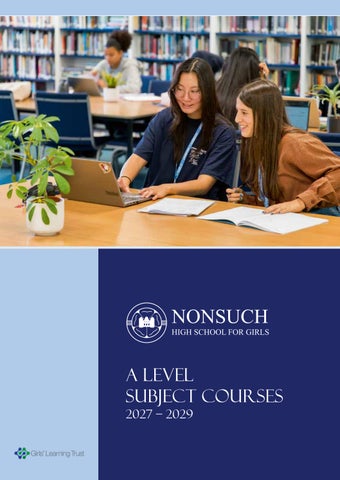
A LEVEL SUBJECT COURSES 2027 – 2029
Contents 01
Art & Design (Fine Art)
02
Biology
03
Chemistry
04
Classical Civilisation
05
Computer Science
06
Drama and Theatre Studies
07
Design & Technology: Product Design
08
Economics
09
English Literature
10
French
11
Geography
12
German
13
Government and Politics
14
History
15
Mathematics
16
Further Mathematics
17
Music
18
Philosophy & Ethics
19
Physical Education
20
Physics
21
Psychology
22
Spanish
*Please note that if there is insufficient demand then an A Level subject may not run or may be run across more than one school in the Trust.
Mrs Williamson – Headteacher Ewell Road, Cheam, Surrey SM3 8AB T: 020 8394 3400 E: office@nonsuchschool.org www.nonsuchschool.org
Exam Board AQA
Art & Design (Fine Art) Why study Fine Art?
Where could it lead?
Art is everywhere. We live in a predominantly and everincreasing visual society where visual communication and understanding is vital. Employers increasingly seek those who can exercise initiative, adaptability, independent judgement and creative problem solving which are the attributes that art and design students have in abundance. The UK produces extremely talented artists and designers who work in world-leading industries. The study of Art & Design will develop your creativity, visual learning, motor skills, decision making, perseverance, focus, collaboration, accountability, improve confidence and has been scientifically proven to improve academic performance. It’s not just drawing and painting!
Students usually progress to degree courses in Art & Design through application to a Foundation course. This in turn gives students a broader understanding of the wide variety of specialisms available at degree level. The choice of further study is extraordinary with new courses emerging year-on-year with the advance of creative technologies. Career paths include: creative technologies, fashion, interior design, web and digital design, textile design and manufacture, graphic communication, animation, conservation and restoration, history of art, curation and education, film and television, product design, photography, 3D design, advertising, marketing, journalism, set design, stylist, special effects, industrial design…the list goes on!
What can I expect? We follow the AQA Fine Art endorsement (full linear course). Two components of work are created over the two year course; the Personal Investigation and Portfolio (September in Year 12 to January in Year 13) and the Externally Set Assignment in Year 13 (February to May) culminating in a 15 hour practical exam. We work in a self-directed route, engaging in personal lines of visual enquiry and developing individual technical skills to expand your creativity and imagination and develop a personal style. You will explore the use of drawing for different purposes, using a variety of methods and media on a variety of scales. You will use sketchbooks/journals to underpin your work where appropriate to accompany each component and you will be aware of the importance of process as well as product. You will develop an understanding and appreciation of aspects of the history of Art and Design and this should lead, inspire and enhance your own work. You will explore relevant images, artefacts and resources relating to a range of art, craft and design, from the past and from recent times.
Case Study: Joanne, Year 13 Why I chose Fine Art… “I chose fine art as an A level because I have always liked expressing myself through visual arts and I wanted an opportunity to practice new skills/ techniques and explore new media and themes.”
What I like best about the course… “What I like best about the course is the freedom to choose my own themes and creative decisions, as well as being encouraged to explore a range of different styles and artists I would not have discovered otherwise.”
Where I hope it will take me… “I am hoping to build up a portfolio to go on to do an art foundation year course before going on to do a design or illustration course at university, and to hopefully pursue a career in art/design.”
With the removal of exams at the end of Year 12, this will give us more time for practical studio work and critical and contextual research, gallery visits and workshops to explore a range of materials and processes.
01
Exam Board OCR A
Biology Why study Biology? Biology is a vast and varied subject which includes the study of living things; from minuscule microorganisms right the way up to human beings. The course aims to develop your interest and enthusiasm for Biology and prepare you for further study or careers in the biosciences. In addition, we want to develop your understanding of how different areas of Biology relate to each other and how to apply your understanding of biological topics to unfamiliar situations. Biology encourages students to appreciate how society makes decisions about scientific issues and how Biology contributes to the success of society and the economy. In this course you will also develop and demonstrate a deeper appreciation of the skills, knowledge and understanding of How Science Works.
What can I expect? We follow the OCR Biology course; this is a linear course, with assessment being three terminal exams at the end of two years. We study the following topics: • Development of practical skills • Foundations in Biology • Exchange and Transport • Biodiversity, evolution and disease • Communication, homeostasis and energy • Genetics, evolution and ecosystems All A Level students are encouraged to participate in extra-curricular activities such as our dissection elective, the Biology Olympiad and the medical society. There is also an opportunity for students to enter the Homerton College Cambridge Biology Challenge.
Where could it lead? There are many options available for further study at university. These include medicine, dentistry, veterinary science, biochemistry, biological sciences, microbiology, psychology, nursing, pharmacology, physiotherapy, environmental science amongst many more options.
02
views of formeR students Why I chose Biology… “I chose Biology because it was one of my favourite subjects at GCSE. I really enjoy the practical nature of Biology – the processes that you study are happening inside and around us all of the time and I wanted to develop my understanding of this. Biology also covers a wide range of topics, with applications in many careers. The support and resources provided by the biology department drew me to the subject as well.”
What I like best about the course… “I really enjoy human Biology and learning about organs and tissues. We had the opportunity to look at a dissected heart and lungs which was one of my favourite lessons. I also enjoy the way Biology focuses on the practical application of GCSE chemistry and physics too which has improved my lateral thinking skills. The experiments involved in the biology course makes lessons fun and interesting.”
Where I hope it will take me… “As a prospective medical student, Biology A Level has provided a firm foundation for my future. The topics studied at A Level will provide a solid basis for studying many STEM degrees. However Biology is not just an A Level for future medics. Many students in my class plan on studying a variety of different courses, including humanities degrees. The research skills taught as part of the course are essential for any degree or job, whilst the ability to understand and use specific terminology has use in many types of degree.”
Exam Board OCR A
Chemistry Why study Chemistry? Completing an A Level in Chemistry can open so many doors for you in the future. It is a challenging, academic and rigorous A Level that will impress a lot of universities and future employers. Studying A Level Chemistry can lead to many careers in healthcare such as medicine, pharmacy and dentistry but is also extremely useful in careers in the biological sciences, veterinary science, physics, mathematics, pharmacology and analytical chemistry. Did you know that chemists are also involved in many other areas, such as Law, Art Restoration, Forensic Science, Sport & Fitness Training, Conservation, Photography and the formulation of cosmetics and perfumes?
What can I expect? We follow the OCR Chemistry A, a fully linear course, with assessment being on terminal exams at the end of two years. We study the following topics: • Development of practical skills • Foundations in Chemistry • Periodic Table and energy • Core Organic Chemistry • Physical chemistry and transition elements • Organic chemistry and analysis With the removal of exams at the end of Year 12, this will give us time to consolidate material on to university level and provide opportunities to make exceptional progress. All A Level students are encouraged to participate in both the Chemistry Olympiad and the Cambridge Chemistry Challenge. We run a ‘Stretch and Challenge’ Club for students to pursue their studies to the highest level.
Where could it lead?
Case Study: Uthra, Year 13 Why I chose Chemistry… “One of the reasons why I wanted to take Chemistry is due to its versatility as a subject, and taking Chemistry has given me a lot of liberty in deciding what course I would like to do in university. Another reason I chose chemistry is because I had gained an appreciation for identifying compounds through analytical techniques and calculations, which both A-level and GCSE Chemistry had allowed me to experience. Additionally, A-level Chemistry has given me a lot of insight into the industrial processes which we (we as a society) heavily rely on, connecting those industrial processes to energy consumption as well as the feasibility and sustainability of them.”
What I like best about the course… “I very much enjoyed learning about the organic reaction pathways of compounds as well as how to identify them. I admired the problem-solving aspect of them alongside with the foundation of chemical calculations it contains. These topics have showed me the real-life impact maths has had on chemistry, with techniques such as rate equations and exponential decay models being used for food expiration date testing, to nuclear medicine and more.”
Where I hope it will take me… “I would like to study pharmacy in university to deepen my current understanding of molecular structures and bonding onto real life applications in terms of formulation and drug design, as well as prescribing to patients, allowing me to make a connection between chemical science to health. I am especially excited to learn about drug formulations and drug designs within the process of industrial drug manufacturing.”in many types of degree.”
The choice of further study is vast, e.g. medicine, dentistry, veterinary science, biochemistry, pharmacology, biological sciences, microbiology, psychology, nursing, physiotherapy, speech therapy, forensic science and many more. Chemistry degrees are well respected for general graduate careers and PhD studies.
03
Exam Board OCR
Classical Civilisation Why study Classical Civilisation?
Where could it lead?
Classical Civilisation focuses on the ancient civilisations of Greece, Rome and beyond, taking in a wide range of literature, art and architecture, philosophical thought and historical context. You don’t need to know any languages because all texts are in translation. All you need is an interest in the Classical World along with pleasure in reading literature and philosophy and studying material culture.
Classical Civilisation A Level supports university studies across the Humanities: Modern and Ancient Languages, History, Archaeology, Philosophy, English, Law and Politics. Indeed, any degree subject requiring rigorous research and essay-writing will benefit from Classical Civilisation skills. It encourages close examination of textual and material sources and sophisticated critical expression. Such transferable skills are highly sought-after job sectors from business consultancy to media production.
What can I expect? In Year 12, students begin by combining the compulsory component 11, ‘The World of the Hero’ with component 21 ‘Greek Theatre’. We focus on Homer’s epic poem set during the Trojan War, The Iliad (and parts of The Odyssey, which follows Troy’s fall). In parallel we also study the tragic dramas Sophocles’ Oedipus and Euripides’ Bacchae, as well as Aristophanes’ comedy Frogs. All (apart from Frogs) are set in the heroic period of Greek Myth and show how the human condition was felt to be subject to the will of the Olympian gods. Frogs depicts a parody of heroic journeys to the Underworld but firmly set in the contemporary Athens. After the Year 12 exams, we begin the Year 13 programme. We continue with ‘The World of the Hero’ by studying the Roman epic, Virgil’s Aeneid. Set immediately after the fall of Troy, the Trojan prince, Aeneas, goes on adventures that lead to Italy and the founding of Rome. At the same time, we study our final component, 32, ‘Love and Relationships’. We explore literary expressions of love in the lyric poetry of Greek Sappho and the elegiac verse of Roman Ovid. We also interrogate ancient philosophical thoughts on love and desire from Greek Plato and Roman Seneca. Across all our studies, we reflect upon current academic scholarship on the texts and materials prescribed. There are many opportunities beyond study: essay competitions; local lecture visits; museum visits or other trips, including a 2027 trip to Rome.
04
Case Study: Ophelia, Year 12 Why I chose Classical Civilisation… “Despite not knowing anything about Classics before taking this course, it greatly interested me to learn about the foundations of Western Civilisation. I also really enjoyed English Lit at GCSE – but what led me to pick Classical Civilisation was the opportunity to learn about something quite new while still analysing works in different contexts while also looking at some very interesting art and mythology!”
What I like best about the course… “I really like the breadth of the content that we study! The scheme of work includes analysis of poetry and drama, epics, politics, philosophy and artefacts such as vases, which means that there is always enough variation to keep the content interesting. The analytical skills required is a completely different skill set from my other STEM-based A-Levels, which is very refreshing.”
How I think it will benefit me… “In these times being able to evaluate and see things in wider contexts is becoming more and more essential. Studying Classical Civilisation develops strong critical analysis skills, widely valued in any career, along with the ability to discuss different interpretations and ideas with classmates. Independent research is also valued by OCR, which gives me plenty of room to stretch my understanding and observe different opinions and perspectives beyond the classroom. These are all transferable skills useful in all aspects of life beyond A-Levels.”
Exam Board OCR
Computer Science Why study Computer Science?
Where could it lead?
Advances in computing are continually transforming the way we learn, work and live. A Level Computer Science is relevant, valuable and interesting. The course focuses on the knowledge, skills and understanding that students need to progress to higher education or to thrive in an IT environment. One can study Computing and go on to a career in medicine, law, business, politics or any type of engineering or science. A Level Computer Science features as a useful A Level subject in the Russell Group’s ‘Informed Choices’, for many scientific and engineering degrees.
Computer Science can open most doors. The skills you learn demonstrate your ability to think analytically, critically and logically. Careers reach from research and development into new technologies, to data efficiency and environmental improvements. At management level, having the ability to mediate between clients and technical teams is highly desirable.
What can I expect? We follow the OCR Computer Science (H446) fully linear course, with assessment being at the end of two years made up of two exams and a project.
Do I have to have GCSE Computer Science? No, but you should have a grade 7 or above in Maths and must be prepared to learn the basics of GCSE Computer Science over the holidays before the start of term. The summer bridging work provided will be essential to get you off to a solid start otherwise you may struggle to access the higher grades.
The main areas covered are: Computer systems – looking at characteristics of contemporary processors, input, output and storage devices; software and software development; exchanging data between systems; data types, data structures and algorithms and consider legal, moral, cultural and ethical issues. Programming – looking at elements of computational thinking, problem solving, programming constructs, standard algorithms and how to use algorithms to solve problems. While we will learn using C#, the exams do not require the use of any particular programming language, focussing on the understanding of principles instead. The emphasis is on computational thinking. This requires abstraction and decomposition. The study of computation is about what can be computed and how to compute it. Computer Science involves questions that have the potential to change how we view the world. The final project will enable you to develop your interests in the world of Computer Science in any direction you like, while having the opportunity to apply the skills learnt in class and go beyond the curriculum to enhance your skills and understanding. This can be completed using any programming language allowing you to develop and hone skills in most mainstream languages.
Case Study: Darshni & Kruti, Year 13 Why I chose Computer Science… “I chose to study Computer Science at A Level because I’ve always been fascinated by how technology works and how it’s used to solve real-world problems. After really enjoying the subject at GCSE, I wanted to deepen my understanding of programming, algorithms, and the logic that underpins modern computing.”
What I like best about the course… “The best part of the course for me is the direct application of theory – I particularly enjoy the way the curriculum encourages thinking strategically, breaking down large problems into simple, manageable steps. Computer Science also encourages analytical thinking and precision, which are skills that apply far beyond the classroom.”
Where I hope it will take me… “Every major industry, from finance to healthcare, is now underpinned by sophisticated digital systems, and I hope that this will be beneficial in the future. I’m especially interested in how computing is driving innovation in areas like AI, cybersecurity, and data science, and I believe this A Level will give me a strong foundation for future study or a career in technology.”
05
Exam Board AQA
Drama and Theatre Studies Why study Drama? As Shakespeare so eloquently writes, ‘All the world is a stage, and all the men and women merely players.’ Drama and Theatre Studies is an exciting, practical and academic course that allows you to get the key communication skills needed to succeed in life. Through exploration of playwrights, practitioners and genres pupils will work as a production company to produce interesting and innovative interpretations of key plays.
Why I chose Drama…
We follow the AQA Drama fully linear course, with assessment being broken into 3 components:
“I chose to study A Level drama because of my passion for performing as well as the vast range of transferable skills it teaches you. It’s a fantastic opportunity to develop confidence in public speaking and when devising, you build up key teamwork and creative thinking skills which transfer directly into any field of work. Additionally, I am extremely interested in understanding a wide range of people. Through studying, creating and performing a vast selection of characters, I feel better able to empathise with others and use this to inform my performances.”
Component 1: Interpreting Drama: Written Exam:
What I like best about the course…
What can I expect?
• Two set texts which will be practically explored. One text will be pre 20th century and the second text will be post 20th century. The set text questions are open book. • A production explored practically and seen live. Component 2: Creating Original Drama: • This is a devised unit of work in which a completely original piece of theatre is created. This is influenced by one theatre practitioner. • A working notebook will be kept and assessed. Component 3: Making Theatre: • A practical exploration of three chosen plays. The third extract will be performed to an external examiner. You will develop: • The practical skills of voice and body language • Understanding of key theory • Analytical and evaluation skills • Performance and rehearsal techniques • Production elements
Where could it lead? The choice of further study is vast, e.g. medicine, law, teaching, stage craft, production, acting, costume design, sound production – the list is endless.
06
views of formeR students
“My favourite aspect of A Level drama is the freedom we are given to tailor the course to our strengths and interests. When completing the devised and scripted elements, we have the opportunity to make suggestions and choose topics we are interested in to explore. The staff and students are so supportive of each other and never miss an opportunity to encourage each other. Drama is such a wonderful opportunity to continue developing written communication skills while simultaneously developing valuable problem solving and the ability to think outside of the box.”
Where I hope it will take me… “I hope to pursue an English and Theatre degree at university and my A Level Drama lessons have been one of the key elements which has inspired me to apply for this course. Studying a wide variety of plays from a dramatic and creative perspective has enhanced my ability to analyse them in an English setting. I hope to work in the theatre industry as the Drama department at Nonsuch have instilled in me a love for performing and have always supported me in working towards this goal!”
Exam Board AQA
Design & Technology: Product Design
*This is not being offered at Nonsuch but may be able to run cross-Trust if there is sufficient demand.
Why study Product Design?
Where could it lead?
This creative and thought-provoking qualification gives students the practical skills, theoretical knowledge and confidence to succeed in several careers. Especially those in STEM, engineering and creative industries. They will investigate historical, social, cultural, environmental and economic influences on design and technology, whilst enjoying opportunities to put their learning into practice by producing prototypes of their choice. Students will gain a real understanding of what it means to be a designer, alongside the knowledge and skills sought by higher education and employers.
The choice of further study is vast. You could study a BA, BEng or BSc in areas like engineering, architecture, designing and manufacturing, STEM, as well as careers in the creative industries.
What can I expect? We follow the AQA Design and Technology: Product Design course. Areas that will be studied include: • Technical principles • Designing and making principles • Practical application of technical principles, designing and making principles.
Design and Technology compliments other A Level subjects including Maths, Physics, Chemistry, Computer Science and Art. Design and Technology is a great subject to study for jobs that require problem solving and practical skills and demand for people in these work areas is growing. Any career in the creative or scientific industries including; • Design • Architecture
• Engineering • Business
views of formeR students
The assessment criteria are comprised of 50% NEA and 50% written exam (2 papers). Students complete a practical NEA project in which they develop their own design task/ challenge and create a working prototype using materials and technique of their choice. These materials may include; Timber, Plastics, Fabrics, Smart materials, electronics and mechanisms. Techniques and machinery available for students to use include: Hand powered tools, pillar drills, hegner saw, sander, vacuum former, sewing machine, overlocker, CAD/ CAM e.g Laser cutter and 3D printers.
Why I chose Product Design…
Students are encouraged to be open to taking risks, showing innovation and enterprise whilst considering their role as responsible designers and citizens.
What I like best about the course…
“I chose Product Design as I enjoy the creative freedom in these lessons compared to other subjects.” “DT gives you space to put your creative mind into practice. It has helped me to use modelling effectively and design iteratively.” “I enjoyed Product Design at GCSE and wanted to develop my knowledge further. I like the creative aspects that the subject brings.”
“I like the theory best as I enjoyed learning about materials and how products are manufactured.” “I like the NEA side to product design best, as it lets me create my own products.”
Where I hope it will take me… “I am hoping to pursue a career in architectural engineering.” “DT allows me to explore and improve my creative and problem-solving skills which will help me in the future when studying Architecture at university.”
07
Exam Board Edexcel (Pearson)
Economics Why study Economics?
Where could it lead?
Economics is about choice and the impact of our choices on each other. It relates to every aspect of our lives; from the decisions we make as individuals or families to the structures created by governments and firms. The economic way of thinking can help us make better choices.
Most students gain access to university normally taking an Economics or Business-related degree. A number have gone into careers in commerce, banking and financial service industries and working for the Government.
What can I expect? We follow the Edexcel Economics linear course, with assessment being on a terminal exam at the end of two years. We study the following topics: Markets and market behaviour • Economic methodology and the economic problem • Individual economic decision making and why those decisions may not be good ones • Price determination in a competitive market • Production, costs and revenue • Perfect competition, imperfectly competitive markets and monopoly • The labour market including why some jobs earn more than others • The distribution of income and wealth: poverty and inequality • The market mechanism, market failure and government intervention in markets The national and international economy • The measurement of macroeconomic performance • How the macro-economy works: looking at the circular flow of income • Economic performance in terms of unemployment, growth and inflation • Financial markets and the link with the Bank of England and monetary policy • Fiscal policy and supply-side policies, and how they can be used to manage the economy • The international economy, including trade, tariffs and the global economy.
08
views of formeR students Why I chose Economics… “Read any newspaper and you will have no shortage of economic issues and questions, that’s why I wanted to study Economics.”
What I like best about the course… “Economics is the only social science awarded the Nobel Prize. Economics is a rich intellectual tradition, and the economic way of thinking gives you a distinct voice in the choices faced by society.”
Where I hope it will take me… “As well as Economics I study Computer Science and Mathematics. At university I want to read Economics.”
Exam Board AQA
English Literature Why study English Literature? English Literature is a gift for the rest of your life. The texts you study and characters you meet stay with you, even change you. Like GCSE, it invites you into the mind of the writer by discussing and interpreting why words or phrases are used and developed and how texts are shaped by their contexts. Unlike GCSE, the focus is more on argument and interpretation and so almost all exams are open book. An A Level in English Literature sharpens your skills to construct and develop precise and persuasive arguments within a well-built and cogent essay and within your life.
It is an excellent foundation subject for a variety of degrees including Law, History, History of Art, Philosophy and Theatre Studies. English is a particularly popular degree for those intending to work in publishing, journalism, television, advertising or teaching, or those who intend to take a Law conversion course after their first degree. Effectively, it is an excellent preparation for the high-level communication skills that all school leavers need to succeed in the 21st century.
Case Study Sophie, Year 13
What can I expect?
Why I chose English Literature…
We follow the AQA English Literature Specification A fully linear course, with there being a terminal exam at the end of two years. The following units will be completed:
“Reading and writing have always been integral to me as a person, so choosing English at A-level was a natural decision. One of my favourite novels, George Eliot’s Middlemarch, describes language as ‘a finer medium’ of art. This captures something I have always found compelling about English Literature: the extraordinary possibilities of language itself. The course has allowed me to explore this fascination while developing the critical skills I hope to carry into further study and, ultimately, my own writing.”
Paper One – Love Through the Ages • Section A – Shakespeare: one passage-based question with linked essay • Section B – Unseen poetry: compulsory essay comparing two unseen poems • Section C – Comparing texts: one question linking two set texts (one of which must be pre-1900) – clean copies of texts can be taken into the examination Paper Two – Texts in Shared Times Option 2B Modern Times: Literature from 1945 to Present Day • Section A – Set text: one essay question on set text • Section B – Contextual linking: one question on unseen extract, one question linking the remaining set texts Non-Exam Assessment – Independent Critical Study: Texts Across Time • Coursework essay of 2500 words comparing two texts of your choice (one must be pre-1900)
Where could it lead? The study of English Literature at A Level will equip you with a wide range of skills that can be applied to all disciplines and occupations later on. It is very highly regarded by universities and employers because of the rigour and complexity of the skills and knowledge that the subject demands.
What I like best about the course… “I particularly enjoy the freedom to write experimentally at A-level, a freedom inspired and fuelled by the enthusiasm of my teachers. Even when studying canonical literature, such as pre-1900s love poetry, there is always a sense that meaning is flexible and that an initial understanding of a text can transform within the span of a lesson. Most of all, I love how English at A-level has allowed me to connect and talk passionately with like-minded students, teaching me that I have much more to say than I once thought!.”
Where I hope it will take me… “It won’t come as a surprise to many that I intend to study English Literature at university. However, taking English at A-level has helped me beyond preparing for a degree in the subject: being President of Literature Society, participating in daily classroom discussions, and engaging in wider reading have made me a more independent and articulate student. English Literature lends itself naturally to philosophy, politics and social anthropology – interests I may never have explored so closely without the opportunity to study English at A-level.”
09
Exam Board Pearson
French Why study French? By studying A Level French you will develop a lasting appreciation of the French language, the ability to comprehend the language in a wide range of contexts, the ability to communicate readily in French for a variety of purposes, useful knowledge of and insights into the culture of France and the Frenchspeaking world and valuable skills for foreign travel, further education and employment. Over 220 million people around the world speak French. French is the official language in 29 countries which puts it in second place behind English.
Why I chose French… “Having done French and Latin at GCSE, I wanted to continue the process of language learning through sixth form and gain the ability to converse with native speakers.”
What I like best about the course… “I enjoy learning about French society and current affairs through debates and discussions with my classmates in French.”
What can I expect?
Where I hope it will take me…
We follow the Pearson French course, with assessment being on a terminal exam at the end of two years. We study the following topics:
“I hope to complete a degree with minor in French to achieve near fluency and make me a stand out applicant during future job opportunities.”
• The evolution of French society • Culture in the French-speaking world • Immigration and the French multicultural society • The National Front • The Second World War • Film: Les Choristes • Text: Un Sac De Billes All A Level students, in addition to normal lessons, will also have the chance to have individual lessons with our French assistant.
Where could it lead? The course will give you a good foundation for further study in higher education. French is in demand in a wide variety of professions including banking, international trade and commerce, import and export, tourism, foreign office, diplomatic corps, teaching, translating, interpreting and many more.
10
Case Study: Lily, Year 13
Exam Board AQA
Geography Why study Geography? Geography is a dynamic and highly relevant subject. Geography is appearing daily on our news screens, with links to the impacts of climate change, how we should reduce our carbon emissions, how to best tackle plastic pollution, managing migration, dealing with global pandemics, how to manage and response to natural disasters, seemingly increasing extreme weather events, sustainability, trade and the economy, geopolitics and geopolitical relationships – learning about Geography has never been more important!
What can I expect? AQA Geography is a fully linear course, with two exam papers sat at the end of Year 13 and a non-examined assessment. We study the following topics: Paper 1: Physical: (40%) • Water and Carbon Cycle • Coastal Systems and Landscapes • Hazards Paper 2: Human: (40%) • Contemporary Urban Environments • Changing Places • Global Systems and Global Governance NEA – Non-Examined Assessment (20%) • Students complete an individual independent fieldwork investigation based on a question or issue relating to any part of the specification content that they are interested in. • They must collect primary data as part of this investigation, so students have to complete 4 days of fieldwork as part of the course.
Case Study: Erin, Year 13 Why I chose Geography… “I chose to do Geography A Level not only because of how much I enjoyed it at GCSE, but also due to how much variety there is in the subject. Geography offers a mixture of humanities and science that is not greatly available in other subjects, which is a unique positive about studying it. Geography is also incredibly relevant and has helped expand not just my academic knowledge but also my general worldview. What appealed to me was that knowledge from outside of school could be brought into the subject. The department is also incredibly organised and helpful which I have found beneficial for my GCSE and beginning of A Level studies.”
Case Study: Zarah, Year 13 Why I chose Geography… “I chose A Level Geography because I loved studying it at GCSE and found the case studies and fieldwork investigation very interesting. I was intrigued by the A level course and how we do a broad range of topics that cover all social, economic, environmental and political aspects of Geography as a whole. The NEA also really stood out to me as I enjoyed the investigations we did at GCSE, and now we had more free range to choose what topic we do our NEA on. My Geography lessons along with so many resources for wider reading integrate with my other subjects well and have helped develop my understanding of how the world works at a greater depth.”
Where could it lead? Students have gone to study Geography at a range of universities – Oxford, Cambridge, Durham and Southampton to name a few, with courses focusing just on human Geography (BA) or physical Geography (BSc) as well environmental science, oceanography, international development and geopolitics. Geography graduates can progress on to a wide range of careers, including finance, commerce and business, local and national government, international relations and development, urban planning, teaching, meteorology, conservation, flooding, renewable energy and journalism!
11
Exam Board Pearson
German Why study German? By studying A Level German you will develop a lasting appreciation of the German language, the ability to understand and communicate in German and useful knowledge of and insights into the culture of Germany and the German-speaking world. Germany today is the political, economic, artistic and intellectual powerhouse of Europe and the European Union. Knowledge of the mother tongue of over 100 million people, (German has the largest number of native speakers in the European Union, more than English, Spanish or French) has never been more important for governments, businesses and private citizens, and students of German are therefore consistently amongst the most sought-after graduates for major employers.
What can I expect? We follow the Pearson German course, with assessment being on a terminal exam at the end of two years. We study the following topics: • The evolution of German society • Culture in the German-speaking world • Immigration and the German multi-cultural society • East-German society pre-unification • The Reunification of Germany • Text: Das Leben der Anderen • Film: Andorra by Max Frisch All A Level students are encouraged to take part in a trip to Cologne. In addition to normal lessons, you will also have individual lessons with our German assistant.
Where could it lead? The course will give you a good foundation for further study in higher education. German is recognised by universities as a facilitating subject and is in demand in a wide variety of professions including banking, import and export, foreign office, diplomatic corps, international trade and commerce, law, tourism, teaching, translating, interpreting and many more.
12
Case Study: Mischa, Year 13 Why I chose German… “As someone who has studied the subject since Year 8, hearing the sixth formers speak German with such complexity always impressed me. I didn’t always consider taking it for A-Level, but I was always intrigued by the notion of taking my language skills just that one step higher, and I loved studying German at GCSE, both the language but also learning about a new culture. Speaking and understanding German, and being able to hold a conversation in a completely foreign language, is a skill I knew I would always value.”
What I like best about the course… “To me, German feels like an opportunity to study many subjects in another language. I loved GCSE history, but didn’t take it further, so studying the Cold War history of Germany really fascinates me, and we always have such lively debates and discussions, and within a smaller class, I always feel as though I can speak with confidence and that my opinion is heard. We also study a play and a film, and this, alongside the other topics, gives such an insight into German culture both now and historically.”
Where I hope it will take me… “Having a foreign language under your belt will make an incredibly valuable addition to your CV when entering the world of work, and will also open up so many conversations with so many new people when travelling the world!”
Exam Board Edexcel
Government and Politics Why study Government and Politics? The world is in a state of turmoil. Megalomaniacs and egotistic have seized power and are set about dismantling everything we have always thought sacred. Young women of Nonsuch, it’s time to take back control, it’s time to make politics great again! Study politics, find out about the systems and the people that govern us, evaluate the ideologies available and then determine to set the future course of British political history yourself.
What can I expect? In Year 12 you will study British Politics, examining the systems of government, the people in power, and the nature of democracy that exists here. In Year 13 you will focus on American Politics and examine the controversies and debates that surround their political system. Over both years you will study the major political ideologies that exist, conservatism, liberalism and socialism as well as a specific focus on feminism.
Case Study: Gunjan, Year 13 Why I chose Politics… “Politics has always fascinated me because it shapes so much of our daily lives. Studying it at A Level has changed how I see the world. I now keep up with the news and analyse events instead of taking them at face value. For example, I’ve learned how charismatic leadership can influence election outcomes, and why populist parties such as Reform have built such a large following.”
What I like best about the course… “My favourite part of Politics A Level is the discussion and debates within lesson. Although my class typically agree with each other, discussing our opinions and occasionally having that debate when we do disagree is enjoyable as it forces me to consider other perspectives and challenge them. This forces me to thoroughly understand what I am talking about and have the evidence to prove it, helping me build more nuanced arguments and aiding my analysis of topics in general. Every lesson teaches me about ideas that I might have never otherwise considered, keeping the subject interesting and aiding my confidence while speaking.”
Where could it lead?
Where I hope it will take me…
Politics doesn’t close doors, nor does it mean you are destined for a career as a politician. Employers respect the academic nature of politics as an A Level or degree level subject as it identifies strong minded, culturally aware and analytically minded individuals. Russell Group universities want more than just grades. They want to find students who are aware of the world, who have opinions and can discuss the matters of the day and nothing will better prepare you for an interview at a Russell Group university than a good understanding of politics.
“I am hoping to study Politics and International Relations at university and studying politics now was a huge motivating factor as I wasn’t largely considering it before. The research required, essay writing and critical thinking skills that I have developed through this a-level has massively prepared me for this. Politics has shaped me into a more curious and open-minded individual and I aim to carry that into my studies at university next. It has been a great experience, and I’ve never felt like going to lesson was a chore as I truly find everything within the subject extremely intriguing.”
In the longer-term politics can open up many employment opportunities. However, a large number of politics students have gone to work as journalists, bankers, public relations officers, civil servants and in a wide range of roles for multinational organisation and charities.
13
Exam Board OCR
History Why study History? History is about people. It is the study of the past through compelling stories that tell us about the ideas and events that have been and are destined to be repeated. It will sharpen your ability to think critically, to consider options and make judgements that are based on facts and not opinion. Moreover, history opens doors to future employment. It doesn’t shoehorn you down one career path at the end of A Level but instead opens up a multitude of possibilities to be explored.
What can I expect? We follow the OCR History course, with assessment being based on three exams at the end of year 13. We study the following topics: • Britain 1930-1997: In this unit we look at the political, social and economic history of Britain in the twentieth century. Students will study the life of Winston Churchill in detail, particularly focusing on his actions as Prime Minister during WW2. • Democracy and Dictatorship in Germany, 1918-1963: In this unit students will learn about the creation and subsequent collapse of democracy in Germany in the years immediately following WW1. The course will then chart the rise of the Nazi Party until their demise at the end of WW2. Finally, the course will examine the reintroduction of democracy following the war. • The Tudors 1485-1603: In this unit students will examine the reign of England’s most famous royal dynasty. Our course will consider how they seize the throne in battle and plot the seismic religious, economic and cultural changes that occurred during their reign, whilst examining the continuous threats to their throne from both home and abroad. • Coursework: Students will be allowed to pursue a coursework option of their choosing.
Where could it lead? History doesn’t close doors. Employers respect the academic and critical nature of a history degree and historians can enter virtually any employment that they choose, from lawyers, bankers and civil servants to accountants, investors and politicians. Studying History at A Level and beyond provides you the opportunity to enter virtually any career and gives you the option and time to make an informed choice as to what that career will be.
14
Case Study: Emma, Year 13 Why I chose History… “I chose History as it allowed me to learn how past events have shaped the world today. I have been able to strengthen my own debate skills when considering a wide range of interpretations on crucial moments in history. In lessons we use a variety of media to develop a broad understanding of the topics we study, allowing me to appreciate what we learn.”
What I like best about the course… “Studying History has given me the opportunity to become more independent in my studies and carry out my own research to broaden my understanding of time. In my coursework, I was able to develop my understanding about the impact of the Siege of Leningrad on German defeat, whilst researching a variety of historians and primary sources. This has given me a wider understanding of how different events in history can be perceived. It has also been fascinating to learn more about periods of history which relate to today’s society such as Britain 1930-1997.”
Where I hope it will take me… “I want to read Law at university and through studying History, I have learnt to be both critical and analytical of sources, which will be a good foundation for my ambition. I’ve also been challenged to read widely and consider a variety of historical interpretations which has enabled me to gain evaluative skills.”
Exam Board Edexcel (Pearson)
Mathematics Why study Mathematics? Mathematics is a rigorous and challenging subject to choose at A Level and is a strong addition to any university or job application. Over the duration of the two-year course, you will encounter familiar topics from GCSE that are extended naturally as well as brand new topics such as calculus and logarithms that are crucial to the study of advanced mathematics. The qualities of a successful A Level Maths student are an inquisitiveness to learn in more depth about the subject as well as the drive to challenge themselves to develop a higher level of problem-solving ability that is required at this level.
What can I expect? We follow the Edexcel specification. There are three terminal examinations at the end of Year 13. Two of them are based around Pure Mathematics with the third examination being a combined Mechanics and Statistics course. Some of the topics over the course of the two years will include: • Calculus – Differentiation and Integration • Logarithms • Vectors • Trigonometry • The Laws of Motion • The Normal Distribution
Case Study: Arlene & Emma, year 13 Why I chose Mathematics… Arlene: “I chose Maths because I always enjoyed the problem-solving process at GCSE. GCSE Further Maths gave me an insight into what A-Level Maths would be like. The opportunity to gain a deeper understanding and to take part in more complex problem-solving drew me to taking it for A-Level.” Emma: “I see maths as a universal tool that plays an important role in understanding the world and supporting learning across many subjects.”
What I like best about the course… Arlene: “My favourite thing about A-Level Maths is that it shows me the importance of maths. I got to learn more about how maths is used to model real life, for example, learning about differentiation and optimisation showed me the application of maths in product design. Several mathematical concepts are also transferable between my other subjects (Biology and Chemistry) and strengthen my understanding of them. As a result, Maths has broadened my worldview. I now see how central it is to everything that exists and the foundation it can provide in other topics.”
Students will require a new calculator for this course. The recommended model is the Casio Classwiz fx-991 CW+ UK which is available at many online retailers.
Emma: “I enjoy exploring the challenge and depth of algebra and calculus, particularly its connections to other areas of mathematics and its applications in modelling real-world situations.”
Where could it lead?
Where I hope it will take me…
A Level Mathematics forms a pivotal part of an application for many different university courses. Whilst an obvious requirement for admission to Mathematics degree programmes, a Mathematics A Level also forms a critical part for admissions to degree courses such as Engineering, Physics and Economics.
Arlene: “I hope that the logical, precise thinking that Maths fostered in me will benefit my future studies and continue to offer me different perspectives on the world.” Emma: “I plan to study Biomedical Sciences and, through wider reading, I have become fascinated by how mathematics can be used to analyse data and improve our understanding of disease spread and containment through SIR models.”
15
Exam Board Edexcel (Pearson)
Further Mathematics Why study Further Mathematics? Further Mathematics is a separate qualification to Mathematics A Level and involves studying other areas of mathematics that are more challenging than the normal Maths A Level. This qualification is designed for students for whom mathematics is unquestionably one of their favourite subjects and a subject for which students have a high level of natural ability at and a consistent track record of high performance throughout their school life.
What can I expect? We follow the Edexcel specification. There are four terminal examinations at the end of Year 13. Two of the papers will be in Further Pure Mathematics, one will be in Further Statistics and one will be in Further Mechanics. Some of the topics covered include: • Complex Numbers • Matrices • Hyperbolic Functions • Trigonometry • Central Limit Theorem • The Normal Distribution • Momentum and Impulse Further Mathematics requires a substantial amount of independent study that should not be underestimated by potential students. A new calculator will be required for this course. The recommended model is the Casio ClassWiz fx991CW, which is available from a range of online retailers. Some students may prefer to use the Casio fx-CG100 graphing calculator, which offers additional graphical functionality to support their studies.
Where could it lead? A Level Further Mathematics forms a pivotal part of an application for many different university courses. Further Maths is a requirement for Mathematics degree courses at some leading universities. It is also a highly prized qualification for degree courses such as Engineering, Physics and Mathematics.
16
Case Study: Aarna & Shalini, year 13 Why I chose Further Mathematics… Aarna: “I chose Further Maths because I’ve always enjoyed maths and wanted to challenge myself further. As someone who has not always been certain about what I wanted to pursue in the future, I also thought that Further maths would open a wide range of opportunities and keep my options open.” Shalini: “I enjoyed maths at GCSE and was keen to continue pursuing the subjects at a more advanced and in-depth level.”
What I like best about the course… Aarna: “I particularly enjoy the fast pace of the course as it suits the way I learn and allows me to explore more challenging concepts. I also like discovering connections between different areas of maths and learning techniques that help us solve problems more efficiently. It is rewarding to see how different ideas can come together to solve seemingly difficult problems.” Shalini: ““I find it incredibly satisfying to solve challenging problems and discover connections between different topics in mathematics and other subject areas. It inspires me to keep exploring and learning more.”
Where I hope it will take me… Aarna: “Further Maths has challenged me academically and helped me become a more resilient and confident problem solver. I hope to study Mathematics and Statistics at university, and I believe the skills and knowledge I am developing through the course will provide an excellent foundation for further study and further opportunities.” Shalini: “The skills and resilience that I have learnt from Further Mathematics will be useful in the course that I aspire to study.”
Exam Board Edexcel (Pearson)
*This is not being offered at Nonsuch but may be able to run cross-Trust if there is sufficient demand.
Music Why study Music? Music is a challenging subject to study, the value of which is recognised by all highly academic universities, particularly Oxbridge and the Russell Group. It develops a range of cross-curricular skills, including in-depth critical analysis, creativity, dedication and collaboration. Music works well in combination with many different subjects – it is often favoured as a creative option amongst Sciences/Maths, but also compliments other artistic and humanities subjects such as English, History, Languages etc.
What can I expect? We follow the Edexcel Music A Level course, with final assessment occurring at the end of the two-year period. The course consists of: • Performing – solo skills (Assessment Objective 1) • Composing – composing music and learning about harmony (Assessment Objective 2) • Appraising – developing aural and analytical skills through the study of 13 set works (Assessment Objective 3 & 4)
Case Study: Hannah, year 13 Why I chose Music… “I wanted to view music as more than a hobby and to able to understand music in an academic way, whilst using this knowledge to work on my performing and composing skills.”
What I liked best about the course… “The subject leaves space for our creativity in composition and performance, but also develops our analytical skills, providing balance in our learning. I also get to meet like-minded musicians through the course and have opportunities to perform and compose with them.”
Where I hope it will take me… “As I hope to study Music in university, and possibly with music as a career, the Music A Level course has definitely helped me to strengthen my knowledge and built skills for my preparation for my future in music.”
All components are externally assessed. It is a requirement that all A Level students participate in the school’s extensive extra-curricular music schedule and undertake peripatetic instrumental lessons outside of the school classroom in their firststudy instrument. Students must also have grade 7 or above in GCSE/ IGCSE Music and at least Grade 6 in their first-study instrument. It is preferential for students to have also achieved their Grade 5 Theory exam.
Where could it lead? Of students graduating with a Music degree, 50% go on to careers in completely unrelated fields: science, IT, welfare, business, administration or public service; 25% become teaching or education professionals, and 25% find employment in artistic, literary and media occupations.
17
Exam Board OCR
Philosophy & Ethics (Religious Studies) Why study Philosophy & Ethics? It is fascinating and enlightening! Not only will you develop a deeper knowledge and understanding of a key world faith, philosophy and ethics but you will also gain many valuable transferable skills along the way. It gives the opportunity to explore some of the biggest issues that have ever challenged humanity in the search for truth, justice and meaning. The course is excellent for developing clear, concise, thinking skills with incisive analysis and evaluation. In the world of work, employers look for someone with an enquiring mind, an appreciation of different viewpoints and an ability to come to clear, balanced decisions. These skills are emphasised and developed throughout the course.
What can I expect? We follow the OCR fully linear course, with assessment being on a terminal exam at the end of two years. We study three broad areas: Philosophy – a variety of fascinating topics, including the nature of the mind, body and soul, the thinking of ancient Greek philosophers, arguments for and against the existence of God, and whether we can truly claim to know anything. Ethics – Ethical arguments about different ways to know if actions are right or wrong, such as Natural Moral Law, Situation Ethics and the ideas of Kant. You will also apply ethical theories to real world issues such as euthanasia. Developments in Christian Thought – topics including the self, human nature, death and the afterlife, gender and sexuality and expressions of religious identity. It is a very thought-provoking subject with excellent opportunities for debate.
Where could it lead? Philosophy & Ethics is a valuable entry qualification to higher education opportunities. All universities regard Philosophy & Ethics as an academic subject and accept and welcome students with this qualification onto a variety of courses. A qualification in Philosophy & Ethics is considered an asset in many careers particularly those involving working with people e.g. journalism, politics, law, teaching, medicine and publishing.
18
Case Study: Ava, Year 13 Why I chose Philosophy & Ethics… “The main factor influencing me to choose Philosophy and Ethics was my love for the GCSE and the way of teaching here at Nonsuch. You are able to speak your mind in class, and have high-level seminar-style discussions with your peers evaluating both your and their ideas. Philosophy and Ethics forces you to construct a rigorous line of argument in which you debate abstract ethical dilemmas and at A Level, it moves beyond surface-level answers and requires you to deconstruct complex moral frameworks, which is a common theme across all my A Levels, thus by practicing an RS essay, I’m effectively honing skills needed across all my subjects. For me, choosing it was an obvious choice as Philosophy of Religion was by far my favourite topic in GCSE, and the A Level takes that content so much further.”
What I like best about the course… “The teachers! The RS/Philosophy department are some of the most supportive teachers here at Nonsuch, who will always be up for marking an extra essay or two when you need it. They make the lessons fly by and teach it in a way that it’s so engaging and feels more like an active conversation than a traditional lecture. We frequently take part in group debates, which are always fun, as in a lively class like ours it tends to get quite heated! The content we study is incredibly relevant for everyday life, making it easy to draw upon knowledge gained from external sources (like social media). Overall, there is no doubt that in terms of the teaching style RS is my favourite and most fun A Level.”
Where I hope it will take me… “Taking RS was an atypical choice for me as I’d like to study Clinical Psychology at university. Throughout the course of my studies I’ve found my A Levels (Psychology, RS & English Literature) are far more interlinked than I thought. For example, studying Freud’s ideas on women is a common theme across all three essays, making the skills I’ve developed, such as effectively communicating a thesis. Ultimately, I hope it takes me toward postgraduate clinical training, where I can combine empirical psychological science with a nuanced, human-centred understanding of personal values and ethics.”
Exam Board AQA
Physical Education Why study PE?
Where could it lead?
The A Level PE course is very broad; it covers topics such as anatomy and physiology, as well as sports psychology and sports technology. Students who study A Level PE find it to be an interesting and engaging course providing insight and information about both past and modern-day sporting issues/ ideas around elite sport performance as well as many physiological and psychological concepts. The course lends itself well to careers in medical related fields due to the large physiological component, as well as many other diverse careers including sports media, sports coaching and Physical Education teaching.
An advanced level qualification will be useful for students intending to study a sport related course at university. It is also an excellent foundation for students of physiotherapy, medicine, sports science, teaching, coaching, sports development, recreational management and professional sport.
What can I expect? Theory This is a linear A Level with two exams undertaken at the end of Year 13. The theoretical content is worth 70% of your final A Level grade and is comprised of the following topics: Paper 1: Section A: Applied anatomy and physiology Section B: Skill acquisition Section C: Sport and society Paper 2: Section A: Exercise physiology and biomechanics Section B: Sport psychology Section C: Sport and society and technology in sport Non-Examined Assessment (Practical) The practical aspect of the course is assessed internally and then moderated externally. The practical assessment is worth 30% of the total A Level. Students are assessed in one activity in the role of player/ performer or coach. In addition, you will be required to undertake a written or verbal analysis of performance. Learning involves a variety of methods such as practical work, group work and independent study.
Case Study: Meela & Ella, YEAR 13 Why I chose A Level PE… Meela: “I have always enjoyed sport and been interested in how performance can be improved, so after thoroughly looking at the specification I decided to give it a try. I’m really glad that I did, as it has turned out to be one of the subjects I enjoy the most. I like that it goes beyond just playing sport and looks at the science, and wider issues behind performance.” Ella: “I chose to take PE at a level because it was one of my favourite subjects at GCSE and I wanted to further develop my understanding of the science behind sport. Having coached gymnastics for many years, I have always been interested in how the body moves and responds to exercise alongside the psychological factors affecting performance.”
What I like best about the course… Ella: “My favourite thing about the course is the wide range of content that it covers, and seeing how different topics can link together to provide a deeper understanding of the subject. I particularly like how the course combines the theoretical component with practical application, for example in my written coursework, allowing me to analyse and evaluate a performance and relate what I learn in lessons to different sporting activities.”
Where I hope it will take me… Meela: “In the future, I hope to study Physiotherapy at university and eventually work within sport, so PE is particularly relevant to where I want to go next. The course has helped me develop my understanding of areas such as anatomy and physiology, movement and injury, which I think will give me a useful foundation for studying physiotherapy. I’m especially interested in being able to apply this knowledge practically in the future, helping athletes recover from injury and return to sport.”
19
Exam Board OCR (Specification A)
Physics Why study physics? A Level Physics gives you the opportunity to explore the phenomena of the universe and to look at theories that explain what is observed. Being in a highly respected A Level, in physics you will study every part of the universe, from the largest galaxies (and indeed the universe itself), to the very smallest subatomic particle. Studying physics also allows you to examine, and understand more clearly, the concepts that underpin many of the other sciences including chemistry, astronomy and engineering.
What can I expect? We follow the OCR Physics A specification as a linear course which comprises of the following units. • Development of practical skills • Foundations of physics • Forces and Motion • Electrons, waves and photons • Newtonian world and astrophysics • Particles and medical physics With the removal of exams at the end of Year 12, we have taken the opportunity to adapt our teaching orders to make the course of study more dynamic and more appropriate to the level of our students. We have recently renewed and added to our practical facilities and complete practical work as often as possible. Support is offered in lessons and with a weekly physics club. You will also have the opportunity to challenge yourself through our Advanced Maths and Physics Club in which we take both subjects well beyond A Level and explore their intrinsic link. All A Level students are encouraged to participate in the Physics Olympiad. Another main highlight is Cern trip to Geneva, Switzerland – very interesting and informative.
Where could it lead? Physicists are always in demand, one of the most sought-after subject at Universities. The choice of further study is vast, not least the study of theoretical Physics, Medical Physics, Astrophysics, engineering, radiography, technical theatre, architecture, Finance, Maths, economics, PhDs, information technologies and many more.
20
Case Study: Natali, YEAR 13 Why I chose Physics… “I chose Physics because I thoroughly enjoyed the subject at GCSE and wanted to explore the ideas behind the topics we had only briefly touched on. I am fascinated by how Physics helps explain the world around us, from everyday phenomena to the technologies that shape our lives, and I was eager to deepen my understanding of these concepts.”
What I like best about the course… “One of the best aspects of studying Physics at Nonsuch is the excellent support provided by the department. Teachers offer a wide range of high-quality resources and recommendations for further reading, which have helped me to extend my knowledge beyond the classroom and develop a deeper appreciation of the subject.”
Where I hope it will take me… “I would like to study Engineering at university, and I think the skills I have gained from Physics, particularly in problem-solving and applying maths to real situations, will be very useful.”
Exam Board AQA
Psychology Why study Psychology Psychology is the science of mind, brain and behaviour. It is a subject at the frontier of scientific discovery and, as researchers gradually reveal the secrets of the human brain and how it relates to behaviour, an understanding of psychology has become important across many areas of employment.
What can I expect? We follow the AQA Psychology fully linear course, with assessment being on 3 terminal exams at the end of two years. We study the following topics: Year 12
Year 13
• Social Influence • Attachment • Memory • Psychopathology • Biopsychology • Approaches
• Schizophrenia • Relationships • Aggression • Research methods • Issues and Debates
The exams involve a mixture of multiple-choice questions, short and longer answer questions and questions that require students to apply their knowledge to real life scenarios.
Where could it lead? Universities accept A Level Psychology as an excellent foundation for a wide range of degree courses. It is an asset in the health professions, law, teaching, advertising and marketing, human resources, general management, the police and the media. In recent years around a quarter of students have gone on to Psychology degrees at universities such as Oxford, Kings College London, Nottingham, and Southampton. Others have been accepted onto a range of courses including Law, Medicine, Dentistry, Midwifery, Nursing, Architecture, Mathematics, Criminology, Sociology, English Literature, History and Art Foundation.
Views of former students Why I chose Psychology… “I chose Psychology as it tackled human behaviour through a more scientific lens which greatly interested me – psychology connects so closely with everyday life that I thought it would be valuable to learn more about what motivates us to act the way that we do. I knew it was going to be my most fascinating A Level subject!”
What I like best about the course… “I love that with psychology there is something for everyone: it covers a broad range of subject matters from biological content to real world issues such as aggressive crowd behaviour and eyewitness testimony. It also gives you the opportunity to develop a number of different skills like analytical thinking and debate. Most of all, I enjoy applying what I learn to real life and generally gauging a better understanding of people and my environment.”
Where I hope it will take me… “A Level Psychology has provided me with a foundation to pursue a career in psychiatry. It has a built on my biological understanding of the functioning of the brain by taking mental processes and behaviour into account. Additionally, it is considered a science by many universities and their respective courses, broadening choices into courses such as criminology, neuroscience, law and education. I have developed many key transferable skills such as critical thinking, data analysis, and ethical awareness. These learned abilities will equip students with transferable skills highly valued across a range of sectors. Furthermore, topics and techniques learnt from lessons such as memory can be applied to make daily studies at university more efficient.”
21
Exam Board Pearson
Spanish Why study Spanish? By studying A Level Spanish you will develop a lasting appreciation of the Spanish language, the ability to comprehend the language in a wide range of contexts, the ability to communicate readily in Spanish for a variety of purposes, useful knowledge of and insights into the culture of Spain and the Spanish-speaking world and valuable skills for foreign travel, further education and employment. There are an estimated 437 million native speakers of Spanish in the world, placing it as the second most important language in the world in terms of native speakers.
What can I expect? We follow the Pearson Spanish course, with assessment being on a terminal exam at the end of two years. We study the following topics: • The evolution of Spanish society • Culture in the Spanish-speaking world • Immigration and the multi-cultural society • The Spanish Civil War • Franco’s dictatorship and the transition to democracy • Text: La Casa de Bernarda Alba • Film: Volver All A Level students are encouraged to take part in our Year 10 + 12 trip, which will be to Valencia for the academic year 2025/26. In addition to normal lessons, you will also have the chance to have individual or small group lessons with our Spanish assistant.
Where could it lead? The course will give you a good foundation for further study in higher education. Spanish is in demand in a wide variety of professions including banking, international trade and commerce, import and export, tourism, foreign office, diplomatic corps, teaching, translating, interpreting and many more.
22
Case Study: Elizabeth, Year 13 Why I chose Spanish… “Having enjoyed studying Spanish at GCSE, I was inspired to continue for A Level in order to develop my language and interpersonal skills. I was excited to improve my familiarity in both the Spanish language and culture through the A Level topics, such as Music, Festivals, Traditions, and more.“
What I like best about the course… “The most enjoyable aspect of the course is the visual improvements in the quality of work you produce as a result of the teachers’ enthusiasm to answer every question you have in lessons. There is a constant supply of helpful resources, which makes revising simple and practical, as well as a weekly meeting with a Spanish assistant to enhance your speaking skills. It goes without saying, that the highlight of Spanish A Level is the trip abroad, where you are immersed into the Spanish culture and are able to learn in a fun environment alongside your peers, who are equally as passionate as you.”
Where I hope it will take me… “I hope to study Modern Languages at university, which is entirely possible thanks to my studies in A Level Spanish at Nonsuch. The soft skills that I have developed can be utilised for future employment, including good communication and critical thinking, and the study of language and culture are increasingly valuable within international sectors, expanding the employment fields available to me.”
NOTES
23
NOTES
24
Mrs Williamson – Headteacher Ewell Road, Cheam, Surrey SM3 8AB T: 020 8394 3400 E: office@nonsuchschool.org www.nonsuchschool.org