Published in
2023
May 2023, Volume 175, Pages 132-136; doi: 10.1016/j.urology.2023.01.037
IsoPSA Performance Characteristics are Unaffected by 5-Alpha Reductase Inhibitors or Alpha-Blockers: Results From the IsoPSA Validation Study Jason M Scovell, Mark Stovsky, Alan Partin, Yair Lotan, Jack Baniel, Martin Dineen, Jason Hafron, Kannan Manickam, Marc Pliskin, Matthew Wagner, Aimee Kestranek, Eric A Klein
Objective Methodology
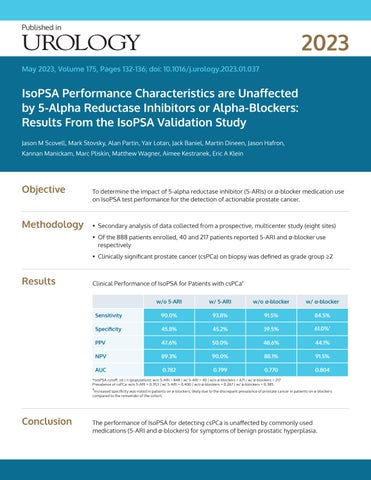
To determine the impact of 5-alpha reductase inhibitor (5-ARIs) or α-blocker medication use on IsoPSA test performance for the detection of actionable prostate cancer.
• Secondary analysis of data collected from a prospective, multicenter study (eight sites) • Of the 888 patients enrolled, 40 and 217 patients reported 5-ARI and α-blocker use respectively • Clinically significant prostate cancer (csPCa) on biopsy was defined as grade group ≥2
Results
Clinical Performance of IsoPSA for Patients with csPCa* w/o 5-ARI
w/ 5-ARI
w/o α-blocker
w/ α-blocker
Sensitivity
90.0%
93.8%
91.5%
84.5%
Specificity
45.8%
45.2%
39.5%
61.0%†
PPV
47.6%
50.0%
48.6%
44.1%
NPV
89.3%
90.0%
88.1%
91.5%
AUC
0.782
0.799
0.770
0.804
*IsoPSA cutoff: ≥6 | n (population): w/o 5-ARI = 848 | w/ 5-ARI = 40 | w/o α-blockers = 671 | w/ α-blockers = 217 Prevalence of csPCa: w/o 5-ARI = 0.353 | w/ 5-ARI = 0.400 | w/o α-blockers = 0.267 | w/ α-blockers = 0.385 †
Increased specificity was noted in patients on α-blockers, likely due to the discrepant prevalence of prostate cancer in patients on α-blockers compared to the remainder of the cohort.
Conclusion
The performance of IsoPSA for detecting csPCa is unaffected by commonly used medications (5-ARI and α-blockers) for symptoms of benign prostatic hyperplasia.
ADDITIONAL PUBLISHED DATA ON ISOPSA IsoPSA MAINTAINS ACCURACY ACROSS A BROAD RANGE OF PSA (4-100 ng/mL)1 • In a clinical utility study, ~25% of patients had total PSA levels of 10 ng/mL or greater. For this group: – IsoPSA demonstrated 92% sensitivity – 48% of patients were negative for csPCa on biopsy
CONSISTENT PERFORMANCE FOR BIOPSY NAÏVE AND REPEAT BIOPSY1 • IsoPSA may have utility in managing patients with persistently elevated and increasing PSA levels over time
IsoPSA ADDS CLARITY TO MRI2 • Negative (PI-RADS 1-2) Help assess the presence or absence of MRI-invisible csPCa • Equivocal (PI-RADS 3) Gain additional insight to triage patients
1. Klein EA, et al. Clinical validation of IsoPSA, a single parameter, structure-focused assay for improved detection of prostate cancer: A prospective, multicenter study. Urol Oncol. 2022 Sep;40(9):408.e9-408.e18. 2. Benidir T, et al. Using IsoPSA With Prostate Imaging Reporting and Data System Score May Help Refine Biopsy Decision Making in Patients With Elevated PSA. Urology. 2023 Jun;176:115-120.
View this and other IsoPSA publications
Learn more about IsoPSA at IsoPSA.com 3615 Superior Ave. Suite 4407C ©2023 Cleveland Diagnostics, IsoPSA and all associated logos are trademarks of Cleveland Diagnostics, Inc. MKTG-VSA006
Cleveland, OH 44114