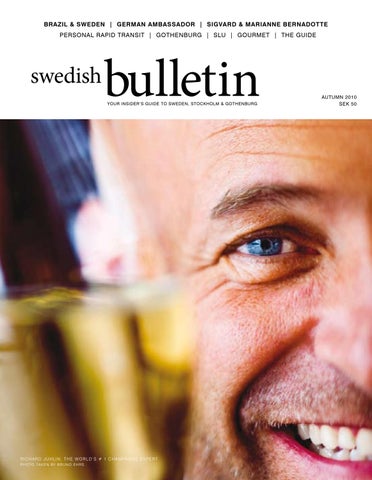
BRAZIL & SWEDEN | GERMAN AMBASSADOR | SIGVARD & MARIANNE BERNADOTTE PERSONAL RAPID TRANSIT | GOTHENBURG | SLU | GOURMET | THE GUIDE
swedish
bulletin YOUR INSIDER’S GUIDE TO SWEDEN, STOCKHOLM & GOTHENBURG
R I C H A R D J U H L I N , T H E W O R L D ’ S # 1 C H A M PA G N E E X P E R T
1
P1H O T O TA K E N BY B R U N O E H R S
AUTUMN 2010 SEK 50
We develop environmental solutions all over the world In the mid-1980s, IVL was approached by the Chinese Embassy in Sweden with a list of environmental problems to be solved. At that time, Tianjin was one of the few open cities in China. In the attempts to attract foreign investors, the city’s substantial environmental challenges proved to be critical obstacles. The reason IVL got the honour to take on this environmental challenge in Tianjin was that Sweden had impressed the Chinese by having instigating environmental authorities, and that IVL was considered to be in the frontline when it comes to applied environmental research. This is still true today. The Tianjin story is a great example of our ability and willingness to take on complex international environmental challenges. What can we do for you?
Tianjin skyline.
Photo: Jonas Röttorp
IVL Swedish Environmental Research Institute is an independent research organisation that has been involved since 1966 in the development of solutions to
22
3
BRAZIL & SWEDEN | GERMAN AMBASSADOR | SIGVARD & MARIANNE BERNADOTTE PERSONAL RAPID TRANSIT | GOTHENBURG | SLU | GOURMET | THE GUIDE
swedish
bulletin YOUR INSIDER’S GUIDE TO SWEDEN, STOCKHOLM & GOTHENBURG
Dear Readers,
AUTUMN 2010 SEK 50
In the afterglow of Crown Princess Victoria’s wedding to Daniel Westling, we feature a story about the 40,000 flowers from Colombia that graced the Swedish royal wedding. Or how Countess Marianne Bernadotte af Wisborg was able to have a famous carpet of iconic status stolen in 1995 rewoven in time for the Royal Wedding of Crown Princess Victoria. The South is always beckoning the enterprising Swedes, either for commerce and profit or for pleasure. This issue features Sweden’s growing partnership with Brazil in the field of ethanol fuel technology. Many Swedes are going to Brazil on vacation and buying property along the northeast coast to enjoy the balmy weather and take advantage of liberal ownership regulations.
5
A U T U M N I 2010 P U B L I S H E D BY SWEDISH BULLETIN HB
RESPONSIBLE PUBLISHER AND CHIEF EDITOR TERESA IVARS LANGUAGE EDITOR FA N G O R N E D I T O R S COVER R I C H A R D J U H L I N C H A M PA G N E C L U B P H O T O TA K E N BY B R U N O E H R S
L AY O U T L LO Y D A X T E N JAMES VARDY
The provinces of Västernorrland and Jämtland are attracting attention internationally for their success in developing the environmental technology sector. Swedish companies are racing ahead in their quest for green technologies. In Uppsala, Sweden, a unique and revolutionary public transportation system known as Personal Rapid Transit (PRT), has been developed by Vectus. Researchers at the Swedish University of Agricultural Sciences are at the cutting edge in several fields and head major EU-financed projects in pursuit of sustainable biological production. Swedes are justly proud of the ultra-modern port of Gothenburg, the largest in Scandinavia, handling one-quarter of Sweden’s foreign trade. But there is more to the vibrant city than shipping and quays. For one, this autumn the Gothenburg Museum of Art presents an exhibition which includes 60 works of Ivarson, painted from 1924 to 1939.
W W W. V I S U A L H E R O. C O. U K
CONTRIBUTORS TO THIS ISSUE LAUREN DYER AMAZEEN BJÖRNSTIERNE ANTONSON D A V I D B A R TA L E L I Z A B E T H D A C E Y- F O N D E L I U S CHRISTINE DEMSTEADER ÖSTEN EKENGREN CHRISTIAN VON ESSEN PER HOLMLUND EVA JONAS SON JOY HUI LIN CHRISTINA LINDEROTH-OLSON MARIA LUNDQVIST JANN MITCHELL E R I C PA G L I A PAT R I C I A B R E N N A N R I C K N E L L MOIRA SULLIVAN FREDRIK WICKLUND
On the diplomatic front, SB interviewed H.E. Antonino Lisboa Mena Gonçalves of Brazil, who shares his experiences with you and Dr Joachim Rücker, Germany’s ambassador to Sweden, who raises the interesting question of the “emotional asymmetry” between Sweden and his country. Readers are encouraged to visit the new Museum of Photography, Fotografiska Museet, which features works by some of world renowned photographers. The observations of our expat writers on life in Sweden often reveal something of interest to readers. Jann Mitchell, one of our regulars, thinks that Swedes are quite superstitious, despite their scientific bent of mind.You go to a birthday party or some other happy event, and when the cake is cut and served, the hostess is careful not to let the slice tip over, otherwise the cakeeater will never marry. Elizabeth Dacey Fondelius in her contribution wonders why Swedes don’t like to disclose their voting preferences.
GERMAN EMBASSY IN STOCKHOLM
ADVERTISING G LO B E I N V E S T M E D I A +46 (0) 18 - 418 60 25 info@globeinvest.se w w w. g l o b e i n v e s t . s e
A D M I N I S T R AT I O N
Tomorrow is a greater day. The Göteborg region is not quite like any other region. To us, the future is far more interesting than the present. Together with a rapidly growing number of companies, Business Region Göteborg combines people, environment and successful business. The way to the future is through sustainable growth. Thousands of companies know the difference it makes. Share the experience with us. www.businessregiongoteborg.com 4
AND SUBSCRIPTIONS LARS EKHOLM +46 (0) 8 - 446 13 13 OR +46 (0) 70 - 235 13 13 PRINTERS PRINT STUDIO OÜ TA L L I N N , E S T O N I A
SWEDISH BULLETIN R Å D M A N S G ATA N 1 8 114 25 STOCKHOLM +46 (0) 8 - 446 13 13 FA X : + 4 6 ( 0 ) 8 - 5 7 0 2 7 4 3 6 info@swedishbulletin.se w w w. s w e d i s h b u l l e t i n . s e © Swedish Bulletin. All rights reserved. No part of this publication may be reproduced or transmitted in any format or by any means, electronic or mechanical, including photocopies, recording or by any information storage and retrieval system, without the prior written permission of the publisher.
Off the beaten track, Joy Hui Lin takes readers to a hunt she attended, albeit as a transporter rather than a shooter. At first she first had misgivings about going, until she was persuaded that unless culled, certain herbivores were likely to starve after denuding their habitat of all edible plants. As always, Swedish Bulletin caters to your interests and tastes, ranging from the sciences, fine dining places, sport, leading business houses, to museums and the cinema. The autumn 2010 edition of Swedish Bulletin, like others, features interesting articles on life in Sweden, as well as events in the weeks to come. I wish you all a happy autumn season.
Teresa Ivars Publisher and Chief Editor
5
Private Banking makes life easier. Every fortune is made in a unique way. Be it from inheritance, hard work, bright ideas or talent. And every person has unique needs when it comes to protecting and increasing that fortune. Internationally, SEB is a leading provider of financial services, catering to the needs of five million customers in Northern Europe. And we’re present with offices throughout the world, where we offer private investment accounts and financial advisory services – aimed at helping you to reach your financial goals. For a personal wealth management solution, don’t hesitate to contact us. +352 26 23 20 01, contact@sebprivatebanking.com or www.sebgroup.com/privatebanking
6
7
bulletin
swedish
10 Ambassador Antonino Lisboa Mena Gonçalves Representing Brazil, the land of opportunity, in Sweden.
12 Brazil – A bio-energy super power Sweden and Brazil are developing a sustainable relationship based on ethical and environmental values.
16 The Brazilian “No” Swedes can’t figure out why Brazilians avoid saying “No”.
18 Interview with Ambassador Joachin Rücker of Germany Correcting the asymmetry of German-Swedish relations.
20 Count Sigvard and Countess Marianne Bernadotte af Wisborg This creative, compassionate couple attract attention as Swedes observe the 200th anniversary of the Bernadotte dynasty.
22 Personal Rapid Transit (PRT) could revolutionize 21st century transport In Uppsala, Sweden,Vectus develops a unique, revolutionary public transportation system.
24 System solutions: Greatest strength of Swedish environmental technology Swedish companies take the lead in developing new technologies to tackle environmental problems.
8
26 SEB provides global guidance for the wealthy
AUTUMN 2010
42 Events Guide: What’s on in Stockholm, Gothenburg, Malmo
64 Meat is King at Djuret
Entrepreneurs, expatriates and athletes on the move all share the same problem: international tax laws and banking regulations can be difficult to track and understand. SEB helps them.
46 New life science hub to be developed in Stockholm
66 The Hunt
28 Sustainable Business Captured on Film
One of the world’s largest life science projects is currently taking place in Stockholm.
Swedish production company Cre8it (read: create-it) is passionate about communicating through visual means.
30 Autoliv – global market leader in automotive safety Night Vision and Pedestrian Protection are two interesting innovations, but seatbelts and airbag systems remain the Swedish company’s bestsellers.
34 Brazil and Sweden fuelling ethanol market development in Africa Biofuels like ethanol are gaining increased attention owing to economic and environmental concerns.
36 SLU – Swedish University of Agricultural Sciences Researchers at SLU are at the cutting edge in several fields and head major EU-financed projects.
38 Lighthouse Maritime Competence Centre The mission of this institution is to serve as an interdisciplinary centre for research, innovation and education within the maritime sector.
48 Port of Gothenburg – Best logistic location in Sweden Sweden’s largest sea port is also a vibrant cultural hub.
50 A Photographic Meeting Place in Stockholm The new Museum of Photography plans to build on its success.
52 Ivan Ivarson – Life and Colours The Gothenburg Colourists are much loved in Sweden. This autumn, Ivan Ivarson is presented in a major
54 A fine diamond from Diamantina Brazilian artist Verônica Alkmim França , based in Stockholm, is usually involved in about six different projects at the same time.
60 German Wines - Leading the Field Again Worldwide Germany’s northerly location makes German wines distinctive, with their renowned lightness and fruity aroma.
Rustic, inviting Djuret offers hearty, satisfying, impeccably prepared meals.
Hunters regard hunting not only as a sport, but a necessity to maintain a balance of nature.
68 Flowers from Colombia grace the Swedish Royal Wedding Colombians are delighted their beautiful flowers graced Crown Princess Victoria’s wedding.
70 Swedish sun-worshippers find refuge in Brazil A new Scandinavian real estate business has emerged in Brazil that targets Scandinavians who just can’t get enough of the Brazilian culture and sun.
74 Swedish Cinema Sound of Noise, which breaks new ground, is directed by Ola Simonsson and Johannes Stjärne Nilsson.
76 Scientific Sweden’s supersitions Swedes may be a rational, scientific people but they cherish their superstitions.
78 Don’t ask, don’t tell Swedish Diary explores Swedes’ secretive behaviour on voting.
9
IN FOCUS
T
people live there – not just birds and fish and animals – and these people need jobs and economic activity.” The key, in his mind, for managing the Amazon is to balance the need for preservation with improving living standards for its human inhabitants.
Although politically significant, this flurry of diplomatic activity pales in comparison to the explosive growth in economic relations between Brazil and Sweden in recent years that have seen trade flow more than double between 2003 and 2008.The foundation of bilateral trade and investment comprises over 200 Swedish companies that are established in Brazil, some going back almost a century. According to Ambassador Gonçalves, “The companies are not only making profits, they are a very relevant factor in our economic development, generating over 50,000 jobs and contributing to Brazil’s national progress.” The ambassador mentions that Brazil is the leading global producer of both Volvo and Scania trucks.
Ethanol has proven to be an important area of mutual interest between Sweden and Brazil. The two countries are working together to develop biofuel production in third countries, such as Tanzania, and the Brazilian mining company Vale and Scania have recently agreed to co-operate on developing ethanol engines for large vehicles. Most importantly, a major accomplishment of President Lula’s state visit was the signing of an agreement on biofuels. Sweden has since become the largest European importer of Brazilian ethanol.When it comes to dining out in Stockholm, Ambassador Gonçalves remarks that “You can have amazing gastronomic experiences in Stockholm, especially with the young and talented chefs that have managed to mix Swedish cuisine with other influences.” Some of his favourites include Lux, Lejontornet and Zinc. Ambassador Gonçalves also enjoys cooking, using herbs and tomatoes he has grown himself. Tending a garden in Sweden,
wice has his president, H.E. Luiz Inácio Lula da Silva, visited Stockholm during his ambassadorship: a state visit in 2007 and for the Brazil-European Union Summit in 2009. Ambassador Gonçalves even had the opportunity to accompany King Carl Gustaf and Queen Silvia on their recent official visit to Brazil. “I have been privileged in my mission in Sweden,” says Brazilian Ambassador Antonino Lisboa Mena Gonçalves.
“The Swedish companies are not only making profits, they are a very relevant factor in our economic development, generating over 50,000 jobs.” Of course steering wheels and catalytic converters are not the only things moving back and forth between Brazil and Sweden. A number of Swedish executives working in Brazil have established families there, and in many cases brought spouses and children back to Sweden, who now form an important part of the Brazilian community in Sweden.
Ambassador Antonino Lisboa Mena Gonçalves Representing Brazil, the land of opportunity, in Sweden T E X T: E R I C PA G L I A
10
P H O T O : E R I C PA G L I A
The best known Swede of Brazilian heritage is of course Queen Silvia, daughter of a Brazilian mother and who spent much of her childhood there. Her charitable organization, the World Childhood Foundation, is very active in Brazil, where in 2008 she gave a speech, in her fluent Portuguese, at an international conference on protecting children from sexual abuse. This past March the royal couple paid their first official visit to Brazil since 1984, during which they visited indigenous communities in the Amazon rainforest. The rate of deforestation in the Amazon has dropped dramatically in the past few years, which Ambassador Gonçalves attributes to improved monitoring by authorities and an increased conservation consciousness in Brazil. He does emphasize, however, that managing the Amazon, larger in size than all of Western Europe, is much more complex than often thought. “Sometimes people think of the Amazon as a very big national park, or a very big zoo,” says the ambassador. “But 30 million
he concedes, requires far more planning than in Brazil, where weather and seasons are not much of an issue. The notion of planning highlights some amusing differences between the Swedish and Brazilian mentality. “One of the things that was interesting to learn when I arrived is that appointments must be made at least a month in advance,” recalls the ambassador. “This has nothing to do with the Brazilian mind. In fact, one of the problems in my work here is sometimes convincing Brazilians, especially government officials or performers and musicians, is that you simply cannot come to Sweden on short notice. Don’t ask me to have appointments for you tomorrow or next week. Next week does not exist in Sweden.” However when one looks ahead the coming weeks, months and years ahead look bright for Brazil. Beyond the spectacular economic growth, Ambassador Gonçalves takes great satisfaction in the social development his country has enjoyed of late. Half of Brazil, he says, is now solidly middle class. “This part of the population has become real consumers. I am more proud of this than any published economic figures,” he says. Uplifting the other half of Brazil’s inhabitants to similar levels of development remains a major challenge, but one that he faces with optimism. 11
IN FOCUS
THERE’S MORE TO LIFE THAN A VOLVO. THERE’S GRIPPING THE WHEEL, PUTTING PROTOCOL ASIDE AND FINDING AMAZING REWARDS ALONG THE WAY. THAT’S WHY YOU DRIVE ONE.
Brazil
~ A bio-energy super power With the largest sugarcane crop in the world, Brazil has become known as a bio-energy superpower. Thanks to an early commitment to eco-friendly fuels, Sweden is developing a sustainable relationship with Brazil based on ethical and environmental values. T E X T: M aria L undqvist
Professor Semida
Silveira
P H O T O : courtesy K T H
When you hail a taxi at Stockholm Arlanda Airport, chances are 75 percent that it is run on environmentally friendly ethanol. The airport gives ethanol driven cars priority in the taxi line. “When I moved from Brazil to Sweden 25 years ago, ethanol fuel was something new. I remember that people used to laugh when I told them that cars in Brazil were run on ethanol made from sugarcane.Today, Sweden is the biggest importer of Brazilian ethanol in Europe,” reveals Brazilian born Semida Silveira, professor in energy and climate studies at the Royal Institute of Technology (KTH) in Stockholm. Despite the initial scepticism, Sweden would become one of the first countries in the world to commit to ethanol by implying tax reduction on qualified vehicles and, in some places, even offering eco-friendly vehicles free parking. Today, the demand for biodynamic fuels is global. Environmental concerns are the main reason, but also the realization that oil is a perishable energy source. Brazil’s leading position in the field is the result of the ability to turn adversity into possibility.
“When the oil crisis struck in 1973 many countries were paralyzed. But Brazil handled the crisis by looking at alternatives. With a sugarcane industry dating back to colonial days and experiences of ethanol production from the First and Second World War, the solution was right there,” says Professor Silveira. By offering incentives to increase the production of sugarcane-based ethanol for use as a gasoline additive, the Brazilian government managed to reduce oil imports and create a domestic market for renewable-energy. “In the mid-1980’s, 90 percent of all cars in Brazil were ethanol-driven.Today all the gasoline sold in Brazil is mixed with ethanol,” states professor Silveira. The goal set up by the European Union is to achieve 20 percent renewable energy by 2020. European policies also state that the import of bio fuels is only allowed if it leads to an overall decrease of emissions with 60 percent compared to gasoline. Imported Brazilian ethanol also has to live up to given European ethical standards.
“These demands put a lot of pressure on Brazil, but I think it’s good for the development of the industry and the country as a whole.” says Professor Silveira. “It has been 40 years since the oil crisis, but it is only in the last decade that the ethanol fuel has had international success. Before, money was spent on research while commercialisation was forgotten.Today, commercialisation is a priority and the public awareness of bio friendly alternatives for the car has increased significantly,” states Professor Silveira. Today, the Swedish government has partnered up with Brazil in an attempt to further enhance research and development of ethanol fuel production. The project at Stockholm Arlanda Airport to favour ethanol-driven taxis has become a success. Thanks to a well-established exchange of Brazilian know-how, advanced research and Swedish devotion, the two countries on opposite sides of the world might with joint forces be well on the way to make ethanol an eco-friendly alternative fuel for the future.
TEST DRIVE THE NAUGHTY ALL-NEW VOLVO S60 NOW. VOLVO CARS DIPLOMAT SALES. privileged to serve you.
12
Special diplomat savings and benefits on diplomat.volvocars.com
13
14
15
C U LT U R A L I N S I G H T S
The Brazilian “No” T E X T: F R E D R I K W I C K L U N D
Interpretation Interpretation Language training Language training tonative speak your–native when doing business BeingImprove able toBeing speak your tongue whentongue doing business yourable language skills engage a professional language coach make all the difference between success and failure. can makeyour allcan the difference and failure. Improve language skills between – engage asuccess professional language coach Tailored to suit your needs Many different languages Interpretation Interpretation Semantix provides language trainThe languages languages for which we proTailored to suit your needs Many different 40 years of experiSimultaneous interpretation and Semantix has 40Semantix years of has experiSimultaneous interpretation and Semantix language trainThe languages fortraining which weinclude proingprovides in business communication vide English, French, ence in interpreting, translating, consecutive interpretation for ence in interpreting, translating, consecutive interpretation for ing in business communication include English, French, – individually or in groups – vide in alltrainingSpanish, German, Italian, Swedish, proofing, writing conferences, business meetings, proofing, writing and training andand training and – individually or in groups – in all Spanish, German, Italian, Swedish, conferences, business meetings, languages, at all levels and within Portuguese, Russian, Mandarin is one of Europe’s leading suplanguages, at all levels and within Portuguese, Russian, Mandarin European Works Council meetings, of Europe’s European Works Councilareas. meetings, various specialist We focus is oneChinese andleading Arabic. supWe also provide various specialist areas. Wedelegations, focusmeetings, Chinese andof Arabic. Wepliers also provide of qualified language and shareholders’ delegations, pliers qualified language andand shareholders’ meetings, on work-related tasks, such as training in many African Asian on work-related tasks, such as training in many African and Asian communication services. study visits, fact-finding missions, communication services. study visits, fact-finding missions, meetings, presentations or negolanguages, such as Swahili, Khmer meetings, presentations or negolanguages, marketing surveys and more. such as Swahili, Khmer marketing surveys and more. ciations. ciations. and Hindi. and Hindi. Semantix has 40 years of experience in translating, Semantix has 40 years of experience ininterpreting, translating,proofreading, interpreting, proofreading, writingwriting and training, and is one of Europe’s leading suppliers of qualified lan-of qualified lanand training, and is one of Europe’s leading suppliers guage and communication services.
guage and communication services.
A
Swedish woman who had lived in Rio for over 12 years once said: “I really love the warmth of Brazilians! However, I don’t understand why my Brazilian friends make plans with me and then cancel at the last minute, or why they don’t show up for my get-togethers.” A common reaction among Swedes to the incident above is to question why Brazilians don’t say they cannot come. How can friendship be viewed so differently? From a Swedish point of view, being an individualistic people, trust is based on transparency and a direct communication style. Compared to Brazilians, Swedes are inclined to say what they mean and mean what they say. If you make plans with someone, you will turn down all other offers that arise later, because you have already made plans. Therefore you will make sure to have done everything else you need to do that day in order to be available. So why agree to plans if there is a possibility that you won’t make it? Well, in collectivist cultures such as the Brazilian, a ‘no’ is almost equivalent to cursing. Saying that you are not available is too direct for Brazilians who are raised to value the preservation of social relations. Because of their direct approach, Swedes may be looked upon as being insensitive and even offensive at times. If Brazilians postpone giving an answer, they are probably doing the best to avoid a direct ‘no’, and it might even mean they have tried and considered
attending the intervention until the last minute. The intercultural term used for the Brazilians would be indirect communication style. The same tendencies are explicit in work situations, where the main complaint among Swedish executives is that Brazilian co-workers tend not to keep deadlines and instead come up with last-minute explanations such as “I have not really understood the task” or “I don’t agree with it”. On the other hand, Brazilians cannot understand the Swedish obsession to be on time since it is more important to be flexible, gentle and tolerant towards unforeseen troubles. For Brazilians, the difficulty among Swedes to be flexible would confirm the stereotype that they are rigid and unreasonable. So what should a Swedish manager do to make sure deadlines are kept? Although there is no magic solution, it is important to remember that collectivistic cultures are often hierarchical, which implies that a good boss is someone who takes care of employees in return for loyalty. This care-taking aspect means that a manager should regularly check up on the employees’ work and also be engaged in private matters in order to gain the required respect to get the job done. In other words, for Swedish professionals to succeed and lead in a typical Brazilian working environment, they must understand and deal with the fragile borderline between the private and professional work relationships.
Interpretation: +46 (0)770-45 74 00 (24-hour service) Translation and training: +46 (0)774-40 05 50 info@semantix.se | www.semantix.se SWEDEN STOCKHOLM GOTHENBURG MALMÖ NORRKÖPING UPPSALA UMEÅ Interpretation: (0)770-45 74service) 00 (24-hour service) Interpretation: +46 (0)770-45+46 74 00 (24-hour FINLAND HELSINKI OULU NORWAY OSLO TRONDHEIM STAVANGER HAMAR Interpretation: +46 (0)770-45 74 00 (24-hour Translation and(0)774-40 training: +46 (0)774-40service) 05 50 Translation and training: +46 05 50 Translation and training: +46 (0)774-40 05 50 info@semantix.se | www.semantix.se info@semantix.se | www.semantix.se
info@semantix.se | www.semantix.se
16
SWEDEN STOCKHOLM GOTHENBURG MALMÖ NORRKÖPING UPPSALA UMEÅ SWEDEN STOCKHOLM GOTHENBURG MALMÖ NORRKÖPING UPPSALA UMEÅ GOTHENBURG MALMÖOSLO NORRKÖPING UPPSALA UMEÅ HAMAR FINLAND HELSINKI OULU NORWAY TRONDHEIM STAVANGER FINLANDSWEDEN HELSINKISTOCKHOLM OULU NORWAY OSLO TRONDHEIM STAVANGER HAMAR FINLAND HELSINKI OULU NORWAY OSLO TRONDHEIM STAVANGER HAMAR
17
INTERVIEW
What are your main priorities now, almost two years into the job?
Is there a similarity in business culture as well?
Why do you think Berlin has turned into such a vibrant and liberal place?
I would say public diplomacy, economic issues, and culture.
I would say so. People stand by their word, and they show up on time, but that is not exclusive, of course.
Berlin has a deep and controversial history, and I really think that the people of Berlin are dealing with that in an honest and open way. Berlin doesn’t try to hide anything, rather it tries to integrate its different features into something that can have a positive impact for today and tomorrow. It is an important city for the arts and music, for culture in general.Thousands of immigrants have contributed to the diverse and liberal atmosphere which makes Berlin so unique.
Symbolic reunification
The reunification was symbolic for Europe Twenty years after the German reunification, Swedish-German relations are better than ever. But they can always be improved, says Dr Joachim Rücker, Germany’s ambassador to Sweden. He is doing his best to fight the “emotional asymmetry” between the two countries. T E X T: C hristian von E ssen
The recent royal wedding here in Sweden attracted hundreds of German journalists, far more than any other country. Why do you think the Swedish royal family is so interesting?
I was actually in church during the wedding, but not at the party. I am not surprised by the interest, Germans love “Kungahuset”. Especially the “yellow press”. But why?
Well first of all, Germans love the Swedes in general.Their perception of Sweden is that it’s a more or less ideal country to live in.The nature, the political system, the monarchy – it’s all related for the Germans, and some journalist coined the phrase “The Bullerby Syndrome” to describe the phenomenon. Astrid Lindgren is very popular in Germany, so Germans grow up reading these children’s stories and naturally the image sticks, true or not. And of course, there is Queen Silvia. All in all, I think the Swedes have a far more sober relation to the Germans, so there is definitely an “emotional asymmetry”. Maybe we can work on that..
How do you look upon the reunification today?
I think of the enormous significance the reunification had. First Berlin was united; then Germany, then Europe – there is a great deal of symbolism here. In Stockholm, we will of course also be celebrating this historic event with our Swedish friends and partners on October, 3rd. Do you have an action plan for the rest of your stay here?
By travelling around in Sweden I would like to further improve the German-Swedish relations with a focus on economic issues. I have already visited many enterprises.
P H O T O S : C hristian von E ssen
It seems Joachim Rücker got his first deep lesson in Swedish culture just by moving here. We are enjoying an afternoon summer breeze on the terrace of legendary Villa Ekarne at Djurgården in Stockholm. The house is also known as Laurinska Villan, and Dr Rücker tells the story of the previous owners, from the Laurin family, to late Stikkan Andersson with his epic ABBAparties in the seventies, up till the great entrepreneurial couple Salvatore Grimaldi and his wife Eva Swartz, who still own it. On the other side of the wooden fence the German Ambassador has sheep and goats, it seems. Skansen is literally a stones throw away.
18
Now, twenty years after the German reunification, Dr Rücker says, it’s a good time to look back. Well, Germany is doing quite well right now. Economic growth is coming back; the East is catching up with the West and inflation is in check. Unemployment numbers are still high – more than seven per cent – but they kept relatively stable even during the recent crisis. I would say we have a quite similar economic profile as Sweden, with a strong industrial, export-driven core. There is the same culture of not least budget stability in our countries; and in Brussels, we are definitely on the same page. German export industry is good when it comes to cars, machinery, high-tech equipment and agricultural products like wine.When it comes to trade and investment, Sweden and Germany are very closely tied together, which is very important. Also historically of course, but that is another subject.
On the wall next to the stairway in the majestic, natural-romantic style building, hangs a Carl Larsson-painting. Joachim Rücker knows that story too, of course. I can’t help but wonder where his knowledge comes from. I just started taking Swedish lessons and dove into the history, language and culture the second I got here, he says. Learning about new cultures is one of the great advantages of this job. Long political career
At the same time he is fast to admit that he has been in places far more challenging than Sweden during his long career. From exchange studies in the US in the sixties, to civil
service in Israel, a long political career in Germany (mayor for a decade) and working as the UN special representative in Kosovo after the Balkan wars, heading the interim administration until Kosovo became independent. How different are the roles as politician and diplomat?
There are similarities of course – representation and social events for instance. But as a politician, you have your own agenda to follow. As a diplomat, I have the German government’s agenda. But there is also a lot of freedom.
19
FEATURE
Sigvard & Marianne Bernadotte As part of the 200-year celebration of the Bernadotte royal family, significant attention has been paid to one of the family’s most creative members – born Prince Sigvard, Duke of Uppland and known as “The Design Prince of Sweden,” Sigvard Bernadotte’s artistry and groundbreaking design had a great influence on the signature style of what we call Swedish design today. Furthermore, his third wife, Marianne Bernadotte, to whom he was married for forty years, nudged him towards philanthropy and the couple set up foundations both to support worthy artists in Sweden and children’s eyecare research. T E X T: L a u r e n D y e r A m a z e e n
design studio 1:2:3, Stockholm
P
rince Sigvard was born on June 7, 1907, the second child of Crown Prince Gustav Adolf (who later became King Gustav VI Adolf), and English-born Princess Margaret of Connaught who was the granddaughter of Queen Victoria of England. In fact, he was the longest living descendant of Queen Victoria when he died at 94 in 2002. Prince Sigvard distinguished himself as the first Bernadotte to receive a college degree – he earned academic degrees in art history, English and political science at Uppsala University. He was, like his mother, artistically gifted and in 1930 began attending art school in Stockholm, and early on became influenced by functionalism, Funkis, a radical approach to design at the time. Prince Sigvard became an internationally renowned industrial designer, focusing on everyday products like glasses, kettles, tableware and office equipment. Plastic was one of the new materials he used and developed. He designed corporate logos, including the one for the popular Swedish candy Marabou chocolate. His designs can be found in many Swedish homes today. Several products are still produced and his famous maze pattern “virrvarr” pops up on everything from countertops, egg cups and cutting boards to blankets and American floors made by Formica. He also worked as a silver designer over 50 years for Georg Jensen, modernizing their designs. And at one point he studied in Germany, worked as a stage designer in Berlin, and later designed film sets in Hollywood. In 1950 he started his award winning industrial design studio in Copenhagen, Bernadotte & Bjørn, specializing in what has
20
been described as “functionality with a human element.” It was simple and refined, what we consider the signature style of Swedish design today. They made items like radios for Bang & Olufsen, kitchenwares for Husqvarna, flatware for Scandinavian airline SAS, and bowls for Rosti. During the 1960s and 70s he was commissioned to design very hip eyeglasses for the famous Swedish company Skaga (Scandinavian Eyewear), which they have recently re-introduced. He co-founded the Society of Swedish Industrial Designers. His silversmith work is represented in the permanent collection at New York’s Metropolitan Museum of Art. Count Sigvard and Marianne Bernadotte af Wisborg were married in 1961. (He had been given the title of Count in 1951.) Countess Marianne Bernadotte af Wisborg, née Lindberg, studied at the Royal Dramatic Theatre School from 1945 to 1948 and remained active in the theatre for eleven years until 1956. In 1983 Marianne Bernadotte received a degree in the History of Art at the University of Stockholm. Marianne Bernadotte has also been an international representative for Sotheby’s auction house. In 1985, she was recognized as one of ten best-dressed women in the world. Marianne Bernadotte was awarded an Honorary Doctorate by the Karolinska Institute in 1998 for her commitment to research in dyslexia and child ophthalmology and an Honorary Doctorate by the Bologna University Institute of Psychology in recognition of her contribution to dyslexia research in 2006. Together with her husband, she founded and now oversees these philanthropic
endeavours: The Sigvard & Marianne Bernadotte Research Foundation for Children’s Eye Care, The Marianne Bernadotte Scholarship Fund for Prominent Dyslexia Research and Education and The Marianne & Sigvard Bernadotte Arts Fund. She created the Marianne and Sigvard Bernadotte Arts Fund in 1982 to mark Sigvard’s seventy-fifth birthday. The foundation has awarded grants to over 150 artists since its founding. In 2009, on the occasion of Marianne Bernadotte’s 85th birthday, a special celebration of the Arts took place at Stockholm City Hall (Stadshuset) on June 18. Crown Princess Victoria presented five grants, each in the amount of SEK 50,000 – SEK 250,000 was awarded in total. Marianne Bernadotte’s interest in medicine began almost 30 years ago when she became involved with the development of an advanced wheel chair, the Permobile, made for the seriously handicapped. Founded in 1990, the Sigvard & Marianne Bernadotte Research Foundation for Children’s Eye Care supports pediatric ophthalmology research in Sweden, and a centre for research and advanced eye care for children at Karolinska Institute in Stockholm. The international arm of the philanthropy – The Bernadotte Foundation For Children’s Eyecare, Inc. – was incorporated in New York in 1993. This past summer marked another noteworthy episode in the story of Sigvard and Marianne Bernadotte. Sigvard had designed a carpet in 1954, which his father King Gustav VI Adolf gave as a gift to be placed between the two Royal Pews at beautiful Storkyrkan in Gamla Stan. In 1995 men who were disguised as carpet cleaners stole it. Marianne Bernadotte had a strong desire to have the carpet reconstructed, especially in time for the Royal Wedding of Crown Princess Victoria. It would not be an easy task, as the small company who produced Sigvard’s carpets in the 1950’s no longer existed. Marianne engaged the support of Angelica Persson, the VD of Märta Måås-Fjetterström AB – the company that produces exquisite hand made carpets and woven textiles by 13 art weavers. They were able to make the reconstruction from old collages provided by Marianne, but it was difficult to define the exact colours since the only resources were old faded family photos. Fortunately, they found an old article about one of the original three weavers who worked on Sigvard’s carpets. They contacted her in Kristianstad
Marianne and Sigvard Bernadot te , 1967
and she agreed to serve as an advisor for the specific colours and methods used. (As it turns out, she and some others are producing a book about those special weaving practices from Kristianstad, no longer in existence.) It took three to four months with three weavers working full time to complete the reconstruction in time for the wedding. On the back of the carpet the following words are stitched: Given to Storkyrkan from Swedes in America at initiative of Marianne Bernadotte on occasion of Crown Princess Victoria’s wedding, June 19th 2010. Karl & Louise Andrén, David & Ide Dangoor, Charles and Monika Heimbold, Lena Biork Kaplan, Lyndon & Kay Olson, Barbro Osher, Steve & Karin Trygg, MMF AB. The Design Prince of Sweden’s carpet lay gracefully for the Royal Wedding.
R econstructed carpet for S torkyrkan , originallydesigned by S igvard B ernadotte . C ourtesy of M Ä R TA M Å Å S - F J E T T E R S T R Ö M A B
Both Örebro Lans Museum and the Centre Culturel Suédois in Paris held exhibitions focused on Sigvard’s design. For further information on these exhibitions and The Bernadotte foundations, please contact: http://www.orebrolansmuseum.se/ http://www.si.se/Paris/Francais/ http://www.bernadottestiftelsen.se/ http://www.bernadottefoundation.org/
21
S W E D I S H C O M PA N I E S
Personal Rapid Transit (PRT)
could revolutionize 21st century transport
requirements of traditional rail transit systems. The guideways can be on ground, elevated or in tunnels, but to avoid barriers at ground level and as tunnels are expensive, the Vectus guideways are usually elevated.
the Wetlands of International Importance because of its unique eco-system; hence, it is very important to preserve the nature as much as possible. At the time of completion in 2013, three million visitors are expected annually.
The Vectus could be an ideal urban transit solution in areas where traditional public transport services are impractical owing to the lack of space or non-availability of affordable right-of-way. For example, the system can be used at airports to connect terminals and parking lots, in large business/college campuses or leisure parks where they could function, not only as an efficient transport system that connects nearby buildings, shopping malls and tourist attractions, but also as a model representing a modern and high-tech image. Furthermore, the Vectus system is also suitable to connect with and expand existing public transport systems, and make them more attractive. For an example, metros and trams travel along a corridor, which only a limited part of the community is adjacent to. A system could increase the accessibility of these corridors for a larger neighborhood, by enabling fast and efficient transfer to and from these lines. In other words, linking existing network of trains, metro and light rail with Vectus system will have a positive impact on the transit network as a whole. This makes the Vectus system an ideal complement to existing modes of public transportation.
In Uppsala, Sweden, a unique and revolutionary public transportation system has been developed by Vectus. It is comfortable and convenient with no waiting time and short travel time. It is environmentally friendly, safe and has a lower cost than other modes of transportation.
P
ersonal Rapid Transit (PRT) consists of small, lightweight, driverless vehicles that carry individuals or small groups nonstop to their destination at average speeds up to 40-50 km/h, significantly higher than typical urban transports. The vehicles are personal and the passenger can choose to travel alone or with others. Despite the small size of the vehicle, the overall capacity of the system is still substantial with down to three seconds interval between the vehicles. In general, Vectus can halve the travel time compared to vehicles with similar transport capacity as buses, trams and light rail services, but at a lower operating cost since no drivers are needed.
22
Vectus has operated a full scale test track with three vehicles in Uppsala since 2006. The system is fully approved by the Swedish Transport Agency. The company is dedicated to become a leading turn-key supplier in the global market. Last year, a memorandum of understanding was signed with Suncheon City, South Korea, to supply the world’s largest PRT system to the Coastal Wetlands Park. Suncheon Coastal Wetland is recognized as one of
The stations are off-line (located on a side track), allowing vehicles to pick-up and drop-off passengers without hindering the flow of other vehicles. This reduces the travel time considerably. When the vehicle is not in use, it simply waits at the station for passengers to arrive. This eliminates long waiting time at off-peak hours and also saves energy. The small dimension of the infrastructure enables increased flexibility in urban city planning. Stations can actually be located inside buildings. Another benefit is lower investment costs compared to the infrastructure
23
S W E D I S H C O M PA N I E S
System solutions are the greatest strength of Swedish environmental technology
Do you have time to wait?
Towards the end of the 1970s, Swedish companies took the lead in developing new technologies to tackle environmental problems. These technologies were focused primarily on cleaning emissions and discharges to air and water from industrial and household sewage. TEXT & PHOTO: ÖSTEN EKENGREN
O
ne of the reasons that Sweden could take a leading role in safeguarding the environment was that it already had a strong lobby demanding measures to reduce pollution. Committed politicians supported the efforts of the environment lobby by enacting appropriate legislation. Over time, the combination has enabled Sweden to develop a wide ranging knowledge of environmental issues and an approach that looks at the big picture, so that today Swedes have become very skilled at so-called system solutions. System solutions involve a variety of determinants and technologies, and include the stakeholders and politicians. Sweden is outstanding in municipal water treatment systems and recycling of water and/or chemicals in industrial production systems to take advantage of energy from waste, and in IT and transport. Sweden has now begun to market its expertise in building sustainable cities under the “SymbioCity” hallmark. SymbioCity represents a holistic and sustainable approach to urban development and an endeavour to identify potential synergies in social functions. Much money and valuable resources can be saved by exploiting synergies between different systems in a city: energy supply, waste management, water supply and sewage, traffic and transportation, and so forth. By recognizing synergies one could harness the energy lost by putting waste in polluting landfills. The waste could be used for energy production. This principle may also involve finding new recycling “loops”. For example, it is now possible to
24
produce drinking water from household waste water. This waste water is also, together with additional biological waste, a resource for production of biogas for the transport sector.
Help to small and medium sized companies The cleantech sector involves many small and medium seized companies. They need support to develop better solutions and capital for demonstration and finding the right partners in markets far away from Sweden. The Swedish Environmental Research Institute (IVL) has for many years helped companies to develop the whole value change from idea to market. IVL has also been involved in building up networks where companies can learn from each other. SMTC (Stockholm Environmental Technology Centre) is one such organization which has the aim to increase the export from the cleantech sector in the Stockholm region. This project is partly financed by EU, IVL-Foundation, Tillväxtverket and Stockholm Business region. It has been ranked 9th globally as a clean tech cluster.
Export boost SMTC and IVL will also help companies to increase their exports by informing the Swedish Trade Council and consultants what sort of products and technologies exist. IVL has close to 25 years experience of the Chinese market and established its IVL office in Beijing 2009 and a joint venture company SEC (Sino-Swedish Environmental Development Centre) in Tianjin. Since 2001 it has made over 60 cleantech installations for Swedish companies in China. IVL recognized early the potential in Swedish solutions but could also see that it was problematic to find the customer far away from Sweden. Therefore, SEC helps companies to find the customer. The companies only pay if they get the contract. This business model is quite successful and IVL is inviting more companies to go to the fantastic Chinese market. During the WorldExpo in Shanghai, IVL together with Stockholm Business region organized the Stockholm Business Day. During the day IVL presented Swedish solutions and also results from Sino-Swedish research projects. The meeting was a success and a good start for many new Swedish cleantech companies. From a global climate perspective this is quite promising. The goal is together to develop sustainable solutions world-wide.
VECTUS Personal Rapid Transit offers an innovative
Fully automated operation On-demand service
Short headways (3-4 seconds)
concept for public transport with a service level similar to private taxis, still providing high system capacity. Each trip is individually arranged for each passenger on demand, without waiting for a vehicle and without stop during travel until the nal destination is reached. VECTUS PRT provides minimal footprints and easy integration in urban areas. The system can be used in a variety of applications; as local circulators for urban villages, campus, shopping malls etc, as collectors/distributors connecting to and complementing existing public transportation, and as city-wide rapid transit forming a network for modern urban transportation.
Safe and secure
Operating entirely on electricity, PRT eliminates the problems of pollution at point-of-use and offers the possibility of using environmentally friendly energy sources.
Small vehicles
Non-stop travel
3-6 seats
VECTUS LTD. Sweden Office | +46(0)18 55 80 70 | info@vectusprt.com | www.vectusprt.com
25
S W E D I S H C O M PA N I E S
W
ealthy people tend to travel, and so does their money. When moving abroad or back home, entrepreneurs, expatriates and athletes all share the same problem: international tax laws and banking regulations can be difficult to track and understand. SEB Private Banking offers professional advice in 11 geographies. Gerth Svensson is global head of SEB private banking, with operation in countries such as the Nordic and Baltic regions as well as the financial hubs in Switzerland, Luxemburg, London and Singapore – At SEB we have a long tradition of private banking services, he explains. The Wallenberg family started financing Swedish entrepreneurs already in the 1850’s, and when these entrepreneurs spread out in the world, they needed someone to look after their financial needs. To some extent these entrepreneurs are still one of the main foundations in SEB Private Banking, but other wealthy individuals such as professional athletes and expatriates also belong to the target group – Every client has his or her special needs, and our ambition is to help them in as many ways as possible, from day to day banking to comprehensive international legal and tax advice. In this area, we believe we have an unmatched competence.
Global guidance for the wealthy
Complexity is common
Three levels of service
Wealth structuring is an important part of private banking, and is crucial for wealthy clients with complex wealth situations– Naturally, tax issues are often one of the most prominent concerns, especially when clients expatriate from the Nordic countries to other parts of the world. They are perhaps only abroad for two or three years. During that time many appreciate to be able to manage the day to day banking activities with a banker who is not only fluent in the Nordic languages and knows the cultures, but also understands their financial situation and has knowledge in the local regulations.
There are basically three different kinds of services. Discretionary management is for clients who want help with taking care of their investment decisions within a risk level they feel comfortable with. Other clients prefer advisory management where they have discussion with their banker before every transaction is executed. Savvy clients have full access to equity research and a personal broker. – One good advantage with being in many markets is that we can work in all different timezones, says Gerth Svensson.
The advice ranges from questions related to generation planning and international mortgage lending to complex issues for wealthy entrepreneurs who have sold their Nordic companies and moved abroad. As an international player the perspective is global. From the office in Singapore, SEB can for example help clients all over Asia – We are the only Nordic bank with physical representation in Singapore, which means that we have clients operating in China and other parts of the region, says Gerth Svensson. With around 450 employees worldwide, we can offer a very personal service as well as an in-depth knowledge of the local market.
We can update our positions and recommendations to the clients very quickly, 24 hours of the day. In the aftermath of our latest financial crisis, Gerth Svensson is surprised how fast things got back to normal. – The risk appetite came back much stronger than I anticipated, and while some people obviously want more stability and less risk in their portfolio after times like these, others seek new investment opportunities in a recovering economy. In Europe, many of the clients are entrepreneurs, while in Asia there are plenty of business professionals. But what about the athletes we mentioned earlier – what makes them part of the target group? – Professional athletes often find themselves in a very vulnerable position. They move abroad very young, and they often move from country to country. They are therefore in need of long term professional advice, not least since they create their entire wealth during a limited number of years. We can help them out with investments, tax issues, language barriers and retirement plans.
T E X T: C H R I S T I A N V O N E S S E N P H O T O : C O U R T E S Y O F S E B
26
27
S W E D I S H C O M PA N I E S
Sustainable business captured on film T E X T: C H R I S T I N E D E M S T E A D E R
PHOTOS:BJÖRN LINDFORS
S
wedish production company Cre8it (read: create-it) is passionate about communicating through visual means. According to their philosophy, film is about conveying a feeling, an atmosphere and an aroma to the audience. Having worked with documentaries and corporate films for over a decade, they know how their product touches all the right senses. It was a unique work trip to Papua New Guinea in 2002 that awakened a new hunger and thirst for company founder Björn Lindfors. And so began the journey towards combining film with a special focus on sustainability. “I lived with cannibals in the jungle,” he says. “The film I was making was about exposing how the tribe lived in the real nature and what we in the west could learn from their way of life.” It was the first taste of documentary work for the former TV news cameraman and he was hooked. “But it was a little early to work with the environmental questions the film posed,” he adds. “Today it’s very trendy to work with sustainability but companies have a problem in getting their message across. They know what they are doing in business but don’t know how to expose their efforts in the best way.”
28
And that’s where the Cre8it team has demonstrated their expertise having produced films for a range of top companies at home and abroad. Lindfors remains still very hands on today in all productions, as cameraman and editor. As is business partner Robert Pukitis, a former actor and theatre director, who assumes the role of producer and director on shoots. The two work closely together and engage a team of top technical and artistic professionals – from specialist aerial photographers to original music composers - to ensure the end product is memorable. “One of our main goals is to make our productions a little bit better than our competitors,” Pukitis says. “Every picture has to earn its place in the movie,” he adds. The two are eager to share an example – a film they have been working on for camera manufacturer Nikon. “We were approached by Nikon because they wanted help to produce a quality film that would extensively promote what their new camera for still photography and filming could achieve,” Lindfors says. “Every frame is visually stunning with clean colourful lines and a picture quality that is sharp, you almost feel you’re part of the scene.”
Cre8it also employs the expert knowledge of environmental consultant Jesserina Flores to help customers tell their sustainable story. Nowadays, corporate social responsibility is high on the business agenda but efforts often remain hidden. “Large enterprises put a lot of money into sustainability projects and environmental reports but they don’t use them or expose them,” she says. “We’re entering a new era now where companies are having to integrate environmental thinking into every part of the business,” she adds.” And they should spread the word of what they are doing.”
“It is this type of activity that can be perfectly illustrated by a well produced film,” Lindfors adds. “Indeed, many companies have little or no experience of what quality films can do for their business.”
Flores is convinced film is the optimal communication channel for corporate clients. “With film, you can make very specific information into a visual experience and that makes it more accessible,” she says. “Today, consumers and investors are bombarded with so much information that film makes more of an impact than a long, wordy report.”
“Times are changing and customers don’t need a big budget to produce a quality film,” Lindfors says. “We don’t need to have a huge film crew either. It’s how we work.”
Businesses that share a passion for what they do can attract more attention with Cre8it’s expertise. For example, a luxury resort in the Maldives grows its own trees to extend and build new resorts,” Pukitis says. “The owners are self-sufficient and produce food for guests from their own land.”
Whether they are exploring the theme of sustainability or otherwise, Cre8it help their clients to achieve maximum exposure for their films. With new opportunities to expose quality film through social media, it is easier to reach out and get feedback with a high-quality promotional movie.
Indeed, Cre8it live their philosophy of sustainable working and are equally passionate about telling their own story. For more information: www.cre8it.se
29
S W E D I S H C O M PA N I E S
Jan Carlsson C E O a n d P r e s i d e n t o f A u t o l i v.
Jan Carlson, President and CEO of Autoliv believes that automotive safety is a priority for the car industry and their customers, as well as for politicians. The World Health Organization estimates that 1.2 million people were killed in car accidents during 2008 and 2.4 million will die in 2030. “The continuing development of seatbelts and airbags is an important issue for Autoliv… Nearly all major technological breakthroughs in the automotive safety industry in the 20 last years have been ours,” he adds. One of their innovations, admittedly on a small scale, is Night Vision, so far used by BMW and Audi. It is based on Autoliv’s far-infrared night vision camera technology, allowing the driver to see in total darkness, as the system is sensitive to the infrared energy from warm objects and living beings.The system automatically detects pedestrians and provides a warning to the driver if the pedestrian is at risk of being hit by the vehicle.The next step is an Active Hood, or a Pedestrian Protection Airbag, that protects pedestrians if the driver is unable to avoid the accident. Today, Autoliv employs more than 40,000 people, some of whom are temporary owing to the problems in the car industry. After a difficult 2008, and a drop in sales in the first half of 2009, the situation looks brighter in 2010.
Autoliv - Global market
“The automotive industry’s production is likely to be back on its former level, as we have probably seen the worst of the financial crisis. China is a booming market, where we expect to have a USD 800 million turnover this year, up from USD 450 million in 2009. In Brazil, the fifth largest automotive manufacturing country in the world, politicians have passed a law on obligatory seatbelts for drivers and passengers. Autoliv’s production in Argentine has recently been transferred to Brazil, where we have 40 per cent of the market,” continues Jan Carlson. Autoliv has 35 percent of the global auto safety market, and the major competitors are the American TRW and the Japanese Takata. About half of the customers are from Europe, while the second largest market is North America. The best selling products, seatbelts and airbag systems, represent 90 per cent of the turnover. Although the company is legally American since 1997, the head office and corporate management of Autoliv remain in Sweden, as well as 60 per cent of the share-holders. www.autoliv.se
“
“
I
t all began in a small Swedish town in 1956, when Auto Lindblad in Vårgårda started to produce seatbelts for the automotive industry. In 1997, Autoliv, then a public company, merged with the automotive safety division of Morton Inc in the USA.
The continuing development of seatbelts and airbags is an important issue for Autoliv… Nearly all major technological breakthroughs in the automotive safety industry in the 20 last years have been ours Jan Carlsson, CEO and President of Autoliv.
leader in automotive safety
Night Vision and Pedestrian Protection are two interesting innovations, but seatbelts and airbag systems remain the Swedish company’s bestsellers. T ext: C hristina L inderoth - O lson
30
P hoto : C ourtesy A utoli V
31
S W E D I S H C O M PA N I E S
Green ideas from Mid-Sweden Rain forest in a box
Multi-tasking solar power
What do the Royal Palace in Stockholm, the lunchroom of a mining company, a school classroom and an airport all have in common? Each of these environments has become home to a world-patented Swedish ventilation system developed by Professor Lars Thofelt, which is very similar to a small rainforest. The “living air filter” basically consists of green plants, soil and water. Fans at the bottom suck in air which flows over the leaves. This results in fewer particles, like bacteria and air pollutants in the indoor air. A tropical garden in the office, home or conference room not only keeps the air people breathe naturally pure, but is also is an attractive addition to a building interior. www.rectus.se
Eight solar power units on the roof of Härnösand Hospital not only produce electricity, but also help cool the building and produce heat. This is the only solar power system in the world which can simultaneously produce heat, electricity and cooling, according to local resident and inventor Joakim Byström. This multi-tasking solar power system is currently being used at hotels in Chile and Spain. The Swedish solar system may in the future be manufactured under license in India. www.absolicon.se
Long-lasting snow
Where is the Green Tech world capital? The provinces of Västernorrland and Jämtland are attracting a surprising amount of international attention for their success in the environmental technology sector. T E X T: D A V I D B A R TA L
PHOTOS: CLEAN TECH REGION L a r s L i n g , M a n a g i n g D i r e c t o r o f C l e a n Te c h R e g i o n
M
id-Sweden is the place to go if you want to find innovative solutions in green technology. This lightly populated region about six or seven hours north of Stockholm has topped this year’s “Innovation 40” list compiled by New Economy, a London-based business magazine. The I-40 List is similar to the Fortune 500 list, but in the environmental sector. “We felt that on balance, mid-Sweden was most innovative compared to all of the regions, individuals, companies and countries that were under consideration,” says contest coordinator Courtenay Harewood. In May 2010, for example, trade representatives from some 20 countries made a pilgrimage to the picturesque town of Härnosand (population 7,000) in Västernorrland for a conference arranged by aid agency SIDA focused on ecosolutions for developing countries. Trade representatives and diplomats from Angola, Equador,
Indonesia, Cameroon, the Philippines, Pakistan, Morocco and many other distant lands were particularly interested in finding ways to conserve or purify water, improve waste management and save or produce energy. Lars Ling, the founder and CEO of Clean Tech Region, played a central role in putting Mid-Sweden on the sustainable economy world map. The project was started two years ago, and today works with 150 local companies in the field of environmental technology. Ling went on a month long road show last year which took him to Singapore, Australia, China, Japan, USA and Brazil. At each stop, he conducted workshops where he talked about the potential of Green technology, while at the same time looking for partners from the public and private sectors for collaboration. Another purpose was to get the ball rolling for a clean tech fund of SEK 5 billion (511 million Euros). “We need a lot of money here for investment,” says Lars Ling.
Sundsvall Hospital boasts the world’s only snow-based cooling system for large buildings. A 10,000 square meter tank is filled with snow during the winter, and covered with wood chips. Melted water is funneled during the summer to a heat exchanger that transfers the coolant to the hospital’s cooling system. As a result of this innovation and other energy-saving measures, the hospital’s total electricity costs were reduced by more than 30 percent between 1995 and 2008. www.snowpower.se
The EcoCycle Design team, headed by visionary architect Anders Nykvist, creates buildings based upon eco-thinking with a social dimension. A 32-unit apartment building constructed in Umeå is made entirely of renewable and recycled materials, and converts all waste and sewage into materials used for irrigation and fertilizer. The building, which is heated by wood pellets, features a beautiful enclosed garden area with living trees which also serves as a meeting place for local residents. Nyqvist’s eco-cycling work reaches beyond Sweden to Tanzania, Japan and Colombia. www.ecocycledesign.com
Pulp mill to bio-refinery Pulp mills are often regarded as terrible environmental villains. At Domsjö Fabriker, a traditional chemical pulp mill has transformed itself into a bio-refinery. This company with sales of SEK 1.5 billion makes special cellulose, additives for concrete and ethanol. A fourth business area is now under development which uses by-products of the forest industry: the production of bio-DME and bio-methanol fuels which can be used by heavy vehicles. The company plans to construct the world’s first full-scale plant for the production of these renewable fuels. www.domsjoe.com
Joachim Byström, Managing Director of Absolicon
32
Sustainable living
Rainforest in a box: air filter system at Sundsvall/Härnösands Airport
33
S W E D I S H C O M PA N I E S
Brazil and Sweden fuelling ethanol market development in Africa Biofuels like ethanol are gaining increased attention due to fluctuating oil prices, fears about energy security and concerns about greenhouse gas emissions from fossil fuels. T E X T: Patricia B rennan R icknell
in August 2010, there were more than 200,000 FFVs on the roads, as compared with just 717 in 2001, in part as a result of government incentives. In stockholm, there are 500 ethanol buses on the city streets, andd all gasoline in Sweden contains five percent ethanol, with a ten percent blend ratio not far off.
PHOTOS: SEKAB
Ethanol is made by fermenting and distilling sugars from corn, wheat, sugar beets and potatoes. It can also be obtained from the cellulose in plant materials (biomass) such as trees, grasses and bagasse, a byproduct of sugarcane processing. It is even possible to make ethanol from the cellulose in vegetable peelings and waste. Once distilled, the ethanol from both sugar and cellulose is the same. Ethanol can be used in its pure form as a fuel or as an additive to gasoline to boost octane and lower CO2 emissions. Most existing car engines can run on up to 15 percent ethanol blended with gasoline, and FFVs, or flexible fuel vehicles, run on up to 100 percent biofuel.
Although cellulose ethanol is more complex to produce than corn ethanol, it can be obtained from plants that are abundant and diverse, making it highly sustainable. Cellulose is the most common organic compound on Earth, comprising about 33 percent of all plant matter. Cellulose ethanol is also less controversial than corn grain ethanol, which is criticised for its adverse effects on the environment, food security and land use. Additionally, it has a higher fossil energy ratio (FER) than corn grain ethanol. In Sweden, more than 50 percent of filling stations sell E85 (which is 85 percent ethanol and 15 percent gasoline) and
Today, most of the ethanol sold in Sweden comes from Brazilian sugarcane. Brazil is considered to have the world’s first sustainable biofuel economy and it is the industry leader. With its highly successful 30-year-old ethanol fuel program based on cellulose obtained from bagasse, a byproduct of sugar cane processing, it has become the world’s second largest producer of ethanol (after the US) and the world’s largest exporter. Brazil may lead the world in ethanol exports, but Sweden is the industry leader when it comes to developing ethanol processing technology, in particular, ethanol derived from cellulose and bagasse. Today, the two countries are teaming up to develop the global ethanol industry.
“We have been working with the Brazilians to develop and utilize the system for producing sugar cane ethanol and in parallel, we are developing the next generation of ethanol that is based on cellulose from soft wood,” Carstedt explains. Soft woods include conifers like pine and fir trees, which are abundant in Sweden. According to Carstedt, ethanol is a more significant fuel than gasoline right now; however, it has not yet gained acceptance as a global commodity. This is mainly because most countries are reluctant to rely on Brazil as their sole supplier. “To really develop the ethanol industry, we need to increase the number of exporting countries,” he explains, “and the countries that have by far the greatest potential for ethanol development outside of Brazil can be found in Africa.” Africa is ideal for sugarcane cultivation. Arable land is plentiful. And the warm climate means that photosynthesis occurs faster. This means that more biomass can be grown in a smaller area and in a more cost-efficient way than at higher latitudes. Developing an ethanol production industry in Africa is one the highest priorities for the Brazilian government.
“There is no renewable liquid fuel that can compare to ethanol,” says Per Carstedt, Chairman of the BioAlcohol Fuel Foundation (BAFF) and former CEO of SEKAB, “and we think that cellulose from sugarcane is the best alternative.”
This is why President Lula of Brazil has been visiting more than 25 African countries in the last five years. Africa is in about the same economic situation as Brazil was about 30 years ago, when most of its import revenues went to pay for oil imports.
SEKAB, which is owned by the municipalities of Örnsköldsvik, Skellefteå and Umeå, is the largest importer of ethanol in Europe and Sweden, and has developed the system and infrastructure for ethanol-based transport in Sweden. It has also been developing technology for the Brazilian ethanol industry.
Indeed, Brazil aims to join Sweden in a trilateral co-operation with Tanzania and Mozambique, and has already signed MOU agreements with the African countries.
“Unlike corn ethanol, no fossil fuels are required to produce ethanol from sugar cane. Corn requires a larger area of land to cultivate, and the net energy effect is higher from sugar cane compared to corn at 90 percent or higher,” explains Carstedt.
34
But Sweden cannot grow sugarcane, so SEKAB has been focusing on countries that can, like Brazil.
Other countries are also interested in establishing an African ethanol industry, like China, India and South Africa. But Carstedt is confident that Sweden and Brazil will lead the way. “We have already proven both in Sweden and in Brazil that you can have vehicles that operate on ethanol, that ethanol is an easy fuel to use, and that you can develop the infrastructure effectively,” he says.
35
EDUCATIONSL
SLU
Swedish University of Agricultural Sciences Researchers at the university are world leading in several fields and head major EU-financed projects. T E X T: C H R I S T I N A L I N D E R O T H - O L S O N
I
f SLU, the Swedish University of Agricultural Sciences, is not Sweden’s largest seat of higher learning – it is certainly the longest, with campus areas, research facilities and test plants situated from the North to the South, encompassing all climate zones in Sweden. “SLU of today, is a modern Life Science university with a long tradition. Our main responsibilities are how to use biological natural resources in a responsible way, and the development of a sustainable biological production. This includes education and research concerning the agrarian industry, veterinary medicine, natural resources and the environment, as well as rural development and landscape architecture. The government has commissioned the university to monitor and assess the environmental situation of the country. 36
PHOTO: JULIO GONZALEZ/SLU
In doing this, we collect data to create an analysis and make forecasts,” says Lisa Sennerby Forsse,Vice Chancellor of SLU. Nearly 70 per cent of the university’s budget is dedicated to research and postgraduate education. Profile areas are Genetic Resources and Biotechnology, Community Planning, Aquatic Environment, Animal and Human Health, Sustainable Production and Natural Resources, Climate and Eco System Change. Research on the impact of climate change on ecosystems is strong. Studies on aquatic environments has, for example, shown that ecosystems can quickly change status, with serious effects on the chemistry and biology in lakes. SLU researchers are world leading in several fields. They were among the first to produce spider webs using biotechnology, an area of research considered to have many practical
applications, as spider web is one of the toughest materials that exist in nature. Other world ranking units are to be found in research areas such as Plant Science and Plant Protection, Ecology and Environmental Sciences, Molecular Biology and Microbiology, Forest Management and Products and Genetics and Breeding. SLU heads several EU-financed research projects. One of the latest, is a SEK 45 million project, where The Species Centre is to make biological diversity freely available on the Internet. In three years time, it will be possible to retrieve information about different species in Sweden from the EU - portal LifeWatch. “Another interesting EU project, ICON (Industrial Crops producing added value Oils for Novel Chemicals), involves
25 partners in eleven countries, in the development of vegetable oils for industrial applications. In the future, they might replace fossil fuels for industrial use,” continues Lisa Sennerby Forsse. In Umeå, the Spruce Genome Project aims to perform a complete genome sequencing on one genotype of the Swedish Spruce breeding program. The spruce genome is far more complicated than that of humans. The result of this five year project will promote the efficient breeding of quality spruce genotypes for the Swedish forestry.
Pioneers in gardening therapy Research on landscape planning and the development of urban environments and rural areas are of a high international standard. “In Alnarp, we are pioneers in gardening therapy, and the interest for research in animal and nature therapies used in rehabilitation processes in collaboration with medical research is growing,” says Lisa Sennerby Forsse. SLU aims to become an international entrepreneurial university within the
next ten years. In order to intensify the collaboration with industries related to SLU’s sectors, the university will launch a cross-faculty scheme to develop and strengthen collaborative processes. “A succesful example is Partnership Alnarp, where researchers collaborate with the industry in Sweden and Denmark in various projects. The idea is that SLU research shall be of use to both society and the industry,” says Lisa Sennerby Forsse. The university has recently carried out a comprehensive evaluation of its research and environmental monitoring and assessment, Quality and Impact at SLU, focusing on assessment of scientific quality in an international perspective, and assessment of the utility for society and the green sectors, as seen by, for example, the industry, public authorities and a number of organisations. “The evaluation has resulted in the gradual implementation of a number of improvements, in order to fulfil the vision of SLU as a world class life science university,” concludes Lisa Sennerby Forsse.
Facts & Figures - The number of full-time students is 3,793 - 712 are employed in postgraduate studies - SLU has 218 professors. - All in all, the university has 3,528 employees Although SLU was founded in 1977, its origins can be traced back to the 18th century. The university has four large campus areas and four faculties. The Faculty of Veterinary Medicine and Animal Science, and the Faculty of Natural Resources and Agricultural Sciences are mainly located in Uppsala, The Faculty of Landscape Planning, Horticulture and Agricultural Science is placed in Alnarp in the Southern province of Skåne, and the Faculty of Forest Science is in Umeå in the North. There is also the School for Forest Management in Skinnskatteberg, and three centres of Equine studies. There are a number of international students, most of them take part in the Masters Programme or work on doctoral theses. Many are from developing countries, as SLU has a long tradition of working in East Africa, South East Asia and Middle America.
37
GOTHENBURG
Lighthouse Maritime Competence Centre The mission of this organisation is to serve as an interdisciplinary centre for research, innovation and education within the maritime sector. TEXT CHRISTINA LINDEROTH-OLSON P H O T O S : T H E S W E D I S H S H I P O W N E R S A S S O C I AT I O N
L
ighthouse aims to make shipping and other maritime activities environmentally sustainable, more efficent and also safer. Another goal is to promote the continued competitiveness of the Swedish shipping industry. The multidisciplinary Maritime Competence Centre was founded in 2006 in Göteborg, initiated by Chalmers University of Technology, the School of Business, Economics and Law at the University of Gothenburg and The Swedish Shipowners Association (SSA).
“Our vision is to be a natural beacon for research projects, educational efforts and innovation within the maritime sector. Lighthouse brings together research in ship construction, maritime safety and hydrodynamics, logistics, maritime law and business analysis and world trade, as well as other financial aspects. There are five theme areas – Business Ship, Cargo Ship, Eco Ship, Ergo Ship and Safe Ship,” says Anders Marby, Director of Lighthouse.
The research is carried out by fifteen senior researchers and 24 graduate students in technology, business/economy and law, working on their doctoral theses. They focus on one theme area, contributing their respective competences, but must take part in the other four as well. Each theme area has a reference group consisting of academics and representatives from shipping and the business community. Together they identify problems and propose research projects. Eco Ship is concerned with the environmental impact caused by shipping and maritime activities and how energy resources are used. Important issues are energy efficiency and the potential use of renewable energy sources. “In the project Energy Management Systems, we evaluate the implementation of energy management practice from the industry in shipping. Another project deals with fuels used in shipping – from energy sources to use for propulsion – comparing different fuels from an environmental point of view”, says Associate Professor Karin Andersson, responsible for Eco Ship.
Baltic Sea Position is an example of an SSA project in collaboration with Lighthouse. “The EU Commission has decided on a zero-vision regarding discharge in the Baltic Sea, that is, no negative impact on the environment from the shipping industry. Our members invest large sums in sustainable environmental solutions, but the fact that Swedish vessels are of a high quality is not enough. We need to co-operate with other stakeholders, and there is a need to export our solutions around the whole of the Baltic Sea. Lighthouse is an objective partner in this project, as they help us in identifying problems, as well as in discussing various solutions,” says Carl Carlsson at The Swedish Shipowners Association in Göteborg. The great challenge is how to combine increased sea transportation in the region with a reduced negative environmental impact from the shipping industry. www.lighthouse.nu
I n B a l t i c S e a Po s i t i o n , t h e f o c u s i s o n r e d u c i n g d i s c h a r g e f r o m t h e s h i p p i n g i n d u s t r y. L i g h t h o u s e i s a p a r t n e r o f t h e S w e d i s h Shipowners Association. The Swedish Shipowners Association.
38
39
You work hard for your money. We promise to do the same. Every fortune is made in a unique way. Be it from inheritance, hard work, bright ideas or talent. And every person has unique needs when it comes to protecting and increasing that fortune. Internationally, SEB is a leading provider of financial services, catering to the needs of five million customers in Northern Europe. And we’re present with offices throughout the world, where we offer private investment accounts and financial advisory services – aimed at helping you to reach your financial goals. For a personal wealth management solution, don’t hesitate to contact us. +352 26 23 20 01, contact@sebprivatebanking.com or www.sebgroup.com/privatebanking 40
41
WHATS ON
What’s on... Stockholm, Gothenburg and Malmö
Stockholm
T E X T: C hristine D emsteader
Gothenburg An annual highlight in the city’s calendar, the 26th Gothenburg Book Fair takes place from September 2326. This four day literary festival hosts meetings between writers, Nobel Prize winners, publishers and booklovers who explore the power of the written word. For 2010, the theme is African literature – more than 70 guests from 25 African nations will be in attendance.
P hoto : P eter S egemark
P hoto : M ichael C laxton
www.bok-bibliotek.se
Friday October 1 is a night of culture where Gothenburg’s galleries, and stages are open all evening with a host of performances including song, theatre, poetry and film – most with free entry. www.goteborg.com
Gothenburg’s own Chocolate Festival runs from October 22-24 and imports chocolatiers and their wares from all over the world. Some of the planned seminars will be held in English. www.chokladkalaset.se
Cheese and wine tasting in the delightful surroundings of the 18th century Gunnebo Castle is on offer on October 14 in the company of expert Jacques Six.
While Hollywood transform Stieg Larsson’s trilogy of books to the big screen, readers closer to home can tour the sights and sounds of the book, largely based in Södermalm. Stockholm City Museum’s popular Millenniums tour in English runs until September 29.
www.gunneboslott.se
www.stadsmuseum.stockholm.se
Andrew Lloyd Webber’s classic musical Sunset Boulevard plays at the Gothenburg opera this season and premieres on October 16. It is a little known fact that Greta Garbo was first offered the lead role as Norma Desmond in 1950.
The Stockholm Beer & Whisky festival claims to be one of the biggest of its kind in the world. Spanning over two weekends at its resident home in Nacka Strand it opens its doors to both calvados connoisseurs and beer lovers on September 30 – October and returns from October 7-9.
And for the first time in over 20 years Verdi’s magnificent opera Don Carlos will be performed in Gothenburg from November 20 – December 12.
www.stockholmbeer.se
www.opera.se
42
The city’s Kronhuset offers a night of Beatlemania from October 27 – 30 accompanied by the Gothenburg Wind Orchestra. A new musical take on some Fab Four classics from the 60s and 70s include Penny Lane, Please Please Me and Yellow Submarine.
Irish actor and comedian Ardal O´Hanlon is best known for his roll as Father Dougal Maguire in the TV series Father Ted. Having taken his stand up show as far as American and Australia, he comes to Stockholm for one night only at Göta Lejon on September 26.
P hoto : N ordiska museet
Experience an evening in the company of English funnyman John Cleese in his one-man show coming to Cirkus from October 11-17. He takes the audience on a comical journey through classics such as
P hoto : C arl T horborg
Monty Python and Fawlty Towers, which remains high on the laughter list for a generation of humour-loving Swedes. www.cirkus.se
An array of comedy closer to home can be found in the basement of Old Town pub The Liffey on Thursday evenings. The autumn season of the popular Laughs at the Liffey brings amateur and professional, international and Swedish, comedians performing in English every week. www.theliffey.se/laughs
P hoto ; R oland T hunholm / S tockholm I nternational H orse S how
Figaro until October 6. www.operan.se Meanwhile, Globen plays host to another love story – Mamma Mia – in English. From October 20-22 stars from the West End show in London are guests in the Swedish capital. www.globearenas.se
Experience world-class tennis as some of the world’s top players come to the Royal Tennis Hall for the If Stockholm open. Part of the ATP tour’s International Series the event runs from 16-24 October. www.ifstockholmopen.se
The sweet-toothed can savour the weekend of October 15-17 at the capital’s Nordic Museum for the annual chocolate festival. Aside from free samples, expert chocolatiers will be on hand to guide you through a heavenly maze of tastes. www.nordiskamuseet.se/choklad
The enigmatic Blue Man Group has performed all over the world from New York to Tokyo. Now their unique form of entertainment mixing music, comedy and multimedia graces the stage of Göta Lejon until October 22. www.blueman.se
This season, the capital’s Royal Opera present Mozart’s The Marriage of
The Stockholm international Film Festival is one of the leading festivals of its kind in Europe, attracting both celebrated guests and new filmmakers from November 17-28. In it’s 21st year, it pays homage’s to Hollywood star Dennis Hopper, who visited the festival in 1991 and the visionary award for 2010 goes to director Gus Van Sant who will be in attendance. International jumping competitions, World Cup dressage and world class horse shows, The Stockholm Horse Show at Globen, November 26-28, has something for all equestrian enthusiasts, from tiny Shetland ponies to competitive stallions. www.stockholmhorseshow.com
43
WHATS ON
What’s on... Stockholm, Gothenburg and Malmö
T E X T: C hristine D emsteader
NORDIC RELOCATION GROUP
NORDIC RELOCATION GROUP
We offer you full service when relocating staff to the Nordic countries
We offer you full service when relocating staff to the Nordic countries
N RELOCATION GROUP NORDIC ORDIC RELOCATION GROUP
We can assist you in the following areas:
We can assist you in the following areas:
We We offer offer you you full full service service when when relocating staff to the Nordic relocating staff to the Nordic countries countries
We can assist you in the following areas: We can assist you in the following areas:
Malmo Spamalot is the sensational awardwinning musical spawned by the original members of Monty Python. It makes its Scandinavian premiere at Nöjesteatern in Malmo running from September 24 – December 19. www.spamalot.se
During the Malmo Gallery Night on September 25, the doors of galleries and art institutions throughout the city are open from 6pm until midnight and all exhibitions are free for visitors. www.konstframjandet.org/ malmogallerinatt
As part of the Oresund Region’s 10th anniversary this year, a number of the main music and arts institutions in the area join forces for the Music & Art Around festival. Running from October 6 – October 31 there are several special events in store.
Älska Mat (Love Food) is a new gastronomic event for Malmo aiming at those who love to both devour and produce culinary delicacies. Take the opportunity to meet with professional chefs, taste food and drinks and get inspiration and knowledge! From 22-24 October at Luftkastellet in the city’s Slaghuset.
The autumn season at the Malmo Opera presents Jekyll & Hyde – the story of a prominent researcher who becomes obsessed with the idea of refining goodness premieres on November 5. Meanwhile the tragic and magnificent love story Madame Butterfly opens on November 27. www.malmoopera.se
www.alskamat.se
Watch out Malmo! Here comes Lady Gaga – the American singing sensation’s Monster Ball Tour has been labelled the best this year, leading the audience through several wild and trademark costume changes. Her spectacular performance comes to Malmo Arena on November 19.
“Our beer is targeted at demanding Great hiking trail! N ORDIC R ELOCATION G ROUP customers requiring Yngve Karlsson Wonderful place to swim Erhard BaumPhone: +46(0)8 545 895 40 top quality in the Regeringsgatan 111 111 39 STOCKHOLM “Our beer is targeted 54 years old Fax: +46(0)8 545 895 49 form of natural beer at demanding 55 211 52 MALMÖ Phone: +46(0)40 25 88 70 ‘Bernard’.Föreningsgatan We wish Fax: +46(0)40 25 88 79 N ORDIC R ELOCATION G ROUP customers requiring you manySödra festive Vägen 7A 411 35 GÖTEBORG Phone: +46(0)31 333 54 40 top qualityRegeringsgatan in the111 111 39 STOCKHOLM Phone: +46(0)8 545 895 40 moments spent with Fax: +46(0)31 333 54 49 Fax: +46(0)8 545 895 49 “Our beer is form natural beer our beer ‘Bernard’.” “Our of beer is targeted targeted email: info@nrgab.com - www.nrgab.com I met an elk!
Rented a cosy cottage
Åke Brattberg
Robin Gavin 29 years old
Germany, Berlin
31 years old
Sweden, Göteborg
Germany, Stuttgart
www.musicandartaround.com
P hoto : M arkus G årder
“Our beer is targeted at demanding NORDIC RELOCATION GROUP customers requiring top qualityRegeringsgatan in the111 111 39 STOCKHOLM Phone: +46(0)8 545 895 40 Fax: +46(0)8 545 895 49 form of natural beer 55 211 52 MALMÖ Phone: +46(0)40 25 88 70 ‘Bernard’.Föreningsgatan We wish Fax: +46(0)40 25 88 79 you manySödra festive Vägen 7A 411 35 GÖTEBORG Phone: +46(0)31 333 54 40 Fax: +46(0)31 333 54 49 moments spent with our beer ‘Bernard’.” email: info@nrgab.com - www.nrgab.com
P hoto : A nne N amba
P hoto : J ohan E klund
Föreningsgatan 55 211 52 MALMÖ Phone: +46(0)40 25 88 70 at ‘Bernard’. We wish Fax: +46(0)40 25 88 79 at demanding demanding N ORDIC RELOCATION GROUP customers requiring you manySödra festive NVägen ORDIC R35ELOCATION ROUP 7A 411 GÖTEBORG Phone:G +46(0)31 333 54 40 customers requiring Fax: +46(0)31 333 54 49 top quality in the Regeringsgatan 111 111 39 STOCKHOLM Phone: +46(0)8 545 895 40 moments spent with top qualityRegeringsgatan in the111 111 39 STOCKHOLM Fax: Phone: +46(0)8 +46(0)8 545545 895895 49 40 Fax: +46(0)8 545 895 49 form of natural beer our beer ‘Bernard’.” form of natural beer email: info@nrgab.com - Phone: www.nrgab.com Föreningsgatan 55 211 52 MALMÖ +46(0)40 25 88 70 Föreningsgatan 55 211 52 MALMÖ Phone: +46(0)40 25 79 88 70 ‘Bernard’. We wish Fax: +46(0)40 25 88 ‘Bernard’. We wish Fax: +46(0)40 25 88 79 you festive Vägen 7A 411 35 GÖTEBORG Phone: +46(0)31 333 54 40 you many manySödra festive Södra Vägen 7A 411 35 GÖTEBORG Phone: +46(0)31 54 40 Fax: +46(0)31 333333 54 49 moments spent with Fax: +46(0)31 333 54 49 moments spent with our email: info@nrgab.com - www.nrgab.com our beer beer ‘Bernard’.” ‘Bernard’.”
Enjoyed picnic here! Camille Rousseau 23 years old France, Paris
email: info@nrgab.com - www.nrgab.com
Explore new places, find likeminded friends, and share stories and photos. Join Sweden's official community -
44
45
FEATURE
New life science hub to be developed in Stockholm
[Atmosphere] [Design] [Hellsten]
One of the world’s largest life science projects is currently taking place in Stockholm. T E X T: P E R H O L M L U N D
PHOTO: STOCKHOLM SCIENCE CITY
T
he Stockholm City Council has decided to invest EUR 1 billion to develop Norra station, the area around the new Karolinska Hospital, where the cities of Stockholm and Solna meet –an area now known as Stockholm Life SolnaStockholm.
46
with the country’s leading business school, Stockholm School of Economics, these institutions feature more than 70,000 students and more than 7,000 scientists.
The new Karolinska Solna University Hospital, which is scheduled to open in December 2015, is the largest project ever undertaken by the Stockholm County Council.
“Stockholm Life Solna-Stockholm will attract more competence to the area, and when completed it will be a leading life science hub. This will be the site where people in the life science field come to close deals or to look for partners to collaborate with,” she says.
Meeting place for the industry
Construction start 2010
“This area will be a dynamic meeting place and a site for collaboration. With a new university hospital, located where academia and business will be in direct proximity, the opportunities for interactions and knowledge transfer will be favourable,” says Filippa Kull, Ph. D. Business Development Director, Stockholm Science City Foundation. Within a distance of 1500 meters you will find one of Europe’s largest medical universities, Karolinska Institutet; Sweden’s largest science faculty, Stockholm University; and Sweden’s largest technical university, Royal Institute of Technology. Together
The development project will start in 2010, and is to be completed in 2025. When completed, the new university hospital will contribute to the goal of the Stockholm region becoming a world-leader in life sciences. The region is home to more than 60 percent of Sweden’s life sciences industry and six universities. The hospital will provide specialized healthcare as well as close collaboration with education and research. It is one of the largest and most innovative healthcare projects worldwide. www.stockholmsciencecity.com
[KVIKKJOKK] [LAPLAND]
Situated in one of the most beautiful places in Scandinavia; Kvikkjokk Mountain Lodge www.kvikkjokkmountainlodge.se
Luntmakargatan, Stockholm
[STOCKHOLM]
[HELSINKI] [FINLAND]
Boutique Hotel in the centre of Stockholm www.hellsten.se
+46 8 661 86 00
For short and long stays in Helsinki Hellsten Apartment Hotels www.hellstenhotels.fi
hotel@hellsten.se
www.hellsten.se
47
S W E D I S H C O M PA N I E S
“
Apart from the wide range of port services we have a responsibility to manage our surroundings, ensuring that the port operates with the least possible adverse environmental impact.We work proactively with environmental issues and have invested in a number of measures to safeguard the environment.
Best logistic location in Sweden T E X T: E V A J O N A S S O N
W
hen the World Bank earlier this year presented its Logistics Performance Index 2010, Sweden occupied third place. In Sweden the Gothenburg region has been awarded “Best Logistics Location in Sweden” for nine years in succession. Apart from an excellent transport infrastructure, cutting-edge education in logistics and strong regional collaboration, the Port of Gothenburg is considered to be a powerful and highly significant factor for industry. “Gothenburg has been a port city from the very beginning. The port has developed along with the rest of society for close to four centuries, taking on new logistics solutions and challenges,” says Magnus Kårestedt, chief executive of the Port of Gothenburg.
48
Magnus Kårestedt.
PHOTO: COURTESY GÖTEBORG HAMN
Sweden’s foreign trade is dependent on shipping and as much as 90 per cent of all trade volume is transported via ports. Port of Gothenburg handles one quarter of the country’s total foreign trade and there is a good balance between exports and imports, which means that shipowners can move cargo in both directions. Seventy per cent of the population and industry in Scandinavia is within 500 kilometres of Gothenburg, making it an attractive location. The Port of Gothenburg has an excellent geographical position for reaching all parts of Scandinavia and the Baltic. A closer examination of the achievements in and around the port reveals, however, that there is more to being a successful port than just a good location.
“Apart from the wide range of port services we have a responsibility to manage our surroundings, ensuring that the port operates with the least possible adverse environmental impact. We work proactively with environmental issues and have invested in a number of measures to safeguard the environment,” says Magnus Kårestedt.
development. Today there are 26 shuttles transporting goods to and from major urban centres throughout Sweden and Norway. More than 50 per cent of the containers handled by the port are moved in and out by rail. In 2009, 51,000 tonnes of carbon dioxide emissions were avoided by goods being transported to and from the port by rail instead of by road.
For example, the Port of Gothenburg was the first in the world to offer high-voltage, onshore power supply for cargo ships. This was achieved in 2000 in close co-operation with major customers. To ensure that the onshore power supply gives minimum of impact the electricity is generated from two wind power stations.
In competition with Europe’s major ports, there are several factors that speak for Gothenburg, such as the capacity to grow, both on land and at sea, the favourable development of container volumes and ro/ro short sea and the “energy harbour” which stands ready for new energy raw materials. Well-developed supply systems, both on land and at sea, are also a factor to reckon with.
The port’s rail investments are also a key element in its sustainable
“For almost 400 years the growth curve has pointed upwards in the Port of Gothenburg and we work hard to become the natural freight hub for sea transport in northern Europe,” says Magnus Kårestedt.
Brief facts: Scandinavia’s largest container port is located in Gothenburg – the only one in Sweden with regular visits by oceangoing vessels. Two out of three containers in Sweden pass through the Port of Gothenburg. Ro/ro handling in the Port of Gothenburg is characterised by a rapid, balanced turnover of rolling cargo. Ships to and from the continent, the UK, Finland and Denmark are loaded and unloaded.
“
Port of Gothenburg
Over two million passengers pass through Gothenburg every year. Both ferry terminals and cruise terminals are gathered in the inner harbours, close to the city. The very largest cruise ships moor in the outer harbour. Every year around 200,000 new vehicles pass through the Port of Gothenburg – to and from all corners of the world. A large number of imported used vehicles also pass through the port. Gothenburg’s Oil Terminal is Scandinavia’s largest general oil harbour. Around half of all the crude oil brought into Sweden is discharged at the Tor Harbour. Refined oil products, chemicals and a smaller volume of crude oil are loaded and discharged at the other two oil harbours, Skarvik and Rya.
49
C U LT U R E
“So far, the museum has been a success, with 10,000 visitors every week. Four major exhibitions and 20 smaller ones are planned each year, with a mix of international stars and interesting Swedish photographers,” says Charlotte Wiking, Deputy Director of the museum. Fotografiska is located in a former Customs house, erected in 1906-10, and designed by Swedish architect Ferdinand Boberg. The carefully renovated Jugend building is beautifully situated on the water front. Fotografiska plans to build a collection of its own, and will mainly focus on temporary shows. Anders Petersen, internationally renowned Swedish photographer, has recently donated a number of black-and-white pictures to the museum. From Back Home is a series of nostalgic images from the province
of Värmland, where Petersen recreates memories of his teens.
meetings with people in various settings in the city, will be on show.
In September, Fotografiska presents three new exhibitions: “Fashion will include the very best in fashion photography from the 1930s and onwards, with pictures by iconic names, such as Richard Avedon and Irving Penn, as well as contemporary photographers like Steven Kline and Mikael Jansson,” says Charlotte Wiking.
Fotografiska is a private institution, founded by Jan and Per Broman. The museum aims to be a photographic meeting place. Apart from the museum galleries, it provides a Photographic Academy offering work shops and courses to both professionals and amateurs, a commercial gallery, events and conferences, a book shop and a restaurant.
The exhibition covers different trends and aspects of fashion photography. It is based on a selection of photographs from the Camera Works collection in Berlin. The New York based artist Sandy Skoglund creates a surrealistic world, where the images are part photography and part installation. The Artificial Mirror is a retrospective collection, showing her work from the 1970s onwards.
Sandy Skoglund – The Artificial Mirror 10 September – 6 November
In March, Swedish-Dutch Pieter ten Hoopen was awarded Press Photographer of the Year for the third time. His images dwell in the boundaries between documentary, social-realistic contemplation and mythical fantasies. In Stockholm, a number of photographs depicting intimate
Sandy Skoglund. From The Artificial Mirror - “Radioactive Cats”, 1980.
A Photographic Meeting Place in Stockholm The new Museum of Photography has been a success from the start, and it has interesting plans for the future.
Fashion Photography through the Ages 24 September – 2 January 2011 You will find the Museum of Photography at Stadsgårdshamnen 22, near Slussen, in the Southern part of the city. www.fotografiska.eu Phone: +46 8 50 900 500.
So far, the museum has been a success, with 10,000 visitors every week. Four major exhibitions and 20 smaller ones are planned each year, with a mix of international stars and interesting Swedish photographers says Charlotte Wiking
T E X T: C H R I S T I N A L I N D E R O T H - O L S O N P H O T O S : S A N D Y S KO G L U N D, M I C H E L A N G E LO D I B AT T I S TA & T I N A ( FA C E / P R O J E C T N O 1 ) .
50
Pieter ten Hoopen – Stockholm 10 September – 28 November
“
I
n May 2010, a new museum, focusing on photography as an art form, was established in Stockholm. Fotografiska Museet opened strongly, featuring works of the renowned photographers Annie Leibovitz and Lennart Nilsson, along with Joel Peter Witkin and Vee Speers, who are also well-known.
Michelangelo Di Battista & Tina. From Fa s h i o n – Fa s h i o n P h o t o g r a p h y t h r o u g h T i m e ” Fa c e P r o j e c t 1 ” , 2 0 0 7 .
51
C U LT U R E
Ivan Ivarson
Life and Colours
The Gothenburg Colourists are much loved in Sweden. This autumn, Ivan Ivarson, who is perhaps the best known, is presented in a major exhibition at Gothenburg Museum of Art. TEXT : C H R I S T I N A L I N D E R O T H - O L S O N PHOTOS: GO TH EN BUR G MUS EUM O F AR T
H
is professional life spanned over 16 years, during which he painted some 600 pictures characterized by a passionate love for art and life. Perhaps Ivan Ivarson (190039) is best known for focusing on four vibrant colours in his paintings– red, blue, green and yellow, although his early work from 1924 and on is more subdued and executed in earthy colours. Among his favourite themes were images from France, sceneries from the west coast near Göteborg, women and flowers. This autumn, Gothenburg Museum of Art presents an exhibition including around 60 works of Ivarson, executed from 1924 to the year of his death in 1939. The Gothenburg Colourists were a group of young artists studying at the Valand School of Art in Göteborg in the early 1920s. They were influenced by Cézanne, the austere Karl Isakson and the “romantic colourist” Carl Kylberg. Ragnar Sandberg, Ivan Ivarson, Inge Schiöler and Åke Göransson are the famous four of the Colourists.Their work is characterized
by a certain lyric colour theme, but they were individuals and never part of a formal movement. Gothenburg Museum of Art has one of Sweden’s finest collections of the Colourists paintings, regarded as “crown jewels” of the museum, and much loved by visitors. The timeless themes and intense colours appeal to all ages. “Ivan Ivarson is generally said to personify the Gothenburg Colourists. An often quoted saying of his was: I would like to eat colours/paint.The Swedish word “Färg” has a double meaning – colour and paint, and Ivarson had indeed an almost sensous attitude towards oil paint,” says exhibition curator Håkan Wettre at Gothenburg Museum of Art. Another famous saying of Ivarson is:
For painting is first and foremost creating poetry and reproducing it in colour. If colour does not take the most important role in this process, then it may indeed be art, but it can not be painting. Although the work of Ivarson fetches high prices at auction sales, he found it difficult to sell his paintings in the 1930s. “In those years, Göteborg was a grey city, and people were poor, even those who normally bought art. But in spite of these trying circumstances, Ivarson managed to transfer a sense of vibrant joy into his pictures. In some of his best work, eternity meets with the fleeing moment,” says Håkan Wettre.
Ivan Ivarson – Colours and Life 25 September – 16 January 2011. Gothenburg Museum of Art is located at Götaplatsen in the city centre of Göteborg. The museum is open Tuesday-Sunday. www.konstmuseum.goteborg.se Phone +46 31 368 35 00.
The Big Harbour Canal, executed in 1933, is considered one of Ivan Ivarson’s best paintings. SEB.
52
Ivan Ivarson painted Girl with flowers in 1935. Gothenburg Museum of Art.
53
FOCUS
A fine diamond from Diamantina If you happen to spot Brazilian artist Verônica Alkmim França strolling along the streets of Södermalm, she probably won’t be wearing pastels. Bright vibrant colours and a South American passion for striking details are typical for this Stockholm-based artist, who is usually involved in about six different projects at the same time. T E X T: D A V I D B A R TA L
PHOTOS: FLANDER DE SOUSA ©
B
orn and raised in the southern Brazilian town of Diamantina,Verônica was one of the pioneers of wearable art in her country. She created unusual dresses made out of spoons and other materials from daily life . I first met Verônica in conjunction with her exhibit “Body Architecture,” in which female torsos were decorated to resemble special buildings, such as the Pompidou Centre in Paris. Works by Ms Alkmim França have been shown at the Barbican Centre in London, the National Costume Museum in Portugal, Kulturhuset in Stockholm and Dunkers House of Culture in Helsingborg. Social responsibility is one facet of Verônica’s expression. She has conducted art workshops with children in the slums of Rio de Janeiro in areas controlled by violent gangs; this led to the art exhibit “Child Sacrifice” which Verônica created in association with the organization Save the Children. Similarly, the artist conducted workshops with Russian children infected with AIDs in St. Petersburg, with the assistance of “Doctors in the World.” That project has resulted in an unconventional art video which will be shown in Sweden and other countries. She recently also designed a jewellery collection made from organic, naturally
54
coloured Brazilian cotton, handmade by low-income women. Ironically, it was this Brazilian—rather than a native of Sweden— who created a special environment for children inspired by Pippi Longstocking, in conjunction with the 100-year celebration of the birth of Swedish author Astrid Lindgren. This exhibit by Verônica was a popular attraction at the Anna Akhmatova Museum in St.Petersburg. Verônica Alkmim França is a sort of cultural ambassador, bringing art and ideas from one country to another. For example, she recently headed a research project into the educational system and theatrical and film sectors of Brazil, which was conducted in conjunction with the ongoing merger of the Swedish National Film- and Theatre School, Teaterhögskolan, and Stockholm Academy of Dramatic Art, Dramatiska Institutet. At this writing, Ms Alkmim França is deeply engaged in a major art series which involves her ideas about time, space, the materials of daily life and work roles. “I can’t tell you so much right now because it is still in the early stages, but this a very big and challenging work,” she explains.
55
GOURMET
The Richard Juhlin Champagne Club - a peek through the keyhole, August 2010 In each issue of The Swedish Bulletin you will be served a peek through the keyhole of the Richard Juhlin Champagne Club. Enjoy… T E X T: B jörnstierne A ntonson , creative head sommelier T he R ichard J uhlin C hampagne C lub
sun, a warble of a lark and blackbird deep frisky embodiment of champagne soul. Not to be outdone Rob points out how we should throw a quick look at the burgeoning lively bubbles, the light golden sunny colour or better still the pale hue of chlorophyll in a young blanc de blancs. The discussions turns almost poetical, ending with Mila´s indisputable encouragement to those standing next to her – or to the human race; the jury is still out on that one – telling everyone to “take a big gulp and breathe freshness reminiscent of the icy winter that is just lurking round the corner and let the tingle dance on the tongue”. The topic then shifts to Rob´s new car, and whether it is indeed a “babe magnet”…
11 p.m. Richard shares a bottle of Deutz with the president of a major airline and his wife, who have just become members. Ideas of on-board champagne tastings are thrown around – who knows what will come out of these high flying plans? 12 p.m. From the speakers Liam Gallagher squall; ’Someday you will find me, Caught beneath the landslide, In a champagne supernova in the sky, Someday you will find me, Caught beneath the landslide, In a champagne supernova, A champagne supernova…’ 01 a.m. The air is still comfortably lukewarm when the lights go on, and the last 20 members reluctantly throttle out the door. Six days and 16 hours until next Friday – oh though eternal tormenting void of waiting…To be continued
P H O T O S : B runo E hrs
L
et’s take a peek through the keyhole, and see what transpires inside the ‘members only’ champagne bar at Rådmansgatan in central Stockholm. It´s a luke warm late afternoon, and after nearly two months of summer holiday the champagne bar is open again! It’s 5 p.m., the door swings open and Michael, a local hero, is the first member to order; he has been longing for a glass of the shockingly good ’03 Les Carelles (single vineyard Bdb from Le Mesnil) from the humble master Anselme Selosse for weeks now. 6 p.m. Rytis, Inga and Andrius, members from Latvia just flew in to meet up with friends that they met on the latest trip to Champagne with Richard in June.
WARNING NOTES FROM THE CLUB’S SOMMELIER: Consumption of Champagne may make you think you are whispering when you are not. ~ Consumption of Champagne is a major factor in dancing like a idiot. ~ Consumption of Champagne may lead you to think people are laughing WITH you…
8 p.m. The bar is now packed to the limit, and everyone seems happy that Friday evenings are back to their normal bubbly standards. What have they been doing all those summer Fridays, one wonders… 9 p.m. Richard and Herman rumble in after the champagne cruise on the Åland Sea, along with some prospective members and passengers, who could not get enough of the fine bubbles. Björnstierne sabers a bottle of Comtes de Champagne ’98, Richard is quite hoarse (dangerous sea air), Filip pours some bubbles... 10 p.m. Mila, Rob and Samuel are involved in an intellectual discussion about when does champagne taste the best? New Year’s eve obviously, Christmas on the Continent, Clicquot at Halloween, Bollinger to the fires of Walpurgis, ’75 Diamant Bleu with the midsummer herring, Krug to saffron bun. Yes every festival has it’s beautiful combination of champagne, but the question Samuel asks is whether or not summer is best suited for champagne indulgences. Mila agrees, and talks dreamingly of a burgeoning hepatica, a dazed late summer
56
57
Your guests deserve the best of Sweden! Your guests deserve the best of Sweden! Scandinavian Perspectives is a leading Quality Destination Management Company with
more than 18 years of experience in handling incoming business for delegations and visitors Scandinavian Perspectives is a leading Quality Destination Management Company with to the Nordic countries. Whether the travel purpose concerns business meetings, study visits, more 18 years experience in handling incoming business for delegations and visitors eventsthan or leisure, weofprovide our clients with local expertise and knowledge. This in turn creato the Nordic countries. Whether the travel purpose concerns business meetings, study visits, tes the best prerequisites for you and your business partners during their visit to Scandinavia. events or leisure, we provide our clients with local expertise and knowledge. This in turn creates the best prerequisites for you and your business partners during their visit to Scandinavia. For more information visit our website www.scandinavianperspectives.se For +46 more (0) 8 information 545 28 180 visit our website www.scandinavianperspectives.se +46 (0) 8 545 28 180
58
59
GOURMET
Interpretation Interpretation Interpretation Interpretation
German Wines Leading the Field Again Worldwide T E X T: G erman E mbassy in S toc k holm
G
60
PHOTO: GERMAN WINE INSTITUTE
ermany’s winegrowing regions are among the most northerly in the world. That is what makes German wines so distinctive: the grapes enjoy long periods of growth in moderate summer heat, which gives the wines their renowned lightness and fruity aroma. Except for two regions in eastern Germany, all the country’s winegrowing areas are in the south and south-west, where they are subject to the mild Gulf Stream climate from the west and the dry continental climate from the east. The grapes are less sweet than similar grapes in neighbouring southern European countries and produce delicate wines with a lower alcohol content.
monastery vineyards – albeit under secular management – produce top German wines of international acclaim.
German winegrowing saw its first heyday in the early Middle Ages. The Thirty Years War led to its near-collapse, and it was not until the 18th century that winegrowing enjoyed a renaissance in Germany. It was the monasteries that passed on their long-accumulated knowledge to the winegrowers, thus helping to permanently establish German wines. Even today, some
There has been a new generation of German winegrowers for the last couple of years. A new breeze has been blowing through Germany’s vineyards. A “new generation” of winegrowers are adopting new approaches and pursuing fresh goals on their inherited soils. Optimally trained winegrowers with winegrowing experience in the Old and New World, equipped with state-of-the-art
German grapes and the diversity of German wines today Many of the names of German wines are confined to Germany. This is particularly true of the white Riesling, the white Müller-Thurgau (also known as Rivaner) and the red Spätburgunder. Two wines that have also attained great popularity in recent years are the white Silvaner and the red Dornfelder. Some 50 different grape varieties are of importance in the German wine industry, 70 per cent of them white and 30 per cent red.
able tonative speak your native tongue when doing business Being able toBeing speak your tongue when doing business Being able to speak your native tongue when doing business make all the difference between success and failure. can make allcan thecan difference between success and failure. make all the difference between success and failure. Being able to speak your native tongue when doing business can make allInterpretation the difference between success and failure. Interpretation
Interpretation 40 years of experiSimultaneousand interpretation and has 40Semantix Semantix years of has experiSimultaneous interpretation Semantix has 40 years of experiSimultaneous interpretation and ence translating, in interpreting, translating, consecutivefor interpretationence for in interpreting, consecutive interpretation Interpretation ence in interpreting, translating, consecutive interpretation for proofing, training and conferences, business meetings, proofing, writing and training andandand of writing expericonferences, meetings, Simultaneousbusiness interpretation and proofing, writing training and conferences, business Semantix meetings,has 40 years is one of Europe’s leading supEuropean Works Council is meetings, oneinofinterpreting, Europe’s leading supence translating, European Works Council meetings, consecutive interpretation for is one of Europe’s leading supEuropean Works Council meetings, pliers of qualified and shareholders’ meetings, delegations, pliers of qualified language proofing, writing and training andlanguage shareholders’ meetings, delegations, conferences, business meetings, pliers of and qualified language and shareholders’ meetings, delegations, communication services. study visits, fact-finding missions, communication services. one of Europe’s leading supstudy visits,Works fact-finding European Council meetings, communication services. studymissions, visits, fact-findingis missions, marketing surveys and more. pliers of qualified language and marketing surveys and more. shareholders’ meetings, delegations, marketing surveys and more. communication services. study visits, fact-finding missions, marketing surveys and more.
technology for their vineyards and winecellars, are producing more world-class wines than ever before.The major boom in exports, especially to the United States and Japan, is evidence of these successful changes.Today, German wines regularly win top awards at trade fairs, exhibitions and international wine-tasting events. In 2004, the prize for the world’s best white wine producer went to Germany. Are the Germans beer or wine drinkers? Today, Germans drink more wine than beer. With an annual per capita wine consumption of 23.5 litres, Germany ranks fourth worldwide, after France, Italy and the USA. Just as German wine culture today displays a modern face and is an integral part of Germans’ lifestyle in the twenty-first century, German cuisine has also changed. Light and cosmopolitan, it ranks second, in terms of international awards, after France. Good wine and modern cuisine are made for one another.
(0)770-45 74 00 (24-hour service) Interpretation:Interpretation: +46 (0)770-45+46 74+46 00 (24-hour Interpretation: (0)770-45service) 74 00 (24-hour service) Translation and(0)774-40 training: +46 (0)774-40 05 50 Translation and training: +46 05 50 Translation and training: +46 (0)774-40 05 50 Interpretation:info@semantix.se +46| (0)770-45 74 | 00 (24-hour service) www.semantix.se info@semantix.se www.semantix.se info@semantix.se | www.semantix.se Translation and training: +46MALMÖ (0)774-40 05MALMÖ 50UPPSALA SWEDEN STOCKHOLM GOTHENBURG NORRKÖPING UPPSALA UMEÅ SWEDEN STOCKHOLM GOTHENBURG NORRKÖPING UMEÅ
SWEDEN STOCKHOLM GOTHENBURG MALMÖ NORRKÖPING UPPSALA UMEÅ HELSINKI OULU NORWAY OSLO TRONDHEIM FINLAND HELSINKIFINLAND OULU NORWAY OSLO TRONDHEIM STAVANGER HAMARSTAVANGER HAMAR info@semantix.se | www.semantix.se FINLAND HELSINKI OULU NORWAY OSLO TRONDHEIM STAVANGER HAMAR SWEDEN STOCKHOLM GOTHENBURG MALMÖ NORRKÖPING UPPSALA UMEÅ
61
62
63
GOURMET
Meat is King at
Djuret
Rustic and inviting, Djuret, tucked away on a little street in Gamla Stan, somehow combines earthiness and poshness in a country tavern setting.The cuisine is hearty, satisfying, impeccably prepared and draws heavily from both Swedish and French influences. T E X T: J O Y H U I L I N
PHOTO: BAKFICKAN DJURET
D
juret’s playful décor belies any sort of carnivorous aggression one might suppose a meat-focused restaurant might have. The vaulted ceilings are paved with red brick, the floors are lined with oriental carpets, and the hunter green walls are decorated with everything from paintings of different kinds of meat, to antlers of every sort (there is even a ferocious boar head in the inner dining room).
On our visit the starters offered were a rich dish of lamb sweetbreads, fried and as a terrine with a variation of cherries and hazelnuts, and Swedish hash served with cabbage and cabbage purée. The cabbage completely took me by surprise, and it ended up being the more-fought-over starter. The flavours were complex, the cabbage lightened the fare, but the consommé was the star.
Djuret, with a meat hook in its logo, is clearly all about meat. Djuret means “The Animal” in Swedish. The menu even includes a quote which reads, “If we’re not supposed to eat animals, how come they’re made out of meat?” says Tom Snyder. The menu showcases organic local meats, and the restaurant is a proud supporter of ethical animal husbandry. They use fresh local Swedish ingredients, including fruits and vegetables of the season, to highlight whichever meat is on the menu.
The lamb rib steak reminded me of Christmas. It came lightly smoked with juniper bark, fried with both chanterelle crème, and whole chanterelles, and a classic red wine demi-glace and Pommes de Terre de Boulangère. The braised Sous Vide lamb shoulder came also with a white wine and herb sauce and summer vegetables. Each bite was both homey, and quietly decadent since Djuret does not only believe in ethnical animal husbandry, but also the power of butter, and lots of it.
About every month or so, Djuret profiles one type of meat and has a “nose-to-tail” policy. Out of respect for the animal, they try to use as many parts of the animal as possible in the menu. They also highlight wine from one region which they pair with the menu. Exotic fair to be had during the fall includes roe deer and Tempranillo wines, elk calf with Rhône wines, veal and Nebbiolo wines, and red deer calf with Cabernet Sauvignon-Wines. Djuret also boasts a 1300-wine list cellar, so if you’re in the mood for a splurge, Djuret will oblige you. If you would like to visit the wine cellar notify Djuret when you make your reservation, they will be happy to show you around.
64
We heaved a happy sigh and turned our interest towards the one dessert offered (there was also a French cheese plate) - raspberry donuts with raspberry ice cream with fresh raspberries, drizzled with mouthfuls of buttery toffee sauce and streusel which was luxury comfort food at its best. We promised to come back again, eager to see what Djuret would do with other menus.
Djuret, Lilla Nygatan 5; Reservations by phone: (46-8) 506-400-84; Web address: www.djuret.se. Main courses range from 195 – 365 kronor.
65
FEATURE
The Hunt Hunters regard hunting not only as a sport, but a necessity to maintain a balance of nature. TEXT & PHOTOS: JOY HUI LIN
T
he first time someone mentioned hunting to me in Sweden, I immediately recoiled thinking of only blood, sport, and violence. A good friend of mine argued that hunting was so much more than violence, and, moreover, that it could be spiritual and ineffable. As she said this, I was still raking through my doubts, but by then our weekend house had already been visited by charming reddish-colored deer. My partner’s father observed that as these deer had feasted on all the roses, apples, and berries in the garden, it was only right that one such deer should end up on our dinner plates. Hunting is not only a sport, but a necessity in the small ecosystem of our archipelago island, which boasts of roe deer, foxes, badgers, and an abundant bird life. Where there are too many deer, they suffer from competing for resources and starve; where there are too many foxes, the bird population declines. So when my friend Diana, who is aptly named after the goddess of the hunt, invited me on a hunt, it was my chance to suss out if there was any truth in her previous statements
66
about hunting being larger than just the immediate violence of the sport. As someone without a hunting license, I would be part of the driving party so I kitted myself out with some sturdy boots, wool socks, a warm sweater, and a wool cap. This particular hunt in Öjervik was for small prey, which includes roe deer and hare. Sunshine flooded the sky that fall day so the party was in a particularly merry mood. The hunting party milled about waited for the guides, wearing fluorescent orange scarves and ribbons as a safety precaution. When the guides arrived, their black and white terrier leapt out of the car and raced around the grass in excitement. The head guide, Henrik Horn af Åminne, had us circle round and listen to the plan for the hunt. Henrik was a tall man with an open face, and a charmer’s grin, clad in a deer stalker with the requisite orange band and a battered wax cotton coat. We splintered off into the shooting party and the driving party. We climbed into several dusty vehicles and drove to a corner of the woods. The other guides dressed in bright fleece and trousers were
particularly engrossed in telling us about the multitudes of wolves roaming around Sunne while we walked briskly into the woods. Winston, the terrier, and a beautiful chocolatecoloured vachtelhund accompanied us (as is mandatory for hunts in Sweden).
We made our way out to the site of the repeated blasts where two other hunters had felled another deer. The entire hunting party drew near them. The last hunt of the day ended in a drizzle, and as I sat as silently as possible among the pines, I realized this hunt was far from being my last.
I had thought of the driving party as sort of a woodsy ramble. I had cracked tree branches to contend with and fallen tree trunks to clamber over while keeping my balance.
When and where to go: The hunting season in Sweden runs primarily through autumn and winter (August-February).
After a fruitless first round, we headed for the last point on the curved arc that Henrik had assigned us to. But then, we heard something crack in the underbrush. Henrik lifted his rifle. Winston could be heard at a distance barking continuously. Then the report of a gun echoed in the air. There was more barking, two, no three more gun shots sounded over the forest. There was quiet. Henrik and I exchanged glances of excitement, but we remained hushed for a few more minutes. The barking stopped and we headed toward the direction of the first shot. An experienced hunter had killed a young buck. In the best hunting, the violence is both sudden and humane as possible which is why dogs are mandatory for hunts, so that no animal is maimed and left in pain. Wasting ammunition is a sign of an inexperienced or poor hunter. After the deed was done and the entrails had been emptied out, the carcass was pulled toward the path to be picked up later.
Sunne: Ominne Hotel & Conference center organize hunts Web: http://www.ominne.com/eng/ E-mail: info@ominne.com Address: OMINNE. Öjerviks Gård, 686 94 Rottneros, Sweden. Phone +46 (0) 565 509 90 Several types of hunts are lead by HUNT (based in Stockholm): Web: http://www.hunt.se/static.php?ID=35 E-mail: info@hunt.se Address: HUNT Stockholm, Kungsholmsgatan 31, 112 27 Stockholm Dalarna: http://www.nordicfootprints.com/en/index.htm Lapland: http://www.huntinginsweden.org/ Shooting ranges: Hanninge Jaktskytte Klubb: http://www.hjk.se/ More information can be found through: Svenska Jägareförbundet, http://www.jagareforbundet.se/en/Hunting-inSweden1/Who-can-go-hunting/
67
FEATURE
Flowers from Colombia grace the
INTERNATIONAL AT HEART ENTREPRENEURIAL IN MIND
Swedish Royal Wedding “Colombia is proud to have our beautiful flowers play an important role in this wedding.” – Augusto Solano, President of the Association of Colombian Flower Exporters (Asocolflores) T E X T: L A U R E N D Y E R A M A Z E E N
T
he flowers selected for Crown Princess Victoria and Prince Daniel Westling’s wedding festivities were a gift from the people of Colombia. Colombia sent more than 40,000 flowers in 83 huge boxes of roses, miniroses, carnations, irises, lilies and hydrangeas, among others. Colombia is the world’s second largest flower exporter, and the leading exporter of cut fresh flowers to the United States. Princess Victoria, along with Sweden’s Royal Designer, Claes Carlsson, selected the floral tones for her entire wedding that ranged from creams to pale rose: cream to pink roses, pink pastel carnations, pink and cream mini-carnations, cream to pink spray roses, white and pink hydrangeas. They also provided guidance on specific flower varieties, including the selection of 6,000 “Serena” mini-roses, the world’s smallest roses produced exclusively by Colombia for the Japanese market. Colombian Ambassador Rafael Nieto Navia stated, “I personally was very moved when I saw that H.M. the King took one of the Colombian roses displayed on the table during the banquet and offered it to H. M. the Queen, who was very moved as well because they were commemorating, that same day, their 34th wedding anniversary.” Possessing the optimum year round climate and geographical location to produce flowers, Colombia began its floriculture in the mid 1960’s, at a time when the country wished to diversify its exports. It benefitted from The Alliance for Progress, launched by President John F. Kennedy to foster economic development in Latin American, and a study
68
by David Cheever, a student at Colorado State University, who found the Bogotá plateau ideal for growing carnations all year round. Colombia is now the leading exporter of carnations worldwide. It has developed the cultivation of many other flowers as well, beginning with chrysanthemums and pompons in the 1970s and later moving to roses, gerberas, lilies, hydrangeas and many more. Simultaneously, innovative and technologically advanced greenhouses were developed.
Jönköping International Business School is a young, innovative and progressive school that prepares students and professionals for an international career.
The Colombians have received awards for their environment friendly methods. Colombia’s high rainfall and high humidity make it possible for rainfall collection that is more ecologically suited to raising flowers (supplying almost 70% of the flower farms’ water needs). In 1996 the Association of Colombian Flower Exporters (Asocolflores) created Florverde® to maintain a high level of competitiveness while both adhering to the best agricultural practices for sustainable crops and offering dignified and fair human resource management. The Florverde® certification system is based on stringent international social and environmental criteria.
Our business school has a close partnership with well renowned universities all over the world, for example, Babson College (US), George Mason University (US), Universidad de los Andes (Colombia), and Tec de Monterrey (Mexico). We actively support business activities between Swedish and international companies, we have several on-going international projects, one of them, “Down to earth”, are presented at the Swedish pavilion in Shanghai.
According to Augusto Solano, President of Asocolflores, Colombia holds a portfolio of “1,600 different varieties of flowers that generate opportunities for direct and indirect employment for over 225,000 Colombians, most of whom are female and household heads.” The initiatives spearheaded in the field of social development are based on the principles of gender equality, worker protection and the family as the crux of essential well-being.
Our international profile is among the strongest in Europe, with 200 partner universities and more than one third of faculty and students from outside of Sweden. We attract talented, entrepreneurially minded individuals from around the globe and our research is world class.
We have created an environment that is ideal for people with the drive to create something new, whether it’s a new business idea or taking a new direction within an established business.
www.jibs.se
69
TOURISM
Swedish sun-worshippers find refuge in
Brazil
The number of Swedes discovering Brazil keeps growing. In the wake of the trend, a new Scandinavian real estate business has emerged that aims at Scandinavians who just can’t get enough of the Brazilian culture and sun. T E X T: M A R I A L U N D Q V I S T
Facts about tourism in Brazil
• Among the most popular destinations in Brazil are the Amazon rainforest, the beaches in the northeast region, the Pantanal in the centre-west region and the beaches in Rio de Janeiro and Santa Catarina.
70
“In many places around Brazil the tourist industry is still undeveloped. It can be a problem, but at the same time it makes it all the more genuine. And Brazilians are generally very helpful and friendly. In Taiba for example, we have a great relationship with the locals,” says Niclas Lindberg.
“At the beginning of the 2000s a couple of big Scandinavian charter airlines launched trips to the coastal town Natal. I think it had a big impact. Today, people have been to Natal, told their friends and now they want to see more,” says Linda Fast, office manager at travel agency Brasilienspecialisten that specialises in trips to Brazil.
Another reason for the newly awakened interest in Brazilian vacation lots is the less complicated laws on ownership.
At travel agency Brasilienexperten, owner Björn Larsson draws the same conclusion. His agency handles anything from families with kids to adventure-loving travellers and seniors, but the majority of his clients are more experienced travellers who want to explore more than the Brazilian beach life. “You don’t travel around the globe just to lay around on the beach. Usually, the people that come to us are attracted by the Brazilian nature and culture,“ says Björn Larsson.
P H O T O S : TA I B A B E A C H R E S O R T
• In 2008, the country was ranked as the fourth largest tourist destination in the Americas, and the main destination in South America.
A
few thousand Swedes live and work in Brazil. Most of them in the country’s biggest city São Paulo, while the northeastern coast of Brazil and especially the areas around Fortaleza and Natal have become popular destinations for Swedish tourists.
• The Carnival in Rio de Janeiro is considered one of the greatest shows on Earth. • Taiba Beach resort is located in the state of Ceará on the Atlantic coast. For more info, please visit www. taibabeachresort.com
“In Thailand for example, a foreigner is not allowed to own land. It means that you can buy a house or an apartment but not the land it’s built upon. In Brazil you can,” says Niclas Lindberg. Currently there are no charter flights operating between Sweden and Brazil. The most common route is via Lisbon, which means a ten-hour trip, sometimes more if you want to push the prize further by adding more stops. But that doesn’t seem to bother the thousands of Scandinavians buying properties on the Brazilian coast.
Last year, the first Scandinavian holiday resort was completed in Taiba, a small fishing village only 65 kilometres from the big city Fortaleza and its international airport.
“To me it’s the climate. It’s 28 to 30 degrees Celsius all year round with a light sea breeze. It’s definitely worth a few extra hours in the air,” says Niclas Lindberg.
“When we started campaigning for the new resort, the interest proved to be huge,” says Niclas Lindberg, one of the real estate agents that promoted the resort in Sweden.
His engagement in Taiba Beach Resort did not only result in a new community of Europeans on the enchanting northeastern coast of Brazil. After having sold apartments to a number of Swedes he finally fell for the temptation and bought one himself. Today he shares his time between his everyday life in Örebro and his own little Brazilian heaven.
According to him, it’s the tropical climate, the friendly culture and lower cost of living in comparison to southern Europe that attracts the Swedish buyers.
More information please visit www.taibabeachresort.com
71
helikopter.nu Illu. Anton Eriksson
CA ATA T RA RATA TAS DO TAS DO IGU GUAÇ UAÇ A U
From Wood to Wheel Solander Science Park · Piteå
FERN FE RNAN ANDO AN DO DE NO NORO RO ONH HA
Solander Science Park is a centre for research and business development in forest industry based biorefining technology. Solander Symposium (17 – 18 November 2010) is an annual international meeting place for research , industry and society.
We have travel packages to Brazil and throughout South America for individuals and group travellers.
Piteå is the home town of the Swedish State Secretary, Mr Ola Alterå, Ministry for Enterprise, Energy and Communications. He is looking forward to meeting you to discuss the role of the forest in fighting the climate change.
Our travel packages are guaranteed to make your stay unforgettable!
Ola Alterå Information: robert.bergman@solandersciencepark.se johan.hedin@solandersciencepark.se www.solandersciencepark.se
PORT PO ORT RTO OD DE E GAL ALIN INH HA AS
+46 8 10 +4 0 370 700 00 • w ww ww. ww. w br braz braz azililtrav travvell.n tr nu Psssst! We can also help you with your travels in other destinations around the world!
72
73
SWEDISH CINEMA
Cannes Festival is alive with Sweden’s
Sound of Noise T E X T: M O I R A S U L L I V A N
S
ound of Noise, directed by Ola Simonsson and Johannes Stjärne Nilsson, is based on their successful short film Music for One Apartment and Six Drummers that debuted at Cannes in 2001 and won the Swedish National Film Award (“Guldbagge”) in 2002. In this film six musicians (Magnus Börjeson, Fredrik Myhr, Johannes Björk, Marcus Haraldson Boij, Anders Vestergård and Sanna Persson) enter an apartment belonging to a couple out on a walk with their dog. They collaborate in creating rhythmic music using objects in each of the rooms and there is no dialogue. In the kitchen they get the beat going with eggbeaters, saucepans, cupboard drawers and shelves and dog dishes. Moving to the bedroom the beat goes on with slippers, eau de parfum spray and other beauty products. In the bathroom they capture sound with toothbrushes, a showerhead, toilet brush and shaving cream. On to the living room they throw down books from the bookshelves that go smack and play with the sound on the vacuum
74G r o u p o f t h e a c t o r s f r o m t h e f i l m “ S o u n d o f N o i s e ”
PHOTO: COURTESY OF WILD BUNCH
cleaner, adding excerpts from a vinyl album on a turntable. Just as they finish the tenants come home and the film ends. Expanding on this inventive use of music, Simonsson and Nilsson’s feature film Sound of Noise was selected for the section “un certain regard“(directors’ fortnight) at the recent Cannes Film Festival and took home the first prize for the prestigious critics week. After making Music for One Apartment and Six Drummers the directors and musicians gave concerts using household utensils, cars and forklifts. The idea for a feature film grew and was to take place in a city. Hundreds of sounds were recorded and Swedish composer Magnus Börjeson created a sound track. A classical score by the innovative French composer Fred Avril was added. In Sound of Noise the music ensemble plays on the body of a hateful actor in a hospital, does a hip hop musical number in a bank and plans to blow up the opera house set to music. The
narrative features police detective Amadeus Warnebring (Bengt Nilsson) who was born into a family of musicians. He hates music and is on the pursuit of the renegade virtuosos. Since his brother is playing at the opera house he is forced to enter the world of music he so detests. On top of that he has fallen in love with Sanna who unbeknownst to him is one of the activist musicians. The practice of performing nonstandard sound is credited to the late American composer John Cage (1912-1992) who was a pioneer in bringing attention to the sounds of the environment we live in. Some of his music was actually performed in silence. Sound of Noise is a contemporary exploration of both non-standard sound and image. Directors Johannes Stjärne Nilsson and Ola Simonsson have no background in film but degrees in fine arts and music. They have received critical and public acclaim in Sweden. Sound of Noise was shot for a period of 10 weeks in Malmö and will debut in Sweden in October 2010.
75
T E X T: J A N N M I T C H E L L
Graphic Design: Malcolm Grace ab | Photo: istock
HUMOR
Scientific Sweden’s Superstitions I L U S T R AT I O N : S I D H U T C H E N S
S
wedes are born with a cell phone in one hand and an iPod in the other (which makes for awkward birthing, but it’s bad luck to talk about it).
They recognize the best minds by choosing Nobel laureates each year, and the prestigious Karolinska Institute itself selects the winners in medicine. Modern-day Vikings use a GPS in their boats these days, and Stockholm uses the latest scientific techniques to recycle its trash and keep its water sparkling. Sweden and science go together like meatballs and lingon, like Victoria and Daniel, like crisp bread and cheese. Why, then, are Swedes so superstitious? You’ve seen it yourself…You go to a birthday party or some other happy event, and when the cake is cut and served, the hostess is careful not to let the slice tip over. Because then the cakeeater will never marry – which means he or she is doomed to a life of loneliness, not to mention passing on the superstition by cutting their own wedding cake. Then there’s the matter of babies. Where I come from, a baby shower several weeks before the birth is customary. Women come and eat cake, play silly games (“Chew the gum up, shape it into a baby, and bundle it up in the wrapper, ladies”) and ooh and aah as the mama-to-be tears open gaily-wrapped gifts containing tiny garments. Not here. A pregnant Swede I know left work a month before the birth and all she got was cupcakes. It would be bad luck, of course, to give a nice sendoff baby gift such as a stroller. Something horrid might happen if you give a gift before Baby is actually in its mother’s arms… Which may also be why so many Swedish babies are nearly in dagis before they’re officially named. Is it easier for the Evil Eye to locate little Inez if she’s merely Lilla Gumman? This same Swedish mama-to-be was lunching at a restaurant one day when she set her house keys on the table. This educated woman, who speaks several languages and has lived in as many foreign countries, promptly grabbed them up, bemoaning, “Oh, no! It’s bad luck here to put keys on the table!”
76
Karolinska Trial Alliance makes visions happen in Clinical Research Karolinska Trial Alliance (kta) is an initiative of and financed by Stockholm County Council (sll), Karolinska University Hospital and is a core facility at Karolinska Institutet (ki). kta works to stimulate clinical research in Stockholm County. Its vision is that Stockholm soon will become the most attractive area in Scandinavia for conducting clinical trials. Its goal is to develop strong collaboration between the healthcare sector, academia and industry in order to develop pharmaceutical and medical innovations more rapidly to benefit patients. Now, the Sweet Swede I’m married to is a world-reknown scientist. He can reel off statistics and acronymns like ARVs and IRBs and CBCs as easily as he blows his nose. But get him into the nearby woods before a tree stump that has decayed into a troll-like face, and Mr. Science pauses reverently. Ceremoniously, he claps his hands three times to call the Spirits of the Woods, then falls silent to bask in their Druid-like presence.
kta functions as a knowledge and resource centre for conducting and coordinating clinical trials as well as providing advice and training. Director of kta Pierre Lafolie. www.karolinskatrialalliance.se
Now, should I report this behaviour the next time the World Health Organization calls to request his presence on a prestige panel? Does it mean the lights are growing dim in his attic? Do I need to worry, to urge him to get a check-up? No, another Swede warns me. Taking such drastic steps could bring on disaster, don’t I realize that? Knock on wood.
77
SWEDISH DIARY
Swedish voting: Don’t ask, don’t tell. Who are you voting for? That’s a question you just won’t hear from many Swedes in Swedish or in English, regarding this or any Swedish election. A direct question about voting choice in the elections just plainly isn’t polite Swedish social etiquette. It’s almost like inquiring about bedroom activities. The choice of political party representation is considered a most private and personal element of personal integrity in Sweden. That Swedish mindset applies before, during and after the elections. Swedes have a collective
we ask who you voted for? I have no good explanation. Perhaps
understanding that the practice of “Don’t ask. Don’t
because a Swede’s debate of the political agendas is more
tell” is alive and well regarding political leanings.
likely to be a polite expression of opinion than a two-way heated
Perhaps I am exaggerating. I know there are Swedes
discussion. Listeners respectfully take in the viewpoint and then
who aren’t shocked nor offended by that question,
either offer agreement or silence. The silent signal is a very loud
but over the years I’ve come to realize that the
message saying that disagreement is present but we have decided
majority of Swedes just don’t want to be asked about
not to pursue this.
their vote. Come to think of it, a Swede will divulge his age in the first introduction: “Hi, my name is Sven,
Truthfully, I respect the privacy angle of an individual’s voting history.
I’m 48 years old.” Go ahead and ask someone’s age
It definitely leaves out the polarization that I have seen come about
any old day. But not voting preferences.
in the US. Personally I am very comfortable discussing who I vote for
BIOFUEL • BIOHEATING • BIOPOWER
whether I am asked or if it fits into the conversation. Being American, It is often said that in polite conversation you ought
I don’t think that my right-of-centre voting record (as defined by the
to avoid politics, sex and religion. Funnily enough
Swedish voting spectrum) ever surprises Swedes. Keep in mind
there’s not much taboo against sex and religion.
that this is Sweden and the rightist party (based on an American
Sex isn’t a four-letter word and the general interest
spectrum) is a fiscally conservative Democrat at his social worst.
in religion in Sweden is tepid at best. But politics
As I’m a Massachusetts Democrat I think I could vote for a liberal
does get sticky in Sweden since it does require a
Republican, so I seem to remain consistent.
Rindi focuses on renewable energy with a clear specialization in bioenergy. We operate twelve biofuel-based district heating facilities in Sweden and two in Poland, and produce fuel pellets in two bioenergy plants in Sweden. We also run development projects in Norway, Poland and Belarus.
divulgence of who you support politically. Now, that’s not to say that you can’t dance around
So I guess this is when you start wondering if I’m going to divulge
the question the way you might direct a discussion
who I’ll be voting for in the election. As this goes to press long
to reveal the saucy rumours about a drunken night’s
before the election I am not yet fully sure --yeah, I know it sounds
escapade; nevertheless you have to be prepared
like a cop out. Last (national) election I voted for the Liberal Party
for the stoic face etched with the message, “That’s
(FP) and they are definitely still in the running. However, I am a
none of your business.” And you can’t just gently
little skeptical about their education and immigration policies but I
prod a Swede to drop the stiff stance and give up the
believe their heart is in it. As The Center Party (C) might dip below
information. The more you push the more indignant
the critical 4% threshold I am considering throwing them my vote.
a Swede will become and the greater the resistance
I like Maud (their party chair) and now that they are on board for
you’ll receive.
nuclear energy they’re ok in my book.
Supported by the EU countries’ 202020 commitments on increasing the exploitation of renewable energy sources, Rindi’s operations are firmly rooted in European energy policy and also boast a strong environmental profile. Established in 1995, Rindi is a privately owned company in an industry dominated by state and municipal actors. We take an active role in the ongoing European shift towards renewable energy through continually developing our core competency in biofuel, bioheating and biopower.
Check back in the next issue. I will be sure to announce the final The question that must be foremost in everyone’s
decision. Go ahead and ask. I’ll tell.
mind is still unanswered in my own. Why? I mean if you can talk about the pressing and topical political issues, express your personal viewpoint on what should be done (or not done) about it, why can’t
78
Rindi Energi AB, Box 1192, 621 22 Visby • Tel +46 (0) 498 29 15 50 • www.rindi.se
79
SSE MBA Executive Format Stockholm School of Economics Welcome to information sessions on September 24 or October 6. SSE MBA program start: January 31, 2011.
For more information, please visit www.hhs.se/mba or contact Helena Bergelv +46 8 586 175 27, helena.bergelv@hhs.se, Ann-Kristin Bjurström +46 8 586 175 04, ann-kristin.bjurstrom@hhs.se
80
EFMD