Clay art
trends,
tools,
and
techniques
®
TIMES
Volume 14 • Number 4 July/August 2008
Defying Gravity:
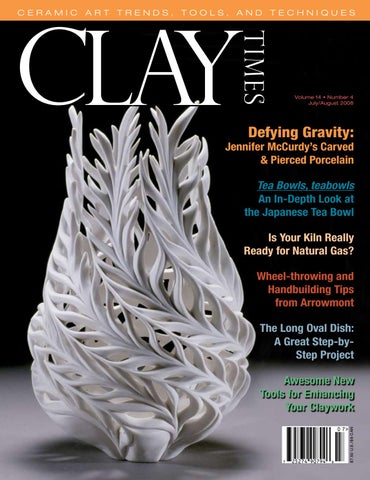
Jennifer McCurdy’s Carved & Pierced Porcelain Tea Bowls, teabowls An In-Depth Look at the Japanese Tea Bowl Is Your Kiln Really Ready for Natural Gas? Wheel-throwing and Handbuilding Tips from Arrowmont The Long Oval Dish: A Great Step-byStep Project Awesome New Tools for Enhancing Your Claywork $ 7.50 U.S./$9 CAN
ceramic
Anyone Can Fix an L&L Kiln.
C
an you change the elements in your current kiln without damaging the interior? Ask any L&L customer to tell you how easy it is to change elements in an L&L kiln!
Why does that matter?
• Your kiln will last longer. are in control. You or the person repairing your kilns does •notYou have to be a kiln expert! Repair your kiln cheaply and quickly.
505 Sharptown Rd, Swedesboro NJ 08085 888.684.3232 Fax 856.294.0070 sales@hotkilns.com
Find out more - Get our free 68 page catalog, sample element holder and instructional CD at www.hotkilns.com/free-claytimes.html
L&L Kiln’s patented hard ceramic element holders protect your kiln.
K_i\\ e\n :fe\ (' :cXpj Xk `ekif[lZkfip gi`Z\j%! 9 :cXp *(%., g\i _le[i\[
<oki\d\cp jdffk_# Zi\Xdp n_`k\% <oZ\cc\ek ]fi k_ifn`e^ cXi^\ fi jdXcc ]fidj% Fo`[Xk`fe fi i\[lZk`fe Zfe\ ,$('%
Nff[ =`i\ GfiZ\cX`e *(%., g\i _le[i\[ DX[\ n`k_ LJ bXfc`ej Xe[ j_fZb i\j`jkXek `e^i\[`\ekj% Jlg\iY Zfcfi Xe[ ÕXj_`e^ \]]\Zkj%
Jf[X :cXp *,%-' g\i _le[i\[
Jdffk_# gcXjk`Z# jc`^_kcp ZfXij\ ZcXp# k_ifnj Y\Xlk`]lccp% ;`jk`eZk`m\ Yclj_ Zfcfi kfe\j `e jf[X Xkdfjg_\i\% !Fi[\i ), $(''' cYj 7 (''' cY gi`Z\ F]]\i mXc`[ fe fi[\ij gcXZ\[ k_ifl^_ 8l^ljk *(# )''/
Nff[Ôi\[ Gfkk\ip1 J`dfe C\m`e# nff[Ôi\%Zfd
1101 Stinson Blvd NE, Minneapolis, MN 55413 1-800-432-CLAY continentalclay.com
CLAYTIMES·COM n JULY/AUGUST 2008
3
$11 $11
Tile-Batt Tile-Batt
Stainless Stainless Steel Steel Extruder Extruder With With Euclid’s Euclid’s exclusive exclusive dual-action dual-action plunging plunging arm arm forfor efficient efficient extruding! extruding!
.70 .70 $1 $1
Extra Extra tiles: tiles:
5” 5” dia. dia. stainless stainless steel steel barrel barrel and and frame. frame. Package Package includes includes diedie mask, mask, z-brace z-brace and and 6 standard 6 standard dies. dies.
New! New! 3/34/4hphp
55 55lb! lb!
Bowl Bowl Sieves Sieves 14”14” dia. dia. Bowl, Bowl, 7” 7” dia. dia. Screen Screen 60-80-100 60-80-100 mm
$39 $15 $15 $39
ea.ea. SetSet of of 3: 3: Each Each SetSet of of 3: 3:
Hollow Hollow dies: dies:
$10 $10
Toxicology: Toxicology: What What every every potter potter needs needs to to know know about about materials materials from from alumina alumina to to zircon. zircon. NoNo potter’s potter’s library library is complete is complete without without Edouard Edouard Bastarache’s Bastarache’s valuable valuable materials materials resource. resource.
More More quality quality Euclid’s Euclid’s Choice Choice products products atat great great prices... prices... Stainless Stainless Detail Detail Tools Tools
$4$4
$89 $89
$50 $50
Canada’s Canada’s best best kept kept secret: secret: The The SHARP SHARP Williams Williams trimming trimming tool! tool!
Set Set (35) (35)
See See all all thethe stainless stainless steel steel detail detail tools tools including including dental dental tools tools at at euclids.com! euclids.com!
quality, low-priced low-priced elements... elements... Euclid’s Euclid’sElements ElementsTopTopquality,
NNeeww!!
Single Single T/C: T/C:
THIN THIN SiC SiC Shelves Shelves
Euclid Euclid
Beautifully Beautifully made, made, heavy heavy duty, duty, all all stainless stainless steel steel trimming trimming tools tools with with sharp sharp chisel chisel edges. edges. . .
$27 $27 $8$8
ea.ea.
See See these these and and more more quality quality products products at at euclids.com! euclids.com!
$48 $48 $66 $66 $66 $66
12”x 12”x 2424 x ½” x ½”
$69 $69 $99 $99
Dual Dual T/C: T/C:
14”x 14”x 28” 28” x ½” x ½”
17”x 17”x 23” 23” x ½” x ½”
9090
/in. /in. 4 ” dia. 13/ 41”3/dia. SiC SiC posts posts
Quality Quality English English Kiln Kiln Furniture Furniture
T H E R M ATLH TE ER CMHANL OTLEOCGHINE O S LOGIES
$44 $44
21”21” dia. dia. 30”30” x 51” x 51” Table Table Top Top
3/4 3/4hphp
www.euclids.com www.euclids.com
..
...for ...for any any kilnkiln
Digital Digital Pyrometer Pyrometer
Japanese Japanese Style Style Bamboo Bamboo Tools, Tools, Jumping Jumping Irons Irons (Chattering (Chattering Tool) Tool) & Polygon & Polygon Drape Drape Molds Molds
SetSet of of 4: 4:
6” x6”6”x 6”
EUCLID EUCLID KILNS KILNS
with with Euclid’s Euclid’s exclusive exclusive Halo Halo lid.lid.
1-800-296-5456 1-800-296-5456
contents
®
TIMES
Clay
July/August 2008 Volume 14, Number 4
KATHERINE ROSE PHOTO
Stacked Carved Jar by Mary Kay Botkins. Celadon-glazed porcelain. For complete details on her slab-building techniques, turn to page 46.
features 34 Defying Gravity: Jennifer McCurdy’s Carved and Pierced Porcelain Here’s a woman who takes clay carving to the extreme—even firing her works upside-down for shape enhancement!
43 Making a Winter Tea Bowl Yin Yang Egg #1 by Jennifer McCurdy. 7" x 6" x 6".
on exhibit 40 Tea Bowls, teabowls Curator Joe Campbell writes about the Japanese tea bowl aesthetic and offers several images of works displayed during this recent exhibition in Frederick, Maryland.
Kristin Muller photographs and describes the step-by-step process used by Takao Okazaki to make traditional Japanese winter tea bowls.
46 Tossing Slabs & Throwing Pots K.T. Anders shares several handbuilding and wheel-throwing techniques learned at Arrowmont workshops by Mary Kay Botkins and Susan Filley.
5
contents
®
TIMES
Clay July/August 2008 • Volume 14, Number 4
departments
columns
9 EDITOR’S DESK
21 AS FAR AS I KNOW “Creative Thinking” by Pete Pinnell
You’re gonna love our new Web site!
25 BENEATH THE SURFACE
11 YOUR WORDS
“Annie Chrietzberg, Part 2” by Lana Wilson
Readers offer their feedback & opinions
13 WHAT'S HOT
29 TEACHING TECHNIQUES
Clay world news, events, and calls for entries
“A Two-step, Altered Pot Project: Making a Long Oval Dish” by Bill van Gilder
27 GREAT GLAZES Annie Chrietzberg shares several cone 6 formulas.
54 KILNS & FIRING “Are You Ready for the Switch to Natural Gas?” by Marc Ward
33 SLURRY BUCKET TIPS Save time and trouble with these studio-tested tips and techniques.
55 TOOL TIMES “What’s New in Tools” by Vince Pitelka
52 THE GALLERY A selection of unique works by CT readers
57 STUDIO HEALTH AND SAFETY “R.T. Vanderbilt Loses Second Mesothelia Lawsuit” by Monona Rossol
59 POTTERY CLASSES Where you can learn claywork in the U.S. & abroad
62 BOOKS & VIDEOS
63 CLASSIFIED MARKETPLACE
“Firing: Philosophies within Contemporary Ceramic Practice” review by Steve Branfman
Goods and services offered especially for active clay artists On the cover: Coral Vessel #1 by Jennifer McCurdy. 13" x 8" x 8". Photo by Katherine Rose.
6
Tea Bowl by Shane Sellers. One of several works recently displayed at Frederick Community College in Frederick, MD. See story, page 40.
Susan Filley flattens a freshly-thrown form by squeezing it between two bats during a recent workshop at Arrowmont School in Gatlinburg, Tennessee. To learn more, turn to page 46.
65 AROUND THE FIREBOX “One Word: Plastics” by David Hendley
7
O u r Wo r l d I s F l at …
with 10 [or 12] sides.
Advancer® kiln shelves are made flat to stay flat. At Cone 10, they won't warp, sag or crack, even under heavy loads and after hundreds of firing cycles! Made in the U.S.A., Advancer® brand is the only silicon carbide kiln shelf that is safe for use in top loading electric kilns. Its unique protective oxide surface is also highly resistant to glaze drips and runs.
Spouting Off I Editor's Desk
CT Web Site Now Offers Full Range of Reader Services
Advancer®… First and lasting, for your world. ©2008, Saint-Gobain-Ceramics. All rights reserved.
TEL : 508-795-5577
H
•
1 New Bond Street, Worcester, MA 01615-0136
E-MAIL : ceramicsystems@saint-gobain.com
ow often do you find yourself online? Is it weekly, daily, or several times a day? If you’re like most of us, it has become a daily ritual to log on and check e-mail and news, weather, or stocks, and perhaps even do some research or a bit of shopping. Clay Times has operated its Web site since the mid 1990s and we’re pleased to report that tens of thousands of people now visit our site each month. As this online community has grown, we have expanded along with it by including virtual content ranging from online articles, a fully searchable back issue index, and an online reader survey to our virtual store, where you can subscribe or renew your subscription or purchase potters’ favorites including glaze books, tools, T-shirts, and more ... If you haven’t visited claytimes.com lately, I encourage you to take a look! We’ve recently updated the entire site with a brand-new design that incorporates flash animations and video, as well as menus and departments that are more user-friendly than ever! A visit to the site also allows you to submit articles, advertisements, comments, or announcements via our “contact” link at the bottom of each page, with its direct e-mail links to CT staff members and columnists.
For your friends who have never seen the magazine, there’s even a link to request a free sample issue, as well as a link to instantly preview a digital version of the entire magazine before they subscribe. So I hope you’ll check out claytimes.com and e-mail me with your comments and suggestions! I look forward to hearing from you. Please send comments to: claytimes@gmail.com — Polly Beach, Editor [
CLAYTIMES·COM n July/August 2008
Special extras include daily tips and glaze recipes, plus measurement conversion charts and links to our favorite ceramic suppliers, educators, and other ceramics resources. We also publish the current issue’s classified ads and pottery class listings online.
9
10
CLAYTIMES·COM n July/August 2008
section of our next issue so that you receive credit for the glaze.
Please inform your readers that the unattributed Cone 6 Clear glaze published on page 51 of your May/June 2008 issue is correctly known as “Glossy Clear Liner Glaze” as published on page 97 in the book, Mastering Cone 6 Glazes.
As you know, when people find a glaze they like, they share it with fellow potters. Somewhere along the line as it’s passed down from individual to individual, the origination of the glaze can get lost.
John Hesselberth coauthor of Mastering Cone 6 Glazes
Response Re: Glaze Credit Where Credit is Due Here, in part, is the response from the reader who supplied the glaze formula referenced above: “That recipe is currently used at our pottery center & was given to me in 2003 by one of the instructors at that time. “She didn’t say where it came from ... only that she had tested & used it. So, in my current glaze recipe book, the glaze is simply listed as ‘Cone 6 Clear.’ However, the glaze field has been open and sharing for a long time; are we now being asked not to share unless the glaze recipe is researched, origination source discovered, & credit given? How does one know when you’re at the absolute point of origin? “I would guess that a large percentage of the glaze recipes published anywhere these days originate somewhere other than with the potter who contributes the recipe for publication. I truly believe that, as a potting community, we’re honest folks & if we misstep in crediting a glaze recipe to whomever, it’s not done vengefully or knowingly.”
Thanks for the alert. If you wish, I’ll be happy to publish your e-mail in the “letters”
Quality Products. Discount Pricing. www.cattlebarnclay.com
magazine
Editor & Art Director: Polly Beach claytimes@gmail.com Circulation Manager: Rachel Brownell ctcirculation@gmail.com
I wish there were a way to identify all glaze formulas prior to publication so that, even if someone doesn’t know it’s one of your glazes, we [publishers] can figure it out up front!
Advertising Manager: Janie Herdman claytimesads@gmail.com
If you have a database you’d like to share with me, solely for that purpose, I’d be happy to use it to check any of the recipes we plan to publish against your database before the issue goes to press.
Office Assistant: Ingrid Phillips
Polly Beach, Editor
Soldner Accolades I just wanted to say ‘thanks’ for putting together Paul Soldner’s essays [in his new book, Nothing to Hide, published by Clay Times in March of this year]. I had the pleasure of assisting Paul in several international workshops and a hot tub building workshop between 1997-2001. I found him to be one of the most brilliant minds I have ever met. I have been to his home in Aspen, and it was staggering to hear him talk about [its building process], and his experimenting, and the work he has done! It seems so many people in the clay community almost have discredited him, due to his “ways of life.” I am glad you are putting out there what he truly has done, and giving him the credit I personally think he deserves. I can’t wait to read the essays! Brian Nettles, via e-mail [
Accounts Manager: Nanette Greene clayaccounts@gmail.com Proofreader: Jenna McCracken
Regular Columnists: Steve Branfman, Books & Videos David Hendley, Around the Firebox Pete Pinnell, As Far as I Know Vince Pitelka, Tool Times Monona Rossol, Health & Safety Kelly Savino, Around the Firebox Bill van Gilder, Teaching Techniques Marc Ward, Kilns & Firing Lana Wilson, Beneath the Surface Contributing Writers: K.T. Anders Joe Campbell Kristin Muller Published by: CLAY TIMES INC. 15481 Second St. • PO Box 365 Waterford, Virginia 20197-0365 540.882.3576 • FAX 540.882.4196 Toll-free subscription line: 800.356.2529 Clay Times® (ISSN 1087-7614) is published bimonthly, six issues per year. Periodicals Postage Paid at Waterford, VA, and at additional mailing offices. Annual subscriptions are available for $30 in the U.S.; $36 in Canada; $55 elsewhere (must be payable in US$). To subscribe, call toll-free 1-800.356.2529, or visit www.claytimes.com. Freelance editorial and photographic submissions are welcome: Please contact Clay Times or visit our Web site for writer’s and photographer’s guidelines. POSTMASTER: Address service requested. Send address changes to: Clay Times, PO Box 365, Waterford, VA 20197-0365. Copyright © 2008 Clay Times, Inc. All rights reserved. The material contained herein is derived from various sources and does not necessarily reflect the views of the publisher. All technical material is offered as general information only and should not be acted upon without expert supervision. No part of this publication may be reproduced or transmitted by any means without the written permission of the publisher.
CLAYTIMES·COM n July/AugusT 2008
After receipt of John’s e-mail, I sent him the following response:
Clay
®
Glaze Credit Where Credit is Due
TIMES
Readers’ Letters
Spouting Off I Your Words
ceramic art trends, t oo l s & t e c h n i q u e s
11
12
CLAYTIMES·COM n July/August 2008
8
ceramic art world news • events • calls for entries
Conferences ‰ From July 13–17, Haystack Mountain School of Crafts in Deer Isle, Maine will present The Language of Craft. The event will feature lectures and panel discussions with artists including Paulus Berensohn, Akiko Busch, Charles Garoian, Janet Koplos, John McQueen, Margo Mensing, Warren Seelig, and Kim Stafford. Registration fee: $310. For complete details, contact Haystack Mountain School of Crafts, PO Box 518, Deer Isle, ME 04627; www.haystack-mtn.org. Ralph Bacerra, 1938-2008
In Memoriam ‰ Ralph Bacerra, renowned ceramic artist and career educator, died June 10 of lung cancer at his home in Eagle Rock, California. He was 70 years old. Bacerra studied ceramics with Vivika Heino at Chouinard Art Institute in Los Angeles, and later became chairperson of its ceramics department from 19631971. He then moved to Valencia, California to work full-time in his studio.
His ceramic art is held by numerous collectors and museums worldwide. It incorporates geometrically complicated form with use of color and contrast via a multi-staged process of overglazing.
‰ Advance registration is now open for the second annual Cruisin’ for Clay Potters Conference in the Caribbean, to take place Jan. 11-18, 2009. Sign up now to beat next year’s midwinter blues with an incredible week of fun in the sun and clay presentations by Tom & Elaine Coleman, Susan Filley, Bill van Gilder, and Xavier Gonzalez on board Royal Caribbean’s “Freedom of the Seas” cruise ship. Destinations include San Juan, Puerto Rico, and Virgin Islands ports of St. Thomas and St. Maarten, with Miami, FL port of departure. For full details and registration materials, log onto www.claytimes.com, or contact Clay
‰ Form and Function: 2009 North Carolina Potters Conference takes place March 13-15, 2009 in Asheboro, North Carolina. Guest presenters including Alleghany Meadows, Mark Pharis, and Phil Rogers will offer panel discussions and lectures. To request full details, contact the Randolph Arts Guild, Moring Arts Center, 123 Sunset Ave., PO Box 1033, Asheboro NC 27204-1033; tel. 336.629.0399; e-mail arts@asheboro.com; www.randolpharts guild.com.
Calls for Entries ‰ Digital or slide submissions are now being accepted through July 15 by the Art Center of Estes Park, Colorado, for its 12th Annual Lines into Shapes show, to take place Sept. 19–Oct. 4. Fee is $13 per submission. To obtain a prospectus, visit www.artcenterofestes.com, or send an SASE to the Art Center of Estes Park, PO Box 3635, Estes Park, CO 80517; 970.586.5882. ‰ Digital and slide submissions are being accepted through July 16 for the University of Indianapolis 2008–2010 Sculpture Walk, to take place Sept. 25, 2008–Aug. 29, 2009 at the University of Indianapolis, Indiana. To obtain a prospectus, send your SASE to the Dept. of Art and Design, University of Indianapolis, 1400 E. Hanna Ave., Indianapolis, IN 46227; or visit http://art.uindy.edu. ‰ Pottworks Gallery of Hamilton, Michigan, is accepting entries through July 18 for Artful Drinking Vessels, to take place Oct. 3–Nov. 1. Entry fee: $30 for three entries; $40 for five. Obtain further details by contacting Pottworks Gallery,
CLAYTIMES·COM n July/August 2008
Bacerra is credited with important technological innovations in advanced ceramics, especially the development of oven-top range surfaces for the Induction Stove Corporation that featured the use of electromagnetic induction. From 1983-97, he returned to educating as chair of the ceramic art department at Otis Art Institute, focusing on technical proficiency and knowledge of materials.
‰ The International Sculpture Center will present Sculpture in Public: Part 2, Public Art from Oct. 2-4 at the Frederik Meijer Gardens & Sculpture Park in Grand Rapids, Michigan. The conference will offer special exhibitions, panel discussions, and trade fair, along with keynote address by sculptor and installation artist Jaume Plensa. Plensa’s work will also be the subject of a major exhibition at Frederik Meijer Gardens & Sculpture Park. For online registration and complete conference details, log onto www. sculpture.org, or call 202.234.0555.
Times, PO Box 365, Waterford, VA 20197; 800.356.2529; claytimes@gmail.com.
Hot Stuff I News & Events
What’s Hot
13
Hot Stuff I News & Events
3765 Lincoln Rd., Hamilton, MI 49419; wmcp@verizon.net; www.pottworks.com; 269.751.5839. ‰ Funeria of Graton, California will host the Fourth International Biennial Ashes to Art/ Scattered exhibition from Sept. 26–Nov. 30. Digital and slide entries may be submitted through Aug. 1 and must consist of either non-traditional funerary urns, ritual objects, scattering vessels, or reliquaries. Entry fee: $35 for three entries; $5 for each additional entry. Jurors are: Nadine Jarvis, Sylvia Seventy, and Adela Akers. To obtain a prospectus, send your SASE to Funeria, PO Box 221, Graton, CA 95444; pros@funeria. com; www.funeria.com; 707.829.1966. ‰ The Clay Studio of Missoula, Montana is accepting submissions through Aug. 1 for its Soda National IV exhibition, to take place Nov. 7–28. Jim Koudelka will jury the show from digital and slide submissions. Entry fee: $30 for three entries. To request a prospectus, mail your SASE to Hannah Fisher, The Clay Studio of Missoula, 1106 Hawthorne Unit A, Missoula, MT 59802; info@ theclaystudioofmissoula.org; Web site: www. theclaystudioofmissoula.org.
Crystalline
Glazing
Workshops with
Xavier González
CLAYTIMES·COM n July/August 2008
June 16-20, 2008 Sierra Nevada College Lake Tahoe, NV www.sierranevada.edu/ workshops Hands on Workshop Throwing Techniques and Crystalline Glazes
14
July 26 & 27, 2008 Boulder, Colorado Potters Guild Crystalline Glazing: Demos and Lecture
To schedule a workshop with Xavier González, call 818.779.0990 or e-mail: xgceramics@sbcglobal.net
‰ Juror Simon Levin is accepting digital submissions through Aug. 1 on behalf of ClaySpace Ceramic Studio of Warrenville, Illinois, for the Clay³: National Juried Ceramics Exhibition. The show takes place Oct. 24–Nov. 21 and is open to functional and sculptural ceramic art that fits within one cubic foot. Entry fee is $25 for three entries. For more information, contact ClaySpace Ceramic Studio, 28 W. 210 Warrenville Rd., Warrenville, IL 60555; info@clayspace.net; www.clayspace.net; 630.393.2529. ‰ Ceramics Biennial 2008 is accepting digital entries through Aug. 1 of works consisting predominantly of clay. Entry fee is $25 for two entries; the show takes place Oct. 8–Nov. 7. To obtain a prospectus, log onto www.nhia.edu/uploadcache/2008_Ceramics Biennial.pdf, or send your SASE to the attention of Alison Williams, Ceramics Biennial, 148 Concord St., Manchester, NH 03104. ‰ Former and current residents of Indiana are eligible to submit their digital entries through Aug. 8 for Clayfest 2008, to take place Sept. 5–Oct. 3 in Indianapolis. Entry fee: $25 for three entries. To learn more, contact Abbey Pintar, c/o Basile Center, Herron School of Art and Design, 735 W. New York St., Indianapolis, IN 46202; apintar@iupui.edu.
‰ The Archie Bray Foundation of Helena, Montana will host its ceramics exhibition, Beyond the Brickyard, in January of 2009. Patti Warashina will jury the show from digital entries of clay works received by the Aug. 15 deadline. Fee: $35 for three entries. For further details, contact the Archie Bray Foundation for Ceramic Arts, 2915 Country Club Ave., Helena, MT 59602; www.archie bray.org; 406.443.3502, ext. 18. ‰ The Wayne Art Center of Wayne, Pennsylvania is accepting digital and slide submissions through Sept. 19 for Craft Forms 2008, to take place Dec. 5, 2008–Jan. 22, 2009. Standard entry fee is $40; just $30 for online submissions. For more information, contact Wayne Art Center, 413 Maplewood Ave., Wayne, PA 19087; www.wayneart.org; www.craftforms.com. ‰ The Feast: About Food, Made from Food, Including Food is accepting digital and slide entries through Oct. 15 for its multimedia show, to take place Feb. 2–March 5, 2009 in Pittsburg, Kansas. Entry fee: $20. To obtain a prospectus, log onto www.pittstate.edu/ art, or contact Pittsburg State University, 1701 S. Broadway, Pittsburg, KS 66762; tel. 620.235.4303; sbowman@pittstate.edu. ‰ Juror Patti Warashina is accepting international digital and slide entries through Nov. 26 for the International Cup show to take place Feb. 6–28, 2009. Fee: $20 for one entry; $25 for two entries. For additional details, contact The Clay Studio of Missoula, 1106 Hawthorne St., Unit A, Missoula, MT 59802; 406.543.0509; info@theclaystudioofmissoula. org; www.theclaystudioofmissoula.org. ‰ Juror Jim Lawton is accepting digital entries through Dec. 5 for The State of Clay 6th Biennial Exhibition to take place March 30–April 25, 2009. Entry fee: $30 for up to three entries. To obtain a prospectus, log onto www.lexingtonma.org/lacs, or contact Lexington Arts and Crafts Society, 130 Waltham St., Lexington, MA 02421; tel. 781.862.9696; lacs.lexington@verizon.net. ‰ The Craft Alliance of St. Louis, Missouri is calling for solo and collaborative installation artist proposals through Dec. 31. For complete details, contact the exhibitions coordinator at the Craft Alliance, 6640 Delmar Blvd., St. Louis, MO 63130; 314.725.1177 ext. 323; exhibitions@craft alliance.org; www.craftalliance.org. ‰ Solo, two-person, and group exhibition proposals are being accepted through Feb.
Ceramics Exhibitions ‰ Recent Ceramics: Bede Clarke, Jil Franke, J. Daniel Murphy is on exhibit through July 18 at AKAR, 257 East Iowa Ave., Iowa City, Iowa.
‰ Elaine and Tom Coleman takes place through July 30 at Blue Dome Gallery, 307 N. Texas St., Silver City, New Mexico. ‰ Tea × 40, works by San Diego Potters’ Guild; takes place July 1-31 at the San Diego Potters’ Guild, Spanish Village, Studio 29, Balboa Park, San Diego, California. ‰ Art Exchange: Arlington–Cwmbran takes place through July 31 at Lee Arts Center, 5722 Lee Hwy., Arlington, Virginia. ‰ Cheers! A MAD Collection of Goblets is on view through Aug. 2 at Museum of
Art and Design, 40 W. 53rd St., Wayne, Pennsylvania. ‰ Susan Beiner: Synthetic Reality takes place through Aug. 2 at Arizona State University Art Museum, 10th St. and Mill Ave., Tempe, Arizona. ‰ Go Green takes place July 6–Aug. 9 at Dowstudio Gallery, 19 Dow Rd., Deer Isle, Maine. ‰ Beth Cavener Stichter solo exhibition takes place July 11–Aug. 9 at The Art Spirit Gallery, 415 Sherman Ave., Coeur d’Alene, Idaho.
Hot Stuff I News & Events
1, 2009 by Pittsburg State University. Either digital or slide entries are welcome; no fee required. For complete details, log onto www.pittstate.edu/art/exopp.html, or contact Pittsburg State University, 1701 S. Broadway, Pittsburg, KS 66762; 620.235.4303; sbowman@pittstate.edu.
‰ Mata Ortiz—Generations, featuring works by second-generation ceramic artists from Mata Ortiz, takes place through July 19 at Armstrong’s Gallery, 150 East 3rd St., Pomona, California. ‰ Beauty and Power: New Work by Misty Gamble takes place through July 20 at Cricket Engine Gallery, 499 Embarcadero Ave., Bldg. #3, Oakland, California. ‰ The Cosmic Collection by Josh Blanc takes place through July 20 at Clay Squared to Infinity/Infinity Gallery, 34 Thirteenth Ave., Minneapolis, Minnesota. ‰ Generations: Ken Shores takes place through July 23 at Museum of Contemporary Craft, 724 Northwest Davis St., Portland, Oregon. ‰ POTR3: Potters of the Roan in Triplicate takes place through July 24 at Crimson Laurel Gallery, 23 Crimson Laurel Way, Bakersville, North Carolina. ‰ Turned and Thrown: English Pottery, 1660–1820 takes place through July 27 at Philadelphia Museum of Art, 26th St. and the Benjamin Franklin Pkwy., Philadelphia, Pennsylvania.
‰ The Fifth Annual Marge Brown Kalodner Graduate Student Exhibition takes place through July 27 at The Clay Studio, 139 N. 2nd St., Philadelphia, Pennsylvania. ‰ Bethany Krull, Signal takes place through July 27 at Genesee Pottery, 713 Monroe Ave., Rochester, New York.
CLAYTIMES·COM n July/August 2008
‰ Political Craft takes place through July 27 at the Society of Arts and Crafts, 175 Newbury St., Boston, Massachusetts.
15
Hot Stuff I News & Events
‰ Victoria Christen solo exhibition takes place through Aug. 9 at Margo’s Pottery and Fine Craft, 1 Main St., Buffalo, Wyoming. ‰ Charles Lakofsky: Ohio Modernist Master takes place through Aug. 10 at Zanesville Art Center, 620 Military Rd., Zanesville, Ohio. ‰ Fourth Annual Teapot Exhibition takes place through Aug. 13 at Red Sky
Gallery, 1244 East Blvd., Charlotte, North Carolina. ‰ Pueblo Clay: America’s First Pottery takes place July 26–Aug. 16 at American Museum of Ceramic Art, 340 S. Garey Ave., Pomona, California. ‰ Michael Kline and Jenny Mendes takes place July 25–Aug. 22 at AKAR, 257 East Iowa Ave., Iowa City, Iowa.
‰ Clay Continuum III takes place July 29–Aug. 23 at Gallery in the Park (Spanish Peaks Art Council), 132 W. Ryus, La Veta, Colorado. ‰ Made at The Clay Studio takes place Aug. 1–24 at The Clay Studio, 139 N. 2nd St., Philadelphia, Pennsylvania. ‰ Six McKnight Artists, to feature works by Lisa Marie Barber, Joseph Kress, John Lambert, Mike Norman, Hide Sadohara, and John Utgaard, takes place July 11– Aug. 24 at Northern Clay Center, 2424 Franklin Ave. E., Minneapolis, Minnesota. ‰ 32nd Annual Pewabic Staff, Student, and Faculty Exhibition takes place July 11–Aug. 29 at Pewabic Pottery, 10125 E. Jefferson Ave., Detroit, Michigan. ‰ Z Jacobson solo exhibition takes place through Aug. 30 at Del Mano Gallery, 11981 San Vicente Blvd., Los Angeles, California. ‰ The Body in Pots takes place Aug. 1-30 at Red Star Studios, 821 W. 17th St., Kansas City, Missouri. ‰ Contemporary Pottery from North Carolina’s American Indian Communities takes place through Aug. 30 at North Carolina Pottery Center, 250 E. Ave., Seagrove, North Carolina. ‰ Masters of the Art, to feature works by Sam Taylor and Toni Ross, takes place Aug. 1–Sept. 1 at Celadon Gallery, 41 Old Mill Rd., Water Mill, New York.
Yeah, it’s something like that. Highwater Clays’ new Web store:
CLAYTIMES·COM n July/August 2008
WWW.HIGHWATERCLAYS.COM
16
The most comprehensive online potters’ catalog with more than 2,000 items, including The Earth’s Best Clays. Highwater Clays 600 Riverside Drive Asheville, NC 28801 828.252.6033
Highwater Clays (Florida) 420 22nd Street South St. Petersburg, FL 33712 727.553.9344
‰ Duets takes place Aug. 10–Sept. 6 at Dowstudio Gallery, 19 Dow Rd., Deer Isle, Maine. ‰ National Teapot Show VII takes place through Sept. 7 at Cedar Creek Gallery, 1150 Fleming Rd., Creedmoor, North Carolina. ‰ Aysha Peltz: Stolen Moments takes place Aug. 8–Sept. 14 at The Artisan Gallery, 162 Main St., Northampton, Massachusetts. ‰ Sixth Annual Perspectives 2008: Georgia Pottery Invitational takes place Aug. 30–Sept. 17 at Oconee Cultural Arts Foundation, 34 School St., Watkinsville, Georgia.
‰ Symbiosis, to feature works by Welsh ceramic artists including Duncan Ayscough, Sam Bakewell, Melanie Brown, Lowri Davis, Morgen Hall, Catrin Howell, Walter Keeler, and Claudia Lis, takes place Aug. 9-Sept. 18 at Baltimore Clayworks, 5707 Smith Ave., Baltimore, Maryland. ‰ Sequoia Miller and Sam Taylor takes place Aug. 29–Sept. 19 at AKAR, 257 East Iowa Ave., Iowa City, Iowa. ‰ Chris Miller solo exhibition takes place through Sept. 26 at The Schein-Joseph International Museum of Ceramic Art, Alfred University, Alfred, New York. ‰ Sergei Isupov, Androgyny takes place Aug. 23–Oct. 4 at Ferrin Gallery, 437 North St., Pittsfield, Massachusetts. ‰ 5 Objects, to feature works by Stephen Heywood, Brian Jensen, and Lai Montesca, takes place Sept. 5-Oct. 5 at Celadon Gallery, 41 Old Mill Rd., Water Mill, New York.
Tell Us What You're Up To! Clay Times welcomes your participation & feedback via letters & comments, articles, event listings, studio tips, glaze recipes, photos of your work ... even your videos! Log onto the "Contribute" department at www.claytimes.com for full details!
Hot Stuff I News & Events
‰ Trompe L’oeil: The Artist’s Studio, to feature works by David Furman, Victor Spinski, Lilianne Milgrom, Sylvia Hyman, John Brickel, and Linda van der Linde takes place through Sept. 17 at Cross MacKenzie Ceramic Arts, 1054 31st St., Washington, DC.
WE WANT TO BE SURE THEY’RE SAFE The FIRST glaze company to commit to being 100% LEAD FREE
‰ Soaring Voices: Contemporary Japanese Women Ceramic Artists takes place Aug. 7–Oct. 18 at Crocker Art Museum, 216 O St., Sacramento, California. ‰ SAC Artist Awards Exhibition takes place Aug. 9–Oct. 19 at Society of Arts and Crafts, 175 Newbury St., Boston, Massachusetts. ‰ Warren MacKenzie: Legacy of An American Potter takes place Aug. 29–Nov. 30 at Houston Center for Contemporary Craft, 4848 Main St., Houston, Texas.
To list your clay conferences, calls for entries, exhibitions, and ceramic news items in Clay Times, please e-mail announcement details to: claytimes@gmail.com, with “What’s Hot” in the subject line.
GLAZES INC. 94 Fenmar Dr Toronto, ON Canada M9L 1M5
P.O. Box 874 Lewiston, NY USA 14092-0874
Phone: (800)970-1970 or (416)747-8310 Fax: (416)747-8320 www.spectrumglazes.com info@spectrumglazes.com
CLAYTIMES·COM n July/August 2008
‰ 2009 Midstream: New Ceramics from the Heartland takes place Aug. 23–Feb. 28 at Arizona State University Art Museum’s Ceramic Research Center, 10th St. and Mill Ave., Tempe, Arizona. [
17
cruisin’ for clay 200
HOW DO THEY DO IT? Find out along with a boatload of fun potters on the second annual Clay Times® Cruise to the Caribbean! Jan. 11-18, 2009 & Puerto Rico & Virgin Islands Advance Registration Now Open—Save $50 thru July 15! View complete conference details at www.claytimes.com
CLAYTIMES·COM n July/August 2008
susan fil ey
18
tom coleman
elaine coleman
bil van gilder
xavier gonzalez
REGISTER ONLINE AT
n-loving
WWW.CLAYTIMES.COM
09 guest artists
20
CLAYTIMES·COM n July/August 2008
The truly creative mind in any field is no more than this: a human creature born abnormally, inhumanly sensitive. To him, a touch is a blow, a sound is a noise, a misfortune is a tragedy, a joy is an ecstasy, a friend is a lover, a lover is a god, and failure is death. Add to this cruelly delicate organism the overpowering necessity to create, create, create—so that without the creating of music or poetry or books or buildings or something of meaning, his very breath is cut off from him. He must create, must pour out creation. By some strange, unknown, inward urgency he is not really alive unless he is creating.
by PETE PINNELL
— Pearl S. Buck
W
ith all due respect to Ms. Buck, who was a fine writer and an admirable person, this may be the biggest bunch of hooey I’ve ever read. This romantic ideal of the tortured artist—who usually goes unrecognized by his pedantic contemporaries—is a staple of 20th Century popular literature. This idea seems to have its roots in ideas of genius and originality that were expressed in the writings of Immanuel Kant, and were enthusiastically adopted by romantics of the 19th Century. However this notion came about, clear-eyed reflection shows us that creativity—in art, as well as in other fields—is not dependent on mental illness or emotional instability, and many highly creative people have been otherwise entirely normal.
A completely different take on the nature of art (and artists) can be found in a wonderful series of books written by Ellen Dissanayake, who looks at art from the standpoint of anthropology and ethology. In particular, I highly recommend her book Homo Aestheticus: Where Art Comes from and Why1. In it,
At first glance, the fact that the arts and related aesthetic attitudes vary so widely from one society to another would seem to suggest that they are wholly learned or “cultural” in origin rather than, as I will show, also biological or “natural.” One can make an analogy with language: learning to speak is a universal, innate predisposition for all children even though individual children learn the particular language of the people among whom they are nurtured. Similarly, art can be regarded as a natural, general proclivity that manifests itself in culturally learned specifics such as dances, songs, performances, visual display, and poetic speech. I first read this book more than 10 years ago, and its insights have colored my view of art (and art-making) ever since. Dissanayake polished her ideas by observing people in Sri Lanka, Nigeria, India, Madagascar, and Papua, New Guinea. After reading her books and observing people right here at home, I’ve observed the same innate needs and interests in contemporary Americans. I’m going to ignore the vast public interest in music, theater, dance, and religious ceremony, and focus on the making of objects, since that’s what I do and it is the primary focus of my teaching. In watching people, what I’ve
noticed is an almost universal interest in making objects that involve aesthetic decision making. Many of these objects are not of the kind that would ever find their way into art books or magazines, but I’m convinced that the impulse that creates these objects is the same basic human impulse, simply channeled into other forms. As one example of this impulse, I think of my former neighbor, Harry, an elderly man who lived up the street from me for several years after I moved into my current home. I happen to live in a 1970s-era suburb, and it is an expectation here that you have a green lawn that you try to keep “nice” (e.g. watered, weeded, and regularly mowed). Some people go beyond these basic expectations, and some, like Harry, go way beyond. Harry cut his lawn twice every time he mowed. Each time, he cut it on the diagonal, and he did so in two different directions in order to produce a diagonal, checkerboard pattern in the grass. After cutting the grass, he would painstakingly trim the edges of the lawn to impose a rigid line between grass and pavement. He would then trim the bushes, which were shaped in such a compelling way as to incite jealousy in a dog-show poodle. His involvement didn’t end with his cutting rituals. He watered and fertilized religiously, removed blades of grass that stood out, zealously patrolled for invading plants, and made sure that the grass displayed a flawless homogeneity.
CLAYTIMES·COM n July/August JULY/AUGUST 2008
Who cares, anyway? Why does it matter if there is this popular misconception? It matters because it colors the way we look at the arts in general, and artists in particular, and this affects things as diverse as funding for arts programs, as well the willingness of many people to take part in activities that they fear might label them as “weirdos.”
Dissanayake argues that art-making (the act of making special) is as intrinsic to human nature as eating or sleeping. In the preface to this book she writes:
Perspectives I As Far As I Know
Creative Thinking
21
Clay Brings us together and sets us apart.
Kent McLaughlin and Suze Lindsey of Fork Mountain Pottery, Bakersville, North Carolina.
Trinity Ceramic Supply, Inc. 9016 Diplomacy Row Dallas, TX 75247 214 631-0540 www.trinityceramic.com
Visit the BRAND-NEW site at www.claytimes.com!
CLAYTIMES·COM n July/August 2008
$-": 500-4 3&'&3&/$& ."5&3*"-4
22
New Instructional DVD $69.95 + $4 S/H
PO Box 722 Honeoye, NY 14471 585-229-2976
www.pcfstudios.com
continued from page 21
This lawn was obviously Harry’s creative outlet: he lavished all his energy on it and tried his best to make it beautiful. As art forms go, I wouldn’t place Harry’s lawn on a par with, say, a Beethoven symphony or a Rembrandt painting, but this was Harry’s art. It was personal and heartfelt, and it garnered him much praise and attention from his neighbors and passing pedestrians. Beautiful lawns are certainly not the only way that people channel their creative urges. Some people customize their cars; chopping, sculpting, painting, and souping them up into something that little resembles the original hardware. Others learn woodworking, and turn logs into bowls, or construct beautiful pieces of furniture. Still others design and sew clothing, quilts, and dolls. Some even draw, sculpt, paint, or make pottery. I’ve had the honor of teaching ceramics workshops at more than 100 locations across the U.S., and found the amateur art scene to be booming everywhere I go. Community art centers and junior colleges are thriving, filling classes and struggling to offer enough seats.
Sometimes I think that these walls are erected not to keep quality high, but out of a kind of laziness—it’s a lot easier to simply dismiss an entire class of objects (and their makers) than to confront, categorize, and evaluate objects that fall outside of our conventional art-school expectations. Most of us do not fall into that rarefied category of highly creative people that Ms. Buck refers to, and frankly, I’m not the least bit concerned by this. Creative expression is a universal human characteristic and one that
we should promote, develop, and reward. This expression can take a stunningly broad range of forms, and as artists we should celebrate and encourage this diversity. Footnote: 1. Publisher: University of Washington Press (September 1995) ISBN-10: 0295974796 ISBN-13: 978-0295974798 [
Peter Pinnell is Hixson-Lied Professor of Art at the University of Nebraska at Lincoln. You can reach him at ppinnell1@unl.edu.
Perspectives I As Far As I Know
Creative Thinking
So why do I care if some people want to characterize artists as a bunch of aberrant oddballs? I’m bothered by this because I think it’s destructive to the arts, not just because it encourages the rest of society to think of us as “outsiders,” but because even artists and arts organizations sometimes seem to believe it, and to act accordingly. A couple of years ago, the art critic in the Lincoln newspaper wrote an article in which he considered whether the custom cars in a local auto show were art or not. He decided they were not, and cited a number of current theories of art to bolster his view. The fact that creative expression played a major role in the making of these cars, and that many of them were downright beautiful (as he readily admitted), got lost in a sea of wordy, exclusionary theory.
CLAYTIMES·COM n July/August 2008
Instead of using our theories to build a wall of exclusivity, I’d rather see us (the art world) wrestle with new means of evaluation that would allow us to decide which of the cars had the best designs, and honor those as outstanding examples of that art form. It would be great if art museums would recognize a broader range of contemporary objects, and would work to define why some of these objects are superior (as objects of art) to others. Notice that I’m not calling for a lowering of standards: just the opposite.
23
Scott Creek Extruders
SC033 XL Clay Gun
SC001 Clay Gun
2636 Pioneer Way East Tacoma Wa 98404 800-939-8783 Fax 253-922-5349 www.scottcreekpottery.com SC034 Clay Gun Handle Die
SC002 Clay Gun Die Kit
SC035 Clay Gun Shape and Coil Set
kilns for
potters CLAYTIMES·COM n July/August 2008
freedom 2527He– 11.9 Cu. ft., Cone 10
24
23 raku– 7 Cu. ft., Cone 10
&
OlympicKilns.1_2H.5-6_08.indd 1
Olympic commercial electric and gas kilns are heavily insulated (6” of insulation and air space) for energy efficiency and built to last with heavy angle iron frames, stainless steel skins. The electric kilns have options for kiln sitter and limit timer, electronic controller, 480 volts, 3-phase, and 3-zone control. Olympic DownDrafts are designed to fire on propane or natural gas. Stainless steel or galvanized vent hoods can be added as an option in addition to kiln sitter and timer, electronic control wall unit, pyrometer and blower burners. Olympic commercial electric kilns range in sizes from 5.5-53 cubic feet and the gas kilns range from 9-40 (useable space) cubic feet.
Raku, bisque or glaze in Olympic raku gas kilns. The unique firing chamber keeps temperature hot inside the kiln even when opened. Sizes range from 18” to 28” wide to accommodate small to large pieces. Propane or natural gas.
strong, duraBle affordaBle! Olympic Freedom kilns really free you up! Each Freedom kiln comes with their own emergency repair kit — 2 elements, crimping tool, pint of mortar, wiring schematic and extra thermocouple at no additional cost to you! And Freedom furniture kits contain shelves and posts to fit your kiln and a free bag of assorted stilts (33 stilts) for firing glaze ware. Freedom kilns are equipped with electronic controllers and fire to cone 10. Sizes range from 14” wide x 14” deep to 25” front to back, 37” wide x 27” deep.
SC036 Clay Gun Tile Trim Set
&
Beginners professionals downdraft 12 with Vented Hood – 12 Cu. ft., Cone 10
fl36e– 36 Cu. ft., Cone 10
Contact an olympic Kilns distributor or us for a distributor near You today! Building the finest Kilns for Your Creative spirit! sales 800-241-4400 Help line 770-967-4009 fax 770-967-1196 email – info@greatkilns.com
www.greatkilns.com 4/1/08 1:56:59 PM
This is the second of two articles about Annie Chrietzberg. The first discussed her inspirations (patterns, ducks, and living on a boat), how she deals with rejection (not caring too much and having more than a few things out there she is waiting to hear about), and not keeping everything she makes. In this column she discusses how she supports herself and develops new work, along with some of her glaze formulas.
Wilson: You mentioned you are working in a restaurant two days a week. Can you talk about the finances and realities you have experienced working in clay and making a living? Chrietzberg: I call my involvement with clay “My Ceramic Lifestyle.” There are many components to My Ceramic Lifestyle, and many ways to make a living in clay. Recently, when I changed my life, my financial circumstances altered considerably. I faced the common challenge of needing more money. Moving is expensive, and setting up a new studio is expensive. I was faced with the quite ordinary thing of making my way in the world again after years of not having to worry about it. I had income from sales and articles I’ve been writing, and future prospects of impending shows and workshops, but it wasn’t enough to support myself. I made some inquires to teach, but I’m still fairly new to Denver and there are already fabulous ceramists teaching at well-established programs in town. It will be a while before I make it to the top of the waiting list.
I am a very stubborn artist who wants to make the pots I want to make when I want to make them. I am lucky to be in a gallery, Hibberd McGrath Gallery (www.hibberdmcgrath.com), that doesn’t send me orders for ‘twelve more cups.’ They always want to see what I am making next.
I love contributing to [magazines], so I kept that going by sending more inquiries to them about articles. I also ran a classified ad in an issue that included my article about making cups, offering another studio workshop to make cups. But those were future prospects, the revenue for which was coming in the spring. I was still mired in autumn and needed money to move my kiln. I decided to work in a little English tea shop where I had been a regular customer two days a week instead of making more stuff to sell. This allowed me to keep my commitments for the shows I was in through the holidays, pursue my writing, and frankly get me out of my studio so I didn’t completely burn myself out by trying to do too much. I was glad to be able to keep eating well, and the two days a week out of the studio probably kept me from imploding. I think if I had been trying to make work for shows as
well as things that were more saleable, I would have gotten grumpy and cynical about ceramics. Working out in the real world does have its drawbacks. For instance, it’s not easy for me to go from my home/studio world where I’m registering a student from San Francisco who’s flying into Denver for my studio workshop, to a restaurant where I get hassled by the bossy pip-squeak who’s in college but still living at home and who has seniority over me. There’s a lesson in humility! Another hard kick in the pants came when the owner let me put some potters’ work in her shop. She already sold tea sets and accessories, of the factory production variety. She wanted to try selling some local artists’ work. We set up a nice display of my work and two other potters’ work. In a month, not one piece sold. Here I am, publishing articles about techniques in a national magazine, have my work at Hibberd McGrath—which I think is the best gallery in the state— and have a full schedule of shows, yet I couldn’t sell a cup in the tea shop where I worked. This solidified my commitment to My Ceramic Lifestyle, let me tell you! I appreciate it and think of ways to nurture it like never before. Wilson: How do you develop a new piece? Chrietzberg: When I am first learning something—say a particular type of handle or spout—I’ll just spend a few hours one day making them over and over until I get past that initial awkwardness and whatever technical challenges present themselves. I often use a heat
CLAYTIMES·COM n July/August 2008
I offered a studio workshop, which filled, but I didn’t want to run through all of my resources. And I like to eat well. I never bought into that starving artist paradigm. So I had to evaluate My Ceramic Lifestyle.
I could have sought out some stores in town that wanted ‘handmade’ items, or taken up any number of offers to sell in someone’s shop on consignment. But I have heard potters lamenting, “If only I could make the pots I want to make, but I have all these orders to fill.” I have no illusions that I am a production potter. I am not. If I make three cups in one day, along with starting a couple of teapots, that’s great. I’ll happily spend three or four days working on a three-chambered gurgling watering can. But trying to make even a dozen of something makes me miserable, unless I spread it out over days and do it like I’m ordering donuts: three of these, three of those. I’ve got to keep changing the patterns to keep myself interested.
by LANA Wilson
Perspectives I Beneath the Surface
Annie Chrietzberg
25
Perspectives I Beneath the Surface
gun to get parts to a self-supporting stage. My lids evolve and change faster than anything else. I like to make lids that are interesting objects on their own, and for the Maude teapots, I really do think of them as hats and think of all the fabulous millinery I’ve seen all over the world. I never officially studied with Peter Beasecker, but I did used to schedule critiques with him. The way he talked about my work would open so many doors in my mind. I remember what he told me about my lids. “It’s as if you have built-in parameters for the pot, but for some reason you don’t have those restrictions for the lid. Your lids are really interesting. I’d like to see your pots become as interesting as your lids.” I heard James Watral joke once, regarding lids, “If it doesn’t fall in the pot, it fits.” The spirit of that statement stuck with me, too. I don’t know if I’m there yet, but regardless, I’m still having a blast with the lids! Sometimes I have to make multiple lids to get an idea to work, but recently an image from a Dr. Suess book popped up in my mind, and I created the right hat on the first go. I don’t know if I will make this kind of hat again; I’ll have to see how it works once it is glazed. Now that I think about it, this kind of lid experimentation is risky ... so what! Wilson: Tell us about the glaze formulas you used for “Cheeseball Bra” and “Auntie Myrtle” (pictured on this page, with glaze formulas on opposite page).
CLAYTIMES·COM n JULY/AUGUST 2008
Chrietzberg: I used Mastering Cone 6 Glazes, by Ron Roy and John Hesselberth. I changed the EPK in the original highcalcium semi-matte recipe to Old Hickory #1, a ball clay. Slow cooling helps keep it matte.
26
John Hesselberth comments, “Changing the EPK to Old Hickory #1 makes it still a very good glaze; but with that relatively high copper level, I would personally test it before using it on food surfaces. Copper is so hard to keep in a glaze. I had a lot of experimentation to do before I found those two high-calcium semi-mattes that were as good as they are at holding copper. It may have significantly different performance because of the switch to ball clay.” Wilson: What else do you want to tell us about?
Pictured above: Auntie Myrtle (top) and Cheeseball Bra by Annie Chrietzberg. Regarding her process for mixing the glazes used (recipes on opposite page): “I also measure out 5% veegum cer and mix it with lots of hot water, first in a blender. Then it goes into the bucket with more water before I sift in my dry glaze mix. This acts as both a suspending agent and gives the glaze some burly green strength, which is important if you are handling a piece a lot when you are glazing it like I do. I pour and dip every bit I can, then brush on the areas where that just can’t be done.”
Chrietzberg: I think it is of great importance to find the right place to work if you are serious about your career. If people are constantly interrupting you, get rid of them. If you are in a relationship with a person who is undermining you, get out. If your work is getting broken, or your kilns are being interfered with, find a new studio. The great thing about ceramics is there are so many ways to participate. You can make, teach, be a hobbyist, be a serious artist, show, curate, sell, collect, write, photograph, document, fire in
groups, fire solo, work in group studios, turn your living room into a studio, give presentations, attend lectures, drink beer at conferences, take notes at conferences, make tools, sell tools, collect tools, use tools. You get the point. Sample it all, mix it up, find what fits today, change it tomorrow. Make the best work you can, keep your word, make your deadlines, and attempt the impossible. [
Visit Chrietzberg’s Web page at http:// earthtoannie.com to view images of her work and templates for some of her cups.
Great Glazes
Share your glaze with us! If it’s published, you’ll earn a FREE Clay Times T-shirt! Send glaze recipes, photo of glaze (if you have one), and your T-shirt size to: Great Glazes, c/o Clay Times, PO Box 365, Waterford, VA 20197.
furnished by ANNIE CHRIETZBERG (SEE PRECEDING STORY)
Mushy Peas • Cone 6 Ox.
Turquoise Variation • Cone 6 Ox.
A green-grey matte glaze that breaks to a different color on texture where thick; used for turquoise area on Chrietzberg’s “Auntie Myrtle” (pictured at top of opposite page; glaze recipe is a modified version of a glaze formula from Mastering Cone 6 Glazes by John Hesselberth and Ron Roy).
Made with the same base as Mushy Peas at left; used for turquoise area on Chrietzberg’s “Cheesball Bra” (pictured on opposite page).
Frit 3195 Wollastonite Nepheline Syenite Old Hickory #1 Glaze Clay Silica TOTAL
20% 29 4 30 17 100%
add Copper Carbonate add Rutile
4% 6%
Frit 3195 Wollastonite Nepheline Syenite Old Hickory #1 Glaze Clay Silica TOTAL add Mason 6410 Canary add Mason 6315 Blue
20% 29 4 30 17 100% 2% 8%
Bright Color Base • Cone 6 Ox. This base is from Jonathan Kaplan's notes; used for crimson area on Chrietzberg’s “Cheesball Bra” (pictured on opposite page).
Corrosion • Cone 6 Ox. A green-grey matte glaze used on the vertical part of Chrietzberg’s “Cheeseball Bra” (pictured on opposite page).
Frit 3195 Wollastonite Nepheline Syenite Old Hickory #1 Glaze Clay Silica TOTAL
1% 0.75% 3% 6%
32% 26 13 10 19 100%
add Mason 6003 for Crimson 10% OR add Mason 6407 for Yellow
10%
F-38 is a Fusion® frit containing boron and strontium (among other, more regular stuff). It is a decent way to source those two oxides, but is not commonly available at all pottery supply dealers. John Hesselberth comments that adding 10% stain is always a flag in his way of thinking, indicating maybe they should be tested, depending on what is in the stains, if they are to be used on food surfaces. [
All recipes are given in percentages (by weight). Results vary with clay bodies and firing conditions; always test first to be sure you’re happy with the results. To mix a glaze batch to store in a 5-gallon bucket, multiply each percentage ingredient by 50 grams (for a half-bucket with room for dipping) or 100 grams (for a very full bucket). It is the responsibility of the user to have glazes tested for stability.
CLAYTIMES·COM n July/August 2008
add Cobalt Carbonate add Copper Carbonate add Red Iron Oxide add Rutile
20% 29 4 30 17 100%
Frit F-38 Kona F-4 Feldspar Whiting Pioneer Kaolin (or EPK) Silica TOTAL
27
Tell a story. A job as the pottery studio manager for a community of disabled adults helped shape Jason
Greene’s
outlook on life and art. Education matters, he says, but true art reflects deeper truths from the soul. His fun and functional “Garden Variety Watering Can” won the 2008 NICHE Award for wheel-thrown ceramics.
Tell your story to thousands of shops & galleries at the Buyers Market of American Craft.
AUGUST 2-4, 2008
28
The RefRactory RefRacToRy Super SuPeR Store! SToRe!
CLAYTIMES·COM n JULY/AUGUST 2008
PENNSYLVANIA CONVENTION CENTER, PHILADELPHIA, PA
Lots of Inventory. Lowest Prices.
larkin refractory solutions Unparalleled Service & Refractory Design Assistance for over 30 years by the folks who truly care about your business. Firebrick – straights, arches, wedges & tiles Insulating Firebrick – straights, arches & wedges Ceramic fiber blankets, boards, papers & textiles Castables in several insulating & dense compositions Mortars, patches & inexpensive coatings
Nitride & Fines Bonded Kiln Shelves P.O. Box 716, Lithonia, GA 30058 Phone: 678.336.7090 Fax: 678.336.7094 Email: LRS@LarkinRefractory.com
www.LarkinRefractory.com
Kiln furniture
GaLoRe! ALL SIzES AvAILABLE!
WWW.AMERICANCRAFT.COM
INFO@ROSENGRP.COM
410.889.2933
Bill van Gilder 2008-2009 Workshops & Presentations 2008 July 28-Aug 1 August 15-17 August 27-30
Sierra Nevada College, Incline Village at Lake Tahoe, NV Ph: (775) 881-7588 • www.sierranevada.edu/workshops Pottery West, Las Vegas, NV potterywest@cox.net • www.potterywest.com Rehoboth Art League, Rehoboth Beach, DE Ph: (302) 227-8408 • www.rehobothartleague.org
Jan. 5-9 Jan. 11-18 April 8-11 May 31-June 12 Sept. 11-13 Sept. 27-Oct. 3
The Armory Art Center, West Palm Beach, FL www.ArmoryArt.org CLAYTIMES “Cruisin’(the Caribbean) for Clay Ph: (540) 882-3576 • www.claytimes.com NCECA (VANGILDER TOOLS), Phoenix, AZ Ph: toll free (866) 266-2322 • www.nceca.net Haystack Mountain School of Crafts, Deer lsle, ME www.haystack-mtn.org Greater Lansing Potters’ Guild, Haslett, MI Arrowmont School of Arts and Crafts, Gatlinburg, TN
Ph: (865) 436-5860 • www.arrowmont.org
2009
Ceramics Studios, Guilds, Universities, Colleges: To schedule a van Gilder workshop call 301.416.2970 or e-mail: vangilderpottery@earthlink.net
Making a Long Oval Dish by BILL van GILDER
In Form I Teaching Techniques
A Two-step, Altered Pot Project
Necessary Supplies • a 3- or 4-lb. weight of clay for slabs • a 12" or 14" bat • a rib tool • a stiff scraper • a fettling knife • a short 1"-diameter dowel • texturing materials • a wiggled or straight cut-off wire • a towel or foam pad • some water and a small sponge • a sheet of newspaper
O
Day One: Throwing the Dish Wall It starts by preparing the throwing clay listed in the Necessary Supplies list.
Attach a wide bat to the wheelhead and center the clay. Open the centered lump and as you firmly pressure the clay downward onto the bat, pull the clay outward, low and fat—but without the typical ¼"-thick floor that would normally be inside the pot. And how is that done? Using ample water, pull the clay upward into a 2½" to 3" tall wall. Make the rim thick and sturdy, rather than thin—at least ¼" wide. Sponge up the water from the inside and outside areas of the thrown wall and use your sponge to smooth the rim. Speed up the wheel and use your rib to shape and remove the slip from the outside surface of your dish wall and smooth the rim of the form once more. Next, adjust the wheel speed to slow, and using a very stiff rib or a stiff metal scraper, scrape away and totally remove the thin clay floor from the inside area of your dish (Fig. 2). But beware: do not scrape away the flaring clay at the inside or outside base of the wall. You’ll need this wide area of clay
2
3
4
CLAYTIMES·COM n July/August 2008
ur students often hear and occasionally read about altered pots—and the word ‘altered’ is certainly part of our contemporary clay vocabulary. This project is all about making an extremely altered pot—a long, oval, deep dish (Fig. 1). It’s partly thrown and partly handbuilt, which typically makes it a two-part project: make the dish’s wall section on day one, then make the floor, feet, and handles, and assemble the project during day two.
1
29