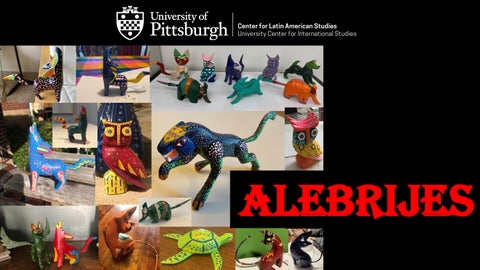
Alebrijes
During the Pandemic CLAS purchased 500 Alebrijes from artist Armando Jiménez Aragón, from Oaxaca, Mexico. The Pandemic presented us with mutual support opportunities with Armando and other artists, including online programming. In Pittsburgh, we partner with Lisa DiGioia-Nutini, who collaborates with us to bring these activities to you. For more information or to host an alebrijes workshop, please email: lavst12@pitt.edu According to Lisa DiGioia-Nutini, “Support of Mexican art and artists is not only a way of enhancing our personal environments with beautiful, unique art forms but also assists in preserving important cultural traditions and livelihoods.”
Alebrijes are whimsical carvings depicting animals, people, objects, and imaginary creatures painted with intense colors and intricate patterns. The alebrije is believe to be a “spiritual and fantastic being” that represents the soul. Although these distinctive cultural artifacts are often assumed to represent a long established, tradition of Mexican folk art, they only began to appear in the 1940s. Offerings here range from the sweetly silly to the seriously sublime. Many artists from these villages are renowned and have works in museums and private collections around the world, including the Smithsonian.
Theirs is also now an endangered art form after a decade of political and economic instability on both sides of the border, that has seen a highly diminished rate of tourism. It is believed that every human being born is accompanied by an animal that will guide and protect him during his life. The alebrije is capable of making the most desired wishes come true. These beings take on animal form and develop through our thoughts and feelings. Almost all alebrijes have wings, which represent the freedom to think and feel. The variety and intensity of colors represent the multiple emotions that a person can experience throughout their life.
$5,800.00
The Alebrijes that you are painting are carved by Zeny and Reina Fuentes.
This extraordinary bull depicting the history of the eagle landing on the cactus in Tenochtitlan was made for a competition in the category of carving in one piece by Zeny and Reina Fuentes. It did receive an award, of course! It measures 22" L x 8" W x 11 1/2" D
Facts: Gender division Males Children Females But things are changing Alebrijes are signed Male Female Copal tree Mexico sap or resin “Copal is a generic term rooted in the indigenous Nahuatl language of Aztecs which uses "copalli" to describe scented smoke.”
Zeny Fuentes & Reyna | Alebrijes de Oaxaca (zenyfuentesyreyna.com)
For inspiration—NO PRESSURE!