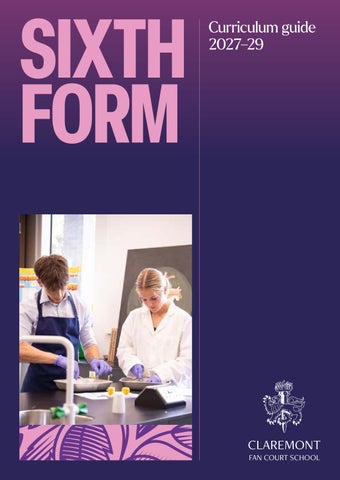
SIXTH FORM
Curriculum guide 2027–29
Contents Welcome Sixth form community Studying at Claremont Success in numbers University destinations
1 Entry requirements and Subject choices 2 Subject list 5 Sixth form academic 10 prerequisites summary 12 Expectations for entry and progression
14 15 80 82
Welcome
Discover your limitless potential
James Grabowski Head of sixth form
Welcome to Claremont’s sixth form, a community where you will be supported to achieve more than you imagined. Welcome to Claremont’s sixth form, a place where ambition is nurtured, individuality is celebrated, and every student is encouraged to discover what they are truly capable of. These final years of school are about so much more than choosing A level subjects. They are an opportunity to deepen academic interests, explore new ideas, embrace leadership opportunities and develop the confidence, independence and resilience needed to thrive beyond school. At Claremont, academic success sits alongside personal growth. Our students benefit from expert teaching, small class sizes and individually tailored guidance, enabling them to achieve exceptional outcomes year after year. More than half of all A level grades are awarded at A-A*, with 98% of students securing their preferred university destination.
98% claremont.net
of students secured their preferred university
Beyond the classroom, students become part of a vibrant and supportive community. Set within our beautiful 100-acre campus, and supported by our dedicated sixth form team, they enjoy an environment designed to promote both academic focus and personal wellbeing. Opportunities extend far beyond examination study. Through leadership roles, an extensive co-curricular programme, the Joyce Grenfell Programme, work experience, enrichment activities and personalised futures guidance, students are encouraged to pursue their passions, broaden their horizons and prepare for the opportunities ahead. Whether your ambitions lead to a competitive university place, a sought-after degree apprenticeship or a career yet to be imagined, Claremont’s sixth form provides the support, challenge and encouragement to help you take the next step with confidence. We invite you to discover your limitless potential and become part of a community where curiosity is celebrated, aspirations are raised and every individual is empowered to flourish.
Claremont
1
Sixth form community
Helping students to thrive
One of the things we value most about Claremont is that success is about much more than examination results. Sixth form is a time to challenge yourself academically, but it is also a time to grow in confidence, become more independent and discover what you are capable of achieving. Our 100-acre campus provides a fantastic environment in which to learn. From specialist laboratories and creative spaces to our recently extended sixth form centre, there are plenty of opportunities to study, collaborate and spend time with friends. What really makes the difference, though, is the support we receive from our teachers and tutors. They genuinely care about each student as an
Pupils are tolerant and respectful. They recognise their responsibilities towards others in a global world. Through the curriculum and pastoral systems, leaders foster a learning environment where pupils share a sense of belonging.
One of the things we value most about Claremont is the balance between independence and support. We are encouraged to take responsibility for our learning and make our own decisions, knowing there is always guidance available when we need it. School captains
individual and are always willing to offer guidance, encouragement and extra help when needed. The relationships we build with staff are a huge part of what makes sixth form here such a positive experience. The balance of lessons and independent study gives us the opportunity to take greater responsibility for our learning and develop the skills that will help us beyond school. Subject drop-ins, enrichment opportunities and a wide range of co-curricular activities mean there is always something to get involved in and explore further. Alongside academic study, there is a strong focus on personal development. Tutor time, PSHEE, careers guidance and pastoral support ensure that every student is known, supported and encouraged throughout the sixth form journey. With smaller class sizes and personalised support, we are given the confidence to aim high, embrace new opportunities and prepare for the next stage of our lives. Each year, students from other schools join us and quickly become part of the Claremont community. New friendships form easily, and everyone is encouraged to make the most of the opportunities available, creating a welcoming and supportive environment.
ISI Inspection Report 2024 2
Claremont
Sixth form curriculum guide 2027–29
We are Megan and Kieran, and together with our Vice Captains, Amelia and Annabelle, we are honoured to serve as the school captaincy team this year. Throughout our time at the school, we have taken part in a wide range of opportunities both inside and outside the classroom. From academic studies and sporting events to performances, leadership roles, and community activities, these experiences have helped us develop valuable skills and create lasting memories. We hope this guide helps you picture what your own sixth form journey could look like at Claremont, and we look forward to welcoming you into our community in the future.
The sixth form gives us the freedom to grow in confidence and become more independent, while still being part of a close-knit and supportive community where everyone wants each other to succeed. School captains
Wednesday afternoons are one of our favourite parts of the week. They give us the chance to step away from the classroom, try something new and spend time with friends, whether that’s playing pickleball, taking part in Pilates or representing Claremont in senior sports teams. Sixth form student
Image: Megan and Kieran, school captains
claremont.net
Claremont
3
Leadership opportunities Leadership is a defining part of the sixth form experience at Claremont. Whether through formal positions of responsibility, mentoring younger pupils, leading initiatives, organising events or representing the school, students are encouraged to make a meaningful contribution to the community around them. We believe leadership comes in many forms. Some students lead from the front, while others make a difference through quiet encouragement, collaboration and service. Whatever their strengths, students are supported to develop the confidence, resilience and interpersonal skills that will serve them well beyond school.
Leadership opportunities at Claremont have helped us develop confidence, communication skills and a sense of responsibility. Whether leading assemblies, representing the school or mentoring younger pupils, there are countless ways to make a meaningful contribution. School Captains the future direction of the school. These roles provide valuable experience of leadership and collaboration, while ensuring that student voice remains at the heart of the Claremont community. At Claremont, leadership is about more than holding a title. It is about embracing opportunities, supporting others and developing the skills to make a positive impact within the school community and beyond.
Through leadership opportunities, students develop their communication skills and oracy, learning to present ideas with confidence, lead assemblies, speak to a range of audiences and represent the school as ambassadors at events throughout the year. Students are encouraged to take initiative, helping to shape wider school life. Working alongside their peers, students learn to collaborate effectively, solve problems creatively and take responsibility for their decisions. These experiences not only enrich sixth form life, but also help students develop the skills, confidence and character that stand out in university, apprenticeship and employment applications. Year 13 students have the opportunity serve within the prefect team, with senior prefects and school captains playing an important role in leading the student body and helping to shape
4
Claremont
Sixth form curriculum guide 2027–29
Studying at Claremont
Academic excellence With more than 30 subjects on offer in the sixth form, Claremont provides the breadth and flexibility for students to shape a programme that reflects their interests, strengths and aspirations. Our approach combines academic rigour with highly personalised support, ensuring that every student is challenged, encouraged and inspired to achieve their full potential. Small teaching groups allow teachers to know each student exceptionally well, tailoring their approach to individual needs while fostering meaningful academic discussion and engagement.
Pupils are motivated to learn and produce high quality work. ISI Inspection Report 2024
Students make good progress over their time in the school. They achieve increasingly well at GCSE and A level because of the effective support and guidance provided by teachers. ISI Inspection Report 2024
A strong culture of scholarship runs throughout the sixth form, with a clear focus on subject mastery, critical thinking and intellectual curiosity. Students are encouraged to explore their subjects in depth, develop independent learning habits and engage confidently with complex ideas, preparing them for the demands of higher education and beyond. Academic aspirations are nurtured from the moment students join the sixth form. Through expert teaching, guidance and a relentless focus on progress, students are supported to aim high and achieve ambitious outcomes. This commitment to excellence is reflected in our consistently strong results, with outcomes continuing to strengthen year on year. Academic success at Claremont is about more than examination results. It is about developing independent thinkers, effective communicators and resilient young adults who are well prepared for the opportunities and challenges that lie ahead. claremont.net
Whether progressing to leading universities, specialist institutions, degree apprenticeships, oversees, or other exciting pathways, our students leave Claremont equipped with the knowledge, skills and self-belief to thrive in the next stage of their journey. Claremont
5
Academic enrichment Academic Enrichment is your opportunity to go beyond your A level studies, challenge yourself intellectually and explore subjects that genuinely interest you. Whether you want to pursue a passion that did not fit into your GCSE choices, discover an entirely new area of learning or delve deeper into a subject you already love, these opportunities will broaden your horizons and cultivate your curiosity. The courses and qualifications on offer are designed to stretch and inspire. They encourage independent thinking, engagement with complex ideas and the confidence to tackle new challenges. Along the way, you will develop valuable skills and gain recognised qualifications that can strengthen university, apprenticeship and future career applications.
to their chosen subjects while developing the breadth of knowledge and critical thinking skills that distinguish strong applications. The Joyce Grenfell Programme forms an important part of this journey and all students will choose one of its courses. At Claremont, we believe that academic enrichment beyond A levels is an essential part of sixth form life. It enables students to explore their interests in greater depth, develop a wider perspective and prepare themselves for success at university and beyond.
Academic enrichment at Claremont extends beyond the Joyce Grenfell Programme. A wide range of lunchtime co-curricular opportunities enable students to explore their interests further through activities such as Model United Nations, Scholars’ programmes and subject-specific societies. Whether joining economics society, medicine society, history of science society, politics society or other academic forums, students have opportunities to debate current issues, engage with wider reading and deepen their understanding beyond the curriculum. Universities increasingly look for students who demonstrate intellectual curiosity, initiative and a genuine enthusiasm for learning beyond the classroom. Through enrichment opportunities, academic societies and super-curricular engagement, students can show a commitment
6
Claremont
Working on an EPQ encourages students to develop research and academic skills relevant to undergraduate study. University of Oxford Sixth form curriculum guide 2027–29
Personalised pathways At Claremont, we recognise that every student has different strengths, interests and aspirations. That is why we offer flexible pathways designed to help each individual achieve their goals and make confident choices about their future. Most students study three A levels, although programmes are tailored to reflect individual talents and ambitions. With expert guidance from experienced teachers and tutors, students are supported in selecting a combination of subjects that provides both challenge and opportunity for success. Many students begin sixth form studying four subjects, allowing them time to explore their interests before refining their programme. For some, this may include a combination of A levels and Level 3 applied diplomas, creating a pathway that reflects their preferred learning style and future aspirations. Throughout sixth form, students receive personalised academic guidance to help them make informed decisions, maximise their potential and prepare for their next steps, whether that be university, an apprenticeship or another exciting destination. At the heart of our approach is a simple belief: every student’s journey is unique, and their sixth form experience should be too.
claremont.net
The teachers are passionate about their subjects and always go the extra mile to help us achieve our best. School Captains
Claremont
7
Student futures Preparing students for life beyond Claremont is a central part of the sixth form experience.
Support is highly personalised and includes: • Individual careers and higher education guidance. • A programme of visiting speakers, workshops and industry insights. • Claremont’s annual Careers Evening, connecting students with universities, employers and alumni.
Our dedicated Student Futures team, who are located in the heart of the campus, provides expert guidance, personalised support and meaningful opportunities to help every student take confident next steps towards their chosen future.
• Year group-specific talks, experiences and visits.
Whether a student aspires to study at a leading university, pursue a degree apprenticeship, enter a competitive profession or explore a pathway that is entirely their own, our experienced team of teachers and dedicated Student Futures advisers work closely with each individual to help them make informed decisions and realise their ambitions. Support begins early in the sixth form and continues throughout the entire application process, from exploring pathways and drafting applications through to results day and beyond.
• Personal statement guidance and application mentoring.
• Specialist support for UCAS applications, including Oxbridge, Medicine, Dentistry and Veterinary Science.
• Interview preparation and coaching. • Access to our growing alumni network. • Support in securing meaningful work experience opportunities. • Access to Unifrog, helping students explore pathways, compare destinations and build successful applications. Our approach goes beyond helping students submit UCAS applications. We encourage them to explore opportunities and make confident, ambitious decisions about their future. From personal statements to offers, apprenticeships and results day, students are supported every step of the way.
The support we receive for university, apprenticeship and career applications is incredibly valuable.
By the time they leave Claremont, students have a clear sense of direction and the skills to succeed. Many also stay connected through our alumni network, benefiting from ongoing advice, support and connections beyond school.
School Captains 8
Claremont
Sixth form curriculum guide 2027–29
Student support and wellbeing At Claremont, wellbeing and personal development are central to the sixth form experience. Experienced tutors and pastoral staff ensure students develop confidence, resilience and independence as they mature. Academic progress is closely monitored through regular assessments and formal review reports each term, ensuring students receive the right level of stretch and challenge needed to achieve their goals. Through daily tutor contact, dedicated wellbeing initiatives and personalised guidance, students are supported to thrive both during sixth form and beyond.
Sixth form has helped us become more confident, independent and prepared for our next steps. School Captains
Pupils’ wellbeing is prioritised and systematically promoted. ISI Inspection Report 2024
Broadening horizons
Co-curricular
Residential visits and educational trips enrich learning by bringing the classroom to life. From skiing adventures and cultural exchanges to international tours in destinations such as Berlin, Morocco and Washington, students gain valuable experiences that broaden their perspectives and deepen their understanding.
Learning at Claremont extends beyond the classroom, with a varied co-curricular programme that encourages students to explore interests, discover new passions and develop new skills.
These opportunities help develop independence, resilience and cultural awareness, preparing students for higher education, future careers and life beyond school.
claremont.net
Students are encouraged to take part and lead, whether through sport, the arts, academic societies, leadership roles or community projects. Through these opportunities, they build confidence, form lasting friendships and make a positive contribution to the wider community.
Claremont
9
Success in numbers 2026 – Our best results ever!
21% 53% 82%
Grade A*
Grades A*–A
I’m immensely proud of our students for achieving over 50% A*–A, our best results yet. Their determination has opened doors to top universities, apprenticeships and exciting opportunities. William Brierly, Head
Grades A*–B
Scan to view the results day video 10
Claremont
Sixth form curriculum guide 2027–2029
Perfect performance
100%
A*–A Classical Civilisation
Seeing the success of the Year 13’s with their results and the university placements, we know that Claremont gives us the skills and support to go for anything! James, School Captain 2025-2026
100% 98% 82% claremont.net
100%
A*–A Computer Science
100%
A*–A Further Maths Pass rate
Preferred university Of placements are with Russell group
Hearing about the grades and amazing results really reassures me. We know that with the support of our teachers, we’ve got this! Current sixth form student
Claremont
11
University destinations Our 2026 A level students are heading off to study inspiring subjects at leading institutions. Explore the map to see where their Claremont journey has taken them. 7
16 5
29
International 12
University of Milan, Italy
14 15
Springfield College, Massachusetts, USA 8 4
Location key University Specialist institutions
12
Claremont
18 19 13 2
Trinity College, Dublin
Russell Group University
21
6
25
28 9 26 23
3 27 17 1 22
10
24
20
Sixth form curriculum guide 2027–29
University 1 Bath • International Management & Modern Languages 2 Birmingham • Business Management • PPE 3 Bristol • Business and Management • Criminology • Design Engineering • Economics and Finance • Veterinary Nursing 4 Cardiff • Architecture • Psychology 5 Durham • Anthropology • Biological Sciences • Physics 6 Exeter • Accounting and Business • Business and Management • Conservation Biology and Ecology • Film and Television Studies • Finance • Marketing and Management • Media and Communications • Physics with Astrophysics • Sociology 7 Glasgow • International Relations 8 Hartpury • Sports Business Management 9 King’s College London • Artificial Intelligence • Business Management • Physics
claremont.net
10 Kent • Business and Management 11 Leeds • Fashion Design Innovation • International History and Politics • International Relations • Sport and Exercise Sciences 12 Liverpool • Sociology and Politics 13 Loughborough • Graphic Design • Marketing • Mathematics • Psychology • Sport Management • Sport Science, Coaching and Physical Education 14 Manchester • Chinese and Business & Management • Economics • Law • Liberal Arts • Politics and Spanish • Psychology 15 Manchester Metropolitan • International Business Management 16 Newcastle • Business Management • International Relations 17 Norland • Early Childhood Education and Care 18 Nottingham • Biomedical Sciences • Business and Management • Chemical Engineering • History • Law • Neuroscience • Politics and International Relations • Psychology
19 Nottingham Trent • Business Management • Business Management and Marketing • Fashion Marketing and Branding 20 Plymouth • Marine Biology 21 Sheffield Hallam • Real Estate 22 Southampton • Business and Artificial Intelligence • Economics and Finance • Fashion Marketing • Politics and International Relations • Psychology 23 St George’s, University of London • Medicine 24 Sussex • Geography, Sustainable Development and Climate Change 25 East Anglia (UEA) • Economics and Finance 26 University of the Arts London • Fine Art 27 West of England (UWE Bristol) • Law 28 Warwick • Accounting and Finance • PPE • Accounting and Finance • Economics and Politics • International Relations • Neuroscience 29 York • Sociology
Claremont
13
Entry requirements For Claremont Senior School pupils, progression into the sixth form is a natural next step. Places are guaranteed, subject to meeting the required entry criteria and individual course prerequisites. Because our teachers already know our students well, they are able to provide personalised guidance and support, helping them select subjects and pathways in which they will thrive. For students joining Claremont from other schools, the admissions process includes an interview, assessment and experience day, providing an opportunity to meet staff, experience A level taster lessons and explore sixth form life. This allows us to understand each student’s aspirations and help design a programme that is the right fit for them.
Our standard entry requirements are: •
Eight GCSEs at Grade 6 or above, including English and mathematics.
•
A supportive reference from the student’s current school.
In general, entry to a subject also requires: •
A strong GCSE grade in that subject, or in a closely related subject if it is new to the curriculum.
•
Most courses require at least a Grade 6 or 7 at GCSE (please refer to individual subject pages for specific requirements).
Subject choices Choosing your sixth form subjects is an exciting step, and we are here to help you make informed decisions that reflect your strengths, interests and future ambitions.
If grades do not quite meet the entry requirements for a chosen course, students may be invited to discuss alternative pathways with the relevant Head of Department to ensure they are on a programme that best supports future success. Top tips for choosing your subjects: • Choose subjects you enjoy and in which you perform well. • Consider future university, apprenticeship and career aspirations. • Aim for a balanced combination of skills and interests. • Explore new subjects through research, discussions and taster sessions. • You are encouraged to start with four subjects before refining your programme to three.
14
Claremont
Sixth form curriculum guide 2027–29
Subject list Art & design: fine art
16 French
49
Art & design: photography
19 Geography
51
Art & design: textile design
22 German
53
Biology
24 History
55
Business
25 Mathematics
57
Chemistry
27 Further mathematics
59
Classical civilisation
28 Media studies
61
Computer science
30 Music
63
Criminology
32 Physical education
65
Design and technology: product design
34 Physics
67
Drama and theatre
35 Politics
69
Economics
37 Psychology
71
English language
39 Religion, philosophy & ethics
74
English literature
40 Sociology
76
Film studies
42 Spanish
78
Food science & nutrition
44
claremont.net
Claremont
15
Subjects
Art and design: fine art Art and design: fine art A level (9fa0) Head of department: Mrs E Williams Exam board: Pearson Edexcel Course prerequisites Subject specific GCSE grade 6 Additional subject(s) GCSE grade: NA
Why study A level fine art? If you are creative, reflective and disciplined then you should consider studying fine art. Visual analysis and creativity is a form of intelligence and can be developed and trained like any other. If you wish to acquire and further develop skills in traditional and contemporary forms of drawing, painting, sculpture and printmaking, as well as an understanding of aesthetics and art criticism, then this may be the subject for you. Whilst this is a practical course, intellect is important. Students will need to be imaginative and demonstrate enthusiasm for exploring original ideas and the potential of materials. You will also need the determination to develop your draftsmanship skills and will have been awarded at least a grade 6 for GCSE Fine Art. A good standard of written English is required for the two year A level course. Fine art at this level complements many other subjects and affords you a lifelong understanding of the subject.
Course outline Over the two year A level course there are two components. Component one is coursework and is worth 60% of the course, component two is an externally set assignment and is worth 40% of the course.
16
Claremont
Sixth form curriculum guide 2027–29
Subjects
Year 12 fine art The first year of the A level course is structured to help students develop skills in a range of media; form an understanding of historical and contemporary artists’ practice; and engage in creative exploration and development. Emphasis is placed on drawing and critical analysis as a foundation for all further study. Students will be taught how to articulate using specialist vocabulary and include written annotations in their sketchbooks. Life drawing classes for Year 12 will run each week throughout the autumn term then after school sessions will be offered to work on coursework outcomes and component two preparation.
Year 13 fine art The A level course provides students with the opportunity to concentrate on developing a specialist and sophisticated portfolio of work that demonstrates high order visual language skills. Students will investigate conceptual ways of working and expand their understanding of the theories of art. Students will be taught written visual analysis skills and will need to write a critical and contextual essay in Year 13. The A level course enables students to develop an understanding of good creative practice naturally, to be ambitious and adventurous and to pursue individual areas of interest in a medium which suits their strengths.
Presenting your work Sixth form students have work featured in the end of year exhibitions at school. As part of this examination, students’ work is presented to the exam subject moderator. Applicants for art school or architecture will prepare a portfolio during the autumn term to take to interview.
claremont.net
Engagement with the course Students in both years will be expected to visit museums and art galleries in their own time to provide a focus for research and regularly attend life drawing classes in the department in addition to timetabled lessons.
Content and structure of the A level Component 1: Personal investigation NEA (Non-Examination Assessment) 60% of qualification Students produce a practical portfolio of coursework focusing on one or more of the fine art disciplines, for example: drawing and painting, mixed-media, sculpture, print-making, installation. The use of moving image and photography may be possible, though it is likely that students with a particular interest in this at Claremont will have opted for Photography A level. Coursework is carried out throughout Year 12 and in the autumn term of Year 13.
Claremont
17
Subjects
As part of this component, students produce a critical and contextual essay of 3000 words produced in the autumn term of Year 13. This essay is marked separately from the practical work but should relate to the practical work in terms of the ideas and use of media explored. Component 2: 40% of qualification ESA (Externally Set Assignment) This is seen as the culmination of the course. Students are issued with an examination paper in February and spend approximately 10 weeks producing a body of practical work in response to the theme set by the awarding body. Students then undertake 15 hours of sustained unaided focus under examination conditions. At this time, they produce a final response to their ESA portfolio. All work produced in the preparatory period and the timed examination is submitted for component 2.
Assessment All work will be internally marked in school by your subject teachers at the end of the course. A selection of students’ work will then be moderated by a visiting moderator.
Future pathways Fine art, with its emphasis on drawing and broad creative thinking provides a highly desirable portfolio for entry to Foundation courses from where specialisation in any one of many different branches of art and design is then decided. Students with a strong portfolio and confidence in their career path may choose to apply directly to a degree course after A level. Direct entry students will again find fine art very suitable for many art related courses. Other than being a freelance artist, students may wish to pursue directly related careers in: graphic design, interior design, product design, animation, architecture, advertising, costume design, curatorial work, art criticism, computer aided design, fashion, art history, illustration, museums and galleries, restoration, theatre design, teaching and lecturing amongst others. Those who go on to work with their hands, such as aspiring medics and surgeons, often find art an enjoyable addition to other choices. A level Fine Art is on the preferred option list for most undergraduate architecture courses and is also considered an academic subject by red brick universities. An understanding of, and appreciation for, visual culture and the ability to think creatively complements many combinations of academic subjects at A level and is widely respected both by universities and employers.
18
Claremont
Sixth form curriculum guide 2027–29
Subjects
Art and design: photography Art and design: photography (9py0) Head of department: Mrs E Williams Teacher in charge: Mrs H Bradshaw Exam board: Pearson Edexcel
Course outline Over the two year A level course there are two components. Component one is coursework and is worth 60% of the course, component two is an externally set assignment (ESA) and is worth 40% of the course.
Course prerequisites Subject specific GCSE grade 6 (if taken at GCSE) Additional subject(s): GCSE Fine Art grade 6 (or suitable portfolio)
Who should study A level photography If you are inquisitive and reflective and are excited by lens-based art work, then you should consider studying photography. If you wish to acquire skills in digital photography; computer aided image manipulation and chemical photography, as well as an understanding of aesthetics and art photography criticism, then this is the course for you. Students will need to be imaginative and demonstrate enthusiasm and patience for all photographic genres. Those who opt for this course would benefit from having studied photography or art at GCSE, but it is not a requirement. A good level of written English is needed for the A level course.
claremont.net
Year 12 photography The Year 12 course is structured to help students develop skills in a range of lens-based media; form an understanding of historical and contemporary photographers’ practice; and engage in creative exploration. Emphasis is placed on technical skills and critical analysis as a foundation for all further study. Students will be taught how to use specialist vocabulary and how to log their ideas in presentation folders.
Claremont
19
Subjects
Year 13 photography
Content and structure of the A level
In Year 13, students have the opportunity to concentrate on developing a specialist and sophisticated portfolio of work that demonstrates high order technical skills. Students will investigate conceptual ways of working and expand their understanding of the theories of art photography through extensive research. Students will be taught written visual analysis skills and will need to write a critical and contextual essay in Year 13. The two year course enables students to develop a full understanding of good photographic practice; to be ambitious and adventurous and to pursue individual areas of interest.
Component 1: 60% of qualification NEA (Non-Examination Assessment)
Presenting your work Students’ work is featured in the end of year exhibition in the mansion. Exam candidates’ work is also presented to the exam moderator.
Engagement with the course Students will be expected to visit public and private galleries in their own time to provide a focus for research. An SLR camera is an instrument and as such students must regularly practice with it; get to know its capabilities; and understand the importance of caring for an instrument personally. As such having access to one’s own digital SLR camera is a requirement of the course. The department can advise on a suitable SLR to purchase. In addition, the department has a number of SLR and DSLR cameras which may be used in class and on the school site.
20
Claremont
A practical portfolio of work in one or more disciplines. Work produced in the Year 12 and the autumn term of the Year 13 will contribute towards component 1. This portfolio is complemented by a 3000-word contextual essay produced in the autumn term of the Year 13. The essay is presented and marked separately but should link to the practical investigation of the work produced in Year 13 for coursework. Component 2: 40% of qualification ESA (Externally Set Assignment) This is seen as the culmination of the course. Students are issued with an examination paper in February and spend approximately 10 weeks producing a body of practical work in response to the theme set by the awarding body. Students then undertake 15 hours of sustained unaided focus under examination conditions. At this time, they produce a final response to their ESA portfolio. All work produced in the preparatory period and the timed examination is submitted for component 2.
Sixth form curriculum guide 2027–29
Subjects
Assessment All work will be internally marked in school by your subject teachers at the end of the course. A selection of students’ work will then be moderated by a visiting moderator.
Future pathways Photography is not just for those who wish to continue their study at higher education level. For those who do, students may choose to opt for a one-year foundation level course or those with a particularly strong portfolio may choose to apply directly to a degree course after A level. Students may also wish to pursue careers in: photography, animation, advertising, computer aided design, editing, fashion, film, graphic design, illustration, interior design, museums and galleries, photojournalism, teaching and lecturing amongst others.
claremont.net
Claremont
21
Subjects
Art and design: textile design Art and design: textile design A level (7204) Head of department: Mrs E Williams Teacher in charge: Ms M Ritchie Exam board: AQA Course prerequisites Subject specific GCSE grade 6 (if taken at GCSE) Additional subject(s): GCSE Fine Art grade 6
Who should study A level textile design? Students will explore a range of textile media, techniques and processes. Students can develop skills using both traditional and new media. Students explore drawings for different purposes and relevant images and resources relating to a range of art and design topics, gaining inspiration from both historical and contemporary fashion and textile artists and designers. The emphasis is on primary research to inspire design development; therefore, the students should visit a variety of exhibitions and galleries over the two year course. Students can work in a variety of areas of textile design such as those listed below. They may explore overlapping areas and combinations of areas. • Fashion design • Fashion textiles • Digital textiles • Printed and/or dyed fabric and materials • Domestic textiles and wallpaper • Interior design • Constructed textiles • Art textiles • Installed textiles
22
Claremont
Sixth form curriculum guide 2027–29
Subjects
Content and structure of the A level Unit 1: Personal investigation NEA (Non-Examination Assessment) 60% of the A level mark (96 marks) –7204/C Early Year 12 work embarks on teacher-led workshops to build up a breadth of ambitious techniques. This then leads the students into their own sub-themes, which then will build deeper conceptual links for their extended coursework project. For this, students conduct a personal investigation into ideas, issues, concepts or a theme leading to a finished outcome or a series of related finished outcomes. This unit gives students the opportunity to derive their own topic or area of study to investigate further. They will study textile designers, artists, fashion photographers, craftspeople and the wider visual arts to develop their ideas. This is supported by a written element of 1000–3000 words. This unit culminates in the development of creative and inventive final outcomes. Unit 2: Externally Set Assignment (ESA) 40% of the A level mark (96 marks)–7204/X The preparation period is followed by a 15-hour supervised outcome. Students will select one starting point from a range provided by the AQA awarding body. Students develop in-depth research responding to the brief using a wide variety of experimental textiles. Students must demonstrate their ability to work independently within specified time constraints, developing a personal and meaningful response that leads to a finished outcome or a series of related finished outcomes. The work produced will be presented in a sketchbook and on presentation boards and this will result in the students using their research and design development to construct a final outcome in a fifteen-hour supervised task. The fifteen hours of supervised time will be undertaken over 3 days. There is an exhibition of the students’ work at the end of the course. claremont.net
Future pathways Textile design combines both the aesthetic aspects of art and the practical work of designing and making. Design has become a wellrespected industry for its structured creativity and in business and commerce for its use of brainstorming, analytical and evaluation techniques. The various fields within this discipline continue to expand daily and this A level will provide a sound foundation for anyone considering a career in fashion, costume, theatre and textile design and related industries. Students have progressed to university and studied a wide range of courses including fashion design, marketing and communication, fashion photography, art history, 3D theatre design and textiles and innovation.
Claremont
23
Subjects
Biology Biology A level (a400qs) Head of department: Mr A Boothe Exam board: Eduqas Course prerequisites Subject specific GCSE Biology grade 7 (GCSE Combined Science not recommended) Additional subject(s) GCSE grade: NA
Who should study A level biology? It is rare to pick up a newspaper these days and not to find an article or discussion about a biologically related issue. Whether the issue is MRSA superbugs, COVID, designer babies or the cloning of embryos, an understanding of biology has never been so important. Diverse issues such as global warming and fertility treatment are brought together in this important discipline. It could be argued that biology is the fastest moving field in science today. With a qualification in biology, you can go on to higher education to follow a degree course in biology, environmental sciences, medicine, botany, ecology, physiotherapy, genetics, dietetics and ophthalmics as well as appreciating biology as a valuable subject in itself. The course aims to develop interest in, and enthusiasm for, biology that could lead in turn to further study and a career in biology. This popular A level will suit students who are passionate about being deeply informed about the world we live in and its future.
24
Claremont
Content and structure of the A level Students follow the Eduqas/WJEC A level Biology course. The A level course is divided into three components. All components are assessed via external examination at the end of the course. The practical endorsement is teacher assessed and endorsed internally. The components covered are as follows: Component 1 – Energy for life: Importance of ATP, photosynthesis, respiration, microbiology, ecosystems and human impact on the environment. Component 2 – Continuity of life: Evolutionary history of organisms, inheritance of genetic information, sexual reproduction in plants and animals, genetics, variation and evolution. Component 3 – Requirements for life: Adaptations for gas exchange, transport and nutrition, homeostasis, the kidneys and the nervous system. Immunology and disease, human musculoskeletal anatomy, neurobiology and behaviour.
Future pathways Studying A level Biology opens the door to a wide range of future pathways. It provides an essential foundation for higher education courses in: medicine, dentistry, veterinary science, nursing, biomedical sciences, environmental science and biological research. Beyond university, biology supports careers in: healthcare, pharmacology, biotechnology, conservation, forensic science and education. The subject develops analytical, practical and critical thinking skills that are highly valued across both STEM and non-STEM professions.
Sixth form curriculum guide 2027–29
Subjects
Business Business A level (9bs0) Head of department: Mr N Rocca Exam board: Pearson Edexcel Course prerequisites Subject specific GCSE Business grade 6 (if taken at GCSE). Additional subject(s): GCSE English grade 6 & GCSE Maths grade 6
Who should study A level business? A level Business is suitable for students who want to gain an understanding of the functions of organisations both small and large. Students will gain a holistic understanding of business through considering how a new idea is developed, understanding how an organisation is managed, how its performance is analysed and how it could trade overseas.
claremont.net
Content and structure of the A level The first year of the course covers the characteristics students need to develop to be successful in business and explores how new or existing businesses generate their product or service ideas and test them through market research. Students will study the different approaches to marketing and human resource management. The course also includes the financial issues faced in setting up and managing a business whether small, medium-sized or large. It introduces students to financial and production management tools and models. There is also basic consideration of wider issues facing businesses such as government legislation and economic factors. The second year of the course builds on all elements of the first year but explores these concepts in greater detail and at a higher level. In addition, there are sections on the theme of global business and strategic decision making. There is greater consideration of the wider economic environment and students will be expected to carry out more complex mathematical calculations and interpretations of their results.
Claremont
25
Subjects
Examinations
Future pathways
At A level there are three final examinations that include one overall synoptic paper. In comparison to GCSE there is more emphasis on extended writing in addition to data response questions. One of the final A level examination papers will also include a pre-examination research task based on a particular market or industry.
Business A level provides an excellent foundation to a wide range of higher education business and management courses. It also provides a solid platform for students who wish to enter employment immediately after A level or undertake an apprenticeship programme. It may lead to any number of business related career pathways including professional options such as accountancy, marketing or events management.
Subject combinations Students will be expected to answer questions with a mathematical element. Specifications state that quantitative questions will be a minimum of 10% of examination questions. A level Business links with any number of subjects including mathematics, English, languages and other social science subjects such as history and geography. There are also a number of students who take the option along with creative subjects. Students are required to attain a minimum grade 6 in GCSE mathematics, a grade 6 in one English subject and a grade 6 in GCSE Business where chosen as an option.
26
Claremont
Sixth form curriculum guide 2027–29
Subjects
Chemistry Chemistry A level (h432) Head of department: Mrs R Michael Exam board: Cambridge OCR Course prerequisites Subject specific GCSE Chemistry grade 7 (GCSE Combined Science not recommended) Additional subject(s): GCSE Maths grade 7
Who should study A level chemistry? Chemistry is known as the ‘central science’ because it helps to connect the physical sciences such as mathematics and physics with applied sciences like biology, engineering and medicine. Students who have scientific curiosity and are keen to develop a deeper understanding of the world we live in opt for A level Chemistry.
Skills gained Students will develop competence and confidence in a variety of practical, mathematical and problem solving skills. They will also acquire a set of transferable skills such as written and oral reporting, analysis and evaluation and computing and data handling, which are desired by both the scientific community and a huge range of prospective employers.
claremont.net
Content and structure of the A level Students follow the Cambridge OCR A level Chemistry course. At A level, there are three papers and a practical endorsement which is a Non-Examination Assessment (NEA) carried out internally throughout the duration of the two-year course. A level
Weighting
Topics
Paper 1
37%
Atomic structure, Periodic Table, elements and physical chemistry
Paper 2
37%
Modern analytic techniques, organic chemistry of aliphatic molecules, arenes and organic synthesis and analysis
Paper 3
26%
Structured questions and extended response questions covering theory and practical work.
Future pathways Chemistry is one of the few subjects that underpins a wide range of science-based degrees courses and careers. Success in A level Chemistry will prepare students for a future in careers such as: medicine, chemical engineering, toxicology, biochemistry, biomedical sciences, pharmacy and dentistry. It is also a highly regarded A level for those intending to apply to study other academically rigorous subjects such as law and to become an actuary, as well as good training for careers in journalism, business and finance and much more.
Claremont
27
Subjects
Classical civilisation Classical civilisation A level (h408) Teacher in charge: Mr J Banham Exam board: Cambridge OCR
Content and structure of the A level The A level consists of 3 components, with all of the course texts studied in translation: The World of the Hero – 40%
Course prerequisites
2 hour, 20 minutes
Subject specific GCSE grade: NA
Homer’s epic poems stand at the very beginning of the Western literary canon and were considered by the Greeks themselves to be a foundational aspect of Greek culture. This component provides learners with the opportunity to appreciate the lasting legacy of the Homeric world and to explore its attitudes and values. Homer’s Odyssey, set in Bronze Age Greece, details the troubled homecoming of the wondrously complex hero, Odysseus and the fantastical obstacles he overcomes. This component also provides an opportunity to study Virgil’s Aeneid, the great Roman epic and another cornerstone of Western literature. Students will also closely examine Rome during the reign of its first emperor, Augustus, as the cultural and political context of this fascinating period had great influence on Virgil’s work.
Additional subject(s): GCSE English grade 6
Who should study A level classical civilisation? Classical civilisation is a subject unique in its wide-ranging and interdisciplinary nature. In studying the classical world of Ancient Greece and Rome we explore the fascinating literature, history, politics, drama, art, mythology and philosophy of these two hugely influential civilisations. As a result, classical civilisation has a broad appeal to students with a range of skill sets and interests. Classical civilisation pairs well with the study of other humanities or essay-based subjects, such as history, English literature, philosophy, languages and politics. But it can also provide valuable balance and breadth of study alongside the traditional STEM subjects.
28
Claremont
Sixth form curriculum guide 2027–29
Subjects
Culture and the Arts: Greek Theatre – 30% 1 hour, 45 minutes The drama produced in the ancient Greek theatre forms some of the most powerful literature of the ancient world and has had a profound and wide-reaching influence on modern culture. To fully understand this cultural phenomenon requires study of not only the plays, but the context in which their form and production developed. Students will examine the social, political and religious themes within comedy and tragedy to discover more about democracy in Classical Athens and the Athenians themselves. The three plays studied in depth are Sophocles’ Oedipus the King, Euripides’ Bacchae and Aristophanes’ Frogs, all of which have proven to be enduring favourites and are still regularly performed around the world. Beliefs and Ideas: The Politics of the Late Republic – 30% 1 hour, 45 minutes The Politics of the Late Republic module offers students a fascinating exploration of one of the most dramatic periods in Roman history. Focusing on the years between Sulla’s retirement in 79 BC and the death of Cicero in 43 BC, this course examines how political tension, ambition and competing ideologies contributed to the collapse of Rome’s republican system and the rise of imperial rule. Students will engage with the lives and ideas of titanic Roman figures such as Cato, Caesar and Cicero, analysing their beliefs, rivalries and strategies, and considering how individuals shaped, and were shaped by, the political landscape. Alongside this, they will study central features of the Roman state, including elections, assemblies, the senate and the cursus honorum, gaining a clear understanding of how Roman politics functioned in practice.
claremont.net
The module emphasises critical thinking through close analysis of primary sources, including Cicero’s courtroom speeches and personal letters. These bring the period vividly to life, allowing students to encounter political debate at first hand. Ideal for students interested in history, politics or literature, this component develops analytical skills, independent judgement and an appreciation of how ancient ideas continue to resonate in the modern world.
Examinations The A level is a two year course with the three exams sat at the end of Year 13.
Future pathways A successful student of Classical Civilisation A level is able to analyse and evaluate a broad range of sources to create a clear and convincing argument. This skill is relevant and highly prized in many different fields. Traditionally classicists are drawn to careers in journalism, politics, the legal profession and teaching.
Claremont
29
Subjects
Computer science Computer science A level (h446) Teacher in charge: Mrs G Cox Exam board: Cambridge OCR Course prerequisites Subject specific GCSE grade 6 Additional subject(s): GCSE Maths grade 6
Who should study A level computer science? The importance of computer science, both as a discipline itself and as an ‘underpinning’ subject across science and engineering is growing rapidly. The study of computer science teaches students not just how to use software, but how to create it. It is a practical subject where students can apply the academic principles learned in the classroom to real-world systems. The course values computational thinking and will help students develop the skills to solve problems, design systems and understand the power and limits of human and machine intelligence. The qualification provides an excellent preparation for students who want to go on to study computer science at a higher level and will also provide a good grounding for other subject areas that require computational thinking and analytical skills, which are increasingly valued in the workplace.
30
Claremont
Skills developed Students will develop a range of transferable skills, which will facilitate personal growth and foster cross-curricular links in areas such as mathematics, science and design and technology. Computer science is an extremely creative subject and skills such as problem solving and analytical thinking are developed and refined as students progress through the course.
Content and structure of the A level 01 Computer Systems: This component is a traditionally marked and structured question paper with a mix of question types: short-answer, longer-answer, and levels of response mark-scheme-type questions. It will cover the characteristics of contemporary systems architecture and other areas including the following: • the characteristics of contemporary processors, input, output and storage devices • software and software development • exchanging data • data types, data structures and algorithms • legal, moral, cultural and ethical issues.
Sixth form curriculum guide 2027–29
Subjects
02 Algorithms and Programming: This component is also a traditionally marked and structured question paper with two sections, both of which will include a mix of question types: short-answer, longer-answer, and levels of response mark-scheme-type questions. Section A Traditional questions concerning computational thinking: • elements of computational thinking • programming and problem solving • pattern recognition, abstraction and decomposition
Future pathways A level Computer Science provides a strong foundation for all STEM studies and careers. Students can pursue degrees in: computer science, software engineering, data science, cybersecurity, game development, web development, engineering, artificial intelligence and mathematics. This A level also equips individuals for roles in all technology-driven sectors and careers that require excellent problem-solving skills.
• algorithm design and efficiency • standard algorithms. Section B There will be a scenario/task contained in the paper, which could be an algorithm or a text page-based task, which will involve problem solving. 03 Programming Project (NEA): Students select their own problem of an appropriate size and complexity to solve. This will enable them to demonstrate the skills and knowledge necessary to meet the course’s assessment objectives. Students will need to analyse their problem, design a solution, implement a solution and give a thorough evaluation. Past students’ projects have included online computer games, educational software and an investigation into the generation of glitch art.
claremont.net
Claremont
31
Subjects
Criminology Criminology level 3 applied diploma (4543qd) Head of Department: Miss S Afsar Exam board: Eduqas/WJEC Course prerequisites Subject specific GCSE grade: NA Additional subject(s): GCSE English grade 6
Who should study level 3 criminology? The Eduqas/WJEC Level 3 Applied Diploma in Criminology will provide students with an introduction to criminal justice through a scientific study of criminal behaviour, management and crime prevention. Students will examine the underlying processes which affect what is even considered to be a crime, why some people commit crimes, and which theories are best placed to explain this. There is an emphasis on the study of real-life cases and the applied nature of the course can help students to gain an insight into the workings of the criminal justice system. The curriculum is designed to offer exciting and interesting experiences that focus learning for students through applied learning. There are no subject prerequisites apart from a grade 6 in English GCSE due to the essay writing requirements of the examinations and two 8 hour controlled assessments, one for the Certificate qualification and one for the Diploma.
32
Claremont
Content and structure of the level 3 diploma course In the first year, students will study the following units: Unit 1 Changing Awareness of Crime (controlled assessment): This is an 8-hour controlled assessment taken towards the end of the autumn term which will involve the application of knowledge and understanding to an unseen crime scenario. Students will plan a campaign of change relating to a specific type of crime that is typically underreported. Within the controlled assessment, students will need to address the many consequences of this underreporting and reflect upon how the media representations of crime can raise awareness of this issue within society. There is an analytical and creative element to the assessment as whilst students will reflect on multiple examples of pre-existing campaigns in this area, they will also have to compare these against a campaign they will have created. Part of the campaign creation will involve constructing publicity merchandise, social media postings and website designing to appeal to a specific audience.
Sixth form curriculum guide 2027–29
Subjects
Unit 2 Criminological Theories (external examinations): This unit is externally assessed in a 90-minute examination in May. The focus of this unit is an evaluative understanding of theories of criminality including individualistic, sociological and biological theories of crime. Students will have a range of questions testing their critical appreciation of these theories, as well as an ability to relate these theories to an exam-based scenario. They will also critically reflect on how these theories have informed wider policy initiatives to control crime. At this point, a pass in both units will lead to the student achieving a Certificate in Criminology. To achieve the Diploma, students must also study and pass Units 3 and 4 in the second year. Unit 3 Crime Scene to Courtroom (controlled assessment): This is an 8-hour controlled assessment taken towards the end of the autumn term where students will be assessed on their ability to understand the roles of personnel involved when a crime is investigated and the suspect is apprehended and convicted. Students will need to show that they can effectively evaluate the investigative techniques available to personnel in identifying the culprit. They will also have to follow the journey of the suspect through the court room process, and finally, to the verdict. Students will have to show a critical appreciation of the safeguards in place to ensure that every defendant experiences a fair trial and due process. Unit 4 Crime and Punishment (external examinations): This unit is externally assessed in a 90-minute examination in June. The focus is on the reasons why most people obey the law, and the role of the social institutions devised to uphold the law. There will be a clear focus on what the wider consequences are of a violation of the law, and students will critically analyse the effectiveness of various social control mechanisms in maintaining conformity and preventing recidivism.
claremont.net
Links with other subjects The Eduqas/WJEC Level 3 Applied Diploma in Criminology will provide students with an introduction to criminal justice through the scientific study of criminal behaviour. It is a qualification with elements of psychology, health and social care, law and sociology. The curriculum is designed to offer exciting and interesting experiences for applied learning, including crime science and forensic science workshops, as well as a criminology conference day. The links to law include the focus on social control, as well as the critical examination of the work undertaken by the CPS.
Future pathways Criminology students have numerous different career options at their fingertips. Exciting roles include: immigration, education, law enforcement, public protection, community planning, advocacy, policing, consulting, public administration and international development. The applied nature of the course means that although it is primarily supporting progression to university, the practical nature of the activities in the controlled assessments make the course vocationally relevant. This helps each student to take a deep dive into the role and expertise of many professionals within the criminal justice system, from pathologists, scenes of crimes officers and probation workers to forensic scientists, CPS lawyers and police officers.
Claremont
33
Subjects
Design and technology: product design Design & technology: product design A level (7552) Head of department: Mr P Gladstone Exam board: AQA Course prerequisites Subject specific GCSE grade 6 Additional subject(s): GCSE Maths grade 6
Content and structure of the A level Paper 1: Core technical principles and core designing and making principles Written 2.5 hour exam/25% of A level Assessed–mixture of short answer, multiple choice and extended response Paper 2: Specialist knowledge, technical and designing and making principles • Written 1.5 hour exam/25% of A level • Assessed–mixture of short answer, multiple choice and extended response
Who should study A level product design? This creative and thought-provoking qualification gives students the practical skills, theoretical knowledge and confidence to succeed in a number of careers, especially those in the creative industries or engineering. They will investigate historical, social, cultural, environmental and economic influences on design and technology whilst enjoying opportunities to put their learning into practice by producing products of their choice. Students will gain a real understanding of what it means to be a designer, alongside the knowledge and skills sought by higher education and employers.
34
Claremont
Non-Examination Assessment (NEA): practical application of technical principles, designing and making principles and specialist knowledge. • Coursework (design and make)–50% of A level Electronic design folder. • Students submit evidence of a substantial designing and making activity.
Future pathways Design technology offers a unique experience for those who enjoy both the aesthetic aspects of art and the practical work of science, engineering and design. Design has become a well-respected industry for its structured creativity and also in business and commerce for its use of brainstorming, analytical and evaluation techniques. The various fields of design itself continue to expand daily and this A level will provide a sound foundation for anyone considering a career in design, engineering or architecture.
Sixth form curriculum guide 2027–29
Subjects
Drama & theatre Drama and theatre A level (9dr0) Head of department: Mr I Williams Exam board: Pearson Edexcel Course prerequisites Subject specific GCSE grade 6 Additional subject(s): GCSE English grade 6
Who should study A level drama & theatre The course seeks to encourage any student who wants to develop an interest and enjoyment in drama and theatre. An enthusiasm for both creating drama as a performer and for responding critically to the work of others as an informed audience member is essential. The course aims to extend an understanding of the theatre, playwrights and devising performances and includes the studying of plays from the viewpoint of a director, designer, performer and critic.
Links to other subjects Drama and theatre can derive content from any field of human endeavour. As Shakespeare famously wrote: “All the world’s a stage…”. There are obvious affinities with English, art, music, dance and history. However, particularly in the twenty-first century, technology, ICT and business studies are playing an increasingly important role in the development of the performing arts.
Future pathways Apart from an acting or design career in theatre, future career paths might include: other performing arts, the entertainment industry in general, media, journalism, law, film, arts management and education. Many other professions are also open to someone who is an effective, creative communicator and organiser.
Skills gained The career and study opportunities beyond A level Drama and Theatre are wide ranging. As well as physical and vocal performing skills, there will be constant opportunities to grow a wide range of communication and people skills relevant to anybody with professional aspirations that are not just associated with theatre. A strong emphasis will be maintained throughout on: collaboration, leadership, organisation, critical reflection, design and decision-making.
claremont.net
Claremont
35
Subjects
Content and structure of the A level
Component 3: 9DR0/03
A level–Theatre makers in practice
Written examination 2 hours 30 minutes
Component 1: Devising – 9DR0/01 NEA – 40% of the qualification
40% of the qualification – externally examined
Internally assessed – externally moderated There are two parts to this component – a devised performance and a portfolio between 2500 – 3000 words. Component 2: Text in performance – 9DR0/02 NEA–20% of the qualification Externally assessed by a visiting examiner Students present a group performance from a play of their choice and a monologue or duologue.
36
Claremont
Section A: Live theatre evaluation Students answer one extended response question from a choice of two questions. This requires them to analyse and evaluate a live theatre performance seen. Section B: Page to stage Realising a performance text. Students answer two questions based on an unseen text from a performance text they have studied. Students answer questions from the perspective of a performer and a designer. Section C: Interpreting a performance text Students will answer one response question using their chosen text that they have studied. Students will demonstrate how their reimagined production concept will communicate ideas to a contemporary audience. They will also need to outline how the work of their chosen theatre practitioner has influenced their overall production concept.
Sixth form curriculum guide 2027–29
Subjects
Economics Economics A level (9ec0) Head of department: Mr N Rocca Exam board: Pearson Edexcel Course prerequisites Subject specific GCSE grade: NA Additional subject(s): GCSE Maths grade 6, English grade 6 and (if taken) Business grade 6
Who should study A level economics? A level Economics is suitable for students who want to explore the operation of markets and economies in order to gain a greater understanding of how the world works. Many topical global issues are analysed and discussed throughout the course, encouraging students to develop critical thinking and problem solving skills.
claremont.net
Content and structure of the A level The first year of A level covers both microeconomics and macroeconomics. The initial microeconomic study covers areas such as the economic problem, price determination, the market mechanism and market failure. Macroeconomics explores the structure and management of the national economy including the economic cycle and economic indicators such as inflation, interest rates, unemployment and government approaches to economic policy. The second year of the course covers the more complex elements of microeconomics including the structure of markets, behavioural economic theories, labour markets and income distribution. The second year macroeconomic section includes globalisation and interrelationships in the international economy. This component also looks at the impact of financial markets and banking systems as well as the importance of the City of London to the UK economy.
Claremont
37
Subjects
Examinations
Subject combinations
There are three final examinations for A level Economics that include a mixture of multiple choice questions, short answer questions and longer essay questions. The A level examinations include one synoptic paper assessing all course content in the context of wider issues in society.
For those wishing to study economics at university, most institutions also require the study of mathematics. Economics links well with politics, history, geography and psychology.
In comparison to previous specifications, the current economics examinations contain a higher level of mathematical content, set at a minimum of 20%. It is essential those choosing the course are suitably proficient both mathematically and in their written work. Students are therefore required to have attained a minimum grade 6 in GCSE Mathematics and an English subject along with a grade 6 in GCSE Business where chosen as an option.
Future pathways
38
Claremont
The Economics A level is highly regarded by many institutions and provides an excellent platform to courses such as accounting, economics, politics, history, law and a wide range of business programmes. By studying A level Economics, students will become well equipped to be global citizens and take responsibility as the decision makers of the future.
Sixth form curriculum guide 2027–29
Subjects
English language English language A level (7702) Head of department: Ms C Fabregas Exam board: AQA
Content and structure of the A level Component 1: Language, the Individual and Society Assessed: • Written exam: 2 hours 30 mins
Additional subject(s) GCSE grade: NA
• Three compulsory questions requiring data analysis on how meaning and representation is created, including one comparison. Plus a discursive essay on child language development.
Who should study A level English language?
Component 2: Language Diversity and Change (includes: gender, occupational language, class, accent and dialect, plus language change and attitudes to language diversity and change)
Course prerequisites Subject specific GCSE grade 6
If you are interested in the way people use words, enjoy writing and want to find out more about how gender/social groups/occupation impact on the way we use language, then you will enjoy this course. You need to be analytical in your approach and able to write accurately under exam conditions.
Assessed: • Written exam: 2 hours 30 mins • 3 exam questions including a discursive essay, a comparative essay and a directed writing task • 40% of A level Component 3: Language in Action NEA:
A level English language This course requires learners to demonstrate a range of skills which will be examined at the end of Year 13. These skills include: • Analysing a variety of spoken and written texts using grammatical and linguistic frameworks • Demonstrating accurate writing skills
claremont.net
• Language investigation • Piece of original writing and commentary • 20% of A level
Future pathways This subject is an excellent basis for university entrance. When you begin a career, you will find linguistic study will make you a skilled and flexible employee. Graduates of English language can be found in a wide and dynamic variety of fields such as: journalism, publishing, law, advertising, business and politics.
Claremont
39
Subjects
English literature English literature A level (h472) Head of department: Ms C Fabregas Exam board: Cambridge OCR
Content and structure of the A level Component 1: A study of one Shakespeare play (The Tempest), drama (H Ibsen, A Doll’s House) and poetry (C Rossetti Selected Poems) pre-1900.
Course prerequisites
Assessed:
Subject specific GCSE grade 6
• Written exam: 2 hours 30 mins
Additional subject(s) GCSE grade: NA
• Closed text • 40% of A level
Who should study A level English literature? Do you love reading? If the answer is yes, then this is the course for you. You will read a wide range of literature, both modern and traditional. We aim to inspire you to develop your skills of literary analysis through creative engagement with a range of prose, poetry and drama texts. At the same time, you should gain a deeper understanding of the heritage and changing traditions of literature in English. This qualification is linear which means that students will sit all the A level exams at the end of their A level course.
Component 2: A study of two literary texts from American literature 1880–1940 (FS Fitzgerald: The Great Gatsby and J Steinbeck: The Grapes of Wrath) Assessed: • Written exam: 2 hours 30 mins • Closed text • 40% of A level Component 3: A study of three texts including prose, poetry and drama (C.Duffy: The World’s Wife and C Ngozi Adichie: Purple Hibiscus. T.Williams: A Streetcar Named Desire) Assessed: • NEA • 20% of A level • Assessed by teachers and moderated by Cambridge OCR
40
Claremont
Sixth form curriculum guide 2027–29
Subjects
A level English literature
Future pathways
This course requires learners to build on the knowledge, understanding and skills established at GCSE and to be of grade 6 standard or above. These skills include:
This subject is an excellent basis for university entrance and English literature graduates are found in many fields such as: journalism, publishing, law, politics, advertising and marketing.
• developing judgement and independence as they synthesise and reflect upon their knowledge of a range of texts • showing knowledge and understanding of the ways texts are interpreted by different readers over time • identifying the significance of cultural and contextual influences on readers and writers • Students will study a minimum of eight texts.
claremont.net
Claremont
41
Subjects
Film studies Film studies A level (a670qs) Teacher in charge : Ms B Johansson Exam board: Eduqas/WJEC Course prerequisites Subject specific: GCSE English Literature grade 6 Additional subject(s): GCSE Media Studies grade 6 (if taken at GCSE)
Skills gained Students will develop a working knowledge and understanding of the language and syntax of film. They will learn to interrogate how concepts such as narrative, genre, representation, spectatorship and aesthetics are used to create meaning by deconstructing and creating a film. They will also research, plan and develop film production or screenwriting skills through practical work.
Content and structure of the A level Who should study A level film studies? The Eduqas/WJEC A level in Film Studies has been designed to ignite a passion for film and encourage broader cultural and historical perspectives on this academic area of study. This course of study encourages learners to watch, engage critically with and explore a wide range of films; to develop and sustain confident, personal responses to film via textual analysis; and to enjoy a variety of critically acclaimed films across the major genres. These include films from different cultural perspectives, films from the Silent Era to the present day, and different forms of film, including documentaries, shorts and experimental.
42
Claremont
Component 1: Varieties of Filmmaking (35% of qualification) Section A: Hollywood 1930–1990 (comparative study). One film from the Classical Hollywood period (1930–1960) and the other from the New Hollywood period (1961–1990). Section B: American film since 2005 /2012 (two-film study). Two American films, one mainstream film and one contemporary independent film. Section C: British film since 1995 (two-film study). Two British films.
Sixth form curriculum guide 2027–29
Subjects
Component 2: Global filmmaking perspectives (35% of qualification) Section A: Global film. Two global films: one European and one produced outside Europe. Section B: Documentary film. One documentary film. Section C: Film movements – Silent cinema. Reference to one silent film or group of films. Section D: Film movements – Experimental film (1960–2001) one film. Component 3: Production Non-Examination Assessment (30% of qualification) You will produce either a short film (4–5 minutes) or a screenplay for a short film (1600– 1800 words) plus a digitally photographed storyboard of a key section from the screenplay and an evaluative analysis (1600–1800 words).
Future pathways Studying film studies can lead to a diverse range of career opportunities within the film and media industry. Graduates can pursue roles such as film directors, who oversee the creative aspects of a film, or film editors, who shape the final product from raw footage. Screenwriters craft scripts for various media, while cinematographers manage the visual elements of a film. Production designers create the visual concept and location managers handle the logistics of filming on location. Sound designers focus on the auditory experience and producers oversee the entire production process. Additionally, careers in animation and visual effects, film criticism and journalism are also viable paths. Entry level positions like production assistants offer a starting point to gain industry experience and work up the career ladder. The skills acquired in film studies, such as storytelling, technical proficiency and project management are highly valuable and transferable to many other fields.
Links to other subjects Several A level subjects complement film studies well, enhancing both analytical and creative skills. English literature is excellent for developing narrative analysis and critical thinking. Media studies provides a broader understanding of media contexts and production techniques. History offers insights into different eras, enriching the understanding of period films. Photography and art and design enhance visual skills, focusing on composition, lighting and aesthetics. Politics and sociology provide context for the political and social themes often explored in films, while philosophy encourages critical thinking and thematic exploration. These subjects collectively support a well-rounded education in film studies, preparing students for various aspects of the film industry.
claremont.net
Claremont
43
Subjects
Food science & nutrition Level 3 alternative academic qualification (extended certificate) Exam board: WJEC Qualification number: 610/6189/X Type of qualification: Alternative Academic Qualification QiW number: C00/5324/7 Teacher in charge: Mrs C Anderson
Who should study food science & nutrition? The WJEC Level 3 Alternative Academic Qualification in Food Science and Nutrition (Extended Certificate) is designed for 16–18-yearolds who are passionate about food science, nutrition and health, and who are considering pursuing graduate careers in these fields. If you’re interested in understanding the science behind food production, dietary health, and how nutrition impacts well-being, this qualification is a great fit for you. It blends academic knowledge with practical application, helping you develop valuable real-world skills while building a solid academic foundation. This qualification is especially beneficial if you’re looking to continue your education at university and pursue careers in areas such as: dietetics, food science, nutrition consultancy, public health, or food product development. It provides in-depth knowledge on key topics like food safety, the role of nutrients in the body, and how to create innovative food products. By focusing on applied learning, it equips you with the research, analytical, and practical skills needed for university and beyond. If you’re interested in tackling real-world challenges, such as fighting obesity, improving food sustainability or addressing food security, this qualification will give you a strong foundation for a future in public health initiatives, food policy development or the research and development sectors within the food industry. The curriculum encourages creativity, critical thinking and problem-solving skills that are essential in competitive and evolving industries.
44
Claremont
Sixth form curriculum guide 2027–29
Subjects
What will I learn on this course? This qualification provides an in-depth understanding of food science, nutrition, and their application in real-world contexts. You will explore the relationship between diet and health, food safety, and the development of innovative food products. The course combines academic theory with practical skills, preparing you for higher education or careers in areas such as dietetics, food science, public health, and product development. You will study: • Nutritional needs across the life stages • Practical food production skills • Principles of food hygiene and food safety • Optional units on food experimentation or current issues in food science and nutrition
Content and structure of the level 3 diploma How will I be assessed? Assessment is a combination of written examinations and non-examined assessments (coursework): In Year 12 Unit 1: Nutritional needs across the life stages – Written exam 1hour 30mins/ 80 marks/ 25% This unit will provide you with an in-depth understanding of the properties and functions of nutrients, the impact of food production on nutritional value, and how dietary requirements vary across different life stages. These topics are directly relevant to human nutrition and food science degrees. Topic headings within the unit: • Understand properties of nutrients
What knowledge and skills will I develop? By studying Food Science and Nutrition you will develop a range of essential skills that will be valuable for higher education and future professional roles, including:
• Understand the relationship between nutrients and the human body • Be able to plan nutritional requirements You will be assessed through a written examination.
• Independent learning and research • Problem-solving and analytical skills • Practical laboratory and food preparation skills • Data analysis and interpretation • Communication and teamwork • Adaptability and innovation. The Certificate is a smaller Level 3 qualification (which is the same size as an AS Level and half the size of an A Level). You should take this Certificate qualification if you want a small Level 3 qualification that builds some applied knowledge and skills in Food Science and Nutrition.
claremont.net
Claremont
45
Subjects
Unit 2: Developing practical food production skills – Internal assessment 9hours 30 minutes/ 100marks/ 25% You will apply theoretical knowledge in a hands-on environment, learning advanced food preparation techniques while considering nutritional value and dietary needs. These skills mirror practical elements found in undergraduate laboratory-based / practical food science modules. Topic headings within the unit: • Factors affecting food choice • Planning, preparation and cooking techniques Evaluating dishes for specific target groups You will be assessed on your ability to plan, prepare, cook and present a meal through recipe development and testing. You will be provided with a target audience, and your dishes must meet the needs of the target audience and showcase a range of skills and techniques. In Year 13 Unit 3: Principles of food hygiene and food safety – Written exam 1hour 30 minutes/ 80 marks /25% You will gain essential knowledge of food safety, microbiology, and regulatory requirements. This unit is particularly relevant if you intend to pursue a career involving food technology, quality control and food safety management as it introduces fundamental concepts related to foodborne illnesses, hazard analysis, and industry standards. These topics are widely covered in food science and public health degrees. Topic headings within the unit:
You will be assessed through a written examination. Plus, one optional unit: Unit 4: Experimenting to solve food production problems OR Unit 5: Current issues in food science and nutrition) – Internal assessment – 25% Unit 4: Experimenting to solve food production problems (Optional 25%)–Internal assessment 12hours/ 100 marks/ 25% You will develop research and investigative skills, mirroring scientific methodologies used in university-level courses. You will learn how to formulate hypotheses, design and conduct experiments, and analyse results. Topic headings within the unit: • Understand the scientific properties of food • Solving food production problems • Scientifically investigate changes to food For your assessment, you will be required to plan and investigate solutions to a given scenario Unit 5: Current issues in food science and nutrition (Optional 25%)–Internal assessment 12hours/ 100 marks/ 25% This unit encourages critical thinking and research into contemporary food science challenges, preparing students for researchfocused university programmes. Topic headings within the unit:
• Understand how micro-organisms affect food safety
• Carry out research into a contemporary issue in food science and nutrition
• Understand how food can cause ill health
• The use of research in food science and nutrition
• Understand how food safety is managed in different situations.
• Evaluate own research into current issues in relation to food science and nutrition For your assessment, you will undertake research into a contemporary issue in food science and nutrition.
46
Claremont
Sixth form curriculum guide 2027–29
Subjects
How is this course delivered?
What could this qualification lead to?
The course is taught through a mix of classroombased theory, practical sessions in a fully equipped kitchen, and independent research. You will develop advanced cooking techniques, understand food safety legislation, and apply scientific principles to food production.
This qualification attracts the following UCAS points:
What subjects will complement this course? • Biology • Business
Grade
UCAS points
A*
56
A
48
B
40
C
32
D
24
E
16
• Chemistry • Mathematics • Physical Education • Psychology • Sociology You can take this alongside your A Levels or other Level 3 courses as part of your Key Stage 5 study programme. It’s a good way to broaden your learning and strengthen your skills for university or other higher education paths.
claremont.net
Claremont
47
Subjects
Future pathways
Entry requirements
What could this qualification lead to?
Five 9–5 grades including English, plus: Maths Grade: 5
This qualification supports progression to higher education courses such as: • BSc Food and Nutrition BSc Food Science • BSc Human Nutrition • BSc Nutrition and Dietetics • BSc (Hons) Public Health Nutrition • BSc (Hons) Food Science and Technology This qualification may be of interest to students who wish to pursue further study and graduate careers in areas where knowledge of food science and nutrition would be beneficial, even if food science and nutrition are not the primary focus. These include:
Subject Specific: 6 or above in Food Preparation and Nutrition (or 5 with teacher recommendation)
For further information contact: Mrs Anderson and Mrs Pollard
• Medicine and healthcare • Sports and exercise science • Agriculture and environmental science It is also relevant for careers in: • Dietetics and nutrition consultancy • Food product development • Public health and food policy • Catering and hospitality management
48
Claremont
Sixth form curriculum guide 2027–29
Subjects
French French A level (9fr0) Head of department: Mr S Woolnough Exam board: Pearson Edexcel Course prerequisites Subject specific GCSE grade 7 Additional subject(s) GCSE grade: NA
Who should study French at Claremont? In the world we live in, the ability to speak another language really is valued more than ever before. It is a thoroughly useful skill, as well as a very satisfying intellectual achievement. The language courses in the sixth form provide students not only with this skill but also provide a real understanding of the multi-lingual world around us. French is generally a popular option at independent schools in the sixth form and there are good reasons to choose French as one of your A level subjects. The A level course is varied and interesting but it is also a step up from GCSE.
What skills will you gain? Language courses teach you many useful communication skills, which is why there are language graduates working in such a range of professions. As well as reaching a high level in French, you will greatly develop your comprehension skills; your ability to understand and present information and arguments; to write clearly and convincingly; to conduct a research project and to present your findings convincingly; to analyse texts quickly and efficiently and present summaries and arguments.
Content and structure of the A level The A level exam consists of three papers at the end of Year 13. Paper 1: Listening, reading and translation • Written paper – 2 hours • Weighting – 40%. • All themes are assessed Paper 2: Written response to works and translation • Written paper – 2 hours 40 minutes • Weighting–30% Paper 3: Speaking (internally conducted and externally assessed) • Spoken examination – 21 to 23 minutes • Weighting 30% – this includes an Independent research project and themes 1 to 4.
claremont.net
Claremont
49
Subjects
Content for papers 1 and 3: Theme 1 – Les changement dans la société française • Unit 1 – Les changements dans les structures familiales Unit 2 – L’education • Unit 3 – Le monde du travail Theme 2 – La culture politique et artistique dans les pays francophones • Unit 4 – La musique • Unit 5 – Les medias • Unit 6 – Les festivals et les traditions Theme 3 – L’immigration et la société multiculturelle française Unit 7 – L’impact positif de l’immigration en France
Future pathways French is an excellent subject to study alongside many others in the sixth form and at university. Students often combine French both with other arts subjects and with sciences or mathematics. Language studies are a respected academic discipline developing analytical and communication skills and you will find language graduates in a wide range of professions. At university and afterwards, having a high level of competence in another language can open opportunities to study and work in other countries and reaching a high level of competence in one foreign language shows the ability to do the same in others.
• Unit 8 – Les défis de l’immigration et de l’intégration en France • Unit 9 – L’extrême droite Theme 4 – L’Occupation et la Résistance Unit 10 – La France Occupée • Unit 11 – Le Régime de Vichy • Unit 12 – La Résistance Content for paper 2 Set texts include: • Un sac de Billes – Joseph Joffo • Les Mains Sales – Jean-Paul Sartre • No et Moi – Delphine de Vigan • L’Etranger – Camus Films include: • Au Revoir les Enfants Intouchables • La Vie en Rose • Les Choristes La Haine The courses are taught with modern, relevant materials that give students the ability to understand the real French spoken in modern France, to learn the skill of writing in French at a high level on a range of topics of real interest, and to study literature and film in French.
50
Claremont
Sixth form curriculum guide 2027–29
Subjects
Geography Geography A level (7037) Head of department: Mr A Pinks Exam board: AQA Course prerequisites Subject specific GCSE grade 6 Additional subject(s) GCSE grade: NA
Why should you study A level geography?
Skills gained Geography is highly valued by universities and employers as it provides students with knowledge and transferable skills. Geographers are numerate, literate and articulate. The A level course is balanced between human and physical geography and specific skills learnt are: graphical, statistical, fieldwork, ICT, analytical, evaluative, communication, extended writing, summarizing, presentation, decision making, investigative, teamwork, leadership and empathy (through studying varying attitudes and opinions from around the world).
Geography is the subject of landscapes and societies and so anyone who has a natural curiosity about the world around them would enjoy Geography A level. With growing concerns over: climate change, migration, environmental degradation, uneven development and the everincreasing importance of global governance in responding to these challenges, there has never been a more important time to study this subject.
claremont.net
Claremont
51
Subjects
Content and structure of the A level
Links to other subjects
The A level course provides the opportunity to engage in new topics that are in line with university geography and tackle the big issues of the 21st century. There is also fieldwork that is assessed as an independent investigation.
Geography complements many other subjects. Physical geography has strong links with biology and chemistry. Human geography has strong links with other humanities subjects, particularly business studies, economics, psychology and history. The geographical skills required are linked to maths, statistics and ICT.
At A level, students study a combination of physical and human geography and carry out an independent investigation based on 4 days of fieldwork. 1: Physical geography • Water and Carbon Cycles • Coastal Systems and Landscapes • Hazards Written Paper: 2 hours, 30 minutes Weighting: 40% of total A level marks 2: Human geography • Global Systems and Global Governance • Changing Places • Population and the Environment Written Paper: 2 hours, 30 minutes Weighting: 40% of total A level marks
Future pathways Geographers have one of the highest rates of employability and promotion compared to other subjects. Geographers make excellent managers due to their skill set. Some popular career options include: environmental management, urban and transport planning, finance and banking, accountancy, legal professions, local government, teaching, the armed forces, surveying, the police, marketing and sales, GIS specialist, writer/researcher, geologist, volcanologist, civil aviation, business and commerce, climatologist, emergency management, national park ranger and careers relating to tourism and working abroad.
3. Non-Examination Assessment (NEA) Independent investigation based on fieldwork (3000–4000 words) Weighting: 20% of total A level marks
52
Claremont
Sixth form curriculum guide 2027–29
Subjects
German German A level (7662) Head of department: Mr S Woolnough Exam board: AQA Course prerequisites Subject specific GCSE grade 7 Additional subject(s) GCSE grade: NA
Who should study German at Claremont? In the world we live in, the ability to speak another language really is valued more than ever before. It is a thoroughly useful skill, as a well as a satisfying intellectual achievement. The language courses in the sixth form provide students not only with this skill, but also provide a real understanding of the multi-lingual world around us. The German A level course is varied and interesting. You will reach a high level in the language and you will also study a wide range of topics related to German society, politics and history. You will study a book and a film in German and write essays on them in German.
What skills will you gain? Language courses teach you many useful communication skills, which is why there are language graduates working in such a range of professions. As well as reaching a high level in German, you will greatly develop your comprehension skills; your ability to understand and present information and arguments; to write clearly and convincingly; to conduct a research project and to present your findings convincingly; to analyse texts quickly and efficiently and present summaries and arguments.
Content and structure of the A level The A level exam consists of three papers at the end of Year 13. Paper 1–Listening, Reading and Writing • Written paper – 2 hours 30 minutes • Weighting – 50% You will answer questions in German on oral and written texts and you will also translate from English into German and from German into English. All themes are assessed. Paper 2 – Writing • Written paper – 2 hours • Weighting – 20% You will write two essays in German, one on the book and one on the film you have studied.
claremont.net
Claremont
53
Subjects
Paper 3 – Speaking • Spoken examination – 21 to 23 minutes •
Weighting – 30%
You will discuss the contents of an information card on one of the general topics, and also present and discuss your research project. Content for papers 1 and 3: • Aspects of German-speaking society • Die Familie im Wandel • Die digitale Welt • Jugendkultur: Mode, Musik und Fernsehen Artistic culture in the German-speaking world • Feste und Traditionen Kunst und Architektur Das Berliner Kulturleben damals und heute
Future pathways German is an excellent subject to study alongside many others in the sixth form and at university. Students often combine German both with other arts subjects and with sciences or maths. Language studies are a respected academic discipline developing analytical and communication skills and you will find language graduates in a wide range of professions. At university and afterwards, having a high level of competence in another language can open opportunities to study and work in other countries and reaching a high level of competence in one language shows the ability to do the same in others.
• Multiculturalism in German-speaking society Einwanderung • Integration • Rassismus Aspects of political life in the German-speaking world Deutschland und die Europäische Union Die Politik und die Jugend Die Wiedervereinigung und ihre Folgen Paper 2 Students study one book and one film. Set texts include: • Der Vorleser – Bernhard Schlink • Die Verwandlung – Franz Kafka • Der Besuch der alten Dame – Friedrich Dürrenmatt Films include: • Goodbye Lenin! • Das Leben der Anderen The courses are taught with modern, relevant materials that give students the ability to understand the real German spoken in Germany, to learn the skill of writing in German at a high level on a range of interesting topics and to study literature and film in German.
54
Claremont
Sixth form curriculum guide 2027–29
Subjects
History History A level (h505) Head of department: Mrs R Webber Exam board: Cambridge OCR Course prerequisites Subject specific GCSE grade 6 Additional subject(s): GCSE English grade 6
Who should study A level history? History is the study of people, events and ideas that have shaped the world we live in today, making it the perfect subject for anyone curious about the past and its impact on the present. In a time when debates over identity, conflict, power and justice dominate global affairs, there has never been a more important moment to understand the lessons and legacies of history.
Content and structure of the A level In Year 12 students explore both British and South African history, examining the causes of the English Civil War alongside the struggle against apartheid and the journey to reconciliation in South Africa. This combination allows students to compare contrasting societies and understand how power, conflict and freedom have shaped the modern world. In Year 13 the focus shifts to American history, where students study civil rights movements across four different groups, developing a deep understanding of change over time and the fight for equality. Alongside this, students complete an independent research project on a topic of their choice, giving them the chance to investigate an area that inspires them while sharpening their skills in analysis, interpretation and argument. Students who take the full History A level will take all 4 units.
Skills gained Studying history equips students with vital skills that are highly valued in today’s society and across a wide range of careers. By analysing sources, weighing up evidence and evaluating different interpretations, students learn how to think critically, form balanced judgments and communicate complex ideas clearly; all skills essential in a range of fields such as law, politics and business. Alongside developing strong research and writing abilities, history students also gain independence, problem-solving skills and the ability to work effectively with others, making them adaptable and well-prepared for the challenges of modern society and the future workplace.
claremont.net
Claremont
55
Subjects
Unit 1: British period study and enquiry • The Early Stuarts and the Origins of the Civil War 1603 to 1660 • Enquiry is a source based study • Gives students the chance to demonstrate their extended writing skills and source skills Written Paper: 1 hour 30 minutes Weighting: 25% of A level Unit 2: Non-British period study • Apartheid and Reconciliation: South African politics 1948–1999 • Period study question to demonstrate knowledge of the topic Written Paper: 1 hour Weighting: 15% of A level Unit 3: Thematic study and historical interpretations • Civil Rights in the USA 1865–1992: African Americans, Native Americans, Trade Unions and Women • Students will develop the ability to treat the whole period thematically and to use their detailed knowledge of the depth study topics to evaluate interpretations of the specified key events, individuals or issues Written Paper: 2 hours 30 minutes Weighting: 40% of A level Unit 4: Non-Examination Assessment (NEA)/ personal study
Links to other subjects History is a versatile subject that complements a wide range of A levels. It pairs naturally with English, politics, sociology, classical civilisation, psychology and philosophy, where skills of analysis, evaluation and argument are central. Many students also choose to study history alongside science and mathematics, finding that its emphasis on research, evidence and logical reasoning strengthens their overall academic profile. Whatever the combination, history enriches and supports other subjects while broadening students’ perspectives and future opportunities.
Future pathways History equips students with highly transferable skills; critical thinking, analysis and the ability to argue with evidence, that are valued by top universities and employers. While it leads naturally into careers such as law, politics, journalism and teaching, it is equally respected in fields like business, finance, technology and media. Ambitious students who study history gain not just knowledge of the past, but the skills needed to thrive in today’s competitive and changing world.
• Independently researched essay, 3000–4000 words in length • Must include evidence of using primary and secondary sources and must reach a substantiated judgment Non-Examination Assessment: 3000–4000 word essay Weighting: 20% of A level
56
Claremont
Sixth form curriculum guide 2027–29
Subjects
Mathematics Mathematics A level (9ma0) Head of department: Mrs L Honnor Exam board: Pearson Edexcel Course prerequisites Subject specific GCSE grade7 Additional subject(s) GCSE grade: NA
Skills gained The ability to analyse and formulate problems, in precise mathematical form, presented in a variety of contexts and to apply a wide range of problem-solving techniques using notions of algebra, trigonometry, graphs, differential and integral calculus. These techniques are fundamental thinking skills which are transferable to all other subjects and have a wide range of applications in all professions.
Who should study A level mathematics? Do you enjoy solving problems? Do you get a feeling of satisfaction from following an intricate argument or proof? Do you want to maximise the range of career and employment opportunities available to you when you graduate? If you do, maths should be high on your list of subjects to consider studying in the sixth form. Furthermore, if you intend to study physics, social sciences, engineering or indeed any numerate discipline at A level or beyond, you should certainly be planning to take Maths A level.
claremont.net
Claremont
57
Subjects
Content and structure of the A level Content overview • Pure mathematics: 2/3 of the course • Statistics: 1/6 of the course • Mechanics: 1/6 of the course Course structure Studied over two years (Year 12 & Year 13) with classes delivered by two teachers across seven lessons per week. Pure maths classes will be taught alongside statistics and mechanics and students will complete the AS content in Year 12 and then begin the A level content. In pure maths, you will learn about a wide range of mathematical techniques in algebra, trigonometry and calculus. This will include the analysis of sequences and series, the principles of coordinate geometry and simple numerical methods. Several functions are studied in depth including the trigonometric functions and exponential and logarithmic functions. In statistics, you will learn about the basic statistical measures of mean, median, variance and standard deviation, the most common statistical distributions, probability and the techniques of hypothesis testing. You will learn how to make informed and valid decisions in a variety of practical situations. Statistics is particularly useful for students of biology, geography, sociology, psychology and economics.
Assessment format: The A level will comprise two pure maths papers and one applied paper covering both mechanics and statistics. Calculators are allowed to be used on all three papers. Taken at the end of Year 13, each paper weighted equally: • Paper 1: 2 hour paper on all pure topics • Paper 2: 2 hour paper on all pure topics • Paper 3: 2 hour papers on statistics and mechanics
Future pathways Studying maths at A level opens a wide range of pathways across both academic and professional fields. It provides a strong foundation for pursuing university degrees in subjects such as: mathematics, engineering, physics, computer science, economics, finance and data science. Beyond higher education, Maths A level is highly valued by employers and can lead to careers in fields like: accountancy, actuarial science, software development, research, teaching and even areas like law or architecture where analytical thinking and problem-solving are essential. The logical reasoning and quantitative skills gained from studying maths are versatile and in high demand, offering flexibility and strong career prospects in an increasingly data-driven world.
Mechanics is the application of pure mathematical techniques to physical situations. It involves the study of forces and moments, motion under gravity and the physical laws governing friction, projectiles and linked systems. The mechanics content of the course is extremely useful for those studying A level physics.
58
Claremont
Sixth form curriculum guide 2027–29
Subjects
Further mathematics Further mathematics A level (9fm0) Head of department: Mrs L Honnor Exam board: Pearson Edexcel Course prerequisites Subject specific GCSE grade 9 Additional subject(s) GCSE grade: NA
Who should study A level further mathematics? If you are enthusiastic, enterprising and able, you may relish the challenge of further mathematics. This is a full A level which goes beyond A level single maths and will allow you to study a wider range of analytical techniques, thus considerably extending the range of your problem-solving skills. You are also advised to study Further Mathematics A level if you are interested in Oxbridge, studying engineering at Imperial College, or studying physics at university.
Skills gained A much deeper understanding of fundamental mathematical principles together with the ability to analyse complex problems and identify precise techniques of solution; in particular, applications of complex algebra, vectors, matrices, integral calculus, differential equations, three-dimensional geometry and unfamiliar non-linear functions. In applied maths, you will tackle much more realistic and challenging problems in statistics and/or mechanics and/or decision maths.
Content and structure of the A level Course structure: Studied over two years (Year 12 & Year 13) with classes delivered by two teachers across six to seven lessons per week. Students are taught core pure maths alongside the optional modules and will complete the AS content in Year 12 before beginning the A level component. Assessment format: There are four written exam papers at the end of Year 13; two are compulsory pure papers, and two are on a choice of further mechanics, statistics and decision maths. Taken at the end of Year 13, each paper weighted equally: • Paper 1: 1.5 hour paper on all core pure topics • Paper 2: 1.5 hour paper on all core pure topics • Paper 3: 1.5 hour papers on module of choice • Paper 4: 1.5 hour papers on module of choice
claremont.net
Claremont
59
Subjects
Future pathways Studying Further Maths A level significantly enhances a student’s mathematical understanding and opens up even more advanced and specialised future pathways. It is particularly advantageous for those aiming to pursue degrees in mathematics, physics, engineering, computer science or economics at top universities, where a deeper grasp of mathematical concepts is essential. Further maths is also highly regarded by competitive institutions and can strengthen university applications by demonstrating strong analytical and problem-solving abilities. In terms of careers, it provides a solid foundation for roles in: quantitative finance, data science, artificial intelligence, cryptography, actuarial science and academic research. The advanced content equips students with the logical rigour and abstract thinking skills that are increasingly valued in both STEM and high-level professional fields.
60
Claremont
Sixth form curriculum guide 2027–29
Subjects
Media studies Media studies A level (h409) Teacher in charge: Ms B Johansson
Skills gained Media Studies A level allows students to:
Exam board: Cambridge OCR
• demonstrate skills of enquiry, critical thinking, decision-making and analysis
Course prerequisites
• demonstrate a critical approach to media issues
Subject specific GCSE grade 6 Additional subject(s): GCSE English grade 6
Why take A level media studies? Cambridge OCR’s A level in media studies is designed to widen the intellectual horizons of the learner through the analysis of both global and historical media. This specification will foster the development of critical and reflective thinking to encourage engagement in the critical debates surrounding contemporary media.
• demonstrate appreciation and critical understanding of the media and its role both historically and currently in society, culture, politics and the economy • develop an understanding of the dynamic and changing relationships between media forms, products, media industries and audiences • demonstrate knowledge and understanding of the global nature of the media • apply theoretical knowledge and specialist subject specific terminology to analyse and compare media products and the contexts in which they are produced and consumed in order • to make informed arguments, reach substantial judgements • and draw conclusions about media issues • engage in critical debate about academic theories used in media studies • appreciate how theoretical understanding supports practice and practice supports theoretical understanding • demonstrate sophisticated practical skills by providing opportunities for creative media production.
claremont.net
Claremont
61
Subjects
Content and structure of the A level Component 1: Media Messages: 70 marks, 2 hour written paper (35% of total A level) Section A: News and Online Media: This section consists of two linked in-depth studies that focus on contemporary news in the UK, requiring learners to explore how and why newspapers and their online counterparts are evolving as media products and the relationship between both online and offline news. Learners must select from a list set by Cambridge OCR. Section B: Media Language and Representation: Learners will explore media language and representation, through media products set by Cambridge OCR in the following media forms: • magazines
Section B: Long Form Television Drama Learners will engage in one in-depth study of television as an evolving, global media form. Learners must study one complete episode of a contemporary English language long form TV drama and one complete episode of a non-English language long form TV drama to inform their study. Learners must select from lists set by Cambridge OCR. Component 3: Making Media 60 marks (NEA) (30% of total A level) Learners will create a cross-media product in response to an Cambridge OCR set brief. The cross-media options include creating a music video, magazine, television production or radio production and a correlating website.
• advertising and marketing
Links to other subjects
• music videos
Students of Media often have an interest in studying subjects such as: English, history, sociology, photography and psychology.
Component 2: Evolving Media: 70 marks, 2 hour written paper (35% of total A level) Section A: Media Industries and Audiences Learners will explore media industries and audiences, through media products set by Cambridge OCR for: • radio • video games • film* * Film to be studied in relation to media industry only.
62
Claremont
Future pathways Media studies will equip you with the communication and technology skills needed to succeed in the modern workplace, whether in the media industry or not. Whether you choose to pursue a career in film and television, fight for your own fame, or take your skills into business – you will be well equipped for what the modern workplace is looking for.
Sixth form curriculum guide 2027–29
Subjects
Music Music A level (a660pa/pb) Head of department: Miss K Wardil Teacher in charge: Mr D Jameson Exam board: Eduqas/WJEC Course prerequisites Subject specific GCSE grade 6 Additional subject(s) GCSE grade: NA
Who should study A level music? Students who have a passion for music and a want to extend their skills further will benefit from such a study.
Skills gained This specification extends the GCSE skills of performing, composing and appraising in ways which emphasise their interdependence. All learners will study the development of the symphony, engaging with landmark orchestral repertoire, which is important in developing knowledge and understanding of musical elements and language in context. Learners will use the musical language of this period to compose one piece of music to a brief. Learners will also choose one area of study from Pop and Rock, Musical Theatre and Jazz and one further area of study exploring the musical language and styles from either the early twentieth century or the late twentieth and early twenty-first centuries.
claremont.net
Content and structure of the A level • There are three A level units representing the three major activities involved in this qualification: appraising music, performance and composition. • Performing will consist of a 10 – 12 minute recital of at least 3 pieces. At least one must be as a soloist. One piece must reflect the musical characteristics of one area of study. At least one other piece must reflect the characteristics of one other, different area of study. This component is externally assessed by a visiting examiner. • Composing is assessed by a submission to the awarding body of a portfolio of two compositions lasting together between 4 and 6 minutes accompanied by a log for each, outlining the process of development and refinement. One composition must reflect the musical language, techniques and conventions associated with the Western Classical Tradition in response to a brief set by the exam board, the other is a free brief set by the candidate.
What units are available? • Performing: 35% of A level (Live recital no shorter than 10 minutes) • Composing: 25% of A level (2 compositions, brief 1 by Eduwas, brief 2 candidates’ free choice, combined time of between 4 and 6 minutes) • Appraising: 40% of A level
Claremont
63
Subjects
How will this qualification be assessed? Performing: NEA (Non-Examination Assessment externally marked by a visiting Eduqas/WJEC examiner Composing: NEA (Non-Examination Assessment externally marked by Eduqas/WJEC examiners. Appraising: externally marked by Eduqas/WJEC examiners. All units will be available for assessment in the June exam sessions.
Future pathways A level Music is a highly respected academic and creative subject that offers a broad and versatile foundation for future study and employment. It develops a wide range of transferable skills, including critical thinking, creativity, discipline, collaboration and effective communication. These qualities are valued not only in musicrelated fields but also across a wide spectrum of careers and university courses. Students who study music at A level often progress to higher education in areas such as: performance, composition, music production, musicology and education. Career pathways include roles in: the music industry, teaching, sound engineering, arts management and music therapy. In addition, the analytical and interpersonal skills gained through music are recognised by universities and employers in fields such as law, media, marketing and business. Music fosters both intellectual and emotional intelligence, making it an excellent choice for students seeking a well-rounded and enriching academic experience.
64
Claremont
Sixth form curriculum guide 2027–29
Subjects
Physical education Physical education A level (h555) Teacher in charge : Mrs R Rixon Exam board: Cambridge OCR Course prerequisites Subject specific GCSE grade 6 Additional subject(s): GCSE Biology or GCSE Combined Science grade 6
Who should study A level PE? A level Physical Education is the ideal subject for any individual who has a passion for sport or fitness and wants to understand the requirements for developing or creating elite performers. The course is a significant increase on the subject content studied in GCSE building on a science, psychological and socio-cultural base. Students embarking on this course must already have a sport they are passionate about and play or coach regularly to a competitive level. They must also be keen to immerse themselves in this subject and to develop their technical understanding and vocabulary which will open the door to a huge range of careers within a multi-national, multi-disciplinary sports industry. A level Physical Education provides a unique foundation of learning across a diverse curriculum. Students studying this course are required to develop an almost unparalleled range of transferable skills which are in high demand both for university.
claremont.net
Claremont
65
Subjects
Content and structure of the A level A level modules: Content overview
Assessment overview
• Applied Anatomy and Physiology
• Physiological factors affecting performance
• Exercise Physiology
• 90 marks
• Biomechanics
• 2 hour written paper
• Skill Acquisition
• Psychological factors affecting performance
• Sports Psychology
30% of total A level
20% of total A level
• 60 marks • 1 hour written paper
• Sport and Society • Contemporary issues in physical activity and sport
• Socio-cultural issues in physical activity and sport 60 marks
20% of total A level
• 1 hour written paper
• Core and advanced skills in performing or coaching one activity.
• Practical performances (NEA)
• Draws upon the knowledge, understanding to analyse and evaluate a peer’s performance in one activity.
• Evaluating and analysing performance for improvement (NEA)
15% of total A level
• 30 marks, weighted up to 45 marks 15% of total A level
• 30 marks, weighted up to 45 marks
Links to other subjects
Future pathways
Biology, physics, psychology, sociology, history, business.
A level PE develops a range of transferable skills that can prepare you for obvious roles such as PE teaching, personal training or sports coaching. However, it also gives the ideal basic knowledge for careers in medicine, physiotherapy and psychology. More diverse opportunities are regularly pursued in sports marketing and the marketing industry in general, such as organisation and development of major events like the Olympic Games and world championships with the relevant governing bodies.
66
Claremont
Sixth form curriculum guide 2027–29
Subjects
Physics Physics A level (a420qs) Head of department: Miss A Jackson Exam board: Eduqas Course prerequisites Subject specific: GCSE Physics grade 7 (Combined Science is not recommended) Additional subject(s): GCSE Maths grade 7. Physics at A level must be taken alongside A level Maths.
Who should study A level physics?
Skills gained Students will gain key skills in analysis, problem solving and numeracy alongside skills such as teamwork and communication which are vital to the modern workplace. Physics is a practical subject so scientific laboratory skills are also developed throughout the duration of the course.
Links to other subjects The most important link from physics to another subject is to mathematics. However, chemistry also shares a lot of close ties with the material studied in the course.
Students who have an inquiring mind concerning the world around us, who are logical thinkers and who have good skills in mathematics will enjoy studying physics. It is essential that A level Maths is studied alongside physics.
claremont.net
Claremont
67
Subjects
Content and structure of the A level Students follow the Eduqas/WJEC Physics A level course. There are three components plus a practical endorsement which is a Non-Examination Assessment (NEA) carried out internally throughout the duration of the two years of study. Component 1
31.25%
Basic physics, kinematics, dynamics, energy concepts, circular motion, vibrations, kinetic theory, thermal physics
Component 2
31.25%
Conduction of electricity, resistance, D.C. circuits, capacitance, solids under stress, electrostatic and gravitational fields of force, using radiation to investigate stars, orbits and the wider universe
Component 3
37.5%
The nature of waves, wave properties, refraction of light, photons, lasers, nuclear decay, particles and nuclear structure, nuclear energy, magnetic fields, electromagnetic induction, optional topic (medical physics)
Future pathways Physicists can be found: predicting climate, designing computer games, working in structural engineering, medicine, the energy industry, space, environment, transport, music and television, education, law and finance to name just a few careers.
68
Claremont
Sixth form curriculum guide 2027–29
Subjects
Politics Politics A level (9pl0) Head of department: Mrs R Webber Exam board: Pearson Edexcel Course prerequisites Subject specific GCSE grade: NA Additional subject(s): GCSE English grade 6
Who should study A level politics? Politics is a dynamic and constantly evolving subject, perfect for students who want to understand the world they live in and the decisions that shape it. You will explore how the UK government works, the role of global organisations and the impact of political ideas and ideologies on everyday life.
Skills gained Studying politics equips students with the tools to understand and engage with the complex world we live in, from competing ideologies and party policies to the processes of government in the UK and beyond. It develops critical skills that are essential in today’s job market: analytical thinking, clear communication, problem-solving and the ability to construct balanced, evidencebased arguments. Students also gain confidence in debate, learn to evaluate multiple perspectives and develop the independence of thought valued by universities and employers alike. These skills are highly transferable and sought after in careers such as law, journalism, public policy, international relations, business and the growing fields of data analysis and digital communications.
There are no subject prerequisites apart from a grade 6 in English, but as an academic, essaybased subject, strong written communication and the ability to structure clear, persuasive arguments are essential.
claremont.net
Claremont
69
Subjects
Content and structure of the A level
Links with other subjects
Paper 1 – 2 hours: Students study UK politics · Democracy and participation
Politics complements a wide range of subjects, from history and economics to philosophy and sociology, helping students make connections across their studies. The skills and insights gained; analysis, debate and understanding of society and global issues are valuable for any subject and provide a strong foundation for university and future careers.
• Political parties • Electoral systems • Voting behaviour and the media Core political ideas • Liberalism • Conservatism
Future pathways
• Socialism
Politics provides a springboard to a wide range of careers, from: political action, journalism and the civil service to law, education, corporate roles, consulting and technology-driven fields like data analysis and cybersecurity. The analytical, communication and decision-making skills developed make it highly valued by universities and employers alike.
Paper 2 (2 hours): UK government • The constitution • Parliament • Prime Minister and executive • Relations between the branches Non-core political ideas • Anarchism Paper 3 – 2 hours: Global politics • The state and globalisation • Global governance: political and economic • Global governance: human rights and environmental • Power and developments • Regionalism and the European Union • Comparative theories
70
Claremont
Sixth form curriculum guide 2027–29
Subjects
Psychology Psychology A level (7182) Head of department: Miss S Afsar Exam board: AQA Course prerequisites Subject specific GCSE grade: NA Additional subject(s): GCSE English grade 6, Biology grade 6 and Maths grade 6
Who should study A level psychology? Psychology is a dynamic and exciting subject for those who are fascinated by the inner workings of the human mind. As the world becomes a faster, competitive, and digitised place, we find it harder to devote time to ourselves and our wider relationships and this has led to the emergence of a range of symptoms and undesirable behaviours such as sleep loss, anxiety, depression and much more. However, the subject is more than the study of dysfunctional behaviours. A knowledge of psychology will help students to understand diverse human experiences and personality types which can promote understanding, empathy, and tolerance.
claremont.net
The subject also has wide range of real world practical applications and offers many potential career paths. It is no surprise that psychology features in the top 5 A level subject choices and is the fastest growing course at degree level. To be successful, students need to achieve at least a grade 6 in GCSE Biology because of the strong science base and the need for an understanding of the nature of scientific method. It is recommended that students should achieve a grade 6 in Mathematics because at least 10% of the overall course will assess maths skills. Finally, essay writing skills are very important, especially at A level where longer essay style answers are required. It is desirable to have achieved at least a grade 6 in GCSE English Language. Psychology is a versatile subject which will develop a wide range of critical thinking and analytical skills.
Claremont
71
Subjects
Skills gained Students will have a considerable understanding of the wide spectrum of study involved in psychology and this will enable them to have a rounded and grounded view of the world and people’s involvement in it. They will learn to analyse and evaluate scientific material and theories carefully, perceptively, and critically. They will learn to write within a time frame and word count and to use psychological terminology and scientific and theoretical language. Students will also be expected to work with previously unseen material and answer questions on it based on their knowledge of the scientific method and a synoptic overview of the whole taught subject.
Content and structure of the A level Paper 1 – Introductory Topics in Psychology: • Social influence – Why do people conform and obey? How does social change occur? • Memory – What are the models of memory? How reliable is eyewitness testimony? • Attachment – To what extent do attachment relationships with parents dictate future attachment relationships? • Clinical psychology and mental health – What are the symptoms of phobias, depression and OCD?
Paper 2: Psychology in Context: • Approaches – What are the competing perspectives in Psychology? How has the subject developed over time? • Biopsychology – Are certain behaviours localised to specific regions of the brain? • Research Methods – How do psychologists conduct research in the real world and what are the ethical and economic implications of their work? Exam: 2 hours Paper 3: Issues and Options in Psychology: • Issues and Debates – Is research culturally biased or focused predominantly on men? To what extent do theories in Psychology suggest that humans have no free will? • Cognition and Development – How do we develop our thinking skills and ability to empathise with others? • Schizophrenia – What are the issues of classification and diagnosis of this disorder and what are the best explanations for the causes and treatments of schizophrenia? • Forensic Psychology – How does the FBI Topdown offender profiling approach compare against the British bottom-up approach? What are psychological explanations of crime? What are the ways of dealing with offending behaviour? Exam: 2 hours
Exam: 2 hours
72
Claremont
Sixth form curriculum guide 2027–29
Subjects
Links to other subjects Psychology has very close links with biology because of the synoptic biological explanations provided for a range of behaviours, as well as the need to follow scientific conventions when designing research and finally writing up lab reports. An understanding of maths is crucial during the analysis of data collected from research e.g., statistical tests, measures of dispersion and central tendency and illustrating data in graphs. There is a substantial extended writing element, and it is expected that students will have strong English language and comprehension skills to structure and write 16-mark essay answers. From time to time, students will also notice an overlap in content with A Level Sociology and Level 3 Criminology.
Future pathways For those intending to go down the chartered psychologist route, be advised that degrees taken should be those accredited by the British Psychological Society (BPS). There are many career paths open post degree such as forensic, sports, educational and occupational psychology. Degrees themselves can be pure psychology or applied subjects such as those listed. There are many career opportunities in: teaching, therapy, counselling, the law, police work, psychometric testing and of course there are research opportunities. Contact the BPS for details. Please note that the popularity of the subject has raised the A level requirement for university entry at all universities throughout the UK. www.aqa.org.uk www.bps.org.uk
claremont.net
Claremont
73
Subjects
Religion, philosophy & ethics A level (7062b) Head of department: Mrs E Robinson Exam board: AQA Course prerequisites Subject specific GCSE grade 6 Additional subject(s): GCSE English grade 6
Who should study religious studies, philosophy & ethics A level? This is an academic A level, ideal for students who like to think deeply about issues and are keen to develop an enquiring and critical mind.
Skills gained from this study Religious studies, philosophy & ethics A level offers students the opportunity to gain a thorough understanding of diverse philosophical and ethical viewpoints. Skills highly valued by employers, such as critical thinking and the ability to evaluate, are developed through a range of thought-provoking topics and contemporary themes. Students will also gain an enhanced ability to articulate arguments and debate effectively, as well as developing excellent written communication.
74
Claremont
Content and structure of the A level Students will study two components throughout the A level course. Students will be assessed in two exams which are taken at the end of the Year 13 year. The first component is philosophy of religion and ethics. This includes arguments for and against God’s existence, the relevance of religious experiences and miracles, a study of popular ethical theories such as utilitarianism and natural law, and ethical issues surrounding human and animal life. The second component comprises a study of Christianity and the dialogue between religion, philosophy and ethics. Topics covered include expressions of religious identity, the impact of science, secularism, gender and sexuality on Christianity, and religious pluralism. Students will use knowledge gained throughout the course to investigate the dialogues between religion, philosophy and ethical studies. Both exams are in the form of essays. Exams: Component 1: One exam – 3 hours Component 2: One exam – 3 hours
Sixth form curriculum guide 2027–29
Subjects
Links to other subjects Religious studies, philosophy & ethics A level complements a wide range of subjects. Many students opt to study the subject alongside other essay-based subjects, such as English literature, history and psychology. Additionally, students studying the sciences find it provides an interesting and up-to-date perspective on current ethical issues such as fertility treatment and abortion, euthanasia and animal testing.
Future pathways This qualification is respected at all universities because it develops critical thinking. It is especially useful for courses such as: philosophy, theology, law, medicine, science, computing, politics, English and history. Due to the broad range of skills it offers, it will be helpful in any career that requires thinking, speaking and writing.
claremont.net
Claremont
75
Subjects
Sociology Sociology A level (7192) Teacher in charge: Ms D Simpson Exam board: AQA Course prerequisites Subject specific GCSE grade: NA Additional subject(s): GCSE English grade 6
Who should study A level sociology? Sociology provides an exciting opportunity to gain a deeper understanding of the world around you and reflect on social issues that are often relevant to your own social experiences. It will open up the possibility for fascinating discussions, for example, ‘Is marriage irrelevant in modern society?’, ‘should private schools be abolished because they perpetuate inequality?’, ‘why do people join religious sects and cults?’ and ‘is white collar crime more serious than street crime?’ It has been said that people who want to avoid shocking discoveries should stay away from sociology because the multi-perspective approach will stimulate a critical understanding of life. Students of sociology will find themselves questioning why it is that society has developed with poverty, ignorance, crime and injustice. There are no subject prerequisites apart from a grade 6 in English GCSE due to the essay writing requirements of the examinations.
76
Claremont
Skills gained Studying Sociology will help develop your essay skills, allowing you to discuss different views on social issues in a critical and evaluative way. Being able to draw on a range of perspectives, evidence and contemporary issues is excellent preparation for university and employment. Sociology provides a strong understanding of social and political issues, past and present. You will also engage frequently in discussion work and debate, and this will boost your confidence in public speaking by developing opinions and new ideas on societal issues.
Content and structure of the A level Paper 1 – Education with Theory and Methods: Introduces students to key sociological perspectives and ways of researching society. Both of these elements will be applied directly to education. Students will consider the role and function of the education system, including its relationship to the economy and to class structure. Using theoretical perspectives, students will explain differential achievement based on gender, ethnicity and social class. They will then apply their knowledge of research methods to the study of education, for example, what might be the best method to research labelling in the classroom? Exam: 2 hours
Sixth form curriculum guide 2027–29
Subjects
Paper 2 – Topics in Sociology: Students will be learning about themes of socialisation, culture and identity, social differentiation and power through the topics of Families and Households and Beliefs. In the Families topic, students will critically evaluate the relationship of the family to the social structure and social change. They will analyse changing patterns in marriage, divorce, cohabitation, gender roles and power relationships as well as how the nature of childhood has changed over time. In the Beliefs topic, students will analyse the role of religion within society; is it a conservative force or a catalyst for change? How has globalisation affected societal beliefs and is it fair to say that secularisation is happening when there has been a growth in fundamentalism in recent years. Exam: 2 hours Paper 3 – Crime and Deviance with Theory and Methods: Students will analyse the social distribution of crime and deviance by ethnicity, social class, age and gender. They will also reflect on recent patterns and trends in crime, applying sociological theories to explain these. Contemporary issues in crime will be considered, including the media portrayals of crime stories and the emergence of green crimes, human rights, and state crimes. In addition to this, students will receive a grounding in theoretical perspectives in sociology and use their knowledge of theory and methods in an applied way to study crime related contexts.
Links with other subjects Sociology has strong links with a range of humanities subjects, such as geography, politics, history and psychology, as they are all interested in people and the impact outside factors have on lives.
Future pathways A level Sociology is very good preparation for university, where strong essay writing skills are very important. Universities recognise that A level Sociology provides students with a very good foundation in social, political and policy knowledge. Sociology is regarded as a demanding and rigorous A level which combines well with any other combination of subjects. Sociology students go on to a wide range of jobs in: policing, marketing and research, teaching, medicine, politics, and the civil service as well as taking jobs in the service sector. Graduates of sociology have higher levels of employment than many other subjects.
Exam: 2 hours
claremont.net
Claremont
77
Subjects
Spanish Spanish A level (7692) Head of department: Mr S Woolnough Exam board: AQA Course prerequisites Subject specific GCSE grade 7 Additional subject(s) GCSE grade: NA
Who should study Spanish at Claremont?
What skills will you gain? Language courses teach you many useful communication skills, which is why there are language graduates working in such a range of professions. As well as reaching a high level in Spanish, you will greatly develop your comprehension skills; your ability to understand and present information and arguments; to write clearly and convincingly; to conduct a research project and to present your findings convincingly; to analyse texts quickly and efficiently and present summaries and arguments.
In the world we live in, the ability to speak another language really is valued more than ever before. It is a thoroughly useful skill, as well as a satisfying intellectual achievement. The language courses in the sixth form provide students not only with this skill, but also provide a real understanding of the multi-lingual world around us. Spanish is one of the world’s big three languages in terms of native speakers, spoken across South America as well as in Spain and also widely used in the United States and as a second language across the world. The Spanish A level course is varied and interesting. You will reach a high level in the language and you will also study a wide range of topics related to Spanish and South American culture. You will study a book and a film in Spanish and write essays on them in Spanish.
78
Claremont
Sixth form curriculum guide 2027–29
Subjects
Content and structure of the A level The A level exam consists of three papers at the end of Year 13. Paper 1 – Listening, reading and writing: • Written paper – 2 hours 30 minutes • Weighting – 50% You will answer questions in Spanish on oral and written texts and you will also translate from English into Spanish and from Spanish into English. All themes are assessed Paper 2 – Writing: • Written paper – 2 hours Weighting – 20% • You will write two essays in Spanish, one on the book and one on the film you have studied. Paper 3 – Speaking: • Spoken examination – 21 to 23 minutes Weighting – 30% • You will discuss the contents of an information card on one of the general topics, and also present and discuss your research project Content for papers 1 and 3: Theme 1 – Aspects of Hispanic Society: current trends • Los valores tradicionales y modernos • El ciberespacio • La igualdad de los sexos Theme 2 – Artistic Culture in the Hispanic World • La influencia de los ídolos
Content for paper 2: Students study literary works, which can include a film. Set texts include: • La casa de Bernarda Alba – Federico García Lorca • Requiém por un campesino español – Ramón J. Sender Crónica de una muerte anunciada – Gabriel García Márquez Films include: • El laberinto del fauno The courses are taught with modern, relevant materials that give students the ability to understand the real Spanish spoken in Spain and South America, to learn the skill of writing in Spanish at a high level on a range of interesting topics and to study literature and film in Spanish.
Future pathways Spanish is an excellent subject to study alongside many others in the sixth form and at university. Students often combine Spanish both with other arts subjects and with sciences or mathematics. Language studies are a respected academic discipline developing analytical and communication skills and you will find language graduates in a wide range of professions. At university and afterwards, having a high level of competence in another language can open opportunities to study and work in other countries and reaching a high level of competence in one language shows the ability to do the same in others.
• La identidad regional en España • El patrimonio cultural
claremont.net
Claremont
79
Sixth form academic prerequisites summary
Sixth form academic prerequisites summary A level subject or level 3 diploma subject
Subject specific GCSE grade prerequisites
Additional subject(s) GCSE prerequisites
Biology
7 (Combined Science not recommended)
N/A
Business
6 (if taken at GCSE)
English 6 and Maths 6
Chemistry
7 (Combined Science not recommended)
Maths 7
Classical Civilisation
N/A
English 6
Computer Science
6
Maths 6
Criminology
N/A
English 6
Drama and Theatre
6
English 6
Economics
N/A
English 6 and Maths 6, plus Business 6 (if taken at GCSE)
English Language
6
N/A
English Literature
6
N/A
Film Studies
[English Literature] 6
Media Studies 6 (if taken at GCSE)
Fine Art
6
N/A
Food Science & Nutrition
6
English 6 and Science 6
French
7
N/A
Further Mathematics
9
N/A
80
Claremont
Sixth form curriculum guide 2027–29
Sixth form academic prerequisites summary
A level subject or level 3 diploma subject
Subject specific GCSE grade prerequisites
Additional subject(s) GCSE prerequisites
Geography
6
N/A
German
7
N/A
History
6
English 6
Mathematics
7
N/A
Media Studies
6
English 6
Music
6
N/A
Religious Studies (Philosophy)
6
English 6
Photography
6 (if taken at GCSE)
Fine Art 6 (or suitable portfolio)
Physical Education
6
Biology 6 or Combined Science 6
Physics
7 (Combined Science not recommended)
Maths 7 (must be taken alongside A level maths)
Politics
N/A
English 6
Product Design
6
Maths 6
Psychology
N/A
English 6, Biology 6, Maths 6
Sociology
N/A
English 6
Spanish
7
N/A
Textile Design
6 (if taken at GCSE)
Fine Art 6
claremont.net
Claremont
81
Expectations for entry and progression
Expectations for entry and progression Joining Year 12 – our expectations
Keeping on track – moving to Year 13
Current Claremont students are not required to submit a formal application for sixth form; their places are guaranteed as long as academic entry requirements are met for their chosen subjects. Students will also demonstrate the maturity and determination needed to succeed in sixth form and beyond.
To ensure students are best placed to reach their full potential in the final year of sixth form, we support every student in working towards meeting the following expectations:
In addition to meeting these academic criteria, students will require the support of the relevant Head of Department. With an emphasis on high academic standards and making a positive contribution to our ambitious school community, entry to the sixth form ultimately remains at the discretion of the Head.
• A consistent and satisfactory track record in the completion of assignments, alongside strong attendance and positive behaviour, informed by staff feedback and our academic review process.
82
Claremont
• A minimum of a grade C in the internal Year 12 summer examinations for each subject (subject to confirmation).
Where these expectations are not met, a course review may be undertaken which could include re-sitting internal exams and discussions with subject leaders, senior academic staff and the sixth form team to agree the best way forward.
Sixth form curriculum guide 2027–29
The whole sixth form community at Claremont is here to support you as You take this important step towards shaping your future. We wish you every success and look Forward to meeting you soon. School Captains
Design: red-stone.com
Claremont Drive Esher Surrey KT10 9LY w. claremont.net t. 01372 467841