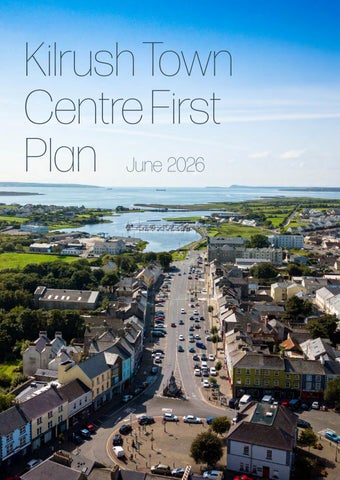
Kilrush Town Centre First Plan June 2026
2
Stage 1 Baseline Report & Vision
14
Stage 2 Understanding the Place 28 Stage 3 Defining the Place 38 Stage 4 Enabling the Place 96
3
Town Centre First Approach
Relevant Policies and Resources which inform the Town Centre First approach used in the formation of this Town Centre First Plan for Kilrush include the following. Town Centre First Policy Project Ireland 2040 Climate Action Plan 2023-2029 National Biodiversity Action Plan 2023-2030 Our Rural Future: Rural Development Policy 2023 National Housing Plan 2025-2030 Places For People - the National Policy on Architecture National Sustainable Mobility Policy Southern Regional Assembly RSES Clare County Development Plan 2023-2029 Clare County Biodiversity Action Plan 2025-2031 Shannon Estuary Economic Taskforce Report Housing For All Healthy Ireland Heritage Ireland 2030 National Investment Framework for Transport in Ireland Digital For Good: Ireland’s Digital Inclusion Roadmap National Implementation Plan for the Sustainable development Goals 2022-2024 The European Green Deal And some useful guides and toolkits; RIAI Town and Village Toolkit Collaborative Town Centre Health Check Programme, The Heritage Council IAF Reimagine Pocket Guide Community-led Village Design Statements, The Heritage Council A Guide for Inclusive Community Engagement in Local Planning and Decision Making RIAI Old Town New Home Manual Bringing Back Homes - Manual for the Reuse of Existing Buildings Design Manual for Urban Roads and Streets Cycle Design Manual Greening and Nature-based SuDS for Active Travel Schemes Sporting Ireland Guide for Accessibility
4
Preface Town Centre First represents a new approach to the development of our towns where local communities and local businesses can be central to reimagining their own towns and planning their own futures. The Town Centre First policy was published in October 2022 and it aims to create town centres that function as viable, vibrant and attractive locations for people to live, work and visit, while also functioning as the service, social, cultural and recreational hub for the local community”. This Town Centre First Plan has been commissioned by the Town Centre First Department of Clare County Council working closely with Kilrush Town Team, West Clare elected members and staff of Clare County Council, with input from community and business stakeholders. A design team from Hassett Ducatez Architects was contracted to prepare the Plan with input from various stakeholders. The Kilrush Town Team is very engaged in the development of this plan and will be central to its delivery. The plan is funded by the Department of Rural & Community Development and the Department of Housing, Local Government, Heritage and the Gaeltacht under the Town Centre First Suite of Supports 2024 arising from the Town Centre First Policy.
5
KILKEE R O
SCATTERY
ISLAND
WEST CLARE GREENWAY
KILRUSH K MARINA
FRANC
CREEK MARINA
CAPPA ROAD
CAPPA VILLAGE
6
OAD
N O R T H
LERY GAL
K PAR
AD ENNIS RO
O DEA’S
FIELD
JOHN PAUL E ATE ST
CES STREET
WO OD RIV E
RW
ALK
ESTATE
AD
ER RO KILLIM
VANDELEUR
7
8
Table of Contents Preface Guiding Principle Vision Statement
Stage 1: Baseline and Vision Outline Description Kilrush At A Glance Town Team Vision Kilrush Objectives Illustrations
Stage 2: Understanding the Place Consultation methodology Detailed analysis
Stage 3: Defining the Place
5 10 12
14 16 18 20 22 24
28
30 34
38
Inclusion Climate and Biodiversity Vibrancy Heritage Culture Well-being Summary Objectives
40 50 62 72 86 88 94
Stage 4: Enabling the Place
96
Key Projects Inclusion Charter Biodiversity Plan Decarbonised Housing Greenway Two Trailheads Shopping Clusters Valuing our Shop fronts Employment Project Leveraging Hotel Opportunities The Square Place de Plouzane Frances Street The Marina Quarter Mars Cinema Wood River Walk John Paul Community Centre Back Road Field The Convent Roadmap Action Plan
98 100 102 104 106 108 110 112 115 116 120 122 126 134 136 137 138 138 142 9
Guiding Principle This plan sets out a variety of projects and objectives of different scales, timeframes and types to harness the capacities of the diverse townspeople of Kilrush and the available supports at local and national levels. Some actions can form part of a larger project, others are ongoing processes. This plan presents many interlinked projects, large and small. This ensures that different people and organisations can align with the plan and that larger projects, subject to funding can be planned for.
10
A necklace of big and small projects connecting together for the future
11
To create a thriving, inclusive, and sustainable town centre that honours Kilrush’s unique character, connects people and places, and supports the wellbeing, culture, and prosperity of the community and wider West Clare region Kilrush Town Team Vision Statement, 2025
12
Kilrush and its large rural hinterlandin 2016, image courtesy of SAUL IU
13
Section 1 Baseline and Town Centre Vision
14
A collaborative vision and Plan-led approach to place is critical, based on an acute diagnosis of the local challenges and a tailored response to match Town Centre First Policy 2022
15
An Outline Description of Kilrush Kilrush is the third largest town in Co. Clare, with a population of circa 2600, undergoing little demographic change in the past 30 years. Its peripheral location in a beautiful setting has had profound effects. Located more remotely than comparably sized Clare towns which are under commuter pressure, Kilrush acts a service centre for a very wide hinterland. This is up to some estimated 20,000 people at the edge of west Clare. The town is connected by ferry to north Kerry and west Limerick. Previously a Shannon estuarine trading centre, a decline in commercial activity and resulting vacancy is now visible in the town centre. The town is characterised by significant
untapped potential in the areas of leisure, wellness, biodiversity and energy generation. The compact and beautiful town has an interesting history which has given rise to some notable streetscapes, intact as an Architectural Conservation Area and some landmark buildings and estates. In the case of Kilrush, it stands apart from many places in that it has significant wealth in key resources, cultural and practical. As a major service hub, the town scores low when assessed under certain inclusion metrics.
Diagram of the distinct character areas of Kilrush
16
There are 6 core Themes 1. 2. 3. 4. 5. 6.
Improving Inclusion Improving Climate and Biodiversity Fostering Vibrancy Valuing Heritage Valuing Culture Promoting Well-being
Kilrush is poised with high levels of natural wealth in green/blue resources and culture and is an exemplar compact planned town in a strategic setting with good urban fabric. On the other hand, the Pobal deprivation index shows continually increasing deprivation
levels, based on a comparison from CSO 2016 to CSO 2022, and high levels of commercial and residential vacancy. Mindful of scarcity of capital project funding, the Kilrush Town Centre First Plan is conceived of as a necklace of projects, some lowcost and threading through all actions and designed to reinforce principles of community inclusiveness, reduce carbon, increase biodiversity and wellness, protect heritage and revalue the culture of Kilrush, working towards improving vibrancy throughout. The next ten years of Kilrush will see the town tackle a renewal and inclusion programme, building on the 6 interlinked themes.
Diagram of a necklace of big and small potential projects threading through Kilrush
17
Kilrush At A Glance Strengths Strong Placemaking Characteristics
Strong Urban Core Kilrush has a rich historic building stock and has retained its strong historic market town streetscape.
Established Industry
& Economy Activity
Kilrush has a number of highquality landmarks with the Market Building & Frances Street, Marina, Vandeleur Estate, Old Convent, Cappa Pier and Scattery Island.
Manufacturing 9% Commerce & Trade 23% Professional Services 27%
All others 41%
Largest employment sectors in Kilrush
Challenges
-15.85 Index
Pobal Deprivation
Kilrush Urban Electoral District (ED) is one of the most deprived areas in County Clare and nationally and is classed as Disadvantaged.
Out-of-Town Development Developments at the outskirts of Kilrush are drawing economic activity away from the town centre, potentially making it a less attractive place to live and spend time.
Dwindling Residency in Town Centre Kilrush town centre suffers from population drain and suction effect from outlying areas.
18
Strategic Location Kilrush has a strategic location on the Shannon Estuary & in green energy futures, the Wild Atlantic Way & Shannon Estuary Way, near to Shannon International Airport and on the Galway - Kerry Western Corridor.
Hinterland of
Exceptional Natural Setting
20,000
Kilrush is an established Regional Service Centre for a large rural hinterland in West Clare.
Kilrush has a unique proximity to a diverse mix of rich local ecosystems including the Shannon Estuary, Vandeleur Woods, and Kilrush Creek.
250 vacant dwellings
Kilrush had double the county and national average of vacant homes, and the fourth highest commercial vacancy rate in the country in 2022.
-CSO 2022, Geodirectory 2022
Negative Town Image
Regional Competition
Perceived lack of investment, degradation of some parts of the built environment, and perceived anti-social effects in Kilrush may threaten engagement with future development.
Kilrush competes with other Clare towns such as Kilkee, Ennistymon, and Ennis as a regional service centre and tourist destination, and needs to capitalise on its unique identity.
19
This is the collective vision of the Kilrush Town Team To create a thriving, inclusive, and sustainable town centre that honours Kilrush’s unique character, connects people and places, and supports the well-being, culture, and prosperity of the community and wider West Clare region The vision of this Town Centre First Plan is structured around six core themes. These themes align with the following national Town Centre First policies.
Role: A Regional Hub for West Clare Kilrush is the administrative, commercial, and service hub of West Clare, providing essential infrastructure such as education, healthcare, retail, and tourism that supports rural living across the region. As a residential town with a strong identity in spirituality, arts and culture, and leisure and recreation, Kilrush is ideally situated to harness its location on the Wild Atlantic Way—offering access to Scattery Island, the Shannon Estuary, and Loop Head—making it the natural gateway for transport connectivity and regional economic development.
Image and Identity: A Town with Heart and Heritage
Town Centre First coverpage
Kilrush is the cultural capital and primary service town of West Clare, a designated Heritage Town known for its maritime legacy, historic market square, and planned streetscape. As a vibrant market town and commercial centre with deep agricultural roots, Kilrush supports rural living while serving as a regional hub for commerce, community, and culture. Located along the Wild Atlantic Way and gateway to the Loop Head Peninsula, it blends heritage, biodiversity, and spirituality— from Scattery Island to the Vandeleur Walled Gardens—offering a welcoming, inclusive environment rich in arts, leisure, and recreation.
20
Inclusion: A Town Where Everyone Belongs
Vibrancy: Bringing Life to the Town Centre
True community development includes everyone. Kilrush is a town that recognises and supports its full diversity—young and old, new residents and lifelong locals, people of all backgrounds, abilities, and incomes. Kilrush will commit to making services and amenities more accessible and ensuring that all neighbourhoods are connected meaningfully to the town centre through safe walking routes, public transport, and clear communication. A truly inclusive Kilrush is a “10-minute town” where essential amenities are within easy reach, businesses reflect the diversity of community needs, and newcomers feel welcomed and informed. By prioritising well-being, neighbourliness, restorative practices, Kilrush will become a town where everyone feels safe, connected, and empowered to shape its future.
Kilrush is a vibrant town where people gather, interact, shop, work, and celebrate, and its future lies in creating an environment that energises and engages people of all ages. Revitalising the town centre with diverse businesses, public art, cultural events, green spaces, and placemaking initiatives, the aim is to foster a lively and welcoming atmosphere that brings colour and activity throughout the week and across the seasons. Vacant and underused buildings will be re-imagined as hubs for enterprise, youth, and community life—supporting a strong local economy and making Kilrush a more dynamic and enjoyable place to live, work and play.
Climate and Biodiversity: A Greener Kilrush
Heritage and Culture: Telling Our Story, Together
Kilrush is a leading example of a green, connected, and climate-conscious town—one that embraces its natural surroundings and its role as a strategic gateway to West Clare, the River Shannon, and the Atlantic Ocean. Our vision includes expanding community gardens and allotments, protecting nature corridors like the Wood River Walk, and safeguarding even the smallest green spaces and marine wildlife as vital parts of the town’s ecosystem. Community education around biodiversity, urban forestry, and citizen science will form part of a wider movement to make Kilrush a leader in rural climate action. We are also committed to protecting marine wildlife and habitats along our coastline and estuary, recognising their ecological value and contribution to Kilrush’s identity. Supporting a just and balanced transition to renewable energy, encouraging sustainable transport, and making room for nature within the town will help Kilrush adapt to future climate challenges.
Kilrush’s heritage is woven through its streets, buildings, and traditions—from the maritime legacy of Cappa Pier and the Marina to the stories held in the churches, convent, Turret Lodge and historic graveyards. Icons like the West Clare Railway, Scattery Island’s monastic ruins, the Vandeleur Estate, and cultural treasures such as the Harry Clarke stained glass windows, Teach Ceoil, Mars Cinema, and the Museum of Rural Irish Life form the foundation of a rich and layered identity. Celebration of the towns cultural wealth through heritage-led regeneration, traditional Irish shopfront restoration, and vibrant programming like Heritage Week, festivals, parades, musicals, and fairs is a focus of this Plan. Investment in cultural venues, heritage trails, and interpretive features will enhance the towns public realm. Honouring the towns past whilst cultivating a thriving future of cultural enterprise and public storytelling for generations to come is another Plan focus.
21
Kilrush Objectives Emerging from the analyses and case studies in stages 1-3, and from consultation, the following objectives will underpin the vision of this Town Centre First Plan. These objectives inform the key projects and actions prescribed in Stage 4 ‘Enabling the Place’. They are not mutually exclusive, projects will each aim to fulfill multiple objectives.
A. Inclusion A1 A2 A3 A4 A5 A6 A7 A8
To improve mobility out of the region to major centres Pursue an active policy of improving inclusion in all Kilrush activities and spaces, including the identification of suitable bus stop locations within the town. To improve universal inclusion measures in the town centre To support walking and cycling links between parts of the town To review inclusion design on a street-by-street basis To investigate the potential and locations for exercise and play equipment provision across the town at short walking distances Creation of a Inclusivity Charter To undertake aHealth Infrastructure Audit for Kilrush town
B. Climate & Biodiversity B1 B2 B3
Investigate and leverage green energy industry, training & community opportunities Investigate the potential re-use of existing town centre buildings Investigate and prepare a biodiversity & urban landscape plan
22
C. Vibrancy C1 C2 C3 C4 C5 C6
Increase residential living populations in the town centre Investigate measures to support reimaginion and reuse of commercial properties. Prepare a Building Frontage enhancement ‘toolkit’ for traditional building fronts of Kilrush Support an increase in footfall by creating an attractive safe environment to do business, visit or carry out daily lives within the town Create a safe environment for drivers and pedestrians alike Protect the town from edge development and focus on strengthening the urban core
D. Heritage D1 D2
Continue to recognise and value the unique and distinguishing heritage of Kilrush as a major asset in the town identity and attraction Continue to improve Kilrush’s clear urban legibility and ease of wayfinding
E. Culture E1
To value and develop the culture of Kilrush and ensure it is retold and understood
F. Well-being F1 F2 F3 F4
To pursue active participation across communities in music and sport as a street animation and inclusion and culture building strategy. To carry out an audit on health infrastructure for Kilrush. To improve access to nature and exercise To actively pursue employment and training projects
23
What will this Vision look like? Sit out for a morning coffee and walk to the shops in the town centre
Cross the street with ease to the bus stop to go to work or school
24
Come home to my restored townhouse and enjoy time in the garden
Go for a walk and spend some time watching boats in the marina
5no. Artist’s impressions of future views of Kilrush
Catch an evening event in the Mars
25
connecting schools
Back R Field si under develo
key community & cultural nodes
bringing the Greenway through the town t e e r t es S
Franc
connecting to the Marina Quarter
26
shopping clusters
Road ite
community greenspace
ne a z lou
P e d ce
Pla
opment
inclusive shared spaces
The Square
Mars
valuing our principal town spaces
living in townhouses
Diagram of some key driving actions for Kilrush Town Centre.
27
Section 2 Understanding the Place
28
The process of understanding a place involves consulting with a wide range of people and collecting and collating data/information on the characteristics of the town centre and its surrounding context. Town Centre First Policy, 2022
29
Consultation Wide consultation was carried out in both broad and targeted fashions during the production of this plan. The following forms of consultation have taken place:
Meetings with
•
•
• • • • • • • •
Steering Group for the Town Centre First Plan, Clare Co Council (drawn from community and rural inclusion, sports and recreation, property management and planning departments/teams within Clare County Council ) Kilrush Town Team (Voluntary group pursuing projects to improve Kilrush drawn from representatives of various sectors including local business, new townspeople, historical society, community inclusion sectors and representing older people) West Clare Municipal District Elected Members Proposed Greenway Project Team Moneypoint site manager ESB Kilrush Marina manager Kilrush Boatyard manager Kilrush Family Resource Centre Two classes of Kilrush Community School students New small shop & cafe business owners
Stage 1 broad, non-targeted public surveys were conducted in several fashions:
• • • •
Christmas Market Survey (Town Team) December 2024 Street Saturday supermarket consultation in March 2025 Online digital Survey running April-June 2025 Door -to-door Survey John Paul Estate May 2025
Stage 3 Draft Plan public consultation was conducted in several fashions:
• • • •
‘Have Your Say’ Online Platform & Email Submissions Nov 2025-Jan 2026 Drop-in Info Night at Town Hall Nov 2025 Paper Submissions at MD Office and Library Nov 2025 -Jan 2026 Christmas Late Shopping Information Event (Town Team) December 2025
30
Photograph of Stage 1 Supermarket Consulatation Event
31
Pride in the Town Assets The findings of all public surveys had several major themes of positivity and pride and others which were more negative.
The town fabric itself, and in particular Frances Street and the Square were identified as sources of great pride and joy, which is a very positive indication of confidence in the town centre. The marina area was identified frequently by respondents as a fantastic asset. The Vandeleur Estate and Woods was identified as a highlight asset for the town. Conversely, taking each of these in turn: a concern about vacancy levels and traffic safety were expressed in relation to Frances Street and the Square. A desire to be able to walk freely around the marina marina area, continuing along the shoreline to Brews Bridge was also expressed in many ways by respondents. Significant concern around a perception of newly reduced access to Vandeleur Estate or a non-identification of the Estate as part of Kilrush in tourist promotion was expressed by several respondents.
There was a general expressed desire for more businesses, including cafes and restaurants. A number of respondents also expressed a desire for a swimming pool, however it was recognised that this may be out of reach due to the very large cost to build and operate. Finding: As with many public survey questionnaires, the extent of the community’s authority and enforcement was not widely known. This may obstruct creativity and agency within the town.
Two items stand out as identified needs, across all surveys: (a) a need for a hotel (b) a need for a facility for the youth.
Photograph of Stage 1 Supermarket Consulatation Event
32
Dereliction and Vacancy
Traditional Shop fronts
This item, variously expressed, was the item identified most frequently and across all questions in Stage 1. This was the case also with youth (secondary school) groups. 50% of all online respondents mentioned vacancy at least once. The public perception included repeated views that action should be swifter: there were mentions of a need to CPO properties, to prevent owners from allowing premises to fall into disrepair and to act punitively. The public suggestions also included softer measures including offering grants to refurbish properties and painting façades and shop fronts. Reduction in rates and rents were also frequently noted as desirable to attract more business.
The online questionnaire highlighted the many traditional style vacant shop fronts in Kilrush and asked respondents what should be done. It is notable that the responses were overwhelmingly positive and supportive, especially when compared with a similar question on biodiversity, where many respondents were unengaged. Responses regarding shop fronts showed that people clearly regard this as a distinctive asset. Ideas given were generally for repair and restoration, painting and cleaning, preventing plastic signage and loss of the traditional shopfront. Again, there was an unclear understanding of the role of others / authorities and enforcement.
Specific Premises (Vacancy)
Biodiversity
Mars Cinema (vacant) scored highly in mentions with a high number of respondents’ comments referring to a need to develop arts, performance and sports offerings and the importance of securing activity for the heritage building Mars Cinema on Frances Street, central in the town.
The theme of biodiversity failed to arise naturally in initial public surveys and was added as a specific target question in subsequent phases. This drew a mixed response, from extremely enthusiastic to unenthusiastic proposals to limit biodiversity. This is a useful finding in relation to education / public communication regarding urban biodiversity. It is also worth noting that biodiversity alone is very low in mentions at around 8% and heritage even lower at 5% in some initial surveys.
St Mary’s Convent was very frequently mentioned by almost all respondents, again either strongly in disappointment or frustration with the owner(s) / authority’s seeming inaction or more positively with ideas for its use. Almost always a hotel use was proposed.
However, planting is added to a list of desirables by many respondents along with streetscape improvements and cleanliness. This would point to the potential usefulness of public communication. W
33
Stage 1: Consultation answers divided by theme Facilities for Youth
Socialising
Vacancy
Busine
Kids of older people, Playground
Proactive groups
dereliction (houses and shops)
shops open later
something for kids,
Activities + socialspaces
More people living in the town
markets- city
indoor faclities for children
Reposess the derelict buildings & ideally sell/use
markets
facilities for young people
more music and dancing social dancing in the community centre not enough life in the town
Paint unocupied buildings iin the town
Clothes + Shoe Shop
Youth Amenities, Bowling
more festivals school programmes
living over the shop
Youth Facilities (Summer Months)
stuff for young people, social activites clean up derelict buildings
Markets veg and plant horse fair More Coffee shops
More done for the kids
Liven up the streets with life + Planting ( cherrry blossoms) Family Resource Centre >Youth project more social things for young people
Give the houses on Frances St small front gardens
Small Shops
Do something about derelict buildings
more shops in the tow be more
Get young people involved
programmes for adults
Get families living in city centre
Clothes shop penneys
space for kids green area
no nightlife
People living in centre
clothes shops,
playground with cafes all around
feeding birds and wildlife
hold and open house for gardens and houses, children/ schools
support for small buisn can remain competitiv
Youth based centres
Communal Spaces
housing for people to have and rent
shops electrical
Airbnbs undone could make up rental stock
Places for youth shops Dunnes, Nails, ennis
somewhere for kids at night and teens Better town infrastructure + social Platforms Not much to do for young people
no bingo hall lots of appetite social life empty houses
Shops- Asian &indian
Places for young people on town no place for them to gather at night play centre
further upgrade the social housing in John Paul estate
incentivise small buisn
Restoring living over the shop preservtion of the facade
Painting Shop Fronts
Playground
fix up derelict houses moore st
Market town more sho
Hotel, Playground
Painting Scheme for disuesd shopfronts buildings
good shops and mix in
leisure centre and playground Teenagers/ young drumming class parades, procession, teachers/ instructors, Jim Connolly's Resettlement, Mick Daly/ Rob Hopkins
do up derelict homes The Convent fine building needs to be developed
seaweed development be more welcoming to opportunites + not cre open rising tide rises a
build housing or make existing buildings compliant
bring more buisness
do something with the convent
Change business peop
apartments needed for downsizing (housing)
Shops which closed
yacht club has no building big cost located in Marina
shelter for market
vacant commercial, rundown convent
bring back the old Hor Ennistimon
Housing-Refugees
could do with more fac
Houses
Drapery Shop
Derelict buildings give a poor impressions old buildings repair property tax lowered
Graph of Stage 1 Public Consultation Responses divided bt Theme Vacancy was the most frequently raised subject, Biodiversity and Heritage were rarely mentioned
34
Stage 1: Consultation answers divided by theme Business
Safety
Cars
shops open later
Garda Prescence
parking near shops
markets- city
more regular gardai wallking the streets
Aqua Park summer swimming club
eally sell/use
markets
More Gardai
Cars Spaces
wn
Clothes + Shoe Shop
Cleanliness
Paint it up +Make Attractive, Umbrellas water bowls for dogs and pet friendly places littering
more planting and more colours at the more electric car recharge stations end of frances St Markets veg and plant stalls, ceramics, anti social behaviour More Parking horse fair More Coffee shops more proactive Garda Prescence Speeding cars at night
Clean it Up
l front gardens
Small Shops
Safe Place to walk at night
Traffic Safety
Littering
ngs
more shops in the town there used to be more
drugs and drink
O Deas road is too narrow to be 2 way should be 1 way (traffic)
Dog dirt all over pavement
Clothes shop penneys
drug use wouldnt come in on friday evenings vandalism
enforces 2 hr free parking
paint murals at the bottle bank
clothes shops,
more pooper scoopers, signage and bins More Bins
Street cleaning
nd houses, children/
support for small buisnesses so they can remain competitive
garda/ drugs
more bins, sign post 'keep your place clean'
t
shops electrical
lack of garda prescence
public toilets
tal stock
Places for youth shops penneys, Dunnes, Nails, ennis
drug dealing
paint murals something to do with boats
Shops- Asian &indian
Intimidation, Anti Social Behaviour
n John Paul estate
incentivise small buisnesses
drug problem
ervtion of the facade
Painting Shop Fronts
Undesirables
onts buildings
be developed
dings compliant
Market town more shops good shops and mix in seaweed development be more welcoming to new buisness/ opportunites + not create bariers ....be open rising tide rises all boat bring more buisness Change business people's attitudes
(housing)
Shops which closed
ocated in Marina
shelter for market
ent
bring back the old Horse fairs like in Ennistimon could do with more factories in Kilrush Drapery Shop
ssions
35
Stage 1: Consultation answers divided by theme Transport
Maritime
Sports & Activities
transport local link 2 hours Ennis
Identity with our maritime
a new swimming pool
cinema
Transport
Market, Maritime Festival, Horse fair
Mars shoul
Transport - ennis, Limerick
workout machines at Marina
emphasis on sports other than GAA basketball, swimming pool have to go to Ennis swimming pool
more public transport & at better times they dont coordinate public transport hard to get to galway
Maritime Centre
Marina Swimming
bring back
Maritime College
facilities for swimmers at cappa
cinema, bo
no transport to ferry
maritime tourist attraction
watersports in the marina
a communi
transport to ennis
Marine Training Centre
indoor sport facility-planned
Cinema Ar
museum of maritime history
multi purpose arena >sports/arts/ music
Cinema, Bo
Festival/ O
look more towards the sea/ estuary as a Sports Hall place of opportunity +leisure Sports Facilities, tennis
cinema -M
cinema mu
sports facilites for kids, youths
Recreation
sports hall
gym, cinem
a hotel, swimming pool
mars Cinem
swimming pool & youth facilities
mars multi
maintain sport pitches . active Kilrush under used too expensive
musical the
a centre dr
Community
cinema re o
cinema com
Graph of Stage 1 Public Consultation Responses divided bt Theme Vacancy was the most frequently raised subject, Biodiversity and Heritage were rarely mentioned
36
Stage 1: Consultation answers divided by theme
Activities
Cinema & Theatre
Streetscape and accessibility
Hotel & Restaurants
Biodiver
cinema
Henry St Zebra Crossing
hotel
greenery around
Mars should be opened for the youth
Cycle paths around town
Restaurants & Bars
lovely wide streets sh Sustainability +Biodiv
Festival/ Occasion
in an ideal world a nice hotel with a pool Restaurants (Sunday, Evening)
planting on francis str
bring back the old Mars cinema
Regular cleaning of the streets& footpaths& repair, bins tactile paving
s at cappa
cinema, bowling
Improve the streetspace
wildflower meadows
arina
a community theatre/ creative arts centre
Foot Paths are uneven and slanted
do something with the old hotel we need a new hotel in the centre hotel or large accomodation
lanned
Cinema Arcade
zebra crossings
bowling alley, restaurants & pubs
>sports/arts/ music
Cinema, Bowling Alley
accessible pathway
Accomodation/ Hotel for visitors
mature established tr Frances St
cinema -Mars
Hotel ( Convent)
A hotel - badly make more use of the fact that kilrush is so close to the water develop that more
ther than GAA pool have to go to
is
cinema musicals & shows
(Visiting ) Wide street but need more pedestrianisation Greenway (cycle)
s, youths
Recreational - Music
2nd pedestrian crossing
gym, cinema
cycle lane
ol
mars Cinema
a good town map with street names
th facilities
mars multifunctional
Dog fouls on paths
s . active Kilrush nsive
musical theatre at mars
Footpaths, pedestrian crosssings are poor footpaths are uneven, no one sweeping roads footpaths are poor, red crossings visibility from ramps Seating area in square
a centre drama/musical theatre Community theatre in Mars
Restaurants
cinema re open!
Biodiversity
lots more plants
make the convent into a hotel
Heritage
greenery around centre cinema community
Make Vandeluer Free
s
lovely wide streets should have Sustainability +Biodiversity
add plaques on streets with information
nice hotel with a
planting on francis street
ay, Evening)
Greenery in the streets
its hard to find information about the history invest more in historic town & Gaeilge
h the old hotel we in the centre omodation
wildflower meadows
aurants & pubs
mature established treees on Frances St
otel for visitors
Greenery in the stree
lots more plants
into a hotel
ake more use of the so close to the t more
37
Specific Area, John Paul Estate Members of the Town Team carried out doorto-door consultation in the John Paul Estate, meeting mostly people aged 30-60. The view from residents was that the overriding need is for youth facilities, to tackle drug problems and a lack of integration with facilities in the town. The former playground, football pitch and community centre in John Paul Estate have all closed and the sole playground in Kilrush is in Cappa. This is a 45-minute brisk walk for a fit adult. Kilrush Woods nearby provide an opportunity for access to a range of walks. It was accepted that the woods are free of charge. Several residents expressed passion for the great history of singing in Kilrush with choral societies and singing pubs competitions. An arts facility in Kilrush was mooted, as was a need for a women’s group in Glebe house to assist with health issues. There was strong interest in participation in decision making about the John Paul Estate and great pride expressed.
Draft Plan Public Engagement Stage 3 public engagement provided the public with access to the Draft Town Centre First Plan for feedback. The most common response was a request for an indoor sports facility, particularly for basketball. Also frequently mentioned were requests for arts and performance space, acknowledgement of the importance of inclusion actions, restoration of shop fronts, and making streets safer for pedestrians, rollers, cyclists and drivers alike.
What would you change about Kilrush? Sports facilities Free public toilets Better transport Employment Activities for Youth (other than sports) More shops & restaurants
Results of Consultation at Kilrush Community College
Climate & biodiversity Fesitvals & tourism Inclusion measures Make streets safer Repair shop fronts Arts / Performance Centre Indoor sports facility Results of Draft Plan Public Engagement
Paper submission at Kilrush Library or Municipal Offices Email submission
‘Have Your Say’ online platform Method of response to Draft Plan Public Engagement
38
Visual Note-Taker’s illustrations of the values of the Kilrush Town Team
39
Section 3 Defining the Place
40
Kilrush is assessed under the following core themes in Stage 3: A Inclusion B Climate & Biodiversity C Vibrancy D Heritage E Culture F Well-being
41
Inclusion
42
Inclusion Despite its wealth in natural resources, its deep layered culture and its people, Kilrush scores poorly when assessed under certain inclusion metrics. These findings are recorded by the national Pobal Deprivation Index of 2022, with Kilrush scoring amongst the lowest nationally. This national score assesses factors like age dependency levels within families, skills and training levels, unemployment levels, lone parents, population change in an area and professional level attained. It is a key pillar of the new Town Centre First Plan that this is acknowledged and addressed. When analysed, many non-inclusive factors are due to the town’s geographic location and some historical factors. Equally, when analysed, there is ample opportunity for a reimagined and inclusive Kilrush at this juncture. The town is wealthy in natural resources for sustainability and for human well-being. It is poised at the cusp of green energy futures with potential for employment and training. The town has a strong heritage core within a very scenic setting in a well organised compact town. These are considerable assets to reimagine a more inclusive town.
Deprivation Index
Kilrush
What Is Inclusion? In the Pobal deprivation index Kilrush appears to be worsening year on year. Countrywide, worsening inclusion is tied to physical enviroment and location. Multigenerational socio-economic factors are beyond the remit of this plan, however spatial and physical infrastructure which can help address greater inclusion are listed below: Access to Activities & Spaces Access to Good Healthcare Access to Good Health & Well-being Access to Employment and Training Access is often dependent having sufficient funds and always dependent on transport, free time, walkability, feeling included & welcome, and being physically able. Physical and mental health positive indicators include safe access to exercise and wellness spaces, communal activity and useful work or education, in addition to satisfactory and dignified living facilities (including healthy buildings).
Clare
Graph of the Pobal Deprivation Indices across recent CSO cycles
43
Bus stop on Frances Street, 2024
44
Regional Movement Kilrush has a population of 2600 or so and serves a large rural hinterland, acting as service town for the Loop Head peninsula and Shannon Estuary environs. Geographically somewhat remote, Kilrush is an important service hub for up to 20,000 people. This places a heavy demand on car use for access to services, education and employment within the town. It is recognised that supporting car use is critical to maintain the role of the town as a hub.
Diagram of the extensive rural network in which Kilrush operates.
1% 1% 4% 4%
No motor No motor car car 21%21%
27%27%
47%47%
1 motor 1 motor car car
In recognition of the hub role of Kilrush, Transport for Ireland bus provision has been designed to support the local rural area and village to village linkages within the region. By contrast, bus schedules come up short when speed and frequency of access to larger urban centres and cities is analysed. This analysis shows lengthy trips for third level education, work opportunity, health services, consumer and lifestyle choice and critical medical care. All options for full inclusion to and from the town are more limited, other than by private car. The 2022 census data show one third of
2 motor 2 motor carscars people in Kilrush ED do not have access 3 motor 3 motor carscars to a car, placing them significantly at a
4+ motor 4+ motor carscars disadvantage in a peripheral location. For
Access to cars in Kilrush households (CSO 2022)
Objective: To improve mobility out of the region to major centres
this cohort access to large critical healthcare centres, third level education or employment prospects in larger adjacent cities/towns must rely on the bus network.
Objective: Pursue an active policy of improving inclusion in all Kilrush activities and spaces.
45
Diagram of existing building use types in Kilrush 2024 industrial social/civic commercial (occupied) commercial (vacant)
Diagram of existing street network in Kilrush
Diagram of a 10-minute walking distance from The Square
46
Walkable Urban Centre for All
Kilrush is a compact well-planned town. It has very good provision of most (but not all) shopping, educational, medical, services, social and cultural uses in the urban core. Many are within walking distance of one another.
To capitalise on this good compact layout, a small number of key pedestrian linkages can be made. This would have the effect of providing more walking and cycling town alternatives whilst not disrupting spaces for important inward car trips using the service town. There is a need for some additions to this to complete the accessibility / inclusion component of the urban environment. More frequent street seat provision, more shelters, more public toilets and sheltered bus waiting spaces are basic components of suitable rest and comfort provision. Additionally, very frequent safe crossings of principal spaces in Kilrush could be prioritised. Kilrush also has several important dispersed centres which are distant from each other. These are the edge of town supermarkets and sportsgrounds, new business provision around petrol stations, edge housing estates and the attractions of the waterfront areas. They all generate increased car trips.
Access To Spaces The addition of level access, rollable surfaces and seating and increased access to public toilets to all key public areas and urban settings will greatly improve inclusion. This will include access to the river, wood and marina walks. Additionally, the provision of play and exercise facilities could be reviewed. It is recommended that some play and exercise equipment be located at regular intervals, so that the twin aims of spaces for many cohorts, and non-exclusion of people who cannot travel far, is achieved. Objective: To improve universal inclusion measures in the town centre Objective: To support walking and cycling links between parts of the town Objective: To review Inclusion Design on a street-by-street basis Objective: To roll out exercise and play equipment provision across the town at short walking distances
47
View over Kilrush Creek from the Creek Lodge, 2025
48
Access to Health & Well-being
200 180 160 140 120 100 80 60 40 20 0 Age 85+
Age 80-84
Age 75-79
Age 70-74
Age 65-69
Age 60-64
Age 55-59
Age 50-54
Age 45-49
Age 40-44
Age 35-39
Age 30-34
Age 25-29
Age 20-24
Age 15-19
Age 10-14
Age 5-9
Age 0-4
Graph of age cohorts in Kilrush ED (CSO 2022)
Access to Activities
Access to Healthcare Facilities.
It is noted that access to activities will be limited for transport-poor, time-poor, not wealthy and those who feel unwelcome or not physically able. This can result in a loss of talent for a town, as well as exclusion. It is also noted that active inclusion practices will include locating sports and other events at times and with facilities suitable for single parents, seeking to ensure people have transport and a person to accompany them, ensuring new or traditionally excluded cohorts are invited personally, in the appropriate manner and that the timing of events is nonexcluding.
Kilrush has an insufficient number of general practitioners, scoring badly in medical provision on national scales. When taken together with the increasing number of older people in Kilrush, the higher proportion of single parents, a high deprivation score, that one-third report a disability and poor public transport to specialist services in adjacent cities, there is a noted deficit. The provision of adequate medical services to the town is a priority.
Objective: Kilrush signs up to an inclusivity charter
Objective: To carry out an audit on health infrastructure for Kilrush
49
Aerial photograph of Kilrush Town Centre © Chris McKenna
50
Kilrush Inclusion Charter
As presented in this Plan, Kilrush will build on its strengths as a diverse set of people with rich histories and capacities. Kilrush signs up to practice active participation. Active inclusion means designing a range of activities that are truly available for everyone, whether they can walk or have a physical limitation, or a developmental difference, a talent, whether they have money, education, free time, the right to work, are neurodiverse or possess a car. This means empathetic design which recognises that people need places to rest (public seats), to take a walk; that all people should be able to access the river, that play spaces are within easy reach, that activity spaces suit the quiet observers and the social. It means having a job and money in your pocket. It means that any new development will be assessed against its projects of active inclusion- the less mobile, those of less financial means, and the newly arrived. It means new commercial development may be asked to sign up to a social training charter, a charter of inclusion, creating a potential ladder of opportunity. And of course, firstly it means that Kilrush will support campaigning to get good healthcare access.
Potential Inclusion Themes for Kilrush: Develop Youth oriented facilities and uses Using Active Participative Measures Training and Using Restorative Practices Running Sports Sessions in Different Venues and neighbourhoods Developing Shared Music Projects Developing Shared Food Projects Developing Apprenticeships Developing Projects for New Skills Campaigning to Improve Public Transport Developing Ability Friendly Parking Redesigning for Level Surfaces Erecting comfortable Bus Shelters Installing plenty of seating Developing Accessible Play Spaces Developing / designing Spaces for All Installing toilets
51
52
Climate & Biodiversity
Climate and Biodiversity
Aerial photograph of Kilrush and its surroundings
Kilrush sits at the edge of the Shannon Estuary on the Loop Head peninsula and its history, origin, trade, agriculture, society and purpose derive from this geography. Kilrush is poised to lead as an urban exemplar town with a wealth of natural green resources.
Immediate Geographical Context The geographical situation of Kilrush is described inter alia by several environmental designations. The rolling landscape of the Loop Head peninsula is traditionally characterised by small dairy farms on grey siltstone, sandstone and mudstone, as is the Estuary bed. The proposed Greenway and several approach roads of Kilrush travel through rolling vantage points at a height giving a strong physical sense of its setting.
53
Shannon Estuary and Moneypoint, 2024
54
Landscape Characterisation Clare County Council Development Plan 2023-2029 describes the immediate hinterland as (a) the Designated Landscape of Vandeleur Woods (b) Broadleaf Woodland (c) Estuarine Intertidal, (d) Flat Estuarine Farmland (e) Framed Rolling Hills and (f) Coastal Plain and Dunes. These landscape characteristics are visible from the town and form specific natural habitats. Many are also used for social and recreational purposes. Interspersed with the rolling enclosed farmland prospect are coniferous forest plantations and windfarm installations. The estuarine intertidal landscape reaches expression in the Cappa beach foreshore and marina area waterfront, very strong assets to the town.
Statutory Environmental Designations Several formal environmental designations underpin the special nature of natural resources at Kilrush. The settlement boundary (at the Cappa shoreline and Lock) is adjacent to two different European Natura 2000 Protected Sites; the Lower River Shannon SAC and River Shannon and River Fergus Estuaries SPA. There are no NHA or pNHAs within or adjacent to the settlement boundary though several are close-by and have strong ties to Kilrush. The nearest are Poulnasherry Bay NHA, Scattery island pNHA and St. Senans Lough pNHA.
Habitats and Biodiversity Wetland Habitats adjacent to the study area include; • Wet Pedunculate Oak, • Acid Oligotrophic Lakes, • Brackish Lagoon and Dystrophic Lakes. Forest Habitats include • Ancient and Long-Established woodland, • Coillte Foresty and • Private Forestry. Several new movement spines will be threaded through some of these, notably the proposed Greenway and Wood River Walk. A natural symbiotic balance between an increase in human species traffic and other habitats will be important to achieve here, including SUDS design.
Marine Habitats The adjacent estuary includes the following habitats defined under the Council Directive 92/43/EEC on the Conservation of natural habitats and of wild fauna and flora and their existence and protection will necessitate screening where marine development is proposed.
• • • • • •
Fucoid-dominated intertidal reef community complex Subtidal sand to mixed sediment with Nucula nucleus community complex Faunal turf-dominated subtidal reef community Salt Marsh Intertidal sand to mixed sediment with polychaetes, molluscs and crustaceans’ community complex Laminaria-dominated community complex
55
Diagram of Kilrush’s strategic location on the Shannon Estuary
56
Transition to Green Energy Generation Many transitions to green energy generation projects are planned for the region. These arise from the twin strategic position of the Shannon Estuary as a shipping route and underwater cable route as well as the Moneypoint power station nearby with its attendant infrastructure including the dispersal grid. Projects mooted at various locations within the near Estuary environs include hydrogen energy generation, offshore and onshore wind energy and turbine assembly but the decisive arrangement of these and other strategic national projects in the Estuary has yet to fully emerge. Kilrush will have a natural role to play in supporting green industry development, given its long history of maritime and engineering work. The town currently has a non-tidal marina and boatyard with a 45-tonne travel hoist and slipway. There are circa nine marine service businesses ranging from boatyard repair / shipwright to powerboat transport, seamanship training, marine tourism and environmental surveying. Separate from the heavier boatyard facilities, a marina of potentially over 150 berths, slipway and facilities thrives. All of the foregoing present an ideal base from which to build a renewed ecosystem of businesses, apprenticeships and training opportunities.
New offshore and onshore energy generation projects will generate demand in boat building and fleet maintenance, Health and Safety, Quality, seamanship, wind turbine maintenance work and demand for specialist fitters, marine craft mechanics, specialist metal workers, electrical and IT specialists as well as conventional trades like carpentry, building and environmental services. Naturally a requirement for education in offshore navigation, boat-mastership, competent crew, water safety, diving, marine based SAR, environmental surveys and supports arise, complementary to likely developments at the Moneypoint site and elsewhere. There is also a stated need for hotel, hostel, short stay accommodation and food and drink facilities in the town. This is a particular need as regards growing business and accommodating specialist workers. It is notable that UK/EU specialist contractors visiting Moneypoint for periodic overhaul projects cannot access accommodation in Kilrush. There is no hotel nor hostel, no short stay airbnbs and half of the 4 listed small accommodation facilities are closed with the remainder offering few beds. Most informal eateries do lunchtime trade only or close circa 1830h.
57
The quayside and Kilrush Marina © Chris McKenna
58
Blue Economy
A survey carried out by the Irish Marine Institute in 2020 found that Kilrush had the highest diversity of marine related businesses in Clare. Diversity of marine economic activity was measured using categories described in the NMPF such as tourism, shipping, defence, aquaculture, fisheries and energy. It is the fourth highest in quantity in Clare after Ennistymon-Lahinch (14), Kilkee (12) and Doolin (11), though in each of these cases tourism / recreation is the majority sector. The LCETB Kilrush Campus offers two maritime courses.; Workboat Master Traineeship, Industry Accredited and Introduction to Marine Biology unaccredited.
Sustainable Energy Communities Kilrush has joined the SEAI Sustainable Energy Communities initiative. This partnership has yet to yield implementation of energy related projects in energy efficiency, renewable energy, sustainable transport and a smart grid, but is a useful source of guidance and funding opportunities. Objective: Leverage green energy industry, training & community opportunities
LO A
RI
N
MA
AY W RK
GATE PA
KILRUSH
CAPPA
DOLPHIN EXPERIENCE
CA
PP
A
BE
VILLAGE
AC H
OA
TR FOR
E CE
AYL EVA RRO O CO AST WA LK
W T IN O YP NE O M
Diagram of marine activity and infrastructure in Kilrush
D
N TRE
IN DF AR M
ISLAND
AG
PA
SCATTERY
LL
PIER
VI
CA P
A clean and healthy quality of water is a baseline requirement for the activation of the marina. Kilrush Marina and Cappa Beach have both been awarded Blue flag status for clean bathing water quality in 2025. However both areas have had this status revoked previously due to wavering water quality. These water bodies, as well as the Wood River are very significant leisure and biodiversity assets to the town. Kilrush Marina, as a locked waterbody, is highly affected by the received water from the Wood River. Pollution, run-off or dumping in the river will result in a worsening of water quality in the marina. No shorelines in Kilrush are in receipt of the Green Coasts award.
OP
Water Quality
59
N O R T H
Social Welfare Branch Office
Family Resource Centre Hall
Bank Bank An Post
Nursing Home
Map of civic & social infrastructure in Kilrush Town Centre
60
Decarbonised Housing Due to the slow pace of growth in Kilrush in the past 20 years, well conserved traditional house
typologies line every street. Many are now vacant, with up to 1 in 4 perceived vacant on some streets such as Moore Street. Other streets such as Toler St and Burton St are well occupied and benefit from the good arrangement of services in the compact town. These twin opportunities: a compact wellplanned town with well-arranged services and a reserve of good quality empty houses is a remarkable low carbon asset. Higher end projections show this reserve could potentially accommodate up to 1000 more people. The town therefore possesses an excellent resource to accommodate growth in a decarbonised model. It is especially easy to harness in Kilrush due to the exemplar compact layout of the town and the location of all key services close to the core.
Gardens Many townhouses in Kilrush also have extensive gardens, a perceived asset. These are more prevalent in Vandeleur, Toler and Frances Streets, though there are also many on Burton and Moore Streets, and few on Henry Street. Retention of these garden spaces will benefit their users. These are important biodiversity reserves, very attractive for families and underpin the low carbon approach to housing refurbishment which Kilrush could lead. Central urban spaces of the Back Road field, Place De Plouzane, The Marina & Greenway,
Artist’s impression of a restored typical Kilrush townhouse and garden
Objective: Investigate and encourage the reuse of vacant town centre buildings
61
Tree and planters in the Square (2024)
62
Urban Greening
Kilrush Quay, Merchants Quay, Frances Street and the Square are notably devoid of sufficient urban greening. It will be a key strategy to introduce mature trees, suitable for the Kilrush micro-climate and urban environments.
Suitable tree species for Kilrush Large (>25m) silver birch hornbeam London plane smallleaf lime broadleaf lime
Medium (10-20m) bird cherry whitebeam oak
system (a half buried pipe at minimum). Use good quality, native trees, ideally grown from local seed which will be adapted to the local conditions. Please note that rowan, beech, and copper beech are not able to survive in Kilrush conditions. At the town edges and threaded through it, extensive natural woodland and waterways lie somewhat untapped. These habitats are important reserves. New movement spines to tie these together in a nature-sensitive way will be a key component of reducing car journeys and increasing well-being.
A tree survey carried out in 2022 on behalf of Kilrush Town Team and Kilrush Tidy Towns noted of the streetscapes;
Flooding and Sustainable Urban Drainage systems (SUDs)
Trees are well established around the Town Hall in Market Square, and there are trees regularly planted along the pavement along roads leading away from the Square. Overall, the older trees in the Square are growing well and look healthy, but the trees along the pavements are mostly sick.
The principal risks to flooding in Kilrush are mapped as fluvial on the national CFRAM mappings. This mapping recognises the important role the marina locke gates play in protecting the town. It will be important to procure good SUDS design in new Greenway areas and all new urban greening designs in the town to contribute to reduction of risk associated with flood events.
The shade of trees may become increasingly important in urban areas in the future. For Place de Plouzane and main streets the following actions were recommended:
Objective: Prepare a biodiversity & urban landscape plan
Check and renovate planting holes to ensure there is adequate drainage. Install an irrigation
63
Vibrancy
64
Vibrancy Kilrush has some challenges and threats as regards vibrancy, but all its assets hold potential to address this.
Vacancy and Dereliction Principal challenges are a disproportionate perception of vacancy as well as high quantities of unoccupied buildings. This has largely arisen due to change in the retail sector over the last 20 years along with the development of edge of town housing estates and shopping centres. It is a national challenge.
Residential Vacancy Residential vacancy rates in Kilrush are high, at 15% in 2022, close to double the county and national averages, but the rate is improving since 2016. It is a similar pattern to other peripheral towns in the country (Ballyhaunis, Donegal and Bundoran for example) or local smaller towns like Milltown Malbay and Lisdoonvarna. Data such as the above, belies the even worse localised effects on individual streets. For example, 1 in 4 houses on Moore Street appear to be unoccupied and 16 shops). There is also a high perception of vacancy, as ascertained through walking surveys. These were carried out to analyse street-by-street effects in a granular fashion, since CSO data is not broken down thus. Henry Street was concluded visually to have up to 20% vacancy, the Square 13% and Frances Street 15%.
The perception of residential vacancy is disproportionate to actual vacancy rates. This is due partly to houses occupied at less than their maximum capacity and other conditions, such as commercial vacancy and degradation of street edges which compound a sense of low activity. More positively, Toler, Vandeleur, Burton and John Streets estimates are up to 90% occupied.
Commercial Vacancy Data from GeoDirectory September 2022 places the commercial vacancy rate in Kilrush at 25.1%, fourth highest in Ireland. With 33% of the town centre ground floor commercial properties vacant (60 out of 179 in 2022) and some concentrated spots, such as Moore Street, with 16 empty traditional shops and Place de Plouzane, a new small urban space with nine empty units, the overall effect is poor.
Key vacant sites There are also key strategic buildings of heritage note which lie empty or derelict, amongst them the Mars Cinema and Inis Cathaigh on Frances Street, St Mary’s Convent on Pound Street and the restored Turret Lodge. Another which is vacant and not commercial but which is significant for communities is the unoccupied community centre of the John Paul Estate.
65
Vacancy on Moore Street, 2024
66
Streetscapes
Walking the streets of Kilrush, many shop fronts are visibly unused or unchanged for over twenty years. There is a high number of traditional shop fronts in the town, which are local distinctive and a unique asset. Some pub and shop-owners, whether well-established or newly arrived, recognise the charm of this asset and have continued to preserve and operate businesses in this distinctive traditional streetscape. It is a rare national asset. This treasure trove on one hand of oldfashioned shops and traditional shop fronts is an asset in terms of potential character and historic record. But the pernicious effect of a general up-to-30% appearance of vacancy contributes on the other hand to emptiness in many streets and reduces civic pride. Objective: Secure residential living populations in the town centre vacant properties Objective: Preserve and record the traditional shop fronts of Kilrush as a unique asset in the town
Henry St 20%
Toler St 10%
Vandeleur St 10%
John St 10% Burton St 10%
Frances St 15%
The Square 13%
Moore St 25%
Diagram of perceived vacancy in Kilrush Town Centre (Street Surveys, March 2024)
Vacancy rate (%) 16 14 12 10 8 6 4 2 0
Kilrush
Clare
Ireland
67
A vibrant street corner at the Henry St and Vandeleur St junction, 2025
68
Footfall Footfall surveys reflect Kilrush’s role as a service town that is busiest during trading hours, at school peaks and on Saturday.
Outside of business hours, the principal urban spaces of Frances Street and the Square are inappropriately empty with some shuttered and unoccupied premises. Some streets, such as Henry Street, maintain constant low level activity levels, however others, such as Moore St, appear deserted at all times with high levels of vacancy. Night-time footfall in all locations is extremely low. During weekdays, footfall on Frances Street is generated by Supervalu, the Post Office, and a concentration of civic and professional services mostly located on the northern side of the street. This is where the highest levels of footfall are observed. Twice a day, schoolchildren also enliven the Toler Street crossing, walking to-and-from schools on the Back Road. It is positive that the elegant principal street of Kilrush maintains a good level of vibrancy during the day.
Projections Kilrush can look forward to a potential increase in vibrancy once the planned Greenway comes to fruition. This is a rich potential asset to increase vibrancy and footfall in the town and should spark a rediscovery of Kilrush for visitors and locals. Based on the success of Waterford, Mayo and Tralee Greenways it is expected that the new Greenway should generate new business opportunities in accommodation, bicycle and food provision for visitors.
It should also add to the wellness and leisure potential for town and hinterland residents. It has been proposed that the Greenway trailhead be located at the Kilrush Marina and arrival into the town from the height of Shanakyle Road will be dramatic. It is important that a second trailhead be in the heart of the town, and a new Smarter Travel cycleway on Frances Street links both areas. This is to prevent suction effect of economic acitivity and vibrancy away from the town centre, and towards the outskirts at the Marina Field Trailhead or elsewhere.
Achieving a balance between driving and walkability The vibrancy of Kilrush as a service town is supported by the ease with which visitors can drive through the town to carry out business and find car parking. It is recognised that this should continue to be supported. Conversely, walkability surveys in Kilrush observe that the obstructions to easy or safe walkability arise from parked cars, from reversing movements from parking spaces into Frances St and from the difficulty of crossing the traffic roundabout at the Market Square on foot. It is recognised that a good balance between pedestrian safety and comfort, and traffic ease is needed. Both are key characteristics of good placemaking.
69
The former Mars Cinema on Frances Street, 2024
70
So, proposals to reinvigorate the town centre must balance car and pedestrian movement. This will create more possibility for livelier streets, opportunity for businesses and for community life. This does not mean the removal of transport freedom and choice for the town. Access into, through, and out of the town should be protected. In addition the experience of walking around the town should be greatly improved, to make walking an attractive choice for everyday local journeys like going to school and small shop trips as well as leisure.
Objective: To balance the two aims of of creating a good environment for both driver and pedestrians Objective: Protect the town from edge of town development and focus on strengthening the urban core Objective: Support an increase in footfall by creating an attractive safe environment to do business, visit or carry out daily lives within the town centre
There is also a need to improve pedestrian choice through increasing permeability of laneways and nature walks. This, in tandem with improving the safety of road crossings would curb the negative effects of cars in streets, whilst encouraging vibrancy arising from shoppers both in cars and on foot. The opening of key planned and former walking routes should be part of this. These would include;
• • • • • • •
the planned Greenway the proposed Wood River Walk, linkages from the planned school at the Back Road Field to Henry St, through lanes & bow-ways generally. Mars and Credit Union links to the river, linking Place De Plouzane and Henry St, rear of the Back Road field and the Square.
Diagram of protection against edge development suction effect in Kilrush.
71
Illustration of a vibrant Frances Street
72
Thus, a series of objectives can be established:
Capitalise on vibrancy from the Greenway by locating a second trailhead in town. These could be designated Town Trailhead and Marina Trailhead and supplemented with apps, maps and good car parking, already available in Place de Plouzane. A new Smarter Travel Project linking both via a cycleway on Frances Street would be a key project.
• • • • • •
Investigate a Frances Street cycleway which in time may work in tandem with Greenway project. Prevent suction effects from marina area by limiting new commercial and residential development in this area. Investigate the merit of pilot projects to develop exemplars of townhouse living. Investigate measures to improve vibrancy within the town Improve street frontage trading areas for businesses with footpath buildouts, planters and seats in commercial clusters. Maintain street parking for businesses, recognising that this ease is a significant draw for Kilrush and improve pedestrian linkages to create shorter journeys.
73
Heritage
74
Heritage Kilrush has a considerable wealth of cultural artefacts in the town. The very broad range and high number is a distinguishing feature of Kilrush.
Architectural Conservation Areas Protected Structures The built heritage of Kilrush is significant. Clare County Council Development Plan 20232029 identifies two adjacent Architectural Conservation Areas (ACAs), one in Kilrush and one in Cappa. These define areas of architectural, historical, archaeological, artistic, cultural, social, scientific, or technical importance to the surrounding environment of a Protected Structure, as set out by the Planning and Development Act 2000.
Heritage Town Designation Kilrush is designated as 1 of 15 Heritage Towns in Ireland under the DoHELG and Heritage Council Heritage Towns Initiative (HTI) in 2018. This qualifies Kilrush for historic town regeneration funding. Fáilte Ireland provides guidance on promoting tourism in historic towns in their Historic Towns in Ireland document.
There are 45 Protected Structures on the Record of Protected Structures (RPS) in Kilrush and immediate environs. These are variously representing structures of historical and social importance. Many are in a category of maritime interest: for example, Cappa pier, the engine turntable site at Cappa amidst others. Several on the Vandeleur estate relate to the eighteenthcentury estate proper whilst several RPS entries reflect the former trading strength of the town: the Corn Store in John St, Distillery & Quay, the Quay Mills. Standard civic structures reflect its status as a planned market town with industrial additions. Thus, the Bank, Town Hall, Railway Station Building, several Churches, together with various monuments, historical pumps, individual houses and a disused c19 Convent are Protected Structures. The adjacent landscape and structures of Scattery Island are a notable National Monument.
75
N O R T H Map of Cappa ACA
N O R T H
Map of Kilrush Town Centre ACA
76
National Inventory of Architectural Heritage The national Inventory of Architectural Heritage contains 22 entries for Kilrush, not necessarily following the RPS listings. Two samples are given below.
Saint Mary’s Convent, Back Road, Kilrush
Reg No : 861 Rating: Regional Categories of Special Interest: Architectural, Artistic,Historical, Social, Technical Original Use: Convent/nunnery Date: 1855 - 1865 Coordinates: 99282, 155323 Date Recorded: 04/09/1997 “Detached nine-bay three-storey over basement convent, built 1860-4, to design by James Joseph McCarthy (1817-82) with single-bay three-storey gabled end bay (west) or single-bay (four-bay deep) full-height chapel (east); seven-bay two-storey return (north). Pitched slate roofs with chimney-stacks, cut-stone coping to gables and cast-iron rainwater goods. Snecked limestone walls with cut-stone plinth and quoins. Pointed segmental-headed door opening approached by flight of steps with cut-stone doorcase and timber boarded door with sidelights and mullioned fanlight. Shouldered square-headed window openings to ground floor with cut-stone dressings and six-over-six timber sash windows. Trefoil-headed window openings to first floor with cut-stone dressings and sixover-six timber sash windows. Shouldered square-headed window openings to top floor with cut-stone dressings and six-over-six timber sash windows. Intact interior including chapel with stained glass, mosaic work and exposed pointed-arch timber roof construction. Set in landscaped grounds.“
Saunders
RPS No.: 867 Rating: Regional Categories of special interest: Architectural, Interior, Detail, Design, Streetscape. Structure: House and Shop Date: 1790-1810 In use as: House and Shop Additional Use: N/A Historical Use: House and Shop “Terraced three-bay two-storey over basement house, c.1800, with moulded architraves to openings; renovated, c.1900, with timber pilaster shop front inserted to ground floor having consoles, raised lettering and moulded cornice; renovated internally, c.1990, retaining original materials.“
77
The former Church of Ireland, Protected Structure, 2024
78
Landmarks and Monuments There is a remarkable wealth of traditional shop fronts in Kilrush and several traditional shop interiors. This asset is another distinguishing feature of the town and worthy of being ascribed great value. Very few, if any towns in Ireland have the same quantum of well-preserved traditional Irish shopfront exemplars.
In summary, the considerable wealth of heritage buildings, shop fronts, structures, quays and piers, streetscapes, the Vandeleur estate, monuments, artefacts and an adjacent National Monument sets Kilrush apart with distinction and underscores its unique nature. It is a strength which has yet to be fully supported in the form of thriving occupancy levels, in narratives about the town, or in wider perceptions of the town and national tourism marketing. The level of conservation protection should continue as Kilrush is home to a considerable wealth of historical built heritage, this sets it apart with distinction.
N O R T H
Map of Protected Structures in Kilrush
79
Traditional Shop fronts of Kilrush
80
Ten traditional shop fronts in Kilrush Town Centre (2024)
81
Focal Views and Prospects Approach to the Town Outside of the fine town centre, there are several key genus-loci views toward the town, setting up a sense of its unique identity. These viewpoints strongly reinforce a strong sense of place at Kilrush.
Approach to Frances Street from the Cappa Road (2024)
Some are important historic views- for example the view of the marina down Frances Street. Another historic view- that of the old Quay walls, boats, old stone warehouse and Frances Street seen in succession from the Merchants Quay area is an important key view as it communicates the genesis of the town. A view prospect can give an overview of the town’s urban shape, for example from the proposed Greenway as it rounds a headland and descends parallel to Shanakyle Road. Other important prospects within the town simply locate landmarks within view like Scattery Island monastic tower and Toler Street steeple. These view prospects all reinforce strong placemaking and heritage characteristics. This coherence should be protected and considered. For example, proposed building or infrastructure developments which might threaten this coherence by blocking a view from the public should be discouraged.
Approach to Kilrush from the Killimer Road (2021)
Note Views and Prospects are not identified in Kilrush in County Development Plans. The important urban concept of genus-loci is a key feature of strong urban places. The term refers to a sense of place which strengthens the intangible quality of a material place, perceived both physically and spiritually. It is sensed and innately understood, by most people.
82
Genus Loci - Sense of Place Usually the characteristics described above- the nodes and landmarks, the scale and repetition of the urban grain, the focal points, the landmark views reinforce this innately understood characteristic, measured together with the people going about their daily routines. Frances Street, Henry Street, the view down Toler Street, the view of the Marina, the view from the old Merchants Quay toward Scattery and up Frances Street are good examples of strong genus-loci places. These should be supported and strengthened.
Genus-Loci view of Kilrush from the former Quay at the old seaweed factory. (2023)
Historic photograph of the view of Kilrush from the old Quay, Lawrence Collection.
83
Placemaking The historic urban grain of nineteenth century Kilrush town centre is remarkable.
It is an excellent and very well-preserved exemplar of a medium scale rural nineteenth century town. A small and easily comprehended number of streets connect to each other and in turn to two principal major urban spaces, Frances Street and The Square. The streets are lined with good examples of nineteenth century urban market townhouses and regularly punctuated with landmark nodes, the two church buildings of Toler Street, the Town Hall, the old convent of St Mary to name solely four. The street edges are formed of long plots of varied modest and fine townhouses The town is particularly notable for its remarkable collection of traditional shop fronts. By contrast, the town edges feature suburban housing estates, ribbon development and standalone commercial buildings, typical of many Irish towns and stretched along national roads. The effects of this spatial arrangement have not threatened the coherence of the town centre as much as other towns, due to the slower pace of development. This is an advantage. Due to the good enclosure of the coherent and varied streetscapes, many short in length, the town possesses all the qualities it needs to be a very pleasant urban precinct. A major caveat is that a very high proportion of these shop fronts and townhouse buildings are unoccupied and in disrepair in some cases.
Urban Morphology & Urban Grain The urban morphology of the town is clear and coherent. This consists of a small number of streets with intact urban fabric and distinct Irish market-town characteristics. Streetscapes are formed out of terraces of continuous individual 2 and 3 storey townhouses, many with generous rear walled gardens. The roof-line silhouette is variable, and this gives an easy informality, underscored by irregular window rhythms. It is punctuated by repetitive chimneys with intermittent gables, due to changing parapet levels. The streets largely share a simple expression, common roof pitch and materials: painted plaster façades, painted timber fenestration, and many exemplars of fine traditional painted shop fronts. Despite being a planned town, laid out as a small number of streets punctuated by nodes, each street is composed of separate individual adjoining houses with variation in details, lending a liveliness of expression in the overall. A small number of alleys and bow-ways lead into plots behind main streets, mostly private.
Finding: The town has a strong urban shape and structure. Protect town from edge development. Focus on strengthening the town.
84
Illustration of the Irish market town architectural characteristics in Kilrush streetscapes
N O R T H
Map of key urban nodes in Kilrush
85
A townhouse with a bow-way on Frances Street (2024) Traditional townhouse and bow-way on Frances Street (2024)
86
Wayfinding Due to the highly legible urban layout, wayfinding is easy and pleasant on foot in Kilrush.
That said, signage is somewhat visually cluttered, of various sizes and styles, and taken together with visually un-coordinated infrastructure installations at important urban nodes, for example the cluttered and undefined waterfront end of Frances Street, or the loss of an urban street edge between there and Merchants Quay disimproves the legibility of the urban precinct. For the driving visitor there are two strong considerations for the town, both related to wayfinding. The first is that two national routes direct the driver into the heart of the heritage Market Square, turning it into an vehicular oriented space. The second is that Wild Atlantic Way maps fail to direct visitors to stop in Kilrush town, leading to a net tourism loss. For visitors, the Place de Plouzane carpark is difficult to find or navigate to.
Approach to Merchants Quay from the Shanakyle Road
Objective: Continue to recognise and value the unique and distinguishing heritage of Kilrush as a major asset in the town identity and attraction Objective: Continue to improve Kilrush’s clear urban legibility and ease of wayfinding Objective: Protect the town from edge of town development and focus on strengthening the urban core
Visual obstructions between the Square and Frances Street (2024)
87
Culture
88
Culture Kilrush has a distinctive and captivating culture which sets it apart. In terms of defining its role and image as required under the Town Centre First Policy and to address a somewhat unearned negative outside image, the town could do more to value and tell the stories of its culture and its place. Several respondents, during consultation sessions, reported a negative perception of the town and dissatisfaction with its reinforcement in media reporting. It is difficult to find contemporary accounts which tell the story of the remarkable setting of Kilrush and its natural beauty. Several contributors also highlighted the significant talent bases of the town and surrounds in sport and music, and the poorly
recorded unusual layers of history of Kilrush which are relatively unknown. These include the role Kilrush played as a premier centre in Irish Opera until 1967 with a mix of opera, traditional Irish music and singing in the town tradition, the 15 Tidy Towns gold medals won, the exemplar compact planned town, scores of traditional preserved Irish shop fronts and shop/pub interiors, exceptional landmarks such as the old Convent or Scattery Island, an untold history of WWI roles in Kilrush, the Irish Whale and Dolphin Group, the maritime and engineering heritage stories and the role the town played in the electricity generation stories of the Irish State. Objective: To value and develop the culture of Kilrush and ensure it is retold and understood
John O’Malley (West Clare MD), Cllr Ian Lynch, and Lisa O’Sullivan (Kilrush Historic Society) visit the former Mars cinema. © John Kelly
89
90
Well-being
Well-being Kilrush has a wealth of assets with physical and spiritual wellness potential which can be immediately harnessed. There is an almost-there network of walks, cycling routes, rowing, swimming, sailing and kayaking available in river, ocean, marina and forests starting at the end of the main street, Frances Street. These remarkable assets are all quite accessible for the physically able. However, a significant project of inclusion of universal access could be undertaken to open access to these wellness offerings for the people with physical challenges. These include level surfaces, seats, toilets and rest shelters and transport initiatives Kilrush has noted talents in music, having been a twin of Wexford town for staging Opera until 1967 and having won national gold medals for singing and with a fine tradition of west Clare indigenous music. These talents can be harnessed to encapsulate greater individual and communal well-being through seeking active participation across communities, valuing artistic self-expression and many talents and traditions, contemporary, traditional, spiritual, formal and ethnic / indigenous musicianship and sport.
Open space & recreation in Kilrush
Playgrounds 1 Sports facilities 4 Parks & walkways 3 Gyms & training facilities 1 Watersports facilities 3 total 12
Community facilities in Kilrush
Community centres 3 Senior, disability & youth centres 3 Civic services (front facing) 6 Civic services (other) 7 Libraries 1 total 20
Religious facilities in Kilrush
Places of worship 2 Funeral homes 2 Burial grounds 2 total 6 Objective: To pursue active participation across communities in music and sport via an inclusion and culture building strategy.
91
Long-established oak tree in Kilrush Woods (2025)
92
Quality of Life
Most importantly, wellness is reflected in feelings of usefulness and inclusion, not least in productivity and employment. More employment, training and opportunities to access these should be a funded target of this plan. This is discussed in greater detail in the Employment & Training project.
Health The provision of adequate medical services to the town is a priority. Kilrush has a limited number general practitioners. When taken together with the increasing number of older age groups in Kilrush, the higher proportion of single parents, a high deprivation score, 23% of the population report having a disability and poor public transport access to primary care centres /hospitals in major cities, there is a noted deficit.
Healthcare facilities in Kilrush
Health Centres & GPs 5 Healthcare professional services 8 Nursing homes 2 Dentists 2 Pharmacies 3 Outreach & Support 1 Emergency Health Services 2 total 23
23% 77%
population with a disability population without a disability
Persons with a disability in Kilrush ED (CSO 2022)
Objective: To carry out an audit on health infrastructure for Kilrush Objective: To investigate potential employment and training projects Objective: To improve access to nature and exercise Objective: Support the enhancement and improvement of existing sport facilities and destinations.
93
KILKEE R O
SCATTERY
ISLAND
WEST CLARE GREENWAY
KILRUSH
FRANC
CREEK MARINA
CAPPA ROAD
CAPPA VILLAGE
94
OAD
N O R T H
GA L
K
LERY
PAR
ENNIS RO
AD
O DEA’S
FIELD
JOHN PAUL E ATE ST
CES STREET
WO OD RIV E
RW
AD K I L L I M ER RO
ALK
VANDELEUR
ESTATE
95
Summary Objectives Emerging from the analyses and case studies in stages 1-3, and from consultation, the following objectives will underpin the vision of this Town Centre First Plan. These objectives inform the key projects and actions prescribed in Stage 4 Enabling the Place. They are not mutually exclusive, projects will each aim to fulfill multiple objectives at a time.
A. Inclusion A1 A2 A3 A4 A5 A6 A7 A8
To improve mobility out of the region to major centres Pursue an active policy of improving inclusion in all Kilrush activities and spaces, including the identification of suitable bus stop locations within the town. To improve universal inclusion measures in the town centre To support walking and cycling links between parts of the town To review inclusion design on a street-by-street basis To investigate the potential and locations for exercise and play equipment provision across the town at short walking distances Creation of a Inclusivity Charter To undertake aHealth Infrastructure Audit for Kilrush town
B. Climate & Biodiversity B1 B2 B3
Investigate and leverage green energy industry, training & community opportunities Investigate the potential re-use of existing town centre buildings Investigate and prepare a biodiversity & urban landscape plan
96
C. Vibrancy C1 C2 C3 C4 C5 C6
Increase residential living populations in the town centre Investigate measures to support reimaginion and reuse of commercial properties. Prepare a Building Frontage enhancement ‘toolkit’ for traditional building fronts of Kilrush Support an increase in footfall by creating an attractive safe environment to do business, visit or carry out daily lives within the town Create a safe environment for drivers and pedestrians alike Protect the town from edge development and focus on strengthening the urban core
D. Heritage D1 D2
Continue to recognise and value the unique and distinguishing heritage of Kilrush as a major asset in the town identity and attraction Continue to improve Kilrush’s clear urban legibility and ease of wayfinding
E. Culture E1
To value and develop the culture of Kilrush and ensure it is retold and understood
F. Well-being F1 F2 F3 F4
To pursue active participation across communities in music and sport as a street animation and inclusion and culture building strategy. To carry out an audit on health infrastructure for Kilrush. To improve access to nature and exercise To actively pursue employment and training projects
97
Section 4 Enabling the Place identifying a clear path to delivery of the Plan, cognisant that this will require actions of varying scale to be delivered by different partners Town Centre First Policy, 2022
98
99
Enabling the Place
Key Projects
This is a plan of many projects, from micro-projects to larger capital programmes. A necklace of interconnected strategies ensure that all projects are aligned towards core themes
re-imagined marina area
Diagram of Key spaces in Kilrush Town Centre and Marina Quarter
100
revitalised town centre
List of Projects Inclusion Charter Biodiversity Plan Decarbonised Housing Shopping Clusters Greenway Two Trailheads Valuing our Shop fronts Employment Project The Square
Place de Plouzane Frances Street The Marina Quarter Mars Cinema Wood River Walk John Paul Community Centre The Back Road Field The Convent
101
Inclusion Measures The integration of inclusion measures across all the town projects and sectors, already underway, will be a core objective of the Town Centre First Plan. Projects will be assessed against active inclusion criteria, including:
Improving ease of physical participation
Improving access to watersports and marine safety for all citizens.
This objective includes the introduction of level and tactile surfaces improving walkability in the town, the introduction of wheelchair and nonvehicle friendly surfaces to improve access to wild and leisure spaces including beaches, woods and river walks. Important components will include the potential provision of seating at frequent intervals, provision of shelter and provision of clean accessible public toilets.
This objective will include the development of low-cost / no cost access classes to water activities- sailing and rowing courses and water safety, building towards water and craft proficiency, apprenticeships and educational certificate pathways.
Improving choice in leisure facilities
Using Active Participative Measures
This objective includes the potential provision of play structures and exercise equipment for many age groups in many locations, rather than single playgrounds. It would include simple parallel bars and balance / step blocks, suitable for multiple types of use, from teen to older adult to child, in many locations. It would also include provision of basic play structures at 5-minute walking intervals, to cut down car trips and assist parents without cars. Play spaces should follow principles of design to accommodate different types of play style, safety, genders, performance, individual, age group or gathering.
This objective recognises that inclusion does not arise naturally and that it is necessary to practice active participative measures. This will include seeking to connect meaningfully with different communities and using restorative practices. Some examples include: Running sports sessions in different venues and neighbourhoods Developing shared music projects Developing shared food projects
102
N O R T H
Diagram of 5-minute walking distances in Kilrush
Alignment with Plan Objectives A2 Pursue an active participation A3 Improve universal inclusion in the town centre. A4 Support walking and cycling links A5 Review Inclusion Design on a street basis A6 Exercise and Play Equipment at walking distances. A7 Kilrush signs up to inclusivity charter. B1 Leverage green energy industry opportunities. C4 Creating an attractive & safe environment D2 Improve urban legibility and ease of wayfinding. E1 Develop culture & ensure it is retold and understood F1 Music and sport as a street animation and inclusion F3 Improve access to nature and exercise F4 Actively pursue employment and training projects
Example image of simple play / exercise structure. Further precedent examples and guidance can be found in Sporting Ireland’s Great Outdoors Guide for Accessibility and from Clare Sports Partnership
103
Climate and Biodiversity Projects This Objective will push forward Climate and Biodiversity measures on several fronts.
Green Energy Support Infrastructure With the town poised strategically adjacent to energy creation sites, there are opportunities for Kilrush to align its development with this sector. This could include developing enterprise, training, marine, engineering, boatyard and service facilities at the existing boatyard site. Equally, the prioritising of hotel/ hostel facilities for specialist and seasonal workers in these industries is a key supporting priority, along with attendant eating facilities.
Decarbonised Housing Provision A core objective of the town is to capitalise on the existing decarbonised model for growth by reusing its empty townhouses. The plan will prioritise reuse of existing townhouses over all new build and will lead with pilot projects. Kilrush Town Team shall promote information about supports and examples of building restoration.
Flooding and Water Conservation All projects will require the introduction of good biodiversity planting, SUDS design and nature-based solutions such as soft surfaces and edges to contribute flood protection.
Greenways and Blueways An objective of the Plan would be to investigate the potential for new river walks and blueways, threading through the town linking extensive natural woodland and waterways with important habitats. As key sustainable movement spines which reduce car journeys and promote well-being whilst adding biodiversity reserve, these will be investigated.
Biodiversity Plan A key strategy will be to investigate opportunities for biodiversity enhancement within the town and its urban spaces. Additionally, suitable urban trees and planting could be introduced on all streets. Providing pollinator-friendly urban greening could form biodiversity corridors allowing movement of insects and birds between otherwise isolated habitats and gardens. Some public spaces can be redesigned as gardens or parks, expanding the provision of greenspace in key core sites. Guidance should be sought from the Clare County Biodiversity Action Plan 2025-2031.
104
Diagram of urban greening throughout Kilrush Town Centre
Alignment with Plan Objectives A2 Pursue an active participation A4 Support walking and cycling links A5 Review Inclusion Design on a street basis B1 Leverage green energy industry opportunities. B2 Re-use existing town centre buildings B3 Implement a comprehensive biodiversity plan C1 Living in the town centre vacant properties C2 Re-imagined and reused commercial properties. C4 Creating an attractive safe environment C5 Balance needs of drivers and pedestrians alike D2 Improve urban legibility and ease of wayfinding. F3 improve access to nature and exercise F4 Actively pursue employment and training projects
Artist’s impression of urban greening in Kilrush.
105
Decarbonised Housing Provision There is capacity for 1000 people in townhouses with gardens in the town centre.
A commonly held view both by some construction industries and homeowners is that it is not technically possible to upgrade 18th century houses to current regulation and living standards. Rather, the real primary barrier is that it is more profitable to build new homes on greenfield sites (often out-of-town) than to restore existing disused buildings. Part of the reason for the difficulty for developers is the case-by-case nature of historic building restoration. This means economy-of-scale benefits are not seen by developers.
Available Guidance ‘Bringing Back Homes’ is a manual for the re-use of existing buildings as homes prepared by the Department of Housing, Planning and Local Government
Pilot Project Investigation a potential building renovation project(s) targeting multiple townhouses in Kilrush is an objective of this Plan. One approach may be the working on multiple properties of the same type, age and construction in one area, allowing a prospective developer to avail of economies of scale, thereby increasing profit margins and making the project more financially viable. Knowledge and experience can be shared between building owners, creating a local support network. The burden of management is spread amongst the contributors and risk is alleviated from individuals.
Typical Kilrush planning considerations Since Kilrush town centre is designated as an architectural conservation area (ACA), any works to the exterior of buildings will require planning permission if they may affect the characteristics of the ACA. This includes:
• • • • •
Forming new window or door openings, Alterations to existing shop fronts, Removal / Covering up of original decorative stonework or facade elements, Alteration to the roof profile or ridgeline, Extension outside the original footprint of the building.
Typical Kilrush building regulations considerations • • • • •
Energy upgrades to cost-optimal level. An alternative vertical escape from any floor over 4.5m above external ground level. Fire separating construction in floors and walls between units. Electrical upgrades including the installation of heat and smoke detector and alarm systems. A separate entrance and stairway for overthe-shop residential units.
106
commercial
What is the current building use?
Will it be a single unit?
residential
Will it be a single unit? yes
no
retain as single dwelling
multi-unit apartments
Planning Permission for subdivision
yes
no
convert to wholly residential
living over-theshop
Has it been vacant for two years or more?
no
Planning Permission for change of use
Fire Safety Cert
Planning permission not required in all instances
yes
Planning Permission for subdivision
Disability Access Cert
107
Vibrancy Project: Two Trailheads Extending the benefits of Greenway access into the town centre and helping to combat out-of-town suction effect.
N O R T H
Trailhead 2
Trailhead 1
linking active travel route
Diagram of a two greenway trailheads strategy in Kilrush
The Greenway The West Clare Greenway should integrate into the town with a connected Smarter Travel project in Frances Street, and not terminate solely at the TII trailhead site (Trailhead 1). A re-imagined Market Square may be seen as the Town Trailhead of the Greenway, a natural arrival point of a Frances Street cycleway. It could be redesigned in tandem with Place De Plouzane, where useful services would be available. This would require small extensions of traffic calming measures linking the Square and Place de Plouzane, good signage, maps and app reinforcement.
Alignment with Plan Objectives A3 Improve universal inclusion in the town centre. A4 Support walking and cycling links A5 Review Inclusion Design on a street basis B3 Implement a comprehensive biodiversity plan C4 Creating an attractive safe environment C5 Balance needs of drivers and pedestrians alike C6 Protect the town from edge development D2 Improve urban legibility and ease of wayfinding. F1 Music and sport as a street animation and inclusion F3 Improve access to nature and exercise
108
Nature walk in Kilrush Woods (2025)
109
Shopping Clusters Kilrush has a strong foundation for experience-led retail.
Key strategic nodes for commercial activity in the town should be identified for street enhancement to improve footfall, encouraging diagonal 30-second street crossings between shops. The location of these nodes will take advantage of wide points of the street in areas where there are visual links from shop to shop. In these specific critical locations, a localised public realm enhancement scheme to create seating, planting and opportunities for outdoor dining and shop displays should be developed. Critically, the Chamber of Commerce and other actors should ensure shop fronts in these shopping clusters remain occupied by meanwhile uses and displays even when not in use commercially.
Precedent Example: Astna Square, Clonakilty
The market town experience that Kilrush offers relies on a critical concentration of retail units. This will improve vibrancy on the streets, making an attractive destination that encourages people to spend more time and share positive experiences and making the place more resilient Alignment with Plan Objectives A5 Review Inclusion Design on a street basis B2 Re-use existing town centre buildings B3 Implement a comprehensive biodiversity plan C2 Re-imagined and reused commercial properties. C3 Preserve and record the traditional shop fronts C4 Creating an attractive safe environment C5 Balance needs of drivers and pedestrians alike C6 Protect the town from edge development D1 Value the unique and distinguishing heritage D2 Improve urban legibility and ease of wayfinding E1 Develop culture and ensure it is retold &understood F1 Music and sport as a street animation and inclusion
110
Experienceled Retail
Build outs
Visual Links
Close Proximity
Ease of Crossing
Places to sit Diagram of a shopping cluster on Henry Street
111
Preserving Heritage Shopping There is a remarkable wealth of traditional shop fronts in Kilrush and several traditional shop interiors. This asset is another distinguishing feature of the town and worthy of being ascribed great value. Very few, if any towns in Ireland have the same quantum of well-preserved traditional Irish shopfront exemplars. Nationwide, the economic pattern of commerce has changed. More products and services can be acquired online, and people are more able or willing to travel further afield to shop. Combined with a national trend of rural depopulation, this has caused strain on traditional retail that relies on immediate local footfall. Experience-led retail occupies a different economic and cultural niche. Concentrated diverse offerings in a pleasant environment make an attractive destination that encourages people to spend more time and share positive experiences.
Case Study: Meanwhile Uses To support continued vibrancy and prevent degradation through vacancy of these prioirity units, meanwhile uses could be implemented. Consideration for potential planning requirements will be required. These could include artist residencies, pop-up shops, or volunteer and community spaces.
Case Study: Digital & Remote Working There has been a shift in the workstyle of many professional workers and students in Ireland towards remote and hybrid working. Kilrush has a successful digital hub, however it is located somewhat far from the primary commercial centres in the town. Research has shown that the most successful digital working hubs offer their users a sense of community that they would not have if they worked from home. Kilrush has a strong potential to form a symbiosis between remote workers and traditional retail in the town centre. Alignment with Plan Objectives
Drawing of a traditional Kilrush shopfront
A2 Pursue an active participation B2 Re-use existing town centre buildings C1 Living in the town centre vacant properties C2 Re-imagined and reused commercial properties. C3 Preserve and record the traditional shop fronts C6 Protect the town from edge development D1 Value unique and distinguishing heritage E1 Develop culture and ensure it is retold & understood F1 Music and sport as a street animation and inclusion
112
O’Sullivans traditional shop interior © Deirdre Power
113
Employment & Training Project The opportunities to develop a new employment and training ecosystem are urgently required in Kilrush.
With a potential advent of green and marine futures a whole portfolio of skills opens. This would build on the nine existing marine service businesses in boatyard repair / shipwright to powerboat transport, seamanship training, marine tourism and environmental surveying.
The urgency of opportunity is compounded because school leavers from potentially as many as 30% of Kilrush families who are without a car and surplus income for student rent and cannot access third level education in major cities, due to inadequate public transport
At present, third level educational and vocational offerings in Kilrush are limited but useful in care provision, digital and entry level areas whilst available marine training is highly targeted and assumes basic seamanship proficiency or access/opportunity and familiarity. The landscape is currently not arranged to capitalise on potential marine employment and training opportunity.
Marine Training and Employment A newly imagined employment future could conceivably see offshore and onshore energy generation projects driving demand. Such needs could range across skills levels from general operative to specialist skilled manual to managerial. The range of possibilities should be extensive; boat / engine repair and fleet maintenance, Health and Safety certification, quality monitoring, fleet management and operations, seamanship, general operatives and specialised wind turbine maintenance work, increased demand for specialist fitters, marine craft mechanics, specialist metal workers, electrical and IT specialities as well as conventional trades like carpentry and building /environmental services. Naturally a requirement for education in offshore navigation, boatmastership, competent crew, water safety, diving, marine based SAR, environmental surveys and supports should arise, complementary to likely developments at the Moneypoint site.
Existing marine infrastructure in Kilrush © Kilrush Marina
114
Workboats moored at Cappa Pier (2025)
115
Hotel as Social Enterprise There is an urgent need for a hotel in Kilrush.
At present, there are no places to stay nor eat for visiting professionals and tourists, seasonal or specialist workers or family gatherings. This is a great curb on the life of the town. There is a great opportunity to imagine a hotel developed as a social enterprise, offering an NFQ/QQI framework of qualifications for training and apprenticeships in entry-level and managerial roles as well as specialisations.
6.
Case Study: East Belfast Shankill Road
Kilrush urgently needs a newly imagined and connected education and training plan to capitalise on these possibilities.
The East Belfast Shankill Road social enterprise for a hotel, developed by the Argyll Group is an inspiring creative exemplar worthy of further research. The Argyll Group describes their project thus:
1. 2. 3. 4. 5.
Renewal of a building that will animate and important city streetscape Provide a home for a vibrant and economically important social enterprise project Provide education and training of traditional heritage skills during construction Provide employment, education and appropriate skills on an ongoing legacy basis Promote the value of education, training and lifelong learning in an area where the formal education system is spectacularly failing many
7. 8.
Enhance the overall tourism product and marketing of the Shankill, North and West Belfast and the city Be a catalyst for private investment and economic regeneration in an area of multiple deprivation The project sponsor (Argyll Business Centre) is a registered charity whose profits are reinvested in regeneration.
This would be conceived of as a ladder system, within the QQI framework of training with Certificates available at entry level 1, pathways into new apprenticeship areas, all the way to micro-credentials at Level 8 in specialist areas.
Diagram of the NFQ
OBJECTIVE It is recommended that a comprehensive audit of education and training offering be carried out and a new framework constructed. OBJECTIVE It is recommended that a specific focus on marine related and engineering skills plus hospitality skills are targeted
116
Leveraging Hotel Opportunities There is opportunity in Kilrush to develop hotel or accommodation provision in existing town centre buildings.
Potential Hotel Models
Candidate Sites
A possible model for the re-use of existing buildings for visitor accommodation is that of the co-operative townhouse hotel. In this model, a selection of restored historic townhouses can be managed and offered as individual suites under a single listing, affording visitors a unique heritage town experience whilst making use of vacant townhouses. The Graiguenamanagh Hotel project is a useful case study of this model in the Irish context, partnering with the Public Participation Network, LEADER, Local Community Development Company and Local Enterprise Office. This is a developing project about which further information can be sought from CLDC in Kilrush.
It will be most beneficial to the continued health and vibrancy of Kilrush that any new hotel development happen within the town centre, and be linked to key walking and cycling routes. This will include campsite and motorhome facilities. This would protect against an out-of-town suction effect and capitalise on the forthcoming greenway, woodriver walk and historic market town tourism offerings which align with critical vibrancy and well-being objectives of this plan.
A case study example of a hotel as social enterprise project is described on the previous page of this plan. Whilst it is not proposed that the private sector can readily deliver this model, it is worth examining what aspects of training and employment might be offered with a hotel development.
OBJECTIVE It is recommended that alternative models for the provision of hotel / accommodation offerings be explored in Kilrush. OBJECTIVE It is recommended that any new hotel development be located in the town centre and connected to key walking and cycling routes.
Alignment with Plan Objectives A7 Kilrush signs up to inclusivity charter. B2 Re-use existing town centre buildings C2 Re-imagined and reused commercial properties. C6 Protect the town from edge development D1 Value unique & distinguishing heritage D2 Improve urban legibility and wayfinding. E1 Develop culture and ensure it is retold & understood F4 Actively pursue employment and training projects
117
118
Artist’s impression of the Square improvements
119
Market Square Area One of the symbolic hearts of the town, and the locus for official and informal gatherings.
The historic Market Building at its centre has been refurbished and is in appropriate and busy use as the municipal offices, including a suitable plenary chamber and a public counter, as well as technical offices. The Market Square space is immediately recognisable as the symbolic principal space of Kilrush. An array of scales of traditional living over the shop and pub buildings surround the square, giving it good enclosure and definition. The role of the Square as the key public space in Kilrush needs to be supported with traffic calming measures to assist people moving across it. It is recognised that it is important to support commercial traffic moving through the town. Thus a better balance is needed in the design of this area for both vehicles and pedestrians. It is recommended that level paving and tactile surfaces be introduced to ensure that traffic entering this area is slowed and surfaces are safe and comfortable for walkers of all abilities. The opportunity to improve placemaking by combining a plaza with the Manchester Martyrs area will give the town a greater opportunity for street animation and festive events to increase vibrancy.
The Market Square improvements should contain a strong programme of biodiverse planting, including suitable urban trees. A re-imagined Market Square can be seen as the Town Trailhead of the Greenway, a natural arrival point of a Frances Street cycleway. It would be redesigned in tandem with Place De Plouzane, where local services would be available. This would require small extensions of traffic calming measures along Burton St, good signage, maps and app reinforcement.
Alignment with Plan Objectives A3 Improve universal inclusion in the town centre. A4 Support walking and cycling links A5 Review Inclusion Design on a street basis B3 Implement a comprehensive biodiversity plan C4 Creating an attractive safe environment C5 Balance needs of drivers and pedestrians alike D1 Value unique & distinguishing heritage D2 Improve urban legibility and wayfinding. E1 Develop culture and ensure it is retold & understood F1 Music and sport as a street animation and inclusion F3 improve access to nature and exercise
120
strengthen sense of place
Henry Street
shared surface Burton Street
shared surface for both vehicles and pedestrians
level access
clear view down Frances Street
combine Square & Manchester Martyrs
ease of crossing
high quality urban realm design to improve sense of place
planters & street furniture aligned with plaza edges
Conceptual diagram of the Square public realm
traffic calming
Moore Street
planters to divide spaces
Varied shared-surface designs to distinguish spaces
121
Place De Plouzane Useful car parking, housing and potential open green space, as well as commercial services, close to core town centre spaces. Its spaces need definition to bring them into optimal use to support placemaking in the town. The role of the re-imagined Place De Plouzane will be to provide support systems for residential communities and the Greenway Town Trailhead and good walking linkages back to the commercial core of the town. This means that the car parking provision in Place De Plouzane could be delineated and signposted on Greenway maps / apps and approaches by road. Street and footpath surfaces could be calmed leading from Place De Plouzane to the Square including a small area along Burton Street. Pedestrian and cycle linkages through smaller alleys could be improved, to connect businesses on Henry Street to Greenway visitors and residential areas on High Street to Place De Plouzane. New high quality greening measures could be introduced as follows: (a) in front of existing commercial units which can be converted to residential bedsits. (b) in the courtyard under the archway to provide a biodiverse, SUDS-friendly pleasant aspect for family living. This may include some simple play structures. (c) a community orchard and greenspace for shared inclusion and skills projects. Again, further play structures could be accessible here.
Public toilets are an important part of inclusion and tourism design and there is opportunity to investigate the green space at Place de Plouzane for adaptable events and facilities.
Project Components • Proposals for threshold green space in front of vacant commercial units to be converted to residencies • Activate the field as a community greenspace • Explore a pedestrian connection through the site to connect to Henry and Vanadeleur Streets • New small trailhead and garden facilities building
Alignment with Plan Objectives A3 Improve universal inclusion in the town centre. A4 Support walking and cycling links A5 Review Inclusion Design on a street basis A6 Exercise and Play Equipment at walking distances. B3 Implement a comprehensive biodiversity plan C1 Living in the town centre vacant properties C2 Re-imagined and reused commercial properties. C4 Creating an attractive safe environment C5 Balance needs of drivers and pedestrians alike C6 Protect the town from edge development D2 Improve urban legibility and ease of wayfinding E1 Develop culture and ensure it is retold & understood F1 Music and sport as a street animation and inclusion F3 Improve access to nature and exercise
122
flexible green space Trailhead parking
links to shopping streets
play area
joined-up public realm surface Henry Street
Frances Street
link to cycleway
green threshold spaces in front and behind converted apartments
Moore Street
Trailhead signage in the Square
Diagram of the Square and Place De Plouzane operating together
123
124
Artist’s impression of improvements at the key urban node at the Toler street junction with Frances Street
125
Frances Street The principal urban space of Kilrush, an elegant wide street lined with fine townhouses leading to a waterfront marina and a vista to Scattery Island. Inversely, it will complete an important genusloci (sense of place) vista for new visitors arriving on the new planned Greenway. An integrated overall approach to Kilrush’s principal street will bring coherence of design approach to this major urban spine. A redefined Frances Street has six design objectives (a) to maintain a clear vista to the water (b) to continue to provide good safe car parking spaces (c) to integrate a smarter travel cycleway along its length, drawing Greenway vibrancy into the town and providing options for short in-town trips (d) to make an appropriate gateway space to the town at the Cappa, Marina and Pella Road junction.
(e) to improve the pedestrian environment with increased safe crossings, seating, suitable urban trees, SUDs design and biodiversity planting and public realm design in key areas (f) to provide an inclusivity focused sheltered bus stop with seating
Alignment with Plan Objectives A1 Improve regional mobility A3 Improve universal inclusion in the town centre. A4 Support walking and cycling links A5 Review Inclusion Design on a street basis B2 Re-use existing town centre buildings B3 Implement a comprehensive biodiversity plan C4 Creating an attractive safe environment C5 Balance needs of drivers and pedestrians alike D1 Value the unique and distinguishing heritage D2 Improve urban legibility and ease of wayfinding E1 Develop culture and ensure it is retold &understood F1 Music and sport as a street animation and inclusion F3 Improve access to nature and exercise
126
(a) protect focal views at key nodes (b) maintain ease of street parking (c) active-travel route linking greenway and town centre (d) Frances St gateway junction redesign
(e) priority public realm at Mars and Toler St junction (f) easy access bus shelter Toler Street
Frances Street
links to river walk Diagram of Frances Street linking key improved urban spaces together.
127
128
129
The Marina Quarter An historic origin of the town. The marina area has great charm and is full of potential.
Without an overall public realm plan in place, its edges are somewhat badly defined, and the sense of place is fractured. The advent of the new Greenway project and the timing of the Town Centre First Plan presents an opportunity to improve this. This is a core objective of this plan. The waterfront area is fragmentary with piecemeal infill on the south bank of the creek and the historic northern edge in urgent need of redefinition. The north bank area starts at one of the gateways to the town on Cappa road with a badly defined green space opposite Merchants Quay, Hub area. The area extends along the old cut stone Quayside leading on through the marina grounds and roughly ending at the original Kilrush Quay, fronting the Seaweed factory, from where historic vistas of the town were photographed in the Lawrence Collection. These areas require redesign as a series of linked walkable green waterfront leisure spaces and design for integration with the Greenway project. Several possible versions are shown here.
3a Merchants Quay The fragmented urban edges of this street should be improved to become an urban street. This means the building line should be formed of terraced or urban buildings, including urban housing. Suburban layouts
3b The Greenway Trailhead There is a great opportunity to develop the Marina Trailhead as a new biodiverse green urban space. The cycleway should integrate into the town with a connected smarter travel project in Frances Street. SUDSfriendly provision of integrated trailhead and waterfront leisure facilities should be targeted avoid a single-function car park design. During the design phase of this space, great consideration should be given to ensuring that it is a net addition to green urban spaces of Kilrush.
130
Possible shared access for marina and trailhead potential infill housing on Merchants Quay
reinforce street edge of Merchants Quay Road
limit commercial suction effect
Trailhead
Marina plaza recreation & RV parking area
redesigned quayside walk and park
Diagram of a re-imagined Quay and Greenway Trailhead shared access
131
132
Artist’s impression of a re-imagined Frances Street Gateway at the Cappa Road junction
133
3c The Marina Walk The old stone Quay edge walkway is a beautiful, curved quay, ending in the vista of Frances Street. There is an opportunity to investigate the potential widening of the paved walkway and define it with seats and planters. Traffic could be re-routed, and solely emergency traffic could be entering this area, whilst the new cycleway could be integrated.
3d Frances Street Gateway The entrance space for this area is an important gateway to the town. Traffic calming measures with good pedestrian crossings are needed to connect Frances Street to the waterfront. A very important waterfront space could be developed immediately at this gateway, on both sides of Kilrush Creek, where people can gather to enjoy well landscaped waterfront. Suburban layouts should be avoided/prohibited.
Consideration may be given to introducing built edges, in time. Terraced housing could be provided, forming an urban street.
Alignment with Plan Objectives A2 Pursue an active participation A4 Support walking and cycling links A5 Review Inclusion Design on a street basis A6 Exercise and Play Equipment at walking distances. B3 Implement a comprehensive biodiversity plan C4 Creating an attractive safe environment C5 Balance needs of drivers and pedestrians alike C6 Protect the town from edge development D1 Value the unique and distinguishing heritage D2 Improve urban legibility and ease of wayfinding E1 Develop culture and ensure it is retold &understood F1 Music and sport as a street animation and inclusion F3 Improve access to nature and exercise
134
Frances St gateway junction redesign ease of crossing
active-travel route linking greenway and town centre
Frances Street
traffic calming
level access redesigned quayside walk and park Kilrush Creek
tiered park on both sides of creek
protect focal views at key nodes Cappa Road
link to river walk
Diagram of a re-imagined Frances Street Gateway urban space with linkages to adjacent routes and key sites.
135
MARS Cinema A beloved icon of Kilrush, now in Clare County Council ownership.
Preliminary studies and consultation processes point to a refurbished future use as multi-functional space for the community. The final form of a proposed programme and its funding will emerge. A soft edge permeable surface SUDS design will be required to manage the CFRAM mapped fluvial risk of Kilrush. As a wellness measure, a new walkway is being investigated to improve choice for short town walks. Its potential usage for school commutes with linkages through to Frances St alongside Mars Cinema is being considered as part. Over time future potential linkages between Wood River and Frances Street may be sought, by re-imagining the historic bow-ways (arch entrance laneways), noting that all of these are currently private. Both ends of the walk, meeting Cappa Road and Killimer Road, have potential for exercise/ play structure location.
Project Components • Masterplan proposals for an active street frontage on Road. • Activate the river, through greening, walking trails amenities etc. • Masterplan a mix of uses, including to support the enterprises on the site, and open the possibilities for more employment in the future, and for community sport and arts.
Alignment with Plan Objectives A2 Pursue an active participation A3 Improve universal inclusion in the town centre. A4 Support walking and cycling links B2 Re-use existing town centre buildings C2 Re-imagined and reused commercial properties. C4 Creating an attractive safe environment C6 Protect the town from edge development D1 Value the unique and distinguishing heritage E1 Develop culture and ensure it is retold &understood F1 Music and sport as a street animation and inclusion
136
Artist’s impression of a re-imagined Frances Street at the Mars
137
Wood River Walk A secret green spine running through the town The proposed Wood River Walk running parallel to Frances Street is an objective of this Plan. As a key Climate & Biodiversity project it will decrease car trips by increasing urban permeability. A soft edge permeable surface SUDS design will be required to manage the CFRAM mapped fluvial risk of Kilrush. As a wellness measure, the new route will improve choice for short town walks. Its potential usage for school commutes with linkages through to Frances Street alongside Mars Cinema is an important addition. Over time further linkages between Wood River and Frances Street can be sought, by
re-imagining the historic Bow-Ways (arch entrance laneways), noting that all of these are currently private. Both ends of the walk, meeting Cappa Road and Killimer Road, have potential for exercise / play structure location. Integration could be sought with the Greenway, Kilrush Wood Trails and the CLDC Glebe House Field. Alignment with Plan Objectives
A4 Support walking and cycling links A6 Exercise and Play Equipment at walking distances. B3 Implement a comprehensive biodiversity plan C4 Creating an attractive safe environment C5 Balance needs of drivers and pedestrians alike C6 Protect the town from edge development D2 Improve urban legibility and ease of wayfinding F3 Improve access to nature and exercise
RS
MA
Gardens
Quayside
The Campground The Bridge
To the Woods
Riverside
Creek Lodge Diagram of potential links between Kilrush Town Centre and a river walk
138
John Paul Estate Options that have been suggested including by the local residents comprise replacing the closed community building with a MUGA pitch and playground, or two or three new houses.
The John Paul Estate is a little over-distant from several town facilities, including the children’s playground at Cappa for a parent without a car, at around 45 minutes brisk walk for a fit adult and up to an unfeasible 1 hour plus with small children. It is vital that sufficient play and other facilities are provided within the estate.
W
E& NTR LINK TO TOWN CE
AD IS RO ENN
URLE PY A ENT C N JOOMHMUNIT C
ILS ON
ACT IVE TRA VE L
G VILLA E SPO
RTS G
Alignment with Plan Objectives A2 Pursue an active participation A4 Support walking and cycling links A6 Exercise and Play Equipment at walking distances. B3 Implement a comprehensive biodiversity plan C2 Re-imagined and reused commercial properties. E1 Develop culture and ensure it is retold &understood F1 Music and sport as a street animation and inclusion F3 Improve access to nature and exercise
RO AD
CY CL E
RO UTE TO W AR D
N R EE
I TY UN MM R E
CO
U SQ
A
VA N
DE LE UR
ES TA TE
ED AR T SH OUR
C
RHOO HBOU NEIG ARDEN
D
RH HBOU NEIG PARK
OOD
RE
D
FO
OA
IL L CO
T
E
WO
R OD
ST
G
SH RU L I K Diagram of potential projects in the John Paul Estate area
139
Back Road Field The field behind Henry Street on the Back Road is a core site in Council ownership, some of which will be developed as a Gaelscoil. Opening a pedestrian linkage from the rear of this site will be a core objective under Climate & Biodiversity measures and under Vibrancy measures. A walking route from the school to The Square / Frances Street via John Street will bring vibrancy to the streets twice a day and, through providing this modal movement choice, increase casual footfall to town centre businesses. The same linkage could also be explored from Henry Street.
St. Mary’s Convent St Mary’s Convent was very frequently mentioned by almost all respondents, either strongly in disappointment or frustration with the seeming inaction or more positively with ideas for its use. Almost always an hotel use was proposed. The Convent plays an important urban role as a historic landmark and cultural focal point. At the time of preparation of this draft the Convent is in private ownership.
140
Clare County Development Plan 2023-2029 Zoning Map of Kilrush Town Centre St.Mary’s Convent and the Back Road Field are assigned Opportunity Sites OP2 & OP10 respectively
141
KILKEE R O
SCATTERY
ISLAND
WEST CLARE GREENWAY
KILRUSH
FRANC
CREEK MARINA
CAPPA ROAD
CAPPA VILLAGE
142
OAD
N O R T H
GAL
K
LERY
PA R
ENNIS RO
AD
O DEA’S
FIELD
JOHN PAUL E ATE ST
CES STREET
WO OD RIV E
RW
ALK
ESTATE
AD
ER R O KILLIM
VANDELEUR
143
Delivery Action Plan Action / Project
Lead
Partners
Funding Source
THEME ONE: Inclusion Measures 1
Pursue active participation through Town Team all projects (Inclusion Charter) Improving ease of physical Town Team participation Provision of additional public toilets Clare CoCo
Voluntary, Kilrush Credit Union Community Project Town and Village Renewal Fund
Provision of public shelters and Clare CoCo seating 5 Play & Exercise structures at short Clare CoCo walking intervals 6 Improving access to water and Clare CoCo marine safety THEME TWO: Climate & Biodiversity Projects
Town and Village Renewal Fund
2 3
RRDF, CLáR
4
7 8 9
Leverage green energy enterprise, training opportunities Promote support & Know-how for re-using town centre buildings Pollinator-friendly green spaces
Clare CoCo
Clare CoCo
CLDC, RRDF, CLáR, ORIS CLDC, RRDF, CLáR, ORIS
ETB
LEADER, STEM, Corporate Social Responsibility Funds SEAI, Croi Conaithe Scheme
Town Team
Heritage Council, Tidy Towns
Town Team
Local Biodiversity Action Fund (LBAF) Private Investment, Town and Village Renewal Fund SEAI
Town Team
10 Introducing new urban greening and Clare CoCo SUDs design 11 Townhouse renovation Pilot project Private 12 Sustainable Energy Community
CLDC
Town Team
THEME THREE: Vibrancy Projects 13 Greenway Two Trailheads Messaging, Access, Facilities 14 Shopping Clusters
Clare CoCo
15 Meanwhile Uses of Commercial Units 16 Digital & Remote Working
Town Team
Active Travel, RRDF, Failte Ireland, CLáR RRDF, Heritage Council, Failte ireland Arts Council, Creative Ireland
Clare CoCo
Enterprise Ireland
Town Team
Chamber of Commerce
17 Street animation through music, art, Town Team food, sport THEME FOUR: Heritage Projects
Clare CoCo
Heritage Council, Arts Council, CLáR, Failte Ireland
18 Preserving shopfronts
Clare CoCo
Heritage Council
19 Townhouse co-op hotel project
Private
Building Owners Clare CoCo
LEADER, Failte Ireland, Enterprise Ireland
144
Action / Project
Lead
Partners
Funding Source
THEME FIVE: Culture Projects 20 Promote & Capture stories
Town Team
Failte Ireland, Arts Council, Heritage Council, BAI
THEME SIX: Wellbeing Projects 21 Social enterprise
Town Team
LEADER, Failte Ireland, Enterprise Ireland TII / TFI
22 Improving regional mobility - Campaign for bus / road improvement 23 Improving regional mobility Community carpool network 24 Health Infrastructure Audit
Clare CoCo
TII, NTA, Private Operators
Town Team
NTA, Volunteers
Town Team
Voluntary, HSE
SITE SPECIFIC PROJECTS (Including above proposed actions where relevant) 25 Place De Plouzane
Clare CoCo
26 The Square
Clare CoCo
27 Frances Street
Clare CoCo
28 The Marina Quarter
Clare CoCo
29 Mars Cinema
Clare CoCo
30 Wood River Walk
Clare CoCo
31 John Paul Estate - Community Centre Reuse/Replace 32 Back Road Field - Gaelscoil Site Integration 33 St Mary’s Convent - Activation
Clare CoCo + CLDC Clare CoCo Clare CoCo
RRDF, Town & Village Renewal Scheme, LBAF, CLár, ORIS RRDF, Town & Village Renewal Scheme, LBAF RRDF, Active Travel, LBAF, ORIS
Private landowners
RRDF, CLáR, ORIS, Active Travel TII, LBAF, Failte Ireland RRDF, Arts Council, Heritage Council ORIS ORIS, DHLGH
Private Investors Private Investors
DoE, Tidy Towns Funding, ORIS, LBAF DHLGH, LBAF, Private Investors, Heritage Council
145