lausthaler eowissenschaften
Clausthaler Geowissenschafien
—
485,
Clausthal-Zellerfeld 2010
Geoforschung 2010 — Beitrige aus der Geologie
Herausgeber: Institut flir Geologie und Palziontologie, TU Clausthal
mit Bcitriigen von Alberto Bertini, Wolfgang Blendinger und Stephanie Lohmeyer
Bibliografische Information Der Deutschen Nationalbibliothek
Die Deutsche Nationalbibliothek verzeichnet diese Publikation in der Deutschen
Nationalbibliografie: detaillierte bibliografische Daten sind im Internet iiber http:dnb.d-nb.de abrufbar.
Schriftleitung: Rainer Miiller, Clausthal-Zellerfeld Fiir dic Inhalte der cinzelnen Beitrige
sind die jeweiligen Autoren verantwortlich
PAPIERFLIEGER VERLAG GmbH, Clausthal-Zellerfeld, 2010 Institut Geologie und Palfiontolgie TU Clausthal TelemannstraBe 38678 Clausthal-Zellerfeld www.papierflieger-verlag.de fiir
|
Alle Rechte vorbehalten. Ohne ausdriickliche ichmigung des Verlages ist es nicht gestattet, das Buch oder Teile daraus auf fotomechanischem Wege (Fotokopie. Mikrokopic) zu vervielfiltigen. I. Auflage, 2009
ISBN 978-3-86948-116-6 SN 1616-0609
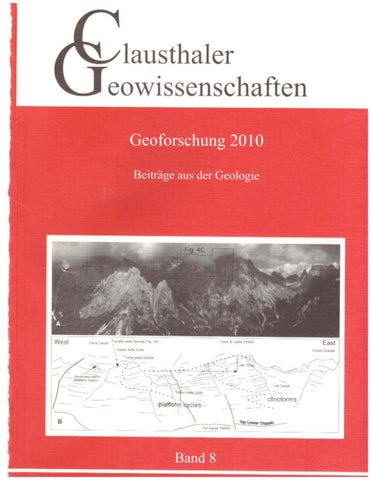
Umschlagseite: Geologische Strukturen im Bereich von Cima
di
\
Lastei und Cima delle Sedole,
Inhalt WoLFcanG BLENDINGER, STEPHANIE Lonmever & ALBERTO BERTINI Platform geometries from the Pale di San Martino (Dolomites, Italy) cast doubt on the peritidal origin of "Latemar cycles'
1
WotFeans BLenoncer & ALBERTO BERTINI Un modello strutturale tridimensionale delle Dolomiti centrali e
meridionali
13
Clausthaler Geowissenschaften
8
I-11
4Abb
Clausthal-Zellerfeld 2010
Platform geometries from the Pale di San Martino (Dolomites, Italy) cast doubt on the peritidal origin of “Latemar cycles” WolFganG BenpiGrR, Sternanie Lonmerer & ALseRTO BERTINI
Abstract: The Middle Triassic “Latemar cyeles” have become a dogma in sedimentary ecology. The tha the eyeles record subtidal to subaerial environments and were shaped by sca level changes
dogma
is
with amplitudes at the metre scale. At Pale di San Martino, the cyeles are dolomitized, but show depositional texture and alternaling facies indistinguishable from the calcarcous “Latemar cycles” at the Laterrar. The peculiarity ol the cyelic platform strata at Pale di San Martino is that, in the southeastem part of che platform, they form the downdip continuation clinoforms. These form two mounds, which limit the platform interior towards the basin and which rise ca. 200 m above the platform interior eycles. Because this geometrical relationship cannot explained by folding faulting, stratigraphic downlap or differenti al compaction, and because a gravity flow origin of'the cyeles can be excluded, these cannot be diagnostie for shallow water nor considered the result of regular sca level changes at the metre scale. Unless high frequency sca level changes the 100 m scale are invoked, the “Latemar eyeles" were controlled by level all sea changes
of
be
be
at
at
not
Keywords: Triassic, Dolomites, carbonate platform, eyelicity, “Latemar
cyel
‘
clinoform polarity
Kurzfassung: Die mitteltriassischen “Latemar-Zyklen” haben sich als Dogma der Sedimentgeologie etabliert und werden weltweit als gesichertes Beispiel 2yklische Mecresspiegelschwankungen im Met Bereich angeschen. In der Pale di San Martino sind diese Zyklen zwar dolomitisiert, doch zeigen Relikttexturen im “subridalen”’ Dotomit und den feinkristallinen *subacrischen” Zyklenkappen die glcichen Merkmale wie die groBtenteils kalkigen Zyklen am Latemar. Dic Besonderheit der Zyklcn der Pale di San Martino dali sie am FuB von Clinoformen auttreten und lateral, unter allmàhlicher Anderung des Fallwinkels, in diese iibergehen, Dic Klinoformen bilden zwei Higelstrukturen (mounds”’). die die ryklische Platform gegen das cigeniliche Becken begrenzen. Der nachvweisbare Niveauuntersschied suvischen dem Scheitelpunkt der Higelstrukturen und der zyklischen Palttform betriigt etwa 200m. Diese Situation ist weder durch (ektonische Deformation noch durch differentielle Kompaktion oder stratigraphischen " “downlap” crklrbar, sondern zcigt daB die “Latemarder Pale di San Martino relativ tîefen Wasser gebildet wurden, “Latemar-Zyklen" konnen deshalb nicht diagnostisch peritidales Milieu sein und auch nicht durch Meerespiegelschwankungen im Meterbereich erklart werden. Fs miissen entweder hochfrequente Mecresspiegelschwankungen im Hundert-Meter-Bereich postuliert werden. oder aber die sind iberhaupl nicht durch Mecresspiegelschwankungen verursacht “Latemas-Zyklen"
fr
ist,
fîîr
Ansehrii dor Autoren:
Wolfgang Blendinger,
Stephanie Lohmeier
Teclmische Universieit Clausthal,Institur Leibmizuim 10
D-38678 Clausthal-Zellerfelt
Alberto Bertini Viale Sommariva 38 1-32021
Agordo
fr Geologie ind Paltiontologie
in
A The “Latemar cycles”: a dogma mentary geology
1
in sedi-
lomitized intervals are thought t0 record subaerial
exposure. The
The so-called “Latemar cyeles” are carbonate platform strata consisting of regular alternations of supposedly subtidal and supratidal deposits, respectively. These deposits, of Middle Triassie age, have been considered a prime example for the record of sea level oscillations. The denomination “Latemar eyeles” from from the Latemar massil'in the Dolomites, northem Italy, an isolated carbonate platform measuring a few kilometres across and surrounded by clinostratified Mank deposits (Fig. 1). “Latemar cyeles” at the Latemar are decimetres to a metre thick and consist of lime grainstone and packstone with dasycladaccan algae and aggregate graîns which altemate with centimetre to docimetre thick, typically yellowish dolomite with similar allochems, pendant cements and pisolites (Bosttt1 & Rossi, 1974; GoLoHameR et al., 1990; EcenHorr et al., 1999). The calcarcous beds are thought to represent the subtidal domain, whereas the dois
control ofsea level fluctuations on the cy-
cles has been universally accepted, în spite of the failure to find supporting evidence for subaerial exposure, e.g., in stable isotope signatures (Dunx, 1992). dispute, called “the Latemar controversy”
(www.geopal.uni-hd.de/sediment'2uchike!respro:
latemar/controv'), is being carried out only around the question of the periodicity of sea level fluetuations (BRAcK al., 1996; Pato al., 2001; Munpi. et al., 2003; ZUHLKE al., 2003). “Latemar cyeles” cast-in-stone example for the study of an appearas oscillating sea level.
et
a
2
et
et
Purpose of this study and methods
of
is
The purpose this paper the presentation of new data which suggest that, based on simple geometrical relationships, the water depth record of “Latemar eyeles” is equivocal. The data derive from a detailed mapping of the cyclic platform carbona-
carbonate platform a: mainly Imestone bi partially or completely dolomitized
Rosengarten-Schlern
Langlote!
Do
Bozen
-
Marmolada
/
ratmoifg@?
$i
—
Cortina d'Ampezzo
x Nine ua der
5
Ò
ed
nu
corte ivetta
ca
=
cena
10.km
Agnello
Pale di San Martino
‘angle of view Fig. 4
in
Location map of the platforms the Dolomites (A), the geological map 2A; Martino (Fig. inset rectangle), and the angle of view of Fig. 4
Fig.
1
#
—
faut
of the southern pari of the di San Pale
tes ofthe Pale di San Martino and their relationships with clinostratified carbonates.
3
The
lagic limestone, siliciclastie and and volcanie rocks (Fig. 2). The Pale di San Martino platform is almost completely dolomitized, but dolomitzation has not destroyed original bedding, the depositional fabric recognizable in many places, and the original platform geometry has been preserved nearly completely (Fig. 2). The Pale di San Martino is almost unfaulted (CastigLIONI, 1939) but is now slightly rotated and shows a regional structural dip of about 5° to the NE, conspicuous fractures with negligible vertical displacements (ZammERI, 1987), and faults with displacements at the tens-of-metres scale occuring only in the periphery. Within the cyclic plat-
Pale di San Martino platform
is
The Pale di San Martino is a comparatively larplatform în the Dolomites, which covers about 150 km? and is up to 1.5 km thick. Similar to other Middle Triassic platforms, the Pale di San Martino consists of a bedded platform interior which is surrounded by clinostratified carbonate, which în tum passes basinward into a thin succession of pege
A (pena
IT fruste ae rene pre mg roma. re — ta SEE ran coni he
BETTI
[3000m
(5)
lt
Pala di San Martino Cima Canali
_.---
N;
2
Cima
still
di Lagtei
“ValCanali -
‘500m above sea level Fig. 2 (A) Geological map of the southern part of Pale di San Martino, where bedding attitide was meusured black Systematically. The indicates the position of (B). The cross section cross section vertically
solid
line
the
of
to scale and shows the stratification pattem across the Pale di San Martino platform. Symbols are as sediment not shown due 10 the limited thickness.
is
is
în (A). basinal
form, strike and dip angles of bedding are highly variable, but lowdip angles of <15° prevaîl 4
he cyeles and their geometrical relation-
ships with clinoforms
(Fig. 2A), but also locally Canali (Fig. 4).
Cima
in the platform interior of
Along the southwestem edge of' the Pale di San “normal” polariMartino, the clinoforms show ty with respect to the platform interior (Fig. 2, Fig. 4). They dip away from the platform interior and can traced for hundreds of metres into the time equivalent basinal sediments. This îs the usual situtation observed in many places in the Dolomites (Bosttini & Rossi, 1974). From the strike and dip measurement it appears that the angles of the platform interior beds. adiacent the platform (particularly south of Cima Canali: Fig, 2A), are somewhat higher than the regional structural dip of the platform base, The peculiarity of the platform-clinoform relatitheir “revers onships around Vallon delle Lede polarity: the clinoforms dip towards the cyclic platform deposits. not away from these (Fig. 2. Fig. 4, Fig. 5). These clinoforms. at the southeast edge of the platform, show stratification pattern simiar to two mounds limiting the platform interior toWards the basin in the cast (Fig, 2, Fig, 4). The geometrically preserved differences în elevation between the platform and the highest paris of correlative clinoforms amounts tens of metres within the platform interior (Fig. 4E) to ca. 200 metres at the southeastem platform margin (Fig.4A.B) The details of Fig. 4C and D show the relationships between the platform interior and the gradually upward steepeing clinoforms clearly. At Cima di Lareal) steî, the apparent (=minimum. but probably dip angles even stecpen to 30° in the inaccessible part of the cliff (Fig. 4C), By contrast, the base of the platform and the overlying platform interior beds, at the cliftà of Cima Lasteî, shows measured dip angles between 5 and 10°, which is 20-25 less than the dip angle of the clinoforms,
the
be
ist
best exposed în eyelie platform interior the southern part of the Pale di San Martino (Fig. 2A), forming poorly accessible vertical cliffs and slopes. Decimetre to metre beds aci essible light grey. often sucrosic, dolomite, alternate with timetre to decimetre thick yellow dolomite (Fig. The
of
3A). The light
ey dolomite beds show, in spite of fabric, abundant molds of dasycladacean algac. preserved as isolated thalli to centimetre long stems (Fig. 33), Aggregate grains, millimetres to centimetres în size. are frequently preserved as well as molds of molluscs. Sedimentary struetures are, except for bedding, totally absent, but tepee structures occur locally The yellow dolomite consists of much finer dolomite erystals which typically preserve the depositional texture, Stromatolitic lamination common, and aggregate graîns are the most abundant constiencrusted by asymmetrical, tuents. Allochems now dolomitic and locally pendant, cement rinds similar to pisolites. Similar to the grey dolomite. în the dolomite are filled primary residual voids with fibrous calcite cement (Fig. 3C). The yellow dolomite typically forms the recessively weathering ledges which make stratification obvious and casily measurable. The clinostratified dolomite is typically sucrosie and only vaguely bedded. Reliable measurements of stratification can only be made locally, because many at many localiltics bedding is not easily distinguished from fractures. Bedding îs recognized by subile differences in colour. ranging from light yellow dolomite grey to tan grey. Intercalations are absent. Marine fossil remains occur occasional1y and include molds of molluscs. brachiopods, ammonoids and and erinoid ossicles, The eyelic platform strata join clinoforms cither the bedding via a gradual or via an abrupt change attitude. The first type is best exposed in Val Canali at the southwestem precipicce Cima di Lastei and Cima delle Scdole. and shows a measurable inereast of the dip angle from less than 10° in Vallon le Lede to about 25° in the clifls ol Cima Lastei and Cima delle Scdole (Fig. 2A, Fig. 4). The second type preserved along the NW trending platform margin across Val Pradidali and Pala di San Martino
the suerosi
is
are
of
of
of
di
is
d
NE
dip
to
margin
is
n
a
to
6 Discus
on
di
San Although the platform deposits of the Pale Martino are dolomitized, as compared the largely calcareous cyeles at the Latemar (GoroHasmeR et al., 1991), the similarity of the cyeles apparent The grey dolomite beds display features indistinguishable from the “subtidal” intervals at the Latemar, the yellow dolomite is indistinguishable from the “subaerial eycle caps” of the Latemar. At the castem Pale di San Martino, the eycles occur ina margin “basinal’ position relative t0 the clinoforms. The “basinal” position Vallon delle Lede was, în principle, already recognized by Zaxmiesi (1987),
to
is
of
of
(A) Cyelic allemation of yellowish ine grained dolomite and thicker bedded grey dolonnite. Hammer (encireled, 30cm long) for scale. These altemations determine the well stratified platform interior of the Pale di San Martino indicating eycles similar to hose preserved at the Latemar, Locality is Forcella delle Sedole (Fig. 4) Fig.
(B)
3:
Thin section (stained with Alizarin-red S and impregnated with blue epoxy to mold pore spaces) micrograph
of'a grey dolomite showing abundant molds of dasycladaceans. (C) Thin section (stained with Alizarin-red S)
micrograph of a yellow dolomite with pisolite grains and locally preserved pendant cement. Calcite cement (red residual voids, Note the absence of evidence for mechanical chemical compaction in B and €
»tained)
fils
or
forms
2 6
Cima
di Lastei
apparent dip angle ca 300
6)
Fig. 4 Photograph (A) and line drawing (B, page of the clinoforms of Cima di Lastei and Cima delle Sedole which grade downdip into the platform eycles of Vallon delle Lede. The dashed black line indicates the profile of the transîtion from clinoforms the east to eyclie platform deposits, indicating relief of ca. 200m. Thin
of
in
a
section micrographs Fig. 3 B and C are from localities along black dashed line. Clinoforms also occur within the platform interior (southem precipiece of Cima Canali) and preserve a relief'oî ca. 100 m (ef. Fig. 5).
the
The western margin of Pale di San Martino shows the usual transition of the platform interior into the clinoforms with a subvertica! boundary (blue lines), but platform strata also show a slight dip towards the platform interior. Photograph taken from Cima delle Regude (2245 m) in the extreme south of the Pale di San Martino. The detail of
(C) clearly
shows the bedding style in the southern precipicce of Cima Lastei and that the upward steepening cannot de the result of tectonie deformation. The detail of (D, page 8) shows the gradual increase in dip angle (arrowed) measured at Cima delle Sedole. x
Vallon delle.Lede (background)
o
x. Sa clinoforms:.
Detail of the clinoforms (for location see Fig. 4A.B), about 100m high, in the southem precipiece of Cima lateral transition from stratfied platform interior into clinoforms, about 80m high, The bedding style excludes an interpretation of the clinoforms as “flower structure” caused by the fracture (red). Fig. 4 E:
Canali, showing
the
of
but interpreted as a drowned portion the platform interior. This interpretation would require downlap of clinoforms onto a planar surface of the cyelcs. This is not observed. but rather a gradual transition ofthe platform interior into clinoforms, documented by measurable, gradual change of the dip angle. It is implausible to interpret the platform-clino-
a
form relationships at the southcastem margin of Pale di San Martino in terms of tectonie deformation. the mounded clinoforms as folds origin can be excluded because thé platform substratum well exposed and nearly planar, and because thrust faults are nowhere observed within the platform An
of
(CasticioNI, 1939; Fig. 2; Fig. 4).
is
Although the platform base in the surroundings of Val Canali appears slightly folded on the cross
has
lower amplitude seetion of Fig. 2B, this folding and larger wavelengih than the critical outcrops at the clifl of Cima di Lastei and Cima delle Sedol Fractures or faults which could account for differential folding of the platform absent. Folding of the platform base (1) could be older than the ove the strata show Iying platform carbonates. and lower dip angles at the base of Lastei than the clinforms higher in the same clif. Therefore, the difference dip angle is either completely or at cast to large part depositional în origin Overall, the profile of the platform interior consistent with a depressed “lagoon”. The structural measurements [rom platform margin with “normal” polarity indicates a slightly chevron shaped the mounds the upper Val profile, and the top “normal” Canali and the platform margin along Val Pradidali could have had similar palcotopographic elevations. The occurrence eylic platform facies can, therefore, not be a reliable indicator for “palacohorizontal”. Only the mixed siliciclasti-carbonate succession of the Lower Triassic platform base was almost certainly deposited horizontally or nearly so. Itis also implausible to interpret the clinoforms grading downdîp into the cycles as Îlanks of subaerial carbonates. The occasional occurrence of marine fossils in the clinostratified dolomite excludes this option An allochtonous, gravity Now origin of the cles equally unlikely. The complete absence cross bedding and size grading of allochems si gues against an interpretation as allochtonous bonate. This is not inconsistent with the reported “channellized megabroccia” bodies in occurrence Vallon delle Lede (Zammeri, 1987), which refers isolated occurrences within the platform cyeles. Differential mechanical compaction as reason for the present geometries is difficult to reconcile with the platform cycle facies. Grainstone and boundstone facies prevail, and all published descriptions and thin section micrographs from other platforms indicate that these were cemented carly and show no evidence for mechanical compaction DogLioni €). & Got prraMMer (1988) have (Fig. 3B, suggested that an argillaccous and lime mudstone sequence, now ca. 440 thick, has compacted only about 80 metres relative (0 the correlative clinoforms at the Sella platform. If this were taken as an extreme value for (unlikely) differential mechanical compaction of the grainy “Latemar cycles”, the eyeles of Vallon delle Lede were still deposited in
are
(2)
Cima
di
in
a
is
the
of
of
of
©
is
of
of
ar-
of
to
m
water tens t0 a hundred metres deeper than the adjoining clinoforms The degree of chemical compaction (pressure solution) a funetion of the overburden, and is extremely unlikely that chemical compaction would affect pure carbonate different magnitudes at the small scale of the Pale di San Martino platform. dasycladaAn cnigma îs the mass occurrence cean algae in the cycles of the Pale di San Martino. The fact that many dasyeladaccan molds suggest coherent stems (Fig. 3B) argues against any transport of these fragile organisms. Dasycladaccans are traditionally interpreted as very shallow water, photic organisms. The cyeles of Vallon delle Lede were deposited ca. 200 m deeper than the surrounding clinoforms. and this measure is still within the photie zone. which can reach about 300 m in clear water (Le Campion-Arsumanro et al., 1982). How much light Triassic dasyelads required unknown and entirely inferred from recent analogs. However, the depositional depth of the top of the mounded roforms is unknown, and dasyelads were posblynot photic organisms all The geometrical relationships between platform ceyeles and clinoforms are thus, either completely or at least largely, primary, depositional gcometries The coexistence of “normal” and “reverse” polarity of the platform margins in one platform indicates that the platform top and its cycles cannot diagnostic for a shallow water. peritidal environment. Moreover, the control of'eyelicity cannot have been sea level Muctuations with amplitudes at the metre
it
is
at
of
is
the at
be
scale. The profile of the cyclic
“lagoon” at the Latemar because systematic structural analyses of the platform are not available. and partly because large part of the platform interior have been removed by erosion. This is different at the Pale di San Martino, which almost completely preserved. The Latemar “lagoon” originally probably had dithe mensions similar platform interior of the Pale di San Martino, and was possibly also depressed by tens of metres relative to the platform margin. EGrxnorr et al. (1999) infer such a depressed “lagoon” from facies changes, not from structural data. As long as it has not been demonstrated the the Latemar “lagoon” was in fact flat, the suggested metre scale of the amplitude of sea level changes remains speculation. In the case of a depressod lagoon. the necessary amplitudes could have been signifcantiy larger is
unknown,
partly
is
to
6 Conclusions
Duxx,PA.(1992): Cyelie stratigraphy and carly di-
Cyelie carbonate platform deposits of the Pale di San Martino are indistinguishable from the “Lutemar cyeles”, but occur as downdip extension ofclinoforms. The geometrical relationships indicate that the cycles were deposited water ca. 200 metres deeper than the highest portions otthe correlative clinoforms, “Latemar cyeles” are, therefore * not diagnostie for an overall peritidal environment, + not shaped by sea level fluetuations at the metrescale, and probably not the results of sea level changes at
in
agenesis: an example from the Triassie Latemar platform, northem Italy-- Unpubi. PhD Thesis Johns Hopkins University, 837 Baltimore.
p.,
Earworr,
A.. BrcHstADT, T., ZON R. & GaotscH, (1999): Facics architecture of an isolated carbonate platform: tracing
te,
Oxford.
GotpHasivia, RK,
DUxN, PA. & Haanir, L.A. Depositional eycles, composite sca level changes, cycle stacking patterns, and the hierarehy of stratigraphic forcing: Examples from the Alpine Triassic platform carbonates.Geological Society of American Bullettin: 102: 535-562; Boulder.
(1990):
all
of
possible solution the problem of “Latemar eycles” must awaît gcochemical and quantitative petrographical dati.
Acknowledgments
LE
Reîimer
(Amsterdam) provided helpful suggestions for improvement of the manuseripi, Thomas Beckmarm manufuctured the din sections, and Rainer Miller provided essential! Jobm
editorial help
7
Cawpioy-ALsumaro, T., CamereLL, SE. & Gorunic, S. (1982): Endoliths and the depih of the photic zone, discussion. Journal of Sedimen52: 1333-1334. tary Petroli
Movon, R. Zimixe, R., Brewstipr, T, EgenHio#r, S.0., Oper, HANseL,
References
A.,
M.,
& Rossi, D. (1974): Triassic carbonate buildups of the Dolomites, Northem Italy Sociely of Economic Palcontologists and Mineralogists, Special Publication. 18: 209-233: Tulsa.
BoseLLini,
A.
Brack,
MixpiL, R., OggRt1, F., Mtier, M.,
eg,
P.,
& Rie
Biostratigraphic and radiometrie data question the Milankoviteh charueterisage tics of the Latemar (Southern Alps, Italy).- Ge‘ology, 24: 371-375; Boulder. H.
(1996);
gruppo delle Pale di San Martino e le valli limitrofe- Memorie dell Istituto di Geologia e Mineralogia Università di Padova, 17: 1-110: Padova B.
(1939):
Il
Docuioni, C. & GoLbHammer, RK, (1988): Compaetion induced subsidence in {he margin of a carbonate platform.- Basin Research, 2371:
246.
rack,
F.,
& Rirnrr.
Pera Metrr,
(2003): Cyelicitios in Triassic platform carbonates: synchronizing radio-isotopie and orbital clocks.- Terra Nova: 15: 81 — 87. P.
H.
Preto, N., Hrywov, L.A., Hakbie, LA. & DE ZANCHE,
re-
(2001): Middle Triassic orbital signature corded in the shallow-marine Latemar carbonate
V.
buildup (Dolomites.
Italy).-
Geology:
29,12;
1123-1126. Le piattaforme carbonatiche (1987): triassiche delle Pale di San Martino (Dolomiti)
Zampriegi,
CastiGLioNi,
I.
the eyeles of the Latemar (Middle Triassic, northern Italy).- Sedimentology, 46: 893-912:
+
A
PETtRMANSEL,
E..
D.
- Memorie delle Scienze Geologiche: 39, 73-83:
Padova.
Zune, R., BecustADT, T. & Mupi,
R. (2003) Sub-Milankovitch and Milankovitch forcing on a model Mesozoie carbonate platform the Latemar (Middle Triassic, Italy) Terra Nova:
15, 69-80.
-