

Welcome to Energy Matters issue 31
Time for some deep thinking on renewable energy
Iran Conflict
The US and Israeli attack on Iran has intensified an already fragile global energy landscape, triggering sharp disruptions across oil and gas markets. This has sent energy prices soaring worldwide. Oil prices have risen more than 25% since the conflict began, with analysts warning that even if the conflict subsides quickly, damaged refineries, disrupted logistics, and heightened shipping risks could prolong the crisis for months.
The current crisis is likely to have consequential impacts beyond energy into chemicals, agriculture, and manufacturing. Overall, the conflict looks to have triggered a far reaching energy crisis with global economic implications, highlighting the vulnerability of world markets to geopolitical conflicts involving key fossil fuel producers and transport corridors.
The UK perspective
In the Aberdeen of the 1990s, oil was booming. Offshore workers flew in from across the UK and beyond. Firms prospered by providing a huge range of services to the sector.
Senior technical and business people from around the world made the Granite City their home. Property prices were buoyant, raising the feel-good factor for homeowners – there was a real buzz and little obvious reason to think it would ever end.
Not everyone thought hard about the future, but some did. Recognising ‘The Houston Effect’, they looked at how the city in Texas had retained its status as the world’s energy capital despite the US lacking the abundant oil and gas reserves of the Middle East and more recently, South America.
Many were concerned with extending the life of oil and gas fields rather than planning a future without them. This was typified by the CRINE initiative –cost reduction in the new era, whereby new efficiencies were adopted, mostly from the US, to address the high cost and ‘over-engineering’ of early North Sea developments.
Others envisaged a post-fossil fuel world to harness the animal spirits that drove the oil pioneers to discover new, more sustainable energy solutions. None of this was urged by governments or activists.
Greenhouse alarm
Then in 2015, fearful of the effects of climate change, the UN’s Paris Agreement set targets for reducing greenhouse gas emissions. These were widely adopted internationally, though Britain’s were among the most demanding. The Climate Change Act 2008 set binding targets and established the Committee on Climate Change to advise Government. Acting on CCC recommendations, the UK legally committed to a 100% reduction –net zero – by 2050.
Numerous policies have been adopted to meet the goal, from Build Back Greener to decarbonising the power sector and setting up Great British Energy to spur clean-energy investment.
I welcome the adoption of renewable energy sources for several reasons but there should be a managed transition away from fossil fuels. Britain is ideally placed to benefit, ranking second only to China in offshore wind capacity, and is a leader in developing green technologies such as green hydrogen, carbon capture and nuclear fusion. But investment in green energy should take place in addition to rather than instead of other sources, especially natural gas, which is much cleaner than other fossil fuels and of which the UK retains significant reserves. If still unproven fields across Northern England are included (though tapping this resource would involve controversial fracking technologies), the reserves are higher still.
Top-down coercion and an uncompromising approach to reducing emissions have led to significant and unexpected anomalies.
Steely resolution
UK investment in North Sea oil and gas has all but halted in the face of ‘windfall’ taxes, restrictions on exploration licences and regulatory uncertainty. Instead, at great expense, we rely on exporters such as Norway, which continues to explore and produce from the same basin, using the latest techniques.
Coking coal needed to produce steel cannot be mined in the UK so must instead be imported at high cost, often from countries with lower safety and environmental standards than ours. By
Mike Reid 07909 978 642

mike.reid@galbraithgroup.com
adding needless transport, this increases rather than lowers global emissions. Why? So Britain, which accounts for less than 1 per cent of greenhouse gas, can set an example to the rest of the world! This is the hidden carbon impact of net zero. The UK uses two different emissions accounting frameworks, depending on policy purpose:
The UK’s legally binding net zero target – set under the Climate Change Act –uses territorial emissions, meaning it counts only emissions that occur within the UK’s borders.
Imported coking coal, even though carbon intensive to produce, does not add to UK territorial emissions until it is actually burned or used inside the UK (e.g., in steelmaking).
Emissions from mining and processing the coal overseas are not counted in UK territorial emissions whereas emissions from using the coal in the UK are counted, because combustion happens within UK borders.
Although imported coal production emissions do not count toward the UK’s territorial carbon budget, the UK does track them and the position is due to change from 1st January 2027 as the UK is implementing a Carbon Border Adjustment Mechanism but we will comment more about that in a future edition.
Consumers pay for renewables three times – through carbon taxes on gasfired generation, guaranteed above-market prices for wind and solar under the Contracts for Difference subsidy, and through a growing list of levies for backup capacity, grid reinforcement, and balancing services required by intermittent generation. Together these impose an implicit carbon price of £339 per tonne on British electricity – more than double the figure some academics estimate would maximise global welfare, according to Duncan McClements, an economics research associate at King’s College Cambridge.
But net zero doesn’t just make heating homes dearer. Due to our high dependence on imported natural gas, established pricing models and high renewable energy costs, Britain has among the world’s highest industrial electricity prices – up to four times higher than in the US, cutting a swathe through UK manufacturing.
u Oil prices rose more than 25% since the conflict began...


Industrial harm
In Britain, the Industrial Revolution led the world into modernity, spurred by free-market thinkers such as Adam Smith, whose seminal publication The Wealth of Nations marks its 250th anniversary this year. Latterly, the UK has shifted to high-end specialist manufacturing in areas where it has a strong competitive advantage. That advantage will be hard to maintain amid sky-high energy prices.
Despite burning half the world’s coal consumption, China is a formidable pioneer in green technologies, making much of the wind and solar equipment that drives our adoption of clean energy.
Rising energy prices, influenced in part by ongoing geopolitical tensions in the Middle East, have reinforced the importance of reliable energy supply, with potential implications for inflation and wider economic stability in Britain.
The heightened geopolitical tensions of recent years remind us of the crucial role of manufacturing in maintaining national security. Meanwhile, Britain’s long-vaunted ‘knowledge’ and service economies are suddenly threatened with joblessness by artificial intelligence. This is ironic, as powering the data centres relied on by AI will require unprecedented additional energy.
Last year’s blackout in Spain was blamed by some experts on over-reliance on, and the ‘inherent instability’ of, wind and solar power. While energy transition remains a worthwhile, admirable goal, we are a long way from replacing fossil fuels completely, however much we legislate to do so.
It took us four centuries to move from wood to coal and on to oil and nuclear, yet we’re expected to complete the next transition in decades or a few years without harming not only Aberdeen but the entire country –permanently. We should recognise the problem and do something about it. n


Galbraith is a leading independent property consultancy. Drawing on a century of experience in land and property management the firm is progressive and dynamic employing over 200 people in offices throughout Scotland and the North of England. We provide a full range of property consulting services across the commercial, residential, rural and energy sectors. Galbraith provides a personal service, listening to clients and delivering advice to suit their particular opportunities and circumstances.



Energy
Grid reform news throws light on development pipeline
The offers will be linked to location because offers are connected to the engineering complexity and the scale of reassessment in each network area.
Philippa Orr.



Since December 2024, The National Energy System Operator (NESO) has been working towards a grid reorganisation to overhaul the outdated electricity connection system, moving from a “first come, first served” model to a “first-ready, first connected” approach.


More than 1,200GW of ready projects were waiting in the queue for a connection date – around four times the projected needs of Great Britain by 2030.
The move by the public body tasked with planning energy grid systems and ensuring adequate supply, is a step in the right direction to meet the government’s Clean Power by 2030 target, which aims to have 95% of electricity being generated from clean and low-carbon sources.
As part of the Connection Reform, renewable developers had to submit evidence of the progress of their schemes by the summer of 2025, with a view to receiving a grid connection date. Developers and landowners alike have been waiting patiently to learn the fate of their projects.
From the announcement date of 8 December, successful renewable projects were to start hearing if they will contribute to the 283GW of generation and storage capacity and 99GW of transmission-connected demand. The first batch of projects scheduled for earliest connection were expected to receive formal offers in the first few weeks of January and all remaining offers were to be finalised by Q3 of 2026.
Protected transmission
However, during a further announcement in February of this year, NESO published the latest iteration of the proposed timeline. The new timeline will see protected transmission and large embedded projects that are due to connect in 2026/2027 receive formal connection offers between February and the middle of April. Protected distribution offers will be sent out between early March and May 2026.
Projects connecting pre-2030, or that form part of Gate 2 Phase 1, will be given offers between mid-May and mid-September for transmission projects and distribution projects will hear between mid-July to midNovember 2026. Projects connecting between 2030 and 2035 will hear towards the end of 2026 and into 2027.
The offers will be linked to location because offers are connected to the engineering complexity and the scale of reassessment in each network area.
Another big change that has been made, is that NESO has removed any reference to when the next application window will open for new and future projects.
It is our understanding that existing projects with grid offers prior to 2035 are likely to be approved, if there is a need, but they will still need to achieve their milestones of funding and planning. Given that it is taking between five and seven years from inception to achieve consent for any development, the 10-year target date is effectively as little as two years away.
In the queue prior to the reform were projects comprising 240GW of battery storage, 210GW of solar, 35GW of onshore wind and 110GW of offshore wind to name but a few of the renewable technologies. With these figures in mind and focusing on what power is needed in Great Britain, many developers and landowners are likely to be disappointed in the coming months.
Queuing churn
This is only stage one of a much larger reform process that has highlighted both the needs of Great Britain in the coming years and areas where there is a market opportunity for future projects. For example, there is a small capacity for offshore wind, onshore wind and solar, but no capacity for any new storage developments as Great Britain has already met its 2035 capacity. We expect a churn in the queuing process as the announcements themselves could bring into question the viability of a number of developers, even if some of their projects cleared the first hurdle. Delays to prospective cashflows and upside may make some funding structures impossible to sustain. Time will tell, but we should expect some reduction or merging among developers as the system works itself out.
Developers and landowners will need to be patient as they could be waiting until March 2027 for confirmation on whether their projects have been successful. We will endeavour to keep our clients updated as and when we know more and have specific project updates from developers.
The information presented above is correct at the time of writing. n
Philippa Orr
07917 220 779 philippa.orr@galbraithgroup.com
Landlords warned of telecom operators offering to buy mast sites at discounted prices

u It’s understandable that some will wish to capitalise on the value of their land, but potential sellers should take their time, and a transfer may not be the only option.
Landlords tempted to offload their telecom mast sites should cast their net wide to maximise financial return, says Oliver Sinclair.


Mobile network operators and infrastructure investors are increasingly offering to buy out landlords, who have seen their returns from telecom mast sites reduce following the introduction of the 2017 Electronic Communications Code (ECC).
Many landlords have been receiving approaches from their existing telecom mast tenant or other investors seeking to purchase sites from them. The decision to sell should be carefully considered to make sure this is the right decision taking into account wider property implications including future development plans.
Maximum flexibility
Approaches to purchase are often accompanied by comments about rents reducing and giving the impression a sale is the logical option – but the figures offered are usually below what can be achieved in the wider market. Operators are looking for maximum flexibility to utilise and expand their networks and keen to secure their sites for the longer term, minimising the threat of removal from landlords looking to redevelop. This shift in bargaining power is one of the key reasons investors and operators are actively approaching landlords, often seeking to secure long-term control at an early stage.
The changes introduced by the ECC reduce the incentive for owners to renew under the new regime, leading many to consider selling sites that host masts and related equipment.
Farmers and other landlords potentially affected need to be cautious of underselling their mast sites.
Lower than market value
Seeking to capitalise on mast values rather than facing a fall in rental income is perfectly understandable, but often is not the only or right option. Farmers and other landlords potentially affected need to be cautious of underselling their mast sites.
The network operators and infrastructure investors often approach with low offers for freehold and long-lease property, expressed as the solution to minimising hassle from the site or making it easy for landlords. Often, these offers are substantially lower than what could be achieved in the market. Initial offers are often not the best available, and for both sides of a bargain, testing the market can materially improve outcomes.
It’s understandable that some will wish to capitalise on the value of their land, but potential sellers should take their time, and a transfer may not be the only option. It is vital that landlords make sure they are advised on the implications and value of any transaction to protect their longer-term property interests.
Any decision should be driven by individual objectives, such as balancing long-term income with capital receipt, tax position and redevelopment plans, rather than purely reacting to legislative changes.
Above all, landowners should obtain specialist professional advice (valuation, legal and tax) before agreeing terms, particularly given the technical nature of the Electronic Communications Code and recent legislative changes.
For more than 25 years we have been maximising revenue on mobile phone mast sites and assisting landowners with telecoms management services and negotiations with telecoms companies across the UK. If you are a landowner and unsure how to proceed in discussions with a mobile network operator, please do get in touch with your local Galbraith office. n
Energy update: Developers reflect on landmark court rejection of Borders wind farm
Developers and landowners are likely to review their planning and consenting strategies for numerous renewableenergy projects after a court rejected plans for an eight-turbine wind farm in the Borders.

Richard Higgins 07717 581 741

richard.higgins@galbraithgroup.com
Scottish Borders Council refused planning permission after local farmers objected on environmental grounds to plans by Energiekontor UK to build the project. The company appealed and the Scottish Ministers appointed a ‘reporter’ – an independent official, who then approved the scheme in January 2025.
Now the Court of Session in Edinburgh has reversed that decision and ruled that a different reporter be appointed to consider the case anew.
The judges said two key stages had to be considered in evaluating the environmental, social and economic aspects of such developments – first, construction and second, the connection of the finished project to the electricity grid. Yet only the construction phase had been considered.
“The issue is whether planning can be lawfully granted when the [electricity] connection to the grid is not included in the application,” said the Court.
u Now the Court of Session in Edinburgh has reversed that decision and ruled that a different reporter be appointed to consider the case anew.

Delays
The 17 February ruling could lead to substantial delays in renewable energy developments due to the large queue that has formed, including many speculative projects with connection dates years in advance.
The National Energy System Operator (NESO) has set up a new grid queuing system, replacing the long-standing ‘first come, first served’ approach with TMO4+ (Target Model Option 4+) – "first ready, first connected". However, tackling the 700GW-plus backlog successfully is likely to take several years.

The proposed development of 150-metre turbines near the village of Heriot was due to provide up to 36MW of installed capacity, generating some 150 GWh of renewable electricity a year, powering an average 38,000 homes.
Until now only construction and related infrastructure aspects are considered in the environmental impact statements that are prepared in the planning process, not the potential impact of the off-site grid connection that comes later.
Potential impacts
Some grid connection agreements require significant, costly reinforcement works to be undertaken and these could have implications well beyond those considered at the earlier planning stage.
As the situation remains under review it is difficult to assess the potential impacts on individual projects and landowners with option agreements in place may wish to enquire of the developer what their views are and if there is potential delay. The timings could be important to consider especially where there are critical dates within the option.
At Galbraith, our renewable energy department has expertise in all the mainstream renewables solutions as well as working across a range of utilities negotiations. Do get in touch if you’d like to talk. n
u The judgment also addressed the statutory amendments of 2022, which introduced limited mandatory sharing rights.

Energy & infrastructure update: Legal ruling is significant shift in Code interpretation
The Upper Tribunal’s decision in Ewefields marks another decisive moment in the evolution of the Electronic Communications Code. While the Code was intended to modernise digital infrastructure, its current interpretation is increasingly diverging from the expectations of many landowners who have hosted telecoms sites for decades.

The decision does not eliminate the challenges landowners face, but it highlights the value of having a specialist team who understands the Code, the operators, and the negotiation landscape... Oliver Sinclair.
The case centred on a number of rural mast sites owned by AP Wireless, where On Tower sought new Code agreements. A key issue was the scope of sharing rights, where network operators are obliged to share equipment to minimise environmental depletion. The First-tier Tribunal had sought to restrict sharing to equipment only, as set out in paragraph 17 of the Code.
On appeal, the Upper Tribunal fundamentally disagreed with this narrow approach. It held that the Code does not confine sharing to apparatus; rather, operators may share the wider site, including structures and lease rights, provided they can demonstrate a commercial need to do so.
Additional value
The judgment also addressed the statutory amendments of 2022, which introduced limited mandatory sharing rights. Some parties had argued that these amendments represented a cap on what tribunals could impose. The Upper Tribunal rejected that view, confirming that the amendments establish a minimum baseline of sharing rights but do not restrict the Tribunal’s discretion to grant broader rights under paragraph 20. This leaves operators able to pursue wideranging sharing rights that exceed the default statutory framework.
The Upper Tribunal did not hear evidence regarding the ownership, maintenance, and operation of the apparatus being installed, nor the income received by the mast operator from such sharing arrangements. It therefore did not consider the additional value that could be attributed to rights extending beyond those in paragraph 17 of the Code.
Because the installation of apparatus on existing electronic communications equipment falls outside the Code, it is not subject to paragraph 24’s restrictions on rent.
The ability to share apparatus in this way—combined with the Ewefields ruling—provides mast operators with a highly valuable income stream, often amounting to £10,000–£20,000 a year, resulting in a considerable profit rent at the expense of the site provider.
Rapid telecoms rollout
In short, Ewefields strengthens operators’ negotiating positions and continues the trend of proinfrastructure decisions. For landowners and advisers, it reaffirms the Tribunal’s view of the Code as a mechanism to support rapid, efficient telecoms rollout, even when that limits the financial and practical leverage of site providers. While Ewefields may stand as a clear statement on the approach to sharing rights under the Code, it is unlikely to reduce the volume of disputes arising from it.
The decision does not eliminate the challenges landowners face, but it highlights the value of having a specialist team who understands the Code, the operators, and the negotiation landscape. Despite operators frequently citing the £1,750 rent determined in Ewefields as a new benchmark for unexceptional greenfield sites, this is not now an appropriate rent and we are aware of new Code agreements being reached at rents considerably in excess of this level.
Knowledge and experience
With the right guidance, landowners can still secure agreements that respect their land, protect their operations, and maximise the value of their site.
At Galbraith, our specialist telecoms team works exclusively in this field, combining deep knowledge of the Code with decades of experience advising landowners. We understand how operators approach negotiations, how the Tribunal is currently interpreting the legislation, and where genuine value can still be achieved. By drawing on this expertise, landowners can navigate an increasingly complex landscape with confidence and ensure their interests are properly represented throughout the process. n

Oliver Sinclair 07920 203376 oliver.sinclair@galbraithgroup.com

Compulsory purchase orders in focus as renewables gain ground
With the transition to greener energy and the trend for larger-scale renewable developments, projects are getting more complex.
While the UK Government does not actively encourage the use of compulsory purchase orders (CPOs) to advance schemes considered vital, it is very clear that interests in land should not preclude the wider renewable development market.
Meanwhile in Scotland, a patchwork system of CPO legislation is undergoing a review. Here, some acquiring authorities have the ability to acquire these subsidiary rights in land while others do not. With no underlying policy reason for this inconsistency, the Scottish Government’s consultation on CPO reform proposes the introduction of three new general powers which could, in principle, be exercised by all acquiring authorities:
• the general power to create new rights in land;
• the general power of temporary possession; and
• the general power to enter land prior to a CPO.
Interested parties can respond to the Scottish proposals here until 19 December.
CPOs have long been seen as a last-ditch measure as they involve the mandatory transfer of property rights. Recently, developers have shown a growing interest in these powers, which are conferred upon them by the Electricity Act.
Given the importance of largescale renewable developments both on- and off-shore, the use of CPO is justified where there are multiple land interests to be negotiated that would take a number of years to settle if carried out by voluntary means. Obtaining and using CPO powers enables the developers to “turbocharge” the timescale, reduce risk significantly and lead to clarity in the development timescale for their projects.
Of course this almost certainly means financial and other costs to landowners – they may find themselves subject to what appears to be an aggressive approach by developers and their agents. Owners often find
themselves in initial discussions about temporary works being done on their land, or traffic passing through it, then receive a compulsory purchase notice.
Understandably, this can be alarming to landowners, particularly when only a limited amount of progress has been made in seeking to agree commercial terms with the developer.
The use of CPOs is well established for nationally important infrastructure such as roads and water installations, and they were used extensively in the post-war period for slum clearance. Having then fallen out of favour for a period, they are now used more frequently.

Of course this almost certainly means financial and other cost to landowners – they may find themselves subject to what appears to be an aggressive approach by developers and their agents... Richard Higgins.


u That said, bringing to bear a robust objection to a CPO is an important negotiating tool in reaching a negotiated settlement...
Should any party be in receipt of a CPO notice, it is important not to panic, but rather seek expert professional advice, as the time between the receipt of notice and the deadline for lodging an objection to the notice can be quite short – usually about one month.
The promoter, or ‘acquiring authority’ of the CPO – typically a developer – must follow a specific pathway that is highly regulated and formulaic. Depending on the precise circumstances, it is generally better to seek a negotiated outcome than to resist a CPO. The ultimate power to determine compensation rights and other matters rests with the Lands Tribunal for Scotland and the High Court in England and Wales.
That said, bringing to bear a robust objection to a CPO is an important negotiating tool in reaching a negotiated settlement acceptable to all, and should not be overlooked.
While the balance of power may rest with the acquiring authority, as reported previously in Energy Matters, the acquiring authority cannot ride roughshod over land and personal interests. n
Richard Higgins 07717 581 741 richard.higgins@galbraithgroup.com
The threat of inheritance tax changes has lifted for some family farms but, says Mike Reid, the recent changes don’t go far enough for many rural businesses.
Rural Inheritance TaxBeneficial changes,
but more should be done
Last month the Government announced a major reverse in its planned change in the rules for inheritance tax (IHT), including agricultural property relief (APR) and business property relief (BPR) on farmland and business assets.
In her October 2024 Budget, the Chancellor Rachel Reeves ruled that above a £1m threshold, only 50% IHT relief would be applied from April 2026, resulting in an effective tax rate of 20% on agricultural assets valued over £1m.
The announcement was met with a mix of desperation and disbelief as farmers and others claimed the changes would make handing over family farms to the next generation unaffordable, threatening the longterm future of food production, environmental stewardship, agricultural businesses, and rural communities across the UK.

u In November 2025 the Government announced that any unused £1m allowance could pass to a spouse or civil partner, increasing the potential combined threshold to £2m.

u BPR may be available to someone who develops and operates wind or solar as part of a wider farming operation, depending on whether the overall business is considered "wholly or mainly" trading versus investment.
In November 2025 the Government announced that any unused £1m allowance could pass to a spouse or civil partner, increasing the potential combined threshold to £2m: then, in December, after months of pressure from farmers, the Government said it would increase the tax-free allowance from £1m to £2.5m.
After any other allowances and reliefs, any business or agricultural property farming part of anyone’s estate over £2.5m will be taxed at 20%, rather than the usual 40% rate.
From April 2025, land used for environmental schemes now explicitly qualifies for APR, encouraging participation in these schemes.
Whereas the headlines are encouraging and more beneficial than the originally proposed IHT charges, many businesses will still end up with a considerable tax bill to pay. Not everyone has a spouse or civil partner and is thus able to benefit from the additional £2.5m IHT relief.
The relief is on the combined agricultural property and business property assets and, whereas the focus has been on the value of the farms themselves, there can often be significant value in business property assets, such as machinery and livestock.
We have seen increases in farmland values and machinery costs over recent years and unless these allowances rise with inflation, which we understand is not included in the proposals, then many farms which fall below the threshold now, will be subject to IHT in future.
Energy a factor
The original proposals would have forced many farmers to sell their family farms to pay the IHT bill, according to the National Farmers Union. The increase in the tax-free allowance from £1m to £2.5m will significantly reduce, or in some cases eliminate, the tax burden for family farms. For married couples, the change could produce a tax saving of as much as £600,000, due to an increase in their combined tax-free allowances from £2m to £5m.
As David Corrie wrote last month, here, “the shift demonstrates that listening to rural voices matters. It reflects ongoing engagement from farming organisations, advisers, and estate professionals who emphasised the importance of protecting family farms and rural businesses when planning long-term succession”.
It is important to assess the overall business as some assets which you might think qualify for IHT relief don’t qualify or may not receive the full relief. One such asset is land used for renewable energy.
While land used for agricultural purposes such as growing crops and grazing livestock can qualify for APR, land used for a solar or wind farm is often treated as having lost its primary agricultural use, making it ineligible for APR except for the residual agricultural value, as when sheep graze under panels, for example.
APR covers only the agricultural value of the land –likely to be considerably lower than the market value if it has been let out for renewables, although there will be a different situation if the business runs the renewable development.
BPR is available for trading businesses such as a farm shop or food processing unit, but generally not for passive investments, such as land leased to a renewable energy developer. BPR may be available to someone who develops and operates wind or solar as part of a wider farming operation, depending on whether the overall business is considered "wholly or mainly" trading versus investment.
Inheritance and other tax changes over the past two years add considerably to the complexity of running many rural businesses, and it is important that farmers and owners seek advice to protect their businesses and position them for the future.
At Galbraith, our rural teams specialise in helping clients with estate, farm and forestry assets. From our offices across Scotland and Northern England we manage and provide advice on farm, forestry, land and estate interests totalling more than 3.5m acres. n

Crawford Mackay 07909 978 641 crawford.mackay@galbraithgroup.com
SETBACKS IN PATHWAY TO NET ZERO MAKE PROGRESS A CHALLENGE FOR ELECTRICITY DISTRIBUTOR
Scottish and Southern Energy Networks (SSEN) has suffered a number of setbacks in its plan to remake its distribution network to help achieve Net Zero. Four of its proposed substations have been refused by local authorities, and concerns have been raised about the overhead lines connecting them.
A new substation at Carnaig near Bonar Bridge was refused by Highland Council in December 2025. This formed part of the proposed Spittal-Loch BuidheBeauly 400kV overhead line.
Tealing substation north of Dundee was refused by Angus Council despite planning officers’ recommendation for consent.
Hurlie near Stonehaven, also part of the Tealing to Kintore Upgrade Project (TKUP), was narrowly rejected by Aberdeenshire Council, also against the planning officers’ recommendation.
There are further problems for the utility in its ambitious plan to deliver a Network for Net Zero –Pathway to 2030.
Areas of concern
The overhead line between these substations is also in difficulty, as more than 11,000 objections have been lodged. Angus Council formally opposed the scheme; Aberdeenshire did not, though it raised a number of areas of concern. SSEN requested the Scottish Ministers to restrict the
terms of the public inquiry to Angus Council’s objections and the Scottish Ministers ordered a public inquiry over only that part of the scheme across Angus. Following representation, that has been reversed and the terms of the inquiry cover the whole route. The line runs through some of the best farmland in Scotland and there is concern that the present design may mean modern farm machinery cannot be safely used underneath it. SSEN continues to omit from its planning submission health and safety and agriculture in its environmental impact assessment, as initially agreed with the Scottish Government. As part of the Public Inquiry, however, the Reporters have ordered SSEN to answer a series of hard questions on the safety and practicality of TKUP
in respect of modern farm machinery.
The Tealing and Hurlie substations that were refused planning permission are integral to SSEN’s TKUP project and there are substantive arguments for any public inquiry dealing with the whole project, rather than dividing the projects into substations and the overhead line.
Planning for Fanellan substation near Beauly was refused in early February by Highland councillors after concerns were raised over visual, environmental and local impacts arising from the proposal. That decision went against the planning officers’ recommendation that the development be approved despite nearly 2,000 objections.
u Councillors raised concerns regarding almost every level of planning policy and questioned planning officers on their decision to recommend that the substation be granted consent.
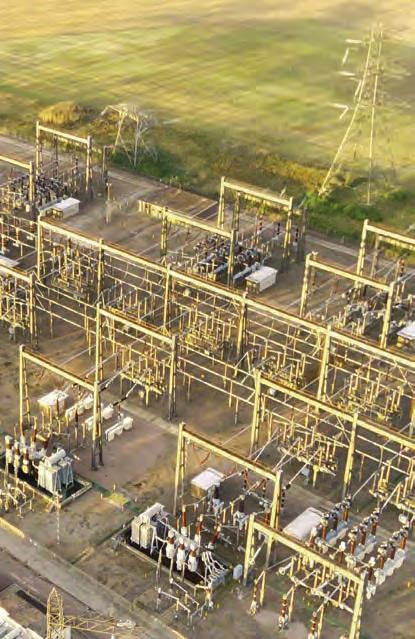

The scale of Net Zero projects required, including to service offshore wind farms and export the electricity generated to Germany and England, has led to local objections... Ian Thornton-Kemsley.

Further substations
Councillors raised concerns regarding almost every level of planning policy and questioned planning officers on their decision to recommend that the substation be granted consent.
The Fanellan proposal was a key part on the proposed 400 kV overhead line network between proposed hubs at Beauly and Peterhead. The Beauly - Peterhead line involves further substations at Coachford near Blackhillock, Greens at New Deer and Netherton near Peterhead.
In May 2025 SSEN announced that, following detailed ground investigation works which revealed technical challenges at the site, it would no longer be proceeding with the construction of the proposed substation at Coachford. The overhead line is the subject of
a Section 37 planning application before the Scottish Government’s Energy Consents Unit. Given Moray Council has lodged a formal objection to the scheme, it is likely to proceed to public inquiry.
Community engagement
The scale of Net Zero projects required, including to service offshore wind farms and export the electricity generated to Germany and England, has led to local objections. Government pressure on local authorities to approve proposals despite community objections is leading to council members rejecting planners’ advice.
Objectors have been emboldened in recent years by the ease of making public representations by email, now also enhanced by the growth of AI. From 19 January, the Energy Consents Unit stopped accepting public objections by
email regarding energy infrastructure projects, which must be submitted either through its online portal or by post. Promises of community engagement and official Net Zero ambitions are proving uneasy bedfellows.
Community funds and offers to build affordable housing may do little to offset the concerns of property owners who, affected by the proposals, have no ability to claim compensation for any loss in their property values.
SSEN’s Pathway to Net Zero, estimated at £20bn in 2023, is likely to cost considerably more, given these setbacks further increasing electricity prices. n
Ian Thornton-Kemsley
01224 860710
ian.thornton-kemsley@galbraithgroup.com
The value of certainty
What works well in practice, may not sit well on paper, Rachel Russell reports.

The belt-and-braces approach to recording land rights may sometimes feel like overkill or regarded as an unnecessary cost, but there are benefits to having formalised rights.
Informal arrangements are often practical, evolve over time and can be hassle-free, until the rights need to stand on their own merit, away from the nuances of the informal deal struck between two parties. With our services covering renewables, utilities and operating asset and property valuations, we frequently come across scenarios where informal arrangements have an unexpected adverse and unwelcome impact on value for our clients.
Due diligence
To provide context, we have highlighted recent examples which have come across our desk since the turn of the year and themes that often arise, which could have been avoided through careful management at the outset or prior to the point of valuation, purchase or sale.
We recently valued a small renewable energy asset portfolio for potential purchase purposes. The assets had been operating for well over a decade and to date, the cabling arrangement from generation to export had served its purpose well.
Having made our due diligence enquiries, it transpired that some of the cable runs between the operating assets and the grid network crossed third-party land, but there were no formally documented rights for this apparatus.
Although it works well in practice, the circumstances present risk, as ransom payments could be sought, or a request made to remove or re-route the cabling which would come at a cost and was an unknown at the date of valuation. Although rights, if uncontested, can be formalised by prescription through the effluxion of time, this presents a risk until this 20-year milestone where rights can be obtained by virtue of prescription is surpassed. Our valuation, therefore, reflected the risk associated with the uncertainty this presented when reaching our opinion of market value.
Into the millions
We recently valued a residential property for inheritance tax purposes, with the property benefiting from a mains electricity supply. On review of the title, the right to the electricity cable from the property to the meter, which was on a third-party-owned property, was specific to the late property owner, and did not include any rights in favour of an incoming purchaser or successor. Our valuation therefore reflected the risk and costs associated with connecting to the mains electricity network, should the incoming purchaser or successor wish for the property to remain ‘on grid’.
Ancillary rights required for development can carry significant value and can present a risk for the grantee but an opportunity for the grantor. Examples include retrospectively negotiating rights of access to allow a developer to construct the boundary of a sub-station, negotiating drainage servitudes for residential developments, and upgrading existing rights to accommodate additional development. Sums negotiated can be considerable, and indeed in some circumstances, into the millions.
A common area of our practice is to advise on formalising rights retrospectively, which often comes at greater expense to the benefiting party than negotiating and formalising rights in advance or before a trigger point, for example coming to the market.
Where rights are not formalised, this can often lead to additional cost and delay, or reduction in value to reflect the associated risks, so there is merit in taking advice to mitigate against the impact of informal rights which can work well in practice, but do not sit well on paper.
Don’t hesitate to get in touch if you’re concerned you may need to secure your rights. n
Rachel Russell 07884 657 219 rachel.russell@galbraithgroup.com
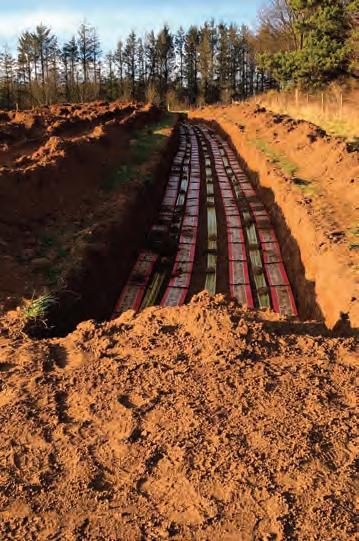

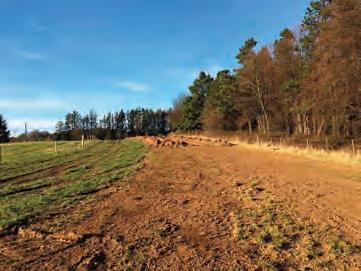
We are well placed to advise affected parties on the practical and legal implications of utility infrastructure schemes...

Owners and occupiers should look to their rights as utility upgrade gathers pace
The roll-out of new utility infrastructure is evident across the countryside, be it traffic lights to facilitate cable installations on your commute, utility outages during upgrades, or access requests for project planning and feasibility investigations.
We previously reported on some of the capital projects due to be undertaken across Scotland in Energy Matters, many of which are now moving from the feasibility and design stage into land rights and subsequently the start of construction.
Taking Scottish Power’s Eastern Green Link 4 project as an example, which is a new high-voltage electrical link that will connect Fife with Norfolk and affects a number of landowners and occupiers, servitude negotiations between Scottish Power and landowners are underway and the principal cable route and drainage contractors have now been appointed.
Momentum
With project momentum building and heads of terms for servitudes in circulation, this presents an opportunity for landowners to negotiate holding specific terms with Scottish Power. With a proposed 50m working width for the construction period to accommodate the installation of two cables in the trench, reducing to 22-24m for the formalised servitude rights, the impact on the day-to-day use of the land could be far-reaching during construction, and agreeing terms to ensure appropriate consideration and compensation is therefore vital. Equally crucially, the long-term impact of the proposed servitude burden needs to be reflected in the consideration negotiated. With a proposed construction start on site date of early 2028 and energisation outlined for 2030,
Scottish Power has considerable ground to cover in the forthcoming 12 to 24 months. With the project scope moving from the desk to the field, this will begin to have practical implications for landowners on the proposed cable route.
Affected parties
We are advising landowners on the EGL4 cable route and, away from EGL4, are representing landowners in relation to proposed land transactions to facilitate new substations and sub-station extensions, on-line rebuilds and upgrades, plus the negotiation of amendments to land rights for existing infrastructure.
We are well placed to advise affected parties on the practical and legal implications of utility infrastructure schemes and offer continuity to assist with compensation claims for years to come, with professional fees being met by Scottish Power.
There are a number of mitigating factors that can be put in place now which will assist with incorporating the land back into the existing farming set up which can be of considerable value to affected landowners both pre and post construction.
Do get in touch if you’d like to know more. n
Rachel Russell
07884 657 219
rachel.russell@galbraithgroup.com
u During.
u After.
Rachel Russell.
u For more than 25 years we have been maximising revenue on mobile phone mast sites and assisting landowners with telecoms management services and negotiations with telecoms companies across the UK.

CALL FOR CAUTION ON BELOW MARKET AGREEMENTS AT LEASE RENEWAL
Landowners should be aware of new tactics used by radio mast operators in negotiating lease renewals. Mike Reid reports.

Radio mast operators usually offer a contribution towards an owner’s professional fees incurred during a lease renewal approach when they look to retain their phone masts and associated equipment on property owned by farmers and other property owners.
This fee contribution is part of a broader negotiation strategy under the 2017 Electronic Communications Code to renew contracts at significantly reduced rent levels and terms in the radio mast operator’s favour.
One-off payment
Offers on costs are often presented as a standard contribution toward "transactional costs" as part of an overall agreement package, aimed at securing a "consensual agreement" and avoiding the costs of a Tribunal hearing.
Some radio mast operators are now offering the landowner a one-off payment equivalent to the proposed contribution towards agents’ fees on the basis that they proceed without professional representation, so instead of appointing an agent, a landowner receives the sum directly.
This tactic looks to deprive the owner of proper professional advice. More importantly, it encourages owners to proceed without representation.
Under the Electronic Communications Code, the operator is required to cover the reasonable and proper professional costs of the site provider, with no fixed cap set in legislation. In practice, however, operators tend to agree to pay fees in legal undertakings up to agreed caps with provision for these to be extended by agreement.
Inducement
Without professional advice, there is a real risk that key provisions are missed or diluted, particularly around matters such as the proper rental value of the site, redevelopment rights or other protections, which can have long-term detrimental implications for the site.
Owners are cautioned against being persuaded to proceed without professional advice in exchange for an inducement payment. To protect their position and maximise value, they should always seek proper professional advice. The overall site value and protecting rights over the longer term are far more critical than receiving a relatively small initial one-off payment.
For more than 25 years we have been maximising revenue on mobile phone mast sites and assisting landowners with telecoms management services and negotiations with telecoms companies across the UK. If you are a landowner and unsure how to proceed in discussions with a mobile network operator, please do get in touch with your local Galbraith office. n
Mike Reid

07909 978 642 mike.reid@galbraithgroup.com
This tactic looks to deprive the owner of proper professional advice. More importantly, it encourages owners to proceed without representation...
WIDER IMPACTS OF UK GOVERNMENT SHARED RURAL NETWORK CUTBACK

It’s almost a year since the UK Government announced its ‘reshaping’ of the Shared Rural Network deployment programme. Mike Reid reports.
u Since 2020, mobile network operators (MNOs) have collaborated with the UK Government to enhance mobile connectivity in rural areas through the SRN.
The “reshaping” of SRN – actually a cost-cutting exercise – has benefited some local communities and owners who opposed these sites due to numerous concerns over environmental and other impacts.
This decision still has significant implications for owners where sites are progressing and for owners where sites are abandoned, as we explain below.
Since 2020, mobile network operators (MNOs) have collaborated with the UK Government to enhance mobile connectivity in rural areas through the SRN. Building Digital UK, the Government agency overseeing state-backed digital infrastructure projects including SRN, said MNOs had achieved key targets early, including boosting 4G coverage to 95% of the UK landmass, which they had originally sought to reach by the end of 2025.
The programme ‘reshaping’ was predicted by Galbraith in October 2024 and again in May 2025. The number of 4G masts planned for rural Scotland has been scaled back from 258 to 44, safeguarding countryside and landscapes from unnecessary infrastructure.
The SRN is now addressing connectivity challenges in more limited, hard-to-reach areas with no mobile signal, and the pressure on the MNOs to progress the remaining sites has intensified as the Government has not extended the MNOs’ contractual deadline to have the remaining sites operational, which remains January 2027. For some sites, the MNOs have had no option but to serve ‘Code notices’ due to this deadline and force through sites to achieve their coverage targets – this often leads to poorly designed sites which don’t take full account of the wider environmental and other


u The SRN is now addressing connectivity challenges in more limited, hard-to-reach areas with no mobile signal...
The programme ‘reshaping’ was predicted by Galbraith in October 2024 and again in May 2025... Mike Reid.

impacts. The Government now expects UK sites to be designed and built to mitigate their environmental impact as far as possible – this will be a challenge for some.
The Government and operators are prioritising new infrastructure in areas of significant need—including popular walking routes such as the West Highland Way—where reliable coverage is needed in emergencies.
We understand MNOs are working with local communities, ensuring new masts are appropriately planned and consider natural beauty, local history and ecology, but we at Galbraith are concerned that the contractual deadlines won’t allow sufficient time for all sites to be designed appropriately. All publicly funded masts will be shared among operators to minimise environmental impact.
Those owners who now no longer have SRN sites proceeding will need to recover any costs incurred to date from the MNOs, and this may be problematic for any owner who didn’t receive a legal undertaking for their reasonable professional fees to be paid. It remains to be seen if the MNOs will cover the sometimes considerable costs that owners themselves have incurred in reacting to the MNOs’ approach and requests for surveys etc.
When the operators reached their required number of sites under the first phase of the SRN and abandoned any surplus sites, some refused to pay any costs owners incurred themselves. Obtaining an undertaking for their own costs is important for any owner approached about a new telecom site to protect their position in case the site doesn’t proceed for any reason.
Despite the cutbacks, some sites are still progressing and we can advise on appropriate terms. Do let us know if you’d like to talk to our telecoms team experts. n
Mike Reid
07909 978 642
mike.reid@galbraithgroup.com
CURRENT SOURCES OF RENEWABLE FUNDING
Members of the Renewable Heat Incentive scheme (Domestic and NonDomestic) will continue to receive payments as long as ongoing obligations are satisfied. Applications for new entrants remain closed as of the 31st March 2022, however.
Scotland
Home Energy Scotland: Grant funding and interest-free loans through Home Energy Scotland remain open for applications for Scottish homeowners to help make homes warmer whilst reducing both our energy bills and our impact on the climate.
Energy efficiency improvements can be grant funded up to 75% of the combined cost of the improvements with a maximum grant amount of £7,500 applicable. Grants of up to £7,500 are also available for the installation of clean heating systems, with an additional £7,500 as an option interest-free loan. Uplifts of up to £1,500 over and above these rates are also available in rural areas to help provide extra support.
Since May 2024, the requirement to have specific insulation in place before applying for a heat pump has been relaxed to make the process faster, though insulation is still highly recommended.

For Energy Efficiency Measures the maximum grant and optional loan available for each improvement is as follows:
• Solid wall insulation: up to £10,000 (£7,500 grant plus £2,500 optional loan)
• High heat retention storage heaters: up to £5,500 loan (£2,500 grant available for high heat retention storage heaters when installed as part of a package of measures)
• Double glazing, triple glazing, secondary glazing: up to £8,000 (loan only, no grant available). Only available when improving single glazing, not for replacement or improvements of existing double, triple or secondary glazing.
• Insulated doors: up to £4,500 (loan only, no grant available)
• Flat roof or room-in-roof insulation: up to £4,000 (£3,000 grant plus £1,000 optional loan)
• Loft, cavity and underfloor insulation: up to £2,000 (£1,500 grant plus £500 optional loan)
• Warm air units: up to £5,000 (loan only, no grant available).
For clean heating systems the maximum loan/grant amounts are as follows:
• Air/ground/water to water source heat pumps: £15,000 (£7,500 grant plus £7,500 optional loan)
• District heating scheme connection: £7,500 (loan only, no grant available)
• Solar thermal: £5,000 (loan only, no grant available)
• Hybrid solar PV/ water heating systems: £5,000 (loan only, no grant available)
• Wind turbine: £2,500 (loan only, no grant available)
• Hydro turbine: £2,500 (loan only, no grant available)
• Wood fuelled (biomass) boilers (and eligible stoves): £15,000 (£7,500 grant plus £7,500 optional loan).
The grant and loan values stated above are subject to availability while funds last or until the end of the financial year – whichever is sooner. Funds will be allocated on a first-come, first-served basis. Funding is reserved for those with a written loan offer, not on application to the scheme.
If you would like to find out if you are eligible and how you apply for the grant and loan funding please follow the link below.
Source: https://www.homeenergyscotland.org/home-energy-scotland-grant-loan
Warmer Homes Scotland:
Warmer Homes Scotland is a Scottish Government programme which provides support to homeowners and private rented sector tenants who are struggling to pay their energy bills and stay warm.
Over £10,000 is available for domestic energy efficiency upgrades following an ‘in-home assessment’ by a Warmworks assessor who will check eligibility and advise what improvements would be correct.
Improvements offered through the scheme will depend on the Warmworks’ assessment and could include the following:
- Solid wall insulation
- Loft insulation
- Draught-proofing
- Central heating changes
- Home renewables system

England and Wales
The Boiler Upgrade Scheme:
The Boiler Upgrade Scheme is a UK Government initiative to encourage more people in England and Wales to install low carbon heating systems. It is an installer run scheme whereby installers recoup costs from the government rather than funding going to the homeowner.
The scheme covers three low carbon heating systems:
• Air Source Heat Pump: £7,500 towards cost and installation.
• Biomass Boiler: £5,000 off cost and installation for properties in rural location and properties not connected to the gas grid.
• Ground Source Heat Pump: £7,500 towards cost and installation. This also includes water source heat pumps.
Eligibility can be broken down as follows:
- The property must be a home or a small or medium non-domestic building with a maximum proposed installation of 45 KWth. Ground loop systems cannot exceed 300 kWth.
- A valid EPC must be in place for the property.
- Biomass boilers are only available to rurally situated properties not connected to the gas grid.
Options available to private tenants may be limited, and tenants will require their landlord’s permission ahead of any improvements being installed. To find out more information please follow the link below.
https://www.homeenergyscotland.org/ warmer-homes-scotland
ECO4 Grant Funding in Scotland:
The ECO4 scheme Scotland provides grants for homeowners and private tenants to improve energy efficiency and lower heating costs. The scheme has been extended until 31st December 2026.
To qualify for an ECO grant in Scotland, a household must live in a property which has an EPC rating of D or lower as well as meeting the following criteria:
• Be a homeowner, landlord or a private tenant.
• Have a health-related illness
• Be receiving any of the following income-related benefits:
• Income-based Jobseekers Allowance
• Income-related Employment & Support Allowance
• Income Support
• Pension Credit Guarantee Credit
• Working Tax Credit
• Child Tax Credits
• Universal Credit
• Housing Benefit
• Pension Credit Savings Credit
The ECO4 scheme covers cavity wall insulation, solid wall insulation, roof insulation, solar panels, air source heat pumps and upgraded heating controls.
Source: https://eco4gov.com/
England, Scotland and Wales
- Funding is only available to fully replace a fossil fuel heating system, not an existing low carbon heating system.
- Funding cannot be doubled up with other heat pump or biomass boiler focused government schemes.
- Funding can be doubled up with energy efficiency upgrade funding for insulation, doors or windows.
- New builds and social housing are not eligible. Self-builds are eligible.
You no longer need to have no outstanding recommendations for loft or cavity wall insulation on your EPC to qualify. This "insulation prerequisite" was removed to speed up heat pump adoption.
Small grants (approx. £2,500) are being introduced in some regions for heat batteries when installed alongside low-carbon heat.
The scheme closes on the 31st December 2027.
Source :https://www.findgovernment-grants.service.gov.uk/gr ants/boiler-upgrade-scheme1#eligibility
Smart Export Guarantee
The Smart Export Guarantee is an ongoing support mechanism designed to ensure small-scale generators are paid for the renewable electricity they export to the grid. This does not happen automatically, so generators must sign up to receive the tariff.
You are eligible to apply if you have one of the following renewable energy generating technologies up to a capacity of 5MW:
• Solar PV Panels.
• A wind turbine.
• Hydro.
• Anaerobic digestion.
• Micro combined heat and power (up to 50kW).
Under the scheme all licenced energy companies with 150,000 or more customers must provide at least one tariff.
Sources:
https://energysavingtrust.org.uk/gra nts-and-loans/boiler-upgradescheme/
https://energysavingtrust.org.uk/adv ice/smart-export-guarantee/
https://www.ofgem.gov.uk/environm ental-and-social-schemes/smartexport-guarantee-seg

Aberdeen 01224 860 710
aberdeen@galbraithgroup.com
Ayr 01292 268 181
ayr@galbraithgroup.com
Blagdon 01670 789 621
blagdon@galbraithgroup.com
Castle Douglas 01556 505 346
castledouglas@galbraithgroup.com
Cupar 01334 659 980 cupar@galbraithgroup.com
Edinburgh 0131 240 6960
edinburgh@galbraithgroup.com
Hexham 01434 693 693
hexham@galbraithgroup.com
Inverness 01463 224 343
inverness@galbraithgroup.com
Kelso 01573 224 244
kelso@galbraithgroup.com
Morpeth 01670 331 500
morpeth@galbraithgroup.com
Penrith 01768 800 830
penrith@galbraithgroup.com
Perth 01738 451 111 perth@galbraithgroup.com
Stirling 01786 434 600 stirling@galbraithgroup.com
Galbraith operates from 13 offices across Scotland and Northern England, bringing our clients a wealth of experience in:
• Building consultancy
• Commercial forestry & woodland management
• Commercial property sales & management
• Estate, farm & forestry sales & acquisitions
• Estates, farming & land management
• Natural capital & carbon
• Property lettings
• Renewables and utilities
• Residential estate agency