OPEN HOUSE
NOVEMBER 6, 2026 | CLEVELAND JEWISH NEWS | CJN.ORG 1
A Cleveland Jewish News Advertising Special Section
Public schools help Jewish day school students make transition A. KEVIN CORVO
T
he first day at a new school often brings an array of emotions to any student but especially those transitioning from a Jewish day school into a public high school. Often, these students are transitioning from the Joseph and Florence Mandel Jewish Day School in Beachwood and Gross Schechter Day School in Pepper Pike to public high schools like Beachwood and Solon. The staffs at those public schools strive to make the transition as smooth and seamless as possible, according to administrators in the Beachwood and Solon public school districts. “The transition begins before the first day of school,” Dakota Berg, principal at Solon High School, said. “New students attend (orientation), where they get an overview of the school and a tour led by current students. “During that session, many of them realize that every ninth grader is new to Solon High School, so they already have that in common with their classmates. We also make sure students who are new to the district get the extra support they need to adjust as quickly and smoothly as possible.” Tamara Strom, director of communications for the Solon City Schools, said that “students joining us from Jewish day schools are part of (the annual process). Our goal is to help every new student feel part of the school community and make connections right away. Solon High School may be larger than the schools some students come from, but that means more opportunities to find the activities and the people that are right for them.” Counselors meet with each new student and their family and begin charting a path based on their current future plans, according to Berg. “We want to be sure they are taking classes that will challenge them academically but at the same time leave room for life balance that allows them space for
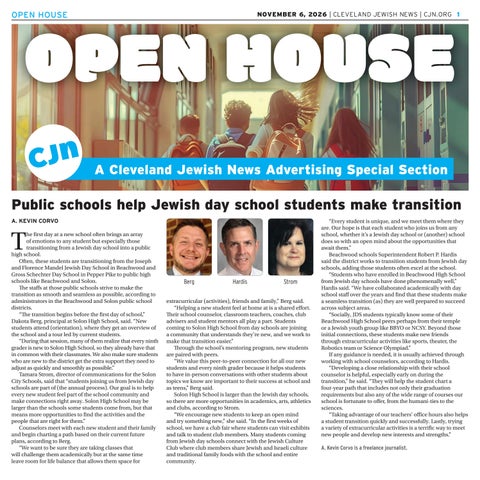
Berg
Hardis
Strom
extracurricular (activities), friends and family,” Berg said. “Helping a new student feel at home at is a shared effort. Their school counselor, classroom teachers, coaches, club advisers and student mentors all play a part. Students coming to Solon High School from day schools are joining a community that understands they’re new, and we work to make that transition easier.” Through the school’s mentoring program, new students are paired with peers. “We value this peer-to-peer connection for all our new students and every ninth grader because it helps students to have in-person conversations with other students about topics we know are important to their success at school and as teens,” Berg said. Solon High School is larger than the Jewish day schools, so there are more opportunities in academics, arts, athletics and clubs, according to Strom. “We encourage new students to keep an open mind and try something new,” she said. “In the first weeks of school, we have a club fair where students can visit exhibits and talk to student club members. Many students coming from Jewish day schools connect with the Jewish Culture Club where club members share Jewish and Israeli culture and traditional family foods with the school and entire community.
“Every student is unique, and we meet them where they are. Our hope is that each student who joins us from any school, whether it’s a Jewish day school or (another) school does so with an open mind about the opportunities that await them.” Beachwood schools Superintendent Robert P. Hardis said the district works to transition students from Jewish day schools, adding those students often excel at the school. “Students who have enrolled in Beachwood High School from Jewish day schools have done phenomenally well,” Hardis said. “We have collaborated academically with day school staff over the years and find that these students make a seamless transition (as) they are well prepared to succeed across subject areas. “Socially, JDS students typically know some of their Beachwood High School peers perhaps from their temple or a Jewish youth group like BBYO or NCSY. Beyond those initial connections, these students make new friends through extracurricular activities like sports, theater, the Robotics team or Science Olympiad.” If any guidance is needed, it is usually achieved through working with school counselors, according to Hardis. “Developing a close relationship with their school counselor is helpful, especially early on during the transition,” he said. “They will help the student chart a four-year path that includes not only their graduation requirements but also any of the wide range of courses our school is fortunate to offer, from the humani-ties to the sciences. “Taking advantage of our teachers’ office hours also helps a student transition quickly and successfully. Lastly, trying a variety of extracurricular activities is a terrific way to meet new people and develop new interests and strengths.” A. Kevin Corvo is a freelance journalist.
OPEN HOUSE
2 CLEVELAND JEWISH NEWS | CJN.ORG | NOVEMBER 6, 2026
Akron Children’s partners with Mandel JDS for new clinic CASEY SWINARSKI cswinarski@cjn.org
S
tudents, clinicians and educators gathered for the dedication of the Akron Children’s Mandel JDS Clinic at the Joseph and Florence Mandel Jewish Day School in Beachwood on Oct. 20, celebrating a partnership between the two entities that will prioritize students’ health and advocacy. Akron Children’s, which operates its main campus in Summit County, has partnered with the Mandel JDS to sponsor its school clinic – one of many outreach projects that the hospital has completed in an initiative to extend its reach to neighboring communities. Jay Leberman, head of school at Mandel JDS, said that the partnership reflects a shared commitment from both educators and healthcare professionals toward the health of the school’s students. “(Akron Children’s) generosity supports not only this clinic, but also the broader work of our school, and the programs and resources that benefit our students and our whole community,” Leberman said at the event. “We’re really fortunate to be a partner with (Akron Children’s), and one that recognizes the importance of supporting children in every aspect of their development. Today’s dedication is a wonderful reflection of this shared commitment.” The partnership kicked off with a celebration that CLINIC | CONTINUED ON PAGE 35
Akron Children’s mascot Pip presents the plaque outside of the Joseph and Florence Mandel Jewish Day School clinic alongside Dr. Daniel Goldstein and Rod Ingram, vice president, marketing and communications for the hospital. | CJN Photos / Casey Swinarski
SCHOOL REDEFINED Get ready to do school differently!
Plan your visit today! Early Childhood, Lower, and Middle School Open House Saturday, 11/21/26 10:00 am
High School Open House Saturday, 11/14/26 1:00 pm
Mastery School Program Preview Saturday, 11/21/26 1:00 pm
Lyndhurst Campus Toddler–Grade 8
Upper School, Gates Mills Campus Grades 9–12
University Circle Campus Grades 9–12
Lyndhurst
Cleveland–West
Coed Toddler – Grade 12
hawken.edu Gates Mills
University Circle
Jay Leberman, head of school at Mandel JDS, welcomes students and staff of Akron Children’s to the school ahead of the clinic’s unveiling.
OPEN HOUSE
NOVEMBER 6, 2026 | CLEVELAND JEWISH NEWS | CJN.ORG 3
“(Akron Children’s) generosity supports not only this clinic, but also the broader work of our school, and the programs and resources that benefit our students and our whole community. We’re really fortunate to be a partner with (Akron Children’s), and one that recognizes the importance of supporting children in every aspect of their development. Today’s dedication is a wonderful reflection of this shared commitment.” Jay Leberman, Head of School Joseph and Florence Mandel Jewish Day School CLINIC | CONTINUED FROM PAGE 34
featured mascots, refreshments and a student art activity led by the Cleveland Museum of Art Studio Go team. Dr. Daniel Goldstein, an anesthesiologist at Akron Children’s whose children previously attended Mandel JDS’ early childhood program, said that for Akron Children’s, the partnership reflects a commitment by the hospital to bring pediatric care and support closer to families in Beachwood. “Our children are our most important
thing in this world,” Goldstein said. “Their health, their education and their sense of security deserve our deepest attention, and caring for them is a responsibility we all share.” Goldstein said that he understands the unique perspective that parents, teachers and clinicians have when assessing a child’s needs. The partnership will allow those voices to come together for the betterment of a child’s health, he said. “When we listen to one another and share what we notice, we can better understand what your child needs,”
Dr. Daniel Goldstein of Akron Children’s shares his excitement regarding the new school clinic partnership between the hospital and Mandel Jewish Day School. | CJN Photo / Casey Swinarski Goldstein said. “Sometimes, the school nurse is at the forefront of that connection.” To signify the partnership, a plaque outside of the clinic’s entrance was unveiled by the school’s student council members and reads, “Mandel JDS Clinic sponsored by
Akron Children’s.” “I hope that when families pass it, they feel reassured that there’s a team here paying attention, working together, and keeping their children’s well-being at the center,” Goldstein said.
Freedom to forge his own path. At University School, boys thrive in an environment with the freedom to explore, create, and innovate. They think deeper, embrace challenge, and discover new passions. Join us for an upcoming fall admission event! #1 Private K-12 School
www.us.edu/visit
Merit Scholarship Opportunity Each year, the Jarvis Scholar Program awards up to ten full, four-year merit scholarships to students entering the ninth grade.
For Boys, Junior K - Grade 12
The application for fall 2027 admission is now open.
4 CLEVELAND JEWISH NEWS | CJN.ORG | NOVEMBER 6, 2026
OPEN HOUSE
Gross Schechter Day School 4th graders receive tikkunim JIMMY OSWALD joswald@cjn.org
G
ross Schechter Day School fourth graders received their tikkunim to celebrate the start of learning to leyn Torah on Oct. 8 Parents and teachers were on hand at the school in Pepper Pike as each student was presented with their own tikkun, thanks to the Morry and Lola Malcmacher Memorial Torah Reading Fund. Malcmacher family members Anne Adelman and Sylvia Kramer, a Gross Schechter alumni parent and grandparent of eight Schechter students, handed
each student their tikkun, and eighth grader Sophie Brown, Kramer’s granddaughter, spoke about her role in continuing her family’s legacy at the school. “Schechter has done so much for my children, and is now doing the same for all of my grandchildren,” Kramer said in a news release. “Our family feels blessed to have a small part in ensuring all Schechter students have this irreplaceable experience.” The ceremony kicks off Gross Schechter students’ Torah reading education. Fourth graders will study with teacher Binyamin Kleinman to learn Torah trope. As they get a handle of the notes, each student will have the opportunity
to read Torah throughout the year at the egalitarian middle school tefillah. The year will culminate with another celebration where every student will read for the gathered families. “Learning to read Torah is a transformative experience,” Sheri Gross, principal of Jewish life and learning, said in the release. “Our fourth graders have spent their time in the lower school building other key Judaic skills in preparation for this moment: speaking and reading Hebrew, davening daily tefillah, learning stories from the Chumash and delving deeper to understand the message and lessons from those stories. Now, using their tikkunim, they will develop the skills to chant and read directly from the Torah, which will hopefully be just the beginning of a long and meaningful Torah-reading journey.” Publisher’s note: Sheri Gross is an Arts columnist for the Cleveland Jewish News.
Sylvia Kramer and Anne Adelman present a Gross Schecther Day School fourth grader with his tikkun during a ceremony on Oct. 8. | Submitted photos
Gross Schechter Day School eighth grader Sophie Brown talks about the role she plays in continuing her family’s legacy at the school.
OPEN HOUSE
NOVEMBER 6, 2026 | CLEVELAND JEWISH NEWS | CJN.ORG 5
Here’s how to make most out of high school open house BRIAN LISIK
T
he high school open house has been somewhat of rite of passage for both private and public school students for decades. And while times have changed, parents and students are still seeking many of the same things as they always have from the open house experience, according to Christina Townsend Hartz, Townsend Hartz director of enrollment and financial aid at University School with campuses in Hunting Valley for grades nine through 12 and in Shaker Heights for grades JK through eighth. Townsend Hartz said the Cleveland area is fortunate to have a wealth of independent school options. This being the case, open houses can be one of the best ways to learn firsthand what each school has to offer. “The really interesting thing about Cleveland is there are a lot of independent schools and a lot to explore,” she said. “Between parochial or independent schools,
open houses are a way to come to a place in a non-committal (environment).” Townsend Hartz also noted the difference between the two primary types of school visits – the open house and smaller, personal day visits such as University School’s “Discovery Days” and Parent Preview events at both of its campuses. At the latter-type events, Townsend said parents of prospective new students can observe classes, meet staff members and tour the campus. She said these visits allow families to meet with teachers and students and get to “learn about the school in-depth.” Open houses, on the other hand, generally offer more opportunity to meet with a greater number of teachers, counselors, coaches and other school staff and get a feel for the overall culture of the school, she said. “When I think of an open house, there is a bigger crowd and less one-on-one,” Townsend Hartz said. “We will have between 500 to 600 people between our two campuses, compared to 20 to 60 during a day visit. I don’t necessarily (recommend) one over the other. There is value in all of these. And I don’t think there is a right way or time. It is more about the family finding
“The really interesting thing about Cleveland is there are a lot of independent schools and a lot to explore,” she said. “Between parochial or independent schools, open houses are a way to come to a place in a noncommittal (environment).” Christina Townsend Hartz University School a time.” She added that University School hosts two to three open houses and three to four parent previews between its two campuses. With both private and public schools, Townsend Hartz said that “the disruption of COVID(-19)” did cause administrators to rethink how an open house or school visit should be hosted. However, the areas schools want to showcase – and more importantly what families are looking for – has not changed significantly over the years, she said. Townsend Hartz added that while there are no hard and fast rules for attending an
open house event, she suggested families come prepared to ask specific questions about the school and what it offers based upon what best meets the needs of the family and the student. “I would say the most important thing is finding the time and place,” she said. “You are going to have different things at different schools. It is important to see what offerings, from academics and to extracurriculars, that resonate with the student.” Brian Lisik is a freelance journalist.
UNDERSTANDING EXECUTIVE FUNCTION SKILLS AND SUPPORTS JOIN US FOR AN INSIGHTFUL PRESENTATION FEATURING CLINICAL PSYCHOLOGIST DR. TORI CORDIANO. In this session, parents, caregivers, and educators will gain a deeper understanding of how executive function skills develop and how deficits manifest at home and in the classroom. Key Topics Covered: ✦ An overview of executive functioning skills, including developmental expectations ✦ Practical, skill-building strategies to help your child manage executive functioning challenges and increase independence. ✦ The importance of the home-school connection to support executive functioning growth.
WEDNESDAY, NOVEMBER 11, 2O26 FROM 6:00 PM TO 7:30 PM FOR MORE INFORMATION OR TO RSVP PLEASE VISIT lawrenceschool.org OR SCAN THE QR CODE
OLDE EIGHT ROAD LAWRENCE UPPER SCHOOL 10036 SAGAMORE HILLS, OH 44067
OPEN HOUSE
6 CLEVELAND JEWISH NEWS | CJN.ORG | NOVEMBER 6, 2026
IEPs can help strengthen student’s education NOELL WOLFGRAM EVANS
M
ost schools have closed out the first quarter of the school year, leaving teachers and parents with a fairly good understanding of how each student is performing. In some cases, this has started a discussion about developing an Individualized Education Program. There is not an immediate marker or observed behavior that would trigger an IEP discussion,” Grace Willer, director of learning strategies and co-director of Laurel School’s Center for Research for Girls, said. “Rather, it is a culmination of observations, classroom performance and testing metrics. We generally need six to eight weeks of data before we begin the evaluation process.” Starting the evaluation process doesn’t have to be driven by the school alone, parents can request it as well. “As a parent, you should look at how long it’s taking your child to complete a homework assignment that they are actively engaged in,” Amy Sheeler, the director of
Sheeler
Willer
student advocacy and support services at the Lawrence School with campuses in Broadview Heights for grades kindergarten to sixth and in Sagamore Hills for grades seven to 12, said. “If it’s covering a concept review and you see them working and erasing and working, I would reach out to the teacher and start a conversation.” After an evaluation is completed, parents, a teacher, a district representative and a specialist – which is often the school psychologist – will meet to discuss the findings and determine next steps. Willer said that evaluations provide a set
of data points, “but there are a wide range of opportunities within them. That’s why we don’t look at just a score but the whole student.” The results of this evaluation may be an establishment of an IEP, the creation of a 504 plan, or the decision to address needs the student has in different ways. “People can conflate IEPs and 504s,” Willer said. “A 504 is about accommodations, while an IEP is focused on specially-devised instruction.” With whatever plan that is established, it is re-evaluated throughout the year to ensure it is truly helping the student. “The goal is always to make sure that students are gaining skills,” Sheeler said.” Part of the re-evaluation process could be considered skills-based with the other part leans more observational. And that’s both in and out of the classroom. Sheeler said that “good parent-teacher communication is essential for struggling students. It helps provide schools with a better picture of what’s happening and
where a student might be struggling.” Willer said that “any time you can have a strong home and school partnership you’re going to be more successful.” IEPs are in place for a three-year period. They have mandated yearly reviews although a school or parent can request an early review at any point. This generally happens if they see good progress being made or feel like a student is still struggling. The discussion around, and exploration of, an IEP can happen at any point in a child’s education. “A lot of parents are told they don’t test anyone before third grade, but you can detect some things that affect a child’s learning, like if they have dyslexia early,” Sheeler said. Willer said that “it’s important that parents understand an IEP is not a formal diagnosis and won’t follow a child around. The purpose isn’t to label a student but to open resources to the kids who need them.” Noell Wolfgram Evans is a freelance journalist.
Goods Bank NEO open house Nov. 10 CASEY SWINARSKI cswinarski@cjn.org
OVER 125 YEARS OF TRUSTED LOCAL BUSINESS FINANCING CFBank is differentiated by our penchant for individualized service, direct client access to decision-makers, and ease of doing business. We match the sophistication of much larger banks without the bureaucracy.
COMMERCIAL LENDING EQUIPMENT LEASING CASH MANAGEMENT COMMERCIAL CARDS MORTGAGE LENDING HIGH-YIELD SAVINGS
THE BOUTIQUE BANK FAIRLAWN
PINECREST
3009 Smith Rd. Suite 100 Fairlawn, OH 44333 (330) 576-1203
100 Park Ave. Suite 420 Orange Village, OH 44122 (216) 468-6135
G
oods Bank NEO, a surplus distribution organization, will open its doors to community members on Nov. 10, sharing its mission of building sustainable connections between surplus inventory and those in need. Through a network of more than 230 members, Goods Bank NEO helps nonprofits, schools and faith-based organizations access essential products at little to no cost or nominal cost, allowing them to stretch limited resources and focus more of their funding on their missions, according to a news release. The open house, which will be held from 9 to 11 a.m. at 7550 Bittern Ave. in Cleveland, will invite attendees to tour the warehouse, learn about Goods Bank NEO’s programs and partnerships, explore volunteer opportunities, and see how the donated and surplus products are redirected from potential waste to community impact. “Every day, we see how access to
essential goods can make a difference for the organizations serving our communities,” Michelle Walsh, executive director of Goods Bank NEO, said in the release. “When nonprofits can access the products they need without spending valuable dollars on those essentials, they can direct more resources toward the services that change lives. Our Open House is an opportunity to share that impact, welcome new partners and volunteers, and explore how we can do even more together.” Since opening in 2022, Goods Bank NEO has helped redirect more than 3.1 million pounds of goods from landfills, distributing more than $17 million in fair-market-value products to its community partners. The open house is an opportunity for current and prospective member organizations, product donors, corporate partners, volunteers, funders and community leaders to discover how they can become part of the growing network. For more information about Goods Bank NEO, membership or volunteer opportunities, visit goodsbankneo.org.
OPEN HOUSE
NOVEMBER 6, 2026 | CLEVELAND JEWISH NEWS | CJN.ORG 7
Friendship Circle’s ABA program rebrands to become FEATS JIMMY OSWALD joswald@cjn.org
F
riendship Circle of Cleveland recently announced it is expanding the ways it supports children with autism and their families by expanding what was previously known as FriendshipABA, a division of Friendship Circle that provides applied behavior analysis therapy to children with an autism diagnosis, into FEATS: Friendship Educational and Therapeutic Services. The new name reflects an expanded purpose to offer therapy, school-readiness programming, educational services and autism evaluations under one roof with no wait time, the organization announced in a news release. FEATS is an approved Ohio Autism Scholarship provider and accepts most insurance plans, including Medicaid. The team also helps families navigate and use their scholarship funding to access services. “We know that when a family is concerned about their child, they don’t want to hear that they have to wait months to get the support they need,” Rabbi Yosef Peysin, clinical director of FEATS, said in the release. “FEATS brings ABA therapy, educational services, autism evaluations, and school-readiness support together under one roof, so families can take the next step right away and get compassionate, quality care for their child without delay.” FEATS combines clinical expertise with the communitycentered mission of Friendship Circle of Cleveland and the Jewish value of ensuring that every person is treated with
dignity, respect and a sense of belonging, according to the release. On the FEATS clinical team will be experienced boardcertified behavior analysts; registered behavior technicians; and educational professionals, with Peysin overseeing the group. “Children don’t grow in isolation,” Peysin said. “They grow through relationships, learning, practice, and connection. Our goal is to support the whole child and give families a place where they can access the help they need while their child continues to grow and thrive.” Offered in the program will be ABA therapy, a relationship-based model that focuses on how children learn with the goal of giving them a deeper understanding and more lasting progress; IEP-aligned educational services for school readiness, a full-day program for preschoolers with autism that combines ABA, early learning and school-readiness skills with services geared toward each child’s individualized education plan; autism diagnostic evaluations; personalized support plans; and integrated socialization designed for children to build social skills through play with peers. FEATS provides these services at Friendship Circle of Cleveland at 27900 Gates Mills Blvd. in Pepper Pike, offering half-day and full-day options for preschool- and school-age children. Families interested can visit friendshipaba.com, call 216-220-9696 or email office@friendshipaa.com.
Rabbi Yosef Peysin, Clinical director of FEATS at Friendship Circle of Cleveland, works with Leib, 5, and Simon, 9, at the craft table in 2024. | Submitted photo
OPEN HOUSE
8 CLEVELAND JEWISH NEWS | CJN.ORG | NOVEMBER 6, 2026
Early childhood education centers keep parents connected NOELL WOLFGRAM EVANS
T
here are a range of emotions, concerns, hesitations and protective feelings that flood parents of young children when they decide to enroll them into an early childhood educational center. Regardless of what drives that decision, the fact remains that, perhaps for the first time, parent and child will be separated. Altman Educators across the region recognize the anxiety this can cause and have created a number of connection points to help parents feel more connected, comfortable and confident. Melissa Altman, the director of Play
Time Early Childhood Enrichment Center in Beachwood said that it uses two mobile apps, paper flyers, in-person meetings and email to keep parents updated on both the progress of their child and the events happening at the center. “We have an app called Brightwheel that we use to keep parents updated on how their child is doing and what they did that day,” Altman said. “There is also an opportunity in the app for parents to reach out to us. “We also have an app called TSG that allows us to link our activities to Ohio’s Early Childhood Learning Standards. This enables parents to get a little more information about what we are doing and why.” As an example, she shared that if they send a picture of a student painting a rock, in TSG they can share how they might have been using that activity as an introduction to texture and colors. “Our parents can download Procare,
an app that allows them to get updates and pictures throughout the day of their children’s learning opportunities,” Daughn Bullock, the director of the Nest School in Solon, said. “Procare gives parents a chance to see their kids as little explorers.” Because teachers post on the app as the day goes along, Bullock said there is an option to get a digest version sent to your email at the end of the day, so parents are not overwhelmed with pictures, videos and updates during the day. “Every teacher has a tablet that they keep all of their lesson plans and activity schedules in so it’s easy for them to upload pictures and notes to the app throughout the day,” she explained. If parents have questions about what they are seeing, they can send a message through Procare. Teachers won’t see those messages immediately, but administrators will and will be able to react in kind.
Bullock said that this type of instant communication is great when kids are having a good day, but it can be especially helpful when there’s a rough patch. “When life happens and a child bends over to pick up a Lego and then bumps their head and gets a bruise, we want parents to know that right away, so we’ll send a message saying there were some tears but we’re working through it,” she said. Altman said that “we feel very strongly that communication is the key to successful early childhood education and to provide that we want to meet every parent where they are.” “Open communication is important for letting parents have a little peace of mind,” Bullock said. Noell Wolfgram Evans is a freelance journalist.
Planning, timing help families get most from open house BRIAN LISIK
A
high school student’s first visit to a potential college or university is typically filled with excitement, anticipation and yes, fear and reservations for the entire family. Mike Andelbradt, assistant vice president for enrollment and director of admission at John Carroll University in University Heights, said planning ahead and narrowing the search in advance of an open house can be essential to getting as much as possible from the experience. “The key differentiation between an open house typical college visit where you may get a tour and will meet with admissions (staff ) is that at an open house we work with (groups) from across the campus,” Andelbradt said. “At our typical college visit, a potential student meets with an admissions counselor to go over the admissions process, and may tour the campus with a current student.” With a broader representation of staff and student groups, open houses can, somewhat ironically, answer more specific questions about programs, majors and campus life than the general visit, according to Andelbradt. He said larger scale open house events are typically held in the fall and spring and include presentations, campus tours, and representatives from all areas of the college or university in attendance. Andelbradt said this allows potential students to both get a feel for the overall atmosphere of the campus and ask specific questions in their particular areas of interest. “There are just more people from across the campus,” Andelbradt said. “We just had our fall open house Oct. 3. About half of our students attend the large-scale events.” He added that JCU also hosts a “Cookout on the Quad”
“The key differentiation between an open house typical college visit where you may get a tour and will meet with admissions (staff) is that at an open house we work with (groups) from across the campus. At our typical college visit, a potential student meets with an admissions counselor to go over the admissions process, and may tour the campus with a current student.” Mike Andelbradt John Carroll University event, which he described as an “open house light,” with guided student-led walking tours, an admission counselor meeting, professor meetings, a student-hosted lunch and special “academic focus days.” “In addition to everything (at a typical open house), the cool thing about these type events is that you get a good idea who your peers are,” Andelbradt said He said that while researching as many college options as possible is never a bad idea, timing is also essential when planning campus visits. Andelbradt suggested high school students and families should try to narrow college visits to their top few choices before scheduling. “I recommend (students) start with a general campus visit,” he said. “That gives you that fundamental feel for the campus. The open houses are (held) fewer and further between, and again, it depends on each family. From a
family’s point of view, there is a travel component, so I would say narrow [planned visits] to three or four schools.” Andelbradt said he feels the “sweet spot” for high school students to begin making college visits is in the second semester of a sophomore year, or the summer before heading into their junior year. Attending open houses, meanwhile, should begin in the second semester of their junior year, he said. “The (general) college visit is, I like to say, a mile wide and an inch deep,” Andelbradt said. “You get a little bit of everything. But when you really want to zoom in on something, I’d say that is when you should look at attending an open house or a personalized visit where you get to meet with faculty members.” Brian Lisik is a freelance journalist.
OPEN HOUSE
NOVEMBER 6, 2026 | CLEVELAND JEWISH NEWS | CJN.ORG 9
LEARN FOR LIFE
The world needs trailblazers. We’ve been preparing them since 1876.
Meet the community shaping tomorrow’s leaders. Register for an admission event at hb.edu/admission/visit
Co-ed Early Childhood • Girls K-12
OPEN HOUSE
10 CLEVELAND JEWISH NEWS | CJN.ORG | NOVEMBER 6, 2026
Orange schools inducts hall of fame classes CASEY SWINARSKI cswinarski@cjn.org
O
range schools celebrated its history and honored the achievements of alumni, staff members and athletes during the 2026 Hall of Fame induction ceremony on Sept. 26 in the Orange High School auditorium. The ceremony recognized inductees in three categories, Athletic Hall of Fame, Staff Hall of Fame and Alumni Hall of Fame, according to a news release. Athletic Hall of Fame inductees were Tomas V. Rodriguez, class of 2001; Brittany Hurd, class of 2005; Evan B. Klee, class of 1991; Janie Boyle, class of 2019; and Eric J. Buckner Sr., class of 1984. Staff Hall of Fame inductees were Joyce Stevenson Brandt, Marc Haag, Jeff Moore, Nancy Wingenbach and Diane Atkin. Alumni Hall of Fame inductees were Donna Apidone, class of 1974; Jordan Matthew Brown, class of 2012; David Holbert, class of 2015; Bud Kraus, class of 1971; Ophir Paz, class of 2014; Steve Samuels, class of 1977; Jonah Bayer, class of 1998; and Vanessa Bayer, class of 2000. Alumni Association President Staci Adelman Vincent, class of 1983, served as master of ceremonies and introduced the
Alumni and Staff Hall of Fame inductees. Current Orange High School student athletes recognized the Athletic Hall of Fame inductees. Participating students were Charlotte Bolton, Cooper Kardamis, Lucy Jais, Joseph De Mata and Andrew Moderick. The ceremony featured musical performances by Orange High School students and alumni and the OHS Advanced String Chamber Ensemble, directed by Rebecca Ellsworth, performed the prelude. Alumni Hall of Fame inductee Jordan Matthew Brown sang the national anthem and the Orange High School choir, under the direction of Dalton Phillips, performed the school’s alma mater and “For Just a Little While,” a song composed by Sally Albrecht, class of 1972. Welcome remarks were delivered by Orange schools Superintendent Lynn Campbell, board of education president Beth Wilson-Fish and Orange High School principal Jamie Hogue. Following the ceremony, attendees gathered in the school’s front lobby for the dedication of the Orange schools kiosk. The kiosk will serve as “an engaging, interactive digital touchpoint to preserve our school’s heritage and celebrate student and alumni achievements through academics, the arts, and athletics,” Vincent said at the event. The celebration also included the
Orange High School presents ‘Murder’s in the Heir’
O
range High School’s fall play, “Murder’s in the Heir,” will be performed at 7 p.m. Nov. 6 and Nov. 7. It opened Nov. 5. The interactive comedy-mystery written by Billy St. John asks the audience to solve the whodunit after tyrannical billionaire family patriarch Simon Starkweather is murdered the same night he announces to his greedy relatives that he is about to change his will, according to a news release. At intermission, under the guidance of the show’s actor/director, the audience members cast their votes for the culprit in
Act One. The cast adjusts the show’s ending based on the audience’s selection. The show is directed by Amy Greene Nally and Kiara Sylvie Durbin. All performances will be held in the Orange High School auditorium at 32000 Chagrin Blvd. in Pepper Pike. Tickets can be purchased at shorturl.at/koKVh. Tickets are $10 for students and $15 for adults. Cash and credit cards will be accepted for ticket purchases made at the door. Snacks will also be available for purchase during each performance.
Performing in the Orange High School production of “Murder’s in the Heir” are front, Danielle Sperber (director Jean Culpepper), middle, Violet Thorman (Nancy Pollard), Hannah Peacock (Kathy Collins), Daniel Rozenshtraukh (Simon Starkweather), Zohar Ben Yosef (Fiona Starkweather), Nina Kinsler (Lois Van Zandt) and Suzanna Smith (Mrs. Trent), Back, Noah Swirsky (Simon Starkweather III), Charlotte Berland (Minerva Walker), Jaidan Shauf-Dressman (Rufus Jones), Elena Schneider (Paula Thompson), Luke Terchek (Jordan Starkweather) and Zoe Fresch (Miss Withers). Not pictured, Mykael Lately (Bensonhurst) and Henry Miller (Mike Davis).
The Orange Schools 2026 Hall of Fame inductees appear with Staci Adelman Vincent, far right standing, Alumni Association President, class of 1983, who served as master of ceremonies during the induction ceremony.. | Submitted photos sealing of the Orange schools centennial time capsule, which will remain closed until 2076. The time capsule box was created by Aaron Mayer and Ryan McMonigle and their students, who signed the bottom of the box. It was crafted from wood taken from a single American red oak tree felled on the Orange Schools campus. The box was placed inside a specially made wooden encasement crafted by Henry McCreary, a 2019 Orange High School graduate
and owner of Brown Dog Woodworks. The time capsule is scheduled to be opened Sept. 26, 2076, marking 50 years since the ceremony. Organizers hope members of the school community will return for the occasion.
Search cjn.org/ pepperpike to view more photos of the event.