Periodical Supplement to Cleveland Jewish News, November 13, 2026
NORTHEAST OHIO | arts | music | performance
Winter 2026
FREE ADMISSION ALL NOVEMBER Supporting Holocaust Education in Northeast Ohio
BORIS LURIE
NOTHINGTO DO BUTTOTRY
Holocaust Survivor • Witness • Artist
“This exhibition deserves serious attention from the art world.” - Hyperallergic
Experience more than 200 artworks and archival objects, from Holocaust survivor Boris Lurie’s early “War Series” to previously unseen personal artifacts, illuminating themes of trauma, memory, and freedom.
2929 Richmond Rd. Beachwood, OH 44122 maltzmuseum.org 216-593-0575
This program is funded in part by the Ohio Holocaust and Genocide Memorial and Education Commission. This exhibition is made possible with support from our sponsors and community partners. View the full list at maltzmuseum.org/boris-lurie.
Organized by The Museum of Jewish Heritage—A Living Memorial to the Holocaust with the Boris Lurie Art Foundation.
Good and Plenty
The World of Paul Spina Nov 24, 2026 - Mar 7, 2027 Good and Plenty: The World of Paul Spina explores the renowned artist’s illusion, activism, and vibrant color palettes, focusing on his Good & Plenty Series. Also on View ... Outside the Lines — Abstraction from the CMA Collection Curious Beasts: A Ceramic Tale by Jennifer Rosseter What Holds: Fiber Art by Melissa English Campbell
Plan Your Visit at
CantonArt.org
1001 Market Avenue North, Canton, OH, 44702
Presented with support in part by ...
The Anthony J. and Susan E. Paparella Family Foundation
Save the Date April 15–18
2027 FINE PRINT FAIR Ames Family Atrium The Cleveland Museum of Art Shop one of the nation’s largest sales of fine art prints—from affordable to rare. The fair is free and open to the public April 16–18, with a ticketed evening preview on April 15. printclubcleveland.org 11150 East Boulevard Cleveland, OH 44106 cma.org
@CanvasCLE
Winter 2026 | Canvas | 3
15 EMERGING ARTISTS OF NORTHEAST OHIO 6 Editor’s Note
The Shape of What’s Next
8 On Deck
Upcoming openings and current events from around Northeast Ohio
10 Carved in Stone
Violet Maimbourg’s We Gotta Bump Up Those Joy Numbers, Girl! grew from a simple daily ritual: buying herself a chocolate-covered doughnut with sprinkles as a small moment of joy. Photo courtesy of the artist.
The Sculpture Center connects Cleveland’s stone-carving past with a new generation of artists redefining what sculpture can be
15 Who’s Next
Emerging artists of Northeast Ohio
INSIDE
26 The Art of Buying Local Art
Think galleries are intimidating or original art is out of reach? Three Northeast Ohio galleries offer advice for finding meaningful pieces for the holidays and beyond
30 Holiday Gift Guide Periodical Supplement to Cleveland Jewish News, November 13, 2026
NORTHEAST OHIO | arts | music | performance
Winter 2026
4 | Canvas | Winter 2026
On the cover
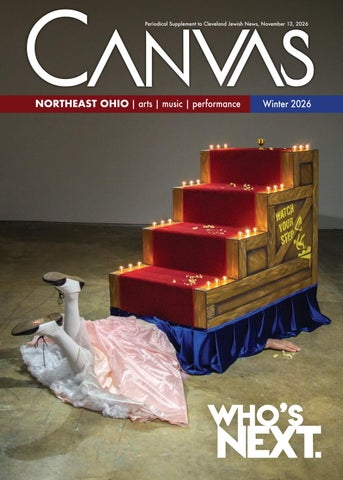
Artist Violet Maimbourg turns emotion into something physical through colorful, often playful sculptures that reveal darker themes beneath the surface. In Road to Nowhere, she explores the relentless pursuit of success, depicting a figure crushed beneath a towering staircase that leads to a tiny trophy. Photo courtesy of the artist.
Museums and galleries to visit this season
32 Listings
Local listings for museums, galleries and more
34 Curator Corner
‘Fondo Marino’ by Edward Marshall Boehm
CanvasCLE.com
Opening November 20 at the Cleveland History Center 10825 East Boulevard, Cleveland Details at wrhs.org | @clestartshere
Editor’s Note
O
The Shape of What’s Next
ne of my favorite parts of putting together our annual Who’s Next issue is seeing just how many different answers there are to the question.
WHO’S NEXT? It might be an artist bringing together years of work across different mediums and finally finding the language that feels entirely their own. It might be someone creating a platform for an art form that has long existed here but hasn’t always had the infrastructure or visibility it deserves. Or it might be a person working behind the scenes to create more opportunities for artists, and more ways for the rest of us to experience their work. THAT RANGE IS THE POINT. This year’s Who’s Next class (Chris Webb, Violet Maimbourg, Samuel McIntosh, Thao Nguyen and Rachel Bernstein) shows just how wide-ranging Northeast Ohio’s arts community is. Their paths couldn’t be more different, and their work spans theater, sculpture, street dance, illustration, public art, music and arts leadership. Some are finding new ways to combine disciplines. Others are creating opportunities for the next generation or taking art out of galleries and theaters and into neighborhoods and public places. The idea of “what’s next” extends
Follow us on Facebook and Instagram, @CanvasCLE. Sign up for Canvas’ free e-newsletter at canvascle.com/signup.
6 | Canvas | Winter 2026
Editor Rebecca Meiser editor@canvascle.com Creative Director Stephen Valentine
President, Publisher & CEO Kevin S. Adelstein Vice President of Sales Adam Mandell
beyond our five artists, too. You’ll also read about the Sculpture Center and the Museum of American Porcelain Art, projects that remind us that a thriving arts community depends not only on the people making the work, but on the people creating places for it to be preserved, discovered, shared and supported. Of course, “Who’s Next” has never really been about predicting who will become the next big name. Creative careers rarely move in straight lines, and some of the most interesting things happening in the arts begin quietly: with an experiment, a collaboration, a new space or an idea that someone decides is worth pursuing. What we can do is pay attention to the people taking chances, opening doors and imagining what could exist here that doesn’t yet. We hope you enjoy meeting some of them in this issue.
Editor, Cleveland Jewish News Bob Jacob
Warmly,
Senior Designer Jessica Simon
CFO Tracy Singer Custom Publishing Manager Paul Bram Sales & Marketing Manager Andy Isaacs Events Manager Gina Lloyd Events Coordinator Sam Spiegle Digital Marketing Manager Courtney Byrnes Columbus Bureau Chief Becky Raspe Operations Manager Abby Royer Editorial Kateryna Kopylchak, Jimmy Oswald, Martha Sorohan, Casey Swinarski Advertising Marilyn Evans, Adam Jacob, Nell V. Kirman, Sherry Tilson, Danielle Enger
Designers Hannah McConihe, Ricki Urban
Rebecca (Becky) Meiser
Digital Content Producers Stephanie Holmes, Daniel Newman
Editor
Business & Circulation Alisa Guseynov, Amanda LaLonde
Becky is also the Director of Volunteers, Community and Program Development at Jewish Women in Action Cleveland
Subscriber Services 216-342-5185/circulation@cjn.org
Stay-up-do-date with around the clock local community and world news from Northeast Ohio and beyond
Display Advertising 216-342-5204 advertising@jstylemagazine.com Canvas Contributors Ed Carroll, Shawna Polster, Cindy Spitz, Carlo Wolff Canvas is published by the Cleveland Jewish Publication Company, 23880 Commerce Park, Suite 1, Beachwood, OH 44122. For general questions, call 216-454-8300 or email info@cjn.org.
CanvasCLE.com
a program of the Jewish Federation of Cleveland
Experience Israeli Arts & Culture Through Film and Visual Art Join the Cleveland Israel Arts Connection for two unique opportunities “MUTUAL REALITY” BY RONEN SHARABANI Open House & Curator Talk November 22, 1-3 pm
Join curator Matthew Garson to discover thought-provoking works that examine migration, identity, and the shifting nature of belonging.
Scan this code to learn more and register at jewishcleveland.org
BEYOND THE TOOL: Technology as Artistic Medium January 10,1-3 pm Registration coming soon
Join multimedia artist Kasumi for a presentation on Movement, Memory, and the Evolution of an Artistic Practice.
Roe Green Gallery Virtual Territories #1, 2017
Jewish Federation of Cleveland Jack Joseph and Morton Mandel Building 25701 Science Park Drive, Beachwood
DOCUNATION:BEYOND THE HEADLINES
Credit: Abe Frajnlich
A free, virtual documentary series featuring compelling films and live filmmaker conversations that explore the human stories behind today’s headlines.
Film: That Orchestra with the Broken Instruments January 14 - February 1 Filmmaker Conversation: January 24
Film: Muhi: Generally Temporary February 11 - March 1 Filmmaker Conversation: February 21
Film: Children of Peace March 11 - 29
Filmmaker Conversation: March 21 Visit docunation.org/ciac to register.
Roe Green Foundation
ON DECK
Upcoming openings and current events from around Northeast Ohio COMPILED BY MARTHA SOROHAN
HARLEM GLOBETROTTERS Rivalry Tour | Dec. 30, 2026– Jan. 24, 2027
The Harlem Globetrotters bring their signature mix of basketball skills, comedy and crowd-pleasing entertainment to Northeast Ohio this winter as part of their Rivalry Tour. The legendary team will make three area stops, giving fans across the region a chance to catch their high-flying tricks and oncourt antics. The Globetrotters play at 7 p.m. Dec. 30 at Rocket Arena in Cleveland; 7 p.m. Jan. 18, 2027, at the Canton Civic Center; and 3 p.m. Jan. 24 at the Covelli Centre in Youngstown.
Harlem Globetrotters: Rivalry Tour Tips Off December 18 – Unveiling Two New Rival Teams That Will Also Take on the Legendary Team Across 350+ Games Around the Globe. Photo courtesy of AP.
MUSEUM OF CONTEMPORARY ART CLEVELAND Artist Talk: Faye Wei Wei | Jan. 21, 2027
Step inside the dreamlike world of British-Chinese artist Faye Wei Wei during a special artist talk at the Museum of Contemporary Art Cleveland. The conversation will explore the memory, mythology and literature that inform Wei Wei’s paintings, along with the emotional power and imagery that run through her work. MOCA Cleveland, 11400 Euclid Ave., Cleveland. The artist talk is free. mocacleveland.org/mocaevents/artist-talk-faye-wei-wei
8 | Canvas | Winter 2026
“Faye Wei Wei’s “Everlight” is part of her exhibit, “Draw in your head and sleep the long way home,” at Cleveland Museum of Contemporary Art through March 7, 2027.”
CanvasCLE.com
APOLLO’S FIRE “Fiddle Virtuosity from the Pubs of Old London” | Jan. 29–Feb. 2, 2027
Celebrating its 35th season under founder and artistic director Jeannette Sorrell, Apollo’s Fire brings the lively spirit of old London’s pubs to Northeast Ohio with “Fiddle Virtuosity from the Pubs of Old London.” Cleveland’s acclaimed Baroque orchestra will showcase dazzling fiddle music and the energetic sounds that once filled taverns and gathering places. Performances are 7:30 p.m. Jan. 29–30, 2027, at St. Paul’s Episcopal Church in Cleveland Heights; 4 p.m. Jan. 31 at Lakewood United Methodist Church; and 7:30 p.m. Feb. 2 at First United Methodist Church in Cuyahoga Falls. apollosfire.org
Cleveland’s Apollo’s Fire Baroque Orchestra is celebrating its 35th season under founder/director Jeannette Sorrell with concerts in Northeast Ohio, Chicago, and around the world. Photo courtesy of apollosfire.org.
42ND FINE PRINT FAIR April 15–18, 2027 | Preview Party: April 15 Cleveland Museum of Art
Discover everything from contemporary editions fresh off the press to rare Old Master prints at the Print Club of Cleveland’s 42nd Fine Print Fair. Held in the Cleveland Museum of Art’s atrium, the annual event brings together 16 dealers from across the country offering thousands of fine prints and drawings at a wide range of price points — making the fair welcoming to seasoned collectors and first-time buyers alike. Dealers will be on hand to talk about the works and help visitors learn more about print collecting, while familyfriendly printmaking and papermaking demonstrations will take place Saturday and Sunday. Proceeds from the annual benefit help support and enrich the Cleveland Museum of Art’s print collection. printclubcleveland.org
@CanvasCLE
Collectors and art lovers browse thousands of works at the Print Club of Cleveland’s Fine Print Fair at the Cleveland Museum of Art. The 42nd annual fair returns April 16–18, 2027. Photo courtesy of Cleveland Print Club.
Winter 2026 | Canvas | 9
The Sculpture Center connects Cleveland’s stonecarving past with artists expanding what sculpture can be today. Photo courtesy of The Sculpture Center.
CARVED IN STONE The Sculpture Center connects Cleveland’s stone-carving past with a new generation of artists redefining what sculpture can be. BY CARLO WOLFF
L
ong before the Sculpture Center began showing experimental installations and contemporary three-dimensional art on the eastern edge of University Circle, the neighborhood around it was already shaped by sculpture – in stone, in monuments and in the community Kenyon that grew up around them. Italian sculptor and stonecutter Giuseppe Carabelli arrived in Cleveland in 1880 and eventually established a monument business on Euclid Avenue near Lake View Cemetery. As the business grew, he recruited skilled stoneworkers from Italy, many of whom settled with their families in the neighborhood that became Little Italy. Carabelli’s company went on to work on some of Cleveland’s most recognizable monuments, including the central marble shaft of the Soldiers’ and Sailors’ Monument on Public Square and Wade Chapel at Lake View Cemetery. More than a century later, sculpture is still being made and reimagined just down the road. For Cleveland sculptor Leigh Brooklyn, there is something fitting about that proximity: Little Italy and Lake View Cemetery, with their
10 | Canvas | Winter 2026
stone-carving history, alongside an institution devoted to what sculpture can be now. “It’s just showing that evolution, with the past walled right up next to the contemporary,” Brooklyn says.
A CAMPUS FOR SCULPTURE
That intersection is, in many ways, what the Sculpture Center represents. Sculptor David Davis and his wife, Bernice, bought the site, consisting of three buildings fronting a courtyard, in 1989. Davis viewed it as a campus, a place where artists at different stages of their careers could work, exhibit and connect. The Davises also helped found the Artists Archives of the Western Reserve, housed on the same campus, in 1996. Today, the Sculpture Center remains one of Cleveland’s better-kept cultural secrets. “The Sculpture Center is the only institution in the region dedicated to showing sculpture in a gallery setting,” says Michael Gill, publisher of CAN Journal. “Sculpture can be a challenge both for galleries and for collectors because of its three-dimensionality. It requires a context of surrounding space.” Brooklyn knows that challenge firsthand. “Even as an artist, when you go to apply for a lot of art calls, it’s just 2D art,” she says. “There’s not a lot of places that you can even get into with sculpture. So having a space dedicated to that is really important.”
d m
WHAT COUNTS AS SCULPTURE
The Center focuses primarily on artists from Ohio and its five neighboring states who are in the first 10 years of their careers after graduation. But the definition of sculpture itself is increasingly expansive. “One of the things we look for in an artist we exhibit is a rigorous practice,” says Grace Chin, the Center’s executive director since 2019. Artists must be in “very serious pursuit of their practice and work in 3D, which is defined by so many different things now.” That might mean objects suspended from a ceiling, sound, light or an entire gallery working as a single experience. “I don’t like the word ‘immersive’ because I think it’s overused,” Chin says, “but artists are creating an experience in the gallery where the objects are in communication with each other.” The Center also gives emerging artists with a track record solo exhibitions and brings in more experienced artists whose work can provide context for those earlier in their careers.
HIDDEN IN PLAIN SIGHT
Part of the Center’s challenge, Brooklyn says, is simply making more Clevelanders aware that it’s there. “A lot of people still haven’t been to the Sculpture Center,” she says. “You could drive past it.” Yet its location may be one of its greatest assets. The road curves back
CanvasCLE.com
m
AUTHOR EVENTS
discover more LASER ENGRAVERS
3D PRINTERS
CULI CLA
GRAPHIC NOVELS
NAXOS MUSIC LIBRARY
LONG QUIL MACH
ADOBE CREATIVE SUITE
SEWING MACHINES
more
BOOK CLUBS
WRITERS CENTER STAGE
CREATIVEBUG CLASSES
FOR LAN CLA RECORDING STUDIOS INNOVATION CENTERS
HOOPLA STREAMING
START HERE:
WRITING WORKSHOPS
cuyahogalibrary.org ARTS & CRAFTS CLASSES
FIL DIG CONV
toward Mayfield Road and Little Italy, geographically connecting the Center to the stoneworkers who helped build the neighborhood. Brooklyn would like to see that history become a bigger part of the connection. “I think it’d be really great to tie more of that history into the Center,” she says.
MATT KENYON’S “MAXIMUM OVERDRIVE”
Its next major exhibition shows just how far sculpture has traveled since Carabelli’s stoneworkers arrived. “Maximum Overdrive,” which opens Nov. 13, features work by Matt Kenyon, a Buffalo-based media artist and designer whose sculptures mix industrial materials, emerging technology and political commentary. Kenyon is a TED Fellow and MacDowell Fellow whose work has been exhibited internationally, including at the Museum of Modern Art in New York. But his route to the art world was hardly conventional. He grew up in Baton Rouge, Louisiana. His mother was a lunch lady and his father a print salesman. Both his father and stepfather were Vietnam veterans, while his stepmother worked as a crisis counselor at the National Hansen’s Disease Center in Carville, Louisiana, the country’s last leprosy hospital. As a teenager, Kenyon worked as a face-painting clown at a nuclear power plant in Kansas. Looking back, he says those experiences exposed him to “some unusual intersections of industry, technology, government, and everyday life.”
reveal stress in transparent materials. Invisible forces appear as patterns of color. “I’m interested in these phenomena as metaphors rather than illustrations,” Kenyon says. “The resulting patterns are strange and beautiful, but they also suggest invisible forces, tensions, and pressures that might otherwise remain unseen.” That interest in materials carrying more than meets the eye runs throughout Kenyon’s work. “I’ve always been interested in how artwork can carry information that might otherwise go unnoticed,” he says. In Dropped Pin, another work in the exhibition, small portrait pins contain RFID chips with short messages of solidarity, support and personal testimony. Kenyon explored a similar idea in The Notepad, an artwork that looked like an ordinary yellow legal pad but carried microprinted information about casualties from the Iraq War. Copies made their way into the hands of
everyday object becomes a vehicle for information that might not otherwise reach its audience. “I’m interested in how seemingly ordinary objects can quietly carry information, becoming repositories of memory and bearing witness to lives and histories that might otherwise be erased,” Kenyon says.
THEN AND NOW
Carabelli and the stonecutters who followed him made monuments to preserve people, events and memory. Kenyon works with transparent guardrails, RFID chips and microprinted legal pads, but he is asking something similar of them: what can an object hold, and who will it reach? Brooklyn says sculpture’s range is a big part of its appeal. It can be highly conceptual, or “like this highly realistic Renaissance sculpture.” “And then there’s all that in between.”
MAKING THE UNSEEN VISIBLE
Soft Shoulder, part of “Maximum Overdrive,” began during a drive through Utah with his wife, who is a writer. They were traveling through enormous landscapes divided by highways and guardrails while listening to news reports Kenyon says seemed to describe a broader unraveling of society. He became fascinated by the corrugated guardrails, both as physical barriers and as symbols of pressure and instability. “I knew I wanted to make them transparent and somehow reveal the forces acting upon them,” Kenyon says. That led him to photoelasticity, a technique that uses polarized light to
12 | Canvas | Winter 2026
members of Congress. Kenyon Sculptor Matt Kenyon uses familiardescribes objects to reveal hidden pressures, histories and information. itPhoto as a kind of Trojan Horse strategy: an courtesy of Kenyon.
CanvasCLE.com
Koehn Sculptors’ Open House 47 years
Christkindlmarkt • Every Thursday through Sunday 11 am till 5:30 pm through Dec. 24 1936 S. Green Rd. South Euclid, OH 44121 • (216) 691-1936 • sanctuaryongreen.com
CHECK OUT THE LATEST ISSUES OF CANVAS AT CANVASCLE.COM
EMERGiNG ARTiSTS OF NORTHEAST OHiO @CanvasCLE
Winter 2026 | Canvas | 15
CHRIS WEBB
Bringing Every Version of Himself to the Stage After years spent moving between poetry, journalism, film and advertising, the Cleveland artist found a way to unite them all in “The End of Black Excellence” — and is already building what comes next. BY ED CARROLL
W
ith “The End of Black Excellence” returning to Cleveland Public Theatre after a successful national tour, multidisciplinary performance artist Chris Webb is enjoying a homecoming in more ways than one. Long before Webb became an Emmy-winning journalist, internationally touring spoken word artist, filmmaker, advertising director and, most recently, playwright, he was a quiet kid at Collinwood Middle School who wasn’t sure what he had to contribute. “The path to get into it was kind of a chaotic and random one,” Webb says. He found writing and theater there almost by accident. Around ninth grade, he wandered into a poetry program called Collinwood Creations — possibly, he jokes, because there was a girl he liked in the class. “But when I discovered the written word, it was like a dormant part of me opened up,” Webb says. “And then I discovered all of this passion and I discovered a perspective that I didn’t even realize that I had.” From there, Webb began seeking out nearly every arts opportunity Cleveland offered. He participated in Cleveland Metropolitan School District arts programs, became a regular at Karamu House and eventually found his way to Cleveland Public Theatre as a teenager. “So really, it started locally,” Webb says. “And then the community came around it and championed it and poured so much fire on the flame that now I’m just privileged and honored to still be doing it and still be doing it in the community that showed so much love initially.” Webb’s career would eventually take him far beyond Cleveland. He studied at the California Institute of the Arts, toured as a spoken word artist throughout 50 U.S. cities and internationally, made award-winning films and spent five years at WKYC Channel 3, where his journalism earned him an Emmy.
16 | Canvas | Winter 2026
But for the past two years, Webb says he would describe himself primarily as a playwright, thanks to his first major work for the stage, “The End of Black Excellence.” The play grew out of a contradiction Webb had been wrestling with for years: The more he accomplished, the less successful he sometimes felt. Despite touring internationally and working across multiple creative disciplines, Webb says he would repeatedly return home feeling as though he still hadn’t done enough. “Every year from 2016 to 2019, I ended up going back home and feeling like I haven’t done enough,” he says. “I felt as if I was the End of Black Excellence. No matter what I did, I could not achieve that standard. I couldn’t reach that place where you would consider somebody to be successful or excellent. I was always below the mark.” Once Webb began writing about that feeling, it came out through nearly every artistic form he knew. “And it was so all-encompassing, purging that feeling,” he says. “And I thought that I would be the only one who felt that way. But because it was so all-encompassing, I had to write it in every way that I knew how.” The resulting one-man show combines experimental technology, three-way projection, spoken word poetry, rap, acting and other artistic forms. It also marked the first time Webb stopped separating the different pieces of his creative life. “’The End of Black Excellence’ was actually the first time in my career that I didn’t think of myself as separate people,” says Webb. “’Video Chris,’ ‘Poet Chris,’ ‘Actor Chris.’ It was the first time that I wondered if there was a world where all of these things could coexist.” Webb has long thought about his career in distinct “eras.” There was a period when he became a videographer because, fresh out of CalArts, he couldn’t find acting work. There was another when he wanted to work in television because he thought it could help his family back home. Eventually, he realized that while those eras ended, the skills
CanvasCLE.com
remained. “But to look back and then realize that even though those eras kind of came and went, the skills are still there, it beckons a responsibility for me to see how these skills could all come together,” he says. “The End of Black Excellence” provided the answer. “I think the last time I counted there were like seven different art forms that melded together to make that one person show,” Webb says. “And once I discovered that it was a possibility to use all of these forms in a complimentary way and not have it be overwhelming, or have it be overwhelming in the best way, that became the way that I wanted to create art for the rest of my life.” The project also helped Webb emerge from an extended period of writer’s block. He traces some of that struggle to losing touch with the voice that originally drove his art. “I feel as if through the 2010s version of my career, I really listened to the crowd and started to be almost like a gun for hire,” he says. “And I lost that authentic voice that was birthed in my neighborhood, birthed in the local churches that I would do poetry at and things like that.” Eventually, he decided pleasing an audience mattered less than reconnecting with that voice. “And it wasn’t until I hit that point where I said, I don’t care what it costs me. I don’t care if I might lose an opportunity. I’m going to speak from that core place again,” he says. “And that became the End of Black Excellence.” That struggle also plays out through the play’s central character, modeled in part on Webb’s own deep desire to achieve. “You see that character compromise themselves in order to get further,” he says. “They talk in a different way. They act like a different person. They do whatever it takes to achieve an elusive goal.” By the end, however, the character reaches a different understanding of excellence. “That character realizes that their existence, their art, their authenticity, their love, their history, their background, all of that is excellent,” Webb says. “And it’s not their job to become a different person in order to prove it.” Although Webb explores that idea through the Black experience, he believes the pressure to prove oneself is universal — whether it comes from family, community or an internal definition of success. “While there’s beauty in definitely achieving goals and doing what you need to do, I think that there’s a healthy and an unhealthy way,” he says. “And I want people to find the healthy way, because I’m just now finding it myself.” Now Webb is taking those ideas into a much larger body of work. He envisions “The End of Black Excellence” as the first in a five-part series loosely inspired by playwright August Wilson’s series of plays set across different decades. “If I could spend the next six years writing and producing these, and each one gets bigger and bigger, and then I could retire as a playwright and just wear tweed sweaters every day, that would be amazing,” Webb jokes. The immediate next project, “The End of Black Love,” is already written, and Webb hopes to have it produced within the next year or so. This time, the inspiration comes from his own marriage. Webb and his wife celebrated their 10th anniversary in April, and he says the play is modeled on their early years together and the process of learning to truly see one another. “I think in a lot of times in relationships, you might see what you expect the person to be,” Webb says. “You might see your own trauma. You might see a whole host of things. When you put that
@CanvasCLE
Above: The End of Black Excellence” grew out of a question Webb had wrestled with for years: Why did achievement still leave him feeling like he hadn’t done enough? Opposite page: Chris Webb spent years thinking of himself as different artists — “Video Chris,” “Poet Chris,” “Actor Chris.” With “The End of Black Excellence,” he finally found a way to bring them all onto the same stage. Photos courtesy of Webb. into the context of Black people, there are historical pressures that go along with it as well.” He wanted the piece, he says, to explore “how love is challenged and can preserve.” Webb makes that inability to fully see another person literally through life-size, hyper-realistic puppets. In the first act, the male character is played by an actor while his girlfriend appears as a puppet operated by Black women puppeteers. In the second, the roles reverse. At one point, both characters are puppets. Only at the end do both actors appear together onstage. It is another imaginative device serving a theme that Webb says runs throughout his work: the struggle to see — and be seen — clearly. The remaining planned works will not be direct sequels, though they will share thematic connections and may include some common characters. Webb expects to spend at least the next half decade developing them, continuing to pull from the artistic “grab bag” he accumulated over years of moving between mediums. After spending much of his career thinking of himself as different versions of Chris Webb, he now sees those skills as parts of the same artistic language. And as “The End of Black Excellence” returns to the Cleveland theater that helped nurture him as a young artist, Webb is no longer trying to decide which version of himself belongs onstage. He’s bringing all of them.
Winter 2026 | Canvas | 17
to follow the same path. It brought her to Cleveland, and eventually to a career very different from the one she imagined. Today she calls herself a designer, illustrator and visual artist, though even those titles feel limiting. Her work stretches from illustration and graphic design to video, printmaking, murals and large-scale public art, with bright colors, graphic shapes and handmade textures that give it an instantly recognizable optimism. Increasingly, though, the work is about people. “I still storytell through my videos or through my artwork,” Nguyen says. “And instead of characters, it’s more real life people.”
FINDING COMMUNITY
THAO NGUYEN Making Connection Visible BY REBECCA MEISER
B
efore Thao Nguyen imagined herself painting murals across Cleveland or telling the stories of neighborhood restaurants, she wanted to make video games. Growing up in Kansas City, Kansas, Nguyen was drawn to the colorful worlds of Studio Ghibli and games such as Paper Mario: The Thousand-Year Door. She loved the characters, the storytelling and the chance to enter places that didn’t exist anywhere else. A high school art teacher gave that ambition a destination: her teacher’s son had attended the Cleveland Institute of Art and gone on to work on projects including League of Legends and a Transformers movie. Nguyen decided
18 | Canvas | Winter 2026
At CIA, Nguyen studied illustration until a professor pointed out that her graphic style and use of color stood apart, and encouraged her to lean into it. Around the time of the COVID-19 pandemic, she began making projects for herself and sharing them on social media, collaborating with her friend Annie Wynn, a photographer. One of their earliest started with a fictional tin of sardines. Nguyen designed and mocked up Asian-inspired packaging; Wynn developed the concept and styling for a product shoot. They documented the process in a video, with no client and no plan to sell anything. It received more than 30,000 views. What stayed with Nguyen was the process: watching something she had drawn become a physical object, and discovering what happens when people in different mediums combine their skills. “You can create something really magnificent instead of just doing on your own,” she says. They kept experimenting. For one project, Nguyen created and mocked up a children’s book and Wynn photographed it as though it were a finished product. Their video showing how the project came together caught the attention of Instagram’s official design account. For another, they turned to the Mid-Autumn Festival, an important celebration in many Asian cultures. Nguyen designed her own packaging for mooncakes, the pastries traditionally eaten during the holiday, while Wynn developed a colorful product shoot around the package, incorporating props including a disco ball. The projects weren’t commissions or products they were trying to sell. They were exercises in seeing how far an idea could travel once illustration, design, photography and storytelling came together. Along the way, Nguyen challenged herself to post once a week for a year and developed what she calls her three Cs. The first was “cringe,” pushing through the discomfort of making yourself visible. The second was collaboration. The third was “choosing your hard”: accepting that challenges are inevitable, but that you have some say in which ones you take on.
ART BEYOND HERSELF
Soon, Nguyen began wondering whether the same tools could do something beyond showcasing her own work. That realization took shape in AsiaTown. During the pandemic, neighborhood organizations were looking for ways to support restaurants hurt by declining traffic. Nguyen was approached about a campaign raising money for AsiaTown businesses and made a video to help
CanvasCLE.com
spread the word. Hundreds of people shared it. But the response made her think about a larger problem. Many of the restaurant owners she encountered were older and had built successful businesses long before Instagram and TikTok became marketing tools. They knew food and they knew their customers, but some had little social media presence to introduce themselves to people who had never walked through their doors. Nguyen and videographer and social media strategist William Aiken decided to help. They began going into restaurants, meeting the owners and making short videos that focused not simply on what they served but on who they were and why they had built their businesses. Nguyen remembers being struck by how much dedication was behind places she had previously known primarily as restaurants. “I learned like how passionate these people are and how I don’t know how much dedication they have with food,” she says. “And it just made me want to help them more.” One was Pho Lee’s, one of Nguyen’s favorite restaurants. Nguyen says the owner, Sonny, was among multiple business owners who later told her they had seen increased customer traffic after the videos. For Nguyen, that response changed the way she understood her own skills. “Art is not just for yourself,” she says. “It can be used as a way to, like, impact the world.” The work also returned her to what had drawn her to video games in the first place: storytelling. Only now, she didn’t need to invent the characters. “I love connecting with people because I mean we’re made for human connection, right?” she says.
TAKING THE LEAP
For a time, Nguyen followed a more traditional path. She worked in corporate jobs and, in 2024, spent about six months illustrating and designing toys for Care Bears. She thought she had landed her dream job. Then freelance projects began to pull at her. One woman hired her to make a poster for a film honoring a family member who had died, and the client became emotional seeing it. “Wow, I want to keep doing stuff like that and just following my voice,” Nguyen remembers thinking. Leaving was frightening. Within her first week on her own, her iPad stopped working and her computer began dying, equipment problems she estimates cost about $5,000. Still, she knew she would regret not trying.
GOING BIGGER
Her first official large-scale public art project came through a Destination Cleveland call for artists. The mural drew on the people she had met in Cleveland, including videographers, writers, food lovers and musicians, and on the importance of community she had felt during the pandemic. “When people drive past it, they can hopefully see themselves or someone that is in their life on that piece,” she says. The Cleveland Browns’ cultural and international marketing team saw it and asked her to live paint a piece for an event centered on women vendors. She had to finish in a single day, so she researched the portable wooden panels vendors use, worked out measurements and brought the concept to a friend who owns a woodworking shop.
@CanvasCLE
Above: For a Cleveland Browns event featuring women vendors, Nguyen designed a colorful portrait of community — and painted it live in a single day. Opposite page: Thao Nguyen brings her bright, graphic style to large-scale work, part of a career that has expanded from illustration and design into murals and public art. Photos courtesy of Nguyen. Painting as people watched was a thrill, and exhausting. “Art is not just the art itself,” Nguyen says. “You’re also having to be an athlete sometimes, especially for mural work.” But scale gives her something a screen can’t: someone can encounter a mural unexpectedly, and public art can become part of a neighborhood’s everyday life.
BACK TO HER HANDS
After years of working mostly digitally, Nguyen wanted to create with her hands again. A 2024 fellowship at Zygote Press introduced her to printmaking, and she chose one of its most demanding techniques, lithography, which requires balancing oil and water and repeating steps until the print works. It took multiple attempts. “It teaches you repetition. It teaches you discipline,” she says. When a print didn’t turn out as planned, she learned to say: “Hey, this might have not turned out the way I wanted, but actually, I love it.” She has also made more than 70 paper lanterns for Plentitude, a Cleveland Foundation exhibition centered on AsiaTown. The project took seven or eight months, working with a committee and curator, and included a research trip to Seattle’s Wing Luke Museum.
WHAT’S NEXT
Nguyen is becoming more selective. Early in a creative career it is tempting to say yes to everything, she says, but she now wants to work with brands and organizations that respect artists, trust their expertise and pay fairly. She would like to make more video, keep telling the stories of business owners, and travel to Korea to learn traditional artmaking and papermaking. She also runs. She finished her first marathon about a year and a half ago and is training for her second, and she can imagine running eventually intersecting with her art. “I’m so passionate about running,” she says. “It brings me so much life.” She doesn’t expect to know exactly where any of it will lead. “I think everyone is always figuring it out,” she says. Her career so far has moved from imagined worlds to real people, from screens to city walls, and from working alone to building projects with photographers, videographers, restaurant owners, woodworkers and curators. The medium keeps changing. The impulse behind it has not: to make something that reaches somebody else.
Winter 2026 | Canvas | 19
ViOLET MAiMBOURG Making the Feeling Physical
BY REBECCA MEISER
B
efore Violet Maimbourg knew she wanted to be an artist, she wanted to be an engineer. Then a filmmaker. Mostly, though, she wanted to make things. Growing up in Orange, Maimbourg spent one summer creating DIY tutorials for YouTube, inspired by the movie-prop series Indie Mogul. Armed with cardboard and whatever else she could find around the house, she built Ghostbusters proton packs, ray guns, laser guns and horror props, filming a new episode each week. “I had no real like fabrication skills, but I tried my best and it was fun and I gained a following,” Maimbourg, 32, says. She even made a little money from the videos, an unusual way for a high schooler to earn money that, looking back, hinted at the career to come. “I think I’ve always been a maker,” she says. Today, that instinct has expanded considerably. Maimbourg works across sculpture, installation, photography, film and practical effects, combining skills that can include welding, silicone casting, electronics, motors and CNC fabrication. Her work is often colorful and playful at first glance — carnival games, clowns, oversized objects, blinking lights — until something darker reveals itself. That tension is intentional.
A PHYSICAL LANGUAGE
Maimbourg initially pursued filmmaking, enrolling in film school with plans to become a cinematographer. By her junior year, she knew it wasn’t right. She returned to Cleveland, filmed weddings for a time and eventually enrolled at the Cleveland Institute of Art to study sculpture and expanded media. There, something clicked. A hypersensitive kid, Maimbourg says she had long struggled to explain the intensity of what she felt inside. Sculpture offered a physical language. “Sculpture became a way for me to actually physically make the embodiments of my emotions and show others what I was experiencing in my head,” she says.
20 | Canvas | Winter 2026
The medium itself fascinated her: an object exists in the same space as its viewer. Someone can walk around it, see it from different angles and experience its size, weight and materials firsthand. One of her earliest sculptures played with that physical relationship. She built an oversized anvil covered in needlefelted material, then suspended the heavy-looking object from string in the middle of a room. More important than the piece was the realization that followed. “I think it taught me that I can be good at this,” Maimbourg says. “Finding sculpture was like, okay, this can involve every one of my interests, and I’m totally on board.” Those interests are unusually broad. Maimbourg still carries some of that aspiring engineer with her, approaching each new work partly as a technical problem waiting to be solved. “I wanted to not be limited by what I knew, and I just wanted to be able to make anything,” she says. If she doesn’t know how to weld something, wire it, cast it or make it move, she learns, often from a YouTube video or by trial and error.
YOUR LOVE IS MY FAVORITE CARNIVAL
That experimentation became central to the work she created while pursuing her MFA in sculpture at Kent State University, which she completed in May 2026. Much of that period culminated in Your Love Is My Favorite Carnival, her solo exhibition at Waterloo Arts, a brightly colored body of work that uses carnival imagery to explore far heavier emotional territory. Maimbourg, who has spoken openly about being diagnosed with borderline personality disorder, saw the carnival as an apt metaphor for emotional extremes: thrilling and frightening, enticing and unsettling, seemingly joyful but capable of turning dark. She is also candid about the stigma the diagnosis carries, and about wanting the work to push back on it. “I never liked carnivals,” she says. Yet in movies, she found herself drawn to them, particularly the eerie carnival of Big. That push and pull gave her a visual world through which to
CanvasCLE.com
Left: Hard to Love uses a giant yellow duck and disembodied hands to explore the tension between holding on and letting go in relationships. Right: Maimbourg’s giant doughnut clown grew from a simple daily ritual: buying herself a small moment of joy. Opposite page: Violet Maimbourg in her studio. Photos courtesy of Maimbourg. tell her own story. Over about a year, she made a new piece every two or three weeks. The works became, as she describes them, “an episodic, illustrative journey.” In Hard to Love, created after the loss of a relationship, two hands cling to a giant yellow duck. The imagery grew from a metaphor she encountered about relationships: hold on to something too tightly and you hurt both it and yourself. You have to let it explore and trust that it will return. Another piece grew from a much simpler attempt to find joy. At a therapist’s suggestion, Maimbourg began buying herself a chocolate-covered doughnut with sprinkles each day. “It was a simple thing that I could do: spend like $2 to get a donut,” she says. The ritual inspired the giant doughnut clown, which she calls everyone’s favorite piece. Her work often operates that way: personal experiences translated into bright objects that invite viewers in with humor or spectacle. “I am a very silly, goofy person, and I can put on a mask that will trick anyone,” she says. “But that mask is very fallible.” People are first amazed by the color and lights, she says, and then they notice the severed hand. “I think that push and pull between the joyful and the pain is really powerful.” She hopes that anyone who is struggling sees the work and realizes they aren’t alone. It’s what she needed to hear growing up, when she struggled to understand the intensity of what she was feeling. “How you feel is valid just the way you’re feeling it, because it’s you and you’re feeling it,” she says.
ROAD TO NOWHERE
A more recent sculpture, Road to Nowhere, began with an image that arrived almost fully formed while she was driving to her parents’ house. She had been talking in therapy about her relentless pursuit of success, the idea that happiness would arrive after the next accomplishment, amount of money or level of recognition. Suddenly, she pictured a woman trapped beneath a massive staircase, struggling under its weight while something waited at the top. “That is perfect,” she remembers thinking. The finished piece features heavy stairs crushing a figure beneath them, with a tiny plastic trophy perched almost absurdly above. She swapped out the original flagpole, which
@CanvasCLE
felt too much like an actual marker of success. Blue velvet nods to filmmaker David Lynch, while popcorn scattered across the stairs reflects her enduring cinematic influences. For Maimbourg, the work marked a turning point, away from the carnival and toward whatever comes next.
SOMETHING LIGHTER
One commission already pointed in a different direction. Through Kent State’s galleries, a private donor sought a student to create a permanent steel butterfly for a healing garden, and Maimbourg’s welding experience put her name forward. It was a departure: a family-friendly, easily understood symbol for a public audience. She wanted it to feel light even though it weighs about 500 pounds, and she chose a purplenavy iridescent patina that shifts in the sunlight rather than the rust finish common on public sculpture. She built it largely alone, cutting and lifting three-eighthsinch steel plate through a summer of 90-degree heat. The project also taught her something about limits. “It’s not the end of the world if something’s delayed,” she says.
WHAT’S NEXT
The next piece is already underway: a motorized sculpture she says she couldn’t have made a few months ago. With her MFA from Kent State completed, Maimbourg has accepted a job at SUNY, where she will fabricate work for science and arts departments. The role has her working with sheet metal, finishes, CNC processes and motors — skills that keep showing her how she might have approached earlier work differently. “I should have made my piece in the spring a different way, but I didn’t,” she says. “That’s okay, because I did the best I could, and now I know more.” She doesn’t see that as a frustration. It is the point. “I just always want to know more, and I always want to learn,” she says. As she begins her next chapter in New York, Northeast Ohio remains an important part of her identity as an artist. Everything that got her here happened here: the Cleveland Institute of Art, her MFA at Kent State, the solo show at Waterloo Arts, a 500-pound steel butterfly built by hand through a summer of heat. “I never want to lose my connection to Cleveland,” she says. “There’s so much talent in Northeast Ohio. A lot of it is overlooked and not recognized.”
Winter 2026 | Canvas | 21
RACHEL BERNSTEiN Bringing Art Into the Open
Rachel Bernstein is expanding Heights Arts’ reach, bringing public art, music and creative experiences into the places Cleveland Heights residents encounter every day. BY SHAWNA POLSTER
R
achel Bernstein came to Cleveland nearly three decades ago knowing almost nothing about the city. Today, she is helping shape how one of its major artistic communities experiences art. Bernstein, 60, is the executive director of Heights Arts, a community arts organization in Cleveland Heights, where she
22 | Canvas | Winter 2026
has worked for almost 14 years. This past year, as Heights Arts celebrated its 25th anniversary, Bernstein helped lead one of the organization’s most ambitious public art efforts to date: an investment of more than $250,000 that is bringing eight new public art projects to the Cedar Lee Arts and Coventry business districts. Six murals have transformed buildings along Lee Road, stretching from the Cain Park area south toward the Lee Road branch of Heights Libraries. Two additional projects are planned for Coventry, including a new artwork near Mayfield and Coventry roads and an outdoor structure in Harvey Pekar Park designed to serve as both a gathering place and performance space. The timing brought together several milestones in Cleveland Heights. Heights Arts marked its 25th anniversary, the Cedar Lee Theatre and Cleveland Heights High School celebrated their centennials, and Cedar Lee was formally being promoted as an arts district. But for Bernstein, the initiative began years earlier — and with very little warning. “It started three years ago when I found out with less than 24 hours notice that the city was entertaining proposals from nonprofits. I really had to think hard and fast about what we could do with the money,” Bernstein says. “For me, it was public art.” The response from artists underscored the scale of the opportunity. More than 200 applied for the six Cedar Lee mural commissions before the field was narrowed and artists were matched with individual buildings. Nine artists were ultimately selected for the eight Cedar Lee and Coventry projects. Bernstein initially hoped to produce the murals in underserved neighborhoods, but due to delays with contracts, the Cedar Lee Arts District, in partnership with Coventry Village, became a more timely option. For Bernstein, however, the larger goal goes beyond any one mural or business district. The initiative reflects a philosophy that has increasingly shaped Heights Arts under her leadership: Art should not require walking into a gallery, buying a ticket or already thinking of yourself as someone who participates in the arts. “What we’re really hoping to do is become known for our accessibility, and for anybody to be able to experience the arts,” Bernstein says. Bernstein has always been drawn to the arts. Growing up in Albuquerque, New Mexico, Bernstein’s original connection to the arts came in the form of music. “I’ve been a musician since I was nine years old. I was very lucky that my parents, who were not musicians and didn’t make a lot of money, provided private lessons for all five of us kids,” she says. Bernstein took cello lessons, where she connected deeply with her cello teacher and refined her musical talent. She says that her parents’ encouragement to play music, along with her admiration of her cello teacher, “ignited her passion” in the arts. “My cello teacher growing up was not only an amazing, versatile musician who could play just about any string instrument, but also she’s an artist,” Bernstein says. “She just oozed creativity.” She vividly recalls her cello teacher’s artistic talent, intricately crafting and designing musical instruments. “She would paint murals on the inside of the instruments,” she says. “You can look inside and see a work of art inside the instrument.” Bernstein enrolled in Southern Methodist University as a
CanvasCLE.com
Above: One of six new murals along Lee Road, this Cedar Lee artwork is part of Heights Arts’ push to bring art beyond galleries and into the places residents encounter every day. Opposite page: For Rachel Bernstein, music, visual art and community all belong in the same conversation. Photos courtesy of Heights Arts. music major, but was unsure if she wanted to pursue a career in music. While she felt pressured to go into music, she had many other interests and explored various administrative roles outside of the arts upon graduation. Eventually, she found herself back in the arts. In 1998, Bernstein moved to Cleveland when she married a member of the Cleveland Orchestra. Upon arrival, she immediately began a job working at The Music Settlement in Cleveland’s University Circle neighborhood. “I got married on a Saturday, I moved to Cleveland on Sunday, and I started my job in administration at the Music Settlement on that Monday,” she says. Connecting with her love of music and utilizing her administrative experience, Bernstein describes herself as a perfect fit for the role. Bernstein worked for the Music Settlement for 15 years before becoming the executive director of Heights Arts. Since becoming executive director, Bernstein has helped expand Heights Arts’ interdisciplinary programming across visual art, music and literary arts, while continuing to teach cello privately. Bernstein combines her love for music and art through Heights Arts programs such as the Close Encounters series, which showcases members of the Cleveland Orchestra performing in unique homes and venues, as well as gallery concerts featuring lesser-known artists. “People can experience the visual art and experience the performance at the same time,” Bernstein says. “It really fulfills my passion for music and for the arts from the programming lens.” Bernstein notes that Heights Arts would not be possible without the support of the community, which she believes is especially strong in Cleveland. She says Heights Arts programming is driven by volunteers and collaboration with other organizations and artists. “We have three community teams for music, poetry and exhibitions and they decide what our exhibitions are going to
@CanvasCLE
be, what our music program’s going to be, who the next poet laureate is going to be,” she says. “They work to create the programming for each year and they hang the installations for the public art initiative.” In addition to making art more accessible, Heights Arts strives to support artists financially — another part of the organization’s impact that Bernstein believes can sometimes be overlooked. “We’ve contributed $2.6 million over our existence, averaging about $100,000 a year for 26 years to the creative economy,” she says. That investment helps explain why Bernstein sees the new murals and installations as more than beautification. They put artists to work, bring art into everyday public spaces and make creativity part of the identity of a neighborhood. While Heights Arts has already had an immense impact, Bernstein has more ambitions for the future of art in Cleveland. She says that with funding, Heights Arts could help city projects become more beautiful and creative. “I would love to see some kind of 1% for the arts program so that we can do more. I hope that any new ideas are supported by infusing the arts into them,” she says. Bernstein says that she is grateful she ended up in Cleveland, where she has built her life, career and home. She says Cleveland is a “special place” with an irreplaceable sense of community and support for the arts. “Now that I know the city and I know so much more about it, I would never live anywhere else,” Bernstein says. “I would still live in Cleveland Heights, because it’s just so rich with that culture.” The public art initiative may be the most visible expression yet of the philosophy Bernstein has spent years advancing at Heights Arts: that art belongs not only in galleries and concert halls, but on the streets people walk, the buildings they pass and the neighborhoods they call home. “I think having more opportunities, which takes a lot of collaboration from governments and different entities, just makes it a better community for everybody.”
Winter 2026 | Canvas | 23
SAMUEL MCINTOSH Building the Movement
Samuel McIntosh is creating the infrastructure, opportunities and visibility to help Cleveland’s street dance scene grow. BY JIMMY OSWALD
H
ip hop and street dance have always had a home in Cleveland. Samuel McIntosh just wants to make sure everyone knows it. The South Euclid resident and Charles F. Brush High School graduate created 10K Movement to give young people a platform to express themselves through street dance, immersive cultural experiences and live performance. Through community classes and performances, hip hop and street dance culture is preserved, presented and cultivated, McIntosh says. “In Cleveland we have a large street dance scene, but we don’t have infrastructure so we’re missing out on what could be an economic generator,” he says. “It’s great for our city because it shows you more of our identity and shows a piece of the fabric that makes us Clevelanders.” For McIntosh, building that infrastructure is also about showing young people what is possible. “I teach in the schools sometimes and there’s so many great artists, visionaries and geniuses among those kids, especially with the Cleveland Metropolitan School District,” he says. “We sometimes place kids in these boxes because we don’t have anything else. What if we gave more opportunities for these kids to see what is possible?” McIntosh falls in love with dance while in high school and takes it to a professional level while attending Baldwin Wallace University in Berea. Along the way, he meets a brain surgeon born in London and living in Australia who is completing a residency at Cleveland Clinic. The surgeon becomes a mentor, sponsoring McIntosh at events and training with him during what McIntosh describes as “crazy” hours.
24 | Canvas | Winter 2026
McIntosh later trains in New York City and Los Angeles, but ultimately returns to Cleveland to help build the street dance scene here in Northeast Ohio. “I realized in Cleveland there was still no access to authentic street dance forms, whether it be breaking, popping, house, hip hop, freestyle, whacking or any other other styles. Nobody even has that language here in Cleveland,” he says. “It started with me teaching classes all over Cleveland but at Karamu House specifically. Then it turned into battles and then large-scale intensives.” McIntosh begins holding events and classes in 2016 and officially launches 10K Movement in 2020. The organization grows into a platform for training, performances, battles and cultural experiences designed to connect Cleveland dancers with the larger street dance community. That same year, 10K Movement premieres Lords of the Land, an international hip hop and street dance festival featuring battles, workshops, performances and parties. The event grows from about 60 competing dancers in its first year to more than 250, attracting dancers and audiences of all ages. “There’s a big event in LA and in NYC, so for our competition to be named amongst those that have been going on for 30 years - it’s amazing to see the growth,” McIntosh says. “We wanted to take a step back and recalibrate for 2027. We’ve seen it grow from 60 dancers the first year to over 250 competing. We see people of all ages come out, the youngest being an infant and the oldest, my grandma, who is in her 90s. There’s something for everybody, and we love seeing it grow.” In 2026, 10K Movement changes the format of its signature summer event, presenting The Function at North Coast Yard. Centered around hip hop battles, the family-friendly event
CanvasCLE.com
brings together dancers, food, music and activities while giving audiences an opportunity to see high-level street dance competition. “You’ll still see some of the best dancers in the world compete, it’s just at a different format this year,” McIntosh says. “It’s family-friendly and there’s activities for all the kids. It is centred around hip hop battles. Think of it like a hip hop expo here in Cleveland. It’s for our community to witness true, authentic hip hop and street dance. It’ll be a big celebration with food, drinks and dance, and you get to see a really intense competition.” Competition, however, is only one piece of what McIntosh is building. 10K Movement also provides intensive training for younger dancers. Its Summer Street Dance Intensive gives dancers ages 14 to 25 more than 75 hours of training across multiple street dance styles, along with opportunities to perform. “It’s a six-week camp that plugs you into the street dance community and gives you access to six different styles in the street dance realm,” McIntosh says. The classes, battles and performances serve a larger purpose: bringing street dance into places and in front of audiences that may not otherwise encounter it. “It’s nice to reach a different audience,” McIntosh says. “It’s really cool to see hip hop and street dance in different realms.” For McIntosh, that growing visibility is part of the point. Cleveland already has the dancers, the culture and the creativity. What it has lacked is the infrastructure to connect those pieces, develop young artists and make the larger community aware of what is happening here. Through 10K Movement, he is helping build it.
@CanvasCLE
Above: A group of dancers receive a round of applause from the crowd after competing at Lords of the Land, an international hip hop and street dance festival in Cleveland that features battles, workshops, performances and parties that was created by Samuel McIntosh’s 10K Movement. Below: Instructors demonstrate moves to perform while teaching hip hop and street dance to a group of aspiring professional dancers at 10K Movement’s Summer Street Dance Intensive. Opposite page: Samuel McIntosh teaches people of all ages how to perform hip hop street dances, such as popping, through his organization, 10K Movement. Photos courtesy of Samuel McIntosh.
Winter 2026 | Canvas | 25
THE ART OF BUYING LOCAL ART Think galleries are intimidating or original art is out of reach? Three Northeast Ohio galleries offer advice for finding meaningful pieces for the holidays and beyond. BY CINDY SPITZ
H
ave you ever walked past an art gallery, glanced through the windows and kept going? Maybe you weren’t sure you knew enough about art to step inside or assumed anything on the walls would be well beyond your budget. You’re hardly alone. The holiday season offers a good reason to reconsider. Art can be a thoughtful, memorable gift, although choosing something as personal as a painting, photograph or print for someone else can be tricky. A gift card can let the recipient make that discovery for themselves. And there’s nothing wrong with putting your own name on the shopping list. As you decorate, entertain and spend more time at home, that empty
HEDGE GALLERY 1300 W. 78th St., Suite 200 hedgeartgallery.com Hilary Gent, owner of HEDGE Gallery, inside 78th Street Studios, which showcases contemporary work by Northeast Ohio artists, helps demystify the process. “You don’t have to be prepared to enter an art gallery,” Gent says. “If you’re interested in supporting local artists, visit with an open mind. We make the gallery atmosphere an inviting, accessible space.” Gent is quick to dispel the notion that appreciating, or buying, art is reserved for the wealthy or those living in Manhattan. “Since we have so many incredible local artists, we keep price points accessible and even offer payment plans to make buying easier,” she explains. Gent, a painter herself, says potential buyers don’t need to arrive armed with a list of questions. Instead, browsing the gallery’s website beforehand can help
26 | Canvas | Winter 2026
wall or overlooked corner may be ready for something new. Buying art doesn’t require becoming a serious collector or starting with a substantial budget. It does help to know a few things before you begin. Where should you look? How much should you expect to spend? And does a new piece of art really need to match your sofa? Fortunately, Northeast Ohio is home to a thriving community of artists and independent makers working across a wide range of media. Three local galleries offer an inviting place to start, taking some of the mystery out of buying art, whether you’re shopping for the holidays or for yourself.
first-time visitors familiarize themselves with the artists and their work. If you need professional advice, a Hedge Gallery professional will visit your home or office to look at wall space and colors to make suggestions. GIVING ART WITHOUT THE GUESSWORK “You really have to know someone will love what you select,” Gent says. If you’re unsure of the recipient’s tastes, she suggests opting for a gift card, which Hedge offers for the holidays, or making the experience part of the gift by visiting the gallery together to select something meaningful. AND IF THE ART IS FOR YOU? “If the artwork makes you question something or inspires you to feel a certain way, then it’s for you,” Gent says. “Art doesn’t have to match your home perfectly to have an impact. People might spend a fortune on a couch or table they’ll eventually replace yet hesitate to invest in a piece of art they could keep forever. Plus, you’re supporting the career of a local artist.”
HEDGE Gallery owner Hilary Gent encourages first-time buyers to choose art that sparks a personal connection. Photo courtesy of HEDGE Gallery.
CanvasCLE.com
October 15 - December 19, 2026
2026-2027 Performing Artists Series
7:30 PM Hoke Theatre
S: S LLIN EYE Y CO LUE JUDJUDY B TOUR L L T E E SWEFAREW
Holy Mountain Blood Boiler by Ryan Cermak
WINTERJanuary EXHIBITIONS 8 - March 13, 2027
FALL EXHIBITIONS
NOV 6
ADAM PASCAL & ANTHONY RAPP CELEBRATING 30 YEARS OF FRIENDSHIP & MUSIC
FEB 4
NASH A COUN VILLE NOEL TRY SPECTA CHRISTMAS CULAR
FEB 27
DEC 16
N: HOME AGAITO A TRIBUTE G KIN LE RO CA
CHICAGO TAP THEATRE
Park Politics by Dadisi Curtis Jr.
FREE & OPEN Fridays and Saturdays
summitartspace.org 140 E. Market St. | Akron
MAR 11
S VARD OULE
THE B
APR 15
440-366-4040 | STOCKERARTSCENTER.COM
Our weekly newsletter brings you family fun features to welcome Shabbat!
Sign up now at cjn.org/esignup @CanvasCLE
Winter 2026 | Canvas | 27
BONFOEY GALLERY & FRAMING STUDIO 1710 Euclid Avenue bonfoey.com Marcia Hall and Diane Schaffstein, co-gallery directors at the Bonfoey Gallery & Framing Studio at Playhouse Square, echo Gent’s approach to accessibility. “We know it can be intimidating to walk into a gallery, so we make customers feel comfortable,” says Hall. “We make it easy for first-time buyers to come in and browse. We want it to be a happy, pleasant experience.” The gallery, which was established in 1893, features regional and contemporary works, as well as framing and restoration services. The gallery provides art for both residential and corporate spaces, although Hall and Schaffstein say residential clients have become a larger part of the business as corporate spaces have downsized. The gallery features the work of roughly 100 artists. Schaffstein says potential buyers can browse the gallery’s website before visiting to get a sense of its offerings. Once there, they can also ask to see works that aren’t currently on display. “If you see something you like but it has already sold, we can show you similar pieces or, in some cases, commission the artist to create a piece of art for you,” she explains. She explains that many people have a color scheme in mind, but that it’s not necessary for everything to match what you may already have. “Print is a great entry point,” Schaffstein says. “These are made from the originals and can offer lower price points – it all depends on the artist and how many prints they made.”
HEIGHTS ARTS 2175 Lee Road, Cleveland Heights heightsart.org Heights Arts, located on Lee Road in Cleveland Heights, features a nonprofit gallery store as part of a larger nonprofit community arts organization that has provided access to emerging and professional literary, musical and visual artists in Northeast Ohio for 25 years. According to Arleigh Savage, Programs and Events Manager, Heights Arts focuses on showing and selling artworks by regional artists at the Heights Arts Gallery and Store. During the holidays, the nonprofit gallery is transformed into
Heights Arts’ Holiday Store showcases work by more than 120 Northeast Ohio artists, writers and makers. Photo courtesy of Heights Arts.
28 | Canvas | Winter 2026
The Bonfoey Gallery offers original works and prints at a range of price points for new and seasoned collectors. Photo courtesy of Bonfoey Gallery. “ART IS FOR EVERYONE!” The viewing room on the Bonfoey website includes a selection of art for $500 and less, which invites all newcomers to shop for themselves or others. Mediums include oil on paper, inks on scratchboard, print on paper, acrylic on canvas, lithograph on paper and paper collages. Hall and Schaffstein agree that gift certificates work best for gifting art. “Unless the recipient has already communicated how much they love the piece, it’s best to let them choose for themselves, adds Hall.” Most of these works are unframed, providing the buyer with the opportunity to choose what they like. “Think of framing as the icing on the cake,” Hall says. “You want to preserve your investment.”
a local holiday artisan marketplace featuring handmade gifts from Northeast Ohio makers. The holiday store opened Nov. 6, 2026. “We have over 120 local artists offering a range of art and gifts, including fine art and visual works, ceramics, glass works, woodwork, sculptures, and enamel art,” says Savage. “We also have handcrafted jewelry, textiles and accessories — even books and greeting cards.” Savage says the gallery offers plenty of art pieces, including paintings and prints under $100 that support the local arts community. “Our space is quite unique in that we’re a community arts organization featuring a gallery, but we also have local artists in the store,” Savage explains. “Prints are a great way to bring art into your home, and they’re more meaningful when they are from the community. Every gift comes with a card and a story about that artist.” She says everyone should feel welcome, and there are gifts to suit a variety of personal tastes. When focusing on gift buying, Savage says it’s fine to mix things up and not necessarily follow a set color palette. For example, collage walls have become increasingly popular. “In this day, we’re redefining what it means to be an art collector,” she adds. “You can begin your journey of buying art by seeing the beauty in it. That’s what it’s about.” The next time you pass a gallery window, consider stepping inside instead of walking by. You don’t need an art degree, a collector’s budget or a perfectly coordinated room. You may simply need to find something that makes you stop, look and want to live with it a little longer.
CanvasCLE.com
Books
13015 LARCHMERE BLVD • WWW.LOGANBERRYBOOKS.COM
NEW, USED, AND COLLECTIBLE BOOKS
9,000 SQUARE FEET 100,000 VOLUMES
Loganberry Loganberry Log ogBooks og anberr rry rr ry Loganberry Books B ooks ks k Books
Loganberry Books
9,000 SQUARE FEET 100,000 VOLUMES
NEW, 9,000 USED, AND COLLECTIBLE BOOKS SQUARE FEET
100,000 VOLUMES 9,000 SQUARE FEET 100,000 VOLUMES
13015 LARCHMERE BLVD • WWW.LOGANBERRYBOOKS.COM NEW, USED, AND COLLECTIBLE BOOKS 13015AND LARCHMERE BLVDBOOKS • NEW, USED, COLLECTIBLE
9,000 SQUARE FEET 100,000 VOLUMES WWW.LOGANBERRYBOOKS.COM
13015 LARCHMERE BLVD • WWW.LOGANBERRYBOOKS.COM
NEW, USED, AND COLLECTIBLE BOOKS Stay at the HEART of University Circle 13015 LARCHMERE BLVD • WWW.LOGANBERRYBOOKS.COM
AT THE GLIDDEN HOUSE You are Adjacent to Arts... Moments from Music... Close to Culture... Steps from School... Doors from Dining...
For special packages go to www.gliddenhouse.com
GLIDDEN HOUSE A HISTORIC BOUTIQUE HOTEL
1901 Ford Dr. | University Circle | 216-231-8900 @CanvasCLE
Winter 2026 | Canvas | 29
Holiday Gift Guide
T
he holiday season is a time for thoughtful giving, and finding a gift that inspires, delights or creates a lasting memory can be especially meaningful. CANVAS annual Holiday Gift Guide offers a collection of ideas for the art lover, culture enthusiast and curious explorer on your list. From unique finds at local galleries to memorable experiences at museums, these offerings celebrate the creativity, talent and cultural treasures that enrich our communities. Whether you’re shopping for someone special or treating yourself, we hope this guide inspires you to think beyond the traditional gift and give something truly meaningful this holiday season. Content appearing in Holiday Gift Guide and Listings is submitted by advertising partners.
GALLERIES ARTISTS AT THE TWIST The Cleveland Twist Drill Building 1242 E. 49th St. and 4700 Lakeside Ave. Cleveland, OH 44114 216.200.8067 ArtistsAtTheTwist.com The 38th Annual Artists at the Twist Holiday Show and Sale is a celebrated annual curation of fine art & craft including painting, photography, ceramics, mixed media, textiles, glass, textiles, and jewelry. What to expect? Meet, greet, and purchase original art by fifty-five (55) local artists. Located slightly north of the Mid-town Corridor with convenient access from Cleveland’s downtown and east and west sides. Free Parking and admission. Elevators and Handicap Accessible.
EILEEN DORSEY STUDIO 1305 West 80th Street, Suite #105 Cleveland, OH 44102 P: 216-245-8313 Located inside the 78th Street Studios : linktr.ee/eileendorsey Capturing both local landscapes and fantasy scenes in vibrant hues, Eileen Dorsey paints meditative forests of light and color. Dorsey is an awardwinning artist and muralist. Her clients include NBC, Barrio Tacos, Redwood Apartments and Living, Sherwin Williams, and globally-known band Twenty One Pilots. The readers of Scene Magazine have voted her as Best Artist or Painter for the last 9 years in a row! Visit Eileen’s studio this winter. She will be offering paintings, prints, puzzles, journals, pillows and many more gift items for sale.
Saturday, Dec. 5, 2026: 10 a.m. - 6 p.m. Sunday, Dec. 6, 2026: 11 a.m. - 5 p.m.
Studio Hours: Friday, Nov. 20: 5 p.m. - 9 p.m. Friday, Nov. 27: 10 a.m. - 4 p.m. Saturday, Nov. 28: 10 a.m. - 4 p.m. Saturday, Dec. 12: 10 a.m. - 6 p.m. Sunday, Dec. 13: 10 a.m. - 4 p.m. Friday, Dec. 18: 5 p.m. - 9 p.m. Saturday, Dec. 19: 10 a.m. - 4 p.m.
Corner of E. 49th St. and Lakeside Ave. Cleveland Twist Drill Building, 2nd floor Event Room 1242 East 49th Street, Cleveland, OH 44114 AND 4700 Lakeside
“Beyond the Valley,” 18” x 24” oil on canvas.
KAREN KOCH / LIFE NEEDS ART 75 Milford Dr. #310 Hudson, OH 44236 P: 216-789-2751 : LifeNeedsArt.com : lifeneedsart Karen Koch creates mixed media art inspired by her love of nature and memories of days gone by. Her style evokes warm reminders of childhood road trips and the promise of grand adventures. Paper, thread, and sentimental objects combine into art that sings with color, texture, and pattern! You are welcome to visit her studio. Hours vary, so inquire before visiting. (Please know that the studio is on the 2nd floor, accessible only by stairs.) Plus, see her work at The Red Twig in Hudson, Understory at W 78th St Studios, and Heights Arts in Cleveland Heights!
“Murmuration,” 20” x 24” painted paper on canvas by Karen Koch.
30 | Canvas | Winter 2026
KOEHN SCULPTORS’ SANCTUARY ON GREEN 1936 S. Green Road, South Euclid P: 216-691-1936 : sanctuaryongreen.com : facebook.com/sanctuaryongreen Celebrating our 47th Annual Open House & Christkindlmarkt from 11 a.m. to 5:30 p.m. Thursdays through Sundays, through Dec. 24. We are Northeast Ohio’s destination gift shop showcasing thoughtfully created sculptures from our studio, and gifts and ornaments from around the world – an unparalleled shopping experience. We feature: exquisite ornaments of wood, blown glass and metal; German nutcrackers, smokers and pyramids; candles; giftware; toys; handmade jewelry, scarves, purses; nativities, angels and everything imaginable for the holidays. We invite you to enjoy a personalized shopping experience in our century home. Celebrate the season with a stroll in our gardens adorned with sculptures and yard art. Visit our website at: sanctuaryongreen.com. “Dove of Peace Obelisk,” 6 feet tall, fir wood. Norbert & Victoria Koehn.
CanvasCLE.com
Holiday Gift Guide MUSEUMS MASSILLON MUSEUM 121 Lincoln Way East Massillon, Ohio 44646 P: 330-833-4061 : MassillonMuseum.org Visit Massillon Museum, where art and history come together, offering exhibitions, events, group tours, and classes. View Stark County Artists Exhibition (through Jan. 10, 2027); Saving Face: Salvaged Negatives of Henry Clay Fleming (through Dec. 31); Nicole Condon-Shih: Hidden Architecture (Nov. 14 - Jan. 3, 2027); Small but Mighty: Big Personalities in Local Circus History surrounding the Immel Circus diorama; What the Tide Brought In; Adventures in Weather; Paul’s Browns; Reflecting on Milestones (through Dec. 31); and six additional art and history galleries. Browse the unique shop, enjoy the TWiLite Café, and take a break in a sensory room. Free admission and parking.
THE ARTISTS ARCHIVES OF THE WESTERN RESERVE 1834 East 123rd St., Cleveland P. 216-721-9020 : ArtistsArchives.org : Facebook.com/ArtistsArchivesoftheWesternReserve The Artists Archives of the Western Reserve is a unique archival facility and regional museum which preserves bodies of work by Ohio visual artists and promotes the region’s rich cultural heritage. We are currently featuring exhibitions in painting, collage, and ceramics by Archived Artists, Dexter Davis, Body & Soul / Robert Wright Civil Disobedience & David Batz, A Creative Odyssey, through December 19. AAWR is open to the public Wed. – Fri., from 10 a.m. – 4 p.m., and Sat. from 12 p.m. – 4 p.m. Please visit our website or Facebook and Instagram for updates and more information, or contact us at 216 721-9020.
Offering tours for children and adults.
Artist Dexter Davis, Shadow (target) detail, 2026 mixed media collage.
Find Unique Art Pieces for the Perfect Holiday Gift!
One-of-a -K Handmad ind, e For $250 Art Gifts O From Loc r Less al Artists !
Valley Art Center
155 Bell St. Chagrin Falls, OH 44022 valleyartcenter.org | 440-247-7507 @CanvasCLE
Winter 2026 | Canvas | 31
LISTINGS GALLERIES
MUSEUMS
HEIGHTS ARTS HOLIDAY STORE 2175 Lee Road, Cleveland Heights, OH 44118 P: 216-317-3457 : heightsarts.org
Heights Arts’ Holiday Store is open Nov. 6 – Dec. 30. Our beautiful Cleveland Heights gallery is your one-stop-shop for locally made artisan gifts, featuring over 120 Northeast Ohio makers. Whether you’re shopping for seasonal decor or a thoughtful Chanukah gift, there is something for everyone at the Holiday Store. LOGANBERRY 13015 Larchmere Blvd., Shaker Heights P: 216-795-9800 : loganberrybooks.com
Loganberry Books Annex Gallery features a monthly rotation of local artist exhibitions, with an opening reception on the first Wednesday evening of the month. M. GENTILE STUDIOS 1588 E. 40th St., 1A, Cleveland P: 216-881-2818 : mgentilestudios.com
A personalized art resource for individuals, collectors and businesses. We offer assistance in the selection and preservation of artwork in many media. Our archival custom framing services are complemented by our skill in the installation of two- and three-dimensional artwork in a variety of residential and corporate settings. VALLEY ART CENTER 155 Bell St., Chagrin Falls P: 440-247-7507 : valleyartcenter.org
Valley Art Center is the hub of the visual arts in Chagrin Falls! VAC offers classes for all ages and in every medium including painting, jewelry design, drawing, clay and more. VAC also presents five gallery exhibitions annually and the iconic Art by the Falls outdoor art festival in June each year.
MALTZ MUSEUM 2929 Richmond Road, Beachwood P: 216-593-0575 : maltzmuseum.org
The Maltz Museum introduces visitors to the beauty and diversity of heritage in the context of the American experience. It promotes an understanding of Jewish history, religion and culture, and builds bridges of appreciation and understanding with those of other religions, races, cultures and ethnicities. It’s an educational resource for Northeast Ohio’s Jewish and general communities.
FRIENDS OF CANVAS CLEVELAND ISRAEL ARTS CONNECTION Jewish Federation of Cleveland E: israelarts@jewishcleveland.org : jewishcleveland.org/israelarts
The Cleveland Israel Arts Connection features the finest in Israeli film, documentary, theater, dance, music, visual art and literature. For updates, visit jewishcleveland.org/israelarts. Please join the Cleveland Israel Arts Connection Facebook page for additional opportunities to experience Israeli arts. CUYAHOGA COUNTY PUBLIC LIBRARY : cuyahogalibrary.org : Branch locations: cuyahogalibrary.org/branches
Cuyahoga County Public Library has 27 branches and serves 47 communities across the county. Our Mission: To empower individuals and communities by providing opportunities for all to read, learn, create and connect. Our Vision: We envision a thriving and inclusive Cuyahoga County where all residents benefit from and are inspired by Cuyahoga County Public Library’s innovative resources, services and programs.
Listings are provided by Canvas advertisers and as a courtesy to readers.
STAGES BECK CENTER FOR THE ARTS 17801 Detroit Ave., Lakewood P: 216-521-2540 : beckcenter.org
Beck Center for the Arts in Lakewood produces The Belle of Amherst, Starring Anne McEvoy as Emily Dickinson, written by William Luce. A must-see for poetry and literature lovers. Running April 9 to May 9, 2027. Tickets at BeckCenter.org or by calling 216-521-2540.
32 | Canvas | Winter 2026
CanvasCLE.com
Beck
Center
arts FOR THE
STUDIO THEATER 4/9 - 5/9, 2027
BECKCENTER.ORG | 216.521.2540
Dashes preconceptions ... with keen dramatic power.
- The Plain Dealer
FEBRUARY 20, 2027 | 7PM Playhouse Square, Ohio Theatre Tickets on sale November 2oth!
You wouldn’t borrow your parents’ toothbrush...
Canvas MAg 26.indd 1
11/2/26 4:52 PM
why borrow their CJN?
cjn.org/subscribe
@CanvasCLE
Winter 2026 | Canvas | 33
CURATOR CORNER ‘Fondo Marino’ by Edward Marshall Boehm BY REBECCA MEISER
A
t first glance, Edward Marshall Boehm’s Fondo Marino looks like a coral reef frozen in time — a dense underwater ecosystem filled with fish, shells, coral and other marine life. Look closer, though, and the real surprise is the material: Barone every element is rendered in hardpaste porcelain. Created in 1970, the sculpture is as much a technical achievement as an artistic one. The original model reportedly took two years of skilled craftsmanship to complete and involved approximately 3,400 mold sections, allowing Boehm and his studio to build the scene layer by painstaking layer. Better known for his extraordinarily detailed birds, flowers and wildlife, Boehm brought that same naturalism to the ocean floor, transforming an unforgiving material into something that appears remarkably alive. Often described as a pioneer of American porcelain sculpture, Boehm built an international reputation for works that elevated porcelain beyond the decorative arts. His sculptures entered major collections and were presented as diplomatic gifts, including works given to the Vatican by U.S. presidents. In this one-on-one interview with Canvas, Carey Barone, curator at the Museum of American Porcelain Art, located in the historic Telling Mansion in South Euclid, shares the story behind Fondo Marino, the craftsmanship required to create it and what visitors may discover when they see it up close. CANVAS: Can you tell us the story behind this piece and who created it? BARONE: Fondo Marino, which translates from Italian as “bottom of the sea,” is an extraordinary porcelain sculpture from the Edward Marshall Boehm Studio in Trenton, New Jersey. Issued in 1970, it captures an underwater world filled with marine life, coral and the delicate details of the ocean floor. Edward Marshall Boehm founded his studio with his wife, Helen, in 1950. He was largely self-taught and had a lifelong fascination with nature and wildlife.
34 | Canvas | Winter 2026
Fondo Marino (1970) by Edward Marshall Boehm is a 26-inch-high and 26-inch-wide underwater scene handcrafted from hard-paste porcelain, with intricately rendered fish, coral, shells and other marine life. Photo courtesy Museum of American Porcelain Art. He wanted to capture the beauty of the natural world in porcelain, a material that allowed him to reproduce even the smallest details. Although Boehm passed away in 1969, the studio continued producing his designs and carrying on his artistic vision under Helen’s leadership. Fondo Marino is associated with the final period of his work and represents the studio’s remarkable ability to create large, complicated sculptures entirely in porcelain. What makes this particular work noteworthy? For me, what makes Fondo Marino so remarkable is its complexity. It’s hard to believe that something so delicate could be made from porcelain. The sculpture measures approximately 26 inches high and 26 inches wide, and almost every inch is
filled with detail. The marine life, coral formations and different textures all come together to create an underwater scene that feels incredibly lifelike. It was also an exceptionally ambitious limited edition. Originally planned as an edition of 50, the number was later reduced to 25. Our Boehm Studio records include an index card documenting that change on Feb. 1, 1976. That doesn’t necessarily mean all 25 were completed, but it does show how limited the production became. The original issue price was $28,500, which was an extraordinary amount for a porcelain sculpture at the time. That figure gives some idea of the work and expertise involved in creating it. What should viewers look for when they see it in person? Are there details or techniques they might otherwise miss?
CanvasCLE.com
I always encourage visitors to take their time looking at this piece. There is so much happening that it’s nearly impossible to notice everything at first glance. Look closely at the different forms of marine life, the coral and the way everything is arranged. There are tiny details that are easy to overlook, particularly in areas where one element seems to disappear behind another. What I find especially interesting is the sense of movement. Nothing feels stiff or frozen in place. The arrangement makes you feel as though you’re looking into an underwater world, with everything gently moving around you. And then there’s the fact that it’s porcelain. When you’re standing in front of it, looking at all those delicate projections and small details, you start to wonder how the artists managed to make it, let alone get it through the firing process without damage. How was the piece made, and what makes its craftsmanship or materials distinctive? Fondo Marino was made from hard-paste porcelain using the demanding methods developed and perfected by the Boehm Studio. Creating a sculpture this complicated required much more than forming one large piece of clay. Porcelain sculptures of this kind were produced using numerous molds and separate components, which were carefully shaped, refined, fired, assembled and hand-painted by skilled studio artisans. One of the greatest challenges was the firing process. Porcelain is subjected to extremely high temperatures, and even a slight change during firing can cause delicate pieces to warp, crack or break. The sculpture’s bisque, or unglazed, finish is another important feature. It gives the surface a soft, natural appearance rather than the shiny finish people often associate with porcelain. The hand-painted colors and variations in texture help bring the entire underwater scene to life. It’s the amount of handwork that I hope people appreciate. These sculptures weren’t simply coming off an assembly line. The process required tremendous patience, technical knowledge and artistic skill. When visitors come to our museum, one of the first things I have them do is watch a video from the Boehm Studio that takes them through the entire porcelain-making process, from beginning to end. Once people see the amount of work, patience and skill that goes into creating these pieces, they have a much greater appreciation for what they’re looking at. They begin to understand that these aren’t simply decorative objects, but works of art created by incredibly talented people. What was happening in American porcelain — or more broadly in art and design — at the time this piece was created? The 1960s and early 1970s were an exciting period for American art porcelain. Studios such as Boehm and Cybis were gaining recognition for creating elaborate, limited-edition sculptures that appealed to collectors. There was growing interest in fine porcelain as an art form rather than simply something decorative for the home. Collectors were drawn to the craftsmanship, the limited production numbers and the reputation of the artists and studios. Boehm had become especially well known for its realistic portrayals of birds, flowers and wildlife. Its work also attracted international attention, and porcelain sculptures became important diplomatic gifts. When Fondo Marino was issued in 1970, the studio was operating during a period of strong collector interest and expanding recognition. Large, ambitious works like this demonstrated just how far American porcelain artists could push the material. How does this work fit into the artist’s or studio’s larger body of work?
@CanvasCLE
Edward Marshall Boehm is probably best known for his birds, but his artistic interests extended well beyond them. His work reflected a deep appreciation for wildlife and the natural environment. Fondo Marino takes that interest into a completely different setting. Instead of focusing on birds or flowers, the studio created an entire underwater scene. I think it represents some of the most ambitious work associated with the Boehm Studio. The scale, complexity and attention to detail show the level of craftsmanship its artists had achieved. It also helps visitors understand that American porcelain art wasn’t limited to smaller decorative pieces. Studios like Boehm were creating large, technically challenging sculptures that required the talents of many skilled artists working together. Why did you choose this particular piece to highlight? I chose Fondo Marino because I think it’s one of the most beautiful and incredible pieces in our collection. What I love most is the movement. When I look at it, I almost feel as though I’m underwater, watching the marine life move around me. There’s so much going on, yet somehow it all comes together. I also love watching visitors discover the smaller details. People will notice something, move a little closer and then suddenly spot something else they hadn’t seen before. I’ve been fortunate to work with so many beautiful pieces of American porcelain, but this one has always stood out to me. I think it’s a wonderful example of what makes this art form so special. And I hope that when people see it in person, they’ll understand why preserving this kind of craftsmanship is so important. What else should we know about the piece or its significance? One thing that makes Fondo Marino especially meaningful to our museum is its connection to the Boehm Studio. When our museum’s founder, Richard A. Barone (Carey Barone’s father), purchased the Boehm Studio assets, the acquisition included porcelain sculptures and the studio archives. Having those original records allows us to learn more about the works, including their production history and the people involved in creating them. For me, preserving American porcelain isn’t just about displaying beautiful objects. It’s also about preserving the history, knowledge and craftsmanship that went into making them. Many of the studios that once produced these sculptures are no longer operating, and we don’t want their stories to disappear. I would really encourage people to come and see the collection in person. Photographs are wonderful, but they simply can’t capture all the details, the scale or the craftsmanship of a piece like Fondo Marino.
ON VIEW: FONDO MARINO Artist: Edward Marshall Boehm / Boehm Studios Year: 1970 Medium: Handcrafted and hand-painted hard-paste bisque porcelain Dimensions: 26 inches high × 26 inches wide Find it: Fondo Marino is on display at the Museum of American Porcelain Art, 4645 Mayfield Road in South Euclid. The museum is open Saturdays from 10 a.m. to 1 p.m., with last admission at 12:30 p.m., and offers free admission on the first Wednesday of each month from 10 a.m. to 1 p.m. Private tours are also available by arrangement.
Winter 2026 | Canvas | 35
LOVE IS COMPLICATED. HOPE IS NOT... Two unforgettable stories. Two remarkable theatrical experiences!
Pictured: Jordan Barbour & Jamie Ann Romero. Photo by Shiny Penny Studios.
Pictured: Lennon Rosiar and Andromeda Peterson, Annie 2026. Photo by Shiny Penny Studios.
A sparkling romantic comedy of love, ego, and irresistible attraction.
A high-energy, rags-to-riches adventure that reminds us all that the sun will come out tomorrow!
NOW thru NOV 22 • OUTCALT THEATRE
NOV 28 – DEC 27 • ALLEN THEATRE
by NOËL COWARD • directed by CHRISTOPHER LIAM MOORE
book by THOMAS MEEHAN • music by CHARLES STROUSE • lyrics by MARTIN CHARNIN original Broadway production directed by MARTIN CHARNIN based on “Little Orphan Annie”® by permission of TRIBUNE CONTENT AGENCY, LLC directed & choreographed by PATRICK McCOLLUM Annie is presented through special arrangement with Music Theatre International (MTI). All authorized performance materials are also supplied by MTI. www.mtishows.com
TICKETS START AT JUST $30!
clevelandplayhouse.com | 216.241.6000