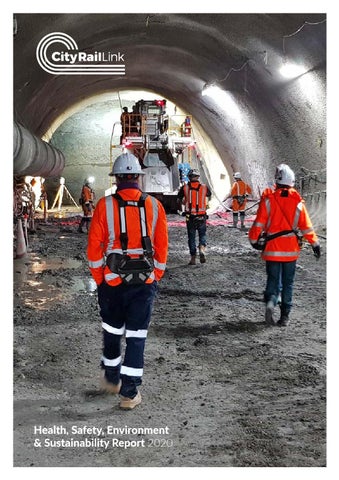
Health, Safety, Environment & Sustainability Report 2020
This report is printed with Atkinson Hyperlegible font developed to create greater legibility and readability for low vision readers. The font can be downloaded for free from the Braille Institute website https://brailleinstitute.org/freefont
Members of the CRL Health. Safety, Environment and Sustainability team on a conservation volunteering day
Contents Foreword
2
Project overview
5
Contracts
6
Highlights from the year
8
Health & Safety
11
Safety in numbers 2020
13
Enhance the maturity of health & safety management systems
14
Support and embed safer working behaviours
16
Establish improved health & safety performance measurements
21
Enable continuous health & safety improvement
22
Environment
25
Environment in numbers 2020
27
Noise and vibration
28
Social impacts and business disruption
30
Air quality
32
Erosion and sediment control
33
Heritage and archaeology
34
Sustainability
39
Sustainability in numbers 2020
41
Reducing resource consumption: energy, materials and water
42
Zero waste to landfill
52
Social outcomes
58
Mana Whenua
66
Governance and reporting
70
Use of Te Reo Māori in this document: Our commitment to Te Reo Māori means that you will see the use of words and phrases in reo Māori throughout this document as normal practice. Some definitions: Aotearoa - New Zealand
Rangatahi - youth
Atua - ancestors with continuing influence, a god, supernatural being, deity
Tapu - a state that is sacred, prohibited, restricted, under atua protection
Kai - food
Tāmaki Makaurau - Auckland
Karakia - words that are chanted to obtain benefit or avert trouble - incantations to invoke spiritual guidance and protection
Te Ao Māori - the Māori world view
Ngahere - forest
Whānau - all families
Pepeha - a way of introducing yourself in Māori
Whakanoa - to remove tapu
Te Reo Māori - the Māori language Māori mātauranga - Māori knowledge, wisdom, understanding, skill Tikanga - Māori practices and ways of doing things Mahi - work Waiata - song
FOREWORD CHIEF EXECUTIVE The unexpected challenge of managing the COVID-19 pandemic this year has failed to derail City Rail Link's (CRL's) determination to set demanding new standards for health, safety, sustainability, and environmental protection that others will follow. Expectations from our sponsors and others with a stake in CRL's outcomes are high and it is with pride that I can say that we have taken big steps to reinforce our objective to be an industry exemplar from day one. While COVID-19 cast a long shadow over the project in 2020, our progress has been excellent and there is much for us to celebrate and much that we can demonstrate to others. Put simply, I believe we have delivered in spades. For a start, CRL played a key role in industry and government planning to establish new health and safety protocols to keep workers safe in the COVID-19 world we now work in. Importantly, those protocols provided the foundation for a rapid restart of CRL construction after lockdown - a significant development not only for the project but for New Zealand's wider economy. Our successes throughout the year are many. Apart from the COVID-19 protocols, CRL is a Foundation Partner of Mates in Construction, the organisation educating workers to prevent a high level of suicides in the construction industry. We opened our specialist training and induction centre known as Te Manawa - the heart. It is an important and modern facility for the safety management and preparation of our teams as complex construction work on the tunnels and underground stations accelerates.
Mauri mahi, Mauri moni, Mauri ora Quality employment creates wealth, health and well-being City Rail Link Ltd (CRL Ltd) welcomed the decision by the Link Alliance to adopt its Progressive Employment Programme (PEP). The scheme, supported by Mana Whenua pastoral organisations, is designed to provide infrastructure-related training, support and job opportunities for rangatahi. The PEP has important social outcomes for CRL, but its long-term legacy benefits the wider industry. It is important to recognise CRL's Ltd partnership with Mana Whenua and the value it brings. Our partnership has strengthened during the year. In addition to adding diverse breadth to the project, our relationship with Tāmaki Makaurau Iwi is also reflected internally with a better understanding of Te Ao Māori. I take great pride in the fact that our Tunnel Boring Machine (TBM) has been honoured with the name Dame Whina Cooper - a woman I believe was a great champion of Māori and of Aotearoa.
2
City Rail Link Limited | Health, Safety, Environment & Sustainability Report 2020
FOREWORD
During the year, we were able to give Aucklanders a glimpse of CRL's sustainable future. The central city's newest public open space - Te Komititanga with its striking Mana Whenua designs and narratives - opened in front of the Chief Post Office (CPO) and the Britomart Station. Nearby, tunnel construction was completed at the lower end of Albert Street - again, leaving an attractive central city destination for people - with wider pavements, new street furniture, lighting, and trees.
The Link Alliance has taken the sustainability learnings from our early works partners and is raising the bar again in sustainability outcomes while it builds the main stations and tunnels.
HEALTH & SAFETY
I want to acknowledge some outstanding sustainability work by two of our construction partners - Connectus (McConnell Dowell & Downer Joint Venture) in Albert Street and the Downer Soletanche Bachy Joint Venture (DSBJV) in the Britomart/Lower Queen Street area. Both are close to being awarded Infrastructure Sustainability Council of Australia (ISCA) ratings that reflect the quality of their 'As built' and construction work. ISCA ratings are important drivers for CRL Ltd in terms of meeting our sustainability objectives.
Contractors are able to demonstrate at all our sites their commitment to being the best neighbours possible when it comes to reducing our impact on the environment.
ENVIRONMENT
Half of all landfill waste in New Zealand comes from construction sites, and with an aspirational zero waste target and 95 per cent of the project's waste diverted from landfill to date, CRL is doing its bit. Construction staples like concrete and steel are reused or recycled. Salvaged items removed from demolished buildings, once destined for the tip, are used again in an Auckland church or a school in far-off Tonga. We are reducing our demands on Auckland's precious water supply with the installation of our own water recycling plants. Importantly, we aim to keep neighbours informed so they can plan for our big programmes of work - at the same time adopting measures to manage dust, noise and light pollution.
Dr Sean Sweeney Chief Executive Officer 3
SUSTAINABILITY
CRL Ltd's challenge for a year ahead that's dominated by heavy tunnel and station construction is to build on our latest successes. With the support of our contracting partners we are determined to deliver the very best health, safety, environmental and sustainability outcomes not just for the project but for wider Tāmaki Makaurau as well.
CRL workers in the Albert Street tunnels 4
City Rail Link Limited | Health, Safety, Environment & Sustainability Report 2020
PROJECT OVERVIEW
Continues to Eastern Line
Parnell Station
Newmarket Station Redeveloped Britomart Station Grafton Station
New Aotea Station
Continues to Southern and Onehunga Lines
New Karangahape Station CRL/Underground Track
Redeveloped Mt Eden Station
Existing Track New/Redeveloped CRL Stations Continues to Western Line
Existing Stations
HEALTH & SAFETY
Project overview From the outset CRL Ltd has been determined to deliver an exemplar project. We are using the scale and complexity of the country's largest transport infrastructure enterprise to push the benchmark higher for construction, workplace safety, environmental sustainability and the reach into the community to provide opportunities for those typically disadvantaged in the workplace.
The gains from building a railway tunnel and stations below central Tāmaki Makaurau are immense.
Importantly, providing a world standard rail network will reduce Auckland's reliance on cars. When CRL is built, the number of people within 30 minutes by train from central Auckland - New Zealand's biggest employment hub - will double.
The capacity of Auckland's rail network will also double. At peak times, up to 54,000 people will come and go from the new CRL stations - that's the equivalent to another 16 lanes of motorway or three more Auckland Harbour Bridges. Train services will be more frequent and there will be significant savings in travel times. CRL will be the catalyst for extensive residential and commercial development, providing opportunities for people to work and live close to rail stations. A number of projects are underway or planned along the CRL route for new homes, places of employment, and spaces for communities to enjoy. CRL Ltd continues to work closely with Mana Whenua to design stations and open spaces that are unique to Auckland and reflect the city's cultural heritage.
5
SUSTAINABILITY
Linking the existing dead-end Britomart Station in downtown Auckland with the Western Line 3.45 kilometres away at Mt Eden and building two new train stations at Aotea and Karangahape will make the city's electrified rail network more efficient and catching a train a more attractive and sustainable travel option.
ENVIRONMENT
The $4.4 billion CRL will provide a world-class rail service for Auckland that also sets a new standard for social benefits that will have profound and longlasting benefits for the city.
Mt Eden Station
Britomart Station
Queen Street
Aotea Station
Karangahape Station
Under Construction:
Contract 1 - Britomart Station/Lower Queen St
Contract 3 - Alliance:
Stations and Tunnels Western Line connection/NAL --- Rail Systems
Contract 9 - Britomart East Contract 8 - Wider network improvements (not shown):
• Strand (completed) • Ōtāhuhu (completed) • Newmarket
Completed:
Downtown Shopping Centre (DSC) Contract 2 - Albert St (Customs to Wyndham St) Contract 6 - Mt Eden Stormwater Main
Contracts The CRL project has been divided into a number of delivery contracts. Some have been completed, others are underway, and some are planned.
Contract 1 - Britomart Station/Lower Queen Street Contract 3 - main tunnel, stations, Western Delivered by Downer Soletanche Bachy Joint
Line connection and rail systems
Venture (DSBJV)
Delivered by the Link Alliance (Vinci Construction
Construction of CRL tunnels from Britomart under Lower Queen Street is finished and refurbishment of the CPO heritage building that is part of the station will be completed in April 2021. Lower Queen Street has been converted into a people-friendly square known as Te Komititanga, and the Contract 1 portion of streetscape enhancement on Tyler and Galway streets will be completed in April 2021.
Contract 2 - the lower end of Albert Street between Customs and Wyndham streets
Delivered by Connectus - a McConnell Dowell and Downer Joint Venture
Contract 2 was completed in October 2020. The contract included 350 metres of trenching and tunnelling from Commercial Bay at Customs Street to Wyndham Street, relocating a stormwater main, strengthening the Ōrākei Main Sewer and improvements at street level that included new street furniture and lighting, trees and bus bays.
6
Grands Projets SAS, Downer, Soletanche Bachy, WSP, AECOM, Tonkin+Taylor and CRL Ltd)
The Link Alliance will excavate tunnels on Albert Street from just south of Wyndham Street to the Western Line at Mt Eden, build two underground stations (Aotea and Karangahape) and redevelop Mt Eden Station (original Contract 3 works). Connection of tunnels to the existing live rail corridor environment and line-wide systems, rail systems integration and testing and commissioning from Britomart Station to Mt Eden Station will also be delivered by the Link Alliance (original Contract 5 and Contract 7 works, now incorporated into Contract 3).
• Aotea - Temporary removal of Albert Street's historic bluestone wall is underway, relocating underground utilities continues, construction of D or diaphragm walls for the station continues, installing bored piles for station and tunnels in Albert Street is underway.
City Rail Link Limited | Health, Safety, Environment & Sustainability Report 2020
PROJECT OVERVIEW HEALTH & SAFETY
Artist's impression of Aotea Station's Wellesley Street entrance
• Karangahape - In Mercury Lane, a sound-proof
Contract 8 - Wider network improvements
Contract 8 involves additional platforms and turn-back facilities at The Strand, Ōtāhuhu and Newmarket. Works at Ōtāhuhu Station were completed in September 2020 and included a new 1.3 kilometre long section of track alongside the main line, a new platform, four new cross-overs, new overhead line and signalling equipment.
• Mt Eden - Re-assembly of the TBM - Dame Whina Cooper - continues on site, mining of the first 51 metres of tunnel at the southern portal is underway. This will provide room to accommodate the TBM before it starts its excavations, scheduled for April 2021.
• Mt Eden North Auckland Line (NAL) - Heavy civil work is underway to prepare for the connection of the CRL to the existing NAL, stage one of the Mt Eden Road bridge is underway.
Delivered by KiwiRail and Libbet Ltd
ENVIRONMENT
noise enclosure to reduce construction impact on neighbours has been erected with mining underway. At Beresford Square, permanent work has started on installing D walls for the station entrance/exits.
Contract 9 - eastern end of Britomart Station
Delivered by KiwiRail
Works involve track realignment, and changes to some walls and station access required to accommodate nine-car trains. SUSTAINABILITY
7
HIGHLIGHTS FROM THE YEAR
MARCH JANUARY KiwiRail safely completed 24hour shifts during a Block of Line over the Christmas period. In Mt Eden they prepared the NAL so that a single rail line could run from July 2020.
2020
8
CRL Ltd contributed to the development of panconstruction industry COVID-19 health and safety (H&S) protocols. These supported a safe and successful restart of construction across CRL sites after COVID-19 Alert Level 4 was lifted.
FEBRUARY The last strut was safely removed from Albert Street as part of Contract 2 works. This marked the end of 18-months of high-risk activity successfully completed without incident.
MAY The Link Alliance installed the first water treatment plant at Mercury Lane. These have now been rolled out at all Link Alliance sites.
City Rail Link Limited | Health, Safety, Environment & Sustainability Report 2020
JUNE The first independent annual review of safety maturity for the project was conducted using the Risk Management Maturity Model (RM3).
JULY Six rangatahi joined Link Alliance's Progressive Employment Programme.
AT A GLANCE
SEPTEMBER The CRL project's health, safety, environment and sustainability team completed a volunteer day at Tararata Stream in Māngere. Together they cleared around 500kg of rubbish and invasive weeds.
NOVEMBER CRL Ltd's Progressive Employment
HEALTH & SAFETY
Programme was a finalist for the Social Impact Award at the ReBuilding Nations Conference.
AUGUST Contract 8 Ōtāhuhu Station works were successfully completed with a leading safety record.
The CRL project celebrated the first 'Mahia te mahi' Health & Safety engagement week.
OCTOBER
DEC DE CEMBER Te Komititanga downtown's newest civic square - opened after four years of construction. The square's name was gifted by Mana Whenua, and its designs were created by Mana Whenua artists and weavers.
ENVIRONMENT
Te Manawa - the Link Alliance's training centre - opened. Over 200 people completed a H&S induction in the first month.
The project marked NZ Recycle week with help from animated character, Michael Recycle. The team gave recycling demonstrations and played an extremely competitive recycling game.
SUSTAINABILITY
9
Construction to build a redeveloped station and new CRL tunnels is underway at Mt Eden 10
City Rail Link Limited | Health, Safety, Environment & Sustainability Report 2020
Health & Safety CRL Ltd aspires to health & safety (H&S) excellence in everything we do. This is an ambitious and challenging goal, and one which requires continued effort and focus from all those involved in CRL to achieve it. CRL Ltd's Health & Safety Strategy 2019-21 sets out our vision 'Mahia te mahi, hei painga hei oranga mo tātou katoa - To do the work for the good of everyone'. To achieve this vision, four strategic priorities have been identified:
• • • •
enhance the maturity of the H&S management system support and embed safer working behaviours establish improved H&S performance measurement enable continuous H&S improvement.
This report provides a summary of progress across each of these areas, using examples to illustrate how that work has lifted safety standards on the project. The Link Alliance is the main construction partner for CRL and has established a strong health and safety culture and framework to achieve CRL Ltd's legal requirements. A significant milestone in 2020 was the opening of Te Manawa, the Link Alliance's safety training and visitor information centre. Thousands of workers will attend this centre and receive a project induction, behavioural safety training and practical experiences of common site hazards using purpose-built hands-on training modules. Using this facility, Link Alliance has invested heavily in training for their teams during the year, including incident management and crisis preparedness. With the arrival of the TBM, the focus has been on ensuring these teams have all the correct competencies to manage their works safely. This is vitally important: individuals working underground face particular dangers. The training these teams receive at Te Manawa ensures, amongst other things, that they are familiar with procedures and equipment necessary to escape from the tunnel in the event of fire or smoke. CRL Ltd continues to monitor and support the delivery of safety excellence across the project. Part of this involves frequent visits to site, engagement with workers and front-line supervisors, and highlighting both good and poor practice where it is seen. CRL Ltd is grateful to our construction partners for their commitment to achieving our health and safety goals. 11
Weekly safety inspection at the Link Alliance's Aotea site 12
City Rail Link Limited | Health, Safety, Environment & Sustainability Report 2020
OVERVIEW
SAFETY IN NUMBERS 2020
3,202,603 450
HEALTH & SAFETY
hours worked
safety toolbox talks delivered
576
site safety inspections completed
2,957
safety improvement suggestions or observations received
workers inducted onto the CRL project
187
heavy goods vehicle safety checks conducted
health & wellbeing events held
152
ENVIRONMENT
6,832
68
safety leadership tours conducted
588
drug & alcohol monitoring tests completed SUSTAINABILITY
*Data for January to December 2020 13
Construction workers at the Aotea Station site
Enhance the maturity of health & safety management systems
Risk Management Maturity Model A H&S management system provides the framework to enable consistent and predictable H&S performance. It includes defined methods to keep people safe and a means for managing significant risks. CRL is the first project in New Zealand to adopt the United Kingdom's Risk Management Maturity Model (RM3) to assess its H&S management systems. RM3 was selected because of its innovative approach, one with built-in mechanisms to continue pushing the envelope, and continued opportunity to learn and seek improvement in how H&S outcomes are delivered. Under RM3 the project will continue to review and improve its H&S systems while delivering welldefined, consistent and replicable outcomes that
14
can be externally verified. We want our people to know what the expected outcomes are, what they are responsible for, and to work together to continue achieving H&S excellence with no gaps, overlap or duplication. All of CRL's construction partners now complete an annual RM3 assessment. This provides a common platform to identify safety improvements, and to drive excellent H&S outcomes.
City Rail Link Limited | Health, Safety, Environment & Sustainability Report 2020
and control of contractors, and where further improvements can be made for the maturity of safety management systems, such as emergency planning, competence management and incident investigation.
OVERVIEW
The project's first annual independent RM3 assessment involved CRL Ltd and its construction partners, the Link Alliance, DSBJV and Connectus. The assessment included interviews, reviews of safety plans and procedures, and on-site observations.
CRL Ltd and its construction partners developed a targeted 12-month improvement programme based on the assessment's findings. The next assessment will be in June 2021 and will review progress.
The project achieved an average of 'Standardised'. This means that 'good practice has been synthesised into standard processes'. The RM3 assessment identified areas of strength, for example governance, organisational structure
What is RM3? HEALTH & SAFETY
RM3 has been used successfully for many years by the United Kingdom railway safety regulator to assess the capability of a H&S management system. It uses 26 individual H&S indicators to measure whether a system is highly functioning.
Assessment is made against five maturity levels for each H&S indicator. They range from 'adhoc' through to 'excellent'. The results can be used to objectively identify management strengths and weaknesses, and to support focused improvements. H&S indicators Leadership Health and safety policy Board governance Written Safety Management System Allocation of responsibilities 6 Management and supervision accountability 7 Organisational structure 8 Internal communication arrangements 9 System safety and interface arrangements 10 Organisational culture 11 Record keeping, documentation, control and knowledge management 12 Worker involvement and internal co-operation 13 Competence management system 14 Risk assessment and management 15 Objective/target setting 16 Workload planning 17 Safe systems of work 18 Management of assets construction assets 19 Change management 20 Control of contractors/suppliers 21 Emergency planning 22 Proactive monitoring arrangements 23 Audit 24 Incident investigation 25 Management review 26 Corrective action
M on
1
ito
g, rin
d au
it a
nd
ie rev
w
Healt h an d and safety boa p rd olic y go ve , lea rna d nc ers hi e p
5.0
1
4.0
3
2
26
25
5
4
2.0
24 23
6
1.0
7
21 0
8 19
9 10
18 17
13
16
12
11
14
mu nic ati on
trols con ements risk rang ng nt ar i t e n me gem ple na im ma d d an ate n
20
Organising for comfort and com
22
15
thr o Pl u gh ann co ing or di
Weighted average of CRL Ltd and its construction partners' RM3 results
SUSTAINABILITY
t ion erat opmen coop l Securing nd deve evels a l e l l c n a e t compet ees a of employ
ENVIRONMENT
3.0
3 4 5 2
15
Link Alliance workers at Aotea Station site
Support and embed safer working behaviours
To support robust H&S processes, it is vital that everyone working on the project understands expected safety behaviours. Over the past year, CRL Ltd and its construction partners have developed and promoted a number of initiatives to better understand and influence safe working behaviours. This has been a collaborative approach involving the project's supply chain and WorkSafe, and has included increased training, mentoring, and developing a thorough safety induction programme.
and the wider community safe - contributions which also had to recognise the scale and complexity of CRL operations and the international organisational structure of the Link Alliance. The project is on track to meet behavioural targets set in the CRL Health & Safety Strategy.
It is fair to say that COVID-19 brought immense challenges during the year. The project is extremely proud of its team for its contributions to keep workers
16
City Rail Link Limited | Health, Safety, Environment & Sustainability Report 2020
OVERVIEW
Construction workers follow COVID-19 protocols at Mt Eden
HEALTH & SAFETY
Case Study
Managing the impacts of COVID-19 in construction Led by the Construction Accord group, CRL Ltd and a team of wider industry representatives worked with Construction Health & Safety New Zealand to develop stringent COVID-19 H&S protocols.
The protocols have allowed construction work to safely continue under New Zealand's COVID-19 alert levels. The protocols were comprehensive and could be used consistently across different construction sites. As well, they gave clarity to regulators and other agencies about how the industry sector managed work during COVID-19 alert levels.
COVID-19 protocols in place at the Mt Eden site
Mobile Plant Hygiene
SUSTAINABILITY
In addition to protecting workers' physical health on-site, significant effort was placed on supporting their mental health and wellbeing. This was particularly important as many of the team - from overseas and other parts of Aotearoa - were separated from their whänau and friends. Support was provided through regular online discussions, sharing personal strategies for staying connected, internal newsletters and active promotion of the Employee Assistance Programme and mental health support networks.
ENVIRONMENT
All CRL construction stopped during the Alert Level 4 lockdown in April. However, design and planning work was able to continue during this five-week period, giving the project time to develop protocols, revise construction programmes, and plan for a safe and successful construction restart. Protocols emphasised health monitoring, physical distancing, enhanced cleaning and additional personal protective equipment (PPE).
DISINFECTANT
• Operators are to sanitise controls on commencement of operation. • Operators must ensure plant and equipment is cleaned regularly. Internal windows, door handles, handrails, steering wheels, control levers, buttons, computers are cleaned regularly with disinfectant and cloths provided. • Where possible, operators should not alternate between different items of plant.
Protocols were implemented on-site to ensure mobile plant users' safety
LA0048_24.04.20
17
Workers attend a H&S induction at Te Manawa
Case Study
Behavioural safety training The Link Alliance's induction to main works is the first experience for workers joining the CRL team. The induction is designed to communicate the project's values and objectives, and what workers can expect when they arrive on-site. An integral part of the induction is concentrated on safety outcomes. It includes an interactive Behavioural Safety module which focuses on how workers can respond positively when potentially unsafe situations occur by illustrating where work conditions or activities might deviate from what was originally planned. Short snippets were filmed during which professional actors played out specific scenes leading up to a significant near miss event.
18
During the induction, inductees are put into teams to discuss how they would react in each situation. The induction facilitator then uses those discussions to reinforce the Link Alliance's 'Golden Actions', which are the core behavioural attributes promoted and encouraged across all its worksites. Positive induction feedback indicated the safety training was an engaging and memorable way to bring to life behavioural principles on-site, and that the scenarios used in the exercise are realistic.
City Rail Link Limited | Health, Safety, Environment & Sustainability Report 2020
Case Study Exclusion lighting on plant An exclusion zone around operational plant is a common control measure to help keep people and plant safe. To further improve this control, Contract 2 contractor, Connectus, added exclusion zone lighting on its road-based plant. This simple but effective mechanism provided an immediate visual demarcation to both a vehicle's driver and other workers near the exclusion zone, thus reinforcing safer worker behaviour. This technology is now being deployed by the Link Alliance on operating plant within Karangahape Station's mined tunnels.
Exclusion lighting used while mining tunnels at Karangahape Station. These tunnels will become the station's permanent passenger platforms.
Ōtāhuhu Station 20
City Rail Link Limited | Health, Safety, Environment & Sustainability Report 2020
OVERVIEW HEALTH & SAFETY
Toolbox talk prior to a working shift starting at the Aotea Station site
Establish improved health & safety performance measurements
ENVIRONMENT
Health & Safety Performance Index CRL Ltd monitors 26 individual H&S performance indicators which cover all activities from design through to commissioning that are critical for the project to effectively manage potential H&S risks.
to stakeholders as well as to workers and site team leaders. CRL Ltd and its construction partners have met and exceeded the monthly performance target index of 80 during the year.
Proactive or 'leading' indicators, like heavy goods vehicle safety checks, are also recorded along with reactive or 'lagging' measures such as near misses. Monitoring creates a detailed and accurate picture of the project's H&S performance.
CRL Ltd also tracks injury frequency rates such as the Total Recordable Injury Frequency Rate (TRIFR) for external benchmarking purposes.
The HSPI has produced an accurate picture of H&S performance which can be easily communicated
Period Performance
84 80 76
SUSTAINABILITY
To manage the large amounts of H&S data and identify key trends, CRL Ltd developed a H&S Performance Index (HSPI). The HSPI categorises each indicator against the H&S management system and assigns weighting based on how critical that activity is for the management of risk. A score is then produced that illustrates how well the project has performed against pre-determined targets.
HSPI Monthly Performance 2020
83.2 1
2
3
4
5
6
7
8
9
10
11
12
Target for each period is 80 21
Worker at Aotea Station's Mayoral Drive site
Enable continuous health & safety improvement
As the largest ever transport infrastructure project in New Zealand, CRL has an opportunity to set the bar as a leader in H&S performance. The project continues to identify and adopt safety improvements and to share its learnings with the wider construction industry.
Case Study
Mahia te Mahi Health & Safety engagement week Great H&S performance in the construction industry comes from doing simple things right every day. The project works hard to eliminate everyday pressures and distractions that can sometimes result in mistakes. To reenergise the team's commitment to our H&S vision, CRL Ltd and the Link Alliance ran a series of events during its first Mahia te Mahi H&S Engagement Week in October. Mahia te Mahi week included quizzes and toolbox talks, visits and tours by management, as well as a photo competition to capture workers following 'Golden Actions'. A review of selected high-risk activities was completed to identify any differences between work as planned against work as done. During the week, workers were filmed talking about why safety is important to them and their whänau
22
and describing the simple things they do each day to keep themselves and their workmates safe. The week ended with a project-wide stand down to show the film, share kai and celebrate the best photos taken on-site.
Health & Safety Week
Health & Safety Week 5–9 OCTOBER 2020
Photo Competition
5–9 OCTOBER 2020
‘I am aware of major risks for keeping safe and getting home to my family’
Do you know your Golden Actions? Look out for a programme of events on your site during the week.
01
Plant & People Keep clear of the gear
02
Planning
03
Operations
04
Fit for Work
Plan the work
Look out for individuals or teams displaying the golden actions Please email your photos to safety@linkalliance.co.nz and include your name, the individual or work group involved, the work location & the golden action observed. You can also send pictures by text message to: 021 942 604
Work the plan
Prizes and giveaways up for grabs!
We’ve got this Entries close 5pm Thursday 8 October Prizes will be given out on Friday 9 October
City Rail Link Limited | Health, Safety, Environment & Sustainability Report 2020
OVERVIEW HEALTH & SAFETY
Mates in Construction 'Fly the Flag' week held in September
Case Study ENVIRONMENT
Mates in Construction
CRL Ltd became a foundation partner of the New Zealand chapter of Mates in Construction in early 2020. This year over 600 CRL workers were inducted into the Mates programme which encouraged more openness about mental health
so that they could support themselves and others. Link Alliance construction sites have a number of 'Connectors' - individuals who have received additional training and can help access specialist help for their workmates. CRL Mates in Construction Field Officer 'B' Peleti is a regular at toolbox talks and pre-start meetings across the project's construction sites. In line with trends across the wider construction industry, increased positive education has seen an increase in the number of workers seeking support.
SUSTAINABILITY
Mates in Construction is a charitable organisation that partners with industry to address and reduce the disproportionately high rates of suicide in construction workers. CRL Ltd partnered with Mates in Construction to ensure that resources are in place to support anyone with mental health issues. CRL also works towards building and strengthening workplace communities, helping workers be more supportive of their mates and developing a wellbeing environment.
23
Chief Post Office 24
City Rail Link Limited | Health, Safety, Environment & Sustainability Report 2020
Environment
The CRL project is committed to meeting its compliance obligations and taking responsibility for preventing and managing risks to the environment and communities. CRL Ltd and its construction partners work to comply with more than 500 separate conditions relating to eight designations and numerous resource consents from Auckland Council. It must also comply with archaeological authorities obtained from Heritage New Zealand. The conditions provide the parameters and limits of effects that CRL construction and operation can have on the project's surrounding environment and communities. A number of Management Plans are then developed which set out the actions that the project will take to meet requirements and achieve environmental compliance. These plans provide detail on the practices and procedures to be followed, and provide a comprehensive framework to manage adverse effects on the environment including:
• noise and vibration • traffic access and parking • social impacts and business disruption, and • discharges to air, land and water. Monitoring is a massive part of the team's work on environmental compliance. If the project exceeds limits, changes to practices and procedures are made as quickly as possible. There are a large number of fixed monitors in place around construction sites. They measure air and water quality, noise, vibration, ground settlement and groundwater levels in real time 24 hours a day, seven days a week. The monitoring network is complemented with targeted site or activity-based inspections that occur daily, weekly and monthly.
25
Tōtara planted on Albert Street as part of the upgraded streetscape
OVERVIEW
ENVIRONMENT IN NUMBERS 2020
ground and building movement monitoring points installed
18
noise and vibration monitors installed
blocks
carefully removed from the bluestone wall and stored off-site for future reinstatement
66
environmental management plans approved
environmental site inspections completed
9
air quality monitors installed
6
water treatment plants installed ENVIRONMENT
564
211
HEALTH & SAFETY
1314
>30
stormwater catch pits protected
134
piezometers installed SUSTAINABILITY
*Data for January to December 2020 27
Acoustic shed while under construction at Karangahape Station's Mercury Lane site
Noise and vibration
Building in close proximity to business and residential neighbours means that extra care is taken to reduce noise and vibration impacts.
Noise and vibration monitors have been set up at the most exposed locations, or close to the most sensitive receivers which include residential accommodation, childcare centres, and community facilities. Older buildings - including heritage buildings - where excessive vibration could cause damage, also undergo condition surveys before and after construction. Vibration sensors are so sensitive that Contract 2's picked up the 2016 Kaikōura earthquake. At the Karangahape Mercury Lane site, an insulated enclosure was built to minimise worksite noise impacts on neighbours - it resembles an aircraft hangar and works a little like a car muffler. The 45 metre by 30 metre shed was built over the site's 22 metre deep temporary access shaft that provides underground access for all plant and people. The noise protection 28
means that the team can work 24 hours a day, seven days a week. At the Mt Eden site, controlled explosions were required to break up basalt. Strict noise and vibration protocols ensured the impact on neighbours was kept to a minimum. The protocols included a 'no surprises' timetable for blasting that was shared widely to keep neighbours informed. Blasting mats were also placed over the charge site to minimise rising dust and prevent fragments of flying rock. 10.00 9.00
< Kaikōura earthquake
8.00 7.00 6.00 5.00 4.00 3.00 2.00 1.00 0.00 21:35 21:51 22:07 22:23 22:39 22:55 23:11 23:27 23:43 23:59 0:15 0:31 0:47 1:03 1:19 1:35 1:51 2:07 2:23 2:39 2:55 3:11 3:27 3:43 3:59 4:15 4:31 4:47 5:03 5:19 5:35 5:51 6:07 6:23 6:39 6:55 7:11 7:27 7:43 7:59 8:15 8:31 8:47 9:03 9:19 9:35 9:51 10:07
Noise and vibration can be caused by a number of construction activities, such as concrete cutting or breaking, hydro-excavation, piling, drilling and compacting. The team mitigates impacts by carefully selecting plant and equipment, using noise barriers and carefully scheduling noisy works.
Kaikōura earthquake recorded on a vibration sensor on Albert Street
City Rail Link Limited | Health, Safety, Environment & Sustainability Report 2020
Noise and vibration monitoring There are 18 noise and vibration monitors installed across Link Alliance sites. Data from monitoring equipment is accessed remotely and if pre-set levels are exceeded, the team is instantly alerted. Monitoring data helps to identify noise and vibration sources and informs construction methodology, mitigation opportunities and communication with neighbours. Vibration data is also carefully monitored to reduce the risk of building damage. As well as the continuous monitoring that occurs on all sites, the team also completes targeted activity-based monitoring if a complaint is made about noise or vibrations.
Link Alliance Environmental Advisor undertaking attended noise monitoring 29
Artist Paul Walsh, putting the final touches on the Karangahape Station's Canada Street hoardings
Social impacts and business disruption
CRL Ltd and its construction partners are committed to helping neighbours maintain 'business-as-usual' as much as possible by reducing construction impacts such as disruption to traffic and access, and maintaining customer access and amenity around sites as much as practicable. Construction methodology that is as least impactful as possible is chosen and conditions are monitored for compliance. The team also work to investigate and take action on complaints and choose times for works that are least disruptive to surrounding communities. Neighbours and stakeholders are communicated with in a timely manner and regular meetings and information sessions are held. Wayfinding, business promotion signage and activations are also developed to encourage people to come to the area and keep them safe as they move around. With the Link Alliance's increased activities on its construction sites, a huge number of hoardings were erected this year. These include Perspex glass wherever possible, to allow views of construction, and colourful attractive designs. To help celebrate Artweek Auckland, the Link Alliance collaborated with local artists to create beautiful, bespoke hoardings and delivered a number of walking art tours. Monthly site tours and weekly infohubs have been hugely popular, however the Boring Day Out was by far, the biggest CRL event of the year. Over 5,000 people booked tickets to look at the project's mechanical star - the Dame Whina Cooper TBM - and view the Mt Eden construction site first-hand.
30
Little Albert - a mobile coffee cart had been located in an area required for Aotea Station construction. The Link Alliance found a new home for Little Albert a block away, and even helped the owner move in.
City Rail Link Limited | Health, Safety, Environment & Sustainability Report 2020
Some 5,000 tickets to the Boring Day Out were snapped up by the public 31
The demolition of buildings at the Mt Eden site to make room for the tunnel portal
Air quality
The project monitors and manages the impacts that building demolition, concrete cutting and other construction related activities can have on air quality Visual inspections of dust are undertaken regularly to ensure mitigation techniques are working effectively with additional continuous monitoring implemented on-site. Early on in the project, Contracts 1 and 2 switched from diesel generators to grid-connected transformers. This not only reduced GHG emissions, it also made the air cleaner by reducing diesel particulates. Link Alliance has also been working to do the same and now have grid-connected transformers at all their sites.
32
Managing dust emissions while construction is underway can be challenging, particularly during dry, windy conditions. The team suppresses dust by spraying it with water. Hoardings and semi-permeable scrim are also erected around construction sites to manage dust.
City Rail Link Limited | Health, Safety, Environment & Sustainability Report 2020
OVERVIEW
Water treatment plant at Mt Eden site
Erosion and sediment control HEALTH & SAFETY
In order to protect surrounding waterways, systems to manage erosion and sediment have been established on all CRL construction sites. This includes soil characteristic assessments, and establishing flocculation and sediment control systems. Water treatment at Link Alliance
The major difference between Link Alliance's WTPs and those on other projects, is that they have been set up so that water, once treated, can be reused on-site. This helps ease the pressure on Auckland's water infrastructure.
Left: Influent - Site water prior to entering WTP Centre: Flocculated - Introducing flocculants Right: Discharged water leaving the WTP
SUSTAINABILITY
Recycled water from the Mt Eden and NAL sites is used for general activities such as soil mixing, cleaning and dust control. To date, no water has been discharged from the NAL site, and in recent months recycled water makes up approximately 20 per cent of Mt Eden's entire water use. At Aotea, the team has now started collecting rainwater from roof areas for reuse. The Link Alliance will continue to ramp up water recycling across all its sites as WTPs are established.
ENVIRONMENT
Six water treatment plants were installed and commissioned across all Link Alliance sites in 2020. Water treatment plants (WTPs) ensure that site rainwater and ground water are free of sediments and any other potential pollutants, before being discharged into the stormwater network.
The systems that control WTPs are also being updated to include online monitoring to automatically adjust pH, measure flows and allow remote access and control.
33
Ceiling at CPO building
Heritage and archaeology
The project is committed to preserving and protecting culture, heritage and local character while we build the CRL. This includes the protection of historic buildings as well as respecting and recording archaeological discoveries.
Archaeological discoveries at Britomart Station and Lower Queen Street As Contract 1 nears completion, we reflect on the artefacts and relics that have been unearthed within the site's relatively small construction footprint. The site which includes Britomart Station and Lower Queen Street is on land reclaimed during the mid1800s, with household rubbish and building debris added along with fill during the reclamation process. This has meant that tunnel excavation has been a unique opportunity for contractor DSBJV to discover remnants from the city's history.
Because the old wharf's timber was in surprisingly good condition it will become part of the final designs for the renovated Britomart Station. Some will be transformed into bench seating, while other piles will remain as they are and form part of an archaeological display in the station. The tapered points of the piles, which had been chiselled with an axe, will be visible - demonstrating the craftsmanship of the time.
A number of beautiful glass and clay bottles have been recovered. These, together with other salvaged items, will be displayed at the renovated Britomart Station. It hasn't only been household items discovered - the DSBJV team also uncovered the remains of the very first Queen Street Wharf built in the 1800s. Wharf piles, wharf fenders and basalt blocks from the original wharf breastwork were found together with timber and basalt blocks.
Glass bottles recovered during excavation within reclaimed land at the Contract 1 site. 34
City Rail Link Limited | Health, Safety, Environment & Sustainability Report 2020
OVERVIEW HEALTH & SAFETY
Old Customs Street bluestone seawall
Bluestone seawall discovery
Stormwater brick barrel discovery
While excavating Lower Queen Street, the team uncovered the old Customs Street bluestone seawall that dates back to circa 1860.
DSBJV first discovered the Queen Street brick barrel drain during piling works in March 2018. Since then, multiple sections of the drain that runs in a northsouth direction down the centre of Lower Queen Street have been revealed.
The discovery was recorded in line with Heritage New Zealand requirements and the seawall will remain in place.
SUSTAINABILITY
Queen Street Wharf was built in Horotiu Bay in 1852 after it was identified as the most appropriate location for transferring goods and settlers from ship to shore. Horotiu Bay was then given its European name - Commercial Bay. Reclamation work began and by 1859 was being progressed between Fort and Customs Streets. By 1870 the reclamation of Horotiu Bay reached as far as Customs Street East. In the 1880s, Quay Street was formed and the former timber Queen Street Wharf no longer existed.
ENVIRONMENT
Commercial Bay and Shortland Street in 1841 (Image: Sir George Grey Special Collections, Auckland Libraries, 4-9089)
Construction to upgrade and relocate services prior to reinstating the Lower Queen Street area has included connecting new stormwater lines to the existing brick barrel drain.
35
Bluestone wall
Case Study
Bluestone wall deconstruction Work started in November to temporarily remove one of Auckland's most historic landmarks in order to make room for the project. The 139-year-old bluestone wall along the eastern side of Albert Street has been shifted block by block out of the way of CRL construction. The historic wall is built from local material - basalt, also known as bluestone - and was erected on the eastern side of Albert Street between Wyndham and Victoria streets in 1881.
When the wall is re-erected in 2023, it will have moved one metre further east - towards Queen Street - from its original location. This is due to the size of the tunnel and Aotea Station. The public toilet will not re-open, however the wrought iron railings and ornamental arch will be incorporated into a maintenance access entry required for the CRL.
The wall's underground public toilet was one of the city's first. The wrought iron railings, piers and the ornamental arch over the stairs on the side of the wall are some of Auckland's last remaining examples of street furniture dating back to the Victorian age. It will take three months to dismantle the wall. Stonemasons must cut it into 1,800 separate blocks, number each block and store them safely off-site until the wall can be rebuilt in 2023 as part of urban realm improvements - once the station tunnel box below has been built.
36
Careful deconstruction of bluestone wall underway
City Rail Link Limited | Health, Safety, Environment & Sustainability Report 2020
OVERVIEW HEALTH & SAFETY SUSTAINABILITY
Bluestone blocks numbered prior to dismantling 37
Demolished concrete is crushed at Mt Eden, ready for resuse 38
City Rail Link Limited | Health, Safety, Environment & Sustainability Report 2020
OVERVIEW
Sustainability
The project aims to achieve sustainability excellence by being careful with the resources we use, optimising our carbon footprint, avoiding waste and leaving a positive social and cultural legacy for Tāmaki Makaurau. HEALTH & SAFETY
CRL's Sustainability Strategy has five key focus areas:
• reducing resource consumption • zero waste to landfill • social outcomes • Mana Whenua outcomes • governance and reporting. A summary of progress across each of these areas is provided, using examples to illustrate how the project is working to create a new normal for delivering infrastructure sustainably.
ENVIRONMENT
The use of materials, energy and water is being optimised across the entire lifecycle of the project, from design through to construction and operation, and the project has an aspirational target of zero waste to landfill. CRL Ltd is also creating opportunities to contribute to society through the project delivery phase by maximising training and employment opportunities, creating greater diversity in the supply chain and upskilling the workforce. The project's sustainability performance is being externally verified using the ISCA rating tool, which has been adapted in partnership with Mana Whenua to respond to Aotearoa's unique cultural context.
39
Auckland's newest civic space outside the CPO, Te Komititanga
OVERVIEW
SUSTAINABILITY IN NUMBERS 2020
6 rangatahi
34,491
tonnes of waste
diverted from landfillº
13
tonnes
5 schools
of concrete consumed
ENVIRONMENT
joined the Schools Engagement Programme
3,393
963 m3
tonnes
of waste reused
of water reused on site
4%
of Link Alliance spend
have secured Link Alliance contracts
to Māori & Pasifika-owned sub-contractors & suppliers
SUSTAINABILITY
15
ISCA credits
being progressed with Mana Whenua
78,607
Māori & Pasifikaowned businesses
HEALTH & SAFETY
joined the Progressive Employment Programme
*Data for January to December 2020 ºexcludes 298,590 tonnes of spoil that has been diverted from landfill 41
Concrete pump at work at the Mt Eden portal
Reducing resource consumption: energy, materials and water
Once completed the CRL will be a low-carbon travel option for Aucklanders. However, it comes with a significant up-front carbon 'cost' to construct, both in energy related greenhouse gas (GHG) emissions and the embodied carbon of the materials used. Water is also required both during construction and to operate the CRL. The CRL project aims to use the least amount of resources possible during construction and over the infrastructure's 100-year lifetime through efficient design and construction methodology. To track the project's success, an estimate called the Base Case was first created for each construction package. This measures the total amount of energy, materials and water that would be used to build and operate the CRL if business-as-usual occurred without sustainability interventions.
the Base Case enables the project to quantify improvements in resource use. With construction well underway, the team can continue to measure progress to minimise resource use against detailed design projections. The completion of Contract 2 has enabled the project to reflect on the sustainability outcomes achieved on this package of works, and review how sustainability thinking was applied during design and construction.
A 'detailed design', which includes initiatives to reduce resource consumption, was then developed. The ability to compare the detailed design against 42
City Rail Link Limited | Health, Safety, Environment & Sustainability Report 2020
Energy
Contract 3 stations and tunnels
Greenhouse savings Projected GHG gas savings for for Aotea Station Operations per annum Aotea Station operations (per annum)
The Link Alliance has a target of reducing the emissions associated with running the CRL stations and tunnels by 25 per cent from a business-as-usual Base Case. This will largely be achieved through design of the mechanical and electrical systems.
641
2
124
600 46
tCO2e
500
10
459
400 300
HEALTH & SAFETY
To review efficiency, a projected operational energy footprint for each station's design is assessed against business-as-usual Base Case scenario. The first station to reach a sufficient level of design for this is Aotea. Aotea Station's current design is projected to enable a reduction in energy use of over 1,600,000 kilowatts per hour (kWh) per year or 182 tCO2e - a 28 per cent reduction that's equivalent to approximately 310 Auckland households' electricity use per year.
700
OVERVIEW
There is an energy-related footprint (measured in tonnes of carbon dioxide equivalent tCO2e) associated with construction and operational activities. Plant and equipment all require power and there is fuel associated with bringing materials to site and removing waste.
200 100 0 Base case Escalators
Lighting
Ventilation Mechanical Detailed design
This has been achieved by:
• Specifying speed control and passenger sensing on escalators, reducing their energy use by nine per cent and reducing the station's energy footprint by 0.3 per cent Ar tist 's im impression of of pr proposed Aot Aote ea Stat Statiion
• Planning a sensored lighting control system that
2,000 1,500 1,000 500
Base Case
Detailed Design
NOV '20
JUL '20
SEP '20
MAY '20
MAR '20
NOV '19
JAN '20
JUL '19
SEP '19
MAY '19
JAN '19
NOV '18
MAR '19
JUL '18
SEP '18
MAY '18
JAN '18
MAR '18
NOV '17
JUL '17
SEP '17
MAY '17
JAN '17
MAR '17
NOV '16
0 JUL '16
more accurate control of the smaller ventilation fans in the station, including heat recovery units to 'capture' the heat contained in air being ventilated outside. The mechanical load will be reduced by 10 per cent and the overall station footprint by 1.5 per cent.
2,500
SEPT '16
• Using electronically commutated fans that allow
Contract 1 energy related GHG emissions
SUSTAINABILITY
over-track exhaust fans that ventilate the station. This results in significant reductions in fan operational hours and running speeds, reducing energy use by just over half and accounting for a seven per cent overall reduction for the station
DSBJV continue to track their progress against original Base Case calculations. To date the most significant energy related GHG emission reductions during construction have come from replacing diesel generators with electricity sourced from the national grid.
tCO2e
• Including sensors that consistently adjust the large
Contract 1 Britomart Station and Lower Queen Street
ENVIRONMENT
adjusts illumination to the exact level required. Over-lighting will be eliminated and the automatic adjustments made will compensate for the age of the LED bulbs, which gradually reduce their output over time, and any daylight or feature lighting that enters the station. Sensored lighting reduces the lighting energy requirement by 45 per cent, and reduces the station's energy use by 19 per cent
Actual
43
Albert Street from Wyndham to Customs streets has been reinstated on top of 350 metres of underground tunnels and upgraded utilities
Case Study
Contract 2 Albert Street Construction which began in 2016 and was completed in October 2020, was delivered by Connectus. The completion of works means that we are now in a position to reflect on the outcomes of applying sustainability thinking into its design and construction. Contract 2 outcomes are being used to obtain ISCA 'As built' certification. Construction figures provided are actual measured values, whilst operational figures are projected based on the final built design.
achieved by replacing diesel generators with grid electricity and using larger truck and trailer units for spoil haulage to reduce vehicle trips. Replacing high pressure sodium lights with modern LED streetlights is projected to save 15 per cent of energy-related GHG emissions over the 100-year life of the CRL asset built by Connectus.
Energy related GHG emissions (scope 1, 2 and 3)
Energy
Improved construction methodology reduced construction energy-related GHG emissions by 19 per cent. The most significant GHG savings were
23%
3,500
saving
3,000 2,500
tCO2e
Overall, Contract 2 achieved a 23 per cent reduction in GHG emissions (4,008kWh) for both the construction and operational energyrelated GHG emissions over CRL's 100-year life. This figure covers Scope 1, 2 and 3 emissions. When looking at just Scope 1 and 2, a 32 per cent reduction has been achieved1.
4,000
2,000 1,500 Operations - street lighting
1,000
Grid switching
500
Spoil haulage All other energy uses
0
Base Case
1
Actual
As per the Greenhouse Gas Protocol: Scope 1 covers direct emissions from owned or controlled sources. Scope 2 covers indirect emissions from the generation of purchased electricity, steam, heating and cooling consumed by the reporting company. Scope 3 includes all other indirect emissions that occur in a company's value chain.
44
City Rail Link Limited | Health, Safety, Environment & Sustainability Report 2020
Water OVERVIEW
A nine per cent saving in water use, both for construction and the 100-year life of the asset combined, is anticipated for Contract 2 compared to the Base Case.
Water use 40
Significant savings in water use during construction were achieved by changing construction methodology to eliminate the need for wheel washing. However, these water savings were offset by the unexpected additional water required to cool the micro-TBM during pipejacking of the Ōrakei stormwater main.
9%
35
saving
Millions of litres
30 25
Pipejacking
20
Office water usage All other water uses
15
Wheel wash
10
Traffic Barriers Operation - Cleaning
5
Operation - Tree watering Dust supression
0
Base Case
HEALTH & SAFETY
Planting drought-resistant native trees and using moisture probes to inform watering requirements is projected to reduce potable water demand for tree watering by 83 per cent.
Actual
Materials Some 37 per cent reduction in materials-related GHG emissions (embodied carbon) has been achieved across both construction and the asset's 100-year life, compared to the Base Case.
• The steelwork required to support the Albert Street excavation was reduced, and the steel struts and pre-cast traffic deck were reused.
• Backfilling was completed with recycled concrete, rather than flowable fill and fly-ash was used as a cement replacement in concrete.
A number of innovations significantly reduced the embodied carbon of materials used during the construction phase: and Albert streets was redesigned to use reinforced concrete, rather than steel.
Overall, Connectus achieved an 11 per cent reduction in materials used.
Material related GHG emissions
ENVIRONMENT
• The traffic deck at the intersection of Customs
Material consumption 300,000
25,000
11%
250,000
20,000
37%
tCO2e 10,000
200,000
Tonnes
saving
15,000
saving
150,000
Recycled concrete
Recycled concrete
100,000
All other materials
Ashphalts
5,000
Gravel/crushed rock
Ashphalts Gravel/crushed rock
50,000
Steel Concretes
0
Base Case
Actual
SUSTAINABILITY
All other materials
Steel Concretes
0
Base Case
Actual
45
Concrete pour at Te Komititanga 46
City Rail Link Limited | Health, Safety, Environment & Sustainability Report 2020
OVERVIEW
Materials
Contract 3 stations and tunnels
For every tonne of cement produced, approximately one tonne of GHGs are emitted, and for every tonne of steel, between 1.2 and 2.5 tonnes of GHGs are emitted, depending on the steel type.
The Link Alliance has a target of reducing the embodied carbon of the materials used to build the project by 15 per cent from the Reference Design (Base Case). The current detailed design already betters this target, and is projected to reduce materials-related carbon by 17 per cent.
Contract 1 Britomart Station and Lower Queen Street DSBJV continue to track their progress against original Base Case calculations.
This has been achieved by reducing the total quantity of materials needed as well as including fly-ash in a large proportion of the concrete. Other initiatives include:
• Rationalising the large number of piles needed for the connections and grade separations on the NAL
• Reducing the size and changing the shape of the
Contract 1 materials related GHG emissions
mined caverns and connections at Mt Eden
• Replacing reinforcing bar with steel fibres in the
20,000
ENVIRONMENT
The majority of savings made on Contract 1 have come from the use of fly-ash as a cement replacement in concrete.
HEALTH & SAFETY
The two most common materials used on CRL - concrete and steel - contain high levels of embodied carbon. Because of the large volumes of both of these required to build the CRL, they also provide the greatest opportunity to reduce the project's embodied carbon footprint. This can be achieved by minimising the total amount of steel and concrete used, and optimising the mix of the two.
bored tunnel
• Constructing diaphragm walls rather than piling at Aotea, Karangahape and for some of the Mt Eden and NAL works.
10,000
Contract 3 materials carbon footprint
5,000
200,000 NOV '20
JUL '20
SEP '20
MAY '20
JAN '20
MAR '20
17%
150,000
Actual
saving tCO2e
JUL '19
SEP '19
NOV '19
MAY '19
JAN '19
MAR '19
NOV '18
JUL '18
SEP '18
JAN '18
MAR '18
NOV '17
JUL '17
MAY '18
Detailed Design
SUSTAINABILITY
Base Case
SEP '17
MAY '17
JAN '17
MAR '17
NOV '16
JUL '16
0 SEPT '16
tCO2e
15,000
100,000
Concrete
50,000
Structural steel Reinforcing steel Cement
0
Base Case
Dec '20 detailed design
47
Concrete trucks queue up at Aotea Station site
Case Study
Concrete Some 198,000m3 of concrete - weighing around 475,000 tonnes - is required to complete the construction of the CRL.
Concrete makes up around two-thirds of the embodied carbon footprint of Contract 3 works. The remainder mostly comes from steel, the majority of which is used for concrete reinforcing. The Link Alliance has a target of reducing the embodied carbon footprint of the project by 15 per cent, and this can't be achieved without tackling concrete's footprint. To do this, two approaches are being taken. Firstly, designs are being optimised to reduce the total amount of concrete needed. Design that minimises concrete use also usually reduces cost, however embodied carbon targets create an additional focus. By using 3D BIM modelling we can track how well this is being done. Secondly, the Link Alliance is using concrete mix designs that partially replace some of the cement in the concrete with fly-ash, a waste product from coal-fired power stations. For example, replacing 30 per cent of the cement with fly-ash reduces the carbon footprint of the concrete by around 25 per cent. Beyond the carbon footprint, using fly-ash also has other benefits and challenges. 2
48
The biggest challenge is that it extends the time taken for the concrete to reach full strength, potentially affecting construction programme, so careful planning is needed to avoid this. This also, however, has a silver lining. As concrete cures it heats up, meaning that small cracks can form as it cools, potentially allowing water to get into the concrete and corrode the reinforcing - reducing the concrete's durability. The use of fly-ash reduces the heating effect due to its slower curing rate, thereby also reducing cracking and improving durability, a key consideration for the CRL which has a 100-year design life. The Link Alliance is aiming to maximise fly-ash use, with some very large elements using up to 40 per cent cement replacement. This is projected to reduce the overall footprint by a further eight per cent after design optimisation, saving an additional 12,000tCO2e of embodied carbon.
Contract 3 footprint reduction due to fly-ash use 150,000
8%
saving
120,000
North Auckland Line
90,000
tCO2e
As well as being extremely useful and versatile, concrete also has a large carbon footprint - mainly due to its cement content. Cement is made by burning limestone, which results in GHGs being emitted due to the use of fossil fuels as well as the chemical process of 'calcinating' the limestone. Because of this, cement production is responsible for around eight per cent of total global GHG emissions. If cement production was a country it would be the world's third largest emitter2.
Mined Tunnels Bored Tunnels
60,000
Mt Eden Civils Mt Eden Station
30,000
Karangahape Aotea
0
Without fly-ash
https://www.carbonbrief.org/qa-why-cement-emissions-matter-for-climate-change
City Rail Link Limited | Health, Safety, Environment & Sustainability Report 2020
With fly-ash
OVERVIEW
Image from Link Alliance BIM model
HEALTH & SAFETY
Case Study
BIM modelling The Link Alliance's target of a 15 per cent reduction in embodied carbon between the Base Case and detailed design is being measured using 3D Building Information Modelling (BIM). As the design progresses, the BIM model allows for monthly updates of material quantities to be extracted and the carbon footprint to be tracked.
ENVIRONMENT
Quantifying the footprint has traditionally been time-consuming and involved measuring the two-dimensional design manually. Measurement was usually only completed at the end of design, with little opportunity to understand whether the project was on track to achieve targeted footprint reductions.
For a complex build like the CRL with many different components being built simultaneously, this enables the team to visualise the various stages of construction and try different sequencing. By exploring different approaches, the most efficient can be found in terms of time, materials and energy, as well as making design changes to facilitate the best build. BIM tracking in December 2020 for Contract 3 projects a 17 per cent reduction of the materials carbon footprint compared to the Base Case.
An additional benefit of BIM is 4D modelling with time as the fourth dimension.
SUSTAINABILITY
This year the Link Alliance won the large projects category for the Architecture, Engineering & Construction Excellence Award for connecting CRL's digital and physical works through the innovative use of BIM to produce 3D images.
49
Wastewater treatment plant, Mt Eden
Water On-site, water is used for activities such as dust suppression, wheel washing, cooling plant and soil mixing. With increasing pressure on Auckland's water supply due to increasing population and recent drought conditions, our construction partners have been playing their part to reduce potable water use. Contract 1 construction water With water restrictions in place in Tämaki Makaurau, the DSBJV team identified an opportunity to use bore water, rather than potable water, during piling works on Tyler and Galway streets. This initiative, alongside the on-site water recycling system has replaced 1,040,000 litres of potable water to date.
DSBJV continues to track their progress against the original Base Case calculations. Meeting the targeted savings in construction water use is still a challenge, with overall water savings reduced because of unanticipated requirements such as the higher than expected water required for jet grouting.
Contract 1 water use 25,000 20,000
m3
15,000 10,000 5,000
Base Case
50
City Rail Link Limited | Health, Safety, Environment & Sustainability Report 2020
Detailed Design
Actual
NOV '20
JUL '20
SEP '20
MAY '20
MAR '20
NOV '19
JAN '20
JUL '19
SEP '19
MAY '19
JAN '19
MAR '19
NOV '18
JUL '18
SEP '18
MAY '18
JAN '18
MAR '18
NOV '17
JUL '17
SEP '17
MAY '17
JAN '17
MAR '17
NOV '16
JUL '16
SEPT '16
0
OVERVIEW
Link Alliance worker using recycled water for dust suppression
Contract 3 operational water footprint
The Link Alliance has now established WTPs on all its sites, capable of providing treated water for reuse in situ.
The Link Alliance has a target of reducing the operational water consumption for CRL stations, tunnels and streetscape by five per cent from a business-as-usual Base Case.
Some of the Link Alliance's largest future reductions in construction-related water use will come from more efficient operation of the TBM. There will be a large, dedicated TBM WTP operation that can treat and potentially recycle up to 7,000m3 of water each month. In addition, the TBM has been designed to enable the capture and reuse of injection water underground potentially reusing an additional 350m3 of water each month.
To meet the reduction target, highly efficient tapware with a high WELS ratings - the New Zealand Water Efficiency Labelling Scheme - will be installed. Based on expected patronage and staff numbers, this is projected to save over two million litres of water annually, a 16.5 per cent reduction from a businessas-usual approach and equivalent to 13 Auckland households' water use each year.
Further opportunities to reduce water use continue to be identified and implemented. It is estimated that these initiatives will account for up to a 20 per cent reduction in water use during construction, compared to business-as-usual.
Contract 3 projected reduction of annual operational water use
ENVIRONMENT
The Link Alliance also look to its supply chain to implement water reduction strategies. Wilson Tunnelling, which produces the concrete tunnel segments has indicated it will use up to 3,000m3 of recycled water in the concrete mix.
Public toilets will be the largest water user for the CRL once its operational - accounting for up 90 per cent of total water used3. Public drinking fountains, cleaning, staff water use, and watering trees and plants make up the other 10 per cent.
HEALTH & SAFETY
Contract 3 water use on-site
15,000
12,000
m3
9,000
SUSTAINABILITY
6,000
3,000
0 Base case
3
Public toilets
Public hand basins
Staff toilets
Staff hand Kitchen basins sinks
Detailed design
Note this excludes the Mt Eden Station, which is not currently at a level of design allowing accurate estimates of water use.
51
Zero waste to landfill
Construction and demolition waste currently makes up around 50 per cent of New Zealand's total waste to landfill. As New Zealand's largest ever infrastructure project, it's not only important for CRL to reduce its waste, but to also play a leadership role for other infrastructure projects. CRL's waste journey From the outset the project set an aspirational goal of zero waste to landfill. Together, CRL Ltd and its construction partners have already diverted a massive 95 per cent of all construction and demolition (C&D) waste from landfill, 99 per cent when spoil is included. Planning was required before construction began to predict the types and volumes of waste generated onsites, how waste could be avoided and suitable places where it could be diverted to.
Building the project's zero-waste culture requires continuous education, engagement, and plenty of enthusiasm from the team. With over five years of construction already undertaken, and around another four years remaining to build the CRL, the project is already well on its successful zero-waste journey.
CRL Ltd and its construction partners continue to develop innovative solutions, implementing the waste hierarchy to avoid, reduce, reuse, recycle and recover as much material as practicable.
Waste types generated on CRL sites While spoil is by far the biggest waste stream on CRL sites, accounting for over 90 per cent of waste leaving CRL sites, construction and demolition waste can be more challenging to identify diversion paths for.
91.42%
535,362 tonnes of spoil
8.55 %
51,614 tonnes of C&D waste
0.03 %
166 tonnes of office waste
52
City Rail Link Limited | Health, Safety, Environment & Sustainability Report 2020
Waste diversion figures across CRL contracts
Spoil
C1 52,724
Construction & Demolition
OVERVIEW
Figures shown are from the start of construction to the end of 2020.
Office Waste
Total %
100%
97%
77%
99.5%
97%
95%
75%
97%
100%
97%
54%
99.6%
100%
23%
not reported
93%
100%
95%
not reported
99.9%
99%
95%
62%
99%
C2 176,947
HEALTH & SAFETY
Tonnes
Tonnes
C3
323,297 Tonnes
15,549
ENVIRONMENT
C6 Tonnes
C8 34,827 Tonnes
603,343
SUSTAINABILITY
Total Tonnes
n Recycled
n Reused
n Landfill
53
Steel struts used as temporary works at Contract 2 were carefully removed for reuse
Reuse Contract 3 stations and tunnels The Link Alliance has diverted 3,388 tonnes of resources for reuse that would otherwise have been destined for landfill. Extensive site clearances were necessary before works could begin at the Mt Eden and Karangahape sites. CRL Ltd and the Link Alliance used this opportunity to demonstrate zero waste practices by salvaging as much material as possible. This included saving two well-known buildings and the removing materials from buildings for reuse prior to demolition. Around eight tonnes of basalt boulders excavated from Mt Eden were identified as having value to Mana Whenua. The boulders were delivered to Ngāti Whātua Ōrākei for landscaping and visual markers in an Iwi nursery. An additional 24 tonnes of excavated basalt was also reused by Auckland Council to landscape Scott Point Park in Hobsonville. The remaining basalt was crushed for use as hardfill on-site. Concrete blocks, totalling around 100 tonnes, removed from Karangahape Station's Beresford Square, are being reused by Downer on other projects. Some 30m3 of timber lagging and seven tonnes of steel posts and walers removed from the Aotea Station site have also been set aside for reuse by the Link Alliance.
Contract 2 Albert Street tunnels and urban realm With Contract 2 construction completed this year, Connectus identified options to reuse materials that had been required on-site for temporary works. Pre-cast concrete panels that had been installed above the tunnel trench and assorted steel was sold to other projects, including to the Link Alliance. This not only avoided waste generation, it also reduced the amount of new materials the alliance had to purchase. Several items were also sold to an industrial supply company that stores them until a buyer is available a service which helps to facilitate reuse and removes timing and storage barriers. Material was also offered to charitable and not-forprofit organisations. The Wolfe Street compound's roofing and decking material was given to Papatoetoe Food Hub. Other items were given to Community Recycling Centres. Several items were sold on Trade Me, and were also placed with CivilShare (a new marketplace for civil contractors). Items such as site fencing were returned to Connectus' parent companies, Downer and McConnell Dowell, for reuse.
An incredible 2,835 tonnes of ballast which was removed as part of the NAL works is also being reused - both on-site as a piling platform, and as haul roads at Envirofill South. The ballast was tested by the Link Alliance prior to reuse to ensure it could be safely repurposed. 54
City Rail Link Limited | Health, Safety, Environment & Sustainability Report 2020
Basalt boulders re-homed
A six-wheeler truck delivered a 24 tonne load of basalt from the Mt Eden Station site to Mana Whenua partner Ngāti Whātua Ōrākei for their new Pourewa Nursery site. The basalt will be used as visual markers and edging for the nursery - known as the Māra Kai food gardens.
Basalt boulders given to Ngāti Whātua Ōrākei
It can be challenging to find new homes for C&D materials, requiring a willingness to think outside the box, be adaptive, and partner with a variety of organisations. To date, over 4,000 tonnes of materials that would otherwise be destined for landfill have been diverted for reuse. This demonstrates the commitment of CRL Ltd's construction partners to finding new homes for materials no longer needed for construction.
"Given the historical significance of these boulders from our ancestral maunga to our ancestral lands here at Pourewa, they will play a pivotal role and will be located amongst our newly developed Māra Kai food gardens". - Dane Tumahai, Pourewa Site Manager
C1
10.3
C2
900.8
TONNES
C3
HEALTH & SAFETY
C&D materials reused
OVERVIEW
Basalt is a legacy from the eruption of Maungawhau (Mt Eden) over 28,000 years ago. As the Link Alliance continues excavation, large pieces are regularly unearthed.
TONNES
C6
3,388
5.0
TONNES
ENVIRONMENT
TONNES
SUSTAINABILITY
The Beresford Square bar/café was carefully dismantled for reuse on a vanilla plantation in Niue. The original building was bolted together, instead of welded making deconstruction and reassembly possible.
55
Building demolished at Mt Eden site
Case Study
Site clearance and demolition Mt Eden and Karangahape The construction site at Mt Eden is, by far, CRL's largest. To prepare for construction activities, more than 40 commercial buildings, workshops and small factories had to be cleared. Additional land at Karangahape was also cleared to make room for construction.
Gita. Alongside the Tonga shipment, salvaged items were also given to church groups in South Auckland and Northland. CRL's salvage and demolition work received positive coverage during the year, including on Prime TV's Demolition New Zealand series.
A building at each site was saved from demolition. At Mt Eden, a 19th century Kauri cottage that's one of Auckland's oldest surviving pioneer homes, was relocated 75 kilometres away in the historic Waikato community of Rangiriri. At Karangahape, a Beresford Square bar/café was completely dismantled by its former owner and shipped 2,000 kilometres to Niue to be repurposed as a pizza parlour. Thousands of items - including desks, floor mats, toilets, ceiling panels, benches and tables - totalling around 50 tonnes - were recovered by social enterprise company, TROW, as part of the salvage works at the Karangahape and Mt Eden sites. Two 40 foot containers were packed with salvaged material and shipped to Tonga to help rebuild communities battered by Cyclone
56
“Not so long ago, a lot of the salvaged material would have been trucked off to the nearest dump as waste. That's an industry image we want to help change.” - Saia Latu, General Manager for TROW
City Rail Link Limited | Health, Safety, Environment & Sustainability Report 2020
Recycling This year the largest opportunity to recycle materials came from site clearance and demolition required at the Mt Eden and Karangahape Station sites.
In 2017, DSBJV built a piling platform to provide support and access for the 100 tonne D wall piling rig that installed the reinforced concrete foundation walls underneath the historic CPO as part of Contract 1 works.
OVERVIEW
Following the soft-strip by TROW, Ward Demolition demolished buildings with a focus on recovering and recycling as much material as possible.
Polystyrene at Britomart Station
To minimise the weight of the platform and reduce the number of reinforced concrete piles needed, the piling platform was built out of high-density polystyrene blocks instead of crushed concrete fill. Since then, the platform has been deconstructed and the polystyrene blocks stored off site.
Mt Eden concrete recycling A concrete crusher used during Mt Eden's demolition works crushed, cleaned and pulverised more than 5,000 cubic metres of concrete. The recovered, crushed concrete now makes up temporary piling platforms and the roading works associated with portal piling. The fill may also be used to backfill the cut and cover tunnels at Aotea Station in the future.
To mitigate this and avoid sending polystyrene to landfill, DSBJV listed it on TradeMe and CivilShare. Polystyrene has now been reused both on Contract 1 and off site, including as fill for an old swimming pool, by Link Alliance on Contract 3, as building insulation, and on a school art project.
HEALTH & SAFETY
Concrete crusher at Mt Eden site
The supplier had originally agreed to recycle the polystyrene once it was no longer required. However, due to the nature of the construction site, the outer surface of the blocks became contaminated with concrete and construction debris. This meant that the supplier could no longer recycle the material without causing damage to their processing equipment.
Nearly three tonnes of polystyrene has been diverted from landfill. ENVIRONMENT
Recycling crushed concrete on-site was an integral part of our sustainability approach. It resulted in a number of positive environmental outcomes by reducing the need to buy virgin aggregate, reducing transport costs and emissions, and eliminating the need to dispose of concrete to landfill. There were also positive flow-on effects for surrounding communities, including less heavy traffic on the surrounding roads.
Polystyrene blocks going into CPO in 2017
57
SUSTAINABILITY
To celebrate Recycling Week in October, all project workers were encouraged to continue playing their part to reduce waste. An animated character, Michael Recycle, was created - based on our own Michael Backhurst who works in the sustainability team - to help guide people on where to dispose unwanted items. Demonstrations were provided to site workers and a very competitive recycling game was held in the office.
Rangatahi on Link Alliance's Aotea Station site
Social outcomes
The immense scale of the CRL project means that it has an equally huge opportunity to leave a positive legacy for New Zealand. He Waka Eke Noa - CRL Ltd's Social Outcomes Strategy - was established in 2017 and outlines how the CRL project will use its scale, complexity and innovation to set a higher benchmark on social investment. CRL Ltd's vision is to connect people with real opportunities and to enhance communities through employment, training, creating a more diverse supply chain and engaging our future workforce.
The current focus for the project is to enhance opportunities for Mana Whenua, Māori, Pasifika and youth. A Social Outcomes team has been established within the Link Alliance to maximise social investment and ensure that the wider team works within the context of Māori culture and maintains cultural safety.
Link Alliance Social Outcomes Manager and Pou Ārahi Māori at the blessing of a St Barbara statue at Mt Eden. St Barbara is the patron saint of tunnellers.
58
City Rail Link Limited | Health, Safety, Environment & Sustainability Report 2020
A Pou Ārahi Māori (Māori Cultural Advisor) role has been embedded within the Link Alliance. Having a person steeped in Te Reo Māori and Tikanga provides a level of cultural security to the Link Alliance which has team members from across Aotearoa and around the world.
OVERVIEW
PEP intern with mentor, buddy and pastoral care provider
Case Study HEALTH & SAFETY
Employment and training Progressive Employment Programme The PEP has a simple bottom line: to help young Māori and Pasifika transition into full time work that's sustained and positive while recognising them in context of their whānau and communities. The PEP is also underpinned by career and personal development opportunities and developing increased confidence.
CRL Ltd piloted the PEP in 2019 with six rangatahi working on Contracts 1 and 2; this year the baton was passed to Link Alliance.
Interns said that the programme enabled them to contribute to their households, create a sense of pride through their work and lead a new pathway for their whānau. It takes a village to deliver the PEP, with support from pastoral care providers, site superintendents, on-site buddies, mentor volunteers and many others across multiple organisations. Together we subscribe to the idea that the PEP will create long-lasting social impact and that investing in one rangatahi is not only investing in their future, it's also investing in their whānau and communities. “I'm really grateful to be shown this role and I got this chance to prove myself now - people where I am from don’t work in places like this, yeah I'm proud of my growth this year.” - CRL Intern
SUSTAINABILITY
In July, six rangatahi joined the Link Alliance's PEP. For most of the interns, this was their first time in paid employment. They not only gained work-based experience, they also learned how to be work-fit -- balancing work with home life and adapting to work environments. During their internship, guidance and mentoring was provided by Link Alliance staff and formal training through Education Unlimited.
Five out of six interns graduated this year's programme, securing fulltime employment on the project. The sixth intern relocated to another city to complete an apprenticeship.
ENVIRONMENT
For a period of 16 weeks, interns are provided with training, mentoring, pastoral care and exposure to various roles on the project while being paid. After graduating from the PEP, they are offered a fulltime role.
Rangatahi Charitable Trust, Whai Maia Ngāti Whātua Ōrākei and Te Whānau o Waipareira.
An important part of the PEP is ensuring that interns have holistic support during their journey. To meet this need, the Link Alliance partnered with Māori pastoral care organisations Te Ara
59
Career development workshop with Link Alliance employees
Developing our workforce The Link Alliance's workforce development programme supports Mana Whenua, Māori, Pasifika and rangatahi workers to map out career pathways and obtain industry training and qualifications. Meetings are held with workers to discuss opportunities. These attracted around 60 people and some 50 completed a questionnaire used to create individual Career Development Plans this year. Acknowledging each person's cultural context, their communities and their confidence with English were important elements of plan development. Numeracy and literacy training and support to enhance communication with peers and leaders were most requested to overcome barriers to career progression. After completing a literacy and numeracy programme through the Link Alliance, one employee is now working towards a Level 3 qualification in health and safety.
Managers have also identified staff with leadership potential, and discussions are being held with the Social Training Lead to explore tailored opportunities. Many workers say this is the first time they have been offered individual career planning. They also say that the methodology employed through the programme has helped them clarify what they want to achieve, the training they need to get there and also provides an open and safe forum where they can share their experiences. As well as creating good outcomes for individual workers, workforce development also benefits the Link Alliance and the wider infrastructure industry. It increases the number of skilled personnel in the workforce, strengthens succession planning, and increases diversity.
English is a second language for many Pasifika workers. Many have told us that a lack of confidence to speak up or put themselves forward is one of the many barriers to accepting career opportunities that arise. These employees will continue to be supported to grow in workplace confidence.
60
City Rail Link Limited | Health, Safety, Environment & Sustainability Report 2020
OVERVIEW
Link Alliance Social Procurement lead with Albert Street's Up Café owner
HEALTH & SAFETY
Case Study
Enhancing supply chain diversity businesses also typically employ Māori, Pasifika and youth workers.
Kai
Our vision is to create a supply chain that's fair, inclusive and creates opportunities for target businesses to grow and share prosperity.
Kai is an important part of any proceeding or event, often used to whakanoa the tapu or sacred part of a ceremony and to end formalities.
The CRL project's vision has been achieved over the past year by identifying target businesses that may have capacity and be available to tender, creating a level playing field during procurement and ensuring appropriate weighting is applied during procurement evaluation. This procurement process exemplifies the "Hui e taiki e" spirit, a collaborative effort between the procurement, human resources and social outcomes functions of the Link Alliance team.
Up Café, a Māori and Pasifika owned business, provides catering for the Link Alliance inductions as well as a number of other CRL events.
Māori and Pasifika businesses and social enterprises now make up four per cent of the Link Alliance's total spend to date. Over the past year, they have provided a wide range of goods and services for the project including arborist services, deconstruction, catering and traffic management. As well as this, nine of the 24 people providers contracted with the Link Alliance are Māori or Pasifika owned. These
Independent Traffic Control (ITC), a Māoriowned business, has provided traffic management services on the project since 2019. They currently have over 40 staff working on-site - many of whom are young people, Māori and Pasifika.
ENVIRONMENT
The CRL project is committed to providing supply chain opportunities for Māori and Pasifika small and medium sized enterprises, social enterprises and socially innovative businesses.
Merge Café is another target business that has supplied kai to the project. They are a social enterprise that supports the homeless community on Karangahape Road, providing free meals throughout the day.
Traffic Management
SUSTAINABILITY
61
Aorere College and Auckland Girls Grammar School teachers and students taking part in the Schools Engagement Programme
Engaging our future workforce In July the Link Alliance launched its School Engagement Programme, designed to share the CRL project with students and teachers and describe career opportunities available in the construction and infrastructure industry. The programme focuses on engaging young Māori, Pasifika and young women, all of whom are underrepresented within the infrastructure industry. So far five schools have taken part in the programme; Māngere College, Massey High School, Kelston Girls College, Aorere College and Auckland Girls Grammar. Students and teachers hear from Link Alliance staff and attend a guided tour of one of the project's construction sites. Getting "up close and personal" with the people and the action has meant that students gain a deeper understanding of the project's engineering complexity and the kinds of careers they may want to pursue. All of those involved in the programme have said that they come away feeling inspired, informed and excited. Students have also told us that visiting our site has given them a deeper understanding about what all the road cones on the way to school mean, and how the project will transform their commute in the future.
62
Massey High School brought a cohort of hearing-impaired students on site. A hearing-impaired draughtsman from the Link Alliance presented his role and career pathway to students in Sign Language.
City Rail Link Limited | Health, Safety, Environment & Sustainability Report 2020
OVERVIEW
Celebrating Māori language The Link Alliance's Social Outcomes whānau led celebrations for Te Wiki o te Reo Māori by sharing waiata at toolbox talks, facilitating Te Reo Māori workshops and activities including poi-making, Mau Rākau (Māori weaponry) and Tītī Tōrea (short sticks). "Ko te reo te taikura o te ao mārama" - language is the key to understanding.
HEALTH & SAFETY
PEP interns join in with Mau Räkau
Let's make the Māori language strong
ENVIRONMENT
Māori Language Week 2020 theme
Sharing Te Ao Māori 'Tūwhitia te hopo, Mairangatia te angitū' Eliminate the negative, accentuate the positive, make the uncomfortable, comfortable
This year staff were able to participate in a range of activities including kapa haka (Māori performing arts), learning Te Reo Māori and Matariki celebrations. Many staff were also given support to learn their pepeha.
SUSTAINABILITY
Sharing Te Ao Māori with the Link Alliance team provides opportunities for cultural engagement, development and learning within a safe environment.
Matariki, the cluster of nine stars known as the Pleiades, rises in mid-winter and heralds the start of the Māori New Year
63
64
City Rail Link Limited | Health, Safety, Environment & Sustainability Report 2020
OVERVIEW HEALTH & SAFETY ENVIRONMENT
Dawn karakia before Te Komititanga opened to the public 65
Blessing for Te Komititanga
Mana Whenua
The CRL Mana Whenua Forum, made up of eight Auckland Iwi, provides a structure to realise the partnership between Iwi Mana Whenua and CRL Ltd. Their contribution of Māori mātauranga and sharing of cultural values continues to deliver better sustainability, environmental, health and safety outcomes. Giving effect to cultural values in Infrastructure Sustainability Mahi Rauora Aratohu (guidance for the work on the health of all things) is a world-first, custom-made ISCA Infrastructure Sustainability technical manual that incorporates Mana Whenua cultural values. Developed together with the CRL Mana Whenua Forum in 2016/2017, Mahi Rauora Aratohu was adopted by the Link Alliance in 2019 when construction on the project's main works began.
criteria embedded within the technical manual. Establishing processes for Mana Whenua involvement in project decision-making, procurement, cultural monitoring and accidental discoveries protocols are some of the mahi undertaken by the sub-group.
The manual ensures that as the project drives its sustainability outcomes and measures its performance, it takes the cultural context of Aotearoa into account and uses sustainability criteria that is compatible with Te Ao Māori. This year a sustainability sub-group of the CRL Mana Whenua Forum was re-established to support and guide the Link Alliance as they give effect to cultural
66
City Rail Link Limited | Health, Safety, Environment & Sustainability Report 2020
OVERVIEW
Artist Tessa Harris, Ngāi Tai ki Tämaki, together with weavers from Te Ākitai Waiohua, Ngāti Te Ata and Ngāti Whātua Ōrākei led the design response for Te Komititanga. The weavers wanted to create designs for the whāriki that would be recognisable to other weavers from across Aotearoa and wanted to ensure that the whāriki pattern could be woven in the future. Around its border, a niho taniwha pattern acknowledges the kīngitanga, and through the middle of the whāriki is the poutama pattern which symbolises learning and achievement.
HEALTH & SAFETY
Case Study
Embedding Mana Whenua cultural identity in design Te Komititanga and the whāriki patterned pavement
The name, which means 'to mix' or 'to merge' in Te Reo Māori, was gifted by Mana Whenua and refers to the confluence of two bodies of water; Wai Horotiu, the stream that once ran down Queen Street, and the Waitematā Harbour. It also references the mixing or merging of people as they commute through the city using the nearby train, ferry and bus services.
The ancient stories shared by Mana Whenua will shape the architectural and public realm design. This ensures that once built, designs will reflect Mana Whenua identity and be uniquely Tämaki Makaurau. A CRL Mana Whenua design sub-group - made up of CRL Mana Whenua Forum representatives, Mana Whenua artists, and the project's architects and designers - was reformed this year. The sub-group and the CRL Mana Whenua Forum are progressing the reference designs, which won an award at the 2019 World Architecture Festival WAFX for Cultural Identity, scheduled to be finalised in 2021.
SUSTAINABILITY
Te Komititanga features over 137,000 basalt pavers, laid to incorporate Mana Whenua narratives. Pavers on the northern end depict the waves of the Waitematā coming to shore, while the southern end design shows the meandering of the Wai Horotiu stream. A whāriki designed by Mana Whenua weavers was built into pavers in front of the CPO entrance to depict a woven harakeke (flax) mat. The whāriki was designed as a welcome mat for visitors from the sea.
This year, the CRL project continued to progress designs for stations, bridges and urban surrounds in line with gifted Mana Whenua narratives and Te Aranga principles.
ENVIRONMENT
Auckland's newest civic square in the heart of the city's downtown - Te Komititanga - opened in December 2020 after more than four years of construction.
Mana Whenua design narratives
67
Mana Whenua lead karakia prior to demolition works starting at the Karangahape Station site
Karakia CRL Ltd and its contractors look to Mana Whenua to inform the project when karakia should take place as part of CRL works. Over the past year, karakia have been performed to bless completed areas of works before they're given back to community, new workspaces, statues of St Barbara, and a memorial for the late Tane Roderick who was a site superintendent at the Mt Eden site. Ngāti Whātua Ōrākei led karakia to reinvigorate CRL's worksites once Alert Level 3 was put in place in May, following the first lockdown. Karakia prior to construction resuming was a key part of ensuring that sites were safe for workers to return.
CRL Ltd partner with eight iwi Mana Whenua represented on the CRL Mana Whenua Forum.
68
City Rail Link Limited | Health, Safety, Environment & Sustainability Report 2020
Paoa ki uta, Paoa ki tai, Paoa ki tua
Ngāti Maru
Planting a ngahere around CRL sites
There will be more opportunities to plant native trees as the streetscapes around CRL's Aotea, Karangahape and Mt Eden Station sites are reinstated.
HEALTH & SAFETY
Streetscape improvements as part of Contracts 1 and 2 were completed this year. This saw five mature pōhutukawa trees planted within Te Komititanga in Lower Queen Street, and a mix of 23 pōhutukawa, tōtara, golden tōtara and pūriri planted in Albert Street. The tree species chosen acknowledge the historic foreshore prior to reclamation and represent the ngahere that would have been present prior to settlement.
OVERVIEW
Mana Whenua, together with CRL Ltd and Auckland Council's arborist, select the species of trees planted in the upgraded urban realm around CRL sites. Native tree species are chosen that support the uses of each space and add to its narrative.
Pōhutukawa being planted on Albert Street
Pōhutukawa
ENVIRONMENT
trees found in coastal areas
Tōtara
popular timber for carving
Golden Tōtara Pūriri
the red fruit appeal to kererū
SUSTAINABILITY
69
Governance and reporting
The project's sponsors, the Crown and Auckland Council, expect CRL to be designed, constructed and operated to achieve sustainability excellence. This is set out in CRL Ltd's Statement of Intent, and is reported to sponsors annually against the Statement of Performance Expectations. CRL is being designed, procured and constructed to generate the greatest long-term environmental, social and economic value from the considerable resources needed to deliver the project. This will result in:
• an asset that has a carbon footprint optimised over its 100-year design-life
• a construction process that minimises the amount of waste sent to landfill
• training and employment opportunities for those experiencing barriers, disadvantage or discrimination in the labour market
• supply chain opportunities for Māori and Pasifika small and medium size enterprises and socially innovative businesses.
Link Alliance commitments Many of CRL Ltd's performance expectations are being delivered by the Link Alliance on Contract 3. Embedded within the alliance's strategies and objectives are the following commitments:
• minimising waste and limiting visual, air quality, water quality and noise impacts
• integrating sustainability in design, construction, operation and maintenance
• maximising opportunities to support local businesses and suppliers
• recognising the broader dimensions of the environment including social, cultural, economic and natural
• maximising opportunities for training and skills development for the widest possible group of people
• protecting and promoting our cultural and historic heritage for future generations.
70
City Rail Link Limited | Health, Safety, Environment & Sustainability Report 2020
OVERVIEW
ISCA's IS framework is a comprehensive rating and certification tool for evaluating sustainability across project design, construction and operation. The CRL project adopted the IS rating framework to evaluate and drive sustainability performance. We adapted the framework in collaboration with Mana Whenua to ensure it is appropriate within the context of Tāmaki Makaurau. The CRL project continues to meet criteria across the framework's six themes:
• modelling and measuring resource consumption • identifying and implementing feasible opportunities to reduce consumption
• achieving significant reductions in resource use across the infrastructure lifecycle. There are three levels of performance -
• Leading • Excellent ENVIRONMENT
• management and governance
The IS rating tool ensures the project focuses on:
• Commended.
• using resources
CRL Ltd has required Contracts 1, 2 and 3 to achieve at least 65 points, which would result in at least an 'Excellent' rating.
• emissions, pollution and waste • ecology • people and place
To date both Contracts 1 and 2 have achieved a Leading Design rating. Contract 2's As-built rating is currently being processed.
• innovation.
U RES SING OU RC ES
PE O PL PLE AC E
INN
IO AT OV
SUSTAINABILITY
ECOLOGY
EMISSIO NS, P OLLUTIO N & WASTE
& ENT EM E AG NANC N R A M OVE G
&
HEALTH & SAFETY
Infrastructure Sustainability
N
71
Delivering CRL safely and sustainably requires a shared commitment and collaboration - we acknowledge the efforts of all
CRLL0311 HSSE Annual Report 2019-2020
Printed on recycled paper