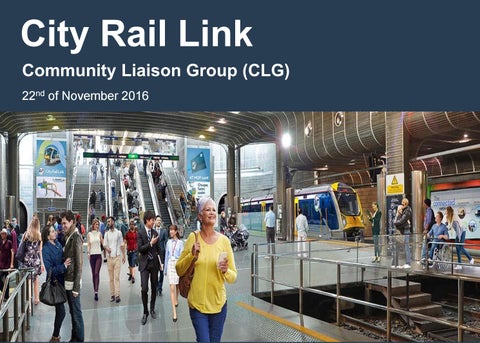
City Rail Link Community Liaison Group (CLG) 22nd of November 2016
1
Overview • General update • C1 update • C2 update
• Groundwater and Settlement Monitoring and Contingency Plan (GSMCP)
General update • Funding agreement • Procurement • Industry briefing • ISCA award
C1 Update
Britomart Station Plaza update
AUG 2016
SEP 2016
OCT 2016
NOV 2016
Internal works update
C1 DSBJV Works forecast Dec – Jan summary
C2 Update
CRL- Contract 2 SP1 Groundwater and Settlement Monitoring and Contingency Plan (GSMCP) Bob Mawdsley - Connectus 22nd November 2016
What’s in the GSMCP 1. Introduction 2. Project Description 3. Existing Environment 4. Overview of Monitoring and Reporting Requirements 5. Groundwater Monitoring Plan 6. Settlement Monitoring Plan 7. Response, Mitigation and Contingency Plan 8. Monitoring and Contingency Plan Review 9. Cumulative Effects of CRL and Adjacent Developments Appendices A to F – Drawings , tables etc Appendix G – Assessment of Settlement Effects
Objectives of the GSMCP • So far as reasonably practical, avoid any damage that affects serviceability of structures and services; and • To remedy or mitigate any adverse effects (including cumulative effects) associated with dewatering and excavation activities required for the CRL tunnel construction.
Summary of Existing Infrastructure • Buildings: • Residential, historic, commercial, retail. • Low-rise heritage shallow foundations vs. modern high rise piled structures. • Basements: • 35 Albert St Development • Commercial Bay Development • Utilities: Less than 2 m below ground level
Existing Ground Conditions
Construction Dewatering Dewatering = • Commencing bulk excavation, or • Commencing to take water from tunnel excavation, or • Dewatering prior to excavation Regulatory mechanisms in place to mitigate potential adverse effects to the environment and infrastructure associated with construction dewatering.
Groundwater Systems • Two key groundwater systems: Groundwater System
Material Type
Water Levels
Shallow (Perched)
• Fill • Sediments
< 5 m to 15 m bgl
Deep (Regional)
Rock
• Trench excavations will be up to 18 m below ground level: • Inflows to the trench of 10 to 60 m3/day. • Groundwater level drawdowns predicted
Introduction to Excavation Induced Ground Movement
Predicted Settlement Contours – Appendix A1
Assessment Settlement Effects – A Recap Burland Scale of Building Damage < Slight
Specimen Design (Prepared by PTA)
Predicted Settlements
Application for Resource Consents
Consent Conditions
Detailed Design (Prepared by Connectus / Aecom / McMJ)
Pre-Construction Surveys
Predicted Settlements
Building Condtion Assessments
Assessment of Settlement Effects
Compliance with Consent?
Yes
Proceed with Construction
No
Monitoring Stages • Three stages: 1. Before dewatering (baseline / pre-construction) 2. During dewatering / during constructions 3. After dewatering / post construction Dewatering = • Commencing bulk excavation, or • Commencing to take water from tunnel excavation, or • Dewatering prior to excavation
Monitoring Programme • Groundwater monitoring – boreholes / piezometers • Settlement monitoring programme: o Building Condition Surveys o Visual Inspections o Ground Movement Monitoring o Building Movement Monitoring o Structural Monitoring o Inclinometers o Strain Gauges • Soldata automated monitoring system: • Cyclops automated total stations • Geoscope database
Fig 6 - Pre-Excavation Set-up
Monitoring Illustration
Fig 7 – Routine Monitoring
Fig 8 – Response to Alerts
Fig 9 – Response to Alarms
Fig 10 – Response to Building Damage
Assessment of Cumulative Effects Concurrent Developments: • 35 Albert Street • Downtown Shopping Centre -> Commercial Bay • CRL-C2 SP2 Stormwater Diversion
Assessment of Cumulative Effects
Questions or comments?