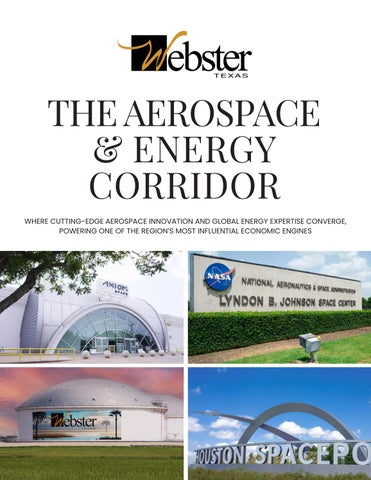
THE AEROSPACE & ENERGY CORRIDOR WHERE CUTTING-EDGE AEROSPACE INNOVATION AND GLOBAL ENERGY EXPERTISE CONVERGE, POWERING ONE OF THE REGION’S MOST INFLUENTIAL ECONOMIC ENGINES
Cooking With Fire
Aerospace & Innovation BUILDING THE SPACE ECONOMY For more than 60 years, Houston has served as a global hub for human space exploration. As home to NASA’s Lyndon B. Johnson Space Center (JSC), the region has supported mission control and astronaut training for every U.S. crewed spaceflight—an anchor that continues to shape Houston—and Webster’s—identity and economy. Today, roughly 60 aerospace and space-related companies, including NASA, operate in and around Webster’s orbit supported by a workforce of more than 12,000 civil and contract professionals advancing the next era of commercial space operations. The depth of this industry cluster gives the region a concentration of talent and capability that few markets can match. THE WEBSTER ADVANTAGE Just 2.3 miles from Webster, JSC drives significant economic activity, contributing more than $2.5 billion annually to the State of Texas. Across the state, the aerospace sector supports over 40,000 jobs and generates more than $9.2 billion in annual economic output. Webster is home to many of the companies carrying out this work. Axiom Space, Leidos, Voyager Space, Lockheed Martin, KBR, and Ad Astra Rocket Company are just a few of the firms that collaborate directly with NASA on commercial space stations, space suits, ISS operations, space habitats, propulsion technologies, space transport, and orbital debris solutions. These efforts position Webster at the center of what comes next in human spaceflight and commercial exploration. The region’s aerospace footprint extends north to Ellington, a unique blend of international
airport, NASA training center, and military airfield—and the world’s first urban commercial spaceport. Spanning more than 400 acres, Spaceport supports launches and landings, hardware development, testing, training, and research. It also houses personnel from all five branches of the U.S. Armed Forces, including the Texas Air National Guard’s 147th Attack Wing. According to the Texas Comptroller, Ellington Field supports more than 2,300 jobs and continues to expand its impact. The volume of work occurring at JSC, the contracts carried out by companies in Webster, and the activity at Ellington collectively bring a substantial daily workforce into and through the City. While NASA JSC contractors like Ad Astra Rocket Company and Axiom Space are headquartered in Webster, many of the City’s aerospace partners operate on a global scale. KBR maintains a team of roughly 100 employees in Webster but employs nearly 35,000 worldwide, and Leidos mirrors that pattern with a local presence of about 100 employees, supported by a global workforce of 48,000.These companies bring international expertise into Webster and regularly bring team members here for project work, training, and mission support—adding to the steady flow of professionals moving through the City each week. The mix of local headquarters and global networks gives Webster a uniquely outward-facing role within the region’s aerospace economy. Sustained aerospace business travel fuels consistent weekday demand for hotels, restaurants, and services, and contributes meaningfully to Webster’s overall economic activity.
Notes From the Kitchen
reliable The region’s aerospace workforce and steady flow of visiting professionals create highThese . services business of weekday activity in Webster and support a strong base robust the and incomes ld househo higher level positions also help shape the region’s entertainment spending that follows.
TOP LEFT: Voyager Space and
Lockheed Martin are advancing their Starlab commercial space station from right here in Webster’s aerospace corridor. Its single-module design— equipped with windows, docking ports, solar arrays, and thermal control systems—sets it apart as a nimble, versatile platform for microgravity research and commercial use. Targeted to launch in 2028, Starlab reflects the groundbreaking work happening in and around Webster. PHOTO CREDIT: Voyager Space BOTTOM LEFT: Axiom Space’s next-generation AxEMU spacesuit showcases the kind of innovation emerging from Webster’s network of NASA partners and contractors. Designed for improved mobility, comfort, and adjustability, the suit supports mission needs for astronauts, space agencies, and commercial operators.The white lunar version will protect astronauts from extreme temperatures on the Moon, while the black cover layer shown here conceals proprietary design features—another example of cutting-edge work tied to Webster’s aerospace cluster. PHOTO CREDIT: Axiom Space RIGHT: Mayor
Donna Jasso holds an EMU helmet during a visit to KBR’s Webster facility, highlighting the company’s key role in NASA’s spacesuit program. The helmet’s pressurized shell, ventilation system, and goldcoated sun visor are essential to regulating oxygen flow and shielding astronauts during spacewalks. It’s one of many innovations developed in Webster that support astronaut safety and the future of human spaceflight.
The Innovation Kitchen THE AEROSPACE INDUSTRY
60
+
MAJOR AEROSPACE COMPANIES
Over 60 major space companies lie within Webster’s orbit — fueling the region’s ascent as a global aerospace hub.
Gravitational Anchors NASA + Houston Spaceport
Ellington Field
6.2
With NASA’s Johnson Space Center and the Houston Spaceport just beyond Webster’s orbit, the City sits at the epicenter of aerospace innovation. These two anchors attract a constellation of contractors, suppliers, and explorers—creating a magnetic pull that keeps world-class talent and investment orbiting right here in Webster.
M ES
IL
NASA Johnson Space Center
Several of these aerospace companies maintain global footprints, employing thousands across continents and managing millions of dollars in NASA contracts. Their presence reinforces Webster’s reputation as a mission-critical hub— where innovation launched in our backyard reaches every corner of the world.
S LE MI 2.3
Webster City Limits
NASA Johnson Space Center
Houston Spaceport
• •
•
•
•
1,620-acre campus home to Mission Control and astronaut training Employs 12,000+ civil and contract workers Generates $4.7B+ in economic impact and supports 40,000+ jobs statewide Annual budget around $5.6B, with nearly half spent in Texas
• •
•
400-acre site under development at Ellington Airport 10th FAA-licensed commercial spaceport for suborbital and reusable aircraft Anchored by Axiom Space, Collins Aerospace, and Intuitive Machines Supports nearly 2,000 jobs and contributes to a $40.6B regional economic impact
WEBSTER’S AEROSPACE NETWORK
THE INNER ORBIT
WITHIN WEBSTER CITY LIMITS AD ASTRAROCKET COMPANY* 50+ employees company-wide
AEGIS AEROSPACE*
400+ employees company-wide
AXIOM SPACE*
1,000+ employees company-wide
BASTION TECHNOLOGIES*
500-1,000 employees company-wide
DRAPER LABORATORY
2,300 employees company-wide
THE OUTER ORBIT
JUST OUTSIDE WEBSTER CITY LIMITS WITHIN 3 MILES: ANADARKO INDUSTRIES (1.2 MILES) 200 employees company-wide
AEXA AEROSPACE, LLC (1.2 MILES) 50 employees company-wide
ARES AEROSPACE + TECHNOLOGY (2.3 MILES) 1,000 employees company-wide
DB CONSULTING GROUP (1.5 MILES) 200-500 employees company-wide
CIMARRON* (2.1 MILES)
550 employees globally
CRAIG TECHNOLOGIES (2.0 MILES)
200-500 employees company-wide
J&P TECHNOLOGIES (2.6 MILES) 50 employees company-wide
GB TECH, INC (2.8 MILES)
200 employees company-wide
JES TECH* (2.3 MILES)
150 employees company-wide
LOGICAL INNOVATIONS, INC (2.1 MILES) 50-100 employees company-wide
PERATON (2.1 MILES)
10K employees company-wide
TECH TRANS INTERNATIONAL (2.9 MILES) 150 employees company-wide
KBR
100+ employees in Webster/35K globally
LEIDOS
100+ employees in Webster/48K globally
LOCKHEED MARTIN SPACE SYSTEMS 20K employees globally
THE ROTHE COMPANIES*
200 employees company-wide
VOYAGER SPACE
100-300 employees in Webster *Headquarters in Houston/Webster
SAIC (1.8 MILES)
24K employees company-wide
WITHIN 5 MILES: THE AEROSPACE CORPORATION (3.7 MILES) 4,500 employees company-wide
ALL POINTS LOGISTICS, LLC (3.8 MILES) 300 employees company-wide
THE BOEING COMPANY (4.8 MILES)
500 employees in Houston/170K company-wide
BOOZ ALLEN (3.7 MILES)
33K employees company-wide
INTUITIVE MACHINES* (4.8 MILES + 6.5 MILES - SPACEPORT) 500 employees company-wide
JACOBS (3.4 MILES)
45K employees globally
NORTHROP GRUMMAN INNOVATION SYSTEMS (3.7 MILES)
100K employees globally
OCEANEERING SPACE SYSTEMS, INC* (3.5 MILES) 10K employees globally
UNIVERSITIES SPACE RESEARCH ASSOC. (5.0 MILES) 500 employees company-wide
JUST OVER 5 MILES: BARRIOS TECHNOLOGY* (6.6 MILES) 800+ employees company-wide
COLLINS AEROSPACE (6.5 MILES - SPACEPORT) 80K employees globally
*Headquarters in Houston/Webster
Made in Webster. Bound for Space. FROM ASTRONAUTS TO ROCKETS—IT’S ALL HAPPENING HERE Within Webster city limits, NASA’s next generation of missions is taking shape. From astronaut training and flight operations to spacecraft design, propulsion research, and on-orbit experiments, Webster’s aerospace companies play hands-on roles that reach far beyond Earth’s atmosphere. Every business featured here operates in Webster—fueling innovation, supporting NASA, and helping define the future of human space exploration. Aerospace Focus Areas Space Stations
Human Spaceflight
Propulsion & Spacecraft
Engineering & Technology
Research & Innovation
Ad Astra Rocket Company
Ad Astra is pioneering the VASIMR® plasma rocket engine, a high-power electric propulsion system designed to dramatically shorten travel times for deep-space missions. In October 2025, NASA awarded the company a new contract to accelerate VASIMR’s development for future human and cargo missions. The company’s state-of-the-art plasma test chambers and propulsion labs in Webster serve as the proving ground for this next leap in space transportation.
Aegis Aerospace
Aegis manages NASA’s REMIS II contract for International Space Station research through 2030, supporting experiments that advance space technology and exploration.The company also operates the MISSE Flight Facility, mounted outside the ISS to test materials, electronics, and energy systems in the harsh environment of space—while Webster-based engineers oversee payload integration and on-orbit operations.
Axiom Space
Headquartered in Webster, Axiom Space is redefining the future of human spaceflight. The company is constructing NASA’s first commercial space station modules—engineered in Webster to initially attach to the International Space Station and later evolve into the world’s first free-flying commercial destination in orbit by 2030. Axiom also leads NASA’s next-generation xEVA spacesuit program for the Artemis missions, designing, testing, and certifying the advanced suits astronauts will use for spacewalks on the ISS and on the lunar surface.
Bastion Technologies
Headquartered in Webster, Bastion provides advanced engineering, safety, and mission assurance services for NASA, including a September 2025 contract with the Marshall Space Flight Center. Since its founding in 1998, the company has secured more than 350 NASA contracts, delivering reliability, IT, and configuration-management expertise that supports both ISS and Artemis missions.
Draper Technologies
Draper develops flight software, avionics, and simulation tools for NASA missions under a five-year, $49 million contract. Its engineers design guidance, navigation, and control systems for the Orion spacecraft and International Space Station, enabling precise maneuvering, docking, and mission execution in orbit and deep space.
Leidos
Leidos supports NASA’s Cargo Mission Contract, managing the complex logistics that deliver everything astronauts need to live and work in space—from food and experiments to critical flight hardware. Its engineers provide hardware development, analytics, and mission planning that keep cargo flights to the International Space Station and future Artemis missions running seamlessly. Leidos also contributes to NASA’s REMIS and Human Health and Performance (HHPC) programs, enhancing onorbit operations and advancing the safety and reliability of human spaceflight.
Lockheed Martin
Lockheed Martin maintains a Webster-area engineering and mission-integration office as part of its global space systems business. The company collaborates with Voyager Space on Starlab, NASA’s next commercial space station developed through the Commercial LEO Development Program, and continues to advance spacecraft, satellite, and defense technologies worldwide.
KBR
KBR supports NASA’s astronaut health, performance, and mission operations through multi-billion-dollar contracts, including the $36 billion Human Health and Performance Contract and the $1.9 billion IMOC III Mission Operations Contract. A key partner to Axiom Space under NASA’s xEVA spacesuit program, KBR leads testing and verification of next-generation suits for ISS and Artemis missions, while also managing refurbishment and readiness for NASA’s current suit fleet. A global engineering powerhouse with operations in more than 30 countries, KBR’s Webster team continues a legacy of excellence that spans every NASA astronaut since 1968.
Rothe Development
Rothe partners withVertex Aerospace on NASA’s Neutral Buoyancy Laboratory contract, providing IT security, facility operations, and logistics that support astronaut training and underwater simulations of spacewalks. The company also delivers aerospace manufacturing, calibration, and technical services for non-human spaceflight systems and mission-readiness operations.
Voyager Space
Voyager Space leads development of Starlab, NASA’s next commercial space station, in partnership with Lockheed Martin under the Commercial LEO Development Program. In 2024, NASA expanded funding to accelerate docking, systems integration, and on-orbit milestone work.Voyager also manages the HUNCH Program, headquartered in Webster, where students design, fabricate, and deliver NASA-approved components that are flown to the International Space Station. Read more in the Mayor of Space edition of Gateway Magazine
Aerospace Pairs Well With Webster’s Secret Sauce • CITY PARTNERSHIP—Provides engaged leadership, aligned officials, and responsive staff that support long-term aerospace growth. • MARKET INSIGHT—Offers a clear understanding of regional workforce strength, travel patterns, and industry needs that guides smart aerospace recruitment and sustained performance. • SECTOR SYNERGY—Brings crossover activity as employees, contractors, and visitors naturally interact with surrounding uses throughout the district. • HOSPITALITY, DINING, ENTERTAINMENT + RETAIL—Create a convenient, amenity-rich environment that supports aerospace teams, contractors, and visiting professionals during multi-day assignments. AXIOM SPACE - SPACE STATION DEVELOPMENT FACILITY
21300 Gulf Freeway, Webster, TX
• AEROSPACE + ENERGY—Bring a large, diverse employee base to the district, creating a dynamic environment that supports aerospace operations and reinforces the area as a convenient place to work.
Cooking With Fire
The Energy Sector THE WINK TO WEBSTER PIPELINE Webster’s economic makeup is defined by a deep bench of specialized professions—from aerospace engineers to medical innovators— and the energy sector adds another powerful layer to that mix. ExxonMobil’s 200-acre Webster Station is a key operations site in the City and region and plays a significant role in the nationwide movement of crude oil. This massive movement is tied to Webster’s place along the Wink to Webster pipeline—a 650-mile system that carries Permian Basin crude to the Gulf Coast. Webster’s namesake pipeline system is one of the largest crude oil pipelines in the United States, transporting more than one million barrels of oil per day from the Permian Basin—one of the world’s most prolific oil regions—to the Gulf Coast. A planned extension from Wink to Midland will add another 80 miles, further increasing capacity. Pipelines like Wink to Webster remain the safest, most reliable, and most costeffective way to move crude oil—avoiding the equivalent of 10,000 truck trips per day. Webster’s station alone provides 2.5 million barrels of storage, supporting products that rely on petroleum—from fuels and lubricants to plastics and chemical feedstocks. Over the next 40 years, Wink to Webster is projected to generate $19.6 billion in economic output and $769 million in state and local taxes, reinforcing its impact on communities across Texas. THE WEBSTER ADVANTAGE ExxonMobil’s Webster Station supports a sizable mix of employees and contractors— operators, engineers, pipeline specialists, and safety teams. The energy presence strengthens the local economy through daily spending at Webster restaurants, shops, and
businesses, as well as steady hotel demand tied to industry travel, contractor rotations, inspections, and project teams. The site also generates indirect economic activity through ExxonMobil’s broader operations and vendor network. Energy may not always be as visible as Webster’s entertainment or medical sectors, but its economic footprint is significant. The City maintains a long-standing partnership with ExxonMobil grounded in safety, training, and operational readiness. Webster’s Fire, Police, and EMS departments coordinate with ExxonMobil’s emergency response teams for drills, planning, and cross-training— strengthening preparedness for both the facility and the community. ExxonMobil has also provided first responder grant funding, which has helped the City acquire equipment and resources that support public safety citywide. Earlier this year, the City and ExxonMobil partnered on a project to enhance the visual landscape along a major corridor by transforming two large tanks into highvisibility murals. The City helped manage artist logistics—from equipment and safety provisions to accommodations and scheduling—reflecting the cooperation and partnership between the two organizations. Energy is one of many sectors that contribute to Webster’s economic success, but the scale of its influence is often overlooked. The Webster Station supports national infrastructure, adds depth to the City’s workforce, brings visitors and industry professionals into the City, and contributes to regional commercial activity. Webster’s role within ExxonMobil’s network is significant, underscoring the impact a 6.7-square-mile city can have.
TOP PHOTO:
Public Works Director John Warnement, City Manager Mike Ahrens, Assistant Public Works Director John Hines, Police Chief Pete Bacon, and Assistant Chief Jeremy Edge joined ExxonMobil’s U.S. Operations Manager Haur Bin Chua, Community Engagement Lead Justin Stegall, and fellow ExxonMobil professionals to celebrate the completion of the Webster ExxonMobil tank murals in November 2025. The project reflects strong collaboration between the City and ExxonMobil— supported through joint funding, coordinated logistics, and an ongoing partnership that strengthens operations, safety, and shared initiatives in Webster. BOTTOM
Notes From the Kitchen
Webster’s energy sector adds a powerful layer to the City’s diverse economic base, supporting national infrastructure and driving substantial regional activity.The sector fuels daily spending, hotel demand, workforce depth, and long-standing partnerships that strengthen safety, readiness, and community impact across Webster.
PHOTO: Painted by artist Eric Henn, the two 148’ x 160’ murals now serve as a vivid entry gateway for drivers traveling along the NASA Bypass. The 16-week installation, completed in July 2025, transformed the tanks into a bold visual landmark and underscored the strong, ongoing collaboration between the City and ExxonMobil.
Who’s at the Table? WEBSTER’S MARKET REACH & SPENDING POWER Webster serves a dynamic super-regional market, supported by compelling statistics, a flourishing business sector, and thriving attractions and venues.
WITHIN FIVE MILES:
Population: 200,172 Average Household Income: $138,988 Total Entertainment Spend: $401.24M $5,146 PER HOUSEHOLD 29% HIGHER THAN HOUSTON MSA AVERAGE
WITHIN TEN MILES:
WITHIN FIFTEEN MILES:
Population: 635,247 Average Household Income: $125,626 Total Entertainment Spend: $1.1B
Population: 1.07M Average Household Income: $113,612 Total Entertainment Spend: $1.67B
$4,774 PER HOUSEHOLD 20% HIGHER THAN HOUSTON MSA AVERAGE
$4,387 PER HOUSEHOLD 10% HIGHER THAN HOUSTON MSA AVERAGE
This inside look at Webster’s Aerospace and Energy Sector highlights just one piece of what draws business to Webster every day. For a complete view of Webster’s key industries and economic strengths, scan the QR code to explore Gateway Magazine: The Secret Sauce.
FOR MORE INFORMATION: BETSY GIUSTO Economic Development Director Email: bgiusto@webstertx.gov Phone: 281.316.4116 Cell: 713.542.7137
KATIE VELA Marketing & Tourism Specialist Email: kvela@webstertx.gov Phone: 281.316.4121 Cell: 248.496.3438
KATY HICKS Economic Development Specialist Email: khicks@webstertx.gov Phone: 281.316.4135 Cell: 832.455.6258