Should I be concerned about lead in my drinking water?
Lead can cause serious health problems, especially for pregnant women and young children. Lead in drinking water is primarily from materials and components associated with service lines and home plumbing. Lynchburg Water Resources is responsible for providing high quality drinking water and removing lead pipes, but cannot control the variety of materials used in plumbing components in your home. You share the responsibility for protecting yourself and your family from the lead in your home plumbing. You can take responsibility by identifying and removing lead materials within your home plumbing and taking steps to reduce your family’s risk. Before drinking tap water, flush your pipes for several minutes by running your tap, taking a shower, doing laundry or a load of dishes. You can also use a filter certified by an American National Standards Institute accredited certifier to reduce lead in drinking water. If you are concerned about lead in your water and wish to have your water tested, contact Lynchburg Water Resources at 434-455-4250 Information on lead in drinking water, testing methods, and steps you can take to minimize exposure is available at www.epa.gov/ safewater/lead.
Water Service Line Inventory
In 2024, the City of Lynchburg published its initial Water Service Line Inventory, indicating what is known about the material of water service lines on both the City side and customer side of the City meter. For more information on this program and for a link to our Water Service Line Inventory, please visit www.lynchburgva.gov/purepipe
Our Source Water
The city of Lynchburg is fortunate to have two water sources: the 138-acre Pedlar Reservoir in Amherst County and the James River. The water from Pedlar flows just over 21 miles by gravity to the city’s two filtration plants. At certain times, water is also drawn from the James River.
The sources for drinking water (i.e., tap water and bottled water) include rivers, lakes, streams, ponds, reservoirs, springs, and wells. As water travels over the surface of the land or through the ground, it dissolves naturally occurring minerals, and in some cases, radioactive material. It can also pick up substances resulting from human activity and the presence of animals.
Contaminants may include the following:
Microbial Contaminants: Viruses and bacteria, which may come from sewage treatment plants, septic systems, agricultural livestock operations and wildlife.
Inorganic Contaminants: Salts and metals, which can be naturally occurring or result from urban stormwater runoff, industrial or domestic wastewater discharges, oil and gas production, mining or farming.
Pesticides & Herbicides: Chemical substances resulting from a variety of sources such as agriculture, urban stormwater runoff and residential uses.
Organic Chemical Contaminants: S ubstances including synthetic and volatile organic chemicals, which are by-products of industrial processes and petroleum production, and can also come from gas stations, urban stormwater runoff and septic systems.
Radioactive Contaminants Substances that can be naturally occurring or be the result of oil and gas production and mining activities.
Source Water Assessment Program
The Virginia Department of Health conducted a source water assessment of our system in 2025 in accordance with the 1996 amendments to the Safe Drinking Water Act. Based upon the criteria developed by the State in its Source Water Assessment Program, both of our surface water sources were classified as highly susceptible to contamination as a result of land use activities and potential sources of contamination in the assessment areas. However, this does not mean that our sources have or will be impacted. It does mean that if there were to be a release of pollutants in the assessment area, the source water could be impacted.
The assessment report consists of maps showing the source water assessment area, an inventory of known land use activities of concern, and documentation of any known contamination within the last five years. For copies of the report, contact Lynchburg Water Resources at 434-455-4250
Information on Sodium
Who makes decisions about my drinking water?
Decisions regarding any changes to Lynchburg Water Resources’ infrastructure or rate changes may be discussed during Lynchburg City Council meetings held on the second and fourth Tuesday of every month at 7 p.m. in City Council Chamber, City Hall, First Floor, 900 Church Street. Citizens have the opportunity to speak during council meetings by signing up online. Meetings are broadcast live on Comcast cable LTV Channel 15, including video-streamed on the City’s website and Facebook page. Agendas for upcoming meetings, archived videos, and minutes to previous meetings can be found at www.lynchburgva.gov
What if I have questions?
If you have any questions or comments concerning information within this water quality report, please contact Lynchburg Water Resources (8 a.m. to 5 p.m. Monday-Friday) at 434-455-4250
For water, sewer, or stormwater emergencies, call LWR’s 24/7 hotline at 434-455-4250
Lynchburg Water Resources’ educators are available for plant tours and group presentations about water supply, treatment, and quality. For more information, visit www.lynchburgva.gov/learn
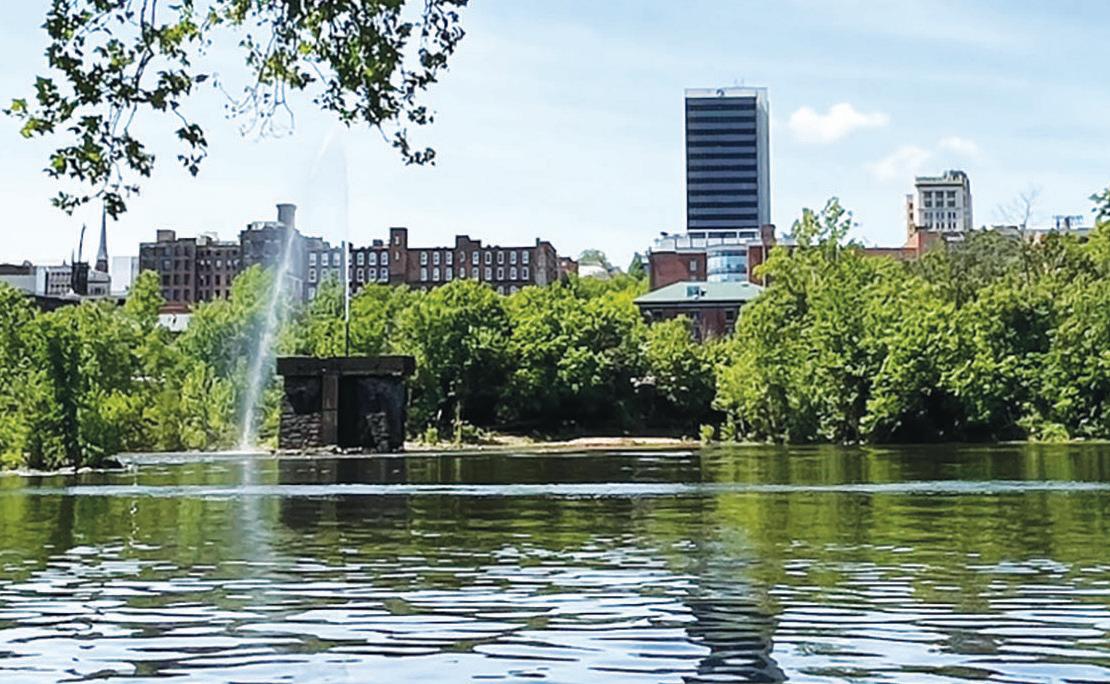
James River
ore than 100,000 citizens in Lynchburg and the surrounding communities depend on clean, safe drinking water every day. The city’s abundant water supply is a critical asset for the economic growth and development of the region. In accordance with federal and state regulations, information on the quality of your drinking water must be shared with citizens annually through the distribution of a water quality report. Lynchburg Water Resources is proud to present you with specific information about your drinking water from this past year. The results shown within this report reveal that your drinking water is better than federal and state standards for safety and is in compliance with regulations governing water quality.
Drinking water, including bottled water, may reasonably be expected to contain at least small amounts of some contaminants. In order to ensure that tap water is safe to drink, EPA prescribes regulations that limit the amount of certain contaminants in water provided by public water systems. The Food and Drug Administration regulations establish limits for contaminants in bottled water which must provide the same protection for public health. The presence of contaminants does not necessarily indicate that the water poses a health risk. More information about contaminants and potential health effects can be obtained by calling the US Environmental Protection Agency’s (US EPA’s) Safe Drinking Water Hotline at 1-800-426-4791
Some people may be more vulnerable to contaminants in drinking water than the general population. Immunocompromised persons, such as persons with cancer undergoing chemotherapy, persons who have undergone organ transplants, people with HIV/AIDS or other immune system disorders, some elderly and infants, can be particularly at risk from infections. These people should seek advice about drinking water from their health care providers. US EPA and US Centers for Disease Control (CDC) guidelines on appropriate means to lessen the risk of infection by cryptosporidium and other microbiological contaminants are available from the Safe Drinking Water Hotline at 1-800-426-4791
WHAT IS IN THE WATER?
CONTAMINANTS DETECTED JANUARY 2025 THROUGH DECEMBER 2025
CONTAMINANTS:
Additional Lead & Copper Samples
These samples were collected in 2025 after our initial water service line inventory was completed, which gave us more accurate information about the pipe materials in our system.
Action Level (AL): Concentration of a contaminant which, if exceeded, triggers treatment or other requirements that a water system must follow.
Maximum Contaminant Level (MCL): Highest level of a contaminant allowed in drinking water. MCLs are set as close to the Maximum Contaminant Level Goal as feasible using the best available treatment technology.
Maximum Contaminant Level Goal (MCLG): Level of a contaminant in drinking water which there is no known or expected risk to health. MCLGs allow for a margin of safety.
Maximum Residual Disinfection Level (MRDL): Maximum level of disinfectant allowed in the water distribution system. There is convincing evidence that addition of disinfectant is necessary for control of microbial contaminants.
Maximum Residual Disinfection Level Goal (MRDLG): Level of disinfectant in drinking water which there is no known or expected risk to health. MRDLGs do not reflect the benefits of the use of disinfectants to control microbial contaminants.
Nephelometric Turbidity Unit (NTU): Measure of water clarity. Turbidity in excess of five NTUs is barely noticeable to the average person.
Parts per million (ppm) or Milligrams per liter (mg/l): Equivalent to milligrams per liter. One ppm corresponds to one minute in two years or a single penny in $10,000.
Parts per billion (ppb) or Micrograms per liter: Equivalent to micrograms per liter. One ppb corresponds to one minute in 2,000 years or a single penny in $10,000,000.
Picocuries per liter (pCi/l): Measures radioactivity.
Treatment Technique (TT): A required process intended to reduce the level of a contaminant in drinking water.