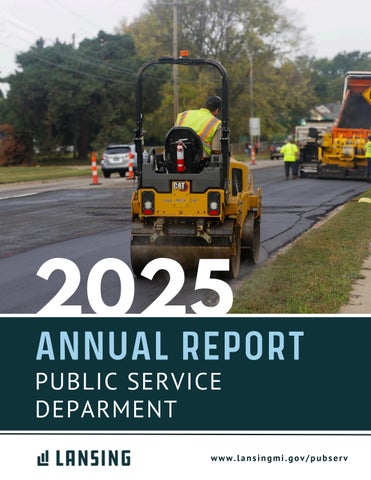
2025
ANNUAL REPORT PUBLIC SERVICE DEPARMENT
www.lansingmi.gov/pubserv
TABLE OF CONTENTS TABLE OF CONTENTS Note from the Director & Board
4
Department Overview
7
Division Breakdown
8
SERVICES PROVIDED TO THE PUBLIC Right of Way Infrastructure
12
Sewers
16
CART (Trash, Recycling, Yard Waste)
19
Special Events
20
Sustainability
21
NTENTS INTERNAL SUPPORT SERVICES Administration
Property Management
Fleet Services
Grounds Services
22 23 24 26
NOTE FROM THE DIRECTOR The City of Lansing Public Service Department works hard to maintain the City's infrastructure to support our residents, businesses, and visitors. With a dedicated staff of more than 220 full-time employees, we: Maintain over 1,500 miles of streets, sewers, sidewalks, and pathways in the city Treat nearly 4 billion gallons of wastewater from over 38,000 customers Provide recycling, trash and yard waste service to customers Permit and monitor all right-of-way activity Repair and maintain the City's parks, buildings, vehicles and equipment Support special events We are proud to serve the residents, businesses and workers who live, work and play in our city and hope that you enjoy reading some of our accomplishments from the 2025 calendar year. For more information on the Public Service Department, please visit our website at lansingmi.gov/pubserv.
Sincerely,
Andy Kilpatrick P.E. Public Service Director
4
2025 Public Service Annual Report
PUBLIC SERVICE BOARD ADOPTION LETTER
www.lansingmi.gov/pubserv
5
TABLE OF CONTENTS BOARDS & COMISSIONS The Public Service Department provides support to the Board of Public Service and the Sustainability Commission, two resident‑driven advisory bodies that give guidance, community insight, and recommendations on infrastructure, sustainability initiatives, and long‑term city planning. These boards give Lansing residents an active role in shaping projects, policies, and priorities that support a more resilient and well‑connected community.
Board of Public Service The Board of Public Service advises the mayor and Council on issues pertaining to City streets, sewers, sidewalks and paths, trash, recycling, buildings and vehicles as well as other areas which fall under the purview of the Public Service Department. The board consists of eight Lansing residents, one from each of the four wards in the city and four serving as at-large members. Members serve four-year terms that are staggered such that the term of one ward member and one at-large member expire each June. Meetings are held at the Wastewater Treatment Plant on the second Thursday of each month at 11:30 am. The Board also holds a joint meeting with the Sustainability Commission approximately once per year. Additional information on the Board of Public Service can be found at www.lansingmi.gov/boardofpublicservice
Mayor’s Advisory Commission on Sustainability The Mayor's Sustainability Commission is dedicated to promoting sustainability and climate action within Lansing. The Commission works to advise the Mayor on sustainability related issues, and to provide expertise and support on the City’s Sustainability and Climate Action Plan. Meetings are held on the third Thursday of each month from 3:30 - 5:00 pm, and are held either virtually or in person. Additional information can be found at www.lansingmi.gov/sustainabilitycommission
6
6
2025 Public Service Annual Report 2025 Public Service Annual Report
TABLE OF CONTENTS DIVISION OVERVIEW Organization Chart ANDY KILPATRICK P.E. DIRECTOR
JEREMIAH KILGORE DEPUTY DIRECTOR
PROPERTY MANAGEMENT
OPERATIONS & MAINTENANCE
FLEET SERVICES
ENGINEERING
DIVISION
DIVISION
CARL DENISON
NICOLE MCPHERSON P.E.
JOE CASTILLO
NATHAN ARNOLD
ERIC THELEN
SUPERINTENDENT
CITY ENGINEER
SUPERINTENDENT
SUPERINTENDENT
SUPERINTENDENT
INFRASTRUCTURE
ENVIRONMENT
DIVISION
TRANSPORTATION
SURFACE
FULL-TIME EMPLOYEES
38+ CONTRACT/SEASONAL EMPLOYEES
www.lansingmi.gov/pubserv
WASTEWATER
ADMINISTRATION
DIVISION
DIVISION
PERMITS
SUSTAINABILITY
OFFICE
OFFICE
SEWERS
Department Numbers
233
DIVISION
STREET
CEMETERY/ GROUNDS/ FORESTRY
COMMUNICATIONS
BUSINESS OPERATIONS
CAPITAL AREA RECYCLING & TRASH
FY 25 Public Service Budget by Fund
11.1% 14.1%
General Fund & Other
Internal Support Services
9.3%
$42.1% Sewer Fund
CART
23.4% Street Fund
Approximately: $105 Million
7
TABLE OF CONTENTS DIVISION BREAKDOWN $14 Mil The Administration Division is the central hub for internal operations and external communications, supporting all other divisions through financial management, strategic coordination, and public engagement. Staff manages budgeting, grants, performance tracking, service requests, FOIA responses, contracts, and claims. It also leads outreach through press releases, traffic advisories, website updates, social media, and public meetings. Additionally, the Sustainability Office is housed within this division, advancing initiatives that promote environmental stewardship and sustainable practices across all operations.
GRANT FUNDING SECURED FOR SUSTAINABILITY PROJECTS
193
TRAFFIC ADVISORIES ISSUED
$50 Mil OF PAYMENTS PROCESSED
4 Billion GALLONS OF RAW SEWAGE PROCESSED INTO CLEAN WATER
0
LOST TIME ACCIDENTS INCURRED
3,845 TONS OF BIO-SOLIDS GENERATED
8
The Wastewater Division is responsible for treating the city’s wastewater and ensuring that clean water is returned to the environment. The division operates and maintains the treatment plant and pump stations, monitors compliance with environmental regulations, and oversees the handling and disposal of residual materials. Staff oversees daily operations, perform routine maintenance, and manage long-term infrastructure improvements to support system reliability and environmental stewardship.
2025 Public Service Annual Report
The Operations & Maintenance (O&M) Division provides many of the Public Service Department’s most visible and essential services to the public, supporting the function, safety, and appearance of Lansing’s neighborhoods and public spaces. O&M staff deliver a wide range of services that residents rely on year-round and are often the City’s frontline response to service needs and maintenance concerns. Core responsibilities include Capital Area Recycling and Trash (CART) services, cemetery and park maintenance, sanitary and storm sewer maintenance, street and alley upkeep, forestry operations, sign shop services, and winter weather response. The division also supports special projects and citywide initiatives, including the installation of the State of Michigan Christmas Tree and coordinated response during severe weather events.
53
MILES OF SEWERS CLEANED
www.lansingmi.gov/pubserv
2,114
POTHOLE COMPLAINTS ADDRESSSED
4,771
TONS OF RECYCABLES COLLECTED
193
ACRES OF CEMETERIES MAINTAINED
9
1,008
The Fleet Services Division
VEHICLES AND EQUIPMENT MANAGED
is responsible for managing the City’s fleet of vehicles and equipment. This includes the acquisition, maintenance, and disposal of vehicles used by Public Service, Police, Fire, and other departments. Fleet Services ensures that all vehicles are safe, reliable, and properly maintained to support daily operations and emergency response. The division also oversees vehicle usage policies and supports strategic initiatives such as fleet electrification and fleet assessments.
2,937
WORK ORDERS COMPLETED
$5.9 Mil IN NEW VEHICLES AND EQUIPMENT ORDERED AND PURCHASED
The Engineering Division plans, designs, and oversees public infrastructure projects such as road reconstruction, sewer rehabilitation, sidewalks, pathways, and traffic signal upgrades. Engineering staff manage project budgets, timelines, contractor coordination, and regulatory compliance to ensure projects meet city, state, and federal standards. The division also supports permit processing and collaborates closely with other Public Service divisions to oversee projects from design to construction, helping to maintain and improve the City’s infrastructure.
$50 Mil IN ACTIVE DESIGN AND CONSTRUCTION PROJECTS CITYWIDE
10
843
PERMITS ISSUED AND INSPECTED
1,688
CITIZEN AND SERVICE REQUESTS ADDRESSSED
2025 Public Service Annual Report
The Property Management Division oversees the maintenance, renovation, and strategic use of City-owned buildings and facilities, ensuring that municipal spaces remain safe, functional, and responsive to operational needs. The division is responsible for a diverse portfolio of facilities, including administrative offices, public safety buildings, and community spaces, each requiring consistent upkeep and long-term planning. Property Management ensures that facilities are energy-efficient, well maintained, and aligned with citywide operational and sustainability goals. Staff manage routine and emergency repairs, planned renovations, energy tracking, and major capital improvement projects, while also supporting public events and elections. Through close coordination with other City departments and divisions, the Property Management Division works to improve service delivery, infrastructure reliability, and the long-term performance of City-owned assets.
100+
FACILITIES & PROPERTIES MAINTAINED
2,134
BUILDING MAINTENANCE WORK ORDERS COMPLETED
50
CITY EVENTS SUPPORTED THROUGH ON-SITE COORDINATION & FACILITY PREPARATION
www.lansingmi.gov/pubserv
11
TABLE OF CONTENTS 2025 OVERVIEW SERVICES PROVIDED TO THE PUBLIC: While each division within the Public Service Department has its own specialized responsibilities, their collective efforts are most evident in the services that directly impact Lansing’s residents, businesses, and visitors. The following section highlights the core public-facing services provided across the department and key accomplishments for 2025.
TRANSPORTATION INFRASTRUCTURE The Public Service Department is responsible for maintaining the City’s right-of-way infrastructure, including streets, bridges, sidewalks, pathways, traffic signals, signs, and pavement markings. These assets are essential to safe and efficient travel for motorists, pedestrians, and cyclists.
STREETS
SIDEWALKS
The City of Lansing manages over 412 miles of major and local streets along with numerous bridges throughout the city. Street work throughout the year included millage paving, major and local street resurfacing, street sweeping, pothole repairs, utility cut restoration, and winter maintenance.
The City of Lansing maintains over 600 miles of sidewalks and pathways that are critical to pedestrian safety, accessibility, and neighborhood connectivity.
MAJOR STREETS Major streets are the primary roadways that carry higher volumes of traffic and connect neighborhoods to key destinations such as business districts, schools, and regional transportation routes. These streets typically serve as main corridors for commuting and commercial activity.
LOCAL STREETS Local streets are the smaller roadways within neighborhoods that provide direct access to homes, businesses, and community spaces. These streets typically carry lower traffic volumes and slower speeds, prioritizing safety and convenience for residents.
12
2025 Public Service Annual Report
2025 STREETS OVERVIEW In 2025 the Engineering Division completed a variety of design and construction projects on local and major streets, which included street resurfacing, pathway construction and reconstruction, combined sewer separation projects, sewer maintenance, road reconstruction, and utility work. Bridge maintenance and inspection remained a priority, with preventative maintenance completed on bridges along César Chavez Avenue and Pennsylvania Avenue, and federally required inspections conducted on 22 City-owned bridges. In total, these projects cost over $50 million comprised of federal, state, and local funds. Several major corridor and neighborhood street projects were completed including the first phase of Pleasant Grove Road rehabilitation and the final phase of the Michigan Avenue reconstruction project. The City coordinated closely with the Lansing Board of Water & Light (LBWL) to pair water main replacement projects with street rehabilitation efforts, minimizing disruption and improving long-term roadway performance.
Traffic Infrastructure Traffic infrastructure and operations supported daily travel, special events, construction, and emergency response, including rapid traffic control for incidents, continued modernization of traffic signals, installation of central traffic signal management software, and completion of traffic studies, speed studies, and work zone mobility reviews. The team maintains over 20,000 signs throughout the city, performed over 800 sign work orders, completed 29 engineering studies and reports, and conducted 121 traffic counts.
Future Projects City engineers also designed future corridor projects for major streets like Pennsylvania Avenue, Mt. Hope Avenue, and Jolly Road. Plans include resurfacing and ADA ramp upgrades on multiple local streets, with work scheduled to begin in spring 2026.
Roadway Maintenance The Operations and Maintenance Division supported pavement preservation and roadway safety throughout the year, completing 2.2 miles of millage paving and using more than 700 tons of cold patch material to maintain road surfaces. O&M also provided seasonal maintenance such as street leaf sweeping and snow plowing. The Surface Section swept over 1,100 lane miles twice this season, collecting more than 3,500 cubic yards of debris. O&M also manages 4,500 tons of salt inventory, operates over 40 plow trucks to maintain over 1,000 lane miles, and last season used about 5,000 tons of salt for streets.
www.lansingmi.gov/pubserv
13
STREET PROJECTS OVERVIEW Type
Street Name
Miles
Limits / Bounds
Status
Project Type
$14.0 M
Pennsylvania Ave to Howard St
Completed 2025
Reconstruction, Utility Upgrades, Traffic and Pedestrian Signal Upgrades
Started 2025, Phase 1 Completed, Phase 2 Planned 2026
Resurfacing & Pedestrian Signal Upgrades
Major
Michigan Ave
Major
Pleasant Grove Rd
1.0
$2 M
Mt. Hope Ave to Jolly Rd
Major
Pennsylvania Ave
0.4
$2.05 M
Mt. Hope Ave to Fayette St
Designed 2025, Planned 2026
Reconstruction / Utility Upgrades / Pedestrian Signal Upgrades
Major
Mt. Hope Ave
0.8
$1.1 M
Pennsylvania Ave to Aurelius Rd
Designed 2025, Planned 2026
Resurfacing / Pedestrian Signal Upgrades
Major
Jolly Rd
0.5
$1.31 M
Cedar St to Pennsylvania Ave
Designed 2025, Planned 2026
Resurfacing / Bike Lane Reconfiguration
Local
Various Streets
2.1
$1.7 M
Multiple Locations
Designed 2025, Planned 2026
Resurfacing & Sidewalk Upgrades
7.2
$22 M
TOTAL
1.4
Cost
HIGHLIGHT: MICHIGAN AVENUE REHABILITATION The biggest major street project completed this year was the Michigan Avenue rehabilitation project. This two year project aimed to modernize one of Lansing’s most important corridors connecting the Capitol to MSU’s campus. The work included full road reconstruction and reconfiguration, sidewalk replacement, traffic signal modernization, and utility upgrades such as sewer and water main improvements. As part of the redesign, Michigan Avenue was reconfigured from five lanes to four, creating a safer, more pedestrian- and bike-friendly environment with two westbound lanes, a center turn lane, and one eastbound lane. This project reflects years of planning, public input through initiatives like Imagine the Avenue, and collaboration with regional partners. With a total investment of $14.1 million, funded through federal, state, and local sources, the improvements balance Michigan Avenue’s role as a key connection between downtown Lansing and East Lansing while supporting businesses and neighborhoods along the corridor.
14
2025 Public Service Annual Report
2025 SIDEWALKS OVERVIEW In 2025, the Department continued to prioritize sidewalk repairs, accessibility improvements, and coordination with street and utility projects to improve walking conditions across the city. The City designed and bid a sidewalk replacement project addressing damaged sidewalks in multiple parks, including Cesar Donora Park, Cavanaugh Park, Cherry Hill/River Street Park, Foster Park, and Walsh Park, as well as sidewalks impacted by street trees along several residential corridors. Construction on this project began in 2025 and is expected to be completed in 2026. The City’s sidewalk repair program focused on eliminating reported trip hazards citywide. In 2025, crews cut 1,872 sidewalk joints and wedged 50 sidewalk sections with asphalt to address immediate safety concerns. In coordination with street and utility improvements, over 75 sidewalk ramps were reconstructed to meet ADA standards and improve accessibility. To maintain a 50-year replacement cycle, approximately 12 miles of sidewalk would need to be replaced annually at a cost exceeding $3 million. The Department continues to advance sidewalk gap closures and long-term repair strategies to improve pedestrian infrastructure and accessibility throughout Lansing.
HIGHLIGHT: DUNCKEL ROAD & FOREST ROAD NON-MOTORIZED PATHWAY PROJECTS Two of the key mobility improvements completed this year include the Dunckel Road non-motorized pathway project and Forest Road Pathway under US-127, enhancing connectivity and safety for pedestrians and cyclists. Along Dunckel Road, a 10‑foot‑wide pathway was installed between Jolly Road and west of the US‑127/I‑496 interchange, paired with a roadway reconfiguration that now provides two southbound/westbound lanes, a center turn lane, and one northbound/eastbound lane, while maintaining four lanes through the interchange. Similarly, the addition of a separated 10‑foot asphalt pathway, guardrail, retaining wall, and fencing under US-127 improves the the connectivity of the Forest Road pathway. Together, these projects, supported in part by federal funding and representing more than $1.7 million in combined investment, expand Lansing’s non‑motorized network and improve safety and accessibility for all users.
www.lansingmi.gov/pubserv
15
SEWERS Lansing’s sewer systems are essential for protecting public health, maintaining environmental quality, and supporting daily life. These systems manage both stormwater and sanitary wastewater, ensuring that rain and snowmelt are safely conveyed to local waterways while sewage is collected and treated before discharge. Proper operation and maintenance prevent flooding, safeguard rivers, and keep the City’s infrastructure resilient.
STORM WATER SEWER
SANITARY SEWER
Collects runoff rain and snowmelt through catch basins and directs it to rivers.
Collects wastewater from homes and businesses and transports it to the Wastewater Treatment Plant (WWTP) for treatment.
COMBINED SEWER OVERFLOW (CSO) Historically, Lansing’s older neighborhoods were served by combined sewers that carried both stormwater and sanitary flow in a single pipe. During heavy rain, these systems could overflow, discharging untreated water into the Grand River or Red Cedar River. To address this challenge, the City’s Wet Weather Control Program is working to separate combined sewers and upgrade sanitary systems, reducing overflows and protecting water quality.
MAINTENANCE Alongside these long-term improvements, the Operations and Maintenance (O&M) Division works year-round to ensure the reliability of Lansing’s sanitary and storm sewer networks by cleaning, repairing and inspecting storm and sanitary sewer systems and flood control devices. Cleaning and repair crews perform year-round maintenance to keep the system operational and reduce flooding risks, ensuring public health, safety, and environmental protection. In 2025, O&M crews cleaned approximately 280,000 feet of sewer mains and televised 31,000 feet of sewers to identify potential issues before they result in system failures. Crews also cleaned 323 storm sewer catch basins, a significant increase from 77 in 2023, and completed 630 feet of storm and sanitary sewer main repairs or replacements. In addition, 96 repairs to catch basins and manholes were completed.
16
2025 Public Service Annual Report
2025 SANITARY SEWER OVERVIEW The City’s sanitary sewer system collects wastewater from homes, businesses, and industries and conveys it to the Wastewater Treatment Plant (WWTP), where it is treated and safely discharged into the Grand River. While much of this flow moves by gravity, pump stations play a critical role in pushing wastewater through the system, especially in low-lying areas or during wet weather. This process is essential for protecting public health and meeting state and federal water quality standards. In 2025, the WWTP treated nearly four billion gallons of sewage, including a peak of 57.5 million gallons on April 2, while maintaining a perfect safety record with zero lost-time accidents. The facility also managed 3,845 dry tons of biosolids, applying over half to farm fields and landfilling the remainder. Routine maintenance and repairs were completed throughout the year, including fixing a sodium hypochlorite leak, replacing valves at the Tecumseh/Waverly pump station, and installing cameras in the grit building to improve monitoring. Several major capital projects advanced in 2025 to strengthen system reliability and sustainability. These include upgrading the East Jolly Road Pump Station with new pumps and variable frequency drives, initiating a biosolids study to evaluate future processing needs, installing a solar array to offset 27 percent of the plant’s electrical usage, and replacing the HVAC system in the screen building to prevent sewer gas accumulation. Additional improvements include replacing chemical storage tanks and beginning work on the Tecumseh River Road Pump Station and force main replacement project, which will enhance capacity for both dry and wet weather flows.
www.lansingmi.gov/pubserv
17
2025 STORM WATER SEWER OVERVIEW In 2025, the City advanced design and construction activities for the Wet Weather Control Program, including both Combined Sewer Overflow (CSO) separation projects and Sanitary Sewer Overflow (SSO) projects. The CSO projects typically construct new sanitary sewer, new watermain, new concrete curb & gutter, new roadway, new concrete driveway approaches, and sidewalk ramps. In addition, the projects include replacement of some public sidewalk and rehabilitation of the existing combined sewers to become the dedicated storm sewers. The SSO projects include the installation of equalization basins or the replacement or rehabilitation of existing pump stations. The CSO 015S Project, located between Lapeer, Sycamore, Ottawa, and Verlinden streets, continued construction with active work west of Martin Luther King Jr. Boulevard and south of Saginaw Street. The CSO 016/017 Phase 2 Project in the Turner-Dodge neighborhood also progressed toward its 2026 completion. The CSO 019 Project, covering areas around Grand Avenue, Chestnut Street, and Saginaw Street, achieved significant milestones with corridor work completed on Saginaw, Grand, Capitol, Seymour, Washington, and Madison avenues; final completion is expected in 2026. Additionally, construction began on a 5-million-gallon equalization basin at the Lansing Avenue pump station east of the Wastewater Treatment Plant, to protect treatment processes during wet weather, with completion anticipated in 2027.
HIGHLIGHT: CSO 034 COMPLETION & ABANDONMENT In 2025, the City of Lansing completed the fifth and final sewer separation project in CSO Area 034 in southwest Lansing. This milestone concludes a series of five coordinated construction projects totaling approximately $70 million. The final project allowed for the abandonment of the area’s regulator – a structure that allowed untreated sewage to overflow into our rivers during heavy rain events. Separating the sewers in this 450‑acre area eliminates approximately 140 million gallons of combined sewer overflows from entering the Grand and Red Cedar rivers each year. This investment significantly improves water quality and public health while advancing Lansing’s long‑term goal of eliminating combined sewer overflows citywide. Achieving this goal is a critical step toward meeting federal and state requirements, ensuring cleaner, healthier waterways, and protecting the Great Lakes for generations to come.
18
2025 Public Service Annual Report
CART- TRASH, RECYCLING, YARD WASTE Capital Area Recycling and Trash (CART) provides waste collection services for Lansing residents and businesses, aiming to support sustainability and convenience. CART offers trash, recycling, and seasonal yard waste pick up services.
TRASH The City’s blue trash cart service provided weekly refuse collection to over 17,000 customers - almost half of the city’s single-family households – while offering four service options including a bi-weekly 32-gallon option for residents generating minimal waste. CART collected more than 34,675 cubic yards of refuse in 2025. In addition, over 1,073 bulk items such as furniture and appliances were collected through the pay for service bulk waste collection program, which offers residents a convenient and cost-effective way to dispose of larger items, reducing illegal dumping.
YARD WASTE Seasonal yard waste collection ran from April through November, with Christmas tree collection in January. In 2025, approximately 15,812 cubic yards of yard waste were collected and processed locally into compost, furthering Lansing’s waste diversion and sustainability goals.
RECYCLING From January through October, nearly 5,594 tons of recycling were collected and processed, including materials from over 150 small to medium-sized businesses participating in the City’s commercial recycling program. This service offers businesses a 96-gallon cart and weekly pickup for an affordable quarterly fee, helping divert recyclable materials from landfills.
HIGHLIGHT: RECYCLING DROP-OFF CENTER One of CART’s most significant achievements in 2025 was opening Lansing’s first official Recycling Drop-Off Center. Located at the City’s O&M facility (610 E. South Street) the center accepts all curbside materials—plastic, cardboard, boxboard, glass, metal, and paper—while expanding opportunities to recycle polystyrene foam (Styrofoam™), food scraps, and plastic bags and film which are sent to specialized processors. This project, funded by grant from EGLE, covered site design and construction and enabled the purchase of two new front-load recycling trucks. This centralized location provides residents with an additional option to help reduce waste beyond curbside service while offering an opportunity to recycle harder-to-recycle materials.
www.lansingmi.gov/pubserv
19
SPECIAL EVENTS The City of Lansing hosts dozens of special events each year, supported through close coordination across multiple divisions within the Public Service Department, including Administration, Engineering, Operations and Maintenance (O&M), and Property Management. Together, these teams provide traffic control, infrastructure and facility support, communications, and safe, accessible public spaces to ensure events run smoothly for residents and visitors.
PROPERTY MANAGEMENT supported almost 50 seasonal events across the city and continued to invest in park and facility improvements that enhance Lansing’s event-hosting capacity. In 2025, this included installing new security gates and controllers at Moores and Bancroft Parks and completing the transformation of the Brenke Fish Ladder into the Fish Ladder Music Park. Through this coordinated, cross-divisional approach, Lansing’s special events remain safe, well managed, and accessible, while continued investment in public spaces supports vibrant community activities year-round.
O&M
ENGINEERING
plays a critical role in event logistics and on-site support. Crews provided traffic control and operational assistance during major events such as the Hawk Island Triathlon, Capital City River Run, and Silver Bells in the City, often working evenings and weekends. In addition to planned support, O&M responded quickly to unexpected situations during events, including flooding, traffic crashes, and gas leaks, and supported other divisions by installing barricades and creating safe work zones.
supports special events by overseeing permits within the public right-of-way and developing traffic control plans to ensure safety and regulatory compliance. In 2025, Engineering staff assisted with planning and traffic control for 37 special events that occupied City rights-ofway, while coordinating with the Communications team to provide timely traffic advisories and public information.
HIGHLIGHT: SILVERBELLS IN THE CITY Silver Bells in the City is one of Lansing’s largest annual events, and it requires months of coordinated planning and extensive on‑the‑ground work across the Department. Preparing downtown involves major street and sidewalk closures, traffic detours, pedestrian‑safety planning, and close infrastructure coordination among multiple divisions. Engineering staff manage right‑of‑way permits and develop detailed traffic‑control plans, while O&M crews install barricades, signage, and protective vehicle placements to safely close streets and guide large crowds. Communications staff share timely public information about road closures, parking impacts, and travel routes. On the day of the event, City crews remain on‑site to close and reopen streets, monitor conditions, and respond to changing needs. CART and O&M resources are strategically deployed, including the use of large fleet vehicles—such as recycling trucks—to block streets and create safe pedestrian corridors. From planning to execution, these efforts keep downtown flowing seamlessly and Silver Bells operating safely and efficiently.
20
2025 Public Service Annual Report
SUSTAINABILITY The City of Lansing continues to pursue ambitious goals to advance sustainability, resilience, and environmental excellence, including reducing greenhouse gas (GHG) emissions by 59% by 2030. Guided by the Sustainability Action Plan (SAP) and Climate Action Plan (CAP), the City is implementing strategies to equitably address and mitigate the impacts of climate change while improving quality of life for residents.
ENERGY REDUCTION
PROJECTS & GRANTS
To improve energy efficiency, sustainability staff are benchmarking energy use in City facilities through Energy Star Portfolio Manager, enabling annual reporting and data-driven improvements. This process has already resulted in measurable energy and cost savings. Other notable achievements include the official launch of the Lansing 2030 District in May, with over 10 million square feet of building space committed to reducing carbon emissions in the built environment, and completion of the City’s second GHG inventory, which will inform new strategies to further reduce emissions.
In 2025, Lansing secured significant grant funding to accelerate progress across multiple focus areas. A $5 million USDA grant is supporting a five-year Urban Forestry Project, which will expand the tree canopy, plant at least 2,000 trees, and provide workforce development opportunities in partnership with BWL, Lansing School District, and MSU. An $8 million U.S. Department of Transportation grant is funding a five-year Electric Vehicle Infrastructure Project, which will implement EV charging stations across the region and support fleet assessments and stakeholder engagement. Additional funding from the State of Michigan and EGLE supported the Nonmotorized Plan update and the opening of Lansing’s first Recycling Drop-Off Center.
HIGHLIGHT: FOOD SCRAPS DROP OFF After one year in operation, Lansing’s Food Scraps Drop-Off Pilot Program has demonstrated strong resident interest and measurable environmental benefits while laying the foundation for expanded organics diversion. Launched in September 2024 and led by the Sustainability Office, the program provides residents with 6 free convenient drop-off locations across Lansing to divert household food scraps from landfills and into composting. By the end of October 2025, more than 63,000 pounds of food waste had been diverted, advancing Lansing’s waste reduction and climate goals. As of 2025, the program enrolled 263 registered participants and expanded capacity at all six sites due to high and consistent use. The program experienced no reported contamination, allowing accepted materials to expand to include certified compostable products and reflecting strong participant education and engagement. Operational data and participant feedback show the program is both accessible and impactful. Nearly half of participants reported using the drop-off sites on a weekly basis, and many indicated increased awareness of composting and food waste reduction. The program reduced landfill disposal and methane emissions, with climate benefits equivalent to recycling 4.7 tons of waste and sequestering carbon comparable to 219 tree seedlings grown for ten years. After its first year, the Food Scraps Program has proven to be a practical, community-supported step toward a more circular economy and provides a strong foundation for future expansion and education efforts.
www.lansingmi.gov/pubserv
21
Internal Support Services In addition to delivering services directly to the public, the Public Service Department’s internal support services strengthen operations both within the department and across the broader City organization. These services provide the administrative, technical, and operational foundation needed to maintain facilities, manage vehicles and equipment, coordinate infrastructure and right-of-way activities, and respond effectively to routine needs and emergencies. By supporting multiple divisions within Public Service and assisting other City departments, these internal services help ensure continuity, efficiency, and reliability in the delivery of municipal services throughout Lansing.
ADMINISTRATION
In 2025, internal support staff continued to strengthen the department’s operations through both administrative and strategic initiatives. Administrative staff managed a wide range of responsibilities, including supporting engineering projects and permits, assisting with grants and records management, handling FOIA requests and service requests, and compiling departmental budgets. Their efforts ensured smooth workflow and timely response across the department.
COMMUNICATIONS The Public Engagement Coordinator maintained key communication channels with residents, businesses, and visitors. In 2025, the Coordinator issued nearly 150 construction-related traffic advisories and 44 special event advisories, provided updates on major projects like the Michigan Avenue Rehabilitation Project, and organized press events for its opening. Communications also included CSO and CART updates, delay notifications, and promotion of drop-off sites. Information was shared through Facebook, X, Instagram, press releases, newsletters, and emails. Educational content such as sustainability tips and winter safety guidance was also distributed to keep the community informed.
BUSINESS OPERATIONS The Business Manager, a new position filled in mid-2025, contributed to operational and financial improvements across the department. Accomplishments for the year included updating the City-owned vehicle use policy including the sections dealing with take-home use, finalizing an approach to charge City departments for the building space they use, overseeing progress and reimbursement reporting for roughly $15 million in grant funding and developing a cash flow projection analysis for construction projects. Collectively, these internal support services enhanced departmental efficiency, financial accountability, and strategic capacity throughout 2025.
22
2025 Public Service Annual Report
PROPERTY MANAGEMENT In 2025, Property Management overcame a 30% vacancy rate and was able to fill all of its vacant positions through close collaboration with the Human Resources Department. This strengthened the division’s ability to respond to over 2,100 work orders this year, from routine maintenance to utility turn-ons and shutdowns at parks and City facilities. Staff also ensured seasonal readiness, including irrigation systems and boilers, and coordinated with Fleet Services to install snowplows and salt boxes for winter operations. Health and safety remained a top priority, with staff completing extensive background checks and annual training in areas such as confined space entry, lockout/tagout procedures, and proper use of personal protective equipment (PPE). Major projects advanced throughout the year, including continued renovations at Moores Park Pool, where Property Management coordinated plumbing, electrical, fixtures, furnishings, and security systems, keeping the historic Natatorium on schedule for spring 2026 completion. The division also supported the Fish Ladder Music Park transformation, which included new guest seating, ADA accessibility, a sound booth, event lighting, riverfront swings, engraved benches, signage, and a gas fireplace, completed in November 2025. Turner Dodge Mansion continued to receive seasonal maintenance, from fire alarm and sprinkler systems to HVAC changeovers, ensuring safe and reliable operation. Property Management also played a key role in supporting city initiatives, such as the setup of EV charging stations throughout City parking ramps, community centers, and fire stations, including implementation of fees to cover electrical and maintenance costs. Staff also coordinated utilities, security systems, and facility readiness for major capital projects included the new Public Safety Complex, City Hall, and the Ovation Center for Music and Arts.
HIGHLIGHT: LANSING ELECTIONS OFFICE One of the primary projects for Property Management in 2025 was the renovation of 701 Jolly Road into the Lansing Elections Office, a critical facility for the City’s election operations. Planning and permitting began in May, with construction progressing through the summer to prepare the building for the November election. Temporary occupancy was achieved in time for election activities, and the final certificate of occupancy was issued on December 15, 2025. Property Management oversaw a comprehensive renovation that addressed both interior and exterior improvements. Work included updating administrative and public-facing spaces, modernizing electrical and HVAC systems, repairing and upgrading plumbing and safety systems, and improving accessibility to meet ADA standards. Exterior upgrades included site maintenance, parking lot improvements, and landscaping enhancements to ensure safe and welcoming access for voters and staff. Through careful coordination with city departments and contractors, the project ensured that the facility can support election operations year-round.
www.lansingmi.gov/pubserv
23
FLEET SERVICES In 2025, Fleet Services managed 1,008 units of vehicles and equipment, including 644 vehicles and 364 pieces of equipment, and completed almost 3,000 work orders encompassing 12,915 individual work codes. Fleet processed over 21,500 parts and labor transactions, totaling more than $4.6 million, and managed the purchase or ordering of approximately $5.9 million in new vehicles and equipment, excluding upfitting costs. These investments supported departmental operations and advanced the City’s transition toward more efficient and electric fleet options. Staffing and workforce development remained a focus throughout the year. The new Assistant Fleet Superintendent position was filled, and Fleet Services hired two mechanics into the Mechanic Trainee program, with the goal of advancing them to full mechanic status within two years. Fleet and Human Resources continue active recruitment for key positions, including Fleet Parts Supervisor, Garage Supervisor, Parts Room Worker, and Mechanic 600 roles. As of October 1, 2025, Fleet Services operated with a 43 percent vacancy rate, highlighting the ongoing importance of recruitment and training to maintain service levels.
HIGHLIGHT: NEWLY PURCHASED VEHICLES Of the new vehicles and equipment purchased in 2025, a total of 110 units were received or are on order across multiple City departments, supporting operations and advancing the transition to more efficient and electric fleet options. Use
# of Units
Total Cost
Administrative
1
$41,536
Building Maintenance
5
$166,900
Economic Development & Planning Department
27
$665,981
Fire Department
4
$1,241,968
Police Department
28
$1,190,515
Public Service
41
$2,527,301
Unassigned
4
$98,907
Total
110
$5,933,107
24
2025 Public Service Annual Report
NEW VEHICLES
2025 Electric Cargo Vans
2024 Ford F550 6-Yard Packer
2025 Chevrolet Equinox EV
2026 Freightliner Dump/Plow Truck
2025 Speed Radar Trailer
2024 Fire Truck Platform
www.lansingmi.gov/pubserv
25
GROUNDS SERVICES
Grounds Services encompasses cemetery operations, grounds maintenance, environmental site management, and forestry services, all of which play a critical role in maintaining Lansing’s public spaces and natural assets. In 2025, Grounds Services staff maintained 193 acres across Mt. Hope, Evergreen, and North Cemeteries, ensuring burial services were conducted with care and respect for all cultural and religious practices while preserving historic landscapes. Cemetery operations required close coordination with funeral directors, vault companies, families, and city staff to accommodate a wide range of cultural and religious practices.
MAINTENANCE
FORESTRY
Grounds maintenance activities included citywide mowing of parks, rights-of-way, FEMA lots, and dead-end streets, with parks mowed 27–30 times throughout the season and rights-of-way maintained on bi-weekly or bimonthly schedules depending on growth conditions. Crews also provided snow and ice removal at City-owned sidewalks, community centers, park facilities, and along the River Trail to ensure safe, year-round public access. In addition, Forestry and Grounds certified pesticide applicators completed herbicide applications at playgrounds, supporting safe recreational environments.
Forestry continued routine tree maintenance and urban canopy management throughout the year, including pruning, hazard mitigation, inspections, and coordination with other Public Service divisions to support infrastructure and right-of-way needs. Environmental site maintenance supported stormwater management areas, naturalized spaces, and city-owned properties through erosion control, vegetation management, and site upkeep.
HIGHLIGHT: MAY 2025 STORM During the busy 2025 season, Grounds Services faced a major challenge when a severe storm struck Lansing on May 15, 2025. Heavy thunderstorms, high winds reaching 63 mph, and EF1 tornado activity caused widespread power outages, blocked roads, downed trees, and significant property damage. Forestry and Grounds staff responded immediately, clearing roads, removing hazardous trees, and addressing storm damage across the city. The response included: 193 tree removals, 251 rightof-way brush pile cleanups, 86 broken branch removals, 815 site/tree inspections, and 35 uprooted stump removals. City crews alone handled 615 brush piles, 55 broken branch removals, and 4 storm removals, while contract crews supported with 241 brush piles, 33 broken branch removals, and 12 storm removals.
26
2025 Public Service Annual Report
TABLE OF CONTENTS STAY CONNECTED Contact the Public Service Department Address City Hall - 124 W. Michigan Ave. 7th Floor Lansing, MI 48933 Office Hours of Operation Monday - Friday 8:00 am - 4:30 pm Website lansingmi.gov/pubserv Phone (517) 483-4456 Email public.service@lansingmi.gov
Social Media Facebook:
X / Formerly Twitter:
@LansingPublicService
@LansingPubServ
Instagram: @LansingPubServ
Report an Issue Call 311 or file a report through Lansing Connect by visiting www.lansingmi.gov/connect or downloading the Lansing Connect App.
www.lansingmi.gov/pubserv
27
www.lansingmi.gov/pubserv