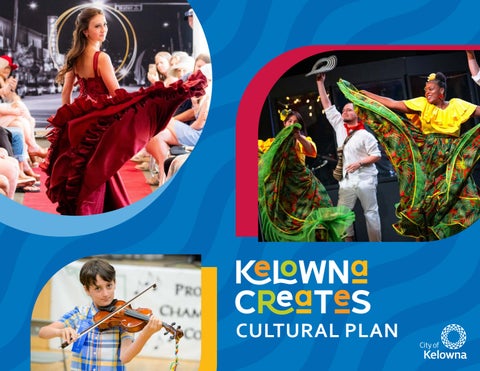
CULTURAL PLAN
syilx/Okanagan Territorial Acknowledgement The City of Kelowna is committed to reconciliation and building meaningful relationships with Indigenous Peoples. We respectfully acknowledge that we are on the traditional, ancestral, and unceded territory of the syilx/Okanagan People. The City of Kelowna is strengthened by the rich history and ongoing contributions of the syilx/Okanagan Nation, whose ancestors have cared for these lands since time immemorial. We also recognize the many Indigenous Peoples who call Kelowna home today, as well as those from around the world who contribute to the city’s vibrancy and diversity. Acknowledging the land is an act of respect and gratitude to the syilx/ Okanagan People, whose stewardship has shaped these lands. It reminds us of our shared responsibility to honour this history, deepen our understanding of the past, and actively engage in reconciliation for a more inclusive and equitable future.
Contents Key Takeaways...................................................................................... 2 1. Introduction...................................................................................... 4 • Kelowna: Cultural Hub of the Okanagan............................................. 5 • Kelowna on the Municipal Cultural Development Continuum......... 6
3. Going Forward: Framing this Plan....................................... 35 • Family of Plans...................................................................................... 36 • Future Considerations: Building a “Culture for Culture”................. 37 • Commitment to Municipal Cultural Infrastructure.......................... 38
• Approach and Timeline......................................................................... 7
4. Implementation, Measurement, and Reporting......... 39
• Engagement at a Glance....................................................................... 8
• Implementation.................................................................................... 40
• Defining Arts and Culture..................................................................... 9
• Measurement........................................................................................ 43
• Recent Key Achievements in Cultural Development....................... 12
• Reporting............................................................................................... 43
2. Vision and Strategic Priorities............................................... 16
5. Key Performance Indicators...................................................44
• Vision...................................................................................................... 17 • Rationale and Overview of the Four Priority Areas.........................18
Acknowledgements.........................................................................49
• How the Priorities Work Together..................................................... 19
Appendices........................................................................................... 50
• Planning Framework............................................................................ 19
• Appendix A | Context Report............................................................ 51
• Strategic Priorities................................................................................ 20
• Appendix B | Glossary........................................................................ 51
• Strategic Priority 1: Build on a Solid Foundation......................... 21
• Appendix C | Background on Cultural Sector Context................... 55
• Strategic Priority 2: Connect the Broader Community.............. 25
• Appendix D | What We Heard: Engagement Findings.................. 68
• Strategic Priority 3: Amplify for Impact....................................... 29 • Strategic Priority 4: Innovate for a Stronger Future................... 32
Photos: (Cover) Clockwise from top left: Kelowna Fashion Week: AesthetiKs Lab, Global Citizen Events Society: Taste of Home, BC Old Time Fiddlers: Branch 7 BC Provincial Championship Fiddle Contest and FiddleFest
KELOWNA CREATES CULTURAL PLAN
1
Key Takeaways
1
As the Okanagan’s most populous city, Kelowna is home to many creatives and the centre of cultural activity. Kelowna is undergoing a cultural shift, shaped by changing community dynamics and identities. Kelowna is best understood as a creative hub at a pivotal stage in its evolution.
2
Kelowna’s rapid growth to a younger, more diverse population and expansion of its downtown core are shaping the community’s cultural life. To adapt to the social, economic, demographic, and environmental shifts Kelowna is experiencing and to navigate major trends impacting the cultural sector, the Kelowna Creates Cultural Plan serves to bridge these shifts to guide targeted community investments in cultural infrastructure, programming, and organizational support for the future.
3
Cultural development is essential to community vibrancy and well-being. Cultural development is an integral part of community-building and is an economic driver with various social benefits from improving residents’ health and well-being, to lowering crime, boosting local economic activity, and attracting physicians and key labour force needs.
4
Notable trends impacting cultural development in Canada include:
•
Broad societal, economic, and global pressures
•
Policy, funding, and structural shifts
•
Equity, Diversity, Inclusion and Accessibility (EDIA) and Reconciliation
•
Audience trends and cultural participation
5
The impact of Canada’s arts and culture sector was an estimated $65 billion in direct contribution to Canada’s gross domestic product (GDP) and backed by a labour force of over 1.1 million cultural workers across the country in 2024. Locally, Kelowna's creative economy sees a labour force of more than 3,500 full-time equivalent jobs and generating over $263 million in total labour income. This means Kelowna is a desirable location for creative labour force attraction. Kelowna saw a 39% increase between 2018 and 2024 in creative jobs (direct full-time equivalent employees). Arts and culture support more jobs and GDP than some of Canada’s largest sectors, including manufacturing and oil and gas.1
6
Kelowna was ranked second in Canada in the 2026 Arts Vibrancy Index by the Canadian Chamber of Commerce and Business for the Arts, recognizing the local economy has both a thriving arts community and broader economic impact.2
7
Input from engagement activities provided a successful foundation to understand the overall impact of culture on the local economy, community health, and tourism, establish how arts and culture can adapt in order to meet the needs of Kelowna, and support the long-term vision of Kelowna’s cultural development.
8
The City of Kelowna has invested in cultural infrastructure and excels at cultural administration. Building on this is broadening leadership and fostering a “culture for culture” by further integrating cultural development into the City’s work at a strategic level. The coming years offer the City an opportunity to grow its return on investment by building community capacity.
1
Canadian Chamber of Commerce and Business Data Lab. October 2025. Artworks: The Economic and Social Dividends from Canada’s Arts and Culture Sector. https://businessdatalab.ca/wp-content/uploads/2025/10/BDL_Artworks_Report_October2025_FINAL.pdf 2 City of Kelowna (2026). https://www.kelowna.ca/newsroom/arts-vibrancy-index
2
KELOWNA CREATES CULTURAL PLAN
VISION
VALUES AND DRIVERS
Kelowna Creates.
Innovation
Inclusion
Resilience
Together. Every Day. Culture.
Curiosity
Identity
Community Wellness
KEY TAKEAWAYS
Kelowna Creates Cultural Plan At-A-Glance
STRATEGIC PRIORITIES
strategic priority 1
strategic priority 2
strategic priority 3
strategic priority 4
BUILD
CONNECT
AMPLIFY
INNOVATE
Build on a Solid Foundation
Connect the Broader Community
Amplify for Impact
Innovate for a Stronger Future
OBJECTIVE 1: Build cultural leadership and capacity.
OBJECTIVE 1: Connect with audiences.
OBJECTIVE 2: Build and maintain cultural infrastructure and spaces.
OBJECTIVE 2: Connect to place-based culture through animated community spaces.
OBJECTIVE 1: Amplify the voice, value, and impact of culture.
OBJECTIVE 1: Innovate in response to emerging trends impacting cultural development.
OBJECTIVE 3: Build equitable access to cultural life, participation, and creative experiences. KELOWNA CREATES CULTURAL PLAN
OBJECTIVE 3: Connect through collaborations and partnerships.
OBJECTIVE 2: Amplify the role of cultural development in shaping community priorities and decisions.
OBJECTIVE 2: Innovate to drive economic development and sectorwide financial resilience.
3
1 Introduction
4
SECTION 1 | INTRODUCTION
1. Introduction Kelowna: Cultural Hub of the Okanagan The City of Kelowna’s previous 2020–2025 Cultural Plan, endorsed by Council in 2019, outlined a framework for cultivating an accessible and engaging arts and culture landscape, one shared vision, four guiding principles, and five key themes, supported by numerous strategies. Its implementation has been a success as Kelowna achieved measurable progress in sustaining and growing its cultural ecosystem despite challenges such as COVID-19 and increased climate change impacts. Kelowna’s creative industries are growing while being recognized within Canada and internationally. Through increased national and international recognition, more major cultural events, and significant progress on Kelowna’s most recent Cultural Plan, Kelowna has established itself as the cultural hub of the Okanagan. As the Okanagan’s most populous city, Kelowna is home to many creatives and the centre of cultural activity. Kelowna is undergoing a cultural evolution, shaped by changing community dynamics and identities. Kelowna is best understood as a creative hub at a pivotal stage in its evolution. To adapt to the social, economic, demographic, and environmental shifts Kelowna is experiencing and to navigate major trends impacting the cultural sector, the Kelowna Creates Cultural Plan will guide community investments in cultural infrastructure, programming, and organizational support for the future. Photo: Niteo Africa: Stories Around the World
Photo: (Page 4 ) Iconic Bear sculpture in Stuart Park by Brower Hatcher
KELOWNA CREATES CULTURAL PLAN
5
Kelowna on the Municipal Cultural Development Continuum To help position where a municipality sits in its cultural development, the Municipal Cultural Development Continuum3 is a useful tool to gauge how cultural investments are helping to advance common municipal goals such as quality of life, vitality, amenities and assets, economic and social impacts, and sense of place and identity.
Kelowna is here
3
6
1
Beautification Effort
2
Economic Driver
3
Community Amenities
4
Creative City
5
Sustainable City
6
Intercultural City
Initiatives are tied to enhancing the attractiveness and beauty of public spaces. (Arts and heritage collections, buildings, monuments)
Cities make the case for the economic value of culture. (Downtown revitalization, Tourism)
Tackling urban issues and investment in community features. (Public art, festivals and events, tangible culture, arts, and heritage infrastructure)
Culture is strategically integrated in urban planning and economic development. (Creative industries, cultural mapping, cultural districts)
Culture becomes part of the infrastructure of a healthy and sustainable community. (Cultural democracy, cultural vitality)
Different cultures and perspectives are interacting, shaping the City’s identity and creative ecosystem. (Cultural democracy, (re)defining cultural meanings, intangible culture)
Dr. Greg Baeker, Municipal World
KELOWNA CREATES CULTURAL PLAN
The development of the Kelowna Creates Cultural Plan was an eighteen-month-long process of research, community engagement, and strategy development that unfolded through seven phases and wrapped up in Fall 2026.
SPRING 2025
FALL 2025
SPRING 2026
FALL 2026–ONWARD
Pre-Planning and Communications
Interest Holder Engagement and Data Collection
Review and Refinement
Plan Delivery, Implementation, Monitoring, and Reporting.
PHASE
1
PHASE
2
PHASE
3
PHASE
4
PHASE
5
PHASE
6
SUMMER 2025
WINTER 2026
SUMMER 2026
Background Research and Review
Plan Development and Content Creation
Plan Adoption, Distribution, and Launch
DESIGN
DELIVER
RESEARCH
KELOWNA CREATES CULTURAL PLAN
SECTION 1 | INTRODUCTION
Approach and Timeline
PHASE
7
7
Engagement at a Glance To develop the next iteration of a community-driven, well-rounded, and actionable Kelowna Creates Cultural Plan, it was important that the strategy was created with the community. Throughout the process, engagement objectives were aligned to the International Association for Public Participation (IAP2) Spectrum and Principles to ensure transparency and fairness within the process. Input from engagement activities provided a successful foundation to understand the overall impact of culture on the local economy, community health, and tourism, establish how arts and culture can adapt in order to meet the needs of Kelowna, and support the long-term vision of Kelowna’s cultural development.
8
Engagement by the Numbers Interdepartmental Staff Sessions with Key City of Kelowna Staff
Community Working Group Sessions
One-on-one interviews and Coffee Conversation with Key Interest Holders
Host Your Own Engagement Sessions
18
20
11
103
Participants/Attendees
Participants/Attendees
Participants/Attendees
Participants
Sept. 16, 2025 Jun. 2 & Jul. 21, 2026
Sept. 16 & Nov. 25, 2025 Jun. 1 & Aug. 12, 2026
Oct.–Dec. 2025
Dec. 23, 2025– Feb. 15, 2026
Community Questionnaire with General Public
Gather Tool with General Public
Pop-up Sounding Boards at Community Events
Pop-up Sounding Boards at Innovation Centre
643
32
38
36
Responses
Posts
Unique Responses
Responses
Oct. 21–Nov. 17, 2025 Jul. 21, 2026
Oct. 21– Nov. 17, 2025
Jul.–Aug. 2025
Feb.–Mar. 2026
Ideas Exchanges with Creative Entrepreneurs, Business Community, Tourism Sector, Arts & Culture Operating Clients, and Community Cultural Groups
75 Participants/ Attendees
Feedback to the Draft Summary through Open Houses, Survey, and Direct Email
75
1,051
Points of Contact
Total Points of Engagement
Nov. 26, 2025
KELOWNA CREATES CULTURAL PLAN
See Appendix B for additional terms.
What is Arts and Culture? “Art is to Culture as Baseball is to Sport.”4 Culture is a porous and flexible concept which includes heritage, the arts, human diversity and many other attributes and practices. Throughout this plan, use of the word “culture” is intended to be broadly inclusive. The subdivision of culture used in cultural policy and development is composed of many expressive and creative disciplines known as “the arts.” The “arts” is a term that encompasses: visual and applied arts (e.g., painting, printmaking, drawing, sculpture, crafts, pottery and ceramics, photography, film, and video), performing arts (theatre, music, dance, and spoken word) and literary arts to name a few. Throughout the Kelowna Creates Cultural Plan, where the term culture is used it is understood to include the arts, heritage, festival and events, and the other assets and resources noted with the Cultural Resources Framework on the following page.
What is Cultural Development? Cultural development is defined as strategic and integrated planning that leverages a community’s unique cultural resources and assets for the social, economic, environmental, and cultural benefit of the city and society. Strategies may include, but are not limited to: •
Establishing lively cultural districts
•
Participatory cultural mapping exercises
•
Encouraging a “Do-it-together” (DIT) culture where non-professional individuals can be creative (e.g., neighbourhood arts workshops, community choirs)
•
Incorporating cultural policy directions in the Official Community Plan
•
Attracting and supporting creative industries (film, television, publishing, design, fashion, music, etc.)
SECTION 1 | INTRODUCTION
Defining Arts and Culture
An important addition and valuable resource is audiences and patrons who play a critical role in advancing Cultural Development. Photo: Art Walk at night 4 Dr. Greg Baeker, MDB Insights
9
Creative Cultural Enterprises & Services Public Art & Installations Public art (sculptures, murals, installations), monuments
Libraries, community centres, municipalities
Visual Artists
Theatre, dance, music, circuses, actors, storytellers
Painting, photography, crafts, sculpture, artists
CULTURAL RESOURCES
History, traditions and customs, Indigenous living heritage and traditional knowledge, artistic expression, stories
Education Art schools, incubators and makerspaces, post-secondary school, elementary and secondary schools
These all play a role along with audiences, patrons, and participants in the successful implementation of the Cultural Plan and are served by the plan. In a cultural development context, culture includes the resources and assets denoted in the Canadian Cultural Statistics Framework which aligns with UNESCO and major governments worldwide.
Natural Heritage Parks and trails, gardens, conservation areas
Spaces & Facilities Formal venues (theatres, performing arts centres, galleries, cultural centres, museums), occasional venues
10
Public Institutions
Performing Artists
Intangible Culture5
5
Writers, radio and TV, sound recording, publishing, film & media, interior design, graphic design, architecture, advertising and PR
https://fpcc.ca/programs/about-our-heritage-programs https://fpcc.ca/resource/intangible-cultural-heritage https://fpcc.ca/resource/indigenous-living-heritage-in-canada
Non-profit and Community Organizations Arts, culture, and heritage organizations, Indigenous-led organizations and cultural groups, support and service organizations
Built Heritage Heritage buildings/properties, museums, culturally significant landmarks
Festivals & Events Arts & culture festivals & events, other festivals & events with arts & culture components
Adapted from Canadian Cultural Statistics Framework
What is Cultural Infrastructure?
Cultural planning is a process of inclusive community consultation and decision-making that helps local governments identify cultural resources and think strategically about how these resources can help a community to achieve its civic goals. It is also a strategic approach that integrates the community’s cultural resources into a wide range of local government planning activities.6 It is closely linked to cultural development. Cultural planning and cultural development go hand-in-hand.
Cultural infrastructure is physical resources or spaces that support cultural exchange, products, or activities within a community. This includes buildings like museums, theatres, libraries, galleries, and cultural centres, as well as networks, funding systems, and policies. Cultural infrastructure accommodates and satisfies the requirements of cultural activities and cultural industries, and may be single purpose or multipurpose, historic or contemporary.7
SECTION 1 | INTRODUCTION
What is Cultural Planning?
What is a Creative Economy? Cultural Planning Economic Development
Community Safety
An economy is driven by ideas, innovation, knowledge, diversity, collaboration, and creativity. It encompasses the creative industries in which ideas and intellectual property produce value and generate wealth. It represents an aggregation of a complex collection of industrial and creative service sectors including design, media, advertising, film, music, performing arts, publishing, and interactive software development.
Community Planning
Tourism Health/Social Programs
Photo: Kelowna Museum Society 6 2010 Legacies Now & Creative City Network of Canada. Cultural Planning Toolkit. https://www2.gov.bc.ca/assets/gov/sports-recreation-arts-and-culture/events-hosting/hosting-toolkit/cultural_planning_ toolkit.pdf 7 Creative City Network of Canada. Cultural Infrastructure: An Integral Component of Canadian Communities. https://www.creativecity.ca/wp-content/uploads/2020/12/News_5_E.pdf
KELOWNA CREATES CULTURAL PLAN
11
Recent Key Achievements in Cultural Development 1. Cultural Sector Economic Impact Assessment8 In Fall 2025, the City completed an updated assessment of the economic and social contributions of Kelowna’s cultural sector, building on earlier studies from 2010 and 2019. The 2024 Assessment highlights significant growth since 2018, using key indicators in economic impact, audience and visitor trends, employment, and social and community outcomes.
In 2024, the cultural sector generated an estimated $381.7 million in direct economic impact, along with $197.9 million in indirect and induced effects. Film and new media represented the largest subsector, contributing $188.6 million in GDP and $227.5 million in total output, accounting for nearly half of Kelowna’s creative economy. The sector also supported more than 3,500 full-time jobs, generating approximately $263.2 million in labour income. Between 2018 and 2024, the number of creative establishments in Kelowna increased by nearly 50%, with a notable shift toward self-employment. The city’s creative workforce is increasingly defined by independent workers, entrepreneurs, and artists pursuing flexible and project-based careers. When benchmarked against other cities in BC, Kelowna residents demonstrate higher-than-average participation in a wide range of arts and culture activities.
2. Arts Vibrancy Index To track vibrant Canadian arts communities and their impact on local economic activity, the Arts Vibrancy Index9 factors-in the arts presence in a particular community and the health of the local economy. A high index score means that the local economy has both a thriving arts community and broader economic activity.
3. Awards and Events Recent awards and events specific to Kelowna’s cultural development include:
kelowna ranked: • #2 Overall • #1 in arts and culture revenue per capita
• #2 in arts and culture jobs per capita
• #4 in all industries revenue per capita nominal growth spending and all industries’ business sentiment
•
In 2025, Kelowna was designated as Canada’s first UNESCO Creative City of Gastronomy, recognizing the city as a world-class centre for agriculture, culinary arts, and beverages.
•
In September of 2025, Kelowna was the site of the Canadian Country Music Association Awards, an event with over 27,500 attendees and a direct economic impact of $11.7 million.10
•
In 2023, annual music festival and industry development conference Break Out West was held in Kelowna, with the city hosting four days of music industry events, a three-night music festival, and the Western Canadian Music Awards.
8 City of Kelowna (2025). Creative Sector Economic Impact Assessment. 9 Source: The Canadian Chamber of Commerce in partnership with Business/Arts 2025. 10 City of Kelowna (2026). Canadian Country Music Association Awards. https://www.kelowna.ca/parks-recreation/event-tournament-planning/major-events/canadian-country-music-association-awards
12
KELOWNA CREATES CULTURAL PLAN
SECTION 1 | INTRODUCTION
Photo: Cultural District
4. Cultural District Kelowna’s Cultural District contains the majority of the City’s cultural facilities and houses 21 pieces of public art, private galleries, performance and concert venues, restaurants, an art walk, banner program, and unique shops that contribute to the vibrancy of north downtown.
KELOWNA CREATES CULTURAL PLAN
The Cultural District is adjacent to the network of waterfront parks, which are key destinations for residents and visitors to gather and celebrate major events and engage in public life. The City has supported the development of the Cultural District through parallel investments in public spaces, transit improvements, and community events and celebrations (including Light Up Kelowna projection project, Canada Day, Parks Alive, Public Skating, etc.).
13
2020–2025 Cultural Plan Report Card The Cultural Plan Progress Report Card reviewed the progress made toward strategic outcomes in the 2020-2025 Cultural Plan. Across all five themes, Kelowna achieved measurable progress in sustaining and growing its cultural ecosystem despite the challenges listed above. The City maintained stable funding, improved infrastructure and accessibility, strengthened sector capacity, advanced reconciliation, and fostered new partnerships and community connections.
Highlights include: Increased per capita cultural investment from $23.75 —> $28.29 Increased permissive tax exemptions by $224,056 Heritage Grants Program provided almost $185,000 in project grants Kelowna Museums signed the BC Repatriation and Heritage & Reconciliation Pledges, the first in BC to do so!
Read the full 2020–2025 Cultural Plan Report Card at
issuu.com/cityofkelowna/docs/2020-2025_cultural_plan_report_card
Photo: Alternator Centre for Contemporary Art
14
KELOWNA CREATES CULTURAL PLAN
As part of the Kelowna Community Theatre renewal in 2022, two spaces in the lobby were allocated for a new Art@KCT professional art exhibition program in partnership with the Alternator Centre for Contemporary Art. By optimizing existing public space, Art@KCT presents the work of visual artists from the Central Okanagan to an audience of engaged cultural supporters. Local artists may propose work for inclusion through an annual open call for submissions. In keeping with efforts to promote fair wages for arts professionals, selected artists receive appropriate CAR/FAC royalties for the presentation of their work. •
28 Okanagan artists supported from 2022–2025
TheBoxOffice.ca, City of Kelowna, 2024 When Kelowna launched TheBoxOffice.ca in 2024, the vision was simple yet ambitious: create a ticketing platform that champions local arts, sports, and community events while keeping revenue and data in the hands of the community. What began as an extension of the Kelowna Community Theatre’s box office has quickly evolved into a regional hub for cultural engagement, helping audiences discover new experiences across the Okanagan. In its first full year, TheBoxOffice.ca has: •
500,000+ monthly digital impressions
•
12% click-through rate (4x industry standard)
•
60,000 active ticket buyers
SECTION 1 | INTRODUCTION
Art@KCT and Alternator Centre for Contemporary Art, 2022–ongoing
The impact is clear. With thousands of tickets sold and strong engagement through targeted marketing, TheBoxOffice.ca has become a trusted partner for event producers. Every sale keeps data and service fees local, reinvesting in city-owned venues and strengthening Kelowna’s cultural ecosystem. For audiences, it offers a seamless, mobile-first experience; for organizers, it delivers confidence through analytics and tailored support. More than a ticketing tool, TheBoxOffice.ca is a strategy for growth by building connections, amplifying local voices, and ensuring that success stays in the community.
Photo: Art@KCT presents Angela Wood, Rhythm and Flow
KELOWNA CREATES CULTURAL PLAN
15
2 Vision and Strategic Priorities
16
Overall key themes that emerged from community, key interest-holders, Indigenous partners, and City of Kelowna staff engagement helped to shape the updated Kelowna Creates Cultural Plan. The Vision, Values and Drivers, and Strategic Priorities were then further developed in collaboration with the Community and Staff Working Groups.
Values and Drivers
Vision
•
•
Kelowna Creates Kelowna Creates…Together. Kelowna Creates…Every Day. Kelowna Creates…Culture. Kelowna is a leader in cultural vibrancy in British Columbia, building on our shared success to shape a sustainable creative future. We invest in a creative ecosystem that strengthens our economy, inspires innovation, and enriches our quality of life and pride of place.
•
•
•
Together, creativity and community nurture the belonging, connection, and well-being that define our city.
• Photos: Creative Okanagan (Page 16) Artist in Residence: Erin Scott and Cole Mash
KELOWNA CREATES CULTURAL PLAN
Innovation
We support creative experimentation, emerging artistic practices, and bold ideas, encouraging thoughtful risks that strengthen Kelowna’s creative ecosystem.
Curiosity
We invest in lifelong learning through arts, culture, and heritage, supporting programming, mentorship, and cross-disciplinary collaboration that invite people of all ages and backgrounds to explore and share knowledge.
SECTION 2 | VISION AND STRATEGIC PRIORITIES
3. Vision and Strategic Priorities
Inclusion
We make space for diverse voices, perspectives, and cultural traditions; supporting intercultural exchange, equitable access, and artistic work that strengthens belonging across our communities.
Identity
We recognize artists and cultural workers as shapers of our city's character, celebrating the heritage and creative expression that gives Kelowna its distinct sense of place and story.
Resilience
We uphold arts, culture and heritage as essential infrastructure, supporting sustainable careers, stable organizations, and adaptive cultural spaces so the sector can respond to change and continue contributing to Kelowna's vitality.
Community Wellness
We prioritize culturally, physically, and psychologically safer environments in venues, programs, and partnerships; supporting artistic work that contributes to mental health, social connection, and collective well-being.
17
Photo: Okanagan Symphony Orchestra
Rationale and Overview of the Four Priority Areas The four priority areas provide an integrated framework for advancing culture in Kelowna. They reflect the conditions needed for a strong cultural ecosystem:
18
•
a stable foundation of people, spaces, and access;
•
meaningful connections between culture, communities, and place;
•
greater recognition of the value and impact of arts, culture, and heritage; and
•
the capacity to innovate in response to social, economic, environmental, and technological change.
Together, these priorities move the Kelowna Creates Cultural Plan beyond individual programs or projects and toward a coordinated approach to long-term cultural development. They recognize that cultural vitality depends not only on creative production, but also on leadership, infrastructure, affordability, participation, partnerships, public awareness, policy alignment, investment, and future readiness.
KELOWNA CREATES CULTURAL PLAN
The four priorities are intentionally interconnected and cyclical. A strong foundation enables broader community connection; connection builds participation, visibility, and co-creation of a shared vision; amplification demonstrates value and informs better decisions; and innovation ensures the cultural sector can adapt, grow, and remain relevant and grounded over time. As each priority advances, it reinforces the others, co-creating a continuous cycle of cultural vitality, community belonging, and creative momentum.
Planning Framework The updated Kelowna Creates Cultural Plan aims to uplift our City’s resiliency and vibrancy by creating a focused architecture that will set the path forward for Kelowna becoming a creative city.
ROLES AND RESPONSIBILITIES LEGEND
Community, including Individuals
Non-profit Organizations
The City and Other Levels of Government
Private Sector
SECTION 2 | VISION AND STRATEGIC PRIORITIES
How the Priorities Work Together
Strategic Priorities, each with a specific rationale, reflect the key focus areas and desired outcomes that emerged from the strategic planning process. Objectives are outcome-driven and present what is expected to be accomplished over the life of the plan. Each objective is realized through Key Actions. Key Actions support the objectives and may reflect new initiatives as well as ongoing work. These actions may include specific items consistent with cultural plan implementation, while other actions may be higher level in keeping with the nature of development work. These actions also reflect the many contributions of the community, Indigenous partners, staff, and align with cultural sector trends. Photo: Ponderosa Fibre Arts Guild
KELOWNA CREATES CULTURAL PLAN
19
STRATEGIC PRIORITIES BUILD Build on a Solid Foundation Core conditions that allow culture to thrive will be prioritized. There will be a focus on strengthening the people, organizations, resources, spaces, and access points that support cultural activity across the city. By investing in leadership, capacity, infrastructure, affordability, and equitable participation, Kelowna can retain creative talent, support sustainable organizations, and ensure residents can take part in cultural life regardless of background, income, age, ability, or neighbourhood.
Amplify for Impact Arts, culture, and heritage need to be better understood, measured, communicated, and integrated into civic decisionmaking. This priority focuses on storytelling, data, advocacy, impact measurement, coordinated communications, and stronger alignment with planning, policy, investment, and service delivery. By amplifying the value of culture, Kelowna can strengthen public awareness, inform better decisions, and demonstrate how cultural development contributes to social, economic, and community well-being.
CONNECT
INNOVATE
Connect the Broader Community
Innovate for a Stronger Future
Culture is most powerful when it is visible, accessible, and connected to everyday community life. It focuses on growing audiences, animating public spaces and neighbourhoods, connecting to the land, strengthening the Cultural District, recognizing the relationship of the syilx/Okanagan people to place and identity, and creating partnerships and reciprocal relationships that link arts and culture with business, tourism, education, technology, wellness, recreation, and community development. By connecting culture to people and place, Kelowna can deepen belonging, expand participation, improve community safety, and strengthen local identity.
20
AMPLIFY
Culture is positioned as a driver of adaptation, creativity, and future resilience. This priority focuses on emerging trends, creative worker attraction and retention, environmental sustainability, digital innovation, responsible use of technology, arts-based well-being, creative enterprise development, market growth, fair compensation, financial resilience, and advancing Indigenous cultural knowledge, perspectives, and creative expression. By supporting innovation, Kelowna can help the cultural sector respond to change, create new opportunities, strengthen cultural identity, and contribute to a stronger, more inclusive, and resilient local economy.
STRATEGIC PRIORITY 1:
Build on a Solid Foundation
Photo: Cultural District: Rotary Centre for the Arts
SECTION 2 | VISION AND STRATEGIC PRIORITIES
BUILD
Rationale Rooted in the rich cultural heritage and enduring presence of the syilx/Okanagan people, Kelowna’s identity has long been built by the stories, knowledge, and creativity of this land. In recent years, Kelowna’s creative industries continue to grow, establishing itself more prominently among Canadian mid-sized cities. In 2026, the Canadian Chamber of Commerce Business Data Lab ranked Kelowna as #2 overall in its Arts Vibrancy Index, a comparison of 22 census metropolitan areas. Kelowna was recently designated as Canada’s first UNESCO Creative City of Gastronomy, and is becoming a destination for prominent Western Canadian music events. The coming years present an opportunity to build on Kelowna’s increasing visibility and strong reputation, further solidifying its position as a creative city.
Objectives OBJECTIVE 1: Build cultural leadership and capacity. OBJECTIVE 2: Build and maintain cultural infrastructure and spaces. OBJECTIVE 3: Build equitable access to cultural life, participation, and creative experiences.
21
OBJECTIVE 1:
Build cultural leadership and capacity.
OUTCOME: Adaptability & Sustainability Kelowna fosters an adaptable and futureready cultural sector where organizations, artists, and creative workers have the capacity, resources, and career pathways to succeed. Through leadership development, workforce supports, mentorship, education and equitable access to opportunities, the community retains creative talent and strengthens a vibrant cultural economy.
Key Actions 1. Facilitate access to shared resources that strengthen organizational and leadership capacity, supporting sector sustainability. 2. Offer training and resources on social enterprise development, sponsorship, emerging and alternative funding models that enhance adaptability and financial stability within the sector. 3. Support capacity-building initiatives tailored to meeting organizations at various stages in their lifecycle. 4. Create initiatives to address burnout and workload pressures in the cultural sector, focusing on staffing sustainability and fair compensation strategies. 5. Develop targeted mentorship networks and professional development opportunities for creative workers that provide support at all career stages. 6. Foster partnerships between post-secondary institutions and the cultural sector to align student training, skills development, and hands-on applied learning with emerging career opportunities, practical experience, and community leadership. 7. Reduce barriers to resources, career pathways, and professional advancement for indigenous, syilx/Okanagan and equity-deserving artists, emerging artists, and underrepresented artistic disciplines.
Photo: Inspired City Summit
22
KELOWNA CREATES CULTURAL PLAN
Build and maintain cultural infrastructure and spaces.
Key Actions 1. Identify and increase access to affordable, flexible production, exhibition and studio spaces for artists, creative entrepreneurs and workers.
Adaptability, Vibrancy, & Future-focused
2. Connect property owners and developers with artists and community groups to activate underused spaces.
Kelowna’s cultural spaces and infrastructure are maintained, adapted, and expanded to strengthen Kelowna as a creative city, with flexible spaces that enable artists, organizations, and communities to create, experiment, innovate, and connect.
3. Review and amend zoning bylaws, event permitting and booking processes to better support community cultural activities, creative use, and arts entrepreneurship.
OUTCOME:
SECTION 2 | VISION AND STRATEGIC PRIORITIES
OBJECTIVE 2:
4. Ensure cultural facilities and spaces reflect and welcome Kelowna's changing community in how they are designed, programmed, and activated. 5. Prioritize equitable access to cultural infrastructure and spaces across neighbourhoods. 6. Protect, conserve, and advocate for the preservation of sylix heritage, intangible cultural heritage, built heritage, cultural facilities, and cultural infrastructure.
Photo: Knowles Heritage Park
KELOWNA CREATES CULTURAL PLAN
23
OBJECTIVE 3:
Build equitable access to cultural life, participation, and creative experiences.
OUTCOME:
Sense of Identity, Belonging & Inclusion Kelowna is a community where cultural participation is accessible, affordable, and inclusive. Where people can easily find and engage in creative experiences that reflect their interests and strengthen belonging across all neighbourhoods.
Key Actions 1. Identify and address gaps in cultural programming to reflect demographic change, affordability needs, and evolving community priorities through ongoing engagement and feedback. 2. Reduce systemic, institutional, and geographic barriers to cultural participation, creative expression, and decision-making, ensuring all residents can access, contribute to, and shape Kelowna's cultural life. 3. Strengthen youth and intergenerational participation in cultural planning, delivery, and evaluation to ensure inclusive civic engagement in the cultural sector. 4. Support and advance Indigenous-led cultural expression, leadership, and participation in cultural life.
Photo: Le Centre Culturel Francophone de l'Okanagan Maplefest
24
KELOWNA CREATES CULTURAL PLAN
STRATEGIC PRIORITY 2:
Connect the Broader Community
Photo: Africans of the Okanagan: Naija Wedding
SECTION 2 | VISION AND STRATEGIC PRIORITIES
CONNECT
Rationale Rooted in the teachings of the syilx/Okanagan people, a connected community is built through reciprocal relationships, collective responsibility, and a deep connection to the land and place. A thriving cultural landscape that encourages and celebrates artistic practices extends throughout Kelowna’s diverse neighbourhoods and coalesces in Kelowna’s Cultural District where well-being and belonging are supported through shared experiences and participation. Widening participation and deepening collaborations generate an interwoven and cohesive community identity. Social cohesion is the glue that binds a community, underpinned by trust and belonging, active participation, supportive policies and infrastructure, and easy access.
Objectives OBJECTIVE 1: Connect with audiences. OBJECTIVE 2: Connect to place-based culture through animated community spaces. OBJECTIVE 3: Connect through collaborations and partnerships.
25
OBJECTIVE 1:
Connect with audiences.
OUTCOME:
Sense of Identity, Belonging, & Inclusion Kelowna's cultural sector attracts, engages, and retains diverse audiences.
Key Actions 1. Enhance representation and visibility within public art, placemaking, and community events. 2. Create opportunities for audiences to explore different genres, artistic disciplines, cultures, and creative experiences through “tryit” campaigns, education and experimentation. 3. Strengthen arts education by involving local arts practitioners in schools and connecting students with arts facilities and events. 4. Implement innovative ticketing models, such as bulk tickets, festival passes, and multi-organization options. 5. Enhance social media presence, audience development, and digital strategies for audience growth.
Photo: Niteo Africa Society: Stories Around the World
26
KELOWNA CREATES CULTURAL PLAN
Connect to place-based culture through animated community spaces.
OUTCOME:
Placemaking, Sense of Identity, Vibrancy, & Community Safety Kelowna's public spaces, neighbourhoods, and Cultural District are safe, vibrant cultural destinations where residents and visitors can easily discover, experience, and connect with local arts, heritage, creative expression, and the living cultural traditions of the syilx/Okanagan peoples that contribute to a strong sense of place.
Key Actions 1. Implement strategies to better leverage and promote Kelowna’s Cultural District as an asset to cultural tourism. 2. Animate everyday nontraditional, outdoor spaces, public art, built heritage and intangible cultural assets through tours, workshops, storytelling, and other engagement activities. 3. Support the development, implementation and strategies associated with the Public Art Strategy.
SECTION 2 | VISION AND STRATEGIC PRIORITIES
OBJECTIVE 2:
4. Create a strategy to incorporate creative wayfinding elements including, where appropriate, nsyilxcən (syilx/Okanagan) language to improve navigability and visibility and strengthen connections to place in cultural events, venues, spaces, and urban design. 5. Engage local businesses, BIAs, and neighbourhood associations in cultural initiatives that connect creative experiences to the unique identity and character of the neighbourhoods and commercial areas where they are located. 6. Support placemaking projects that animate and enhance public spaces and inspire creativity.
Photo: Community Art Grant: In-Tension
KELOWNA CREATES CULTURAL PLAN
27
OBJECTIVE 3:
Connect through collaborations and partnerships.
OUTCOME:
Vibrancy, Connectivity, & Future-focused Kelowna's cultural sector is connected through strong cross-sector, cross-cultural, and regional partnerships that expand opportunities, strengthen creative enterprises, and integrate arts and culture into community and economic development.
Key Actions 1. Strengthen sector convening and senior-level strategic dialogue to support sector collaboration on shared priorities and challenges. 2. Nurture collaborations and connections with economic development groups, business associations, neighbourhood associations, tourism representatives, technology leaders, wellness advocates, sports and recreation organizations, and educational institutions. 3. Deepen relationships with diverse cultural communities and promote intercultural exchange through cross-cultural networks and collaborations. 4. Promote shared use of creative technologies and deepen partnerships with the technology sector. 5. Leverage the UNESCO City of Gastronomy designation to highlight culinary arts and locally produced food and beverage in events, programs, and cultural performances. 6. Build strategic relationships that expand local and regional programming throughout the Okanagan. 7. Embed arts in non-arts mandated organizations, events, and programming, with a focus on the development of new partnerships that elevate the community impact of the arts.
Photo: Pride Festival
28
KELOWNA CREATES CULTURAL PLAN
STRATEGIC PRIORITY 3:
Amplify for Impact
Photo: Ballet Kelowna , photo by Abigail Wiens
SECTION 2 | VISION AND STRATEGIC PRIORITIES
AMPLIFY
Rationale Arts, culture, and heritage play a significant role in Kelowna’s social, economic, and community well-being, but their full value is not always visible, understood, or reflected in decision-making. As the cultural sector grows and community needs become more complex, there is a need to better measure, communicate, and advocate for the impact of cultural development. Amplifying the voice, value, and contributions of culture will help build public awareness, strengthen support for investment, inform policy and planning, and demonstrate how culture contributes to belonging, identity, economic vitality, and quality of life.
Objectives OBJECTIVE 1: Amplify the voice, value, and impact of culture. OBJECTIVE 2: Amplify the role of cultural development in shaping community priorities and decisions.
29
OBJECTIVE 1:
Amplify the voice, value, and impact of culture.
OUTCOME:
Resiliency, Vibrancy, Placemaking & Future-focused Kelowna’s cultural sector is widely recognized, understood, and valued for its social, cultural, and economic contributions. Through shared data, impact measurement, storytelling, advocacy, and coordinated communications, the community strengthens public awareness, informs decision-making, responds to community needs, and demonstrates the relevance of arts, culture, and heritage in everyday civic life.
Key Actions 1. Support the development of systems, tools and knowledge to measure and articulate data that can be used to refine community programming and amplify community impact. 2. Share the economic, social and cultural value of the cultural sector in relevant and timely ways. 3. Encourage public officials, Council members, syilx/ Okanagan elders, community leaders, and possible donors to the cultural sector to attend arts and cultural events. 4. Develop coordinated marketing, communications, and media campaigns that use preferred languages, culturally relevant methods, and multiple channels to build audiences, promote arts achievements and opportunities. 5. Promote the cultural sector beyond city limits by building and sharing a compelling narrative that strengthens the city’s identity and reputation as a vibrant creative hub.
Photo: Inspired City Summit
30
KELOWNA CREATES CULTURAL PLAN
Key Actions
Amplify the role of cultural development in shaping community priorities and decisions.
1. Empower arts service organizations to lead, support, convene and advocate for sector development at a strategic level.
OUTCOME: Vibrancy, Sustainability & Resiliency Cultural development is embedded as a shared civic responsibility across planning, policy, investment, and service delivery. Through stronger sector leadership, cross-departmental collaboration, sustainable funding practices, and transparent implementation, Kelowna advances an interconnected cultural ecosystem that informs community priorities, supports equitable access, and strengthens the wellbeing, identity, and belonging of all residents.
2. Integrate and align cultural space needs, artist affordability, and accessibility into broader municipal planning, decision making and service delivery earlier in the planning processes. 3. Strengthen collaboration across City of Kelowna departments, Indigenous communities, cultural organizations, and non-arts mandated partners to integrate arts, culture, and heritage into decision-making, planning, programs, services, and everyday experiences.
SECTION 2 | VISION AND STRATEGIC PRIORITIES
OBJECTIVE 2:
4. Conduct an environmental scan and granting framework review to identify opportunities to better support sector stability and sustainable funding models, ensure equitable practices, and streamline reporting requirements within and across granting programs. 5. Develop implementation strategies that align Kelowna Creates Cultural Plan priorities and objectives with available resources, clear actions, timelines, evaluation measures, and regular progress reporting to support transparency and accountability.
Photo: New Vintage Theatre Society
KELOWNA CREATES CULTURAL PLAN
31
INNOVATE STRATEGIC PRIORITY 4:
Innovate for a Stronger Future
Photo: French Cultural Centre: Nuit Blanche
Rationale A sustainable future means building on the momentum emerging in creative and cultural workforce development, capacity-building, and cultural infrastructure, while aligning policies, partnerships, and investments to support a sustainable sector where artists and creative workers can live, work, and create. It also requires deeper crosssector strategic collaboration to enable innovation and expand opportunities, alongside a strong understanding of sector pressures to ensure timely, relevant and adaptive responses to changing needs.
Objectives OBJECTIVE 1: Innovate in response to emerging trends impacting cultural development. OBJECTIVE 2: Innovate to drive economic development and sectorwide financial resilience. .
32
KELOWNA CREATES CULTURAL PLAN
Key Actions
Innovate in response to emerging trends impacting cultural development.
1. Strengthen the attraction and retention of creative workers, including artists, cultural practitioners, and syilx/Okanagan artists and knowledge keepers.
OUTCOME: Adaptability & Future-focused Kelowna’s cultural sector is adaptive, forward-looking, and resilient, with the capacity to respond to emerging trends and opportunities. Through innovation in workforce development, sustainability, digital practices, and creative industries, the sector advances community well-being, drives economic growth, and remains responsive in a rapidly changing environment.
2. Advance the framework for reconciliation through the British Columbia Declaration on the Rights of Indigenous Peoples Act (DRIPA) and set out in the United Nations Declaration on the Rights of Indigenous Peoples (UNDRIP) and the Calls to Action of the Truth and Reconciliation Commission (TRC) of Canada, in collaboration with syilx/Okanagan partners.
SECTION 2 | VISION AND STRATEGIC PRIORITIES
OBJECTIVE 1:
3. Support volunteerism, research and arts-based initiatives that advance well-being, inspire positive social change, and demonstrate the impact of arts participation on health and well-being. 4. Embed climate-conscious and sustainable practices across cultural programs, facilities, and events. 5. Encourage human-centred approaches while advancing digital transformation and, where appropriate, address the ethical, transparent, and responsible use of Artificial Intelligence (AI). 6. Strengthen the sector’s ability to anticipate and respond to emerging trends, opportunities, and challenges.
Photo: Eco Dye Workshop
KELOWNA CREATES CULTURAL PLAN
33
OBJECTIVE 2:
Innovate to drive economic development and sector-wide financial resilience.
OUTCOME:
Sustainability, Vibrancy & Placemaking Through targeted investment, business supports, creative enterprise development, market expansion, fair compensation practices, and stronger partnerships with funders, businesses, and philanthropists Kelowna’s cultural sector is financially resilient, entrepreneurial, and has the resources, skills, and opportunities to grow sustainable careers, enterprises, and communityserving cultural initiatives.
Key Actions 1. Accelerate emerging creative enterprises through business supports, business incubators, seed funding programs and access to micro-loans. 2. Strengthen revenue diversification by enabling organizations to leverage public investment to attract alternative funding, partnerships, and new market opportunities. 3. Drive the growth of highpotential creative industries, expanding opportunities for economic development. 4. Expand markets by increasing opportunities for promotion, distribution, cultural tourism, export, and "buy local" initiatives. 5. Advance fair compensation standards for creative workers, including artists, cultural practitioners, and syilx/Okanagan artists and knowledge keepers. 6. Collaboratively develop a fund that attracts business investment and philanthropy to reinvest in community cultural initiatives.
Photo: Artist in Residence: Lucas Glen
34
KELOWNA CREATES CULTURAL PLAN
3 Going Forward: Framing this Plan
35
3. Going Forward: Framing this Plan Family of Plans The Kelowna Creates Cultural Plan lives within an ecosystem of plans and operates under the direction of the Official Community Plan (OCP), a powerful growth management tool grounded in the community's vision for the future. It is also informed by Imagine Kelowna, a community vision developed by residents that is guided by the principles of being connected, smarter, responsible, and collaborative. The Plan is shaped by, and intersects with the Community Safety Plan, the regional Roadmap to Resiliency: Central Okanagan Economic Development Commission (COEDC) Strategy, as well as the City’s Transportation Master Plan in regards to improving access to urban centres. The Roadmap to Resiliency COEDC Strategy includes strategic directions around driving economic resilience, building a skilled workforce, and promoting innovation, all of which are reflected in this Plan. The Plan is informed by Weaving our Collective Threads: Offering a Pathway for Syilx Creativity Within the City of Kelowna, prepared by Carrie Terbasket of Stands Above Consulting. The report highlights the importance of advancing syilx creativity, strengthening relationships with the Okanagan Nation, and recognizing the deep connections between culture, land, language, and community. It reinforces the value of reciprocal relationships, collective responsibility, and Indigenous ways of knowing as foundational elements of a vibrant and inclusive cultural future.
Imagine Kelowna: The Community Vision Council Priorities 2023-2026
Imagine Kelowna: Official Community Plan
Roadmap to Resiliency: COEDC Strategy*
Kelowna Heritage Strategy
Public Art Strategic Plan**
Community Safety Plan
Transportation Master Plan
Kelowna Cultural Plan
Central Okanagan Music Strategy***
Kelowna Event Strategy
Weaving our Collective Threads**** Cultural Facilities Master Plan
*The Roadmap to Resiliency: COEDC Strategy was produced by the Central Okanagan Development Commission. **The Public Art Strategic Plan is forthcoming. ***The Central Okanagan Music Strategy was produced by Creative Okanagan. ****Weaving our Collective Threads: Offering a Pathway for Syilx Creativity Within the City of Kelowna was prepared by Carrie Terbasket, Stands Above Consulting.
Photo: (Page 35) OCCA Spring Lantern Festival
36
KELOWNA CREATES CULTURAL PLAN
Future Considerations: Building a “Culture for Culture”
The existing Cultural Facilities Master Plan (CFMP) is a guiding document that builds on prior efforts to strengthen commitment to cultural facility development. The CFMP explores how facilities throughout the city are used in support of cultural programming, the opportunities and challenges related to City-owned cultural facilities and what steps are needed to enhance Kelowna’s cultural spaces to meet current and future needs.
By continuing to incorporate culture more broadly into decision-making across the City a more integrated lens on cultural development can be achieved. Information-sharing and collaborative projects between branches and departments can leverage existing human resources and skills without necessarily needing to increase staffing levels.
OUR TARGET Kelowna Creates establishes a per capita investment target of
$40 by 2040.
The City of Kelowna has invested in cultural infrastructure and excels at cultural administration. Building on this is the need for broadening leadership and fostering a “culture for culture” by further integrating cultural development into the City’s work at a strategic level.
By playing a leadership role in cultural development, encouraging information sharing and facilitating capacity-building in the broader community, the City can extend a “culture for culture” beyond City Hall and throughout the community.
“The arts and culture sector enriches every aspect of Canadian life. It fields economic growth, attracts talent, fosters belonging, and strengthens our communities.”11 – aubrey reeves, President and CEO of Business/Arts
SECTION 3 | GOING FORWARD: FRAMING THIS PLAN
The Kelowna Creates Cultural Plan is also intended to bolster and support Kelowna’s Event Strategy, Heritage Strategy, forthcoming Public Art Strategic Plan, and the regional Music Strategy. In other words, this Plan aims to provide high-level support for the actions and objectives identified in these strategies and plans without duplicating existing efforts.
A $40 per capita investment in culture by 2040 reflects Kelowna's commitment to ensuring that arts, culture and heritage grow alongside our population. It provides a clear, measurable target that supports community vibrancy, creative sector sustainability, and quality of life for current and future residents.
11 Aubrey Reeves, October 28, 2025, as quoted in “Arts and Culture Sector Contributes $131 Billion to Canada’s Economy.” Canadian Chamber of Commerce. https://chamber.ca/news/arts-and-culture-sectorcontributes-131-billion-to-canadas-economy
KELOWNA CREATES CULTURAL PLAN
37
Commitment to Municipal Cultural Infrastructure
Cultural infrastructure projects may emerge or change as opportunities are identified and evaluated in alignment with Council priorities, community needs, and available resources.
Kelowna will continue to invest in cultural infrastructure that supports community participation, creative expression, and economic growth. The City of Kelowna's 10-year Capital Plan includes dedicated funding for arts and culture focused on enhancing and maintaining City owned cultural facilities, helping to create a community with a rich variety of high-quality arts, culture, and heritage experiences that embrace diversity and are open and welcoming to all.
While municipal facilities are an important component of cultural infrastructure, they represent only one part of a broader cultural ecosystem. Cultural activities are also supported through spaces owned and operated by non-profit organizations, Indigenous communities, educational institutions, businesses, developers, and private sector partners. From galleries, studios, performance venues, museums, festivals, and creative workspaces to community gathering places and public spaces, it is the collective strength of this interconnected network that supports cultural development and community vibrancy.
The City is currently engaged with three major commitments: •
Advancing a Cultural Facilities Master Plan to guide long-term infrastructure priorities and investments.
•
Planning and business development work for the proposed Okanagan Centre for the Performing Arts (OCPA) as a regional-scale venue serving the broader Okanagan.
•
Strategic renovations to the Kelowna Community Theatre (KCT) to improve accessibility, audience experience, operational efficiency, and long-term sustainability.
In addition to these major commitments, the City is advancing targeted investments that strengthen cultural and civic assets, including: •
Central Okanagan Sports Hall of Fame (Kelowna Museums)
•
Kerry Park Upgrades
•
Kelowna Artwalk Expansion
•
Queensway Upgrades, including updates to the Okanagan Heritage Museum exterior
•
North Entry Monument
•
Art and Culture Equipment Fund
Photo: Okanagan Heritage Museum
38
KELOWNA CREATES CULTURAL PLAN
4 Implementation, Measurement, and Reporting
39
4. Implementation, Measurement, and Reporting Implementation The goal is to build a resilient foundation during turbulent times, and encourage a strong cultural ecosystem that can be stabilized further in future years. While the City plays a central role in the development and implementation of this Plan, its fulsome implementation will require collaboration between nonprofit organizations, individual creatives and arts-appreciators, the broader community, all levels of government, and the private sector. This plan establishes the priorities and key actions; the next step will be to develop a detailed approach for phasing, resourcing, and outcome measurement on these actions.
Roles and Responsibilities Roles and Responsibilities reflect the interconnected nature of implementing the Kelowna Creates Cultural Plan.
Roles The City and other levels of government, artists and cultural workers, community groups, arts and cultural organizations, foundations and capacity builders, Indigenous and equity-deserving individuals, and business in the private sector all play a role along with audiences, patrons, and participants in the successful implementation of the cultural plan and are served by the plan. In subsequent action planning, one or more of these icons will be used to identify the interest holders associated with initiatives.
Audience and Participants
Non-profit and Community Organizations
The City and Other Levels of Government
Foundations and Capacity Builders
Artists and Cultural Workers
Indigenous and Equity-deserving Individuals
Private Sector
Photo: (Page 39) Cultural District: Art Gallery
40
KELOWNA CREATES CULTURAL PLAN
Descriptions of the Various Responsibilities in Cultural Development The specific responsibilities of an interest holder can shift depending on the nature and goals of each initiative, reflecting the diverse ways they may contribute to cultural development.
•
Funder
•
Providing grants and financial support to local arts and culture organizations.
•
Facilitator and Information Broker Connecting artists, creative professionals, cultural practitioners, and businesses for opportunities, knowledge-sharing, networking, and resources.
•
•
•
Owner
•
Programs and Service Delivery Planning, implementation, management, and evaluation of programs, services, and facilities to achieve organizational objectives, and deliver value to the community.
Role of the City in Municipal Cultural Development Cultural development at the municipal level spans three key components; (1) cultural administration; (2) programs and services delivery; (3) community cultural development. These components typically include heritage, public art programs, capacity-building including grant administration for cultural organizations, festivals and events, arts programming and various arts disciplines, and economic development. Since arts and culture are inherently multifaceted and interconnected, the strongest government cultural development initiatives exist within organizations that are able to effectively collaborate across resource areas and the three main components.
Promoter and Advocate Championing arts & culture within the community to raise awareness, grow participation, and build the reputation as a cultural hub.
•
Owning key cultural facilities and partnering with non-profits to keep cultural spaces active, programmed and accessible for the community.
Partner and Stakeholder Collaborating with cultural organizations, tourism, entrepreneurs, community groups, Indigenous partners, and creative professionals to support cultural growth and new opportunities.
Custodian and Host Providing, maintaining and activating cultural spaces, facilities and public realm for the community to create, gather and celebrate.
Capacity Builder and Supporter Supporting sector development through organizational resilience, professional skills development, career pathways, and compensation standards to attract, retain, and grow the cultural sector long term.
•
Culture Consumer Engages with, attends, purchases, experiences, or otherwise consumes arts and cultural activities, products, and experience.
SECTION 4 | IMPLEMENTATION, MEASUREMENT AND REPORTING
Responsibilities
Arts and culture aren’t a “frill.” Recently, there has been a growing understanding that they are essential economic infrastructure key to identity and belonging.12
12 Arts BC. (May 20, 2026). https://www.instagram.com/p/DYkMg_GFdF1/?igsh=ejFxdjNseDFiazkz&img_index=9
KELOWNA CREATES CULTURAL PLAN
41
42
Key Performance Indicators
Culture is complex, evolving, and deeply connected to community life. Measuring progress requires a range of approaches that reflect both what can be counted and what can be experienced, shared, and understood through stories, relationships, and community outcomes.
Key Performance Indicators help track progress toward the goals and objectives of the Kelowna Creates Cultural Plan. They may include quantitative measures, such as participation levels, investment, facility use, or program activity, as well as qualitative measures, such as partner feedback, community stories, relationship-building, and examples of cultural impact.
This plan provides a broad vision for the direction of cultural development and outlines the foundation needed to move toward our shared goals. A more detailed implementation plan will identify the projects, initiatives, partners and timelines needed to achieve these goals. The associated Action Plan (or Implementation Framework) will provide guidance for essential implementation items including: •
Roles and Responsibilities
•
Communications and Ongoing Engagement
•
Priority-setting and Timelines
•
Metrics/KPIs
•
Resource Considerations
Measuring Our Progress Progress will be shaped by the collective contributions of the City, community groups, arts and cultural organizations, Indigenous communities, other levels of government, the private sector, audiences, patrons, and participants. Because priorities and initiatives will vary in scope and purpose, implementation plans will identify the most relevant Key Performance Indicators for specific initiatives, while also considering broader measures that reflect sector-wide progress and impact. The following section will outline a menu of possible Key Performance Indicators and is intended to support shared measurement across the cultural ecosystem. It includes measures commonly used by municipalities, arts and cultural organizations, and community partners. This is intended to understand progress, demonstrate impact, and support ongoing accountability.
SECTION 4 | IMPLEMENTATION, MEASUREMENT AND REPORTING
Measurement
Reporting
S
M
A
R
T
Transparent and accountable reporting is essential to tracking progress, identifying opportunities for improvement, and demonstrating shared responsibility for implementation.
Specific
Measurable
Achievable
Relevant
Time-Bound
Building on the reporting approach established in the 2020–2025 Cultural Plan, the City will prepare a bi-annual report card for public presentation. The report card will summarize progress on strategic priorities and key actions using available quantitative and qualitative data to monitor implementation of the Kelowna Creates Cultural Plan.
Photo: (Page 42) Opera Under the Stars at UBCO
KELOWNA CREATES CULTURAL PLAN
43
5 Key Performance Indicators 44
Key Performance Indicators Key Performance Indicators for this strategic priority could include: •
Number of hours of professional development undertaken by local creative workers
•
Square footage of community space available for artistic production and presentation
•
Number of participants who participate in peer learning and other training opportunities
•
Average cost per square foot of community space available for production/presentation space
•
Number of access/downloads of shared resources
•
•
Number of professional development opportunities for artists and cultural workers
Presentation of temporary cultural activities in vacant and underused spaces
•
Establishment of new capacity-building programs/ opportunities
Number of cultural activations and programming in City-owned spaces
•
Staff turnover rate within non-profit arts organizations
Investment in technical infrastructure needs to support culture presentation and production
•
Percentage of employees paid a living wage within the non-profit cultural sector
Number of cultural activations and programming per neighbourhood
•
Net change in primary cultural infrastructure and assets (spaces lost are outweighed by spaces gained)
•
Development of formal and informal partnerships with business, tourism, and donors
•
Youth are co-developing, leading and contributing to arts and culture initiatives
•
Number of Indigenous-led cultural expression initiatives supported or presented annually
•
Number of Artist in Residence programs/artists engaged
• • • •
Number mentorship placements for local creative workers
•
Number of mentorship programs/matches that connect students and youth with established creative professionals
•
•
Number of small, emerging, and underserved organizations and practitioners receiving funding supports Number of funding opportunities and resources available to equity-deserving communities
SECTION 5 | KEY PERFORMANCE INDICATORS
BUILD: Build on a Solid Foundation
Photos: Cultural District: Kelowna Art Gallery (Page 44) Alternator Centre for Contemporary Art
KELOWNA CREATES CULTURAL PLAN
45
CONNECT: Connect the Broader Community Key Performance Indicators Key Performance Indicators for this strategic priority could include: •
Number of public art, placemaking, and community event initiatives, including implementation of Public Art Strategy actions, featuring underrepresented artists or communities
•
Net change in audience participation, including engagement through social media, digital channels, and cultural tourism/visitation
•
Number of participants reached and converted through accessible or innovative ticketing programs
•
Number of students and participants engaged in arts learning, professional development, and peer learning opportunities with local practitioners
•
Number of accessible arts experiences, signature festivals, and culinary/ gastronomy-focused cultural events delivered annually
•
Number of underutilized spaces activated and partnerships developed (including regional, inter-sectoral, business, and non-arts organizations)
•
Participation in inter-sectoral working groups, roundtables, and collaborative initiatives
•
Number of intercultural collaboration initiatives and stories shared from equity-deserving communities
•
Number and diversity of creators engaged in cultural programs and initiatives
Photo: Global Citizen Events Society: Taste of Home
46
Key Performance Indicators Key Performance Indicators for this strategic priority could include: •
Number of shared resources downloads or accesses by local artists and organizations
•
Number of organizations accessing the Kelowna Cultural Sector Economic Impact Assessment report
•
Number of public officials, Council members, syilx/Okanagan elders, community leaders, and potential donors attending arts and cultural events annually
•
Increase in audience reach, engagement, or participation driven by culturally relevant, multilingual, and multi-channel marketing
•
Number of external promotional features, partnerships, or campaigns showcasing Kelowna’s cultural sector beyond city limits
•
Number of community stories and data points shared with the public
•
Percentage of funded projects with Key Performance Indicators and evaluation metrics embedded in program design
•
Number of planning initiatives that integrate arts, culture, or heritage through cross-departmental or cross-sector collaboration
•
Alignment of the Cultural Grant program with the Kelowna Creates Cultural Plan
•
Percentage of Kelowna Creates Cultural Plan implementation actions with assigned resources, timelines, evaluation measures, and completed annual progress reporting
•
Establishment of and participation in a local Creator/Creative Advisory Committee
•
Number of new cross-sector collaborations
SECTION 5 | KEY PERFORMANCE INDICATORS
AMPLIFY: Amplify for Impact
Photo: Le Centre Culturel Francophone de l'Okanagan Maplefest
KELOWNA CREATES CULTURAL PLAN
47
INNOVATE: Innovate for a Stronger Future Key Performance Indicators Key Performance Indicators for this strategic priority could include: •
Creative worker attraction and retention rate within Kelowna’s cultural sector
•
Perceptions of community and individual well-being through arts and culture
•
Percentage of cultural programs, facilities, and events that incorporate climate-conscious or sustainable practices
•
Percentage of funded organizations that have responsible AI use policies and guidelines
•
Number of emerging creative enterprises supported through business incubation, seed funding, microloans, or business development services
•
Value of alternative funding, partnerships, sponsorships, or earned revenue leveraged by cultural organizations
•
Number of creative enterprises supported through business development, market expansion, or investment readiness initiatives
•
Market reach, sales, or tourism-related participation resulting from promotion, distribution, export, or buy-local initiatives
•
Creation of a community arts and culture fund
•
Value of business investment and philanthropic contributions secured for the community arts and culture fund
•
Number of cultural initiatives, partnerships, policies, and programs that demonstrate alignment with the Truth and Reconciliation Commission Calls to Action and the United Nations Declaration on the Rights of Indigenous Peoples (UNDRIP)
Photo: Central Okanagan Performing Arts Festival
48
The Kelowna Creates Cultural Plan was created in collaboration with the community of Kelowna and is an important milestone that sets the path forward for sustainable cultural development at the City of Kelowna.
ACKNOWLEDGEMENTS
Acknowledgements
A sincere thanks to all community members who attended sessions, inspired the vision for arts and culture, participated in interviews, and contributed to the development of the final plan. Thank you to Mayor and Members of Council. Thank you to the City of Kelowna Cultural Services Department for your leadership in advocating for culture in Kelowna: Christine McWillis, Sara Thirnbeck, Joanne Taylor, Laura Day. Thank you to the City of Kelowna Interdepartmental Working Group for providing input on how to foster and sustain a “culture for culture” at City Hall: Jim Gabriel, Sigrun Geirsdottir, Robert Miles, Sarah Semeniuk, Tanya Sletten, Paul Selzer, Tracey Hillis, Lyndsay Regnier, Christine Matte, Valentina Trevino, Paul Reyes, Ben Walker, Carlin Bolt. We extend our appreciation to the Community Working Group members for their knowledge and expertise in shaping the plan: Lorna McParland, Samuel Abiodun, Mide Coker, Fei Liu, Wilbur Turner, Wayne Wilson, Elana Bizovie, Ally Gallant, Jacqueline Faulkner, Damon Gregory, Lisa Magnusson, Jillian Povarchook, Sergio Cortes, Debbie Hubbard, Carol Fraser, Anna Jacyszyn, Eliseo Santillan, Joshua Desnoyers, Steve Huculiak. We extend our appreciation to Elder Llana Teichroeb for her knowledge and expertise in shaping the strategy. The Kelowna Creates Cultural Plan was developed by the City of Kelowna, Cultural Services Department with guidance from Patricia Huntsman, Principal of Patricia Huntsman Culture + Communication, and a multidisciplinary team of professionals: Laurel Lawry, Parm Johal, Amanda McCulley, Justine Bochenek, Em Cussen, Katie Lapi. Photo: Art Walk, UBCO Banner
KELOWNA CREATES CULTURAL PLAN
49
Appendices
50
Appendix A | Context Report Context Report: kelowna.ca/sites/files/1/docs/final_city_of_kelowna_ cultural_plan_context_report_1.pdf
Appendix B | Glossary Artist The designer/creator of an artwork who has completed specialized training in his or her artistic field or is recognized by their peers as such; is committed to his/her artistic activity; and has a history of public presentation. The Canada Council for the Arts defines a professional artist as someone who: •
Has specialized training in the field, consistent with the standards of their practice.
•
Is recognized by other artists working in the same tradition as an artist of superior achievement or potential.
•
Is committed to their own artistic vision, retains creative control and is committed to the creation and/or promotion of original work.
•
Has a history of public presentation in a professional context, receives professional compensation for the public presentation of their work, and actively seeks to maximize their audience, regardless of purely commercial considerations.
Arts The subdivision of culture, composed of many expressive and creative disciplines. The term encompasses: visual and applied arts (e.g., painting, printmaking, drawing, sculpture, crafts, pottery and ceramics, photography, film and video), theatre, music, song, spoken word, literary arts and dance.
APPENDIX B | GLOSSARY
Appendices
Capacity-Building The process of developing and strengthening the skills, resources, and systems an organization needs to better achieve its purpose. Community Working Group Groups that contribute to the development of a strategy and are often composed of multigenerational and multicultural members mirroring the local ecosystem and the various aspects of life in the community. Includes key arts and culture partners, equity-deserving groups, business owners, tourism and related sector partners. Cultural Democracy An approach to arts and culture that actively engages everyone in deciding what counts as culture, where it happens, who makes it, and who experiences it.13 Creative Economy An economy is driven by ideas, innovation, knowledge, diversity, collaboration, and creativity. It encompasses the creative industries in which ideas and intellectual property produce value and generate wealth. It represents an aggregation of a complex collection of industrial and creative service sectors including design, media, advertising, film, music, performing arts, publishing, and interactive software development.
Photo: (Page 50) Kelowna Community Music School: 50th Anniversary Concert 13 64 Million Artists, https://64millionartists.com/resource/cultural-democracy
KELOWNA CREATES CULTURAL PLAN
51
Creative Ecosystem/Cultural Ecosystem The interconnection of cultural resources in a community. The arts function as a part of a larger network of industries with each cultural resource playing an important role in shaping the city’s arts and culture scene. Facilities, spaces, festivals, makers, artists, designers, arts organizations, tourism, and business all interact with and rely on each other to support the well-being and vitality of a vibrant creative city.
Cultural Development Cultural development is defined as strategic and integrated planning that leverages a community’s unique cultural resources and assets for the social, economic, environmental, and cultural benefit of the city and society. Strategies may include, but are not limited to: •
Investing in arts and cultural facilities (art galleries, museums, theatres, concert halls etc.)
Creative Placemaking A process that uses arts and culture strategies to implement communityled change and intentionally leverages the power of creativity to serve a community’s interest that also builds character and quality of place.
•
Producing public festivals and events, and programming arts and culture activities
•
Implementing public art and creative placemaking initiatives (transformed underused public spaces for creative or playful uses)
Culture Culture is a broad term and relates to who we are and how we live when used in a cultural development context and includes all of the cultural resources and assets denoted in Canadian Cultural Statistics Framework, which aligns with UNESCO and major governments worldwide. The term ethnocultural refers to an ethnic identity supported by cultural practice, tradition, and institutions.
•
Attracting and supporting creative industries (film, television, publishing, design, fashion, music, etc.)
Cultural Activity Any activity that involves the expression, preservation, or celebration of a community’s cultural identity, traditions, or creativity. This can include art exhibitions, music or dance performances, festivals, language classes, storytelling, and heritage events.
Cultural Infrastructure Cultural infrastructure is physical resources or spaces that support cultural exchange, products, or activities within a community. This includes buildings like museums, theatres, libraries, galleries, and cultural centres, as well as networks, funding systems, and policies. Cultural infrastructure accommodates and satisfies the requirements of cultural activities and cultural industries, and may be single purpose or multipurpose, historic or contemporary.14 Cultural Planning Cultural planning is a relatively recent concept emerging from Europe in the 1960s. It is a process of inclusive community consultation and decision-making that helps local governments identify cultural resources and think strategically about how these resources can help a community to achieve its civic goals. It is also a strategic approach that integrates the community’s cultural resources into a wide range of local government planning activities.15 It is closely linked to cultural development. Cultural planning and cultural development go hand-in-hand.
14 Creative City Network of Canada. Cultural Infrastructure: An Integral Component of Canadian Communities. https://www.creativecity.ca/wp-content/uploads/2020/12/News_5_E.pdf 15 2010 Legacies Now & Creative City Network of Canada. Cultural Planning Toolkit. https://www2.gov.bc.ca/assets/gov/sports-recreation-arts-and-culture/events-hosting/hosting-toolkit/cultural_planning_ toolkit.pdf
52
KELOWNA CREATES CULTURAL PLAN
Cultural Sector The network of individuals, institutions, organizations, industries, cultural spaces, and events that are involved in the creation, production, distribution, preservation, and presentation of cultural expression. This includes artists, performers, museums, cultural festivals, media companies, libraries, publishers, and more. The sector plays a vital role in shaping and reflecting societal values, identities, and diversity. Cultural Vitality The evidence of what makes a community exceptional or remarkable through creating, disseminating, validating, and supporting cultural activities and expression as a dimension of everyday life in communities. Cultural vitality is dependent on the protection and advancement of cultural resources to facilitate and continue cultural engagement. Photo: Alternator Centre for Contemporary Art: Opening Night
•
“Deaf” with a capital “D” refers to individuals who identify as part of a distinct cultural and linguistic community that uses Sign language, rather than solely in terms of audiological hearing loss.17
•
“Disability culture” is the shared community knowledge, traditions, and art of the Disabled community and is inherently tied to the disability justice framework.18
•
“Mad” is a reclaimed term by people who identify as living with mental illness. Mad Arts are an expression of Mad Pride where mental illness is not framed as pathology.19
•
These art forms often explore themes of access, identity, resilience, and resistance, challenging dominant narratives and advocating for social and systemic change.
APPENDIX B | GLOSSARY
D/deaf, Disability and Mad Arts An area of creative practice in which being D/deaf, Disabled, and/or Mad are central to the exploration of narrative, form and/or aesthetics of the art.16
Equity, Diversity, Inclusion, and Accessibility (EDIA) •
Equity is a principle and process that promotes fair conditions for all persons to fully participate in society. It recognizes that while all people have the right to be treated equally, not all experience equal access to resources, opportunities or benefits. Achieving equality does not necessarily mean treating individuals or groups in the same way, but may require the use of specific measures to ensure fairness.
•
Diversity means all the ways we differ as individuals. It includes visible differences (e.g., age), gender, ethnicity, and physical appearance and underlying differences, such as thought styles, religion, nationality, socioeconomic status, belief systems, sexual orientation, and education. It means respecting, valuing, and harnessing the richness of ideas, backgrounds, and perspectives that are unique to each individual (i.e., a new worldwide source of creativity).
16 https://canadacouncil.ca/funding/funding-decisions/decision-making-process/application-assessment/context-briefs/deaf-and-disability-arts-practices 17 https://cad-asc.ca/issues-positions/terminology 18 https://thecanadianencyclopedia.ca/en/article/disability-culture 19 https://canadacouncil.ca/funding/funding-decisions/decision-making-process/application-assessment/context-briefs/deaf-and-disability-arts-practices
KELOWNA CREATES CULTURAL PLAN
53
•
•
Inclusion means an environment where everyone contributes their skills and talents for the benefit of the community. The aim is to create a community in which individuals are involved, supported, respected, and connected. Accessibility means that everyone, with varying abilities, has the right to participate fully in society. It can also be understood as “a set of solutions that empower the greatest number of people to participate in the activities in question in the most effective ways possible” (UNESCO, 2021). In the arts and culture sector, accessibility refers to the quality in which cultural experiences and activities can be fully participated in, experienced, and enjoyed through the practice of removing physical, technological, financial, sensory, and social barriers for individuals of all abilities and backgrounds.
Festival A special event designed to present and celebrate an arts discipline(s) through public access, productions, or services. It is often multi-faceted and occurs during a brief period of time, often annually and usually in a reasonably contained area (indoors and/or outdoors). Heritage Heritage resources include artifacts and architecture, historic and prehistoric resources, and archival and interpretive material and activity. Significant objects and structures are protected by legislation distinguishing between items that are merely old and those deemed valuable according to notable public aesthetic, educational, and social significance Indigenous Placemaking Working with Indigenous communities, youth, public sector agencies, school boards, different levels of government, and public and private institutions to bring and restore Indigenous presence and knowledge in communities, towns, and cities. The focus is on reclaiming public spaces as sites of reconciliation by creating inclusive, sustainable, and culturally appropriate communities.
Interculturalism Support for cross-cultural dialogue. Multiculturalism Respects all cultural and/or racial groups in a society equally, affording all the same rights and opportunities. Public Art Artwork in the public realm, which is accessible physically or visually to the public and possesses aesthetic qualities. Public Realm includes the places and spaces, such as building facades, parks, public open spaces and streets, which provide physical or visual access to the general public. Public Space Space available for use by the public that can include, but is not limited to, parks, boulevards, trail systems, open spaces, waterways, roads, bridges, gateways, street spaces, civic squares as well as exterior and interior public areas associated with buildings or structures owned, operated, occupied or used by or for the City. Sounding Boards An engagement tool utilized for collecting both passive and active insights from the general public and to generate excitement for the project. Interactive and suitable for participants of all ages and backgrounds. Often include a QR code or website URL for participants to learn more information about the project and other engagement opportunities.
Photo: Central Okanagan Heritage Society
54
KELOWNA CREATES CULTURAL PLAN
Economic and Social Returns of Investing in Arts and Culture Growing bodies of research are backing what we already know: government investment in arts and culture provides many returns to residents on an individual level and cities as a whole.
Social Return on Investment
Economic Advantages
•
Builds community identity and pride
•
•
Improves residents’ sense of belonging and place attachment
Provide significant returns: Each $1 invested in the cultural sector, provides ~$6 direct return on investment and up to $12
•
Builds interpersonal ties and promotes volunteering
•
Are an economic generator: Induces spending as do their audiences
•
Increases inclusion and celebrates diversity
•
Foster a creative scene: Spurs economic growth in creative industries
•
Builds social networks
•
Increase labour: Cultural work is one of the fastest-growing job categories
•
Enhances perceptions of safety and comfort
•
•
Fosters resilience, responsibility and positive choices in youth
Create local jobs: Cultural infrastructure projects generate economic activity
•
Promotes positive development and safer communities
•
Serve as critical investment and attraction strategies: tourists, businesses, new residents and investors
•
Relieves stress and helps well-being
•
Outperform traditional areas of Canada’s economy
•
Contributes to improved physical, mental, and emotional health
•
Opportunities to support climate action and resilience
•
Community Safety •
Creative placemaking discourages destructive behaviors, reduces crime and enhances perception of safety
•
Strengthens ownership, trust, pride and care for the environment
•
Supports positive use of public space and draws pedestrians into spaces, revitalizing areas, and improving natural surveillance
APPENDIX C | BACKGROUND ON CULTURAL SECTOR CONTEXT
Appendix C | Background on Cultural Sector Context
Art has a positive impact on your health!20 A recent study from University College London found that participating in arts activities, attending events, and visiting a museum or library lead to people staying biologically younger. The arts have been shown to reduce stress, lower inflammation, and improve cardiovascular disease risk (just like exercising!). It is vital “that everyone, everywhere has access to excellent and affordable culture” to help people live well for longer.
20 https://www.theguardian.com/science/2026/may/12/arts-cultural-engagement-linked-slower-pace-biological-ageing-ucl-research
KELOWNA CREATES CULTURAL PLAN
55
Economic Impacts The impact of Canada’s arts and culture sector was an estimated $65 billion in direct contribution to Canada’s GDP and supported 1.1 million jobs across the country in 2024 (Statistics Canada). Arts and culture support more jobs and GDP than some of Canada’s largest sectors, including manufacturing and oil and gas.21 Arts and Culture play a strong role in placemaking, community building, tourism, and economic development. There are numerous direct and indirect social and livability benefits resulting from cultural development.
GDP of Culture and Key Economic Sectors ($ billions, 2022)
Energy Construction ion & communications technology dvanced manufacturing (estimate) Culture (industry method) Culture (product method) Mining Agriculture Tourism Trucking Forestry $8 Aerospace Bio-economy (nothing found) Environment (nothing found)
$285
Energy
$203
Construction
$136
Information & communications technology
$110
Advanced manufacturing (estimate)
$74
Culture (industry method) Culture (product method)
$60
Mining
$59
Agriculture
$44
Tourism
$41 $28
Trucking Forestry
$8
Aerospace
$7
Sources: 1) GDP at basic prices, by industry; 2) Tourism GDP, current prices; 3) Culture and sport indicators by domain and sub-domain (industry and product perspectives).
21 Canadian Chamber of Commerce and Business Data Lab. October 2025. Artworks: The Economic and Social Dividends from Canada’s Arts and Culture Sector. https://businessdatalab.ca/wp-content/uploads/2025/10/BDL_Artworks_Report_October2025_FINAL.pdf
56
KELOWNA CREATES CULTURAL PLAN
$381, 700,000
$579,600,000
in Direct Economic Output
in Total Economic Output
49% increase in number of establishments between 2018 and 2024
58%
39%
increase in total gross domestic product between 2018 and 2024
increase in direct full-time equivalent employees between 2018 and 2024
$199,400,000
$260,200,000
in Total Fiscal Contributions
in Total Labour Income
APPENDIX C | BACKGROUND ON CULTURAL SECTOR CONTEXT
CITY OF KELOWNA 2024 CREATIVE ECONOMY HIGHLIGHTS 22
Note: For comparability across studies, the 2018 figures presented here are based on a rerun of the dataset conducted in 2025. As such, they may differ slightly from those published in the 2019 report, but remain methodologically valid.
22 City of Kelowna (2025). Creative Sector Economic Impact Assessment
KELOWNA CREATES CULTURAL PLAN
57
CULTURAL SECTOR MAJOR TRENDS The City of Kelowna Context Report provides a detailed overview of the major trends that contribute to Canada’s complex and evolving cultural landscape. Important events and trends that will continue to have a significant influence on Canada’s cultural sector include:
Truth and Reconciliation Rapid Scale Prototyping to Festivals and Events, Calls to Action Respond to Community Issues Participatory Experiences
58
Creative Placemaking and Co-Activating Spaces
Lifecycle of Arts Organizations
New Operating Models
Generational Considerations
Housing Affordability
Burnout in the Arts
Equity, Diversity, Accessibility, and Inclusion
Family Arts
New Approaches to Art Making Climate Crisis (e.g. wildfires, (at odds with funding models) floods, extreme heat, air quality)
Interpretative Assistance
COVID-19 Recovery
Digital Strategies
A.I.
Accessibility Arts
Arts Philanthropy
Major Rising Costs for Production and Presentation
1. Broad societal, economic, and global pressures •
The climate crisis and the role arts and culture plays in mitigating climate change
3. Equity, Diversity, Inclusion and Accessibility (EDIA) and Reconciliation •
Upholding Truth and Reconciliation Commission of Canada 94 Calls to Action (specifically #67 and #70, which directly call up the Canadian Museums Association and Canadian Association of Archivists)
•
The role of technology and changing nature of work through artificial intelligence (AI)
•
The affordability crisis; cost of living and cost of art-making/ creative spaces are too high
•
•
Economic and political instability; tariffs’ impacts on Canadian cultural imports/exports
Innovations in D/deaf, and Disability arts and accessibility to the arts
•
Creating safer and more inclusive spaces for community dialogue through the arts (e.g., social-change arts practices)
2. Policy, funding, and structural shifts •
Scaled-back corporate sponsorships and art in public spaces funding
•
Lifecycle of arts organizations: many arts organizations in BC are having difficulty moving to an established phase or shifting to a turnaround mode after a period of gradual decline
• •
•
4. Audience trends and cultural participation •
Festivals are struggling to rebuild audiences; challenges in funding, climate change adaptation, and safety concerns
•
Shifting from passive consumption of arts and culture to more participatory arts experiences
New operating models for arts organizations that are more entrepreneurial in nature
•
Generational shifts in arts audiences and increased arts experiences for families
Further capacity-building within community groups, supporting grass root community-driven programming, shifting a City’s role to be more of a facilitator and convener (rather than a directsupplier of services)
•
Outdoor arts, creative placemaking and co-activations of spaces
•
For musicians, touring has become a major income source but rising costs have slimmed or eliminated profit margins
APPENDIX C | BACKGROUND ON CULTURAL SECTOR CONTEXT
Summary of Major Trends
Private and corporate donations become increasingly important in light of reduced government spending, however, this requires important relationship building over time to ensure artistic intentions and programming choices are not restricted
KELOWNA CREATES CULTURAL PLAN
59
Affordability There is an urgent need for protections that safeguard the mobility, livelihoods, and creative expression of Canadian artists and cultural workers. Living and working as an artist and arts worker in Canada’s cities is getting harder and cultural entrepreneurs and creatives will leave if they can’t afford space. According to a study commissioned by the Canada Council for the Arts, the lead reasons for why artists move away from the city23 include: •
Cost of living is too high
•
Access to both affordable housing and creative space is a struggle
•
Renovictions (when a tenant is unwilling evicted so a property owner can make renovations) apply to both housing and creative spaces
•
Allowable subsistence levels in grants are inadequate and do not reflect increases in cost of living or inflation
•
Education is needed on tenant rights and CRA rules for grants
•
Corporate cultures of cities impact the aesthetics of the kinds of arts that are considered valuable
•
Racism and intersecting forms of discrimination persist in the sector
In a recent study commissioned by the Cultural Human Resources Council, it was revealed that affordability and working conditions for Canada’s artists are worse than Canadians in other professions.24 Only 3 out of every 10 artists are satisfied with the affordability of their dwelling, even though over half work from home. According to the report, challenges intensify at the intersections of identity, as BIPOC artists, artists who are D/deaf and/or disabled, gender diverse and women artists, and younger artists reported lower personal incomes and less satisfaction with the affordability of their dwellings. Musicians and performers that tour have been impacted significantly by changes to their industry and affordability. Due to changes in music listening behaviours, touring now represents a larger income proportion than it did in the 1990s (75% of income today compared to less than a third of income in the 1990s).25 Post-pandemic, touring has become almost cost-prohibitive, for independent and big-name artists alike, especially as participants become more selective about their discretionary spending. This is just one example of the challenge facing creative workers in inflationary scenarios. Now more than ever, it is important for governments and large organizations to appropriately compensate creatives to help keep up with rising costs. In recent years, the Province of British Columbia and the Government of Canada have streamlined their cultural spending through either targeted investment or reduced overall spending. This will likely have a significant impact on cultural organizations, especially non-profit organizations that rely on grants from higher orders of government, in the coming years. This will likely increase cultural grant funding demand for municipalities.
23 Canada Council for the Arts (2023). Concentration of Artists in Canada. Available online: https://canadacouncil.ca/research/research-library/2023/11/concentration-of-artists-in-canada 24 Hill, Kelly. (2024). How are Canada’s artists doing? Analysis of a survey of affordability and working conditions in early 2024. Cultural Human Resources Council & Hill Strategies. Available online: https://hillstrategies.com/wp-content/uploads/2024/05/chrc-kellyhill-artists-analysis-2024.pdf 25 Wall Communications Inc. (June 2, 2021). 2021 Study of the economic impacts of music streaming on the Canadian music industry. https://www.canada.ca/en/canadian-heritage/corporate/transparency/ open-government/economic-impact-music-streaming.html
60
KELOWNA CREATES CULTURAL PLAN
According to the Arts Response Tracking Study, arts and cultural organizations continue to have about one tenth of the share of charitable giving among culture-goers compared to causes related to health, social, and community services. The same study found that arts and culture donations were not commonly made through employergiving programs, and that most culture-goers (also known as cultural participants) do not recall being asked to donate to arts and culture in the last year. This points to a need for charitable arts organizations to strengthen their fund development strategy including, but not limited to, their giving or donation programs. The Central Okanagan Foundation reports that while Arts & Culture as a sector contributes to Sustainable Development Goals such as quality education, sustainable cities and communities, and economic growth, and that over half of respondents to its Vital Signs survey report (2023) participating in arts and culture activities, only 2.9% of grants distributed in 2025 went to Arts & Culture causes.26
Culture-goers who report donating say that arts and culture organizations give about an average of $12 out of $100 of their charitable giving to arts and culture. While on average, $88 out of $100 of charitable giving goes to other causes and events such as health, social and community services, etc.”27
APPENDIX C | BACKGROUND ON CULTURAL SECTOR CONTEXT
Challenges Impacting Arts and Culture Giving
Photo: Opera Kelowna: Pagliacci & Gianni Schicchi, photo by Stephanie Dea 26 https://www.centralokanaganfoundation.org/wp-content/uploads/2025/12/2025-COF-Annual-Report-FINALwebcopy1.pdf, https://www.centralokanaganfoundation.org/wp-content/uploads/2023/11/2023_COF_VitalSigns. pdf 27 https://www.businessandarts.org/wp-content/uploads/2025/11/2025-2929-BAA-NAC-ARTS-Oct-Populatedreport.pdf
61
Climate Change and Action BC has seen significant changes to climate and weather, prompting the need for positive environmental practices. This is especially necessary due to the direct impacts the climate crisis and associated increase in extreme weather have had on the event sector. In a recent study published in the International Journal of Disaster Risk Reduction, researchers found that 57% of the reported disrupted or cancelled events were from extreme weather events caused by climate change.30 Due to the financial cost of creating new safety strategies, especially for events typically held outdoors, “arts, cultural and sports events are particularly vulnerable.”31 Nearly two-thirds (63%) of arts, entertainment, and recreation organizations and businesses have some type of environmental practice or policy.32 The most common environmental practices include: •
Encouraging employees to adopt environmentally friendly practices: 43%
•
Reducing waste: 39%
•
Reducing energy or water consumption: 30%
•
Choosing suppliers based on their environmentally responsible practices or products: 26%
30 Baker, Rafferty. “Extreme weather caused by climate change increasingly cancelling major events: study.” CBC, August 2, 2025. Available online: https://www.cbc.ca/ news/canada/british-columbia/extreme-weather-climate-change-leading-to-morecancelled-events-1.7599194 31 Ibid. 32 Hill, Kelly. “Greener Arts?” Hill Strategies Statistical Insights on the Arts. January 21, 2022. Available online: https://hillstrategies.com/2022/01/12/greener-arts
62
Photo: Okanagan Society of Independent Filmmakers
What are the takeaways for Kelowna? The Canadian cultural sector is facing recent dramatic shifts in governance, funding, and service delivery models amid changing public expectations and financial pressures. Local non-profit organizations will likely be negatively impacted by divestment from higher orders of government, increasing demand on City grants and services. As the cost of living impacts everyone, Kelowna has seen and will likely continue to see more creative individuals and organizations relocating to the community for the affordability it offers relative to other major BC cities. Simultaneously, Kelowna’s postsecondary institutions will continue to draw young people to the region. Having a vibrant arts and culture ecosystem can help retain students and workers to the city. This Plan examines ways to effectively realign resources to support a sustainable, vibrant cultural ecosystem that can also serve as an investment draw for businesses and potential residents. KELOWNA CREATES CULTURAL PLAN
Kelowna is the sixth largest city in BC and is rapidly urbanizing to become one of the fastest-growing mid-size cities in the country. Located in the Central Okanagan Valley on the traditional, ancestral and unceded territory of the syilx/Okanagan people, the city is surrounded by mountains, lakes, and vineyards. This unique setting and climate supports a lifestyle rooted in year-round outdoor recreation and participation in cultural activities.33 Kelowna’s economy is diverse, balancing longstanding sectors with emerging industries. Top economic sectors34 include:
Manufacturing
Construction
165,907 Residents call Kelowna home. A 8.2% increase from 2022
20–34 age cohort has grown faster than national growth
Indigenous population is
Tourism
Food and drink
Aviation
Health care
Agriculture
growing quickly
Newcomer population grew nearly 70% from 2001 to 2021, outpacing provincial and national growth
More than half of new arrivals (53%) have Asian origins
Visible minorities make up 14% of the population
Philippines (14%), India (13%), the UK (7%), and the US (7%) are the top
APPENDIX C | BACKGROUND ON CULTURAL SECTOR CONTEXT
Community and Regional Profile
four countries of origin for recent immigrants35
YOUNG AND URBAN*: Kelowna’s rapid growth to a younger, more diverse population and
expansion of its urban centre are shaping the city’s cultural life!
*Urban Centres that are walkable, nature-adjacent neighbourhoods (Downtown, Pandosy, and Rutland) are favoured by young, dynamic newcomers. 33 City of Kelowna (2025). City profile. City of Kelowna. Available online: https://www.kelowna.ca/our-community/about-kelowna/city-profile 34 City of Kelowna (2025). Economic development. City of Kelowna. Available online: https://www.kelowna.ca/business-services/business-city/economic-development 35 City of Kelowna (2023). https://www.kelowna.ca/our-community/community-stories/growing-kelowna/how-immigration-migration-are-shaping-our-city
KELOWNA CREATES CULTURAL PLAN
63
Zooming In: BC Context Impacts for Kelowna Culture is an integral part of community building and is an economic driver with various social benefits. BC’s cultural sector contributes to local economies, building strong, vibrant communities while creating community and provincial pride.
Public Safety and Major Events After several tragedies at public events, the Government of BC has released a report29 on how to improve public safety at events with six key recommendations: •
Perform risk assessments
•
Clarify jurisdictional roles (providing tools and expertise to help communities and local governments across the province coordinate)
Until recently (2017), BC received the least amount of federal funding towards culture. This historical funding inequity has impacted the sector, particularly at the community arts level, and has prevented many arts organizations from operating from a stable funding position, which has in turn impacted capacity-building among arts organizations.
•
Establish a centralized training and support hub
•
Boost local event delivery capacity
•
Foster local collaboration
•
Promote learning through evaluation
COVID-19 Recovery
Accessible Arts for the Inclusion of People with Disabilities
In BC, as seen across Canada, the pandemic shifted the way audiences participate in cultural activities. Far from recovering to pre-pandemic attendance levels, performing arts and cultural venues are adapting to a “new normal” and are attempting to innovate ways to attract and engage audiences. After the pandemic, British Columbia had been providing up to $34.5 million in one-time pandemic-era recovery and resilience funding to arts and culture organizations to support the uneven recovery within the sector.28 Since then, the 2024 provincial budget did not include significant pandemic-era funds, which may result in more organizations relying on the limited funding from the BC Arts Council.
In 2021, BC enacted its first provincial legislation on compliance with accessibility requirements to remove barriers for people with disabilities. The Accessible British Columbia Act (2021) sets a provincial precedent for all local governments to create their own accessibility plans for the inclusion of people with disabilities in civic life. While provincial standards are forthcoming, it is anticipated that in the coming years there will be an increased emphasis on accessibility for people with disabilities.
Photo: (Page 65) Cultural District Lamp Banners 28 BC Museums Association (2024). Key Takeaways from Budget 2024 for Arts, Culture and Heritage Organizations. BC Museums Association. Available online: https://museum.bc.ca/key-takeaways-for-artsculture-and-heritage-organizations-from-budget-2024 29 Schuermann, Jan (July 2025). “B.C. releases safety report, including 6 recommendations, after Lapu-Lapu Day festival attack.” CityNews Vancouver. Available online: https://vancouver.citynews. ca/2025/07/09/bc-to-release-public-safety-report-lapu-lapu-day
64
KELOWNA CREATES CULTURAL PLAN
APPENDIX C | BACKGROUND ON CULTURAL SECTOR CONTEXT 65
Cultural Mapping
36
Background Cultural resource mapping is a systematic approach to identifying, recording, and classifying a community’s cultural resources in order to describe and visualize them. It is an important point-of-time capture that local governments use to establish baseline data on cultural production, presentation, and participation spaces. The resulting inventory and map are then replicated every two to three years to determine whether cultural spaces are being displaced in the local real estate market. It is an important tool to determine ongoing cultural space use, needs, and challenges. Cultural mapping encompasses qualitative and quantitative mapping of cultural resources and is useful for bringing together academic, community, industry, and government sectors in a convergence of skills, knowledge, and interests that are a highly relevant snapshot of the community’s context.
Another key value of Cultural Mapping, when done regularly, is to determine a community’s status as an evolving and relevant cultural and economic ecosystem, and to provide critical insight into whether: •
Artists and organizations are thriving locally (or retreating to other cities).
•
There is affordable housing and access to spaces for creation and production (or to track losses to this vital inventory).
•
Cultural organizations are sufficiently supported by related support industries and suppliers (or whether they must look outside the region to support their activities, with related impacts on environment and local economies).
•
Community’s needs and expectations are met by the distribution and types of cultural resources, spaces, and services (or where there are gaps or misalignments).
Photo: Artist in Residence: Erin Scott and Cole Mash 36 The United Nations Educational, Scientific and Cultural Organization’s (UNESCO) 1998 Intergovernmental Conference on Cultural Policies for Development report identified and endorsed cultural mapping as an important tool for improving cultural policy research.
66
KELOWNA CREATES CULTURAL PLAN
Recent emerging practices in community-based cultural mapping being carried out in BC by leading cultural mapping researchers at Thompson Rivers University under the guidance of Dr. Will Garrett-Petts include impactful insights of intangible culture shared by Indigenous Peoples. Opportunities to include sylix/Okanagan People's examples of intangible cultural heritage are an exciting avenue of change in future local iterations of cultural mapping.37
Kelowna Context The City of Kelowna has made significant investments in cultural assets and facilities, particularly in the Cultural District, established in the 1990s. However Cultural spaces go beyond City assets and include assets owned and operated by non-profit organizations, Indigenous communities, educational institutions, businesses, developers, and private sector partners. Further to that many people experience culture in places not specifically dedicated to cultural use, such as restaurants, breweries, and parks, as well as in neighbouring communities including West Kelowna, Vernon, and Lake Country. This highlights the close relationship between culture, business, and regional connection. Since cultural mapping was identified as an action in the 2020–2025 Cultural Plan, early work has helped build a clearer understanding of cultural spaces in Kelowna. This includes an interactive map developed by UBCO Master of Data Science students in 2019, the Creative Okanagan Music Venue Database created in 2023, and performance venue mapping completed by Okanagan College students in 2025.
Drawing on this preliminary work, research data, community input, and municipal knowledge, a Cultural Resources Matrix has been developed as a spreadsheet-based tool to track Kelowna’s key cultural assets, resources, and spaces. Moving forward with a collective approach and critical lens, cultural mapping can help identify and make better use of cultural resources that respond to Kelowna’s changing demographics, growth patterns, and community needs, supporting the city’s continued evolution as a creative city.
APPENDIX C | BACKGROUND ON CULTURAL SECTOR CONTEXT
Emerging Trends
Photo: Creative Okanagan 37 Source: You Are Here: City of Kamloops Cultural Plan 2024.
KELOWNA CREATES CULTURAL PLAN
67
Appendix D | What We Heard: Engagement Findings Engagement Summary •
Engagement participants expressed a deep appreciation for culture in Kelowna, including current support from City Hall. Repeatedly, they expressed the perception that arts and culture are essential services.
•
Participants were interested in how culture can enhance tourism and vice versa. They identified an opportunity to connect arts and culture with a sense of place and belonging by promoting creators, history, the Okanagan’s significant outdoor spaces, and cultural resources.
•
At the same time, participants were also interested in increased cultural variety, including more variety in programming and infrastructure, as well as more opportunities to participate in culture across the city’s various neighbourhoods. They strongly supported the continued development of a vibrant, accessible and safe downtown/public realm. In other words, they weren’t in favour of one or the other, they wanted both a vibrant downtown and opportunities for culture in their neighbourhoods.
•
Participants repeatedly pointed to affordability challenges, and interest in cultural spaces and programs that include everyone. This includes a public realm that incorporates the heritage and culture of the whole community.
•
Partnerships were emphasized. Participants identified there are opportunities to strengthen the community’s ties with Indigenous people while finding new ways to engage with equity-deserving communities. Post-secondary institutions were identified as a potential partner for the City through the provision of space, applied projects, and cost-sharing opportunities. Diversified funding sources could help local artists as well as local arts and culture organizations’ operations, professional development, and projects.
•
The community envisioned enhanced opportunities for cultural career development for creatives in Kelowna. These partnerships could be further strengthened through collaboration, both within City Hall and across sectors within the community to help foster a “culture for culture.” Photo: Global Citizen Events Society: Taste of Home
68
KELOWNA CREATES CULTURAL PLAN
Community Working Group Sessions
Indigenous Engagement
A Community Working Group of 20 diverse, key interest-holders participated in four sessions between fall, 2025 and summer, 2026. This group:
Indigenous engagement included coffee conversations with the Métis Community Services and Kelowna Friendship Society (KFS) as well as ongoing, strategic advice from Elder Llana Teichroeb and Joanne Taylor, Cultural Advisor to the City of Kelowna. Key themes that emerged included: •
Incorporating Indigenous knowledge throughout the Plan
•
Interest in space for cultural practices
•
Interest in fostering further cultural collaboration with the City and broader community
•
Valued vision statements that incorporated diversity and culture as a unifying tool, and identified the ability for arts and culture workers to live and work in the community as important
•
Emphasized opportunities for partnerships within the community, including local First Nations, school districts, and outdoor groups
•
Showed interest in cultural hubs within and outside of the downtown core
•
Showed support for the draft plan, providing important input on key elements
•
Refined language in the draft plan to better reflect the community experiences of culture
•
Indicated that equity-related actions should be approached thoughtfully, and reflected on the role of culture in addressing broader social challenges
Interdepartmental Staff Sessions City of Kelowna staff from a range of relevant departments met three times to inform the development of this Plan. Staff identified the City’s significant investment in cultural grants, programming, and capacitybuilding opportunities as key strengths. As opportunities they noted a need to increase public awareness and understanding of the City’s role in supporting and advancing cultural development across the community as well as the limited access to meeting and performance spaces was identified as an ongoing challenge. Staff were supportive of the draft Plan and emphasized the importance of cross-departmental collaboration to strengthen implementation, elevate the profile of culture within municipal priorities, and communicate the City's contributions to a thriving cultural sector.
KELOWNA CREATES CULTURAL PLAN
APPENDIX C | WHAT WE HEARD: ENGAGEMENT FINDINGS
Engagement
69
Meetings and One-on-one Interviews
Ideas Exchange
Between January and April, 2026, the project team held various one-onone meetings with interest holders in Kelowna’s arts and culture landscape, including directors of local arts and cultural institutions, and staff from local post-secondary institutions. Many of the interviewees expressed a desire to deepen and strengthen current connections with Kelowna City Hall.
On November 25, 2025, three Ideas Exchange Roundtables were held with three separate audiences, expressing complementary but distinct priorities. Shared perspectives were that stronger collaboration, clear communication, and enhanced cultural infrastructure are essential.
•
The interviews and coffee conversations depicted a local creative sector with strong leadership, high-quality programming, and a collaborative spirit.
•
Partners expressed a need for support from the City or other sources to help manage operational pressures, aligning infrastructure with contemporary creative needs, and consistent sector-wide and crosssector collaboration and resource-sharing.
•
The discussions revealed interest in strengthened support for emerging artists while identifying and building career pathways from education into sustainable careers within the cultural sector.
•
Group 1 (Creative Industries, Business and Tourism) emphasized the biggest need in better coordination while identifying opportunities in cross-sector collaboration.
•
Group 2 (Arts and Culture Operating Clients) focused on challenges affecting delivery such as funding and space requirements as well as equity considerations.
•
Group 3 (Intercultural Community Groups) place the strongest emphasis on belonging, equity, and representation.
Community Questionnaire A community questionnaire was shared on the Get Involved Kelowna website to provide the public with an opportunity to provide input on the 2020–2025 Cultural Plan. Over 640 respondents provided input, which reflected strong public interest in arts and culture. Community questionnaire feedback emphasized: •
Public support for the creative sector, including diversity and investment in spaces, vitality, and capacity.
•
Favourable perspectives on the value of arts, culture, and heritage.
•
Perceived gaps in terms of inclusion, availability of cultural spaces in neighbourhoods outside of downtown, affordability.
•
Interest in more diverse and culturally representative programming, improved communication and outreach, continued strengthening of creative infrastructure, and vibrant public spaces.
Photo: Kelowna Pipe Band Society
70
KELOWNA CREATES CULTURAL PLAN
Host Your Own Engagement Sessions
People who live, work, and play in Kelowna were asked to share what they would like to see in terms of arts and culture in the community. Participants could anonymously post an image and caption online to describe their vision for Kelowna. Collectively, this exercise revealed public desire for a cultural ecosystem that is accessible and interconnected. Posts tended to highlight:
Individuals, organizations, and community groups were invited to facilitate Host Your Own Engagement sessions. Interested parties were provided with a Conversation Toolkit to help guide the conversation. Host Your Own engagement events took place between December, 2025 and March, 2026. Twelve expressions of interest were received, eight groups and individuals submitted post-engagement reports, including one joint report submitted by Creative Okanagan & AesthetiKs Lab. At least 103 individuals participated in the Host Your Own Engagement Sessions.
•
Priorities such as new cultural spaces and diverse programming
•
Engagement with the fulsome population of Kelowna
•
More initiatives related to creative placemaking and public art
“Cultural Planning should integrate music, art, fashion, and other creative industries, not silo them.”
KELOWNA CREATES CULTURAL PLAN
host your own engagement participants said… “I think arts and culture need a little more representation in Kelowna.”
“We strongly feel that providing accessible and affordable venues is essential for creative people to continue their work.”
Common themes across multiple session emerged: •
Positive perspectives of the community, local culture, and City staff
•
A desire for more facilities and programming options
•
An interest in supporting local cultural creators
•
Rising costs associated with space use
•
Demand for accessible or low-cost programming and production opportunities
•
Interest in pop up and temporary events
•
An opportunity to increase awareness of cultural events and programming within the community
•
A need for capacity-building for community organizations and local creatives
•
Celebrating interculturalism and encouraging cultural production and participation in people with diverse backgrounds
•
Demand for more robust active transportation options (e.g., transit, cycling infrastructure) to enhance ability to participate in and produce culture across the community
APPENDIX C | WHAT WE HEARD: ENGAGEMENT FINDINGS
Gather Tool
71
Sounding and Innovation Centre Boards During Summer 2025 and Winter 2026, the public had an opportunity to share their voice through sounding boards at community neighbourhood events and the Innovation Centre. When asked about their vision for culture in Kelowna, people expressed a desire for more facilities and programming options; creative placemaking and tourism opportunities; integration with the outdoors and nature; multiculturalism/interculturalism; accessibility and affordability; and heritage.
Help us determine the long-term vision for Kelowna’s cultural development How can the City of Kelowna create a more vibrant arts and culture scene—what’s your vision?
WANT TO SHARE MORE?
What are your top priorities for arts, culture and heritage in Kelowna?
Scan the QR Code or visit us at getinvolved.kelowna.ca/cultural-plan to learn more about our upcoming engagement opportunities.
Photos: Art Walk: UBCO Banner Installation (Page 69): Canada Day Fireworks (Back cover clockwise from top left) Rotary Centre for the Arts, Kelowna Fashion Week: AesthetiKs Lab, ARTSCO KCT Urban Screens
72
KELOWNA CREATES CULTURAL PLAN