Strategic Community Reference Group
Meeting report — CCTV Policy
Date: Thursday 23 April 2026
Time: 6.00 – 8.30 pm
Location: Civic Centre Conference Rooms 2/3 90 Boas Avenue, Joondalup
Facilitator: Joel Levin, AHA! Consulting
Attendees:
Presiding Member: Mayor Daniel Kingston
Elected Members: Cr John Chester Cr John Raftis
Community Members:
North Ward: Ronni-Jo Howe
Michelle Jenkins
North Central Ward: Taylah Bell
Neil Mortimore
Central Ward: Bryan Saunders
South-West Ward: Leonard Collier
South-East Ward: Aleksandra Miller
South Ward: Bianca Galipo
Youth: Joshua Challis
Jesse McAuley
Julian Tearney
Michelle Wright
City Officers: Rebecca Maccario, Strategic and Organisational Development Manager
Michael Smith, Manager Community Safety
Nina Jurak, Acting Strategic Planning and Engagement Coordinator
Glenn Stevens, Systems & Security Officer Community Safety
Natasha Murphy, Policy Officer
Subject matter experts:
Inspector Mark Ridley, Capability Development, State Operations Command Division, WA Police Force
Constable Jacob Savage, Joondalup Police District, WA Police Force
Inspector Luke Collins, Joondalup Police District, WA Police Force
Nick Dimond, Critical Infrastructure Security Management Specialist and Consultant, Adamas Security
Jose Pereira, Technical Security Systems Integrator Specialist, Adamas Security
Dr Nicola Lockhart, Lecturer – School of Science (Security Science), Edith Cowan University
Observers: Cr Bettina Gould
Apologies:
Jamie Parry, Director Governance and Strategy
Marlaine Lavery, Director Planning and Community Development
Sue North Central Ward
Mark Allgood South Ward
Rewi Whaitiri South-East Ward
David Hudson MBE South-West Ward
Preparation:
To ensure an engaging experience, Strategic Community Reference Group members were encouraged to familiarise themselves with the pre-reading materials provided ahead of time. The information in the pre-reading materials was designed to introduce the topic and promote contribution to the discussion.
Purpose:
The purpose of the meeting was to provide input into the development of a new closed-circuit television (CCTV) Council Policy. The meeting investigated the scope and priorities that a policy should detail and explored community expectations and preferences for City CCTV systems.
Objectives:
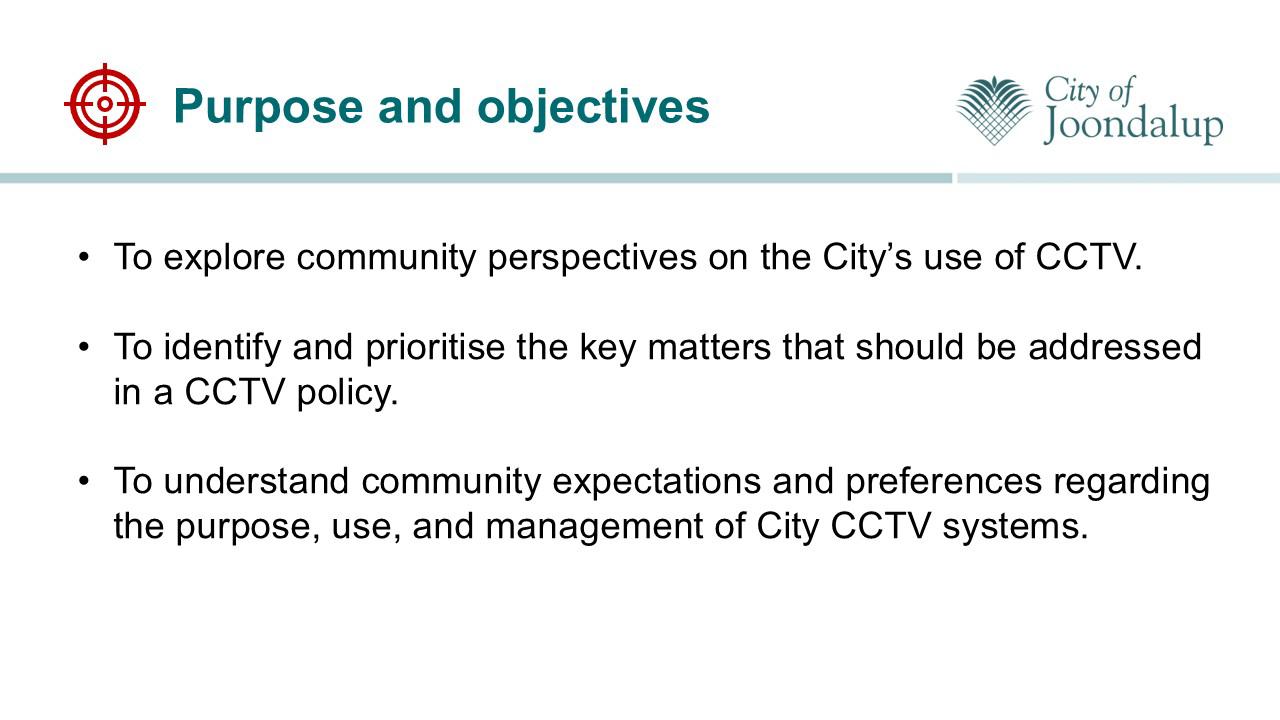
• To explore community perspectives on the City’s use of CCTV.
• To identify and prioritise the key matters that should be addressed in a CCTV Council policy.
• To understand community expectations and preferences regarding the purpose, use, and management of City CCTV systems.
Outcomes and key discussion points:
Presentation and Q&A – CCTV and the City of Joondalup
The Strategic Community Reference Group meeting opened with a short presentation from a City Officer to explain the role of CCTV at the City of Joondalup. The following information was presented to the reference group members:
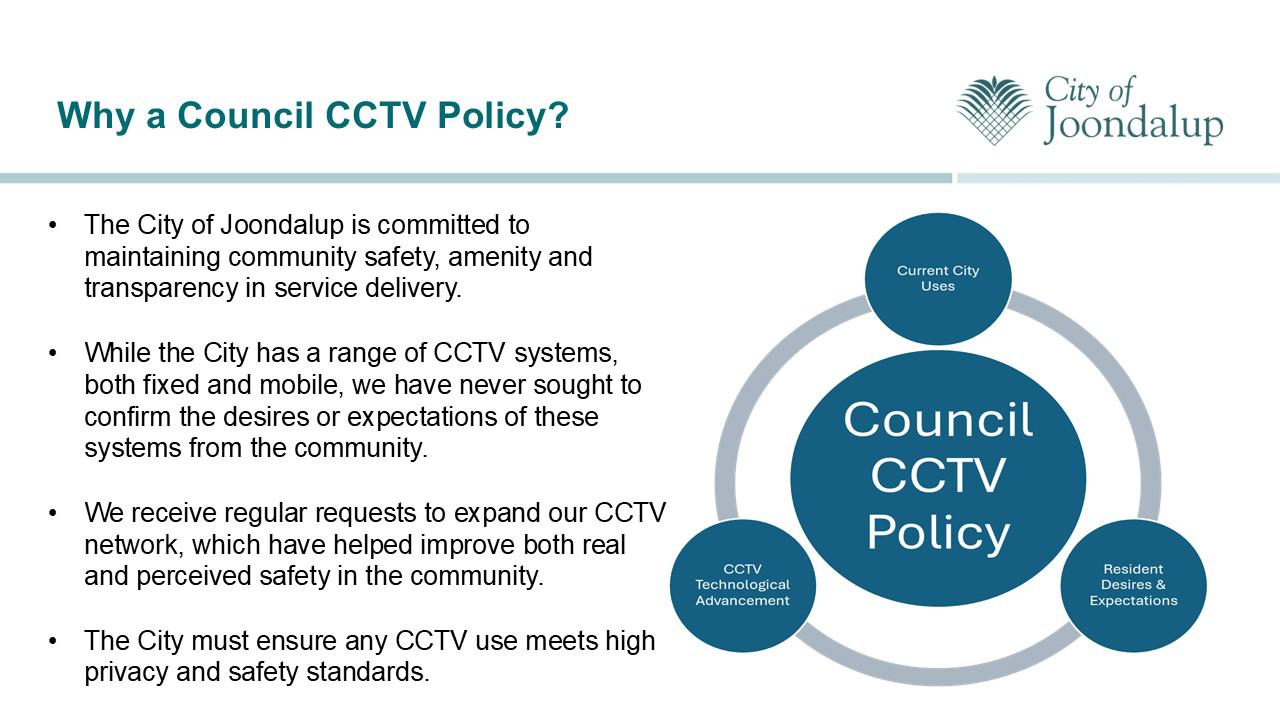
Purpose of CCTV Policy
• To guide how the City uses CCTV, ensuring community safety, transparency and privacy compliance
• Policy aims to clarify appropriate use, limitations and community expectations.
Context of CCTV
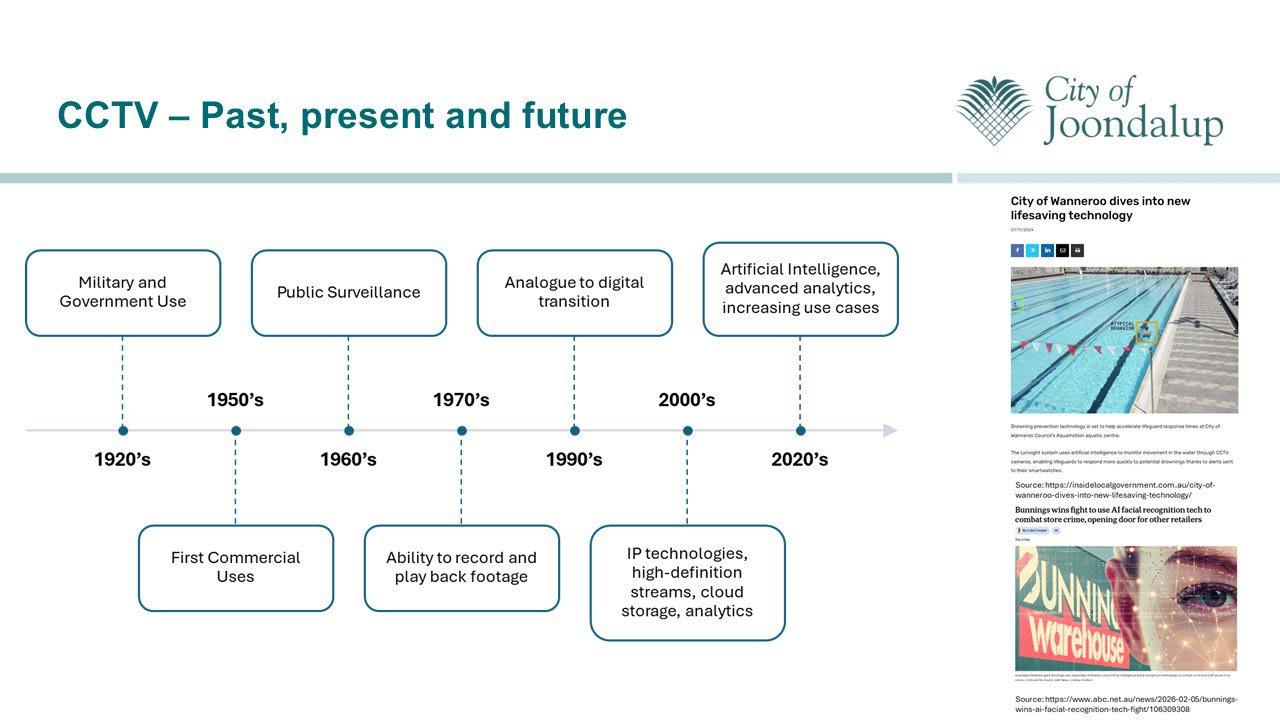
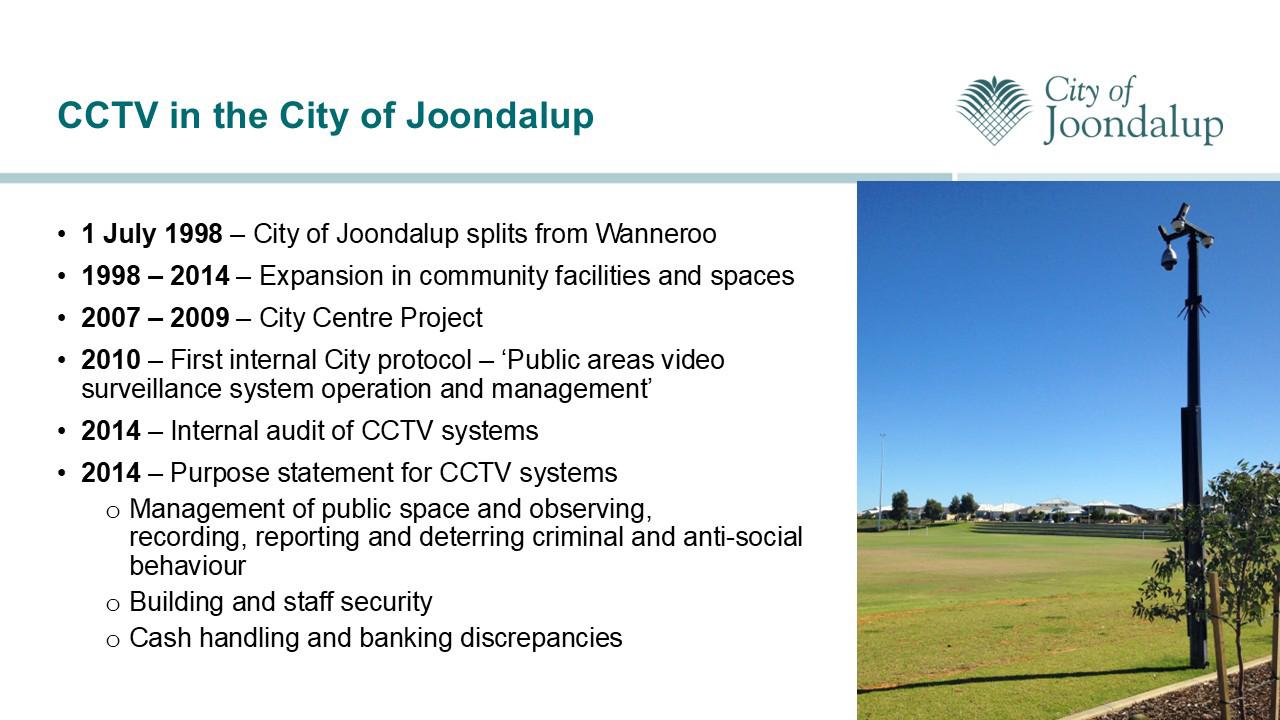
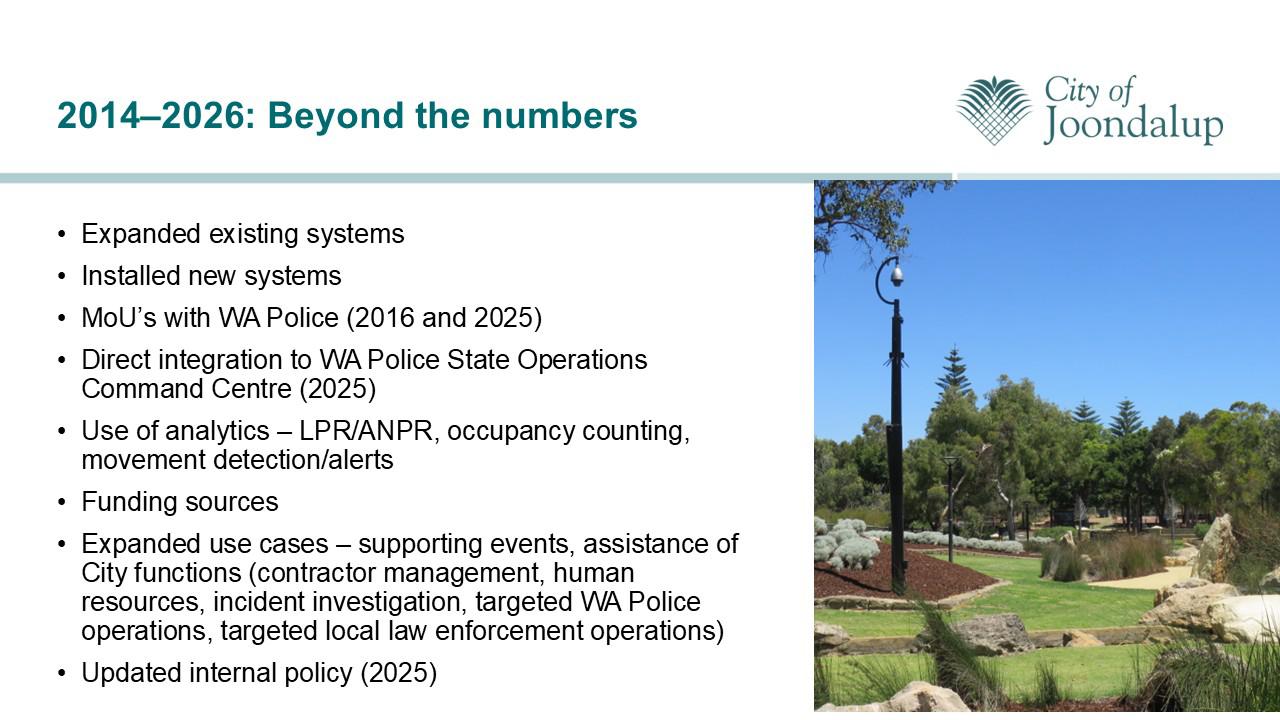
CCTV has evolved over time to support:
• Crime prevention and deterrence
• WA Police operations
• City functions (events, investigations, asset protection)
Key Q&A themes
A following key themes emerged in response to questions raised after the presentation.
• Access to CCTV data:
WA Police can access footage
Public access via FOI processes only
Privacy is the overriding consideration, with future legislation (e.g. Privacy and Responsible Information Sharing) potentially influencing access
• Data and privacy:
City does not use facial recognition (focus is on number plate recognition where applicable)
Footage retained for 31 days then overwritten (aligned with Australian Standards)
Strong emphasis on defining what is legally permissible vs. community expectations
• Future technology
⋅ Emerging tech (e.g. drones) could be considered if supported by the community, noting regulatory constraints
• Effectiveness of CCTV
⋅ Evidence suggests:
o Modest but meaningful reduction in crime in monitored areas
o Crime displacement may occur when cameras are moved
o Significant value in locating missing persons and supporting vulnerable individuals
• Cost and value
Example provided: ~$113,000 for a 15-camera installation (Timberlane Park)
Benefits include:
o Reduced crime and antisocial behaviour
o Increased community satisfaction
o Noted gap in quantitative data and cost-benefit measurement
• Risks and concerns
“Function creep” and “use creep” (expansion beyond original purpose)
Bias risks in advanced technologies (e.g. behavioural analytics, facial recognition)
Importance of getting ahead of misuse and unintended consequences
The slides from this presentation can be found at Appendix 1.
CCTV Expenditure (Question Taken on Notice)
During the meeting, a query was raised regarding the City’s current expenditure on its CCTV network. As this information was not available at the time, the question was taken on notice. The following provides a breakdown of the City’s estimated operational and capital investment in CCTV for the 2025–26 financial year:
Operational (Running Cost) Budget
The estimated operational budget for CCTV in 2025–26 is $230,000. This covers the ongoing costs associated with operating and maintaining the City’s CCTV network, including system maintenance, monitoring, licensing, data storage, and lifecycle asset management across all sites.
Capital Works Budget
For 2025–26, approximately $260,000 has been allocated within the Capital Works Program for CCTV infrastructure.
This funding supports:
• New CCTV site installations
• Lifecycle replacement of end-of-life cameras, servers, and associated equipment
• System upgrades to enhance capability, coverage, and reliability
• Supporting infrastructure such as poles, power supply, communications, and integration with the existing CCTV network
Activity
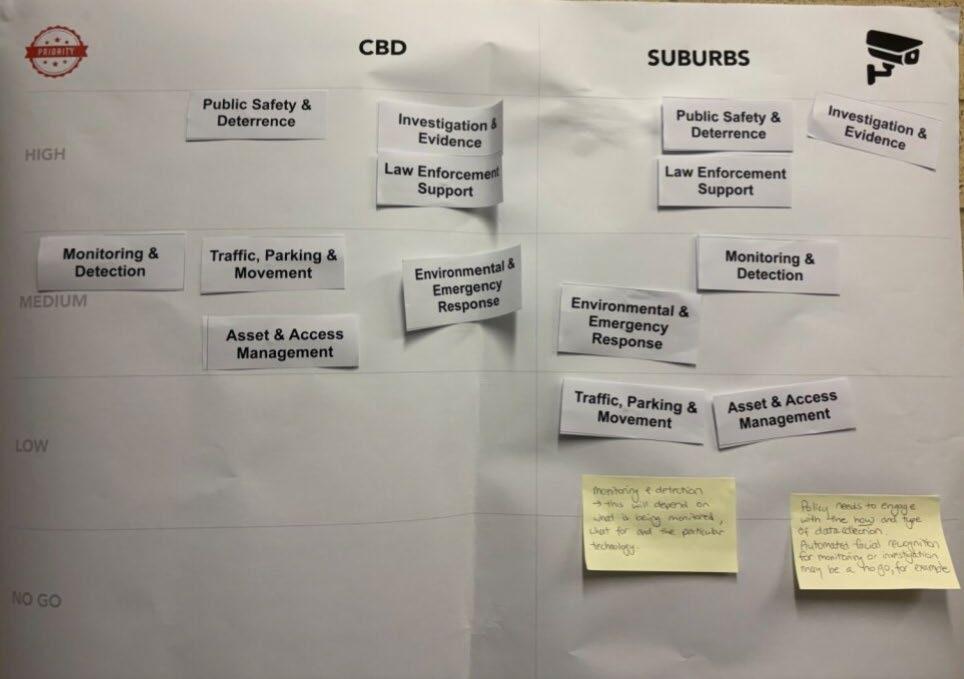
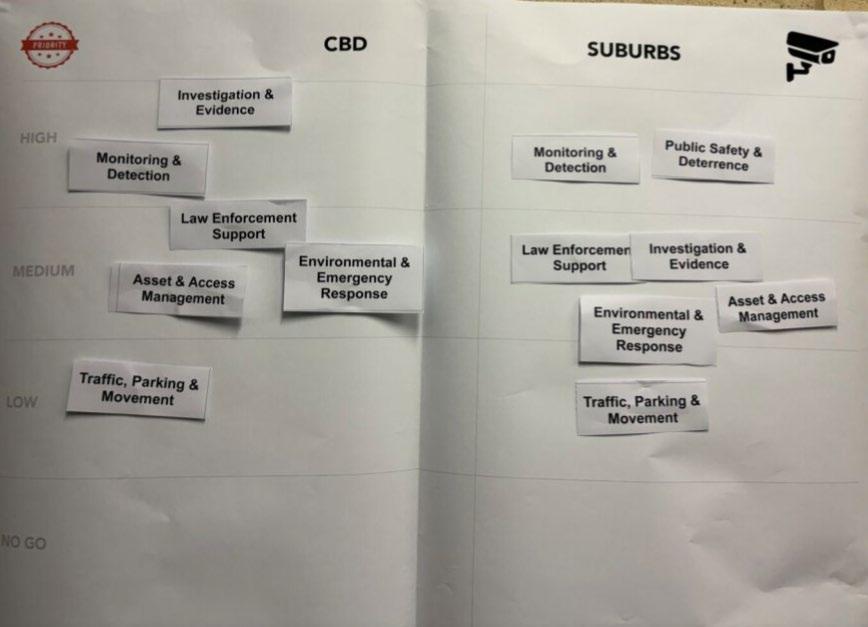
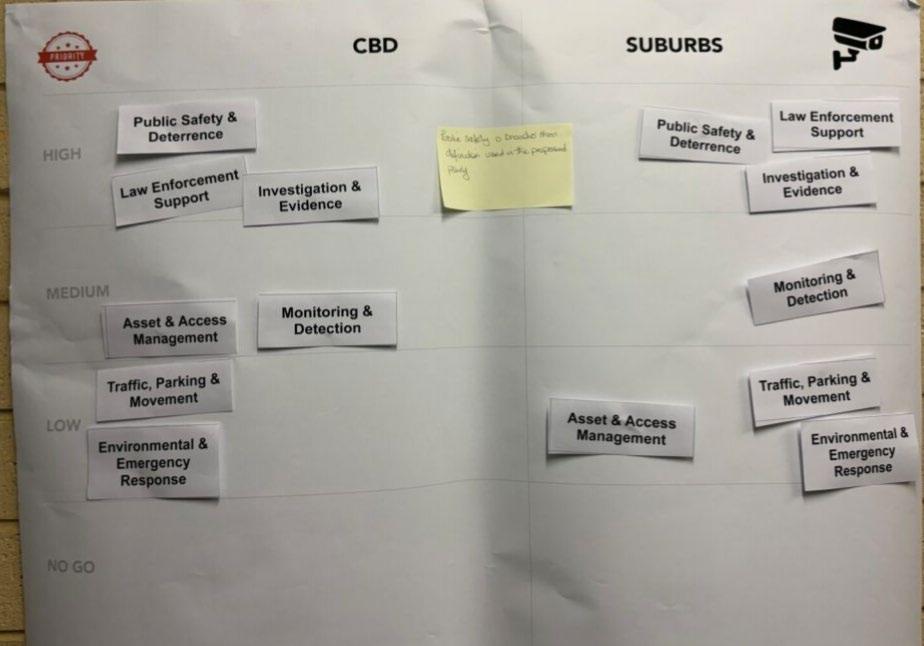
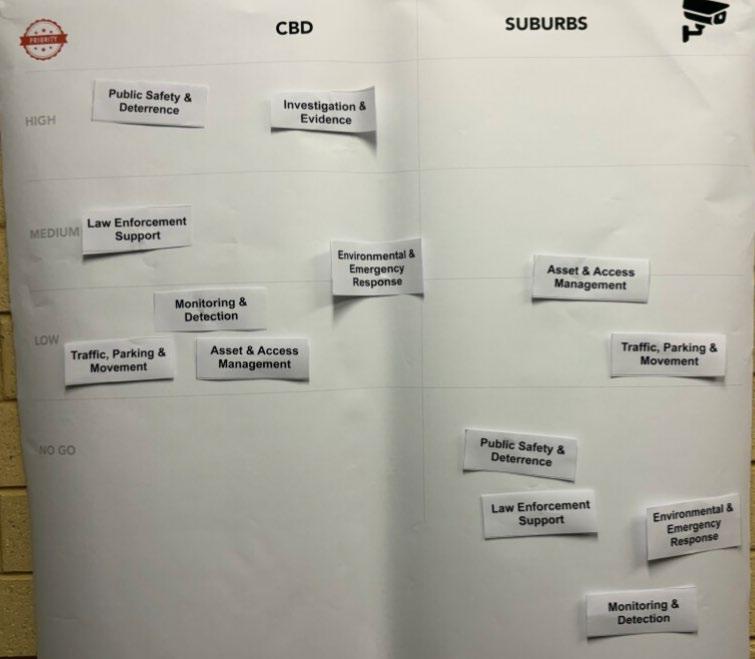
1 – Exploring priorities (aligned with workshop activity on CCTV use cases)
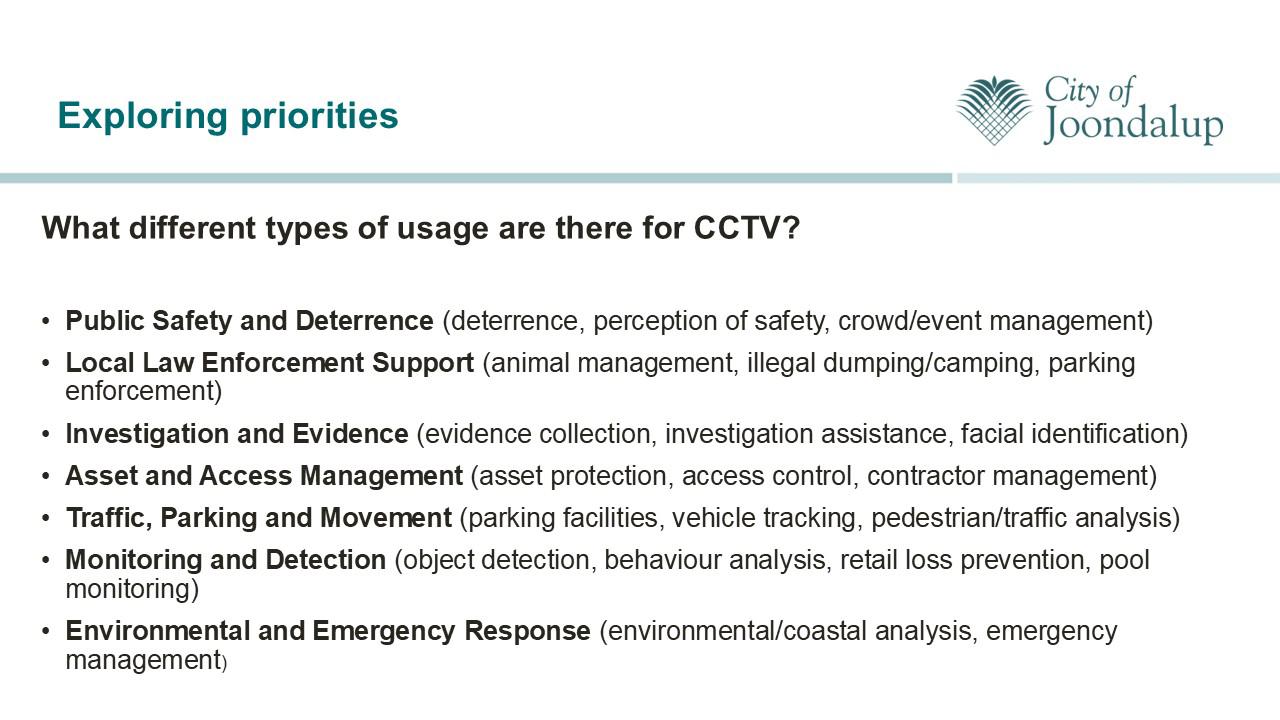
Participants were asked to consider a range of potential CCTV purposes, listed below:
• Public safety and deterrence
• Law enforcement support
• Investigation and evidence
• Asset protection
• Traffic and movement monitoring
• Environmental and emergency response
Participants were then split into four groups and collaboratively assessed the importance of the above purposes in both the central business district and suburban areas. Overall, the purpose of the activity was to help understand community perspectives so that any future CCTV strategy is grounded in informed, balanced, and publicly supported decision-making.
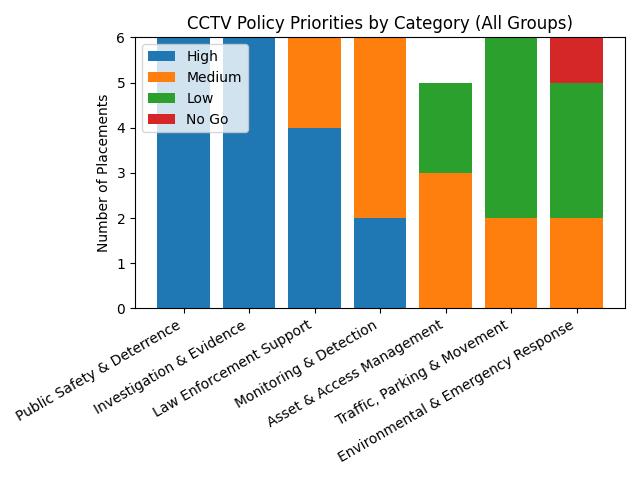
The chart below presents a summary of how groups prioritised CCTV purposes across High, Medium, Low and No-Go categories. Public Safety and Deterrence and Investigation and Evidence were consistently ranked as high priorities. Other purposes, such as Monitoring and Detection, Asset and Access Management, and Traffic Management showed more varied responses, indicating areas where policy direction may require further refinement. Environmental and Emergency Response received mixed feedback, including limited ‘No-Go’ responses.
Key reflections from group discussion
• Diverse community perspectives
⋅ Range from strong opposition (privacy concerns) to strong support (safety benefits)
⋅ Debate centred on:
o Personal privacy vs public safety
o Role of surveillance in community life
• Privacy and ethics Concerns about:
o Loss of anonymity in public spaces
o Overreach and surveillance culture
o Recognition that technology use (not technology itself) is the key issue
• Trust, transparency and governance
⋅ Strong support for:
o Transparent processes
o Clear governance and accountability
o Evidence-based decision making
• Technology considerations
⋅ Facial recognition widely viewed as high risk / low acceptance
Cybersecurity identified as a critical issue
Acknowledgement that private surveillance (e.g. home CCTV, apps) is already widespread
• Community dynamics
⋅ CCTV can:
o Improve safety and coordination (e.g. neighbourhood sharing)
o Potentially reduce community cohesion if overused
• Use cases beyond crime
⋅ Important benefits for:
o Missing persons
o Dementia / vulnerable individuals
o Event and crowd safety
The raw notes from Activity 1 can be found at Appendix 2
Activity 2 – Exploring key principles
The purpose of this activity was to bring together different perspectives to agree on the key principles that should guide a CCTV policy. The activity helps to balance community safety and crime prevention benefits with the protection of individual rights, build shared understanding, and inform the development or refinement of a policy that is clear, justified, and trusted by the community.
The group discussed and identified the following priority areas for the CCTV Policy as a whole:
1. Privacy and data protection
Clear safeguards and limits on data use
2. Community benefit
⋅ Demonstrated public value and safety outcomes
3. Risk-based approach
⋅ Evidence-based justification for installation
⋅ Proportional response to identified threats
4. Accountability and governance
⋅ Clear rules on access, storage and security
⋅ Independent oversight / auditing
5. Transparency
Open communication on:
o Why CCTV is installed
o How it is used
o How effectiveness is measured
Additional considerations:
• Clear process for installation and removal of cameras
• Ongoing privacy impact assessments
• Regular policy review and adaptation to new technology
• Development of metrics to assess effectiveness and justify investment
Overall insight
• There is no single consensus, but strong alignment on the need for:
Balanced approach (privacy vs safety)
Clear guardrails and governance
⋅ Transparency and community trust
• Workshop successfully met its purpose of:
⋅ Gathering community perspectives
⋅ Identifying key policy priorities (rather than reaching decisions)
The raw notes from activity 2 can be found at Appendix 3
Next steps
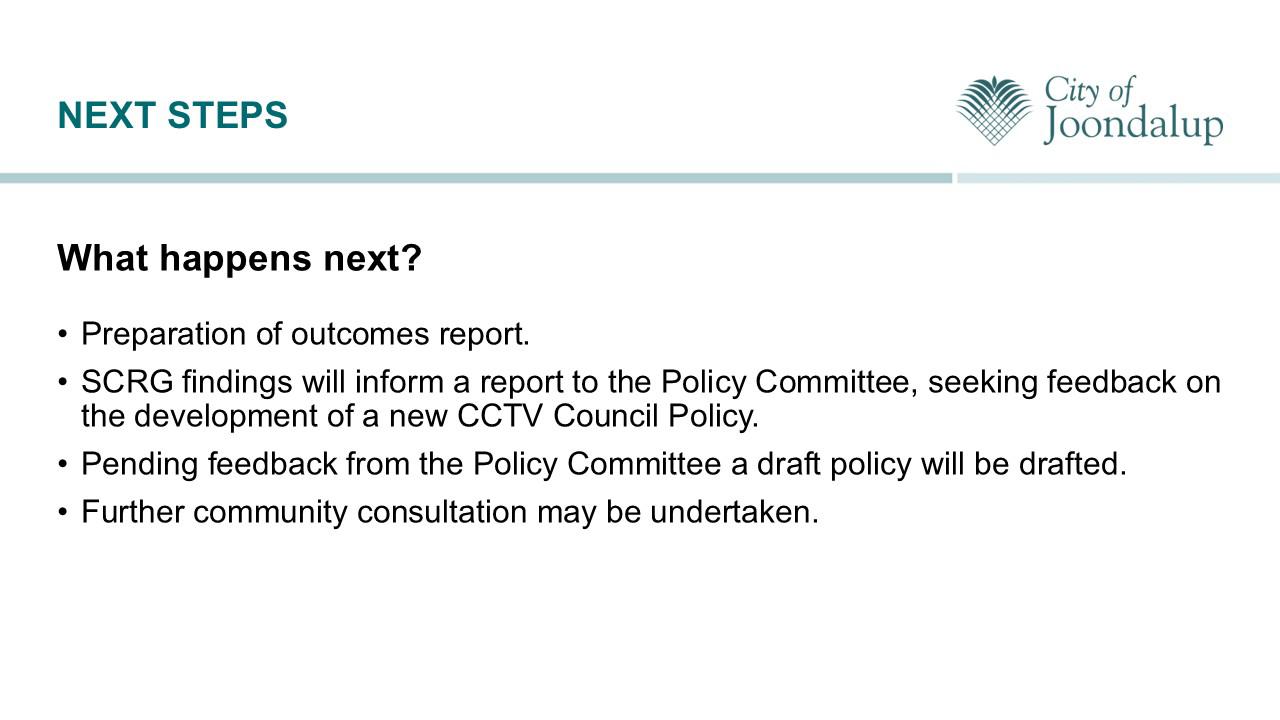
The discussion provided valuable, informed insights to guide the future direction of a CCTV policy. While there was recognition that not every change requires broad consultation, there was strong support for a structured review process that considers value for money, emerging evidence, and potential unintended consequences, particularly for individuals or groups who may be disproportionately impacted. The feedback has helped to shape a set of clear principles to inform policy development, with an emphasis on transparency, proportionality, and community safety. These findings will now be considered alongside broader strategic priorities to determine the next steps in progressing a balanced and responsive CCTV policy.
Appendix
1 City Officer presentation slides

Appendix
Appendix

Appendix 4 Presentation slides