I would like to take this opportunity to encourage you to serve your neighborhood and your community by forming a Neighborhood Watch. The best way for us to, along with our residents, keep our city free from crime is to work with our Neighborhood Watch groups. We are all in this together and we can be more effective by working in collaboration.
Forming a Neighborhood Watch group is the first step for every community wanting to mobilize against crime. Besides acting as the “eyes and ears” of local law enforcement, Neighborhood Watch groups also educate residents about how to make their homes and property less vulnerable to break-ins and vandalism.
With that in mind, we are pleased to provide you with this booklet, which contains information on how you can start your own neighborhood watch, and suggests activities for your group once you are up and running. You will also find other valuable information you can use about home security, crime prevention and community services.
We realize that peace of mind means a great deal to everyone. If you notice anything suspicious in your neighborhood, or have a concern, do not hesitate to contact the Irving Police Department. We are here to serve you 24-hours a day, seven days a week.
If you have any questions or suggestions, feel free to call us.
Sincerely,
Jeff Spivey Chief of Police, Irving Police Department
NEIGHBORHOOD WATCH
Neighborhood Watch programs begin with you! Officers count on your support in their efforts to fight crime. This is a never-ending task that cannot be undertaken by the police department alone. Thank you for taking the time to educate yourself on how to better protect your neighborhood, family and home.
FACTS ABOUT CRIME
• Burglaries, auto thefts, rape, child abductions and arson are the most prevalent crimes nationwide.
• Home burglaries are one of the easiest crimes to commit and prevent, but one of the hardest crimes to solve.
• Statistics show that in more than half of home burglaries, forced entry is not involved.
• The majority of home burglaries occur during daylight hours.
WHAT
IS A NEIGHBORHOOD WATCH ?
A Neighborhood Watch program is just that, learning how to effectively watch a neighborhood. It is neither a substitute for police protection nor a platform for taking the law into one’s own hands. Neighborhood Watches are designed to supplement police patrols by residents becoming the eyes and ears of their department.
The three main principles of Neighborhood Watch are as follows:
1. Getting to know neighbors and watching out for them.
2. Watching out for neighbors’ property.
3. Reporting suspicious or illegal activity to police immediately.
Members of a Neighborhood Watch are simply asked to use common sense, and observe what is going on around them. The three principles listed will help residents recognize their neighborhood’s individual identity (i.e., what is normal activity, who “belongs” there, etc.). The added benefits are that members have a sense of community, pride and peace of mind.
FACT VS. MYTH
Myth: Neighborhood Watch areas do not work.
Fact: Working programs reduce crime as much as 80 percent. Criminals have said that Neighborhood Watch programs scare them into other areas.
Myth: Neighborhood Watch areas are nothing more than a clique. Fact: Neighborhood Watch groups are for everyone in the block or area. Neighbors’ observations and input are just as valuable as anyone else’s.
Myth: To be part of a Neighborhood Watch group, means dropping out of something else.
Fact: Neighborhood Watch takes very little time. All a neighbor needs to do is watch what is going on, report suspicious activity and attend meetings in the neighborhood.
Myth: The police department runs the Neighborhood Watch program. Fact: Your Neighborhood Watch program belongs the neighbors in the area. The police will help set it up, but the members in the neighborhood will be the voice.
HOW TO START A
Neighborhood Watch programs take many forms, but organizing by blocks is the cornerstone of all residents’ crime prevention programs. The following suggestions can help build a Neighborhood Watch group in the community.
Step 1
Talk with neighbors and friends and ask for their participation. Find out who else is interested in being a leader (Block Captain) for the area. Explain the need for, and the value of, a Neighborhood Watch. Define the boundaries of the area to be organized.
Step 2
Contact the Irving Police Department’s Community Services Division at (972) 721-2544. Ask to speak with the Crime Prevention Officer about starting a Neighborhood Watch.
Step 3
Plan the first meeting! Get the news out by telephone, fliers or going doorto-door. Give neighbors at least two weeks notice and plan a time and place that is convenient for everyone. Keep in mind that not everyone can attend an early meeting during the week. Typically, Mondays, Wednesdays and Fridays get low attendance results.
KEEP THE NEIGHBORHOOD WATCHING
Starting a Neighborhood Watch and keeping people interested are two of the biggest hurdles to overcome. Below is a list of ideas to help keep the community engaged by making meetings fun and informative. This will help turn the “block” into a community instead of a row of houses.
• Have a picnic at a local park.
• Have a backyard barbecue.
• Invite a guest speaker to the meeting. (Be imaginative! How about a 20- or 30-minute question-and-answer session with a landscaper or a home repairman? How about fire safety with the Irving Fire Department? There are hundreds of topics out there).
• Have a holiday party (Christmas, Halloween, etc.).
• Have a summer block party. (Arrange to have a police car or fire truck on site).
• Have a neighborhood clean-up day.
• Start a Neighborhood Association.
• Hold a best-kept yard event.
Another great idea is to start a neighborhood newsletter. This will keep friends informed (especially if they missed a meeting). To keep reader’s interest the following can be included.
• Services within the neighborhood (including personal sales consultants)
There are so many possibilities to choose from. A Neighborhood Watch is only as good as the people who are willing to stand behind it and keep it going!
Example of Neighborhood Watch street sign.
GUIDELINES
RESPONSIBILITIES OF ALL MEMBERS
Participation in Neighborhood Watch requires only a small fraction of time. Members should try to meet once per month. Of course, members must use their eyes and ears daily and report suspicious activity to police. That is all there is to it!
During monthly meetings, residents will have the opportunity to meet new neighbors, keep friendships thriving, voice concerns about potential problems and pass along valuable information about the neighborhood.
BLOCK CAPTAIN RESPONSIBILITIES
If a neighbor chooses to participate as a Block Captain, they will be asked to help with certain duties within the neighborhood:
1. Block Captains acquire and maintain a current list of participating block members (including addresses, phone numbers, emails or other contact information). They will submit that list to the Crime Prevention Officer.
2. They will create a notification system (by phone tree, email or other means) so all members of the group will receive information as needed.
3. They will put together a block map showing exactly where each participating family lives (an example follows) and give members copies of the map. Find members who are willing to be a “block parent.” Mark these “safe homes” on the map for children to go to in an emergency.
4. Block Captains should keep regular contact with the police department liaison (i.e. Crime Prevention Officer). They will disseminate any information received from the police department out to the neighborhood. Block Captains also will bring the concerns of the members to the police department. This can be accomplished by phone, email or written correspondence. This way, the police department and neighborhoods maintain positive and open communication.
5. Block Captains also are responsible for planning and setting Neighborhood Watch meetings. They plan the agenda and make arrangements for special speakers or other items of interest, if needed They ensure that each group member is notified about meeting times and places. There are a minimum of two Block Captains for Neighborhood Watch groups. Of course, more are welcome!
6. When Planning a Neighborhood Watch meeting, notify the Crime Prevention Unit to request the beat officer to attend. Keep in mind that the beat officer is subject to calls, and may not be able to attend each meeting.
WHEN TO CALL THE POLICE
THE PURPOSE OF REPORTING
The purpose for reporting suspicious activity to the police is to stop the criminal activity that may be occurring, increase police presence in the neighborhood and give a true perspective of crime in the area. Making a report helps police establish criminal patterns and increases the potential for the return of property.
Keep the nonemergency police phone number handy: (972) 273-1010. This is a 24-hour line.
If the situation is an emergency, or a member is not sure go ahead and call 911. Never worry about “bothering” the police. The police department is there for residents.
Police officers check on suspicious circumstances and persons every day. If suspicions prove to be unfounded, do not be embarrassed. It might help stop a potential crime, save a life or prevent an injury. Think about what could happen if a member fails to act.
Whether calling 911 to report an emergency or the nonemergency number, remember to stay calm. The operator will ask about the problem. Give a specific and brief answer (i.e., a man is breaking into a car or there is a fire at my neighbor’s house).
Next, answer the operator’s questions and know that help is on the way. The operator is trained to get information in the order it needs to be sent to the officer. Provide a location and a description of what is occurring or who is involved. Again, be as specific as possible (but brief). Do not hang up until the operator says to.
Do not attempt to apprehend a person who is committing a crime. Do not attempt to investigate suspicious activity. Personal safety may be at risk if trying to intervene. The police need information — not action. When the police arrive, do not immediately rush onto the scene. Stay in a safe place and tell the operator where the officer can make contact.
WHEN SHOULD YOU CALL THE POLICE?
Use common sense! Not every person who comes into the neighborhood is a criminal. There are some basic rules of safety and common sense that come into play.
1. Be alert. Know what is going on in the area.
2. Be aware. Consider the circumstances. For instance, is he going door-to-door putting fliers on doors and walking off? Or might the criminal be the person taking his time knocking on the door (while nervously glancing around), and looking into windows as he goes house-to-house? Who would the police be called on?
3. If something does not feel right, it probably is not. Everyone has had that feeling. Too many times though, officers have taken crime reports from people who ignored that “funny” feeling that something was not right. If a member is that suspicious, go ahead and call the police.
LEARN TO BE OBSERVANT
The most valuable help a member can give an officer is information to identify suspects or suspect vehicles. That and facts about the crime or suspicious circumstance are the two main components of an investigation. Keep a notepad handy to write down the facts.
Here are some important details to focus on: Person –
Color Eye Color Hat Shirt/Pants Glasses Shoes Coat Tattoos Jewelry Scars Complexion Facial hair
If this seems like too much information to digest, do not worry. By making it a habit to be aware of people and cars around everyday, observation will become second nature.
SUSPICIOUS ACTIVITIES
CIRCUMSTANCE
POSSIBLE CRIME
Door-to-door sales person is seen going burglary or theft to the rear of a home or apartment
Waiting/loitering in front of home or burglary or theft closed business
Forcing entry into home, business or car burglary or theft
Person running, especially if something of suspect fleeing a crime scene value is carried
Large amount of human traffic to/from a drug, vice or fence operation residence on a regular basis
Person screaming rape or assault in progress
Person looking into parked cars car thief, car burglar especially if carrying light
Person loitering around school, parks, sex offender, pedophile secluded area, parking lot
Person offering items for sale selling stolen items in parking lot, road-side
Person repeatedly driving through area burglary, theft suspect
“Delivery man” with “wrong address” or burglary, theft or scam artist asked if another person lives at location
Car being driven slowly or with lights off casing area; eluding police
Parked car with occupants (especially at possible “look-outs” for burglary/theft an unusual hour) or casing area
Cars being loaded with valuables burglary or theft
Moving van or other vehicle being loaded at a burglary or theft neighbor’s home (especially if they had not said they were moving)
Abandoned car on street stolen car, dumped junk car
Someone being forced into a car, kidnapping, assault or rape especially if female or juvenile
Persons taking pieces off of a car or theft or vandalism cutting up a car
Objects thrown from a car disposal of drugs, weapons/contraband
Continuous repair operation at a nonbusiness location “chop-shop” for stolen vehicles or other stolen items
Open or broken doors/windows at any location burglary, theft or vandalism
Unusual odor (paint thinner) drug lab
Person exhibiting unusual mental or physical symptoms injured, intoxicated or mental illness
Large accumulations of the same type of items stolen property (car stereos, speakers, computers, etc.) inside a garage, home, storage area, etc.
There are thousands of unusual or suspicious circumstances that can occur at any time. Remember, the police officers cannot be every place at the same time. Alerting police about situations such as these or others can lead to the reduction of crime in the area.
HOME SECURITY
Always keep in mind personal safety when reading and implementing these or other crime prevention tips. Do not do anything that may hinder or prevent a person’s ability to escape a dangerous situation. Make sure all family members are aware of all safety features in place and that they know how to quickly overcome them if they need to get out in an emergency.
Look at the home exterior. In an emergency, can the police, fire department or an ambulance find the home quickly from the street or other entrance? One of the top complaints of police officers and other emergency responders is that they cannot easily see address markers at night.
At night, try and find the address markers of the houses in the neighborhood. Now, imagine how a speeding ambulance trying to locate a heart patient, or an officer looking for a burglary in progress does it.
Be sure that the address can be seen. Use large numbers that are contrasting or reflective. The numbers should be no less than three inches in height. If there is an alley behind the residence, post the address on the rear entrance. Also, trim plants away from address markers for good visibility.
Lighting is another major problem. Can a prowler, burglar or vandal hide in the shadows around the property? One of the most cost-effective features that can be placed around the home is exterior lighting. Lighting has proven to be an effective crime deterrent.
Effective lighting should:
1. Illuminate as many sides of the house as possible.
2. Be placed under the eaves of the house or shielded with a protective covering to prevent tampering.
3. Kept on at night (consider motion lighting as well).
An inexpensive timer or photoelectric cell will automatically turn lights on at dusk and off at dawn. Do not overlook the sides and rear of the property.
Check landscaping. Could a criminal hide behind shrubbery or use a tree to gain access to the roof? The security of the home depends on visibility. Ornamental plant growth should be kept well trimmed, especially around doors and windows where a person could hide to attack or break into the home.
In planning the landscape, consider discouraging intruders from window areas by planting sticker-type bushes (i.e., roses, holly, pyrancantha, etc.). Keep trees trimmed. This is not only good for the life of the tree, but also eliminates hiding places. Cut away branches that allow roof access to the home. Trim trees from the bottom up and shrubbery from the top down. A person should be able to walk under the trees and see over the bushes.
Is there a privacy fence that obstructs a neighbors’ view of the backyard? Are fence cross-rails on the outside giving a step-ladder type entry into the backyard? What about the gate; is it secured? Privacy fencing is a disadvantage to home security since it provides concealment. Other forms of fencing would eliminate this disadvantage, but here are some methods to offset this problem:
1. Remove every other slate along the sides of the fence to allow greater visibility. Use chain-link instead of wood.
2. Plant a sticker-type bush or vine to cover the outside of the fence to discourage climbers (i.e., thorny vines or pyrancantha).
3. Padlock the gate so that entry is restricted.
SECURITY INSIDE YOUR HOME
When there is a knock at the front door, look before opening it? If there is a peep-hole use it. If not, install a wide-angle peep-hole with a 190-degree angle. This will help to view not only who is in front of the door, but anyone who might be hiding to the side of the doorway.
What type of door is it? Is it solid to the core or hollow? How thick is it? Is it metal? Is the door in good condition? Not only the front door, but all of the exterior doors and the door between the house and garage should be solid core construction or heavy-gauge metal with a minimum thickness of 3/8 inches. A thinner door may give if pried or kicked.
If the door is the panel-type, make sure the joints have not deteriorated or come loose. Check the strike plate on the door frame. (That is the small metal plate surrounding the bolt on the edge of the door.) Are the screws short? The metal strike plate should be secured with screws that are a minimum of three inches long. Better yet, install a heavier gauge security strike plate with three-inch screws. The screws should reach beyond the frame into the structural 2’ x 4’s.
Take a good look at the door lock. Is it a simple lock in the knob (such as one on a bathroom door)? Is the latch spring-loaded? The simple lock in the knob only offers convenience and privacy. It can be easily defeated by intruders with a screw-driver or even a credit card!
A more secure lock is needed for better security. The best is a deadbolt lock with these safety features:
• Single cylinder
• Minimum one-inch bolt throw
• Rotating cylinder guard
• Five-pin tumbler
• Hardened steel interlocking screws
Double-cylinder locks are discouraged because of the risk they pose during a fire. If the interior key is lost, a person could be locked inside with no way to escape! Another consideration is French or double doors.
When there are a pair of double doors, at least one door must be made inactive to make them secure. To do this, flush bolts should be installed at both the top and bottom of the inactive door. The flush bolts should be secured into metal strike plates. A deadbolt may then be added to the active door. Other types of doors in the home also must be adequately secured. Sliding glass doors are particularly vulnerable to attacks. Secure sliding doors to keep them from sliding or being pried up and out of the track.
Here are a few suggestions:
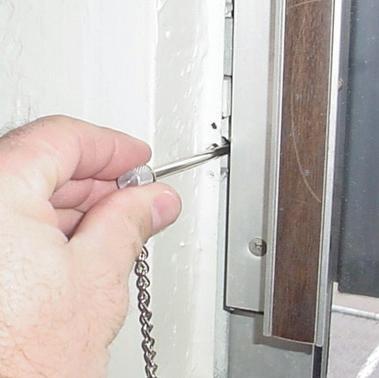
A Pinning: Drill a slightly downward sloping hole through the center or bottom part of the sliding door frame. Insert a straight pin (not a screw) as illustrated. This will help keep the door from being pried open.
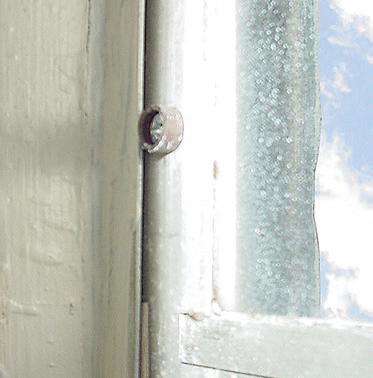
B. Track Screws: To keep the door from being lifted out of the track, place two or three screws into the top track. Leave the screw heads out far enough to allow just enough room for the door to open and close. The screws will take up the extra space needed for lifting. (See illustration).
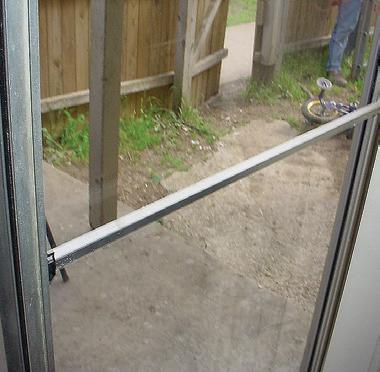
C. Charlie Bar: Commercially available, these bars are bolted onto the moveable glass frame and have a hinge. When the door is not in use, the bar is lowered and connected to a small metal grip that is mounted to the frame. This also will help keep the door from being pried open. (See illustration).
Check local hardware store for more options.
A.
B.
C.
Remember to check the door hinges on all exterior doors (garage door too!). If hinges are exposed to the outside, make sure they are “pinned” in place to prevent removal. Nonremovable hinge pins also are commercially available. Having the biggest lock on the block, can still be easily bypassed when a burglar taps out the hinges!
Because windows are easy entrance points, secondary locks need to be added for extra security. First, determine what type of windows they are (single hung, double hung, sliding, aluminum frame, wooden frame, casement, jalousie, etc.). There are many different types of secondary locks for windows. They can be pinned (similar to sliding doors) or have key locks attached. However, key locks on windows are discouraged because they will hinder escape routes in a fire.
To pin a window, drill a hole at a downward angle through both the movable and fixed window frame. Next, drop in a straight pin that can be easily removed. That is all there is to it. (Never drill into a vinyl window frame. It will damage the structural integrity of the frame.) Never nail or screw a window shut. This could hinder an escape in a fire. Other types of window locks include: thumb screw locks (placed on the track), dowels, storm windows and factory built-in secondary locks.
Make it a point to replace or repair damaged or loose-fitting hardware. Check a local hardware store for more ideas. There are many selections of locking devices available.
Now take a walk through the garage. The door from the garage to the house should meet the standards for doors and locks previously discussed. What about the actual garage door? Is it in good condition? Is it metal or wooden? Does it have windows? Is there a garage door opener? If so, does the cord release to the opener hang in front of the windows? Is there a sliding bolt on the door that goes through the rail?
Most garage doors are difficult to secure due to their construction. Here are a few ideas:
• Remove any knobs or rings from an automatic garage door release cord. If they are left in place, an intruder can break out the window to pull it or use a coat hanger slipped through the top of the door (or a crevice) and pull the cord. Then the door will be released from the track. (Note: By removing the knob or ring from the cord it may not be as easily pulled if there is an emergency so have an alternate release plan ready).
• Keep the garage door closed and locked at all times. Cover the windows to keep thieves from peering inside. Another option is to place mirrored film over the windows so a burglar will not know if someone is home or gone.
• While on vacation, place a padlock through the track or at the end of the door bolt. Unplug the automatic door opener as well. It is easy for a burglar to drive along the street with a “code-grabber” and simply open the garage door with the touch of a button!
• If the garage door needs to be replaced, consider buying a windowless, metal door. They offer the most security. While standing in the garage, look up. Is there an attic access? Are there pull-down stairs? This also needs to be secured. A case hardened, hinging clasp with a good padlock will help secure this.
MISCELLANEOUS SECURITY INFORMATION
Alarms
Alarms offer extra security, but they are no substitute for good locks and other hardware. Keep in mind that alarms do not keep people out of your home. Although they can be a good deterrent to burglars, alarms are designed to notify an alarm company first. Then, the company notifies the police. An alarm with an audible, exterior siren or bell will add additional security, as this will alert anyone in the neighborhood when it sounds. For additional information on alarm systems, see the last page of this booklet.
With all the alarm companies that are in the area, take the time to research for one that has a good reputation and also can offer references if requested. Pay close attention to the quality of the service and products offered. The City of Irving requires that an alarm permit is obtained. Call (972) 721-2411 between 8 a.m. and 5 p.m., Monday through Friday for an application.
Padlocks
Do not buy a cheap lock that may not offer the protection needed. The most common method of defeating a padlock is to cut the shackle with bolt cutters or break it with a pry bar.
Minimum Standards (exterior lock):
1. Case hardened steel with a 9/32-inch shackle 2. Locking mechanism in the toe and heel
Be sure to record and then file off the “key code numbers” from all padlocks. This number (usually on the bottom of a lock) is used to make keys for that particular lock. If a thief gets the code number, they can make a key and simply enter at their convenience.
Where
are the keys?
It defeats the purpose of locks if the location of the keys are not known. If someone recently purchased or rented a home or apartment where the locks re-keyed? If not, think about what could happen if the former occupants still have keys!
What about the garage door opener?
Is it in the unlocked car that is sitting in the driveway (or worse yet on the street)? Was there on left in a car that was sent for repairs? The garage door opener is a convenient, electrical key granting access to the home. Before leaving for vacation, notify trusted neighbors and the police. The Irving Police Department can place a vacation watch on the home. It only takes a few minutes to call and complete the form by phone. While away, an officer will check the home at random. For convenience, a vacation check list follows.
VACATION CHECK LIST
❏ Lock all doors, including the garage door and overhead doors.
❏ Lock all windows, including basement and garage windows.
❏ Cancel all deliveries (newspapers, mail, bottled water, etc.) or have mail and newspapers picked up by a family member/neighbor.
❏ Have family/neighbor pick up any handbills/trash.
❏ Arrange to have the lawn mowed.
❏ Adjust blinds or draperies.
❏ Place at least two interior lights on timers in separate rooms.
❏ Secure all exterior valuables (ladders, mowers, etc.).
❏ Secure items such as jewelry, furs, cameras, credit cards and checks.
❏ Arrange to have friend/family house sit while away.
❏ Have a neighbor park in the driveway and report suspicious activity to the police.
❏ Make sure a friend/family member has the travel plan and emergency contact information.
❏ Leave a radio on near the doorway (tune it to a talk station).
❏ Turn down or turn off the ringer on the phone.
❏ Put the house on the police vacation watch.
❏ Make sure someone will take care of pets.
DO NOT
❏ Leave notes outside indicating absence.
❏ Hide keys under mats, in lights, flower pots, fake rocks, etc.
❏ Leave a message on the answering machine that says no one is there.
BURGLARY, THEFT PREVENTION CHECK LIST
This checklist was designed to identify features in the home or in the daily routines of family members that might make an easy target for burglars. The goal is to eliminate any opportunity that invites criminals to the home. The security inspection should begin at the front door, and include an inspection of all doors, windows, locks, lights and landscaping. Each “no” answer indicates a security weakness or hazard. After completing the survey, it will show which areas need to be improved for home security.
SECURITY POINTS
1. Are all exterior doors in the house either metal
or solid wood? (Check upstairs as well.)
2. Are all exterior doors equipped with single-cylinder
deadbolt locks?
3. Are door frames strong enough and tight enough
to prevent forcing or spreading?
4. Are door hinges protected from removal from the
outside?
5. Are all door locks adequate and in good repair?
6. Are all exterior doors equipped with heavy-duty
strike plates with screws three inches or longer?
7. Has the mortis hole (hole in door jamb) been drilled
at least one-inch deep on all doors?
8. Can the lock be reached through a mail slot
or pet entrance?
9. Is there a screen or storm door with an adequate
lock?
10. Are all entrances lighted with at least a 40-watt
light bulb?
11. Are outside lights controlled by timers, motion
sensors or photoelectric cells?
12. Can the front entrance be seen from the street or
public area?
13. Do you know everyone who has a key to your
home?
14. Have you had your locks re-keyed or replaced?
15. Does the porch or landscaping provide a place for
burglars to hide?
16. If there is a sliding glass door, is the sliding panel
secured from being lifted out of the track?
17. Is a “charlie-bar” or broom stick-type auxiliary lock
used on sliding glass doors to prevent sliding?
18. Do all windows have adequate working locks?
19. Do all windows have secondary locking devices?
20. Do windows have screens or storm windows that
lock from the inside?
21. If you have security screens, grills or bars over
windows, do they remove from the inside?
YES NO
22. Are all sides of your home (exterior) lighted at
night?
23. Are your trees trimmed up and away from the
ground and away from windows and roof tops?
24. Are shrubs trimmed down and away from windows
and doors?
25. Are there ladders outside that could offer roof
access?
26. Does the garage overhead door have an adequate
lock?
27. Is garage door kept closed at all times and locked
when not in use?
28. Are the keys in your car when parked in
the garage?
29. Have you given thought about what you would do
if you came home and discovered that your house had been burglarized?
30. Have you talked to your family or children about what
to do if an intruder breaks into your house while you are there?
Consider setting up a security closet. If there are valuables, such as silver or jewelry, build a place to keep them safe. The interior walls of an existing closet can be reinforced (it is easy to cut through wall board). Install a metal or solid core wood door with a one-inch deadbolt. Use only a single-cylinder deadbolt with the flip latch on the inside. Make sure the hinges are pinned or nonremovable. Use a reinforced strike plate with three-inch or longer screws. This closet also could be used for temporary personal safety if someone breaks in while at home. If possible, keep a cordless phone or cell phone in the closet to call 911.
Another good idea is a metal safe. There are two basic safes. A fire safe protects against heat, not necessarily theft. A valuables safe is heavy duty and protects against break-in, but is not heat proof. Combination fire/ valuables safes are available. Buy quality products! A safe can be put inside a security closet and also be bolted to the floor or mounted inside a wall for extra security.
COMMUNITY SERVICES – Police Crime Prevention Unit
OTHER POLICE DEPARTMENT NUMBERS Police Records (972) 721-2437
OTHER IMPORTANT NUMBERS
IRVING POLICE DEPARTMENT WEBSITE
CityofIrving.org/Police
OTHER COMMUNITY SERVICES
HOME SECURITY SURVEYS
By appointment, a police officer trained in Crime Prevention will come and complete an interior and exterior survey of the residence to make recommendations on how to improve the current home security devices. To schedule an appointment, call (972) 721-2544. Advance notice is required.