FAMILY & COMMUNITY SUPPORTS SERVICES (FCSS) : OVERVIEW
The City of Grande Prairie has partnered with the Government of Alberta to provide Family and Community Support Services (FCSS) funding since 1966 -67. FCSS receives its mandate from the Family and Community Support Services Act , the Family and Community Support Services Regulation , and the Family and Community Support Services Accountability Framework .
FCSS is an 80/20 funding partnership between the Government of Alberta and participating municipalities or M étis Settlements to develop locally driven preventionbased social initiatives t hat enhance the well -being of individuals, families, and communities. The funding partnership is based on a shared understanding that municipalities and M étis Settlements are in the best position to assess community needs, set priorities, and support individuals, families , and communities through preventative social programs and services.
The FCSS Act mandates an emphasis on prevention. As stated in the FCSS Regulation Section 2.1(1)(b). FCSS programs must do one or more of the following:
• Help people develop independence, strengthen coping skills, and become more resistant to crisis .
• Help people to develop an awareness of social needs ( e.g., community needs assessments) .
• Help people to develop interpersonal and group skills which enhance constructive relationships among people
• Help people and communities to assume responsibility for decisions and actions which affect them.
• Provide supports that help sustain people as active participants in the community. 1
1 Government of Alberta, Family and Community Support Services Regulation (Edmonton, King’s Printer, 2021), https://kingsprinter.alberta.ca/1266.cfm?page=1994_218.cfm&leg_type=Regs&isbncln=9780779824540
FCSS FUNDING ELIGIBILITY CRITERIA
To be eligible for FCSS funding, organi zations must:
• Provide prevention -based programs or services for Grande Prairie residents and be incorporated for a minimum of one year. FCSS defines prevention as “a proactive process that strengthens the protective factors of individuals, families, and communities to promote well -being, reduce vulnerabilities, enhance the quality of life, and empower people to meet the challenges of life. ”
• Be in alignment with the Pro vincial Prevention Priorities .
• Provide accessible, safe, and inclusive programs and services.
• Demonstrate the ability to successfully implement the proposed activity and gather measurable outcomes data that align s with the Provincial Prevention Strategies .
• Demonstrate sound fiscal management and strong board governance.
• Be in good standing with the City of Grande Prairie , with no funding agreement s terminated by the City with in the past 12 months .
In addition , organi zations must e nsure the proposed activities, and related expenditures , meet FCSS requirements . Ineligible expenses include:
• The purchase of land or buildings.
• The construction or renovation of a building.
• The purchase of motor vehicles.
• Operational costs of the organi zation that do not relate to the funded program.
• Municipal property taxes and levies; nor
• Payments to a member of a board or committee other than reimbursement of incidental expenses necessarily incurred in providing volunteer services to the program.
Furthermore, the FCSS Act indicates that services provided under a program must not:
• Be primarily for the recreation needs or leisure time pursuits of individuals.
• Offer direct financial assistance, including money, food, clothing, or shelter, to sustain an individual or family.
• Be primarily rehabilitative in nature; nor
• Duplicate services provided by a government or government agency .
FCSS FUNDING ADMINISTRATION
The City of Grande Prairie’s FCSS funding is administered through the Housing & Community Development department in partnership with the Government of Alberta. Most FCSS programming in Grande Prairie is delivered by local community service providers, with select services provided directly by the City, including t he City’s Home Support Program , the Youth Advisory Council , and the Grande Prairie & Area Community Compass , a partnership with the County of Grande Prairie FCSS.
The City’s responsibilities for administering FCSS funding include :
• Allocating FCSS funding.
• Monitoring FCSS funded programs and outcomes.
• Ensuring alignment with provincial requirements.
• Reporting to the Government of Alberta.
FCSS funding supports prevention -focused programs and initiatives that strengthen the well -being of individuals , families, and the broader community. To ensure funding reflects local needs, the City also does the following :
• Engages with residents and community organizations.
• Identifies emerging needs and service gaps.
• Uses local data and research to inform decisions.
This approach ensure s FCSS investments are responsive, evidence -based, and aligned with community priorities.
All FCSS -funded activities must also align with the FCSS Accountability Framework , including provincial prevention priorities and program requirements.
STRATEGIC ALIGNMENT
While the Government of Alberta’s new FCSS Accountability Framework provides a clear definition of prevention and sets provincial prevention priorities to support local planning, program design, and evaluation , the City’s funding decisions for the 2027 -2029 funding cycle are also guided by local strategic priorities , investment goals, and data
Applicants are required to review the following documents prior to submitting applications for FCSS funding.
1. FCSS Accountability Framework (2023)
The FCSS Accountability Framework sets out provincial prevention priorities , strategies, and provides clear direction on approved delivery models, intended outcomes, and key performance measures for FCSS -funded activities.
Provincial Prevention Priorities:
• Homelessness & Housing Insecurity
• Mental Health & Addictions
• Employment
• Family & Sexual Violence
• Aging Well in Community
➢ For a summary of key information from the FCSS Accountability Framework , please refer to Appendix 1 .
2. The City of Grande Prairie ’s 2026 -2029 Strategic Plan
After each municipal election, City Council sets strategic priorities for the next four years.
The City’s Strategic Priorities for 2026 -2029 :
• Economic Opportunity & Resilience
• Community Empowerment & Livability
• Infrastructure & Financial Responsibility
• Purposeful Leadership & Government
3. 2025 /2026 Social Needs Assessment
The 2025/ 2026 Social Needs Assessment is informed by community engagement and local input, providing a snapshot of local needs to guide program planning, policy development, and FCSS funding decisions for the 2027 –2029 cycle.
Local FCSS Investment Goals:
• Connect Individuals and Families to Supports
• Build Community Belonging and Resilience
• Encourage Youth Engagement and Employment Readiness
• Strengthen Child, Youth, and Family Wellbeing
• Support Aging Well Together Initiatives
4. Aging Well Together 2025 Priorities & Goals
Launched in 2024, the City’s Aging Well Together 2025 Priorities & Goals were shaped by community engagement to better understand the needs of residents aged 55 and older, who make up 19.3% of Grande Prairie’s population. In 2025, City Council approved the initiative’s priorities, setting a clear path to strengthen age -friendliness across the community.
Aging Well Together Priorities :
• Accessibility, Mobility and Connectivity
• Communication and Technology
• Affordable Living
• Social Participation, Recreation, and Wellness
• Community Supports & Health Services
LOCAL FCSS INVESTMENT GOALS
Local FCSS investment goals reflect key needs identified through the Community Supports & Services Survey and FCSS engagement sessions.
Local FCSS Investment Goals
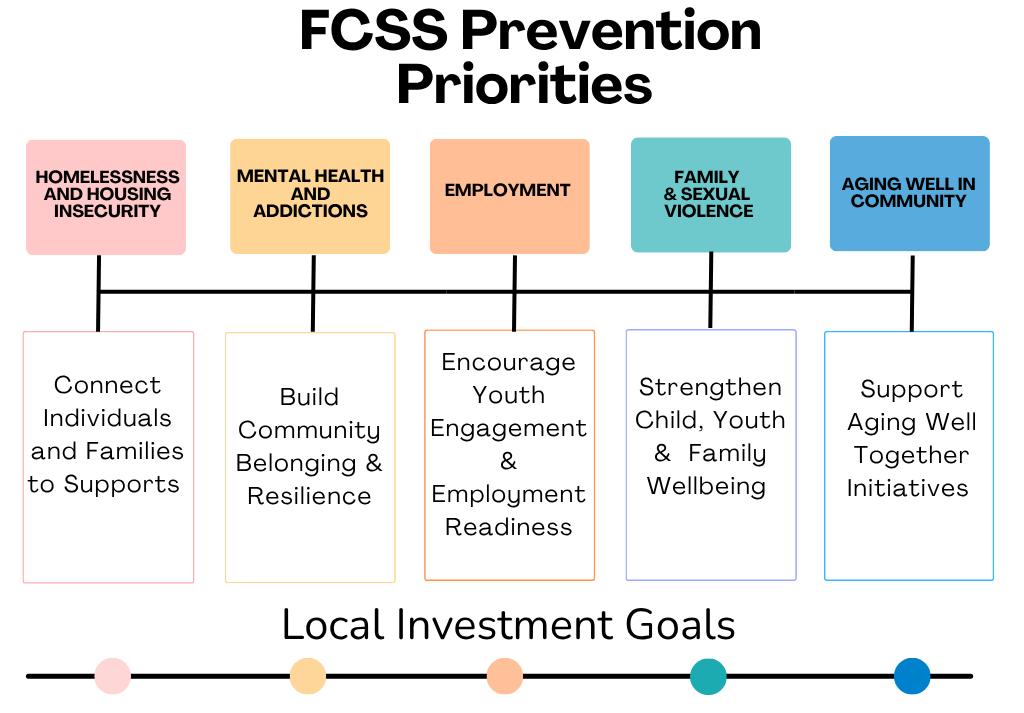
Connect Individuals and Families to Supports
Build Community Belonging and Resilience
Encourage Youth Engagement and Employment Readiness
Strengthen Child, Youth and Family Wellbeing
Support Aging Well Together Initiatives
These goals are intended to guide local funding decisions while keeping in alignment with the Provincial Prevention Priorities.
All FCSS -funded activities must:
• Align with at least one Provincial Prevention Priority, and
• Demonstrate how they support one or more of the Local FCSS Investment Goals.
Figure 1 provides an example of how the Local FCSS Investment Goals align with the Provincial Prevention Priorities. Because community needs are interconnected, many programs may align with multiple priorities and goals. Therefore, organizations will need to decide which priorities and goals best align with their organization’s overall mandate and the expected program outcomes.
Description of the Local FCSS Investment Goals
1. Connect Individuals and Families to Supports : Enhance awareness and access to community programs and services, and support individuals and families in navigating available resources, including those that address basic needs.
2. Build Community Belonging & Resilience : Foster belonging and resilience by supporting inclusive community initiatives that promote mental wellbeing, healthy relationships and collaborative responses to complex or emerging social challenges.
Figure 1: Provincial Prevention Priorities and Local FCSS Investment Goal Alignment
3. Encourage Youth Engagement & Employment Readiness : Encourage youth to build foundational life skills, confidence, and readiness for the future through affordable, youth -centered programs delivered in welcoming spaces that support positive mental health, reflect their interests, and strengthen their connect ion to the community.
4. Strengthen Child, Youth & Family Wellbeing : Strengthen the social, emotional, and developmental wellbeing of children, youth, and families by recognizing that healthy development is supported through strong parenting, nurturing caregiving, and positive relationships .
5. Support Aging Well Together Initiatives : Support older adults to remain connected, engaged, and independent through community -based, prevention -focused programs that strengthen aging -in-place supports and social connection.
➢ Please see Appendix 2 for a sample showing FCSS program alignment .
COMMUNITY COLLABORATION
Collaboration is a core value in the City of Grande Prairie’s 2026 -2029 Strategic Plan , aligning with the priority of Community Empowerment. The City is committed to working with FCSS -funded organizations and other partners to address unmet needs, fill gaps in social supports and services, and respond to complex community issues.
As no single organization can meet the full range of needs individuals and families may experience, FCSS funding supports coordinated, community -based approaches that emphasize connection, shared responsibility, and collective solutions.
System Navigation
A key part of collaboration is system navigation, which is central to FCSS funded work. Funded o rganizations are expected to play a role within the system by:
• Helping individuals understand available supports.
• Connecting individuals and families to other programs and services through warm referrals, as needed.
• Working alongside other providers to ensure continuity of support.
Collective Impact Initiatives
Collaboration also goes beyond participation in committees. It involves organizations working together toward shared goals and outcomes through collective impact initiatives by:
• Aligning efforts around common priorities.
• Shared responsibility for outcomes and measuring impact.
• Coordinating actions to address complex and interconnected needs.
What this means for applicants:
As collaboration is a core value and community empowerment is a key priority of Council , applicants are expected to demonstrate how their proposed activities:
• Connect with other services or supports in the community by identifying partnerships or collaborative relationships, where relevant.
• Contribute to a coordinated system that ensure individuals and families are matched to the best supports and services to meet their needs by providing navigation and referral s ervices, where appropriate.
FCSS FUNDING APPLICATION PROCEDURES
The City will be using competitive Request for Proposals (RFP) process to fund eligible activities under two streams:
1. Programs
2. Community Development & Capacity Building
FCSS f unding will be awarded for a three -year cycle, with the first payment issued in January 2027.
The City awards FCSS funding in accordance with the following Council policies:
• Policy No. 310: Procurement
• Policy No. 364: Family & Community Support Services (FCSS) Funding
All FCSS -funded activities must align with one or more of the activity categories defined in the FCSS Accountability Framework Training Package , p. 14-18, which provides further description and examples of activity options. A chart can also be found in Appendix 1 .
➢ As per Council’s motion on June 22, 2026, the FCSS funding available for external investments will be distributed between the two funding streams, with 80% directed towards Programs and 20% to Community Development and Capacity Building.
FCSS Funding Streams
1. Program s Stream
Programs are services that support community members as active participants , typically through ongoing or recurring participation . A summary of FCSS -eligible program types and sub -types can be found in Table 1.
Table 1: FCSS Eligible Activity Categories & Sub -Types (Programs)
Activity Categories
Mental Health Promotion
Home Support
Child Development & Caregiver Support
School -Aged Camps & Drop -in Programs
Skill Building Programs
Healthy Relationship Programs
Community Outreach
Group -Based Social Connection/Social Well Being Programming
Sub -Types
➢ Support/Psychoeducational Groups
➢ Short -Term Counselling
➢ Awareness & Education Programs
➢ At-Home Supports
➢ Meal/Food Delivery
➢ Parenting/Family/Caregiver Programs
➢ Early Childhood Development, Preschools and Play Groups
➢ Camps
➢ Drop -in Programs
➢ General Life Skills
➢ Employability Skills
➢ Financial Literacy
➢ Mentorship & Leadership Programs
➢ School -Aged Healthy Relationship Programs
➢ Family, Gender -Based, Age -Based Violence Prevention
➢ Community Workers
➢ Outreach Workers
➢ System Navigation and Other Support Services
➢ Family School Liaison Workers
➢ Outreach Centres/Programs
➢ No specific sub -types
➢ As per Council’s motion , funding allocated to the Programs stream will be distributed across the five Provincial Prevention Priorities, as outlined in Table 2.
Table 2: Funding Allocation – Programs Stream O nly
2. Community Development & Capacity Building Stream
This stream is for initiatives involving collaboration with other organizations to support and strengthen the community. It includes activities that help people, groups, and services grow, connect, and build a stronger, more supportive community.
Table 3: FCSS Eligible Categories ( Community Development & Capacity Building) Activity Categories Details
Volunteerism
Staff and Board Development
Partnerships and Agency Capacity Building
➢ Activities that strengthen volunteerism across the community, this involves volunteer training, recognition, and/or development.
➢ Activities that help build the skills and competencies of organizational leaders and board members in the community .
➢ Collective impact initiatives to address complex needs identified in the community Proponents applying to backbone collective impact initiatives will be required to submit a minimum of four letters of support from community organi zations willing to participate .
Please note that Table 1 & 3 are adapted from the FCSS Accountability Framework Training Package , p. 14 . T he sub -type examples listed in Table 1 & 3 are not exhaustive, and applicants may propose other prevention -focused activities that align with FCSS requirements.
Applying for FCSS Funding
1. Request for Proposals (RFP) for FCSS funding for the 2027 -202 9 funding cycle will open in early July 2026 , on the City’s Bids & Tenders site.
The anticipated RFP schedule is detailed in Table 4 below. Please note dates are subject to change.
Table 4: FCSS Funding Application Schedule
FCSS 101 Information Session
Posting of RFP
Closing of RFP
Early July 2026
Early July 2026
Early September 2026
Evaluation Period September 2026
Intent to Award Letters Distributed October 2026
Funding Agreement Negotiations
October – November 2026
Funding Agreements Signed November - December 2026
New Funding Agreements in Effect January 1, 2027, to December 31, 202 9
2. Full application and submission instruction will be available on the City’s Bids & Tenders site when the submission period opens , where proponents will be able to download details and submit proposals until the closing date .
Please note that all applications must be submitted through the Bid s & Tenders system.
➢ More details and registration information can be found at: https://cityofgp.bidsandtenders.ca/Module/Tenders/en
3. Prospective a pplicants are encouraged to be innovative and collaborative in their proposal s, and should ensure they consider the following:
Questions for the Planning Stage:
✓ Does your proposed activity align with the FCSS Accountability Framework, including the provincial prevention priorities, strategies and activity categories?
✓ Is there research, data or other evidence available to support that your proposed activity will meet an identified need within the community and/or what is innovative about your proposal?
✓ What community collaboratives, leadership tables, or other initiatives is your organi zation currently involved in?
4. Non -profit organi zations must demonstrate that their Board Chair/President , plus one additional member from their Board of Director’s , has completed the following Board Development training within the past 2 years , or are committed to completing the recommended training before January 1 st, 2027.
Recommended Training Contact
Alberta Board Member Essentials
Edmonton Chamber of Voluntary Organizations (ECVO): https://www.ecvo.ca/what -we-do/courselisting/abme/
➢ Discount codes for Alberta Board Member Essentials are available for Grande Prairie residents by emailing: FCSSGP@cityofgp.com
5. Applicants should be prepared to submit a full budget for their proposal . Funding requests of up to $135,000 per year may be submitted for each program or initiative.
A comprehensive and realistic budget is a critical component of all FCSS funding applications. Applicants are expected to demonstrate the financial sustainability of their proposed activity, recognizing that FCSS funding is not intended to support the full cost of a program , nor can it b e used to supplement program funding received through other Provincial grants
➢ As per Council’s motion , a maximum annual FCSS funding cap of $135,000 per program or initiative is in effect for the 2027 -202 9 funding period . This represents the maximum amount of funding a single program or initiative may be eligible to receive each year , not the amount successful proponents will be awarded .
Proposed budgets should clearly identify additional sources of revenue, including grants, organi zational contributions, fundraising, and gifts -in-kind, to illustrate diversified support , using the template provided.
➢ A sample budget template is provided in Appendix 3 to assist applicants in planning their submission.
6. Complete applications must include the required attachments, including the signature of the organi zation’s Board Chair or President. Applicants should be prepared to submit the required and optional attachments (when applicable) with their proposal. If required attachments are missing, the application will not be scored. The additional supporting documents should be available for review if/when requested.
Required Attachments
Application Form
Budget
Letters of Support* (if applicable)
Optional Attachments
Alberta Board Member Essentials Training Certificates (if available)
Program data and/or needs assessments supporting the proposal (if available)
Additional Supporting Documents
Certificate of Incorporation
Insurance Certificate
WCB Clearance Letter
Organi zational Chart
Current list of Board of Directors, with profiles and contact information
Organi zational Bylaws
Minutes from the last Annual General Meeting (AGM)
Current Strategic Plan
Audited Financial Statements (for the most recent fiscal year available -2025)
*Letters of Support : Proposals involving community partners, including schools, must include a letter of support from each named partner. Programs requiring access to minors in schools
must also provide a letter from the appropriate school division superintendent. Collective Impact initiatives require a minimum of four letters of support from collaborating community organizations.
Application Review and Assessment
Once the submission period closes, all proposals will be reviewed by a committee and scored using a pre -developed scoring matrix A strong application will have answered the questions fully, thoughtfully, and concisely using specific examples and references where appropriate. Applications will be assessed based on the following:
• Organizational Experience, Capacity, and Sustainability
• Understanding of the Identified Issue and Local Context
• Alignment with Provincial Prevention Priorities, Local FCSS Investment Goals, and FCSS Prevention Strategies
• Participant Changes and Prevention -Focused Approach
• Program or Initiative Design, Delivery, Accessibility, and Risk Mitigation
• Connection, Navigation, Collaboration, and Community Capacity Building
• Anticipated Reach and Community Impact
• Budget Alignment, Reasonableness, and Value for Investment
Once the applications have been evaluated, successful proponents will receive a notification from the City that there is an intent to award funding.
➢ Please note that successful proponents may not receive the full amount of funding requested.
FCSS FUNDING AGREEMENTS & REPORTING
FCSS Funding Agreements
Funding agreement discussions will occur with successful proponents in fall 2026 , where City Administration will work to confirm the amount of funding offered , finalize the budget, and ensure that there is a mutual understanding of the deliverables and outcome measurement s required for FCSS -funded activities.
➢ All FCSS Funding Agreements must be signed by the end of December 2026 , as they become effective January 1, 2027.
FCSS Reporting Requirements
Organi zations are not expected to design their own reporting templates. If your activity is receiving FCSS funding , the City will assist by :
1. Identify ing applicable outcomes and indicators with your team .
2. Assign ing appropriate K ey Performance Measures (KPMs) and advise on tracking methods.
3. Provid ing City -issued FCSS reporting and budget template s tailored to your program .
4. Meeting with organi zations on a quarterly basis to discuss successes and challenges.
➢ Reporting will be due semi -annually for the length of the Funding Agreement . Midyear reporting is due in July and year -end reporting is due by the end of January .
REFERENCES & KEY RESOURCES
City of Grande Prairie. Aging Well Together: 2025 Priorities and Goals . Grande Prairie, AB: City of Grande Prairie, 2025 https://cityofgp.com/culture -community/social -programs -and -initiatives/aging -well -together
City of Grande Prairie. Bids & Tenders (website): https://cityofgp.bidsandtenders.ca/Module/Tenders/en
City of Grande Prairie. Grande Prairie & Area Community Compass (website) : https://cityofgp.com/culturecommunity/social -programs -and -initiatives/community -compass
City of Grande Prairie. Policy No. 310: Procurement . Grande Prairie, AB: City of Grande Prairie, 2018 https://cityofgp.com/sites/default/files/2022 -01/policy_310.pdf
City of Grande Prairie. Policy No. 364: Family & Community Support Services . Grande Prairie, AB: City of Grande Prairie, 2025. https://cityofgp.com/sites/default/files/202506/364%20FCSS%20Funding%20Policy%20 -%20web.pdf
City of Grande Prairie. Strategic Plan 2026 -2029 . Grande Prairie, AB: City of Grande Prairie, 2026. https://cityofgp.com/city -government/mayor -city -council/councils -strategic -plan
Edmonton Chamber of Voluntary Organizations (ECVO). “Alberta Board Member Essentials ” (course) : https://www.ecvo.ca/what -we-do/course -listing/abme/?utm_source=chatgpt.com
Government of Alberta. Family and Community Support Services Accountability Framework 2022 https://open.alberta.ca/dataset/d261ab1f -2926 -4436 -aa50 -a994d606520e/resource/919134b3 -209c -4ea9ab10 -7a0d1b9f2c31/download/scss -family -and -community -support -services -accountability -framework.pdf
Government of Alberta. Family and Community Support Services Act . Revised Statutes of Alberta 2000, c F3 https://kings -printer.alberta.ca/1266.cfm?page=F03.cfm&leg_type=Acts&isbncln=9780779860203
Government of Alberta. Family and Community Support Services Regulation . Alta. Reg. 218/94 . https://kingsprinter.alberta.ca/1266.cfm?page=1994_218.cfm&leg_type=Regs&isbncln=9780779824540
Family and Community Support Services Association of Alberta (FCSSAA). Accountability Framework Training Resources (website) : https://fcssaa.org/accountability -framework -training/
Family and Community Support Services Association of Alberta (FCSSAA). FCSS Accountability Framework Reporting Training Package : 2025. https://fcssaa.org/wp -content/uploads/2025/10/FCSS -AccountabilityFramework -Training -Package.pdf
Family and Community Support Services Association of Alberta (FCSSAA). Survey Question Catalogue . 2026. https://fcssaa.org/wp -content/uploads/2025/10/FCSS -Accountability -Framework -Survey -QuestionCatalogue.pdf
Tamarack Institute . Collective Impact Toolkit (website) : https://www.tamarackcommunity.ca/collectiveimpact -toolkit
A PPENDIX 1: FCSS ACCOUNTABILITY FRAMEWORK SUMMARY
The new Family and Community Support Services (FCSS) Accountability Framework provides a clear, consistent definition of prevention, identifies provincial prevention priorities and strategies, and strengthens accountability by using an outcomes model to show the impact of FCSS -funded work. The following information is only intended to provide an overview of the basic information that funded organi zations need to know , as any FCSS funded activities must align with the framework .
What is Prevention?
The focus of FCSS funded activities is on prevention -based social initiatives. The provincial definition of prevention is:
A proactive process that strengthens the protective factors of individuals, families, and communities to promote well -being, reduce vulnerabilities, enhance quality of life, and empowers them to meet the challenges of life.
Prevention exists along a continuum and FCSS funded activities are limited to primary and secondary prevention initiatives intended to help individuals and families avoid crisis (see Figure 2, adapted from the FCSS Accountability Framework , p. 7). Tertiary prevention, which involves direct support, is outside the FCSS mandate and is only permitted during a public health emergency or under Minister -approved extenuating circumstances.
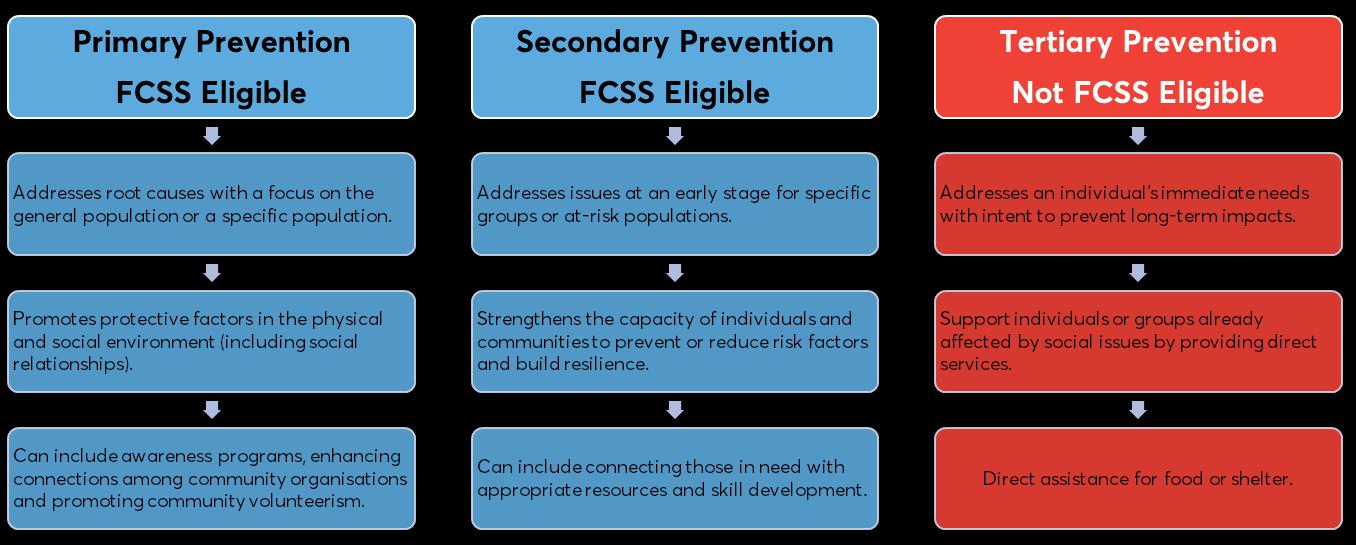
Figure 2: The FCSS Prevention Continuum
Provincial Prevention Priorities
Healthy individuals and families are a sign of a strong, connected community. Local FCSS programs help prevent social problems by focusing on root causes. The Government of Alberta has identified five provincial prevention priorities where proven strateg ies can strengthen protective factors and support community wellbeing.
All FCSS funded activities must align with at least one of the Provincial Prevention Priorities listed below:
• Homelessness and Housing Insecurity
• Mental Health and Addictions
• Employment
• Family and Sexual Violence
• Aging Well in Community
Provincial Prevention Strategies
FCSS funded activities should apply at least one of the following provincial prevention strategies to strengthen protective factors for individuals, families, and communities. Local FCSS programs may apply these strategies in ways that respond to local nee ds and enhance protective factors.
All FCSS funded activities must align with at least one of the Provincial Prevention Priorities listed below:
• Promote and encourage active engagement in the community.
• Foster a sense of belonging.
• Promote social inclusion.
• Develop and maintain healthy relationships.
• Enhance access to social supports.
• Develop and strengthen skills that build resilience.
Eligible FCSS Activit y Categories & Descriptions
All FCSS -funded activities must fall within one of the following four categories and/or their respective subtypes (see Figure 3) :
Programs: Programs are services that support community members as active participants. Participation is typically ongoing or recurring, with people attending multiple times.
Information and Referrals: Information & Referrals include times when staff or volunteers share service information with community members or help direct them to another support. These are typically brief, one -off interactions.
Community Events: Community Events are planned, usually one -time gatherings that help bring people together and build a sense of connection. They often happen around a specific date or season (like a holiday or day of remembrance), may follow a meaningful theme, and are cou nted by attendees rather than participants .
Community Development & Capacity Building: Community Development and Capacity Building includes work led by staff and/or volunteers to help strengthen communities by supporting and improving FCSS programs, such as volunteerism; staff and board development; partnerships, agency and community capacit y building; and assessment, consultation and evaluation.
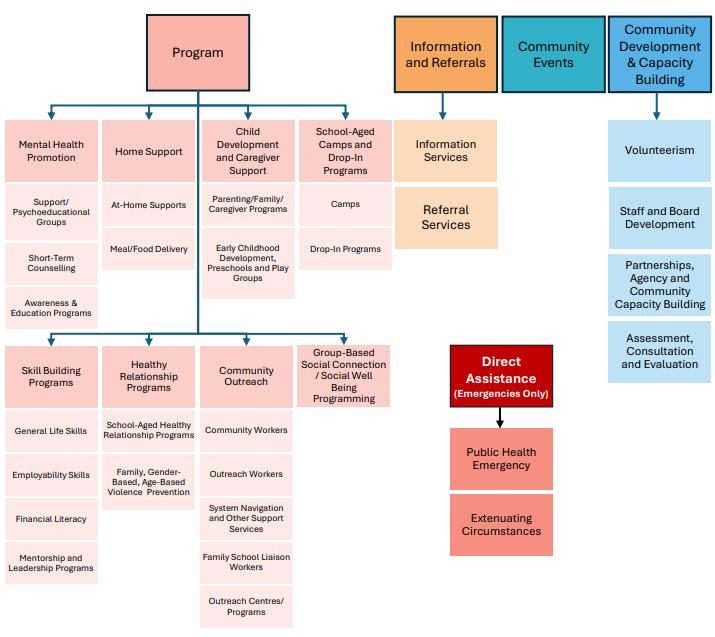
Figure 3: FCSS Activity Categories and Descriptions
Source: FCSS Accountability Framework Training Package, p. 14 (FCSSAA )
FCSS Key Performance Measures
FCSS funded activities are expected to collect data for reporting purposes. Data collection requirements depend on the activity category type. However, the KPMs are separated into Count Based KPMs and Survey Based KPMs
Please note that FCSS programs are not expected to design their own survey questions for FCSS reporting purposes. The survey questions required for each program will be discussed and selected during Funding Agreement negotiations.
➢ Survey Question Catalogue examples can be reviewed at : https://fcssaa.org/wp -content/uploads/2025/10/FCSS -AccountabilityFramework -Survey -Question -Catalogue.pdf
FCSS Accountability Framework Training Materials
The Family and Community Support Services Association of Alberta (FCSSAA) has created numerous resources that help provide guidance on understanding the FCSS Accountability Framework and reporting requirements .
➢ FCSSAA Training Materials, including video training modules, can be found here: https://fcssaa.org/accountability -framework -training/
APPENDIX 2: PROGRAM ALIGNMENT (EXAMPLE )
Program Name: City of Grande Prairie Home Support Program
Activity Categorization:
Program
o Sub -type: Home Suppo rt
• Community Development & Capacity Building
Provincial Prevention Priority (select best fit):
• Homelessness and Housing Insecurity
• Mental Health and Addictions
• Employment
• Family and Sexual Violence
Aging Well in Community
Provincial Prevention Strategies (select all that apply):
• Promote and encourage active engagement in the community.
• Foster a sense of belonging.
• Promote social inclusion.
• Develop and maintain healthy relationships.
Enhance access to social supports.
• Develop and strengthen skills that build resilience.
Local FCSS Investment Goals (select best fit ):
• Connect Individuals and Families to Supports
• Build Community Belonging and Resilience
• Encourage Youth Engagement and Employment Readiness
• Strengthen Child, Youth and Family Wellbeing
Support Aging Well Together Initiatives
APPENDIX 3: FCSS PROGRAM BUDGET (SAMPLE)
FCSS Funding