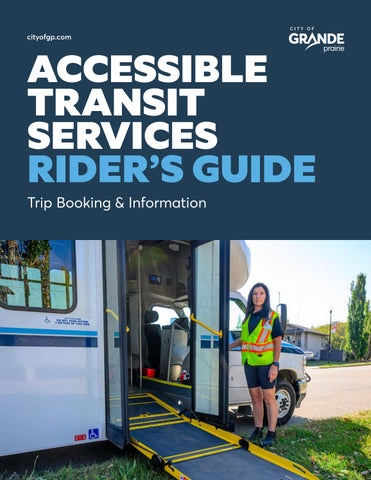
ACCESSIBLE TRANSIT SERVICES RIDER’S GUIDE Trip Booking & Information
CONTENTS 01
About Accessible Transit
07
Travelling with Pets
02
Bookings
08
03
Fares, Tickets & Passes
Travelling with a Personal Care Attendant
09
Travelling with Mobility Aids
10
Service Locations
11
Fixed Route Accessibility
04
Cancellations, Changes & Requests
05
Riding Accessible Transit
06
Operator Assistance
Accessible Transit Rider’s Guide
01
ABOUT ACCESSIBLE TRANSIT Accessible Transit
How can I apply for Accessible Transit?
Grande Prairie Accessible Transit (GPAT) provides transit services to those who cannot use regular transit for some or all of their travel needs due to a physical or cognitive impairment.
Those wishing to use Accessible Transit must register and be approved before booking a trip. Application forms are available at:
GPAT is a shared ride public transportation service available to any resident of the City of Grande Prairie and to residents in the County of Grande Prairie who live within 5 km of the City limits (including Clairmont). Registration is required.
10205 - 98th Street, Grande Prairie, AB T8V 2E7
Service is provided on an “accessible door to door” basis, providing a safe and secure trip from origin to destination. Booking and scheduling decisions are made to optimize our services for as many customers as we can possibly service. All of our Accessible Transit busses are equipped with wheelchair lifts or ramps to accommodate clients with special mobility needs. Customers using wheelchairs or scooters or Canadian National Insitute of the Blind (CNIB) pass holders may travel with an attendant at no extra cost. The attendant must board and exit at the same stop as the customer requiring assistance to provide assistance during the boarding and off boarding process. Funding for GPAT is made possible through contributions from the City of Grande Prairie and County of Grande Prairie.
Who can use Accessible Transit? Accessible Transit is available to permanent residents of The City of Grande Prairie and to residents within the County of Grande Prairie who live within 5 km of the City Limits, who cannot use regular transit service.
■ City Hall
■ City Service Centre
9505 - 112th Street Grande Prairie AB T8V 6H8
Applications are also available online at: cityofgp.com/gpat Only fully completed and signed applications will be considered. Section two of the application must be completed by a qualified health care or social services practitioner familiar with the applicant’s mobility.
Temporary Service Individuals who are temporarily disabled and meet the registration criteria may be able to use Accessible Transit for the duration of time they are unable to use regular transit.
Conditional Service Applications are sometimes approved with conditions attached. This means the Accessible Transit can only be used for those trips where regular transit will not work for a rider. Examples of conditions may include “in winter only”, “in dark conditions only” or for “medical appointments only”.
02
Accessible Transit Rider’s Guide
BOOKINGS Booking a Trip Accessible Transit Bookings: 780-830-7433 cityofgp.com/gpat
Dispatch Office Hours Day
Start Time
End Time
Monday–Friday
6 a.m.
11 p.m.*
Saturday
8 a.m.
11 p.m.*
Sunday
8 a.m.
8 p.m.*
Statutory Holidays
Sunday Hours**
* Last same-day booking: 30 minutes before end of service. ** Closed Christmas Day and New Years Day.
Accessible Transit Hours of Operation Day
Start Time
End Time
Monday–Saturday
6 a.m.
11 p.m.*
Sunday
8 a.m.
8 p.m.*
Statutory Holidays**
Sunday Hours**
* Last pick up times may vary based on demand. ** Closed Christmas Day and New Years Day.
The following information is required for booking a trip:
■ Client first and last name, and if they will be
accompanied by an attendant, companion, or service animal.
■ Any mobility equipment used, such as a wheelchair, scooter or walker.
■ The physical address of the pick-up and drop off, and the preferred accessible building entrance.
■ The appointment time, or the time when the client must arrive at the destination.
■ The time and location for the return trip, if required.
Due to the high volume of requests for service, Passengers are limited to two booking requests per call and a maximum of two return trips per day. Peak hours of operation are from 7:30 a.m. to 3 p.m. and 8 p.m. to 11 p.m., Monday to Friday when priority is given to persons taking medical, work or school trips. Please be courteous to other callers by having all your booking information ready. Accessible bookings can be made up to 14 days in advance and are subject to availability.
Pick-up Window (time frame) When you book your Accessible Transit trip, you will be given a pick-up time. The pick-up window starts at the scheduled pick up time and ends 30 minutes after your scheduled pick-up time. This window is the time frame in which the vehicle can be expected to arrive. For example: If your scheduled pick up time is 10:30 a.m., your vehicle should arrive between 10:30 a.m. and 11 a.m. Please be ready at the start of this window to prevent delays. If your bus has not arrived by 5 minutes past the end of your window, please contact the Accessible Transit dispatch office at 780-830-7433. Please remember to allow 45 to 60 minutes to get to your destination when riding the Accessible Transit, as there are often stops or possible pick-ups for other riders along the way. NOTE: Operators will not enter buildings to search for passengers. Please be ready at the exterior set of accessible doors at the beginning of your pick-up window. Upon arriving at your location, Operators will only wait for a maximum of 5 minutes.
Accessible Transit Rider’s Guide
03
FARES, TICKETS & PASSES Accessible Transit utilizes re-loadable, electronic smart cards known as SUPERPASS for tap-and-go bus fare payments. The SUPERPASS has replaced all paper passes and tickets. Exact cash fares are still accepted. Please note change is not provided.
GPAT passes are valid for both Accessible and Conventional buses. Lost card / replacement fee of $5.50 applies to lost or damaged cards needing replacement. There are no extra fees for re-loading your SUPERPASS.
Tap the card on the card reader when boarding the bus. Once the screen flashes “approved” you may find your seat. Each time a patron boards the bus they will be charged for one ride. For example, if it is a round trip, two rides will be charged: one for going to the destination and one for the ride back.
SUPERPASS can be purchased with cash or cheque to your driver. The SUPERPASS can be reloaded at City Hall, the City Service Centre or online at superpass.cityofgp.com
Fare Category
Fee
Cash One-Way
$3.00
20 Rides on a SUPERPASS
$35.00
Register your SUPERPASS online at superpass.cityofgp.com to access and track your balance. If you lose your card your balance can be transferred to a new card ONLY if you have registered your SUPERPASS online.
Monthly Unlimited SUPERPASS
$40.25
RELOADABLE, PAPERLESS, EASY! Simply tap-and-go to pay your bus fare! For more details on registration, reloading and purchasing, visit:
superpass.cityofgp.com
It can take up to 48 hours for online re-loads to be activated.
For more information, visit cityofgp.com/superpass.
04
Accessible Transit Rider’s Guide
CANCELLATIONS, CHANGES & REQUESTS Cancelling a Trip
Trip Adjustments
Your cooperation in phoning Accessible Transit promptly if you must cancel your trip is appreciated. This will help us provide better service for all passengers.
Accessible Transit Operators will not accept requests for changes of destination or pick-up times at the time of boarding. This will disrupt the planned schedule and negatively impact other riders.
Please call 780-830-7433 to cancel any unwanted bookings a minimum of 2 hours before the pick-up time.
Same day changes are subject to availability and can be requested by calling the dispatch office at 780-830-7433 during dispatch hours only.
NOTE: Trips cancelled less than two (2) hours before the scheduled pick-up time are recorded as a ‘Late Cancellation’. Frequent late cancellations may affect client trip booking privileges and lead to a possible suspension of service.
Late changes may not be accommodated due to time or space limitations.
No-Show What is considered a “No-Show”?
■ If the operator arrives at the scheduled time and pick-up location and no one is there.
■ When the client cancels at the door. No-shows are recorded in the client’s file at the Accessible Transit office. Frequent no-shows will be reviewed and may lead to a suspension of service. Operators will wait for five minutes upon arrival within your scheduled pick-up window. If you are not ready during this five-minute period, your trip is considered a no-show and the Operator will proceed to his or her next call. NOTE: The scheduled return trip will automatically be cancelled in the event of a no-show.
Travel Time on Vehicles Accessible Transit tries to minimize travel time; however, riders may be required to spend up to 60 minutes on the vehicle during any one-way trip. This is especially important for scheduling appointments that are time-sensitive like a doctor’s appointment.
Special Requests Unfortunately, we are not able to accommodate requests for specific vehicle types, seating locations or operators.
Accessible Transit Rider’s Guide
05
RIDING ACCESSIBLE TRANSIT Passenger Safety Accessible Transit riders are strongly encouraged to avoid taking accessible transit if they are known to have or suspected of having a communicable disease, illness or infection that could pose a risk to the health and safety of our operators or other passengers.
■ Refrain from wearing scented products such as
Grande Prairie Accessible Transit is dedicated to the safety of every passenger on every trip. All passengers are required to use the appropriate securement system or transfer to a vehicle seat for the safest trip possible.
■ Refrain from interfering with the operation of
It is mandatory to use a securement safety system for any mobility aid and to wear a seatbelt/shoulder strap. If a rider is unable to wear a seat belt/shoulder strap for health reasons, there must be a medical exemption on file.
■ Ensure the sidewalk and step outside your
aftershaves or perfumes. Other passengers or Operators may have allergies to these products.
■ Do not consume alcohol or non-prescription drugs on the bus.
the vehicle and all equipment attached to it.
■ Wear appropriate attire and footwear, unless
exceptions must be made for medical reasons. residence is cleared of ice and snow. Ramps must be kept in good repair. Your trip may be cancelled if we cannot get you to and from the bus safely.
Passenger Procedures
Seatbelts
As a registered rider on Grande Prairie Accessible Transit, it is your responsibility to:
Correct use of a securement safety system (mobility aids) and seat belt assemblies (passenger) is mandatory and a condition of use while travelling on GPAT. All clients are required to wear a seatbelt/ shoulder strap, unless they have a medical exemption letter on file, signed by a doctor. The Province of Alberta has requirements which GPAT must follow regarding seatbelt exemptions for medical reasons; these letters must be updated annually. Clients traveling with a scooter or a transport chair must transfer to a seat for all GPAT trips.
■ Be ready 15 minutes before your scheduled pick up time.
■ Have the exact fare or SUPERPASS ready when the Accessible Transit vehicle arrives. Drivers will not provide you with change.
■ Remain seated with the seatbelt or tie-down fastened while the vehicle is in motion.
■ Always follow the Operator’s instructions while
boarding, riding and exiting the Accessible Transit vehicle. Improper conduct may result in a refusal of service.
■ Refrain from smoking and vaping within five
metres of the vehicle; smoking and vaping are not allowed on the bus.
Carry-On Items Carry-on items are allowed but limited to what the client can carry on at one time, conforming to the size restrictions if being attached to a wheelchair or scooter. Operators DO NOT assist clients with their carry-on baggage.
06
Accessible Transit Rider’s Guide
OPERATOR ASSISTANCE Accessible Transit Operators DO:
Accessible Transit Operators DON’T:
Operate power lifts and ramps on the vehicle.
Assist clients in climbing more than one step.
Secure wheelchairs and scooters in restraint devices to the floor.
Enter a client’s residence under any circumstances.
Assist clients with lap/shoulder straps and belts.
Make repairs or adjustments to equipment.
Assist clients between the vehicle and the inside of the first exterior set of accessible doors at the place of origin and/or destination. An accessible door is an outside door with no more than one step.
BOOKING A RIDE
There are three ways to book Grande Prairie accessible transportation: 1. Download and create an account on the app: Grande Prairie My Ride 2. Online: gpmyride.app.ridewithvia.com/login 3. Call the dispatch center: 780-830-7433
Bookings can be made up to 14 days in advance. Enjoy the ride!
Carry parcels or load baggage. Limit carry-on items to what can be carried by you at one time. Board a client in a manual wheelchair when the weight exceeds 250 lbs without the assistance of an attendant.
Accessible Transit Rider’s Guide
07
TRAVELLING WITH PETS Service Animals
Family Pets
Accessible Transit Operators are required by law to transport assistance or service dogs accompanying people who are visually impaired, hearing impaired or persons with other disabilities.
Accessible Transit must balance the desire to be pet friendly with the comfort of all passengers on the bus. Therefore, some restrictions apply:
Upon registration for Accessible Transit, clients are required to provide an identification card for the animal that verifies that a recognized dog school has trained the animal.
An assistance dog can be recognized as follows:
■ Only small dogs and cats are allowed if they
are contained in a fully enclosed, clean, handheld crate appropriate to the animal’s size.
■ All crates must have a solid bottom to contain animal waste.
■ Crates must be small enough to fit on the owner’s lap.
■ Visually impaired – by its leather harness and
■ Only one hand-held crate allowed
■ Hearing impaired – by its bright orange
■ Passengers are responsible for their pets and
the identification card.
leash and collar and/or vest and the identification card.
■ Other disabilities – black harness and leash
and/or blue saddle bags and the ID card issued by a recognized dog school.
■ Assistance dogs are trained to be non-
threatening and unobtrusive and do not require a seat as they are trained to sit at the owner’s feet.
per passenger.
must always hold onto their crates. If there is room on the bus, crates may be placed on the floor beside the owner without blocking the aisle or other passengers.
■ Pets may be refused if they misbehave or pose a health or safety risk.
■ Concerns with allergies are minimized when
pets are contained in crates, which reduce the spread of dander. If a passenger with pet allergies notifies the driver of a problem, the passenger carrying a dog or cat on board may be placed in a different location on the bus.
08
Accessible Transit Rider’s Guide
TRAVELLING WITH A PERSONAL CARE ATTENDANT Personal Care Attendant A Personal Care Attendant (PCA) can travel with you on Accessible Transit if you require assistance during your trip or require assistance at your destination. When booking your trip on Accessible Transit, make sure you book a seat for your PCA if you will have one travelling with you.
■ A PCA must be 12 years of age or older. ■ A registered customer cannot be a PCA for another registered customer.
■ There is no additional charge to have 1 PCA travel with you.
You must provide your own attendant if:
■ You require help beyond the exterior door of the building at your pick-up or destination locations.
■ You require assistance with exterior stairs that exceed the one step policy.
■ You require assistance carrying mobility equipment.
■ You cannot be left alone and there is no one to meet you at your destination.
■ You require assistance with oxygen or other medical equipment.
■ Accessible Transit has determined an attendant is required because your conduct compromises the safety and/or comfort of yourself, other customers or the driver.
NOTE: It is not the driver’s responsibility to supervise customers. The driver will leave the vehicle to escort customers to and from the exterior doors of their pick up and drop off locations. If the client requires supervision, a PCA is required. Accessible Transit clients required to travel with a mandatory PCA can never travel alone on Accessible Transit and will have a designation on their file stating that all trips must be booked with an attendant as a condition of travel. The PCA does not have to be the same person for every trip, but they must be able to address the medical condition and/or behavioural concern. An existing client of Accessible Transit cannot be a Personal Care Attendant for another client.
Passenger Safety – PCAs Grande Prairie Transit is committed to providing safe and comfortable transportation for all passengers. Accessible Transit Operators are not trained to provide attendant care or emergency medical type services. This is the responsibility of the client and/or their guardians.
Accessible Transit Rider’s Guide
09
TRAVELLING WITH MOBILITY AIDS Wheelchairs & Walkers
Scooters
The base of the wheelchair (with push rings and attachments) cannot measure more than 76 cm x 127 cm (30” x 50”). Bags attached to the backs of wheelchairs must be compact and fit into the space behind the chair’s back.
The base of the scooter, including bumpers and other attachments, cannot measure more than 76 cm x 127 cm (30” x 50”). Bags attached to the backs or sides of scooters cannot extend past the 76 cm x 127 cm (30” x 50”) size limit.
If the wheelchair has handles, bags should not extend past the end of the handles or below the level of the seat. If there are no handles, suggested bag size is 36 cm x 46 cm x 15 cm (14” wide x 18” high x 6” deep), or smaller.
Scooters must be tied down separately. The client will be asked to transfer to a seat for their safety. Scooters must have a secure, easily identifiable place on the frame for the tie-downs to be attached at approximately a 45-degree angle to the floor.
Wheelchairs must have a secure, easily identifiable place on the frame for the tie-downs to be attached at approximately a 45-degree angle to the floor.
The scooter, passenger and parcels/baggage cannot have combined weight of more than 337 kg (750 lbs.).
The wheelchair, passenger and parcels/baggage cannot have combined weight of more than 337 kg (750 lbs.). Measurements are the same for walker size limits. Walkers that can fold must fold up during travel. All mobility aides must be inspected by Transit Staff prior to being utilized on Transit Services.
For safety reasons, Accessible Transit will not transport walkers, wheelchairs and scooters that are too large or cannot be tied down safely. Smaller equipment will allow more flexibility and travel options. When buying new equipment, ask the vendor if any securement devices, such as D-rings, can be added to the main frame to ensure safe travel on public transit.
10
Accessible Transit Rider’s Guide
SERVICE LOCATIONS Guidelines
One-Step Maximum
Locations which are served by Accessible Transit need to be accessible, safe for public transportation, and have the following:
A building entrance is considered to be “wheelchair accessible” if it has one step or less to enter it. The driver will assist a customer in a wheelchair up or down a maximum of one step plus the door threshold. Please confirm your destination has an accessible entrance before booking a trip.
■ Address is clearly visible from the roadway. ■ Good lighting in the area. ■ Sidewalks and driveways must be well
maintained and free of snow, ice and debris.
■ All ramps must meet City of Grande Prairie
building code requirements and maintained to the standards acceptable within the bylaw.
■ Parking area should be clear for Accessible
Transit to safely pick up and drop off passengers. Accessible Transit vehicles will not double park to load and unload clients.
Snow & Ice Ramps, sidewalks, driveways and roadways must be cleared of snow, ice and other debris. Accessible Transit may be unable to provide service if a clear and safe path is not available from the location’s doorway to where the vehicle door or lift is opened.
Ramps Make sure that permanent ramps are installed for everyone’s safety.
■ For every 0.3 m (1 ft) in height you need at least 3.6 m (12 ft) of ramp.
■ Non-slip surface for walking and handrails. ■ Handrails should be no higher than 0.86 m (33”). ■ Ramp should be at least 0.87 m (34”) wide (between handrails).
■ Be sure you have adequate room to maneuver
a chair or walker at the top landing of the stairs or at doorways at residences. The Barrier Free design standards state there should be a landing at the top and the bottom of not less than 1.5 m by 1.5 m (approximately 4.9 ft.).
■ If there is a curve or turn in the ramp there should be a level area not less than 1.2 m x 1.2 m (3.4 ft.).
Accessible Transit Rider’s Guide
11
FIXED ROUTE ACCESSIBILITY All our fixed route transit buses are wheelchair accessible. Many of our Accessible Transit Clients have discovered that taking fixed-route transit can make travelling easy. When using these transit services, keep the following information in mind:
■ Optimal dimensions for wheelchairs and
scooters are 71 cm x 121 cm (28” x 48”) or smaller, including push rings and attachments, or they will not fit through the doors (note: this is a slightly smaller size allowance than on the Accessible Transit).
■ Regular Transit may be unable to transport
■ Low floor buses can accommodate two
wheelchair/scooters at a time. Customers with children in strollers are also encouraged to use this space. All buses operated by The City of Grande Prairie are low floor buses and require only one step to enter the bus. They are also equipped with a ramp that can be deployed for passengers using a mobility aid.
■ Wheelchair passengers must be able to board and alight on their own. The operator secures the chair in. If they cannot board or alight alone, an attendant is required.
scooters or wheelchairs that are too large or cannot be tied down safely.
■ Baggage must be carried on lap and cannot
■ For everyone’s safety, walkers should be folded
For information on transit’s fixed route accessible features contact AccessGP at 311 or 780-538-0300.
down to approximately 20 cm (8”) and stowed away from the aisle.
For questions and concerns, please contact:
Main Line: 311 or 780-538-0300 Ride Bookings: 780-830-7433 Email: info@cityofgp.com
block the aisle.
Stay connected to cityofgp.com and engage.cityofgp.com and follow us on: facebook.com/CityofGP instagram/CityofGP linkedin.com/company/CityofGP twitter.com/CityofGP youtube.com/CityofGrandePrairie
For the latest news, events and opportunities at the City of Grande Prairie contact us at: PHONE 311 or 780-538-0300 EMAIL info@cityofgp.com WEB
cityofgp.com/accessgp
cityofgp.com