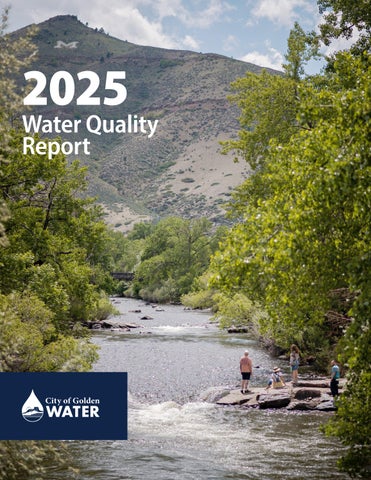
2025 Water Quality
Repor t


In accordance with regulations set for th by the Environmental Protec tion Agenc y (EPA), City of Golden Water is obligated to provide this repor t which offers comprehensive information about the quality of your drink ing water, including its source, contents, and compliance with rigorous state and federal standards. City of Golden Water values the trust that the public has placed in us, and we understand and embrace our obligation to provide responsible stewardship of our infrastruc ture and environment.
The City of Golden has mailed postcards to all individual City residents to notify them of this repor t We encourage residents to share this information with people who may not have received this repor t direc tly, like those who live in apar tments, nursing homes, schools, and businesses. You can do this by posting this repor t in a public place or distributing copies by hand, mail, email, or another method. Paper copies are available upon request by calling the Water Quality Lab at (303) 384-8181.
WATER UTILITY STAFF ARE C OMMITTED TO DELIVERING VALUE THR OUGH RELIABLE SERVICE.
To stay informed and have a voice in decisions that may impac t your water quality, the City of Golden invites you to attend City Council meetings. These meetings are held on the second and four th Tuesday of each month in the Council Chambers at 911 10th St., Golden, CO 80401. Go to w w w.cityofgolden.gov for more information.
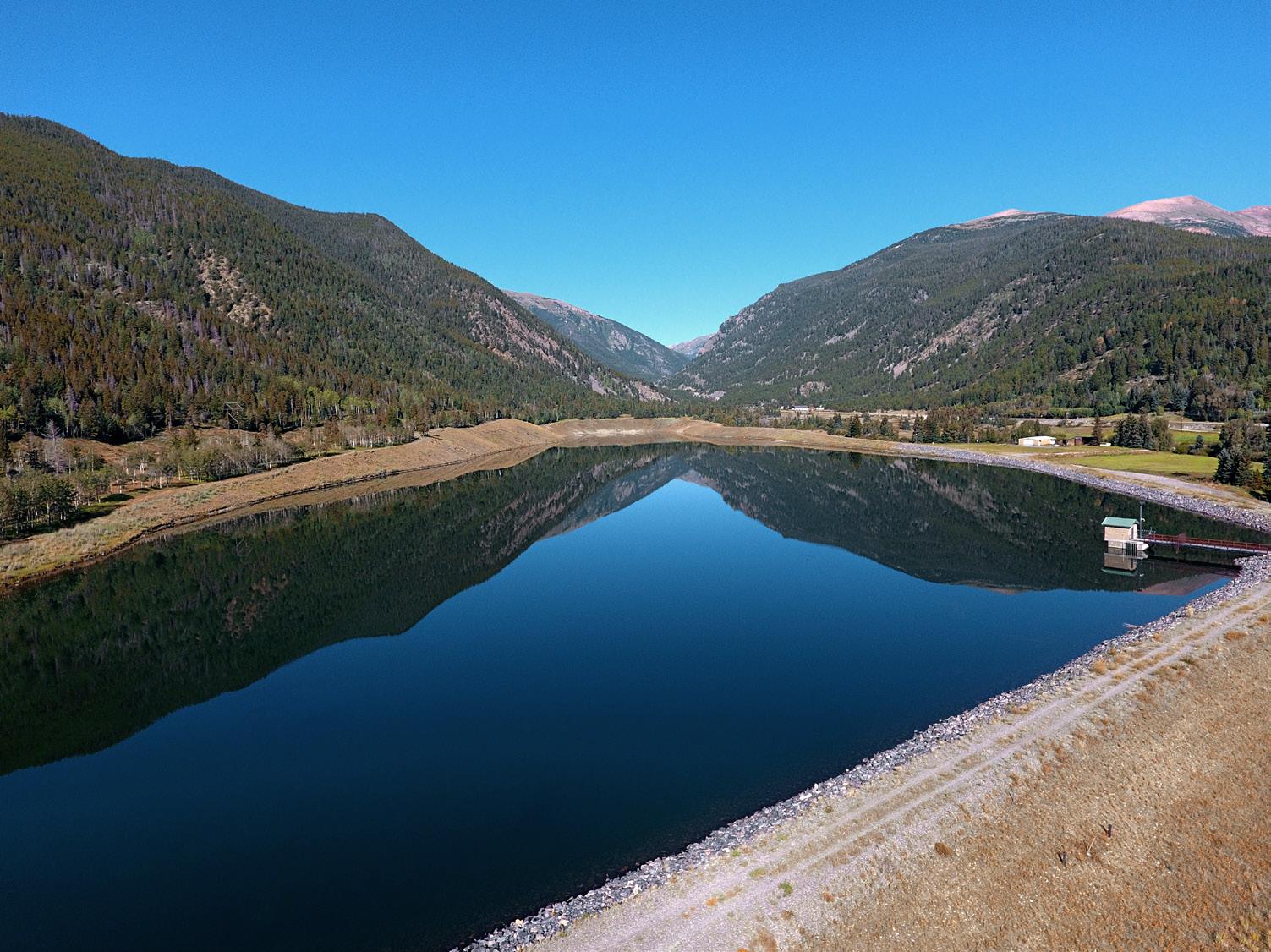
The sources of drink ing water (both tap water and bottled water) include rivers, lakes, streams, ponds, reser voirs, springs, and wells. Golden’s source water is sur face water from Clear Creek , primarily fed by snowmelt and its tributaries.
The Clear Creek watershed spans four counties covering an area of 575 square miles, with 400 square miles located in the ‘upper ’ watershed in the mountains west of Golden. Nearly two thirds of the upper Clear Creek watershed lies within the Arapahoe & Roosevelt National Forests; the rest of this mountainous region is covered by
a patchwork of private, municipal, county, and state lands. Clear Creek and its tributaries ser ve as the primar y drink ing water supply for multiple towns and municipalities in addition to Golden, ser ving over 450,000 Colorado residents.
The Colorado Depar tment of Public Health and Environment (CDPHE) completed a Source Water Assessment Repor t for Golden’s water supply in 2004. The repor t provides a screening-level evaluation of potential contamination that could occur. I t does not mean that the contamination has or will occur. We can use this information to evaluate the need to improve our current
water treatment capabilities and prepare for future contamination threats. This can help us ensure that quality finished water is delivered to your homes. A copy of this repor t is available by contac ting our Water Quality staff at (303) 384-8181 or by emailing waterquality@cityofgolden. net. You can also access it online by visiting https://cdphe.colorado. gov/swap -assessment-phase and searching for “Golden”.
Potential sources of contamination include Environmental Protec tion Agenc y (EPA) Super fund sites, EPA
identified abandoned contaminated sites, EPA identified hazardous waste generators, EPA identified chemical inventor y/storage sites, permitted wastewater discharge sites, aboveground, underground, and leak ing storage tank sites, solid waste sites, existing/abandoned mine sites, commercial/industrial/transpor tation, residential areas, urban recreational grasses or fallow, quarries/strip mines/gravel pits, row crops, pasture/ hay, deciduous, evergreen, and mixed forests, septic systems, oil/gas wells, and roads
Lead can cause serious health effec ts in people of all ages, especially pregnant people, infants (both formula-fed and breastfed), and young children. Lead in drink ing water is primarily from materials and par ts used in ser vice lines and in home plumbing. We are responsible for providing high quality drink ing water and removing lead pipes but cannot control the variety of materials used in the plumbing in your home Because lead levels may var y over time, lead exposure is possible even when your tap sampling results do not detec t lead at one point in time.
You can help protec t yourself and your family by identifying and removing lead materials within your home plumbing and tak ing steps to reduce your family ’s risk . Using a filter, cer tified by an American National Standards Institute accredited cer tifier to reduce lead, is effec tive in reducing lead exposures. Follow the
instruc tions provided with the filter to ensure the filter is used properly.
Use only cold water for drink ing, cook ing, and mak ing baby formula. Boiling water does not remove lead from water. Before using tap water for drink ing, cook ing, or mak ing baby formula, flush your pipes for several minutes. You can do this by running your tap, tak ing a shower, doing laundr y or a load of dishes. If you have a lead ser vice line or galvanized requiring replacement ser vice line, you may need to flush your pipes for a longer period.
If you are concerned about lead in your water and wish to have your water tested, contac t the Golden Water Quality Lab at (303) 384-8181. Information on lead in drink ing water, testing methods, and steps you can take to minimize exposure is available at epa.gov/safewater/lead
CITY STAFF REGULARLY TE ST WATER TO ENSURE ADHERENCE TO ALL REGULATORY STANDARD S .
New state and federal laws require us to inventor y all water ser vice lines in our ser vice area to classify the material. A ser vice line is the underground pipe that carries water from the water main, likely in the street, into your home or building. If you would like to view a copy of our ser vice line inventor y, scan the QR code or visit the link below.
IF YOU HAVE QUE STIONS AB OUT A C CE S SING THE INVENTORY, YOUR SERVICE LINE MATERIAL, OR BELIE VE YOUR WATER SERVICE LINE IS INC ORREC TLY C ATEGORIZED OR LISTED A S ‘UNKNOWN’, PLEA SE C ONTA C T THE WATER QUALITY LAB AT (3 0 3) 3 84 -8 18 1 OR EMAIL WATER QUALITY@CITYOFGOLDEN.NET.

https://co.accessgov.com/ public-works/Forms/Page/ public-works/ ser vice -line -repor t/1
All drink ing water, including bottled water, may reasonably be expec ted to contain at least small amounts of some contaminants The presence of contaminants does not necessarily indicate that the water poses a health risk . More information about contaminants and potential health effec ts can be obtained by calling the Environmental Protec tion Agenc y ’s Safe Drink ing Water Hotline, 1 (800) 426-4791 or by visiting epa.gov/ground-water-and- drinking-water.
Some people may be more vulnerable to contaminants in drink ing water than the general population.
Immunocompromised persons such as persons with cancer undergoing chemotherapy, persons who have undergone organ transplants, people with HIV-AIDS or other immune system disorders, some elderly, and infants can be par ticularly at risk of infec tions. These people should seek advice about drink ing water from their health care providers. For more information about contaminants and potential health effec ts, or to receive a copy of the U.S. Environmental Protec tion Agenc y (EPA) and the U.S. Centers for Disease Control (CDC ) guidelines on appropriate means to lessen the risk of infec tion by Cr yptosporidium and microbiological contaminants, call the EPA Safe Drink ing Water Hotline at (1-800-426-4791).
As water travels over the sur face of the land or through the ground, it dissolves naturally occurring minerals and, in some cases, radioac tive material, and can pick up substances resulting from the presence of animals or from human ac tivity.
Contaminants that may be present in source water include:
• Microbial contaminants: viruses and bac teria that may come from sewage treatment plants, septic systems, agricultural livestock operations, and wildlife.
• Inorganic contaminants: salts and metals, which can be naturally occurring or result from urban storm water runoff, industrial or domestic wastewater discharges, oil and gas produc tion, mining, or farming
• Pesticides and herbicides: may come from a variety of sources, such as agriculture, urban storm water runoff, and residential uses.
• Radioac tive contaminants: can be naturally occurring or be the result of oil and gas produc tion and mining ac tivities.
• Organic chemical contaminants: including synthetic and volatile organic chemicals, which are byproduc ts of industrial processes and petroleum produc tion, and also may come from gas stations, urban storm water runoff, and septic systems.
In order to ensure that tap water is safe to drink , the Colorado Depar tment of Public Health and Environment prescribes regulations limiting the amount of cer tain contaminants in water provided by public water systems. The Food and Drug Administration regulations establish limits for contaminants in bottled water that must provide the same protec tion for public health.
FOR MORE INFORMATION, C ALL THE WATER QUALITY LAB AT (3 0 3) 3 84 -8 18 1 OR EMAIL WATER QUALITY@CITYOFGOLDEN.NET.
The City of Golden routinely monitors for contaminants in your drink ing water according to Federal and State laws. The following tables show all detec tions found in 2025 unless other wise noted. The State of Colorado requires us to monitor for cer tain contaminants less than once per year because the concentrations of these contaminants are not expec ted to var y significantly from year to year, or the system is not considered vulnerable to this type of contamination. Therefore, some of our data, though representative, may be more than one year old.
Organic and Inorganic Contaminants Sampled at the Entry Point to the Distribution System
Total Organic Carbon ( TOC ), repor ted as a ratio, must remain above 1.0 for optimal water treatment.
Radionuclides Sampled at the Entry
Fer tilizer use, septic tanks, erosion of natural deposits
of natural deposits
Turbidity (Measurement of the cloudiness of the water
It is a good indication of the effec tiveness of our filtration system)
Turbidity December 2025
Lowest monthly percentage of samples meeting T T requirements for our technology : 100%
In any month, at least 95% of samples must be less than 0.3 NTU
Runoff
Disinfection By-Products
Trihalomethanes ( T THM)
Haloacetic Acids (HAA5)
Chlorine is used to disinfec t water and protec t public health. Some customers may occasionally notice a chlorine -like smell. This odor is due to normal off- gassing and does not indicate a problem with water quality.
TT REQUIREMENT: AT LEA ST 9 5 % OF SAMPLE S PER PERIOD (MONTH OR QUAR TER ) MUST BE AT LEA ST 0.2 PPM OR IF SAMPLE SIZE IS LE S S THAN 40, NO MORE THAN 1 SAMPLE IS BELOW 0.2 PPM. GOLDEN SAMPLE SIZE IS 43 .
TYPIC AL S OURCE S: WATER ADDITIVE USED TO C ONTR OL MICR OBE S .
Corrosion of household plumbing
Secondar y standards, or secondar y maximum contaminant levels (SMCL), are non- enforceable guidelines for contaminants that may cause cosmetic effec ts (such as sk in or tooth discoloration) or aesthetic effec ts (such as taste, odor, or color) in drink ing water.
of
of
* REQUIRED TO BE MONITORED FOR E VERY 9 YEARS , BUT YOUR WATER UTILITY MONITORS THEM MORE FREQUENTLY. THO SE MORE FREQUENT MONITORING RE SULTS ARE INCLUDED IN THIS TABLE.
EPA has implemented the Unregulated Contaminant Monitoring Rule (UCMR) to collec t data for contaminants that are suspec ted to be present in drink ing water and do not have healthbased standards set under the Safe Drink ing Water Ac t. EPA uses the results of UCMR monitoring to learn about the occurrence of unregulated
contaminants in drink ing water and to decide whether or not these contaminants will be regulated in the future. We per formed monitoring and repor ted the analytical results of the monitoring to EPA in accordance with its Unregulated Contaminant Monitoring Rule (UCMR). Once EPA reviews the submitted results, they are made available in the EPA’s
National Contaminant Occurrence Database (NCOD) (epa.gov/dwucmr/ national- contaminant- occurrencedatabase -ncod) Consumers can review UCMR results by accessing the NCOD. Contaminants that were detec ted during our UCMR sampling and the corresponding analytical results are provided below.
Lithium is a naturally occurring metal found at higher concentrations in cer tain par ts of the countr y, par ticularly in groundwater sources in arid regions of the Western United States. It has various commercial uses, including in pharmaceuticals, industrial processes, sanitizing agents, and batteries While lithium can be present in drinking water, the EPA has not established a non-regulator y drinking water health advisor y or any regulator y standard level for it. Research on its potential health effec ts is ongoing, par ticularly regarding exposure through drinking water.
Per fluoroalk yl and polyfluoroalk yl substances, also k nown as PFAS, are human-made chemical compounds that have been used for decades to repel water, grease, and oil. A few produc ts that contain PFAS include carpets, firefighting foam, water-resistant clothing, nonstick cook ware, and food pack aging. Because these chemicals cannot break down easily, they have been nick named “forever chemicals.” Although they were made to make our lives easier, researchers have found that there may be health effec ts associated
with exposure to some PFAS. During the latest round of UCMR monitoring, Golden sampled quar terly for 29 different PFAS chemicals in our source water and finished drinking water and had zero detec tions for any of the compounds. Golden also conduc ted monitoring for selec t PFAS throughout 2025 in accordance with state regulations. No PFAS were detec ted in Golden Water ’s finished drinking water. For more information about Golden’s PFAS sampling and results, contac t the Water Quality Lab at (303) 384-8181 or email waterquality@cityofgolden.net
Treatment Technique (T T ):
A required process intended to reduce the level of a contaminant in drink ing water.
Health-Based: A violation of either a MCL or T T.
Non-Health-Based: A violation that is not a MCL or T T.
Ac tion Level (AL): The concentration of a contaminant which, if exceeded, triggers treatment and other regulator y requirements
Contaminant: Any physical, chemical, biological, or radiological substance or matter in water
Maximum Contaminant Level (MCL):
The highest level of a contaminant that is allowed in drink ing water. MCLs are set as close to the MCLGs as feasible using the best available treatment technology.
Maximum Residual Disinfec tant Level (MRDL):
The highest level of a disinfec tant allowed in drink ing water. There is convincing evidence that addition of a disinfec tant is necessar y for control of microbial contaminants.
Maximum Contaminant Level Goal (MCLG): The level of a contaminant in drink ing water below which there is no k nown or expec ted risk to health. MCLGs allow for a margin of safety.
Maximum Residual Disinfec tant Level Goal (MRDLG):
The level of a drink ing water disinfec tant, below which there is no k nown or expec ted risk to health. MRDLGs do not reflec t the benefits of the use of disinfec tants to control microbial contaminants.
Violation (No Abbreviation):
Failure to meet a Colorado Primar y Drink ing Water Regulation.
Formal Enforcement
Ac tion (No Abbreviation):
Escalated ac tion taken by the State (due to the risk to public health, or number or severity of violations) to bring a non- compliant water system back into compliance
Variance and Exemptions ( V/E): Depar tment permission not to meet a MCL or treatment technique under cer tain conditions.
Gross Alpha (No Abbreviation):
Gross alpha par ticle ac tivity compliance value. I t includes radium-226, but excludes radon-222, and uranium.
Picocuries per liter (pCi/L): Measure of the radioac tivity in water
Nephelometric Turbidity Unit (NTU): Measure of the clarity or cloudiness of water. Turbidity in excess of 5 NTU is just noticeable to the typical person.
Compliance Value (No
Abbreviation): Single or calculated value used to determine if regulator y contaminant level (e.g. MCL) is met. Examples of calculated values are the 90th Percentile, Running Annual Average (RAA) and Locational Running Annual Average (LRAA).
Average (x-bar): Typical value
Range (R): Lowest value to the highest value.
S ample Size (n): Number or count of values (i.e. number of water samples collec ted).
Par ts per million: Par ts per million = M illigrams per liter (ppm = mg/L).
One par t per million corresponds to one minute in two years or a single penny in $10,000.
Par ts per billion: Par ts per billion = M icrograms per liter (ppb = ug/L).
One par t per billion corresponds to one minute in 2,000 years, or a single penny in $10,000,000.
Not Applicable (N/A): Does not apply or not available.
Level 1 Assessment: A study of the water system to identify potential problems and determine (if possible) why total coliform bac teria have been found in our water system.
Level 2 Assessment: A ver y detailed study of the water system to identify potential problems and determine (if possible) why an E. coli MCL violation has occurred and/or why total coliform bac teria have been found in our water system on multiple occasions.
LRAA: The average of sample results for samples collec ted at a par ticular monitoring location during the most recent four calendar quar ters
Pesticide: Generally, any substance or mix ture of substances intended for preventing, destroying, repelling, or mitigating any pest.
Herbicide: Any chemical(s) used to control undesirable vegetation.
90th Percentile: The value at which 90% of all other results are lower (or that 10% are higher). Used to determine compliance with the Lead and Copper Ac tion Levels.
CITY OF GOLDEN, C OLOR ADO