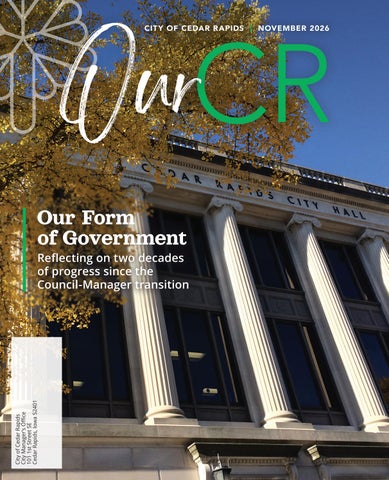
CIT Y OF CEDAR R APIDS | NOVEMBER 2026
Our Form of Government Reflecting on two decades of progress since the Council-Manager transition
FROM THE
CITY MANAGER
NOVEMBER 2026 FROM THE CITY MANAGER • 2 OUR FORM OF GOVERNMENT • 4 TAKING ACTION • 8 LOOKING AHEAD • 16 NEWS YOU CAN USE • 20 DIRECTORIES • 23
CONNECT
WITH CEDAR RAPIDS City of Cedar Rapids Iowa Government
Mobile CR Smartphone App
@CityofCRIowa
CR News Now Text / Email Alerts
CityofCR
City Source Email Newsletter
City of Cedar Rapids on Nextdoor
CityofCR.com/Subscribe
Interested in advertising with us? Contact communications@cedar-rapids.org.
Cedar Rapids is fortunate to have exceptional elected leaders. Our Mayor and City Council bring valuable perspectives, a shared commitment to our community, and the vision and determination to make difficult policy decisions that move us forward. One of Cedar Rapids’ greatest strengths is how we work together. It is something leaders in other communities have noticed, too. When they ask me what makes Cedar Rapids successful, the answer is never any one person, project, or decision. It is Cedar Rapids’ ability to bring people together around a shared purpose. Our form of government provides a strong foundation for this. The Mayor and City Council establish the priorities and policies that guide our community’s future. Professional City staff bring the expertise and dedication to turn that direction into results for residents and businesses. Equally important are the residents, businesses, nonprofits, and community partners who contribute their ideas, resources, and energy to our shared success. Cedar Rapids’ achievements reflect the contributions of many people working toward a common purpose. No one individual, department, or organization can accomplish that alone. That spirit of shared leadership and commitment is Cedar Rapids at its best. It is what makes this community special, and what gives us confidence in the future we are building.
Jeffrey Pomeranz Cedar Rapids City Manager citymanager@cedar-rapids.org 2
Twenty years ago,
Cedar Rapids began operating under a new form of government. The more important story is what has happened since.
Cities constantly balance the needs of today with the demands of tomorrow. Streets, utilities, public safety, housing, economic development, and community services all compete for attention and resources — and many of those needs overlap. Forward progress requires more than individual departments doing their own work well. It requires shared priorities, continuity, collaboration, and the ability to bring the right people and resources together around a common goal. That is the thread running through this edition of Our CR. The stories ahead show how: broad community goals become practical decisions, priorities shape the budget, long-term investments move from planning to construction, departments adapt to work more efficiently, and Cedar Rapids prepares for future economic and workforce needs. Some of that work is highly visible. Other work happens behind the scenes. Much of it takes years. Twenty years into the Council-Manager form of government, its structure has become almost invisible. What remains visible is the result: plans carried forward, challenges met, resources shared, and people across the organization and community moving in the same direction. This is the story of the past 20 years — and the foundation for what comes next.
CEDAR-RAPIDS.ORG
3
OUR FORM OF GOVERNMENT
moving
cedar rapids
forward A New Form of Government
For nearly a century, Cedar Rapids operated under the Commission form of government. In 2005, residents chose a different path, approving a Home Rule Charter that established the Council-Manager form of government we use today. The change took effect January 1, 2006, creating a structure that separates elected leadership from the professional management of day-to-day City operations.
Under the previous form, elected commissioners held both legislative and executive responsibilities, including oversight of City departments. The Council-Manager form separated those responsibilities. Today, the Cedar Rapids City Council includes the Mayor and eight council members. The Mayor and three council members are elected at large, representing the entire city, while five council members represent geographic districts. Together, the Mayor and City Council establish policy and priorities, approve the budget, and determine the tax rate. They also appoint a full-time city manager to carry out those policies and oversee City operations. Department directors report to the City Manager, creating a clear connection between the direction established by elected leaders and the services provided across the community.
A Structure Built for the Long Term
For more information, visit: CityofCR.com/FormofGovernment
4
Residents feel the impact of our City government every day, even though its structure and operations mostly happen behind the scenes. Elected leaders bring community perspectives to decisions about priorities, services, and long-term direction. Professional staff provide expertise to put those decisions into action. In practice, residents elect the
OUR CR
|
NOVEMBER 2026
Twenty years ago, Cedar Rapids began a new chapter in how its government would be led and managed.
people who set the direction for Cedar Rapids and experienced professionals oversee the day-to-day work needed to deliver City services. This structure provides continuity. Streets, flood protection, public safety, parks, utilities, housing, and other community priorities often require years of planning, investment, and coordination — efforts which must continue even as elected officials change over time. Over the past 20 years, Cedar Rapids has experienced significant growth and change, along with challenges that have tested our community. Through it all, the Council-Manager form has provided a framework for elected leaders and professional staff to work together toward shared priorities. Our City continues to grow and evolve. The structure established in 2006 helps provide consistency in how we serve the community today while supporting the long-term planning that will shape Cedar Rapids for years to come.
How it Works: Home Rule Charter A Home Rule Charter is one of eight forms of government available to Iowa cities. Think of it like a local constitution: it establishes how city government is organized and how responsibilities are shared. Cedar Rapids’ charter establishes a Council-Manager form of government, combining elected leadership with the professional administration of a city manager.
How Cedar Rapids is Organized The City’s organizational structure begins with its residents, who elect nine members of the City Council (including the Mayor). The part-time Council sets policy, establishes community priorities, approves the budget and tax rate, and makes decisions about longterm issues like growth, development, infrastructure, and strategic planning.
THE MAYOR
CITY MANAGER & OPERATIONS
The Mayor is a voting member of the City Council and presides over Council meetings. The Mayor also represents Cedar Rapids in intergovernmental relationships, helps facilitate communication among elected and appointed officials, assists the Council in setting goals and advancing its policy decisions, and appoints members of citizen boards and commissions with Council approval.
The Council appoints the full-time City Manager to carry out those policies and oversee the City’s day-to-day operations. Working with department directors and employees, the City Manager prepares the proposed budget, manages City staff, advises the Council, recommends policies and provides information about City operations and the potential impacts of Council decisions.
COUNCIL APPOINTMENTS The Council appoints the City Attorney, City Clerk, and numerous community members who serve on boards, commissions, committees, and task forces. These groups provide resident perspectives, expertise, and recommendations that inform public policy and stewardship of City resources. Policymaking authority rests with the elected City Council. The City Manager and City staff put those decisions into action.
Cedar Rapids Residents
City Attorney
Cedar Rapids City Council
City Clerk
Airport Commission
Civil Rights Commission City Manager
Boards & Commissions
Library Board of Trustees
City Departments
CEDAR-RAPIDS.ORG
Veterans Memorial Commission
5
OUR FORM OF GOVERNMENT
one city,
working together Residents experience City government through many different services: a park, a street project, emergency response, drinking water, neighborhood improvements, and more. Behind those services are employees with different expertise; however, they all have one shared responsibility: serving Cedar Rapids. That idea is at the heart of our One City mindset.
Why “One City”? Community needs rarely fit neatly within one department. Housing can involve planning, infrastructure, utilities, and public safety. Neighborhood revitalization may involve streets, parks, housing, and economic development. Addressing homelessness can require several City teams working alongside nonprofits and service providers. Our form of government creates a structure that tackles those challenges. Rather than organizing priorities around individual departments, the City Council establishes direction for the organization. 6
HOW IT WORKS It all begins with a shared vision. EnvisionCR, the City’s comprehensive plan, looks 20 years ahead, guiding decisions about growth, transportation, housing, infrastructure, neighborhoods, and other investments. Each year the City Council builds on that vision through priority-setting sessions that identify where the organization should focus its attention and resources. The City Manager and City Team then organize around those priorities, bringing together the departments, expertise, resources, and community partners needed to move the work forward. This differs from Cedar Rapids’ former commission form of government, when elected commissioners directly oversaw separate areas of City operations. Today, responsibility for carrying out Council’s direction is coordinated across the organization, creating more opportunities to solve problems collectively.
WORKING ACROSS CITY HALL Our One City mindset takes this structure a step further. It asks employees to start with the outcome the community needs, then determine how departments can work together to achieve it. That OUR CR
|
NOVEMBER 2026
means sharing expertise, resources, and ideas across departments, and bringing different perspectives to the table. It also helps the City use public resources responsibly and maintain quality services as financial conditions, community needs, and available resources change.
HEALTHY ORGANIZATIONAL CULTURE The City’s Organizational Health framework helps make that mindset part of everyday work. Its Core Values — We Serve Enthusiastically, We Find a Way, and We Team Up — emphasize service, initiative, problemsolving, relationships, and collaboration. The framework also distinguishes between ongoing responsibilities and challenges needing added focus now. Standard operating objectives represent work that must consistently be done well, while an annual One City Goal identifies one nearterm opportunity or challenge requiring shared focus across the organization.
Conditions may cause priorities to change. However, the expectation will remain the same — bring the right people together, focus on the shared outcome, and find a way forward as One City.
Caring is our specialty At Physicians’ Clinic of Iowa, we’re proud to offer expert, compassionate care for children of all ages. Whether it’s a routine check-up or a more complex health issue, our board-certified pediatricians are here to ensure your child’s needs are met with care and attention. We offer a full range of pediatric services, including routine check-ups, immunizations, well-child visits, and chronic condition management, working with specialists to provide comprehensive care.
We’re accepting new patients! Schedule online or call (319) 247-3820 today!
PCOFIOWA.COM
TA K I N G A C T I O N
one city,
Every year, Cedar Rapids faces a challenging question: how can we best use limited resources to best serve the entire community?
one budget
Under the former commission government, elected commissioners set policy and oversaw individual departments and their budgets. The transition to a Council-Manager government created an opportunity to bring those pieces together. Accounting and finance functions were consolidated under one department, helping establish more consistent practices for budgeting, purchasing, financial reporting, and long-term planning. This change improved efficiency and created clearer lines of responsibility, strengthened internal controls, and established a more complete view of the City’s finances. Today, the budget is built the same way the organization increasingly works: as One City. Elected
leaders set priorities while professional staff develop a unified budget that addresses the needs of the entire organization. The City's annual budget planning cycle begins up to two years before its funds are spent. Department directors work with the Finance Department and City Manager to assess needs, guided by Council priorities, EnvisionCR, and community input. The City Manager then presents a balanced budget for Council's consideration and adoption within the months before that budget begins. The result is a unified financial plan that balances public safety, infrastructure, staffing, utilities, quality-oflife investments, economic development, and long-term financial stability.
Changing Financial Landscape Recent changes to Iowa property-tax law have placed new limits on local budgeting while the costs of providing City services continue to adapt to fiscal pressures. The City's 2026 One City Goal, Adjust to Financial Realities, reinforces an important principle for staff: One City, One Budget. This means protecting core services, finding efficiencies, sharing resources, and solving problems together. Learn more about the City Budget and find a FY27 Budget Summary at CityofCR.com/Budget.
C A SE S TUDY: PAVING FOR PROGRESS
From Street-by-Street Decisions to a Citywide Plan Most cities face the same challenge: aging streets and more infrastructure needs than available funding can address. Cedar Rapids is no exception. Historically, street funding focused largely on main roads, leaving limited resources for residential streets. Years of deferred maintenance created a growing backlog. Paving for Progress demonstrates how professional oversight, dedicated funding, and long-term planning support a coordinated, citywide approach to maintaining public infrastructure. Rather than addressing streets individually as problems arise, the City uses a 10-year management plan based on pavementcondition data collected on every City street. Every two years, a 8
How the Budget Comes Together ` Summer: Departments identify needs and begin planning. ` Fall–Winter: Requests, revenue, and public input are reviewed. ` Early Spring: Council reviews the City Manager’s budget proposal. ` Spring: Public Hearings are held and Council adopts a final budget. BUDGET
Fiscal Year 2027
PRESENTATION
` $928 Million Total Budget ` $361 Million in Capital Improvements ` No property-tax rate increase.
Unified Finance Department
` Strategic economic growth reduces pressure on homeowners. ` Cedar Rapids is one of few Iowa communities to earn national recognition from the Government Finance Officers Association for its budgeting and financial reporting.
Consolidating financial functions helps the City: ` apply consistent purchasing and accounting standards; ` strengthen checks, balances, and audit trails;
CITY MANAGER'S
` coordinate purchases and reduce duplication;
BUDGET PROPOSAL
` compare needs across all City departments using one financial big picture; and ` make spending decisions with the whole organization in mind.
DEDICATED FUNDING, LONG-TERM RESULTS Paving for Progress leverages a one-percent, voterapproved sales tax dedicated to improving City roadways. First approved in 2013 and renewed in 2021, it provides reliable road improvement funding through 2034. From 2014–2026, the program has: ` Completed 550 projects+, 75% on residential streets specially equipped vehicle measures pavement texture, distress, and roughness. Engineers use that information to prioritize projects, coordinate with other infrastructure work, and balance two goals: ` Reconstruct roads in the worst condition when repairs are no longer practical.
` Improved 131 miles+ of City streets ` Invested $260 million+ in Cedar Rapids roadways Paving for Progress puts One City, One Budget into practice: using dedicated funding, professional expertise, and reliable data to make decisions based on long-term, citywide needs.
` Perform less costly preventive maintenance to extend the life of roads before they require expensive reconstruction. This approach helps stretch available funding by preventing more expensive repairs while improving streets throughout the community. CEDAR-RAPIDS.ORG
View the 10-year management plan at CityofCR.com/PavingforProgress.
9
TA K I N G A C T I O N
BEHIND THE SCENES:
better services Residents expect City services to work reliably, efficiently, and consistently. What they may not see is the considerable work happening behind the scenes to make that possible. service. Sharing services allows departments to focus on their specialized responsibilities while benefiting from organization-wide expertise and resources.
Meeting Expectations with Consistent Standards Over the past two decades, Cedar Rapids has continually refined its operations, recognizing opportunities to improve where traditional approaches fell short. By reducing duplication, coordinating resources, and establishing consistent standards across departments, the City has become more effective and responsive — anticipating community needs and delivering the level of service residents expect and deserve.
` Communications: A unified Communications Division coordinates public information, improving consistency in resident notifications, project updates, and emergency communications. ` Fleet Services: Centralized vehicle maintenance, fuel management, and equipment replacement planning help departments share resources, reduce downtime, and maintain service readiness. ` Finance: Consolidated accounting, purchasing, payroll, and financial reporting functions establish consistent practices and support coordinated financial management.
Sharing Resources Across Departments The transition to Council-Manager government in 2006 created an opportunity to rethink how Cedar Rapids organized its operations. With City departments unified, functions previously managed separately are now consolidated, reorganized, and coordinated to better serve the entire organization and our residents. The City has brought together essential support services, established consistent practices, and developed organization-wide initiatives that encourage employees to work across departmental boundaries. These changes reduced duplication, coordinated investments, and made specialized expertise and resources available throughout the organization. Many of these improvements happened behind the scenes, but their impact extends to everything from emergency response and infrastructure maintenance to neighborhood communication and customer
10
OUR CR
|
` Information Technology: Centralized technology services provide shared network infrastructure, cybersecurity, software, mapping, and technical support for all departments. ` Innovation: Cross-departmental collaboration creates opportunities for employees to share ideas, challenge existing practices, and develop more effective approaches to delivering services. ` Organizational Health: Shared leadership practices, clear priorities, and common Core Values establish expectations for collaboration, problemsolving, and accountability. ` Sustainability: Departments and community partners work closely together to integrate environmental considerations into City operations and long-term planning.
NOVEMBER 2026
Coordinated Communication The benefits of working as one organization extend beyond sharing equipment, knowledge, and resources. They also influence how residents experience City services. Consider a street reconstruction project. While residents may see one construction site, the work can involve multiple departments coordinating roadway improvements, underground utilities, sidewalks, traffic management, and other infrastructure. Just as those teams must coordinate their work, they must also coordinate how they communicate with the surrounding neighborhood. To support that effort, Cedar Rapids has established organization-wide communication guidelines that create consistent expectations for notifying residents about projects and activities that affect them. The guidelines help departments determine when and how to communicate, using methods such as direct mail, neighborhood meetings, electronic newsletters, project websites, and door hangers. They also establish expectations for explaining the purpose of a project, anticipated schedules and impacts, and whom residents can contact with questions.
EFFECTIVELY COMMUNICATING WITH RESIDENTS ABOUT CITY WORK IN NEIGHBORHOODS
A Consistent Resident Experience That same emphasis on consistency applies to everyday interactions with City government. Whether someone is reporting a neighborhood concern, asking about a utility service, or seeking information about a City program, residents should expect helpful, responsive service. The City’s Customer Service Standards establish shared expectations for employees across departments. These standards emphasize taking ownership of inquiries, providing timely responses, and helping residents find solutions regardless of which City service they initially contact.
CUSTOMER SERVICE STRATEGY & STANDARDS GUIDE
Employees are expected to acknowledge correspondence within one business day and document concerns through a shared request management system. They are also encouraged to resolve questions without unnecessary transfers and connect residents directly with employees who have the appropriate expertise when additional assistance is needed. These common standards help create accountability while allowing individual departments to address the specialized needs of the services they provide. Residents should not have to understand how City government is organized to receive great service. That is the value of the work happening behind the scenes: bringing together the people, resources, and expertise of an entire organization so that, no matter which department is involved, residents experience One City working for them.
CEDAR-RAPIDS.ORG
11
TA K I N G A C T I O N
connecting
departments
When an emergency happens, effective response depends on clear communication. Behind every response is a network connecting police officers, firefighters, ambulance crews, and other City teams. At the center of that network is the Joint Communications Agency (JCA), the dispatch center responsible for coordinating their response. JCA dispatches Cedar Rapids Police, Fire, Animal Control, and Airport officers while coordinating with other City departments and outside emergency services, such as Area Ambulance Services. Over the past 20 years, Cedar Rapids has strengthened its network through major advances in technology, staffing, and equipment. These improvements have helped connect departments, share resources, and build a more reliable emergency communications system for the entire community.
strengthening
emergency response
12
OUR CR
|
NOVEMBER 2026
CURTIS WALSER, DISTRICT FIRE CHIEF
VEHICLE RADIO SYSTEM
Building a Stronger System Two decades ago, dispatchers relied on functional, but limited, radio systems. Coverage gaps, equipment vulnerabilities, and less-secure transmissions made it difficult to maintain reliable contact with responders in the field. The 2008 Flood underscored these challenges. When floodwater overran radio centers, systems failed, leaving responders without the reliable communication network they needed. Since then, major improvements have transformed JCA operations. Today’s radio systems have built-in backups, are secure, encrypted, and designed to perform in extreme conditions. Clearer audio, stronger signals, and real-time location tracking help dispatchers coordinate emergency responses across agencies. What once required multiple steps and manual tracking is now streamlined through integrated systems that automatically update unit locations, statuses, and emergency events. These advances help dispatchers share information and coordinate responders more effectively. Kyle Hadenfeldt, JCA's senior dispatcher, has connected emergency callers with responders for 45 years. He marvels at the information now available to dispatchers compared to two decades ago. "Had someone told me when I started that in the future, we would be able to transmit call information, vehicle registrations, driver's licenses, I would have said that was impossible," said Hadenfeldt.
KYLE HADENFELDT, JCA SENIOR DISPATCHER
Connecting Departments, Sharing Resources Recent upgrades demonstrate how Cedar Rapids continues to improve emergency communications while making the most of available resources. The City recently completed a full rollout of new handheld radios for the Police and Fire Departments. Improvements include larger controls for firefighters wearing gloves, clearer audio in noisy environments, and the ability to reprogram radios to meet local needs. Rather than discarding the previous system, staff repurposed the decommissioned radios for use by other City departments. This extended the value of existing equipment, met communication needs, and avoided unnecessary expenses. Much of the programming for both sets of radios was handled internally by District Fire Chief Curtis Walser. His work reduced costs and helped ensure equipment could be used across City operations. Walser recently accepted an award on behalf of the City for helping connect the 50,000th radio to Iowa's statewide interoperability system. This network helps agencies communicate with one another during large-scale emergencies, extending coordination beyond City departments.
Breaking Down Barriers The 2008 Flood exposed a challenge that extended beyond Cedar Rapids. The City, Marion, and Linn County operated on different radio systems, making it difficult for emergency responders to communicate directly with one another. The three governments worked together to develop a shared regional radio system. Launched in 2014, the system connected emergency responders across jurisdictions, improving coordination during everyday operations and major emergencies. The partnership also allowed governments to share the cost of infrastructure rather than maintain separate systems.
CEDAR-RAPIDS.ORG
13
TA K I N G A C T I O N
protecting the city
Just two years after Cedar Rapids transitioned to its new form of government, it faced a massive challenge: how to move forward from the 2008 Flood. On June 13, 2008, the Cedar River crested at 31.12 feet, its highest level in Cedar Rapids history — by far. Floodwater covered 10 square miles of the city, impacted almost 5,400 homes, displaced more than 18,000 residents, and damaged more than 300 City facilities. The Flood became an early test of the new government. The City needed to work across departments, address residents’ immediate needs, and develop a long-term plan to protect the community from future flooding.
14
How a new form of government shaped the response to the 2008 Flood and the years that followed
A Closer Look: The A Avenue Pump Station Located in the heart of downtown, and part of Five Seasons Plaza Park, the A Avenue Pump Station is one of the newest and most colorful pieces of the Flood Control System.
The Community Comes Together Steps toward recovery began even before floodwater receded. Under the new form of government, the City committed to engaging all sectors of the community in recovery planning. This meant addressing residents’ immediate needs while planning for the community's future. Just six weeks after the flood, the first open houses were held to develop a flood management strategy. More than 2,600 community members participated. In November 2008, just five months after the flood, the City Council approved the strategy. That was only the beginning. Turning the community's vision into a permanent Flood Control System would require years of planning, advocacy, and cooperation among local, state, and federal partners.
Years of Effort, Long-Term Investment Securing funding became a major focus of the City. The size and cost of the proposed system required support far beyond the City's available resources. Moving the project forward would take years of sustained effort and partnerships at every level of government. The City worked with state legislators to develop a new source of funding. Those efforts established the State of Iowa Flood Mitigation Board in 2012. The board made its first award to Cedar Rapids: a 20-year, $269.4 million commitment to flood protection. The City Manager’s Office also worked with legislators at the federal level. In 2018, Congress appropriated more than $117 million in funding for the East side of the Cedar River, as part of the Water Resources Development Act Supplemental Funding. Each milestone built on years of work. With the City Council setting the direction and professional staff carrying that work forward, Cedar Rapids maintained its focus through changing priorities and funding challenges. This continuity helped turn the community's original flood management strategy into a long-term investment in our community's future.
Building a Flood Control System Working with HR Green and Stanley Consultants, Cedar Rapids developed a larger Flood Control System (FCS) for both sides of the river. The FCS is designed to convey the same volume of water as the 2008 Flood, reducing flood risk through the heart of Cedar Rapids. The system combines floodwalls, levees, and gates with features that reflect our culture, history, and vision. Today, many parts of the system are complete, with more under construction. Multiple City departments are working together to make it happen. That collaboration is made much easier by the overall vision and leadership of the new government format — representing a triumph of the vision our community committed to in 2005. CEDAR-RAPIDS.ORG
Pump stations play a key role in protecting the community from floods. During a flood event, underground gates close the storm sewer system off from the river; however, that rainwater still needs somewhere to go. Pump stations help lift rainwater from the storm sewer system up and over the flood wall, keeping the water in the river and out of the City. Staff from the City’s Water Pollution Control Division monitor pump stations while they’re in use. They make sure the system is working to keep rainwater from flooding on the “dry side” of the flood wall. Because the A Avenue Pump Station is highly visible along the Cedar River, it provided a great opportunity for artistic expression. Earlier this year, artists were chosen to create a bold, welcoming public art mural on the exterior walls of the new station. It is the latest example of the Flood Control System “hiding in plain sight” — embracing the role of protection, while serving as an attractive riverfront feature.
LOOKING AHEAD
developing
How Cedar Rapids attracts development, strengthens businesses, and creates opportunities for residents
our future
Cedar Rapids is open for business! New employers, expanding local businesses, housing developments, and neighborhood improvements are all signs of a growing city. Each brings jobs, investment, and new possibilities for residents. Over the past 20 years, Cedar Rapids has made significant changes to how it welcomes development and helps businesses succeed.
Making Development Easier to Navigate Before the transition to our new government structure, development projects involved several departments operating under separate leadership. Uniting those efforts made it easier to coordinate the work. In 2012, the City further improved the process by establishing its Economic Development and Development Services Divisions. Today, developers can work with City staff early in their process to understand requirements and identify potential challenges. Through Pre-Application and Concept Plan Reviews, businesses and
16
developers can discuss their ideas with City staff before investing significant time and money in detailed plans. Planning, Engineering, Utilities, Building Services, and other City teams coordinate their reviews to identify potential issues early and help projects move forward without unnecessary delays. The result is strong for businesses considering Cedar Rapids: they can anticipate what to expect, plan for how long a project might take, and understand costs. Our consistent development process helps businesses make decisions with confidence while ensuring projects meet City standards.
Preparing for Opportunity Cedar Rapids also works to put itself in a position to attract future investment. This involves looking ahead at where businesses might locate, planning for potential infrastructure needs, and ensuring developments fit into the City's plans for growth. An important part of this work is supporting businesses already operating in Cedar Rapids. Through the Existing Industry Program, City staff annually survey approximately 50 businesses engaged in interstate commerce to better understand their needs, challenges, and opportunities for growth. Staff also meet with local employers to build relationships, identify potential expansion plans, and help
OUR CR
|
NOVEMBER 2026
businesses navigate development processes efficiently when they are ready to invest. Companies considering Cedar Rapids look at available land, transportation, utilities, and workforce needs. The City works to attract investment that fits the community, helping existing businesses grow while bringing in new employers. Efforts focus on industries such as manufacturing, food processing, life sciences, logistics, and financial services. Supporting existing businesses is an important part of that work. An existing employer adding a production line, a new business opening in a commercial district, or an underused property finding a new purpose can all generate economic activity — each contributing to community growth and improved quality of life.
For Our Residents New development brings jobs, customers, and opportunities for housing and investment. As the community grows, an expanding tax base helps support City services and amenities while spreading costs across more properties. The improvements Cedar Rapids has made over the past 20 years have put the City in a stronger position to welcome that growth and help ensure its benefits reach the broader community.
AT A GL ANCE: E VALUATING PROPOSED PROJEC T S
01
03
Residents Shape Our Future
City Department Review
Public meetings, surveys, and neighborhood planning give residents opportunities to influence how Cedar Rapids grows.
With all development proposals, City departments review plans against applicable requirements.
ENVISIONCR
The City's comprehensive plan sets a long-term direction for our community.
WHAT GETS REVIEWED? ` Zoning & land use
` Stormwater drainage
` Traffic & site access
` Engineering & site design
` Water & sewer capacity
` Building & fire safety
PLANS Departmental, program-based, and area-action plans dive deeper into specific needs and areas.
ARE ADDITIONAL APPROVALS NEEDED?
FUTURE LAND USE MAP Shows the types of development envisioned for different areas of the city.
LOCAL PLANNING PROCESS & CITY COUNCIL ADOPTION Follows any applicable public review processes.
02
Plans Guide Development Rules The City uses its plans to help establish zoning and development standards.
ZONING
Determines what types of development are legally allowed on a property today.
NO ADDITIONAL APPROVALS Permitted under existing rules. The project continues through the required reviews, permits, and inspections.
ADDITIONAL APPROVALS REQUIRED Depending on the request, the process may involve public hearings and decisions by boards, commissions, or City Council. Some projects also seek City incentives or development agreements, which are considered separately from standard development approvals.
PROJECTS MOVE TOWARD CONSTRUCTION After applicable requirements and approvals are satisfied.
DEVELOPMENT CODES Set standards for building design, site layout, infrastructure, and safety.
WHEN ZONING CHANGES ARE PROPOSED The process includes public notice, Planning Commission consideration, and City Council action, including required public hearings.
ARE YOU CONSIDERING A DEVELOPMENT PROJECT IN CEDAR RAPIDS? Scan the QR code to schedule a pre-application meeting with Development Services staff to discuss your project and identify next steps. ` CityofCR.com/NewProject
17
LOOKING AHEAD
the foundation of
cedar rapids' future The future of Cedar Rapids will be shaped by its next generation of thinkers, creators, and problem solvers. That’s why the City is committed to youth engagement — connecting students with real-world experiences, demystifying how local government operates, and showing them that their ideas genuinely matter.
Real-World Skills, Authentic Learning Cedar Rapids’ next generation of leaders is already stepping forward with curiosity, confidence, and a front row seat to how their city works. Each fall, more than 150 high school students from across the Cedar Rapids area attend the Mayor’s Youth Conference. Now in its fourth year, this free, day-long event helps students explore their futures, discover new interests, and find ways to get involved in their community. Students learn financial literacy, explore Cedar Rapids’ form of government, take career assessments, and hear about college experiences from area 18
students. They also discover the many services the City provides and the careers that make those services possible. This year, one group of attendees had the opportunity to brainstorm ideas for the Mayor's Youth Climate Action Fund, a $5,000 grant opportunity that turns students’ ideas into real projects that benefit the community. Across the City, departments connect with students of all ages through school visits, hands-on learning, and community activities. From teaching public safety to
explaining how streets, utilities, and other infrastructure work, City employees help students understand the services they rely on every day. These opportunities introduce young people to local government, spark interest in future careers, and encourage them to help shape their community.
MAYOR TIFFANY O'DONNELL SPEAKING AT THE MAYOR'S YOUTH CONFERENCE
C A SE S TUDY: RE AL-WORLD LE ARNING WITH 3DE The Challenge: How can the City of Cedar Rapids best communicate about its One City Goal to employees within the organization? Through Junior Achievement’s 3DE program, students apply classroom lessons to real challenges provided by local organizations. Working with professionals, they learn how organizations operate, explore careers, develop solutions, and present their ideas. As one of this year’s Case Partners, the City worked with Washington High School students on an internal communications challenge. The partnership gave students an inside look at City government and the opportunity to learn from City staff while building problem-
solving, teamwork, and communication skills. Students presented their solutions to the City's Communications Team. This year's winners, Abigail Sullivan and Zane Trembly, proposed a creative pager-style notification system for employees. The experience introduced students to the people and work behind local government while giving City staff fresh perspectives on a real organizational challenge.
Join a Culture Built for What’s Next The City offers opportunities in more fields than might be expected. Alongside firefighters, police officers, engineers, and public works crews are professionals working in finance, human resources, information technology, communications, planning, and many other areas. Many of these careers use the same skills found in the private sector. Working for the City offers something more: the opportunity to use those skills to serve the community and work alongside people from many different professions. The City's focus on Organizational Health helps create a workplace where employees are encouraged to collaborate, share ideas, and solve problems together. Innovation is also part of that culture. From finding better ways to deliver everyday services to developing new programs, employees have opportunities to turn their ideas into action. Supporting those employees is just as important. The City offers competitive benefits, work-life balance, and opportunities for professional growth to attract and retain talented employees. Choosing a career with the City means becoming part of a team where every role contributes to making Cedar Rapids a better place to live.
ABIGAIL SULLIVAN & ZANE TREMBLY 3DE GRAND CHAMPIONS
COMPREHENSIVE BENEFITS We provide competitive pay with an excellent benefits package, including affordable medical, vision, and dental insurance; a strong retirement pension plan; deferred compensation program; structured pay increases; longevity pay after five years; tuition reimbursement; 100% City-paid basic life insurance; long-term disability options; and access to the Public Service Loan Forgiveness program for student debt assistance.
BETTERING THE COMMUNITY Working for the City means being part of something bigger. It gives you the satisfaction of giving back to our community with a commitment to public service.
WORK-LIFE BALANCE We prioritize work-life balance with an average of 11 paid holidays and 4 weeks of paid parental leave for both parents.
HEALTH & WELLNESS Your wellbeing is important to us. We offer access to health and wellness coaching and other employee assistance services, such as counseling for personal and family issues, mental health support for depression and anxiety, work-life balance assistance, substance abuse resources, financial and legal counseling, crisis intervention, and referrals to community resources. CEDAR-RAPIDS.ORG
19
NE WS YOU C AN USE
Mount Vernon Road SE Facelift Replacing Lead Service Lines The City is advancing the first phase of its Lead Service Line Replacement Project, focused on Hamilton Street SW, near Wilson Avenue and I-380. About 450 lead and galvanized service lines will be fully replaced through LEARN MORE the project. In qualifying neighborhoods, homeowners can have lead or galvanized water-service lines replaced at no cost by opting in to the program. We expect Phase 1 to start in Spring 2027. Planning is also underway for the program’s next phase in the Time Check neighborhood. Advance work includes locating and confirming service line materials in the area to determine eligibility. The City will continue to reach out directly to homeowners to share information throughout the process.
Over several years, City teams have coordinated a series of improvements along Mount Vernon Road SE. Paving for Progress work has rebuilt and resurfaced sections of the roadway while also replacing water mains, improving drainage, adding sidewalks and transit stops, upgrading ADA crossings, and improving lighting and traffic flow. Another recent improvement was the reconditioning and recoating of the Mount Vernon Road SE water tank this summer, extending its lifespan, enhancing its appearance, and helping maintain area water quality. We also used the opportunity to add the City's name and logo, continuing a practice initiated in the past decade to promote community pride. This work is part of broader, long-term efforts to reinvest in the corridor, including the Mount Vernon Road Urban Revitalization Area and projects tied to the Mount Vernon Road Corridor Action Plan. Together, these projects show what One City looks like in practice: Public Works, Utilities, Community Development, Planning, Transit, and other City teams coordinating around a shared vision to improve not only a street, but also the infrastructure and neighborhood surrounding it.
SAVE THE DATE
Cedar Rapids Tree Lighting SATURDAY, DECEMBER 5 | 4:30–6 PM | GREENE SQUARE Following the event, enjoy the Five Seasons Lights at McGrath Amphitheatre, presented by Farmers State Bank and running through Sunday, December 27.
Reminder: Yard Sign Regulations With election season over, yard sales winding down, and leaves being collected, it's a good time to assess excess yard signs. While the City cannot regulate the content of yard signs or other temporary signs, there are rules about where and how they can be displayed. ` Signs must be placed on the property owner’s side of the sidewalk and should not block foot traffic. ` If there is no sidewalk, signs must be a minimum of 10-12 feet from the road. ` Residential properties are permitted six square feet of yard signs, which is equal to an area that is two feet by three feet, most times of year. ` During the 60 days prior to any state, federal, or local election, residential properties are permitted 24 square feet of yard signs. ` With the recent election season over, please ensure your residential property does not have more than six square feet of yard signs on display. Improperly placed signs can be reported using the Mobile CR application on your smart phone or the My CR reporting tool online at CityofCR.com/MyCR.
Recognition Beyond Cedar Rapids A City can measure its own progress in many ways; however, it is always good to get an outside perspective. In recent years, national organizations have repeatedly recognized Cedar Rapids for qualities that matter to residents: opportunity, affordability, safety, healthcare, quality of life, and strong public services. No single ranking tells the whole story. Added up, they illustrate a bigger picture: Cedar Rapids is a community where people can build careers, put down roots, access quality services, and enjoy a high quality of life. ` Find more City rankings and recognitions at CityofCR.com/Rankings
BY THE NUMBERS
No. 1 in iowa
Best-in-State Hospital – UnityPoint Health–St. Luke’s
No. 7
Safest City in America
No. 12
Newsweek, 2026
WalletHub, 2026
Best Big City for Economic OpportunitY
U.S. News & World Report / Milken Institute, 2025
No. 14
Best Cities for Work
No. 16
Best City to Buy a House in America
No. 33
Best Place to Live in the U.S.
CEDAR-RAPIDS.ORG
Indeed, 2026
Niche, 2026
Livability, 2026
21
NE WS YOU C AN USE
Winter Road Reminders Are you prepared for winter driving? Take a moment to review these safety tips for Iowa's winter season, especially during Snow Emergencies.
residents and businesses to not push snow from driveways or parking lots into public streets, as this violates City Code and adds extra work for crews clearing the roads.
MAKE SAFETY A HABIT
EMERGENCY SNOW ROUTES
` Give plows plenty of space as they may stop and back up unexpectedly.
During a Snow Emergency, we enforce parking restrictions on Emergency Snow Routes. These routes are typically on main roads and bus routes, and near school zones and hospitals. The routes have signs to mark them and show they have priority for snow removal due to high traffic. We may ticket or tow vehicles parked on these routes after we declare a Snow Emergency.
` Reduce your speed. ` Use caution when turning. ` Avoid sudden movements. ` Accelerate and brake carefully and slowly. ` Leave extra space between vehicles and increase braking distance.
Find a map of Emergency Snow Routes and more snow removal information at CityofCR.com/Snow.
` When walking, "walk like a penguin" to prevent slips, trips, and falls: walk flatfooted, take short steps, and keep your weight centered above one leg.
ODD/EVEN PARKING RULE
CLEARING SNOW FROM DRIVEWAYS & PARKING LOTS
In residential areas, residents should follow the odd/even parking rule to help with snow removal. Park on the side of the street with odd-numbered house addresses on
Our crews work overnight to keep roads clear during winter snow events. We ask
odd-numbered calendar days, and on the even-numbered side on even days. This gives snow plows enough space to clear the streets safely and efficiently. Odd calendar days: Park on odd-address side of the street
Even calendar days: Park on even-address side of the street The rule applies to most residential neighborhoods but does not apply to Emergency Snow Routes, metered parking areas, or streets with permanent parking restrictions. Need a friendly reminder? Sign up for text alerts and get City news like Snow Emergencies: CRNewsNow.com
Holiday
Garbage, Recycling & Yard Waste CO L L E C T I O N S C H E D U L E THANKSGIVING
Thursday, Nov. 26
No collection, 1 day delay remainder of week Leaf collection delayed 1 day for SW Quadrant
CHRISTMAS
Friday, Dec. 25
No collection, 1 day delay remainder of week
NEW YEAR’S DAY
Friday, Jan. 1
No collection, 1 day delay remainder of week
DEC. 14 – FEB. 26: YARD WASTE CALL-IN ONLY
CityofCR.com/Holiday
Cremation
Funeral
Cemetery
Everything for your family A t Cedar Memorial, you’ll find comfort, dignity, and quality at every turn. From our distinctive facilities and grounds to our caring, professional staff—we provide everything for your family. We pride ourselves in providing innovative funeral and cemetery services to families throughout the Marion
and Cedar Rapids area. Learn more today at www.CedarMemorial.com
CITY SERVICES DIRECTORY CITY SERVICE
LOCATION
PHONE
EMAIL ADDRESS
Animals
7241 Washington View Parkway SW
319-286-5993
AnimalControlMgmt@Cedar-Rapids.org
Assessor
City Services Center, 500 15 Avenue SW
319-286-5888
CRAssessor@Cedar-Rapids.org
Bid Opportunities
City Hall, 101 1 Street SE
319-286-5021
Bid-Purchasing@Cedar-Rapids.org
Building and Housing Codes
City Services Center, 500 15 Avenue SW
319-286-5831
Building@Cedar-Rapids.org
Buses
Ground Transportation Center, 450 1st Street SE
319-286-5573
CRTransit@Cedar-Rapids.org
Fire Safety Inspections
713 1st Avenue SE
319-286-5166
CRFire@Cedar-Rapids.org
Garbage, Recycling, and Yard Waste Collection
City Services Center, 500 15th Avenue SW
319-286-5897
Solid-Waste-Recycling@Cedar-Rapids.org
Housing Assistance Programs
City Hall, 101 1st Street SE
319-286-5872
HSG-Admin@Cedar-Rapids.org
Land Development
City Services Center, 500 15 Avenue SW
319-286-5822
DevelopmentServices@Cedar-Rapids.org
Park Pavilion & Shelter Rentals
City Services Center, 500 15 Avenue SW
319-286-5566
Parks@Cedar-Rapids.org
th
st
th
th th
Police — Non-Emergency
319-286-5491
Potholes and Street Maintenance
City Services Center, 500 15th Avenue SW
319-286-5826
Street@Cedar-Rapids.org
Recreation Programs
Northwest Recreation Center, 1340 11th Street NW
319-286-5566
Recreation@Cedar-Rapids.org
Sewer Backup or Problems
City Services Center, 500 15th Avenue SW
319-286-5815
Sewer@Cedar-Rapids.org
Traffic Signals, Signs, and Markings
City Services Center, 500 15th Avenue SW
319-286-5176
Utility Billing
City Hall, 101 1st Street SE
319-286-5900
Traffic@Cedar-Rapids.org WaterMail@Cedar-Rapids.org
For more information about the City of Cedar Rapids and its services, call 319-286-5080 or visit CityofCR.com.
CITY COUNCIL
To leave a message for a City Council member, call 319-286-5051. Find your district at LinnCountyElections.org.
MAYOR
DISTRICT 1
DISTRICT 2
Tiffany O’Donnell
Martin Hoeger
Scott Overland
DISTRICT 3
DISTRICT 4
DISTRICT 5
Dale Todd
Scott Olson
Ashley Vanorny
AT LARGE
AT LARGE
AT LARGE
David Maier
Tyler Olson
Ann Poe
T.Odonnell@cedar-rapids.org
D.Todd@cedar-rapids.org
D.Maier@cedar-rapids.org
M.Hoeger@cedar-rapids.org
Scott.Olson@cedar-rapids.org
T.Olson@cedar-rapids.org
CEDAR-RAPIDS.ORG
S.Overland@cedar-rapids.org
A.Vanorny@cedar-rapids.org
Ann.Poe@cedar-rapids.org
23
RESEARCH RESEARCH PARTICIPANTS PARTICIPANTS NEEDED NEEDED Researchers Iowa are are seeking seekingteenagers teenagers Researchers atat the the University University of Iowa andyoung youngadults adults ages ages 14-19 14-19 for aa paid and paid research researchstudy studyonon factorsrelated related to to alcohol alcohol use and factors and problems. problems. Participation Participation consistsofof3 3lab labvisits visits over over 30 30 months consists months and and completing completingonline online surveys. Participation Participation is is voluntary voluntary and surveys. and participants participants can can withdrawatatany any time time without without penalty. penalty. Eligible withdraw Eligible participants participantscan can earn up to $540. earn up to $540. Scan the QR code for more Scan the QR code more information about thefor study information the study and how to about participate
and how to participate
CARD-STUDY@UIOWA.EDU
CARD-STUDY@UIOWA.EDU