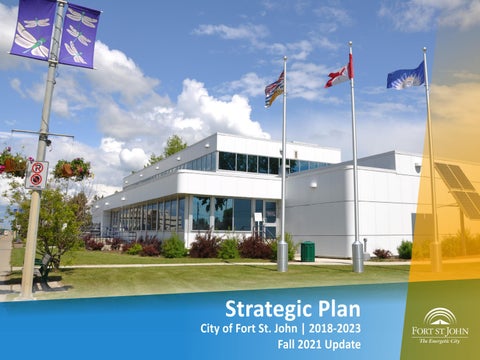
Strategic Plan
City of Fort St. John | 2018-2023 Fall 2021 Update
Contents Message from Council. . . . . . . . . . . . . . . . . . . . . . . . . . . . . . . . . . . . . . . . . . . . . . . . . . . . . . . . . . . . . . . . . . . . . . . . . . . . . . . . . . 2 Role of the Strategic Plan . . . . . . . . . . . . . . . . . . . . . . . . . . . . . . . . . . . . . . . . . . . . . . . . . . . . . . . . . . . . . . . . . . . . . . . . . . . . . . . 3 Guiding Statements. . . . . . . . . . . . . . . . . . . . . . . . . . . . . . . . . . . . . . . . . . . . . . . . . . . . . . . . . . . . . . . . . . . . . . . . . . . . . . . . . . . . 5 Strategic Goals Goal Number 1 | Economic Development . . . . . . . . . . . . . . . . . . . . . . . . . . . . . . . . . . . . . . . . . . . . . . . . . . . . . . . . . . . . . . . 6 Goal Number 2 | Municipal Operations . . . . . . . . . . . . . . . . . . . . . . . . . . . . . . . . . . . . . . . . . . . . . . . . . . . . . . . . . . . . . . . . . 8 Goal Number 3 | Managing Assets . . . . . . . . . . . . . . . . . . . . . . . . . . . . . . . . . . . . . . . . . . . . . . . . . . . . . . . . . . . . . . . . . . . . 10 Goal Number 4 | Partnerships and Advocacy. . . . . . . . . . . . . . . . . . . . . . . . . . . . . . . . . . . . . . . . . . . . . . . . . . . . . . . . . . . . 12 Goal Number 5 | Vibrant Community. . . . . . . . . . . . . . . . . . . . . . . . . . . . . . . . . . . . . . . . . . . . . . . . . . . . . . . . . . . . . . . . . . 14 External Guiding Documents Sustainable Development Goals. . . . . . . . . . . . . . . . . . . . . . . . . . . . . . . . . . . . . . . . . . . . . . . . . . . . . . . . . . . . . . . . . . . . . . . 17 Principles of Reconciliation. . . . . . . . . . . . . . . . . . . . . . . . . . . . . . . . . . . . . . . . . . . . . . . . . . . . . . . . . . . . . . . . . . . . . . . . . . . 19 Environmental, Social and Governance Framework. . . . . . . . . . . . . . . . . . . . . . . . . . . . . . . . . . . . . . . . . . . . . . . . . . . . . . . 20
1
Message from Council We are pleased to present the 2018 - 2023 Strategic Plan for the City of Fort St. John. The 2018 - 2023 Strategic Plan contains five strategic goals that address our commitment to enhancing community development, demonstrating environmental responsibility, and supporting the current and future needs of our community.
Mayor Lori Ackerman
This Plan is the road map for the delivery of City services and programs and ensures we are deliberately moving forward. It provides the foundation for aligning the Council's planning decisions and provides direction for budgets and work plans. The coming years will continue to bring opportunities and challenges, and we will continue to face them as we have been, head on and with careful consideration. Recognizing our vision, mission, and key values, we will continue to make progress towards bettering and advancing the interests of our community. We welcome your input and comments on the 2018 - 2023 Strategic Plan at council@fortstjohn.ca.
2
Councillor Trevor Bolin
Councillor Lilia Hansen
Councillor Gord Klassen
Councillor Jim Lequiere
Councillor Byron Stewart
Councillor Tony Zabinsky
Role of the Strategic Plan The City of Fort St. John has numerous guiding documents that, together, provide the foundation for the delivery of all City services and programs and set the long-term course for Fort St. John. These guiding documents are created with extensive public input to reflect the vision of Fort St. John residents. STRATEGIC PLAN This five year plan, approved by Council, translates the vision of the Official Community Plan into a clear framework of projects and initiatives to be undertaken by City staff. OFFICIAL COMMUNITY PLAN This overarching plan outlines the values and vision for the future of our community. Council uses this plan to guide their decision making and create the Strategic Plan. This plan is updated every five years with extensive community consultation. CITY BYLAWS A City Bylaw is a law made by City Council. These laws only apply within the city boundary and they are enforced mainly by Bylaw Department staff and Building Inspectors. During the approval process of a bylaw, a public hearing is held for the community to provide their feedback.
MASTER PLANS These are comprehensive community development plans that guide planning staff and decision making around topics such as transportation, utilities, land use, and recreation. Examples of recent Master Plans created in our city include the Transportation Master Plan and the Parks and Recreation Master Plan. Extensive community consultation is undertaken during the drafting of a Master Plan. FINANCIAL PLAN Each department creates budgets based on anticipated activities and Strategic Plan priorities. Expected expenses and estimated revenues are planned for each year. Public meetings are held each year to receive feedback from the community on the draft operating and capital budgets. Together, these budgets make up the Financial Plan.
EXTERNAL GUIDING DOCUMENTS In addition to several internal guiding documents, the City of Fort St. John Strategic Plan references three guiding documents - the Sustainable Development Goals, Principles of Reconciliation, and Environmental, Social and Governance framework. Each of these documents, referenced at the end of this Strategic Plan, provide additional context and guidance into the actions, goals and efforts of the City to create a better community for tomorrow. 3
4
Guiding Statements Our Vision, Mission, and Key Values are guiding statements that lead City Council and staff during the day to day corporate operations of the City of Fort St. John.
Vision Fort St. John will be a flourishing community, where nature lives, businesses prosper, families are active and diversity is celebrated.
Mission To facilitate a community that embraces opportunity, diversity, and sustainability. We do this through the development of innovative municipal services.
Key Values Transparency
Innovation
We are committed to share information with citizens.
We are committed to lead.
Responsiveness
Integrity
We are committed to listen to our citizens and work together.
We are committed to high ethical and professional standards.
5
Strategic Goal No. 1 Enhance community economic development to provide opportunities and sustainability for Fort St. John.
Strategic Objectives
Why it matters
1.1 Develop a 5-year economic development
Community economic development is action by people locally to create economic opportunities that improve social conditions.
strategy
1.2
Monitor and support Community Economic Recovery opportunities
1.3 Implement and monitor the Downtown Action Plan
1.4
6
Develop a tourism strategy
The goal is to generate growth, employment and investment opportunities through community economic development strategies that reflect the unique character and resources of our community and region. We will engage with the community to assess the benefits needed to make our community a more liveable city.
We believe it is important to ensure our community is a well-planned and regulated community that provides for managed growth and development.
Strategic Goal No. 2 Demonstrate leadership in environmental responsibility through sustainable and effective practices for municipal operations.
Strategic Objectives
Why it matters
2.1 Provide efficient, high-quality municipal
We believe our community should take a leadership role to raise awareness of energy options, invest in energy-efficient buildings and demonstrate green energy sources in our operations.
services
2.2 Promote and demonstrate Energy Literacy and BC Energy Capital Branding
2.3 Support the long-term and secure access to affordable, fresh and healthy food for the community
2.4 Demonstrate innovative and sustainable
strategies to divert solid waste from landfills
8
As local leaders we will integrate climate change adaptation and mitigation strategies in order to protect our community. In addition, we continue to recognize the critical importance of providing access to clean water and sanitation, solid waste management and recycling. Urban planning plays a major role in waste reduction and food security through both private and public initiatives.
Strategic Goal No. 3 Build and manage civic assets and human resources that support the current and future needs of the community.
Strategic Objectives
Why it matters
3.1 Invest in building, improving and maintaining
Ensuring access to clean water, sanitation, safe streets and care of public facilities and assets is a Council key responsibility. Master Plans, quality control and continuous improvements are all aspects of good governance, principlesbased urban planning and fiscal sustainability.
the physical assets
3.2 Develop and implement administrative processes and digital assets
3.3 Attract and retain the necessary employees 3.4
Foster a safe, caring community
Rapid growth has led to a need to plan for these services into the future. We are responsible for improving road safety and to provide our citizens with safe, green public spaces as well as facilities that support an active and inclusive lifestyle. Our plans are built through public participation. It is our citizens’ expectation that these plans which they built will be implemented in a fiscally prudent and efficient manner. A healthy workplace ensures we have the human resources needed to grow and manage our physical assets and our community.
10
Strategic Goal No. 4 Initiate and foster partnerships that will benefit Fort St. John. Advocate to decision makers on issues that impact the community to ensure our northern voice is heard.
Strategic Objectives
Why it matters
4.1 Strengthen relationships with First Nations
Council believes comprehensive policies should be developed to address the challenges faced by communities. Council is in a leadership position to facilitate partnerships between the City and other public organizations.
and Métis communities
4.2 Collaborate on a Sub-Regional Comprehensive Development Plan with Area C
4.3 Continue to develop partnerships with
agencies that provide education, health and public safety services
4.4 Continue to liaise and engage with local,
provincial and federal governments and industry to ensure sustainability for resource communities
12
Council has been a strong advocate of partnerships and working in collaboration with others to ensure the needs of the community are met in a sustainable and cohesive manner. We believe no community is an island onto itself and recognize the need to work collaboratively with other international communities and to be part of the international municipal movement. We are ready and willing to take a seat at the global table.
Strategic Goal No. 5 Continue to invest in community social, cultural and recreational assets and programs to provide an inclusive, vibrant, livable Fort St. John.
Strategic Objectives
Why it matters
5.1 Develop arts and cultural capacity through
We believe that investing in our community recreational, cultural and social assets creates a community where residents are proud to call home.
facilitation, direct delivery and partnerships
5.2 Celebrate and promote the unique and
culturally diverse history and heritage of our community
5.3 Provide and support robust, affordable
and accessible wellness and recreation opportunities for the whole community
5.4 Foster community pride and sense of
belonging through instigation, participation and support of community events
14
Council continues to recognize the diversity of our community and the need to celebrate and recognize that diversity through various cultural, social and recreational services. While we are regulated to provide key services such as waste management and access to clean water, it is the cultural, recreational and social services that improve the quality of life of our residents.
Sustainable Development Goals
The Sustainable Development Goals (SDGs) are a call for action for all municipalities, cities, and countries – poor, rich and middleincome – to promote prosperity while protecting the planet. Recognized for the transformative power that municipalities have, local governments are policy makers, catalysts of change, and the level of government best placed to link the global goals with local communities. They recognize that ending poverty must go hand-in-hand with strategies that build economic growth and address a range of social needs including education, health, social protection, and job opportunities, while tackling climate change and environmental protection
16
Learn more about the Sustainable Development Goals at www.un.org/sustainabledevelopment.
17
18
Principals of Reconciliation The Truth and Reconciliation Commission of Canada believes that in order for Canada to flourish in the twenty-first century, reconciliation between Aboriginal and non-Aboriginal Canada must be based on the following principles.
1 2 3 4
5
The United Nations Declaration on the Rights of Indigenous Peoples is the framework for reconciliation at all levels and across all sectors of Canadian society. First Nations, Inuit, and Métis peoples, as the original peoples of this country and as self-determining peoples, have Treaty, constitutional, and human rights that must be recognized and respected. Reconciliation is a process of healing of relationships that requires public truth sharing, apology, and commemoration that acknowledge and redress past harms. Reconciliation requires constructive action on addressing the ongoing legacies of colonialism that have had destructive impacts on Aboriginal peoples’ education, cultures and languages, health, child welfare, the administration of justice, and economic opportunities and prosperity. Reconciliation must create a more equitable and inclusive society by closing the gaps in social, health, and economic outcomes that exist between Aboriginal and non-Aboriginal Canadians.
6 7 8 9 10
All Canadians, as Treaty peoples, share responsibility for establishing and maintaining mutually respectful relationships. The perspectives and understandings of Aboriginal Elders and Traditional Knowledge Keepers of the ethics, concepts, and practices of reconciliation are vital to long-term reconciliation. Supporting Aboriginal peoples’ cultural revitalization and integrating Indigenous knowledge systems, oral histories, laws, protocols, and connections to the land into the reconciliation process are essential. Reconciliation requires political will, joint leadership, trust building, accountability, and transparency, as well as a substantial investment of resources. Reconciliation requires sustained public education and dialogue,including youth engagement, about the history and legacy of residential schools, Treaties, and Aboriginal rights, as well as the historical and contemporary contributions of Aboriginal peoples to Canadian society.
Learn more about the Truth and Reconciliation Commission of Canada, including the 94 Calls to Action and the Principals of Reconciliation at www.nctr.ca.
19
Environmental, Social & Governance
Environmental, Social & Governance (ESG) is a framework to assess the three central factors in measuring and assessing the sustainable, responsible and ethical structure of an organization. While there is no standardized ESG framework format, there are many similar aspects contained in all frameworks.
ESG Factors for Municipalities Environmental
Social
Governance
Planning for sustainability of projects can enhance long-term viability of infrastructure and utility systems, while reducing their carbon footprint
Opportunity to invest in local community initiatives such as education, health care, and transportation.
Well-managed municipal governments, have solid organizational structures, adhere to sound financial controls, feasible capital projects, and monitor long-term liabilities.
ECONOMY Drive economic growth through a�rac�ng and influencing industry partners towards sustainability targets and community goals.
GREEN BUILDINGS Establish goals for new and exis�ng commercial and residen�al buildings.
LOCAL FOOD SYSTEMS En�re cycle of food - growing, transpor�ng and the use of disposal.
8
2
7
3 6
CLEAN ENERGY Energy sources and efficiency in all ac�vi�es of the municipality and residents.
1
5
4
CLEAN WATER Valuable resource for people, wildlife, economic development and recrea�on.
LIVABILITY Includes quality of life for all residents. Environment, recrea�onal ac�vi�es, economic prosperity, culture and equity.
TRANSPORTATION Reduce use of private automobiles and invest in infrastructure to encourage more sustainable choices.
WASTE REDUCTION Goals to eliminate sending solid waste to landfills.
Learn more about ESG in municipal governments at www.gfoa.org/materials/esg-disclosure. Adapted from a presentation on ESG Frameworks provided by MNP to the Resource Municipalities Coalition. 20
21
10
fortstjohn.ca