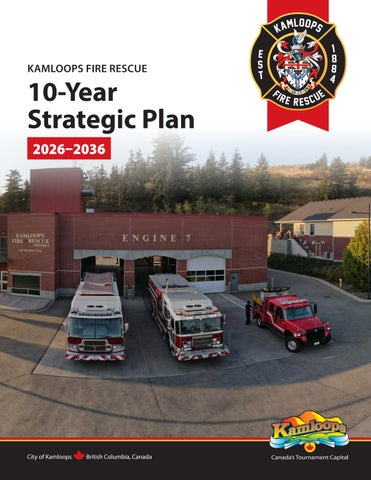
KAMLOOPS FIRE RESCUE
10-Year Strategic Plan 2026–2036
City of Kamloops
British Columbia, Canada
Safetek Profire
Serving With Pride Since 1884 | KAMLOOPS FIRE RESCUE
TABLE OF CONTENTS Message From the Chief . . . . . . . . . . . . . . . . . . . . . . . . . . . . . . . . . . . . . . . . . . . . . .5 Background and Introduction . . . . . . . . . . . . . . . . . . . . . . . . . . . . . . . . . . . . . . . . . .6 Interest and Impacted Party Feedback . . . . . . . . . . . . . . . . . . . . . . . . . . . . . . . . . . . . 8 Kamloops Fire Rescue Mission, Vision, and Values . . . . . . . . . . . . . . . . . . . . . . . . . . . . .9 Critical Issues and Service Gaps . . . . . . . . . . . . . . . . . . . . . . . . . . . . . . . . . . . . . . . . 11 Strategic Planning Framework . . . . . . . . . . . . . . . . . . . . . . . . . . . . . . . . . . . . . . . . . 13 Strategic pillars . . . . . . . . . . . . . . . . . . . . . . . . . . . . . . . . . . . . . . . . . . . . . . . . . . 14 Goals, Strategies, and Actions . . . . . . . . . . . . . . . . . . . . . . . . . . . . . . . . . . . . . . . . . 15 Pillar 1: A Sustainable Fire Service . . . . . . . . . . . . . . . . . . . . . . . . . . . . . . . . . . . . . . .15 Pillar 2: Our People . . . . . . . . . . . . . . . . . . . . . . . . . . . . . . . . . . . . . . . . . . . . . . . . 17 Pillar 3: Community Risk Reduction . . . . . . . . . . . . . . . . . . . . . . . . . . . . . . . . . . . . . .19 Pillar 4: Emergency Response . . . . . . . . . . . . . . . . . . . . . . . . . . . . . . . . . . . . . . . . . .20 Pillar 5: Partnerships and Relationships . . . . . . . . . . . . . . . . . . . . . . . . . . . . . . . . . . . 21 Implementation and Monitoring . . . . . . . . . . . . . . . . . . . . . . . . . . . . . . . . . . . . . . . 23 Action timeline . . . . . . . . . . . . . . . . . . . . . . . . . . . . . . . . . . . . . . . . . . . . . . . . . . .23 Appendix: Strategic Plan Tools . . . . . . . . . . . . . . . . . . . . . . . . . . . . . . . . . . . . . . . . 25 Strategic Plan Progress Tracker Template . . . . . . . . . . . . . . . . . . . . . . . . . . . . . . . . . . 25 Quarterly/Annual Progress Summary Template . . . . . . . . . . . . . . . . . . . . . . . . . . . . . . 25 Sample Reporting Narrative . . . . . . . . . . . . . . . . . . . . . . . . . . . . . . . . . . . . . . . . . . .26 Conclusion . . . . . . . . . . . . . . . . . . . . . . . . . . . . . . . . . . . . . . . . . . . . . . . . . . . . . 26
10 YEAR10 STRATEGIC Year Strategic PLAN Plan | CITY OF KAMLOOPS
3
CITY OF KAMLOOPS | 10 YEAR STRATEGIC PLAN
4
KAMLOOPS FIRE RESCUE | Serving With Pride Since 1884
Serving With Pride Since 1884 | KAMLOOPS FIRE RESCUE
MESSAGE FROM THE CHIEF I am excited to share the new strategic plan outlining Kamloops Fire Rescue’s priorities and goals for the coming years. Kamloops Fire Rescue is dedicated to delivering exceptional fire and emergency services to the City of Kamloops and its partners. Kamloops Fire Rescue has a deep and honoured commitment to serving the Kamloops community since 1884. This plan is our pledge to continue to provide high-quality services for all our residents, visitors, and businesses. It will also guide our management decisions, organizational structure, and the efficient use of city resources. To develop this plan, we sought feedback from staff, external partners, businesses, industry, and residents alike. We also used data from the Community Risk Assessment and Standards of Cover, Asset Management Plan, Training Master Plan, and the Facilities Condition Review. This input helped us identify expectations and common themes to set our department’s priorities and goals. The document lists the overarching themes as Strategic Pillars, and each is crucial to our organization’s success. This 10-Year Strategic Plan (2026–2036) provides a comprehensive, actionable roadmap to ensure Kamloops Fire Rescue remains sustainable, innovative, and community focused. The plan is structured around five strategic pillars: A Sustainable Fire Service, Our People, Community Risk Reduction, Emergency Response, and Partnerships and Relationships. Each pillar includes SMART (specific, measurable, achievable, relevant, and time-bound) strategies, clear actions, performance measures, and timelines, with assigned responsibilities to ensure accountability and progress. While this plan provides a roadmap of where we want to take the organization in the coming years, we recognize that as our city, communities, and departmental needs change, we will have to make ongoing adjustments to stay effective in the constantly changing fire and emergency services industry. This strategic plan is a living document. Even though it looks out over a 10-year period to keep us future orientated, specific actions focus primarily over a five-year timeframe. We will review and update the document as we achieve our objectives or new challenges emerge, and we will publish updated versions every five years. Thank you for your continued support. Sincerely,
Ken Uzeloc Protective Services Director/Fire Chief
Alisa Khliestkova
10 Year Strategic Plan | CITY OF KAMLOOPS
5
CITY OF KAMLOOPS | 10 YEAR STRATEGIC PLAN
Jamie Chase
BACKGROUND AND INTRODUCTION Kamloops has a rich history shaped by Indigenous cultures, the fur trade, and economic development in the 19th and 20th centuries. Known as a hub city because of its location at the confluence of the North and South Thompson Rivers, Kamloops’ name is derived from the Secwépemc (Shuswap) word Tḱemlúps, meaning “where the rivers meet.” The Secwépemc people, part of the Interior Salish group, have inhabited this region for thousands of years, making it a place of significant Indigenous cultural heritage. The Tḱemlúps te Secwépemc First Nation has historically stewarded the lands, using the rivers for fishing and the land for hunting and gathering. The city’s development accelerated with the 1862 Cariboo Gold Rush, drawing prospectors through the area on their way to the goldfields. Kamloops became a stopping point, bolstering its growth as a service centre. This period also introduced steamboat travel on the Thompson River, connecting Kamloops with other parts of British Columbia. By the late 1800s, agriculture was emerging as a significant industry, with settlers establishing farms and ranches in the fertile valleys surrounding the city. The arrival of the Canadian Pacific Railway in 1885 transformed Kamloops from a modest trading post into a significant transportation hub. The railway brought more settlers, commerce, and economic growth, enabling Kamloops to serve as a crucial link between the coast and the interior of British Columbia. It encouraged industries such as mining, forestry, and agriculture, and Kamloops continued to thrive as a centre for regional trade and transportation. This rapid growth led to Kamloops’ official incorporation in 1893, by which time it was well established as a bustling community. Established in August 1884, Kamloops Fire Rescue is one of British Columbia’s oldest fire departments, with a history rooted in resilience and community service. Originally founded as the Kamloops Fire Brigade, the department was formed in response to a series of devastating fires that severely impacted the downtown core of what was then a rapidly developing western farming and ranching community. Initially a volunteer-driven organization, Kamloops Fire Rescue has grown and transformed over nearly 140 years, evolving into a modern, professional, and highly trained emergency response agency.
6
KAMLOOPS FIRE RESCUE | Serving With Pride Since 1884
Serving With Pride Since 1884 | KAMLOOPS FIRE RESCUE
On May 1, 1973, the Government of British Columbia mandated that several neighbouring communities come together as one to form the City of Kamloops. This unification brought with it the opportunity to share vital resources, water systems, recreation facilities, fire services, and more, strengthening the ability of the growing city to serve its residents. From the hills of Aberdeen and the valleys of Barnhartvale to the neighbourhoods of Batchelor Heights, Brocklehurst, and Campbell Creek, each community contributed its own identity and spirit. Dallas, Dufferin, Heffley Creek, Juniper Ridge, Knutsford, North Kamloops, Rayleigh, Rose Hill, Valleyview, and Westsyde all joined in, weaving together a diverse collection of neighbourhoods that would shape the Kamloops we know today This restructuring consolidated the fire services of the North Shore, South Shore, Dallas, Heffley Creek and Westsyde, bringing their volunteer fire departments under the jurisdiction of Kamloops Fire Rescue. This integration laid the foundation for a unified and strategically coordinated fire service, ensuring a higher level of emergency preparedness and public safety across the newly expanded city. Today, Kamloops Fire Rescue serves a rapidly growing and diverse community, facing evolving risks from urban expansion, climate change, and increasing service demands. This plan is informed by extensive internal analysis, community engagement, and foundational documents, including the Community Risk Assessment and Standards of Cover, Asset Management Plan, Training Plan, and interest and impacted party feedback.
10 YEAR10 STRATEGIC Year Strategic PLAN Plan | CITY OF KAMLOOPS
7
Cory Durant
CITY OF KAMLOOPS | 10 Year Strategic Plan
INTEREST AND IMPACTED PARTY FEEDBACK Kamloops Fire Rescue understands and embraces the fact that we serve our communities and, as such, two key values we live by are service and public trust. To ensure that the community helps drive our focus and that we strive to meet expectations, Kamloops Fire Rescue used a combination of online surveys and in-person engagement to gather feedback. The City of Kamloops website and the Let’s Talk Kamloops engagement platform were used to engage citizens and businesses. Through this platform, 19 individual businesses and 472 individual citizens contributed by answering a set of questions focused on services, prevention, education, response time, value, and interaction with Kamloops Fire Rescue. In-person engagement sessions were held with industry partners, first responder partners, and the Tḱemlúps te Secwépemc First Nation. The Fire Chief facilitated these sessions, which followed a format similar to the online survey questions and focused on services, response times, training, collaboration, opportunities, value, and interaction with Kamloops Fire Rescue. Table 1. External Groups Engaged
Community
Industry Partners
First Responder Partners
Individual Citizens
472 online
Individual Businesses
19 online
Tḱemlúps te Secwépemc Nation
In person
CN Rail
In person
New Gold Mine
In person
CPKC
In person
Kruger
In person
RCMP
In person
BC Emergency Health Services
In person
Thompson-Nicola Regional District Fire Services
In person
Sun Peaks Fire
In person
British Columbia Wildfire Service
In person
City of Kamloops Community Services
In person
Kamloops Fire Rescue also offered all internal staff an opportunity to provide feedback through an open answer online survey to provide input into the internal strengths and weaknesses of Kamloops Fire Rescue and the external opportunities and threats affecting Kamloops Fire Rescue. 8
KAMLOOPS FIRE RESCUE | Serving With Pride Since 1884
Serving With Pride Since 1884 | KAMLOOPS FIRE RESCUE
KAMLOOPS FIRE RESCUE MISSION, VISION, AND VALUES Kamloops Fire Rescue is an all-hazard fire and rescue organization that provides full service as defined in the British Columbia Structure Firefighter Minimum Training Standards. Kamloops Fire Rescue offers fire suppression, emergency medical services, technical rescue (including high-angle rope rescue, steep slope rope rescue, ice rescue, water rescue, confined space rescue, and auto extrication/highway rescue ), operations-level hazmat response, fire dispatch, fire prevention, fire investigation, and public education services to the community and visitors of the City of Kamloops, and operates training and fleet services internally for the department. Kamloops Fire Rescue is guided by the following principles and values:
OUR MISSION Kamloops Fire Rescue is committed to protecting our community through fire suppression, rescue, pre-hospital care, public education, and fire prevention.
OUR VISION
Peter Olsen
To consistently provide a full level of service throughout our entire community through the responsible use of our resources.
OUR VALUES Safety, Service, Public Trust, and Teamwork are at the root of who we are and guide our actions, behaviours, and interactions with citizens, partners, and each other.
OUR COMMITMENT Our Family Helping Your Family
10 YEAR STRATEGIC PLAN | CITY OF KAMLOOPS
9
CITY OF KAMLOOPS | 10 Year Strategic Plan
Manager Business and Strategic Services
Fire Chief
Deputy Fire Chief
Assistant Chief Administration, Dispatch & Prevention Dispatch Dispatch Lead Communication Operators Fire Prevention Office Chief Fire Prevention Officer Project Coordinator Inspector/Investigator Life Safety Educator
Assistant Chief Logistics & Operations
Office Services Admin - Fire
Assistant Chief Training & Operations
A Platoon
C Platoon
Platoon Chief Captains Lieutenant Firefighters
Platoon Chief Captains Lieutenant Firefighters
B Platoon
D Platoon
Platoon Chief Captains Lieutenant Firefighters
Platoon Chief Captains Lieutenant Firefighters
Fleet Services
Paid on Call
Lead Mechanic Mechanic
Captains Training Officers Firefighters Training Chief Training Officer Training Officer
10
KAMLOOPS FIRE RESCUE | Serving With Pride Since 1884
Serving With Pride Since 1884 | KAMLOOPS FIRE RESCUE
Critical issues and service gaps were identified through a SWOT (strengths, weaknesses, opportunities, and threats) analysis and from the compilation of the Community Risk Assessment and Standards of Cover document. A SWOT analysis and community risk assessment to identify strengths, weaknesses, opportunities, and threats were conducted. Key findings include:
STRENGTHS
WEAKNESSES
• Skilled, committed, and adaptable workforce • Strong fire suppression and interface capability • Effective interagency co-operation • Pride in service and willingness to train • Operationally agile to deliver results despite resource limitations • Improving reputation as a progressive department • Good equipment
• Staffing and service capacity pressures • Aging stations and infrastructure • Inconsistent crew-level and specialty training • Gaps in high-rise, hazmat, industrial, and technical-rescue readiness • Response models that may not reflect current risk • Leadership development • Budget and equipment limitations • Insufficiently formalized after-action learning • Limited ability to access detailed data from the records management system • Burnout, compassion fatigue
OPPORTUNITIES
THREATS
• Expanded British Columbia Wildfire Service relationship • Industry, Thompson Rivers University, interagency training and community partnerships • Drones and other operational technology advancements • External funding and cost sharing • Expanded fire prevention, mitigation, and public education • More consistent multi-agency exercises and after-action reviews • Stronger involvement in community growth and infrastructure planning • Strong community support
• Increasing medical call volume and resource exhaustion • Increasing wildland-urban interface fire and urban conflagration risk • Increasing climate change risk • Community growth outpacing staffing and facilities • High-rise and industrial development • Hazardous material transportation risks • Lithium-ion battery incidents • Rising operating and capital costs
10 YEAR10 STRATEGIC Year Strategic PLAN Plan | CITY OF KAMLOOPS
Kamloops Fire Rescue
CRITICAL ISSUES AND SERVICE GAPS
11
CITY OF KAMLOOPS | 10 Year Strategic Plan
Gaps identified from the Community Risk Assessment and Standards of Cover include: • An updated fire underwriters study should be completed to plan for future growth and development of services affected by the fire underwriters study ratings, present and future. • KAMPLAN: City of Kamloops Official Community Plan has limited consideration of Kamloops Fire Rescue’s needs for growth to match the projected development/planning of the city. • A new records management system– computer-aided dispatch system will be implemented in 2026. It should be developed so that data can be easily and routinely retrieved, measured, and analyzed for efficiency and effectiveness. Currently, data analysts have to “mine” the data and often manually search for trends, patterns, and performance information. • Kamloops Fire Rescue should establish a review of supplemental industry support as part of an annual risk and response review of emergency preparedness/response procedures for responding to emergencies at sites such as the Kamloops Airport, Kruger Pulp Mill, and Trans-Mountain Pipeline. • Kamloops Fire Rescue’s Specialty Team mandate/needs/effectiveness/level of operation (operations, technician) should be measured to determine the most appropriate level to meet response risks. • A program appraisal process should be implemented for analysis of future needs, including the review of station locations (actual and projected/proposed), effectiveness of current Kamloops Fire Rescue-operated buildings/sites, safety equipment/tools/ supplies/materials, review of emergency response program, and non-emergency program effectiveness. • A fleet inventory plan should be completed with apparatus maintenance and life cycle review, current fleet inventory effectiveness, light fleet inventory/future needs analysis, parts and service availability, and projected future needs.
12
KAMLOOPS FIRE RESCUE | Serving With Pride Since 1884
• A Training Centre operation/future needs/ effectiveness/assessment should be conducted to look at the ability for external use and training opportunities. • The Fire Prevention program should be reviewed to match community risks and response performance to education and prevention efforts. • Once the NG911 and records management system–computer-aided dispatch upgrades are done, Kamloops Fire Rescue Dispatch has the opportunity to grow and a plan for matching growth potential with workload and resources should be explored. • An annual performance review for the emergency response program by station is required to analyze the effectiveness of resources across the city compared to the performance targets and identified risks. • Planning zones should be created and align with each fire station. Future planning and data collection should identify critical infrastructure in each zone, future growth and development, response needs, infrastructure composition, and limitations (e.g. water service delivery). • Pre-emergency planning related to Kamloops Fire Rescue responsibilities and response needs has been applied inconsistently and is typically done in response to current incidents. Fire-specific pre-incident plans, including evacuation/access routes, gates, critical infrastructure, and hazards by occupancy, should be identified and updated annually for effective fire response to interface fires, flash floods, water distribution system failures, ground stability emergencies, freshet flooding, dangerous goods spills, major motor vehicle/ railway incidents, and pipeline releases.
Serving With Pride Since 1884 | KAMLOOPS FIRE RESCUE
Strategic planning is a systematic, formal process used to set priorities and focus energy and resources to ensure all members are working toward common goals. It establishes direction toward intended outcomes and results. It also assesses and adjusts the organization’s direction in response to a changing environment and the community’s needs. This is done in the context of what is happening in the present and how we believe it will influence the future.
C Laird
STRATEGIC PLANNING FRAMEWORK
The department structures itself to address the major issues and trends that impact our citizens and community. This structure involves adjusting the people, systems, and programs we have based on a model that monitors prevention, intervention, and risks. These three model components are independent but complementary to success. An underlying principle of this model is that regardless of the amount of prevention done, there will always be a need for intervention activities. The gap that exists between prevention and intervention activities is the level of fire and safety risk remaining. To address this gap (which can include external and internal factors), Kamloops Fire Rescue analyzes the risks, plans strategies to address them, and then allocates budgets and resources to minimize them as much as possible. Kamloops Fire Rescue uses this framework to set a level of fire and safety protection that is appropriate, acceptable, affordable, and specific to the City of Kamloops. The final part of the strategic planning process involves monitoring and tracking plan strategies and actions to identify if they are achieving the desired results and outcomes. This plan is structured around five strategic pillars, each with supporting SMART (specific, measurable, achievable, relevant, and time-bound) strategies, actions, performance measures, and timelines (short: 1–2 years, medium: 3–5 years, long: 6–10 years). Each action is assigned a responsible lead and supporting resources. The plan is designed to be adaptable, with annual reviews and updates to ensure ongoing relevance. Kamloops Fire Rescue measures the success of the strategic plan and the planning process by the progress made toward achieving the department’s vision and the support received from our members, elected officials, and the community.
10 YEAR10 STRATEGIC Year Strategic PLAN Plan | CITY OF KAMLOOPS
13
CITY OF KAMLOOPS | 10 Year YEAR Strategic STRATEGIC Plan PLAN
STRATEGIC PILLARS Strategic Pillar 1: A Sustainable Fire Service Goal: Ensure financial and operational sustainability through robust asset management, data-driven planning, and continuous improvement.
Strategic Pillar 2: Our People Goal: Invest in recruitment, training, wellness, and diversity to build a resilient, skilled, and inclusive workforce.
Strategic Pillar 3: Community Risk Reduction Goal: Proactively reduce risks through prevention, education, inspection, and targeted mitigation strategies.
Strategic Pillar 4: Emergency Response Goal: Deliver timely, effective, and equitable emergency response across all hazards and service areas.
Strategic Pillar 5: Partnerships and Relationships Goal: Strengthen collaboration with internal and external partners to enhance service delivery and community resilience.
14
KAMLOOPS FIRE RESCUE | Serving With Pride Since 1884
Serving With Pride Since 1884 | KAMLOOPS FIRE RESCUE
GOALS, STRATEGIES, AND ACTIONS PILLAR 1: A SUSTAINABLE FIRE SERVICE Goal: Ensure financial and operational sustainability through robust asset management, data-driven planning, and continuous improvement. Strategy
Actions
1.A Asset Lifecycle Management
1.B Budget Planning and Optimization
1.C Fleet and Facility Optimization
Responsible Lead
Supporting Roles
Timeline
Performance Measure
1.A.1 - Implement an updated frontline apparatus lifecycle schedule by the fourth quarter of 2026, ensuring 100% of front-line apparatus are within lifecycle targets by 2031.
Assistant Chief –Logistics and Operations
Fleet Services, Finance, Asset Management
Short (initiate)
Lifecycle schedule
Medium (embed)
Percentage of fleet within lifecycle targets
1.A.2 - Conduct an annual asset inventory audit every January starting in 2027, with 100% completion and discrepancies addressed within 60 days.
Assistant Chief –Logistics and Operations
Long (sustain) Platoon Chiefs, IT, Training Division
Short (annual)
1.A.3- Align all equipment and personal Assistant Chiefs – protection equipment replacement Operations with current National Fire Protection Association standards and manufacturer recommendations by the second quarter of 2028, verified by annual compliance review.
Training Division, Safety, Asset Management
Medium
Percentage of compliance with National Fire Protection Association/ manufacturer standards
1.B.1 - Complete annual capital and operating budget reviews by September each year, integrating inflation and supply chain risk into forecasts starting in 2026.
Fire Chief
Command Team, Finance
Short (annual)
Budget variance reports and review of supply chain risks
1.B.2 – Implement changes for capital budget to include critical equipment aligned with asset plan by the third quarter of 2028.
Fire Chief
Command Team, Finance, Capital Prioritization
Medium (embed)
1.C.1 – Identify the appropriate performance targets for the Kamloops Fire Rescue Fleet Division, including the ratio of Emergency Vehicle Technician to apparatus and workload by the second quarter of 2027.
Assistant Chief – Logistics and Operations
HR, Fleet Services
Short (targets identified)
1.C.2 - Review and optimize station locations and fleet deployment by the first quarter of 2027, presenting recommendations for new/expanded stations to City leadership.
Fire Chief
Command Team, City Planning, GIS, Capital Prioritization, Finance
Short (review)
Command Team, City Planning, GIS, Capital Prioritization, Finance
Medium (review)
1.C.3 – Review long-range land and Assistant Chief facility planning to identify opportunities –Logistics and for joint uses and other development Operations opportunities by the second quarter of 2028.
Ongoing
Ongoing
Ongoing
Ongoing (monitor)
Medium to Long (new builds)
Annual asset inventory audit completion
Percentage of capital requests funded Performance targets documented and approved
Station location report
Percentage of new land and Long (incorporate facility projects in planning) evaluated for joint use and efficiencies
10 Year Strategic Plan | CITY OF KAMLOOPS
15
CITY OF KAMLOOPS | 10 Year Strategic Plan
Strategy 1.D Data-Driven Decision Making and Continuous Improvement
Actions
Responsible Lead
Supporting Roles
1.D.1 - Deploy new records management system-computer-aided dispatch system by the second quarter of 2027, with incident risk and resource allocation decisions supported by system data.
Assistant Chief – Administration, Dispatch, and Prevention
IT, Training Division, Dispatch
Timeline
Performance Measure
Short (deploy)
Records management systemcomputeraided dispatch implementation
Medium (embed)
Percentage of decisions supported by data
1.E Sustainable Growth Alignment
16
1.D.2 – Develop a staffing plan by the third quarter of 2027 based on community risk, service expectations, and operational performance to address projected needs for consideration in the appropriate future budget processes.
Fire Chief
Command Team, Business Manager, Finance
Short (review staffing gaps)
1.D.3 – Complete the Commission on Fire Accreditation International self-assessment process by the second quarter of 2027.
Deputy Chief Operations
Command Team, Training, Fire Prevention, Dispatch, Platoon Chiefs, Business Manager
Short
Assessment completed
1.D.4– Present report on Commission on Fire Accreditation International accreditation process to City Leadership and Council for consideration to proceed by the third quarter of 2027, and target to complete the accreditation process by the fourth quarter of 2028.
Fire Chief
Command Team, Centre for Public Safety Excellence
Short (approval)
Report submitted, accreditation achieved
1.D.5 – Develop a process to embed the focus of continuous improvement into the department and culture by the first quarter of 2028.
Fire Chief
1.E.1 - Ensure Kamloops Fire Rescue representation in the Official Community Plan update process, with documented input on service impacts/needs for all growth areas by the first quarter of 2030.
Assistant Chief – Administration, Dispatch, and Prevention
Fire Prevention, City Planning
Medium (embed)
1.E.2 - Embed Kamloops Fire Rescue in the city planning process by the first quarter of 2027 to ensure fire department impacts and needs for all major developments are reviewed and considered.
Assistant Chief – Administration, Dispatch, and Prevention
Fire Prevention, City Planning
Short (embed)
1.E.3 – Integrate fire department service, infrastructure, and land needs into the City’s planning framework to ensure safe, sustainable growth by the third quarter of 2027.
Assistant Chief – Administration, Dispatch, and Prevention
KAMLOOPS FIRE RESCUE | Serving With Pride Since 1884
Medium (Report submitted)
Medium (accredited)
Command Team, Medium Business Manager
Report submitted for 2028 budget process
Process developed Policy adopted
Long (sustain)
Medium (adopt)
Kamloops Fire Rescue member assigned to the Official Community Plan team Planning process policy, including Kamloops Fire Rescue drafted Policy approved
Command Team, Fire Prevention, City Planning
Short (identify) Medium (integrate) Long (sustain)
Requirements drafted Policy approved Policy implemented
Serving With Pride Since 1884 | KAMLOOPS FIRE RESCUE
PILLAR 2: OUR PEOPLE Goal: Invest in recruitment, training, wellness, and diversity to build a resilient, skilled, and inclusive workforce. Strategy
Actions
2.A Comprehensive Training and Certification
2.A.1 - Expand the four-year training plan to a 10-year roadmap by the third quarter of 2027, reviewed and updated annually, with 95% of staff meeting annual training requirements.
2.B Recruitment and Diversity
Responsible Lead
Timeline
Performance Measure
Training Division, Short (expand) Station Captains, Human Resources Ongoing
Percentage of staff meeting training requirements
2.A.2 - Achieve 100% emergency medical Assistant Chief responder certification for all required - Training and suppression staff by December 2026 and Operations maintain certifications.
Training Division, Medical Training Instructors
Percentage of required staff emergency medical responder certified
2.A.3 – Expand opportunities for use of training centre and delivery of training programs to a broader audience by the second quarter of 2027.
Assistant Chief - Training and Operations
Training Division, Short (identify Training plan) Instructors, Business Manager Medium (market)
Number of external bookings
2.B.1 - Increase recruitment outreach events (boot camps, school programs, and community events) to underrepresented groups by 50% by 2028 and report annually on diversity metrics.
Fire Chief
Assistant Chief – Administration, Human Resources, Communications and Strategic Partnerships, Community Partners
Medium (increase)
Percentage of new hires from target groups
Human Resources, Medical contractor, Joint Occupational Health and Safety Committee, International Association of Fire Fighters
Short (initiate)
2.C Health, Wellness 2.C.1 - Conduct annual health and and Safety wellness medicals for staff according to scheduled requirements, with 95% participation by 2027, and track participation in critical incident stress management/Employee and Family Assistance Program and mental health programs.
Jamie Chase
Assistant Chief - Training and Operations
Supporting Roles
Deputy Chief Operations
Short (achieve) Ongoing
Ongoing
Ongoing
Number of external courses taught
Annual diversity report
Percentage of wellness/ safety medicals completed Mental health participation rates
10 YEAR STRATEGIC PLAN | CITY OF KAMLOOPS
17
CITY OF KAMLOOPS | 10 Year YEAR Strategic STRATEGIC Plan PLAN
Strategy 2.D Leadership Development
Supporting Roles
Timeline
Performance Measure
Deputy Chief Operations
Training, Human Resources, Platoon Chiefs, Command Team
Medium (launch)
Number of staff in leadership programs
2.D.2 - Launch a formal company officer Assistant Chief and leadership development program by - Training and the second quarter of 2027, with at least Operations 50% of confirmed officers participating annually.
Human Resources, Platoon Chiefs, External Organizations
Short (launch)
2.D.1 - Launch a formal mentorship and succession program by the first quarter of 2028, with at least 5% of staff participating annually.
Responsible Lead
Long (sustain)
Ongoing
2.E.1 - Conduct employee engagement surveys every two years starting in July 2026, with action plans developed and communicated within 90 days of results.
Human Resources Fire Chief, Advisor Communications, International Association of Fire Fighters
Short (survey)
2.E.2 – Investigate a program to celebrate achievements and milestones by the first quarter of 2027.
Deputy Chief Operations
Short (identify)
Communications, Human Resources, International Association of Fire Fighters
Ongoing
Program implemented Percentage officers participating Employee engagement scores Turnover rates
Medium (implement)
Number of recognition initiatives Employee engagement scores
Peter Olsen
2.E Retention and Engagement
Actions
18
KAMLOOPS FIRE RESCUE | Serving With Pride Since 1884
Serving With Pride Since 1884 | KAMLOOPS FIRE RESCUE
PILLAR 3: COMMUNITY RISK REDUCTION Goal: Proactively reduce risks through prevention, education, inspection, and targeted mitigation strategies. Strategy
Responsible Lead
Supporting Roles
Timeline
Performance Measure
3.A Risk Assessment 3.A.1 - Update the Community Risk and Mapping Assessment and Standards of Cover annually by March, with 100% of risk maps and critical infrastructure lists reviewed and revised as needed.
Assistant Chief – Administration, Dispatch, and Prevention
Fire Prevention, GIS, Platoon Chiefs, City Planning, Emergency Management
Short (update)
Percentage of risk maps updated
3.B Community Risk Reduction
3.B.1 - Inspect 100% of high-risk occupancies annually and all inspectable properties identified in risk-based frequency schedule by December each year starting in 2027, with all code violations corrected within 90 days.
Assistant Chief – Administration, Dispatch, and Prevention
Fire Prevention, Suppression Crews
Short (annual)
3.B.2 – Implement a formalized fire investigation program by the first quarter of 2027 that allows for fires requiring investigation to be started within 2 hours of occurring, with 100% of all Office of the Fire Commissionerrequired investigations completed.
Assistant Chief – Administration, Dispatch, and Prevention
Fire Prevention, Suppression Crews, Office of the Fire Commissioner
Short (implemented)
Program implemented
Medium (embed)
Percentage of Office of the Fire Commissioner investigations completed
3.C.1 - Increase public education events by 25% by 2028, and track engagement through event attendance and social media analytics.
Assistant Chief – Administration, Dispatch, and Prevention
Fire Prevention, Communications and Strategic Partnerships, School District No. 73, Community Partners
Medium (increase)
Number of education events
Ongoing
Ratio of Kamloops residents engaged
3.C.2 – Reduce fire incidents by 5% annually starting in 2028 through analysis of community risk assessment and incident data with safety and education programs to evaluate changes or additions required to programs.
Assistant Chief – Administration, Dispatch, and Prevention
Fire Prevention, Suppression Crews, Communications, Office of the Fire Commissioner
Short (analysis)
Number of fires
Medium (program changes)
Percentage satisfied with public education programs
3.D.1 - Hold biannual interest and impacted party meetings (business, Indigenous, agency partners) starting the first quarter of 2027, with meeting summaries and action items published within 30 days.
Fire Chief
Command Team, Communications and Strategic Partnerships, Community Partners
Short (initiate)
3.C Public Education and Outreach
3.D Community Engagement
Actions
Ongoing
Ongoing
Annual risk assessment report completed Percentage of required properties inspected Percentage of code violations corrected in 90 days
Ongoing Ongoing
Number of interest and impacted party meetings Feedback response rate
10 Year Strategic Plan | CITY OF KAMLOOPS
19
CITY OF KAMLOOPS | 10 Year Strategic Plan
PILLAR 4: EMERGENCY RESPONSE Goal: Deliver timely, effective, and equitable emergency response across all hazards and service areas. Strategy 4.A Deployment and Coverage Optimization
4.B Specialty Teams and Capabilities
4.C Technology and Communications
Actions
Responsible Lead
Timeline
Performance Measure
Short (maintain)
Percentage of shifts meeting staffing targets
4.A.1 – Annually, maintain minimum roster suppression staffing with compliance tracked monthly.
Deputy Chief Operations
Platoon Chiefs
4.A.2 - Review response time performance monthly starting in 2027 to identify gaps or issues for improvement, with quarterly performance reports and annual appraisals completed for all response programs.
Deputy Chief Operations
Dispatch, Short Command Team, (implement) Platoon Chiefs, Business Manager Medium (embed) Ongoing
Percentage Response time compliance
4.A.3 – Review risk assessments and maps in Community Risk Assessment and Standards of Cover in the first quarter of each year to ensure deployment model matches risks with effective response force requirements.
Deputy Chief Operations
Dispatch, Command Team, Platoon Chiefs
Annual assessment, including fire and non-fire risks completed
4.B.1 - Provide specialty team training (technical rescue, hazmat, wildland) for 100% of designated team members as per master training schedule.
Assistant Chief - Training and Operations
Chief Training Officer, Specialty Team Leads
Short (training)
4.B.2 - Investigate feasibility of expanding to technician-level hazmat capability, with report delivered by 2029.
Assistant Chief - Training and Operations
Chief Training Officer, Hazmat Team Lead
Medium (report)
Report submitted to Fire Chief
4.B.3 – Conduct a review of all specialty team programs by the first quarter of 2028 to determine if the level of service is appropriate or required based on risk and response data.
Deputy Chief Operations
Command Team, Platoon Chiefs, Business Manager, Training, Team Leads
Medium
Report with recommendations submitted
4.C.1 - Complete technology upgrades (dispatch, Mobile Data Terminal, radios) by the second quarter of 2028, with 90% user satisfaction measured by postimplementation surveys.
Assistant Chief – Administration, Dispatch, and Prevention
IT, Dispatch,
Medium (upgrade)
Percentage of tech upgrades completed
KAMLOOPS FIRE RESCUE | Serving With Pride Since 1884
Ongoing
Medium (implement)
Number of reports and appraisals completed
Report presented annually
4.C.2 – Evaluate and integrate new Deputy Chief technology by the fourth quarter of 2028 Operations to make incident command/incident management more effective.
20
Supporting Roles
Ongoing
Long (integrate)
Command Team, Platoon Chiefs, Training, IT
Medium (evaluate) Long (integrate)
Percentage of specialty team members trained
User satisfaction results Number of new technology evaluated Incident management efficiency
Serving With Pride Since 1884 | KAMLOOPS FIRE RESCUE
Strategy
Actions
Responsible Lead
4.D Resilience and Adaptation
4.D.1 - Conduct at least one Kamloops Fire Rescue-related response scenariobased exercise annually by the third quarter of 2028, with after-action reviews and recommendations for improvement reported within 60 days.
Deputy Chief Operations
4.D.2 – Complete emergency preparedness and business continuity planning for Fire Department by the second quarter of 2027 and review annually.
Assistant Chief – Administration, Dispatch, and Prevention
Supporting Roles
Timeline
Performance Measure
Training Division, Emergency Management, City Partners, Industry Partners
Medium (plan)
Number of scenario exercises
Command Team, Division Heads, Emergency Management
Short (draft)
Ongoing
Medium (plan implemented)
Percentage of high-priority recommendations addressed Kamloops Fire Rescue emergency preparedness and business continuity plan reviewed annually
PILLAR 5: PARTNERSHIPS AND RELATIONSHIPS Goal: Strengthen collaboration with internal and external partners to enhance service delivery and community resilience. Strategy 5.A Interagency Agreements
5.B Indigenous Relations
5.C Academic and Educational Partnership
Actions
Responsible Lead
Supporting Roles
Short (review)
Performance Measure
5.A.1 - Review all interagency agreements annually for performance concerns, gaps and review/renew/ add as required.
Fire Chief
5.B.1 - Deliver cultural awareness and reconciliation training to 100% of staff.
Assistant Chief - Training and Operations
Communications and Strategic Partnerships, Human Resources, Training
5.B.2 - Co-host at least one event (educational or training) with Indigenous partners each year by the fourth quarter of 2027.
Assistant Chief – Administration, Dispatch, and Prevention
Communications Short and Strategic (implement) Partnerships, Ongoing Tḱemlúps te Secwépemc, Human Resources
Number of events per year
Command Team, Human Resources, School District No. 73, Thompson Rivers University, Communications and Strategic Partnerships
Number of meetings
5.C.1 - Hold annual meetings with School Fire Chief District No. 73 and Thompson Rivers University and launch at least one joint risk reduction, career opportunity, or partnership initiative per year by 2027.
Command Team, Legal, Finance, Partner Agencies
Timeline
Medium (renew)
Percentage of agreements reviewed
Ongoing
Number of renewals/ additions
Short (training)
Percentage of staff trained
Ongoing
Short (annual) Ongoing
Number of initiatives per year
10 Year Strategic Plan | CITY OF KAMLOOPS
21
BC Wildfire Service
CITY OF KAMLOOPS | 10 Year Strategic Plan
Strategy
Actions
Responsible Lead
5.D Transparency 5.D.1 - Publish annual report to and Communication community and achieve an annual increase in digital engagement metrics (website, social media, feedback).
Fire Chief
5.E Collaboration and Partnerships
5.E.1 – Annually identify opportunities for collaboration within Protective Services to improve efficiency and service delivery.
Fire Chief
5.E.2 – By the second quarter of 2028, evaluate areas to share services and programs across the corporation.
Deputy Chief Operations
Supporting Roles
Timeline
Command Team, Life Safety Educator Communications, IT
Short (initiate)
Command Team, Protective Services
Short (implement process)
Ongoing
Performance Measure Percentage of increase in engagement metrics from previous year Number of opportunities identified Number of opportunities initiated
Command Team, City Management Team
Medium (identify)
Number of opportunities identified Number of new shared services/ programs implemented
22
KAMLOOPS FIRE RESCUE | Serving With Pride Since 1884
Serving With Pride Since 1884 | KAMLOOPS FIRE RESCUE
IMPLEMENTATION AND MONITORING ACTION TIMELINE • Assignment of Responsibility: Each SMART (specific, measurable, achievable, relevant, and time-bound) action has a clear lead and supporting roles for accountability. • Annual Work Plans: Actions are integrated into annual divisional work plans and budget cycles. • Performance Monitoring: Quarterly and annual reporting will track progress on performance measures, with results shared internally and with interest and impacted parties. • Continuous Improvement: The plan will be reviewed annually, with adjustments made based on emerging risks, community needs, and organizational learning. • Interest and Impacted Party Engagement: Regular engagement with staff, City Council, partners, and the public will ensure transparency and foster a culture of shared responsibility.
Pillar Pillar 1 – A Sustainable Fire Service
Actions 2026-2027 (Short)
Strategy 1.A
1.A.1
Actions 2028-2030 (Medium) 1.A.3
Actions 2031-2036 (Long) 1.A.1
1.A.2 1.B
1.B.1
1.B.2
1.C
1.C.1
1.C.2
1.C.2
1.C.2
1.C.3
1.C.3
1.D.1
1.D.4
1.D.2
1.D.5
1.D
1.D.3 1.D.4 1.E Pillar 2 – Our People
2.A
1.E.2
1.E.1
1.E.1
1.E.3
1.E.3
1.E.3
2.A.1 2.A.2 2.A.3
2.B
2.B.1
2.C
2.C.1
2.D
2.D.2
2.E
2.E.1
2.D.1
2.D.1
2.E.2 Pillar 3 – Community Risk Reduction 3.A
3.A.1 3.A.2
3.B
3.B.1 3.B.2
3.C
3.C.2
3.C.1 3.C.2
3.D
3.D.1
10 Year Strategic Plan | CITY OF KAMLOOPS
23
CITY OF KAMLOOPS | 10 Year YEAR Strategic STRATEGIC Plan PLAN
Pillar Pillar 4 – Emergency Response
Actions 2026-2027 (Short)
Strategy 4.A
Actions 2028-2030 (Medium)
Actions 2031-2036 (Long)
4.A.1 4.A.2 4.A.3
4.B
4.B.1
4.B.1 4.B.2 4.B.3
4.C
Pillar 5 – Partnerships and Relationships
4.D
4.D.2
5.A
5.A.1
5.B
5.B.1
4.C.1
4.C.1
4.C.2
4.C.2
4.D.1
5.B.2 5.C.1
5.D
5.D.1
5.E
5.E.1
Kamloops Fire Rescue
5.C
24
KAMLOOPS FIRE RESCUE | Serving With Pride Since 1884
5.E.2
Serving With Pride Since 1884 | KAMLOOPS FIRE RESCUE
APPENDIX: STRATEGIC PLAN TOOLS STRATEGIC PLAN PROGRESS TRACKER TEMPLATE Pillar
SMART Action
Responsible Supporting Target Date Lead Roles
(e.g. Pillar 1: Sustainable Fire Service)
(e.g. Implement 12-year engine replacement schedule)
Assistant Chief – Fleet
Fleet Services, Finance
…
…
…
…
Status
Performance Progress/ Measure Results
Barriers/ Notes
Next Steps
Fourth On Track/ quarter 2026 At Risk/ Delayed/ Complete
Percentage of Fleet Within Lifecycle Targets
(e.g. 80% of engines within target; new schedule approved)
(e.g. Supply chain delays for new apparatus)
(e.g. Finalize 2027 order; review supply contracts)
…
…
…
…
…
…
Instructions for Use: • Pillar: Reference the strategic pillar (e.g. Sustainable Fire Service, Our People, etc.) • SMART Action: Copy the action as stated in the plan. • Responsible Lead: Name or role accountable for delivery. • Supporting Roles: List all key contributors. • Target Date: Planned completion date (quarter/year). • Status: Use standardized status (On Track, At Risk, Delayed, Complete).
• Performance Measure: As defined in the plan (quantitative or qualitative). • Progress/Results: Brief summary of current progress, milestones achieved, or data. • Barriers/Notes: Any issues, risks, or context affecting progress. • Next Steps: Immediate actions or adjustments required.
QUARTERLY/ANNUAL PROGRESS SUMMARY TEMPLATE Pillar
Percentage of Percentage of Percentage of Actions On Track Actions Complete Actions At Risk/ Delayed
Key Successes
Key Challenges
Adjustments Needed
Sustainable Fire Service
80%
10%
10%
New records management system-computeraided dispatch deployed; two new engines ordered
Apparatus delivery delays
Review procurement process
Our People
90%
5%
5%
100% emergency medical responder certification achieved
Recruitment diversity lagging
Expand outreach events
…
…
…
…
…
…
…
Reporting Cycle • Quarterly: Update progress, review barriers, and adjust next steps.
• Annually: Summarize overall progress, celebrate achievements, and revise plans as needed.
10 Year Strategic Plan | CITY OF KAMLOOPS
25
CITY OF KAMLOOPS | 10 Year YEAR Strategic STRATEGIC Plan PLAN
SAMPLE REPORTING NARRATIVE Second Quarter 2027 Progress Report: • 85% of actions are on track or complete. • Major milestone: All suppression staff are emergency medical responder certified. • Challenge: Apparatus replacement delayed due to supply chain issues; mitigation plan in place. • Next quarter: Focus on expanding FireSmart outreach and finalizing new interagency agreements.
CONCLUSION This 10-Year Strategic Plan positions Kamloops Fire Rescue to meet the challenges of a growing, diverse, and dynamic community. Through a focus on sustainability, people, risk reduction, operational excellence, and partnerships, Kamloops Fire Rescue will continue to protect and serve Kamloops with professionalism, innovation, and integrity, achieving our vision to consistently provide a full level of service throughout our entire community through the responsible use of our resources.
26
KAMLOOPS FIRE RESCUE | Serving With Pride Since 1884
Kamloops Fire Rescue
City of Kamloops
British Columbia, Canada
Kamloops Fire Rescue: 1205 Summit Drive, Kamloops, BC, V2C 5R9 250-372-5131 | kfr@kamloops.ca
Stay Connected @KamloopsFireRescue @KamloopsFireRescue @KamFire @kamloopsfirerescue1884
Kamloops.ca/KFR Prepared by: Kamloops Fire Rescue April 2026