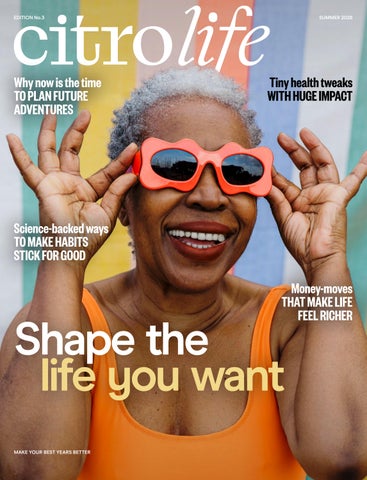
EDITION No.3
Why now is the time TO PLAN FUTURE ADVENTURES
SUMMER 2026
Tiny health tweaks WITH HUGE IMPACT
Science-backed ways TO MAKE HABITS STICK FOR GOOD Money-moves THAT MAKE LIFE FEEL RICHER
Shape the life you want MAKE YOUR BEST YEARS BETTER
CITROLIFE 2026
Managing editor Bronwyn Mandile Art director Mara Cheshire Designer Jovelyn Gonzales Contributing writers Sabrina Rogers, Elli Jacobs, Maddie Southall, Nicole Pedersen McKinnon, Elli Jacobs, Carolyn Tate, Rachael Mogan McIntosh, Bron Maxabella Content production Maddie Southall Rob-Yna Peña-Lopez Marketing & growth Rachel Lim, Grace Chen, Nicolas Rivarola, Catherine Phung, Kevin Xu Operations Megan Burgess Rachel Monahan Head of engineering Dennis Leon Head of legal & compliance Ralph Timpani Managing director Toby Ellis Citro acknowledges the Traditional Owners of Country throughout Australia and pay our respects to Elders past and present. This magazine contains general information only. It is not financial advice and is not intended to influence readers’ decisions about any financial products or investments. Readers’ personal circumstances have not been taken into account and they should always seek their own professional financial and taxation advice that takes into account their financial circumstances, objectives and needs. The information in this magazine is general information and should not be used to diagnose or treat a health problem or disease. Do not use the information found here as a substitute for professional health care advice. Any information you find in this magazine or on external sites which are linked to on this page should be verified with your professional health care provider.
WELCOME
This magazine is published by Citrus Innovations Pty Ltd, 50 Bridge Street, Sydney, NSW 2000 ABN 25 667 285 654 joincitro.com.au Phone 1300 869 596
2
joincitro.com.au
WELCOME
Consider this your invitation to make life a little brighter and better this year. And ‘little’ is the operative word.
If there’s one thing we’ve learned over many years, it’s that lasting change rarely comes from big gestures. Instead, making small, consistent tweaks is the way to slowly shift the way we live, think and spend our time. The kind of tiny changes we barely notice until one day we realise we’ve significantly moved the dial in our favour.
So dive in. Take what speaks to you, leave what doesn’t, and remember: progress doesn’t only happen when you’re perfect. It also happens in the ‘oh no’ moments, when you’ve stuffed up but decide to keep going anyway. So, whatever you do… just. keep. going.
This edition of Citro magazine is packed with all kinds of smart, practical ways to give every part of your life this kind of boost. You’ll find health habits backed by science, money moves that actually make you feel richer and stories of real people who’ve turned setbacks into comebacks. We’ll help you reset your energy, rethink happiness, map out travel adventures and steadily build the kind of money habits that ultimately change everything.
Warmly,
From all of us at Citro, we wish you a wonderful year ahead.
Bronwyn Mandile Managing Editor, Citro
PS - If you’re ready to start the year feeling lighter and brighter, join our 10-day #LifeUpgrade challenge. We’ll send you one quick, achievable action each day to help lift your health, money and lifestyle habits. It’s free, fun and a surprisingly easy way to reset your routine. Click here to join.
Make your best years better
3
CITROLIFE 2026
CONTENTS Map your travel timeline
6
The trips you dream about today might not be the ones you’ll be up for tomorrow. Lauren went from gym avoider to bodybuilding competitor in her 50s
YOUR LIFE UPGRADE PLAN Your life upgrade plan
6
Forget massive life overhauls that fizzle by February. This life upgrade plan is about micro-moves with mega-impact. Is happiness really the goal?
14
Small shifts, big results. These simple upgrades add up to better energy, strength and longevity without needing a life overhaul. 5 biggest money secrets
4
52
With the clock ticking until you happily clock off for good, you don’t want to let any of this bonus retirement wealth go to waste.
30
40
44
Feeling like it’s time to make some changes, but unsure where to start? You’re not alone.
MAP YOUR TRAVEL TIMELINE New year, less stress: start your 56 year off with a cleansing declutter Got piles of stuff you’ve been meaning to sort through but have a hard time starting? Here are our favourite decluttering tips.
14
Elizabeth Jane rebuilt her life after being blindsided by divorce at 50
26
In this refreshingly simple guide, Citro’s trusted financial educator, Nicole Pedersen-McKinnon, shares 5 money principles that could change your financial life.
7 ways to boost your super fund in a single year
Tired of feeling tired? Reclaim your vitality with these science-backed tips. 20 small habit changes that could change everything
20
36
Queensland-based Lauren Clemett found unexpected meaning in life when skydiving on her birthday led to bodybuilding competitions. The midlife energy upgrade
We all want to be content and experience joy, but what if we’ve had it wrong all along and pursuing happiness isn't the way to live a fulfilled life? 12 tiny health tweaks with huge impact
30
IS HAPPINESS REALLY THE GOAL? joincitro.com.au
60
After feeling like her life was over, Elizabeth Jane now believes that life’s obstacles are just an opportunity for personal growth.
WELCOME
10 money moves that make life feel richer
66
Let’s be honest, most of us want more money… Or do we? Perhaps what we really crave is the stuff we think money brings: freedom, security and the ability to say yes to the things that make life feel good.
Meet the upgraders
78
What if midlife was just the beginning? We all know that life doesn’t come with a straight path or a finish line.
72
THE WEALTH RESET
How to nurture social connections and feel like you truly belong 72
Why I wake up at 5am every day (and love it)
Nurturing strong social connections is critical for optimal health and wellbeing. While this can feel daunting as you get older, there’s plenty you can do to foster meaningful relationships no matter your age.
66
94
The 5am club isn’t just for CEOs and influencers – it might be the gentlest way to reclaim your time and peace of mind.
HOW TO NURTURE SOCIAL CONNECTIONS The wealth reset: turning what you have into what you want
3 science-backed ways to make habits stick
84
Get the best out of your money without having to work harder for it. Sounds like a win to us! 12 fantastic glamping experiences in Australia and NZ
10 MONEY MOVES THAT MAKE LIFE FEEL RICHER
84
89
These incredible glamping stays offer all the beauty of the outdoors with none of the discomfort – just luxury beds, hot showers and unforgettable views. Make your best years better
98
Changing your habits can feel close to impossible, but that’s probably because everything you’ve been taught about behaviour change is false. Here’s how to make habits stick, according to neuroscience.
12 FANTASTIC GLAMPING EXPERIENCES 89 5
CITROLIFE 2026
6
joincitro.com.au
LIFESTYLE Lifestyle
Health
Money
Travel
YOUR LIFE UPGRADE PLAN Make your best years better
7
CITROLIFE 2026
Forget massive life overhauls that fizzle by February. This life upgrade plan is about micro-moves with mega-impact: realistic tweaks to your health, money, travel and lifestyle that make life after 50 feel even better. By Bron Maxabella
We’ve all done it. Declared that this will be the year we completely transform into someone fitter, richer, calmer, happier. We’ll basically go to sleep on 31 December and wake up on 1 January completely transformed into the kind of person who, I don’t know, says no to cake? Stops at one drink? Loves the gym?
The myth of the big transformation But how’s that working for us so far? We’ve all bombed more new year’s eve resolutions than we care to admit, so maybe it’s time to just… not make any? We’re too smart to fall for all the “new year, new you” nonsense anymore. But does that mean we’re abandoning all hope of making any changes in our life? Not at all. But instead of making lofty resolutions we’re bound to break, this year we’re setting ourselves up for the win. How? With tiny, thoughtful life upgrades instead. That’s what this life upgrade plan is all about: simple, satisfying shifts that last.
8
A little bit more you Worried tiny moves won’t be enough? Don’t worry, we’ve got you. We’re tapping into something psychologists call the compounding effect of habit formation. When you make a very small improvement – say, walking for 10 minutes a day or saving an extra $20 a week – it feels easy enough to actually do, which means you’re much more likely to repeat it. Each small win triggers a dopamine response in the brain, creating a little feedback loop of reward and motivation. Over time, those repetitions strengthen neural pathways, shifting a behaviour from effortful (“I have to think about doing this”) to automatic (“this is just what I do”). This is known as identity-based change. Rather than trying to become a new person through massive effort, you act like the person you want to be in small, consistent ways.
joincitro.com.au
“Many people begin the process of changing their habits by focusing on what they want to achieve. This leads us to outcome-based habits,” explains Atomic Habits author James Clear on his eponymous website. “The alternative is to build identity-based habits. With this approach, we start by focusing on who we wish to become.” It’s the same psychology that underpins BJ Fogg’s Tiny Habits research. Both Clear and Fogg show that sustainable change happens when you decide who you want to be, start small, succeed quickly and build momentum from there. Every tiny improvement reinforces the belief that you’re capable of growth, which keeps you engaged and optimistic, which keeps you going. So what are we waiting for?
LIFESTYLE
HEALTH THAT FEELS GOOD Consistency for the win. When we were younger, exercise was about chasing big goals: losing weight, running faster, doing “challenges” that mostly challenged our sanity. But now we’re older and wiser, the win is simply consistency. Moving your body daily (in whatever way your knees, hips or time allow) keeps you strong, mobile and mood-balanced. "Ageing naturally leads to a decline in muscle mass, flexibility and bone density, but regular exercise can dramatically slow these changes,” says functional ageing specialist Graham Elliss, who specialises in fitness for over-50s. “It also plays a vital role in preserving cognitive function and maintaining independence and quality of life.” And sleep? It’s the world’s most underrated health hack.
Your upgrade plan
□ Move like it matters.
□ Get outside.
Sure, you could aim for at least 7,000 each day, but why not make it at least 30 minutes of joyful movement instead? Walk with a friend, dance around the house to your favourite tunes, stretch before bed and add in a couple of strength exercises for good measure.
Fresh air is one of life’s simplest health boosters, yet we treat it like a luxury instead of the free, daily medicine it is. Just 20 minutes outdoors can lower stress hormones, improve sleep and lift your mood. ‘Nature’ doesn’t need to mean a national park, either. Go for a walk around the block or just hang out in the garden with the birds.
□ Eat what fuels you. Swap “what I should eat” for “what makes me feel good later”. The key word there is ‘later’ – that bar of Dairy Milk might trigger the happy chemicals while you’re munching on it, but it’s unlikely to ultimately make you feel good. What will? According to the Cancer Council, plenty of fresh fruit and vegetables, wholegrains and fibre; cut down on red and processed meat; and limit sugary drinks and fast food. You know it already.
□ Prioritise rest. Sleep in later life can be patchy, so try a wind-down ritual to let your body know it's time for bed. Listen to some soft music or have a hot shower or bath. Before you head in for the night, write down a couple of things you’re grateful for from this day and a couple of things you’d like to achieve tomorrow. If you’re a worrier, write down your worries too, then leave them inside the notebook, ready to sort out tomorrow.
Did you know? Research shows that ‘exercise snacks’, even just 15 minutes of moderate exercise a day can significantly lower your risk of heart disease and cancer, and extend your life expectancy. Now that’s something worth walking towards.
Make your best years better
9
CITROLIFE 2026
When you can see where your money's going, you can start steering it towards things that actually matter.
MONEY MADE SMARTER Check in regularly. You don’t need to give up flat whites or avo toast to make your money work harder. What you need is clarity. When you can see where your money’s going and what it’s doing, you can start steering it toward things that actually matter. “Small daily or weekly habits are less intimidating and help you build confidence over time,” says Julie Slapp, director of growth and customer solutions at AMP. “Particularly with starting a savings habit, you don't just get the benefit of what you saved but whether you get interest or invest it, you also receive a return, effectively compounding your savings over time.”
Your upgrade plan
□ Audit your outgoings.
□ Feed your future self.
Log into Citro Rewards and check if any of your regular purchases (like Woolies, fuel, or travel) could be earning cashback.
Review your super contributions – could salary sacrifice or using Citro’s ‘Grow your Super’ feature help you increase your balance?
□ Build a buffer.
□ Make your money multitask.
Aim for three months’ expenses in an easy-access high-interest savings account. Even putting away $20 a week will add up over time. Set up an automatic transfer and forget about it (until the battery goes in the car and then you’ll be so grateful that emergency fund is there).
Pay down debt and invest at the same time. Even micro-investing counts as forward motion. Check out micro-investing apps like Pearler Micro, Raiz, Spaceship Voyager or Sharesies. Little by little by little your ‘spare change’ grows into something meaningful.
SMART MOVE Next time you get a pay rise or a windfall, split it: 50% enjoy, 50% invest. A celebration and compounding interest? Now, that’s life balance. 10
joincitro.com.au
LIFESTYLE
TRAVEL WITH INTENTION Forward planning is key. While a bucket list is a great way to collect your thoughts, travel shouldn’t be about ticking boxes. The best trips offer us slower, more intentional connection with the world and the people who live there. Think long lunches in local cafés instead of frantic sightseeing. A few extra nights in one place instead of racing through five. Midlife travel knows joy lives in how we travel, not just where. “Start small, but don’t wait. You’ll never regret taking the trip you have been thinking about. Figure out what kind of travel suits you, whether that’s solo adventures, group tours, or something in between - once you know what feels right, planning becomes more enjoyable,” says Expedia travel expert, Sarah King.
Your upgrade plan
□ Travel with purpose. Choose experiences that light you up. “Australians over 55 are seeking travel experiences that go beyond traditional sightseeing, with a growing appetite for deeper cultural immersion,” notes Sarah. Maybe that’s volunteering while you travel, heading to out-of-the-way hiking trails or taking local village cooking classes.
□ Plan the pace. Schedule downtime into your itinerary (and don’t call it a “missed opportunity”, call it “living like the locals”). “For adventure travel, it’s important to choose experiences
that align with your fitness and health needs, ensure you have the right insurance coverage and strike a balance between your activity and comfort levels,” advises Sarah.
□ Book smart. We’ve got an entire Citro guide to help you with that. Download your free copy here.
□ Say yes. An art class in Portugal, an overnight stay at a hotel in your own city, the Hai Van Pass train ride through Vietnam, a weekend away solo… what will you say yes to this year?
LOCAL LOVE A staycation counts! If a trip isn’t in the budget this year, perhaps a holiday at home could be? Pack a picnic and visit somewhere new in your area each day, then eat out or get takeaway each night for dinner (or just keep home cooking super simple). Add to the charm by going out for breakfast, too. Abandon as much housework as you can for the duration, then treat yourself to a cleaner at the end of your ‘holiday’. Make your best years better
11
CITROLIFE 2026
BRAIN GAIN Studies show that maintaining strong social connections in midlife is as important for longevity as diet or exercise. Unfortunately, the older we get, the faster we seem to forget how important being with other people is to our mental health (yes, even the introverts). So take the time to text your friend back, meet the volunteer crew for Thursday coffee, stop to chat with your neighbour or meet your buddy at the supermarket to do your weekly grocery shop together. Open your home to friends and family whenever you can (‘bring a plate’ can make it super easy).
LIVE WITH CLARITY Midlife brings a kind of clarity when we start to see what really deserves our time, energy and attention. But it also brings noise: work, ageing parents, grown kids, health issues and the added burden of feeling like, surely, we should have it together by now. Here’s the thing: we’re probably never going to have it all together. And that’s okay. Instead, let’s finally decide to meet life exactly where it is and gently accept that it’s always going to be a little bit messy and chaotic. “Co-opting family members to support you in your goals can be helpful. If you are worried that family might not understand your priorities and interests, you might consider an independent mediator to guide a family conversation,” suggests Lise Barry, a member of the executive at the Lifespan Health and Wellbeing Research Centre and Dean of Macquarie Law School. 12
Your upgrade plan
□ Find your flow.
□ Set better boundaries.
“Flow is important because it is a time when we bring ourselves totally to what we are doing,” explains high performance psychologist and author Dr Sue Jackson. “This allows us to perform well, achieve our goals and to find times of enjoyment and meaning… Whether that’s gardening, journalling, a swim or a round of golf, Dr Jackson advises us to “take a learning perspective, where you seek to develop your skills and where you are open to taking on incremental challenges."
“No” is a complete sentence, and one of the most powerful life upgrades there is. If we learn nothing else this year, let’s learn that it’s okay to say no and mean it.
joincitro.com.au
□ Connect with intention. Upgrade your social circle: fewer energy vampires, more people who make you LOL. If you don’t feel like you have meaningful connections with others on most days, start small. Reach out to one person, go to one group activity to see if you like it or say yes to one invitation.
LIFESTYLE
When you fall down, here’s how to get back up There’ll be days, weeks, maybe an entire season when even the tiniest changes feel hard. That’s completely expected and not something you need to ‘fix’. ‘Upgrading’ your life is about lightening your load, not adding to it. If everything feels like a blur of responsibilities, make your changes even smaller: cook one nourishing meal that week, take one 5-minute walk or even one five-minute lie down because life feels too hectic. There have been many studies done trying to pinpoint exactly how long it takes to form a habit. Depending
WHY TINY WORKS • Small actions feel achievable, so you start. • Success releases dopamine, so you keep going. • Repetition builds neural pathways, so it becomes automatic. • Automatic behaviours form identity, so you become someone who naturally does the thing.
on the person, the timeframe ranges anywhere from 4 to 335 days, which basically means it takes anywhere from two to five months for a behavior to become automatic. That’s a long time to plug away at something that might make you feel a bit uncomfortable. Which makes it fairly inevitable that you’re going to break your new habit at some point or another. When that happens, keep your goal top of mind, dust yourself off and start again as soon as you can. When setbacks hit, what matters most isn’t willpower but self-
compassion. Research from the University of Texas shows that people who treat themselves kindly after failure are more motivated and resilient than those who criticise themselves. So give yourself a break. One way to do that is to ask yourself what you’d say to a friend in the same situation. Chances are you wouldn’t berate them or call them a failure. Instead, you’d remind them that they’re only human then ask what you could do to help them start over. So ask yourself as many times as needed: what can you do to help yourself start over?
WHERE TO NEXT? Once you start upgrading, you’ll see opportunities everywhere – in your routines, relationships… maybe even the way you talk to yourself? Just start with a single thing to add to or take away from your life this year. Once you make that one small improvement, it will likely open the door to the next. And then the next. And then before you know it, you’re well on the way to becoming the person you want to be. No crash diet, extreme money makeover or personality change needed. So, forget reinvention. You don’t need a “new you.” The one you’ve become over the years is already more than enough. This year, you’re just here for the upgrades. Make your best years better
JOIN OUR CHALLENGE Sign up for the 10-day #LifeUpgrade challenge: we’ll email you one simple daily action to lift your health, money, travel and lifestyle habits. It’s free, fun and hopefully habit-forming!
Sign up here
13
CITROLIFE 2026
14
joincitro.com.au
LIFESTYLE Lifestyle
Health
Money
Travel
IS HAPPINESS REALLY THE GOAL? Rethinking what it means to live well.
Make your best years better
15
CITROLIFE 2026
We all want to be content and experience joy, but what if we’ve had it wrong all along and pursuing happiness isn't the way to live a fulfilled life? ‘Dr Happy’ weighs in. By Sabrina Rogers
When Maree turned 50, she made a pact with herself: she was going to shake up her life and push herself out of her comfort zone. She’d been pursuing a life of comfort and ease for decades and it hadn’t brought her the happiness she’d hoped it would. No matter how much she tried to avoid stressful situations or how many expensive gadgets she bought to make her life easier, unexpected dramas always came along to disrupt it and she would get angry that she “couldn’t catch a break”. “I had this completely unrealistic expectation that life should be easy and I should be happy all the time,” she says. “I don’t know why it took me 50 years to figure out I had it all wrong, but the day I decided to embrace the hard stuff and actually put myself out there and try new things that scared me was the day I started being truly happy. I went skydiving that year and I hiked the Santiago Trail in Spain. It was scary, but so fulfilling.
16
“When my mum was diagnosed with cancer and my dog died on the same day last year, I didn’t curse the gods. I told myself, ‘This is a sh*t day. Tomorrow something good will happen.’ That mindset shift changed everything for me. It’s ironic that the key to my happiness was letting go of trying to be happy all the time.”
Why are we so obsessed with being happy? According to Dr Tim Sharp, aka ‘Dr Happy’, Chief Happiness Officer at the Happiness Institute and author of Lost & Found, there’s nothing wrong with wanting to be happy – but we might need to revise our definition of this coveted feeling. “The average person defines happiness as a positive or pleasant emotion,” he explains. “Positive emotions are important and should be nourished, but they’re only part of the equation. That’s why psychologists generally view happiness as something deeper or more enduring. More technically, it might be called thriving, flourishing or living a meaningful life.”
joincitro.com.au
4 ways to pursue a more meaningful life How can we go about pursuing this deeper meaning of happiness? Dr Sharp has 4 tips.
1. Stop judging your emotions Historically, psychologists have categorised emotions as either positive (happiness, joy and love) or negative (sadness, fear and anxiety). While they weren’t ill-intentioned, this has led many of us to erroneously judge our emotions as either “good” or “bad”, says Dr Sharp. “Anxiety, for example, isn’t bad,” he explains. “It serves a very useful purpose by preventing us from doing dangerous things. Similarly, anger can motivate us to protect ourselves or our loved ones. Our emotions are like signals or messages that are almost always telling us something useful. “So, rather than seeing emotions as positive or negative, I encourage people to try to view them all equally. Human beings should and do feel all sorts of things, so we need to get away from judging our emotions.”
LIFESTYLE
That said, it’s important to differentiate between normal human emotions and clinical disorders, such as a major anxiety disorder or depressive disorder, notes Dr Sharp. Mental health issues can significantly impact our quality of life and professional help may be needed.
2. Lean into discomfort Once we accept our challenging emotions as a normal part of the human experience, we can start to see them as a useful tool for growth and progress. “Trying new things can feel uncomfortable, but with that comes excitement, pride and other positive
things we wouldn’t experience if we played it safe all the time,” explains Dr Sharp. “Discomfort can be associated with growth, learning, experimentation and exploration.” His own experience with skydiving a decade ago was “both the most terrifying and the most exhilarating moment” of his life.
Our emotions are like signals or messages that are almost always telling us something useful.
“The terrifying bit is the cost of admission for the exhilaration,” says Dr Sharp. “Just like anxiety is the price we pay for excitement and sadness is the price we pay for love. Grief can be incredibly painful and distressing, but love is a beautiful part of life and you can't have one without the other. Seeing it this way can help us approach some of those unpleasant emotions in a more constructive way.”
3. Reframe your challenging emotions Have you ever wondered whether you’re excited or anxious in the lead-up to a big moment or event in your life? These emotions can be hard to tell apart because they’re so similar – and you can use that to your advantage. “If you look at the physiological symptoms of anxiety – like increased heart rate, muscle tension and an upset stomach – they’re often exactly the same as the signs of excitement,” notes Dr Sharp. “Physiologically, our bodies are responding in the same way. The difference is in the interpretation of those symptoms. If we see them as potentially dangerous or risky, that leads to feelings of anxiety. But if we frame them in a more positive light, we see it as excitement. So, learning to reframe those feelings – which is at the heart of cognitive therapy – can help people cope with them better.”
Make your best years better
17
CITROLIFE 2026
“Comfort is attractive in the present moment, but in the long term, it can be boring, mundane and limiting,” says Dr Sharp. “I encourage people to look beyond the present moment and consider what choosing the uncomfortable option will lead to in an hour, a day or a year. It might help you master a new skill or feel better about yourself.”
But what if some situations cause you an excessive amount of anxiety or fear and you can’t bring yourself to confront them? “The most effective treatment for anxiety is exposure therapy, which involves gradual exposure to objects or situations you fear,” says Dr Sharp. “Some days, you may not be able to handle social situations, for example, and you’ll choose to stay at home. While that’s fine in the short term, it’s not great in the long term. Confronting your fears in an appropriate way and at your own pace will help you overcome them.”
18
4. Look beyond the present moment Next time you’re tempted to skip your Pilates class, consider this. “Comfort is attractive in the present moment, but in the long term, it can be boring, mundane and limiting,” says Dr Sharp. “I encourage people to look beyond the present moment and consider what choosing the uncomfortable option will lead to in an hour, a day or a year. It might help you master a new skill or feel better about yourself.
joincitro.com.au
“If all we do is think about the here and now, we’ll just eat chocolate ice cream and never exercise. But most of us know that, while it isn't always fun now, eating healthy and exercising will benefit us in the long run. It's all about weighing up the short versus longterm feelings and consequences and trying to make better decisions.”
Finding fulfilment Everyone deserves happiness in their lives, but – at the risk of sounding cliché – it isn’t a destination and roadblocks are inevitable. By reframing the way you view life’s knocks and bumps, you might find that you’ve been happy all along, but you just didn’t know it.
You were made to have friends in other languages
Made to Travel
CITROLIFE 2026 Lifestyle
Health
Money
Travel
12 TINY HEALTH TWEAKS WITH HUGE IMPACT Small shifts, big results. These simple upgrades add up to better energy, strength and longevity without needing a life overhaul. By Maddie Southall
20
Okay, let's be real. The world is drowning in health advice, most of which involves complicated diets, punishing workouts, or supplements that cost more than your electricity bill. It's exhausting just thinking about it. Trying to overhaul your entire life often leads to burnout and declaring “it’s all too hard” a few days later (no judgement).
joincitro.com.au
But what if getting healthier wasn't about a massive transformation? What if tiny, almost effortless tweaks woven into your everyday routine could add up to huge improvements? Good news: they absolutely can. Forget the bootcamps and rabbit food. Lasting change often comes from small, consistent habits. Here are 12 ridiculously simple, evidence-backed upgrades you can start today.
1
HEALTH
SOAK UP SOME MORNING SUN Step outside for the first 10-15 minutes of the day – yes, even before coffee (or just bring your coffee outside if you’re smart). Bright morning light can help set your body's internal clock (circadian rhythm). Even brief exposure to nature may have a heap of benefits, from improving your attention and focus to simply putting you in a better mood. As the American Psychological Association puts it, “spending time in nature can act as a balm for our busy brains.” Plus, it just feels good. Extra points for sunglasses off.
BALANCE WHILE BRUSHING Stand on one leg while you brush your teeth for the first minute, then swap legs. Why? Balance naturally declines with age, a major risk factor for falls. Maintaining stability is crucial as we get older and this daily practice can strengthen stabiliser muscles with zero extra time required. Win, win! While you’re at it, check-in with your posture too to help prevent back pain and muscle fatigue. Read more about why balance is key for longevity.
3
2
WATER FIRST, THEN EVERYTHING ELSE Before anything else – down a glass of water. You're dehydrated after sleeping. Rehydrating first thing can help kick-start metabolism, improve mental clarity, and can even help manage appetite. Keep a glass by your bed. Easy.
Make your best years better
21
4 CITROLIFE 2026
ADD IN EXTRA VEG If you’re not hitting five servings of veg yet, don’t stress. Try adding just one extra vegetable to one meal. So if you usually have none, have one, and if you usually have two, have three and so on. Building a healthy plate of food is about giving your body the nourishment it needs, and adding fruits and veggies into your diet is an important part of fueling well. A healthy diet can help prevent conditions like high blood pressure, heart disease and even some types of cancer. So throw some spinach in your scrambled eggs or tomato on your sandwich. Your body and mind will thank you for it.
TAKE THE STAIRS (JUST ONCE) We know, we know. But ditch the lift for just one or two flights daily because even small bursts of moderate activity count towards your daily goal. In fact, University of Sydney researchers found that short bursts of high-intensity incidental activity throughout the day (such as climbing the stairs or carrying groceries) can significantly reduce the risk of cardiovascular events such as heart attack, stroke and heart failure, especially in women.
6 22
It elevates your heart rate and strengthens leg muscles without you even trying, or needing to change into gym gear. For those of us who are pros at dodging exercise, add bursts of high-intensity movement whenever you can.
STAND UP EVERY HOUR Desk job? Binge-watching? Set a reminder to stand and move for a couple of minutes every hour. Breaking up prolonged sitting is crucial for circulation and preventing heart disease, diabetes and some cancers, as highlighted by Better Health. In fact, they go as far as to say sitting is the new smoking - a spooky thought! So stand up, make a cup of tea or just step outside for a couple of minutes for a breath of fresh air (see also point 1: soak up some morning sun).
joincitro.com.au
5
7
HEALTH
POSTURE PERFECT Ok, your posture doesn’t have to be ‘perfect’ – it was just good alliteration. But if you find yourself hunching over screens, make a conscious effort to sit or stand tall: shoulders back, chin tucked. Good posture is more than how you look or present yourself; in fact, it can reduce muscle strain, ensure weight is evenly distributed and can even boost mood.
ADD PROTEIN TO YOUR SNACK When 3pm rolls around and lunch is a distant memory but dinner is oh-so far away, try and opt for a highprotein snack when you can. Reach for Greek yoghurt, nuts, or a hard-boiled egg instead of biscuits or cake. Protein is more satiating than sugary carbohydrates, it stabilises blood sugar (avoiding energy crashes) and supports muscle maintenance, which is particularly crucial after 50.
9
8
BLACK OUT BEFORE BED We get it, a bit of a scroll before bed feels like a harmless way to wind down. But that last look at the news, the footy scores or your emails may be doing more damage to your sleep than you think. A recent large-scale study by the American Cancer Society confirmed that this habit is a killer for good quality rest. The research found that daily screen use in the hour before bed was associated with a 33% higher prevalence of poor sleep quality and cost participants nearly an hour of sleep over the course of a week. The light from that little screen is essentially telling your brain "hey, it's not time for bed yet," delaying the natural release of melatonin that helps you feel sleepy. So, do your tomorrow-morning self a favour: put the phone on the charger an hour before bed and pick up a book instead. Make your best years better
23
10 CITROLIFE 2026
TREAT YOURSELF TO A MINDFUL MINUTE OR 10 Stressed? Take a minute. Close your eyes, take slow, deep breaths, focus on your breathing. Controlled mindful breathing can help lower blood pressure and heart rate and make you feel more calm. Try it when you’re stuck in traffic or waiting for the kettle to boil. If you want to take this a step further, keep finding new ways of being present that work for you.
CHECK-IN WITH YOUR BUDS Taking care of your mental health can be hard on top of the demands of day-to-day life – it’s easy to push that “mental health walk” further down your daily to-do list when life gets busy. That’s why checking-in on your mates is so important - it can feel totally overwhelming going it alone, so we have to help each other stay connected. R U OK? aims to make asking, ‘are you OK?’ part of your everyday relationships with friends, family, team mates and colleagues.
12 24
If you or someone you know is struggling, contact Lifeline on 13 11 14 or Beyond Blue on 1300 22 4636.
SWAP YOUR PHONE FOR A BOOK I know, it’s probably one of the last things you want to hear, but getting lost in a good book does wonders for your cognitive health. Regular reading is associated with a reduced risk in cognitive decline later in life. Beyond the brain boost, it’s also a fantastic de-stresser, allowing you to escape daily pressures and immerse yourself in another world. Plus, reading widely expands your knowledge, boosts empathy by letting you see through others' eyes, and simply makes you feel like a more well-rounded human. So, crack open a book, even for just 10 minutes a day. joincitro.com.au
11
CITROLIFE 2026
5 BIGGEST MONEY SECRETS I'VE LEARNED IN MY 25 YEARS AS A FINANCIAL EDUCATOR 26
joincitro.com.au
MONEY Lifestyle
Health
Money
Travel
In this refreshingly simple guide, Citro’s trusted financial educator, Nicole Pedersen-McKinnon, shares 5 money principles that could change your financial life. By Nicole Pedersen-McKinnon
I can tell you one thing for sure after a now-25-year career as a financial educator: when it comes to money, the secret is not ‘aptitude’ but ‘attitude’.
Principle 1: Get compounding working for you
(A lot of experts make it seem like the former – vested interest maybe?)
Famous for his theory of relativity, the premise that’s far more relevant to money mastery is what I call his theory of relative worth.
But your ‘money mode’ matters far more than your knowledge of complex financial products or fine print. In fact, I have identified just five simple principles that power most financial success. Here are the easy but highly effective elements it takes…
No, managing money is not rocket science but do borrow from physics – specifically from renowned physicist Albert Einstein.
Firstly, you need to know that Einstein allegedly called compounding – which is when you earn interest on interest so that your savings snowball – the “eighth wonder of the world”. But he went on to give this vital insight: He [or she] who understands compound interest, earns it… and he [or she] who doesn’t, pays it. You – of course – ‘earn it’ when you save or invest. All you need to do is leave your money there… so it swells faster and faster as you make earnings on your interest (or money you didn’t even save).
Make your best years better
For example, just $6 a day saved for 45 years – untouched – at an 8% investment return becomes $1million… and you’ve only had to contribute about $100,000 from your own pocket. Yep, $900,000 is free. In other words, compounding has multiplied your money by 10. By contrast…
Principle 2: Ditch debt fast The flipside of Einstein’s theory of relative worth – “He [or she] who doesn’t understand compound interest, pays it” – applies when you take on debt. And some debt is initially good – particularly to get a house, which you otherwise probably couldn’t afford by saving alone and that will hopefully rise in value. But the key to maximising wealth is to get in then get out quick.
27
CITROLIFE 2026
Putting some numbers on that to drive it home: a pretty typical $600,000 mortgage at roughly the best interest rate today, which is around 5%, would cost you $452,263 in interest over 25 years. But accelerate repayments such that you clear it in 15 years and you part with some $100,000 less: $349,002. (That saving is from paying $460 a month extra.) And this next bit helps you with this a lot...
Principle 3: Loyalty is for (financial) losers. And respect fees Now, in your quest to get ahead, paying too much is keeping you behind. We’re talking fees on your investments, which drag down your returns…. fees on your loans, which if you add them to the loan, compound to cost multiple times the original amounts… and just fees in your day-to-day life when you’re transacting with money – everything from ATM fees and credit card surcharges (until they’re banned) to late-payment slugs. When it comes to money, disorganisation is the enemy of optimisation.
28
joincitro.com.au
And this is a related concept to what I call the “lax tax”. Every year the ‘relative’ price of your every financial deal or arrangement will effectively become more expensive. This is because over time, more competitive deals will be available elsewhere. So, you need to keep on top of what you’re paying – and (possibly, probably) keep switching. I have another term for it if you don’t: Being a “bill D.I.L”… which stands for Digitally Induced Laziness. Don’t let direct debits and annual automatic rollovers cause more and more money to leach unnecessarily from your pocket.
MONEY
Principal 4: Invest in yourself We’ve been talking all about the ‘money out’ side of your financial equation. But you need to have a razorsharp focus on the ‘money in’ side, too. And this particularly applies if you’re doing a hard slog, drudging job that you don’t like or no longer like. Investing in yourself, maybe via more training or even an occupation change, could be the best money you ever spend. If you could be earning more for your 40 hours a week and having more fun, why wouldn’t you? And remember if you undertake training in your existing field, it could be tax deductible.
Principal 5: Target goals so sweet you can almost taste them There is none among us – I believe – who wouldn’t simply spend everything we earn when they earn it… unless we have a good reason. Sure, mostly that reason is bills and life’s costs. But the above four principles can – hopefully – also generate some excess to put towards the good stuff. The holidays, the house upgrades, the experiences with your loved ones that makes life wonderful. However, you’ll likely never get any of this – at least not for the lowest possible cost (in other words, without going into debt) – unless you target it. Make goals that are short term, medium term and long term. But more than that, you should “cost” and “calendar” them.
Make your best years better
That’s as simple as: • ‘Cost’ equals the straight-up price without paying interest (which you are avoiding in this process); and • ‘Calendar’ is that cost divided by how many pays there are until you want that beautiful item or experience. And sticking that on your fun horizon is the surest way of making sure you will actually achieve it. Trust me – I’ve seen the above five money-mastery principles change people’s lives for the better. Over and over again. This article reflects the views and experience of the author and not necessarily the views of Citro. It contains general information only and is not intended to influence readers’ decisions about any financial products or investments. Readers’ personal circumstances have not been taken into account and they should always seek their own professional financial and taxation advice that takes into account their personal circumstances before making any financial decisions.
29
CITROLIFE 2026
30
joincitro.com.au
TRAVEL Lifestyle
Health
Money
Travel
MAP YOUR TRAVEL TIMELINE Why now is the time to plan future adventures.
Make your best years better
31
CITROLIFE 2026
The trips you dream about today might not be the ones you’ll be up for tomorrow. Mapping your travel now helps you match adventures to the right stage of life. By Bron Maxabella
We’re all guilty of daydreaming a little too vaguely about our travel future. On my own list are things like JOGLE (walking the length of Britain); trekking the Milford Sound; living in Italy for a year; doing The Big Lap; tackling the Camino de Santiago; and overlanding South America. But when I actually sat down to map out every dream destination and activity on a timeline, the shock was huge: there’s probably no way all my plans will fit neatly into my retirement years. Plus, let’s face it, many of the bigger ambitions I’ve listed above are better tackled sooner rather than later… Here I am, expecting retirement to open the door wide to travel, but my energy, health and confidence won’t stay the same forever. I’ve realised I need to be realistic and intentional, so I can give myself the best chance of making the most of my most active years. I’m guessing you might be in the same boat?
32
Get practical about your wanderlust The most sensible thing we can do is write a travel timeline. Jot down every trip we want to do, then shuffle them into sensible order. Active adventures go first, long haul before short haul, peopledependent trips before solo ones, and everything else sprinkled in around other life commitments. But, before we tackle the ‘how to’, let’s take a look at the things you need to consider before you start planning. Think of this as a list of ‘possible, but it all depends on your own set of circumstances’ barriers to travel in retirement…
Active adventures belong up front If hiking, skiing, diving or cycling feature on your wish list, move them to the early slots. You may still be able to do them in your later years, but it’s
joincitro.com.au
far easier (and more enjoyable) when joints, stamina and balance are on your side. Think about whether you’d prefer to hike the Himalayas in your 50s or your 70s…
Long-haul tolerance changes Another thing: flying for 24 hours is exciting when you’re 20; uncomfortable when you’re 50; likely intolerable when you’re 75. Plan the longer, more arduous trips while you’re still keen to put up with airport layovers and time zone chaos. Save shorter flights, cruises and local travel for later, when comfort may mean more to you than another great adventure.
Be open to changing your mind While you might write them off as naff or a ‘cop out’ now, as the years pass, travel options like cruises and luxury tours may start to look more enticing. Keep an open mind about what futureyou might appreciate (and as Citro writer Andrew will tell you, you might be surprised all along).
TRAVEL
This works both ways, of course. My husband Bart and I always dreamed of “hiking” the length of Britain over a couple of months, but now we are older we’re planning to take several. We joke that the first leg of our “big trek” will be 150 metres from the start of our walk to the nearest cafe for a cuppa and a snack. Yes, we all get to travel exactly the way we want to – there’s no one way to do anything.
Health and confidence considerations Adventure relies on both physical and mental readiness. Today, you might feel perfectly fine climbing the ruins in Mexico, but in 20 years the confidence in your balance and mobility may not be there. That doesn’t mean your joy of travel ends; it just means the style of your travels may have to adapt.
Factor in the cost
Leave room for life
Remember to factor in the financial side of travel when you’re mapping out your trips. You’ll need to know approximately how much you’ll be spending so you can set a realistic saving plan. If a bucket-list destination is going to be pricey, get it in earlier while you’ve got the means. Big-ticket adventures like an Antarctica cruise or an African safari might be best done in pre-retirement while you’re still earning; or early in retirement before healthcare costs start to rise. Also keep in mind that currencies wobble and prices increase frequently, so make sure you’ve got a generous buffer in your travel budget.
Don’t forget that life keeps going on back home, even if you plan to be of no fixed address for a very long time. Which is why you should consider big life events and how they might affect your travel plans. Kids graduate, get married, have babies and do all sorts of things you won’t want to miss. Parents also have a habit of needing us well into our own dotage as well. Not a reason to never leave the country, of course, but definitely pause for thought.
Visas and red tape Countries change entry requirements over time and that may mean some destinations become more complicated for older tourists to get visas or travel insurance. This one is especially important if you’re planning on staying in a particular country for a longer period of time.
Travelling companions shift Hopefully your nearest and dearest will always be by your side, but will your partner still want to ski Japan with you at 65? Will your adult kids still want to road-trip Europe with you in 10 years? If certain experiences depend on specific people sharing the same dream as you, schedule them sooner rather than later.
Energy for big itineraries Multi-stop trips are a thrill in your 40s and 50s, but later, you might prefer one destination done well rather than a ‘10 countries in 10 days’ whirlwind. Slot the complex many-destination trips in while you still get a buzz from running for connecting trains.
Make your best years better
33
CITROLIFE 2026
Step-by-step: build your travel timeline Okay, so now we’ve got all of the Debbie Downer talk out of the way, let’s get planning! As I mentioned at the top, do this sooner rather than later. Like me, you might find yourself running out of timeline for all the travel you want to do… and then it comes down to playing a bit of travel-Tetris to try to squeeze everything in. Or make some hard decisions about where, why and when. Here’s how you might approach your own timeline. 1. Do a fast brain-dump Write every trip or experience you want, big and small. One line each. Examples: “Walk the Ho Chi Minh Trail”, “Ski Japan”, “Portugal road trip”, “Kimberley cruise”, “Paris apartment over summer”, “Africa overland truck”... you get the idea.
34
2. Capture your “why”
5. Mark the time-sensitive ones
Next to each trip, jot down why it matters to you: is it for the joy, challenge, family, culture, nature, food? Your list of reasons will help you prioritise later.
Circle anything that clearly gets harder with age or logistics, for example backto-back hiking days, high altitude treks, diving, skiing, remote overland trips, even complicated visas.
3. Tag the effort level
6. Do an honest energy check
Mark each trip as Active, Moderate or Easy. Consider things like flight times, stairs, hills, altitude, balance (tip: never underestimate Europe’s cobblestone paths), long days on foot, water supply, heat or cold… all the things.
Note your realistic window for strenuous trips and very long flights. Example: “Happy with long haul until ~72, multi-day hikes until ~68, coldweather skiing until ~65” etc.
4. Set your travel cadence Decide your ‘rhythm’ per year to set the number of “slots” you can fill across the next 10–20 years. It might be “ 1 hero trip, 1 shorter break, plus local weekends” or “1 big international every second year, domestic in between”. Remember to factor in other lifestyle changes that might compete with your travel plans, like the arrival of grandkids.
joincitro.com.au
7. Consider the cost A list of desirable places to go is one thing, but affording it is another. You don’t need to do a full reccy of each trip, but you should estimate whether it’s High $$$, Mid $$ or Low $ cost. 8. Create your map This can be an online spreadsheet, in a calendar or just on a big sheet of paper – anything that you can create a timeline of years and months for many years to come will do the trick.
TRAVEL
9. Block out your knowns
10. Add your age
Your timeline, your way
Grey-out times that won’t be suitable for travel so you have the basis of your timeline starting from now. How many weeks annual leave do you currently get from your job? Are you owed long-service leave? Are you bound by a work or school calendar? When do the kids graduate from high school (off the school calendar for life, yes!)? Importantly, when do you plan to retire? Will you have flexibility at work before then – like taking a sabbatical or the ability to ‘buy’ extra annual leave or work a 3-day week?
Each year, make a note of how old you’re going to be. Not to scare you, just to warn you…
The beauty of having a travel timeline like this is that it’s all yours. You can swap things around and add things to your heart’s content. I’ve always believed half the joy of travel is in the planning and anticipation, so this is only adding to that for me. I will warn you though, it gets a bit addictive. This is all about giving yourself the clarity to see when things are possible and the confidence (and budget) to make them happen.
11. Add your trips Roughly plot each of your planned trips along your timeline according to all of the above. Consider the seasons and event timing to capture the optimal time to travel to each destination as you go. Remember to cap each year to your cadence and budget, so your plans remain doable. 12. Review every year Shift items around as health, interest, family and finances evolve. Add new dreams, retire old ones without guilt and keep your timeline current.
When you map it all out, you stop being at the mercy of “someday” travel and start building a plan for “this year, next year, soon.” Even if plans shift – and they always do – you’ll know which adventures to move forward, which to push back and which to let go of entirely. The truth is, we already know that we’re never guaranteed the perfect moment for anything. But hopefully with a travel timeline, we’re far more likely to tick off the big trips while we still have the health, the means and the appetite to enjoy them. And later, when pace and priorities change, there will still be plenty of gentler adventures left to savour.
The beauty of having a travel timeline like this is that it’s all yours. You can swap things around and add things to your heart’s content.
Make your best years better
35
CITROLIFE 2026
Image credit: ICN photographer, Durran Olsen Photography 36
joincitro.com.au
HEALTH Lifestyle
Health
Money
Travel
LAUREN WENT FROM GYM AVOIDER TO BODYBUILDING COMPETITOR IN HER 50S Queensland-based Lauren Clemett, 56, found unexpected meaning in life when skydiving on her birthday led to bodybuilding competitions.
As told to Elli Jacobs I’d always been the adventurous type. Growing up in Hunua, New Zealand, my siblings and I had an active, outdoor childhood full of bushwalking, swimming and even pig catching. I tried hang gliding and hotair ballooning in my 20s, but skydiving was still on my bucket list. For my 50th birthday in 2019, I rallied my friends to jump with me. It was an incredible day, but it wasn’t the thrill of freefall that left the biggest impact. It was the photos. I saw a version of myself I didn’t recognise: unfit and unhealthy, not the adventurous spirit I believed myself to be. That was my wake-up call.
Determined to change, I joined a gym with my husband, Graeme. We started an eight-week F45 challenge and those 45-minute sessions became more than just calorie burns. They changed the way I thought about fitness and food. I began eating more protein, shedding weight and even mastering burpees. What started as an eight-week challenge became a daily commitment.
From gym enthusiast to bodybuilder In 2021, my daughter Kerenza, then 20, began training for bodybuilding competitions and convinced me to join her. We trained for the I Compete Natural (ICN) event – Australia’s longest-running natural bodybuilding
Make your best years better
federation. I had eight weeks to prepare, so I switched to daily weight training, tracked 10,000 steps and weighed every meal. By competition day in May 2022, I’d dropped from 65kg to 55kg. Surrounded by women who had overcome illness, injury and life challenges, I realised how powerful it is when we take control of our health. My daughter won first place and became a personal trainer, so she coached me for my next competition in May 2024. Training together brought us closer than ever. Even though she’d moved out, our daily chats about nutrition and workouts became our new connection.
37
CITROLIFE 2026
A bodybuilding life
Finding balance
Setting goals for the future
For two years, my life revolved around training, meal prep and sleep, all while running my business helping people win and leverage business awards. My social life dwindled, but I was lucky to have supportive friends who understood my goals.
Bodybuilding can easily distort body image. Even now, I sometimes wish my arms were more toned or that I looked leaner. But with Kerenza as my coach, I stay grounded. I remind myself I’m strong and healthy – that matters more than size.
My next competition will be in 2026. Right now, I’m focusing on muscle growth and sustainability. My goal is longevity: to stay strong, independent and mobile well into my 80s.
To fit it all in, I’d wake at 5am for weight training, stair climbs and posing practice, followed by walking at least 10,000 steps. My training was intense, but the diet was tougher. At events, I’d bring my own food – a boiled egg or turkey packet – while others clinked champagne glasses. It was exhausting but rewarding: in 2024, I placed third in the over-50s and fifth in the over-40s category.
I’m back to 65kg and a size 8-10, and I’m happy with that. I love food too much to stay in competition mode forever. Now I eat wholefoods in balanced proportions, enjoy the occasional burger or slice of kiwi pie, and live without guilt. I’ve also given up alcohol and drastically cut sugar. My sleep has improved, my migraines have almost disappeared and I feel better than ever.
It proved that nothing is impossible. I learned that our limitations are selfimposed — and that I could step on stage in a bikini in my 50s, confident and proud.
38
joincitro.com.au
For anyone looking to improve their health, my advice is simple: set goals that matter, make small daily changes, cut processed foods, lift weights and find your “why.” This journey has transformed how I see health, ageing and menopause. When it comes to health consistency: set goals that truly matter to you; make small consistent changes everyday – like take the stairs instead of the lift; remove processed and packaged foods from your diet; lift some weights daily; and find a reason beyond just “losing weight” to achieve your goal. Set long-term goals that come from your heart and work towards them.
CITROLIFE 2026
THE MIDLIFE ENERGY UPGRADE
40
joincitro.com.au
HEALTH Lifestyle
Health
Money
Travel
Tired of feeling tired? Reclaim your vitality with these science-backed tips. By Sabrina Rogers
When Sara turned 50, she wasn’t in the mood to celebrate. She’d been running on empty for years and a party felt more like a chore than a good time. “I can’t even describe how exhausted I felt,” she says. “It wasn’t until I spoke to a GP who took my concerns seriously and helped me make small, achievable lifestyle changes that the fog started to lift. I feel better now at 54 than I did at 45.” Sound familiar? That’s because midlife is a perfect storm for energy declines in women, explains Dr Helena Popovic MBBS. “Not only are they at the height of their career, but they often find themselves sandwiched between caring for ageing parents and rebellious teenagers,” she says. “The stress and time pressures in their lives often mean they have less drive and opportunity to exercise and look after themselves, which exacerbates the decline in their vitality.” Alcohol use is also emerging as a significant problem. “About 1 in 5 Australian women aged 40 to 65 binge-
drink and almost 12% drink more than 2 standard drinks a day,” says Dr Helena. “This is a major contributing factor to low energy and it increases the risk of breast cancer.”
Fatigue and low energy are not inevitable parts of ageing - and that this widespread myth is costing many of us our quality of life. And let’s not forget about perimenopause and menopause, which can lead to sleep disruption as well as changes in body composition and metabolic function that can increase the risk of energy-sapping chronic diseases such as type 2 diabetes, fatty liver disease and high blood pressure. Women aren’t the only ones who can lose their mojo in midlife. In addition to lifestyle factors including poor diet, lack of exercise and alcohol consumption, men may feel fatigued
Make your best years better
due to low testosterone levels, sleep apnoea, heart disease, thyroid issues, some medications, depression or anxiety. But despite all these contributing factors, Dr Helena says fatigue and low energy are not inevitable parts of ageing - and that this widespread myth is costing many of us our quality of life. Ready to reclaim your vitality? Here are 4 key areas to focus on.
Get enough ZZZs “During perimenopause and menopause, about 80% of women experience hot flashes and night sweats that can disturb their sleep and leave them feeling tired,” says Dr Linda Grosser, Research Associate at the University of South Australia’s Behaviour-Brain-Body Research Centre. A lesser-known fact is that men may have the same experience. “Up to 40% of men aged 45 years and older have low testosterone levels, or hypogonadism, that may give them sleep-disrupting night sweats,” Dr Grosser explains. 41
CITROLIFE 2026
Add to that the stress of juggling life’s competing pressures and sleep can feel like an elusive friend who won’t return your calls. So, what can you do? “Rather than worrying about getting a solid 7 to 9 hours every night, aim for that as often as possible,” says Dr Grosser. “If you don't get enough sleep one night, try to have a half-hour power nap in the afternoon or sleep in on the weekend to make up for it. Zoom out and look at the total sleep you’ve gotten during the week.” You can also improve your sleep quality by: • Going to sleep and waking up at the same time every day • Exposing yourself to sunlight in the morning (preferably for about 30 minutes) to regulate your circadian rhythm
• Getting enough exercise, but not in the evening to avoid disrupting your sleep • Removing screens, pets and other distractions from your bedroom • Talking to your GP if these tips don’t help
Eat the right foods To help you fire on all cylinders, Dr Helena had 5 top dietary tips: 1. Eat whole foods: Cook from scratch as much as possible. 2. Cut back on fast food, ultraprocessed food and sugary drinks: “Dealing with all the chemicals, artificial flavourings, colourings, emulsifiers, sugars, seed oils and trans fats impedes the functioning of your brain and body and contributes to mental and physical fatigue,” says Dr Helena.
• Avoiding alcohol, caffeine and food too close to bedtime 42
joincitro.com.au
3. Eat enough protein: “Muscle loss leads to frailty and fatigue,” she says. “A woman should aim for 1.5 to 2 grams of protein per kilogram of her body weight [in midlife], so a 70 kg woman should eat 105 to 140 grams of protein per day.” Find out more about protein requirements for different genders, ages and activity levels. 4. Don’t be afraid of fat: Fats are essential for optimal brain function, hormone production and sustained energy, explains Dr Helena. “The biggest mistake the medical system ever made was to advise people to restrict eating fat and opt for lowfat products.” 5. Avoid or minimise alcohol: The less, the better.
HEALTH
Move your body “Regular exercise can improve fitness and strength, reduce chronic inflammation in the body and help maintain a healthy body weight,” says Dr Mia Schaumberg, Associate Professor in Physiology at the University of the Sunshine Coast. “It also improves muscle, bone, joint, heart and blood vessel health, and increases circulation to the brain to improve thinking and memory. All this can help combat an energy slump and make us more effective at achieving our goals under the many pressures of midlife.” But your old workout routine might need an upgrade, says Dr Schaumberg. Here’s what you should focus on: 1. Seek support: “If you’re new to exercise, make a commitment and build a support system to keep you on track,” says Dr Schaumberg. “It’s a good idea to seek out professional guidance, especially if you have any health concerns.”
2. Push yourself: Incorporate highintensity exercise, such as interval training, into your routine. “It can help challenge the body in a shorter period of time and be a very effective way of maintaining fitness,” she explains. 3. Build strength: Musclestrengthening exercises are crucial to counteract the age-associated decline in muscle health. “Consider replacing or combining some of the cardio-based workouts in your routine with strength training,” says Dr Schaumberg. 4. Embrace incidental exercise: “Incorporate movement into your daily tasks, such as listening to a recording of a meeting while on the treadmill or going for a walk with a friend.”
See your GP If lifestyle changes aren’t cutting it or you suspect there may be an underlying medical reason for your fatigue, talk to your doctor.
Make your best years better
“Your GP can exclude any physical factors,” says Dr Helena. “They may want to test your haemoglobin and iron levels, run thyroid and liver function tests, and check your vitamin B12, vitamin D and magnesium.” And if hormone levels are an issue, menopausal hormone therapy (MHT) for women and testosterone replacement therapy (TRT) for men may help. “MHT is very effective at relieving hot flushes and other symptoms of perimenopause, as well as improving mood, sleep and overall quality of life,” says Dr Helena. “Women should definitely discuss this option with their doctor.”
Get your life back “The most important thing to remember is that low energy isn’t a part of normal ageing,” says Dr Helena. “Midlife is an opportunity to reassess our values and ask ourselves where we want to channel our energy to move towards a more fulfilling life.”
43
CITROLIFE 2026 Lifestyle
Health
Money
Travel
20 SMALL HABIT CHANGES THAT COULD CHANGE EVERYTHING Feeling like it’s time to make some changes, but unsure where to start? You’re not alone. By Bron Maxabella
44
Most of us don’t start because we’re already overwhelmed. The thought of changing everything all at once feels exhausting, so we don’t change anything at all. Our brains only have so much decision-making fuel, and when we burn through it weighing options, planning routines or doubting ourselves, we stall. Add in choice overload – the modern curse of too many diets, workouts and wellness hacks – and it’s no wonder we freeze. joincitro.com.au
When life feels too big to overhaul, the trick is to start tiny. The right small habit, done consistently, doesn’t just make one area of life better, it can spark a ripple that transforms everything else. Here are 20 mini upgrades to get you started – simple, science-backed and 100% doable. So which small change will you introduce today?
1
LIFESTYLE
SET A 3-ITEM DAILY PRIORITY LIST Why it matters: Long to-do lists overwhelm your brain and contribute to procrastination (my specialty!). By focusing on actually completing 3 key tasks each day, you can methodically smash through your larger list. How to do it: Each morning, write down the 3 things that really matter today. Already doing it? Set up each item as a meeting in your calendar so you make time to get them done.
CREATE A 2-MINUTE TIDY HABIT Why it matters: Visual clutter increases cognitive load and steals your attention, making even simple tasks feel harder. How to do it: Pick one tiny zone – the kitchen bench, the dining table, your bedside table – set the microwave timer to 2 minutes and tidy away. Already doing it? Add a 10-minute Friday reset to clear surfaces before the weekend so you start fresh.
3
2
GIVE EVERY DOLLAR A JOB Why it matters: Money disappears fastest when it has no purpose. Assigning even loose categories can help curb impulse spending and boost your sense of control. How to do it: When the money comes in, divide it into buckets: bills, food, fun, savings. You can use a spreadsheet or an app to help you do this. Even better if you can set up different areas in your main transaction account to physically move the money into. Already doing it? Create one new bucket labelled “future fun” and auto-transfer a weekly amount into it. To be exclusively used for frivolity! Make your best years better
45
4 CITROLIFE 2026
ADD A ONE-SCREEN-AT-A-TIME RULE Why it matters: Multitasking fractures focus and lowers enjoyment. How to do it: This is a simple one: if you’re watching TV, don’t scroll; if you’re scrolling, don’t watch TV. Already doing it? Ditch screens altogether as often as you can. Use an app like YourHour, QualityTime or Forest to help you monitor your screentime.
NOTICE ONE SPECIAL THING EACH DAY Why it matters: Deliberate moments of appreciation train your brain to scan for the good. How to do it: Pause when something catches your eye – a smile, a tree, a cloud, the way light hits your wall – and acknowledge it. Already doing it? Snap a quick photo each day and create a little “good bits” album on your phone or upload your photos to social media.
6 46
DO ONE THING STANDING Why it matters: Sitting or lying down too long increases your risk of chronic health problems. How to do it: Make one task a standing one, for instance, when you take phone calls, chop veggies or check your emails. Already doing it? Set a reminder to jump up and do something on your feet for five minutes at least every hour.
joincitro.com.au
5
7
LIFESTYLE
READ FOR PLEASURE BEFORE BED Why it matters: Reading helps you relax and get a better sleep. How to do it: Keep a book on your bedside, even if you only read two pages. Already doing it? Add a 10-minute morning read instead of scrolling your phone.
KEEP A “GRATITUDE BOOKMARK” Why it matters: Noting 3 things you’re grateful for rewires your brain for optimism. How to do it: Use a post-it note in your current book to jot your grateful list. Already doing it? Share your gratitude with someone you love.
9
8
DO SOMETHING YOU’VE BEEN PUTTING OFF Why it matters: Finishing a lingering task frees up mental space and increases confidence. How to do it: Pick one small “nagging” job and do it today. Already doing it? Make the “two-minute rule” sacred: If it takes under two minutes, do it immediately.
Make your best years better
47
CITROLIFE 2026
10
END EACH DAY WITH ONE LINE OF REFLECTION Why it matters: Reflection helps you process emotions and build resilience. How to do it: Write one sentence about what went well today. Already doing it? Each day, make a note of one thing you’ll do differently tomorrow.
EAT DINNER WITHOUT SCREENS Why it matters: Mindful eating improves digestion and helps you eat less. How to do it: Phones and TVs off, conversation or music on. Already doing it? Try one meal a week outdoors for a bigger mood lift.
12 48
DO A QUICK MONEY CHECK-IN EVERY MONDAY Why it matters: Regular check-ins reduce financial stress and build awareness. How to do it: Open your banking and superannuation apps, glance at balances, notice patterns. Already doing it? Automate transfers – savings, super top-ups, bills – so your money moves without you. joincitro.com.au
11
13
LIFESTYLE
CHECK YOUR SUBSCRIPTIONS Why it matters: Most Australians waste $600+ a year on forgotten recurring charges. How to do it: Scan your statement regularly and cancel at least one thing you don’t use. Already doing it? Review which programs your streaming services will feature each month to ditch the ones you won’t be watching.
HAVE ONE NO-SPEND DAY A WEEK Why it matters: Breaks the autopilot spending loop and increases awareness. How to do it: ‘Shop’ your pantry, fridge or freezer for meals and check local listings for free entertainment. Already doing it? Track what you would have spent that day and redirect it to savings.
15
14
CHECK YOUR SUPER BALANCE ONCE A MONTH Why it matters: A lot of people don’t know what’s in their super, but awareness helps with planning. How to do it: Log in, note the balance, check your investment options. Already doing it? Review insurance needs and fees to grow your balance faster.
Make your best years better
49
16 CITROLIFE 2026
MAKE SUNDAY PLANNING SACRED Why it matters: Planning reduces stress and helps you spend intentionally. How to do it: Spend 10 minutes setting priorities and reviewing bills for the week ahead. Already doing it? Add a “mad money” fund and book one fun or relaxing thing to look forward to each week.
MESSAGE A FRIEND FOR NO REASON Why it matters: Social contact improves longevity and mood. How to do it: No need for a long chat if you don’t have time. A simple “thinking of you” message is enough to boost your connection. Already doing it? Pick up the phone instead for a good natter. How long has it been?
18 50
WALK WHILE YOU TALK Why it matters: Walking meetings or calls improve creativity. How to do it: Ask a friend to meet for a walk instead of a coffee. Already doing it? Schedule a weekly “walk and talk” with your friend.
joincitro.com.au
17
19
LIFESTYLE
MAKE YOUR BED Why it matters: This simple daily act can improve both your mood and your sleep. How to do it: Pull the bed sheets back to air while you get ready for the day, then pop back to spend a minute neatly making the bed. Already doing it? Go ahead and declutter your bedside table and the rest of your bedroom as well.
DREAM UP YOUR NEXT MINI-BREAK Why it matters: Anticipation is half the joy of travel. How to do it: Start making a list of good day trips or weekend getaways nearby. Already doing it? Dream up your next big travel adventure! Where have you always wanted to go? Go ahead and plan it. Even if you may never get there, you’ll still enjoy yourself immensely.
20
WANT MORE TIPS LIKE THESE? Sign up for the 10-day #LifeUpgrade challenge and get one small, smart action in your inbox each day. Simple steps that lift your health, money and lifestyle and they’re surprisingly fun to stick with.
Sign up here
Make your best years better
51
CITROLIFE 2026
7 WAYS TO BOOST YOUR SUPER FUND IN A SINGLE YEAR
52
joincitro.com.au
MONEY Lifestyle
Health
Money
Travel
With the clock ticking until you happily clock off for good, you don’t want to let any of this bonus retirement wealth go to waste. By Nicole Pedersen-McKinnon
If you’re a few years out from retirement (or even a few years into), there are ways to easily and cheaply boost your super in each of those years. Indeed, there are – legitimately – free extra contributions available. And, with the clock ticking until you happily clock off, you don’t want to let any of this bonus retirement wealth go to waste. Here are 7 strategies to swell your super – at the last vital minute. Let’s start with that free money…
Super hack 1: Claim the government co-contribution You must still be earning in some capacity to get this one but if those earnings are under $62,488, you’re quite literally in the money. Under a scheme called the super cocontribution, $500 free is available to
eligible Australians every 12 months. And that eligibility resets each 1 July. To qualify, you have to contribute $1000 after tax into your super fund throughout the year. But think about it: that’s only $19.25 a week – which might even be about an equal amount to what you’re getting extra in your pay each week thanks to last financial year's stage 3 tax cuts. In fact, for someone squarely in the ballpark of this opportunity, on $50,000 a year, the tax cut added $18 a week. You get the full $500 annual government super top-up on income up to $47,488, phasing down and running out at that $62,488 mentioned above. Provided you have paid in the requisite $1000, the bonus $500 will simply land in your super fund after the end of the financial year.
Make your best years better
Super hack 2: Help your spouse Now, this one does not technically give you free super – it’s about your partner instead and it is a little costly up front – but it could make a lot of difference to your loved one and to your family’s ultimate finances. What's more, it nets you a tax offset of up to $540. Which you could make count doubly by paying into your super. The spouse super contribution is designed to help equalise the super balances of couples where one person may have a far more paltry balance (hello child-raising females). To help balance things out, the higher earning spouse can pay into the super of a low-earning one. To get the maximum offset available, the contribution needs to be $3,000 after tax and the partner whose super you’re topping up needs to be on income less than $37,000; you still
53
CITROLIFE 2026
receive some offset up to $40,000 income, though. For this one, your spouse does not need to be working. And it could make a massive difference to both of your super balances.
Super hack 3: Run a ruler over your fund I’m going to break this right down to dollar amounts to show just how crucial it is. Let’s say you have $500,000 in super today – what difference does it make if you earn 6% or 9%? The difference is $30,839 added a year at 6% or $46,903 at 9% (with compounding assumed to be monthly). Over five years, that becomes a difference of $108,416 more… or less. And that’s ignoring any contributions in that time.
The past financial year, SuperRatings estimates the median Balanced fund (that means the middle fund in the ranking of those with 60 to 76 percent invested in shares) made its members 8.8 percent. That’s good, especially after market volatility persisted in the first part of last financial year; they have made a strong turn around since November 2023. But don’t just look at performance over one year – your fund manager needs to have made the grade in all sorts of different conditions. Over three years the median returned 4.7 percent, over 5 the number was 6.2 percent and over 10, 7 percent. Did yours measure up? If not, you can now easily switch funds – and compare your fund’s performance – at the ATO’s YourSuper.
Super hack 4: Check your fees and insurance The sensible assumptions on ASIC’s excellent super calculator at moneysmart.gov.au are a good benchmark to judge your own fund against. These are a $59 annual administration fee and an 0.85 per cent investment cost, the last one being a percentage of your fund. There may well be default insurance costs on top of this, even if you add nothing extra. Just remember that while insurance in super might be cheaper (because it is issued on a group, rather than individual, basis), the premiums still erode your super stash. Note that the historic investment returns mentioned last point are net of fees.
Super hack 5: Get what’s yours The ‘superannuation guarantee’ – what your boss must pay on your behalf – went up from 11.5 percent to 12 percent as the clock struck midnight on last financial year on 30 June. Make sure you’re enjoying the extra… unless it is stipulated in your contract that it’s at the expense of your pay (some ‘total employment cost’ or ‘total package value’ contracts actually allow a reduction! As in, if your super goes up, your salary goes down).
54
joincitro.com.au
MONEY
And starting on 1 July this year, your boss must pay your super contributions at the same time as your pay, or you can report them.
There are also limits on how much you can contribute a year, but you can also mop-up unused contributions from the past five years.
You can do this on the ATO’s website.
All you do is use the form to claim a deduction for them.
This financial year’s payment due dates – similar every financial year – are 28 July, 28 October, 28 January, and 28 April.
Super hack 6: Use super to slash your tax A powerful thing called an intent to claim form lets you turn an aftertax contribution to super into a before-tax one. And if you sold some shares or property and made a capital gain, this can dramatically slash your tax on that gain. In the first place, these have to be from your own pocket and, of course, after tax.
Super hack 7: Claim your lost super Aussies have $18.9 billion in lost and unclaimed super, spread across 7.3 million forgotten superannuation accounts. Lost super is where your fund hasn’t been able to contact you for 12 months or you haven’t made a contribution for the past 5 years. It’s all sitting there for you to claim… but if you have any lost super that has subsequently been designated as unclaimed, you want to do so urgently: this is held by the ATO and no longer invested in markets or earning you any money.
Make your best years better
Thankfully, all you need to do is go to your ATO profile through MyGov or do a super health check, and you can shift lost or unclaimed accounts into your existing fund. You can also call the ATO’s lost super line on 13 28 65. And in more good news, since 2021, your super fund has been ‘stapled’ to your tax file number – if you move jobs, it moves with you, removing the risk of losing it in the future… and preventing you from collecting multiple funds. This has been a big issue in the past – multiple funds mean multiple fees. If you hold some duplicates, again, you’ll be able to see these and can also consolidate them into one via MyGov. All or even any of the above could add thousands to your retirement kitty in this tax year alone – and make for a far sweeter retirement. Advice given in this article is general in nature and does not take into account your personal circumstances. It is not intended to influence readers' decisions about investing or financial products. They should always seek their own professional advice that takes into account their own personal circumstances before making any financial decisions.
55
CITROLIFE 2026
NEW YEAR, LESS STRESS: START YOUR YEAR OFF WITH A CLEANSING DECLUTTER 56
joincitro.com.au
LIFESTYLE Lifestyle
Health
Money
Travel
Got piles of stuff you’ve been meaning to sort through but have a hard time starting? Here are our favourite decluttering tips. By Carolyn Tate
Remember that old you - the one with too many shoes and boxes of who-knows-what in the back of the cupboard? The one who could never find anything and was often stressed out or rushing around? Say goodbye to that self - it's time to start fresh! And while we’ve all convinced ourselves before (probably multiple times) that surely this year we’ll be tidier, more mindful and calmer - this could just be the one when you make it happen. That’s because you now know that decluttering is the key to your calmest year yet. A tidy home isn't just about convincing visitors you’re not an animal, it's about creating a peaceful environment that supports our well-being and helps us thrive in the year ahead.
The art of letting go
Making mindful decisions
The first step in any decluttering journey is adopting a method that resonates with you. The globally acclaimed KonMari Method, developed by Marie Kondo, has revolutionised how we think about our possessions. At its core is a simple yet powerful question: "Does this spark joy?" This approach shifts our focus from what to discard to what we want to keep, making the process more positive and intentional.
When you’re evaluating each item, ask yourself 3 questions:
But if the concept of sparking joy feels too abstract (and runs the risk of you throwing out your work computer or your spouse), consider the practical time-test rule: if you haven't used an item in the past 6–12 months (excluding seasonal or truly sentimental items), it might be time to let it go. This straightforward approach can make decision-making clearer and more objective.
Make your best years better
• Do I genuinely love this item? • Does it serve a purpose in my current lifestyle? • Would I purchase it again today? These questions help cut through the emotional clutter that can keep us holding onto items we no longer need. The key to successful decluttering lies in taking decisive action with each item you evaluate. Create 4 distinct categories: 1. Keep 2. Donate 3. Repurpose 4. Recycle/throw away.
57
CITROLIFE 2026
Items that serve your current lifestyle or hold genuine sentimental value deserve their place in your home. Good-condition items that could benefit others should be donated, while some objects might find new life through creative repurposing (but not if you’re going to repurpose them ‘some day’ - that’s a trap!).
The power of immediate action One important tip from the KonMari Method that often gets overlooked is the importance of removing unwanted items from your home immediately. Those bags of donations sitting in your hallway for weeks? They're more likely to be unpacked or shuffled around than actually make it to their intended destination. Make it a priority to remove these items straight away to stop any second-guessing and maintain your decluttering momentum.
58
Embracing digital solutions
Maintaining your progress
In our digital age, there's no need to keep mountains of physical paperwork and photos. Consider digitising important documents, cherished photographs, and memorable cards. It might feel weird at first, but if they’re saved to the cloud, they’re not going anywhere. This not only saves physical space but also makes your memories and important information more accessible and better protected.
To prevent clutter from creeping back, schedule regular mini-decluttering sessions throughout the year. Because you’ve already done the hard yards, they don’t have to take long, but these check-ins help maintain the serenity of your space and serve as reminders to regularly evaluate what serves you and what doesn't. Think of it as routine maintenance for your home's energy and flow - and for your stress levels.
Creating lasting change
If you’re dreading the work, it could help to shift your mindset. Decluttering isn't just about creating physical space – it's about making room for new experiences, growth, and possibilities in the year ahead. Focus on creating a home that relieves your stress and brings you joy. Let this be the beginning of a more mindful, organised, and peaceful living space that truly reflects who you are and who you want to become.
While it might seem like a daunting task, tackling your entire home in one focused effort has been shown to lead to more lasting change than doing one room or corner at a time. This approach, recommended by Marie Kondo, helps shift your mindset about material possessions and makes you stop and think more deeply about any future purchasing decisions. You could find yourself becoming more intentional about what you bring into your home, choosing items that truly add value to your life. joincitro.com.au
Grow thriving plants without the guesswork! Complete plant care in 3 easy products.
Explore more at wethewild.co
CITROLIFE 2026
60
joincitro.com.au
LIFESTYLE Lifestyle
Health
Money
Travel
ELIZABETH JANE REBUILT HER LIFE AFTER BEING BLINDSIDED BY DIVORCE AT 50 After feeling like her life was over, Elizabeth Jane, 60, now believes that life’s obstacles are just an opportunity for personal growth.
As told to Elli Jacobs My husband asked for a divorce in 2017. It was completely unexpected, with no real explanation at first. I was completely blindsided. Before that, life seemed idyllic: four healthy children, the white picket fence, and opportunities to travel the world. The children thrived and our family life felt secure. I lived by my parents’ saying: ‘Couples that play together stay together.’ And we did. My husband and I sailed yachts, I learned to race alongside him, and we often journeyed together as a family. As a primary school teacher, I was deeply involved in my children’s lives, creating a household that was lively, busy and full.
Make your best years better
At first, I was in denial, hoping it was temporary, even attributing it to something like male menopause. Despite nearly 28 years of marriage, my husband during mediation simply said he had “fallen out of love.” I had imagined us growing old together, but that dream collapsed. The foundation I had built my life on was shattered.
The moment it all became real When reality sank in, I was swept into a storm of grief, anger and loneliness that lasted nearly five years. But beneath the turmoil, I realised something deeper: I had lost myself long before. My identity had been bound to roles - daughter, wife, mother, teacher - and I had spent much of my life seeking approval, first from my parents as the eldest child, then from teachers, partners, and eventually from my husband and children. 61
CITROLIFE 2026
Consequently, learning to navigate life on my own and stepping into the role of leading myself felt daunting - managing finances, deciding how to spend my time, and simply learning how to navigate life alone. Loneliness pressed in, sharp and unrelenting even more when many mutual friends quietly slipped away, leaving an even deeper emptiness. That was when I realised how my entire social circle had been built around my ex-husband’s sailing community. I had no close-knit circle of my own. On top of everything, uncertainty about the future loomed large. When my youngest twins turned 18, the reality hit even harder: I suddenly had four adult children and no partner. I felt discarded - like a toy no one wanted anymore.
62
I started taking my healing seriously
What actually helped me move on
To begin lifting myself up, I realised I had to build my sense of worth and that required I discover what truly brought me joy. Out of that awareness, a new purpose began to take shape.
What truly shifted things for me was understanding that while it was vital to feel my emotions, I also had to move through them. I subsequently developed a simple but powerful tool I call “the A-B-C of me.”
I started journaling what helped me heal and what held me back. Those notes grew into the foundation of my book, Free and First: Unlocking Your Ultimate Life, an organic collection of tools and practices to help women rebuild after divorce or trauma. I realised that the should’ve, could’ve and would’ve - along with the shame and blame - don’t assist in healing. They only keep us circling in the past.
joincitro.com.au
A stands for acknowledge, allow and accept – it is the moment we stop, pause, and sit with our feelings instead of running from them; B stands for boundaries - the essential limits that protect our wellbeing and help us feel safe again. When anger shows up, for example, it may be guiding us to have that empowered conversation where we say clearly: this behaviour can’t continue; and C is for communication honest, respectful communication with ourselves and others clears the air and prevents emotions from festering.
LIFESTYLE
Through practicing this tool daily, I began to feel freer, lighter, and more connected to myself and others. I allowed the heavy emotions - mostly sadness and unworthiness to move through me, no longer weighing me down or dimming my light. Additionally, alongside writing and journaling, painting, yoga, writing poetry and honest conversations with counsellors and friends, created a path for those heavy emotions to further keep moving, rather than staying stuck inside me.
Healing doesn’t happen overnight Healing was not an overnight wonder - it took about five years. I had to learn to reward myself along the way, I liken to climbing Mount Everest. You don’t just celebrate at the summit; you stop to admire the view one-third of the way up, halfway up, three-quarters of the way
up. Healing is the same. You celebrate the journey, even when you take a step back and slip into old patterns of blaming, shaming, or numbing.
poetry circles, and within creative communities. What began as hobbies became lifelines - places where I could connect, laugh and rediscover myself.
I drank too much at times to numb the pain, only to wake with regret. That’s a common human response - the reality of loss and shock can feel unbearable. But over time, I learned to be kind and patient with myself, to nurture myself instead of punishing myself. In the early days, just getting out of bed was an achievement. I kept a list of little joys to reach for: a silly song on the radio, skipping down the street, something spontaneous to make me laugh. Small joys helped me survive the heaviness.
I’ve always been a romantic, someone who deeply believes in love. That hasn’t changed, but my understanding of it has. By learning to honour myself, I’ve discovered that love requires vulnerability, and that vulnerability begins with self-respect. If I don’t value myself, I invite disrespect. If I don’t speak up when something hurts, I attract people who cross boundaries. Real love begins within. Self-love radiates outward, shaping the quality of every connection we create.
Filling my cup and embracing friendship
Leaning to put myself first
Rebuilding my support network was one of the first steps in healing. I found new friends through my children, at yoga class, on the tennis court, in
Make your best years better
This shift felt radical to me, because for years I believed putting myself first was selfish. I had children to raise and elderly parents to care for - how could I possibly prioritise myself? But I came
63
CITROLIFE 2026
to understand that filling my own cup was not selfish; it was essential. Just like the stewardess reminds us on a plane: put your mask on first before helping others. When I took care of my energy, my family and friends benefited. They could feel the difference. Exhaustion made me sharp and stressed, but when I was grounded and joyful, I radiated calm. And yes, I am open to love again. This time, I will welcome it differently. I will be more vulnerable, more honest about my feelings, and more courageous in expressing what I need. I want a partner who does the same, because true intimacy requires empowered communication. The sticky conversations, the brave truths, those are the soil where love can thrive.
It’s never too late to begin again Now, as I turn 60, I see clearly: it’s never too late to begin again. You’re never too old to dream new dreams or to choose differently. Life is a series of choices, and no one can take that
64
from you. We may have sixty thousand thoughts a day, but each one offers the chance to say yes to what uplifts us and no to what doesn’t. That is an act of healing. The obstacle I once thought would break me – divorce, became my greatest teacher. It taught me that the only way to create a better world is to begin with ourselves, healing step by step, one choice at a time. For too long, I put everyone else first, which kept me trapped in the shadows of unworthiness. But when I finally spoke my truth and honoured my needs, I began to attract respect instead of disrespect.
Looking back on my old self with acceptance If my 2017 self could see me now, she’d be astonished. I would tell her: You don’t have to follow the crowd. You don’t need everyone’s approval. If you don’t look after yourself, no one else will truly respect you either. Be brave enough to be you.
joincitro.com.au
Starting over at sixty doesn’t feel like beginning again at all - it feels like uncovering more of myself. This is less about reinvention and more about revelation: finally allowing myself to be who I always was. Looking back, I even feel gratitude for my husband. If we had stayed together, I might never have grown in this way. His leaving pushed me to reclaim my creativity, my writing, my art, and my voice. It was painful, but it became the catalyst for transformation. If I could sum it all up in one phrase, it would be this: the power of authenticity. When we follow what we truly feel, speak openly about what we need, and dare to live as ourselves, we free ourselves. For so long, I kept quiet out of fear of upsetting someone, losing a job, alienating my children, or being left by my husband. But now I know: freedom comes from courage. The courage to be me and to do me well.
LIFESTYLE
"Now, as I turn 60, I see clearly: it’s never too late to begin again. You’re never too old to dream new dreams or to choose differently."
Make your best years better
65
CITROLIFE 2026 Lifestyle
Health
Money
Travel
10 MONEY MOVES THAT MAKE LIFE FEEL RICHER Small shifts + smarter spending = big wins. By Bron Maxabella Let’s be honest, most of us want more money… Or do we? Perhaps what we really crave is the stuff we think money brings: freedom, security and the ability to say yes to the things that make life feel good.
66
But what if we could do all that with the money we already have? Getting your money on track doesn’t have to mean overhauling your entire life. The most powerful changes are often the smallest ones. When you commit to making gradual changes you’re far more likely to stick with them. “Small daily or weekly habits are less intimidating and help you build confidence over time,” says Julie Slapp, director of growth and customer solutions at AMP. “That is true whether you are learning a language, trying
joincitro.com.au
to stop biting your nails, making sure you unpack your dishwasher as soon as it is done or starting to create a savings habit.” Bit by bit, these easy wins should build momentum, quietly shifting your finances in the right direction without feeling like hard work at all. “The good thing is that no matter when you start or what your previous relationship with money has been, your savings start to accumulate the moment you start practicing these small money habits,” says Julie.
1
MONEY
AUTOMATE YOUR GOOD HABITS The simplest way to grow your money is to get out of your own way. When good habits happen on autopilot, your future self quietly gets wealthier without your current self noticing that anything is different. “Use a daily tracker, like Finch (which is free),” suggests Julie. “You give yourself a small money habit, like saving $5 – which you can get by skipping a coffee, or walking somewhere rather than getting an Uber – and you get to tick off that you’ve met your habit for the day.” You can also set up automatic transfers the day after payday or pension day – a little to savings, a little to super, maybe a bit into an ETF. The rest is all for you. “Setting up your pay to automatically split into different accounts is a great way to consider your spending,” advises Julie. “Set aside money for your mortgage or rent, as well as an amount you intend to save. “The good thing is that no matter when you start or what your previous relationship with money has been, your savings start to accumulate the moment you start practicing these small money habits.” Citro lore: “Set and forget” is motivation in disguise: you only have to make the good choice once.
KNOW WHERE YOUR MONEY ACTUALLY GOES Spend a month tracking every dollar – bills, coffees, treats, everything. Don’t be shy, this is about awareness, not guilt. Most people heading into retirement underestimate their living costs, and knowing your true outgoings is the key to feeling confident that your super will last. Citro tip: Use a free budget tracker to make it easy. We like apps like Frollo, Buddy or Goodbudget.
Make your best years better
2 67
3 CITROLIFE 2026
MAKE EVERY DOLLAR DO DOUBLE DUTY Before you pay full price for anything, check your Seniors Card perks, concession fares or Citro Rewards offers. Every saving – from savings on prescriptions to discounted utilities to cashback on your grocery shop – keeps money in your pocket for the good stuff: travel, family, perhaps a nice bottle of wine. “Small changes once you have made them are also easier to stick to, like always accumulating your points on your Woolworths rewards card or Flybuys used to be hit or miss depending on whether you had your card with you but now with rewards on your phone it’s easy to save every time you shop,” says Julie. Why it matters: Maximising all available benefits isn’t pennypinching, it’s smart.
INVEST IN CALM An emergency fund is an important safety net and that includes looking after your mental health. Knowing you can handle a surprise bill or appliance breakdown without panic is what financial security is all about. “With starting a savings habit, you don't just get the benefit of what you saved but whether you get interest or invest it, you also receive a return, effectively compounding your savings over time,” says Julie.
5 68
Aim to keep three months’ living expenses tucked away in an easy-access high-interest savings account. It might take you a while to build this up, but it will be worth the sacrifices along the way. Most of the time we barely remember why we ‘had to have’ half the things we buy anyway… Citro lore: Peace of mind will always beat any purchase.
GET YOUR SUPER SUPERCHARGED If you’re still working, make the most of your contribution caps while you can. Salary sacrifice or after-tax top-ups can grow your balance faster and save you tax. Already retired? Review your fund’s fees and investment mix as small tweaks now can stretch your savings further down the track. Citro tip: Log into your super account – yes, actually log in – and regularly check your progress. If you don’t have online access to your super, call your fund and get it. joincitro.com.au
4
6
MONEY
DITCH THE DEBT THAT DRAGS Not all debt is bad, but the high-interest kind can chomp through your wealth. Paying off credit cards and personal loans before retirement is one of the most empowering financial moves you can make. Imagine the headspace you’ll reclaim when your income is yours alone again. Why it matters: Freedom from debt is sweeter than any new car smell, so, like they say, buy the cheapest car your ego can afford.
BUY WHAT LASTS, NOT WHAT FLASHES In a world of “new season everything,” being selective is its own form of wealth. A well-made appliance, jacket or pair of boots may cost more upfront but less in the long run. Choose value over volume so your money stretches with purpose. You’ll also be more inclined to fix rather than throw something that is good quality, further extending its lifespan and keeping dollars in your pocket. Citro lore: Longevity is the new luxury.
8
7
INVEST LIKE YOU MEAN IT You don’t need to be a stock-market wizard to invest wisely. Alongside your super, low-cost ETFs and index funds can help your money grow steadily with minimal fuss. Investing like this means giving all your money a job so it can quietly work while you get on with life. Why it matters: Compound interest is still the most magical thing in finance, even when you’re older.
Make your best years better
69
CITROLIFE 2026
9
SPEND WHERE IT MATTERS MOST Take a fresh look at where your money goes each month. Cancel the subscriptions you barely use and redirect that cash to things that truly enrich your life, like a weekend away, a class you’ve always wanted to take, or spoiling the kids/grandkids. Align where you spend your money with your values and you’ll always spend wisely. Citro tip: Before you spend, ask ‘will this make my life better tomorrow?’
GIVE SOME AWAY Generosity is the ultimate money upgrade. Donating to causes you care about – or simply picking up the tab for a friend – reminds you that abundance isn’t about how much you keep, but how much good your money can do. It’s hard to feel poor when you’re making someone else’s day, don’t you think? Why it matters: Giving boosts your wellbeing as much as your recipient’s. Studies show that generosity activates key reward pathways in our brain, such as the release of dopamine and oxytocin hormones, promoting feelings of happiness and wellbeing. Now that’s a rich way to live.
RETIRE ON PURPOSE Stop guessing and start crafting the life you really want! Our brand new guide has the expert intel and smart steps you need to take control of your money and time-so you can plan your next chapter with confidence.
Download your copy now
70
joincitro.com.au
10
“We used the wealth in our home to free ourselves of debts and to free up further cash flow. Once we actually had the Household Loan, it was a great sense of relief to both my husband and I. It was easy because we were so well supported. If you can imagine how good it feels, how comfortable we feel, you too might consider Household Capital.”
See how much home wealth you could unlock at householdcapital.com or call 1300 965 270 to speak with one of their specialists Calculate My Wealth
– Pam, Household Capital customer
Applications for credit are subject to eligibility and lending criteria. Fees and charges are payable, and terms and conditions apply (available upon request). Household Capital Pty Limited ACN 618 068 214, Australian Credit Licence 545906, is the Servicer for the credit provider Household Capital Services Pty Limited ACN 625 860 764.
CITROLIFE 2026
72
joincitro.com.au
LIFESTYLE Lifestyle
Health
Money
Travel
HOW TO NURTURE SOCIAL CONNECTIONS And feel like you truly belong.
Make your best years better
73
CITROLIFE 2026
Nurturing strong social connections is critical for optimal health and wellbeing. While this can feel daunting as you get older, there’s plenty you can do to foster meaningful relationships no matter your age. By Sabrina Rogers
Loneliness can feel isolating and even overwhelming at times. Even though 1 in 4 Australian adults experience it, we tend to feel alone and misunderstood when we’re in its grip. And the more time we spend on our own, the more likely we are to feel anxious about interacting with others. We may end up avoiding social situations and unwittingly perpetuating our loneliness. Here’s the good news: it doesn’t have to be that way. Creating and nurturing social connections can feel challenging at first, but with the right approach it will soon become easier. “During the pandemic, I didn’t see anyone except my mailman and neighbours on the street for months at a time,” says Melbourne-based Lorraine, who lost her husband 6 months before COVID hit. “I was trying to be strong and not burden my kids who both live in other states. But at one point, I realised I wasn’t OK. When we could finally go out again, I didn’t want to. It’s like I was 74
scared of people. I ended up talking to my daughter about it and she encouraged me to join the local bridge club because I used to love playing bridge. I was hesitant at first, but I ended up making great new friends and we play together two to three times a week. It’s been a godsend.”
How loneliness affects our health and wellbeing There’s an astounding amount of research demonstrating the ill effects of loneliness on our physical and mental health. Here are a few key findings: • In a 2023 report on loneliness and isolation, the US Surgeon General equates the health effects of loneliness to smoking 15 cigarettes a day. • The World Health Organization’s Commission on Social Connection found that loneliness and social isolation increase the risk of dementia by up to 50%, the risk of heart disease and stroke by up to 30% and the risk of early death by 25%.
joincitro.com.au
• A 2024 study found that feeling consistently lonely over a long period of time increases stroke risk by 56%. • Loneliness and isolation are linked with mental health conditions including depression, anxiety, panic attacks and paranoia. They can also lead to substance abuse problems and suicidal thoughts.
How to nurture social connections Ready to tell that sinking lonely feeling where to go? Here’s how to connect with others and create a sense of belonging.
1. Foster your friendships A study of 422 women aged 31 to 77 found that those who had at least 3 friends had significantly higher levels of life satisfaction than those who had between 0 and 2.
LIFESTYLE
But the researchers also found that participants who were satisfied with how many friends they had - regardless of the number - also had higher life satisfaction than those who were dissatisfied with their number of mates. Take inventory of your friendship group and ask yourself if you have enough friends and whether they’re satisfying your emotional needs. According to a 2023 review published in Frontiers in Psychology, quality adult friendships share these three important qualities:
They build you up True friends want you to succeed. They celebrate your good news and care about your happiness.
They truly support you
2. Be proactive
Good friends offer practical assistance in times of need; emotionally bolster you with empathy and understanding; and empower you to make your own decisions and pursue goals that feel right for you.
Have you ever sat at home feeling left out and getting resentful towards the people in your life who aren’t checking in on you?
They put the effort in Deep friendships don’t feel one-sided. Instead, both people dedicate time and energy to regularly communicate, initiate plans, actively listen and express appreciation and gratitude. If the friendships you rely on don’t feel like they tick these three qualities, it might be time to reassess the relationship and potentially make new connections. There is no greater loneliness than feeling lonely when you’re with people.
Make your best years better
Instead of letting those feelings of hurt, anger and self-pity take over, make the first move. Text or call a friend to ask if they want to catch up for coffee or even virtually watch a TV show together over Zoom. By reaching out, you may find that your friend was also sitting at home feeling lonely and dejected. But even if they’re not, they’ll no doubt be thrilled to hear from you. When was the last time you resented a friend reaching out to you? Exactly! Get in the habit of phoning at least 3 friends or family members a week.
75
CITROLIFE 2026
3. Meet face-to-face The jury is still out on whether social media creates a sense of connection and can help alleviate loneliness. When the Australian Institute of Health and Welfare (AIHW) reviewed the available evidence, they found that some studies showed positive associations between social media use and wellbeing while others linked frequent social media use with emotional distress. But there’s no doubt that meeting friends face-to-face boosts wellbeing. In the study measuring the ideal number of friends mentioned above, participants who met with friends a couple of times a week had significantly higher life satisfaction levels than those who visited with friends only a couple of times a year.
76
Good friends offer practical assistance in times of need; emotionally bolster you with empathy and understanding; and empower you to make your own decisions and pursue goals that feel right for you.
4. Join a social group Participating in a sporting or community organisation has also been shown to reduce social isolation and loneliness. The key is to find an activity you enjoy and that attracts like-minded people. Bonus if your group involves moving your body: a 2017 study by Black Dog Institute found that regular exercise of any intensity helps prevent depression. It’s estimated that 39% of men and 23% of women aged 55+ participated in a sport-related activity at least once a week, including swimming, cycling, running, golf and tennis. You could also join a walking group, book club, knitting circle, art class, card group or gardening team. Whatever you’re into, there’s a group waiting for you to join.
joincitro.com.au
LIFESTYLE
5. Get a pet
6. Volunteer your time
A large body of research has shown that companion animals help alleviate feelings of isolation and loneliness.
Some research has found that people who volunteer weekly have lower levels of loneliness.
One study found that people aged 60 and over who have a pet experience a stronger sense of purpose and meaning, increased social interaction, reduced loneliness and better emotional resilience.
You may not have enough free time to volunteer regularly, but most charitable organisations are happy to take any volunteering hours they can get. From raising funds by working at a sausage sizzle to accompanying seniors to appointments, there’s no shortage of opportunities to help others and make important social connections in the process.
This is especially true for dog owners - after all, a dog gets you out for a walk at least once a day, plus their general cuteness is an invitation for people to chat. If you get in the habit of visiting the same off-leash dog park at around the same time each day, you’ll soon get to know other regulars. Your daily dog walk is also a consistent way to meet up with a fellow dog-loving friend to walk and talk.
“Ever since my uni days, I’ve consistently volunteered an hour or two a week in my local community,” says Sydney-based Bronwyn, 53. “Through giving my time I’ve helped improve my local area and made lifelong friends."
Make your best years better
"The older I get, the more I value the role volunteering plays in connecting me to life in the wider community. I feel like without it I wouldn’t get to know people of all ages or really even know what’s going on in my own neighbourhood." “The payback for a few hours of my time has been massive.”
Help is available if you need it It’s natural to be lonely sometimes, but chronic feelings of loneliness can be detrimental to your health and wellbeing. If your feelings of loneliness and isolation are overwhelming, talk to your GP, ReachOut, Head to Health or call Lifeline on 13 11 14. If it’s an emergency, please call 000 immediately.
77
CITROLIFE 2026
78
joincitro.com.au
LIFESTYLE Lifestyle
Health
Money
Travel
MEET THE UPGRADERS What if midlife is just the beginning? The kids grow up, the rules don't seem to matter as much and suddenly there’s space to try something different. These three Australians show what happens when you back yourself to see what's around the next corner.
By Bron Maxabella We all know that life doesn’t come with a straight path or a finish line. It twists, loops and occasionally doubles back, and somewhere along the way we realise that the person we were at 25 isn’t necessarily the one we want to be at 55. That’s where exciting change can happen. Reinvention – or as we like to call it, upgrading – begins when experience meets courage to open the door to what’s next.
Make your best years better
For some, that upgrade looks like turning a long-held passion into a business. For others, it’s testing endurance, growing into yourself, defying limits or finally acting on an idea that everyone else thought was too risky. What ties upgraders together is the decision to start again, not because life forced their hand, but because they reckon they still have more to give. Meet three remarkable Australians who remind us that it’s never too late to try something bold, build something new, or simply see what else you’re capable of.
79
CITROLIFE 2026
Stephen Bradbury Beer legend
Ask any Aussie what “doing a Bradbury” means and you’ll get a grin – a twist of fate, a surprise win, pure luck. But as Steven Bradbury well knows, luck’s only part of it. “I don’t think I’ll take the medal as the minuteand-a-half of the race I actually won. I’ll take it as the last decade of the hard slog I put in,” he says. More than 23 years since his famous 2002 Winter Olympics win, Steven hasn’t slowed down. These days he’s the founder of the Last Man Standing beer company, a motivational speaker who’s delivered more than 1500 gigs, and a dad of three who still wakes up ready to give life another crack. “We’re about five years old now,” he says of the beer brand he co-founded in honour of his late mate, Wallaby Roy Prosser. They bought the former Newstead Brewery across the road from Suncorp Stadium and turned it into a brewery, pub and event space for up to 500 people. “We knew we were getting into one of the most 80
competitive marketplaces imaginable… The industry is so monopolised, you know, I think it’s a little bit unAustralian… 9 out of the 10 top-selling beers in Australia are owned by the Japanese.” So what drives a man like Steven Bradbury to keep trying new things, even in the face of steep odds?
“I’ve always been somebody who lives and dies by the sword,” he says. “I’ve got to put myself in a position where I’ve kind of taken the risk and I’ve gone too far to go back. Otherwise, I’m likely to say, oh, f*ck it, I’ll do it tomorrow.” joincitro.com.au
That’s the “pressure principle,” as Steven calls it: putting yourself in situations where you have no choice but to step up. “If you put yourself in a position where you're past that point of no return, you've invested too much time and too much money into something, well, it's not a ‘risk’ anymore because you can't go back.” And when things go sideways? You pivot. Steven Bradbury’s story might have started with an unlikely Olympic win, but it’s what he’s done since that holds practical wisdom for anyone looking to start over – especially if you’re 50+ and wondering what’s next. “Just do one thing differently and see how it goes,” Steven advises. It doesn’t have to be big. That shift – however small – can be the beginning of momentum. Fix one thing and others often follow.
LIFESTYLE
Amanda Lintott Inventor
Amanda Lintott’s career has taken more turns than the Great Ocean Road. After studying law, she swapped the courtroom for car showrooms, eventually becoming the first female dealer principal of a Porsche dealership in 2005. But it was her next encore act that truly drove her success: inventor of RoadBlock, an Australian-made insect and spider spray designed specifically for cars. After decades in the motoring industry, Amanda saw a gap no one else did. “I had a backlog of product ideas that people thought were crazy,” she laughs. “But I knew there was a market.” Two years, 3,000 hours of testing and one hard-won government registration later, Roadblock hit the market in 2023. It’s the first of many ideas under Amanda’s new brand, Autonomy, created to make life on the road a little safer and saner.
Her journey has been as much about family as business. “When my kids were small, I was often overwhelmed by their immediate needs and by wanting to be with them as much as possible. Now that they are older, I am free to spend more time away and take more risks with work.” Amanda’s now-adult children help her out wherever they can. “I ring them for inspiration for Instagram captions, blog ideas and occasionally drag them into product videos and reels,” she laughs. “I know they want to see me succeed and am hugely grateful for their support, encouragement and perspective. They don’t think I’m crazy!” Amanda admits that self-confidence has been her biggest challenge in business. But these days, she’s learned to trust that her work speaks for itself. “Being older helps in so many ways. You are more efficient with your time,
Make your best years better
more confident to recognise and admit things you don’t know rather than wasting time trying to figure things out for yourself or worse, stuffing it up,” she says. “You have a bigger network of people to support you and you have more respect from others.” Her advice for would-be upgraders?
“Just keep moving. It is so easy to feel defeated by daily obstacles, but once you get through them, they are nothing in hindsight and help you prepare for the next ones to come.” At 50+, Amanda’s proof that a “crazy” idea can be the smartest move you ever make.
81
CITROLIFE 2026
Tania Dalton Ironwoman
As told to Elli Jacobs At 52, during the height of menopause, Tania Dalton completed her first Ironman triathlon – a 3.8 km swim, 180 km cycle and 42.2 km run – all in one exhausting, exhilarating day. It was a feat she never imagined possible. “I’ve always been someone who was active. I completed a few sprint triathlons in my 20s, but I never focused on endurance training and only maintained a basic level of fitness in my 30s and 40s while raising my kids,” explains Tania. “Never in my wildest dreams did I ever think I could do something as monumental as an Ironman.” Three years of training, setbacks and pandemic cancellations followed, with Tania balancing an osteoarthritic toe, menopause symptoms and motherhood. “Something inside me
82
refused to let fear hold me back. Deep down, I felt that maybe – just maybe – I could do it,” she explains. There were times when she felt overwhelmed and in tears, on the verge of giving up. “To get through it I would repeat motivational mantras, telling myself to ‘toughen up, Princess,’” recalls Tania. “I also had a meditation and visualisation technique I’d listen to where I’d see myself completing all the events.
“It was gruelling, but I pushed through, especially knowing I was getting closer to something that had once seemed impossible.” joincitro.com.au
Crossing the Ironman finish line in just under 14 hours remains one of the proudest moments of her life. “It was up there with childbirth – exhaustion, exhilaration and triumph all mixed together,” she laughs. Now 57, Tania trains alongside her daughter, who’s started competing in triathlons too. “One of my biggest incentives during training was showing my kids that they could do hard things too. I hope to inspire other women along the way as well. It’s fascinating because we're the first generation of women so invested in still exercising at this stage of life, and that’s empowering.” Her biggest lesson? “This experience has shifted my perspective. I used to think life slowed down with age, but now I see it’s just a new stage, and I’m just getting started.”
a little island can do wonders
CITROLIFE 2026
84
joincitro.com.au
MONEY Lifestyle
Health
Money
Travel
THE WEALTH RESET Turning what you have into what you want.
Make your best years better
85
CITROLIFE 2026
Get the best out of your money without having to work harder for it. Sounds like a win to us! By Nicole Pedersen-McKinnon
Do you ever get the niggling feeling you’re not making the most of your money - that it could be working harder for you… to save you working harder to make more? Well, you’re probably right. And it’s very possibly for three simple reasons:
The old deals to ditch
Insurances
It’s an old ploy not to reward loyalty when it comes to your financial and other products, but few people realise that companies often rely on the existing customers who are stuck on old, inflated rates to fund tremendous discounts extended to lure new ones.
The expense escalation here has also been acute, so see that you’re not paying over the odds on both your general insurances and risk/life protection.
1. You’re on old deals
Let’s go through the opportunities by category.
2. You’ve missed new product developments because…
Utilities
3. You’re time-deprived. Quite frankly, disorganisation is the enemy of financial optimisation. So, here’s the cheat-sheet to make more of your money without having to make more of it!
Electricity and gas prices have applied among the biggest pressures in the cost-of-living crisis, so make sure you are on the best deal. You can do this on energymadeeasy.gov.au in NSW, QLD, SA, Tas and the ACT. In Victoria, go to compare.energy.vic.gov.au. Don’t forget your telco outlay either. On whistleout.com.au, you can compare internet and mobile phone plans, and model the merits of bundling the lot and more.
86
joincitro.com.au
For general insurance price checks, go to a comparison site like canstar.com. au, finder.com.au or mozo.com.au. For most risk insurance, you’re better off getting a few rival quotes to see – you can do it online, direct from insurers. Just be sure you are comparing like-for-like and won’t lose cover if you switch. For health insurance, there is an independent and comprehensive service: privatehealth.org.au. Realise that you shouldn’t have to re-serve waiting periods that you have already. The savings on offer from a quick insurance audit are often huge.
MONEY
And just a further note on all of this, I have coined the phrase (coined being the operative word): Being a “bill D.I.L.” D.I.L. stands for Digitally Induced Laziness and it’s when you make the seemingly sensible move of signing up for direct debits, which also means auto-renewals. Even if the price doesn’t go up at the end of each year of contract, it will most definitely become less competitive over time. This insidiously eats up your financial excess, if indeed there is any left. And, finally, a special mention for banking products too…
Bank products
Offset accounts for savings
Paying extra on your loans – via a substandard interest rate – means money is leaching out of your pocket.
OK so offset accounts are not new and I really hope you’ve heard of them. But you may not realise just how much better they are for your savings, than dedicated savings accounts.
What is your benchmark? For the biggest debt you will probably ever have, your mortgage, today you should be paying way down in the low 5 percents. Stick on a home loan levying 6 percent instead and, if you have a pretty typical $600,000 home loan, you part with $107,480 in extra interest.
The new products to embrace Once you have ‘tidied the financial house’, time for a bit of a design update’.
It’s for three reasons. 1. Money parked in an offset account that runs alongside your mortgage saves you the identical interest rate to that mortgage. 2. The mortgage interest rate is usually about 1 percentage point higher than what you can earn in a savings account. 3. From interest earned in a savings account, you lose tax of up to 47 percent. So you will make more of your money – tax-free – by housing it in an offset account rather than a savings account… and bring your debtfreedom date forward too. Thinking that you don’t have spare money, though? You should at least be targeting building up an emergency or what I call a ‘Holy shit’ fund’ of at least three months’ salary. And – yup – holding it in your offset account.
Make your best years better
87
CITROLIFE 2026
Cashback services
Micro-investing apps
Rewards apps that offer cashback, like Citro Rewards, give you a little back each time you shop.
The democratisation of the sharemarket, which commenced with the invention of online broking just before the turn of the Millenium, has now progressed so far that you can make ‘fractional’ investments through your phone.
So, I make sure I get cashback for everything I buy, if it’s available on the app. It’s not always possible if there is no partnership deal with that merchant, or if you want to pay with a gift card (unless you get cashback when you buy the actual gift card, of course), but most things are on there! If I can’t buy via a cashback service, I then go to a platform that gives me bonus points, like the airlines’ Qantas Shopping and Velocity e-Store. Why wouldn’t you get something for nothing?
That simply means, forget needing to save chunks of money before you can get into the market… you can buy a bit. Apps such as Raiz let you invest small, regular amounts into a diversified portfolio with a time horizon of your choice. And that could end up being a huge hip-pocket hack.
The wealth upgrade opportunity The way to not just low-key redesign but to completely maximise your life, is understanding the big stuff: ditching your debt and swelling your savings. The most fundamental of financial goals is to retire with a home to live in and enough money to live on. So, think about using the funds you have hopefully generated from the above to pay down your property and build your super or other retirement resources. And don’t forget that you might be able to extract the equity you hold in your home via a reverse mortgage, or private or government equity access scheme down the track. Just as with the investing app above, micro-repaying and micro-saving – over time – make a maximum difference. This is even more so when you supercharge the money you devote to this purpose, by jumping ship to the lowest possible mortgage interest rate and ensuring you are in a top-notch super fund. Made together, little but lucrative changes represent a 'life upgrade' that could dramatically improve your bottom line and your future.
Advice given in this article is general in nature and does not take into account your personal circumstances. It is not intended to influence readers' decisions about investing or financial products. They should always seek their own professional advice that takes into account their own personal circumstances before making any financial decisions.
88
joincitro.com.au
TRAVEL Lifestyle
Health
Money
Travel
12 FANTASTIC GLAMPING EXPERIENCES IN AUSTRALIA AND NZ These incredible glamping stays offer all the beauty of the outdoors with none of the discomfort – just luxury beds, hot showers and unforgettable views. By Bron Maxabella
I used to love camping with the kids when they were young. There was something magic about bundling everyone into the car, cranking up the playlist and setting off with half the house in the boot. We’d spend days swimming, bushwalking, cooking over the fire and falling asleep to the ebb and flow of frogs and crickets. It was big, messy, chaotic joy – but also completely devoid of comfort. I don’t know about you, but as I’ve gotten older, slipping into a comfy bed at the end of the day simply isn't negotiable for me. Or a hot shower… and definitely a flushing toilet. Make your best years better
What I don’t want to give up is waking up to birdsong, spending copious amounts of time outside and feeling that deep, grounding calm that only comes from sleeping under canvas. Which means, while the old family tent has long been packed away, it’s glamping all the way for me. I reckon you’ll love it too. Here are the standout glamping experiences across Australia and New Zealand that deliver big on comfort, charm and views for days.
89
1
CITROLIFE 2026
PAPERBARK CAMP, JERVIS BAY NSW This is not your usual tent set up. Sleep among the eucalyptus trees in luxury safari tents just minutes from the white sands of Jervis Bay. Paperbark Camp is my favourite and I can guarantee that one night in this place and you’ll be a convert to glamping forevermore. Think outdoor tubs, candlelit dining at the award-winning The Gunyah and possum chatter at night. A favourite for romantic escapes with a strong eco-focus. Paperbark Camp: 571 Woollamia Road, Woollamia NSW 2540
NIGHTFALL CAMP, LAMINGTON NATIONAL PARK QLD Peace, tranquility and privacy as far as the eye can see. This adults-only retreat offers just a handful of luxury tents by a tumbling creek. Each tent has a fireplace and outdoor stone bath, perfect after a rainforest hike. Organic meals are served under the stars. Nightfall Camp: Christmas Creek Road, Lamington QLD 4285
3
SAL SALIS, NINGALOO REEF, WA Their website urges you to ‘drop yourself here for a second’ and we can assure them a second won’t be nearly long enough. Beachfront safari tents meet coral reef adventures at this bucket-list destination. Swim with whale sharks, snorkel in clear waters and fall asleep to the sound of the Indian Ocean. Sal Salis is as remote as it appears and truly spectacular. Sal Salis: Yardie Creek Rd, Cape Range National Park WA 6707
90
joincitro.com.au
2
4
TRAVEL
SIERRA ESCAPE, MUDGEE NSW No place you’d rather be. High on a hill overlooking Mudgee’s rolling vineyards, Sierra Escape’s luxe tents feature freestanding tubs (that’s one of them in our feature image above), king beds and fire pits. You can sip local wine from your deck while watching kangaroos bounce by. If you haven’t been to charming Mudgee for a while, book this one sooner rather than later. Sierra Escape: 1345 Lower Piambong Rd, Piambong NSW 2850
COSY TENTS, DAYLESFORD VIC This is what we’re all living for, right? Set on a private property near spa-country’s favourite town, Cosy Tents has bell tents with proper beds, wood stoves and communal fire pits. It’s glamping with country charm and access to excellent massages and mineral springs. There’s plenty to do around Daylesford, including a visit to nearby Hepburn Springs. Cosy Tents: 6A Kanga Rd, Yandoit VIC 3461
6
5
LONGITUDE 131°, ULURU NT Absolutely iconic. This is glamping at its five-star best. Your luxurious ‘tent’ offers uninterrupted views of Uluru and a frontrow seat to the stunning sunrises of Uluru-Kata Tjuta National Park. Fine dining, guided experiences and Indigenous culture round out this iconic stay. Plus a price tag to match (but I promise, you won’t mind!). Longitude 131°: Yulara Drive, Yulara NT 0872
Make your best years better
91
7
CITROLIFE 2026
DISCOVERY, ROTTNEST ISLAND WA While Discovery may lack some of the luxury fixings of other glamping offerings, its location more than makes up for it. We already know how much you love quokkas, but there’s more to Rottnest Island than cute lil’ smiley critters. Like the eco-conscious glam tents at the Discovery Resort, just behind the dunes at Pinky Beach. Tents range from simple to indulgent, and you’re never far from a swim, a quokka selfie, or a sunset cocktail at Pinky’s Beach Club. Discovery Resorts - Rottnest Island: Strue Rd, Rottnest Island WA 6161
KANIMBIA, SUNSHINE COAST HINTERLAND QLD This looks like the perfect camping holiday to me. Surrounded by the lush Obi Obi Valley, Kanimbia’s beautiful bell tents offer a secluded escape with mountain views and nearby waterfalls. Solar lighting, plush bedding and a deck for sunset drinks (or reading to your heart’s content) seal the deal. Kanimbia: 27 Inalls Rd, Obi Obi QLD 4574
9
UNYOKED, MULTIPLE LOCATIONS AUS + NZ It might have walls, but an Unyoked cabin is still every bit the magical glamping experience. Part of a new wave of minimalist escapes, Unyoked offers off-grid tiny cabins in wild locations. While not technically glamping, they scratch the same itch: nature immersion with all the creature comforts (plus excellent coffee). Unyoked: Various faraway locations
92
joincitro.com.au
8
10
TRAVEL
TE WEPU INTREPID PODS, AKAROA NZ Never leaving this tub. Te Wepu’s architect-designed pods sit high above Akaroa Harbour with views to the Pacific. Private hot tubs, fire pits and a short drive to the charming French-settled town make this a dreamy New Zealand escape. Te Wepu: Top Of Bantry Lodge Road French Farm, Akaroa 7582
VALLEY VIEWS GLAMPING, WAITAKI VALLEY NZ Just the spot to take in that view. Set on a working farm in the South Island, these geodesic domes offer clear-roof stargazing, cosy beds and dramatic high-country scenery. Solar power, eco loos and resident alpacas complete the off-grid experience. Valley Views Glamping: 161 Domett Road, Otiake 9494
12
11
THE ROUND TENT, WAIHEKE ISLAND NZ Sure beats a Coleman. This beautifully designed tent sits in the bush just minutes from vineyards, beaches and boutiques. Think spacious boho-luxe interiors, an outdoor tub under the stars and that laidback Waiheke vibe. The Round Tent: 38 Matakotea Road, Raglan 3295 Make your best years better
93
CITROLIFE 2026
94
joincitro.com.au
HEALTH Lifestyle
Health
Money
Travel
WHY I WAKE UP AT 5AM EVERY DAY (AND LOVE IT) The 5am club isn’t just for CEOs and influencers – it might be the gentlest way to reclaim your time and peace of mind.
By Rachael Mogan McIntosh A picture of Bondi Beach at 6am went viral recently. It wasn’t your classic Bondi sunrise postcard: waves crashing photogenically on an empty expanse of sand while a single surfer shades his eyes against the horizon. No, in this image, that vivid sunrise overlooks a hectic scene of swimmers, Instagrammers, Mums in activewear with massive prams and dog-walkers wrangling various poodle-crosses; all of them competing for space on the wide walkway behind the beach with members of the Bondi Run Club. Starting your day at dawn is hot right now. Michelle Obama does it. Kris Jenner (Mother of Kardashians) does it. CEO’s love it! And famously, actor Mark Wahlberg starts his day
at 3.30am, which is a lazy sleep-in for him. He used to get up at 2.30 to fit in prayer, workouts and a stint in his cryo chamber. Science backs the benefits of the early morning routine. Harvard researcher Andrew Handler found that morning owls were more proactive and made better decisions and a Toronto study found that early risers might even live healthier, happier lives.
A pleasant, straightforward routine My own day begins with a 5.30am session on my novel. While the rest of my family snore, I creep out, make a giant cup of tea and set up at the dining room table. It’s not easy to drag myself out of the warm bed, but once there, I lock into my favourite part of the day. Make your best years better
During business hours, I am pulled in dozens of directions by other people’s needs, including those of Biggles the dog, who bounces at my feet begging for dinner approximately five minutes after he finishes his breakfast. But at dawn, even Biggles is dreaming his twitchy dreams, and I’m alone with my thoughts. I started building the habit while writing my first book Pardon My French, following the Flaubert dictum: ‘Be regular and orderly in your life, so that you may be violent and original in your work.’ Working in the very early morning is a common routine for writers, perhaps because once interrupted it is hard for us to return to the thread of our thoughts, or perhaps because we are strange goblin creatures better suited to the witching hours. 95
CITROLIFE 2026
Benjamin Franklin, father of the American Constitution, said ‘I rise early every morning and sit in my chamber without any clothes whatever, half an hour or an hour, according to the season, either reading or writing’, and Auden liked the mornings too. ‘Only the Hitler’s of the world work at night,’ he said. ‘No honest artist does.’ But I think possibly Kafka, writing in 1912, phrased it best: ‘Time is short, my strength is limited, the office is a horror, the apartment is noisy, and if a pleasant, straightforward life is not possible then one must try to wriggle through by subtle manoeuvres.’
A good morning starts the day before The key, for me, is an early bedtime the night before, ensuring a magical eight hours of sleep – a non-negotiable the older I get. This isn’t a chore. I’d go to bed with my book and my laptop and my glasses and some biscuits at 5pm if I could get away with it. That’s the kind of sophisticate I am. Berkeley
96
researchers who studied the sleep habits of 833 people and published their findings in the journal Nature Communications, agree that a good morning starts the day before. They boil it down to three elements: sleep, exercise and breakfast. Andrew Huberman, neuroscientist and internet darling, advises drinking two glasses of water on waking and getting into the natural sunlight as soon as possible, in order to set the body's circadian rhythm for the following night’s sleep. Huberman delays his morning coffee for at least an hour, advises morning exercise, with particular focus on ‘forward ambulation’ to reduce anxiety, and follows this with a round of yoga, or another mediative practice like journalling.
Less monastery, more momentum Huberman’s morning routine and the 6am Bondi Beach influencers share a certain monastic, hyper-disciplined leaning towards ‘productivity’.
joincitro.com.au
It’s a lifestyle that extends even to dating these days, with one Bondi Beach event starting at 6.45am, and involving the evergreen romantic ploys of deep breathing exercises and sexy sound baths. Flirting over an ice bucket isn’t my style, although I wish those young lovers, with their matching matcha lattes and their tiny bike shorts made of recycled plastic bottles, all the best. My own morning is somewhat less aesthetic. I stumble out of bed and fumble to the kitchen in my woolly socks and bed hair, plugging in the heating pad for my hip bursitis, and nobody is putting that image on Tik Tok. But Gen Z and I do share our love of the 5am start; a ritual so ingrained for me now that a day missed leaves me feeling slightly unmoored. My peaceful hour of morning writing is like beginning the day with a vitamin shot — Vitamin M, perhaps, for momentum — that centres me in my solitude and sets the tone for the day ahead.
CITROLIFE 2026 Lifestyle
Health
Money
Travel
3 SCIENCE-BACKED WAYS TO MAKE HABITS STICK Changing your habits can feel close to impossible, but that’s probably because everything you’ve been taught about behaviour change is false. Here’s how to make habits stick, according to neuroscience. By Sabrina Rogers
98
Whether you’ve been trying to create a new habit, moderate an existing one or kick a bad one to the kerb, chances are you’ve been going about it all wrong. Our society teaches us from a young age that we’re somehow weak if we can’t change our ways through sheer self-control, but neuroscience shows that willpower has nothing to do with lasting habit change.
joincitro.com.au
Neuroscientist, addiction psychiatrist, Brown University professor and New York Times bestselling author Dr Jud Brewer, MD, PhD, has been studying habit change for more than 20 years. Here’s what he’s discovered.
LIFESTYLE
Understanding the habit loop “We all learn habits through a simple process of cue, routine and reward,” says Dr Jud. “The cue is what triggers the habit, the routine is the cycle of behaviours involved in the habit, and the reward is the outcome that makes us repeat the cycle again.” Habits tend to get a bad name, but forming them is crucial for our everyday functioning. “If we didn't have habits, we'd have to relearn everything every day and we'd be exhausted before we even finished breakfast,” explains Dr Jud. “There's a strong evolutionary origin to habit formation. It helped our ancestors find food and remember where it was, as well as learn where
danger was and avoid it. These processes are known as positive and negative reinforcement.” The problem arises when the habit loop causes us to repeat unwanted behaviours, such as scrolling on social media when we’re bored or having a glass of wine to unwind after work. “I used to pour my first drink every day at 4pm and I’d drink until I went to bed,” says Sue. “I tried for years to cut back, like I’d try to not drink from Monday to Wednesday, but I was always white-knuckling it until I was ‘allowed’ to have a drink. It wasn’t until I addressed the reasons behind my drinking and made conscious efforts to disrupt my habits that I managed to give it up. I haven’t had a drink in 3 years and life has never been better.”
Why willpower is a fallacy when it comes to habit change According to Dr Jud, Sue’s story is a common one and it highlights a widely held yet deeply misguided belief about habit change. “We all think that self-control is the key because we’ve been taught that societally,” he explains. “But when you look at the neuroscience formulas for behaviour change and forming habits, they don't include a variable for willpower. “It all comes down to how rewarding something is. I had a patient who had been smoking their whole life and had never been able to quit. When they were about to become a grandparent, their child said they couldn’t be around their grandchild if they were smoking. Suddenly, they managed to quit. It’s easy to look at that situation and think they did it through willpower, but boy was there a strong reward dangling at the end of that.” The willpower myth can be extremely detrimental to people’s sense of selfworth when they inevitably “fail” to change their ways through self-control. “It really saddens me because it makes people feel like there's something wrong with them or that they're broken,” says Dr Jud. “It’s also really frustrating because there are entire industries built around this [myth]. For example, the diet industry will say, ‘You haven’t succeeded, so you need to sign up to our program for another year.’ But these industries aren't teaching people how their brains really work.”
Make your best years better
99
CITROLIFE 2026
3 WAYS TO MAKE HABITS STICK Now that you know what doesn’t work, let’s take a deep dive into 3 neuroscience-backed ways to change your habits for good.
1 Get curious about your behaviour Instead of expending energy pointlessly trying to develop willpower, Dr Jud asks his patients to pay attention to their behaviour and notice how rewarding or unrewarding it is. “We did a study with our Eat Right Now app to see how quickly the reward value of overeating dropped in someone’s reward hierarchy just by having them pay attention as they overate,” says Dr Jud. “It only took 10 to 15 times of somebody overeating for that reward value to drop below zero. “It's all about bringing curiosity to the process. If somebody's worrying or has a craving, they can get curious. ‘What does this craving feel like?’ as opposed to, ‘Oh no, here’s this craving, I have to fight it.’”
100
2
3
Get out of your head
Find the bigger, better offer
Put your hand up if you have a tendency to obsess about the habits you want to change. While you’re certainly not alone, overthinking can be counterproductive.
“For years, I’d start a fitness program and give up within weeks because it felt too hard,” says Marie. “It wasn’t until I pushed through those initial weeks of discomfort at the gym that I started to feel good after my workouts. Within 3 months, I was going to the gym 4 days a week and now I go 6 days. I can’t believe I ever hated exercise – it’s my happy place!”
“Our feeling body is much stronger than our thinking brain,” explains Dr Jud. “Instead of thinking, ‘I shouldn't do this’, we should try to feel into our experience. ‘What did I get from this last time? Did it really give me X, Y or Z?’ Memory helps change our behavior because we predict future behaviour based on how rewarding it was in the past. “If we only focus on the highlight reel of our memories, it’ll be hard to change our behaviour. But if we look at the whole movie and how rewarding our behaviour really is overall, it makes it easier to change our habits.” joincitro.com.au
According to Dr Jud, reinforcement learning is a 3-step process: the first is recognising an unhelpful habit, the second is becoming disenchanted with it and the third is finding what he calls the “bigger, better offer”. “We can actually form new habits relatively quickly," he says. "It comes down to realising how much bigger and better the new habit is compared to our old one.”
THANKS FOR READING! You don’t need a total life overhaul – just the willingness to make a few small tweaks or hit ‘reset’ where it counts. Whether it’s mapping out a dream trip, prioritising your health, or nurturing a new friendship, small upgrades add up, and pretty soon you should be feeling healthier, wealthier and more connected. Happy upgrading! And if you’ve got a personal ‘upgrade’ story or a habit hack we haven’t covered, we’d love to hear from you: editor@joincitro.com.au
Make your best years better
101
Lifestyle
Health
Money
joincitro.com.au
Travel