PROCEDURALLY TAXING tax notes federal
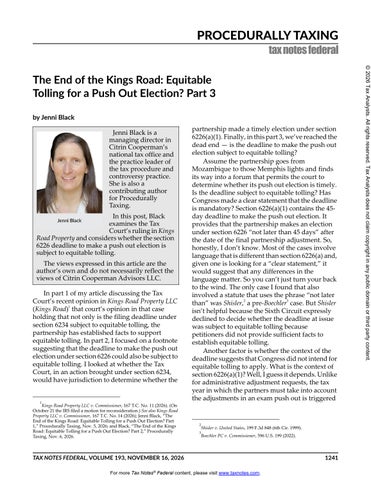
by Jenni Black Jenni Black is a managing director in Citrin Cooperman’s national tax office and the practice leader of the tax procedure and controversy practice. She is also a contributing author for Procedurally Taxing. In this post, Black examines the Tax Court’s ruling in Kings Road Property and considers whether the section 6226 deadline to make a push out election is subject to equitable tolling. The views expressed in this article are the author’s own and do not necessarily reflect the views of Citrin Cooperman Advisors LLC. In part 1 of my article discussing the Tax Court’s recent opinion in Kings Road Property LLC 1 (Kings Road) that court’s opinion in that case holding that not only is the filing deadline under section 6234 subject to equitable tolling, the partnership has established facts to support equitable tolling. In part 2, I focused on a footnote suggesting that the deadline to make the push out election under section 6226 could also be subject to equitable tolling. I looked at whether the Tax Court, in an action brought under section 6234, would have jurisdiction to determine whether the
1
Kings Road Property LLC v. Commissioner, 167 T.C. No. 11 (2026). (On October 21 the IRS filed a motion for reconsideration.) See also Kings Road Property LLC v. Commissioner, 167 T.C. No. 14 (2026); Jenni Black, “The End of the Kings Road: Equitable Tolling for a Push Out Election? Part 1,” Procedurally Taxing, Nov. 5, 2026; and Black, “The End of the Kings Road: Equitable Tolling for a Push Out Election? Part 2,” Procedurally Taxing, Nov. 6, 2026.
partnership made a timely election under section 6226(a)(1). Finally, in this part 3, we’ve reached the dead end — is the deadline to make the push out election subject to equitable tolling? Assume the partnership goes from Mozambique to those Memphis lights and finds its way into a forum that permits the court to determine whether its push out election is timely. Is the deadline subject to equitable tolling? Has Congress made a clear statement that the deadline is mandatory? Section 6226(a)(1) contains the 45day deadline to make the push out election. It provides that the partnership makes an election under section 6226 “not later than 45 days” after the date of the final partnership adjustment. So, honestly, I don’t know. Most of the cases involve language that is different than section 6226(a) and, given one is looking for a “clear statement,” it would suggest that any differences in the language matter. So you can’t just turn your back to the wind. The only case I found that also involved a statute that uses the phrase “not later 2 3 than” was Shisler, a pre-Boechler case. But Shisler isn’t helpful because the Sixth Circuit expressly declined to decide whether the deadline at issue was subject to equitable tolling because petitioners did not provide sufficient facts to establish equitable tolling. Another factor is whether the context of the deadline suggests that Congress did not intend for equitable tolling to apply. What is the context of section 6226(a)(1)? Well, I guess it depends. Unlike for administrative adjustment requests, the tax year in which the partners must take into account the adjustments in an exam push out is triggered
2 3
Shisler v. United States, 199 F.3d 848 (6th Cir. 1999). Boechler PC v. Commissioner, 596 U.S. 199 (2022).
TAX NOTES FEDERAL, VOLUME 193, NOVEMBER 16, 2026 For more Tax Notes® Federal content, please visit www.taxnotes.com.
1241
© 2026 Tax Analysts. All rights reserved. Tax Analysts does not claim copyright in any public domain or third party content.
The End of the Kings Road: Equitable Tolling for a Push Out Election? Part 3
PROCEDURALLY TAXING
1242
This also brings us back to the question of jurisdiction. The pass-through partners are not parties to the proceeding involving the audited partnership. Regardless of how broadly you read the definition of partnership-related item (PRI), I’m not sure how you say that the due date for an action required to be taken by a third party that is not a party to the proceeding is a PRI of the audited partnership. And to make it even worse — it’s a due date that is contingent on future events. The audited partnership has to actually furnish statements first. The pass-through partners’ actions have zero impact on the audited partnership — it doesn’t impact whether it has a valid push out election or the timing of anything the audited partnership is required to do. This means any equitable tolling would have to come up in a later proceeding of the passthrough partner. And this has a domino effect. If tier 3 didn’t timely furnish its statements that means any tier above it didn’t either. The taxpaying partners (all of them, all the way up) must take into account the adjustments and pay any tax in the tax year in which the audited partnership furnished its statements to its partners. Not when the pass-through partner furnished the statement to the tax-paying partner. There may often be a misunderstanding when it comes to the year for which the adjustments are taken into account but, when we look it in the eye, reg. section 301.62263(e)(3)(iv) clearly provides that it is based on the audited partnership’s actions, not the passthrough partners’ actions. Therefore, if equitable tolling applied to the deadline for the passthrough partners, it could be that the partners’ period of limitation is closed. Let’s run through an example. Audited Partnership timely furnishes push out statements to its partners on July 1, 2025, and 2025 is the adjustment year. This means that all pass-through partners must either furnish their own statements or pay an imputed underpayment (IU) by September 15, 2026. Passthrough Partner is a partner in Audited Partnership and receives its statement a few days later, on July 3, 2025. The people in charge of furnishing Pass-Through Partner’s push out statements are real jerks and do not furnish their own statements until September 15, 2026. The statement furnished to Tier 2, a partner in Pass-
TAX NOTES FEDERAL, VOLUME 193, NOVEMBER 16, 2026 For more Tax Notes® Federal content, please visit www.taxnotes.com.
© 2026 Tax Analysts. All rights reserved. Tax Analysts does not claim copyright in any public domain or third party content.
by the furnishing of the push out statements. Under section 6226(b)(1), the partners’ tax for the year in which the statement is furnished is what is impacted. Therefore, the further into the future the statements are furnished, the further out the tax reporting and collection. It would be reasonable to assume Congress did not intend collection of tax attributable to partnership adjustments to be delayed far into the future. This is evident from section 6226(b)(4)(B), which requires all pass-through partners to furnish any push out statements by the same date (the extended due date of the audited partnership’s adjustment year return) regardless of whether the pass-through partner is tier 3 or tier 12. This ensures partners do not get their statements years and years down the road. If the time to make the push out election was subject to equitable tolling, this could delay the statements and, therefore, the tax reporting and collection for years. In addition, as section 6226(b)(4)(B) requires all pass-through partners to furnish their statements by a set deadline, that set deadline will, in probably most cases, have passed by the time it is determined whether the audited partnership made a timely push out election. The pass-through partners can no longer pass Go or collect $200. Does that mean you have to equitably toll the pass-through partners’ deadlines too? We’re getting further and further down toward the distant shore. The deadline for pass-through partners isn’t set based on a number of days, it’s set by reference to the hypothetical due date of a hypothetical partnership return; that return being the audited partnership’s adjustment year return (whether one is filed or not) and that deadline being the extended due date of that return (regardless of whether an extension was requested). The adjustment year is the year in which the FPA is mailed (if no petition is filed) or when the court’s decision becomes final. The court would have to rewrite the definition of “adjustment year” or say that “the due date for the return for the adjustment year of the audited partnership” is a different date than the due date as prescribed by the code. While interpretations sometimes bend and sometimes stand, it’s hard to add language that isn’t there.
PROCEDURALLY TAXING
entitled to equitable tolling so the push out statements issued in February 2027 are timely. Therefore, Tier 2 is not liable for the IU. What happens now? Tier 3 had no reason to think it had to take any action when it received a very late push out statement. Is it now liable for an IU because it didn’t timely furnish push out statements? Even if Tier 2 contacts Tier 3 and tells it about its equitable tolling success, the ultimate tax-paying partners were required to take into account the adjustments in 2025, which is now closed. This can’t be the right answer. Although we’ve come to the end of the road, I still can’t let go. While the centralized partnership audit regime enacted by the Bipartisan Budget Act of 2015 is not the same as the one enacted by the Tax Equity and Fiscal Responsibility Act, it does not mean that BBA doesn’t have more (and different) complications than a deficiency case with the only impacted taxpayer being the party to the proceeding. There are things that are very similar between BBA and TEFRA and things that are very different. In some instances, Congress reused the words from TEFRA when it enacted BBA. That has to mean something. In addition, BBA needs to be evaluated on its own, not just saying “it’s not TEFRA.” I encourage courts to dig into all of BBA’s nuances and its purpose before making far-reaching decisions that may result in unintended consequences. I would not read out Congress’s purpose in passing BBA when evaluating the language it selected. We do not want to go down a long and winding road only to have to start all over again.
TAX NOTES FEDERAL, VOLUME 193, NOVEMBER 16, 2026 For more Tax Notes® Federal content, please visit www.taxnotes.com.
1243
© 2026 Tax Analysts. All rights reserved. Tax Analysts does not claim copyright in any public domain or third party content.
Through Partner, is delivered to its mail room on September 20, 2026. Unfortunately, the same day there is a small fire in the mail room, and the statement is turned to ash before anyone could determine what suite (or STE) it was for. Tier 2, blissfully unaware, does nothing. On February 1, 2027, the IRS sends Tier 2 notice and demand for an IU calculated on the adjustments contained in the push out statement it received (we’re just going to hand wave how we got to this point), which is the first time Tier 2 learns about the push out statement. Tier 2 pays the IU and brings a claim for refund (assume this is a thing it can do) arguing that the deadline for it to furnish its own statements should be equitably tolled because circumstances beyond its control prevented it from issuing its statements: (1) PassThrough Partner was a jerk and Tier 2 couldn’t have issued its statements in time; and (2) the small fire destroyed the statement. Because Tier 2 reads my articles, it also furnishes its own statements at this time (Tier 2 gets a copy of the statement from Pass-Through Partner). Tier 3, a partner in Tier 2, receives the push out statement on March 1, 2027. Tier 3 also reads my articles and is aware that, because Tier 2 did not timely furnish the statements by September 15, 2026, Tier 2 was liable for an IU such that Tier 3 should not have received a push out statement. Tier 3 files it away but does nothing else. At this point, assume, after much litigation, the district court, on April 23, 2029, holds that the deadline under section 6226(b)(4) is subject to equitable tolling and Tier 2 has established it is