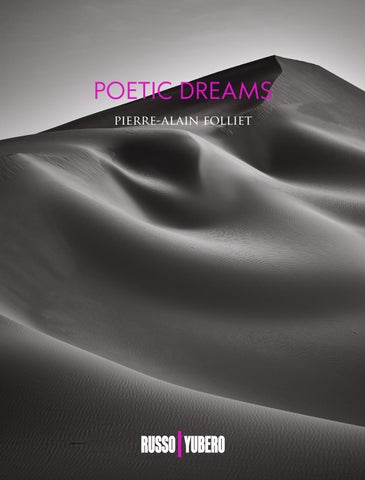
POETIC DREAMS pierre-alain folliet
RUSSO YUBERO
Poetic Dreams Pierre-Alain Folliet
Pierre-Alain Folliet
As he spends his childhood in his family house in Geneva, Switzerland, Pierre-Alain Folliet firstcontact with photography comes at age 12 through his parent’s Rolleiflex. His passion for image is born. Later while in the USA Pierre-Alain sets up a photography studio to pay back for his university loan and takes thousands of shots with the legendary Polaroid SX70. The brand offers him a contract, allowing the photographer to further explore this medium. This period sets the base for Pierre-Alain Folliet’s graphic and minimalist style. Back home in Switzerland, he starts working in the finance field in Geneva, but never abandons photography. He thus starts an exhaustive project depicting the rock formations in the Lavezzi Islands in Corsica, France. In 2004 while visiting the Yellow Mountains in China Pierre-Alain Folliet is mesmerised by the mystery of the site and its interaction with the ever-changing skies. Six months later, he returns to explore most of them, this time fully prepared for his photographic exploration. The artist enjoys mostly working on long-term projects and sets up his tripod in various parts of the world. He crosses the deserts in the Middle East, sails to the Antarctica and lingers over diverse horizons. Being a sensitive aesthete unfailingly linked to Nature, he relentlessly studies deeper perspectives that would remain unnoticed to a superficial gaze. His meticulous, precise and poetic artworks transports the viewer into a universe full of details, unusual atmospheres and shapes, a universe dedicated to the depiction of simple beauty. Initially slightly skeptical but now totally a believer in digital photography, Pierre-Alain Folliet works on high precision devices such as Alpa and PhaseOne platforms. Different projects are currently in progress, including books and exhibitions, as well as portfolios dedicated to Desert images, Horizons, and the Antartica. The artist’s work has been displayed in Europe, Brazil and the USA. It is now present in notable private collections worldwide. In this small book, Pierre-Alain Folliet shares in his own words his photographic journey. We hope you will enjoy it as much as we did. Helene YUBERO Francois RUSSO
5
6
PINK (2014-2015) The origin of the PINK project is the result of an erroneous manipulation of my photographic equipment. During a limited period of time, the synchronisation process between my ALPA camera and the PhaseOne sensor was not accurate. When the copal shutter was manipulated too fast, a partial superposition would occur. It generated a major colors aberrations while creating many random vivid pink areas. Past the initial surprise, I started to experiment with random images. As I was playing with the delay between two shots and searching for subjects, I hoped some would be well suited for this type of work. The result is a small set of prints taken in various locations, from the Liwa desert in the UAE to the Portuguese cliffs and Lisbon bridges, and the Swiss Jura woods. This synchronisation problem was ultimately addressed, signalling the end of this small project. The PINK set of images was shot with my ALPA STC camera linked to a PhaseOne digital back. This synchronisation issue that lasted some time was finally very much welcome as it allowed for this technical and artistic experimentation.
7
9
Previous pages :
25.04
Size : 75 cm x 100 cm
Sobre o Tejo
Size : 75 cm x 100 cm
10
Sobre o Tejo - 2015 - 75 x 100 cm
Steel Suspension
Size : 100 cm x 75 cm
13
Shades of Forest Pink Size : 75 cm x 100 cm
14
Shades of Forest Pink - 2015 - 75 x 100 cm
16
HUANG SHAN (2004-2012) The Huang Shan, or Yellow Mountains, are located in the Anhui Province of the People’s Republic of China and on the UNESCO World Heritage List since 1990. With an average height of 1800 meters, the contrast between sharp needle formations and small valleys is striking. The clouds are playing hide and seek thus modifying the landscape all along the day. How a Swiss photographer living next to the highest mountain range in Europe would apprehend these Chinese mountains? How his perception would interpret these historical holy mountains that have been depicted in the Chinese iconography for more than 3000 years? I decided to use a panoramic camera and shoot mainly in vertical format. Over the years, this choice proved to be well suited. To reach the mountains is already a long process in itself. The path from the hotel is a 4000 steps climb. Upon reaching the top, I would learn there was a lift… However, it proved to be a small feat in view of what was to come. First, the weather has to be accounted for. Rarely sunny, often cloudy, rainy 300 days a year, it can prove challenging. While the rain prevents to go out for days, the challenge becomes acute. But through mist and rain, with a few clear moments, I walked, climbed for hours up and down the various tairs carved in the granitic rocks. Days started at 4:30AM, rarely ending before 8PM, with an average of 15000-20000 steps per day. The scarcity of the food was another challenge, I would lose about 1kg per day. This environment calls for the right equipment and a capacity of full self-sufficiency. Patience is a must, I had to learn. Climbing up and down for 3 hours to reach a place and shoot a few photos, having to wait 2 hours for the rain to stop just for a few minutes… My Ba Yin Niao image is the perfect example. And not to forget the same walk on the way back… Unlike most people who would stay a day or two, I always managed to bring back images from my 10-day trips. My first stay in Huang Shan was only part of a trip in China and I used the Hasselblad XPan. All subsequent photos of the Mountain were made with the Fuji GX617. I only used Fuji Neopan Acros 100 films exposed at 50 ASA.
17
Left : Bai Yin Niao III
Size : 220 cm x 73 cm
Right : Towards Lotus Peak
Size : 220 cm x 73 cm
19
Left : Behai Sunrise Size : 160 cm x 52 cm
Right : Sunset Canyon Size : 160 cm x 52 cm
20
Left : Natural Monument
Size : 160 cm x 52 cm
Right : Behind Valley
Size : 160 cm x 52 cm
23
ANTARCTICA BLUES (2016-ongoing) Antarctica is not a country. It is a continent. This distinction becomes self-evident when one is sailing through these fierce elements, gigantic icebergs who certainly look down on you. Travelling through such a continent need a thorough organisation and one has to constantly be aware of the ever changing environment. Antarctica is far. It is far from Ushuaia which is already very far… Sailing for four days, often through terrifying weather conditions as the crossing of the Drake Passage is a kind of an adventure. I long dreamed photographing icebergs. Their extraordinary shapes and sheer size always amazed me. The ice sheet is flat, or cut in pieces as it would be by giant knives. The remains of this slaughter are often kilometers long. Sometimes flat (tabular icebergs), sometimes in extraordinary shapes with the various signs of unbalanced life. They glide like the silent ships of the roaring 50s and seem to emerge from the void. I traveled to the end of the world to photograph them. Antarctica is not a simple destination as there are no shops at all in case something is missing. It requires thorough preparation and anticipation. Waterproof and warm clothes. A first aid kit for the photographer and the equipment as shooting in the mist, storms and snow flurries is not an obvious undertaking. However, once all this has been taken care of, here we are, sailing towards the White Continent. The profusion of icebergs showing the stigma of their wandering life, the light finding a divine path through the dark skies create an eerie atmosphere where the line between the real and the imaginary becomes fuzzy. Life is omnipresent. Krill, small fishes, penguins and birds, orcas and whales, seals and sea elephants, to name a few, coexist or devour each other in a live depiction of the food chain. It is an incredible sensation to step on a beach early in the morning, surrounded by half a million penguins, noisy as a giant kids playground, not to mention the seals, huge sea elephants and the arctic life…
24
Numbers are staggering. As an example, the crabeater seals, who do not eat crabs despite their name, are estimated to be about 50 millions. What a feeling when a big group of penguins is passing by a few feet away, staring at us for a brief moment, before heading into the water. The man is no longer the predator he was. There is no fear, no animosity. As the noise of the colony muffles the wind, a bashful sun replaces the snow flurries. Welcome to the end of the world, Antarctica, where man is now only a privileged witness of life. For this unique destination I used my Phase One sensor on the ALPA and Phase One platforms. When standing in the small rubber dinghy, I used the ALPA to minimise the vibrations asa this equipment is mirrorless.
25
Previous pages :
The Ghost Ship Size : 80 cm x 120 cm
Table is Ready Size : 77.6 cm x 240 cm
28
29
30
Antarctic Coast
Size : 77.6 cm x 240 cm
31
Melting Ridge - 2016 - 80 x 120 cm
Previous pages :
Cathedral
Size : 295 cm x 500 cm
Melting Ridge
Size : 80 cm x 120 cm
33
Moving Ice
Size : 80 cm x 120 cm
36
Moving Ice - 2016 - 80 x 120 cm
LIWA (2012-ongoing) The Liwa desert is part of the Rub al Khali desert, south of Abu Dhabi in the UAE. Also called Empty Quarter it is an overwhelming succession of beautiful sand dunes. The size of the desert is about the size of France with a few oasis. The geometric shapes, the steepness of some dunes and their sheer size forms an endless monumental labyrinth. To work there alone for so many hours every day is totally immersive and meditative. This project is an example of the extraordinary progress in resolution quality the medium format sensors have allowed. I wanted to see the sand, to obtain an image resolution good enough for one to almost feel like touching the sand. The PhaseOne sensor I used allows for this incredible feat. The relation with the image is no longer just looking at a photograph as the capacity to produce large prints with such details leads to a physical relationship with the image. It is a very different feeling. The desert is not something new for me. I did travel in various desert areas, although not with a real camera. There is a hotel in the middle of the desert within the UAE, located about three hour drive from Abu Dhabi and I thought it would be a good base to start. The routine is rather simple. Wake up at 6AM, gone by 6:30 for a 30 minutes drive to a spot where I would spend hours alone with three bottles of water. Then back for lunch and equipment cleaning and gone again until the night would settle. I decided to aim for shapes, curves, contrasts, graphic renderings. I discovered how fast the light was moving, the need for anticipation. I learned through trial and error how to plan a photo without exposing my tracks on the sand, how to visualise where to walk in order to avoid the costly mistake of having my footsteps on an image I would take an hour later while following the light… No sound at all except the wind, sometime freezing cold, endless climbs of big dunes further away.
38
For the Liwa project I am using a PhaseOne digital back on my ALPA and PhaseOne cameras. The incredible lenses associated to the 150 million pixels IQ4 sensor allow for the smallest possible details at sand grains levels to appear visible to the viewer.
39
Lonely Tree
Size : 135.8 cm x 240 cm
40
LonelyTree-2018-135.8x240cm
Labyrinth
Size : 200 cm x 150 cm Next pages :
Morning Dune
Size : 124.5 cm x 240 cm
43
44
45
46
Liwa Sunset
Size : 96 cm x 240 cm
47
Solar Wind
Size : 69.15 cm x 120 cm
48
Solar Wind - 2015 - 69.15 x 120 cm
The Big Dune - 2018 - 135 x 180 cm
The Big Dune
Size : 135 cm x 180 cm
51
EXHIBITIONS « Pierre-Alain Folliet. Photographies Première. » Galerie Patrick Cramer, Geneva, Switzerland, 2001 « La Mémoire et la Mer » Galerie Charlotte Moser, Geneva, Switzerland, 2006 « Les Montagnes Sacrées » La Galerie, Geneva, Switzerland, 2007 « Ethers et Abîmes : Eternelle HuangShan » Galerie Lipao-Huang, Paris, France, 2009 « Huang Shan, Montanhas Sagradas da China » FotoRio, Rio de Janeiro, Brazil, 2011 « Antarctica Blues » Galerie ArtDynasty, Geneva, Switzerland, 2017 « Poetic Dreams » Galerie Russo Yubero, Geneva, Switzerland, 2021
52
« Antarctica Blues » Galerie ArtDynasty, Geneva, Switzerland, 2017
« Ethers et Abîmes : Eternelle HuangShan » Galerie Lipao-Huang, Paris, France, 2009
« La Mémoire et la Mer » Galerie Charlotte Moser, Geneva, Switzerland, 2006
53
Credits This book gathers 22 photographs by Pierre-Alain Folliet, produced from 2006 to 2018.
Curators Hélène YUBERO Francois RUSSO
Creative Direction Francois RUSSO Assistant Pakin JANETHUMNUGUL
Publisher RUSSO YUBERO PUBLISHING books@russoyubero.net Route du Grand Lancy 6A 1227 GENEVA SWITZERLAND GENEVA - BANGKOK - CHIANGMAI