TransportationTalk

SEEKING NEW TALENT?
Reach thousands of transportation professionals and students with ITE Canada’s Job Board
ITE Canada Job Board offers:
Ad posted instantly & proof-read
Job emailed to 3,600+
member mailing list
Job posting shared to ITE Canada’s social media channels

Your direct pipeline to thousands of top candidates
Grow your team
Genevieve Tokgoz
Trevor
Meet
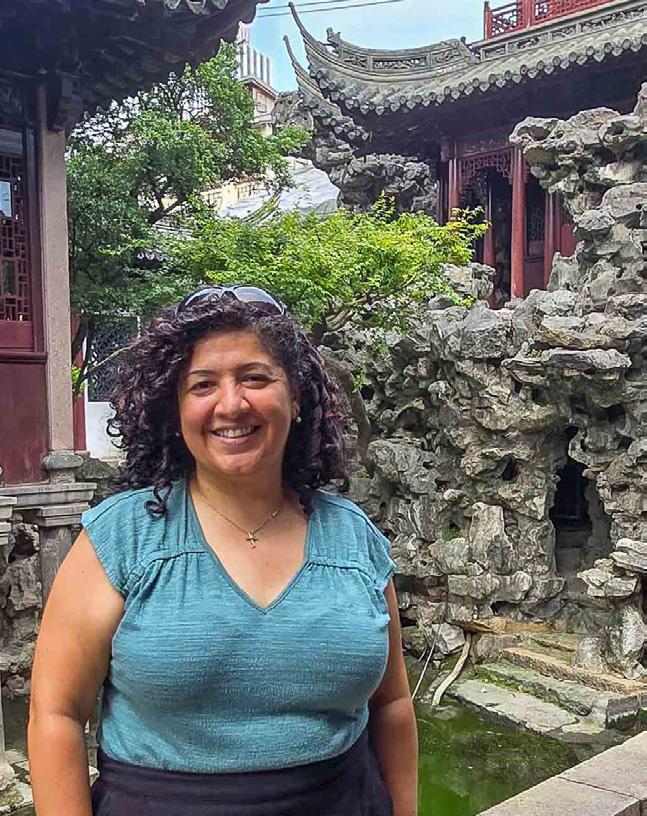
Irini Akhnoukh, M.Eng., P.Eng., FITE
President, ITE Canada District president@itecanada.org
Spring is here, and 2026 continues to move at a fast pace. The year seems to have kicked off with a steady stream of major news and change—globally, nationally, and across our profession. While that level of turbulence can be challenging, it also reinforces the importance of staying connected, informed, and engaged with one another as transportation professionals.
Here at ITE Canada, we’ve experienced some change of our own. Earlier this year, Madhuri Seera stepped down from her role as Secretary and from the Board of Directors, effective February 6, 2026. I want to sincerely thank Madhuri for the time, energy, and thoughtfulness she brought to her service with ITE Canada. Volunteer leadership is never easy to balance, and we are grateful for her contributions and commitment. We wish her all the best in what comes next.
To ensure continuity on the Executive Committee, the Board of Directors appointed Greg O’Brien of the ITE Atlantic Canada Section to serve as Secretary for the remainder of the 2026 calendar year. Greg is well known to many of you and brings valuable governance and finance experience gained through his work with ITE Canada and beyond. We appreciate his willingness to step into this role, and I’m pleased to be working alongside him as we move through the year.
At the same time, ITE Canada District is now seeking nominations for a candidate to serve as Secretary on our Executive Committee. If you are passionate about ITE, interested in contributing at the national level, and able to make the time commitment required, I strongly encourage you to consider putting your name forward. Serving on the Executive Committee is both rewarding and impactful, offering the chance to help guide the organization’s direction while developing meaningful leadership experience.
The 2026 Annual Conference in Victoria is almost upon us, and excitement is building. The LAC and NTPC have both done an amazing job with the technical and social programs, and current interest suggests this could be our highest‑attended conference yet. With venue capacity in mind, we will likely need to cap registration once we reach our maximum numbers, so if you’re planning to attend, I encourage you to register now! Fun fact about Victoria: by 1890, the city had completed a five mile electric streetcar network and was the third Canadian city to adopt this technology.
Professional development remains a priority for ITE Canada, and this spring we’ve launched two training programs designed to support members at different stages of their careers. Engaging with Confidence: Essential Prep and Strategies for Successful Engagement and Geometric
Design: Fundamentals and Emerging Practices in Urban Street Design. Both of those training opportunities are particularly well suited for younger members, while also serving as a useful refresher for more established professionals navigating increasingly complex engagement and urban environments. I encourage you to take advantage of these opportunities if they align with your professional goals.
As part of our 75th Anniversary celebrations, we’re collecting pieces of ITE Canada’s history. We know many great moments live in photo albums and old hard drives across the country, so if you have conference or Section photos—particularly from before 2000—we invite you to share them with us in this public Google Photos album or by email to archives@itecanada.org. These snapshots help bring our collective story to life, and we’re excited to showcase them as part of our anniversary celebrations.
Despite the pace of change this year has brought, what continues to stand out is the strength of our ITE Canada community. Members and volunteers continue to step up, support one another, and stay engaged. That shared commitment is what allows this organization to thrive—even during times of uncertainty.
As we move further into the year, thank you for staying connected, for contributing your time and expertise, and for being part of the ITE Canada community. I look forward to the months ahead and to seeing many of you soon in Victoria.
Warm regards,

Irini Akhnoukh, P.Eng. President, ITE Canada
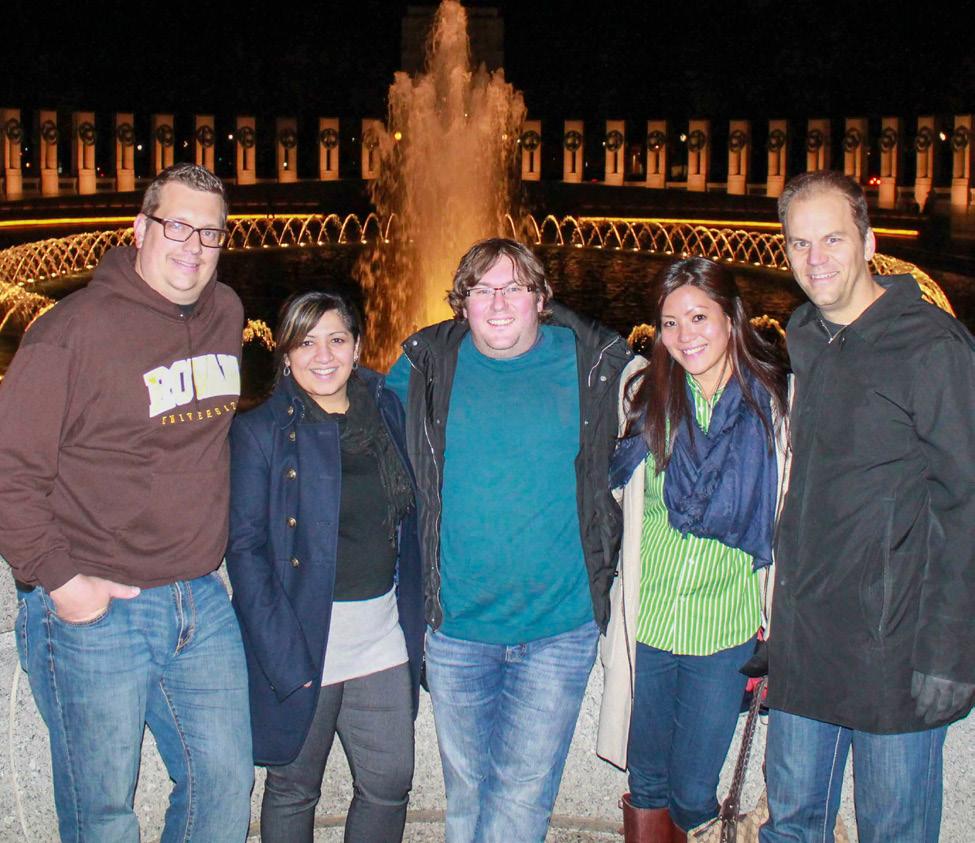
The “Frozen Five” Canadian members of the inaugural LeadershipITE class in 2013
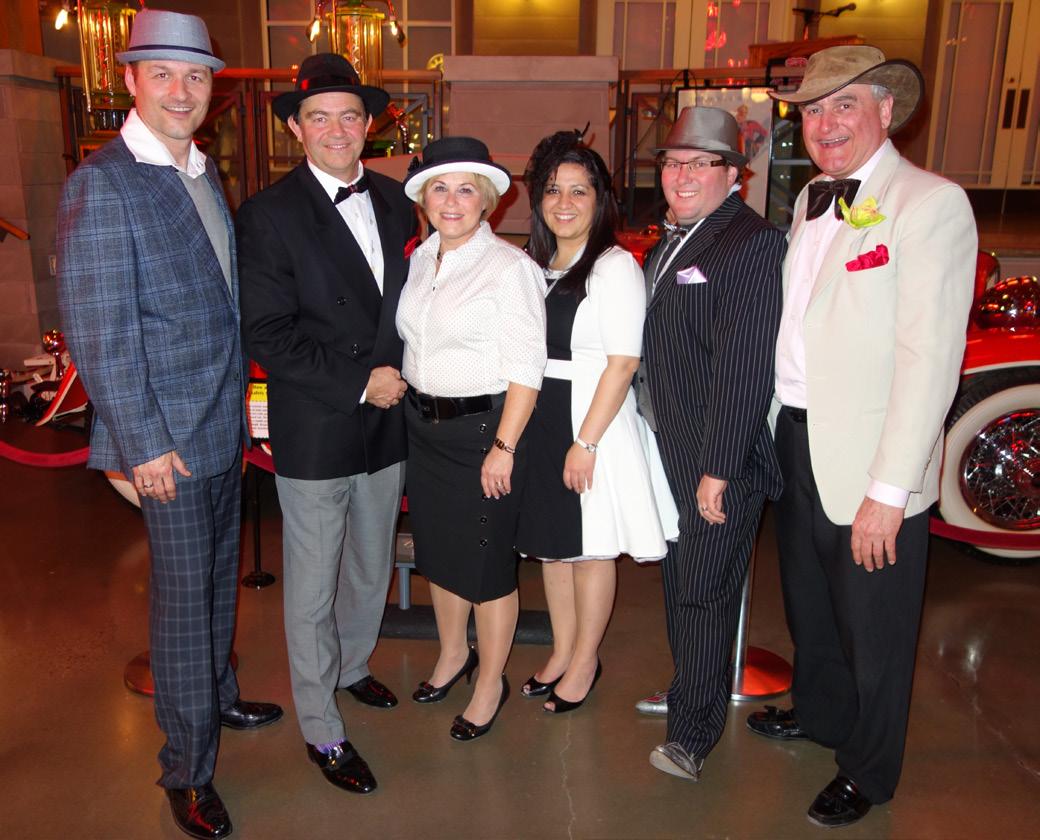
The 1960s themed banquet at the 2013 Annual Conference in Calgary

Julia Salvini, MEng, PEng, FITE
Canadian District Director, ITE director@itecanada.org
Welcome to Spring 2026! There are a lot of exciting things happening in your ITE Community across Canada and the world!
I hope that many of you had the opportunity to participate in the ITE Virtual Conference in March. The content was excellent and Canadians across the country contributed their technical expertise to the discussions on a range of transportation topics. Thank you to Sarah Wells for her keynote address, fireside chat with ITE President Gord Meth, and for highlighting all the excellent work she is involved in and the way that we as Canadians collaborate in the transportation field. Thank you also to Josée Dumont, Peter Truch, and Todd Litman for their excellent presentations; you represented us well and I appreciate the time you take to share your experiences with other ITE colleagues.
Here in Canada, there have been many local events to enjoy over the last few months including Student Presentation Competitions. I welcomed the opportunity to, once again, be a judge at the annual joint Student Presentation Competition organized by the Southwestern Ontario, Hamilton, and Toronto Sections in Waterloo. I also had the opportunity to mentor a 4th year capstone student project group from the University of Waterloo over the last year. And I was able to attend a student/practitioner trivia night organized by my local Southwestern Ontario Section as well. Watching all of these students learn and discover where their professional passions lie is such a rewarding part of working with them. Whenever you have the chance to engage with your local student chapters and help guide their enthusiasm, I encourage you to jump into the experience—you won’t regret it!
The highlight of the coming months for me will be the many opportunities to mingle with fellow transportation professionals. I am looking forward to gathering with colleagues in Rhode Island for International Board of Direction meetings associated with the ITE Northeastern District conference in May, in Victoria for the ITE Canada conference in June, and in Detroit for the ITE International conference in July. If you will be in Detroit, please reach out and let’s keep an eye out for one another in the big crowd.
It is election season at ITE Canada. We are looking for a Secretary to serve on the ITE Canada District Executive Committee for the 2027–2028 term. If you are interested and would like to chat with me about it, please reach out. Find more information in the Call for Nominations.
The latest step in the ITE Road Safety Action Plan is the roll out of the ITE Safety Partner Pledge. The Pledge serves as a reminder that the many decisions and actions we take in our professional roles directly impact the safety of users in our transportation networks. There are a number of different actions you can consider and tailor to your own role and projects. I encourage you to explore the ITE Safety Partner Pledge and to continue to recognize the enormous impact we each have on the safety of travel for all users in the communities we serve.

Julia Salvini, P.Eng., FITE ITE Canada District Director

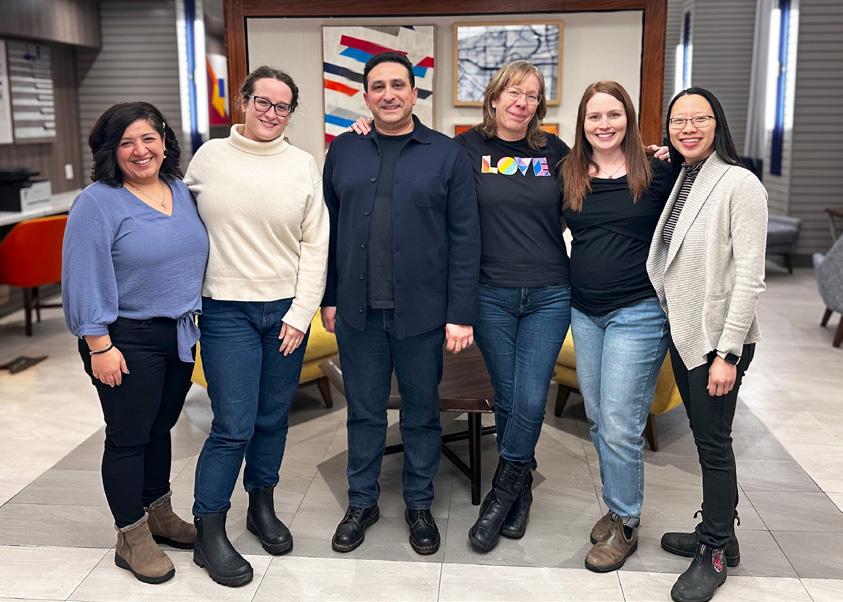
Members of the ITE Canada District Executive and staff hosted by Julia in Kitchener

10 Actions You Can Take as an ITE Safety Partner
What actions will you take to challenge the status quo and foster a cultural shift toward safer transportation?
1. Support and Advance Safety Knowledge: Participate in the development of ITE technical resources while staying informed on emerging safety research, technologies, and global best practices aligned with Safe System principles.
2. Reach Beyond Minimum Standards : Supplement minimum design standards with proven best practices and engineering judgment to better address context, risk, and user needs.



3. Plan & Design Safer Streets for Everyone : Ensure all transportation designs prioritize safety first, while also providing access and mobility for people walking, biking, rolling, driving, motorcycling, and taking transit.
4. Set and Design for Safe Speeds: Support setting target speeds based on human injury tolerances when appropriate and implementing operational and geometric interventions as well as using safety cameras where permitted.
5. Use Design to Influence Behavior: Apply self-enforcing street design principles, and not just a posted speed limit, to make safe speeds the natural choice.
6. Identify Risks Proactively: Consider near-miss, conflict, and exposure data in addition to crash history to inform safety improvements.
7. Protect Vulnerable Road Users: Apply proven safety design elements such as lighting, safe crossings, and multimodal features that protect people walking, biking, rolling, motorcycling, and using transit.
8. Measure What Matters: Evaluate success using safety performance and accessibility metrics, in lieu of primary reliance on level-of-service or throughput measures.
9. Collaborate Across Disciplines : Partner broadly across sectors, including emergency response, public health, enforcement, and community organizations, to advance shared safety goals. 10. Integrate Land Use and Safety Decisions: Incorporate designs that match local and regional policies and align with how built environments influence long-term
www.ite.org/safetypledge | safetypledge@ite.org
News from ITE Canada
Executive Committee Elections | Call for Nominations
ITE Canada District is seeking nominations for a candidate to serve as Secretary on our Executive Committee for a two year term from January 1, 2027 to December 31, 2028.
The nomination deadline is Friday, May 1st, 2026 at midnight Pacific standard time.
Learn more about the position in the Executive Committee Roles & Responsibilities document
Nomination Process
The Nominations Committee is undertaking a general call for nominations that may also include a direct invitation to potential candidates. Eligibility for the elected position will be determined by the Committee through an assessment of the nominee’s suitability.
Please review the ITE Canada Nomination & Election Policy for further details.
How to Apply
To apply, candidates must send a letter to the Nominations Committee Chair via email to director@itecanada.org indicating their interest in the position, why they are suitable, and two signatures from ITE members in good standing. The deadline is May 1, 2026 at midnight Pacific standard time.
Campaign Activities
ITE Canada will make space available on the corporation’s website to highlight candidate profiles. Candidate profiles must include: name of candidate that will be used on the election ballot, a photo of the candidate, a 400 word or less candidate statement, and optionally, links to social media profiles.
Campaign Rules
Candidates for the District Executive Committee election shall abide by the campaign rules outlined in our Nomination & Election Policy:
• Individual websites are prohibited.
• Bulk mailing and direct advertising techniques are not allowed. Bulk mailing for this purpose is defined as mailings of the same enclosures to more than 1 person. Bulk mailing encompasses both postal and electronic mailing.
• One on one personalized email communication is allowed by a candidate or by others on behalf of a candidate, expressing their perspectives (not those of others).
• Candidates may not contact Sections and Chapters for the purpose of advertising or endorsing their candidacy. Additionally, they may not encourage or promote the use of surrogates to campaign on their behalf.
• Candidates may attend District, Section, and Chapter meetings during the time period of their candidacy. Candidates may present on matters unrelated to their candidacy. They cannot present a campaign speech at any meeting. This does not preclude the candidate from carrying out their duties as an officer of a Section/Chapter or retaining a currently held volunteer position.
• There is to be no malice toward other candidates.
Any breach of these rules may result in the Nominations Committee revoking the nomination of that individual for office.


DATE & TIME
Ǭ Tuesday, May 12, 2026
TRAINING
Ǭ 11 to 3 pm (Eastern) / 8 am to 12 pm (Pacific)
g FACILITATORS
Ǭ Jocelyn Deeks and Lewis Walker of Bousfields Inc.

REGISTRATION FEES
Ǭ ITE Member (Individual or Public Agency): $275*
Ǭ Non Member: $400*
Ǭ ITE Young Member: $200
Ǭ ITE Student Member: $150
*15% group rate discount for 3+ registrations purchased together
REGISTER
QUESTIONS ABOUT THE TRAINING PROGRAM? Contact the Training Committee at training@itecanada.org
QUESTIONS ABOUT REGISTRATION? Contact ITE Canada at info@itecanada.org

TRAINING SUMMARY
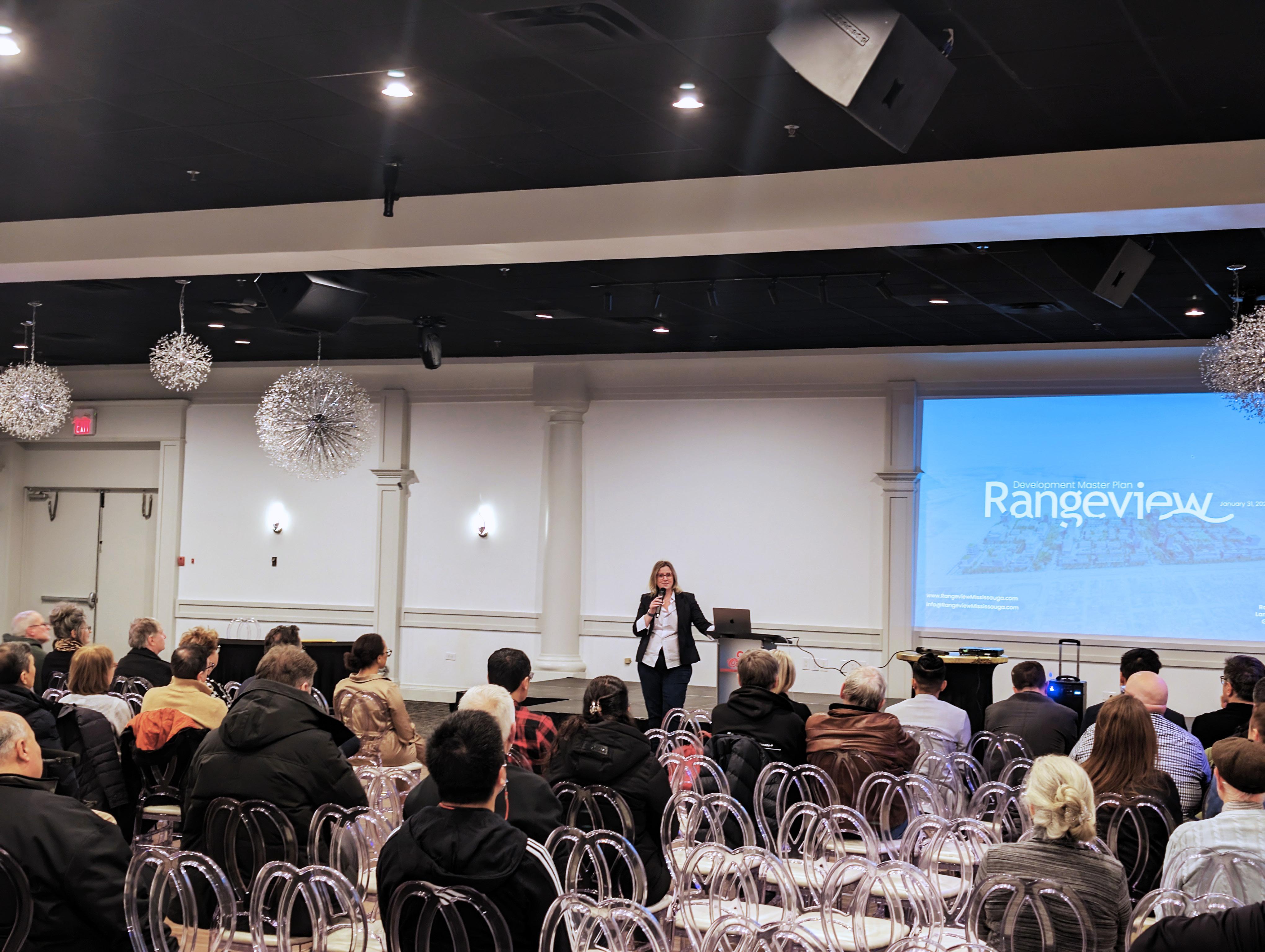
Community engagement can feel daunting. What if the public is not happy with your project? What if tough questions arise? Maybe you want to strengthen your public speaking or strategic thinking when facing a crowd, or simply refresh your knowledge of best practices. This training introduces practical approaches for preparing and delivering community meetings, tailored for transportation professionals across all levels and sectors. Participants will learn how to prepare effectively, communicate transportation related materials, and apply core principles to public engagement.
Through guided discussions, structured exercises, and collaborative problem solving, attendees will develop practical skills for navigating challenging conversations with the public. The session will focus on understanding the community consultation process, preparing for engagement, approaching public speaking with confidence, and structuring clear and effective responses to questions. Participants will also explore key strategies for addressing tough questions, review transportation focused case studies, and take part in group exercises that build shared learning and confidence in public facing situations.
KEY LEARNING OUTCOMES
At the conclusion of the training programme, attendees will leave having honed or developed their skills in order to:
Ǭ Build confidence in public speaking and engagement
Ǭ Learn structured approaches to prepare for community engagements
Ǭ Develop strategies for handling challenging questions
Ǭ Discuss best practices for engaging with the community
Jocelyn Deeks, MCIP, RPP Lead Trainer Lewis Walker Assistant Trainer

May 31–June 3, 2026
Victoria, BC
With excitement bursting at the seams, the ITE Canada District 2026 Annual Conference happening May 31–June 3 in Victoria, BC may completely sell out well ahead of registration deadlines due to physical venue capacities.
More than 550 delegates, presenters, sponsors and exhibitors will to gather and share knowledge around the theme of Creating Connections Through Transportation. The technical program is the heartbeat of our conference, featuring over 60 curated technical sessions, panels, and hands on workshops. From deep dives into current practice to explorations of emerging innovations, the sessions will spark dialogue on how we can better bridge the gaps in transportation. Our Technical Tours will take the learning outside, offering a first hand look at Vancouver Island’s most innovative multi modal projects in action.
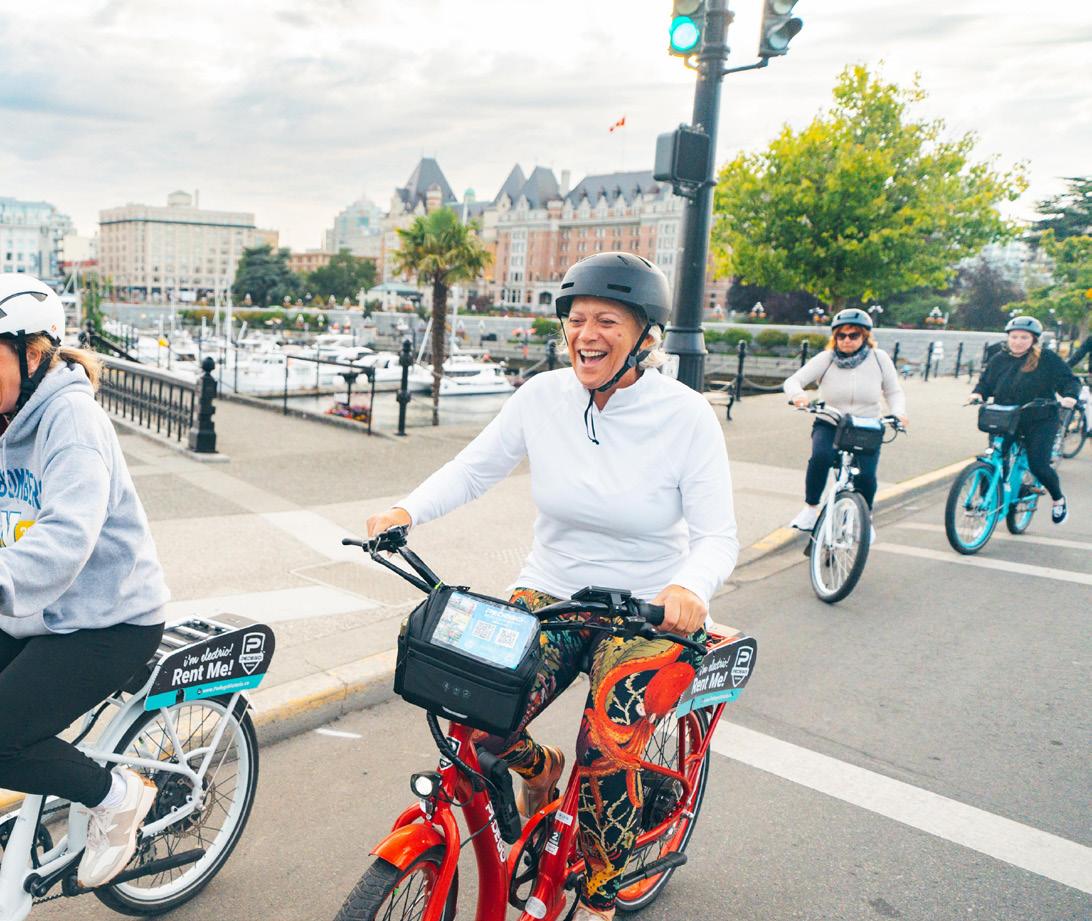
Beyond the learning, Victoria 2026 is about fostering our transportation community. Set against the stunning backdrop of the Inner Harbour, the conference provides a unique venue for the cross country networking that has become an ITE Canada hallmark. The opportunity to reconnect with peers and mentors in such a picturesque setting is what truly defines this year’s theme of Creating Connections.
ITE CANADA DISTRICT ANNUAL CONFERENCE
SPONSORSHIP
A limited number of sponsorship opportunities are still available until April 30. Don’t miss this opportunity to showcase your expertise and connect with hundreds of transportation professionals and students in Victoria alongside leading companies like our Diamond and Platinum Sponsors below.




Keep up to date with all conference related news at our official website—conference.itecanada.org, via the ITE Canada email list, and by following #ITECanada2026. SPONSOR

STUDENT LEADERSHIP SUMMIT 2026
30–31 MAY 2026
University of Victoria, British Columbia
Leadership Through Sustainability and Reconciliation

Join the ITE University of Victoria Student Chapter for the 2026 ITE Canada Student Leadership Summit (SLS) in Victoria on May 30th and May 31st. They look forward to hosting and meeting students from across Canada to learn about Leadership Through Sustainability and Reconciliation!
The SLS will feature an evening social event on Saturday, May 30 and sessions on Sunday, May 31. Dinner on Saturday plus breakfast and lunch on Sunday will be provided.
This event will be hosted on the beautiful University of Victoria campus.
REGISTRATION
Early bird rates until Saturday, May 9, 2026
• ITE Member: $25
• Non ITE Member: $35
After May 9th, the ticket sales will increase to the below:
• ITE Member: $35
• Non ITE Member: $45
Registration closes Saturday, May 23, 2026
Advancing a Unified Regional Transportation Vision in the Capital Region
By Genevieve Tokgoz, Capital Regional District
LEANNA RATHKELLY
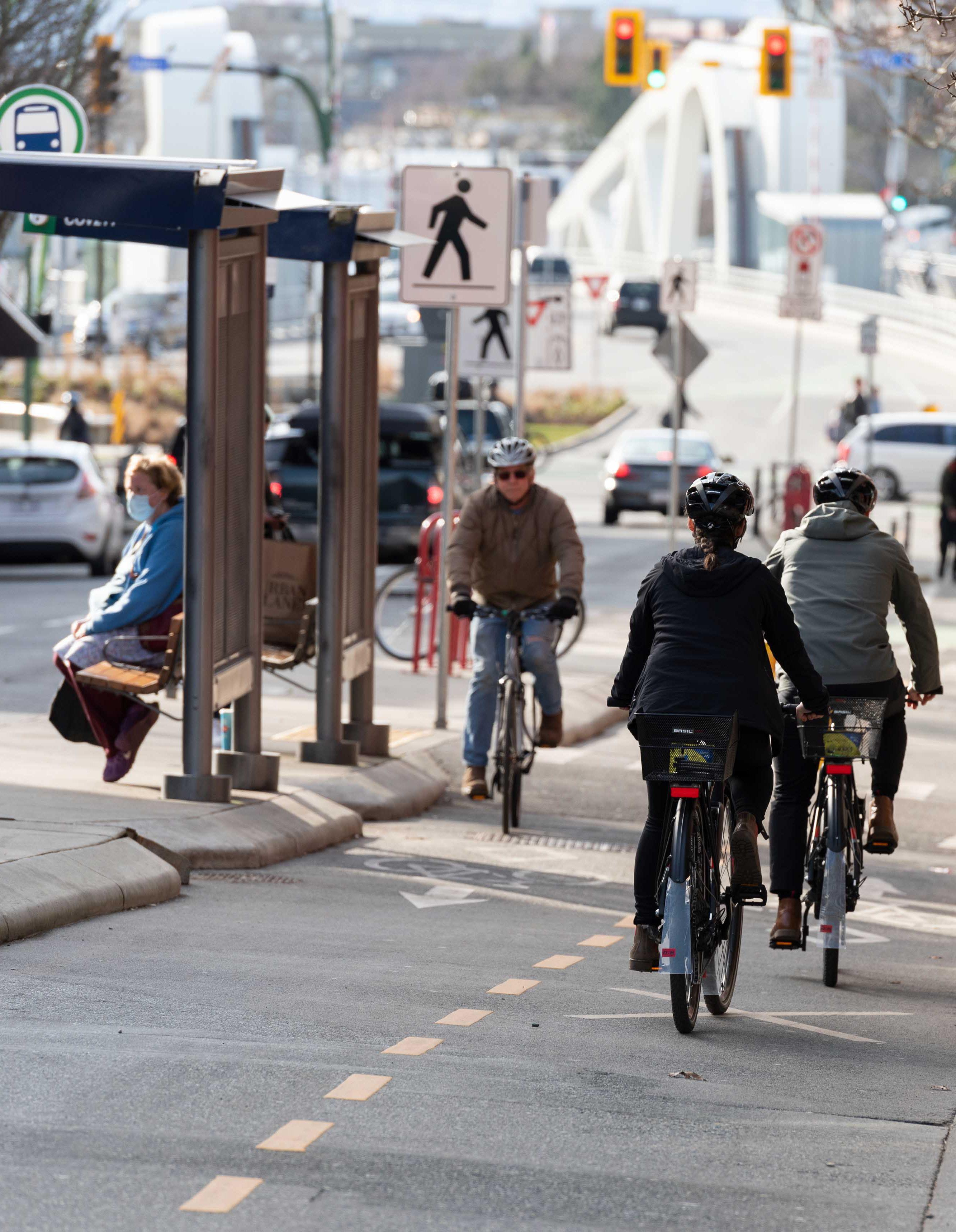
For the first time, the Capital Regional District (CRD)—the regional government for 13 municipalities and three electoral areas on southern Vancouver Island and the Gulf Islands—has a formal mandate to lead transportation planning and service delivery. The creation of the CRD’s Regional Transportation Service in 2025 marks a growing recognition that congestion, growth, climate action, and mobility do not stop at municipal boundaries. This moment echoes Metro Vancouver’s experience in the 1990s, when growing congestion and fragmented accountability led to a deliberate shift toward regional transportation planning, ultimately resulting in the creation of TransLink.
While the capital region’s geography and context are distinct, advancing a unified regional transportation vision will still require familiar steps: sustained coordination, a shared understanding of constraints and opportunities, and a clear plan supported by the right tools.
Recognize that it will take time and lots (and lots) of coordination
A lot has changed in the capital region since the 1980s and 1990s when I was a kid growing up in Saanich. I used to ride my BMX around my neighbourhood, cutting through Browning Park to pick blackberries along Bowker Creek. I would pedal along the sidewalk down Shelbourne Street to the video store to rent a VHS movie. Getting to school by bus meant travelling downtown to grab a paper transfer, then catching a second bus. On a good day, the driver tore the transfer generously, buying us an extra hour to hang out at the Eaton Centre after school.
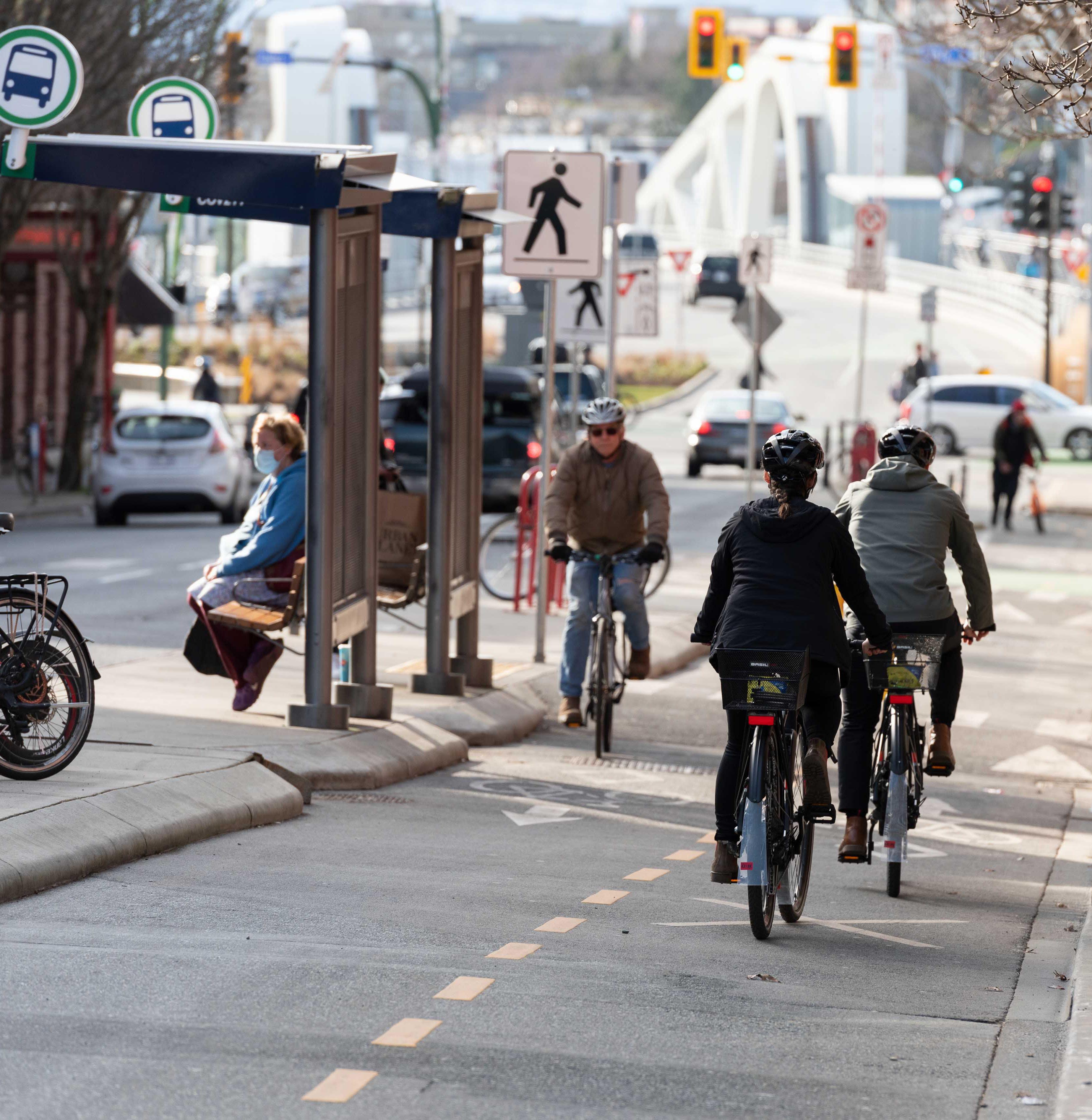
Now, as both a transportation professional and a parent raising kids in Victoria, I experience the region very differently. My kids still ride their bikes around the neighbourhood, but they do so on a growing network of all ages and abilities routes that did not exist when I was their age – though this experience is still far from universal across the region. When they are walking, they can use contactless crosswalk buttons and benefit from slower vehicles, and shorter crossing distances on traffic calmed streets. If they are tired on the ride back from Bamfield Park swim dock, they can load their bikes on the front of the bus. What feels routine to them reflects changes that took years to move from idea to implementation.
At the same time, some things feel unchanged. The ‘Colwood Crawl’ is still a thing and heading out of town on a Friday afternoon adds time to the trip due to congestion on Highway 1. The E&N rail corridor is still there too—transformed in parts into the E&N Rail Trail with tracks that have yet to return to active service.
Looking back, the real takeaway isn’t how much has changed, but how much coordination it took to make those changes happen at all. Behind every bike lane, transit improvement, and rail corridor are years, sometimes decades, of planning, negotiation, funding, and political will. Recognizing that complexity is the starting point for thinking realistically about what comes next and why regional coordination is so important.
The CRD’s Regional Transportation Service exists to support regional coordination around planning, programs, data, and policy. Its approval followed years of discussion and an earlier attempt dating back to 2018, underscoring how time intensive it is to build consensus across a growing and geographically constrained region.
Understand the context, constraints, and opportunities
The capital region is home to roughly 460,000 people, with growth unevenly distributed across the region. Between 2016 and 2021, core municipalities grew by about 4.3%, while the Westshore expanded rapidly—by more than 22.2%—adding over 16,000 residents. Within this trend, Langford was among the fastest growing municipalities in Canada with a population increase of over 30% during the same period. The result is an increase in longer, cross regional trips, particularly between the Westshore and the urban core.
Transportation also sits at the intersection of many of the capital region’s most pressing challenges including congestion, land use change, equity, and economic resilience, and
remains the region’s largest source of greenhouse gas emissions.
Governance adds further complexity. No single regional body has the mandate, authority, or representation needed to guide the full transportation system. While the CRD leads transportation planning, it has limited authority in transit decisions. Roads, transit, and active transportation are planned and funded by separate agencies each with distinct governance structures and funding tools.
At the same time, this context creates opportunities to strengthen the case for better connections between emerging population centres and the urban core. In practice, this means expanding high quality transit, improved multi modal options for longer trips, and a governance model that supports decisions that tie multi modal transportation investments with land use planning.
Juan De Fuca Electoral Area
Cowichan
Build a foundational plan
In this context, how decisions are guided matters as much as decisions themselves. This is where the Regional Transportation Plan (RTP) plays a central role. Currently being updated through a two year collaborative process with member municipalities, First Nations, and agencies with transportation mandates, the RTP aims to establish a unified regional vision. The plan will set priorities and provide a consistent basis for making difficult trade offs like how best to allocate our finite road spaces.
A core element of the RTP is the Regional Multi modal Network (RMN). The RMN identifies priority corridors for transit, cycling, walking, goods movement, and emerging modes across the region. Aligning these corridors across municipal boundaries is one of the capital region’s most significant technical and political challenges, but it is also where regional planning adds the greatest value. The RMN provides a way to address questions that cannot be resolved on a project by project basis. Questions like where rapid or frequent transit should be prioritized, how reliable connections can be maintained across municipal boundaries, where active transportation investment should be focused, and how strategic opportunities such as the E&N corridor can be integrated into the broader network.
Just as important, the RTP must also align with the CRD’s Regional Growth Strategy, which guides how and where the region grows. Transportation and land use are tightly linked. If growth patterns and transportation investments are pulling in different directions, neither plan will deliver the outcomes the region is aiming for.
Tool up
To deliver the RTP and turn its goals into action, the right tools and supports must be in place: reliable data and evidence, and a multi modal decision making framework that enables priorities to be acted on and delivered.
The CRD is responsible for regional transportation data collection. Household travel surveys, traffic and cycling counts, and modelling tools provide a shared evidence base for evaluating options, testing assumptions, and supporting consistent decision making across jurisdictions. Tracking change over time will help reinforce a positive feedback loop—one that becomes tangible when I look at how much the region’s cycling network has evolved since I was a kid. As the all ages and abilities network has gradually taken shape, cycling’s share of all trips increased from 2.6% to 7.9% between 2001 and 2022. High quality infrastructure attracts more users, builds visibility and public support, and helps make it easier to justify further investment. Additionally, as the Regional Transportation Model is updated, the region will be better positioned to test scenarios, assess corridor level trade offs, and link RTP priorities more directly to investment decisions.
Just as important, the RTP is being shaped around what the region needs, not solely what existing decision making structures can deliver. Achieving the region’s mobility goals of increasing walking, cycling, and transit use, reducing carbon pollution, and tackling congestion will depend on a governance framework capable of coordinated action at a regional scale. Whatever form it ultimately takes, that framework must align land use, growth, and transportation investment in support of shared objectives, and enable the plan’s implementation rather than limit its ambition.
Move forward together
Ultimately, advancing a unified regional transportation vision is not about any single mode or project. It is about enabling safe, reliable movement between communities—by transit, bike, foot, and car— and doing so through a shared regional approach that requires jurisdictions to move forward together rather than through a patchwork of local solutions.
Having observed transportation change in the capital region, from childhood to today, momentum for more substantive regional action has been steadily building. Just as today’s system reflects decades of coordinated planning and persistence, the decisions now being made will shape what future generations experience as everyday travel, whether through higher transit use, new forms of regional connectivity, or options that have yet to be fully realized.

LEARN MORE about CRD’s Regional Transportation Service and the Regional Transportation Plan
AUTHOR
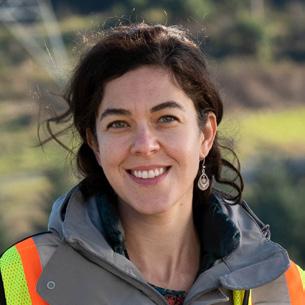
Genevieve Tokgoz, P.Eng, M.Eng started her career in transportation at the City of Vancouver, contributing to the pilot Burrard Bridge bike lanes project in 2008. She later worked in renewable energy roles at Metro Vancouver and the Capital Regional District before returning to transportation as Manager of Transportation at the CRD, supporting the new Regional Transportation Service.
Meet Associated’s Transportation Planning & Traffic Engineering Team
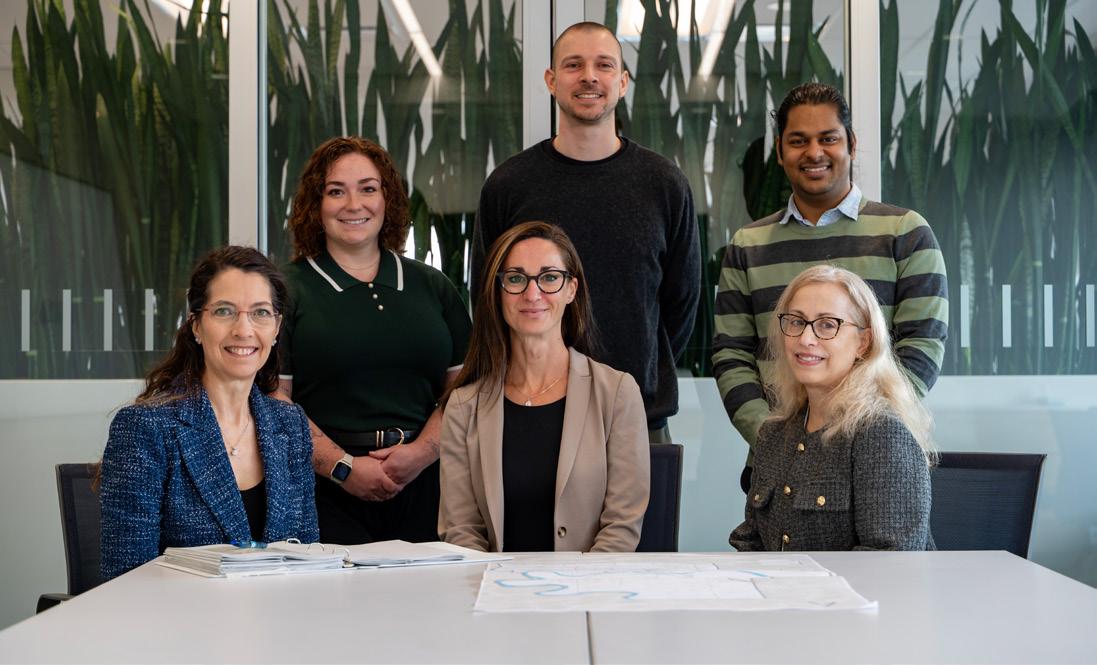
Associated Engineering is a proudly Canadian, employee-owned company. Our transportation planning & traffic engineering team provides customized strategic services and works with clients, communities, and stakeholders to develop sustainable and resilient transportation solutions. We are passionate about building vibrant, healthy, and resilient communities that support economic growth.
Together, we are shaping a better future.
PAID ADVERTISEMENT
CAPITAL REGIONAL DISTRICT
LEANNA RATHKELLY
TRANSPORTATION FOR A STRONG CANADA
In a country as vast as Canada, transportation is vital to connect people and move goods. The conference will feature sessions that explore how transportation contributes to nation-building through mobility, resilience and a stronger economy.

Join engineers, planners, contractors, and other transportation leaders at the 2026 TACConf.
October 4–7 | RBC Convention Centre Winnipeg
Across Canada, transportation professionals are designing and delivering the road, highway and urban transportation infrastructure that keeps communities connected and economies moving.
At the 2026 TACConf, you’ll connect with peers from across the sector to exchange ideas, explore innovations, and gain insights you can apply to your projects.
From mobility to infrastructure management to safety, sustainability, and emerging technologies, discover the solutions shaping the future of transportation.
300+ Presenters
Technical sessions and expert panels
80+ Exhibitors
Innovations in transportation technology and services
1,400+ Delegates
Transportation professionals from across Canada
Technical Tours
Explore Winnipeg infrastructure projects
Visit TACCONF.CA/ITE to learn more and register
October 4–7 | RBC Convention Centre Winnipeg Registration opens mid-April
Built in a Flash: Pedestrian Hybrid Signals in BC
By Trevor Demerse, BC Ministry of Transporatation & Transit
Intersections are distinctive, individual, and ever changing. For transportation professionals, the concept of the “intersection” represents more than a physical meeting of roads; it symbolizes the complex challenge of balancing safe and efficient movement of our communities. We know convergence brings complexity and challenge and, like never before, we are tasked with getting more from the places where paths cross. More safety. More connectivity. Addressing these challenges requires leveraging modern traffic control systems to optimize existing infrastructure and enhance the flow of people through their communities.
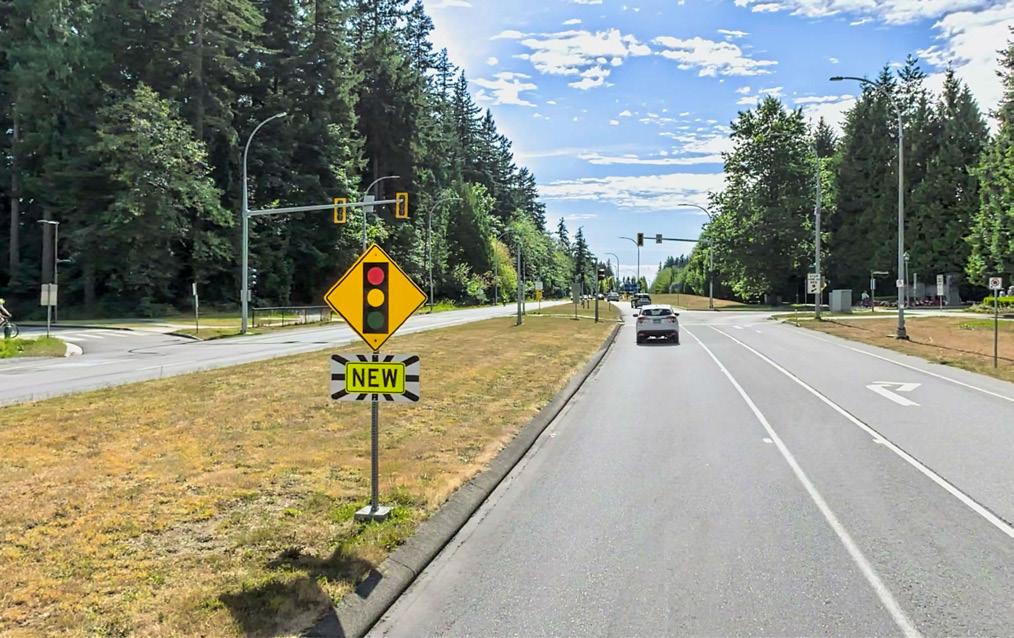
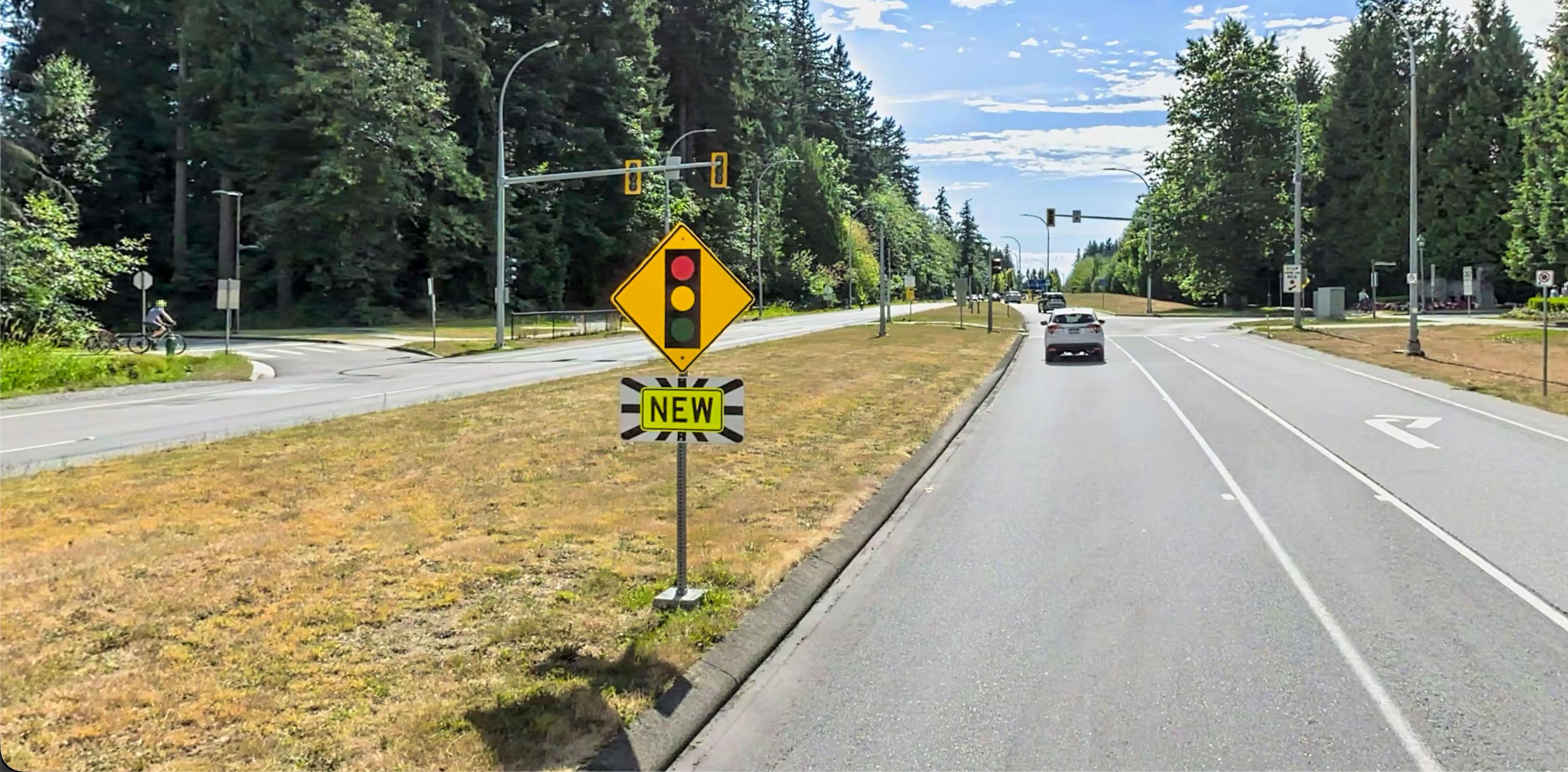
A primary example of this evolution is the BC Ministry of Transportation and Transit’s (BCMOTT) activation in October 2024 of an installation that would later become known as a Pedestrian Hybrid Signal. For those familiar with BC’s conventional Pedestrian Signal, this installation marked an evolution of that concept incorporating elements of the US Pedestrian Hybrid Beacon (also referred to as a HAWK signal) and the UK Pelican Crossings. The evolving capabilities of our modern traffic control systems allow us to do more with existing hardware and to be more strategic in regulating the flow of people regardless of how they are moving through their communities.
Pedestrian Hybrid Signal Operation
The operation of the Pedestrian Hybrid Signal begins the same as any other Pedestrian Signal in BC. These are half signal installations installed at intersections or mid block. In the absence of crossing demand the signals flash green on the main road while those approaching from a side street (where one exists) encounter a stop sign. I’m often asked why BC uses this flashing green. If you’ve ever travelled in areas where conventional half signals are common, you may have experienced the strange situation where a driver pulls out from a side street across your path while you
approach a solid green light. Behind the wheel or handlebars, it just feels wrong that a vehicle can emerge in front of you while a solid green is telling you you’re good to go. Since the 1960’s, BC has flashed the green light in these cases to tell you that the right of way is yours but to be aware both that:
• a vehicle may cross your path if they have an appropriate gap, and
• a vulnerable road user may activate a red light to cross more safely.
A solid green doesn’t communicate that first point, while a flashing yellow doesn’t communicate the second.
FIGURE 1. A comparison of signal output phases for Pedestrian Hybrid Beacon, Pelican, and BC Pedestrian Signals. Blue shading indicates that the phase is optional for this treatment.
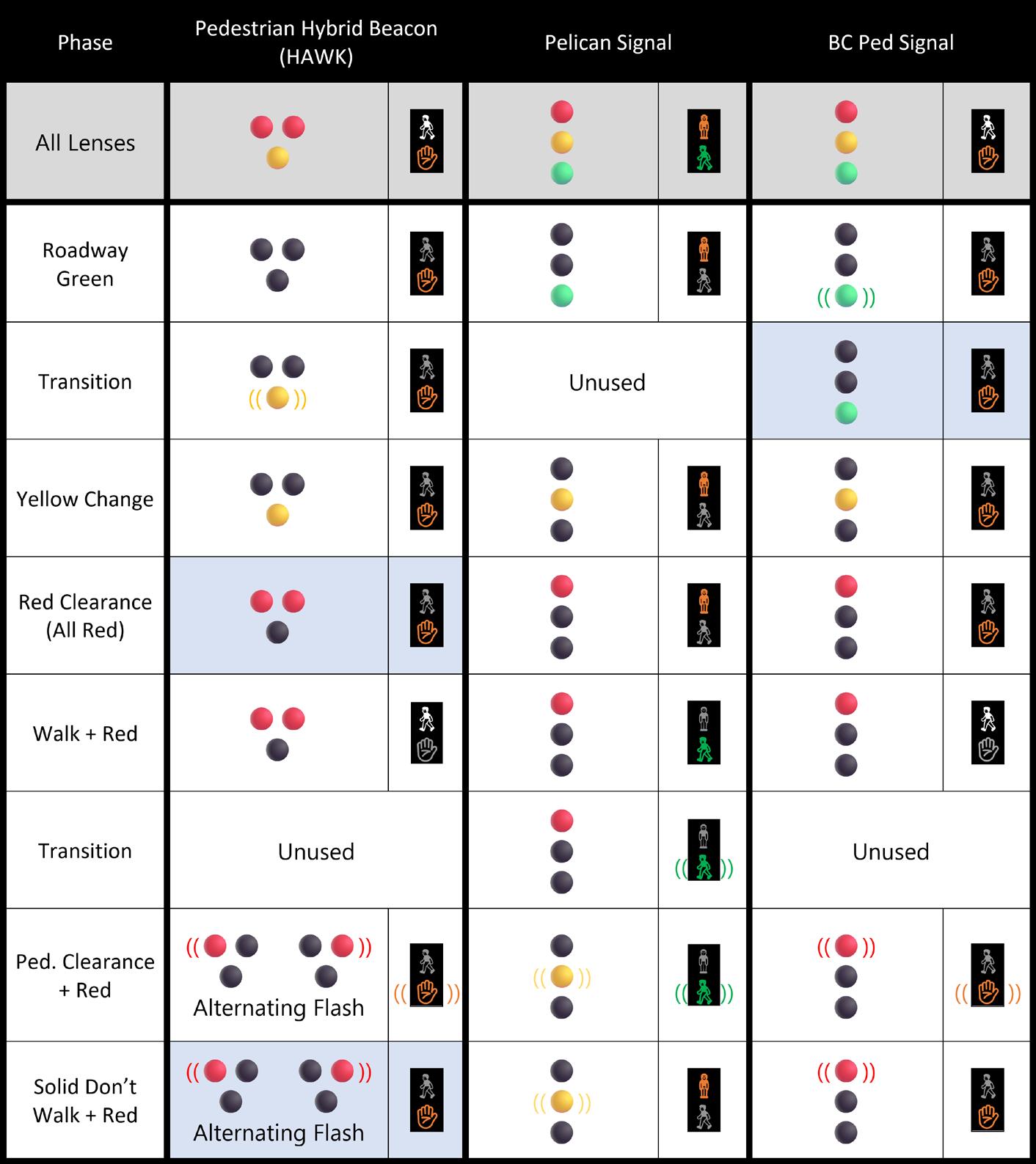
Like a normal Pedestrian Signal, vulnerable road users trigger the hybrid signal to spring into action. The sequence is as follows:
1. 5 second solid green to tell drivers the system is “waking up”
2. A typical yellow change and red clearance intervals
3. 7 second walk and a solid red light on the roadway
4. A Pedestrian Clearance interval consisting of a flashing don’t walk based on 1 m/s walk speed and a 3 second of steady don’t walk, with flashing red lights on the roadway. (This is the only difference from a conventional Pedestrian Signal.)
5. Flashing green on the roadway
Those familiar with the operation of a Pedestrian Hybrid Beacon (HAWK) can probably picture that system’s alternating red lamps. Locally, the side by side red lamps ran afoul of regulations so a standard signal arrangement was retained. However, the red lights are wired on separate channels to deliver an alternating flashing pattern which serves two purposes. This unique flashing pattern is highly conspicuous, and we wanted to ensure

that the signal did not look like it was in a fault condition. The design includes information signs that explain to drivers that they may proceed after stopping if the crosswalk is clear on flashing red.
Developing the Hybrid Signal
With the technical description out of the way, the question is what this solves and which niche it fills. The following factors and opportunities led to the Pedestrian Hybrid Signal’s development:
• BCMOTT’s experience is that 3 color signals see better stopping compliance compared to RRFBs or Special Crosswalks (overhead amber flashers) on arterial roads which often feature more lanes, higher speeds, and higher vehicle volumes.
• Sustained crossing activity at a conventional crosswalk can lead to substantial transit and vehicle delays during peak times, potentially leading to aggressive driving behaviours.
• Joggers and people rolling may only need a small fraction of the walk time to finish crossing leaving substantial “unused” walk and pedestrian clearance time some cycles.
• The BC regulatory structure does not prescribe overall signal operation.
• A legal ambiguity in BC means that at midblock locations, drivers are not ticketed for proceeding past a solid red light after stopping when it is clear to do so.
• BC has a policy requiring Advance Warning Flashers at all locations with 70km/h + posted speed.
FIGURE 2 . Information signs developed for the treatment and placed at the stop-bar (left) and on the signal arm (right)
• A hybrid device could serve walk phases more frequently reducing crossing delays.
These elements taken together created an opportunity for an intermediate tool in the hierarchy of crossing controls. The Traffic Engineering group developed an animated concept of the operation as early as 2023 in case a suitable location arose and seriously considered the risks of piloting such a new system. A multi discipline team reviewed how drivers would react to the flashing red and concluded that in suitable locations most drivers experiencing flashing red would already be stopped and even if confused were unlikely to proceed into an occupied crosswalk, and driver compliance with flashing red lights was satisfactory and generally superior to yield compliance at other types of crosswalks.
The Pilot Installation
Identifying the site
As the University of British Columbia (UBC) has grown, its Westbrook and Eastern neighborhoods—with their residential developments and community features such as an elementary school, centralized daycare facilities, and a network of nature trails connecting to Pacific Spirit Regional Park— have driven increasing demand for connections across West 16th Avenue.
Operated by BCMOTT on the UBC campus, West 16th Avenue is an arterial road with a wide grass median and either 1 or 2 lanes per direction. It serves as a major driving, cycling, and bus transit route connecting the campus to Vancouver.
Although conventional warrant analysis found that a Special Crosswalk adequately served an existing midblock crossing near Hampton Place, the community told us a
safer crossing was needed. The crossing was straightforward with a wide median and two short crosswalks. However, due to the crossing’s popularity, transit services were routinely caught in and delayed by a daily 1.5+ kilometer vehicle queue. The queuing was a factor in aggressive driver behaviour at the crossing and shortcutting through an adjacent information pullout.
Furthermore, the operational review found that only 40% of pedestrians actuated both crosswalks while another 28% actuated only one crossing, even after supplementary signage was installed. The Walk and Don’t Walk displays of a conventional Pedestrian Signal were expected to improve actuation rates by providing clear feedback for those crossing. Such a signal was studied but designers would either delay crossing users up to 120 seconds or increase vehicle queues to 3+ kilometers, spilling into the City of Vancouver’s network. Here, the hybrid treatment and its projected ability to provide enhanced safety with shorter delays had a suitable first location.
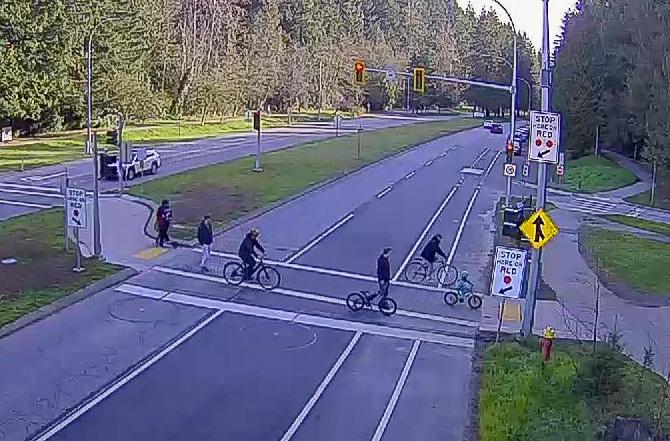
3. Site video recordings showing various multimodal users crossing during the Pedestrian Hybrid Signal’s flashing red phase
FIGURE
Initial Outcomes and Observations
On a rainy October day in 2024, the signal was activated and staff were on site to connect with the community. With many young users and a new requirement to wait for a walk display, the project team knew outreach was needed. Flyers were handed out to students and parents with guidelines on using a signalized crossing safely and parents were encouraged to have a conversation with their kids about road safety.
Since implementation, the Traffic Engineering group has continually monitored the signal including reviewing hundreds of hours of footage to assess how all users reacted and adapted to the new operation. Several notable

points were made during the three day observation period undertaken at one year post construction:
• 70% of users actuated both stages of the crosswalk, up from 40%. Observations suggest the remaining 30% walk against the signal due to the short crosswalks and many years of having an essentially delay free crossing.
• 62 vehicles were forced to yield on green to a pedestrian that walked into the roadway against a Don’t Walk signal.
• 2 vehicles were observed running the red light.
• 5 vehicles failed to yield to a pedestrian during the flashing red phase (none were considered a near miss)
• Over 80% of cyclists on West 16th Avenue disregarded the solid red signal including many instances when a pedestrian was present (several were considered near misses)
• The crossing is so popular that several times a week, the median has insufficient storage capacity filling with pedestrians, bikes, strollers, scooters, wagons, and all manner of other active transportation equipment.
• Vehicle queues no longer routinely form at the location, dramatically improving transit reliability and general mobility both at the site and at a set of downstream roundabouts.
Post-implementation Response
The project team has responded to the observations from this continual monitoring, including:

• Automated two-stage crosswalk walk progression is being implemented to
target the 30% of pedestrians crossing without the benefit of the light system, to reduce vulnerable road user delay, and to reduce or eliminate instances of the median exceeding storage capacity. Several methods were tested to achieve this Netherlands style “walk wave” including using the logic processor to place a delayed pedestrian call, to set and hold walk extension detectors on, and to omit the downstream pedestrian signal for a set period. The most successful and reliable method ended up being to hold the green signal on at the downstream crossing for a set period before releasing it to serve the walk light at just the right time.
• Signage Improvements are underway to improve both messaging to and sightlines between users.
• Additional Technologies including APS pushbuttons with locator tones are being installed to supplement existing audible speakers. Custom spoken messages such as “The south walk sign is on to cross 16th Avenue to the center median” will be added to give clearer information on the signal’s status. The pushbutton locations were improved shortly after opening based on community feedback.
• General operational monitoring continues, including investigating reports of shorter than anticipated walk times. Whenever new advanced or customized programming is used it’s critical to take all reports of unexpected behaviours seriously and to investigate each one thoroughly.
Before this next wave of site modifications goes in another review is currently underway and will be repeated post implementation.
The Future of the Pedestrian Hybrid Signal
Treatments must be carefully matched to their location and context. Further operational improvements build on what we’ve learned and will inform future installations should another suitable location arise. For now, we believe that the treatment will work best at locations with no left turns across the crosswalk, especially at midblock sites and on moderate or higher speed corridors where policy requires Advance Warning Flashers.
The main lesson learned involves the two stage operation. The upcoming directional pedestrian progression, including serving walk displays in only a single direction to ensure vulnerable road users are not waiting in a median unnecessarily is the next step for us. That lesson is already being applied at 3 additional conventional expressway intersections in Greater Victoria, host region of the 2026 ITE Canada Annual Conference. I can’t wait to share more about our work improving the pedestrian experience at signalized intersections at the conference.
AUTHOR

Trevor Demerse, P.Eng. is President of the ITE Greater Vancouver Section and is a Senior Traffic Operations Engineer with the BC Ministry of Transportation and Transit. He has over a decade of experience in the transportation industry and was named Young Professional of the Year by ITE Greater Vancouver in 2024.
Jason Dahl P.Eng.
Employment: Toronto Transit Commission (TTC), Senior Transportation Planner.
Education: University of Windsor, Masters of Applied Science, Civil Engineering (Transportation), 2011. University of Windsor, Bachelor of Applied Science, Civil Engineering (Honours, with Co op), 2009.
First transportation job: LEA Consulting Ltd, Transportation Analyst, 2012.
City of Residence: Toronto, Ontario
Hometown: Windsor, Ontario
Family: Elysia (partner), Samuel (son, 5), Kairi (daughter, 2) & Dennis (greyhound, retired)
Hobbies: Music!! Attending concerts, songwriting/producing, playing bass. Roller coasters. Cycling. Pro wrestling.
What roles have you taken on as a member of ITE: ITE Toronto Executive (2017 2022), ITE Toronto President (2021), ITE Canada Board of Directors (2022, 2023), ITE Toronto Awards Committee Chair (acting, since 2023)
ITE INVOLVEMENT
When did you first attend an ITE event?
I attended the joint ITE Toronto, ITE Hamilton & ITE Southwest Ontario Student Presentation Competition in 2010. My grandmother and I drove up to Toronto Metropolitan University for this event, and I was fortunate to participate in and win the graduate category. Little did I know that, sixteen years later, I’d still be interacting with many of the people I met that night. Fast forward to now, I always encourage my students to participate in this event each year (the cash award doesn’t hurt either ;))
What is your ITE involvement?
I’ve been volunteering for ITE Toronto Section in some capacity since 2017 (technically since 2015, for those who remember SimCap, ITE Toronto’s short lived technical committee), helping run events or doing admin behind the scenes. I was part of the team which shrunk the Executive down to five, and therefore the time commitment to participate, in order to attract more candidates. We also introduced a number of committees and non executive roles in order to allow

members to participate with variable time commitments.
What do you value most about your ITE membership?
Attending ITE events and networking are often highlights of the year for me. The community in general is pretty social and friendly, so it’s always nice to catch up when I can.
GETTING TO KNOW YOU
What attracted you to the transportation profession?
It wasn’t until I returned for grad school that I decided to pursue a career in the industry and THAT decision was largely in response to the post 2008 job market; I figured if I was going to be broke, might as well be a grad student.
What are some of your favourite albums of the past couple years?
Bad Nerves Still Nervous; Deafheaven Lonely People With Power; Jeff Rosenstock SKA DREAM;
Metz Atlas Vending; The Armed ULTRAPOP; Turnstile Glow On
What is your favourite mode of transportation?
Who doesn’t love a good monorail!? As a child obsessed with trains and things that move, I will always feel nostalgic for the Disney monorail (and the Busch Gardens suspended one, RIP). That aside, my mode of choice most days is my bicycle. My workday commute involves using a cargo bike to bring my son to school, and then switching to the subway to get to work.
PROFESSIONAL ACHIEVEMENTS & PERSPECTIVES
What is one aspect of your work that you particularly enjoy?
I enjoy that my work includes a good mix of fast paced quick items, and some longer range slow burn items. The variety of work allows me to better match up my to do list with whatever mood I’m in that moment. I also find it incredibly empowering being around my highly dedicated and enthusiastic colleagues, it has made the transition to the new role very enjoyable.
Who has had the greatest influence on your career?
Dr. Chris Lee was the professor who taught all of those transportation electives I took during undergrad, and he was also my advisor throughout my master’s program. Were it not for those years, I likely wouldn’t have gotten into transportation engineering. His leadership style and my work styles were very compatible, and it was an absolute pleasure to work on that bit of research for those years. I’d also like to give an extra special shout out to Elysia. Thank you for helping me navigate all of our career changes, big life changes, and all of the day to day minutia which often goes over my head. You’re way better at this than I am, it’s truly been a pleasure to spend these years with you.
Projecting yourself into the future, from an end of career perspective, what will you hope to have accomplished?
I hope that the people I interact with, be it colleagues or the general public, generally walk
away with a positive impression of me and the work I’ve brought forward. I hope that I am able to pass on my experience and knowledge to the next cohort of engineers hoping to make a difference in our cities.
If you could change one thing about the transportation practice, what would it be?
At times there is a lack of appetite to experiment. Increasingly, transportation projects receive a lot of scrutiny from public and political spheres, which creates an aura of risk avoidance as part of the planning and design process, a tendency to overengineer solutions, and endless iteration. I wish there was more of an open and honest discourse around project expectations, project scoping, before and after studies, and not letting perfect be the enemy of good. Perhaps instead, we should really lean into pilot projects, build it and see what happens.
As you reflect on your career, do you have any lessons learned or challenges that you would like to share with emerging transportation professionals?
The success of a project is not a reflection of you as a professional nor as a person. It is very easy to embody this industry, wear it on your sleeve, and die on every hill but you shouldn’t. Don’t get me wrong if you’re new to the field, channel that energy and go in head first. But for me, personally, the transition to parenthood has made me reflect on how much of myself I give to my day job, because I still have people depending on me in the evening.
How would you describe your job to someone you just met at a party?
“How can we get the bus to fit?” In the short term, we determine detour routes through neighbourhoods and within terminals; medium term, we review development applications to ensure transit stop facilities are up to standard, and that WheelTrans can access the site; and in the long term we interface with municipalities and other agencies on larger planning studies and transit expansion projects. At the end of the day, our goal is to ensure that passengers can easily get to and from fast, reliable and accessible transit.
Olivia Wiper
Education: B. Eng – Civil Engineering & Society (Co op), Minor in Sustainability from McMaster University (2020–2026)
Upcoming Educational Endeavors: EIT Urban Mobility Programme in Sustainable Urban Mobility Transitions: M. Sc – Urban Mobility from Aalto University and M. Sc – Building, Architecture & Planning from Eindhoven University of Technology (2026–2028)
First transportation job: Highways & Roads Engineering Co op with HDR (2022)
City of Residence: Hamilton, ON
Hometown: Newmarket, ON
Hobbies: Reading, crocheting, learning Languages (French, Finnish, Mandarin)
What roles have you taken on as a member of ITE:
• ITE McMaster Student Chapter: Member (2021–2022), VP Media & Marketing (2022–2023), Co President (2023–2024), VP Outreach (2024–2026), SLS Director (2024); ITE Hamilton Section: Student Liaison (2025–2026)
ITE INVOLVEMENT
When did you first attend an ITE event?
The very first ITE event I attended was with ITE McMaster in March of 2022. The event was virtual as McMaster was adhering to COVID guidelines, and the speaker was Dr Lili Du from the University of Florida. Dr Du spoke about her research on connected and autonomous vehicles, which at that point in my undergrad, was not a topic I had heard much about. I recall learning a lot of new words and concepts related to autonomous and connected vehicles, and I was grateful to my friend Joseph D’Angelo for convincing me to begin attending ITE McMaster events as a general member.
GETTING TO KNOW YOU
What attracted you to the transportation profession?
When I was in highschool, I thought I wanted to be a food scientist. Then I ended up in engineering because I was interested in doing

work in the nuclear energy industry. But in first year, I was very bad at theoretical physics, so I decided to choose a branch of engineering that was more concrete, civil! Once in civil, I discovered that I could specialise in Transportation through the WTS Women in Transportation Scholarship and through the ITE McMaster chapter at my school. From that point forward I was hooked!
Knowing what I know now about the field of Transportation engineering and planning, I continue to be interested in the field because it combines engineering with human behaviour and societal considerations in a way that other branches cannot. As an engineering and society student, I am intrigued by the human side of engineering, and I think the field of transportation is the best way to explore this. I also think that improving our transportation systems is one of the best ways to make sustainable change at a large scale. So, I hope to be a part of the solution that gets people
out of their cars and into more sustainable modes of mobility!
What is the last book that you read or are currently reading?
The Strength of The Few by James Islington. It is the second book in the Hierarchy series, and I highly recommend it to anyone who likes sci fi and fantasy. James Islington is incredible at world building, and I always feel so immersed in the world’s he creates in his stories.
Once my exams are over, I will begin reading The Overstory by Richard Powers. This is a Pulitzer Prize winner that provides insight into global warming’s effects on the planet from an interesting perspective. This story is told through the fictional lives of individuals and their families over hundreds of years as they experience an unfolding environmental catastrophe.
What is your favourite mode of transportation?
I love cycling! Whenever I have the ability to do so, I bike to campus using the SOBI bikeshare in Hamilton. When I travel, I find that the best way to see a city is by bike since you are still aware of everything around you, but you can move faster and go further than a pedestrian. In the future, I hope to live in a walkable neighbourhood where I can safely bike to work every day.
EARLY CAREER & PERSPECTIVES
What is one aspect of transportation work or study that you’ve enjoyed the most so far?
During the fourth year of my undergrad, I took a course called Sustainable Cities with Dr Léa Ravensbergen, which ended up being one of my favourite courses at Mac. In this course we dove deep into what sustainability means, and what that looks like in the built environment. As my final project for this course, I got to complete an independent study regarding the feasibility of walking for the
elderly in Tillsonburg, ON. This study allowed me to improve my research and GIS skills, while also providing me with an open ended opportunity to research how mobility can be transformed in small rural towns in Ontario. However, most importantly, I think this study helped me realise that although I was specialising in transportation engineering in my undergrad, I also had an interest for urban planning and building communities that shift mode share towards active and public modes of transportation.
What advice would you give to students or recent graduates who are just getting involved in ITE or the transportation profession?
For me personally, my experience in undergrad became so much more exciting and worthwhile after I became involved with clubs and teams at McMaster. It was through clubs and teams that I was able to realise what branch of civil engineering I wanted to pursue, and by attending ITE events I was able to make connections with people in the transportation industry. Connections made through club events, field trips, and industry nights are an invaluable way to learn more about the industry and secure co ops in fields that you are actually interested in. Therefore, the advice I would give to a younger student or recent graduate is to get involved and form a community of students, professionals, professors, and mentors who can guide you onto the path you want to pursue.


ITE Southern Alberta launched 2026 with a strong focus on connection, practical learning, and supporting emerging professionals. From student centered events to in depth technical discussions and relaxed networking opportunities, the first quarter of the year showcased the strength and diversity of Southern Alberta’s transportation community. Below is a recap of our Spring 2026 events.
February – Industry–Student Mixer
The year kicked off with our annual Industry–Student Mixer, bringing together transportation professionals and students at the University of Calgary’s Last Defence Lounge. This well attended event created an informal space for students to connect with practitioners from across consulting, public agencies, and academia.
Organized in collaboration with the University of Calgary Student Chapter of ITE, the mixer emphasized mentorship, early career advice, and building confidence in professional networking. Conversations ranged from career pathways and co op experiences to emerging trends shaping the transportation industry, reinforcing the importance of strong
connections between students and professionals early in their careers.
February Luncheon – 26 Avenue SW Bike Lanes
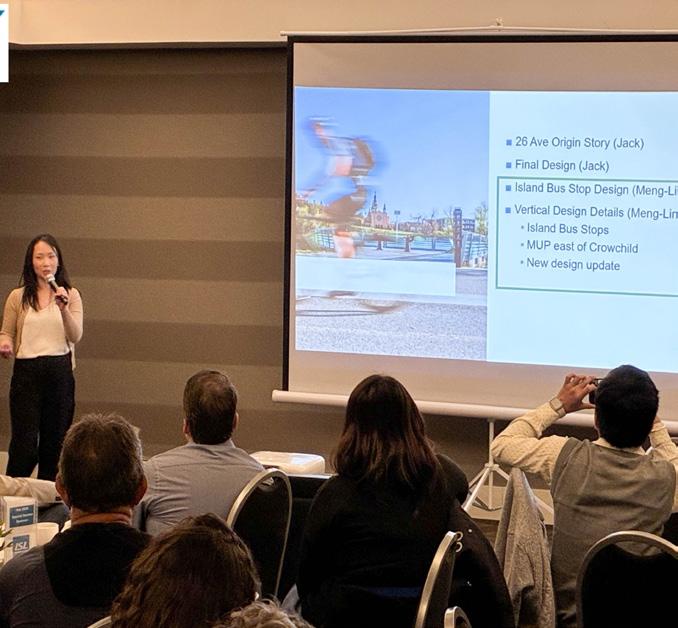
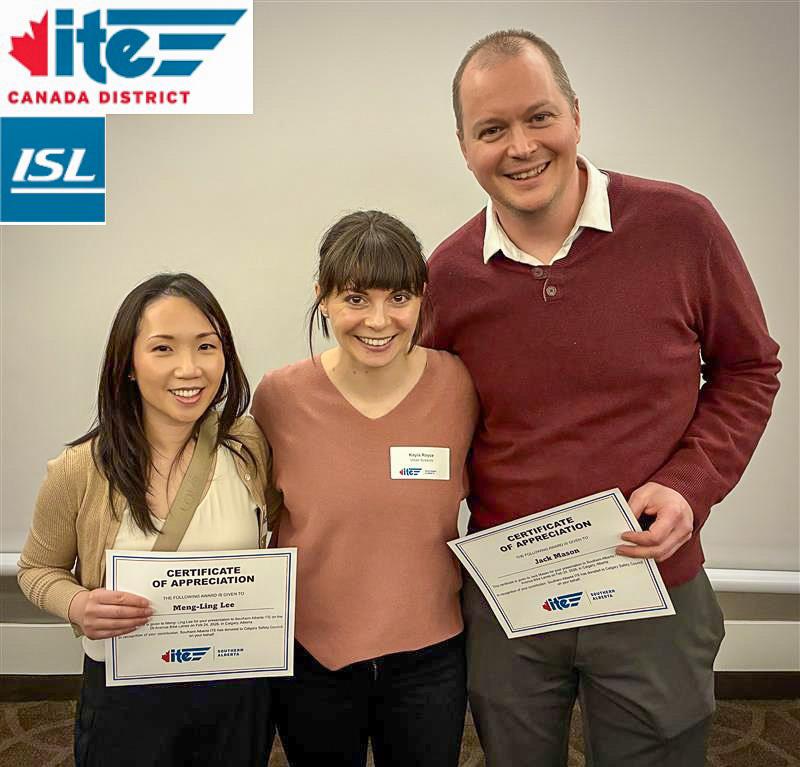
Later in February, members gathered for a technical luncheon focused on the 26 Avenue SW Active Transportation upgrades in Calgary. Jack Mason and Meng‑Ling Lee of ISL presented an in depth look at the project’s design approach, which replaces painted bike lanes with protected cycling infrastructure and introduces a new multi use pathway segment.
A key highlight of the presentation was Calgary’s first half height island platform bus stops, showcasing how accessibility, operations, drainage, grades, and urban context were integrated into a complex corridor design. The session prompted strong discussion around trade offs, constructability, and how innovative design solutions can be successfully applied within constrained rights of way.
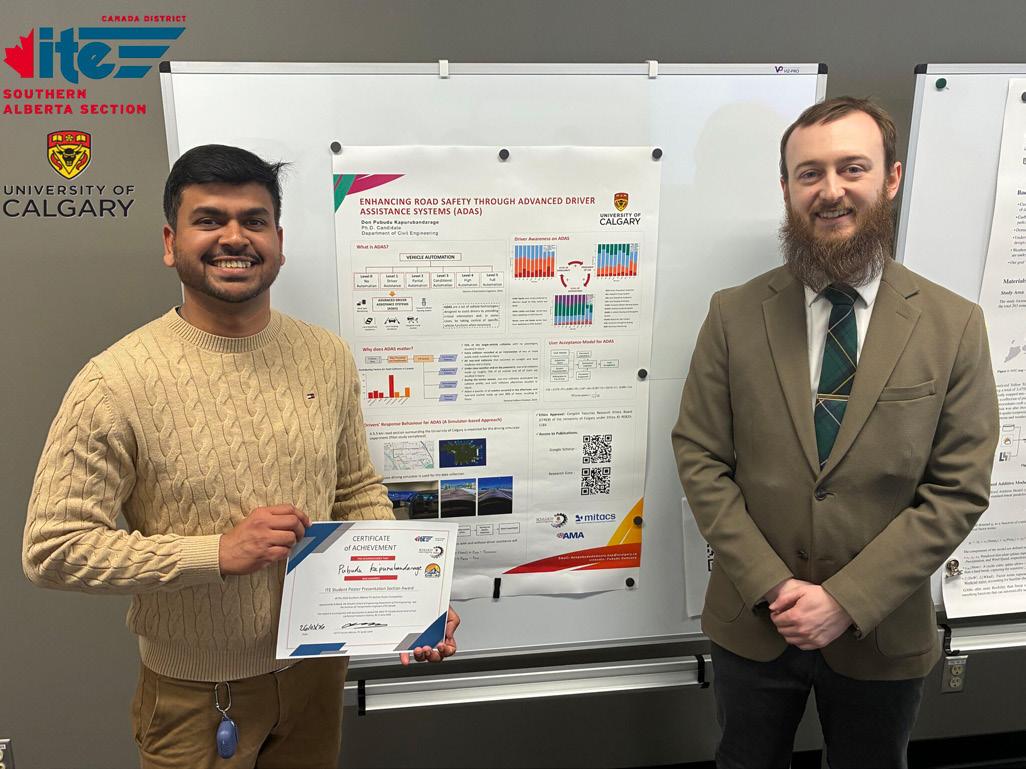
March – Student Presentation Competition
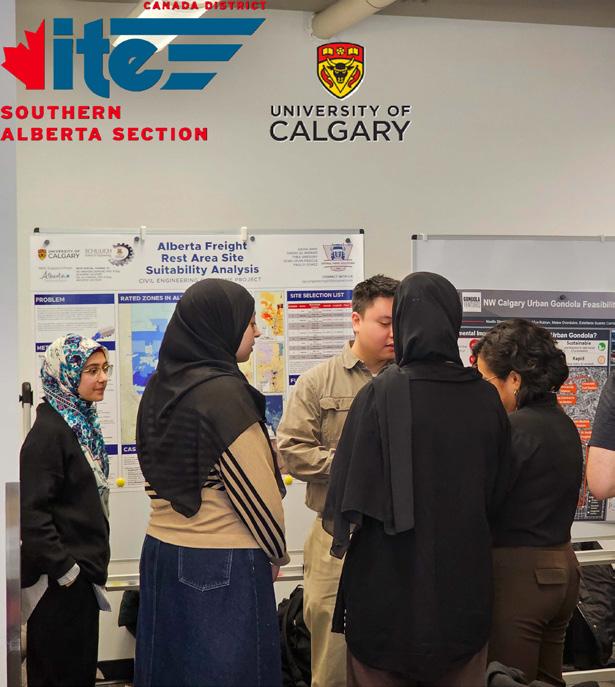
In March, ITE Southern Alberta hosted its Student Presentation Competition at the
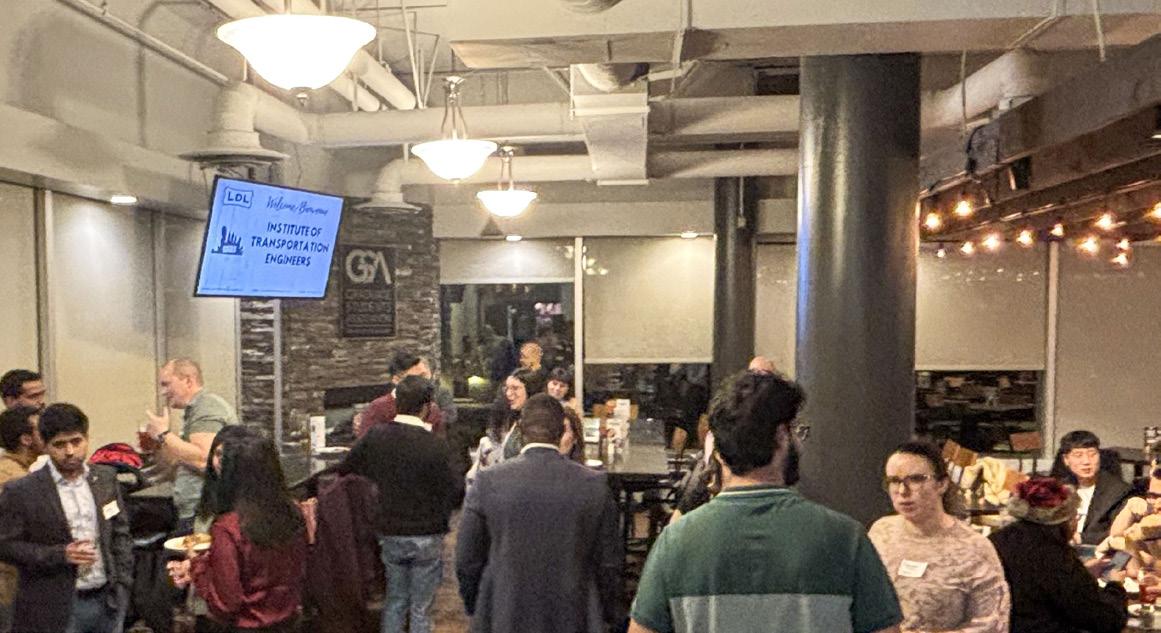


University of Calgary Downtown Campus in partnership with the ITE University of Calgary Student Chapter.
Students presented posters and research on a wide range of transportation topics, engaging directly with industry professionals during the lunch hour event. Attendees participated in voting for the best student presentation, reinforcing the competition’s collaborative and supportive atmosphere.
Beyond recognizing technical excellence, the event highlighted ITE Southern Alberta’s ongoing commitment to student development, knowledge exchange, and national engagement, with the local winner advancing for nomination at the ITE Canada level.
April – Spring Pub Social
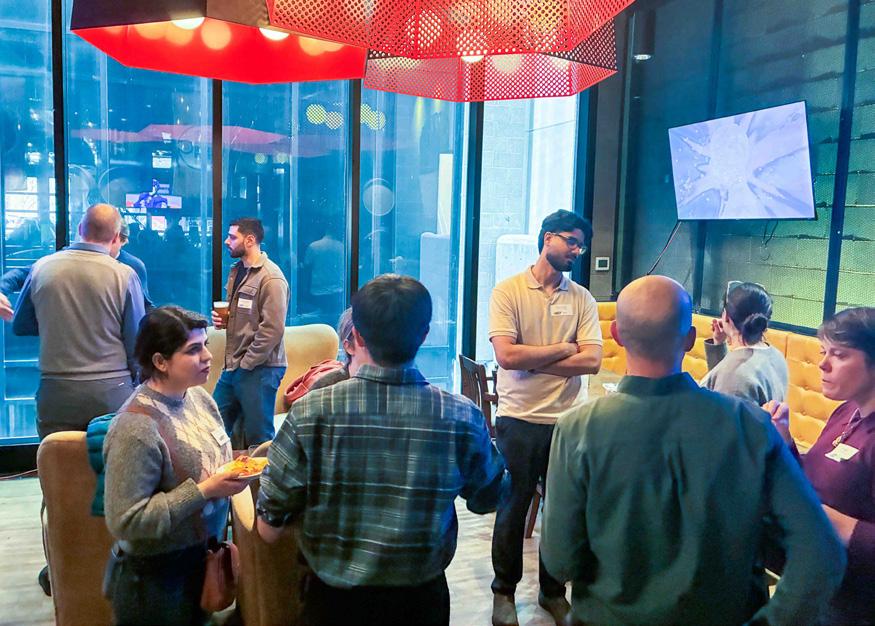
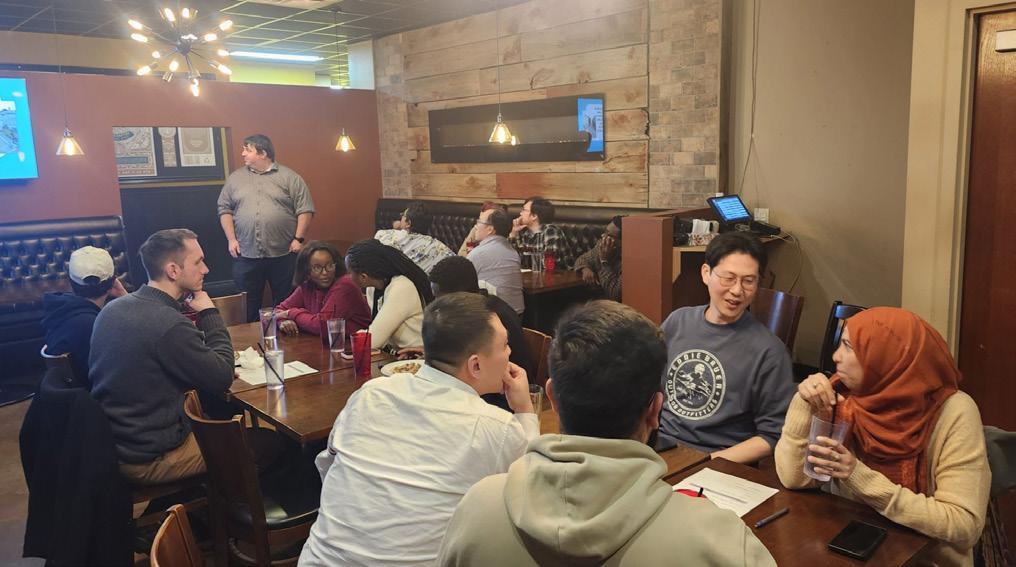
The Spring season wrapped up with the ITE Southern Alberta Pub Social, a relaxed networking event held at Trolley 5 Brewpub in Calgary. Designed as an inclusive, low pressure setting, the pub social welcomed students, new professionals, and long time members alike.
With informal conversations, shared appetizers, and a lively atmosphere, the event
reinforced the value of relationship building across disciplines and career stages. These socials continue to play an important role in creating space for mentorship, collaboration, and future leadership to grow organically.
Looking Ahead
Looking ahead to the rest of 2026, ITE
Southern Alberta is continuing to build a diverse and engaging program. Upcoming technical luncheons will maintain our focus on practical, locally relevant transportation topics, while a planned field tour will offer members the chance to experience transportation infrastructure and operations firsthand. We are also developing a new trivia-style event, combining friendly competition with learning and networking.

This spring, ITE Saskatchewan has been focusing on our students! We hosted a Pizza with the Transportation Pros student mixer at the University of Saskatchewan and helped the University of Regina Student Chapter run a traffic bowl style competition. Finally, we hosted our annual Student Presentation Competition, highlighted below.
Student Presentation Competition
The Saskatchewan Section proudly hosted its 4th annual Student Presentation Competition, showcasing the scholarly prowess of students from Engineering and Planning departments across the province.
Jessica Lam from the University of Saskatchewan took the 1st place prize with her compelling presentation investigating the impacts of long term transit closures on subjective well being and travel choice. The study offered valuable insights for planners and policymakers; and the findings can inform mitigation of adverse effects for future projects.
A special thank you to all our student presenters:
• Esraa Othman, University of Saskatchewan Car Usage for Possible 15 Minute Active Transport Trips: Understanding Patterns in Saskatoon
• Jessica Lam, University of Saskatchewan Shifting feelings: Changes in subjective well being during long term transit disruption
• Olha Khrebtishceva, University of Saskatchewan Evolving Patterns of Deprivation, Diversity, and Mode Share in Saskatoon’s Urban Core and Housing Accelerator Fund Areas

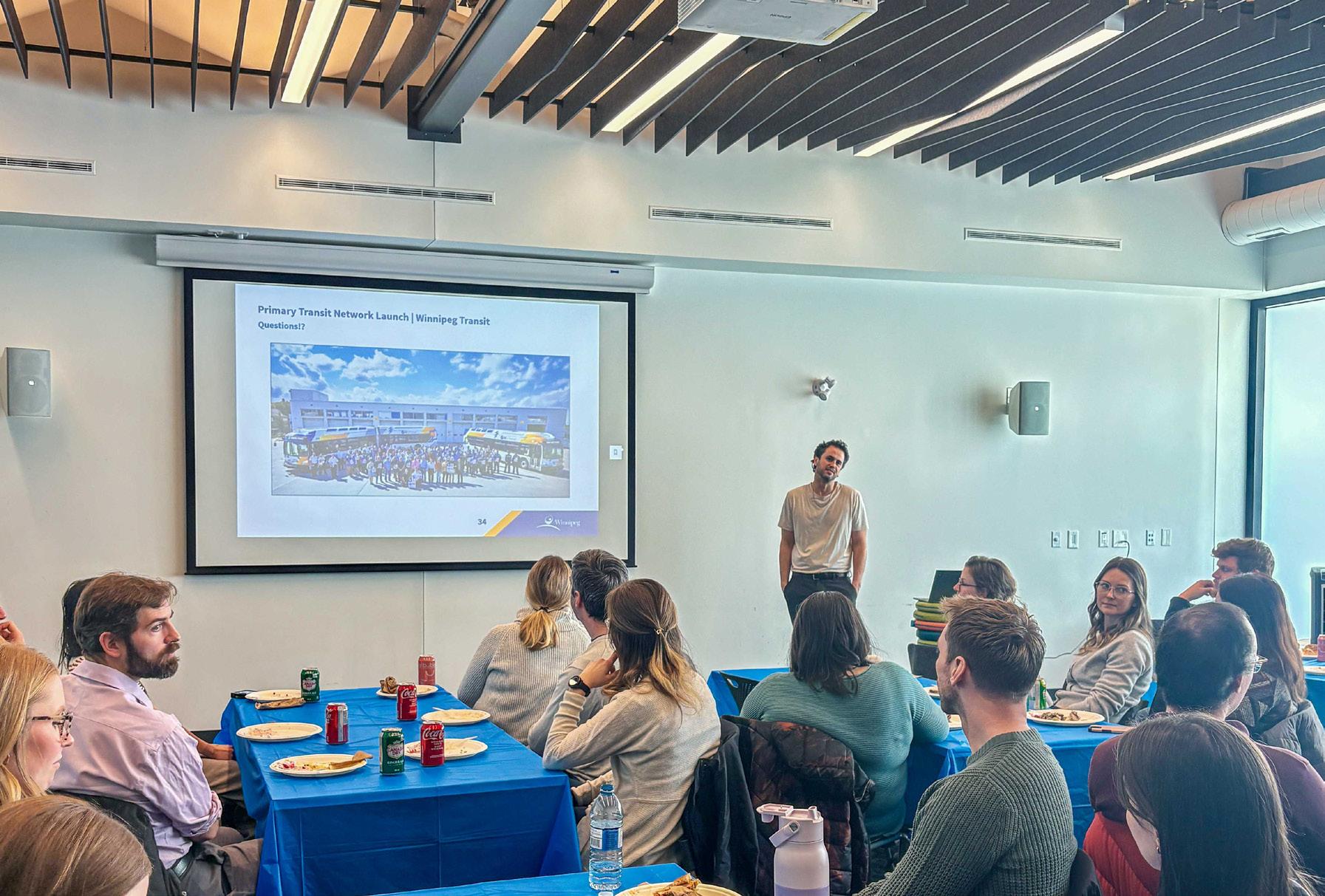
Members of ITE Manitoba joined in a networking event held by the University of Manitoba Student Chapter on January 14 at the Kings Head Pub. This event gave students a valuable chance to meet transportation professionals from both the public and private sectors, explore co op opportunities, and gain a better understanding of the transportation industry in Winnipeg and across the province.
March Luncheon on the Winnipeg Transit Network
The ITE Manitoba Section’s luncheon series for 2026 began strong with a presentation in March from Adam Budowski on the recent
changes to the entire Winnipeg Transit network. In his presentation, Adam highlighted key lessons learned from delivering such a complex and ambitious project. Adam also explained the changes that have been implemented since launch, in order to respond to passenger feedback.
The Manitoba Section will be continuing our luncheon series in April with a presentation from Steve Wood with the City of Winnipeg Traffic Signals. Steve will talk about the history and progress of the leading pedestrian interval (LPI) program in Winnipeg, and how this pedestrian focused approach will help them improve road safety in Winnipeg!

The ITE Southwestern Ontario Section has been active in the first part of 2026, with multiple events taking place in March.
Joint Student Presentation
Competition (with ITE Hamilton and ITE Toronto Sections)
On March 18, three graduate students and three undergraduate students presented at the 18th Annual Joint ITE Canada Section Student Presentation Competition in Waterloo, Ontario. In Southern Ontario, the competition rotates between the ITE Hamilton, ITE Southwestern Ontario, and ITE Toronto Sections, and the 2026 event was hosted by the ITE Southwestern Ontario Section.
Thank you to the following student presenters:
Graduate Category
• Timotéo Frelau (University of Toronto) — Traffic Noise Contribution by Vehicle Class: An Urban Case Study in Toronto Using Non-Negative Matrix Factorization and XGBoost Methods
• Shuke Xie (University of Waterloo) — Does Risk Dissipate or Escalate? Understanding Sequential Conflict Risk Dynamics at Urban Intersections
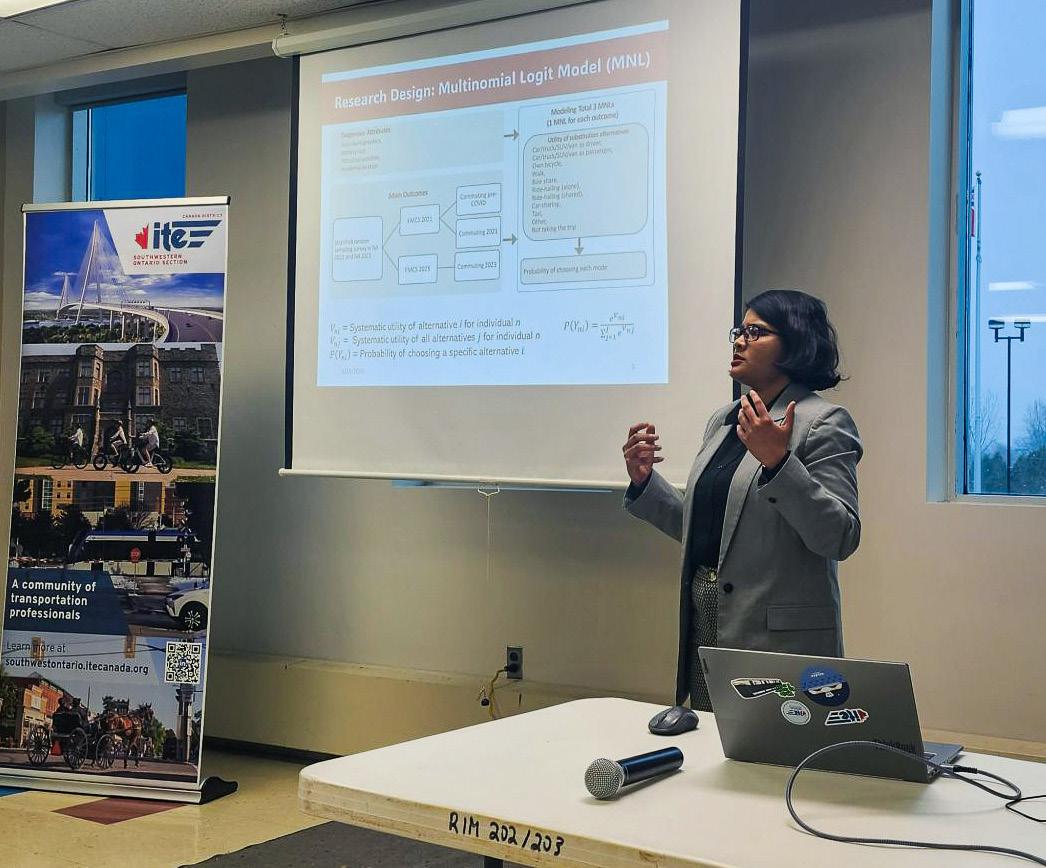
• Sadia Chowdhury (McMaster University) — If Not Transit, Then What? Shifts in Mode Substitution Behavior for Commuting Trips Before, During, and After COVID-19
Undergraduate Category
• William Pham (University of Waterloo) — A Network Approach to Bus Rapid Transit
• Varsan Jeyakkumar (University of Toronto) Analysis of Transit Signal Priority in Toronto
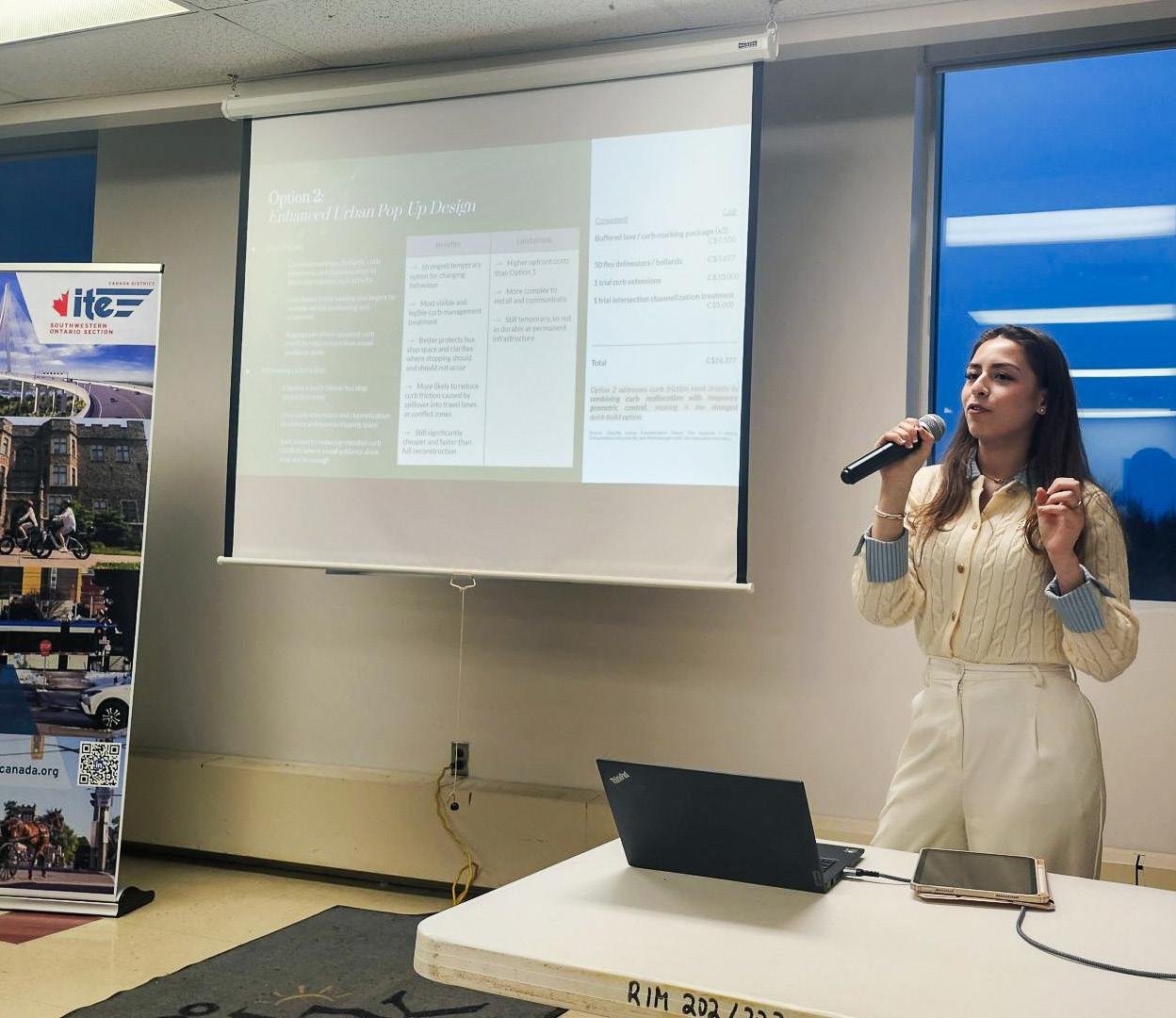
• Sarah Shami (Western University) — The Curb as a Bottleneck Near Western Campus: Quantifying Delivery and Ride-Hailing Impacts on Bus Reliability and Bike-Lane Safety
A sincere thank you to the judges, volunteers, and attendees who helped make this event a success.
Transportation Trivia Nights in Waterloo and Windsor
The Section also hosted two Transportation Trivia Nights, one in Waterloo on March 24 and one in Windsor on March 25, bringing together students and professionals from across the region for friendly competition and great conversation.
A special thank you to Ian Lindley, Treasurer of the ITE Southwestern Ontario Section, for organizing and leading both events and ensuring their success. Strong participation from the University of Waterloo and University of Windsor ITE Student Chapters, along with local transportation professionals, made both evenings a success.
Looking Ahead
The ITE Southwestern Ontario Section is working on a number of initiatives and events for the remainder of the year. Members and partners are encouraged to follow the Section on LinkedIn to stay informed.
The Section is also looking ahead to hosting the ITE Canada Annual Conference in 2028, which will bring the national conference to London, Ontario for the first time.

The ITE Hamilton Section has kicked off 2026 with renewed leadership and an expanded program of activities. Michael Kong has joined the executive team as Technical Liaison, strengthening the Section’s technical capacity and industry engagement.
At the February 10th Executive Committee meeting, members reviewed the 2026 work plan and developed a framework to enhance both networking and professional learning opportunities. In parallel, a K–12 outreach program is currently in development, aimed at engaging local schools and promoting careers in transportation. Further details on program activities and timelines will be shared in the coming months.
On the student front, Hamilton co hosted the annual Joint ITE Canada Student Presentation Competition alongside the Toronto and Southwestern Ontario Sections on March 18th in Waterloo. Graduate winner Timotéo Frelau and undergraduate winner William Pham were recognized for their outstanding presentations.
The planned April 1st Electric Vehicle Planning speaker event, featuring Micha Gutmanis, has been postponed to a later date in 2026. Looking ahead, the Section is organizing a mid May transit themed event, along with a series of summer social events and technical tours.
The Section will continue its strong partnership with the McMaster ITE Student Chapter by providing student presentation opportunities at Section events and supporting McMaster students’ participation in the Traffic Bowl at the ITE Annual Conference in Victoria
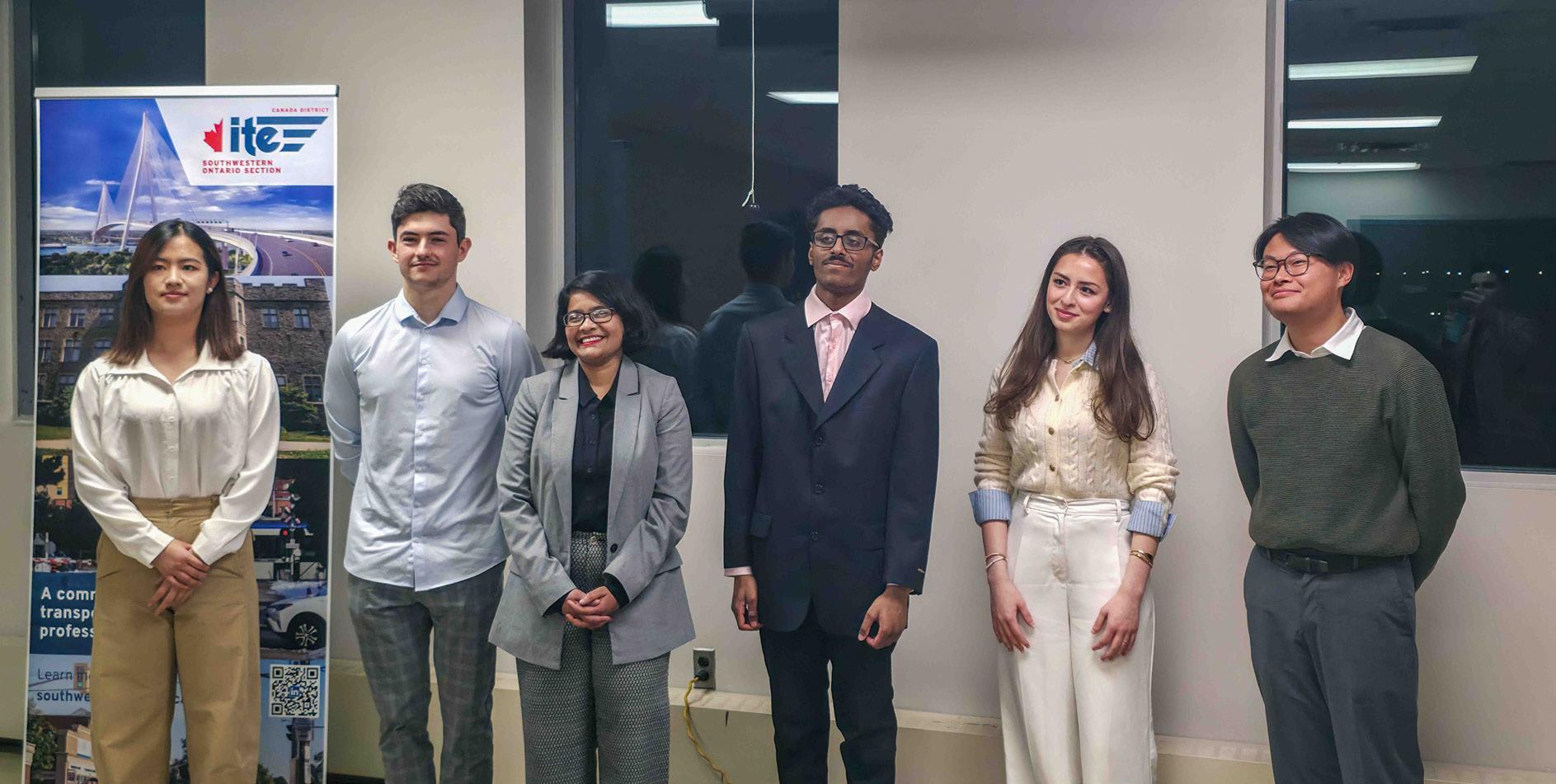
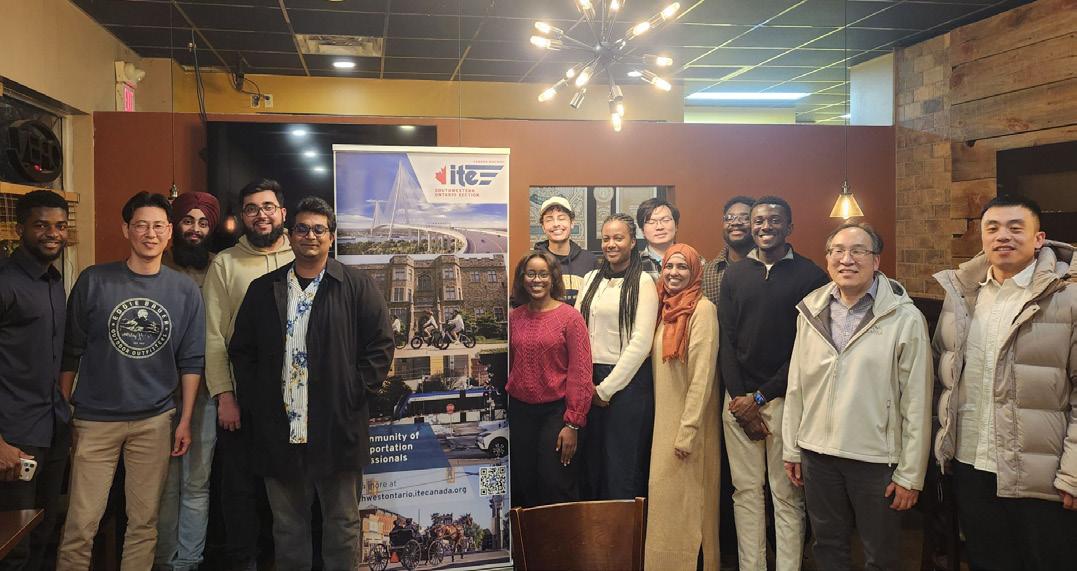
Joint ITE Student Competition Participants: From left to right : Shuke Xie, Timoteo Frelau, Sadia Chowdhury, Varsan Jeyakkumar, Sarah Shami, William Pham.

ITE Québec has had a dynamic start to the year, marked by two engaging and well attended events that brought together professionals from across the transportation community.
Webinar – March 19, 2026
On March 19, 2026, the section hosted its first webinar, featuring Bartek Komorowski from the City of Montréal. His presentation on Island Platform Bus Stops explored emerging trends, innovative technologies, and key lessons learned from projects across Canada, the United States, and internationally. The webinar drew strong interest, with over 75 participants joining the discussion.
Networking Event – April 16, 2026
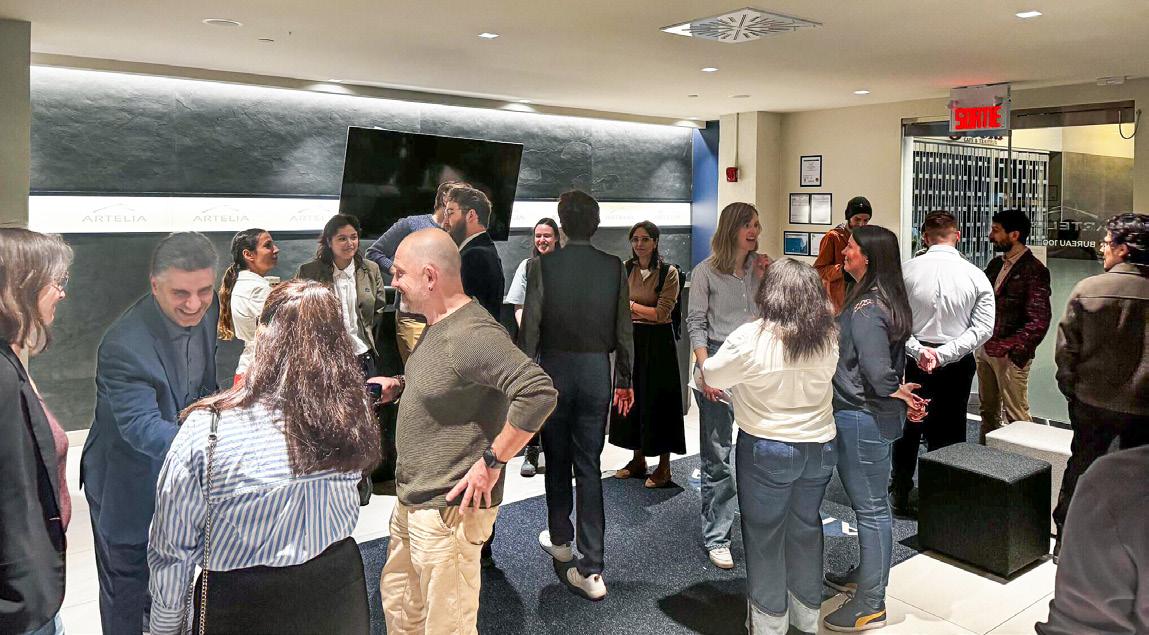
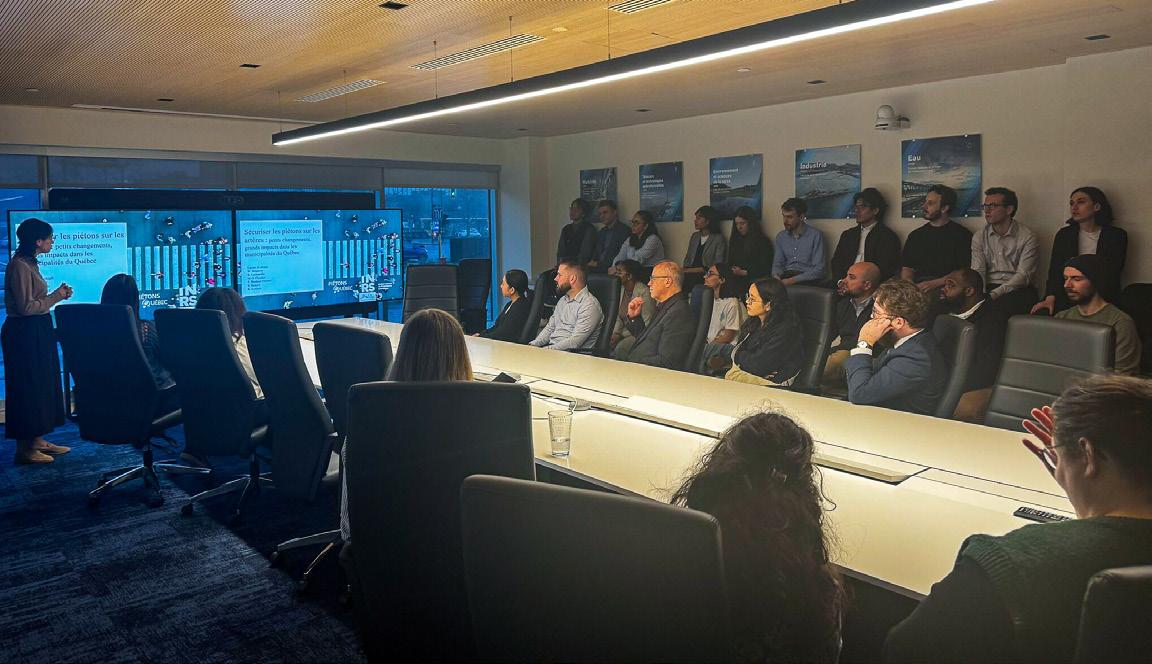
Building on this momentum, ITE Québec held a networking evening on April 16, 2026, sponsored by Artelia. Centered on Vision Zero, the event featured four insightful presentations delivered by an all women panel of speakers, highlighting critical topics in road safety and mobility. The evening concluded with a networking session that encouraged meaningful exchanges among the more than 50 attendees.
New Committee Members
ITE Québec is also pleased to welcome its new committee, bringing together a diverse group of
professionals committed to advancing the section’s mission:
• President: Alexandre Nolet, CIMA+
• Vice-President & Section Director on ITE Canada Board: Antoine Gerson, Momentum
• Secretary: Emily Anderson, GHD
• Treasurer: Carole Taillée, Artelia
• Events Lead: Karla Gamboa, Artelia
• Communications Lead: Élizabeth Caza, CIMA+
• Student Representative: Éloi Corbeil, Concordia University / CIMA+

The ITE Atlantic Canada Section hosted its Fall Technical Session and Annual General Meeting (AGM) on November 13th in Fredericton, NB. The event featured engaging presentations from several members who shared insights into the exciting work they are currently undertaking across the region.
During the AGM, the ITE Atlantic Executive welcomed the 2026 Section Executive:
• President: Jill DeMerchant
• Vice President: Bri Benson
• Secretary/Treasurer: David Copp
• Past President: Hannah McBride
Toronto Metropolitan University (TMU)
The Section was also pleased to welcome our new Section Director Garrett Donaher, who was officially sworn in at the ITE Canada District AGM in December.
Looking ahead, planning is underway for the Spring Technical Session, which will be hosted at Dalhousie University in Halifax, NS, in May 2026. We look forward to reconnecting with familiar faces and welcoming new members to the event.
From February to April, TMU ITE had a busy and engaging term marked by collaboration, student involvement, and professional development. The chapter supported the ITE Awareness Event at TMU, featuring ITE International President Gordon Meth, collaborated with UT ITE on a joint Research Lightning Forum for graduate students, and partnered in the Bentley OpenRoads workshop for TMU and UofT students. TMU ITE also took part in hosting the Aalborg University student visit, which included student presentations, research discussions, and a valuable opportunity for academic exchange.
STUDENT CHAPTER NEWS
University of British Colombia
STUDENT CHAPTER NEWS
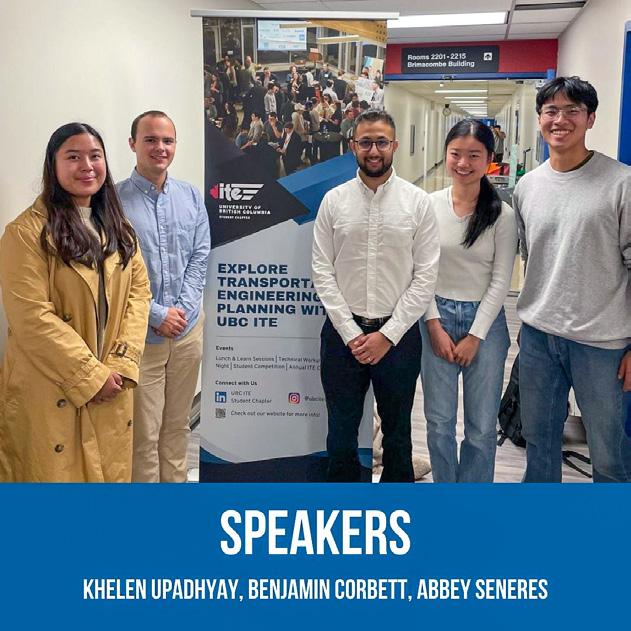
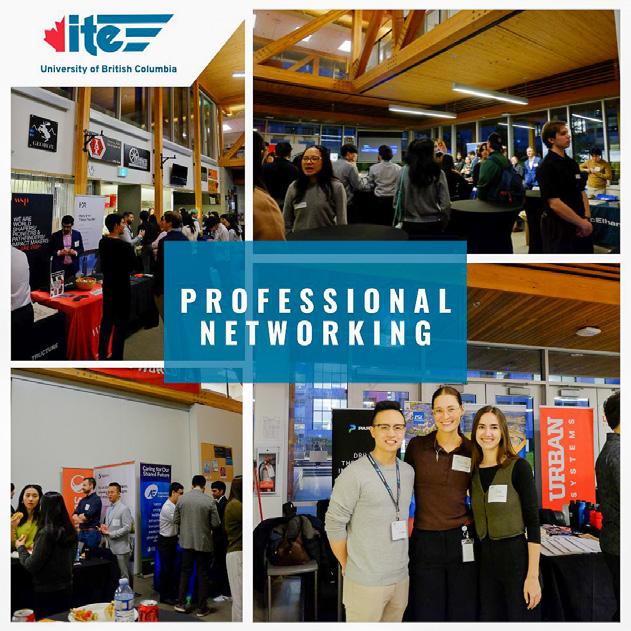
The UBC ITE Student Chapter has had a highly active year, focusing on industry connections, technical skill development, and community outreach.
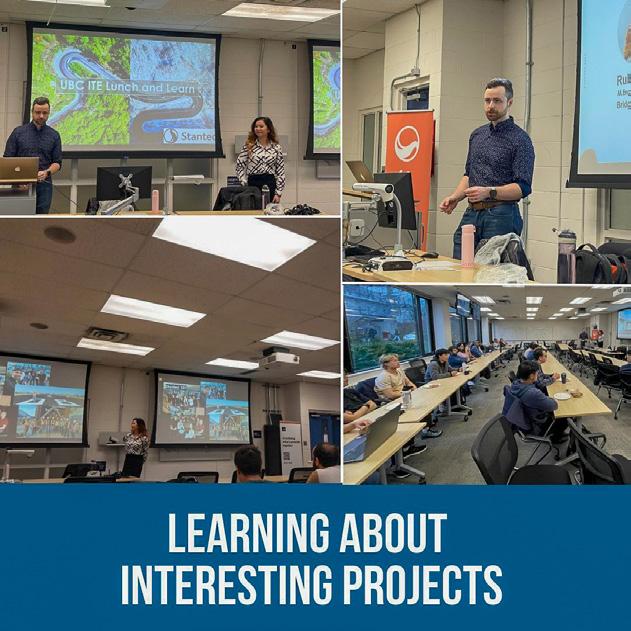
We kicked off the academic year with an engaging “Careers in Transportation” panel discussion with past UBC ITE members who are now working in the industry to share their experiences in September, 2025. Building on that momentum, we hosted a series of 8 Lunch and Learn sessions throughout the year with our Gold Sponsors. From each Lunch and Learn session, our sponsors came and gave a presentation on the technical projects they do and introduced the transportation engineering and planning methodologies on an application perspective. These sessions covered a wide range of technical topics and helped students gain valuable industry insights while exploring potential career paths.
Over the year, our team also actively engaged in technical talks to expand our practical understanding of regional transit development. Our members attended a presentation from TransLink team on the R6 RapidBus design hosted by GVITE in November 2025. Additionally, to learn more about the road
design projects update, our members attended an in person technical tour of the Guildford Way Transportation Improvements at the City of Coquitlam in September 2025, held by GVITE.
Our flagship networking event, the annual Industry Night, where we brought 14 sponsors and 120+ attendees together, bridging the gap between academia and the professional world by connecting students with transportation professionals. The industry night was held by the alternation between sponsor presentations and structured networking sessions, concluding some informal interview session and a raffle draw.
On the community front, we were proud to continue our K 12 STEM outreach with our “Journey into Transportation” initiative. In March 2026, we hosted an event at McMath Secondary to introduce 12th grade students to the field of transportation. Along with the presentation, we also delivered a mini competition on transportation improvements around us and prepared prizes to the winners, making students realize the importance and the fun part in transportation studies.
British Columbia Institute of Technology
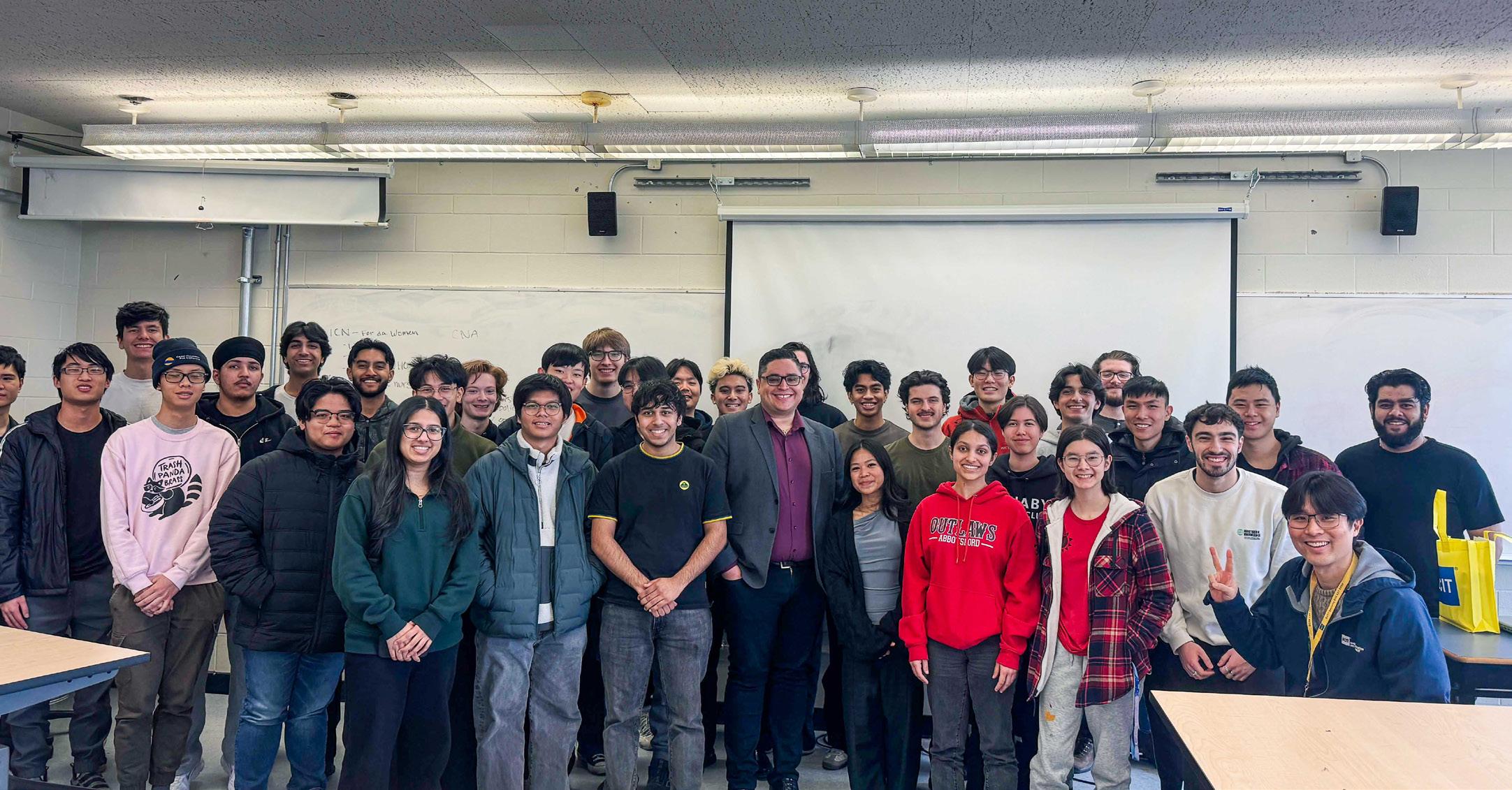
British Columbia Institute of Technology ITE had a very successful first year as a brand new student chapter! We stayed busy in 2026 by hosting six Lunch and Learn events throughout the term. These sessions brought in experts from the industry to talk about their work and give students a real look at what it’s like to work in transportation. We are grateful to all the presenters for making time to connect with our chapter.
We are so proud of everything we started this year. We are already looking forward to the 2026 2027 school year and are excited to host even more events and guest speakers!
University of Alberta
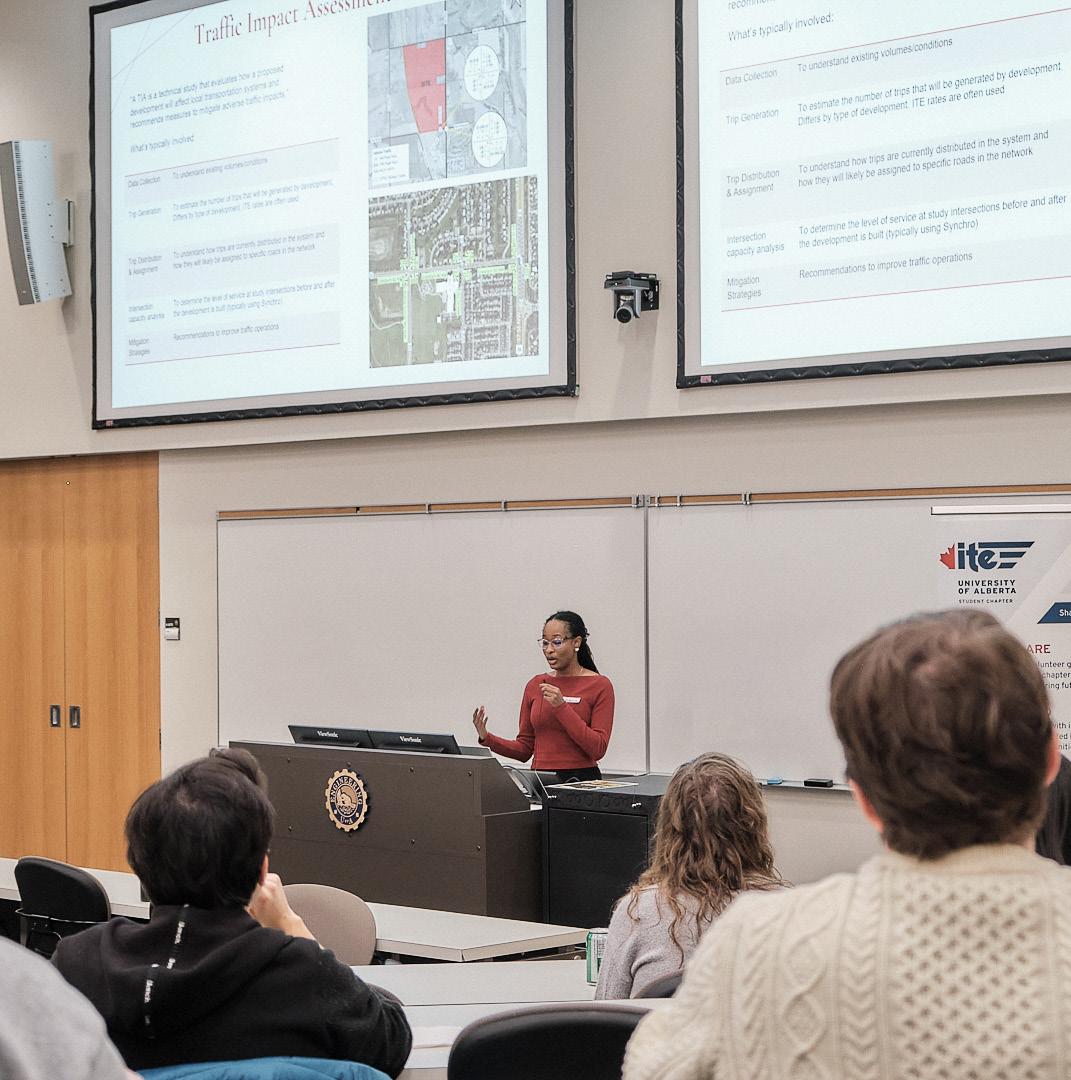
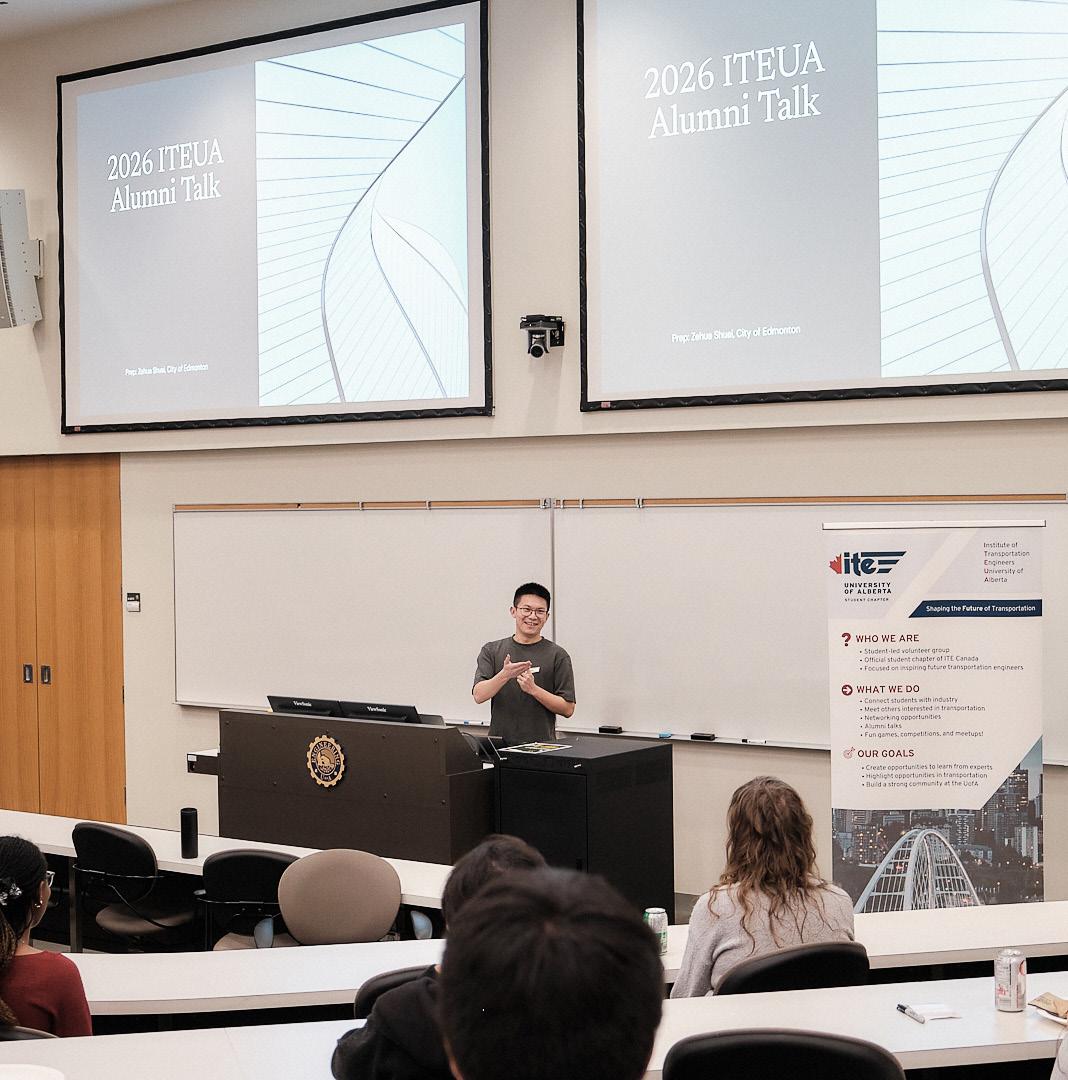
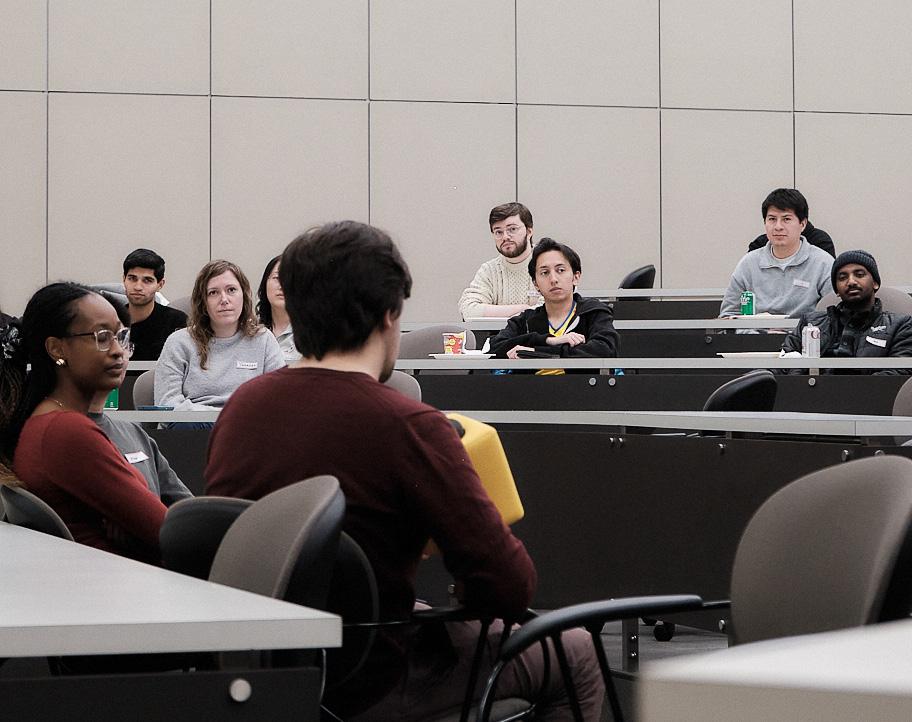
ITEUA hosted three events during the winter academic semester! Our first event was an Alumni Talk, where three recently graduated University of Alberta alumni discussed their early career journeys, while offering valuable advice and job hunting tips. The event was well attended by both graduate and undergraduate students, connecting them with real world engineers and showing them what a career in transportation engineering can look like. Check out the photos below!
Our second event was the ITEUA presentation competition, where undergraduate and graduate students presented their transportation related research. We are pleased to announce Fedor Kuznetsov and his presentation on the new urban growth area of Bremmner in Strathcona County as the winner. Finally, ITEUA hosted a study break event at the start of April with snacks, games, and activities, helping students recharge before the start of the exam season.
University of Calgary
UCITE had a highly active winter semester, highlighted by several successful events and strong student engagement. On February 3, we hosted our annual Industry–Student Mixer in collaboration with the Civil Engineering Undergraduate Society and SAITE at the Last Defence Lounge. The event was well attended by both students and industry professionals, offering valuable opportunities for networking, learning, and meaningful connections.
On March 23, UCITE held its annual Traffic Bowl Qualifier. Faculty advisor Jacob Lamb led six rounds of competitive play involving both graduate and undergraduate students. Four participants were selected to represent UCITE at the national Traffic Bowl competition during the 2026 CITE Conference in Victoria.
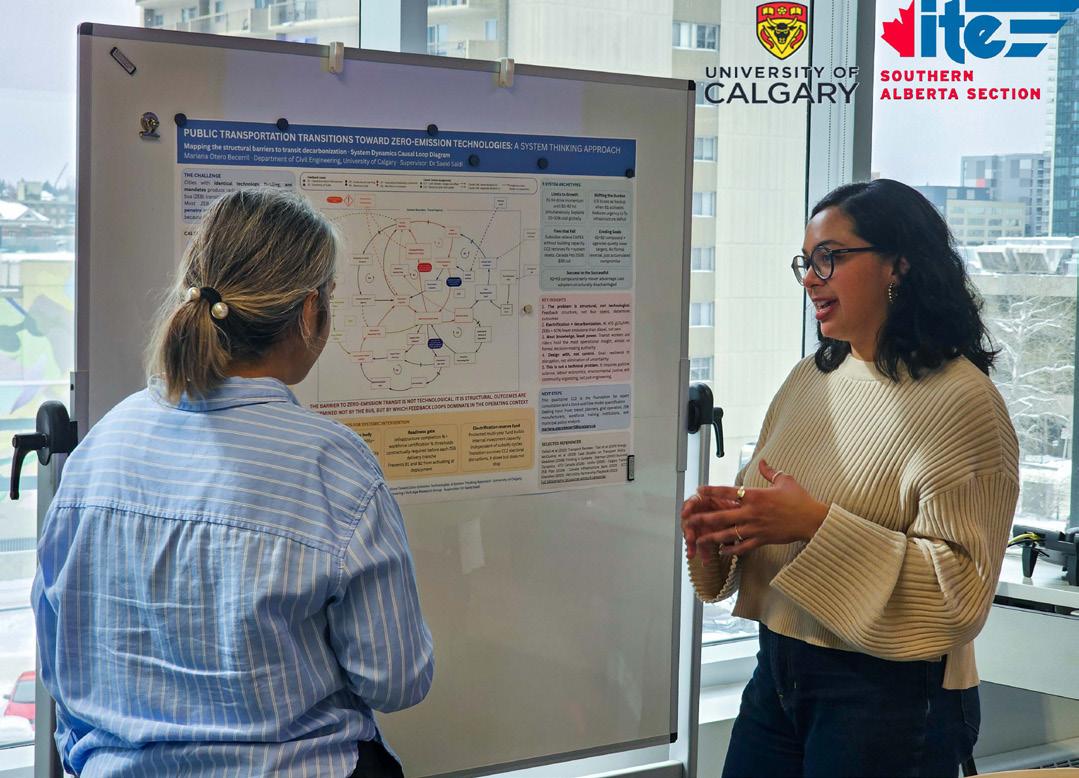
That same week, nine UCITE students took part in SAITE’s student poster competition. Their work showcased a range of graduate research and undergraduate capstone projects, evaluated on practicality, evidence, communication, and design thinking.
Looking ahead, the UCITE team remains actively engaged through the spring and summer terms. In addition to preparing Traffic Bowl competitors, several students will attend the 2026 CITE Student Leadership Summit and Annual Conference in Victoria. UCITE is also relaunching its Transportation Industry Talks series, aimed at providing graduate students with greater exposure to real world transportation engineering practice. STUDENT CHAPTER NEWS
McMaster University
Complete Networks with Mobycon
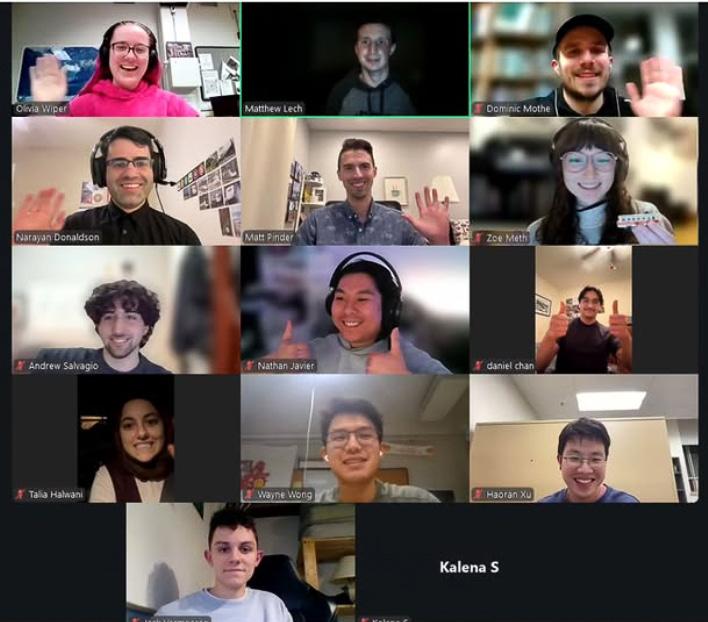
McMaster’s chapter started the spring off strong with a virtual presentation from Matt Pinder and Narayan Donaldson of Mobycon titled ‘Complete Networks: Managing Conflict at the Network Level’ on February 24th. Attendees learned about a network planning method based on the Sustainable Safety program of the Netherlands and left with an understanding of the importance of minimising conflicts when designing transportation networks and land use. The presentation featured real world case studies and interactive examples to allow for great audience participation. Special thanks to Matt Pinder and Narayan Donaldson for sharing their expertise.
Delivering Transit in Ontario
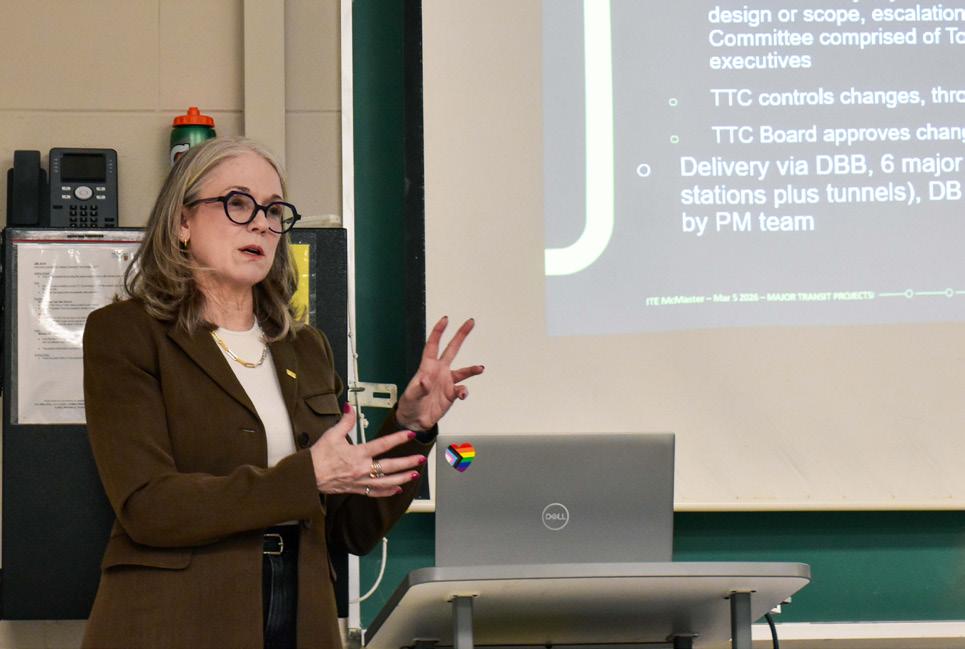
On March 5th, McMaster hosted a presentation by Joanna Kervin of AECOM. With experience in delivering the TTC Line 1 subway extension and the Eglinton Crosstown, she is a recognised industry leader. Attendees got a unique behind the scenes look at what it takes to work with various stakeholders to deliver transit in Ontario and across the world, including case studies from Toronto. A huge thank you to Joanna Kervin for taking the time to share her knowledge and experience!
Waterloo Central Railway Tour
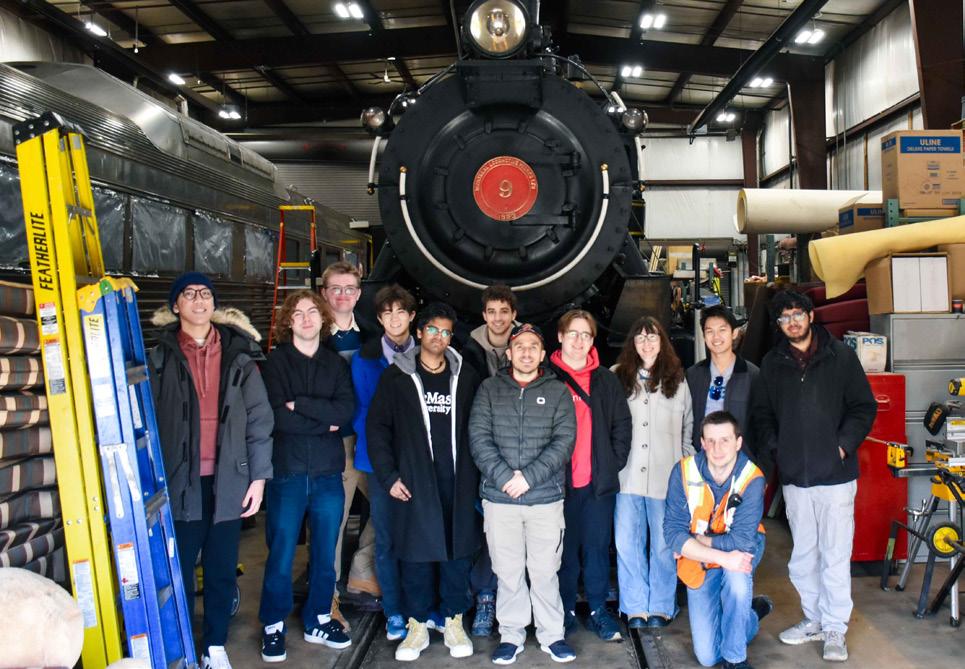
McMaster’s chapter had the opportunity to tour the Waterloo Central Railway restoration and maintenance facility on March 25th along with some new friends from the University of Waterloo chapter. The tour offered a behind the scenes look at railway operations, maintenance, and historic preservation. Attendees got to see the famous steam locomotive #9 and take a scenic ride on historic mid 20th century rail equipment through Woolwich to Elmira. It was a wonderful trip, all thanks to the WCR staff and volunteers!
University of Manitoba
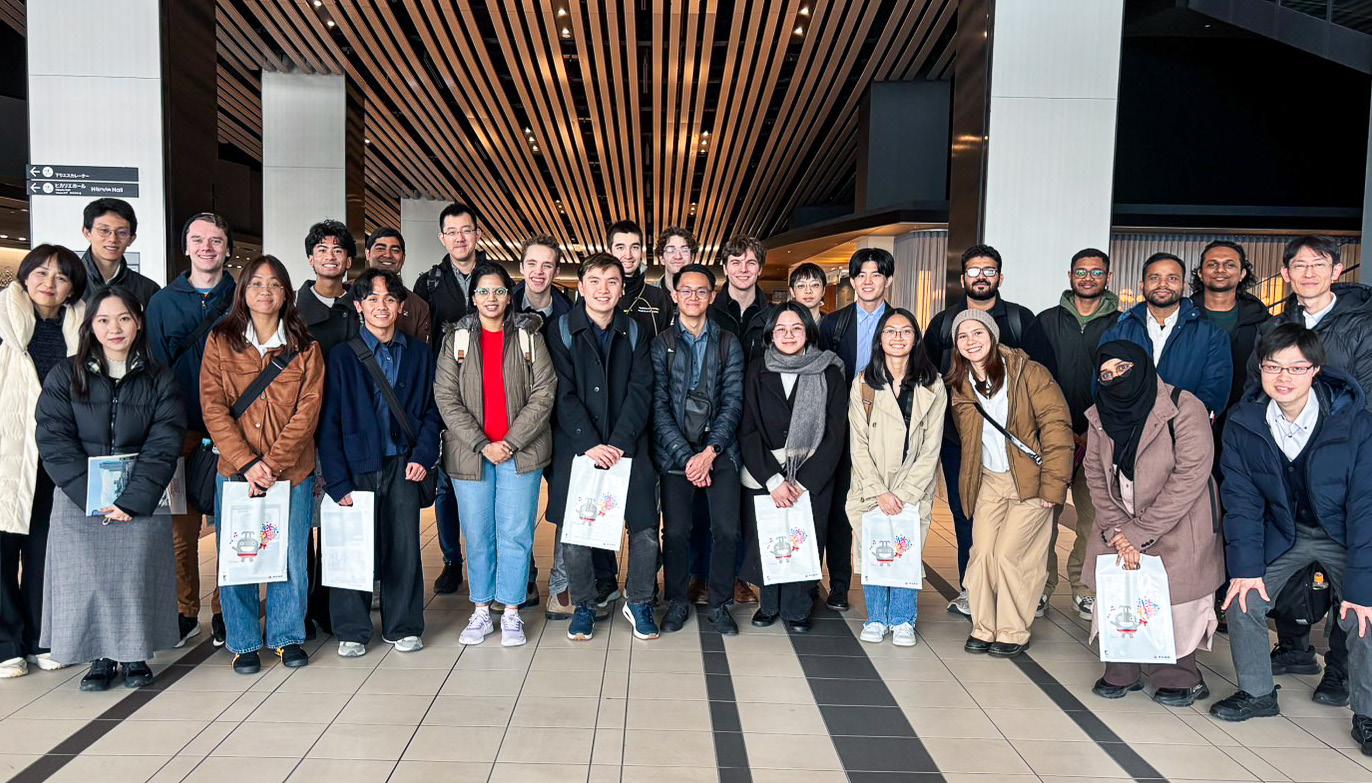
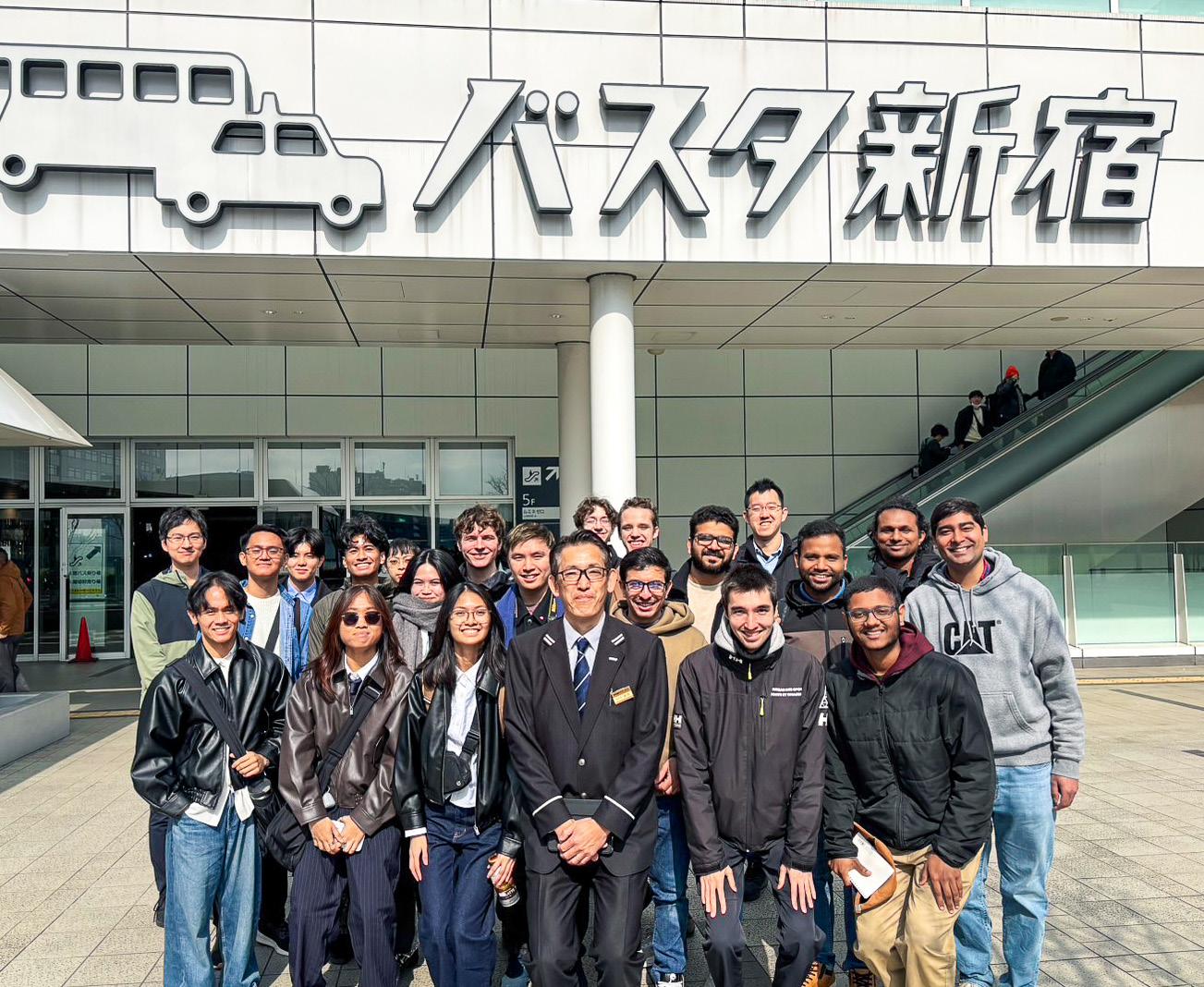
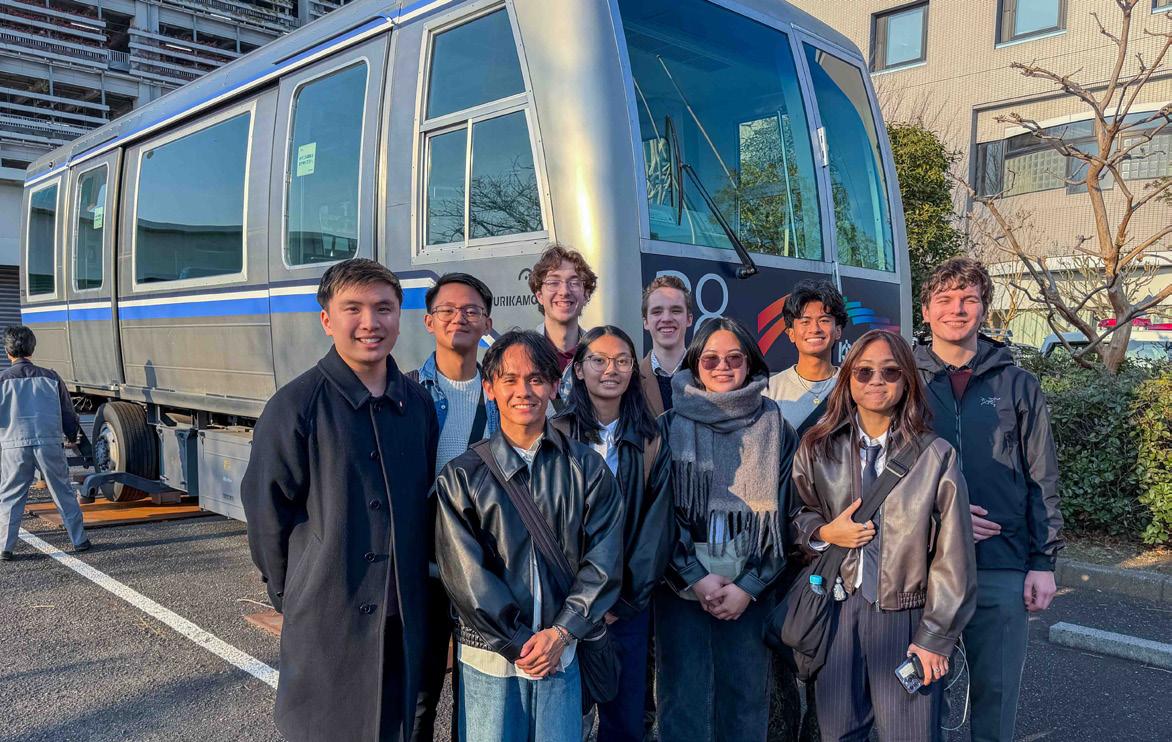
The University of Manitoba ITE Student Chapter has had an exciting and impactful term, highlighted by international technical experiences, professional development opportunities, and continued growth within the chapter.
Japan Technical Trip
UMITE successfully completed its international technical trip to Tokyo, Japan, where 10 student members participated in a 9 day immersive learning experience within one of the most advanced transportation systems in the world.
Throughout the trip, students explored how Tokyo’s transportation network supports one of the largest and most complex metropolitan regions globally. The group engaged in technical visits and discussions with Tokyu Corporation, Tokyo Metro, Yurikamome Inc., the Shinjuku Expressway Bus Terminal, and the ITS research group at the University of Tokyo.
Students gained valuable insight into transit oriented development, automated transit operations, urban rail integration, and large scale station redevelopment. Technical tours included the Shibuya Station Square, Toranomon Hills Station, and the Yurikamome Line control and maintenance facilities. This experience provided students with a deeper understanding of how engineering, planning, and policy come together to deliver world class transportation systems.
Lunch & Learn with Karalee Bloch
UMITE hosted a Lunch & Learn session featuring Karalee Bloch, Road Safety Engineer with Manitoba Transportation and Infrastructure. Karalee shared insights into her work improving safety across Manitoba’s highway network and delivered a presentation focused on public engagement in transportation projects. The session provided
students with valuable perspective on stakeholder collaboration and the role of communication in implementing effective safety solutions.
UMITE Constitution Update
The executive team has been actively working to strengthen and grow the chapter through the development of an updated constitution. Non elected executive roles are now explicitly outlined, and will create more opportunities for members to get involved without the barrier of an election process. These changes aim to improve accessibility, increase engagement, and support the long term sustainability of the chapter.
Presidential & General Elections
UMITE recently held its annual elections and is excited to introduce part of the 2026–2027 Executive Team:
UMITE 2026–2027 Executive Team
• President: Luke Qually
• Vice President Finance Co-Chairs: Ryssa Estopace & Hannah Gagarin
• Vice President Outreach: Alexandre King
• Vice President Events: Ella Dela Cruz
Along with a Secretary, who will be chosen in a future byelection, the chapter looks forward to another successful year under this new leadership team.
Looking ahead, UMITE is excited to continue building connections within the transportation community. The chapter will be sending seven student members to attend the upcoming ITE Canada Conference, where they will have the opportunity to engage with industry professionals, attend technical sessions, and represent UMITE on a national stage. We hope to see you there soon, and thank ITE Manitoba, ITE Canada, and all of our members and partners for their continued support.
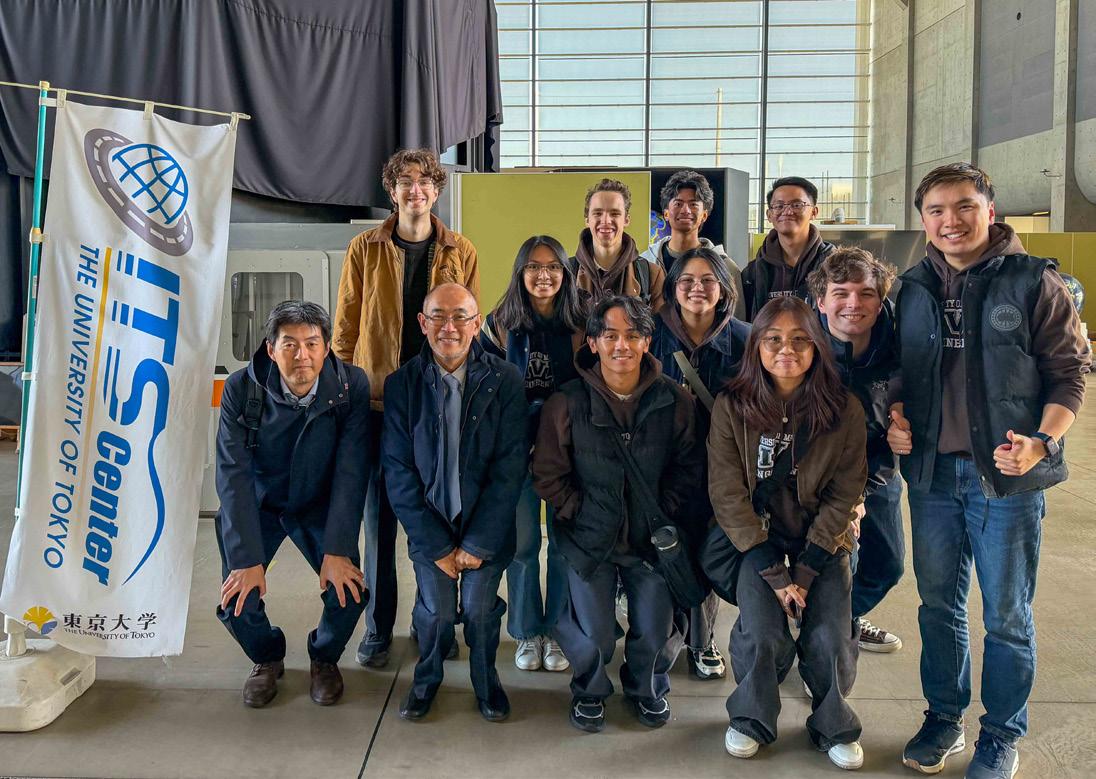
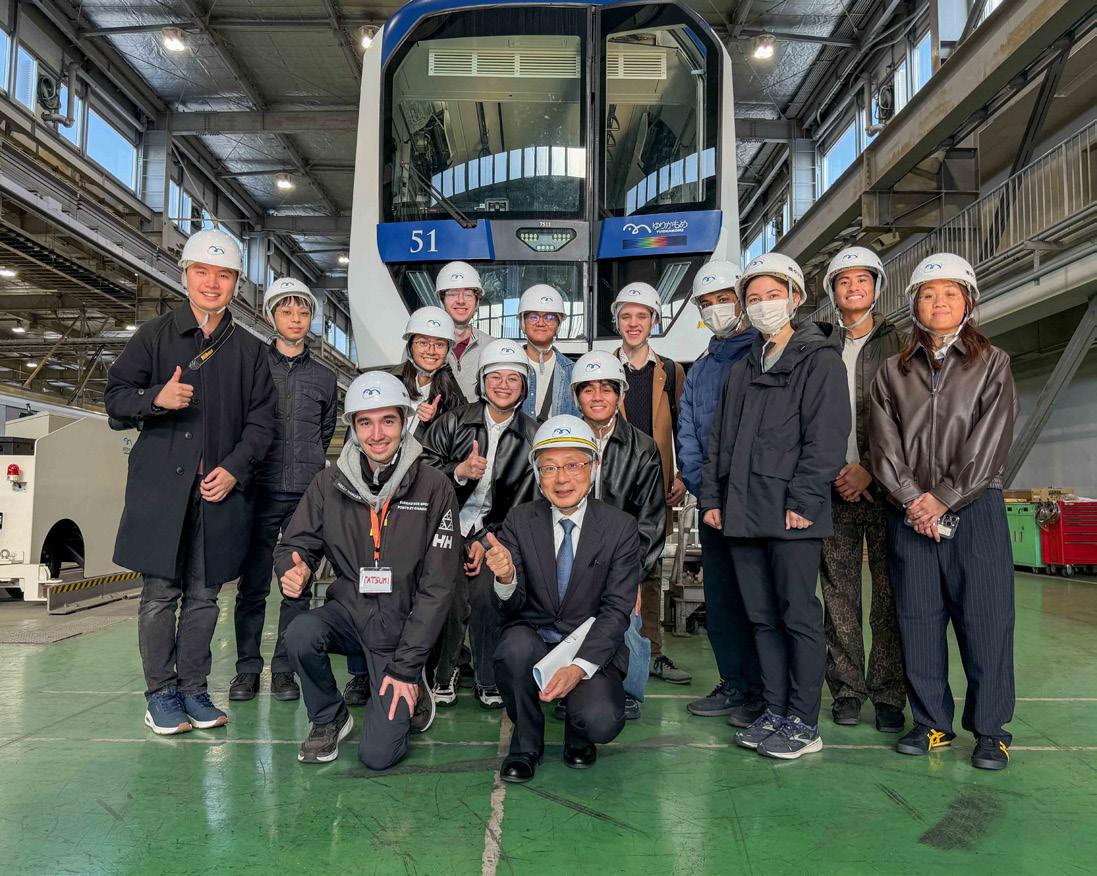
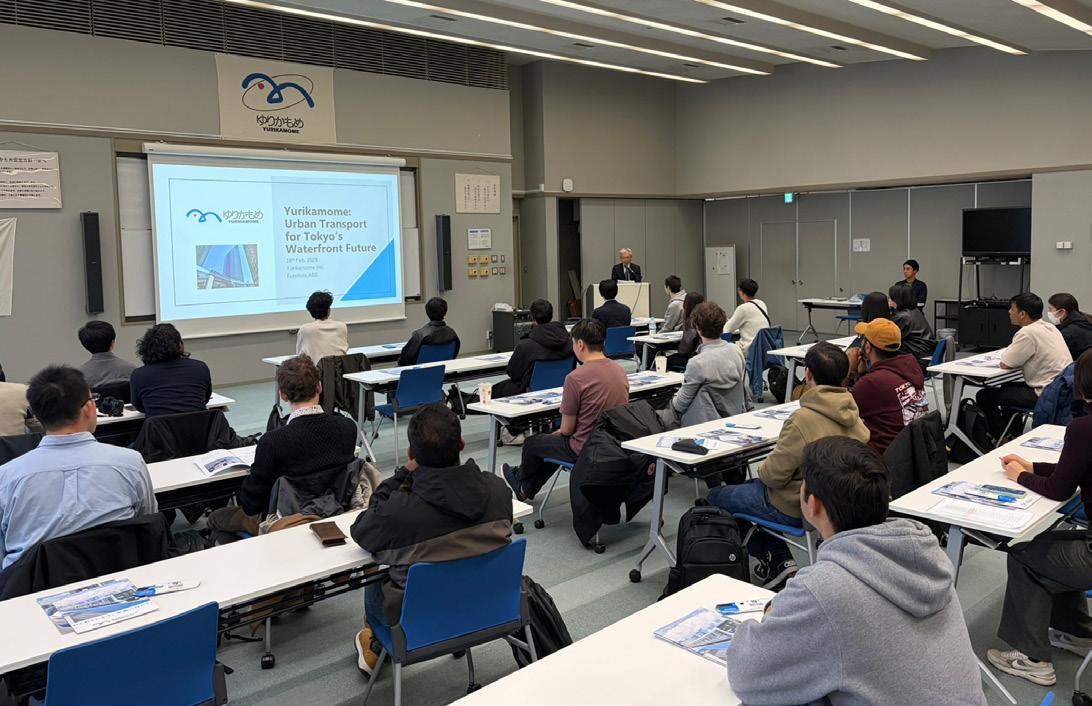
Western University
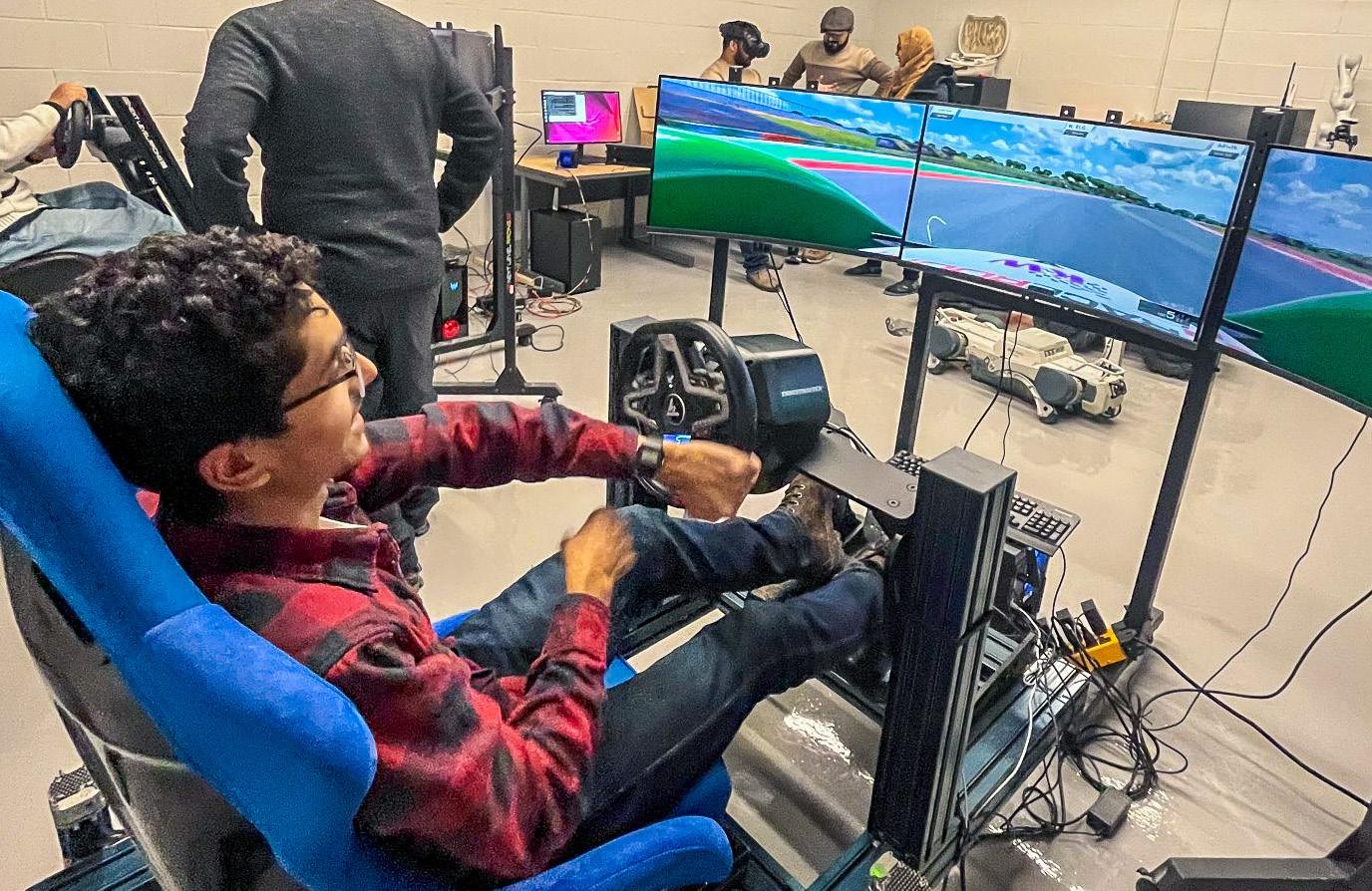
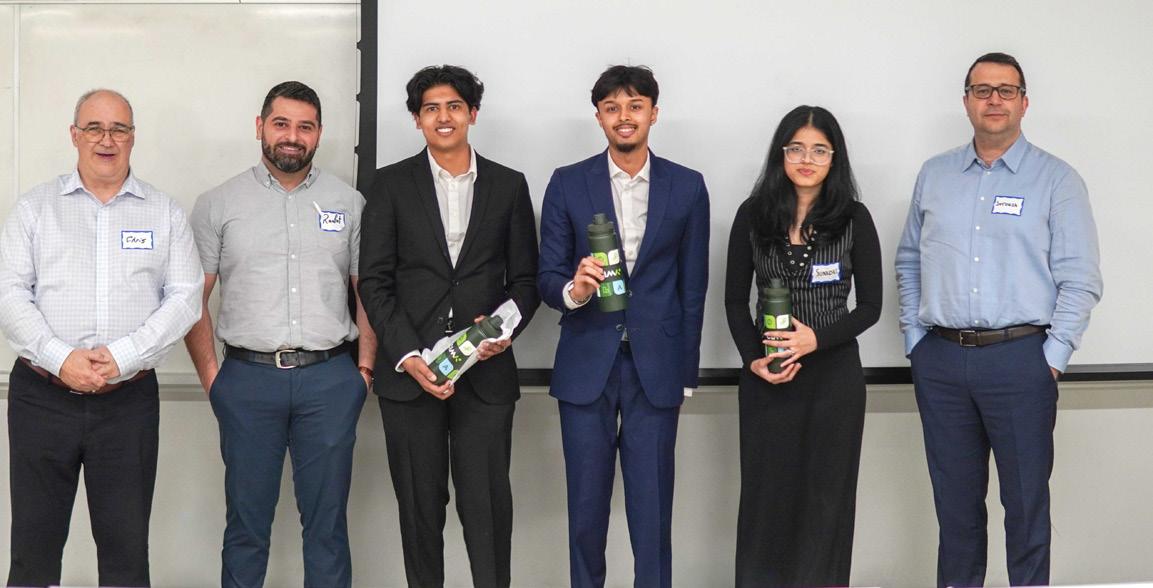
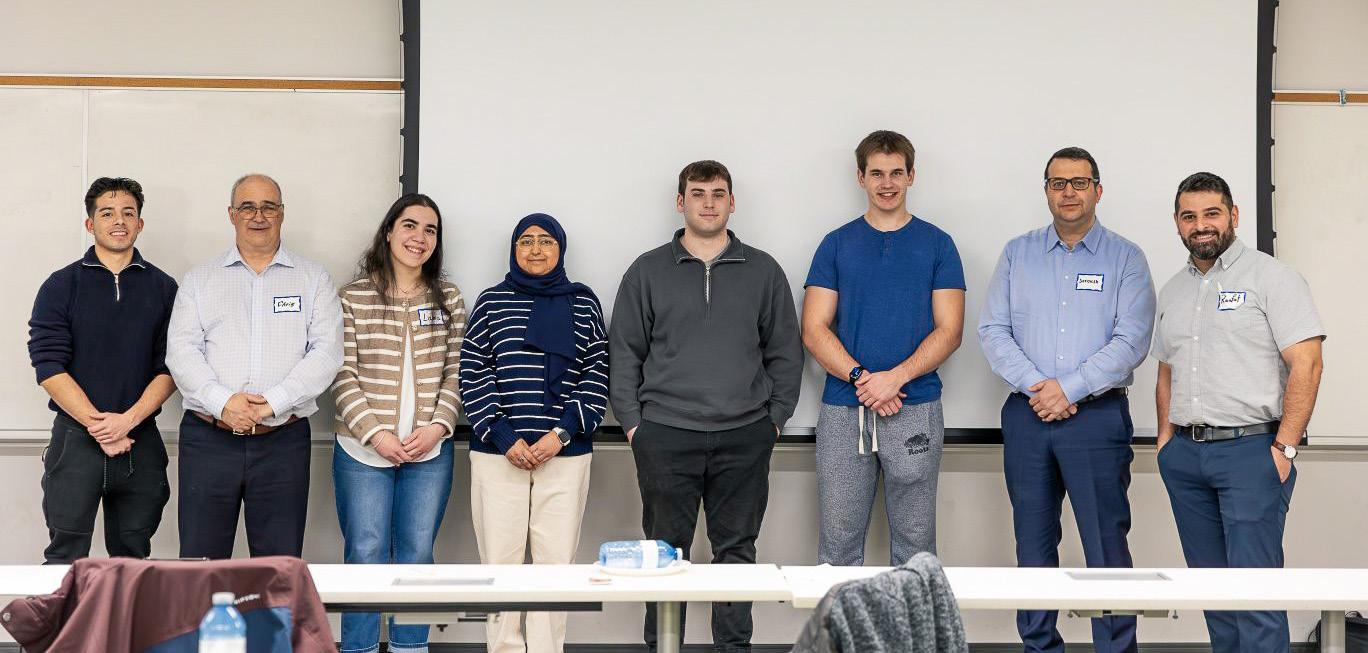
Smart Cities Lab Tour
Our club advisor, Professor Zaki, welcomed students to his lab for a fun and informative experience learning about technologies in transportation engineering. Students from different engineering programs attended the lab tour. They engaged with the equipment and took part in meaningful discussions with the lab researchers.
Annual Case Competition
ITE Western Chapter hosted its annual case competition, sponsored by the engineering firm CIMA+. Students were challenged to propose innovative and practical solutions to improve the conditions of the Western Road corridor between Sarnia Road and Windermere Road. Solutions had to align with the City of London’s Mobility Master Plan, which emphasizes multimodal integration, accessibility, sustainability, and safety. The competition was fierce, where eight teams from different undergraduate years of study and programs presented their ideas. It was a pleasure to meet new students who expressed interest in running for future executive roles after attending the case competition!
Transportation Engineering Workshop
As part of our educational initiatives, PhD Candidate in Civil Engineering and executive member of our club, Mohamed Shams, presented an interactive technical talk, where he shared research driven insights into transport planning, traffic engineering, and simulation based decision making. Students also learned about real world applications in smart cities and intelligent transportation systems. We were happy to see many students attend and engage with the presentation!
Spring Open House
In March, our chapter met with excited high school students at Western University’s Spring Open House. Our team members welcomed students to our booth, answered questions about our academic and extracurricular experience, and encouraged them to keep following our chapter updates as they enter university!
Current and Future Executive Team Dinner
The final event of the year was a dinner that brought together this year’s and next year’s executive team. Members enjoyed a fun meal together, reflected on this year’s chapter achievements, and brainstormed initiatives for next year.
The future executive team is excited to maintain and grow our chapter’s student engagement. Most executive members will be in their early years of the engineering program, and this will support the chapter’s goal of club sustainability.
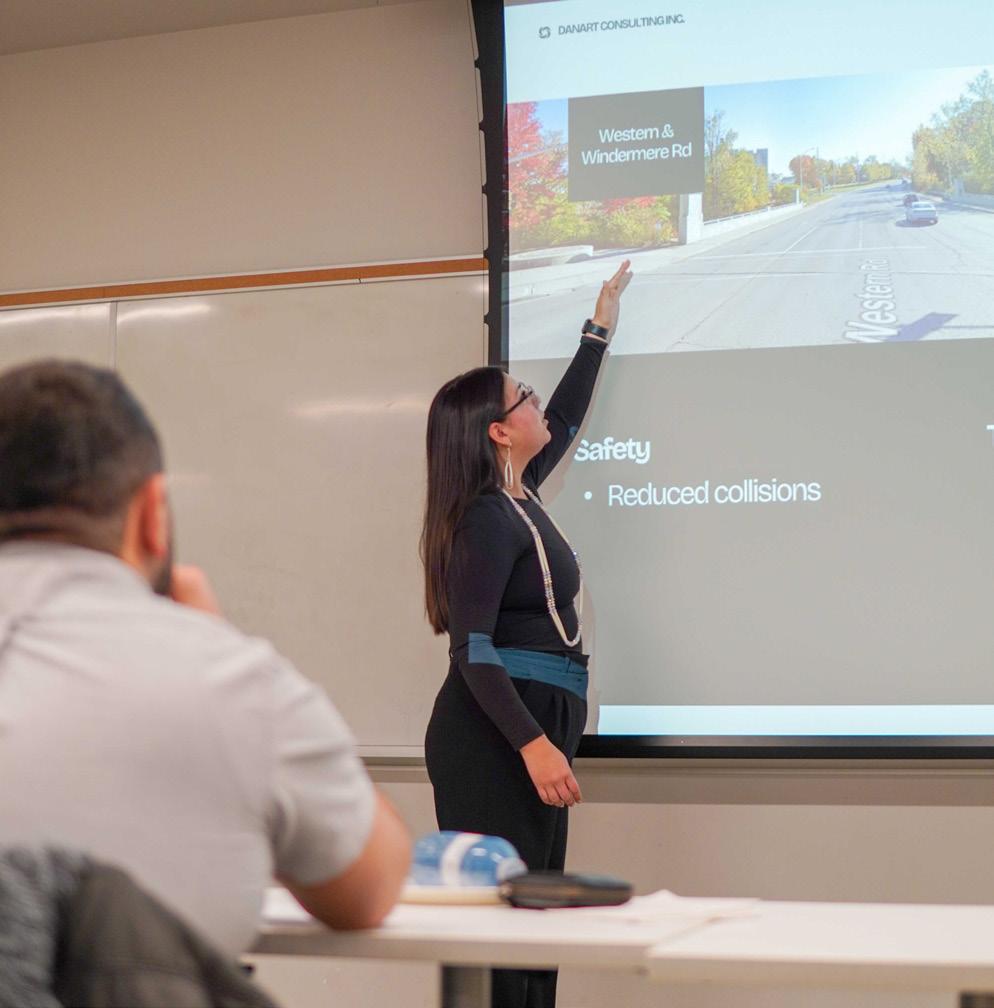
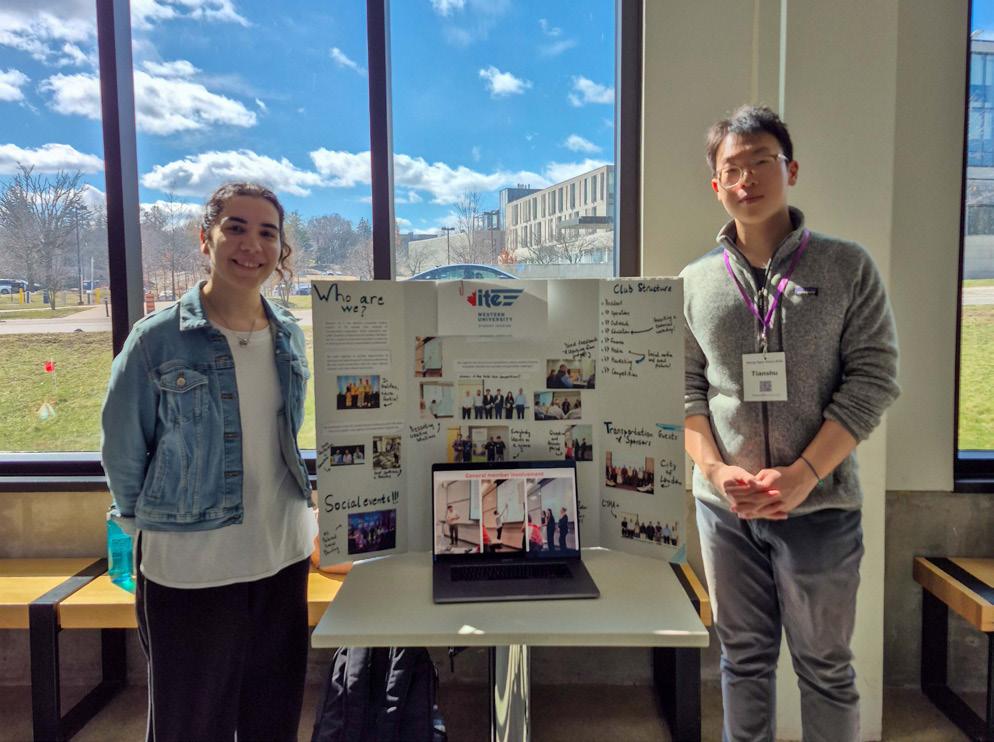
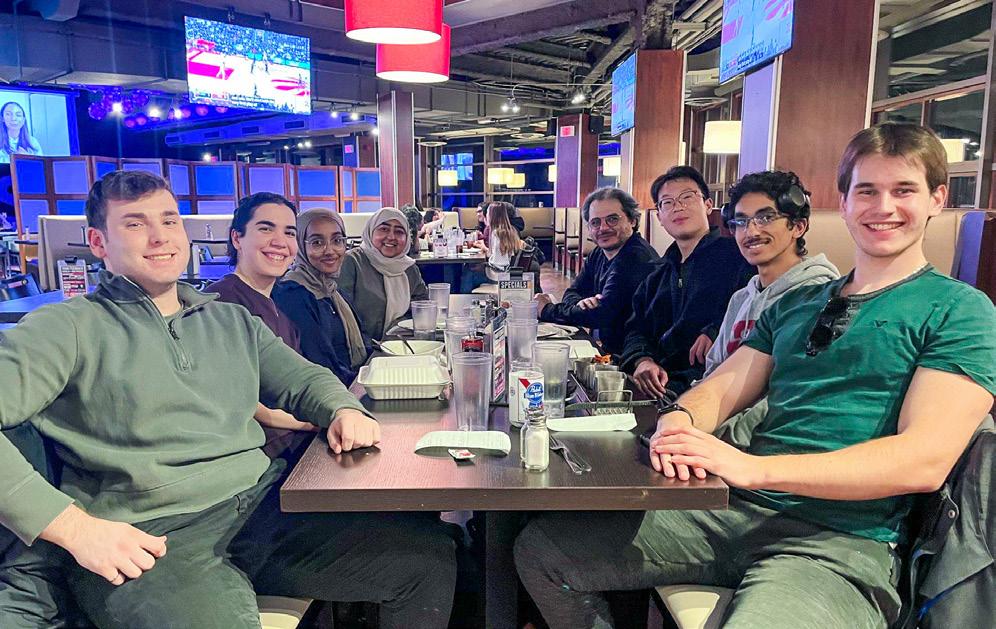
University of Waterloo
STUDENT CHAPTER
With the snow melting, ITE UW reflects off an active start to the year with numerous events with industry leaders and other student chapters focused on the region’s exciting transit projects and professional development.
CEAGES Industry Night
On January 23, the chapter represented ITE at the Civil, Environmental, Architectural and Geological Engineering Society’s (CEAGES) Winter Industry Night along with many other industry and student groups. For four hours, members advertised the chapter’s upcoming events to fellow engineering students and introduced opportunities for a career in transportation engineering.
Industry Talk with Brandon Gafoor
The chapter hosted a successful industry talk with Manager of Property Acquisition at Metrolinx, Brandon Gaffoor, who is currently working on the Ontario Line Subway. With high turnout, Mr. Gaffoor shared stories of his role in infrastructure delivery with Metrolinx as well as provided students with invaluable insights as they began their professional careers.
Eglinton Crosstown Tour
On March 6, ITE UW and ITE UofT held a joint technical tour of the Eglinton Crosstown with
Joanna Kervin and colleagues at the City of Toronto and the Consortium. Attendees travelled the full route, making stops at key stations such as Cedarvale, Avenue, and Yonge Eglinton station. Students gained first hand insights into the project from station design, signal priority, and construction methods from the professionals who helped lead it. Overall, the event was highly successful with strong levels of participation and engagement from students. This also represents a start for future collaboration between ITE UW and ITE UofT.
Industry Talk with Matthew O’Neil
Our chapter also got the chance to learn more about the light rail project in the region from Matthew O’Neil, who is currently leading the region’s ION Stage 2 Project. In it, Matthew shared his experience leading the public consultation for the project back in the Fall as well as how cost–benefit analyses have been applied across both stages of the project. This was a valuable opportunity for students to learn how key transit engineering decisions are made.
Leadership Workshop with Stephen Oliver
Students got the chance to participate in a leadership development workshop with Stephen Oliver, who is a Transportation Planner
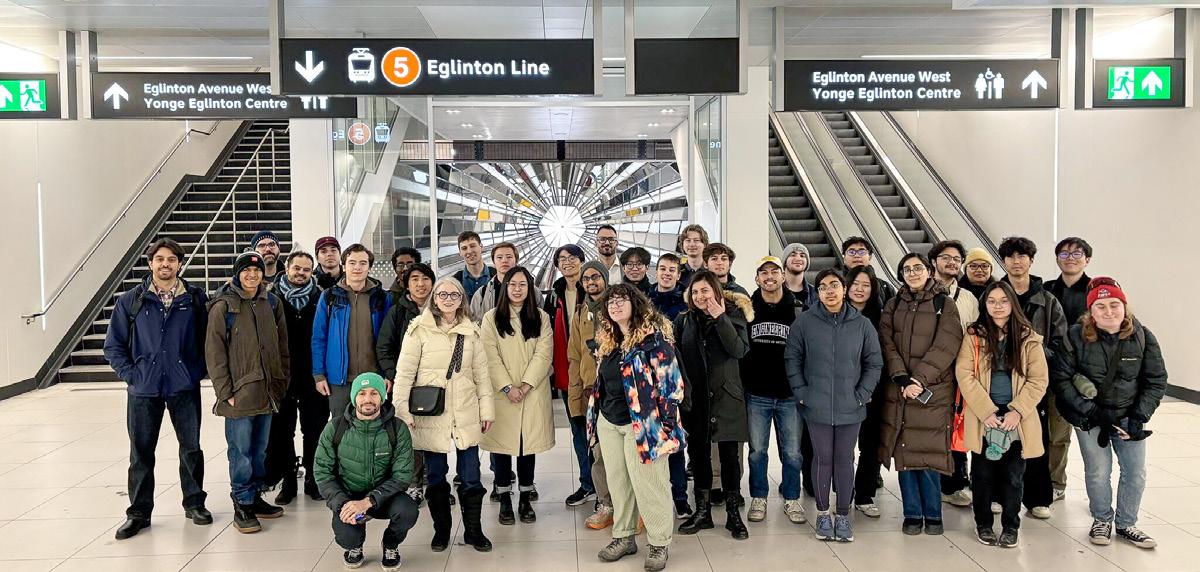
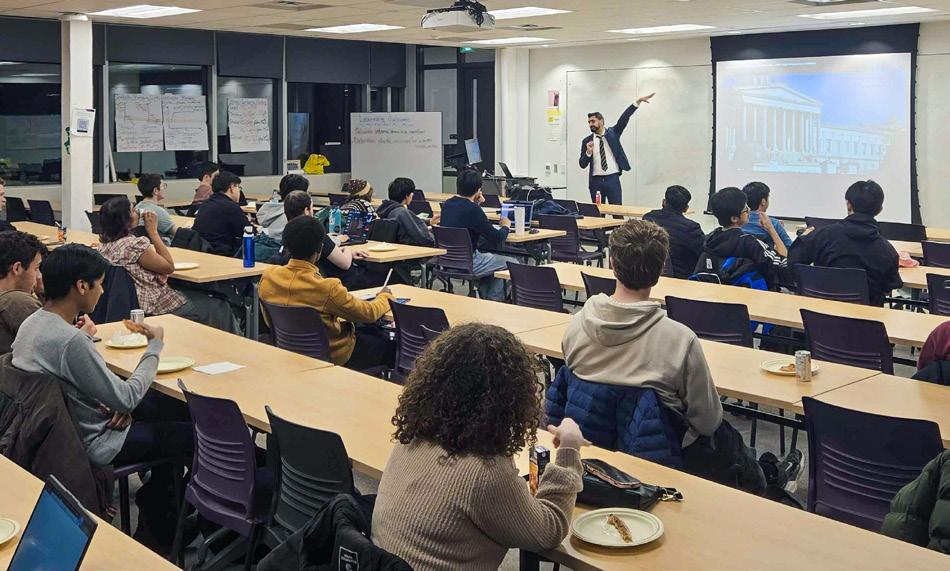
Eglinton Crosstown Tour
Industry Talk with Brandon Gaffoor
at GHD. This interactive session allowed students to practice their presentation skills in a low pressure environment and receive direct feedback on how to effectively communicate with diverse audiences.
GIS Workshop
In collaboration with GIS Specialist Markus Wieland at UW’s Geospatial Centre, ITE UW hosted a two day GIS workshop. These sessions provided students with the fundamentals and understanding of ArcGIS Pro’s Network Analysis tool.
Waterloo Central Railway Tour
The chapter continued our annual collaboration with ITE McMaster by touring the Waterloo Central Railway in Woolwich to Elmira. This tour offered attendees a behind the scenes look into the railway’s restoration and maintenance facility as well as their famous steam engine #9.
March Open House
Several chapter members volunteered at the university’s March Open House, hosting a booth at the Faculty of Engineering’s Design Team Showcase. In addition to engaging prospective
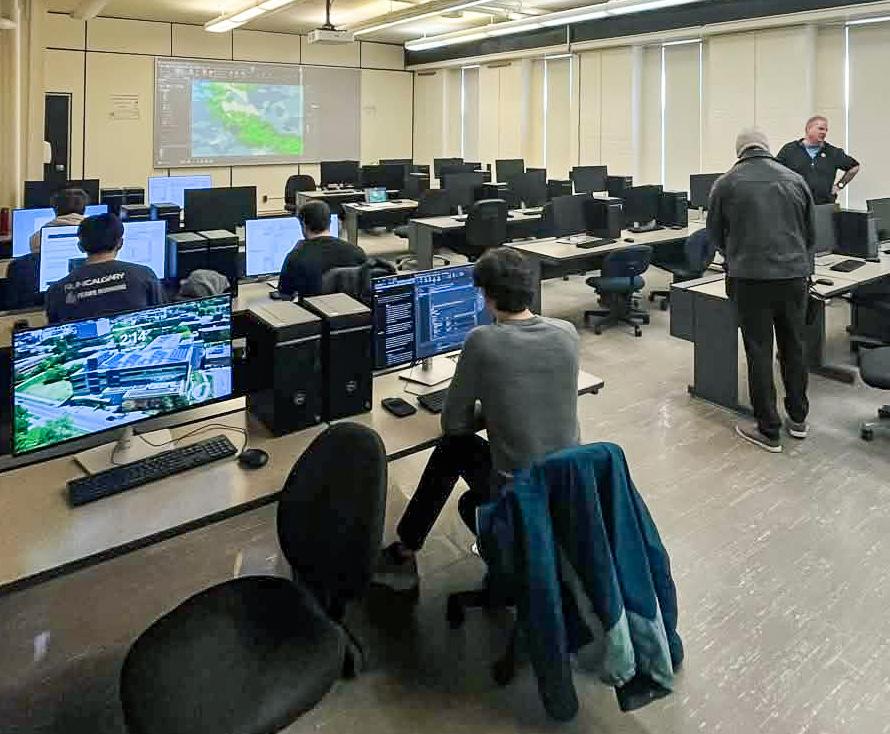
students interested in transit, a key highlight was the poster of the chapter’s 2025 Sandbox submission, which sparked conversations with high school students about how they would improve transit infrastructure.
ITE Sandbox
Continuing off of last year’s submission, the chapter participated in the 2026 Annual Sandbox Competition. Throughout the term, a team of 20 students from a range of academic levels and programs collaborated on a People Centric Mobility Plan for the University of Michigan–Dearborn. This experience provided students with valuable exposure to technical writing and research to solve issues in transportation planning.
K-12 Outreach and Community Engagement
In a similar vein to last fall, the chapter collaborated with Engineering Outreach at one of their after school clubs to deliver an interactive workshop introducing students to complete streets. Participants designed their own street cross sections using StreetPlan.net, learning key principles of street design and safety while exploring how streets serve diverse needs.
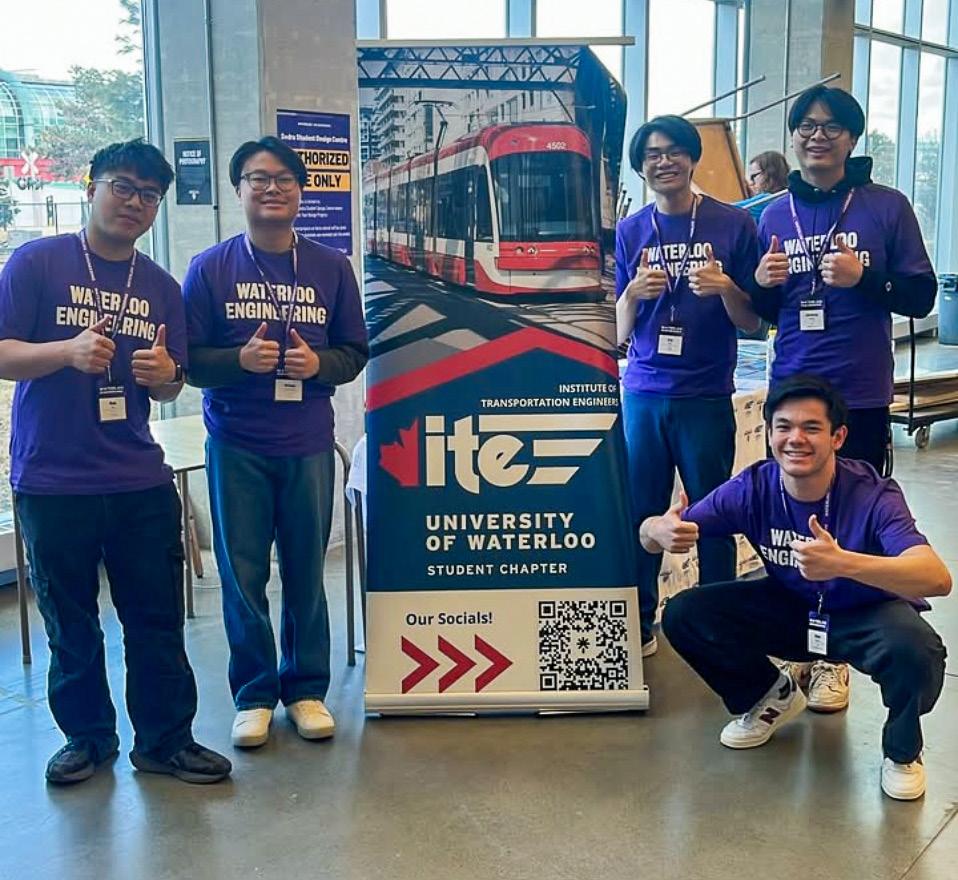
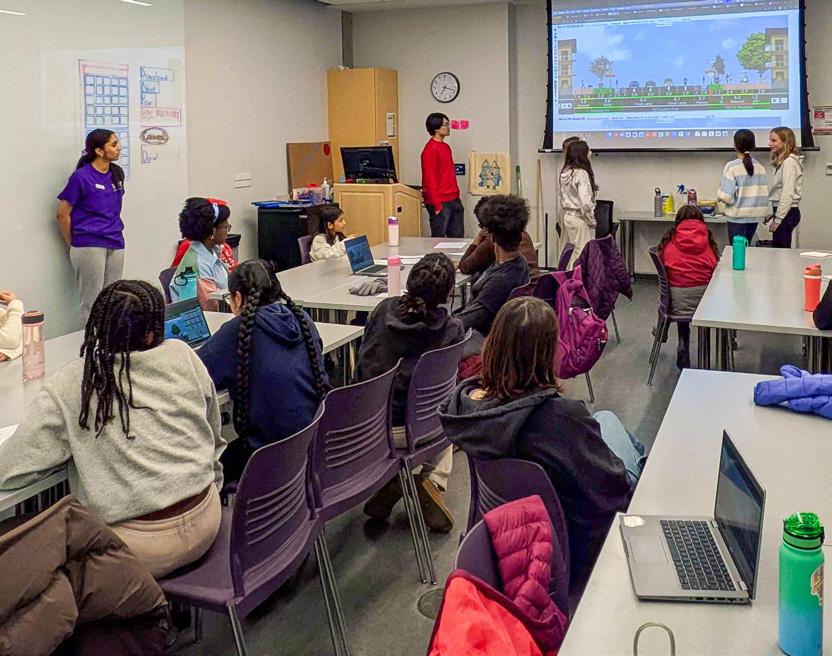
University of Toronto
UT-ITE Winter Collaborations Galore!
February to April were busy times for UT-ITE, featuring a handful of collaborations with fellow ITE student chapters and local organizations. We began this stretch collaborating with TMU ITE on their ITE Awareness Event on February 6 at TMU, featuring a special guest appearance from ITE International President Gordon Meth. On March 6 we joined ITE Waterloo on a highly insightful tour of the finally opened Eglinton Crosstown LRT featuring members of the Crosslinx execution team. The next week, we hosted a joint Research Lightning Forum with UofT and TMU graduate research students, before rounding out the month with collaborations with Toronto’s Young Professionals in Transportation, featuring a discussion on winter transit maintenance, and finally Bentley Systems, which delivered an OpenRoads workshop for UofT and TMU students.
UT-ITE Motion Commotion and Winter Friday Sessions
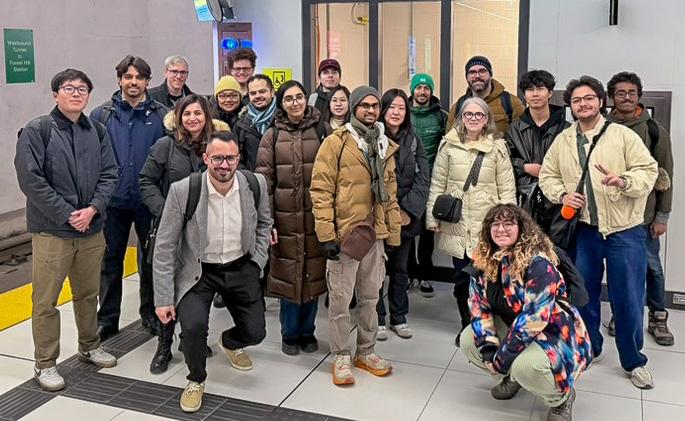
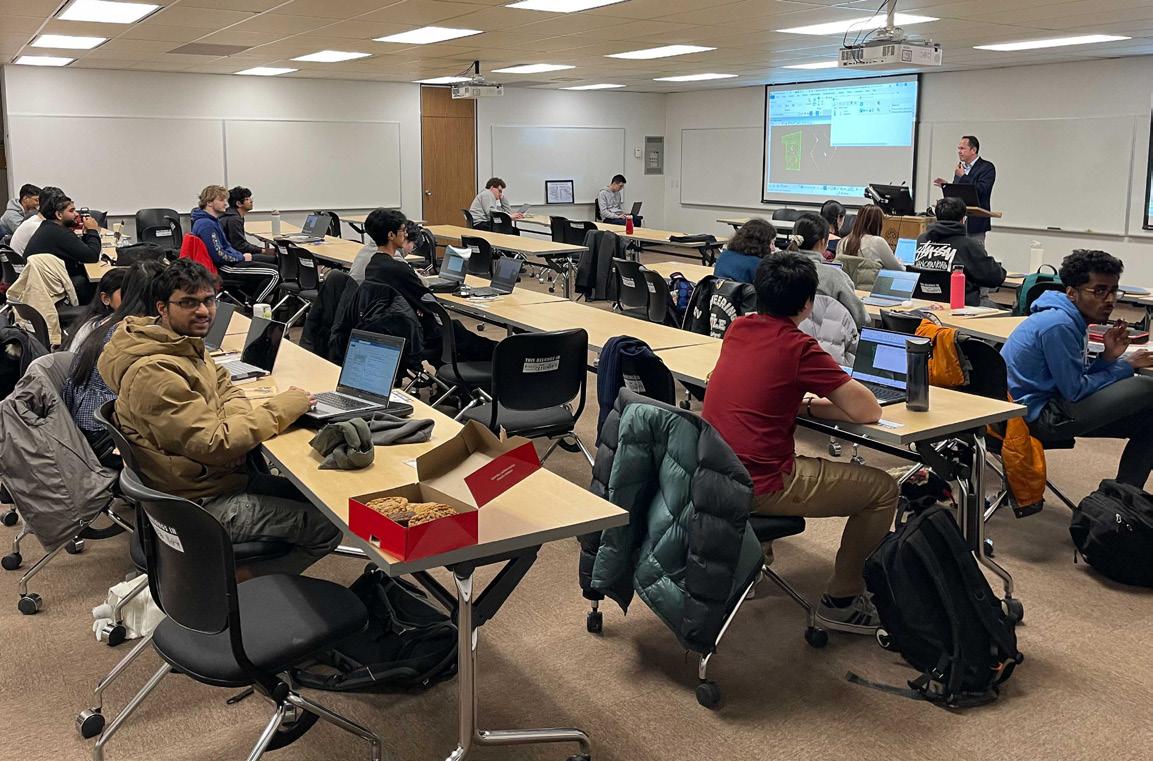
Similar to other major Toronto transportation projects, our Motion Commotion debate experienced slight delays, but at long last we held our 4 team competition on February 28. The two round competition tackled contemporary mobility topics including equitable electrification, emerging AV technologies, and road safety design approaches. This Winter we continued our weekly Friday seminars, including presentations by representatives from the Toronto Transit Commission, City of Vaughan, and UofT graduate researchers.
Annual General Meeting
On April 10 UT ITE hosted its annual general meeting, where the 2025 26 Executive Team provided a recap of the past year and members voted for the new 2026 27 Executive Team, who will be introduced in next term’s Transportation Talk. This was a strong year for UT ITE, capped off by a busy last few months for the 2025 26 team, and we are excited for 2026 27 and beyond to continue our momentum!
University of New Brunswick
Two ITE UNB executives are graduating!!!
Congratulations to Ahmed Mamoon Faheem (Social Chair) and Priscilla Mensah-Aborampah (Vice President) who recently completed their Masters of Engineering projects and will be graduating in May.
On February 11, the ITE UNB student chapter held a scholarship information session for both undergraduate and graduate Civil Engineering Students. The session provided information on the scholarship opportunities available through ITE, as well as some of the perks of
being involved in ITE for those who have yet to attend an ITE session.
On March 20th, the student chapter hosted a Lunch & Learn with Tyson Aubie, who is the Traffic Director for the City of Fredericton. Tyson spoke on his experience navigating the landscape of working for a municipality in terms of tackling specific transportation challenges, communicating with the public, and working with the Fredericton City Council on specific issues. Thank you again to Tyson for coming in to chat with us!!!
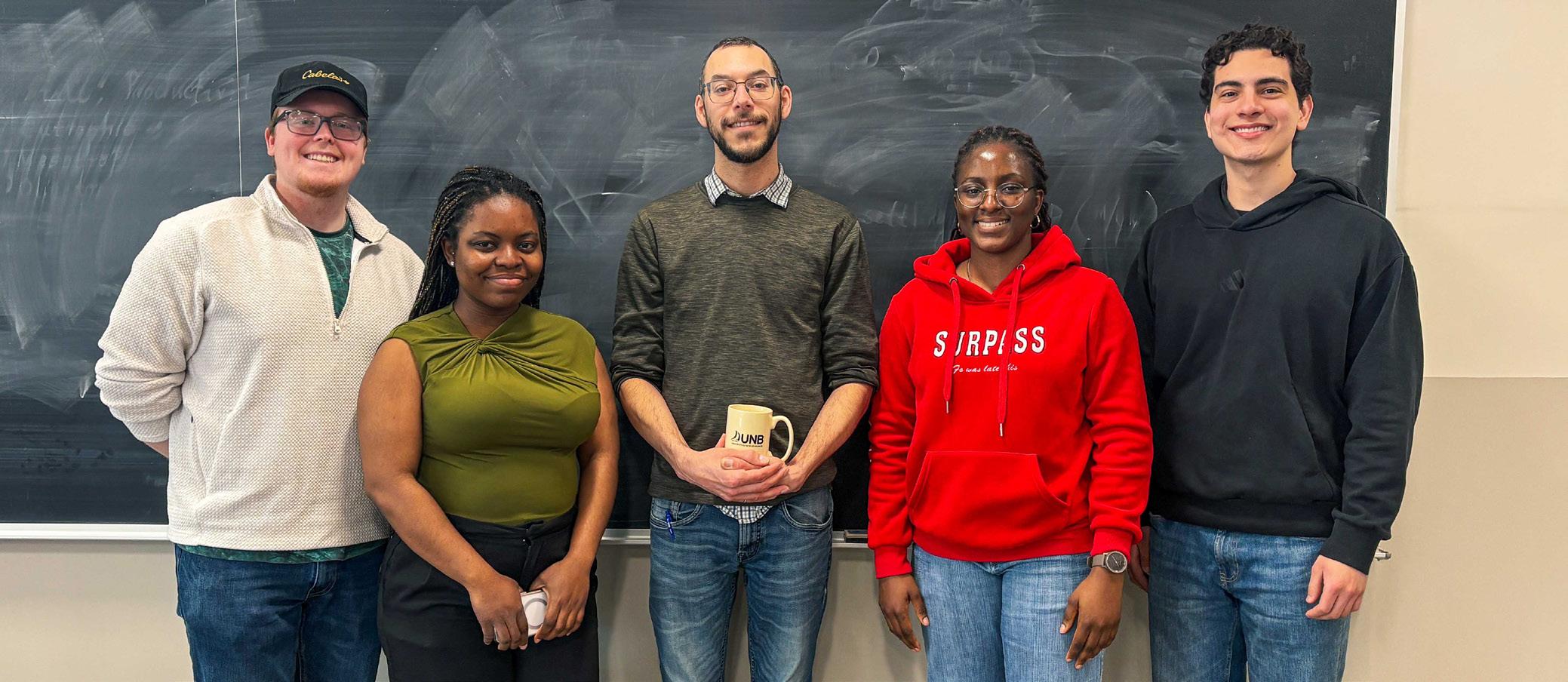
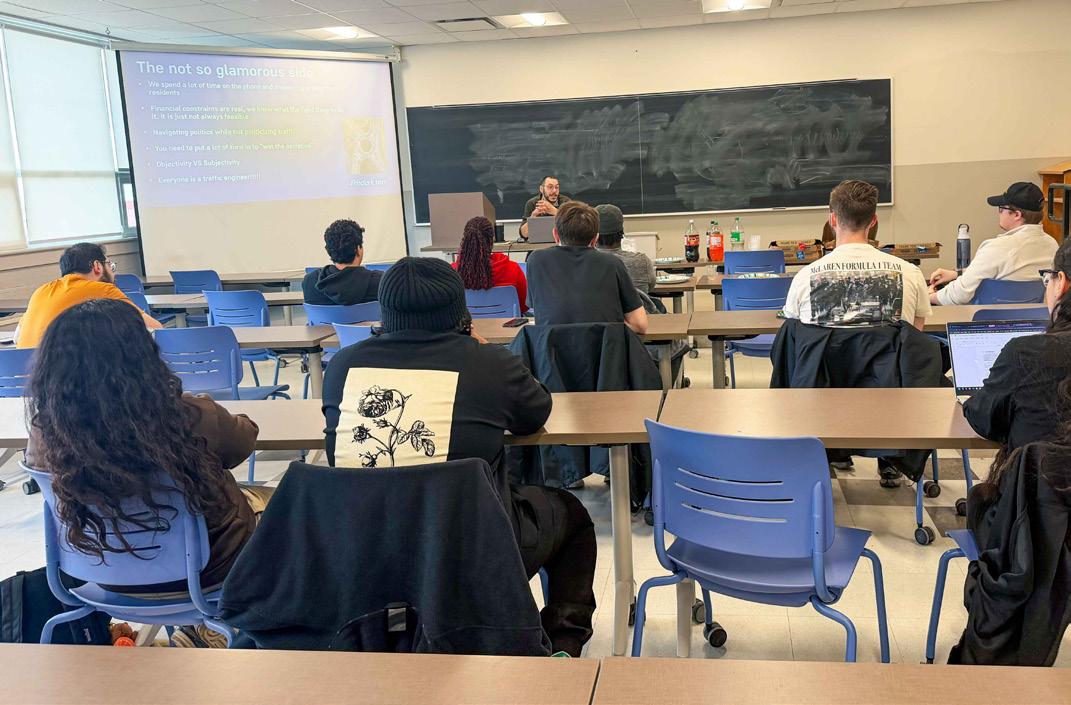
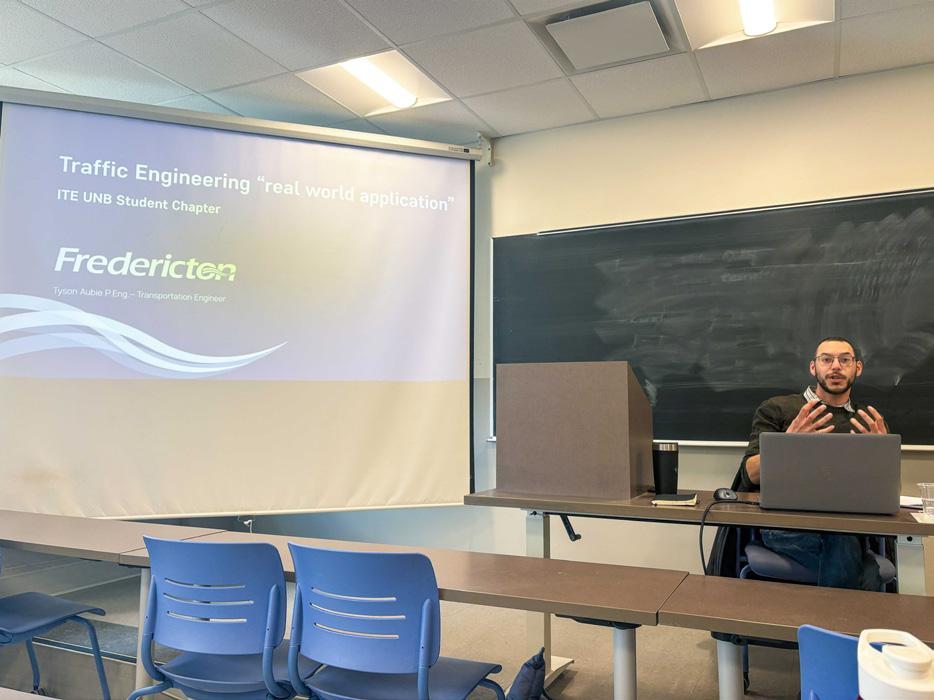
ROAD SAFETY for Canadian Practitioners Online Training
The Road Safety For Canadian Practitioners online training program, presented by TAC & ITE Canada, allows you to tailor your learning to your specific professional development needs Five courses are offered:
Foundations of Road Safety
Measuring Safety
Human Factors and Road Safety
Solving Safety Problems
Implementing Road Safety Programs




Comprehensive & tailored professional development
FORMAT
Courses are delivered through TAC’s Online Training Centre as self-paced, on-demand modules that include recorded lectures, case studies, exercises, supplemental reading lists & quizzes
DURATION
Lectures in each course range from 3-6 hours. In total, the five courses offer 24 hours of learning. Modules are accessible for 6 months after payment.
PURCHASE
The five modules can be purchased individually or as discounted bundles. Find complete course details and prices at tac-atc.ca.
More Information: tac-atc ca/en/knowledge-centre/training-courses/#roadsafety
Welcome to these new Canadian members who joined ITE between January and March 2026. We look forward to connecting with you and supporting your professional learning and growth in our community of transportation professionals!
Amina Abdala, University of Waterloo, Kitchener, ON
Mohammed Abuhadrous, University of Calgary, Calgary, AB
Kazeem Akanbi, University of Windsor, Windsor, ON
Mahin Alam, University of Windsor, Windsor, ON
Sika Antonio, City of Calgary, Calgary, AB
Shelby Armstrong, University of Alberta, Leduc, AB
Punya Arora, Surrey, BC
Daniel-Job Asuncion, University of Calgary, Mississauga, ON
Mohammad Babaei, Ottawa, ON
Khalil Barakzai, Town of Oakville, Ontario, Pickering, ON
Molly Barkowsky, Translink, Vancouver, BC
Nandish Barot, City of Calgary, Alberta, Calgary, AB
Brittany Barrie, Centennial College, Sioux Lookout, ON
Ankeet Baskota, Edmonton, AB
Frances Braimah, University of Alberta, Cochrane, AB
Ameera Brar, Mission, BC
Sean Breen, Markham, ON
David Brett, City of Calgary, Alberta, Calgary, AB
Isaac Buchanan, University of New Brunswick, Fredericton, NB
Kelsey Carriere, City Of Toronto, Toronto, ON
Elizabeth Caza, Verdun, QC
Charles Chan, University of Waterloo, Scarborough, ON
Ricky Chan, Victoria, BC
Qi Chen, McGill University, Montreal, QC
Abhinav Chugh, City of Calgary, Alberta, Calgary, AB
Theressa Chung-Hun, Toronto, ON
Jonathan Claude, Seneca Polytechnic, Ottawa, ON
Allan Conopio, Bunt & Associates, Vancouver, Jaclyn Currie, Victoria, BC
Ana Daniya, Ryerson University, Mississauga, ON
Davis Dejean, Queen’s University, Toronto, ON
Rivith Dissanayake, University of Waterloo, Oakville, ON
Larissa Dushime, University of Windsor, Windsor, ON
Mike Elliott, ISL Engineering, Nanaimo, BC
Zain Fayaz, Ryerson University, Brampton, ON
Sylvain Felton, Laval, QC
Elen Ferreira
Phoebe Fu, Town of Oakville, Ontario, Oakville, ON
Shawn Fu, University of British Columbia, Surrey, BC
Luiz Gagalac, University of Calgary, Calgary, AB
Areen Garboushian, University of Waterloo, Waterloo, ON
Aayush Ghai, University of Alberta, Edmonton, AB
Pegah Ghane, University of British Columbia, Vancouver, BC
Eric Gilmour, Nepean, ON
Kim Ha, Mohawk College, Stoney Creek, ON
Ian Hancock, Kelowna, BC
Dorna Hatami, City of Port Moody, BC, Port Moody, BC
Daniel Hipkin, McGill University, Montréal, QC
Adrian Hipolito, University of Waterloo, Scarborough, ON
Kathryn Holm, City Of New Westminster, New Westminster, BC
Yiyang Hu, Markham, ON
Yongzhi Hu, City of Calgary, Alberta, Calgary, AB
James Hulme, University of Waterloo, Scarborough, ON
Gilbert Iradukunda, Hamilton, ON
Raqin Islam, University of Waterloo, Etobicoke, ON
Natalie Jagger, University of New Brunswick, Lakeville, NS
Puneet Jagpal, McElhanney, Surrey, BC
Varsan Jeyakkumar, University of Toronto, Scarborough, ON
Billy Jin, University of Waterloo, Waterloo, ON
Christina Johansson, Toronto, ON
Maryka Jolicoeur, Montréal, QC
Sijun Jung, University of Waterloo, London, ON
Kaleb Khemet, Carleton University, York, ON
Eric Kim, University of Waterloo, Waterloo, ON
Geunil Kim, Calgary, AB
Alexandre Kingsbury, Dalhousie University, Dartmouth, NS
Jacob Klassen, Burnaby, BC
Yvonne Kordjie, University Waterloo, Waterloo, ON
Karthika Krishnan, City of Calgary, Alberta, Calgary, AB
Tim Kwan, Regional Municipality of York, Newmarket, ON
Dean Lachner, City of Calgary, Alberta, Calgary, AB
Juan Lamilla, University of Alberta, Edmonton, AB
Tsz Him Lau, CPCS, Richmond, BC
Brandon Lee, Calgary, AB
James Lee, Bunt & Associates, Vancouver, BC
Meng-Ling Lee, Calgary, AB
William Lema, Urban Systems, Calgary, AB
Jonathan Lin, University of Waterloo, Markham, ON
Brian Lo, University of Waterloo, Richmond Hill, ON
Jing Chen Lu, Toronto, ON
Le Ma, City of Airdrie, Airdrie, AB
Adam Manji, University of Waterloo, Etobicoke, ON
Jena Masalma, University of Waterloo, Waterloo, ON
Ryan McClelland, Scarborough, ON
Josh Morcombe, University of Waterloo, Caledon, ON
Reid Morden, University of Alberta, Calgary, AB
Oliver Lok Ching Mui, University of Toronto, Markham, ON
Somi Nim, Toronto, ON
Depeng Niu, University of British Columbia, Vancouver, BC
Ali Noori, University of Waterloo, Mississauga, ON
Rory O’Sullivan, Town of Oakville, Ontario, Oakville, ON
Emmanuel Odeshi, City of Saskatoon, Saskatoon, SK
Enochdaniel Okorosobo, City of Calgary, Alberta, Calgary, AB
Francis Olisa, University of Manitoba, Winnipeg, MB
Steve Oteng-Owusu, University of Windsor, Windsor, ON
Mariana Otero Becerril, University of Calgary, Calgary, AB
Aleena Mathew Panakkal Suresh Babu, University of New Brunswick, Fredericton, NB
Emily Pelleja, Town of Oakville, Ontario, Oakville, ON
Kiefer Precious-Predinchuk, Mohawk College, Dundas, ON
Yehan Qu, Edmonton, AB
Mohammad Sameem Raheemi, RJ Burnside, Etobicoke, ON
Mahendrasinh Rana, Southern Alberta Institute of Technology, Calgary, AB
Ben Reeves, Bunt & Associates, Calgary, AB
Soo Jin Ri, Calgary, AB
Josh Richardson, Al Terra, Spruce Grove, AB
Scott Robertson, City of Victoria, BC, Victoria, BC
Bijoy Saha, University of British Columbia, Kelowna, BC
Deorishabh Sahu, University of British Columbia, Vancouver, BC
Abdul Saleh, University of Calgary, Calgary, AB
Diana Sanabria-Barboza, University of British Columbia, Vancouver, BC
Christian Santos, British Columbia Institute of Technology, Burnaby, BC
Faye Ingrid Sepacio, University of Windsor, Windsor, ON
Marta Shahezian, University of Toronto, Toronto, ON
Jamie Shaw, New Tecumseth, Alliston, ON
John Shehata, University of Manitoba, Winnipeg, MB
Yoonhwan Shin, Bunt & Associates, Vancouver, BC
Mason Singh, Lethbridge, AB
Naomi Siyam, York University, Toronto, ON
Beverly Smetaniuk, Edmonton, AB
Craig Stackpole, Nepean, ON
Sumaiya Afrose Suma, University of Toronto, Toronto, ON
Brian Thi, Bunt & Associates, Edmonton, AB
Gurnoor Thind, British Columbia Institute of Technology, Richmond, BC
Krista Tollefsen, British Columbia Institute of Technology, Burnaby, BC
Weston Vanderveen, Coquitlam, BC
Maria Vetrici, University of Toronto, Toronto, ON
Megan Vogt, University of British Columbia, Kelowna, BC
Daming Wang, University of Victoria, Victoria, BC
Yibo Wang, Burnaby, BC
Yiyang Wang, University of British Columbia, Vancouver, BC
Thomas Williams, Calgary, AB
Jordan Williams-Neheli, University of Waterloo, Milton, ON
Emily Woitas, University of Calgary, Calgary, AB
Shing Long Wong, University of British Columbia, Richmond, BC
Austin Xu, University of Waterloo, Mississauga, ON
Anne Yang, City of Calgary, Alberta, Calgary, AB
Qiao Yang, City of Calgary, Alberta, Calgary, AB
Yifei Ye, McMaster University, Scarborough, ON
Yeontaek Yoo, University of Calgary, Calgary, AB
Yan Lan Yuan, Edmonton, AB
Jason Yuen, WATT Consulting Group, Vancouver, BC
Maral Zazzi, British Columbia Institute of Technology, Coquitlam, BC
Yanxin Zhang, University of Toronto, Toronto, ON
Nahvid Zolfaghari, University of Waterloo, Waterloo, ON

Connecting Communities for a Brighter Future
Calgary Edmonton
Vancouver Victoria Kelowna
ITE Canada Executive Committee
President .............. Irini Akhnoukh, M.Eng., P.Eng., PTOE president@itecanada.org
Vice President .......... Destiny Piper, P.Eng. vicepresident@itecanada.org
Treasurer Kelsey Waugh, P.Eng. RSP1 treasurer@itecanada.org
ITE Canada Staff
District Operations Lead ..... Evonne Winchiu Donaher edonaher@itecanada.org
Operations & Communications Associate ... Sara Belmore sbelmore@itecanada.org
Secretary .............. Greg O’Brien, P.Eng. secretary@itecanada.org
Past President .......... Pedram Izadpanah, Ph.D., P.Eng. pastpresident@itecanada.org
District Director Julia Salvini, M.Eng., P.Eng., FITE director@itecanada.org
Technical Liaison Committee
tlc@itecanada.org
Chair Borg Chan, M.Sc., P.Eng., PTOE, RSP, FITE Vice-Chair Erin Toop, M.A.Sc., P.Eng. Committee ...... Syed Atif Ali, M.Eng., P.Eng., PMP Reza Aminghafouri, PhD
Niraj Sunuwar, P.Eng., PTOE
Past Chair ....... Farhad Shahla, M.Eng., P.Eng.
National Technical Program Committee
technicalprogram@itecanada.org
Chair Amy Do, P.Eng. Vice Chair ....... Breanna Jackson, P.Eng. Committee Omar Shams, CET Erica Bayley, P.Eng.
Ken Wimble, P.Eng. Past Chair Garrett Donaher, P.Eng.
Sections & Presidents
Vancouver Island ........ Bruce Beames vancouverisland@itecanada.org
Greater Vancouver ...... Trevor Demerse vancouver@itecanada.org
BC Interior Maciej Wysocki bcinterior@itecanada.org
Northern Alberta David Mason northernalberta@itecanada.org
Southern Alberta........ Kayla Royce southernalberta@itecanada.org
Saskatchewan .......... Ellen McLaughlin saskatchewan@itecanada.org
Manitoba Karalee Bloch manitoba@itecanada.org
Training Committee
training@itecanada.org
Chair Karin Huang, EIT Committee ...... Hamed Esmaeeli, P.Eng. Ali Zaidi, P. Eng., LEED® AP Souzan Saadat, M.Eng., P.Eng., PTOE
Past Chair ....... Marcia Eng, P.Eng.
Southwestern Ontario ... Tim Kooistra southwestontario@itecanada.org
Hamilton ............... Omar Shams hamilton@itecanada.org
Toronto Heather Hector toronto@itecanada.org
National Capital Rebecca Conrod nationalcapital@itecanada.org
Québec ................ Alex Nolet quebec@itecanada.org
Atlantic ................ Jill DeMerchant atlantic@itecanada.org
Student Chapters
Student Chapter
British Columbia Institute of Technology
Advisor
Haesung Ahn
President(s)
Alexander Reis bcit@itecanada.org haesung_ahn@bcit.ca
Carleton University
Adam Weiss
Rulla Al-Haideri & Houssam Siyoufi carleton@itecanada.org Adam.weiss3@carleton.ca
Dalhousie University.......................
Ahsan Habib .......................... Atkia Ibnat dalhousie@itecanada.org ahsan.habib@dal.ca
Lakehead University .......................
Juan Pernia ...........................
Omotunde Adeniran lakeheadu@itecanada.org jpernia@lakeheadu.ca
McMaster University
Moataz Mohamed
Dominic Mothe & Daniel Chan mcmaster@itecanada.org mmohame@mcmaster.ca
Mohawk College Craig Sherwood
Jimmy Chen & Kim Luu mohawkcollege@itecanada.org craig.sherwood@mohawkcollege.ca
Montréal-Québec Étudiants ................ Ciprian Alecsandru .................... Sandra Ristovic quebecstudents@itecanada.org ciprian.alecsandru@concordia.ca
Toronto Metropolitan University ............
Bilal Farooq ........................... Vacant tmu@itecanada.org bilal.farooq@torontomu.ca
University of Alberta Tony Z. Qiu
Ian Borody ualberta@itecanada.org zhijunqiu@ualberta.ca
University of British Columbia
Tarek Sayed
Kelly Jiaqi Zhang & Norman Tsang ubc@itecanada.org tsayed@civil.ubc.ca
UBC Okanagan ............................ Suliman Gargoum .....................
Imrul Kayes Shafie ubco@itecanada.org suliman.gargoum@ubc.ca
University of Calgary ......................
Jacob Lamb...........................
Amin Ashena ucalgary@itecanada.org Jacob.lamb@ucalgary.ca
University of Manitoba Giuseppe Grande Darin Ng umanitoba@itecanada.org Giuseppe.Grande@umanitoba.ca
University of New Brunswick Trevor Hanson
Daniel Higdon unb@itecanada.org thanson@unb.ca
University of Regina ....................... Ben Lichtenwald ....................... Sania Sami uregina@itecanada.org Ben.Lichtenwald@uregina.ca
University of Saskatchewan ................ Vacant ............................... Vacant usask@itecanada.org usask@itecanada.org
University of Toronto Eric Miller Sebastian Villada Rivera utoronto@itecanada.org eric.miller@utoronto.ca
University of Victoria Laura Minet Aislinn Dressler uvic@itecanada.org lauraminet@uvic.ca
University of Waterloo Chris Bachmann Shrinidhi Elangovanneela & uwaterloo@itecanada.org chris.bachmann@uwaterloo.ca William Duy-Anh Pham
University of Windsor ...................... Hanna Maoh .......................... Ochuko Keren Eyeta uwindsor@itecanada.org Hanna.Maoh@uwindsor.ca
Western University ........................ Mohamed Zaki Hussein ................. Michael Mariano & Ahmed Elnawawy westernu@itecanada.org m.zaki@uwo.ca
York University
Mehdi Nourinejad
Won Mo (Tony) Jeoung yorku@itecanada.org mehdi.nourinejad@lassonde.yorku.ca