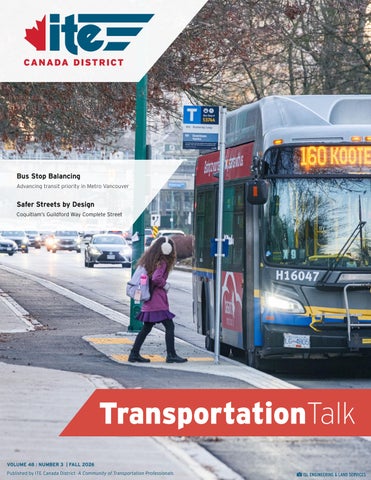
Bus Stop Balancing Advancing transit priority in Metro Vancouver
Safer Streets by Design Coquitlam’s Guildford Way Complete Street
TransportationTalk VOLUME 48 : NUMBER 3 | FALL 2026 Published by ITE Canada District—A Community of Transportation Professionals
ISL ENGINEERING & LAND SERVICES
SEEKING NEW TALENT? Reach thousands of transportation professionals and students with ITE Canada’s Job Board
ITE Canada Job Board offers: Ad posted instantly & proof-read Job emailed to 3,600+ member mailing list Job posting shared to ITE Canada’s social media channels
Your direct pipeline to thousands of top candidates
Grow your team at
itecanada.org/jobs
TRANSPORTATION TALK FALL | OCTOBER 2026 VOLUME 48 : NUMBER 3
FEATURES 13
2027 Joint ITE International & Canada District Annual Meeting: Call for Abstracts & Exhibitors Save the date and get your name on the program for our 2027 conference in Calgary next July 25-28
15
Virtual Technical Symposium Plan to join us for ITE Canada’s virtual event on December 3 featuring 17 speakers and 4 sessions
21
Highlighting Canadian ITE Student Chapters See the work of some of our outstanding student chapters and their exceptional leaders in building community, technical trips and fundraising, and STEM outreach
27 A Balanced Approach to Advance Bus Priority: Bus Stop Balancing in Metro Vancouver Stephanie Tsui shares the benefits of bus stop balancing and explains TransLink’s process and lessons learned in implementing this transit priority measure
33 Safer Streets by Design: Coquitlam’s Guildford Way Complete Street Project Showcasing the Path to a Safer Transportation Network Roy Symons, Scott MacDonald & Thomas Thivener highlight the design elements and outcomes of the 2026 ITE International Transportation Achievement Award Winner in Complete Streets
41
Member Highlight: Marcia Eng
43 Young Member Highlight: Steve Martin ITE CANADA NEWS 5
Call for Proposals - 2027 Training
7
Call for Volunteers: Committee & Appointees
10
Canadian highlights from ITE 2026 in Detroit
REGULAR COLUMNS + UPDATES
40 Training: Geometric Design Fundamentals & Emerging Practices in Urban Street Design 47 Partner News: CARSP ADVERTISERS 6
1
A Message from Your President Hear from President Irini Akhnoukh
3
From the District Director Updates from Julia Salvini and ITE International
49 Section News 61
Student Chapter News
70 Welcome New Members 73 ITE Canada Contacts
CTS
30 Associated Engineering 38 Align Engineering 69 Bunt & Associates
ITE Canada District • 150 Elgin Street, 8th Floor • Ottawa, ON • K2P 1L4 | itecanada.org © 2026 Canadian Institute of Transportation Engineers • Institut canadien des ingénieurs en transports (A Canadian Non-Profit Corporation)
FROM YOUR PRESIDENT
Where did summer go? I can’t believe we’re already well into fall with winter knocking at our doors. One highlight of my summer was attending the ITE International Annual Meeting in Detroit. It had been several years since I was last able to attend, so it was great to reconnect with colleagues from across North America, catch up with friends from LeadershipITE, and see what is happening across the broader organization. I spent much of my time helping to promote next year’s ITE International Annual Meeting in Calgary, but I also had the opportunity to cheer on two of our outstanding Canadian student chapters at the international competitions.
Irini Akhnoukh, M.Eng., P.Eng., FITE
I couldn’t have been more proud watching the
President, ITE Canada District
University of British Columbia and the University of
president@itecanada.org
Toronto Student Chapters represent Canada in the Traffic Bowl and Sandbox competitions. Our student chapters continue to impress with their talent, enthusiasm, and professionalism, and it’s always rewarding to see them showcase their skills on an
international stage. Supporting student members remains one of the most important things we do as an organization and seeing their success reinforces why that investment matters. ITE Canada is very excited to be hosting the 2027 Joint ITE International and Canada District Annual Meeting and Exhibition in Calgary next July 25-28. This will be later than our usual conferences and gives attendees the chance to take in a global ITE event and experience the beauty of Alberta in the summer. The Call for Abstracts is open until December 1. We hope to see many submissions showcasing your amazing work happening across the country. As fall moves ahead, ITE Canada is kicking into high gear. Sections and Chapters across the country are hosting technical sessions, networking events, and professional development opportunities that continue to bring our community together. These local events are the backbone of our organization and one of the best ways for members to stay connected and engaged. We encourage you to find one near you at itecanada.org/events. We’re also continuing to expand our training offerings. The Training Committee is developing two new courses focused on Speed Management for Safer Streets and Traffic Control Devices: Principles and Applications, with an Expression of Interest now open until November 13. A final offering of our popular Geometric Design: Fundamentals and Emerging Practices in Urban Street Design workshop will be hosted on November 19. And to wrap up the year, our third Virtual Technical Symposium will take place on December 3, 2026. The symposium has quickly become a valuable opportunity for members from across Canada to share knowledge, learn from one another, and engage with emerging transportation topics without having to leave their desks.
1
TRANSPORTATION TALK
Behind the scenes, ITE Canada’s Executive Committee and Board of Directors have spent much of the past year reviewing and updating our organizational policies. It was a substantial undertaking, but an important one to ensure our governance documents remain relevant, accurate, and aligned with the needs of the organization. I’d like to thank the Board members for the significant amount of time and effort they dedicated to this work. The updated policies are now available on our website. At the same time, both the Executive and Board are exploring new ideas and special projects aimed at enhancing the value of ITE Canada membership and strengthening the services and opportunities we offer to members. I’m excited about sharing more as those initiatives develop. We have two fast approaching deadlines. Our Call for Technical and Committee Volunteers closes on October 30. This is a great opportunity for anyone looking to get more involved in the organization. Operationally, we are also hiring a new part-time Operations & Communications Associate. If you know anyone who would be great fit for these roles, encourage them to apply! As we wrap up another year, our Annual General Meeting is scheduled for December 9, 2026. Although typically brief, the AGM provides a valuable opportunity to hear about ITE Canada’s financial performance, professional development activities, and our priorities for the future. I hope everyone enjoys the remainder of 2026 before we launch into more exciting initiatives in the new year. Warm regards,
Irini Akhnoukh, M.Eng., P.Eng., PTOE, FITE President, ITE Canada
FALL 2026
2
FROM THE DISTRICT DIRECTOR
It has been a busy few months at ITE. The July ITE International Annual Meeting in Detroit was the highlight over this time and held all the inspiration, connection, and celebration I had hoped for. Congratulations to the Canadians who were celebrated in Detroit, including Omar Shams for completing LeadershipITE, University of British Columbia for competing so well in Traffic Bowl, University of Toronto for winning the Sandbox Competition, our colleagues from ISL Engineering and City of Coquitlam who won the Complete Streets Technical Achievement Award, and Gene Chartier for winning the Distinguished Consultant’s Award. I was so proud to be able to cheer from
Julia Salvini, MEng, PEng, FITE
my table for each of these remarkable accomplishments.
Canadian District Director, ITE
In the coming year, our members are taking on various roles
director@itecanada.org
within ITE and I want to make a special shout-out to Erica Bayley who is taking on the role of Vice Chair of the LeadershipITE program. Erica is a passionate advocate for the program and will certainly leave her imprint on it. Thanks, Erica, for your continued leadership!
As summer winds down and the fall has snuck up on us, there have been many great events across the country. I had the opportunity to attend a joint Southwestern Ontario Section event with the local SWO chapter of WTS a few weeks ago. The event included a presentation about the history of the ION light rail system in Waterloo Region, the chance to ride the ION, and a presentation on the King/Victoria Transit Hub that will link ION with GO Transit, GRT bus services, private transit services and the many other modes that make downtown Kitchener so livable. The tour wrapped up with a ride on a historic train to St. Jacobs for lunch. It was a wonderful opportunity to hear about ongoing and new projects and to connect with colleagues from across the transportation spectrum. Special thanks to ITE President Gord Meth for making the trip to attend. I want to take this opportunity to share information about what ITE and the Transportation Professional Certification Board (TPCB) are working on in the area of Road Safety Audits - a topic area that seems to be on a lot of our members’ minds. There are two different, but important initiatives I would like to highlight: the ITE Road Safety Audit (RSA) Fundamentals Training Course, and the work of the TPCB to explore the potential for a Road Safety Audit Certification. A Road Safety Audit is a formal, independent safety performance review of a future or existing road transportation project, conducted by a multidisciplinary team of safety specialists. The ITE Road Safety Audit (RSA) Fundamentals Training Course is a two-day, in-person program that blends classroom instruction with hands-on application to give participants practical experience in conducting RSAs. Grounded in FHWA guidelines and with important Canadian context, the course
3
TRANSPORTATION TALK
emphasizes not just understanding RSA principles but applying them in real-world contexts. If this is of interest to you, please reach out to me as we are trying to gauge interest in Canada for the training. Meanwhile, in a separate effort, the TPCB is considering the development of a Road Safety Audit Certification program to enhance industry consistency and strengthen professional competencies. To guide this effort, TPCB assembled an advisory group to provide input and recommendations to TPCB. The advisory group is composed of practitioners representing public and private agencies, and academia. Several of our Canadians practicing in the area of road safety are involved in this effort and representing our Canadian perspective as discussions progress. As decisions are made around the certification, we will update the ITE Canada membership. As the fall season progresses, I hope you will make the time to connect with colleagues through a local ITE event. Your Sections and Student Chapters have many wonderful events planned to allow you to learn, connect, contribute, and grow as a professional.
Julia Salvini, P.Eng., FITE ITE Canada District Director
FALL 2026
4
2027 Professional Training - Call for Proposals ITE Canada invites individuals or firms to
Speed Management for Safer Streets
express their interest in providing professional training opportunities to our transportation
This proposed course is designed for
community in 2027. The purpose of this
transportation professionals who translate
training program is to equip and inform
speed-management principles into decisions
participants with the latest trends and skills
about collector and arterial corridors,
critical to their professional development,
intersections, neighbourhoods, complete
career success, and effective performance.
streets, micromobility, capital projects, and safety programs. The course also examines the
This year, ITE Canada is seeking submissions on
framework of roadway design and operations,
two training topics: Speed Management for
and methods that can produce the desired
Safer Streets and Traffic Control Devices.
speeds.
These training courses will provide a balance of
The course will be a practice-oriented
foundational knowledge and specific technical
workshop where participants will work through
applications, with opportunities for participants
speed data interpretation, context-sensitive
to learn about innovative approaches and
targets, constraints, countermeasures selection
relevant guidelines. Training content should
(including vertical/horizontal deflection, road-
also be eligible for Professional Development
width adjustments and psychological speed
Hours (PDH) with provincial regulatory bodies.
management), and post-implementation evaluation. Canadian examples and jurisdictional considerations must be used
5
TRANSPORTATION TALK
NEWS FROM ITE CANADA
alongside selected international case studies so
devices; regulatory, warning, and guide signing;
that participants can transfer the methods to
pavement markings; traffic signals; and
their own agencies and assignments.
temporary traffic control. The course would also examine the application of design
Speed-management concepts increasingly need
standards, human factors, and engineering
to reconcile roadway function, land use,
judgment in the selection and implementation
vulnerable-road-user exposure, transit
of traffic control measures to support safe and
operations, active transportation, emergency
efficient roadway operations.
response, accessibility, public expectations, and network performance toward Vision Zero and
The course should include an interactive
Safe System frameworks.
workshop where attendees apply these concepts by selecting and placing appropriate
Download EOI Speed Management
signs and pavement markings for a street or intersection, using both urban and rural examples. As a value-add, the training could
Traffic Control Devices: Principles and Applications This training would cover the broad fundamentals of traffic control design, including the appropriate use of traffic control
also incorporate current industry “hot topics,” such as multimodal traffic control, wayfinding for active transportation users, speed management treatments, work zone innovations, and the use of technology and data-driven approaches to support traffic control design and operations.
Download EOI Traffic Control Devices Expression of Interest To submit, please review the Expression of Interests above in detail and submit the information requested to training@itecanada. org by the noted deadlines. • •
Deadline for questions: October 30, 2026 by 11:59 PM (Pacific) Deadline for submissions: November 13, 2026 by 5:00 PM (Pacific)
Prospective trainers submitting a response to this Expression of Interest can expect the ITE Canada Training Committee to conduct their proposal evaluation and selection in Fall 2026. The successful proponent is expected to be Traffic Engineering • Transportation Surveys • Transport Planning
www.cts-bc.com info@cts-bc.com 604.936.6190 PAID ADVERTISEMENT
notified by mid December 2026 with delivery of the first training session in early 2027.
Offices in Metro Vancouver & the Okanagan Connect with us FALL 2026
6
Volunteer Opportunities Call for Volunteers ITE Canada District is seeking new members for our committees and appointees to six TAC and ITE International Technical Councils & Committees. The deadline to apply for all positions is October 30, 2026. You may indicate your interest in multiple positions on one volunteer form submission. Application Deadline: Friday, October 30, 2026
Training Committee The ITE Canada Training Committee is seeking
Since the Training Committee is primarily a
a new member to contribute to the
coordinating body tasked with providing
coordination and organization of high-quality
opportunities for training to ITE Canada
training initiatives for transportation
members, it typically does not get involved with
professionals throughout Canada. The ITE
the development of specific training materials
Canada Training Committee’s goal is to
or delivery of the actual training sessions.
increase the availability of high-quality training opportunities for Canadian transportation
We are seeking one new member to join the
professionals by overseeing the development
ITE Canada Training Committee beginning
and delivery of training initiatives. Past training
January 1, 2027. The term for the committee
sessions coordinated by the Training
members is maximum of four years, where you
Committee include Geometric Design,
you may serve as a member, Vice-Chair, Chair,
Transportation & Affordability, Transportation
and Past Chair. To apply, please complete the
Equity, Big Data and Emerging Traffic
ITE Canada Volunteer Form at itecanada.org/
Technologies, Multimodal Traffic Signal
volunteer by October 30, 2026 and check off
Operations, Bicycle Facilities Design, Protected
ITE Canada - Training Committee along with
Intersection Design and Accessibility.
any other opportunities you may be interested in.
As a member of the Training Committee, you will collaborate with the committee team for
More information, including the Committee’s
prioritizing training needs and emerging topics,
Terms of Reference, is available here. If you
selecting and procuring facilitators, and
have any questions about this opportunity and
organizing ITE training events for
the Training Committee, please feel free to
transportation professionals across Canada.
contact them at training@itecanada.org.
Start application
7
TRANSPORTATION TALK
NEWS FROM ITE CANADA
Appointees to ITE
Appointees to TAC
The ITE Canada Technical Liaison Committee
The ITE Canada Technical Liaison Committee (TLC)
(TLC) is looking to fill two Appointee positions
is looking to fill two Appointee positions to TAC
to ITE International Councils & Committees
Councils & Committees (TAC Appointees)
(ITE Appointees) beginning January 1, 2027
beginning January 1, 2027 for the following:
for the following: •
Sustainability Committee (under the Planning Council)
•
Transportation Systems Management & Operations Council
• •
years. They are expected to attend the ITE Annual Meeting in person (under normal conditions), representing ITE Canada, and may be assigned to lead projects within their committees/councils, representing ITE Canada. Expenses are expected to be covered by the employer but may be partially subsidized by ITE Canada depending on budget availability and priorities and subject to successful completion of post-meeting Activity Reports.
Mobility Management Committee (under the Mobility Council)
•
Traffic Operations and Management Committee (under the Safety, Design and Operations Council)
ITE Appointees are assigned for three-year terms, renewable up to a maximum of two
Mobility Council
•
Technology Council
TAC Appointees are assigned for three-year terms, renewable up to a maximum of two years. They are expected to attend the Fall TAC technical conference in person (under normal conditions) and the Spring conference virtually, representing ITE Canada. They may also be assigned to lead projects within their committees/councils, representing ITE Canada. Expenses are expected to be covered by the employer but may be partially subsidized by ITE Canada depending on budget availability and priorities and subject to successful completion of post-meeting Activity Reports.
ITE and TAC Appointee candidates must be current paid members of ITE, illustrating knowledge and involvement with ITE. To apply, complete the Volunteer Form at itecanada.org/volunteer by October 30, 2026. On the form, check off ITE International – Council/Committee Appointee and/or TAC Council/Committee Appointee and select the position(s) you are applying for as well as any other opportunities you may be interested in. Please also provide the skills you would bring to the committee, an indication of support from your employer, and a resume. If you have any questions about the volunteer position as an ITE Appointee, please feel free to contact them at tlc@itecanada.org.
Start application
FALL 2026
8
VOLUNTEER OPPORTUNITIES
Technical Liaison Committee (TLC) The ITE Canada Technical Liaison Committee
ITE Canada depending on budget availability and
(TLC) is looking for a new committee member
priorities.
beginning January 1, 2027. A minimum of four members will comprise the core of the TLC with
Preference in choosing TLC members will be
an appointed member from the ITE Canada
given to current ITE Canada Appointees and ITE
Executive Committee as liaison.
members illustrating knowledge and involvement with ITE. Other interested ITE members are also
TLC members are appointed for five-year terms.
encouraged to apply.
They are expected to attend at least one face-toface meeting per year (under normal conditions),
To apply, please complete the ITE Canada
attend a monthly conference call, and assist in
Volunteer Form at itecanada.org/volunteer by
the ongoing coordination of ITE and TAC
October 30, 2026. On the form, check off ITE
appointees as well as technical projects that ITE
Canada - Technical Liaison Committee as well as
Canada is involved in. Furthermore, the TLC
any other opportunities you may be interested in.
members also support ongoing partnership development and relationship building with other transportation organizations such as CARSP and CUTA.
The Terms of Reference and more information about the Technical Liaison Committee can be found here. If you have any questions about this opportunity and the TLC, please feel free to
An indication of support from your employer is
contact them at tlc@itecanada.org.
required. Expenses are expected to be covered by the employer but may be partially subsidized by
Start application
Members of the ITE Canada Technical Liaison Committee (TLC) with Appointees to ITE and TAC in 2025 9
TRANSPORTATION TALK
Canadian highlights from Detroit 2026 ITE Annual Meeting Canadians made their mark at the 2026 ITE International Annual Meeting in Detroit with many of our members recognized for their technical contributions, outstanding performance in student competitions, and leadership in the industry and service to ITE.
Professional Excellence Transportation Achievement Award in Complete Streets Guildford Way Complete Street Project
ITE Distinguished Consultant Award in Honour of Nelson J. Shaffer Gene Chartier The ITE Distinguished Consultant Award in Honour of Nelson J. Shaffer recognizes a
ITE’s Transportation Achievement Awards
consultant for outstanding contributions to the
recognize excellence in advancing transportation
transportation engineering and planning
to meet human needs. The Guildford Way
profession. Gene Chartier, M.A.Sc., P.Eng.,
Complete Street Project exemplifies this purpose
exemplifies the spirit of this award through a
by transforming a 2.2-kilometer arterial corridor
35-year career defined by technical leadership,
in Coquitlam, British Columbia into a safer, more
professional service, mentorship, and an enduring
accessible, and more comfortable complete street
commitment to advancing ITE and the
that supports people walking, biking, rolling,
transportation industry.
riding transit, and driving while maintaining vehicle capacity. Congratulations to everyone involved in this project from ISL Engineering and Land Service, DMD & Associates Electrical Consulting, and the City of Coquitlam!
Gene Chartier (middle) with ITE President Gord Meth and ITE Executive Director Steve Kuciemba
Learn more about this award-winning project in the feature article on page 33—Safer
Thomas Thivener of City of Coquitlam and Scott McDonald of ISL Engineering and Land Services accept the Transportation Achievement Award from ITE President Gord Meth and ITE Executive Director Steve Kuciemba
Streets by Design: Coquitlam’s Guildford Way Complete Street Project Showcasing the Path to a Safer Transportation Network
FALL 2026
10
ITE INTERNATIONAL
Outstanding Students Sandbox Competition University of Toronto ITE International’s 2026 Sandbox Competition challenged teams from across the ITE community to develop solutions to transportation planning challenges around the theme of people-centred mobility. The Student Competition required the creation of a People Centered Mobility Plan and
Left to right: Michael Hollander, Sean Leung, and Lucas Gaspari with their winning plaque at the “ITE” letters in Detroit
Roadway Network Design to incorporate the concepts of People Centered Mobility into an existing university campus environment. For the first time, a Canadian team was selected as a finalist and won the top prize. Congratulations to team members from the University of Toronto: Sean Leung, Lucas Gaspari, and Michael Hollander (pictured) as well as co-authors lan Cassidy, Kaiy Cao, Thanusan Ragulan, and Owen Zhang!
Traffic Bowl
Lucas Gaspari answers questions after Sean Leung’s presentation of the University of Toronto team’s work
University of British Columbia Well done to the team from the ITE UBC Student Chapter who represented Canada at the ITE Collegiate Traffic Bowl Grand Championship in Detroit! It was a hard fought battle and though they didn’t advance to the final round, they made us proud. Congratulations to team members: Kelly Zhang, Victress Philemon, and Bradley Carver, and alternate Tarek Ghoul.
Left to Right: Victress Philemon, Bradley Carver, and Kelly Zhang in the hot seat during the 2026 Traffic Bowl Championships
11
TRANSPORTATION TALK
HIGHLIGHTS FROM DETROIT 2026
Recognizing Emerging Leaders The ITE Canada 2026 Rising Star—Kelsey Waugh, Treasurer on the District Executive from the Toronto Section—was highlighted as part of the overall class of District Rising Stars. The 2026 Class of Young Leaders to Follow was also announced and includes two Canadians: •
Karalee Bloch, P.Eng., RSP1 – Road Safety Engineer, Manitoba Transportation and Infrastructure (Manitoba Section)
•
Kelsey Waugh, P.Eng., RSP1 – Project
ITE President Gord Meth (left) and Executive Director Steve Kuciemba (right) with Omar Shams, 2026 Canadian graduate of LeadershipITE
Manager, Transportation Mobility, CIMA+ (Toronto Section) Finally, we extend a hearty congratulations to Omar Shams, M.Eng., C.E.T., City of Hamilton & Hamilton Section, who graduated from the 2026 Class of LeadershipITE and Erica Bayley for her role as Vice Chair of the LeadershipITE Member Program Committee.
LeadershipITE graduate Omar Shams (left) and LeadershipITE Committee Vice Chair Erica Bayley (right)
LeadershipITE alumni present at the Detroit Annual Meeting including Canadians Irini Akhnoukh, Erica Bayley, Tyler Golly, Jill Juhlke, Julia Salvini, Omar Shams, David Thatcher, Peter Truch, and Ryan Vanderputten.
FALL 2026
12
ITE Canada District is thrilled to be co-hosting the Joint ITE International and Canada District Annual Meeting and Exhibition at the BMO Centre in Calgary, Alberta next summer, July 25–28, 2027. ITE International has launched the Call for Abstracts and we invite you to submit to showcase your work, shape key conversations, and demonstrate how better planning, design, and operations improve communities to a global audience of transportation professionals. Keep up to date with all conference-related news at the official #ITECalgary27 conference website: iteannualmeeting.org.
13
TRANSPORTATION TALK
Share Your Expertise: Conference Call for Abstracts Closing December 1, 2026 The 2027 Annual Meeting will feature a diverse program of sessions and discussions across eight major tracks, offering both practical solutions and innovative strategies that advance the transportation profession and create positive impacts on safety, mobility, and community outcomes: •
Safety: Implementing the Safe System Approach, conducting road safety audits, and designing for vulnerable road users.
•
Traffic Engineering: Advancing traffic signal operations, designing innovative intersections and interchanges, and implementing speed management techniques.
•
Planning: Promoting sustainable, equitable, and transparent planning; integrating trip and parking generation data; and strengthening planning-engineering connections.
•
Complete Streets: Designing inclusive networks, improving pedestrian and bicycle facilities, enhancing transit access, and creating healthy, multimodal communities.
•
Transportation Operations: Improving incident detection and response, managing planned and unplanned events, and deploying technology that supports transportation systems management and operations (TSMO).
•
Technology and Innovation: Leveraging data, analytics, artificial intelligence (AI), and intelligent transportation systems (ITS) to enhance safety, operations, and services for all communities.
•
Professional Practice: Focusing on leadership, communication, collaboration, and workforce development.
•
Education: Focusing on various elements of transportation education.
Abstracts are invited in a variety of session formats: Technical Presentation, Poster, Full Conference Session, Technical Workshop, and Calgary in Motion Field Session.
SEE FULL CALL FOR ABSTRACTS
Showcase Your Company Exhibitors are invited to join the #ITECalgary27 trade show and be profiled alongside dozens of fellow vendors and suppliers at the BMO Centre. Sponsorship opportunities will also be available with a prospectus to be released late 2026.
EXHIBIT
FALL 2026
14
ITE CANADA DISTRICT
Virtual Technical Symposium December 3, 2026 ITE Canada invites you to join us for our 2026 Virtual Technical Symposium. Earn professional development credits (PDHs) and learn from four virtual sessions on Special Event Management, Complete Streets, Road Safety & Vision Zero, and Transportation Systems & Operations. Explore the program, consider opportunities to showcase your company, and mark your calendar!
15
TRANSPORTATION TALK
Thursday, December 3, 2026 9 am – 2 pm (Pacific Time) 11 am – 4 pm (Eastern Time) The symposium will consist of four live virtual sessions with short breaks in between.
ITE CANADA 2026 VIRTUAL TECHNICAL SYMPOSIUM
9:00–10:05 (PT) / 11:00–12:05 (ET)
fans including many visitors from around the world, all while keeping the city moving. This
SESSION 1
presentation highlights how Vancouver planned
Special Event Management
and delivered an excellent World Cup
SPONSOR:
UCI World Road Championships 2026 in the City of Montreal
transportation experience for visitors, residents, and businesses alike.
Moderated by: Destiny Piper
Davide Campellone
ITE Canada Vice-President & KGS Group
This session will go behind the scenes of two major global events held in Canada this year and the mobility management work that was required to make these events possible.
Vancouver’s FIFA World Cup 2026 Mobility Experience Sherwood Plant City of Vancouver FWC26 Host City Mobility Lead Over the course of seven FIFA Men’s World Cup matches hosted in the summer of 2026, Vancouver welcomed hundreds of thousands of
City of Montreal Traffic Engineer In support of the 2026 UCI Road World Championships in Montréal, the City of Montréal explored a technology-driven approach to traffic and mobility management aimed at reducing congestion. Through a collaboration between the Innovation and Mobility Management Division and the Montréal Police Service (SPVM), the project leveraged the capabilities of the Urban Mobility Management Centre (CGMU), including video surveillance, real-time performance indicators, and online monitoring platforms. The initiative demonstrated how dynamic traffic signal management can enhance network efficiency, support road user safety, and mitigate the impacts of major events through proactive, datadriven traffic operations.
SPONSORSHIP Showcase your company with a symposium sponsorship. Only three sponsorships are remaining at $500 each. Each sponsor receives the following benefits: • Complimentary registration for two individuals ($250 value) • Recognition during opening plenary + chosen sponsored session (selected in order of registration) with logo on slide & verbal acknowledgement • Recognition in promotional materials including the event website, social media posts reaching 8,000+ followers, and email blasts to 4,000+ transportation professionals and students • Access to attendee list by request Purchase your sponsorship here. Questions? Contact us.
FALL 2026
16
ITE CANADA 2026 VIRTUAL TECHNICAL SYMPOSIUM
10:20–11:20 (PT) / 12:20–13:20 (ET)
•
SESSION 2
Complete Streets
•
The Solution: Quick-build bike lanes followed by permanent reconstruction. We’ll compare their strengths and limitations, then examine protected intersections, floating bus stops, signal timing, and turning rules. The Results: Highlighted by a 99.4% reduction in critical and high-risk conflicts.
SPONSORSHIP AVAILABLE Moderated by: Julia Salvini ITE Canada District Director & Mosaic Mobility Group
This session will highlight complete streets projects transforming communities across the country as well as strategies municipalities are using to shape future improvements.
Lessons and Results from Coquitlam’s Award-Winning Guildford Way Complete Street Transformation Scott McDonald ISL Engineering and Land Services Sustainable Transportation Planner
Steeles Avenue East Complete Street Sayan Sivapathasundaram City of Toronto Transportation Engineer The Steeles Avenue East Complete Street project transformed a critical arterial corridor into a safer, more accessible, multimodal, and sustainable roadway. Following the Metrolinx Stouffville Line grade separation between Kennedy Road and Midland Avenue in 2023, this City of Toronto led initiative extended those benefits eastward by integrating cycling, pedestrian, and safety improvements as part of a coordinated road resurfacing and reconstruction project between Midland Avenue to McCowan Road. The project required extensive coordination with many partners and demonstrates how proactive corridor rehabilitation can be leveraged
Tom Thivener
to deliver long-term mobility, safety, and
City of Coquitlam Manager, Transportation Planning
environmental benefits for the community.
In 2025, Coquitlam transformed Guildford Way, a suburban arterial in a densifying part of Metro Vancouver, into a complete street. The project
York Boulevard & Cannon Street West – Hamilton’s Complete Streets Transform
received the ITE International 2026 Award for Excellence in Complete Streets. This presentation
Danny Pimentel
will touch on:
City of Hamilton Senior Project Manager, Integrated Active Transportation
•
•
17
The Context: A suburban area growing denser, with nearby SkyTrain service reflecting that shift. The Problem: Walking and cycling felt uncomfortable, particularly at intersections.
TRANSPORTATION TALK
At the City of Hamilton, we see sustainable mobility as more than moving people from one place to another—it’s about reimagining our
streets as places that connect communities,
designed to meet the urgent need to prevent
support healthy lifestyles, and create
further harm and create safer streets for all. The
opportunities for everyone. Through the
Action Plan outlines 68 interdisciplinary actions
integration of our Complete Street Design
across 12 City departments using a myriad of
Manual, meaningful public engagement, and
visually captivating infographics, data analysis,
community activation initiatives such as the
maps, and local examples. It kickstarted a new
Mobility Lab, we are building a new approach to
way of doing things in Guelph, focused firmly on
how we plan and design our transportation
actions that prevent collision causing injuries,
network. The York Boulevard Cycle Track was an
reduce risk and exposure across our
important first step in bringing this vision to life,
transportation system, and communicating this
demonstrating what is possible when innovative
new approach effectively. This presentation will
design and community voices come together to
share the story behind the Action Plan, key
transform our streets.
lessons learned, achievements to date, and what comes next.
11:35–12:35 (PT) / 13:35–14:35 (ET)
SESSION 3
Road Safety & Vision Zero
Systemic Intersection Safety Plan for Saskatchewan Highways Monique Beaudry Associated Engineering National Discipline Lead Transportation Planning
SPONSORSHIP AVAILABLE Jeffrey Holland Moderated by: Carolyn Sherstone
Saskatchewan Ministry of Highways Director of Traffic Engineering
Symposium Committee & WSP This presentation will provide an overview of a
This session will shine a light on municipal and provincial efforts to move communities towards safer streets through data-driven assessments, strategies, and countermeasures.
systemic safety assessment of highway intersections project completed by Associated Engineering with support from Human Factors North for the Saskatchewan Ministry of Highways. The result was a repeatable, data-driven screening tool that feeds project development,
Zero by Design: Building Guelph’s Vision Zero Action Plan Nico Koenig City of Guelph Transportation Safety Specialist The City of Guelph’s Vision Zero Action Plan is a plain-language, equity-informed, and data-driven report grounded in public health principles,
funding prioritization, and post-implementation evaluation. The project developed a plan to proactively reduce the risk of severe collisions over the whole highway network and demonstrated that Saskatchewan has a solid foundation of collision data, road characteristic data, and traffic volume data while identifying areas for improvement. The resulting recommendations will guide the Ministry’s approach to prioritizing intersection safety improvements.
FALL 2026 SCOTT WEBB\UNSPLASH
18
ITE CANADA 2026 VIRTUAL TECHNICAL SYMPOSIUM
Creating Safer School Connections: A Vision Zero Road Safety Review in New Westminster Kanny Chow City of New Westminster Transportation Engineer
Alvin Tse
12:50–14:00 (PT) / 14:50–16:00 (ET)
SESSION 4
Transportation Systems and Operations SPONSORSHIP AVAILABLE
ISL Engineering Road Safety Lead
Moderated by: Breanna Jackson
Omid Ebadi
Symposium Chair & Associated Engineering
ISL Engineering Transportation Engineer Sixth Avenue and Second Street in New Westminster, beside Herbert Spencer Elementary, is a daily route for hundreds of students and
This session will explore various aspects of transportation systems planning, traffic operations and tools to inform decisionmaking in the face of various constraints.
families. Recurring curb-mounting incidents and a high share of injury collisions a Road Safety Review. The review combined insurance and police collision data, field observations,
Real-time Decision Support for Transit Headway Management
community input, operational modelling, and
Mehdi Nourinejad
AI-based video conflict analysis using TrafxSAFE.
York University – Associate Professor
Over 60 hours of footage revealed frequent pedestrian-vehicle near misses, aggressive turning, queue spillback, limited sightlines, and
This presentation introduces an AI-driven real-
speeding in the school zone.
time decision-support platform developed by York University and the Toronto Transit Commission
Guided by Vision Zero and the Safe System
(TTC) to improve transit reliability by addressing
approach, ISL developed achievable, data-driven
bus bunching and service gaps. Integrating real-
countermeasures including a full traffic signal
time vehicle data, predictive analytics, and
with Leading Pedestrian Intervals and no right
optimization, the platform identifies headway
turn on red, speed feedback signs, painted
disruptions and recommends corrective
markings, curb extensions and speed tables, and
interventions, including targeted vehicle holding.
improved lighting. These measures have lowered
During a six-month TTC pilot, operators made
the risk of Killed or Seriously Injured (KSI)
14,672 decisions, and 88.4% of bunching events
collisions through lower speeds, a formalized
with applied holds were reported as resolved
intersection, and greater pedestrian priority.
within 14 minutes. The presentation will highlight
Many of these improvements can be piloted first
the underlying methodologies, operational
with modular materials, offering an approach that
results, human-in-the-loop decision-making, and
can be applied by other municipalities.
lessons learned from deploying AI-enabled transportation systems management tools in practice.
19
TRANSPORTATION TALK
Everything and the Kitchen Sink: Systems Planning in a Small Municipality Bruce Belmore KGS Group – VP of Transportation & Infrastructure
Destiny Piper KGS Group Transportation Planning Lead
Keeping Niagara Moving: How Multi-Scale Traffic Modelling Guided the Garden City Skyway Construction Keyur Shah HDR Traffic Lead (Eastern Canada)
Qingjie Zeng HDR Microsimulation Practice Lead
Moose Jaw – with a strong tourist focus – is a small municipality located in southern
Major freeway construction projects can
Saskatchewan with a population of 34,000
significantly affect traffic operations, requiring
residents. Several years ago, the City of Moose
agencies to balance infrastructure renewal with
commissioned a study to renew their dated
mobility and safety. This presentation
Transportation Master Plan. Like most small
demonstrates how a multi-scale traffic
municipalities, Moose Jaw has many more
modelling framework was used to support
infrastructure needs than there is money
construction staging for the QEW Garden City
available to fix them and the City wanted a
Skyway project in Niagara Region. By
comprehensive investigation of 15 different
integrating regional travel demand modelling,
focus areas, including signal equipment
microsimulation, and intersection operations
condition, corridor operation, rail crossing
analysis, the study evaluated construction-
assessment, school zone safety, transit system
related traffic impacts, identified diversion
review, cycling network needs, sidewalk and
patterns, and assessed mitigation measures
pathway deficiencies, etc. Fortunately, there
across both freeway and local road networks.
was ample budget to develop a comprehensive
The results informed staging decisions, reduced
plan. But what happens when there is not
project delivery risks, and helped maintain
enough money to implement all of the network
network performance. The approach provides a
changes a municipality needs?
practical and transferable framework for managing traffic during major transportation infrastructure projects.
REGISTRATION Register at itecanada.org
Registration includes access to live virtual sessions and a PDH certificate. Recordings will also be made available for a limited period afterward.
Registration closes Tuesday, December 1
Registration Rates • ITE Member: $75* • ITE Young Member: $50 • ITE Student Member: $10 • Non-ITE Member: $125*
*Group Discount: Receive 30% off of 4+ regular ITE Member or Non-Member registrations purchased together. Tune in separately from remote offices or gather in a boardroom to learn together.
FALL 2026
20
Highlighting our Canadian
ITE Student Chapters
ITE Canada’s Student Chapters continue to exceed expectations with their events, workshops, competitions, social events, technical trips, and more. This article highlights four exemplary Student Chapters and their outstanding work in 2026: ITE University of Waterloo, ITE University of Manitoba, ITE University of Victoria, and ITE British Columbia Institute of Technology. Students Chapters are an integral part of ITE Canada, bringing energy to our community, developing future leaders, and sparking an interest in transportation careers for many soon-to-be professionals. With the goal of learning, growing, and fostering new connections with other aspiring young professionals, these Student Chapters are an inspiration and exemplify the fantastic work being done in the ITE student community across Canada.
21
TRANSPORTATION TALK
CELEBRATING CANADA’S STUDENT CHAPTERS
University of Waterloo - 2026 Outstanding Student Chapter Award Winner
A DIVERSE & ENGAGED COMMUNITY By Adrian M. Hipolito, Eric Tran & Benjamin Gosselin, ITE University of Waterloo Executive ITE UW is built around a simple idea: transportation attracts people from diverse backgrounds, and a strong student chapter should give all of them a place to connect. Our members include everyone from transit enthusiasts to highway fans, and we have intentionally built events around that range of interests. Through technical workshops, industry talks, competitions, tours, and social events, we aim to create multiple ways for students to engage with transportation beyond the classroom. That interest also extends well beyond our traditional programs of civil engineering and planning. Our events have drawn students from fields such as Mechatronics Engineering, Computer Science, Statistics, Systems Design, and Management Engineering, demonstrating a broader appetite to learn about transportation. We try to meet that interest by giving students practical entry points into the field. Workshops on ArcGIS Pro and PTV VISSIM, for example, introduce younger students to tools they may not otherwise encounter until upper-year courses or work terms. Our goal is not only to engage students already studying transportation, but also to give those from other disciplines the tools to explore it. We have also adapted Waterloo’s well-established design team model to ITE. For our Sandbox Competition team, lower-year students can contribute meaningfully within subteams, while upper-year students gain leadership experience by managing teams, mentoring members, and taking ownership of different parts of the project. Over the past two years, our members have come together to propose solutions to complex transportation issues and present them to professionals at various conferences. These topics include a proposal to redevelop UW’s Transit Terminal into a mobility hub and the development of a people-centric mobility plan for the University of Michigan– Dearborn. This structure allows technical projects to simultaneously serve as learning opportunities and as leadership pipelines. Community building has been just as important as technical development. A Minecraft server, initially piloted by a member through our leadership development program, continues to run today, while our Discord server provides an informal space for members to discuss all things transportation. General members are also encouraged to develop and lead their own initiatives. By collaborating with chapter members who are involved in other clubs, we have created unique beginning-of-term activities, including our own student Traffic Bowl-style trivia competitions and GeoGuessr events. Members have also taken ownership of creative initiatives, such as a merchandise design competition, where students developed sticker and poster concepts for the chapter, and the development of K-12 Complete Street workshops centred on introducing transportation concepts to middle school students. Together, these activities give students with shared interests in transportation a chance to learn from one another, contribute
FALL 2026
22
their own ideas, connect outside the classroom, and simply enjoy the topics that brought them to ITE in the first place. For ITE UW, success has come from giving students more than opportunities to participate and learn about transportation. We want them to apply what they know, lead something of their own, and, most importantly, connect with other people who share their interests. That sense of ownership and community has helped ITE UW become more than an organizer of events. It has become a place for students to explore transportation together.
University of Manitoba
INTERNATIONAL TECHNICAL LEARNING & FUNDRAISING By Alexandre King, VP Outreach, ITE University of Manitoba The University of Manitoba ITE Student Chapter (UMITE) had the opportunity to participate in two technical trips in 2025 and 2026, providing students with firsthand exposure to transportation systems and practices outside Canada. Both trips were planned and coordinated by students and focused on connecting learning with real-world transportation projects and professionals. In 2025, UMITE sent a delegation to the Netherlands to study international best practices in sustainable transportation planning and design. Students participated in technical tours with organizations including the Dutch Cycling Embassy, Nederlanse Spoorwegen (NS), TU Delft, and Stantec. The delegation learned about the development and promotion of cycling infrastructure, rail operations and multimodal integration, transportation policy and modeling, and the role of private consultants in delivering transportation projects. The delegation also met with Professor Bert van Wee at TU Delft to discuss transportation policy, travel behaviour, and transportation modelling. Together, these visits provided students with insight into integrated cycling, rail, policy, and consulting practices that contribute to the Netherlands’ transportation system. In 2026, UMITE travelled to Tokyo, Japan to explore how transportation systems are planned, operated and integrated within one of the world’s largest metropolitan regions. Students participated in technical tours with Tokyu Corporation, Tokyo Metro, Yurikamome Inc., Shinjuku Expressway Bus Terminal, and the University of Tokyo. The group learned about topics including transit-oriented development, urban rail integration, automated transit operations, and large-scale station redevelopment. The delegation also met with Professor Oguchi at the University
23
TRANSPORTATION TALK
CELEBRATING CANADA’S STUDENT CHAPTERS
of Tokyo to discuss his transportation research and current challenges in traffic management. Visits to projects like Shibuya Station redevelopment, Toranomon Hills Station, and the Yurikamome Line provided students with firsthand insight into the engineering, planning, and operation behind Tokyo’s extensive transportation network. To establish the connections needed for these technical trips, UMITE began planning well in advance by developing a shortlist of potential countries that were of interest. The chapter then extensively researched previous transportationfocused technical trips organised by other universities and student groups, many of which were published online. These previous trips provided valuable leads to organizations and contacts who had experience hosting technical tours and could potentially organize similar tours for UMITE. The chapter also pursued any personal connections that could help establish contacts, whether through professors, students, alumni, or other members of the transportation community. In the case of the Japan technical trip, UMITE was particularly fortunate to have an executive member who had completed their master’s degree at the University of Tokyo, which helped the chapter establish connections to arrange a visit. Funding these trips required a combination of student-led fundraising and support from the University of Manitoba and the ITE Manitoba section, with most of the overall cost ultimately covered by participating students. UMITE organized several fundraising events throughout the year, with samosa sales being one of the chapter’s largest and most consistent sources of revenue. These events made the trips more accessible by reducing the cost to attend.
University of Victoria - 2026 Student Chapter Momentum Award Winner
STEM & COMMUNITY OUTREACH By Julia Tay (2025-2026 VP Community Outreach) and Aislinn Dressler (2025-2026 President)
A Year of Outreach In 2025 and 2026, a big focus of our club was engaging younger students in the transportation field through workshops and events. For our K to 12 workshops our primary focus was introducing students to the transportation field, showing them how design choices can make them feel safer, and conducting mini field work exercises. This outreach was impactful for the students and for our executives.
FALL 2026
24
What We Did From August 2025 to April 2026, our club ran seven outreach workshops with a range of students. In August, two of our executive members went to UBC to work with Geering Up to run a transportation workshop for more than 50 Grade 8 to 12 students. This included an introduction to transportation engineering, a traffic count, and a safety assessment as well as discussions about how to get involved in the field in their communities. In October, the team ran a workshop with a local Rangers Girl Guides section (ages 15 to 17) to introduce attendees to transportation engineering. The session included a game with traffic signs, a site tour, and a site improvement activity to reinforce the topics discussed. In November, our team attended a UVic Science Venture event called Go Eng Girl, where individuals aged 8 to 14 came to learn about engineering. We introduced different types of transportation accessibility concerns to the attendees in a workshop and conducted a site visit around campus to point out the concepts in real life. The team then guided attendees through proposing improvements to an intersection to increase safety and accessibility. In February, our team held a workshop for Girl Guides Brownies group, ages 7-10. We introduced transportation engineering, sustainable transportation, and safe transportation. The workshop included crafts, an obstacle course, and an outdoor field trip to reinforce these concepts in a more engaging way. In March, three of our executive members attended an Engineering for Kids Minecraft camp run through the District of Saanich, and ran a two hour workshop. This workshop was quite similar to the Brownies Girl Guides workshop, as the age groups were relatively similar.
Factors for Our Success Our K-12 outreach was very successful during 2025-2026 due to the opportunities found by our dedicated VP of Community Outreach. We leveraged connections within the team to reach out to Girl Guides and UBC Geering Up. We were able to use these initial opportunities to gain our following opportunities, which were researched and cold called/emailed. We encourage other chapters to take advantage of the STEM outreach created by the universities, such as Gearing Up, Science Venture, and science fairs. Our team was fortunate in having multiple team members who work or have previously worked with children and in child development. This foundation ensured that our activities, concepts, and terminology were appropriate and engaging for the age group. We used the K-12 resources provided by ITE, as well as created our own games and activities to develop our lesson plans. Lesson plans for each workshop were made with the same basic building blocks: (1) presentation on transportation, (2) field visit, and (3) activity. For the presentation, we
25
TRANSPORTATION TALK
CELEBRATING CANADA’S STUDENT CHAPTERS
highlighted the definition of transportation, and careers in the field, although our team found more success in group discussion and reduced presentation time. For the field visit, students were asked to either conduct a traffic count in groups or identify the safety or accessibility challenges and improvements they can see in the current design at a nearby intersection. We ended with an activity that included print out copies of the observed intersection for older students, and crafts or obstacle courses for the younger ones.
British Columbia Institute of Technology - Our Newest Student Chapter
COMMUNICATION & ADVOCACY IN STUDENT LEADERSHIP By Alex Reis, BCIT ITE Chapter President Starting a new student chapter is not something which can be done quickly or easily. Coordination with the school, student association, students, and ITE requires constant advocacy and relationship building. One lesson we learned very quickly in the establishment of our chapter is that you shouldn’t be afraid to ask for something or advocate on behalf of your community. Being able to justify and prove that there is interest in whatever it is you’re working on is an important skill for any professional or future professional. To establish our new ITE chapter we worked strategically on reaching out to students to prove interest in creating a new ITE club. We also reached out to members of our neighbouring student chapter at UBC and those at ITE Canada to see what has historically been successful. Using these resources, we were able to have successful events in our first year as a chapter and have been building on this momentum to host larger events through help from industry sponsors. Our chapter is also lucky enough to have a faculty advisor who is passionate about connecting students to learning more about transportation engineering and planning. We found that maintaining clear communication with our faculty advisor on upcoming events, questions, and planning has helped us establish a good relationship with BCIT. This relationship has helped us work closely with instructors and faculty when needed. A recent example of this relationship is when BCIT faculty reached out to our chapter to introduce the chapter to the first-year Civil Engineering students on their first day. This has created increased interest in chapter membership and events, which helps further strengthen our chapter.
FALL 2026
26
A Balanced Approach to Advance Bus Priority Bus Stop Balancing in Metro Vancouver By Stephanie Tsui, TransLink
27
TRANSPORTATION TALK
TRANSIT PRIORITY IN METRO VANCOUVER
As cities resume normalcy and revert to preCOVID travel patterns, traffic congestion has also returned to pre-COVID levels. This means longer commute times and delays for everyone, including transit users. In Metro Vancouver, buses carry more than 60% of all transit riders in the region who share road space with general purpose (GP) traffic. On the region’s busiest corridors, bus passengers can account for 30% to 60% of all people on the road. While there were pandemic restrictions, bus delays were back to pre-pandemic levels by Fall 2021. According to its 2025 Bus Speed and Reliability (BSR) Report, TransLink estimates that over $115 million per year (800,000 annual service hours), or 13% of bus operating costs, is attributable to roadway delays. Furthermore, time spent at bus stops (dwell time) accounts for 15% of those annual operating costs. To
What is Bus Stop Balancing? In Metro Vancouver, Transit Service Guidelines recommend 300m to 800m for frequent service, about a 5- to 10-minute walk between stops. Yet in the region, more than half of the stops are less than 300m apart, often as a result of historical, political, and other ad-hoc installments over the years. In response, bus stop balancing is a process where bus stops are spaced more effectively with minimal impact on operations and accessibility. Reducing the number of superfluous bus stops saves time spent decelerating and re-accelerating in traffic and maneuvering and remerging from bus stops.
Benefits
alleviate pressure from these growing congestion and operating costs, TransLink
When stops are removed and spaced effectively,
developed a bus priority toolkit to address the
there’s a suite of advantages to bus stop
actual sources of bus delay. However, while
balancing.
TransLink and its Coast Mountain Bus Company (CMBC) partners plan and operate the buses
Shorter Travel Times
themselves, they do not own or have authority over the streets those buses run on.
First, these changes can lead to shorter travel time with up to 12-15 seconds per stop saved,
The authority to implement many of these tools
depending on the time of day. Second,
are controlled by different municipalities and
delivering the same service at a lower cost
provincial agencies who own the roadway,
would enable reinvestment to increase service.
signals, and infrastructure. TransLink cannot build dedicated bus lanes or signal priority without a road authority’s consent. Hence,
Greater Reliability and Addressing Unpredictable times
implementing real and effective bus priority is often an expensive, time-consuming, and multi-
Stronger reliability performance can result by
stakeholder challenge. Nonetheless, there is one
actively removing 12-15 seconds per stop which
tool at TransLink’s disposal that can be
gives fewer chances for buses to go off
delivered in a shorter turnaround time and
schedule. This also addresses variability that is
within the transit agency’s discretion: Bus Stop
often unpredictable at the busiest times of day,
Balancing (BSB).
allowing customers to get to their destinations faster and transfer points at key terminus stations.
FALL 2026
28
BUS STOP BALANCING
Customer Experience
Partnerships/ Key Stakeholders – Involved Parties
From a customer experience perspective, it’s a faster and more comfortable journey. Riders
Implementing bus stop balancing requires
experience fewer delays with fewer instances
coordination and partnership among key
of buses needing to accelerate and decelerate
stakeholders – TransLink, Coast Mountain Bus
at stops, without merging and staying in-lane
Company (CMBC), the municipality, and
while in motion.
business improvement associations. TransLink plans and manages the transit system while
Community Benefits
CMBC is the bus operating company and has control over bus stop poles and IDs. Any
When stops are removed, it creates
roadway changes like curbside regulations fall
opportunities for placemaking. With the freed-
under the municipality’s jurisdiction. Business
up curbside space, there can be an expansion
improvement associations are also key
of public-realm amenities and street furniture,
stakeholders to partner with when stops are
creating safer zones for pedestrians. For
within their area, and placemaking
instance, widened sidewalks and patios are
opportunities arise for bus bulb installation.
prime examples of how space can be utilized. Also, there are opportunities to have in-lane
Operational Savings
bus stops, also known as bus bulbs. Across an entire route with a significant number of trips each day, the seconds saved at every stop would be compounded into thousands of hours. This would help yield operational savings in preventing another bus required to be added to maintain service.
Routes Selection Process Candidates for BSB Selection From the outset, TransLink begins with selecting routes that have more than half of stops less than 300m apart based on five core criteria for assessment: Average stop spacing Below average stop spacing of 300m; more than half of the stop spacing is over 300m. Bus frequency
FIGURE 1. Southbound bus bulb at W 15th Ave and Granville St in Vancouver
29
TRANSPORTATION TALK
A higher number of buses per hour will likely yield more operational hours saved.
TRANSIT PRIORITY IN METRO VANCOUVER
Bus delay cause Root causes of delay can arise from stops,
From Selection to Implementation
intersections and segments. Depending on the location and context of route delay, bus stop
Engagement
balancing may be suitable. Ridership characteristics
Before implementation, TransLink develops a comprehensive communication and
Higher ridership can bring more time savings
engagement plan. Most of the work would
for customers, but at the same time, consider
involve drafting key messaging on the benefits
the population’s access needs.
of bus stop balancing and the impacts of removing bus stops. TransLink adopts various
Land use and destinations
engagement tactics through signage, rider
After a route is selected, there are specific
alerts, and social media posts to reach a wider
factors for consideration to ensure a balance
audience. For example, installing signage at
between good access and bus speed
proposed stops for removal in various
improvements; these include, but are not
languages and pop-ups at community centres.
limited to:
Engagement is usually done six to seven weeks
•
Existing safety and accessibility amenities
before implementation. After the engagement
nearby (pedestrian crossing, signalized intersections) •
PAID ADVERTISEMENT
Slope Grade (pedestrian crossing and
Meet Associated’s Transportation Planning & Traffic Engineering Team
signalized intersections) •
Demographics
•
Wheelchair deployment
•
Bus Stop amenities (benches and shelters)
While TransLink weighs the above factors, TransLink prepares a plan to be shared and discussed with CMBC. After reviewing with CMBC, the plan will then be passed on to the municipality for review. Once all stakeholders have reviewed, TransLink conducts site visits with them as the final step in finalizing the plan. Site visits are intended to provide a better understanding of the potential localized impacts for affected customers and
Associated Engineering is a proudly Canadian, employee-owned company. Our transportation planning & traffic engineering team provides customized strategic services and works with clients, communities, and stakeholders to develop sustainable and resilient transportation solutions. We are passionate about building vibrant, healthy, and resilient communities that support economic growth.
the overall community.
Together, we are shaping a better future.
www.ae.ca
FALL 2026
30
BUS STOP BALANCING
period ends, TransLink and CMBC will review
and bus bulb implementation. The results were
the responses received and make any
promising: round-trip travel times dropped by
necessary changes before implementation.
4-6 minutes and by up to 10 minutes during
More often than not, TransLink will roll back on
peak congestion.
the plan and keep a few stops to address the community needs.
TransLink implemented bus stop balancing on route 4, which has characteristics similar to
Implementation
route 2. The combination of consolidated stops and six interim bus bulbs reduced travel times
Bus stop poles and IDs will be removed at the
by 10% to 20% through the most congested
proposed stop removals, while signage will be
segments of the West 4th Ave corridor. Notably,
installed to inform customers of the closest
TransLink and the City of Vancouver partnered
stop where they can board. Throughout this
with the local business improvement
time, TransLink will monitor public comments
association, and bus bulbs received strong
through a dedicated email address, the
support. Given the success of the bus bulbs,
customer service centre, and operators, and
they built rapport among key stakeholders that
track feedback across social and traditional
bus bulbs are effective not only in reducing
media.
costs but also in improving pedestrian safety and traffic in retail areas like West 4th. More
In Practice In 2019, TransLink conducted the first bus stop balancing pilot on Route 2. Aside from its high bus frequency and operating along the downtown core and retail areas, it features significant curbside parallel parking, yet many sidewalks are historically narrow. Hence, Route 2 was a prime candidate for bus stop balancing
recently, TransLink has adopted a similar approach for South Granville, building four bus bulbs and consolidating bus stops as part of a larger Granville corridor project. With the success of the Route 2 and Route 4 pilot, TransLink has implemented bus stop balancing on other high-frequency routes with closely spaced stops. By combining Route 2 with other routes, TransLink saved enough time to launch a new service, Route 80, in an up-and-coming residential hub in Southeast Vancouver.
FIGURE 2. Posters in multiple languages installed on bus stops proposed for removal during a balancing pilot.
31
TRANSPORTATION TALK
TRANSIT PRIORITY IN METRO VANCOUVER FIGURE 3. Example of TransLink’s implementation process
What have we learned? There are valuable insights TransLink has learned from completing a series of bus stop balancing projects. Early stakeholder engagement helps build rapport among stakeholders, creating advocates for the project in the early phases. A great example is partnering with local business improvement associations that can be champions of the project. They are, by extension, members of the public and help build confidence in bus priority projects that can be highly publicized and, at times, controversial. TransLink recognizes that bus stop balancing is
public’s eye, it would cause more disruption in their communities and consultation fatigue. With the success of bus stop balancing, TransLink is looking to incorporate this tool alongside other bus priority improvements for high-delay corridors. Currently, TransLink is working on five high-delay corridors in Vancouver: Kingsway, 49th, Granville, Marine Dr, and Hastings. Tools like bus stop balancing act as proof of concept for delivering faster bus service and on-time performance. Inevitably, it is emerging as a catalyst for building support for bus priority, leading to more bus priority capital investments in Metro Vancouver.
a delicate matter requiring a thoughtful and careful balance between bus speed reliability and equitable accessibility. Consequently,
AUTHOR
TransLink maintains a flexible approach which allows for scaling back the number of stops to accommodate community needs, if required and identified through engagement. Adopting various engagement tactics based on the target audience is also critical to the project’s success. When the public has a chance to provide feedback, they feel heard and that their opinions matter in the final implementation plan. In the future, TransLink is considering city-scale or regional-scale bus stop balancing. When individual routes are implemented, TransLink is
Stephanie Tsui is a Senior Planner in the Bus Priority Programs team at TransLink. She is the lead in the Bus Speed and Reliability (BSR) municipal funding program for the municipalities south of the Fraser River. Her work includes identifying sources of delay and developing solutions with municipal partners that can be funded through the BSR Program.
duplicating efforts in resourcing and from the
FALL 2026
32
Safer Streets by Design Coquitlam’s Guildford Way Complete Street Project Showcasing the Path to a Safer Transportation Network By Roy Symons & Scott MacDonald, ISL Engineering and Land Services and Thomas Thivener, City of Coquitlam
33
TRANSPORTATION TALK
ALL PHOTOS CREDIT ISL Engineering unless otherwise noted
PROJECT PROFILE
Coquitlam is one of the 21 municipalities that
introduced the first protected intersections in
forms Metro Vancouver, located east of
the Tri-Cities region, modernized signal
Vancouver itself, and separated from it by
operations, enhanced accessibility treatments,
Burnaby and Port Moody in places. It has its
and implemented island platform bus stops in
own defined town centre that is increasingly
accordance with recent provincial guidance.
densifying, is connected by SkyTrain to the
These improvements advance Coquitlam’s
wider region and of course many other transit
Vision Zero commitment and 2050
routes and roadways.
Transportation Plan goals of zero transportation emissions and 50% sustainable
Coquitlam has long had a pathway network in
mode share.
place, but the Guildford Way Transportation Improvements Project has transformed a 2.2
The project took a proactive approach to apply
kilometre (1.4 miles) arterial corridor that
safe system thinking, following it up with
connects Port Moody centre to Coquitlam’s City
before and after video conflict analysis. This
Centre into a modern complete street that
approach has shown Coquitlam what is
prioritizes safety, accessibility, and multimodal
possible—and it can do the same across Canada
mobility while maintaining vehicular capacity.
if others follow the same philosophical and evidence-based approach elsewhere.
The project was delivered in two phases, 1.5 kilometres (0.9 miles) of quick-build infrastructure for Phase 1 in 2023, and the focus of this article, the 0.7 kilometres (0.4 miles) of ultimate-build infrastructure for Phase 2 in 2025. The corridor connects approximately 24,000 residents within 400 metres to schools, parks, employment areas, recreation facilities, City Hall, and the Lafarge Lake–Douglas SkyTrain Station.
Key Design Elements Guildford Way’s safety improvements extend beyond the protected bike lanes. The project combines changes to the street cross-section, intersections, traffic signals, pedestrian crossings, bus stops, drainage, and accessibility features. Each element addresses a different source of potential conflict or discomfort, and together they create a more consistent
Prior to improvements, micromobility facilities
experience for everyone using the corridor.
along the corridor consisted of painted bike lanes adjacent to high volumes and speeds of traffic. It was not a comfortable active transportation corridor and was suitable for only the most confident cyclists. The intersection at Guildford Way and Pinetree Way was among the most collision-prone in the city, including many with vulnerable road users.
Between intersections, painted bike lanes were replaced with wider, raised, one-way cycling facilities behind a full-height curb. This physical separation provides greater comfort for people cycling and accommodates a wider range of micromobility devices. A small mountable curb separates the bike lane from the sidewalk, giving people walking and cycling distinct
The Guildford Way Complete Street Project
spaces without creating barriers that might
upgraded painted lanes to physically separated
catch a pedal.
uni-directional micromobility facilities,
FALL 2026
34
GUILDFORD WAY COMPLETE STREET
Drainage was integrated between the sidewalk and bike lane using dedicated catch basins along the mountable curb. This allowed the project to maintain a full-height barrier curb beside the roadway without re-grading the existing vehicle lanes. In some locations, this also allowed the project to retain the existing sidewalk. The design shows how drainage, grading, and curb details can determine whether physical protection is achievable on an existing street without substantial regrading.
Drainage along mountable curbs between bike lanes and sidewalks
The project introduced the first three protected intersections in the Tri-Cities region of Metro Vancouver. Each features protected corner areas that carry the bike lanes through the intersections and provide space for two-stage left turns. Instead of moving across several vehicle lanes to reach a left-turn lane, someone cycling can cross one leg of the intersection, wait behind the curb, and cross the second leg when permitted. At Guildford Way and Pacific Street, the westbound bike lane passes through the intersection behind the curb, allowing people cycling straight through to continue without stopping for the traffic signal.
Wide crosswalks, reduced crossing lengths, and tactile warning and directional indicators
Pedestrian improvements were incorporated into the same intersection layouts. Narrower vehicle lanes and the removal of the painted bike lanes from the roadway reduced crossing distances across Guildford Way. Crosswalks were widened to accommodate demand generated by SkyTrain, nearby schools, and Town Centre Park. Tactile warning and directional indicators were added at intersections to help people with vision loss identify crossing locations and align themselves with the crosswalk. The geometric design works in harmony with several signal and operational changes. Protected left-turn phases separate turning
Protected left turn
35
TRANSPORTATION TALK
PROJECT PROFILE
vehicles from opposing through traffic and from pedestrians and cyclists crossing their paths. No-right-turn-on-red restrictions remove turns across active transportation crossings during the red signal and reduce the likelihood of vehicles blocking the crosswalk while waiting for a gap. Dedicated bicycle signals are less common in the region at protected intersections with oneway protected bike lanes, where bicycle movements from behind the curb may otherwise follow pedestrian signal indications. They were used on Guildford Way to make the intended bicycle movements easier to
No-right-turn-on-red restrictions, leading pedestrian intervals, and dedicated bicycle signals
understand and to provide operational flexibility, including the ability to call a bicycle phase when no pedestrians are present improving efficiency in some situations. Right-turn overlap phases provide a separate opportunity for vehicles to turn while compatible protected left turns operate on the cross street. This helps serve right-turn demand during a part of the signal cycle without conflicting pedestrian or bicycle movements. During portions of the cycle when right turns operate concurrently with walking and cycling movements, leading pedestrian and bicycle intervals give people entering the
Right turn overlap phases
crossing a head start. These measures do not eliminate every potential conflict, but they reduce the number of potential conflicts. Island platform bus stops address conflicts between buses, passengers, and people cycling. Buses stop in the vehicle lane while the bike lane passes behind a dedicated passenger platform. This avoids having buses pull across the bike lane to reach the curb and then merge back into traffic. The platforms also keep waiting passengers out of the sidewalk and cycling facility. Defined crossings direct
Constrained island platform bus stop
FALL 2026
36
GUILDFORD WAY COMPLETE STREET
passengers across the bike lane, while tactile wayfinding connects the sidewalk to the boarding area and warning indicators identify
Transferable Lessons
where passengers cross.
Scalable Elements that can be Applied Anywhere
These improvements were delivered while
The Guildford Way complete street project
retaining all four vehicle through lanes and the
demonstrates that such innovations are
existing turn lanes at Guildford Way and
entirely feasible and highly beneficial for
Pinetree Way. The result is a corridor that
suburban municipalities seeking to retrofit their
provides physical separation between
wide auto-oriented arterial corridors into safer,
intersections, carries that protection through
multimodal complete streets.
intersections and bus stops, and uses signal operations to manage movements that cannot be separated through street design alone.
Between June 2023 and June 2026, 175,000 shared e-micromobility trips were recorded within the City Centre operating area, with 37% (64,600) of those trips using Guildford Way. Regional research suggests that approximately
“The result is a corridor that provides physical separation between intersections, carries that protection through intersections and bus stops, and uses signal operations to manage movements that cannot be separated through street design alone.”
PHOTO CREDIT City of Coquitlam
37
TRANSPORTATION TALK
one-third of shared micromobility trips may otherwise have been made by automobile, indicating potential reductions in vehicle kilometres travelled and associated greenhouse gas emissions.
PROJECT PROFILE
Importantly, improvements for active modes were achieved with minimal impact to operational performance for motor vehicles along a key arterial corridor, something that is key to getting buy-in from all decision makers and the community at large. This has been validated post-construction with no impact to corridor travel times. At the intersection of Guildford Way and Pinetree Way, all four vehicle through lanes and turn lanes were retained. The introduction of protected signal phasing reduced vehicle-to-vehicle conflicts and improved clarity and predictability for all road users, demonstrating that safety improvements and multimodal enhancements can be delivered without compromising corridor capacity or throughput.
Significant and Measurable Safety Outcomes The application of the innovative ideas above has led to measurable safety outcomes. The City undertook pre- and post-implementation near-miss conflict analysis using Miovision video analytics at Guildford Way and Pinetree Way that demonstrated the significant benefits of these design and operational techniques. The project resulted in substantial safety improvements at the Guildford Way and Pinetree Way intersection by reducing both the frequency and severity of conflicts and demonstrated an incredible return on investment thanks to the protected intersection features, something that has been recognized, by ITE at the local, national and now
The project is having a regional impact encouraging neighbouring municipalities to extend their infrastructure to connect. The neighbouring City of Port Moody is advancing
PAID ADVERTISEMENT
complementary upgrades to connect directly with Coquitlam’s Phase 1 facilities, addressing a critical gap in the regional micromobility network. Planned future extensions by the City to the east, and by Port Moody to the west, will create a continuous protected bike lane corridor between two urban centres where urbanization is happening thanks to the arrival of the Sky
Building Better Communities
Train in 2016. The project’s phased implementation strategy, protected intersection designs, accessible island platform bus stop integration, and data-driven safety evaluation approach provide a framework and evidence for similar projects across Canada seeking to advance complete streets objectives within constrained arterial environments.
MUNICIPAL DESIGN & CONSTRUCTION TRANSPORTATION ENGINEERING & PLANNING www.aligneng.ca admin@aligneng.ca
Kelowna, BC
FALL 2026
38
GUILDFORD WAY COMPLETE STREET
international level culminating with the ITE
AUTHORS
International 2026 Complete Streets Transportation Achievement Award. Safety highlights include: •
99.4% reduction in critical and high-risk interactions. This near elimination indicates that the most severe conflict types were effectively addressed by the infrastructure improvements.
•
99.6% reduction in conflicts between leftturning vehicles and opposing through traffic across all critical, high-and medium-risk conflicts, with several critical and high-risk
Roy Symons, P.Eng. is a Sustainable Transportation Specialist at ISL in Burnaby with over 25 years of experience. He oversees active and sustainable transportation projects that create more equitable streets and connected networks in support of broader community goals. He is the author of Bike Lanes, Except Bicycles, and fietspad.
movement pairs completely eliminated. •
93% reduction in conflicts between left-turning vehicles and active transportation users, including the complete elimination of high-risk and critical interactions.
•
>50% reduction due to the no-right-turn-on-red restrictions, together with right-turn overlap phasing combined to reduce medium-risk rightturn vehicle versus active transportation users in the northbound and westbound movements.
•
Zero high-risk or critical right-turn or throughmovement active transportation user interactions were observed in the postimplementation analysis.
•
40% reduction in people riding bikes or scooters on the sidewalk with total percentage of sidewalk riding reduce from 6.3% to 3.7%. Anecdotally, the uni-directional bike lanes do result in some people riding the wrong way on the sidewalk at times.
The success of the Guildford Way Complete Street Project is clear, from its thoughtful design details and transferrable lessons learned to measurable impacts on road safety improvements. SEE MORE in this Guildford Way Complete Street Project Video LEARN MORE at Scott and Tom’s ITE Canada Virtual Technical Symposium presentation
39
Scott MacDonald is a Sustainable Transportation Planner with ISL based in Squamish, BC. He is passionate about learning from international planning and design practices—particularly those from the Netherlands—and exploring how they can be adapted to projects across Western Canada. His curiosity provides insight into how communities can most effectively advance goals related to sustainable mode shift, vision zero, and sustainability.
TRANSPORTATION TALK
Thomas Thivener is the Manager of Transportation Planning for the City of Coquitlam, where he leads multimodal street redesigns, planning, policy and programs. Under his leadership, the city recently completed the Guildford Way corridor. He has twenty years’ experience working in Canada and the US to improve sustainable and active transportation in both the public and private sectors. He hails from Tucson, Arizona but calls Vancouver home.
DATE & TIME Ǭ Thursday, November 19, 2026 Ǭ 12 to 4 pm (Eastern) / 10 am to 2 pm (Pacific)
g FACILITATORS Ǭ Shawn Smith, Anthony Kwok, Beverley Ng, and Pavani Perera of WSP Canada
REGISTRATION FEES Ǭ ITE Member (Individual or Public Agency): $275* Ǭ Non-Member: $400* Ǭ ITE Young Member: $200 Ǭ ITE Student Member: $150 *15% group rate discount for 3+ registrations purchased together
REGISTER
TRAINING SUMMARY This interactive half-day workshop introduces the fundamentals and emerging practices of urban street design, emphasizing safety, mobility, and livability for all users. Participants will learn how to apply foundational concepts in cross-section design, horizontal and vertical alignment, and intersection geometry to create context-sensitive solutions for varying urban contexts. Emerging topics such as low-speed streets, self-enforcing streets, multimodal roundabouts, and protected intersections for urban contexts will be integrated throughout the curriculum. Through presentations, real-world case studies, and handson exercises using collaborative tools led by four facilitators, participants will gain practical skills to apply design principles and innovative solutions in their own projects. Designed for entry-level to intermediate professionals, this training will equip participants with the knowledge and confidence to navigate the evolving landscape of urban street design in Canada.
KEY LEARNING OUTCOMES
Ǭ Describe the key functions and elements of urban streets Ǭ Explain the importance of engineering judgment in selecting design parameters
Ǭ Understand speed management and the relationship between design features and operating speeds
QUESTIONS ABOUT THE TRAINING PROGRAM? Contact the Training Committee at training@itecanada.org QUESTIONS ABOUT REGISTRATION? Contact ITE Canada at info@itecanada.org
Ǭ Analyze and design cross-sections for urban streets Ǭ Assess intersection controls & geometric design considerations Ǭ Collaborate in group exercises to solve real-world challenges Ǭ Interpret case studies, connecting concepts to built examples
MEMBER HIGHLIGHT
Marcia P. Eng P.Eng.
Education: University of Calgary, Bachelor of Science (Civil Engineering), 2000 First Transportation Job: Engineering Intern for IMS development project, Alberta Transportation (now ATEC), Edmonton, AB, 1998-1999. (Worked with Dr. Stan Teply who was consulting to the Province at the time for this project.) Current Employment: Urban Systems Ltd., Senior Transportation Engineer/Principal Family: Husband (Shea) and two kids (Otis and Lucia) City of Residence & Hometown: Calgary, AB Hobbies: Adventures in the mountain/nature, exploring cities, with food, and in travel What roles have you taken on as a member of ITE: • 2003-2015 Executive member of Southern Alberta Section, ITE SA Toastmasters • 2008-2014 Executive member and President (2014) of Southern Alberta Section • 2017-2022 ITE Canada Appointee to the TAC Geometric Design Committee, and co-chair of Chapter 4 Cross Section working group • 2023-2026 ITE Canada Training Committee (2025 Chair) • 2023-2026 ITE Canada Representative for TAC Geometric Design Chapter 4, Cross Section Synthesis Project
ITE INVOLVEMENT When did you first attend an ITE event? An ITE Southern Alberta luncheon in 2001/2002. I remember feeling a bit overwhelmed with not knowing anyone there, and my mentor at the time told me that it’s a small industry and you will know everyone in no time. Tell us about your involvement with ITE I was largely involved in our local Section, first as a publicity coordinator for a few years before I decided to take on a role as part of the Section Executives. I was also involved in the inauguration
Canada representative on technical committees and also as part of the Training Committee. What do you value most about your ITE membership? I appreciate the broad range of information, data, and training that is available. ITE also provides a lot of networking opportunities where you can connect with people across the country or across the globe on common problems or challenges. It’s a great resource for coming up with different solutions from varying perspectives.
of the local ITE Southern Alberta Section Toastmasters group. It was a great opportunity for
GETTING TO KNOW YOU
‘technical’ folks to practice speaking in public so conferences could have more engaging
What attracted you to the transportation
presentations and to help people learn to facilitate
profession?
meetings and navigate small talk. More recently, I have been engaged with ITE Canada as the ITE
41
TRANSPORTATION TALK
I originally went into civil engineering for structural engineering, as I had aspired to be an
MEMBER HIGHLIGHT
architect and someone suggested that it would be
congestion, personal reason, distractions,
good to study structural engineering so that I
technology, the list is really endless. I think as an
would have a good technical foundation for
industry we need to reassess our assumptions and
designing buildings.
our standards because what may have made sense
I did not even realize transportation engineering was a field. I was introduced to it in third year engineering, where I had a few transportation
20-30-50 years ago may not be relevant anymore. We need to be more proactive then reactive and develop systems that are adaptable and flexible to
related courses, one being Highway Engineering
changing needs.
taught by Dr. John Morrall. Then I ended up with
As you reflect on your career, do you have any
an internship (co-op), and then a job following graduation in the transportation field, so it felt like the universe was telling me to follow another path. Now I get to explore my creativity in rethinking streets.
lessons learned or challenges that you would like to share with emerging transportation professionals? Every day itself has its own challenge, and for each of us to grow from those experiences. The
What is the most daring thing you’ve done in your
biggest learning for me is realizing that there was
lifetime (that you’re willing to see in print)?
no ‘right’ answer. I think we get caught up in the
At the time, it seemed more exciting than daring but looking back I am impressed that I went on a three-week trip through Japan by myself having only booked a plane ticket and an unlimited railway pass. It was in 2004 before smart phone was accessible and all I had to go on was paper maps. I managed to visit 17 cities and stayed in all different types of accommodations from a capsule to a
traditional learning where we are taught to solve a problem and are graded on whether it was right or wrong, but we are not really taught to navigate ambiguity and what to do when we have to figure out what the problem itself is, and the many other factors that weigh into a decision. When you get stuck on being right, you stop listening and lose sight of what other possibilities there are from
ryokan to a temple that also served as a hostel.
different perspectives. Also remember that you are
What is your favourite mode of transportation?
are not alone so, learn from others and learn from
Walking – because you can see and experience more things at a slower pace and close up. You can pretty much go anywhere, where other modes are limited to their system network. This though is only because I am able bodied, so I am appreciative of the fact that I am able to navigate these things now.
PROFESSIONAL ACHIEVEMENTS & PERSPECTIVES
part of a bigger team, industry, world where you what others have done. What is the greatest opportunity you see for the field? To be able to leverage AI to process data more efficiently for modeling assumption, for land use planning and integration with transportation systems, for smart technology and advancement in traffic controls.
If you could change one thing about the transportation practice, what would it be? The Transportation practice is such a complex field because we need to account for human behaviour, which is not an exact science. There are so many factors that can influence how one person makes their decision or how they react to their environment each day; weather, events,
FALL 2026
42
YOUNG MEMBER HIGHLIGHT
Steve Martin MASc, EIT
Employment: Transportation EIT, WATT Consulting Group Education: University of British Columbia, Canada, Master of Applied Science in Civil Engineering (Transportation), 2024. Bachelor of Applied Science in Civil Engineering, 2021. First Transportation Job: Junior Engineering Assistant – City of Prince George City of Residence: Victoria, British Columbia, Canada Hometown: Parksville, British Columbia, Canada Hobbies: Trivia, Board + Video Games, Vexillology, Working out, Swimming + Cold Plunging, Rowing, Photography, Eating What roles have you taken on as a member of ITE: • UBC ITE Student Chapter – Graduate Student Representative (2022-23) • UBC ITE Student Chapter – Co-President (2023-24) • ITE Canada Local Arrangements Committee – Facilities Manager (2025-26)
ITE INVOLVEMENT When did you first attend an ITE event? I believe my first ITE event was back in my
four consecutive titles – GO BIRDS!
fourth year of undergrad (2020/2021). COVID-19
After graduating and joining WATT Consulting
was in full swing, so I recall attending an online
Group, I joined the Local Arrangements Committee
lunch and learn hosted by the UBC ITE Student
(LAC) to stay involved with ITE, primarily handling
Chapter. From there, I attended the CITE Virtual
facilities and social events at the 2026 Conference
Conference in 2021, followed by the in-person
in Victoria. Looking ahead, I’m currently involved
Vancouver conference hosted in 2022.
with the ITE Canada Conference Task Force, and
What is your ITE involvement? When I returned to the University of British Columbia for my master’s degree, I joined the UBC ITE Student Chapter as Graduate Student Representative. In my second year, I became Co-President to further develop my leadership
I’m also keeping an eye out for my next opportunity, whether with the local Vancouver Island section or ITE Canada. What do you value most about your ITE membership? What I value most from my ITE membership has
skills and industry connections. Another highlight
evolved over the years. Initially, it was about
was helping UBC win back-to-back ITE Canada
learning more about the industry, building
Collegiate Traffic Bowl championships. As of the
43
2026 Conference in Victoria, UBC has now won
TRANSPORTATION TALK
YOUNG MEMBER HIGHLIGHT
professional connections, and establishing myself
Seeing how all the interconnected pieces worked
within the transportation profession.
together to move people from point A to point B,
Now, while networking and fostering
was fascinating.
relationships remain important, I’ve come to
At the time, it felt like an on-the-spot interview
appreciate the knowledge and resources ITE
answer, but looking back, it really captures why I
provides. In particular, the professional
love working in transportation. Mobility is an
development and training opportunities, along with
essential part of everyday life, and we work behind
conferences and events showcasing new and
the scenes to get people where they need to go. It
emerging trends, are invaluable as I continue
may be an industry you mostly hear about when
developing my knowledge and expertise as a
things go wrong, but it’s incredibly rewarding to be
young professional. I think one of ITE’s greatest
part of it.
strengths is its ability to bring people together and share knowledge across the industry. Transportation is constantly evolving through new
What is the last book that you read or are currently reading?
technologies, changing practices, and new
The last book I read was Project Hail Mary by Andy
approaches to moving people and goods. Having
Weir. Currently, I’m alternating between
an organization that can help disseminate that
Smithsonian History of the World Map by Map, and
information, provide opportunities to learn from
the Complete Flags of the World (The Ultimate
others, and bring professionals together is
Pocket Guide) – although maybe “reading” isn’t
essential.
quite the right word… I’d say I’m more focused on
Ultimately, we’re all striving to prioritize public safety and provide efficient transportation systems for the communities we serve. To me, that’s where ITE provides so much value: it gives transportation professionals a place to learn from one another, share ideas, and stay connected as our industry continues to evolve.
improving my geography, history, and flag knowledge. What is the most daring thing you’ve done in your lifetime (that you’re willing to see in print)? When I finished my master’s at UBC, I was in a bit of a limbo throughout the summer before starting my new job, so naturally, I decided to go
GETTING TO KNOW YOU What attracted you to the transportation profession? My first exposure to transportation came during
skydiving on a random Wednesday afternoon. It was an absolute thrill, and I would highly recommend! What is your favourite mode of transportation? It might be a bit of a cop-out to choose more
a co-op in Prince George, where I helped set up
than one, but I’m going to settle on two: boats and
MioVision cameras for traffic data collection and
trains.
prepared parking signage plans. I enjoyed transportation more than the other areas of public works I worked in, so I pursued my next co-op with IBI Group in Vancouver. During my interview for the IBI position, my eventual supervisor asked why I was interested in transportation. I hadn’t really thought about it before, but I had just flown back to Vancouver Island and had a window seat (which isn’t my usual choice). I was genuinely amazed by
Since I was a kid, I’ve relied on BC Ferries to travel between Vancouver Island and the mainland. I’ve also recently gotten more into recreational boating, spending time wake surfing, tubing, and enjoying the water in the Shuswap. I love that boating can be both a way to get somewhere and an activity in itself, which is unusual when you consider transportation as a “derived demand.”
the layout of the roads and trails from above.
FALL 2026
44
MEMBER HIGHLIGHT
However, for getting from point A to point B, I
What advice would you give to students or recent
have to give the nod to the classic: the train. I
graduates who are just getting involved in ITE or
frequently used the SkyTrain while living in
the transportation profession?
Vancouver, and have had amazing experiences traveling by train around the UK and Japan. I’m also a huge advocate for rail’s potential to shape how people live and travel, influencing land use, changing travel patterns, and reducing reliance on automobiles. I’d love to see passenger rail return to Vancouver Island sometime soon.
Don’t be afraid to try new things. You won’t know what aspects of the profession you enjoy until you’ve experienced a variety of projects and types of work. Checking truck turns in CAD, leading a Transportation Impact Assessment, or helping update a regional travel model… embrace the opportunity to learn something new! The more variety you get early in your career, the better
EARLY CAREER & PERSPECTIVES
chance you have of discovering what you enjoy. I’d say the same applies to location. Considering
Tell us about a project that you’re particularly
a co-op in Prince George or a consulting role in
proud to have worked on.
rural Saskatchewan? Why not give it a try? You’ll
One standout project from early on in my co-op with IBI group involved modeling a border crossing / toll plaza-type set up in VISSIM, which isn’t really
different perspectives. Finally, be approachable and prioritize building
the software’s standard application. It was
relationships. Communication is critical in any
extremely satisfying to find a way to represent
profession (as you’ve probably heard hundreds of
queues at the booths and understand how
times), and the connections you build with your
different configurations impacted wait times and
team, clients, and others across the industry go a
queue lengths. I also had the opportunity to
long way. Be willing to ask questions, listen,
prepare and review traffic management plans for
communicate clearly, and be a reliable team mate –
the Broadway Subway Project. It was just a small
these skills can make a real difference, especially
piece of a gigantic puzzle, but knowing I
early in your career.
contributed in some form to a project that will eventually bring SkyTrain to UBC and serve thousands of students daily will be incredibly rewarding. Who has had the greatest influence on you so far as you begin your career? It’s really hard to pick just one. When I started at IBI, Matt Colwill and Alaleh Adib were incredible mentors who had a big influence on my early career. Alex Bigazzi, one of my favourite undergraduate professors at UBC and later my master’s research supervisor, also helped shape my appreciation for transportation research and its role in the profession. I’m fortunate to now be surrounded by an amazing and supportive team at WATT in Victoria, and to have learned from so many great people along the way.
45
learn plenty and gain valuable exposure to
TRANSPORTATION TALK
MEMBER HIGHLIGHT
Online Training
ROAD SAFETY for Canadian Practitioners
Comprehensive & tailored professional development
The Road Safety For Canadian Practitioners
online training program, presented by TAC &
ITE Canada, allows you to tailor your learning to your specific professional development needs. Five courses are offered:
Foundations of Road Safety Measuring Safety Human Factors and Road Safety Solving Safety Problems Implementing Road Safety Programs
FORMAT Courses are delivered through TAC’s Online Training Centre as self-paced, on-demand modules that include recorded lectures, case studies, exercises, supplemental reading lists & quizzes.
DURATION Lectures in each course range from 3-6 hours. In total, the five courses offer 24 hours of learning. Modules are accessible for 6 months after payment.
PURCHASE The five modules can be purchased individually or as discounted bundles. Find complete course details and prices at tac-atc.ca.
More Information:
tac-atc.ca/en/knowledge-centre/training-courses/#roadsafety 46 FALL 2026
PARTNER UPDATES
News from CARSP
CARSP/ITE Canada Partnership Agreement We are now in negotiations to extend this partnership, having completed its 2-year term. The collaboration has resulted in joint initiatives for our members, including conference sessions, webinars, and student activities.
Transport Canada Rail Safety Grant CARSP is pleased to announce that it has received funding through Transport Canada’s Rail Safety Improvement Program for a three-year national rail safety initiative. The project will include 6–8 webinars, conference programming, bilingual resources, and an online resource centre to support knowledge sharing, collaboration, and railway trespassing prevention.
Upcoming Conference Information •
2027 CARSP/Transoft Conference – May 30–June 2, 2027, Vancouver, British Columbia. CARSP is pleased to partner with Transoft Solutions to co-host the 2027 conference at the Pan Pacific Vancouver. Under the theme Designing Safer Futures – Advancing Road Safety Through Collaboration, Innovation and Evidence, the conference will bring together professionals from across Canada and beyond to share research, innovative solutions, and practical approaches to improving road safety. Visit the conference website.
•
Call for Abstracts – Deadline: November 15, 2026! The call for abstracts is now open! Don’t miss this opportunity to share your research, innovative solutions, and practical insights with Canada’s road safety community. New this year are Lightning Talks, short, focused presentations (4–5 minutes) highlighting one key idea, finding, or practical insight. Learn more and submit your abstract here.
•
Awards and Recognition: Celebrate excellence and contributions to road safety! Explore the conference’s awards and recognition opportunities and find out how to participate. Explore awards and recognition opportunities here.
•
Early Access Registration Is Now Open! Register before the preliminary program is released and save $100 compared to regular registration rates! CARSP members enjoy even greater savings
47
TRANSPORTATION TALK
PARTNER UPDATES
News from CARSP
with exclusive member pricing. Early Access registrants also receive advance notifications about complimentary tours, giving them an earlier opportunity to register before spaces fill up. Register for CARSP 2027 here. •
Sponsorship and Exhibitor Opportunities: We invite organizations to become sponsors or exhibitors at the 2027 CARSP/Transoft Conference. Showcase your organization, connect with road safety professionals, and support the advancement of road safety in Canada. Explore sponsorship and exhibitor opportunities here.
Publications and Resources •
Canadian Road Safety News Digest: Monthly compilation of news stories on road safety in Canada. The most current issue is available to CARSP members, while past issues are available to the public. Read our latest and past News Digests here.
•
CARSP Safety Network Newsletter (SNN) (available to the public). Read our latest and past SNN issues here.
•
Other CARSP resource sections: Updated Road Safety Information is available, featuring key information on salient topics, including links to resources.
Outreach, workshops, and training opportunities •
Monthly CARSP webinars on road safety topics – Learn more here.
•
Many past webinars on various road safety topics, free to the public, posted here.
Actions for ITE Canada Members •
Join our mailing list – Updates on the CARSP Conference, webinars, release of publications, etc.
•
Consider joining CARSP! Membership is $125/year. Multi-year discounts and group rates available.
•
Spread the word about CARSP to your networks.
FALL 2026
48
In Memoriam Dr. Frank Navin, Ph.D., D.Sc.(Hon), P.Eng. Dr. Frank Navin, Ph.D., D.Sc.(Hon), P.Eng.,
on truck rollover reconstruction, reflecting his
passed away peacefully in Vancouver, British
expertise in accident reconstruction and heavy-
Columbia, on Tuesday, September 1, 2026.
vehicle dynamics. His international collaborations included long-standing
Over a distinguished career in academia and
relationships with the University of North
consulting, Frank was one of Canada’s most
Florida and Universidad de Piura in Peru, which
respected and inspirational professors,
recognized him as a “Professor Honorario” in
specializing in traffic flow theory,
2009.
transportation planning, and, most notably, road safety engineering.
Frank’s road safety career began in 1979, when he took over Transport Canada’s UBC-based
Frank earned his Bachelor of Engineering in
Accident Research Team. He oversaw full-scale
Civil Engineering from McMaster University, a
vehicle collision and dynamic experiments
Master of Science from the University of
involving braking, rollovers, roadside barriers,
Missouri, and a Ph.D. from the University of
winter traction, and vehicle cornering. The
Minnesota, where his research focused on
program produced eight Ph.D.s and 16 master’s
urban transportation planning, transit systems,
graduates, all specializing in road safety.
and traffic dynamics. In 2003, McMaster awarded him an Honorary Doctor of Science.
A leading road safety expert, Frank became a go-to expert witness in numerous complex
Frank joined the University of British Columbia
collision cases. He also helped establish and
faculty in 1972 and inspired generations of
grow ICBC’s Road Improvement Program in the
students until his retirement in 2003. He
1990s, advancing the role of engineering in
published more than 100 papers on
road safety across British Columbia. Frank was
transportation planning, accident
a pioneer in road safety auditing, serving as a
reconstruction, and road safety. His
senior member of some of North America’s
groundbreaking research on traffic flow and
earliest road safety audits, including those for
catastrophe theory helped explain how traffic
Highway 1 in British Columbia and Highway ETR
can suddenly transition from free-flowing to
407 in Ontario.
congested conditions. He also published a book
49
TRANSPORTATION TALK
SECTION NEWS
A long-time member of the Canadian
to think more deeply, explore alternatives, and
Association of Road Safety Professionals, Frank
elevate their work.
served on its Board and conference committees. He was also an ardent supporter
Frank is survived by his wife, Marina, whom he
of the Institute of Transportation Engineers. In
met while serving as a lieutenant in the Corps
the 1980s and 1990s, it became a tradition for
of Royal Canadian Engineers; their children,
him to “ask the first question” at Greater
Neil, Nona, and Craig; and their families.
Vancouver ITE meetings. He leaves behind a rich legacy of research, Beyond his remarkable career, Frank was a
professional contributions, and mentorship, and
kind, generous, and deeply caring educator and
a lasting positive impact on generations of
mentor. He championed women in engineering
Canadian engineers. He will be sorely missed,
and immigrants pursuing engineering
but never forgotten.
education in Canada. With a sharp, curious mind and a warm smile, he challenged others
Some of Frank’s contributions to ITE Canada Frank pictured below with fellow members of the Local Arrangements Committee for the 2010 ITE International and ITE Canada District conference held in Vancouver
By Geoff Ho
From the August 2000 President’s Message in Transportation Talk by Jan Voss: “I have just received an application by the civil engineering students of UBC to set-up a new CITE student Chapter under the guidance of Dr. Frank Navin. UBC has a very active transportation engineering program with emphasis on road safety.”
FALL 2026
50
FOSTERING COMMUNITY, SHARING KNOWLEDGE, AND INVESTING IN THE NEXT GENERATION
emerging mobility trends. The event offered a
ITE Southern Alberta continued a diverse fall
outside of traditional professional settings
season with events that brought members
while showcasing their transportation
together to learn, connect, and strengthen the
knowledge.
relaxed and engaging environment for members from across the industry to connect
transportation profession. From testing transportation knowledge during a lively trivia
With strong participation, enthusiastic team
night to exploring one of Calgary’s most
spirit, and more than a few creative answers
significant transit planning initiatives and
along the way, the evening highlighted the
preparing students and professionals to
value of creating opportunities for members to
connect through mentoring, the chapter
build connections, share experiences, and
remained focused on fostering both technical
strengthen the professional community that
excellence and professional relationships.
makes ITE Southern Alberta such a vibrant chapter.
JULY - TRANSPORTATION TRIVIA NIGHT
Trivia Night, bringing together members for an
SEPTEMBER LUNCHEON - ADVANCING TRANSIT ON THE 52 STREET EAST CORRIDOR
evening of friendly competition, networking,
In September, members gathered to learn
Kicking off the summer with its Transportation
and plenty of transportation-themed challenges. Participants formed teams to tackle questions spanning transportation planning, engineering, operations, transit, active transportation, and
51
TRANSPORTATION TALK
about the 52 Street East Bus Rapid Transit (BRT) Functional Planning Study, a key component of Calgary’s RouteAhead transit strategy.
SECTION NEWS
Presented by Aasha Williams-Blanco, P.Eng
across the transportation industry through a
from Stantec., and Nusrat Jehanara, P.Eng.,
series of structured mentoring sessions.
from The City of Calgary, the session explored
Participants gain valuable insights into career
the vision for transforming one of Calgary’s
paths, technical disciplines, leadership
busiest transit corridors into a higher-capacity,
development, and the diverse opportunities
more reliable rapid transit connection. The
available within the profession.
proposed improvements include dedicated bus lanes, transit signal priority, enhanced stations,
Speed Mentoring continues to be one of the
and improved walking and wheeling access
chapter’s most impactful annual events, helping
designed to better connect communities
build meaningful connections between future
throughout East Calgary.
transportation leaders and the professionals who support their growth and success.
Attendees gained valuable insight into the planning considerations, equity objectives, and technical challenges associated with delivering
LOOKING AHEAD!
major transit investments that support
ITE Southern Alberta is looking forward to an
mobility, economic development, and improved
exciting finish to 2026. Upcoming events
access to opportunities across the city. The
include the Annual General Meeting and Board
presentation generated thoughtful discussion
Elections, where members will help shape the
regarding the future of Calgary’s transit
future direction of the chapter, as well as the
network and the role of BRT in creating more
Chapter Awards and Year-End Gala, an
connected and sustainable communities.
opportunity to celebrate the outstanding volunteers, and members who contribute to
OCTOBER - SPEED MENTORING
the success of our transportation community.
This October, ITE Southern Alberta will once
As another successful year draws to a close, we
again host its popular Speed Mentoring event,
extend our sincere thanks to our members,
bringing together students and transportation
volunteers, sponsors, presenters, and partners
professionals for an evening of conversation,
for their continued support and engagement.
career guidance, and professional development.
We look forward to celebrating the year’s achievements together and continuing to build
The event provides students and early-career
a strong and connected transportation
professionals with the opportunity to connect
community across Southern Alberta.
directly with experienced practitioners from
FALL 2026
52
ITE Saskatchewan is gearing up to host two
Exploring the Digital Future of Traffic
events this fall.
Infrastructure •
PIZZA WITH THE PROS
Engineering Limits to Public Engagement for LINK BRT
We will be hosting our annual student networking night- Pizza with the Pros - at the
Sheliza Kelts, City of Saskatoon: The
•
Ellen McLaughlin, CIMA+: Traffic
University of Regina with the help of the UofR
Modelling 101 for LINK BRT (on Presenting
Student Chapter on October 15. The free event
Detailed Analysis to a non-Technical
is expected to draw students, professors, and
Audience)
professionals alike to network and share opportunities in the field of transportation
ANNOUNCING THE 2027 BOARD
planning and traffic engineering.
We are pleased to announce the newly elected 2027 ITE-Saskatchewan Board of Directors:
FALL SESSION We will be hosting our annual Fall Session and AGM on October 22 in Saskatoon. The event will feature a day of technical presentations followed by low stakes networking at a local
• • • • •
brewery. A special Thank You to the presenters that have already committed to the event: •
Marina Melchiorre and Lucas Campbell, City of Regina: Connecting the Dots: A Wheely Good Analysis of Cycling Connectivity
•
•
•
The 2027 Board represents a diverse spectrum of personal identities, geographical locations, and public / private employers. They will strive
Jeffrey Holland, Ministry of Highways and
to meet the needs of our members and provide
Laurel Richl, Associated Engineering:
meaningful opportunities for learning and
Enhanced Driver Compliance Project
volunteering.
Devon Chaykowski, ISL Engineering: From Asset Management to Augmented Reality:
53
•
President: Christine Heintz Vice President: Erica Mthembu Secretary / Treasurer: Ferdous Shikder Programs Director: Henry Zhao Communications / Membership Coordinator: Majid Abedi Student Chapter / STEM Coordinator: Samuel Debia Past President: Ellen McLaughlin
TRANSPORTATION TALK
SECTION NEWS
This Summer, ITE Manitoba continued our 2026
We also hosted a speed networking event with
event series with a bike tour hosted by Chris
professionals and students from the University
Baker and Erik Dickson from the City of
of Manitoba ITE Student Chapter to kick off the
Winnipeg’s Public Works Department. Members
semester! The event provided a valuable
had the opportunity to explore local facilities
opportunity for students to connect with
firsthand, discuss design considerations, and
industry professionals, learn about career
learn more about how cycling infrastructure is
paths in transportation, and build relationships
being implemented to support safer, more
within Manitoba’s transportation community.
connected active transportation networks across the city.
Stay tuned for more updates on ITE Manitoba activities in the Winter edition of Transportation Talk!
FALL 2026
54
The ITE Southwestern Ontario Section has
and lunch at Stockyards Brewing, and all
remained active throughout the fall, bringing
participants received 2.0 PDH credits.
together transportation professionals, students, and industry leaders through technical tours,
The ITE Southwestern Ontario Section also
networking opportunities, and professional
hosted its annual London Cycling Tour, where
development events. As the year draws to a
members and guests explored a variety of
close, the Section looks forward to concluding
cycling facilities across the city while discussing
another successful year while continuing
the continued evolution of active
preparations for future initiatives, including the
transportation networks and opportunities to
establishment of a Local Arrangements
enhance safety and connectivity throughout
Committee (LAC) that will begin planning
our communities. Led by Daniel Hall of the City
activities in early 2027 for the 2028 ITE
of London, the guided tour provided
Canada Annual Conference, which will be
participants with a firsthand look at London’s
hosted in London, Ontario.
cycling infrastructure and encouraged valuable discussions on active transportation planning
In September, ITE Southwestern Ontario and WTS SW Ontario were pleased to host transportation professionals and students from across the region for a sold-out technical tour of the Region of Waterloo’s ION LRT system and the Waterloo Central Railway. The event provided a unique opportunity to experience both modern and heritage rail transportation while exploring the planning, engineering, active transportation integration, and community-building strategies that have shaped Waterloo Region’s transit network. Following a presentation by Dr. Clarence Woudsma at the University of Waterloo, attendees toured the ION corridor and heard from Dave Pawelko and Shen-Hao Chang on transit network development, capital renewal, project delivery, and future expansion initiatives. A highlight of the day was the transition from riding the innovative ION LRT system to boarding a heritage Waterloo Central Railway train, offering a firsthand perspective on the evolution of rail transportation in Ontario. The tour concluded with networking
55
TRANSPORTATION TALK
SECTION NEWS
and implementation. The event concluded with
of Guelph and President of CARSP, who will
a networking social at Anderson Craft Ales,
discuss the City of Guelph’s Vision Zero Action
providing attendees with an opportunity to
Plan and proactive approaches to road safety.
continue conversations and strengthen
Attendees will also earn 1.5 PDH credits while
professional connections.
enjoying one of the Section’s premier annual networking events.
The ITE Southwestern Ontario Section extends its sincere appreciation to all presenters,
Members interested in becoming more involved
volunteers, partners, and attendees who
with the Section are encouraged to consider
contributed to the success of these events and
joining the 2027 Executive, as we continue to
helped foster meaningful professional
recruit volunteers to help support and guide
development and networking opportunities
the Section’s growing program of events and
across Southwestern Ontario.
initiatives.
Looking ahead, the ITE Southwestern Ontario Section has two major events planned for October and November. On October 28, 2026, the ITE Toronto, Hamilton, and Southwestern Ontario Sections will once again join forces to host the 2026 Mini Transportation Conference at the Oakville Conference Centre. This full-day event will bring together transportation professionals, students, academics, and public sector practitioners from across Ontario for a day of learning, collaboration, and networking. The program will feature four technical sessions focused on Land Use & Transportation, Road Safety/Speed Management, Active Transportation, and Planning & Engagement, as well as student poster presentations and opportunities to connect with colleagues from across the industry. Attendees will be eligible to earn up to 4.0 PDH credits, with breakfast and lunch included as part of registration. We will then host our 2026 Annual General Meeting on November 19, 2026, at the Hellenic Community Centre in London, Ontario. The AGM will provide an opportunity for members, students, academics, and transportation professionals from across the region to connect, reflect on the Section’s accomplishments, and look ahead to the 2027 Executive. The evening will feature networking, a buffet dinner, Section and District updates, and a keynote presentation by Dr. Liraz Fridman, Road Safety Supervisor with the City
FALL 2026
56
The ITE Hamilton Section partnered with the McMaster University Student Chapter to host a joint event on October 1st at McMaster University, bringing together students and transportation professionals. Section President Omar Shams provided an overview of ITE Canada and ITE Hamilton activities, highlighting the value of ITE involvement for students and early-career professionals. He encouraged students to participate in Section events to expand their professional networks and showcase academic and research projects through poster sessions and short presentations. He also highlighted ITE resources, scholarships and awards, volunteer opportunities, as well as financial assistance available through the ITE Canada Foundation and the Hamilton Section’s support for the McMaster University and Mohawk College Student Chapters. Dr. Moataz Mohamed also spoke about the growing role of Artificial Intelligence in Transportation Engineering, discussing its applications, emerging challenges, and increasing importance in shaping the future of the profession. The event provided an excellent opportunity to connect students with the broader transportation community, support professional development, and strengthen ITE Hamilton’s engagement with the next generation of transportation professionals.
57
TRANSPORTATION TALK
SECTION NEWS
ITE Toronto has been busy over the past few
group through the design considerations
months hosting events, and preparing for an
behind the corridor. He highlighted how
exciting end to the year.
signalized intersections, signage, and amenity zones shaped the project’s development and
Our first webinar of 2026 was delivered in
user experience.
partnership with 30 Forensics, featuring Mehemed Delibasic and Jason Kumagai on
We closed out the summer with our second
Integrating Traffic Engineering and Human
webinar of the year, featuring Liraz Fridman
Factors for Safer Transportation Systems. The
and Nico Koenig from the City of Guelph. Their
session highlighted how behavioral insights
presentation on Guelph’s equity‑centred Vision
paired with engineering expertise can uncover
Zero Action Plan explored how equity
latent risks, improve intersection design, and
principles are being embedded into collision
support cost‑effective safety countermeasures.
analysis, street design, community
With more than 80 participants and an active
engagement, and prioritization frameworks.
Q&A, the webinar set a strong tone for the
Once again, the session drew over 80
year.
participants, demonstrating strong interest in equity‑driven safety planning.
In May, we returned to Hart House at the University of Toronto for our annual Spring
A sincere thank‑you to all presenters,
Luncheon. Attendees enjoyed a networking
volunteers, and attendees who contributed to
session and buffet lunch before hearing from
the success of these events.
two guest speakers: •
Ghazaleh Mohseni (York University) presenting on the Transit Management Headway Tool
•
ITE Toronto has many more events lined up for the end of the year: •
Technical Tour and Social — October 20
Lauren Wilcox (Toronto Transit Commission) sharing insights on Toronto’s
TTC Queen’s Quay East Bus Lane
•
ITE Toronto-Hamilton-Southwest Ontario
preparations for hosting the FIFA World
Sections: Mini Transportation Conference
Cup.
— October 28 (Oakville Conference
The event brought together professionals and students for an engaging afternoon of learning
Centre) •
Project — November 18
and connection. • August took us outdoors for a Finch Hydro
Webinar: Deerfoot Trail Improvements
Christmas Luncheon & AGM — December 10 (Granite Brewery and Tied House)
Corridor Multi‑Use Path tour with the City of Toronto. Matthew McAinsh welcomed participants at the trailhead and walked the
FALL 2026
58
The ITE Quebec Section has enjoyed an active
Simulation, presented by Matthew Juckes
start to the fall season with technical learning
(Aimsun) and Denis Matarangas (CIMA+).
opportunities and networking activities for its members.
Earlier this year, the Section also organized a successful bicycle tour in Laval, providing
In September, the Section hosted a webinar
members with an opportunity to explore local
entitled Evaluating Internal Trips: A Tool for
cycling infrastructure while exchanging ideas in
Sustainable Mobility in Traffic Impact Studies,
an informal setting. This activity was
presented by Érika Brière and Sandrine
co-organized with BIXI and the City of Laval.
Ducharme. The session explored methodologies for estimating trips that occur entirely within a
Looking ahead, the ITE Quebec Section is
development site and how these analyses can
planning a networking event focused on
improve the accuracy of traffic impact studies
entrepreneurship in transportation, bringing
while supporting sustainable mobility
together professionals and emerging leaders to
objectives.
discuss innovation and business opportunities within the industry.
On October 8, members participated in a webinar on digital twins and transportation
The Section thanks all presenters, volunteers,
simulation, From Reactive to Predictive:
sponsors, and participants for their continued
Building the Foundations of a Digital Twin for
support. We look forward to reconnecting with
Road Corridor Management Through
members at upcoming events throughout the Fall!
59
TRANSPORTATION TALK
SECTION NEWS
ITE Atlantic Canada is gearing up for an
place the evening prior at Dolan’s, offering
exciting fall! We are currently in the midst
attendees an opportunity to connect with
of our Vice Presidential election, with
colleagues while enjoying live
members voting to select our Vice
entertainment and refreshments.
President for the 2027-2028 term. The day will conclude with our Annual Looking ahead, our Fall Technical Session is
General Meeting, during which we will
scheduled for November 5 on the UNB
swear in the newly elected 2027 Executive.
campus and will feature a variety of
We look forward to bringing members
engaging presentations from
together for a combination of professional
transportation professionals across the
development, networking, and celebration.
Atlantic provinces. A social event will take
Find Out What Works
Build Your Network
Stay Ahead of Industry
Join more than 18,000 transportation professionals who are passionate about improving the communities they live and work in. Gain access to the critical ideas, people, and resources you need to get your job done. Renew your membership today!
Go to www.ite.org to renew.
FALL 2026
60
British Columbia Institute of Technology STUDENT CHAPTER NEWS
The British Columbia Institute of Technology
designed both to help students already
ITE Student Chapter is excited to start its
passionate about transportation expand their
second year, with several large events,
knowledge and to introduce other civil
including our first-ever Industry Night
engineering students to the field. We would like
networking event on October 29th! Since
to give a huge thank you to all our industry
establishing our chapter last year, we have
sponsors for making this event possible!
made significant progress, gaining valuable experience and connections with the industry. With a new executive team and an exciting
STUDENT OUTREACH
schedule of events, we are looking forward to
This year our chapter was given the
our first full calendar year as an official
opportunity to introduce ourselves to the first-
chapter!
year civil engineering students during their orientation. From this, we were able to gather
BCIT ITE has elected its 2026-2027 executive
interest in chapter membership and introduce
team; each member is looking forward to
ITE to new members!
organizing some amazing events this year, building on our chapter’s momentum from last year. • • • • • •
President: Alexander Reis Vice President: Konark Rishi Treasurer: Barzan Suleyman Secretary: Andrei Aberin Outreach Director: Brian Castillo Social Media Director: Benjamin Cook
ITE TRANSPORTATION INDUSTRY NIGHT We are excited to announce that BCIT ITE will be hosting its first-ever Transportation Industry Night. This event will follow in the footsteps of the Canadian Society of Civil Engineers BCIT Student Chapter’s annual industry night. It will be an opportunity for students to engage with the transportation community and connect students and industry professionals. Our goldlevel sponsors will be presenting on their companies during the evening. This night is
61
TRANSPORTATION TALK
LOOKING AHEAD Continuing from last year, our student chapter will be hosting numerous Lunch and Learns throughout the academic year. Our first lunch and learn was held on October 7th; Gary Vlieg from Creative Transportation Solutions presented on the role of an expert witness in court. We will have a range of presentations throughout the year, each on different topics and perspectives in the transportation
We are also looking forward to hosting more social events to help connect students in a casual way and provide a break from our classes. This year is shaping up to be a lively one at the BCIT ITE Student Chapter. We look forward to building our chapter and its traditions even further. BCIT ITE will continue to enhance the networking opportunities between students and the engineering community.
industry.
FALL 2026
62
University of British Columbia STUDENT CHAPTER NEWS
After returning from the ITE Conference in
invited Ben Corbett and Tarek Ghoul to share
Victoria in the summer, the UBC Vancouver
their pathways, backgrounds, and experiences in
Student Chapter has started off the new 2026-27
the industry and in academia respectively. Both
semester with a wonderful pace.
events were very successful and we are excited about the ones to come later in the year!
We have successfully launched our first two lunch and learns, there was a great turnout with our
Upcoming from November to December, we will
information session and we received outstanding
be hosting more lunch and learns as well as high
registrations for the year! We also had a “One
school outreach events!
Road, Two Lanes” Lunch and Learn, where we
University of Alberta STUDENT CHAPTER NEWS
ITEUA held its Annual General Meeting in September, where we elected the new executive team! We are pleased to welcome Thayanne and Juan as co-presidents, Shelby and Fedor as co-secretaries, and Anyu as treasurer. We are happy to have many new and returning volunteer members for the 2026-2027 year! We look forward to the activities we’ll host this school year, starting with a game night in November
63
TRANSPORTATION TALK
University of Calgary STUDENT CHAPTER NEWS
It’s been a great few months for UCITE! Over the
professionals. Thank you to all of our speakers
summer, we hosted a Transportation Industry
for taking the time to share their work with our
Talk with Muhammad Arslan Asim, Senior
members!
Transportation Engineer at Calgary Transit, on July 23. He spoke about how technology is
On September 25, we hosted our Fall Welcome
helping deliver safe, reliable, and efficient
Potluck, a great chance for new members to
Calgary Transit bus service, and about 16
meet the group, for returning members to
members joined us for the conversation.
reconnect, and for everyone to share some good food. 16 members came out, and it was
We kept the momentum going in the fall. On
wonderful to see so many new faces.
September 11, about 20 attendees joined us for a talk with David Thatcher, Vice President &
Looking ahead, we have more Transportation
Canadian Roadway Sector Leader at Stantec, and
Industry Talks on the way, along with a
Zoran Carkic, Leader of Public Spaces Project
Transportation Trivia night and movie nights for
Development at the City of Calgary. They shared
our community. We’re also looking forward to
their experience working on the Sarcee/Bow Trail
helping out with the 2027 ITE Canada and ITE
Functional Planning Study and offered insights
International conference, which will be held in
from their careers as transportation
Calgary!
FALL 2026
64
Western University STUDENT CHAPTER NEWS
CLUBS DAY - SEPT. 8, 2026 ITE Western Student Chapter participated in Western University’s Clubs Day, introducing students to the chapter and the opportunities available in transportation engineering. The event provided an opportunity to connect with prospective members, promote upcoming activities, and encourage students interested in transportation to get involved. Many students expressed interest in the club, and found past events like the case competition appealing and exciting.
ANNUAL GENERAL MEETING KICKOFF EVENT SEPT. 29, 2026 ITE Western hosted its Annual General Meeting to begin the new school year, welcoming new and returning members for the 2026-2027 academic year. Jeff Jongsma (Past President of ITE Southwestern Ontario), and Adam Morrison (Vice President of the Section), joined us to share insights into ITE and the transportation engineering community. Students also had the opportunity to meet the executive team, learn about upcoming events and competitions, and connect with fellow members. We look forward to another exciting year of learning, networking, and professional development!
65
TRANSPORTATION TALK
University of Waterloo STUDENT CHAPTER NEWS
This fall has been an exciting and eventful one for
workshop, while our chapter newsletter explored
ITE UW! We kicked off the term with a joint event
the haunting of the Hespeler railway tracks and
alongside the UW GeoGuessr Club, where we
concerns surrounding transportation technology
introduced students to our chapter, shared
and surveillance.
members’ takeaways from the 2026 ITE Canada Annual Conference in Victoria, and rounded out
Although the fall term is already halfway through,
the evening with friendly GeoGuessr trivia
we’re not even halfway done with the events we
featuring transportation infrastructure projects
have in store! November will bring Transportation
from around the world. Beyond campus, general
Talks and guest seminars with professionals from
member Alex Cherkassky represented ITE UW at
Arup, Milton Transit, WSP, CIMA+, and the City of
the Mpact Conference, presenting our ITE 2026
Mississauga, followed by Metrolinx in December.
Sandbox Competition concept for people-centred
We’re also planning an advanced GIS workshop
mobility. We also joined a technical tour organized
with the UW Geospatial Centre, a complete streets
by ITE Southwestern Ontario and Women in
outreach activity for younger students with
Transportation Southwestern Ontario, featuring
Women in Engineering, and a virtual reality driving
the ION LRT and Waterloo Central Railway, and led
simulation session supporting Dr. Christian
by UW professor Dr. Clarence Woudsma alongside
Bachmann’s research on distracted driving. We
Region of Waterloo staff.
look forward to more professional development, hands-on learning, and community engagement.
Back in Waterloo, we hosted a Post-School
Thank you to our members, executive team,
Transition panel in September, where graduate
sponsors, and supporters for making these
students and professionals from GHD and Mosaic
opportunities possible!
Mobility shared insights on entering the transportation workforce. We also participated in UW CSCE Student Chapter’s Fall Industry Night, connecting students with potential employers. In October, UW Geospatial Centre specialist Markus Wieland led our hands-on introductory GIS
FALL 2026
66
McMaster University STUDENT CHAPTER NEWS
67
ITE McMaster was excited to begin the new
Mohamed also shared his experiences. The
school year with an Intro to ITE event.
presentations were followed by a period of
Representatives from ITE Canada and ITE
networking and refreshments, during which
Hamilton (including President Omar Shams)
students had the opportunity to meet
were in attendance and delivered
transportation professionals and learn about
presentations on behalf of ITE as an
the industry. We can’t wait to see everybody
organisation. Faculty advisor Dr. Moataz
again at our future events!
TRANSPORTATION TALK
University of Toronto STUDENT CHAPTER NEWS
UT-ITE is off to a busy and exciting start to the
Looking ahead, we have a packed calendar for
2026–27 academic year! We are proud to share
the rest of the semester, beginning with the
that our chapter has won the ITE Global
launch of our Mobility in Practice series. The
Sandbox Competition. Congratulations to our
series brings experienced industry
team (presenter Sean Leung and authors lan
professionals to campus to share their work,
Cassidy, Kaiy Cao, Lucas Gaspari, Michael
reflect on their careers, and connect with
Hollander, Sean Leung, Thanusan Ragulan, and
students in a more personal setting. Our first
Owen Zhang) for their hard work and for
session will feature Arcadis, exploring the
bringing home the gold!
challenges and strategies behind keeping Toronto moving during the 2026 World Cup.
On campus, we have begun an ambitious effort
Over the coming months, we will also welcome
to offer more events and a wider range of
speakers working in rail, transit, aviation, and
opportunities for students across all University
other transportation fields from organizations
of Toronto campuses. We kicked off the term by
including Arup and WSP.
co-hosting a speed networking event at the MPACT Conference in September, in
Finally, we look forward to hosting our annual
collaboration with YPT Toronto, CUTA’s Rising
Career Night, our largest event of the year! We
Stars, and MPACT. UT-ITE members had the
will welcome hiring managers and
opportunity to meet professionals from across
representatives from public- and private-sector
the industry, expand their networks, and
organizations to campus for an evening of
explore potential career paths. A special
networking with students seeking internship
shoutout goes to our president, Andres
and graduate opportunities.
Valencia, who spoke on the Rising Stars panel at the conference! We also hosted an icebreaker social in collaboration with the University of Toronto Transportation Research Institute (UTTRI), giving students and faculty a chance to step away from academic pressures, get to know one another, and share their enthusiasm for transportation. Alongside these events, we have continued to help deliver the weekly faculty academic seminar program, a longstanding chapter responsibility. These seminars bring advanced technical presentations to graduate students while remaining open to anyone interested in attending.
UT-ITE members Michael Hollander, Sean Leung, and Lucas Gaspari with their winning plaque for the ITE International 2026 Sandbox Competition on PeopleCentered Mobility
FALL 2026
68
University of New Brunswick STUDENT CHAPTER NEWS
ITE UNB has had some changes in the executive!
Due to some changes in how UNB operates in
We are pleased to share that Madi Hubbard has
relation to student clubs/societies/organizations,
become our new Treasurer, while Han Pham has
ITE UNB has only hosted a brief introductory
transitioned from undergraduate representative
event for undergraduate students thus far.
to Secretary, and Juan David Botia Porras has
However upcoming events such as the third
transitioned from Treasurer to Vice President!
annual ITE UNB x UNB CSCE trivia night, study/
Daniel Higdon remains the sitting President of
cramming sessions for transportation-related
ITE UNB.
courses, and the ITE Atlantic Fall Technical Session in Fredericton, New Brunswick are all on the docket. Stay tuned!
Connecting Communities for a Brighter Future Calgary Edmonton Kelowna Vancouver Victoria
69
TRANSPORTATION TALK
WELCOME WELCOME
New Members
Welcome to these new Canadian members who joined ITE between July and September 2026. We look forward to connecting with you and supporting your professional learning and growth in our community of transportation professionals!
Sebastian Aetolz, University of Waterloo, Waterloo, ON
Rumkey Chowdhury, University of British Columbia, Kelowna, BC
Christophe Affinito, University of New Brunswick, New Maryland, NB
Amanda Chung, Thornhill, ON
Sarah Al-Mirmar, City of Calgary, Alberta, Calgary, AB
Vincenzo Costantino, GHD, Brampton, ON
Jeremy Aloysius, Region Of Peel, Brampton, ON Hussam ALTaraji, Lakehead University, Kitchener, ON Breion Amoyaw, University of Manitoba, Winnipeg, MB Adam Ansari, Ryerson University, Mississauga, ON Shervin Ataeian, University of Calgary, Calgary, AB Luis Avila, Saskatoon, SK Victoria Awor, McMaster University, Mississauga, ON Veronica Ayetan, Ministry of Transportation of Ontario, St. Catharines, ON
Mathew Cicero, Kelowna, BC Lauren Court, DLX Engineering, Brant, ON Luca Cristofari, Lakehead University, Windsor, ON William Davis, University of Waterloo, Waterloo, ON Mark Luiz De Jesus, British Columbia Institute of Technology, Surrey, BC Joel DeMeritt, Trek Bikes, Victoria, BC Arjun Dhura, British Columbia Institute of Technology, Surrey, BC Charlie Droumtsekas, University of Waterloo, Waterloo, ON Andrew Dudley, University of Ottawa, Vanier, ON Erica Duque, Region Of Peel, Brampton, ON
Veenu Badhan, Lakehead University, Thunder Bay, ON
Amna Ejaz, Lakehead University, Thunder Bay, ON
Yara Bashoory, Queens University, Oakville, ON
Abdulqoyum Elelu, University of Waterloo, Waterloo, ON
Vicente Benitez, Ministry of Transportation of Ontario, St. Catharines, ON Shafqat Hussain Bhatti, University of New Brunswick, Fredericton, NB Aditya Bhyan, City of Calgary, Alberta, Calgary, AB Eva Bortolussi, University of Waterloo, London, ON Carl Vincent Botardo, Lakehead University, Edmonton, AB
Charlie Elliott, Halifax Regional Municipality, Halifax, NS Tsz Yeung Wilson Fan, University of Waterloo, Waterloo, ON Asha Fidow, City of Calgary, Alberta, Calgary, AB Stephanie Fritz, University of Waterloo, Kitchener, ON Brahm Gainda, University of Regina, Regina, SK
Jack Briggs, University of Alberta, Edmonton, AB
Caleb Gatdula, University of Manitoba, Winnipeg, MB
Elijah Eira Canlas, Lakehead University, Calgary, AB
Teghpal Gill, Lakehead University, Spruce Grove, AB
Tsz Chun Chow, North York, ON
Thomas Gryz, Elements Engineering, Kingston, ON
FALL 2026
70
NEW MEMBERS
Molly Gural, Lakehead University, Thunder Bay, ON
Vishva Madu, McMaster University, Peterborough, ON
Sage Hall, University of Waterloo, Kitchener, ON
Leo Mainwaring, Santa Clara University, Vancouver, BC
Matthew Hamer, Halifax Regional Municipality, Enfield, NS Ryan Hanna, York University, Toronto, ON
King Hei Mang, University of Waterloo, Waterloo, ON
Junn Hayashi, University of Waterloo, Mississauga, ON
John Derick Martinez, Lakehead University, Hamilton, ON
Grayson Hayes, Lakehead University, Thunder Bay, ON
Yolibeth Mejias De Pernia, Ministry of Transportation of Ontario, St. Catharines, ON
Hossameldin Helal, McMaster University, Hamilton, ON
Leila Mekchoudi, Ryerson University, Etobicoke, ON
Paul Hung, Region Of Peel, Brampton, ON
Jing Min, Bunt & Associates, Vancouver, BC
Vincent Huntington, Lakehead University, Brockville, ON
Seyedali Mousavilazouri, Toronto Metropolitan University, TORONTO, ON
Zubair Hussaini, British Columbia Institute of Technology, New Westminster, BC
Abdullah Al Nafees, University of Calgary, Calgary, AB
Patrick Huynh, University of British Columbia, Vancouver, BC
Mohsen Nazemi, Mott MacDonald, Thornhill, ON
Hirusha Illanga Mudalige, University of Manitoba, Winnipeg, MB Shahrin Islam, University of Toronto, Hamilton, ON Azaan Ismail, University of Waterloo, Markham, ON
Brendan Ngo, Ryerson University, Woodbridge, ON Tomás Ortega León, University of Waterloo, Kitchener, ON
Nathan Javier, McMaster University, Ajax, ON
Parakshi Patel, McMaster University, Brampton, ON
Anjaly Joseph, City of Calgary, Alberta, Calgary, AB
Viduni Pathirannehelage, University of Calgary, Calgary, AB
Muhammad Kazim, University of Victoria, Victoria, BC
Ben Plested, Ministry of Transportation of Ontario, St. Catharines, ON
Tayyab Khadim, Lakehead University, Edmonton, AB
Eng Si Po, University of Calgary, Calgary, AB
Sofin Lalani, Lakehead University, Thunder Bay, ON Aidan Lavery, University of New Brunswick, Fredericton, NB David Lee, Lakehead University, Calgary, AB Ahmed Lethy, Lakehead University, Calgary, AB Yin Li, Lakehead University, Scarborough, ON Chloe Liu, Ministry of Transportation of Ontario, St. Catharines, ON
71
Magnus Ngieng, University of Victoria, Surrey, BC
TRANSPORTATION TALK
Ibrahim Arif Qadeer, McMaster University, Toronto, ON David Reimer, City of Calgary, Alberta, Calgary, AB Grace Reusing, University of Waterloo, Waterloo, ON Lara Ricaloglu, McMaster University, North York, ON Konark Rishi, British Columbia Institute of Technology, Surrey, BC
WELCOME
Joseph Rouleau, University of New Brunswick, Fredericton, NB
Nabil Wahid, University of Manitoba, Winnipeg, MB
Frederick Sandoval, City Of Mississauga, Toronto, ON
Tristan Warywoda, Lakehead University, Thunder Bay, ON
Cameron Saskal, University of Waterloo, Waterloo, ON
William Watts, Lakehead University, Thunder Bay, ON
Drew Sears, University of Manitoba, Winnipeg, MB
Ruben Weber, Lakehead University, Wheatley, ON
Alaa Shaheen, TapLane, Belle River, ON
Steven Welbourne, Lakehead University, Thunder Bay, ON
William Sherwin, Egis, Kanata, ON Glenda Shi, University of Alberta, Edmonton, AB Luqman Siddiqui, McMaster University, Brampton, ON
Lucas Wesley, University of Victoria, Victoria, BC Sara Wu, City of Calgary, Alberta, Calgary, AB
Jashanpreet Singh, Lakehead University, Thunder Bay, ON
Saffron Xia, University of Waterloo, Scarborough, ON
Joshua Stainton, University of Waterloo, Waterloo, ON
Kristelle Yabut, Lakehead University, Thunder Bay, ON
May Sun, University of Waterloo, North York, ON
Michael Yap, Region Of Peel, Brampton, ON
Eric Tan, University of Waterloo, Waterloo, ON
Rachel Young, Waterloo, ON
Jessabelle Tang, British Columbia Institute of Technology, Port Coquitlam, BC
Ryan Yue, Western University, Georgetown, ON Sonia Zhapa, Region Of Peel, Brampton, ON
Thaddeus Vo, British Columbia Institute of Technology, Richmond, BC
FALL 2026
72
ITE CANADA CONTACTS
ITE Canada Executive Committee President . . . . . . . . . . . . . . Irini Akhnoukh, M.Eng., P.Eng., PTOE president@itecanada.org
Vice President . . . . . . . . . . Destiny Piper, P.Eng. vicepresident@itecanada.org
Treasurer . . . . . . . . . . . . . . Kelsey Waugh, P.Eng. RSP1 treasurer@itecanada.org
Secretary . . . . . . . . . . . . . . Greg O’Brien, P.Eng. secretary@itecanada.org
Past President . . . . . . . . . Pedram Izadpanah, Ph.D., P.Eng. pastpresident@itecanada.org
District Director . . . . . . . . Julia Salvini, M.Eng., P.Eng., FITE director@itecanada.org
ITE Canada Staff
Technical Liaison Committee
District Operations Lead . . . . . Evonne Winchiu Donaher
tlc@itecanada.org
edonaher@itecanada.org
Operations & Communications Associate . . Sara Belmore sbelmore@itecanada.org
Chair . . . . . . . . . . . . Borg Chan, M.Sc., P.Eng., PTOE, RSP, FITE Vice-Chair . . . . . . . Syed Atif Ali, M.Eng., P.Eng., PMP Committee . . . . . . . Reza Aminghafouri, PhD . . . . . . . . . . . . . . . . Niraj Sunuwar, P.Eng., PTOE Past Chair . . . . . . . Farhad Shahla, M.Eng., P.Eng.
National Technical Program Committee technicalprogram@itecanada.org
Chair . . . . . . . . . . . . Amy Do, P.Eng. Vice Chair . . . . . . . Breanna Jackson, P.Eng. Committee . . . . . . . Omar Shams, CET . . . . . . . . . . . . . . . . Erica Bayley, P.Eng. . . . . . . . . . . . . . . . . Ken Wimble, P.Eng. Past Chair . . . . . . . Garrett Donaher, P.Eng.
Training Committee training@itecanada.org
Chair . . . . . . . . . . . . Karin Huang, EIT Committee . . . . . . . Hamed Esmaeeli, P.Eng. . . . . . . . . . . . . . . . . Ali Zaidi, P. Eng., LEED® AP . . . . . . . . . . . . . . . . Souzan Saadat, M.Eng., P.Eng., PTOE Past Chair . . . . . . . Marcia Eng, P.Eng.
Sections & Presidents Vancouver Island . . . . . . . Bruce Beames vancouverisland@itecanada.org
Greater Vancouver . . . . . . Trevor Demerse vancouver@itecanada.org
BC Interior . . . . . . . . . . . . . Maciej Wysocki bcinterior@itecanada.org
Northern Alberta . . . . . . . David Mason northernalberta@itecanada.org
Southern Alberta . . . . . . . Kayla Royce southernalberta@itecanada.org
Saskatchewan . . . . . . . . . . Ellen McLaughlin saskatchewan@itecanada.org
Manitoba . . . . . . . . . . . . . . Karalee Bloch manitoba@itecanada.org
73
TRANSPORTATION TALK
Southwestern Ontario . . . Tim Kooistra southwestontario@itecanada.org
Hamilton . . . . . . . . . . . . . . Omar Shams hamilton@itecanada.org
Toronto . . . . . . . . . . . . . . . . Heather Hector toronto@itecanada.org
National Capital . . . . . . . . Rebecca Conrod nationalcapital@itecanada.org
Québec . . . . . . . . . . . . . . . . Alex Nolet quebec@itecanada.org
Atlantic . . . . . . . . . . . . . . . . Jill DeMerchant atlantic@itecanada.org
ITE CANADA CONTACTS
Student Chapters Student Chapter
Advisor
President(s)
British Columbia Institute of Technology . . . . . Haesung Ahn . . . . . . . . . . . . . . . . . . . . . . . . . Alexander Reis bcit@itecanada.org
haesung_ahn@bcit.ca
Carleton University . . . . . . . . . . . . . . . . . . . . . . . . Adam Weiss . . . . . . . . . . . . . . . . . . . . . . . . . . carleton@itecanada.org
Adam.weiss3@carleton.ca
Dalhousie University . . . . . . . . . . . . . . . . . . . . . . . Ahsan Habib . . . . . . . . . . . . . . . . . . . . . . . . . . dalhousie@itecanada.org
ahsan.habib@dal.ca
Lakehead University . . . . . . . . . . . . . . . . . . . . . . . Juan Pernia . . . . . . . . . . . . . . . . . . . . . . . . . . lakeheadu@itecanada.org
jpernia@lakeheadu.ca
McMaster University . . . . . . . . . . . . . . . . . . . . . . . Moataz Mohamed . . . . . . . . . . . . . . . . . . . . . Daniel Chan & Talia Halwani mcmaster@itecanada.org
mmohame@mcmaster.ca
Mohawk College . . . . . . . . . . . . . . . . . . . . . . . . . . . Craig Sherwood . . . . . . . . . . . . . . . . . . . . . . . mohawkcollege@itecanada.org
craig.sherwood@mohawkcollege.ca
Montréal-Québec Étudiants . . . . . . . . . . . . . . . . . Ciprian Alecsandru . . . . . . . . . . . . . . . . . . . . quebecstudents@itecanada.org
ciprian.alecsandru@concordia.ca
Toronto Metropolitan University . . . . . . . . . . . . . Bilal Farooq . . . . . . . . . . . . . . . . . . . . . . . . . . tmu@itecanada.org
bilal.farooq@torontomu.ca
University of Alberta . . . . . . . . . . . . . . . . . . . . . . . Tony Z. Qiu . . . . . . . . . . . . . . . . . . . . . . . . . . . Juan Esteban Lamilla Cuellar & ualberta@itecanada.org zhijunqiu@ualberta.ca Thayanne Gabryelle Medeiros Ciriaco University of British Columbia . . . . . . . . . . . . . . Tarek Sayed . . . . . . . . . . . . . . . . . . . . . . . . . . Norman Tsang and Bradley Carver ubc@itecanada.org
tsayed@civil.ubc.ca
UBC Okanagan . . . . . . . . . . . . . . . . . . . . . . . . . . . . Suliman Gargoum . . . . . . . . . . . . . . . . . . . . . Imrul Kayes Shafie ubco@itecanada.org
suliman.gargoum@ubc.ca
University of Calgary . . . . . . . . . . . . . . . . . . . . . . . Jacob Lamb . . . . . . . . . . . . . . . . . . . . . . . . . . Mariana Otero Becerril ucalgary@itecanada.org
Jacob.lamb@ucalgary.ca
University of Manitoba . . . . . . . . . . . . . . . . . . . . . Giuseppe Grande . . . . . . . . . . . . . . . . . . . . . . Luke Qually umanitoba@itecanada.org
Giuseppe.Grande@umanitoba.ca
University of New Brunswick . . . . . . . . . . . . . . . . Trevor Hanson . . . . . . . . . . . . . . . . . . . . . . . . Daniel Higdon unb@itecanada.org
thanson@unb.ca
University of Regina . . . . . . . . . . . . . . . . . . . . . . . Ben Lichtenwald . . . . . . . . . . . . . . . . . . . . . . Chesyne Pepito uregina@itecanada.org
Ben.Lichtenwald@uregina.ca
University of Saskatchewan . . . . . . . . . . . . . . . . . Vacant . . . . . . . . . . . . . . . . . . . . . . . . . . . . . . . usask@itecanada.org
usask@itecanada.org
University of Toronto . . . . . . . . . . . . . . . . . . . . . . Eric Miller . . . . . . . . . . . . . . . . . . . . . . . . . . . . Andres Valencia Rodrigues utoronto@itecanada.org
eric.miller@utoronto.ca
University of Victoria . . . . . . . . . . . . . . . . . . . . . . Laura Minet . . . . . . . . . . . . . . . . . . . . . . . . . . Mackenzie Clarke & Cathy Yeung uvic@itecanada.org
lauraminet@uvic.ca
University of Waterloo . . . . . . . . . . . . . . . . . . . . . Chris Bachmann . . . . . . . . . . . . . . . . . . . . . . Shrinidhi Elangovanneela & uwaterloo@itecanada.org chris.bachmann@uwaterloo.ca William Duy-Anh Pham University of Windsor . . . . . . . . . . . . . . . . . . . . . . Hanna Maoh . . . . . . . . . . . . . . . . . . . . . . . . . . Lily Peaker uwindsor@itecanada.org
Hanna.Maoh@uwindsor.ca
Western University . . . . . . . . . . . . . . . . . . . . . . . . . Mohamed Zaki Hussein . . . . . . . . . . . . . . . . Lama Abdulal westernu@itecanada.org
m.zaki@uwo.ca
York University . . . . . . . . . . . . . . . . . . . . . . . . . . . . Mehdi Nourinejad . . . . . . . . . . . . . . . . . . . . . yorku@itecanada.org
mehdi.nourinejad@lassonde.yorku.ca FALL 2026
74