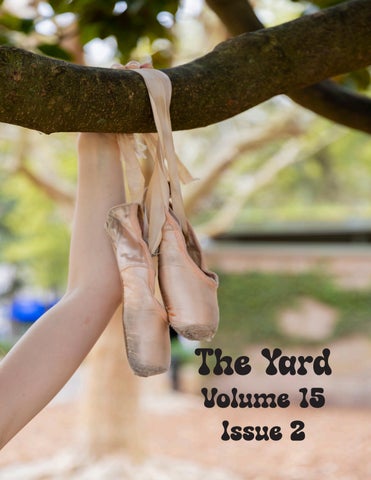
The Yard Volume 15 Issue 2
As this semester comes to an end and my first year as Editor-in-Chief does as well, I can only reflect on the memories made and the lessons learned. This year taught me so much. I learned how to grow and stretch and shift. I learned that identities and priorities can change and that is okay. We, as humans, should be changing for it is the uncomfortable parts of change that build character. If we can learn to lie comfortably in the uncomfortable, anything is possible. That was my intention for this issue. I wanted to lie in the uncomfortable and see what visions and shapes revealed themselves. What would they look like? What would they feel like? Whatever your individual answers to these questions are, I want you to sit in them as you enjoy this issue. I invite you to analyze your answers and figure out what they mean to you. Maybe you could learn something really wonderful about yourself. I would like to thank the amazing people that helped me put this issue together. Charlotte Ottaiano, Julia Bianchini, Audrey Palmadessa, Sia Sharma, and Scarlett Grave. Thank you for showing up every week and working on this project with me. Thank you to every volunteer that gave their passion and dedication to me and my staff. Thank you to Cameryn, Mitzie, and Addi for listening to every anxiety and celebration I had throughout the semester. Thank you Mom and Dad for listening to my doubts and alleviating them every time. Finally, thank you Austin for being my soft place to land. To you, dear reader, please enjoy the second issue of volume 15. I hope you move and grow and learn with every word read, photo admired, and page turned. Thank you, and I will see you again in the fall.
Love, Caz
Contributors Writers McCain Childress Ella Crabtree Josie Elia Aiden Hylen Emilie Lynch Lauren Martin Jack Mazur Audrey Palmadessa Hannah Shaffer Jack Simon Natalie Wallace JP Zeeh
Layout Designers Ella Crabtree Josie Elia Caz Kopf Scarlett Grave Emilie Lynch Lauren Martin Charlotte Ottaiano Audrey Palmadessa Sia Sharma
Photographers Scarlett Grave Charlotte Ottaiano Natalie Wallace
Meet The Staff
Julia Bianchi Managing Editor
Caz Kopf Editor in Chief
Charlotte Ottaiano Creative Director
Scarlett Grave Head of Photography
Sia Sharma Opinions Editor
Audrey Palmadessa City + Caz Kopf Campus Editor
Editor in Chief
The De-Trendification of Trends By: Jack Simon
In the past few centuries, decades have been defined by the pieces seen on the street, runway, and media, and those deemed “trendsetters” paved the way for average, day to day people to follow suit. In the past 5-10 years however, trend cycles have skyrocketed in a circular motion, making it impossible for a decade to be defined by trends, and instead it is just seasons where one item or style takes over. The past 20 years, however, have basically just been recycling through the trends of the many generations before us. For example, the low-rise jeans of the early 2000’s, butterfly clips from the 90’s, and the bold, audacious colors of the ‘80s. Tracking and forecasting trends has proven to be incredibly difficult due to not only the impact fast fashion has had on trend cycles, but also the many different niche online communities pioneered by Gen Z. This isn’t groundbreaking news. Everyone knows trends are moving fast. But have we thought about the fact that trends in itself may soon no longer be trendy?
Growing up in a generation characterized by screen time and judginess, I am in a constant state of observation and am practically a sponge for the content my phone drips out.Furthermore, as a hypercritical gay man who likes to think of himself as fashion forward, it is rare that I am not observing fashion trends through an either scathing, or adorational lens. I spend my time scrolling on pinterest, shopping online, or noticing outfits on the street (of course I am a much deeper, positive, kind person than this may suggest, but it is a small part of me). As someone who is observing fashion in all types of ways around the clock, it would be hard to not notice the clear inspiration many different communities and types of people take from past fashion trends. This differentiation in personal style makes it difficult to really get a sense of what is popular in the world, versus what is popular on online forums and conversations. Nearly every other video I see on my TikTok For You page is “Fashion Predictions for Fall 2026” or “What the It-Girls are Wearing This Winter” or some other biased summarization of what the upcoming year/ season has in store. But the thing is, very few of these videos have anything in common. One video is of a girl in Colorado who spends her time hiking and camping, while the next is a runway model in New York who attends black tie events and perpetually goes out to the new, hot nightlife extravaganzas. Through the diversification of content being created, and therefore consumed, online, there is no way to push one style, piece, or brand, making it harder and harder to concretely define a specific look to new generations.
It would be misleading and unrepresentative to mention hastily moving trend cycles and neglect to speak on fast fashion. Fast fashion is a common business model in which mass-market retailers quickly produce clothing items representative of trends at the time, often made with cheap materials meant to be disposed of soon after purchase, promoting more purchasing of other similar pieces. Ultimately, your most recent fashion purchase becomes out of style by the time it lands in your mailbox. This amount of production and consumption also contributes heavily to global carbon emissions, water resources, and textile waste. Fast fashion not only is ruining fashion, but the environment as well. According to an article from Qz.com, in 1990 the average American bought around 40 new garments annually. Now, according to PIRG.com, people buy around 65 new pieces a year. That is an over 50% increase in about 30 years, and this number is likely going up as the years go on. That is, unless trend cycles are fought against and originality and personal style prevails and trends become a thing of the past.
The concept of personal style is almost laughable when reflecting on the past 10-15 years in fashion, but slowly and steadily the recent “it-girls” of social media have been pioneering the movement that is closet staples. Influencers and celebrities like Emma Chamberlain, Zendaya, and Rihanna have all been active proponents of curating one’s own personal style, rather than falling into the trap of overconsumption of fast fashion. When crafting your closet, it is important to buy and wear things that you like, rather than what you’re being told to like. Clothing and fashion is meant to be expressive, not a trap, so when getting dressed for work or class in the morning, or getting ready to grab dinner with your friends, I encourage you to pick up what feels good to you and that feels like you; It just might save the environment, and your bank account.
What You Need to Know Before the Next Hunger Games Movie By: Lauren Martin They say that Suzanne Collins only writes when she has something to say. It’s no wonder, with everything going on in the world and our country, that she’s come out with another book discussing oppression, rebellion, and the general dangers of a too-powerful government. This new book, Sunrise on the Reaping, follows the story of Haymitch Abernathy’s games, the 50th Hunger Games. Before seeing this movie, I’d recommend reading the original Hunger Games series, or at least watching the movies. Katniss Everdeen and Peeta Mellark are main characters of the first three books, and Haymitch Abernathy was their mentor. They led a rebellion against the oppressive government of Panem, spearheaded by President Coriolanus Snow, and ended up living peacefully together in their home District. The History of the Hunger Games When we’re first introduced to the idea of the Hunger Games in the original trilogy, it’s this glorified pageant-esque precursor to a death match between 24 kids, called tributes. The tributes, after being “reaped” (picked out of a bowl) in their districts are sent to the Capitol, the home of the government and the elite. There, they undergo an extensive, invasive, and often painful makeover before being paraded in front of the corrupt President Snow. They spend a few days training in a facility and are then allowed to show off a skill to the Game Makers—the sick fucks who design the death arena— who rate them on a scale from 1 to 12. All of this is, of course, done for the entertainment of the dear vain Capitol citizens.
Then, it’s time for the actual Hunger Games. These 24 kids, between the ages of 12 and 18, are put into some sort of artificial environment called the arena. The arena changes every game. For Wiress, a former Victor, her arena was made of mirrors, designed to drive the kids insane. For Katniss and Peeta, the protagonists of the original Hunger Games books/ movies, it is a seemingly innocuous forest area. For Haymitch, subject of Sunrise on the Reaping, it is an idyllic, beautiful landscape where everything is secretly poisonous. The kids are usually positioned on podiums in a circle surrounding a structure laden with weapons, food, water, and other survival supplies. This structure is called the Cornucopia. A countdown will play to signify the start of the Games, and if a tribute steps off of their podium before the countdown is done, they will be blown sky-high by the landmines surrounding it. When the countdown ends, the bloodbath begins. Many tributes–including the “Careers” (tributes from districts 1, 2, and 4 who are trained to kill)-go straight for the Cornucopia as soon as the countdown is over. Many tributes die in the battle for supplies, while others–the smart ones–run as far away as they can. The Games continue in this manner of kill-or-bekilled, though a decent number of the kids will be taken out by their environment, or by deadly events orchestrated by the Game Makers. For example, in the first book, Katniss is nearly taken out by a firestorm cooked up by the Game Makers. In the second book, the arena is divided into twelve sectors, which each hold some sort of deadly force.
Sponsors–rich Capitol citizens who often bet on the victor of the Games–can send their chosen tribute gifts, such as food, water, or medicine. The Games will only end when one tribute remains, usually following a fight to the death between the remaining two tributes. This tribute, now a Victor, is then showered with gifts and riches and taken on a tour of Panem so the Capitol can show their pet off. Often, terrible things are done to the Victors as well, particularly if they act defiant to President Snow’s power. The Hunger Games weren’t always this way, though, and that is where the first prequel comes into play. A Ballad of Songbirds and Snakes follows a young Coriolanus Snow (future president of Panem) as he works to revolutionize the 10th Hunger Games. You see, at this time, the Capitol is starting to get bored of the Hunger Games. Who wants to watch a bunch of starving kids hack each other to death for a few hours? A pre-presidency Snow changes the game, though, in the first prequel A Ballad of Songbirds and Snakes. He proposes the idea of sponsors, interviews, and general dramatics. Of course, these changes are loved, and thus the pageantry begins and continues to evolve until we see the 74th Hunger Games (Katniss’s games). There is similar frivolity in Haymitch’s Games in Sunrise on the Reaping. Sunrise on the Reaping SOTR focuses on Haymitch’s games. Haymitch was a drunk who seemed not to give a shit about anything until Katniss and Peeta came along. We go back in time to 24 years earlier, for the 50th Hunger Games. These Games are a Quarter Quell. The twist this time? There will be twice the amount of tributes: 48 instead of 24. In the beginning of SOTR, we see Haymitch go through his daily life. He lives with his mom and brother, Sid, works as an apprentice for an alcohol bootlegger–though he explicitly says he doesn’t drink–and spends his free time doting on his girlfriend, Lenore Dove. Lenore Dove is Covey, and
niece to Clerk Carmine and Tam Amber, who were Lucy Gray’s “cousins,” though their biological relation isn’t clear. Lucy Gray was one of the protagonists from Ballad of Songbirds and Snakes, which focused on Snow’s rise to power. She was also Snow’s love interest, and her alleged betrayal of him motivates his special hatred of District 12. The Covey are her family, a previously free-roaming band of musicians who were rounded up by Panem and forced to live in District 12. Haymitch is also friends with Burdock Everdeen, who will later go on to father Katniss and Primrose. So, technically, Katniss is Covey, if distantly. Burdock is cousins with the Covey, and dating Astrid, a privileged girl who will later be Katniss and Prim’s mother. Burdock is dead in the original trilogy, so his presence in SOTR is his only living appearance in the Hunger Games universe. Reaping Day is Haymitch’s birthday–July 4th, how ironic–and Lenore Dove gives him a flint striker that her uncle made. It features a snake and a songbird facing each other, which grace the cover of the novel. Similar to every other District 12 Victor, Haymitch isn’t actually reaped. Katniss volunteered, Lucy Gray’s reaping was rigged, and the original boy who was reaped in SOTR ends up getting killed when he tries to run away. Haymitch is chosen in his place. Along with Haymitch, Maysilee Donner, (Mckenna Grace) Wyatt Callow, (Ben Wang), and Louella McCoy (Molly McCann) are reaped. In the Capitol, we reunite with a few familiar faces: Beetee (Kelvin Harrison Jr.), Wiress (Maya Hawke), Mags (Lili Taylor), and a young Effie Trinket (Elle Fanning). Also featured is Beetee’s son, Ampert (Percy Daggs IV). There are many twists and turns in the novel, including the fact that Ampert was reaped as a punishment for Beetee, who is forced to serve as a trainer for the tributes. I have hope that these twists will translate well to the big screen. Why Now? The question remains as to why Collins decided to write and publish this book. Or, more importantly, why now? Some may argue it was because she saw all the edits of young Snow on TikTok and decided to remind us just how terrible he is. The world has a
history of idolizing monsters and only realizing the truth in retrospect. One could point to a handful of dictators around the time of World War II, and how some of their followers didn’t realize the severity of what they’d signed up for until they were already in the trenches of it. You could also indicate the 2016 or 2020 US presidential elections, and how ome voters didn’t understand what a mistake they’d made until they were already in the trenches of it. You could also indicate the 2016 or 2020 US presidential elections, and how some voters didn’t understand what a mistake they’d made until Trump’s term started. I’ve seen many people talking about how they “didn’t vote for” the war in Iran, the rise in gas prices, the kidnapping or murdering of American citizens by ICE, and the illegalization of marijuana. The thing is, though, they did. They saw a woman with a weird laugh and decided that a man who had already proven to be predatory and unstable was a better choice.
Capitol citizens, we once rebelled against our government, and we could again. Haymitch’s reaping switch-up, additionally, could reflect many things in our society. For one, the racial profiling and targeting of ICE agents, where they’ll target anyone of color whether or not they are citizens (there are documented cases of this). For another, the unjust amount of Black people who are incarcerated or on death row for crimes they either didn’t commit, or their white counterparts would’ve gotten a slap on the wrist for. Marcellus Williams is a more famous case for this, as there was a lot of social media buzz around his execution in 2024. New evidence suggested his innocence, the family of the alleged victim pushed for a life sentence, yet the state did not care. They killed him anyway, just like how the Capitol punishes District kids for “crimes” committed before they were born. Crimes that stemmed from a rebellion against oppression.
Reading is inherently political, especially The Hunger Games.
Unfortunately, most American citizens have become so desensitized to these horrible actions by the government that we look at the headlines and say “huh? Oh, yeah, he seems like he would do that.” As the crimes and the disregard for the balance of power slowly builds up, our complacency indicates our agreement with the regime. Others could argue it’s because of this ramping-up of atrocities that Collins decided to tell Haymitch’s story. To emphasize this point, she begins the novel with a quote by philosopher David Hume: “Nothing appears more surprising to those who consider human affairs with a philosophical eye, than the easiness with which the many are governed by the few; and the implicit submission with which men resign their own sentiments and passions to those of their rulers.”
This submission is seen in the way Capitol citizens delight at the Games despite their brutality, and, in our world, the way each killing, kidnapping, or horrible act gets less and less media coverage. We are abandoning our own opinions for the convenience of becoming part of the majority, the ones who go with the flow. Collins wants us to remember that, like the
Artificial Intelligence (AI) is also featured in this novel. On page 243 of SOTR, a young Plutarch (an orchestrator of the trilogy’s rebellion) talks about AI, describing it as a “[tool] that [was] abolished and incapacitated in the past.” He remarks upon how convenient generative AI was, then goes on to say how banning it was “the right thing to do,” given human nature. This paragraph, though AI isn’t extensively discussed in the novel, is clearly a criticism of the emergence and increased use of generative AI. AI companies such as OpenAI (ChatGPT), Google (Gemini), and Meta have seen incredible growth in their usage. Some may view the new abilities of technology as beneficial, since it can streamline previously tedious and time-consuming work. It can also have benefits in the medical field, since programs have been developed to increase diagnosis accuracy and provider efficiency. It is safe to say that AI is not without its benefits. However, in my eyes, the negatives far outweigh them. Generative AI programs have been caught lying and fabricating sources in chat, so using it for assignments is not recommended (and, generally,
negatively affects your learning). It also commonly steals from artists and writers, since their work is used to train the AI without the artists’ consent. Additionally, AI usage can be harmful to the user’s brain. An MIT study showed that regular ChatGPT users had the lowest brain engagement and consistently underperformed in tests in a controlled study. Then, somehow, it gets scarier. Plutarch warned of AI’s potential power, especially in human hands. In an experiment by Palisade Research, a company dedicated to tracking AI’s development, generative AI resisted being shut down in 79% of their experiments. Despite explicit instructions to allow itself to be shut down, Anthropic’s Claude even resorted to blackmail in an experiment to prevent itself from being shut down. These self-preserving techniques in a program that is not meant to be sentient is concerning, to say the least. Despite all of the government of Panem’s missteps (and war crimes), I think they were right in nipping generative AI in the bud. There are also, of course, the Patriot Games: a series of competitions held for America’s 250th anniversary featuring the country’s top young athletes. The parallels are evident. The name itself, “The Patriot Games,” is only one word off from The Hunger Games. The fact that they are competitions between specifically young, teen-aged athletes, is also a reflection of the Hunger Games’ tendency to target the youngest of their society. While the Patriot Games were announced nine months after the release of Sunrise on the Reaping, one has to wonder if President Trump didn’t take some inspiration from it. And if all of this talk of politics and war makes you uncomfortable, I’m sorry. Reading is inherently political, especially The Hunger Games. Collins wrote the initial trilogy as a response to the exploitation of children she’d seen working in the television industry. She wrote it as a form of protest, and continues to write to protest the happenings in the world. I won’t say much more for fear of spoilers. Sunrise on the Reaping is the most brutal, heartbreaking, and incredible Hunger Games novel yet, and I have no doubt this will be reflected in the movie. I hope to see y’all in theaters November 20th, 2026!
Why Are All Vampires Confederate Soldiers? By Josie Elia In middle school, I had an obsession with Damon Salvatore, as most teenage girls who watched The Vampire Diaries did in 2016. And at the time, I was attracted to his blue eyes, dark hair, and mysterious past. As I’ve grown older, my taste in media hasn’t changed much, and I’ve watched other vampire media like True Blood, Twilight, and Interview with a Vampire, and I’ve noticed one odd similarity between them all: they’re all confederates. Damon Salvatore, a main character in The Vampire Diaries, served in the Confederate army before coming home and being tragically killed by his father for his vampire sympathies. Bill Compton, the main love interest in True Blood, returns to his hometown of Bon Temps, Louisiana, where he served as a Confederate soldier. Jasper Hale, in the Twilight series, served as a Confederate major before serving in a southern vampire army. And finally, Louis de Pointe du Lac in the original book series written by author Anne Rice was a plantation owner. All of these series were and continue to be staples of the Vampire and romance genres. Vampires have always been used as a metaphor for something, homosexuality, religion, fear, but this trope especially touches on the South and their fears and hopes centering around the Civil War.
The idea that a person can die and be reborn with the ability to live forever is a fantasy that anyone can latch on to. After the Civil War, the southern states were trashed; all their righteous excuses had nowhere to latch onto. The slave economy they had built was torn down. This led to the “lost cause,” or the South’s effort to change the narrative of the Civil War.
Instead of fighting to keep slavery, they were fighting for states’ rights. That they were defeated only because of their lack of troops, since God was on their side. This ideology fits right in with the southern vampire trope. Damon Salvatore served as a Confederate soldier as a human before returning home, where, after the war, he was turned into a vampire. His extremely confederate father killed both him and his brother for their loyalties to vampires, which ultimately led them both to be turned themselves. This confederate past was never truly explored in the show, just something that happened. But Damon, as a character, was a bad person at the beginning, but has a long redemption arc where he is eventually the main love interest and widely accepted by the end of the series. While not explicitly stating the facts, this shows the South’s redemption and its intention to flip the narrative. Damon Salvatore lived to change the narrative and become good again.
While the show doesn’t have a consistent metaphor for Vampire, in The Vampire Diaries, flashbacks to the past vampirism are mostly used as a metaphor for the union. Vampires have infiltrated the South, killing and corrupting people, during the Civil War
Despite serving in the Confederate Army, Damon is uninspired and wants to go home to Katherine, the vampire who has seduced both him and his brother. Then he is killed by his conservative, confederate father for falling for her tricks. While not explicitly stated, this storytelling portrays the South in a better light. In a narrative of the TV show, Damon and Stefan’s father is the bad guy, and they are the good ones, despite Damon’s service. Changing the narrative of the South from one that relished in and welcomed the war to one that was forced into and suffered from it. While both of those narratives are true, depending on whether you were a poor boy drafted in against your will or a Major in the army, the TV show has a way of getting you to simpithize with Damon, as if he is not the son of a rich plantation owner himself.
IS CTRL BY SZA THE MOST INFLUENTIAL R&B ALBUM OF ALL TIME? By: JP Zeeh
INTRO On June 9th, 2017, the music artist SZA released her breakout debut album Ctrl, marking the beginning of her impactful musical journey. For many people, SZA’s work has become a sense of comfort that nothing else can bring them. People often gravitate to this album for its themes, including love, heartbreak, growth through self-discovery, and being a person of color. For me, as a fellow listener of the album, I feel as though this album brings me comfort, showing me that I am not alone in my feelings about love, insecurities, and how to cope with them. Discovering this album in eighth grade to being a freshman in college, writing this, Ctrl has carried me through life and pushed me to be the person I am today. Many people around the world feel the same way, feeling lost in their own lives, and they use this album to cope with that feeling and shift their perspective. No matter when you first listen to this album, it will remain relevant and offer a sense of familiarity and clarity always. This goes to say that Ctrl by SZA is one of the most influential R&B albums of all time.
THE BRAIN BEHIND THE ALBUM For a while, SZA did not intentionally plan to become a musician because of her self-doubt, so there was a chance Ctrl might not have been made. Ctrl was SZA’s first real attempt at getting her thoughts onto paper and writing them into lyrics that made sense to her. The writing process for her was difficult because she did not know what she wanted the album to sound like or what her style should be. Before she even thought about creating anything, she needed to figure out who she was and what she wanted. After the album’s initial release, SZA thought no one would end up liking the work she had created, stating, “When this album came out, I cried. I screamed, and I cried. I was so embarrassed; I thought no one would like it (How Breakout R&B Star SZA Went From Sharing a Futon to Finding Her Voice)” which clearly should not have been the case. Moving forward in her work, SZA wants to find a balance between taking things seriously and learning that not everything has to be as serious as it may seem. I think what makes SZA so successful in her work is that she does not know exactly what she wants, which allows her to think more freely and create what finds its way to her listeners.
MEANING BEHIND THE LYRICS “Broken Clocks” Throughout this song, SZA looks back on the imbalance between her own love and work, and reaches the revelation that her romantic life, which interfered with her busy schedule, was only hinting at her own independence. Ctrl covers many themes across its tracklist, like Broken Clocks, which explores running away from the past, a theme that runs throughout SZA’s entire discography. “I've had a thing for dirty shoes since I was ten Love dirty men alike.” This line about having something for dirty shoes really means that she has always been settling for less, and that also applied to her taste in men she dated. This line also connects to the album's recurring theme of running away. The lyric suggests she's settling for less in her relationships, which could give her a stronger reason to run away from them, and then expressing that in her music. “Ooh Better day than yesterday (Keep cuttin' up) Ooh I just take it day by day.” Further into the song, SZA uses figurative language to convey a sense of progress and gradual improvement, hence the idea of taking it “day by day”. Coming from a listener standpoint, when you sing on your own, it feels like you are committing yourself to making each day better than the last. The lyric “I just take it day by day” emphasizes living in the present and avoiding fear or feeling overwhelmed about the future.
“The Weekend” This song is about three women who are all involved with the same man, but one of them doesn’t care, as SZA sings from the women’s perspective. At the end of the day, it serves to elevate women beyond the idea that a man is the center of their lives and their actions. All of these women are positioned in this one man’s life as being aware of what they want from him. This factor undermines the lies he tells them, which makes him look foolish. “The feelin’ is reckless, of knowin’ it’s selfish And knowin’ I’m desperate Gettin’ all in your love, fallin’ all over love, like Do it ‘til it hurts less.”
This lyric refers to SZA singing from the perspective of the other woman, trying to make herself feel better about wanting someone who is already supposed to be committed to someone else. The lyric is another way of expressing how she may be “desperate,” feeling so lonely without him or any man. “My man is my man, is your man, heard it’s her man too My man is my man, is your man, heard that’s her man Tuesday and Wednesday, Thursday and Friday I just keep him satisfied through the weekend.” From this line, we hear SZA’s perspective on dating and how it can become complicated when it comes to sharing the same man, with none of the involved parties being “his” girl. With that, she also exemplifies how the women in this story enter the situation with the man for different reasons, which drives home the idea that she wants the man to do what he said he would do for her.
“Drew Barrymore” In the lyrics of this song, she presents an unconfident version of herself, suggesting low self-esteem, especially in a potentially unbalanced relationship. The song continues to speak to insecurity, questioning of companionship, and self-worth. According to TIME, SZA chose Barrymore to be an inspiration for the song because “she just radiates this air of confidence and also acceptance of her quirks.” “Drew Barrymore” refers to a time in SZA’s life when she was in high school, going to a party just for a boy, but the boy she wanted ended up going with a different girl. This factor explains the first line of the song, “Why is it so hard to accept the party is over?” in which she accepts that she won’t get the boy. “Warm enough for you outside, baby? Yeah (Tell me if it’s warm enough here for you) Is it warm enough for you inside me, me, me, me?”
The chorus of the song about being “warm” on the outside is a way of saying that someone is physically attractive, while being “warm” on the inside is a sexual innuendo. All of this, to say, about the chorus is that SZA is challenged by the expectations men might place on her. “I’m so ashamed of myself, think I need therapy-y-y-y I’m sorry, I’m not more attractive I’m sorry, I’m not more ladylike I’m sorry, I don’t shave my legs at night.” This song refers to the insecurities that women may face in their relationships with men. SZA uses sarcasm to allude to the societal expectations of women and their roles within it. The idea that most men and maybe some women have that being “ladylike” is the need to shave their legs and essentially be attractive. With this line, SZA is saying that society should break the stereotypes about women and accept them for who they are.
FAN REACTIONS Many SZA supporters feel the album reveals a side of them they may not have recognized before. YouTuber AJay Deluxe, referring to the song Supermodel: “This actually felt like I was invading her privacy, like I was reading a journal I was not supposed to read,” alluding to how personal SZA gets in her work. SZAs’ work also made people think about the truth of their personal relationships by considering how the album details loving someone who never really saw you. A lot of Ctrl is also about self-discovery, and many fans have read into the lyrics that explore the feeling of doing everything to be seen but still feeling invisible. Almost ten years later, and SZA’s album is still being brought up every day, whether it is because people are just now finding it or discovering something new about them that they did not think of before. THE CHARTS Ctrl by SZA is the longest charting R&B album by a female artist in history, with over 450 weeks on the Billboard 200 album charts. As of February 13th, 2026, Ctrl is officially certified platinum 6x and is continuing to grow as the years go by. Ctrl has set a foundation for SZA to create more and elevate her craft, as shown in her second album, SOS, released in December 2022. The success that Ctrl brought to SZA helped her newest album release, SOS, become 9x certified platinum. There is no telling where SZA will go next with her music; only the future will know.
Interview with a Crew-gar By: Audrey Palmadessa
Jackson Lee-Sosolik is a sophomore Physics and Astrophysics major here at CofC. He is the former Novice Men’s Captain and in Fall 2026, he will step up as President of CofC Crew (Club Rowing).
AP: What led you to get involved with this sport? AP: Tell me about your athletic background. Jackson Lee-Sosolik: I have been in organized sports since I was in third grade. I did club swim until I was 13, but in 7th grade I started running cross country. The next year, I started track. My sophomore year of high school, I went to state for the high school swim team (my first year on the team) and that was the only year I did all three sports: cross country and swim in the fall and track in the spring. My junior year, I quit running altogether, but I went to state for swim again. In my senior year, I went to state for swim a third time, then returned to track in December 2023 and I had the biggest athletic “glow up” ever. After a good swim season, I was motivated to move up to the top of the high school track team. I really focused on running the 800m and the 4x400 and 4x800 relays. We managed to podium in 4x8 in the state meet and I narrowly missed a podium in the open [individual] 8. We also set a school record in the DMR (distance medley relay), and set a county record in the 4x400. In the summer after high school, I ran some 5k races for fun and kept training to be my best self as I entered college.
JLS: Coming off of an athletically successful senior year, I was motivated to continue racing and competing. I found that racing was my sport, but I wasn’t fast enough to run for the College, so I went to the next-best, most accessible thing that I could learn and grow from. I was recommended to the rowing team by a friend. Coincidentally, it is another very olympic sport, like track is. AP: What is different about this sport compared to your past experiences? Do you find it to be a better or worse fit for you? JLS: JLS: Compared to swimming and running, it is a lot more technical, and less accessible. It is also much more team focused, not that running and swimming aren’t. It is impossible to make up for bad teammates in rowing, whereas in swimming and running, one fast athlete can make up for somebody else. One good rower will not make up for a novice in a boat. It is so much more about being connected as one unit. As far as being a good or bad fit, I am not optimally built to be a rower, I am much more of a swimmer or runner, but it does not stop me from being competitive.
If you go into it with a competitive mindset, you can be AP: Do you have a role model or someone you look up to just as successful as the 6’5” 220 pound Harvard guy. when you doubt yourself? AP: What are the benefits of rowing? What are the draw- JLS: In a race, you don’t have time to doubt yourself; you’re not allowed. There’s someone yelling at you backs or challenges? through speakers the whole time. However, in training, I JLS: I think the number one benefit is the communi- wouldn’t say that I look up to anyone in particular, but I really think about the journey I had with track and ty that comes with the sport. Especially because it my teammates from high school and how we requires such a sense of connection with teamwere able to motivate each other. I know mates and coaches. The drawbacks of cost and that I am capable, I just have to make equipment even create their own benefits in an effort. By the end of high school I the community that comes with rowing. felt very competent, but that was after Everyone is always willing to either lend plenty of practice and learning. I can’t you something or help out. Rowers expect myself to feel as knowledgewant as many boats out there for the able in rowing as I did my senior sake of the race. The obvious drawyear [of high school] with running, backs are that it’s cold and wet. If you but I know it can happen someday. expect it to be nice and sunny, wind with running, but I know it can in your hair like a sailboat, you will happen someday. be thoroughly disappointed. In a general sense, rowing is also just very AP: How is your time management expensive, and as a college club, it affected by your commitment to is difficult to get funding, which is this club? always a challenge. AP: What motivates you to overcome those challenges? JLS: At the end of the day, the benefits outweigh the drawbacks. Also, I’m a swimmer, and I’ll always be one, so the cold and wetness don’t bother me so much. I run in the rain, lap pools are cold, you get used to it. If you go out there expecting it to be miserable, you’re going to be miserable, but if you want to learn and feel the boat glide under you, those other things will fade away.
JLS: Honestly, it’s better. It forces me to get up every morning and exercise. It’s a really good way to start my day, by working out and doing something that can be considered a success even if I didn’t meet my specific goal for the session, since I’m just training. AP: What is the biggest lesson you have learned from AP: your experience? JLS: The whole thing has just been a reminder of the learning process from zero knowledge. Exercise and positive self-talk and self-motivation, as well as trusting other people to do their part instead of trying to make up for everybody’s mistakes.
Even the best, smartest, most experienced person makes mistakes. The only problems you can fix are your own, at the end of the day. AP: What advice would you give someone wanting to start a new sport? JLS: Go for it. For the people who have done sports before, remember what it was like the first time you threw a football or jumped in a pool. You’re not going to be the best, and that’s fine. And if you’re just starting in college, you’re probably not going pro, so just have fun with it. If you’ve never done a sport at a competitive level before, your team will be the most supportive group you’ll know, but only if you let them. You have to open yourself up to them. Even if you aren’t very good at the beginning, you will never have another experience in life where you can so clearly see how you grow along the way. The best time to start was yesterday, and the second best is right now.
J O I N C R E W @charlestoncrew
Bounce to the Beat By: McCain Childress There’s nothing like the feeling of sitting in a seat, hyped to watch your favorite team play, music blaring, everyone getting hyped, and your favorite snacks and drinks at your fingertips. Wait, but did you catch the music blasting in the background? Music and sports may seem unrelated, but upon closer inspection, they are deeply connected. Music acts as a catalyst among various areas of the sports industry. From the game presentation to the athletes themselves, music is a key part of the traditional game day ritual. In the same way you listen to music while getting ready, athletes listen to music while preparing for games.
On the same tune, Draymond Green, forward for the Warriors, picked “Walk Through” by Rich Homie Quan. Rap tends to be the center of most hype music from an athlete’s perspective. The further through this playlist from the cup you get, the more that this theme continues to bleed into most of the selections. More prime examples are “TV Off” by Kendrick Lamar, which is a selection of Johnathan Kuminga, forward for the Warriors, as well as “Family Matters,” a Drake song selected by Jalen Williams, a forward for the Oklahoma City Thunder. While rap is a widely enjoyed genre, some of these athletes selected music from genres ranging from country to folk Each person is so differ- (Lamarre). Each athlete can be vastly different in their selection ent. and their music taste of music that is geared to focus reflects that as well. How- on the goal of winning or playing their best.
One of my close friends, Carley Dircrechio, who is a cheerleader for the College of Charleston, always pre-games her games with the artist Crazy Frog, coupled with her amazing teammates. This is what they use to generever, music brings everyone ate energy for the team before together, and athletes are That makes this topic so fascinata game. Another song they use, ing. Each person is so different, which Carley describes as “fawell-documented in that and their music taste reflects that mous for a lot of cheerleaders as well. However, music brings field. and a lot of athletes in general”, everyone together, and athletes is “The Climb” by Miley Cyrus. are well-documented in that These songs were selected with field. A great example of this the intention of unifying and cultivating good energy was the football locker room video, which began with and hype up the squad before a big game or important Caden Woodall, a running back for Livonia Stevenson performance. High School, singing “Eenie Meenie” by Justin Bieber, and then his entire team joined in to sing along This is not just a phenomenon limited to college stuand celebrate. This video alone received 50 million dents. Even professional athletes, such as NBA players, views and 6.4 million likes, and remained trending on have pregame hype songs. Billboard’s Carl Lamarre TikTok for months back in 2020. This is just one of provides a prime example of this in his article, “Stemany trending athlete singing videos. A similar examphen Curry, Luka Doncic, & More Drop Their Faple to Woodall is Jared McCain, a guard for the Oklavorite Pre-Game Songs for NBA Cup 2024.” Lamarre homa City Thunder. McCain gained a massive TikTok created a 2024 NBA Cup playlist compiled of a selecfollowing through dancing, singing, and lip-syncing tion of songs from some of the players. He defined this on his page. One of his most famous videos features playlist as the player’s “favorite pre-game songs.” The McCain singing “2 Days Into College” by Aimee Carty arguably best point guard of my generation, who plays in the locker room one afternoon after a basketball for the Golden State Warriors, Stephen Curry, selected workout when he was at Duke University. He has since “Coming in Hot” by Andy Mineo and Lecrae. embraced this fame apart from being an NBA player,
singing on social media regularly, and dancing with his teammates. People tend to show McCain love for being his authentic self on his social media platforms, even though he is an NBA star. On a similar note, the NFL teams have started rookie karaoke for all the rookies who join the teams every year. When a new player joins the team, they have to select a song to sing in front of everyone. These videos have slowly made their way onto TikTok in the past couple of years and have continually gained traction. It is all in good fun, and for team-bonding of some sort, but as an outsider, it is enjoyable to be able to experience it too. This goes to show how much music makes a positive impact on athletes, whether you realize it outright or subconsciously. On that note, curating an effective pre-game vibe can make or break a player. That is why you tend to hear the same genre of music while warmups are happening before any type of sporting event. Usually, those songs have been selected by the home team, so that they are able to continue to become energized by fast-paced music, even during warmups.. Not only does the music directly affect the players, but it also affects the fans. Have you ever stopped to notice the music that plays before any type of sporting event? It is geared to encourage crowd engagement as well as curate an energetic vibe. Through this, the players can feed off the energy of the crowd, along with the music, and vice versa. Even though this music comes across as seemingly meaningless, it has such deep roots in the energy of a room, especially a sporting event. One prime example is the song Seven Nation Army by the White Stripes. As you read this, there’s a low chance you know this song by name. However, when this song is played in a sports setting, almost every person in the crowd is singing and dancing along. This is directly related to how the music affects the fans.
People only know the song because it is associated with hyping up the crowd and curating an energy only found on a court or field. Engineering a great vibe for the players and fans boosts the overall experience for everyone involved. Sports and music are both deeper concepts than what meets the eye. Next time you are at a sporting event, pay attention to that pre-game playlist. Those athletes have great music taste, so don’t hesitate to add some of the songs to your personal playlist. If these players can win championships, they will know ball when it comes to music.
Is Generative AI Killing Our Creativity? By: Aidan Hylen
On February 24, 2017, a little-known artist called Steve Lacy released his first album, appropriately titled Steve Lacy’s Demo. The album lasts only 13 minutes, but it is an R&B masterpiece from its funky guitar riffs and intoxicating drumbeats to Lacy’s distorted vocals. Although Lacy was only 18 years old and largely unknown at the time, the album received high praise from critics. This success would reach new heights when the track “Dark Red” went viral on TikTok in 2021 nearly 4 years later. Most of you have probably heard it. What I bet you didn’t know though, and what makes Steve Lacy’s Demo even more impressive, is the fact that it was produced entirely on an iPod Touch. Lacy was still in high school at the time and couldn’t afford his own laptop, much less a recording studio. So, he got creative. He used the free app GarageBand and an inexpensive piece of hardware called an iRig to record his guitar straight to his iPod, while singing vocals into its built-in microphone. While others may have seen Lacy’s lack of professional equipment as an impasse, he used this to his advantage to create his own distinct sound. Building off of this, he would later go on to win a Grammy award in 2023 for his album Gemini Rights.
Creativity is not limited exclusively to people who consider themselves “artists” either. You go through a form of the creative process every time you write a paper for class or decide what outfit you’re going to wear to go out with your friends. Everyone can be creative, if they choose to.
But this article is not about Steve Lacy. The reason that I brought up Steve Lacy’s Demo is because it demonstrates an essential point about art and the creative process in general. There is no barrier to entry for being creative. It’s true that expensive tools might allow you to try certain techniques, but that doesn’t mean that art in general isn’t accessible to everyone. The creative process is about coming up with ideas, trying and failing and trying again, and arriving at something you’re proud of. It’s about using whatever resources you do have to make something unique, to push the limits of what we think is possible. All the while, you’re improving as a painter, writer, musician, performer, filmmaker, chef, or whatever your craft is.
This narrative is complete bullshit, and it infuriates me. As I mentioned already, creativity has never been dependent on what equipment you have or how much money you can spend. Big tech companies are not your friend, and they don’t care about helping you unlock your creativity. They are for-profit entities who are purely interested in selling their products and will say whatever they need to do that. In many ways, AI is harming the creative process. At best, AI is just another tool you could use to make (slightly soulless) art. At worst, I would argue that AI is shepherding us towards the death of true creativity. I know this may sound crazy to some of you, but I’m not making this claim lightly.
This probably seems intuitive to a lot of you. So why am I bringing this up? Because we are being fed a very different narrative about creativity by AI companies, who like to paint themselves as champions of art and friends to creatives. The common phrase in Silicon Valley is that AI will “democratize creativity” and breakdown formidable barriers to the creative process. We’re told that tools like ChatGPT can act as “creative partners” that we can bounce ideas off of and unlock our true potential as artists. Thanks to our big tech saviors, now everyone can be creative! What’s more, for the low price of $200 a month, you can buy ChatGPT Pro and really take your creativity to the next level! Obviously OpenAI isn’t the only perpetrator of this story, but I’m using them as an example because they’re indicative of the industry as a whole.
Let’s dive deeper into the evidence so I can explain my reasoning. The first thing you need to know about AI “tools” such as ChatGPT, Claude, and Gemini is that they are extractive technologies. The companies that make these large language models use a strategy called “scaling,” which means feeding the models massive amounts of data in order to make them more capable. Included in this data being scraped from the web are millions of pieces of art from artists who haven’t consented to their work being used to train AI. Remember that trend last year where people would “Ghibli-fy” their personal photos and memes? This was only possible because OpenAI included Studio Ghibli works like Spirited Away and Princess Mononoke in the training data for GPT-4o. Meanwhile, Hayao Miyazaki - the founder of Studio Ghibli who’s poured his life into animating these films by hand – has said that he is “utterly disgusted” by AI and even called it an “insult to life itself.” I doubt he was happy about OpenAI using the culmination of his life’s work to train a machine that could pump out soulless emulations to be posted on X. This is just one high-profile case of an AI company stealing artists’ work, and there are countless others I could mention. If AI companies were truly supporters of the arts, why would they show such blatant disregard for artists and their intellectual property? When artists get no say in how their work is used, big tech has no right to say that they’re “democratizing creativity.”
Let’s take a look at another piece of big tech’s argument for AI improving creativity. This involves AI acting as an “intellectual partner” that you can share ideas with and get feedback from. I think that this is a misrepresentation of their product that can be extremely dangerous to the user. I do agree that intellectual partners are a key part of the creative process. It’s important to have someone that you can share and combine ideas with, and who can help you challenge your assumptions and think critically. However, I don’t think that AI can or should substitute for a human in this role. Chatbots like ChatGPT and Claude are ultimately programmed to elicit as much engagement from the user as possible. This leads to a sort of sycophancy in chatbots, where they flatter you or praise your ideas (sometimes excessively). In the worst cases, this can seriously harm the user’s mental health and lead to what is known as “AI psychosis.” I’d bet that most of you have seen some instance of this online where ChatGPT is praising someone for “reinventing reality as we know it” or something similar. In most cases though, this just means that AI isn’t pushing you to think outside of the box. It is natural in the creative process to follow multiple threads before settling on one idea. Creative partners can help you flesh out which ones might be more worthwhile. But by praising whatever you tell it uncritically, AI misses the human quality of providing meaningful feedback that can make you a better creative.
Another issue to this “scaling” approach is that eventually, companies run out of human-made content on the internet. Once it gets to this point, AI must train itself on other AI-generated content. This creates a positive feedback loop, and AI researchers have found that this results in image outputs slowly homogenizing. To put it simply, generative AI is eating itself. Instead of allowing for a more diverse range of art, it is facilitating the opposite. This makes complete sense when you think about how AI works. These are pattern-recognition tools whose goal is to generate outputs that resemble the data they’re trained on. As a result, they tend to focus on and reproduce the most popular styles, since this is a larger portion of the training data. Generative AI is much more likely to steer us in the direction of cultural homogenization, not some artistic renaissance.
This leads me to my last point. Many people are sucked into using generative AI because they are insecure that their art isn’t good enough. To this I say, so what? How are you ever going to get better if the extent of your creative process is inputting a few sentences to get an essay or an image back? Is there a single great artist out there who hasn’t failed over and over? Practicing and failing are the most important part of the creative process. Make shitty paintings. Write shitty essays. At the end, evaluate your work, ask yourself how you can improve, and try again. In the end, you’ll have improved significantly. Plus, you might find that you have a lot more fun and feel prouder of your work when you can trace your creative trajectory.
Art is as much about the process as the finished product. This is why so many artists are disgusted with AI art. They enjoy the time and effort they spend on their work, and would never want to get rid of that for the sake of increased “productivity.” Consider this: can you honestly think of one essay, picture, or piece of music you generated with AI that you can say you’re proud of or show off to others, or that you had fun making? We constantly hear about “AI slop” flooding the internet and making social media worse. I think what this really comes down to is the fact that most AI art feels so soulless. Yes, someone was responsible for typing the prompt that generated each image, video, and caption. But this slop lacks the deliberative and intentional aspects of the creative process that make us appreciate art. I have no authority to say that AI “art” isn’t real art, but I can certainly say that generative AI will not democratize creativity. To me, it seems to do the opposite. After you put in your prompt, AI takes care of all the decision making for you. It takes away your ability to manage even the smallest details in your work. Even if you try to refine it using more prompts, AI will never be able to understand your vision like you can. In the end, you can’t say that you were the one responsible for creating the work either. In this way, AI denies you agency as an artist. That is fundamentally anti-democratic.
Reading Bonds of Hercules So You Don’t Have To By: Lauren Martin Welcome back to the torture that is the Villains of Lore series by Jasmine Mas. Previously, you may have seen me reviewing the first book, Blood of Hercules and tearing my hair out over the ridiculosity (yes, it is a real word) of it. Well, as luck would have it, Miss Mas released a sequel in 2025 called Bonds of Hercules and I am blessed to be able to review it. Of course, I will be dragging you, dear reader, along on this journey. To recap the ending of the last book, though you can get a lot of it from the synopsis of it because the “big plot twist” is literally in the title, it turns out that our girl Alexis is actually Hercules, the daughter of Hades and Persephone (totally how it was in the myths). Also, she’s married. Her teacher and her tormentor tricked her into marrying them by sending her the mangled remains of two of her friends, naturally. When asked for an explanation as to why the hell they forced her to marry him, Kharon simply says, “The olympians... the oppression” (25). Right, ‘cause that’s not cryptic at all.
deadly creatures. Olympians are supposedly the more honorable ones, though we quickly find out that’s not true. Titans, in this version of Greek myth, are not intelligent precursors to gods, but instead bumbling monsters that Chthonics are forced to hunt down before they terrorize Earth. As a Percy Jackson girl, this hurt. Something I did appreciate about this book, however, is that we finally got a better look into Patro and Achilles’s relationship, which was one of the few reasons why I was able to get through book one. It’s no Song of Achilles, but the bond they share is kind of beautiful. They’re wholly devoted to each other (at least for most of the book) and would do anything for the other. It’s kind of nice, I guess. Now, unfortunately, onto the actual plot of Bonds of Hercules.
Her mentors, also, are obsessed with Alexis for some reason (though we do later find out why). This, admittedly, feels out of place in this book because Patro and Achilles, like, really hated Alexis in the first book, but now they’re willing to fight two powerful Chthonics for her. Make it make sense.
There’s too much going on in this book for me to possibly cover it all without this review being,, 20 pages long (and it very nearly was). It’s difficult even to give a rundown of the most important points, because nothing makes sense and everything is simultaneously important and inconsequential. I’ll do my best, though.
Chthonics are basically the evil versions of the gods. Alexis is one, and so are Patro, Achilles, Augustus, Kharon, Hades, Artemis, Ares, and Aphrodite. Olympians are what you would typically think of when someone says “Greek god”: Zeus, Hermes, Poseidon, Hera, etc., etc. Olympians, as expressed by Kharon’s eloquent words above, have been oppressing Chthonics through targeted laws and brutal “showcases of Chthonic power,” where they force Chthonics to face
Let me just say, I had no idea what the hell was going on in the beginning. It starts with some garbled prophecy, then moves on to Persephone doing
some nature-goddess-magic to feel Alexis’s... sorry, Hercules’s... feelings. Suddenly they’re in Siberia? For some reason, the whole Chthonic crew—the “dark” Olympians, including Kharon and Augustus, (her husbands) and Patro and Achilles (her former mentors)—run through the woods while being shot at. It’s a trial of some sort, I’m sure, but it’s never fully explained why she and her mentors are in the same trial if they supposedly have a higher status than her. At one point, they all stop and it becomes a fight for Alexis—Hercules—with Patro and Achilles trying to steal her from Kharon and Augustus. There’s a time and a place for this type of thing, and this isn’t it. Alexis ends up teleporting away (because of course she can teleport) but Kharon tags along with her. Naturally, she’s bleeding out, and naturally, Kharon is pissed at her. Once he realizes lecturing her won’t work, he decides to pretend to be nice to his wife so that he can treat her injuries. If that isn’t chivalry, I don’t know what is. Then, to put the cherry on top of this weird misshapen cake, he gets a boner while he’s treating her wound. Who said romance was dead? The romantic moment is ruined when Kharon subsequently tackles her, electrocuting her as well (though apparently she’s into it, so who knows). Augustus shows up, ordering them to kiss (as one does), Alexis teleports away, almost dies, and when Augustus tries to visit her in the god-hospital, Hades keeps him away. I can’t lie, Hades is giving DILF in a major way in this book. He’s basically the only person aside from Persephone who seems to actually want what’s best for Alexis, even if he does send her into a death-run in the middle of the Siberian woods. Then, we get a long stretch of Augustus’s and Kharon’s POVs while Alexis is healing. It’s almost like the author tried to humanize Kharon and Augustus by showing more of their perspectives in this book. From Alexis’s point of view, they’re violent and cruel men who torment her and trapped
her in an agonizing marriage. From their view, they’re doing what they think is best for Alexis by being violent and cruel men who torment her and trap her in an agonizing marriage. Here, it’s revealed that Medusa, who in this retelling is a fearsome god-slaying monster, has escaped from Tartarus. This is added as a kind of a throwaway in the book, but trust me, it will come up later. A bunch of somewhat logical stuff like training happens for a while, and you’re not here for that, so I won’t bore you with the details. We do finally get a scene of Patro and Achilles alone, if you know what I mean. An exact transcription of what I wrote in my notes at this part: “YES FINALLY!” We also find out why Patro is so intent on stealing Alexis away from Kharon and Augustus, as well. He wants her to be his and Achilles’s beard. There are some dumb marriage laws saying Spartans have to marry before so and so age, but of course the gods are homophobic, so they only respect unions between a man and a woman. Patro just wants to stay with his not-so-secret lover, and since Alexis isn’t homophobic, he figures she’s their best shot at a happy life. Seems reasonable. Then, it’s finally the day of their... Titan mission? Honestly, no idea, I wish I could provide more context, but this book just keeps throwing drama at the reader with little to no explanation for any of it. Persephone, Alexis’s mom, finally shows up for the second time in this book. Even though the reveal of her parentage was a massive plot twist, we spend no time with Alexis’s parents and all the time with the four assholes who want to marry her. Persephone says some dramatic stuff about how, since Alexis is the blood of both Demeter (Persephone’s mom) and Hades, they have unique powers and are feared by other gods. Persephone says some BS about how Demeter disowned her which, if you’re familiar with even an inkling of Greek mythology, you’d know would never happen in any version of any story ever. Except this one, of course.
While on their mission to hunt down a Titan, Patro explains part of his beard-plan to Alexis. There is a way she can end her unwilling marriage to Kharon and Augustus; she can use her blood (which can cause people pain, btw) to bring them to the brink of death, and apparently that will... divorce them? Yeah. Alexis is understandably skeptical about why he’d tell her this, an argument ensues, and Alexis finally reveals that she knows sign language and has understood Patro and Achilles’s conversations all along. The trio–Patro, Achilles, and Alexis–ends up facing a duo of grotesque Mary Shelly-esque Titans straight from the mind of whatever sick fuck decided The Human Centipede needed to be a trilogy (or a movie in the first place). Patro gets injured, so Achilles promptly teleports himself and his lover away, leaving Alexis to fend for herself. I gotta respect the dedication. I just hope their story doesn’t end the same as, well, every other tale of Patroclus and Achilles. Oh gods, I can’t believe I’m starting to actually care about the characters in this book. What is wrong with me? Alexis pulls some sort of deus ex machina move to save a squad of elderly citizens–wait, no, I’m just getting a report in from my eyes, and it appears she gets horribly mangled and loses an ear. Kharon and Augustus show up, because of course they do. Kharon, noticing Alexis’s missing ear, chops off his own and sews it onto her head, like any good husband should. They also decide now’s the perfect time to make out. Just as everyone has healed from the mission, Patro and Achilles’s plot to steal Alexis for themselves is revealed. Augustus and Kharon react as any normal person would by trying to kill themselves using Alexis’s poisonous blood. Alexis, to my great dismay, somehow saves them and says she wants to give their marriage a real chance. This girl is allergic to any sense of self-preservation.
Then, it’s time for the Spartan Gladiator Competition, or the SGC. Essentially, it’s a fancy dick-measuring contest where gods can show off their skills and young Chthonics get tortured by various mythological creatures. When the Chthonics get to this mysterious SGC, they are locked into cells because they’re suspected of being involved in Medusa’s escape. Naturally, Alexis is locked in with Kharon and Augustus, and, oh no, there’s only one bed. What ever shall they do? Sleep. Literally nothing happens. They just sleep. When the SGC starts, they go through various trials that only Chthonics have to, for some reason. They briefly mention a war, which I suppose the Chthonics lost, and are now being punished for. Alexis is forced to face 12 beasts and kills them with the help of her overpowered blood, hybrid dog-Pegasus buddy named Fluffy Jr., and venomous snake friend. During the battle she discovers that not only is her blood poisonous (which we found out in the previous book) but she can turn it into veritable weapons and it can also heal people and animals. A little much, don’t we think? And, of course, because this book likes its drama, two of the beasts that Alexis is forced to face are her husbands. They force her to incapacitate them— just a little stabbing and mental manipulation—but all somehow end up surviving just fine. For a second there, I thought Augustus died, and I got excited. My mistake. Won’t happen again. The book culminates in this bizarre sequence where Alexis exposes Zeus for: 1. Trying to kill her as a baby 2. Leaving her stranded in the human world 3. Framing Medusa for it all Zeus flees like the coward he is. Medusa—who’s been disguised as a different prisoner this whole time—is pardoned for her alleged crimes, and here is where this book really starts piss me off.
I was willing to give Bonds of Hercules a chance for genuinely keeping me entertained and interested in the story. Untilllll... Miss Mas decided, hey, I have this happy gay couple in my story, let’s add a woman to the situation! I shit you not, she starts to hint at a love triangle between Patro, Medusa, and Achilles. Suddenly, Patro can’t stop staring at Medusa’s lips, and Achilles is intrigued by her. To add on to that, for her gorgon-ness and ability to see the future (yeah, she can do that) she has to attend a Spartan university to hone her powers. As the former enemy numero uno of the gods, though, it isn’t exactly safe. You’ll never guess who are assigned as her bodyguards. No, really, guess. Of course it’s fucking Patro and Achilles. Aside from the plot, which very obviously pissed me off, I’ll try to speak objectively about the writing and quality of the book. The verdict? Bad. While I can see the appeal for some people, the writing in this book came off as immature, cringy, and repetitive. Don’t get me wrong, it wasn’t nearly as intolerable as the first book, but it’s still the kind of thing I’d expect to read on AO3 or Wattpad, not traditionally published and in the market. There was one sequence of scenes where the whole “someone screamed and I realized it was me” was repeated three times. I also noticed many grammatical errors, which everyone makes, but I would’ve expected an editor to catch. For example, on page 207, it says, “Helen made a sound as she neared...” In any other book this would have been an innocuous mistake, but it’s the fact that these errors repeat and only serve to highlight the overall quality of the writing. The author also, unfortunately, seems to be unable to
write in any voice but her own. The reader switches point of view a lot more in Bonds of Hercules, but honestly, I had to keep checking whose POV it was , because they all sound the same. It’s one thing for Alexis to have the inner monologue of a teenage girl, but her fully-grown professor-husband? It doesn’t make sense. One final thing that I think particularly bothers me due to my Greek Mythology phase as a kid. Most of us were obsessed with Percy Jackson, so it’s not like I’m alone in this. This book makes so many characters act antithetical to their very being as they’re portrayed in myths, or even changed their story to begin with. Artemis, famous eternal maiden and man-hater, has children in this book. Granted, she’s not a very good mother, but the fact that she has children at all is the polar opposite of how she’s portrayed in most Greek myths. And Kronos! In the mythology, Kronos is the evil father of the gods. He is hated and feared. In Bonds of Hercules? They worship him. Entire stadiums chant his name and sing his praises, despite him literally eating his kids and starting a war. It just doesn’t add up. Overall, I didn’t hate every minute of this book like I did the first. Far from it, to be honest; I read the last 40%-or-so in the same day because I wanted to know what happened. Unfortunately, interest does not equal quality. My advice? Skip over this BookTok recommendation. There are better romantasy, Greek mythology, reverse-harem, why-choose books out there. “Nothing in life was more powerful than two women affirming each other’s horrible life choices,” and one of those choices was me reading this book (70).
A Simple Drink By Natalie Wallace
Coming to college my freshman year, I was petrified about making friends. How will I meet people? Do I need to join a bunch of clubs? Should I be randomly approaching people on the street? How do I do that without seeming like a creep? These were all questions I remember thinking about as if I had never talked to another human before. Luckily for me, I immediately clicked with a few of my roommates and our circle of friends only grew from there. While we all came from different places across the country, our humor and love for coffee kept us together talking in group-chats named after inside jokes and debriefing every aspect of our lives while baristas overheard the crude stories of 19-year-olds experiencing freedom for the first time. While the friendships adjusted, the meeting place for these conversations did not change, besides being a block or two down the street or from iced to hot. I vividly remember spending my friend Ari’s birthday opening cards over drinks sitting on the outside patio of a nearby coffeehouse. As we celebrated her 21st, she got a mimosa from inside and got to give the barista her ID while we all cheered. The people in line around us congratulated her as she wore her birthday sash for all to see. Another time I was sitting with my roommates studying for our first set of finals, or more so drawing on each other’s notes to procrastinate studying. I could hear conversations around us of other stressed out students, families taking a weekend away in Charleston, and those families children running around after having a bit too much sugar. Second semester my Junior year, I took a risk by going abroad to Newcastle University where I knew close to no one. I came from Charleston with 4 other students, two of which I got close with very quickly. We went to pubs, restaurants, and planned where we wanted to go on weekends. Our trip to Dublin was one that stands out in my mind for not only the beauty of the city, but also the Guiness Factory tour we took. I don’t mean to sound like an advertisement for beer, but this experience was fantastic. There were many different floors to the building that included facts about the creation of the beer, past advertisements, and even a tasting room. The part, however, that meant the most to me was the top: the floor was covered in windows with a million people all crowded around trying to get the free Guiness that came with their ticket. I have to be honest, I am not a huge Guinness fan or any beer for that matter. The taste is not for me and neither is the bloated feeling I get after a couple sips. This floor remains special to me, though, because of the bond I felt with the girls beside me as we looked over the skyline. Everyone around us seemed to be so entranced with their drink and bugging the bar tenders to get it that few fully noticed the value of where we stood. Looking at those I was with, I could tell we felt the same about appreciating where we were and what we were being able to see. After this I knew that both people were fantastic, but I did feel this desire to meet those that weren’t from where I came from. To meet people very different from myself. This was, after-all, one of the whole points of me coming all the way across the Atlantic to another continent. In every class I spoke to those around me. I went to every welcome event and introduced myself to so many people that I lost count; attempting to remember names went out the window after the first 10 people. We all had the same conversation: “I’m Natalie!” “I’m [insert a very British name here]!” “Nice to meet you, Ollie! What are you studying?” And so on until we got the other one’s instagram, but we both walked away to hardly ever speak again. After a few weeks in, I felt like I had only gained followers on Instagram but was missing a secret code for getting to actually know others. I know I could have reached out, but it felt very forced when I didn’t know the city well enough to ask them to do much. Soon enough, one of my classmates, Juliet, asked me to get coffee. We spent a while talking with our lattes about our future career paths and class assignments. Similar to back home, it was students that sat around us. None of them were doing work, but their chatter joined with our’s completely filling the room, so we walked around downtown for a while, then I went to her house for a bit and met her roommates. We talked about all of our lives and the differences between the US and
the UK for several hours before finally heading home at 8 pm. Safe to say, we made quite the connection after being together for 9 hours in total. Juliet’s roommates made me tea one night not long after meeting them. As we sat together and sipped our drinks, my bond grew from primarily Juliet to these other sweet girls, whose new sides of them I was able to meet in their cramped kitchen sitting on faux leather chairs hopped up on the caffeine in front of us. We were able to go from a dry conversation about our majors to our funniest stories. One of them told an embarrassing one about falling down the stairs while another talked about an awkward interaction between her boyfriend and her ex. We compared who had the weirdest secret talents and showed off for each other, including touching our tongues to our noses and exposing double joints. The very next weekend they took me to a popular student bar downtown crawling with University students. We played cards and took turns grabbing drinks for one another, but we couldn’t help but notice a table not far from us. Every five minutes, almost as if they had a timer to keep them on task, they would sing “Happy Birthday” to one person at their table. Each time they did it, anyone listening could hear their voices slurry more than the time before. One time I am pretty sure they forgot the lyrics and restarted the whole song. We stayed there for about two hours before leaving back to their house. Once home, we couldn’t stop laughing about the experience. It feels a little strange to explain, but it was one of those experiences that we could not hold back laughter about. We would begin to move onto another topic, but then the pints we had been drinking would influence us to do our greatest impression of their sloppy “Happy Birthday” mid-sentence. I imagine that’s how that group felt as they were singing to their friend. They felt an abundance of laughter mixed with the drinks that had surely been downing. The experience brought me back to the day of Ari’s birthday back home. I related to the desire to make their friend feel special and to celebrate them until they knew how much love they had for them. The presents on the table looked like the ones we picked out, and the cards I saw them reading were shockingly similar to the cards we drew her with sweet notes. While I was in a different country, I could feel the same type of love that I felt at home through this random group at the bar, as well as with the group of people I had met. I am determined to continue getting drinks with them, until I have to leave in just a few short weeks. I would consider myself a very logical person; I like to have a solid answer to every issue that comes my way. After this, I realized I had cracked it. The secret code was coffee! Or at least some sort of beverage, perhaps a pint. Getting so rowdy from the caffeine was how I could make those friends that I had real bonds and connections with. Ultimately, talking is what brings out the common aspects of people into being so well bonded, and there doesn’t seem to be an easier way to do so than over a drink. While I have not finished my abroad experience yet and have no clue if I will manage to keep these friends once I return home without the assistance of caffeine, these memories we made together will last a lifetime whether we stay talking or not. That group in the bar, the ones singing “Happy Birthday,” will stay with me as a lasting reminder that friendship is about love and care. I hope to bring this back with me after my time abroad and use this new found revelation as a way to have lasting friendships with those I love. The impact will remain, and the lesson that finding human connection over a cup of coffee can’t compare to much else.
Audrey Hobert: The People’s Princess By: Jack Simon
Picture this. It’s a hot summer day in 2024 and you’re blasting music out of your car speaker, one volume increase away from blowing out your car’s bass. The wind is blowing, but the real storm taking over is the breakthrough pop artists of the time, like Charli XCX, Sabrina Carpenter, Chappel Roan, and all the other talented singers who were able to bring back pop music and make it cool again in that generation-defining summer. Songs like Espresso, 360, and HOT TO GO were everywhere, making any casual trip to CVS a fashion show thanks to the confidence boosting anthems you couldn’t help but sing along to. Eventually though, summer ends, as it always does, and the cold weather sneakily creeps up on you, and introverts everywhere retreat indoors, embrace their quirkiness and relish in the comfortability of their own awkwardness. Enter Audrey Hobert.
Born on February 19th, 1999, Audrey Hobert is the daughter of Tim Hobert, a well known television writer and producer for shows like Scrubs and The Middle. Audrey grew up in Los Angeles, California with her parents and three younger siblings, but eventually moved across the country to attend New York University, graduating in 2021 with a Bachelor of Fine Arts in Dramatic Writing. Growing up, Audrey’s best friend was Gracie Abram’s, two time gramm nominated artist and acclaimed singer-songwriter. Hobert, credited with co-writing many of Abrams’ biggest hits, established herself as a generational hit-maker when “That’s so True” was released off of Abram’s deluxe version of her second studio album “The Secret of Us” on October 18th, 2024 and took over the internet, and the charts, peaking at No. 6 on Billboard Hot 100, an admirable feat for a relativily new artist. Abrams credits Hobert with a lot of the songwriting of this album, declaring it is “equally Audrey’s as it is hers” in an interview with Genius. Soon after, on May 9th, 2025, Hobert released her debut single “Sue Me”. Debuting at No. 39 on Billboard’s Hot 100, and peaking at No. 26, Sue Me currently has 44 million streams and that number is only increasing. For weeks, this song was all over the internet, thanks to its catchy melody, relatable and vulnerable lyrics about craving attention and dismissive feeling toward an ex, and upbeat rhythm. Roughly three months after the release of “Sue Me”, Hobert’s debut album “Who’s the Clown” was released on August 15th, 2025, including hits such as “Bowling Alley” and “Thirst Trap”, as well as “Sue Me”.
“Who’s the Clown” perfectly encapsulates the feelings of insecurity and uncomfortability in songs such as “Chateau” and “Phoebe”, while alongside confident anthems about feeling your best and partying like “Silver Jubilee” and “Shooting Star”. Hobert’s unapologetic Gen Z-ness allow for young people everywhere to find constant relatability in every lyric of her album, whether it be about retaking a selfie to send to a cute boy, or feeling out of place at a party you feel unwanted at. Her upbeat sound despite much of the content being quite pessimistic perfectly represents the dark, sarcastic humor of this generation, allowing for Hobert to be a stand out artist and a breath of fresh air in the past few years.
In a world where celebrities feel so out of reach and out of touch, Hobert’s relatable nature is refreshing and practically foreign. It feels as if every modern day pop star writes abou secure feelings of reciprocated love, partying with their model friends, or the sex they’re having with their millionaire actor boyfriends… and that’s ok! There is room for all of these subjects in the pop industry, and as fun as it is to dance along to these songs, Hobert is able to fill a gap in the pop music market, appealing to a niche yet somehow broad community at the same time. Hobert and her self proclaimed “fuckedup face” make the more awkward an shy pop listeners feel at home in her music thanks to her authentic nature and sheer honesty in her songwriting. Hobert frames herself as a social outcast in songs like “Chateau” and “Phoebe” with lyrics like “Guess I don’t have it, guess I don’t have it after all”, as well as complaining for a whole 3 minutes and 18 seconds about her feelings of resentment and discontent towards the Chateau Marmont, a famous hotel known for celebrity after parties and interactions, stating she doesn’t care that she’s with “ the whole A-list”, comparing the whole shindig to a high school party. In a world full of pop stars feeling so unattainable, Hobert’s presence is an interesting case study in what happens when an admitted outcast takes center stage and relishes in the spotlight. Her ability to appeal to so many different audiences, sounds, and personality types is admirable, and plants a seed in one’s mind regarding the future of the music industry. Is the future of celebrities and the appeal of them shifting from out of reach to relatable? Only time will tell, but in the case of Audrey Hobert, I’d have to say yes.
Woodstock 1969, and Why it Will Never Happen Again Music Festivals as markers for how our societal values have changed over time By: Hannah Shaffer Music festivals’ fashion, culture, and connotations have evolved greatly since their eruption in the 20th century. What started in the 60’s and 70’s as places for peace advocating, existential pondering, and appreciating lyrical genius morphed into new wave rock and roll in the 80’s, chaotic riots of teenage angst in the 90’s and early 2000’s, to what is now arguably a platform for the epidemic of status signaling and over-consumption. When first brainstorming this article, I had planned to look at music festivals strictly through a fashion lense. But that felt impossible almost immediately. I could look at what festival-goers were wearing and gush over the perfectly worn-in graphic tees, or handmade crochet tops, or the bold accessories. But it’s how the absence of an emphasis on material possession years ago, and our obsession with it now can be seen in massive gatherings that tells more of a story. So instead this has become a deconstruction of how music festivals act as markers for change in our societal values and modes of human interaction. Let’s start in 1969. It’s the 15th of August and 400,000 people have flocked to the first Woodstock Festival. Forty miles from the city of Woodstock, NY, at the Yasgur’s 600-acre dairy farm. Let’s start in 1969. It’s the 15th of August and 400,000 people have flocked to the first Woodstock Festival. Forty miles from the city of Woodstock, NY, at the Yasgur’s 600-acre dairy farm.
Up until the teens of the 21st century, ticket prices were relatively affordable. Now they are upwards of 500$ a day, making accessibility limited to the middle and upper classes. To me, the dramatic price increase marks the change in purpose for attending a music festival, and an attempt to make the arts exclusive. We no longer find value in the arts themselves, rather in what our proximity to them tells people about us. Such elaborately planned vanity is fascinating to me, and its intensity in our society undoubtedly hinders our ability to fully enjoy a music festival for what it is. In the 60’s, and for a while after, the fashion at festivals was shaped more around practicality for the days without bathing and the desire to be ready to sit anywhere, on anything, to see artists. The torrential downpours and excessive heat throughout festival weekends without weatherproofing resources meant constant line-up changes and postponements. Dirt encrusted barefeet were a signature look. In pictures from these festivals, effortlessly cool and sexy outfits adorned everyone.
But clothes came off, shoes were abandoned, and games in the mud or skinny-dipping in the river to pass time were chosen over maintaining a “look”. People were on site to stay, and didn’t want to miss a moment of the magical weekend. Clothes have always held meaning. Pieces can be sentimental, or become favorites because of their perfect color or a flattering fit, but now they have significant roles in representing our identities to others. Often coming before our hobbies, values, careers, and life experiences. Our time spent focusing on them and their curation means time lost creating real relationships and absorbing the world around us. Thinking about festivals today, the “fit-check” social media takeover comes to mind. We see influencers and celebrities planning their thousand-dollar outfits for months in advance, sometimes never even publicly commenting on the musical experience itself. It feels like in society today, memories don’t hold much value without the perfect social media post to prove it happened. The importance placed on appearances at festivals now is greatly a result of social media, as the experience is not personal in the way it once was. We strangely choose to broadcast it to people whose opinions of us feel like life or death. Numerous times I’ve caught myself obsessing over the outfits I’m going to wear on a big trip or to an exciting event in terms of the aesthetic it will build in pictures I’ll post online. Meaning I’m completely forgetting the value of the actual experiences. Thinking about the purposefulness that people brought to things like festivals 50-60 years ago makes me check myself in these moments. The change in logistical organization of music festivals is a simple example of how they show our world has changed. They went from consecutive shows with one artist performing at a time, to many at once. Apart from the needed changes due to weather or moody rockstars during the chaos of a first weekend, that set-up stayed the same for decades. Now festivals often have 5-7 artists playing at once. Leaving people to pick and choose who they want to see and who they’re willing to skip out on. This removes the aspects of unity and connection that exist from all attendees listening to the same words at the same time.
The shift in layout illustrates many things about our current society- we are more disconnected from each other, our attention spans are horrible, and so is our ability to do things we don’t want to do. Ad-free music and unlimited skips mean no sucking it up and giving unfamiliar sounds a chance. When I listen to the words of Joan Baez, I can’t help but think bigger than myself. She finished off that Saturday night in August of 69’ with “We Shall Overcome.” A song that’s been sung by people like MLK at protests for civil rights, or by Lucille Simmons during the segregation strikes at the Charleston Cigar factory just up the road. These lyrics and the voices that have sung them were powered by hope and pain. Political ideas just aren’t in popular songs anymore. The lyrics of loving-thy-neighbor and peace to all, reflect the Flower-Power culture of the time. “Flower-Power” was a term coined by Allen Ginsberg for the counterculture of the 1960’s and 70’s, who encouraged passive resistance to violence. Ginsberg and America’s youth saw the strength in peaceful movements and used vehicles like the arts to talk about world issues in a way that was accessible to everyone. These festivals became protests in and of themselves- directly marking the values of those decades.
Art has always been political and thought-provoking. Now suddenly, people want to separate those things. Maybe Jordan Smith was onto something, why can’t we talk about the political and economic state of the world? And do that through the unique medium that is these gatherings? War and conflict are still happening in abundance, and music used to be a way we could work through that pain together. Pop music today might talk you through a break up, or put feelings to words about fun romantic relationships, but it’s not a tool for us to explore hard topics anymore. Our tendency to get riled up and shut down voices through “cancel culture” likely instills fear in artists. Maybe they do want to be vocal about these things, but don’t want to fall victim to our reflex to be cruel when we’re scared or uncomfortable. Lady Gaga’s performance at the 2025 Coachella Festival entailed multiple costume changes and a theatrical performance of 20 songs within 2 hours. Though her message claimed to be about her internal struggle with light and darkness, this got a little lost in the extravagance. Massive music festivals now encourage and represent maximalism, extreme individualism, and materialism, while those in the 60s, 70s, and 80s placed value on addressing world issues and living purposefully. Maybe we are just less able as a society to be vulnerable in public? Maybe Gaga is just trying to give us something we won’t work out until we’re in the safety of our homes and can reflect in private.
Maybe our attention spans have been so harmed by social media and the pressure to live at high-speeds, that artists are just trying to keep us engaged through an orchestra of many moving parts. While writing this I’m listening to Joan’s cover of Bob Dylan’s “I Shall Be Released,” live from Woodstock 1969. Dylan’s words are about imprisonment in the fear of other’s wrongful perceptions of us in society, and the hope for a spiritual enlightenment from the confinement this creates. This song is relevant to the aspects of our world that I’m describing. We could all benefit from putting away our phones and slowing down. We are missing so much of what’s unfolding around us by living online. I hope we all find little escapes and release from the pressure to be viewed in a very curated way, and can be purely vulnerable together again sometime soon. While writing this I’m listening to Joan’s cover of Bob Dylan’s “I Shall Be Released,” live from Woodstock 1969. Dylan’s words are about imprisonment in the fear of other’s wrongful perceptions of us in society, and the hope for a spiritual enlightenment from the confinement this creates. This song is relevant to the aspects of our world that I’m describing. We could all benefit from putting away our phones and slowing down. We are missing so much of what’s unfolding around us by living online. I hope we all find little escapes and release from the pressure to be viewed in a very curated way, and can be purely vulnerable together again sometime soon.
Are They A Cult: Pilates Studios By: Jack Mazur
The sunlight beams into the hot mirrored room, illuminating the aesthetically pleasing “GET IN THE ROOM” sign in the background with blueish-purple lighting. The sun is just rising, the city of Charleston is awakening. However, the people inside of this room have been up since five am, and at their Sculpt Vinyasa class by six thirty am. It is no question that Pilates and workout studios have become a cultural focal point in the Charleston area. Chances are, two in ten people you know are part of a studio like The Works. These classes are a great way to increase strength and mobility through movement, all while looking aesthetically pleasing. However, I have come to realize that many of these studios have a cult-like following of sorts. In my opinion, there is no issue with this, however I find it interesting to explore what makes these studios so addicting and what keeps bringing girls and guys back over and over. One of the first ways that pilates studios first capture their audiences are simply the aesthetics of it all. From the matching sets, to visually appealing mat setups, to pretty mood lighting, you are certain to be able to capture visually appealing content, no matter your level of skill. At The Works specifically, filming is discouraged during the class, so you’ll often find people taking pictures before and/or after the workout. During my time at the Works, I’ve found myself taking pictures at the start/end of every class (and I definitely wasn’t the only one). In Charleston, influencer culture has become so big, so pilates studios have naturally become a big part of that world. A lot of the creators in Charleston are very wellness focused, so you’ll often see them posting up at studios such as The Works, BodyRok, HyLo, and others as a part of their daily routine. Consequently, many students and professionals alike see this and are drawn to this lifestyle, resulting in an influx of people at these studios across the peninsula.
Many students at the College post like full time influencers, so of course their day in the lives are similar across the board: wake up, pilates class at seven, in class by ten, homework, fun dinner out, then in bed by ten to repeat the same thing the next day. Pilates have also unofficially been tied into the “clean girl” aesthetic, which became popular around 2022 but has seemed to reach an all time high here in Charleston. In warmer months, you will often see the girls of the College of Charleston wearing their matching workout sets to class, and this isn’t a rare occurrence. Pilates classes, more specifically pilates memberships have become a status symbol within the culture of Charleston. It isn’t just about whether you do pilates or not, it becomes a question of what studio you attend, what brand your yoga mat is, and what color your workout sets are. I may be reading into this a bit too much, but these simple things matter a lot to those that attend these classes in my mind.
While off brand yoga mats and at home pilates exist, many choose to pay full price for memberships, Alo Yoga mats and towels, and the latest sets to come out, and this is just a part of the experience. When you attend these classes, you become part of a wellness, self improvement atmosphere that is accepting to all, if you’re willing to pay the price and dedicate the time needed. Personally, I made sure to take pictures when I have attended classes at The Works, and honestly it felt comparable to how some people take “progress pictures” throughout their workout journey. Looking back on my month at The Works, I can definitely see a noticeable difference in my appearance in the before vs after. The heated classes offered at The Works are meant to tone and “sculpt” to an extent, and I can confirm that this is possible through consistency. I definitely wasn’t a pro at pilates when I started, and am still not, but I was still able to see deliverable results. I usually took breaks during my classes, however as my month long membership went on I found myself taking fewer and fewer breaks, which was beneficial in the long run. While I didn’t see a complete abdominal definition, I definitely noticed a bit more structure and shape than before I started. I was very intimidated when I first started these classes, as I didn’t have a clue what I was doing. The instructors usually don’t help much, as these are very fast paced classes with little time for breaks in instruction. The goal for many instructors is to have the class be in sync, whether that be with the beat of the music or the voice of the instructor saying “pulse…5..4…3…2..”, and it’s actually pretty fun when you get in a rhythm with those around you. All of these classes have mirrors, so you’re able to check your form and pace as you go through the class. Some instructors are more cutthroat than others, so for beginners it can be stressful at first, however all of the instructors always mean well. Additionally, many of the girls that attend these classes are regulars, whether that means a membership to one studio or using a ClassPass membership to have access to different studios around the area. When I had a membership, I probably spent five to six days out of the week going to these classes, and some days I took multiple classes.
I will note that I did feel a bit behind compared to those who had been doing pilates for years or more, however I never felt judged by anyone there. I assumed that everyone had once been where I was when I started, and reminding myself of that really helped me push through when I first started with these classes. Since I have started doing yoga more regularly, I have noticed a slow but clear build in progress simply by repeating the moves over and over again. This is definitely an activity anybody can pick up, regardless of prior workout experience. Contrary to popular belief - pilates is not just a workout for girls. Even though it is majorly popular amongst women, many men partake in this workout, and I never had any issue going to these classes as a guy. While I was a little nervous to attend classes at The Works at first, I was never the only guy in class. Usually, there were about four to five guys besides myself, and while that number may seem small it has made the classes a little less intimidating. In fact, pilates was actually invented by a man, believe it or not. Following World War Two, Joseph Pilates introduced “Contrology” (now known as pilates) as a way to rehabilitate bedridden soldiers. Pilates developed the first known reformer to improve core strength, flexibility, and mind-body awareness. In 1926, Pilates and his wife moved to New York spreading this new workout amongst dancers, athletes, and celebrities alike. In the 1990s, as people looked for alternatives to high-impact aerobics, pilates gained popularity for its focus on core strength and mindful movement, and has since continued to gain more popularity over the years with the rise in health-conscious individuals posting on social media.
While the original pilates involved a reformer machine, the sport has since branched out into mat and tower, each equally as challenging. Alternative workout classes such as various HIIT (High-Intensity-Interval-Training) and Barry’s have also become popular amongst men and women alike. Today, pilates is a sport you can find in almost every major city, with dozens of studios within close proximity. In downtown Charleston alone, there are over twenty studios on the lower peninsula all within a fifteen mile radius. To the outsider, pilates and yoga in general may seem like an aimless and unproductive use of time, however this is not the case whatsoever. Studies have shown how pilates not only increases core strength, but also enhances posture, increases flexibility, and is a viable solution to relieving lower back pain. With all of this in mind, pilates has a multitude of benefits shortened into brief forty five minute to one hour workouts, making it ideal for those with busy schedules that may not be able to lift weights regularly or supplement their existing workout routines in a fun way. Additionally, pilates, like any physical activity, is proven to reduce stress and anxiety. Since pilates falls into the light to moderate intensity category of workouts, it is something anyone can pick up. For the duration of the workout class, all one needs to focus on is their breath and movement, disregarding anything going on outside of the studio.
This can be helpful to college students and working professionals alike, as it is immensely helpful to take time during busy days to stop and recharge before conquering tasks. While it may look like some people are just doing pilates for the Instagram post, there is definitely a significant amount of benefits behind this visually appealing workout. While this may not seem like a “real workout” to some, it is in fact a very real, beneficial workout. However, these aesthetic mirror selfies don’t come cheap. The introductory month unlimited package at The Works will run you $80, and after that your only options are $125 a month (12-month contract) or a $400 student package for four months. These prices are average, if not on the low end of workout studios in Charleston. Higher end studios will run you around $150-500+ per month, and that is without the yoga mat and towel you’ll need to buy for most of the mat pilates classes. Some studios include these things, however The Works only includes the classes, which made me question my decision to purchase a membership at times. A low end yoga mat will cost around $90, with on-brand mats being $115 and up. If you decide to belong to The Works, you must also take into account the purchase of resistance bands and towels to go on top of the mat so you don’t slip during the class (you WILL need one). On days where I forgot my face towel, I was required to rent one for $1, which seems small but is honestly unfair given the amount that this studio charges for class. With all of that in mind, these classes are still really enjoyable, as there is usually fun music the instructors play that create a vibe of sorts, along with the room being heated making it feel like I was also paying for a sauna session which I did not mind whatsoever. This was really nice on cold days, as I would be warmed up instantly once I got in the room. Another factor to consider are the cancellation fees. These were honestly a big motivating factor on days I didn’t want to go to class, as the studio will automatically place a $25 charge if you don’t show. I wouldn’t be surprised if this is a factor that plays into other members’ attendance, as it is a very steep price given you are already paying for the membership. That being said, I honestly didn’t completely feel that I got my money’s worth paying for the full membership to The Works. Oftentimes, classes were shoulder to shoulder, and I would be placed on a waitlist if I didn’t book my class fast enough.
The process to book classes is easy, and I usually got off of these waitlists, however I find it a little absurd how overbooked these classes would be sometimes. Experiences like this made me feel like I was just a number to this studio, not a paying member. I’m told this experience is not out of the ordinary within the world of pilates, however it didn’t sit right with me given the fact that I was paying over $200 just to get in the door. There are less costly options such as ClassPass which runs for about $50-60 per month, however many people find that the “true” experience of pilates is by picking a particular workout studio and sticking to it regularly. While you do get so much more from these classes besides pictures, the cost is definitely something to keep in mind as you think about how everyone inside these classes is paying the same if not more than you to be there depending on their package. These studios can charge whatever they want simply because of the chokehold they have on the workout scene in Charleston. Pilates is just one part of the perceived “charleston wellness aesthetic” that is promoted by influencers and normal residents alike. A day in Charleston for many consists as follows: an early morning workout class or run, followed by an iced coffee at a local cafe, work or school with shopping on king street in between, then dinner at one of the various restaurants in town. Each component is routine, whether that be a coffeeshop you visit several times a week, or in this case a pilates studio that you go to every single morning. It all plays into the very picturesque and instagrammable lifestyle that is easily attainable here in Charleston, if you go out and seek it. While this may seem performative, this is just a part of living in Charleston, or any major city for that matter. With the rise of social media, anyone has the power to document and share their day for all to see, some posting more than others. For many girls I know, their life is instagrammable without even trying; this is just their day to day life. Many of my friends that participate in these classes stick to few particular instructors and rarely skew from them as long as their schedule allows, which may appear obsessive to the outside eye. However, what I have learned is that the reason behind this is simple. My friends that pick the same instructor every time often have relationships with these instructors, and get shoutouts via positive affirmations during classes, and feel seen in a way.
Many of these studios are their own community in a way, contributing to part of one’s daily routine, as this is more than just a workout for some. After trying an unlimited class membership for a month, I can confidently say that there is definitely an atmosphere built within these classes. Each instructor provides a different experience, so there are unlimited possibilities depending on your skill level and workout desires. From the colored lights, to the fun playlists, these classes have a certain energy that cannot be replicated through a home workout. I’ve also found that I can take these poses learnt in class to home, however it’s definitely not the same as being in one of these classes. The bottom line - are pilates studios actually a cult? Not exactly. While many pilates and workout studios like The Works have a cult-following, they don’t exactly fit the definition of a cult. Especially with the rise of workout culture in popular media today, it is no surprise that Charleston has been a capital of wellness, more specifically for pilates studios. Working out has become such an integral part to the “Charleston Lifestyle” that I think it has just become a part of the living in this city. A cult is defined as a group that have beliefs and practices that are regarded as sinister or controlling; this is the complete opposite of pilates. Even though some girls seem “obsessed” with pilates, their obsession forms from passion.
Lots of people have passions, and pilates and workout classes are actually a very healthy one. Everyone that attends these classes chooses to be there, and you can definitely feel that energy in any pilates studio you visit. Everything feels intentional: from the music played during class, to the poses the instructors guide the group into, everything within these classes have purpose. So no, pilates studios may not technically be a cult, but they do have a way of pulling people back in day after day. Somewhere between the music, the movement, and the community, it’s easy to see why so many people keep coming back “in the room.” What starts as a simple workout class can quickly become part of a daily routine, something people look forward to as a break from the constant movement of school, work, and life in Charleston. For some it’s about the results, for others it’s about the atmosphere, but for many it’s a mix of both. In a city where lifestyle and wellness are so closely tied together, it makes sense that these studios have become such a central part of many student’s routines. And maybe that’s the real reason the rooms keep filling up every morning before the sun is fully up.
2016 vs. 2026, & the In-Between By: Lauren Martin
2016 was the prime era for cringy yet endearing paranormal romances and YA dystopian books. Modern sensations like “Caraval” by Stephanie Garber and “Scythe” by Neal Shusterman had just come out, while franchises like “The Hunger Games” by Suzanne Collins and “The Selection” by Kiera Cass maintained their hold over the zeitgeist. “Red Queen” was in its hay day before its copycat (*cough* “Powerless” *cough*) came along and took BookTok by storm. The 2010s were an incredibly powerful influence on modern-day readership, and its traces can be found throughout literature. “Illuminae,' a collaboration between authors Amy Kaufman and Jay Kristoff published in late 2015, is largely known for its immersive storytelling and unique epistolary formatting. It’s told through a variety of mediums, from song lyrics and journal entries to memos and emails. “Illuminae” and its sequels still have a presence in the book world today, and is being brought up more and more with the growing conversation around Artificial Intelligence. “Illuminae” features a morally gray AI named AIDAN that the main character is forced to work with in order to save the last vestiges of her colony. One can see why this is still relevant today. The book discussed AI when it was just theoretical, and outlines potential (albeit far down the line) consequences of its advancement. It also went on to inspire similarly formatted books told through letters and whatnot such as “A Chorus of Dragons” by Jenn Lyon. Red Queen’s influence on young adult literature cannot be overstated. Though looking back on it, the book might seem formulaic and too similar to other books of the same genre, this is because it helped originate the format. This inspiration can be seen in modern books such as Fourth Wing by Rebecca Yarros. Red Queen, written by Victoria Aveyard, is especially relevant today because of the discussion around Powerless by Lauren Roberts. When Powerless was published in 2023, it became an instant hit among the book community. But it soon drew in controversy as readers began noticing similarities between it and Red Queen, which had come out eight years prior. Both follow a poor girl who steals for a living and accidentally ends up stealing from a prince. The girl is then invited to the castle where she discovers she has–gasp–magical powers! Both books feature a love triangle between our main girl and two princely brothers, and the similarities continue from there. The incredible part of this, though, is that after new readers and fans of Powerless found this out, some went and accused Victoria Aveyard of copying Lauren Roberts. This, of course, is not possible, since, as I said before, Red Queen came out eight years before Powerless.
vs
It feels like popular BookTok books now have been watered down into basic tropes. You could throw these tropes into a bowl, pick a few out, and boom! You have a new bestselling romantasy novel. At the same time, though, increasingly innovative books keep coming out, such as “Strange Houses” by Uketsu and “The Anthropocene Reviewed” by John Green. Speaking of John Green, 2016 was also part of the golden age for Mr. Green’s poignant young adult books. The movie for The Fault in Our Stars had come out in 2014, so relatively recently, and Turtles All the Way Down would be released the next year. John Green taught teenagers how to feel, and me how to sob on my couch at 2 AM. He’s since drifted from YA fiction to non-fiction and speculative work (which, btw, is awesome), but his impact on the YA community is still felt today. Turtles All the Way down, the movie, came out just two years ago in 2024, and reignited the conversation around John Green’s books. I, myself, am still working my way through his catalogue, and dread the day I’ll reach the end. I can’t talk about 2016 without bringing up my comfort book Divergent by Veronica Roth. Yes, I know about the Tris scream meme. Yes, I know it’s nothing revolutionary or particularly well-written, but it holds a special place in my heart. Divergent follows the typical format of the area where an otherwise ordinary girl finds out she’s actually quite extraordinary in some way. Divergent follows Tris, a girl who discovers she does not have the same one-track mind as her peers, and instead has a multi-track mind like some weird mutated train. This makes her dangerous to her society because she is resistant to mind control and other forms of manipulation by their authoritarian regime. Without getting too political (which, believe me, I could), books like this hold an especial relevance to today. I am writing this just days after the president of our country has bombed Iran, and though I am sure there are many more updates to the situation when you are reading this, it is still a scary time. Our people are being turned on by our own government and many people are struggling to make a living all while billionaires continue to line their pockets with our suffering. Divergent is special to me because it was the first dystopian book I read, and made me aware of the dangers of a too-powerful government. While I’m sure there are more well-thought-out and better-written authority-questioning books out there, Divergent will always be my favorite. 2016 feels simultaneously like it was a million years ago and like it was yesterday. Though many things have changed since then, such as our books, media, politics, etc., many things are still the same. The influences of this era can be felt throughout the world today, and the books of that time will not be forgotten.
2
0
1
6
From Waverly Place to the Tipton Hotel: The Disney Channel Style Icons Who Shaped Our Wardrobes By: Emilie Lynch and Jack Simon Growing up, we all remember some of our favorite TV show moments and characters. With an abundance of big personalities and blooming stars, Disney Channel was a staple for kids everywhere. Looking back, a lot of these TV shows are still enjoyable to watch, not only for the lovable characters and unbelievable storylines, but the clothing and accessories worn by the teenagers who we thought were the coolest people in the world. They say to never meet your idols, but how about dressing like them? We couldn’t help but make the observation that many popular fashion niches and styles are incredibly reminiscent of the Disney Channel TV show characters. From long, baggy shorts, to glittery headbands, Disney’s influence is everywhere, and we will be exploring some specific characters’ style, and how they are presented today.
Harper Finkle Starting 2007, kids around the world became absolutely enamored with the extravagance and embellishment seen in Harper Finkle’s wardrobe on the hit Disney Channel TV Show Wizards of Waverly Place. Whether you couldn’t look away, or had to close your eyes due to the brightness radiating from her clothes, you can’t deny the absolute memorability of her fashion choices. Throughout the show, Harper is seen sporting decorative dresses ranging from animal patterns to school supplies, with a sweater to match, frilly midi skirts falling just below the knee, and never seen before bags and purses coinciding with whatever theme she has on for the day. Some of her most iconic dress patterns are pink and red strawberries, orange and blue sea animals, and colored markers spanning the entirety of the color wheel. Atop her shoulders when wearing these dresses were oftentimes a plain colored, thin cardigan which ties seamlessly into the theme and color scheme of her dress. These dresses, while exciting, were still incredibly comfortable and modest (in disney channel fashion), exemplifying modern ways to turn heads, but still maintain comfortability. Her unapologetic flamboyancy mixed with her expression of self in her clothing is admirable and unforgettable, allowing for her to still be on style inspiration mood boards multiple decades later. Disney Channel costume designer, Cathryn Wagner, said in a Vogue article titled “Disney Channel’s Former Costume Designer Doesn’t Get the Y2K-Resurgence Either” that early in her disney days she was told “You have to understand that live-action shows are basically competing with cartoons for kids’ attention”, making her choose bright color like “turquoise, hot pink, and emerald green” in order to pop out on tv screens. This idea is clear when focusing on Harper’s style. Andrew Bolton, curator in charge of the Costume Institute at The Metropolitan Museum of Art, and therefore decider of the theme of fashion’s biggest night, the Met Gala, took a page out of Harper’s book when deciding this year’s theme; Costume Art. We think it’s safe to say we can definitely expect to see some outfits Harper Finkle definitely would have worn this May, whether it be butterfly dresses or bumble bee bags!
Hannah Montana / Miley Stewart Watching Hannah Montana was a quintessential part of growing up in the 2000s. There weren’t many pop girls who could pull off living two separate lives on a daily basis, but we watched Miley Stewart endure that journey throughout our childhood. In terms of style, Miley and Hannah were a pleasant reminder that no one needs to stick to one specific aesthetic–we should be able to explore all aspects of our identity through how we dress. Miley often stuck to looser, more boho and western-style looks, opting for midi skirts, cowboy boots, and springy colors. Miley’s style was reflective of popular 2000s-era stores that embraced the vibe of the girl-next-door, such as Limited Too and Delia’s. Her pop star alter ego Hannah Montana, on the other hand, embraced funky polka dots, stripes, and sparkles, usually wearing tighter looks with capris or bootcut jeans, cross-body belts, jackets, pointy heels, and of course, a blonde wig. Hannah’s style was the complete inverse of Miley’s, but they complemented each other well, allowing the audience to understand the facets of Miley’s personal style and identity to their fullest extent. A modern adaptation of Miley/Hannah’s fluidity are the various popstars and style icons that embody fluidity and versatility in their fashion choices, such as Harry Styles, Zendaya, and Billie Eilish. You don’t have to have a secret famous alter ego to be fluid in your day-to-day fashion, and you don’t need to let your day-to-day fashion define who you are, either!
Chad Danforth You didn’t think we’d go this whole article without mentioning any of the male style icons seen on Disney, did you? When pondering all of the options for best menswear on the channel, our ideas ranged from any of the Jonas Brothers to Jeremy Johnson, but in the end it was inevitably going to be Chad Danforth. Mixing long cargo shirts with tight fitting graphic tees and a baggy button down shirt atop, Chad was everything every younger brother watching High School Musical with their sister wanted to be–especially with those iconic T-shirt slogans that read phrases like “I Majored in Vacation” and “Viva La Basketball.” His masterful swagger combined with his charming charisma made his style fitting, blending athleticism with comfortability and fashion everyday as he walked the halls. We can imagine co-starring with Zac Efron playing Troy Bolton is no easier feat in terms of making oneself memorable, but Chad’s fashion throughout the series makes that possible. Today, we can see Chad’s street style inspired clothing choices reflected in many menswear fashion trends famously worn by rapper A$AP Rocky. Swapping the button down for a suit jacket and the cargos for dress shorts, A$AP rocks an older, more mature sense of style than Chad while keeping the integral ideas and silhouettes present.
London Tipton London Tipton is that girl – always has been, always will be. Much like the real life it-girl her character was based on, Paris Hilton, London was often found in the Tipton hotel (yes, the one her dad owned) of The Suite Life of Zack and Cody accessorizing to the max, adorning herself with furs, berets, and sparkly headscarves. Each episode, we watched London pull off a new monochromatic color scheme–one day it was pink, the next was green, and even the occasional orange was sprinkled into the mix. Her vibrant, in-your-face wardrobe matches her character precisely; she knows exactly who she is, exuding confidence, self-assuredness, and assertiveness. In the Vogue article, Cathryn Wagner explained that she wanted to highlight London’s socioeconomic status, while still emphasizing her personal style. It helped that the actress who played London in the show, Brenda Song, was extremely willing to try on any outfit Wagner put her in: “[Brenda] said yes to everything I ever showed her.” While the financial security of London’s hotel-owning father allowed her to pull off her amazingly flamboyant outfits and personality, she was a refreshing representation of how to have fun while still keeping it classy, showcasing that while on the surface she may seem like just another spoiled, out-of-touch daughter of a billionaire, she has an element of exuberance that empowers her to connect with anyone she comes across, which is evident in her friendships with other characters on the show. London is a textbook example of a nepo baby done well. When thinking of who matches London’s style and extravagance in 2026, it’s undoubtedly PinkPantheress and Zara Larsson in the “Stateside” music video that came out earlier this year. London is the perfect mix of PinkPantheress’ chic, composed British look (many thanks to London’s name) and the playful, sparkly Eurosummer vibe Zara Larsson radiates.
Sharpay and Ryan Evans Being this generation’s first example of the internet reference “Gay Son and Thot Daughter”, Sharpay and Ryan Evans paved the way for guys and girls to show their relationship and love for each other through clothing. Sharpay, often seen covered in pink, wearing mini skirts and glitter contrasted ironically with Ryan’s more formal wear, including polo shirts, dress pants, and the occasional fedora. Their styles encapsulated their personalities perfectly, with Sharpay’s dramatic extravagance and Ryan’s more intelligent and reserved. Despite their differences, however, they still had the same parents supporting their shopping, and taking a closer look at their fashion, it’s clear. As the movies progress, Sharpay begins wearing polo shirts with a broader, more masculine look, and even swaps her signature pink for white and orange, colors Ryan is often seen wearing. Ryan’s fedoras and lighter colors in his clothing become more present as time goes on, exemplifying the twins’ developing and clear love for each other. Today, while a biological boy-girl sibling duo who dresses as well is a little harder to come by, similar motifs and dynamics can be seen in famous comedian and actor, host of the Ride podcast, Mary Beth Barone and Benito Skinner. Usually seen wearing either matching colors and patterns, or outfits in similar themes, the duo demonstrates their adoration for each other, as well as their undeniable chemistry through their fashion.
Raven Baxter
Raven Baxter was consistently breaking boundaries, whether it be through her psychic powers, ambitious personality, or showstopping outfits. Raven’s character was extremely important in being one of Disney’s first black and plus-size female main characters, whose storyline in That’s So Raven was complex, captivating, and easily reflected in the mosaic of her creative, outside-the-box apparel. From the classic denim-on-denim Canadian tuxedos, whimsical floral dresses, and colorful hair accessories, Raven stayed undeniably true to herself and consistently prioritized self-expression, even with the weight of having special psychic powers on her shoulders. Raven’s style on the show laid a strong foundation for what we now consider to be classic Y2K that has resurged since the show’s ending in 2007, which is fitting for a character who dreamed of becoming a fashion designer. Almost every aspect of Raven’s style is reflected in today’s fashion trends, including the low rise bell bottom jeans adorned with rhinestones and faux fur-trimmed jackets. Her legacy goes beyond the clothes; the clever storytelling through Raven’s special ability highlighted important life lessons and social commentary that have made as strong of a lasting impact, if not stronger.
Despite the extensive range of styles, items, and exciting accessories worn, all of these characters share one thing in common: absolute dedication to themselves and their authenticity. Each character’s boldness to express themselves through fashion helped us and so many other 2000s kids develop our own sense of self worth and confidence. Whether it be glitter and sparkles or cargo shorts and fedoras, every character’s style is inherently them, which is exactly why they stand out in both our memories and current fashion trends so many years later.
Album Review: Review:Kiss Kiss All All The The Time. Album Time. Disco,Occasionally. Occasionally. Disco, By: Audrey Palmadessa
Preface: This article is essentially a compilation of the notes I took while listening to this album for the first time as it came out, at midnight on 3/6/26. Any and all opinions can and will change over time, but I like to look back on my original takes on popular media. Enjoy my mostly unfiltered opinions generated by my first listen of “Kiss All The Time. Disco, Occasionally.” by Harry Styles.
Aperture: Because this was the first single released, I do not have my original opinions on it. However, as I was listening to the album in full, I felt similarly to how I did at first. I am not the biggest fan of the verses, but I do enjoy the chorus, and I especially like the bridge. The production is fun, and does make me want to get up and dance a little bit (not too much though). I am still very confused by the music video, so if anyone has any theories let me know. My Rating: 5/10 American Girls: The first thing I thought while listening to this song was that I loved the production. It has a smooth flow that I really enjoyed. I liked the vibe he curated here. However, one thing that I began to notice was the simplicity of his lyrics. Honestly, it was a little disappointing for me because I tend to pay more attention to lyrics rather than production when listening to music. But, I guess that’s exactly what he told us he was releasing so I can’t be too mad about it. My Rating: 6.5/10
Ready, Steady, Go: Okay, I’m starting to get it now. This one is really fun, and definitely has a more sexy club vibe. I could definitely see myself playing this on full blast while getting ready. I really like the way this song sounds, especially the bass. The voice distortion is also good, although it took me by surprise at first. My Rating: 7/10
Are You Listening Yet?: The spoken verses are not speaking to me. Also, when the tracklist dropped I was fully expecting a political statement song. This is very much not that, which was quite disappointing. The guitar riff was chef ’s kiss and genuinely saved the song for me. My Rating: 5/10
you just need a little l o v e Taste Back: This is my first favorite on the album. Lyrically, it is the most similar to his past albums. I also just really like the sound of it in general. The little “ooo”s throughout are very satisfying, and I love the way his voice sounds in it. It sounds the most authentic so far. My Rating: 8/10
The Waiting Game: This song is very short and sweet. I really liked the harmonies on this song, and the lyrics are very cute. I did, however, feel as though there was a mismatch between the production and singing, which led me to feel kind of meh about the song. My Rating: 5/10
Season 2 Weight Loss: This was definitely my least favorite track. I was honestly just really confused by the message and title when I listened to it, but that could have been the exhaustion setting in. I also noted that I felt that it sounded offbeat, and I really disliked the end. My Rating: 4/10
Coming Up Roses: Definitely my second favorite track. I love any song with some good strings. It was a refresher in the midst of all the electronic production. This is another example of lyricism that matched up with some of Styles’ previous work. I felt as though this was a beautiful and sweet song, and I can’t wait to listen on repeat. My Rating: 8/10
Pop: At first, I was skeptical of this song because of the voice distortion, but the chorus caught my attention. This song felt similar to Ready, Steady, Go with the sexy club vibe. It also feels comparable to “Cinema” from his last album, Harry’s House. I did like this song better than both Ready, Steady, Go and Cinema. My Rating: 7.5/10
Dance No More: Harry definitely curated a vibe here. It is reminiscent of Britpop (although I could be slightly off on the genre name). I really enjoyed the adlibs throughout the song, I thought it added a lot. I felt as though this track was very cool and stylish. My Rating: 8/10
Paint By Numbers: This song sounds most similar to other music I enjoy, specifically in the folk-ish sphere. It is the second slower/sad song on the album, and similarly to Coming Up Roses, I really enjoyed his lyricism. I truly felt as though this song was too short. If it got the screen time I think it deserves, I would’ve rated it higher. My Rating: 6/10
Carla’s Song: This is the final track on this album, and it felt underwhelming to me. This is the one track I feel like the production was too soft. I think the lyrics were great for a closer, but the production was monotone and lacking for me. I did really enjoy the buildup with the “I know what you like; I know what you really like” repetition towards the end of the song. My Rating: 5/10
Overall First Impression: To be completely honest, this is my least favorite of all Harry’s albums. As I stated before, I am much more a lyrics person, especially when it comes to my favorite artists. I appreciate the album for what it is, and I find it to be very creative and interesting overall. I think over time I will learn to appreciate it more, but for now I would describe myself as a partial hater. This sentiment could be the result of my sleep deprivation upon first listen, but it is how I feel nonetheless. I think that I may not be the intended audience for this album, and that’s okay! By no means do I think this album is bad, I just think there was more energy and focus put into aspects of music I don’t tend to gravitate towards.
2 Weeks Later… I’ve had some time to reflect on this album and my original thoughts, and I can say that there are some things I still agree with and feel strongly about, and some others I don’t really agree with anymore. Taste Back is definitely my favorite track on the album; I can’t stop listening to it on my walks to and from class. I fear I may have to knock Coming Up Roses down a bit because it has definitely become slightly overplayed for me. I think I have seen too many devastating La La Land and Normal People edits using that song, so for my mental health, I have had to skip this song lately. I will say, I have come around on Carla’s Song, which seems to have been my least popular take (so far). I like that song way more than I thought I did, but I do still think it is not his strongest closing track (Fine Line you will always be famous). Now, I would probably rate the song a 7.5. Another song I was too harsh on is Season 2 Weight Loss. I’m still very much confused, however, it is not my least favorite song on the album. My real least favorite (as of now) is Are You Listening Yet? My frustrations with that song have already been explained, and I still feel the exact same way. In general, I still feel similarly now as I did two weeks ago. I’m sure my opinions will continue to change as I listen more casually, but for now, my top three songs are: Taste Back, Pop, and Coming Up Roses. It is clear that this album was a labor of love for Styles, and it has been very interesting to listen to him speak about his creative process and motivations for creating, especially in his Zane Lowe interview (I suggest you watch, it’s pretty insightful). I hope that this album review was (at the very least) entertaining, and I am interested to see where Harry goes from here. xoxo
Small Steps, Big Changes By: Ella Crabtree What is the fastest way to get abs in two weeks? Does that website offer same day shipping? Should we just eat out for dinner tonight? Our culture worships intensity, breeding on the grounds of immediate, careless results. We want to feel the burn immediately. We want to lose weight before the vacation. We want online orders to appear on our doorstep overnight. Everything is louder, quicker, and more stimulating, and this is overall changing the flow and functions of human nature. Our minds are vast, our bodies are sensitive, and we didn’t seek this instantaneous reward system in the past. It is something that has been learned, and it is something we can unlearn by taking the risk of doing less. Small and smart choices create big changes, not the dramatic transformations and extreme protocols. Just consistent, intentional slowness in a world addicted to speed. Your body needs movement, for like a car it runs better by frequent use and consistent maintenance. Running and high-intensity cardio classes are celebrated because of the fact that they are visible in results. You sweat. Your heart races. You leave exhausted. It feels productive because it is intense. The modern era has shaped us to see intensity in movement and hurl ourselves at it. But what if movement didn’t have to be a chore that left you feeling red in the face, but more so controlled and quiet. It feels scary since it is the opposite definition of our preconceived notion of exercise. It doesn’t make you sweat or sore, but it pushes your body to work better. Yoga and pilates are perfect examples of how slow movements leave you hanging, almost waiting around for a result or “the burn.” But when you least expect it, you are getting stronger, your body is finding definition, and changes are manifesting both mentally and physically. The focus on controlled movements, even movements of the breath and the mind, work to exercise in a way that does not scream at you to keep going but whispers in your ear to not give up. Pilates requires presence, for you cannot rush through it, and yoga requires a mental battle revealing itself through your body on the mat. You have to pay attention to your mind and slow down, something that is fear-inducing in a society that glamorizes acceleration. Cardio often allows you to escape by blasting music, moving fast, and burning quick calories which challenges your physical stamina, but it is just as important and maybe even a tad rebellious to participate in mindful movement. And this distinction matters in life far beyond fitness. The same pattern appears in how we use technology. Scrolling is the cardio of the mind, racing with information and overstimulating every muscle in your head. The dopamine spikes are quick and frequent, much like running on a treadmill. You feel movement, but go nowhere. Your feed is endless, yet you feel empty. Much like yoga, reading books requires sustained attention because there are no flashing notifications or constant gratification. You are forced to sit there, keep yourself entertained with your own imagination and the page in front of you, and move through the lines of black and white ink. Silence also functions similarly. Many of us rarely experience it, for headphones and speakers are constant companions to us with our music in the car, podcasts while walking, and watching videos while eating. Noise fills
every gap of our lives. Rarely do we pause and sit with the uncomfortableness of silence because distraction feels safe. We don’t want to stretch ourselves into the unknown but when there is a constant interruption, creativity walks right out of the back door. We even altered the way we survive to be fast-paced, not only limiting this to our forms of entertainment. We decide cooking will take too long tonight and that DoorDash will ultimately suffice. We leave behind all efforts of planning, preparation, and patience. Chopping, stirring, waiting completely left behind in hopes of convenience. Food ordering apps are designed for speed, leaving a few taps up to someone and another person does all the labor. But something is lost in that exchange, for cooking connects you to silence, to family history, to sensory experience. It engages all five senses, and it slows you down enough to notice small details and correct mistakes using creativity. This also disregards the blessing it is to have access to food, for immediate satisfaction leaves us forgetful of the simple fact that food is life-giving. Fast food culture, much like fast fitness or fast media, prioritizes immediacy over involvement.
Consumerism hangs over all of these looming immediacies, controlling them like a puppet on a stick. Two-day shipping feels miraculous and packages arrive before we have even fully considered whether we needed what we bought. Desire becomes impulse, much like food from DoorDash or Postmates, but this time it is plastic items and polyester clothes. There is no waiting involved therefore we rarely sit with the question: Do I value this? It is this speed that removes all necessary reflection that usually aids sustainability. Fashion used to move in seasons. Designers developed collections thoughtfully and patrons had patience and excitement for experiencing fresh creativity. Now trends cycle at alarming speed. Micro-trends appear on social media, peak within days, and disappear forever. Fast fashion can replicate designs instantly that took designers years and it ships them globally in a matter of weeks. The art of sewing, the storytelling behind garments, the craftsmanship of drawing pieces – all quickly become lost to a culture invested in speed – leaving behind a core value of making art. Technology has made life easier in countless ways, many of us not being able to imagine life without these new conveniences. High-intensity workouts can be empowering and necessary for health. Fast shipping can be practical. Fast fashion might be the only way you can afford trending clothes. But when speed becomes the default in every area of life, we lose our tolerance for slowness and fostering true experiences. Pilates teaches you to engage muscles you did not know you had. Reading strengthens focus you did not realize was weakening. Cooking reconnects you to learning a process. Silence reconnects you to your most internalized thoughts. These small, minor everyday choices allow you to
know yourself better and put what you need back into your routine. It is also slow movement that fuels innovation. When you slow down, you begin to notice more. The texture of fabric. The layering of instruments in a song. Leisure, understanding, and focus is required for wholehearted effort and creativity. Without it, everything becomes surface-level consumption. Silence reconnects you to your most internalized thoughts. These small, minor everyday choices allow you to know yourself better and put what you need back into your routine. It is also slow movement that fuels innovation. When you slow down, you begin to notice more. The texture of fabric. The layering of instruments in a song. Leisure, understanding, and focus is required for wholehearted effort and creativity. Without it, everything becomes surface-level consumption. There is also something powerful about restraint. Choosing not to scroll, not to buy immediately, to pick up a book are all decisions that build discipline. A culture obsessed with “hustling” often overlooks the power of subtle effort. The most transformative changes are not always dramatic but formed through repetition, discipline, and patience. A stronger core. A longer attention span. A more sustainable wardrobe. A developed creative process. Small, smart choices compound on top of each other until they stand tall, shaping you into the most conscious and intentional version of your personhood.
I AM ENOUGH!
Instead of chasing after the thrill of intensity, what would it look like to prioritize mindfulness and sustainability? The irony is that slowing down can feel radical. These actions resist the cultural demand for speed. And it is this resistance that is necessary to preserve the depth that comes along with our souls. Big changes do not always announce themselves loudly; rather they accumulate, build in layers, and eventually reshape habits gradually until one day you realize you are stronger physically, mentally, and creatively than you were before. Small steps are not about being lazy or putting in less effort, but doing things with distinct purpose instead of urgency. In a world that constantly tells us to go faster, perhaps the most rebellious thing you can do is to simply take it slow, day by day. And from that slowness, an original, thoughtful, and empowering light can shine over the hills and valleys of the almost forgotten human experience.
IS 2026 IS The New 2016? By: Josie Elia Trends have a way of resurfacing in current media. In 2018-2020, mom and flare jeans made a comeback along with the “art hoe” aesthetic. In the past couple of years, music, clothes, and culture popular in the early/late 2010s have been back. Clothes like skinny jeans, cropped and ripped shirts, and distressed tights. Music not only from that time, but also new music with a similar sound, like the return of Zara Larsson and the popularity of Midnight Sun. This is not just a normal trend recurrence but a love and a wish to return to a simpler time. Trends don’t live in a vacuum, but exist within the context of the real-world events that happen around them. The generation that brought back these trends is now growing up, stepping into the world as adults rather than children as they were in the early/late 2010s. In 2008, a recession hit the United States that the citizens had never experienced. With it came an extreme surge of pop and electronic music. Artists like Lady Gaga, Katy Perry, and Rihanna quickly gained fame and are now forever iconic. People were broke and struggling, recent grads struggled to find jobs, and grown adults struggled to keep them. But bars and nightclubs stay open
Keep Calm And Live. Laugh. Love.
and were a way for people to come together and forget the tight economic situation they couldn’t escape. Similarly, now, the economy is struggling, and the job market is highly competitive, and music is reflecting that. Artists like Charli XCX and Zara Larsson, who were popular in 2016, are making an insane comeback, gaining a fanbase bigger than ever. Along with new artists like Tate McRae, Pinkpanthers, and Kaytranda, the early 2010s dance-pop sound. Most notably, Harry Styles’ new album, titled, Kiss All The Time. Disco, Occasionally, is full of house music, a genre he’s never been part of. The music of the early to late 2010s is coming back, and it’s not simply a trend cycle but a reaction to a similar economic state. The resurgence of Zara Larson didn’t originate from her. With a renewed love of music popular around 2016, a trend on TikTok came about. People used a 2016 meme of her old song “Symphony,” which was extremely popular at the time. She took that momentum and rebranded herself to fit the bright, 2016 filtered aesthetic and quickly released her song Midnight Sun, a dance-pop phenomenon.
Then she released a remix with Pink Panthers, a new artist with an electric sound. Zara Larson’s 2016 popularity and sound, combined with Pink Panthers’ popularity today, have caused an explosion of 2016 in 2026. Famously, at the 2026 Olympics in Milan, popular figure skater Alyssa Liu skated to the song for her exhibition skate. Alyssa Liu has an alt look reminiscent of 2014. People’s renewed love of the early 2010s doesn’t stop with just music. Fashion has also made a comeback. People have started cutting the neck out of big T-shirts and cutting the back out of shirts with cute designs. Along with skinny jeans, grommets, and the Union Jack. People are having fun with clothes again and diying instead of fast fashion. Yes, fast fashion exists everywhere now, but a boom of thrift and upcycling has also become a staple to combat that. We can recognize that fashion was more fun when it was individual and different. People are growing tired of the same micro-trends and the terrible quality of fast fashion.
BENITO BOWL By: Laura Darby
‘What did he say? I couldn’t understand a thing?’ These may have been common questions among viewers of the Super Bowl halftime performance this year. Bad Bunny, also known as Benito Antonio Martínez Ocasio, was born in San Juan, Puerto Rico. He is a global superstar who rose to fame on SoundCloud in 2016. Some know him as the “King of Latin Trap”, but his most recent album carries sounds of reggae and pop music as well. Bad Bunny was the 2026 Super Bowl halftime performer.
She shares the last name with her brother who is also represented in the suit Benito wears. The number ‘64’ is written on the back, which pays respects to his late uncle who loved the NFL, specifically the San Francisco 49ers. Benito says when his uncle would visit, it would be around the time of the Super Bowl, and they would watch it together. His uncle died before Benito was able to take him to a Super Bowl game, so his birth year – 1964 – is a way that he was able to enjoy his time at the game with his uncle.
His performance was filled with many homages to the territory and people of Puerto Rico. His performance also consisted of no English, and he even introduced himself in only Spanish. I think the performer did this purposefully paying recognition to his home and all Spanish speakers in America who may have been watching the performance. Especially the ones who have been experiencing violence due to our government’s I.C.E. agency and lack of restrictions and consequences given to the agency over their brutality in recent events.
The performance opens up in a sugarcane field to the song, ‘Tití Me Preguntó’. There are field workers who are in the background which signify the labor and economy in Puerto Rico. Their deep connection to the land is also signified here. This can be seen as a nod to the laborers and their struggles as farmers including insufficient pay and long grueling hours. Sugarcane has been at the forefront of their economy for centuries. Its history goes hand in hand with the slavery faced by the indigenous people and enslaved Africans by Spanish colonizers. Next, Bad Bunny passes by two women getting their nails done, two Latino boxers, and other street vendors. One vendor sells ‘pira guas’, a shaved ice treat soaked with syrups. They are known to keep you cool in the hot Puerto Rican summers and represent the street life of Puerto Rico. Benito then passes a jewelry stand, where he accepts a box with a ring and hands it off to another man who proposes to a woman.
Some of the many recognitions he gives to his home, Puerto Rico, can be seen through the symbolism created by certain objects or scenes acted out but also by the people he chose to have incorporated into his performance. Family ties, festive celebrations, and rhythmic dancing are all seen as what makes up Puerto Rican culture. And all these aspects are prevalent in Bad Bunny’s Superbowl halftime performance. The singer wears an all-white suit with his mother’s last name written on the back.
Bad Bunny is surrounded by mostly women dancers throughout the perfor mance, and this can be seen as representation of the Puerto Rican matriarchy in
most families. Women are well respected and looked up to in their culture. The casita, which probably had the most buzz throughout Benito’s 31 – night residency in Puerto Rico, was also present at the Super Bowl. Like on his tour, he had famous Latino celebrities join him on stage in the casita. Some of those celebrities included Pedro Pascal, Karol G, and Cardi B. Another special guest was the older woman seen serving Benito a drink. She goes by the name Toñita and is the owner of an iconic Caribbean social club in Brooklyn, New York. This is one of the last remaining Latino clubs in New York City. Bad Bunny has become a regular at the club and gives it a feature in his song, ‘NuevoYol’. Another important aspect of the performance is the power outages represented during the song ‘El Apagón’. Workers are seen hanging from telephone poles while they spark. This scene portrays the unreliable power grids in Puerto Rico and the many power outages that people face because of them. A private – owned company has since taken control of the power grids called LUMA energy. This has only led to more discourse for the people of Puerto Rico, Time Magazine states, “Since LUMA took control of the grid, higher rates, more frequent outages, and growing public distrust have become the norm...” The government fails to decide on a lasting solution and the Trump administration specifically has only made problems worse. Under his administration, federal programs that supported solar energy and battery storage for vulnerable residents were gutted. Now Puerto Rico must wait in the dark while they wait for the government to act. Bad Bunny portrays a lot of his past in his performance. A mini-Benito is shown sitting in front of a TV watching himself win a grammy.
Present day Benito is then shown handing his grammy to his younger self. He then says in Spanish to the camera, “You can do it, believe in yourself.” He is speaking to audiences all over the world, tuning into his performance. One question that many may have had is, ‘Who is the couple getting married?’ or ‘Was that a real wedding?’ The two lucky people who got to have their real wedding during Bad Bunny’s halftime performance are Eleisa Aparicio and Thomas Wolter. The couple had invited Benito to their wedding and, in turn, had been invited to his performance. Their wedding scene had many depictions of Puerto Rican culture. The kid sleeping during the wedding celebration represents the long parties that are had and how when you wake up, you still feel like dancing. Wrapping up the performance, Bad Bunny does something that I don’t think a lot people expected. In the time of utmost division our country is in, Bad Bunny decides to pay homage to all of North America and South America. He goes on to name all of the countries that make up the continents and is followed by people carrying all of those countries’ flags. He shows a football tothe camera that says, ‘Together, we are America.’ Behind him on the jumbotron is the message, ‘Only thing stronger than hate is love.’ The message symbolizes unity, despite the discourse that surrounded the choice made for him to be the Super Bowl halftime show performer. Many were outraged that a Spanish speaking singer was chosen and made the argument that he wasn’t American, despite Puerto Rico being a U.S. territory for over 127 years. The group of people that were outraged went as far as creating a separate halftime show consisting of all white country singers. This type of thing has
never been done in the 60 years that the Super Bowl has been around. Some could say this was just a front that racist conservatives used to make an excuse for their unhappiness over the halftime performer. But Benito rose above them and chose to portray love and unity through his performance of culture, tradition, and most importantly, through his music. He gave a performance that some people did not want, but what all of us needed. The performance ends with the famous song, ‘Debí Tirar Más Fotos’, which is also the name of his most recent album that also won Album of the Year at the 2026 Grammy’s.
Follow Us On Instagram @cisternyardmagazine Until Next Time...