The
For family, friends, and alumni of Cistercian Preparatory School
December 2002
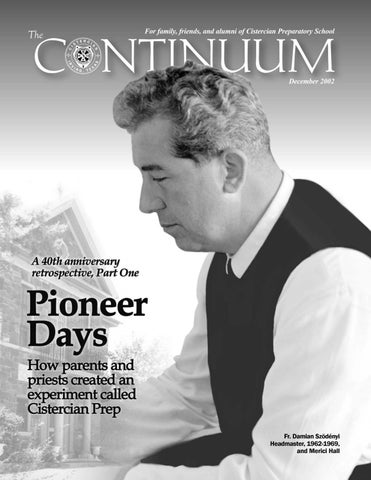
Fr. Damian Szödényi Headmaster, 1962-1969, and Merici Hall
Letter from the Headmaster
Dear Cistercian Families, Friends, and Alumni,
Photo by Jim Reisch
This issue of The Continuum points to some of the ways Cistercian has been successful in its first 40 years. The feature article chronicles the excitement and adventure of the School’s first years. The founders’ vision has ultimately borne fruit in the successes of our graduating classes. The School has moved from a rented threestory-house-turned-boarding school to beautiful facilities on 60 acres of wooded land. Beginning with a faculty of eight teachers, most with little experience teaching American boys, we now have a faculty of 35 men and women with an average of 14 years teaching experience at Cistercian. And the percentage of faculty with doctorates is higher today than it was in the School’s first years. But there is one area where Cistercian is still waiting to see the fruit of its labors — vocations to the priesthood. After 40 years of growth and development, Cistercian needs a new gymnasium and more tennis courts. But we need new Cistercian priests much more. Ten Cistercians are still active in the School. Six of these (Abbot Denis, Fr. Henry, Fr. Matthew, Fr Roch, Fr Julius, and Fr. Bernard) observed the first graduates receive their diplomas in 1970. We are grateful that over the last 30 years four more monks have joined the faculty (Fr. Gregory, Fr. Peter, Fr. Mark and Fr. Paul). And we are eagerly looking forward to the ordination of Fr. Gabriel this summer and his presence in the Prep School next fall. More priests teach at Cistercian than in any other school in the Metroplex, and I suspect that one would be very hard pressed to find another Catholic school in Texas, even in the United States, with a greater percentage of priests on the faculty. Still, even Cistercians age. The struggle to add and form new members to the monastery must be our primary task for the future. We must all become both more prayerful and more active in bringing vocations to our abbey. We are searching for young men who seek to know and follow Christ. Over 1,500 years ago, St. Benedict formulated the ideal of our life: amori Christi nihil praeponere (Put nothing before the love of Christ). To promote vocations, we must cultivate this lifestyle by word and example. Recently, the community has begun the practice of gathering every Thursday evening for Adoration of the Blessed Sacrament and prayer for vocations. We also gather Tuesday evenings to pray the Rosary together, again for vocations. I believe that in recent years interest in the spiritual life and sacramental practice has increased noticeably. In the Upper School there are weekly opportunities for the sacrament of reconciliation and spiritual counseling. Fr. Roch and Fr. Paul have also begun hosting upper classmen at a Bible study in which the topic of a religious vocation is both frequent and explicit. Under Fr. Paul’s leadership as vocation director, we have seen a variety of activities bring college students to the monastery for retreats and guidance. People speak of “the current crisis in vocations.” We’d like to think that the wind is turning, for more and more young people are seeking advice about how to give their lives to Christ. Cistercian has been blessed over the 40 years. But the biggest challenge is still ahead of us: the renewal of religious and priestly life and replenishing the ranks of the Cistercian monks.
Fr. Peter Verhalen ’73 Headmaster
2
The CONTINUUM
In this issue.. .
Volume 30, Number 1
CISTERCIAN PREPARATORY SCHOOL
F
E
A
T
U
R
E
S
th
40 anniversary
R E T R O S P E C T I V E P a r t O n e
Pioneer days at Cistercian Prep
ADMINISTRATION Rev. Peter Verhalen ’73 Headmaster
5
When parents recruited the Cistercians to start a prep school in Texas, they believed their new school might produce 20-25 leaders every year and “transform the community.” But building a school wouldn’t be easy.
Rev. Bernard Marton Assistant Headmaster College Counselor
Greg Novinski ’82 Dean of Students
Robert J. Haaser Director of Admissions
Michael Burns ’81 Director of Development and Alumni Relations
Dan Lee Director of Athletics
Jim Bloodgood President, Cistercian Alumni Association
EDITORIAL STAFF David Stewart ’74 Editor & Art Director
Tom B. Pruit Copy Editor
Sally L. Cook Assistant Copy Editor
Jim Reisch Photography Editor
Great expectations A few of Cistercian’s financial gurus discuss the causes and the cures for the business scandals of 2002.
13
D E P A R T M E N T S Letter from the Headmaster . . . . . . . . . . . . . . . . . . . . . . . . . . . . . . . . . . . . . . . 2 School News . . . . . . . . . . . . . . . . . . . . . . . . . . . . . . . . . . . . . . . . . . . . . . . . . . 4 Sports News . . . . . . . . . . . . . . . . . . . . . . . . . . . . . . . . . . . . . . . . . . . . . . . . . 15 Class Notes . . . . . . . . . . . . . . . . . . . . . . . . . . . . . . . . . . . . . . . . . . . . . . . . . . 16 On Prayer . . . . . . . . . . . . . . . . . . . . . . . . . . . . . . . . . . . . . . . . . . . . . . . . . . . .20 Calendar . . . . . . . . . . . . . . . . . . . . . . . . . . . . . . . . . . . . . . . . . . . . . . . . . . . . 20 Cover photography courtesy of the Cistercian Abbey Archives and the Cisterican Prep School Archives
The CONTINUUM is published by
Cistercian Preparatory School. P.O. Box 140699 Irving, TX 75014-0699 469-499-5400
www.cistercian.org December 2002
Cistercian Preparatory School was founded with the aim of preparing talented boys for the colleges of their choice by challenging their minds with excellent academic programs, molding their character through the values of Catholic education, and offering them guidance with both understanding and discipline. Cistercian Preparatory School does not discriminate on the basis of race, color, national or ethnic origin in the administration of its educational practices, admissions, scholarship programs, and athletic and other school administered programs.
3
School News Photo by Jim Reisch
NEW TALENTS This year’s new faculty members are (from left to right) Craig Sklar, Cambria Reinsborough, and Kristin Speakman. See “Noteworthy” below. FUNDRAISING
The Campaign surpasses the $4 million mark Winter is when it really hits you. The numbers of boys trying out for basketball seem to expand every day. On rainy days, the gym is teeming — boys packed into the weight room and the PE classes roaming in search of a dry place to work out. The picture will be very different when the new gym is built. The renovated weight room will accommodate more students. The PE classes will enjoy volleyball, badminton, or basketball in the old gym while the basketball teams practice next door. A freshman basketball team will be added, reducing the numbers cut from the varsity and junior varsity. (Remember when Cistercian was small enough that cuts were rare?) The Campaign for Cistercian lies within about $500,000 of the funds needed 4
to build the gym. “We’d like to start construction next year,” said Michael Burns, development director. Architects are busy completing their final drawings and Andres Construction has brought in subcontractors to examine the site and to prepare their bids. The remaining funds needed to begin construction will require everyone to sacrifice. If you haven’t already, please make a generous pledge. If you have already pledged, consider a larger gift. The kids are counting on each and every one of you.
THE ARCHIVES
Efforts made to preserve Cistercian’s past Under glass in the lobby of the library, the collectibles from decades past took on a new glow. The display, the first work of Cistercian’s new archivist Anne Peterson, attracted a lot of attention from students. “The display brings the history of the school to life and the kids have fun with it,” said Peterson, who is curator of photographs at SMU’s DeGolyer Library. She’s also the mom of Clayton Westmeier ’08. “I just volunteered for the job,” she said. But she is hardly an amateur. She served as the archivist at Hockaday (her alma mater) for seven years prior to taking on her duties at Cistercian. The job is a big one. “It starts with setting a policy on what we want to keep,” she said, “which I am working on with Fr. Peter.” Then there’s organizing the photos and preserving them in acid-free archival storage. “We want to establish a safe repository along with a
finding aide.” But the archive will extend beyond photographs. Ideally, it also will include at least two copies of each student publication, school directories, diplomas and other artifacts. Peterson also would like to collect items like an old Cistercian tie, emblem, a gray sweater, and an old Cistercian book bag (remember those?). “Right now, we’re in the process of finding out what we don’t have,” she said. If you have something you think belongs in the Cistercian Archives, please contact Ann Peterson by email: aeptx@aol.com. MORONEY AWARD
Johnston ’71 to receive alum award Jan. 31 Time to make your reservations to see Dr. Steve Johnston ’71 receive the Moroney Award, which honors the school’s most distinguished alumnus. The presentation will be made at the Tower Club on January 31. For reservations, call the development office at 469499-5406.
N O T E WO RT H Y Cistercian welcomes three new faculty members this year. Cambria Reinsborough, who holds a masters and a doctorate in Geology from UT, teaches Life Science (Form II) and Physical Science (Form IV). Dr. Reinsborough also is working to revamp the school Web site. Kristin Speakman, who admits she didn’t always like math, teaches it to Forms II and IV. She comes to Cistercian from Tulsa, where she taught at Bishop Kelley High School. After a brief stint in the “real world,” Craig Sklar decided teaching and coaching were just in his blood. He teaches Social Studies to Form II and serves as head coach of the junior varisty basketball team, and is an assistant coach for football, basketball, and baseball. Over the past two years, the number of legacies from the classes of 1970-1972 have tripled. Until then, only Matthew McAuliff ’00 son of Steve McAuliff ’71 had attended Cistercian. Now the school is proud to be educating James Coyle ’06, Wes Johnston ’10, Will Johnston ’08, and Joseph LaManna ’10. Dads Kevin Coyle ’70, Steve Johnston ’71, and Joe LaManna ’72 can again be seen regularly around campus.
The CONTINUUM
th
40 anniversary
Photo courtesy of the Cistercian Prep School Archive
R E T R O S P E C T I V E P a r t O n e
EN GARDE Fr. Damian poses with fencers Mike Wunderlick and Paul DeCleva on the grounds near Merici Hall on Walnut Hill Lane circa 1963.
PIONEER DAYS CISTERCIAN at
When parents recruited the Cistercians to start a prep school, they believed their new school might produce 20-25 leaders every year and “transform the community.” But building a school wouldn’t be easy.
T
BY DAVID STEWART ’74
HE RIDE HAD SEEMED INTERMINABLE, but the car was turning onto his street now. The smallish third grader looked at the burly priest sitting next to him. He had grown comfortable with him over the course of their afternoon together. Though his thick accent sounded a bit like Dracula, the priest’s baritone voice soothed his nerves and his friendly attention had eased the boy’s apprehensions about the new school. “Steve performed very well on our tests,” Fr. Damian Szödényi explained as he sat down with Mr. and Mrs. McAuliff in the living room of their University Park home. He looked over at Steve who sat fidgeting. “He is a bright boy, the kind who will do well in our new school.” Mr. and Mrs. McAuliff were impressed with Fr. Damian’s December 2002
appraisal of their son and with his description of a school based on European high schools (or gymnasiums), which prepare above-average boys for the best universities. The McAuliffs had sent their older sons to the local parochial school, Christ The King, and then to Jesuit for high school. But they were anxious to give this new school a try. They hoped it might answer some of the nagging questions Americans were asking themselves in the Spring of 1962 about an educational system that appeared weak in math and science. After all, how else did the blasted Russians find their way into space ahead of us? Maybe these Hungarian monks were on to something. “Our new school,” Fr. Damian emphasized, his eyes twinkling, “is for special boys who will one day become leaders in the community.” Steve’s curiosity was piqued. The McAuliffs 5
were sold. “Like all of the early families, my parents took a huge gamble,” emphasized Steve McAuliff ’71. “There was not even a school building yet. All Fr. Damian had to show was the abbey. But he was very persuasive.” Fr. Damian did not linger for more than a half hour at the McAuliff’s house. He was on a mission. “Beginning in January of 1962, we were extremely busy,” recalled Fr. Melchior Chladek, who had been appointed by Prior Anselm in late 1961 to assist Fr. Damian in preparing the new
Glory days Recalling some of the greatest games in Cistercian’s 33-year gridiron history “What sport do you like to play,” a priest asked the boys assembling on the meadow outside the three-story mansion on a bright September morning in 1962. The priest, along with several of his Hungarian cohorts, was determined to make Cistercian’s first recess a success. The boys were ready to blow off some steam. “Football!” the boys screamed excitedly, almost in unison. “You’ve never seen a group of grown men so giddy,” said David Dolan ’70, who remembers the reaction of the priests vividly. The boys scratched their heads as a priest hurried inside and then reappeared with a soccer ball. American-style football (“Silly fuuutball and monkey suits”) was banned from campus that first year until a parents committee led by Leslie Pritchett intervened. The school fielded its first seventh/eighth grade team in 1966. Blessed with some very talented players — three of whom would play in larger programs in high school — the Hawks won every one of their games that year. But while football gained a foothold at Cistercian, the school’s de facto athletic director in the early days preferred activities that were distinctly “old school.” Dr. DeGaulle, a rotund Hungarian who would go on to coach fencing at SMU, taught the boys the only sport he knew. When it rained, the boys threw medicine balls at each other. Ray Foley ’70 remembered that he and John Bush ’70 competed evenly with college fencers.
6
school. In addition to administering admission tests (and chauffeuring each candidate home), the two priests were ordering textbooks, chalk, and desks, everything one needs to run a school. Once the Cistercians had leased Merici Hall on Walnut Hill Lane from the Ursuline nuns, they began to transform the old mansion into a schoolhouse. [The Ursulines had housed boarders there through the end of the 1961 school year.] Ideas and concepts on how to blend the best of the European educational traditions with modern American ideas bubbled out
Cistercian’s varsity football team saw its first action in a game-conditions scrimmage during spring training of 1969. The Hawks prevailed 8-6 over Greenhill. The following fall, the Hawks faced the Trinity Valley Trojans in Fort Worth in their first official game. “We strapped on our leather helmets and made Coaches Coombes, Cooper, Cortemiglia and the venerable Coach Haaser proud with the school’s inaugural victory. Thereafter things got a little dicey with a string of defeats,” Charlie Williams ’70 said. “I recall thinking that a weight room, or actually a home field would be nice. Alas, we played all of our games on the road.” Fr. Denis said that the boys showered in what is now the ladies restroom on the first floor of the Middle School. Upon exiting the showers, they had little choice but to dress in the hallway. According to our very unscientific poll, the greatest game of the seventies took place on October 14, 1972, a homecoming game vs. powerful Dallas Christian, which had never lost to Cistercian. Cistercian cheerleaders elected by the student body graced the sidelines for the first time that year. Fans sat in bleachers, which had been completed just in time for this game. Quarterback Terry Buell ’73 (20 of 35 for 316 yards and four TDs) and receiver Tom Lewis ’73 (two TDs of 53 and 65 yards) kept the Hawks close. Then with just 45 seconds remaining, Buell lofted a 13-yard pass to Peter Smith ’74 for a 24-20 victory. Cistercian football grew up that day. The next year, Bob Cahill arrived – along with countless 40-yard wind sprints at each practice – and winning became a habit. The top game from the eighties took place on the first Friday night of the 1983 season in Tyler versus Gorman. Tied with just 10 seconds remaining and the ball on the 32-yard line, Coach Haaser called out, “Field goal team!” The 47yarder would be the longest field goal in school history if good. Greg O’Hagan ’84 trotted out and hit it perfectly. Running backs Kevin Spencer ’85 and O’Hagan each gained over 100 yards rushing that night while quarterback Matt Walter ’86 threw for over 100 yards in the 10-7 victory. For the nineties, we’ll go with the ’99 Greenhill game, arguably Coach Hillary’s finest moment. Ranked number three among area private schools, the Hornets’ no-huddle offense had stung opponents early and often. But with two minutes to go, the Hawks’s David Aird ’00 scored and the Hawks once again proved Coach Hillary right: no HUDDLE UP Quarterback what matter the odds, the Terry Buell ’73 (number 10) Hawks always believe calls a play for the Hawks during the 1970 season. they can win.
The CONTINUUM
of the 49-year-old Fr. Damian. Some were rooted in his experiof York, England, had enjoyed tremendous success, sending a ences teaching at secondary schools in Europe, others derived large percentage of the students in their first graduating class of from work at universities in America. In Hungary, he had taught 1960 to the nation’s top colleges. The magazine story, or word Hungarian language and literature at the Cistercian school in of it, slowly made the rounds. All agreed that the Priory School Budapest (including Fr. Melchior in Form I and Fr. Daniel in paradigm appeared solid. Form VI). In the United States, Fr. Damian taught Latin at a Mrs. Bret, who had Fr. Louis and Fr. Damian, recommended university in Buffalo, New York, and the growing band of “zealots” (as Smith psychology at the University of Dallas. referred to them) consider the Cistercian His interests ranged far and wide, and monks as an option. Mrs. Bret scheduled his open mind picked up ideas everyan appointment with Prior Anselm to where. Fr. Damian read about education discuss the idea. and he listened to parents. He considered “Yes, indeed we’d like to form a everyone’s opinion. school,” Prior Anselm told her. “We have “We did not consider ourselves teachbeen teaching secondary school students ers,” Fr. Melchior explained. “We saw for centuries in Hungary. But we’ll need ourselves as educators.” Fr. Damian more than moral support.” studied the most current thinking on eduMr. Smith, the chief financial officer cation and sought to integrate it into the for Texas Instruments, began to line up new school. that support. He approached his good This openness fit nicely in the sixties, friend Pat Haggerty, then executive vice — Brian Melton ’71 a decade that was to stretch everyone’s president of Texas Instruments. Mr. sensibilities. Only a year before, Haggerty (who later would become the President Kennedy had promised that Americans would walk on company’s chairman) had a son the same age as Mr. Smith’s the moon by the end of the decade. Anything was possible. oldest son. He heard parents complain that their sons misbehaved in the “I could really get interested in this,” said Haggerty. parochial schools because they were bored. Fr. Damian proSmith then asked Mrs. Bea Haggerty to help him enlist the posed an advanced math and science curriculum. In Form I, Fr. support of Bishop Gorman for this new Catholic boys school. Melchior would introduce microscopes, which were traditionalThey found the bishop preoccupied with a variety of other projly reserved for high school students. Fr. Damian directed Fr. ects, including the creation of two new diocesan high schools, Bede, who had earned a master’s in history, to teach a course on Bishop Dunne and Bishop Lynch. ancient civilizations to the youngsters. In addition, he envi“Bea and I had to sit on the bishop’s desk, literally,” Smith sioned the boys becoming familiar with geography, languages, remembers. “We would not let the subject drop; we kept him on literature, music, and art. He envisioned all of the school’s the case. He finally said, ‘If you’re going to do this school, go teachers having a master’s degree in their field. ahead.’” There was, however, a condition. The bishop prohibited fund-raising efforts for this new boys school from interfering with his other projects — in other words, no public campaign. E DON’T HAVE ANY PLACE Without advertising, the message would have to spread by word to send our boys before they of mouth. reach high school,” Jane Bret In the Spring of 1961, Dr. Mike Healy, Mr. Bill Bret, and Fr. told Fr. Louis Lékai on the steps Moses Nagy traveled to St. Louis to visit The Priory School. of the University of Dallas in The trip fueled the group’s enthusiasm and provided fodder for late 1959. Mrs. Bret, a Fr. Moses’ first and, as it turned out, last presentation on the new Montessori teacher and mother of three boys, was completing school. her degree at U.D. and was studying history under Fr. Louis. The Smiths hosted a buffet in May 1961 for interested par“We need a school like Ursuline for boys,” she explained. ents. Sixty attended and heard Fr. Moses tell of the challenges The parochial schools were overflowing with children, of the coming decade, including the increasing competition for sometimes 75 to 80 students filling a class. The private schools spots at the nation’s top colleges. He outlined the school’s proweren’t much better. In conversations with other moms, she posed curriculum, and it sounded very similar to the curriculum found two, Pat Healy and Beth Smith, who shared her concerns. of Cistercian schools in Hungary. All three women had a number of sons for whom they were Prior Anselm, however, decided in June 1961 to appoint Fr. seeking a top-notch education. Damian, not Fr. Moses, as the school’s first headmaster. The “These three ladies didn’t like what they saw in the private appointment surprised both men and neither appeared amused and parochial schools,” remembers Bryan F. Smith. “They soon by the decision. convinced their respective spouses that the education of their “I sensed that Fr. Damian really didn’t want the job,” sons was in serious trouble.” A Harvard graduate with five sons recalled Mr. Smith in his remarks at Fr. Damian’s Rosary and out of seven children, Smith enthusiastically jumped aboard the Vigil Service in December 1998. “I soon discovered he had a small bandwagon that still had little direction. reservoir of negotiating skills when he finally agreed to In January 1960, a feature article in the catholic magazine assume the task, but only if he would be free from the responJubilee changed that. sibility for fundraising and the school’s finances; thus cleverThe story trumpeted the exploits of a new school in St. Louis. ly shifting back to the lay zealots the responsibility for those The Priory School had been founded in 1955 by parents who essential tasks.” recruited Oxford-educated Benedictine monks to serve as the nucleus of their faculty. The monks from the Ampleforth Abbey
“Individually, we were just bookish, dorky little kids. But as a group, we functioned as one ... We were the Beatles of Mayhem..”
“W
December 2002
7
“I
NSTEAD OF PARKING LOTS AND playgrounds, we had forests and creeks, and a remarkable three-story, ages-old mansion to explore,” Charlie Williams ’70 recalled of those first days of Cistercian Prep School in September 1962. “This is pretty cool,” Steve McAuliff remembers thinking to himself forty years ago, “this big old house, a bunch of really bright guys, a morning recess — that was just fabulous — where you could go out and play in this big meadow. There was such a feeling of freedom, no robed nuns, and we were given free rein. You could wander down to the creek if you wanted. There was a bombardment cage built and we had fencing.” “If it could be brought back to life,” says Jack Brennan ‘70, “you could almost shoot a Harry Potter movie there.” Transforming Merici Hall into a school, even a temporary one, posed quite a challenge for the Hungarians. Despite having seen service as a boarding house, remnants of the old mansion’s glory days were everywhere. “We had to establish classrooms somehow,” Fr. Melchior laughed. “The first floor had quite a large room, large enough for an entire class, with a beautiful parquet floor. The second floor had two smaller rooms and a balcony with a bathroom connecting. I turned the bathroom into my animal room and kept turtles in the bathtub. “The third floor, which was just an attic, served two functions. We used it as a gym and as a chapel in the last year and a half. Originally, I believe, class masses were held downstairs on the semi-circular porch behind what had been the library across the way from the entrance hall.” Mr. Jerry O’Brien, who taught math at Cistercian from 1962 through 1987, remembered that an iron fire escape on the back of the building was declared off limits for the students. “There were times, however, that they couldn’t resist the temptation,” he said. Electric fans stationed in the classrooms fought a losing battle against the heat. [The Wunderlick family donated window units for the classrooms in 1963.] But the boys in their black neckties didn’t seem to mind. “We felt like we were something special wearing those ties,” McAuliff said. “We stuck out like a sore thumb. I remember going to the symphony at Fair Park in our dress uniform. A black boy from another school came up to us and asked, ‘Where do you go to school?’” When the Cistercian students answered, the boy struggled to make sense of it, “Construction?’” “But this was what I had been prepared for. This was a new school with special kids who were expected to be leaders. They expected more out of us — and they gave us more responsibility academically — but they also gave us more freedom to do different things.”
Fr. Bede Lackner served as Form Master for Form I and taught ancient history, music, and geography. Fr. Daniel Csanyi handled the Pre-Form and taught religion. Fr. Melchior taught biology. In addition to Mr. O’Brien, and Ursuline Sister Miriam taught English. “I do have fond memories of Fr. Melchior and his biology classes,” remembered David Dolan ’70. “Those frogs were doomed from the beginning.” “I CALL UPON CHAIRMAN KHRUSHCHEV TO HALT and eliminate this clandestine, reckless, and provocative threat to world peace,” President Kennedy told a nationwide television audience on October 22, 1962. Nuclear war had never appeared more imminent. Meanwhile a 26-year-old priest was stepping into the monastery for the very first time, quite unaware of the showdown between the two superpowers. One couldn’t blame the bespectacled immigrant — fresh from a taxing, four-day journey from Rome — if he had hoped for an old-fashioned Hungarian welcome upon his arrival. But as he made his entrance into the recreation room that afternoon, only the monks’ backs greeted him. The monks, who were riveted by President Kennedy’s words on the Cuban Missile Crisis, hardly noticed Fr. Denis Farkasfalvy. Not long afterward, Prior Anselm sat down with the monastery’s newest priest to discuss his future. While Fr. Denis hoped to pursue the study of Biblical Theology or French literature, his superior had other ideas. “French teachers we have more than we need,” Prior Anselm insisted. “You have a choice between math and some science, like Physics or Chemistry.” Prior Anselm explained to the young priest later, “Only as a teacher of math or science could you gain enough respect to be a leader at the school.” Fr. Denis followed those orders and enrolled at TCU to study math. Back on Walnut Hill Lane, the boys were hitting their stride. “The initial intimidation of learning from priests with funny accents evaporated pretty quickly,” recalled Williams. “We had strength in numbers. In fact, the intimidation factor ultimately seemed mutual. I don’t think the Cistercians had quite anticipated the degree to which 10-year-old American boys could be unqualified jerks, albeit creative jerks I must say. Their frustration level reached comic proportions at times.” “Individually, we were just bookish, dorky little kids,” explained Brian Melton ’71. “But as a group, we functioned as one, a whole that was greater than the sum of its parts. We were the Beatles of Mayhem.” Many parents had signed on with the new school because they believed the Cistercian monks would impose the strict discipline associated with the European gymnasiums. They were disappointed. By the end of the year, discipline topped a list of problems that
PIONEERING STUDENTS Students enjoyed being “home schooled” in Merici Hall’s fascinating surroundings. “You could almost shoot a Harry Potter movie there,” remembered Jack Brennan ’70.
PARTY TIME Beth and Bryan Smith (right) hosted a party in May 1961 to introduce Dallasites to the Cistercians and generate interest in their new Catholic school. Prior Anselm (left) and Fr. Moses represented the monks. Photo courtesy of “The Cistercians in Texas” Photo courtesy of the Cistercian Abbey Archive
8
The CONTINUUM
planned to transfer the monastery to a 51.8-acre site called the Georges’ estate at the corner of Marsh Lane and Valley View Lane (now the site of Brookhaven College). Prior Anselm had favored this site for the school and for the abbey since the Cistercians would own all rights to the land (unlike the land in Irving). The Prior’s announcement startled the bishop. Realizing U.D. could not afford to lose the services of the Cistercians, he reversed his earlier decision. With characteristic bravado, the bishop announced that the Cistercians were hereby forbidden from building the school anywhere but in the vicinity of the present location of the monastery. Inside the monastery, Prior Anselm was disappointed but relieved. Unbeknownst to the bishop, the monks had voted down Prior Anselm’s plan to move the monastery. Cistercian Prep would be located in Irving. “The Irving location made it paramount that the school strive for excellence,” Smith insisted. “There was not — Bryan Smith room for a ‘me too’ school, certainly not one out in Irving in those days. The striving for excellence, the dedication to this over time, was the single most important factor in the growth of the school. It still defines the place.” Smith and Haggerty insisted that the school be designed to reflect that excellence and called upon the most renowned Texas architect of the day to handle the job. O’Neil Ford had completed several projects for Texas Instruments as well as Trinity University in San Antonio, Skidmore College in New York, the University of Dallas, the Haggertys’ Dallas residence, and, years later, the Smiths’ residence. Ford frequently just sketched out his ideas on the back of a napkin and then let his staff work out the details, but as Smith said, “He guaranteed you’d end up with something distinctive.” Another aspect of the job was to design a building that could be built around easily, allowing for future growth. Duane Landry, who worked in Ford’s office, handled much of the detail work, but Smith said, “Neil’s fingerprints were all over the thing.” “Neil possessed the innate skills to integrate buildings into the Texas landscape,” Smith added. “He was a natural fit for the project. We wanted something unique, and it turned out to be just that. I think it has withstood the test of time very well.”
“The Irving location made it paramount that the school strive for excellence ... The striving for excellence ... was the single most important factor in the growth of the school.”
W
HILE THE FACULTY AND STAFF undertook changes to make life better for the boys during their second year in Merici Hall (e.g., the number of toilets were increased and a baseball diamond was carved), the founding families and Prior Anselm continued their efforts to secure and build the school’s permanent quarters. The location of those quarters triggered a chess match between the bishop and Prior Anselm. The bishop, who was prone to dictatorial pronouncements, initially proclaimed that the school could not be located near the Cistercian monastery. This decision resulted from serious lobbying by U.D. officials who feared that a secondary school so nearby would erode the monks’ dedication to the University. Within days, Prior Anselm made his own announcement: He
“HOW WOULD YOU LIKE TO GO TO FISH CREEK this weekend with the Haggertys?” asked Fr. Damian, poking his head into Fr. Daniel’s office twenty minutes before the final bell one Friday. Fr. Daniel was taken completely by surprise and he
TRYING TIME Fr. Denis, Abbot Anselm, and Fr. Damian at the May 1970 graduation ceremonies.
MAPPING A LOCATION In 1962, the trek from North Dallas to Irving consumed 30 to 45 minutes. That’s why some parents favored a site at Marsh and Valley View (see white circle) rather than the site near the monastery (see black circle). The black star indicates the location of Merici Hall. Map scan courtesy of TexasFreeway.com
Photo by Edward Montgomery
9
Photo by Jim Reisch
were discussed with Prior Anselm and the Cistercians by the parents’ representative, Bryan Smith. According to Smith’s subsequent memo to Fr. Damian, the provisions of the Rules and Regulations (dated October 1, 1962) lacked clarity and were applied inconsistently. Each teacher was coming to terms with class discipline in his or her own way (e.g., some shying away from corporal punishment, others embracing a limited form of it). The memo also noted that some parents believed the school’s blend of European and American educational principles leaned too heavily stateside. Specifically, they were concerned that the ideas of Professor John Dewey — who some consider to be the father of American education — were exerting too much influence on Fr. Damian. Dewey’s philosophy was founded on the premise that nothing is constant. Rather than measure results absolutely, he suggested results be measured relatively based on a student’s desire. While some parents may not have appreciated what they considered Fr. Damian’s overly lenient attitude, the boys loved this about the man they would name “The Bear.” “Fr. Damian always tried to find the good thing about you, what you excelled in,” said McAuliff. “He tried to find the positives in people.” The disciplinary and philosophical problems were compounded by the fact that the number of applications for the following year’s Pre-Form had dropped sharply. The enthusiasm and optimism of 1962 was evaporating in 1963.
wondered how it could be possible to arrange a trip so quickly? “Where is Fish Creek?” he asked. “On Green Bay near Lake Michigan,” Fr. Damian answered. “It is impossible,” he said. “How could I possibly return for classes on Monday morning?” he asked. “The Haggertys’ private jet will fly us up and back. Don’t worry. You will be back in time. Go pack some clothes,” Fr. Damian said, hurrying out the door. For Fr. Daniel, who was not accustomed to such treatment, it stands out as an unforgettable experience. “It was a wonderful weekend. We ate in a superb restaurant with spectacular views and stayed at the Haggertys’ beautiful home, a renovated 19th-century barn on the tip of the peninsula. We sailed on their yacht. Mike [eleven years old at the time] and I capsized a boat Sunday morning. We were back in the monastery by Sunday evening.” “The Haggertys were absolutely lovely hosts,” Fr. Daniel said. Such occasional perks rewarded the priests for all their hard work, and the parents very much enjoyed the company of priests like Fr. Damian, Fr. Anselm, Fr. Henry, and Fr. Melchior. The founding families frequently invited the priests to their homes. “My husband and I enjoyed the company of such learned men,” remembered Mrs. Bret. “They were very stimulating.” School matters dominated the conversations in 1962 and 1963. “The parents and the priests engaged in endless hours of discussion in those first years,” remembers Jane Bret. The topics ranged from how to handle lunch (it was decided the boys would “brown bag” it to avoid the expense of a cafeteria) to fundraising. The sacrifices — in both time and money — demanded by such an ambitious enterprise forged deep bonds between the American suburbanites and the Hungarian refugees. They shared a devout Catholic faith, a belief in the power of education, and an excitement over the prospects of establishing a school that might one day produce 15 to 20 real leaders every year. They felt the school might “eventually transform the whole area,” Mrs. Bret remembered. The beautiful relationships between the parents and the
priests played a major role in helping the school raise $250,000 from just 82 families by February 1964. Along with the Cistercians’ contribution of $100,000, the funds were available to construct the Middle School building, which would be completed approximately one year later.
B
Y SEPTEMBER 1964, THE BEGINNING OF Cistercian’s third year, Merici Hall was exploding with boys. The school now boasted four grades, stretching from Pre-Form to Form III. It seemed like the place might be destroyed before the Cistercians and their rowdy boys relocated to the wilds of Irving. Disciplinary problems continued to plague a number of the teachers, especially the monks, who found that American students never tired of making fun of their accents. “Fr. Damian did not promote corporal punishment. He was a new breed,” Mr. Jerry O’Brien said. “He was more permissive. He wanted to let a child grow. Cracking the whip was not his style. There was a bit of hassle over that.” Many teachers felt compelled to take matters into their own hands. “The wonderful late Fr. Thomas (one of the monastery’s most senior members) in particular was victimized way too much,” said Williams. “We were characterized daily as ‘brutes, beasts and animals’ which was fairly accurate.” David Hines remembered, “Father Thomas would yank the hairs of our — Jane Bret sideburns up and say Huey Yi Yi!” Even Fr. Damian, who preached patience and motivation, occasionally lost his temper. Once, his temper turned on the poor turtles that occupied the bathtub in the upstairs bathroom in Merici Hall. Fr. Damian finally had enough of the stench one particular day and had the creatures thrown out. When Fr. Melchior discovered that his turtles were gone, Fr. Damian explained that officials from the Fire Department had said the turtles did not meet code. Everyone looked forward to the days ahead in the new school in Irving. “We visited the construction site daily,” remembered Fr. Daniel. “We were trying to will the new school out of the ground.”
Photo courtesy of the Cistercian Prep School Archive
“Fr. Damian had a wonderful philosophy that there were no troubled boys at Cistercian, just boys having troubles adjusting to a rigid academic curriculum.”
“HOW LONG DO YOU THINK YOU’LL last?” Alan Thomasson ’74 asked Stephen Housewright, the latest English teacher, on the teacher’s first day on the job in 1969. Although insolent, the question reflected the students’ frustration over a steady stream of faculty failures. “Boy was I green when I began teaching in MIDDLE SCHOOL CONSTRUCTION (from left) Dr. Charles Galvin, Bryan Smith, Fr. Damian, and Dr. E.A. Steinberger inspect the site in August 1964. That’s Peter Smith ’74 (left) and older brother Buck ’71 (right) tagging along.
10
The CONTINUUM
Hawks, Stingrays, Monks ... hmm “I remember thinking we’d be teased mercilessly” “When we started playing sports against other schools,” remembered Jim Pritchett ’70, “it was determined that we needed a mascot. We were told we
1969,” remembers Housewright, who would provide stability and excellence at Cistercian for ten years. “I knew the English Department had been in a state of flux for several years before I came, and Alan’s question gave me some anxiety.” The new school building had eased the overcrowding of students and teachers, provided a lunchroom, and other conveniences, but problems with several faculty positions persisted. While many lay faculty members from Merici Hall stuck around (Paul McArdle taught English until 1972, Jerry O’Brien taught math through 1987, and Rodney Walter continues to teach history at the school), the English Department experienced a great deal of turnover. Art and Science teachers also seemed to come and go with regularity. The move to the new school was accompanied by an influx of young Hungarian monks. Fr. Aurel Mensaros, Fr. Bernard Marton, Fr. Denis Farkasfalvy, Fr. Julius Leloczky, and Fr. Roch Kereszty had escaped Hungary in 1956. They brought a new attitude to the abbey and to the school. In fact, Fr. Denis’ attitude had found its way under the skin of both Abbot Anselm and Fr. Damian rather quickly. The 26year-old with a doctorate in theology had completed his bachelor’s and master’s in math at TCU in just two years while also learning English. They also knew him to be a talented student of Hungarian literature. But he could be difficult, frequently contradicting the Abbot. So, he was put to the test. Fr. Denis was assigned to serve as Form Master of the school’s newest and largest class to date, the Pre-Form of 1965-66, with 25 students. He would sink or swim with them, teaching them eleven classes per week (eight math and three religion) plus supervising five study halls and one Form Master’s period every week. When he wasn’t standing in front of his form, he would be teaching Form IV math (Class of 1970) or at the university. Fr. Denis quickly earned a reputation for strict discipline, a December 2002
I
N SEPTEMBER 1967, Cistercian Prep School appeared well on its way towards success and stability. The new Upper School Building opened and the school boasted seven grades and 151 students. Behind the scenes, however, Abbot Anselm was scrambling to keep the enterprise going amidst complaints from both parents and priests. “Our kids were like guinea pigs in those days,” Jane Bret said recently, referring to the students on whom so many teachers were tested. She adored Fr. Damian but came to realize that some of his greatest assets created liabilities for the school. “He was an educational psychologist. Fr. Damian had a wonderful philosophy that there were no troubled boys at Cistercian, just boys having troubles adjusting to a rigid academic curriculum. I remember one boy who grew quite tall had some academic problems. Fr. Damian told his parents not to worry; he would do much better once he quit growing. And he was right.” But the inconsistent standards caused problems for students and for teachers. A few students were passed when they should have failed. A few teachers were given new contracts when they should have been let go. Parents saw that the revolving-door faculty was retarding their boys’ chances of academic success. Results from a standardized high school entrance test in 1967 proved disappointing. Time was of the essence. The first two classes had risen to high school now. The Class of ’70 was just two short years away from applying to colleges. The reputation of the school hung in the balance. Parents and monks alike were beginning to feel that Fr. Damian, while a wonderful person to start a school, was not up to the task of managing a school of this size. A number of monks in the abbey also expressed their frustrations with the school’s inability to operate profitably. It was a financial black hole, they said. At the current rate, they suggested, the abbey would go bankrupt in a decade. The prep school, it appeared, would eat up the monks’ savings and rob it of the funds to develop facilities or vocations Amidst this turmoil, the Abbot stepped in decisively. Abbot Anselm appointed Fr. Placid Csizmazia as Assistant Headmaster to help with the administrative tasks, including the arduous process of preparing for accreditation by the Texas Education Agency. Then he formalized relationships with those people he had trusted all along. He named Bill Bret, Pat Haggerty, Dr. Louis Johnston, and Bryan Smith to the Board of Advisors (later re11
Photo by Jim Reisch
would have an election and that the only rule was that the school colors would be black and white (like the monks’ robes).” “The Cistercian ‘Brothers’ was one of the finalists (the priests were tallying the votes),” David Hines ’72 said. “I remember thinking that we would be teased mercilessly at every game we ever played if clearer heads did not prevail.” “We had a little unofficial club in those days called the Weatles,” said Jack Brennan ’70, who reminded us that this occurred during the early-to-mid ’60s, during the first wave of Beatlemania. “At some point we split the club up into three teams for sports. Jim Pritchett and I named our team the Weatle Hawks.” That appears to be the origin for the eventual school mascot. “Nominations were taken,” Pritchett said. “Here are the names that I remember: Hawks, monks, monkeys (Fr. Damian’s nickname for all of us), and “stinrays.” (Actually the person meant stingrays, but misspelled the name of the popular bicycle at the time.) I think jaguar also made the list. The election came down to Hawks and Stingrays. Lots of heated discussion and a close call. The first decal was designed by Fr. Damian. It was the giant shield with a Hawk in the middle. My brother actually had those manufactured and sold them for 50 cents each.”
sharp tongue, and unerring standards. Direct, cocky, and brilliant, he possessed a powerful personality and he proved to be an effective teacher and a prodigious worker. This new breed of monk threatened to ruin much of the fun that had made the “old school” so memorable.
Photo by Edward Montgomery
BRAVE NEW GRADUATES Peter Kurilecz, Jim Pritchett, John Bush, Charlie Williams, Jack Brennan, and John Thomas mug for the camera on May 23, 1970. The Commencement Exercises were held in the current lunchroom.
named the School Board). It also included four monks: Fr. Christopher, Fr. Benedict, Fr. Placid, and ex officio Fr. Damian. The Abbot served as president of the Board. Following the recommendation of Abbot Anselm and Fr. Damian, the board also named Fr. Denis to the newly created position of college counselor. Fr. Denis had impressed members of the board as someone whom they could trust with this important job. Though some found him difficult to work with, no one argued with his performance. As a Form Master, he kept his boys under tight control, helping them to produce the highest grade-point average of any class in the school. His teaching also continued to gain admirers, including Mr. and Mrs. Haggerty, whose son Michael was suddenly performing well in math under Fr. Denis’ tutelage.
ing too aggressive,” said Abbot Denis recently. Nevertheless, Abbot Anselm realized that the school needed some strong medicine and Fr. Denis was the one to administer it. Many greeted Fr. Denis’ appointment with a sigh of relief and a conviction that he would lead the school effectively. But others were angered. The students in the first three classes — most of whom, years before, Fr. Damian had chauffeured home after their admissions test — felt let down and betrayed. “Speaking for myself,” said Ray Foley ’70, “the animosity that we as a class displayed towards Fr. Denis probably came from a deep love and respect for Fr. Damian. It was certainly my own desire to graduate under Fr. Damian’s tutelage.” The differences between the two men also colored people’s feelings. “Fr. Damian was a big picture guy,” said Steve McAuliff. “He’d work the — Ray Foley '70 room like a politician. He had the perfect personality for establishing a school. He was creative and very sociable. But he tended to pass off details. Fr. Denis was extremely organized and regimented. One thing you knew about Denis, if he praised you, you knew you’d done something right.” “A lot of people perceived him to be a protector of his class (Class of ’74),” McAuliff added. “He put them on a pedestal. He felt that they were the first real class, and the first four classes just kind of muddled their way through.” Finally, Fr. Denis’ attitude struck many as arrogant. “We felt that he thought he was smarter than everyone else,” McAuliff commented, “and he was probably right.” “He would call a spade a spade,” Fr. Peter Verhalen ’73 remembered. Those whom Fr. Denis had offended found themselves blaming him for Fr. Damian’s resignation. But regardless of how anyone felt, a new headmaster would hand out the diplomas at the first graduation in May 1970. And the school would move forward, embracing Fr. Damian’s vision while creating new promise for Cistercian Prep.
“The animosity we displayed towards Fr. Denis probably came from a deep love and respect for Fr. Damian. Certainly my own desire was to graduate under Fr. Damian’s tutelage.”
CITING HEALTH REASONS, FR. Damian tendered his resignation as Headmaster of Cistercian Prep School in November 1968. “He had burned out,” said Jane Bret. Having steered the school through its infancy — providing it with direction, inspiration, and love — he was unwilling to subject himself and the school to any more criticism. It was not easy to give up a position that had given his interest in educational psychology meaning, had helped shape so many friendships, and was becoming more prestigious as the school matured. Abbot Anselm requested that Fr. Damian serve out the remainder of the 1968-69 school year while he considered his options. The two leading candidates were Fr. Placid, 54 years of age, and Fr. Denis, 32. While very competent, the elder candidate had a reputation as a compromiser. His age also concerned school board members. In such a case, Mr Haggerty said, one should choose the younger candidate. Fr. Denis and the Abbot had never been close friends, but the Abbot found the young priest to be industrious, intelligent, and decisive. Whatever Fr. Denis did, he did well. Abbot Anselm concurred with Haggerty. “I was perceived as young, immature, and dangerous, mean1212
The CONTINUUM
Great
Expectations Cistercian’s financial gurus discuss the causes and the cures for the business scandals of 2002. By David Stewart ’74
“I
t’s a simple, sad story of greed and pettiness,” said Jim Smith ’72, who has worked in the investment management business for almost twenty years and is a principal in Bedrock Management. He believes the recent crop of corporate failures like Enron, WorldCom, Tyco, ArthurAnderson, etc., were seeded in the early nineties. “If you step back a little bit, this is the epitome of the Clintonian narcissism,” he said. “People embraced a very unfortunate sort of MO where they were saying I am looking to serve only my own purposes. I am interested only in that which does something for me, that which enhances my status. You cannot imagine it’s that simple, but I think it is.” “I believe we wildly underestimated the cultural ripple effect of watching Clinton’s behavior embraced. By virtue of not being called on it, he became a role model.” “Financials statements,” Smith insisted, “are just a shell game.” They focus investors on one thing, like earnings per share, while weaknesses are hid elsewhere. “Wall Street slaughters any company that misses its quarterly numbers,” said Jere Thompson ’74, who found out the hard way as CEO of CapRock Telecommunications, a darling of the Nasdaq in 1999 (a year in which the company generated $193 million in revenues). McLeodUSA purchased the company in 2000 after a brief halt in CapRock’s earnings growth and a quick slide in its stock price. “If there’s a hiccup in your momentum, you can be crucified,” Thompson explained. “Money managers invest on the basis of the story and the momentum. Any shift in that momentum and they are out. They sell first, ask questions later.” In the face of such consequences — in which employees, customers, vendors, all suffer — even the most honest executives feel pressure to take steps to keep their stock price from falling precipitously and jeopardizing the entire company. That’s when some executives “took what appear to be reckless actions,” said Thompson. Like women starving themselves to measure up to runway models, executives take risks with their balance sheets and income statements to meet or exceed Wall Street’s expectations. “Unfortunately,” Thompson said, “executives aren’t rewarded December 2002
by Wall Street for running a company conservatively.” “Based on my contacts with others in the industry, it is clear that companies have become more aggressive in ‘managing earnings,’” said Joseph Shea ’78, finance director of the Operations & Technical group of Dr Pepper/Seven Up, Inc. “This consists of using the balance sheet to smooth profit. If results are especially good, some profit is ‘held back’ for a rainy day. This is driven in part due to the expectations of Wall Street analysts.” Guys like Robert Schoenvogel ’96, a financial analyst at Priderock Management in New York City, try to spot such tricks so that they can protect their investors. “Financial statements can be like a black box — there is a lot of room to manipulate certain items,” Schoenvogel said. “For example, we look to see if companies are setting unrealistically high assumptions for returns on their pension funds. Some companies turn these returns into paper profits to boost their reported income. We also look closely at any unusual charges coming out of acquisitions or divestitures. Those are red flags.” “The number of options granted to management teams and executive compensation levels are also topics that come up frequently in investor conferences,” he said. The average investor, of course, must rely on his own research and the word of the accounting firms, a word that was considered credible just a year ago. “I think that a lot of the problems observed with Enron and WorldCom show some of the inherent conflicts of interest for the large audit firms, who are supposed to serve as the investing public’s watchdog,” said Bruce Stevenson ’89, a chartered financial analyst and senior associate with CBIZ Valuation Group, Inc. in Dallas. “First of all, audit work is relatively unprofitable compared to high fee consultancy work previously performed by the (then) big five firms,” he said. “The incentive system was set up such that an audit partner’s job was dependent upon on his maintaining a particular client. Another issue that has been highlighted is that the interests of management and the board of directors are too closely in line.” Thompson agrees that “when a company is growing and the stock price is rising, no one wants it to end, not management, not the board, the investment bankers, the employees, analysts, nor investors.” 13
“Wall Street is still full of con“Let’s don’t let ourselves slip flicts of interest,” Schoenvogel into a populist notion of apologizsaid. “At times it become difficult, ing for corporate profits. The botif not impossible, to balance these tom line is that corporations must competing responsibilities.” make money, not only for the ben“For years, my colleagues and efit of all corporate stakeholders I have advocated greater consult(shareholders, vendors, employant independence,” said Matt ees, etc.), but also for the success Morris ’92, a senior partner at of a democratic society.” Value Incorporated where he is “The unfortunate result of the often asked to quantify the ecoavarice of a few morally bankrupt nomic damage to shareholders individuals is that a bunch of that results from “corporate entrenched and self-interested accounting misstatements.” politicians in Washington D.C. “Many times, we’re hired to took it upon themselves to ‘craft’ help protect shareholders who a blueprint for governance that have felt the impact that conflicts applies to each and every corpoof interest can have on their rate entity. The Sarbanes-Oxley investments,” Morris said. Act, in my opinion, is fodder for Accountants shouldn’t shoulder plaintiff’s lawyers, academicians, all the blame, said Martin LeRoy and insurance companies.” ’90 who worked as an auditor for Alex Frutos ’87, an attorney Ernst & Young before becoming a who handles private equity offerfinancial analyst at Intel. ings, mergers and acquisitions for “The accounting firms are Akin Gump Strauss Hauer and faced with the same pressures Feld LLP, believes the legislation every other business has,” he has some benefits. pointed out. “Their customers “This legislation has greatly constantly pressure them to lower increased the responsibilities of fees. Therefore they have to cut boards of directors, executive MONEY MEN: (clockwise from top left) Buck Smith ’71, chief counsel of 7-11 Inc., Matt Morris ’92, senior partcosts. The way they do it is by officers and independent accountner for Value Incorporated, Bruce Stevenson ’89, senior cutting the amount of time spent ing firms and will dramatically associate with CBIZ Valuation Group, Inc., and Paul on each project. affect how companies do busiWehrman ’84, attorney for Haynes and Boone. “All the accounting firms are ness. When the dust settles, I required to test for is unintentionthink a healthier environment will al, significant misstatement of financials. If shareholders wantemerge where companies have a renewed focus on ethical busied them to provide a higher level of assurance they would have ness practices.” to be willing to pay them a lot more for their services.” From the corporate boardroom, a different assessment: But management occasionally succeeds in co-opting their “I believe that we will survive this latest round of legislative accountants. activism directed at corporate America,” Buck Smith said. “My “Why were they open to being co-opted?” Smith asked hope is that we don’t find ourselves too bogged down in the rhetorically. “They were looking at Clinton as a role model. process of complying with the nits and the nats and forget about They’re working 80 hours a week and they’re seeing these big the need to make money.” dollars being made.” That’s one thing that Wall Street will be watching closely. “No legislation, creation of oversight boards, or any other out“Wall Street expects steady earnings growth,” Schoenvogel side form of regulation will prevent crises like this in the future,” said, “but that’s not the way the real world works. The events of suggested Paul Wehrmann ’84. An attorney for Haynes and the past year have started to create a flight to quality.” Boone, he works in the public securities field, spending countless That flight to quality may be the most promising sign since hours on the progeny of the accounting scandals, the Sarbanesgreedy investors helped spark the crisis in the first place. Oxley Act. “The culture of greed grabbed everyone’s psyche,” Jim “You can’t legislate character, morals, or ethics,” Wehrmann Smith insisted, not just corporate management and accounting added. “As long as the only benchmark of success in the busifirms. “It was a mass psychosis. During the mania of 1998ness world is monetary gain, those who are successful will con2000, you could not talk sense to people. Investors at even the tinue to be those who manipulate the rules to make money withmost sophisticated levels took wild gambles. It was crazy.” out regard to the effect such manipulation has on others or soci“In the business world of the nineties, life was a game in ety as a whole. In a system where value equals profit (either perwhich I serve myself and the world exists to serve me. It was sonally or for your business), integrity plays no part.” everywhere. It’s still really bad. Too many people have done too “I agree with the premise that you cannot legislate character, well,” said Smith. “It may take a real live crash before we can morals or ethics,” answered Buck Smith ’71, chief counsel for get down to a base from which we can build again.” 7-11 Inc. “I strongly disagree, however, with the implied notion “Investors who lost a lot of money recently had lost their that a profitability benchmark is somehow the sole driver of the mind — and their sense of perspective — years before,” Smith type of manipulation that led to the corporate meltdowns that concluded. “They were caught up in the money thing. You can’t we have witnessed in the last couple of years. let it run your life or it will ruin your life. Be careful out there.” 14
The CONTINUUM
Sports News.d
Talented senior class exits in style with victory over ESD The talented senior class went out shining. Against a highly touted ESD team, the Hawks came out strong and hung on to win the final game of the season, 24-21. The victory left Cistercian with a 5-2 conference record (6-4 overall) and just one game out of the SPC Division II championship game. ESD’s ranking as the area’s top small private school team didn’t scare McCarthy and his team.
Henderson sets two career marks
“They had not played the same level of competition we had, so we felt confident that we could play with them.” As is custom, the Hawks tuned up by playing stiff competition, including SPC Division I outfits like Greenhill and Houston-St. John. That seasoning played an important role in the team’s confidence. “Our kids came out ready to play and made some things happen early,” Coach Steve McCarthy said of the ESD game. Running back Michael
Yards from scrimmage
Seth Henderson ’03 5,654 Baxter Underwood ’97 4,715 Matt Walter ’86 4,696
Passing yards
Matt Walter ’86 Seth Henderson ’03 Baxter Underwood ’ 97
4,616 4,026 4,004
QB Seth Henderson
Photo by Michael Giordano ’03
Tinker
’03
scored two touchdowns and Matt Truitt ’03 ran in another to put the Eagles in a big hole. Quarterback Seth Henderson ’03 threw for 159 yards, ran for 83 yards, and provided the winning margin with his 27-yard field goal. Henderson graduates as
the school’s career leader in all-purpose yards with 5,654 and ranks second in passing yards with 4,026 (see graphic). Spencer Bethman ’03, who injured his collarbone in the previous game, ended his career second on the all-time receiving yards list with 1,609. “Defensively, we were able to stop their option game,” McCarthy said. “If it hadn’t been for a couple of busted coverages, it wouldn’t have been so close.” McCarthy believes the defense progressed all year as it became more familiar with the 4-3 alignment coaches installed after last year. The ESD victory marked the second time this season that the Hawks knocked off the state’s top-ranked small private school team. Back in August, the Hawks defeated Pantego Christian, 23-20. Spencer Bethmann (receiver and defensive back), Seth Henderson (quarterback, safety, kicker), Joe Meier ’03 (tight end, defensive lineman), Brandon Pitzer ’03 (center and linebacker), and Brent O’Donnell ’03 (offensive lineman, linebacker) earned All-SPC honors.
SPORTS SHORTS Cross country gains momentum Cross country gained some well-deserved attention this year with over thirty students participating at the varsity and junior varsity levels. Team captains Andrew Theilen ’03, Andrew Milner ’03, and Matt Bell ’03 led the team by example, “showing the guys what it takes,” said Coach David Monroe. The team’s top runner, Ian Cary ’03, was supported by the surprising performance of two freshmen, James Hansell ’06 and Will Beuttenmuller ’06. The team’s top meet came at Grace Prep, where Cistercian’s JV won first place and the varsity placed fourth. Monroe, who came to Cistercian from Providence Christian, expects the enthusiasm and performance of the runners to continue to progress.
Hawks to be strong near the hoop Six new players will step up to the varsity basketball team this season. One in particular, Chandan Vangala ’04, will have to carry a heavy load. He will take the reins of the offense as point guard while Spencer Bethmann ’03, who has shouldered the duties of point guard since he was a
December 2002
sophomore, recovers from a collarbone injury suffered during the football season. Coach Lee believes the Hawks will possess a strong inside game, with returning post men Joe Meier ’03 and Eric Ojeda ’05, who led the team in rebounding as a freshman. Last year’s leading scorer, Peter McCormack ’03, returns as does Matt Truit ’03, a three-year starter at the two guard position, and guard Andrew Theilen ’03.
A golden year ahead for soccer The coming soccer season promises to be one to remember for the Hawks. With 60 boys trying out for soccer this year and ten starters returning to the varsity squad, it’s hard not to think about the possibilities. “We’ve been looking to this year since these guys were freshmen,” said Coach Rob Kowalski. The team’s heart is comprised of forward Jeff Sakowski ’03, center mid Ian Cary ’03, center mid Jeff Judge ’03, sweeper Will Harris ’03, and keeper Alex Gette ’03. The season opener legitimized the high hopes. Playing without Cary and Sakowski, the Hawks blanked St. Mark’s, 2-0. Judge assisted on goals by Brandon Pitzer ’03 and Eddie Anderson ’03.
15
CALENDAR ISTERCIAN
Non-Profit Organization U.S. Postage
PREPARATORY SCHOOL
PAID
ONE CISTERCIAN ROAD IRVING, TX 75039-4599
Permit No. 281 Irving, Texas
December 12 Forms I-II Christmas Concert 20 Ring Ceremony 21 Casino Night
RETURN SERVICE REQUESTED
January 25 Admissions testing 31 Moroney Award Dinner
February 1 8-9 20-2 26
Admissions testing Middle School drama BraveArt Middle School Open House
Address corrections Your address is important to us! Please send your change of address to the Development Office at 469-554-5406 or mburns@cistercian.org as soon as possible so we can send publications to you in a timely manner. Thanks for your help!
March 9 Book Fair
On Prayer
What is faith? Crutch, escape, or flight from reality? We are often tempted to slip into a religious posture that would clearly justify the labels of “crutch” and “escape from reality.” But this happens only to the extent that we succeed in creating our own personal god, a docile idol who is supposed to fulfill our expectations: a reliable crutch and an unfailing comforter in all our troubles. Those who create such a god have no awareness of the true God’s consuming holiness that becomes a crushing burden and an unbearable fire when it touches sinful man (Hebrews 12:29; Luke 5:8-9). This kind of a god appeals only to a certain type of people, those who dread responsibility, adventure, risk, uncertainty, struggle or danger. Their “faith” is in fact an escape from the challenge of adult life. Yet, God does not abandon even these weak children of his. He will use the powerful medication of “reality therapy” to cure them. Thus, those who once felt so secure that God could act only in a certain way, will sooner or later realize that He cannot be controlled. The true God surprises us, puts us off balance, makes our small dreams collapse and lets us struggle in water up to our neck. He allows sickness, death, financial woes and psychological traumas to rock our boat. When such things happen, the incorrigible idol-maker is not amused. His god did not behave as he was supposed to, so he will pour out his rage upon 20
him; he punishes his god by disbelieving in him. Like a child in a temper tantrum, he smashes his toy in rage. Those, however, who are willing to learn from the trials of life, those who realize that the true God cannot be squeezed into the straitjacket of our expectations will gradually understand the challenge of Christian faith. Faith means to follow Christ: “Let the dead bury their dead and you come and follow me” (Luke 9:60), “Lord, where are you going? Foxes have holes and birds have nests but the Son of Man has no place where to lay down his head” (Luke 9:58). Faith means to let Jesus lead me where He wants me to go. He asks me to take up the cross and carry it with him and for him. This cross consists of my own burdens and the burdens of all those people whom God has entrusted to me. If I refuse to carry the cross, it will crush me into despair. If I embrace it with love, I will discover that I am helping to carry the very cross of Jesus Christ. To the extent that my love for Him grows, the burden of the cross becomes light. I no longer cling so much to the comforts and assurances that once my idol-god was supposed to secure. The very cross of Jesus Christ turns into a source of life, joy, and security. — Fr. Roch Kereszty
The CONTINUUM