The
For family, friends, and alumni of Cistercian Preparatory School
March 2002
Letter from the Headmaster
Dear Cistercian Families, Friends, and Alumni, A few weeks ago we received the final report from the accreditation team that visited Cistercian in the fall. The report drew a conclusion that was a little surprising, especially considering that the accrediting team was largely non-Catholic: The School can maintain its uniqueness only if the future of the Cistercian monks is assured. Photo by Jim Reisch
The Abbey has always maintained that the presence of Cistercian monks is essential for the success of the Prep School. This is not because the Cistercians are necessarily better educated or better educators. Nor is it really because they bring the “European tradition” to the Cistercian School in Texas, though this is important. Nor are the Cistercian monks essential to the School because their contributed services help lower the tuition costs significantly, though this is also true.
The Cistercians are essential because they give a special gift to the boys they educate: their witness to the Kingdom of God, to the world of the Spirit, and their ministry in word and sacrament to further the growth of that Kingdom. The monks do not marry and raise their own families so they can live a life uniquely obedient to God’s call to serve others. In this issue, our features focus on Cistercian students, past and present, who have learned that the rewards of service can be great. In the first piece, we trace the story of a Cistercian student from the early days who, having benefited from the monks’ special gift himself, follows God’s call to return to Cistercian. In our second feature, Dr. Pruit beautifully captures the difficulties and the rewards students encounter as they participate in community service projects. We are happy to report that the tradition of community service at Cistercian grows stronger every year. These pieces help us to reflect on that special gift the Cistercians bring to the school. They also reinforce the importance of supporting young men considering a religious vocation. After all, the uniqueness of the school depends on it.
Fr. Peter Verhalen ’73 Headmaster
2
The CONTINUUM
In this issue.. . CISTERCIAN PREPARATORY SCHOOL
F
E
A
T
U
R
E
S
ADMINISTRATION Rev. Peter Verhalen ’73 Headmaster
Rev. Bernard Marton Assistant Headmaster College Counselor
Mr. Rodney J. Walter Administrative Assistant Director of Transportation
Mr. Greg Novinski ’82 Dean of Students
Mr. Robert J. Haaser Director of Admissions
Mr. Michael Burns ’81 Director of Development and Alumni Relations
Mr. Danny Lee Director of Athletics
Mr. R. Kevin Spencer ’85 President, Cistercian Alumni Association
EDITORIAL STAFF Mr. David Stewart ’74 Editor
Dr. Tom B. Pruit Copy Editor
Mrs. Sally L. Cook Assistant Copy Editor
Mr. Jim Reisch Photography Editor
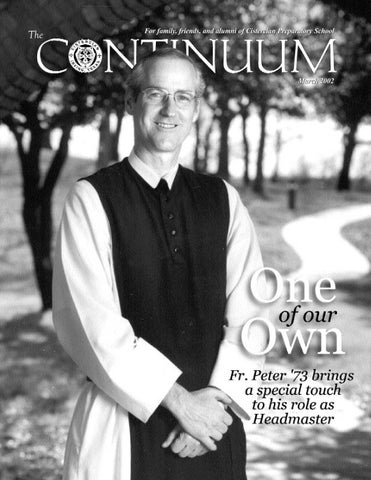
One of our own: Fr. Peter’s special touch
6
Fr. Peter ’73 brings more to his role as Headmaster than just smarts and a Cistercian diploma. His quiet strength, heartfelt compassion, and abiding faith touch those in need.
The overlooked beauty of life
13
Cistercian students find that in giving to others in the midst of a 30-hour fast, they come to understand themselves and life better.
D E P A R T M E N T S Letter from the Headmaster . . . . . . . . . . . . . . . . . . . . . . . . . . . . . . . . . . . . . . . 2 School News . . . . . . . . . . . . . . . . . . . . . . . . . . . . . . . . . . . . . . . . . . . . . . . . . . 4 Sports News . . . . . . . . . . . . . . . . . . . . . . . . . . . . . . . . . . . . . . . . . . . . . . . . . 15 Class Notes . . . . . . . . . . . . . . . . . . . . . . . . . . . . . . . . . . . . . . . . . . . . . . . . . . 16 On Prayer . . . . . . . . . . . . . . . . . . . . . . . . . . . . . . . . . . . . . . . . . . . . . . . . . . . .19 Calendar . . . . . . . . . . . . . . . . . . . . . . . . . . . . . . . . . . . . . . . . . . . . . . . . . . . . 20 Development News . . . . . . . . . . . . . . . . . . . . . . . . . . . . . . . . . . . . . . . . . . . . 20 Cover photography by Jim Reisch
The Continuum is published by
Cistercian Preparatory School P.O. Box 140699 Irving, TX 75014-0699 972-273-2022
March 2002
Cistercian Preparatory School was founded with the aim of preparing talented boys for the colleges of their choice by challenging their minds with excellent academic programs, molding their character through the values of Catholic education, and offering them guidance with both understanding and discipline. Cistercian Preparatory School does not discriminate on the basis of race, color, national or ethnic origin in the administration of its educational practices, admissions, scholarship programs, and athletic and other school administered programs.
3
School News FACILITIES
Drama, music expansions to begin in June The evolution of Cistercian’s drama and music spaces will take a major step this summer. Funds are already committed to convert the lecture hall in the Science Building into a very suitable dramatic venue. A 16’ x 33’ backstage area will be added, the stage will be enlarged, and a vestibule added. The seating will be modified and seats added on the floor and in a new balcony. The result will be a space with excellent acoustics and seating for approximately 175. The new music room will be built in an existing space adjacent to the art studio and
will provide ample space for choral risers, practice rooms, and a piano. CAPITAL CAMPAIGN
Funds sought to expand gym, tennis facilities “The Campaign for Cistercian” officially kicked off in February. The campaign aims to raise about $5.4 million to fill out the school’s athletic facilities with an expansion of the gym facilities, the addition of four new tennis courts, site work, and an endowment to assure maintenance of the new facilities. Expanding the gym facilities will relieve severe pressure on the school’s basketball and physical education programs.
The old gym will connect to the new gym through a lobby area that will house restrooms and concessions.
It will help the school accommodate a student population that has doubled since the first gym was completed in 1972. The new tennis courts will allow Cistercian’s tennis team to practice on campus. The campaign brochure was produced by Slingshot, the ad agency of Cistercian alum Owen Hannay ’81. Peter Smith ’74, who has
helped spearhead fund-raising efforts in the past, is serving as co-chair along with parent Patricia Villareal. “We believe this will be a very successful campaign,” said Michael Burns ’81, Cistercian’s director of development. “It is being run very professionally.”
Fr. Peter draws record crowd to Moroney Awards Dinner The Cistercian Alumni Association decided the school’s Headmaster needed a roasting so Fr. Peter Verhalen ’73 was named the winner of the 2002 Jim and Lynn Moroney Award on the occasion of the award’s tenth anniversary. “This was an important event,” said Jim Bloodgood ’74, presidentelect of the association, “and it was time that we recognize the alumnus who is truly an example to us all.”
Over the years, the event has drawn between 100 and 150 alumni and faculty to the Tower Club in downtown Dallas. Fr. Peter attracted over 250 to this year’s event. The number included a healthy showing from current parents and as well as Left: Fr. Peter with parents Elise Murchison and Dee Ann Payne. Center: Hope and Peter Verhalen Sr. Right: Tom Lewis ’73 introduces Fr. Peter.
some alumni who hadn’t been seen in years. Tom Lewis ’73 delivered introductory remarks that kept the audience laughing. Fr. Peter took advantage of the large gathering by discussing Cistercian’s campaign to expand the school’s athletic and artistic facilities (see story above).
Photos by Jim Reisch
4
The CONTINUUM
School News.d Photo by Jim Reisch
B R A V E • A R T From museum visits and workshops to the book fair and brave performances The Cistercian Arts Festival (a.k.a. BraveArt) continues to grow in its impact on the school, students, and faculty alike. The three-day event began on Thursday with a visit to a variety of art exhibits at SMU, including the Meadows Museum of Art and the Bridwell rare book collection. On Friday, the boys took part in a variety of workshops, from breakdancing and ceramics to woodworking and improvising. Glenn Arbery, the event’s featured artist, offered a workshop on “How Fiction Works.” Arbery addressed the faculty and parents Friday evening and signed books at the BookFair. Saturday featured a faculty-only visit with Arbery in the morning, the BookFair in the afternoon, and the Coffee House in the evening. “It’s the event the boys look forward to most,” said organizer Tom Pruit.
THE ARTS
Colombo wins statewide piano competition Senior year can be tough at Cistercian but that’s not stopping Giancarlo Colombo ’02 from playing piano. The senior is anxious to play as much piano as possible before leaving for college. In the classical realm, Giancarlo recently won the 2002 Baylor University/Waco Solo Piano Competition, placed first in the senior division of Texas Chamber Orchestra Young Artist Concerto Competition, was a semi-finalist in the Lennox Young Artists Competition, and won second place in the DMTA Dallas Solo Piano Competition. He has been an active jazz pianist as well. Last year he won first place in the DMTA Dallas Jazz Competition, in the category of Jazz Improvisation. He was the hired performer for the Texas Chamber Orchestra's Benefit Gala in February and the invited soloist for the Italian Club of Dallas' Annual Gala March 2002
in October. He has played for many private events such as anniversary, wedding, and Christmas parties, worked as an accompanist for voice, wind, and brass, and played in various hotels and restaurants in Dallas.
Brothers Jordan ’04 and Josh Campbell ’02 perform “Osteoporosis” at the Coffeehouse.
money to the school. In the future, this kind of event could fund a scholarship.” Deadline for registering for the golf tournament is March 24 and registration is
limited to the first 144 players on a first-come, firstserve basis. For more information, contact Jim Truitt at 972-5563772 or jtruitt@jpi.com.
N O T E WO RT H Y FUND-RAISER
Golf tourney for alumni and boosters The Booster Club and the Alumni Association are teaming up again to put on the Second Annual Cistercian Golf Tournament on Monday April 2 at the Hackberry Creek Country Club in Las Colinas. “It’s a great chance for alums and parents to get out and visit with one another,” said Victor Arias, president of the Booster Club. Last year’s event, the first of its kind at Cistercian, raised over $10,000. “We have planned the event carefully,” Arias insisted. “We hope that translates into a greater turnout so that we can contribute more
For the fourth consecutive year, Cistercian’s Middle School Math Team captured first place in the Mathcounts DFW/Mid-Cities Chapter Competition. Dr. Richard Newcombe’s troops include James Hansell ’06, Kurt Klinke ’06, Landry Jarvis ’06, and Chris McGowan ’06 are now preparing for the state championships to be held in Austin on March 23. Joining the Fourth Formers will be Third Formers Stephen Fox ’07 and Kyle Mitchell ’07. Peter Saliga, head of the Social Studies Department, recently announced his engagement to Jean Toman, a teacher at the Highlands. No date has been set. Cistercian’s reputation at the “Le Fête Française” continues to grow. Wadad Finan brought just a few students to the competition, but those students collected 14 trophies. Our congratulations go to AJ Minich ’04, Peter Radu ’05, Juan Muldoon ’05, Robert Cenzon ’04. Their efforts won Cistercian second place. Pebble Barbero, who teaches Life Science and Biology, and husband Ignacio Barbero ’91 became the proud parents of their first child on January 25. Victoria Ann weighed in at 8 lbs., 4 ounces on 20¼” frame. While Mrs. Barbero takes maternity leave, Mrs. Emily Williams, wife of Charlie Williams ’70, is teaching Life Science to Form II. Mr. Tim Parker ’90 is filling in for Mrs. Barbero’s Form V Biology class.
5
Photo by Jim Reisch
One Own of our
Fr. Peter ’73 brings more to his role as Headmaster than just smarts and a Cistercian diploma. By David Stewart ’74
T
HE PHONE RANG AT THE SCHOOL just a few minutes before the 8:30 bell. It was a warm Friday in the middle of May 1996. Souad Shrime, mother of Mark ’92 and Ryan ’96, was calling from the hospital room where her husband had been fighting cancer since January. The battle was taking a turn for the worse. Cistercian priests had visited Dr. George Shrime’s hospital room on a regular basis ever since hearing about his condition. “Nothing was spoken. We didn’t ask them to come to the hospital,” Mrs. Shrime said. “They just came.” Ryan’s Form Master, Fr. Henry, spent many hours lending his moral support to the family along with Fr. Gregory, who had grown close to Ryan his senior year. “Ryan and Fr. Greg were like two peas in a pod,” said Mrs. Shrime. Fr. Peter also devoted hours to the Shrime family, in the hospital room and at their home in Lake Highlands where he conducted a Bible Study class. At those weekly sessions, Mrs. Shrime often would ask Fr. Peter if there was anything she could do for him. “Just pray for us,” he said, “and pray for me.” Several months later she learned Fr. Peter had been appointed Cistercian Prep’s new headmaster, giving Fr. Bernard the rest he had sought for so long. “Fr. Peter prayed fervently that my husband would make it to Ryan’s graduation,” Mrs. Shrime recalled. But when the phone rang in the school that morning, Mrs. Shrime was calling because she felt those prayers would go unanswered. She needed the Cistercians there with her. Juggling class schedules, priests rotated in and out. The monks would maintain a near-constant presence at the hospital for the next several days. Fr. Denis, Fr. Bernard, Fr. Henry, Fr. Gregory, and Fr. Peter all shared time beside Mrs. Shrime and her kids, Mark, Maria, and Ryan, who were there non-stop. “It was a very private time in our lives,” recalled Ryan Shrime, 6
who graduated from Harvard last May with a degree in economics. “No one was at the hospital with us Sunday morning, except for the priests. My sister had met the priests only at school functions, but she was comfortable with them; we were all strengthened by their presence. There was a real feeling of peace when they were in the room. They didn’t have to say anything. “I didn’t cry very often in the last couple of days of my father’s life. We had been awake for so long, our senses were numbed,” he said. “But I remember leaving the hospital room for a few minutes of down time. When I returned and saw Fr. Peter there, I just lost it. “Their presence was so important; they were like angels in the room. I was so grateful. I felt protected with them there,” Ryan added. Mid-morning on Sunday, while his classmates attended their Baccalaureate Mass and Breakfast, Ryan saw his father losing the battle. As Dr. Shrime’s life drew to an end, Mrs. Shrime turned to Fr. Peter for guidance. “What do you say?” she asked. “There is nothing more to do,” said Fr. Peter, who stood on one side of the hospital room door. Then Mrs. Shrime looked to Fr. Gregory who stood on the other side of the door. He bowed his head, overcome with tears. “At that point, we all broke down,” said Ryan. “An unspoken bond was created at that moment,” Mrs. Shrime said. “YOU APPLIED FOR THIS JOB?” Fr. Peter often asks other school administrators when he meets them. Cistercian headmasters, you see, are an odd breed in their line of work. They do not set out consciously to climb the career ladder of school administration. Positions at larger institutions do not interest them. They are Cistercians first, educators second, and headmasters third. Running the school is service work — a case of The CONTINUUM
servant leadership. “I didn’t campaign for the job,” said Fr. Bernard, “and neither did Fr. Peter.” “I don’t believe Fr. Denis, Fr. Bernard, or I would have been a headmaster at any other school,” Fr. Peter added. “No one in the abbey has the ambition to be headmaster.” Fr. Bernard, who served for 15 years without a break, tried to be excused from the job for several years. He had grown tired of the stress. (He was asked frequently, “Did you resign out of protest? Was there a power struggle?”) Upon his retirement from the position, Fr. Bernard said it was a job he had taken simply in obedience to his vocation. Along the way, he had help. “The school couldn’t have doubled in size during those years without Fr. Peter,” Fr. Bernard said. “He made it possible through his diligent work on the curriculum and his organizational skills. In some ways, I was just the front man. “You see, it’s a family enterprise,” explained Fr. Bernard, “we all help each other out. That’s the strength that the monastery brings to the school. We all have been successful at one aspect or another of the job. The great thing is that each headmaster is supported by his brothers who can fill in where needed. “It’s a tough job,” he added. “You are tugged at from all sides. You have to try to be your own man, and you can’t try to satisfy all the demands. You do have to accommodate. It can be very stressful.” Most acknowledge that Cistercian’s first headmaster, Fr. Damian, was a master at public relations. Fr. Denis stepped up and made those promises a reality by formalizing the school’s curriculum and raising the school’s academic standards. Fr. Bernard enjoyed promoting the school and was very successful at it. Fr. Peter officially took over as headmaster a few weeks after Dr. Shrime’s funeral at Cistercian and Ryan Shrime’s emotional valedictory address at the 1996 commencement exercises. The death of Dr. Shrime and the outpouring of support for his family drew the community together in a very special way. Fr. Peter sought to keep that feeling of selflessness going. “I was ready, excited, anxious,” said Fr. Peter about becoming headmaster, “and naive.”
out of Lewis’ face leaving him white as a sheet, just grateful to be alive. Verhalen glanced casually over at Lewis and smiled. “I think,” he said over the noise of the car and wind, “he was trying to run us off the road.” With natural cool and a hungry, logical mind, Peter Verhalen began squeezing out every bit of knowledge from the Cistercian faculty right from the start (which was Pre-Form or fourth grade in those days). In just his second year at Cistercian, Verhalen was considered for the St. Bernard Gold Award, the school’s highest honor. Verhalen’s Form Master in those days, Fr. John, promoted him to faculty members (who vote on the award) as a “wonderful specimen and a delightful person.” The faculty agreed, voting to give the award to the precocious First Former. “Remember,” said Fr. Peter, anxious to downplay the accomplishment, “the school only went through Form IV that year.” He remains the youngest winner of the award to this day; that award marked the beginning of a truly remarkable career at Cistercian Prep, a career that has many years to go. “Peter would come home from school, grab a glass of milk and hit the books or play piano,” said his dad, Peter Verhalen. “He recognized the value of capturing the time he had when he was clearheaded.” But he was not just a bookworm. As a member of perhaps the most athletic class of the seventies, Verhalen won a reputation as a tough tackling defensive end in — Cullen Thomas ’73 eighth grade football. “I liked hitting, psyching up, and the emotion of the game,” Fr. Peter recalled. “Peter was one of the fiercest tacklers on the eighth grade football team when I had the misfortune of being a second-string running back who was used primarily as a tackling dummy,” said Cullen Thomas ’73. “The coaches used to say Peter had a split personality because he was always so easygoing until he put on his helmet.” His affinity for sticking his head into ball carriers resulted in his pinching a nerve in his neck on two separate occasions his freshman year. The injuries prematurely ended his gridiron career; soccer became his sport for the remaining years of high school. Socially, he was a winner with the girls from the start. “I remember Peter was voted the King of Hearts at the Junior Assembly Valentine’s Dance one year,” Thomas said. “That was quite an accomplishment considering Cistercian students’ limited exposure to the opposite sex in social situations back then. I was still terrified to ask girls to dance so it gave me a glimmer of hope for the future. “At the time,” Thomas reflected, “ I would have voted Peter the least likely person in our class to become a priest and myself the one most likely to become celibate.” “Peter was extremely intelligent and well-liked,” recalled Gary Lucido ’73. “He was the only person in our class who could learn foreign languages. The rest of us concluded that the people of the world should just learn English.”
“Peter was one of the fiercest tacklers on the eighth grade football team ... The coaches used to say Peter had a split personality because he was always so easygoing until he put on his helmet.”
P
ETER VERHALEN’S WAVY BLOND LOCKS were blowing in the wind on a gorgeous day in 1973. He and classmate Tom Lewis ’73 were headed out on the highway to a senior class field trip in Verhalen’s 1956 Karmann Ghia convertible — a burnt red number that, despite a “tiny” engine, exuded machismo. Lewis was thinking life couldn’t get much better — field trip, sunny day, convertible — when his heart stopped. An eighteenwheeler swung into their lane on Highway 114 forcing Verhalen to react quickly and swerve onto the shoulder. The blood sped
March 2002
7
Teachers like Fr. Placid and Stephen Housewright encouraged Verhalen’s love for languages. Mr. Housewright, who taught English at Cistercian from 1969 until 1978, was a slight man who rarely raised his voice but whose love for literature captivated his classes. He once wrote on the blackboard a sentence from the Iliad in Homer’s Greek and then translated it word for word. Mr. Housewright explained to Verhalen and his classmates that Homer was trying to describe the same experience one would have in Vietnam (which was being fought at the time). The relevance of the passage and the ability to understand the writer’s native language whetted Verhalen’s intellectual appetite. “I WANTED TO GET OUT OF DALLAS, TEXAS, and America,” Fr. Peter recalled about his reasons for taking his junior year abroad. In Europe, he would study, travel, and soak up the culture. During school vacations — while his Austrian classmates vacationed with their families at home — Verhalen traveled alone around the continent. “I would spend a week or two hiking around, seeing a lot of places. It also was a chance to pray. I was thrown on to my own resources. I would come into a new city and I would end up in a church. It made me feel safe. I would pray, then leave, and follow the directions to the nearest youth hostel.” While his sense of independence and his reliance on prayer were growing, Verhalen’s hungry mind was absorbing European life. Some of that life lay within the Cistercian monastery where Verhalen boarded along with many of his classmates at Schlierbach High School, about 50 miles from Linz.
“I saw another side to the monks by staying in the monastery,” Fr. Peter said. “The real influence was my form master, Fr. Ludwig. The boys said he had a sad eye. There had been some severe illnesses in his family and his best friend had left the abbey. He was running the school because the Headmaster was too old and tired to do so. He had all the responsibility but no authority. But he did his duty. He’d wake us up at 6:30 to send us off to a study hall every day. I admired his stability and his strength of will to live his vocation faithfully.” One night, Fr. Ludwig was sitting around in the lounge with Verhalen and his classmates. “He was predicting what each of us would become. When it was my turn, he said, ‘You, Peter, will become a Cistercian.’ I said no and laughed it off.” Then there was the matter of going to school. Fr. Denis, who had helped select the school and was old friends with Fr. Ludwig, told Verhalen he probably would last just a semester. After all, this school could not and would not make any allowances for an American who hoped to learn their Form VII curriculum in a language he had studied for only two years. “I was really lucky with Fr. Placid at Cistercian,” Fr. Peter insisted. “We teased him a lot but he was so talented. He prepared me so I was able to take all the classes at Schlierbach.” Verhalen took all the courses his Austrian classmates were required to take, except for Greek. The curriculum included Latin. “The Latin at Schlierbach was a real eye-opener; it was so much more advanced than what I was used to. They were reading Virgil. We had to memorize page after page of vocabulary, one everyday. And it was cumulative. It was a great way to
Fr. Peter’s formative years
Age 10
With Fr. Roch and Br. Gregory, age 20
With Mom, at 16
Cistercian senior, age 18
Photos courtesy of Fr. Peter, Hope and Peter Verhalen Sr., and Exodus ‘73.
learn German and Latin. I spent a lot of time with my LatinGerman dictionary.” Mr. Housewright had amazed him back in Texas by translating Homer’s Greek. Now he was learning to read the Aeneid in Virgil’s Latin. The challenge of learning Latin in German excited him. Back in Irving, the September 1971 edition of The Informer made hay of Verhalen’s bold move to study in Austria. The cover proclaimed “Verhalen in Austria,” over a photo of the gymnasium under construction. Verhalen wrote a letter to the paper that appeared in the October 1971 edition describing, among other things, one of Fr. Ludwig’s parties. “I went to a dance Friday night and it reminded me of something out of the early 1960’s. There was a ‘playlike’ disc jockey and lots of ‘boys and girls.’ I really enjoyed it.” Fr. Denis, who had expected to pull a weary Verhalen back to Texas by the end of the first semester, was receiving long, enthusiastic letters in German from the young American. Verhalen was proving to be up to the challenge and prepared for more. By June, when Fr. Roch and Robert Salgo ’73 flew across the Atlantic to travel around with Verhalen at the end of his year at Schlierbach, the changes were clear. “The three of us were standing at the window of the Royal Castle [now a museum in Budapest],” remembered Fr. Roch. “We were looking down at the Danube. Half-joking, half-serious, Peter declared, ‘I don’t want to go back to America.’ He had developed a great love for Europe.” And while the thought of the priesthood had occasionally entered his mind over the years, his year in Austria showed him the way. “I began to realize that God wanted me to do something else.”
After school, Verhalen worked at various jobs, from landscaping with Joe Martin ’73 to serving ice cream at Ashburn’s and at Swenson’s on Oak Lawn with Eugene Johnson ’73, Billy Hassell ’74, and David Martin ’74. In the fall of 1973, Verhalen and good friend Eugene Johnson headed off to Bowdoin College in Maine where he studied classics and tended bar at the inn where Harriett Beecher Stowe wrote Uncle Tom’s Cabin. “He began to hint at a priestly vocation in his long letters written in fancy, complicated German during his freshman year at Bowdoin,” recalled Fr. Roch. “He would always write about serious matters in German before his decision to enter the monastery. But while at Bowdoin, he warned me not to take him too seriously since he even had a girl friend.” But it was serious. During the spring of his freshman year, Verhalen decided to take a leave of absence in the fall. After tending bar for a couple of months, he headed to Colorado with a Bowdoin classmate who had never been west of Maine. Their plan was to ski during the day and to tend bar at night. But Verhalen had something else on his mind. When they found bartending jobs weren’t so easy to come by, the pair decided to part ways in Crested Butte for a few days. His buddy headed to Steamboat Springs to check out the job market; Verhalen was going hiking. They agreed to meet up in Aspen in a couple of days.
The season’s first snow moved in and obscured the trail. This 24-hour hike [from Crested Butte] would take Verhalen over four days before it finally landed him in Aspen and in the priesthood.
“W
HAT WILL OUR school become within the next 10 years?” Abbot Anselm asked rhetorically in his letter to the readers of the 1973 Exodus, reflecting on the school’s first 10 years. “It depends on its administration, teaching staff, the enthusiasm of the parents and, above all, on the young men who graduate from our school.” For Peter Verhalen, the future looked bright. The future of the school was another matter. “There were subtle differences in Peter when he came back from Austria,” said Tom Lewis, who served as president of the student government their senior year. “Nothing earthshattering. He was just more mature; he had a quiet confidence that grew out of his experiences in Europe. He had developed an international perspective on things and he seemed to have a feeling of how his own future was going to fit into that bigger picture.”
“WHEN I AM ALONE HIKING, IT’S LIKE A RETREAT,” Fr. Peter said. “It’s frequently just praying, enjoying nature, and meditating.” This hike in the first days of September 1974 would give the young Verhalen plenty of time to reflect on finding his way in life because within three hours of leaving balmy Crested Butte, he lost the trail. Verhalen had set out in shorts with a little dehydrated food and a quart of water. He was counting on continued good weather, an easy-to-follow trail, and a 24-hour hike. But the weather deteriorated quickly. The season’s first snow moved in and obscured the trail. This 24-hour hike would take Verhalen over four days before it finally landed him in Aspen and in the priesthood. “Hiking is such an important element in his life,” said Matthew Nevitt ’97, a class for which Fr. Peter served as Form Master. “It makes him the guy he is. He always used hiking as a metaphor when he taught us. Every summer, he would take a hiking trip and return with captivating tales. “He would tell us stories about being above the tree-line with lightning all around him. It fascinated all of us. So when he offered to take us on a hike after seventh grade, nearly the whole class signed up. Since he could take only about twenty, we drew numbers to see who would go. (The remaining students were taken the following summer.) “It was an incredible trip. Fr. Peter told us what to take in our backpacks and divvied up the food. We drove out to Wheeler Peak, the highest peak in New Mexico. We hiked up near the
9
Photo by Jim Reisch
snow and caught lots of trout. After we climbed to the summit, we all slid down the steep snow bank, like we were skiing on our feet. I expected him to tell us that it was too dangerous, but he didn’t mind. We came sliding down, instead of taking the path. We’ll never forget it.” Back in September 1974, the young Verhalen found little time for merriment, but lots of time for reflection. “The first night I couldn’t find a creek so I was afraid to drink my quart of water or eat my dehydrated food,” recalled Fr. Peter. “It was cold. Coyotes surrounded me. I held on to my Swiss Army knife; I was scared, hungry, and lost.” During the course of the hike, Fr. Peter heard the call. “That little voice said, ‘You need to stop all this searching and join the monastery and teach kids.’ “A day later I met up with two guys and a girl who also were lost and hungry,” Fr. Peter said. “One of the guys was completely unprepared for the weather and was so scared and starved that he had lost all composure. He was weeping uncontrollably; he was certain he was going to die on the mountain.” Fortunately, Verhalen and the girl kept their cool, studied their maps, and helped the group find the trail and their way down. The life-threatening situation bonded the four. When they arrived in Aspen, they met up with Verhalen’s buddy and had a great party to celebrate the hikers’ survival. His buddy still hadn’t found a job. Verhalen had.
“I
N THE FALL OF ’74, PETER showed up in Dallas, and told me that he wanted to be a priest,” remembered Fr. Roch. Busy and unable to talk at that moment, Fr. Roch asked Verhalen to come back. “A few weeks later I was supervising a study hall in the freshman classroom when, unexpectedly, Peter walked into the almost empty room and announced, as if 1012
in a daze, ‘I want to enter the monastery.’ Then it was my turn to fall into a daze. What should I say? I recommended that he wait until the next fall.” Fr. Roch’s hesitation was understandable. Both the Cistercian Abbey and Cistercian Prep stood at a crossroads. Abbot Anselm was trying to determine whether the abbey should focus its efforts on the prep school, the University of Dallas or a combination of the two. Fr. Denis believed that the prep school, in the long run, would prove to be a more stable source of MORONEY AWARD employment than the uniFr. Peter speaks after versity. The monastery accepting the 2002 was split over the issue, Jim and Lynn Moroney and the Abbot sensed he Award on Friday, had lost support. When he January 25, 2002. asked his brothers for a vote of confidence, the vote did not favor the Abbot. This turmoil had major repercussions on the prep school. Fr. Denis, who had served as Headmaster since 1969, was asking to be included in abbey decisions that affected the school. The Abbot, perhaps feeling that such a move would indicate he was favoring the prep school side, did not act on the request. So, with the Abbot’s permission, Fr. Denis resigned from the school, packed his bags, and flew off to study in Rome for a year. “There also were factors that complicated the situation, like choosing between the different ideas on how to continue at the prep school, the style, the personnel,” Abbot Denis remembered. Fr. Henry was left to run the school, rather reluctantly. By the fall of 1975, when Verhalen officially joined the monastery, the monks had reinstated Abbot Anselm and Fr. Denis had resumed his position at the helm of the school. But the school was not out of the woods. “As an alumnus of the prep school,” Fr. Denis said, “Peter had an awareness of the importance of the school.” Br. Gregory, who joined the monastery at the same time as Br. Peter, also followed the path toward teaching at the school. Although novices have no political power in the monastery, their decisions to teach at the prep school helped swing the balance toward the prep school. “It was providential,” said Fr. Denis, “that these two novices were open and interested in the school and had no other goals than to make themselves available to the school. Peter could have said, ‘I really feel I need a doctorate, and I will be a Greek professor at UD.’ But that didn’t happen.” The arrival of Br. Peter and Br. Gregory also proved to be a turning point for the school in another way. While the school’s math curriculum excelled from the start, the English curriculum lagged far behind. Some supporters of the school felt that the English program, not the math program, was the key to success in secondary education. How, they asked, could Hungarians succeed at teaching English to American students? The CONTINUUM
The school had attracted two fine English teachers by the mid seventies — Stephen Housewright and Ronnie Shepherd — but the need was still great. So while Fr. Peter and Fr. Gregory may have had other ideas, Fr. Denis strongly suggested that they complete their masters’ degrees in English (Fr. Peter would later obtain his masters in classics as well). By the time Fr. Gregory and Fr. Peter joined Tom Pruit in 1981, the school was well on its way towards forming an excellent, and stable, English department.
to include the opinions of his administrative team. “I would like to reduce the load on our administrators without adding to the bureaucracy,” he said. He also is looking for ways to capitalize on the expansion and improvement of the drama and music facilities that will be made this summer (see page 4). “Somehow I would like to see us come up with a more coherent, comprehensive arts program,” Fr. Peter said. “Perhaps the new drama space and music room will allow us to re-think the entire schedule. It’s an exciting prospect.”
“IT’S LIKE SEARCHING FOR GEMS,” said one School Board member in describing Fr. Peter’s efforts to stock the Cistercian faculty with great teachers. “I strive to find smart, smart people who also can serve as role models for the boys,” said Fr. Peter. “I want them to be able to model how you live an intellectual life and a spiritual life. “I want teachers who can light up the room. If they have been athletes or musicians, the boys can look up to them and trust them. That’s the kind of person we always are looking for, even though we might not have a specific need at this time.” “He has showed the door to a few teachers,” Abbot Denis emphasized, “and recruited those he wanted. He has greatly contributed to the quality of the faculty. He has a genuine enthusiasm for this aspect of his job. And he does not take chances; he researches each candidate very carefully. He wants dynamic teachers who plan to stay here. That will show in the long run.” Clearly, Fr. Ludwig, Stephen Housewright, and Fr. Placid made a lasting impression on Fr. Peter. “Fr. Peter is passionate about improving every aspect of the school,” said Greg Novinski ’82, dean of students and Form II Form Master (not to mention father of six). “He seeks the advice and opinions of the veteran teachers and is open to our improving any part of the program. Fr. Peter really wants to fill out the school academically, athletically, artistically, in every way possible.” It isn’t an easy task. In addition to his normal duties as Headmaster, Form VII Form Master, and Form IV Latin teacher, he constantly oversees a number of “extracurricular” activities (e.g., the renovation of the Upper School last summer, the reaccreditation process in the fall, and the capital campaign that was kicked off recently). “Perhaps the most amazing feature of his leadership as Headmaster — and for me also the most frightening — is the ever-growing demands he places on himself,” Fr. Roch insisted. “He always wants to improve himself, and as a consequence, the School. The results are beautifully obvious and heartening, but how long will he have the energy?” “He leads by his example. He works extremely hard,” Novinski added. “He’s too busy nowadays to kick back, have a beer, and talk shop like we have in the past.” Instead, Fr. Peter relies on regular Monday morning meetings
E WANT CHRISTOPHER TO come back to school tomorrow,” insisted Fr. Peter, sitting in the living room of Christopher’s parents, Kelly and Jim Bloodgood ’74 this past September. Christopher Bloodgood ’05 had sustained a head injury playing JV football six nights before. Within 24 hours, virtually all of his short-term memory was lost. The doctors admitted that the memory loss baffled them. Fr. Peter accompanied Fr. Paul, Christopher’s form master, to the Bloodgood’s home. Christopher had answered the door. He didn’t recognize the monks. “I don’t think you understand what we’re dealing with,” responded Mrs. Bloodgood, “Christopher doesn’t remember anything. He doesn’t know where he goes to school. He won’t recognize his classmates or his teachers.” “We will take care of him. We want Christopher to come back to school,” Fr. Peter persisted. “Christopher won’t know where his classroom is,” Mrs. Bloodgood said. “He won’t know where the bathroom is. He’s certainly not going to remember anything he hears in class.” “Mom,” Fr. Peter said compassionately, “we will take care of him and we want him to come — Abbot Denis back to school.” “I thought he was crazy,” recalled Mrs. Bloodgood recently. “I couldn’t imagine sending this child to school. School was the least of my worries.” But the faculty and his classmates were prepared. Classmates took him from one class to another and showed him the bathroom. He was never left alone. “They felt that there would be more stimulation at school and that it would spark his memory,” she said. “They also felt that Christopher was an important part of the community. They didn’t want students and faculty to assume the worst because he was out for a while.” “Christopher is going to be fine,” Fr. Peter told Mrs. Bloodgood countless times. Sometimes if Christopher did not feel up to sitting in class, he would sit and talk with Fr. Peter in the Headmaster’s Office. After three weeks, Christopher’s memory improved significantly. But a new obstacle arose. Christopher began to experience petit mal seizures. He would become dazed for a few sec-
“W
“It was providential that these two novices were open and interested in the school ... Peter could have said, ‘I really feel I need a doctorate and I will be a Greek professor at UD.’ But that didn’t happen.”
March 2002
11
onds to a few minutes. know their stuff. But when I need some advice on an imporThen nearly two months after the head injury, Christopher tant life issue, Fr. Peter will be the first person I turn to. He’s suffered a major seizure, a grand mal seizure, during theology been a loyal friend, someone you can always rely on in any class. Fr. Roch alerted Mrs. Tinker who immediately called the kind of situation.” ambulance and Fr. Peter. Christopher would lie unconscious “I remember our playing tag out on the old middle school socfor nearly 10 minutes. Fr. Peter stayed at his side while Fr. cer fields beside what’s now the science complex,” said Tom Molanphy ’89, who now teaches writing at the University of San Paul took the rest of the class outside. Francisco. “I can still see Fr. Peter dashing over the cleat-marked Fr. Peter accompanied Christopher to the hospital and stayed field, scrambling to snatch in phone contact with the 11-year-olds giggling in Bloodgoods. ON DEE WALKER’S PASSING the tall grass. One particu“When Jim and I lar day in the winter when walked into the emerthe field was slick with gency room,” Mrs. mud, Fr. Peter slipped. I Bloodgood said, “Chriscan still see him standing topher was talking to Fr. back up, his pristine white Peter as if they were best EE, WHAT DO I DO NOW?” Fr. Peter occahabit vilified with a deep friends. He was a little sionally asks in his prayers. Dee Walker ’97 green stain. Those of us in pale, but he was fine. Fr. passed away in a car accident in the summer sight stood frozen, while Peter took care of it all.” between his junior and senior year, about a month after Dr. those in the tall grasses In February, ChristoShrime’s battle with cancer ended in May 1996. Fr. Peter was slunk deeper to hide from pher made it through his still moving into his new digs in the Headmaster’s Office. what we assumed would first full week of school As Dee’s Form Master, Fr. Peter remained a pillar not just be a rage. since September. “It’s for the class, but also for his grieving parents. Dee was their “But Fr. Peter poked huge for us,” said Mrs. only child. the nearest student, Bloodgood. Christopher “Dee’s death galvanized the community,” Fr. Peter smirked ‘Gotcha!’ and has missed 27 days of remembered. “He was a blessed kid and he continued to galloped off. For the next school so far this year. At bless his class and the entire community. I still remember eight years, Fr. Peter Cistercian, missing three him in prayers daily.” played tag with us, and he to five days can throw a “Emotionally, it was very trying when Dee Walker died,” inevitably won. Whether student behind. Abbot Denis recalled. “Peter is not the most gregarious fellow he tapped us with the eth“Fr. Peter has kept up but the support that he offered to the boys and to Dee’s parents ical implications of our with his health constantwas well beyond the call of duty. It is very typical of Peter not actions, touched us with ly,” she added. “He told us explain the heart-rending part of the story. His role was enorthe importance of hard not to worry about the mously difficult, and he worked very hard to help the boys and work and play, or grabbed grades. He told me recentthe parents cope.” us with his legendary ly, ‘I want you to know “Fr. Peter had so many roles — teacher, mentor, form massmile and chuckle, Fr. that Christopher will gradter, emotional leader, and Headmaster,” remembered Dee’s Peter taught us in the best uate from Cistercian.’” classmate Matthew Nevitt. “As hurt as he was, he remained manner: he told us of an “He had complete emotionally strong for us so that he could lead us. He was honorable way to live, faith that Christopher was stoic. Most of us had not experienced a death so close to us. and he supported his going to be fine. Fr. Peter He called us together before the funeral to talk about Dee so brave theory by living stood by Christopher we could express our emotions. He orchestrated us through the that way every day that every step of the way. It’s grieving process.” we were around him.” comforting to know that “The laid-back smile and self-deprecating demeanor hide a “When I go back to the if a truly serious issue spine of steel,” said Fr. Roch, “and a child-like faith in the God school now, Fr. Peter can’t arises, Fr. Peter will be who has carried him so far.” keep the smile off his there for you and your face,” Nevitt said. “He’s kids,” she said. so excited; sometimes he’s at a loss for words. He may not always know what to say but you can tell he relishes every “FR. PETER IS THE TYPE OF GUY WHO IS A ‘10’ when it minute of our time together.” comes to self-control,” Ryan Shrime said from his apartment in “Looking back, I couldn’t think of a better time for my dad to New York City where he is acting in an off-Broadway show. pass away,” Shrime reflected. “Had it happened earlier, I would “The funny thing is when he kicks back on a hike, his self-conhave been too young and unprepared. Had it happened aftertrol goes from a ‘10’ to a ‘9.’ He may be dressed in his civvies wards, we wouldn’t have had the support of the priests. They on a hike but he always has the Fr. Peter air, kind of like the gave us so much strength. oldest brother. He has this definite sense of what is right and “The monks see a lot, a lot more than lay people,” Shrime what is wrong.” said. “It always amazes me how many classes they can rear as “People sometimes have the impression that he’s aloof,” said their own children. I remember going to Fr. Peter’s office and Matthew Nevitt, “but he’s not. I think he is just pensive, contalking to him after he became Headmaster. Fr. Peter had this stantly analyzing the situation and the possible outcomes before gleam in his eyes when he saw me — it was as if he was lookhe acts. He’s a very reflective guy. ing at one of his own children.” “I am in medical school now and I believe that psychiatrists
“He remained emotionally strong so he could lead us”
“D
12
The CONTINUUM
Photo by Jim Reisch
John Flinchbaugh ’04 (front) and Patrick Whittington ’04 paint a house during February’s 30-hour Famine.
Beauty OVERLOOKED
Cistercian students find that in giving to others in the midst of a 30-hour fast, they come to understand themselves and life better. By Tom Pruit
O
NCE UPON A TIME at a fabled school tucked away in the Irving woods there was a group of young men, more than three score and ten, who decided that they would voluntarily miss a meal. In fact, these young men decided to miss three. Though ’twas the weekend, the elders among them chose the company of their school mates, including the young lads, over the company of fair maidens. And though their stomachs growled for lack of food, the young men toiled for hours in the service of others. They did not sleep or play games of folly as was their want. In addition to this sacrifice of food, time, sweat, and fun, the young men gave of their gold — all in the voluntary service of others. Sound like the world of make-believe? As a matter of fact, no. Like all genuine fairy tales, this one came true as, during the last weekend in February, nearly half the students of the Upper School chose to participate in the 30hour Famine, a project sponsored by World Vision, a Christian relief organization focused on supplying food to as many of the world’s needy as it can reach. In addition to raising over $2,500 through the event, the boys accomplished several important community service projects: some were engaged in cleaning, reorganizing and painting at the Voice of Hope, and preparing (both scraping and priming) the exterior of an elderly lady’s home for painting near the Voice of Hope facility; others painted a bathroom and refurbished a shed at the Marillac Center; still others went over to the Abbey and moved the collection of Hungarian literature in the Abbey library. The boys also found time for a couple of hours of bowling Friday night before they retired to the care of several host families. According to its organizer, Bayard Friedman ’03, “the 30-
March 2002
hour Famine is definitely a group thing. It took teamwork to make it work and we grew as a group, helping each other fight through being hungry.” On one level the fasting element seems an unnecessary hardship. Wouldn’t it be just as successful, and perhaps more appealing to the students, to raise just the money, do the community service, and have a little fun together? Friedman thinks not. “The fast really adds another dimension to the activity. You have to get away from your basic dependence on food and on your familiar habits, and you have to support each other to get through it. The group of guys becomes a fraternity of friends that helps each other develop a kind of spiritual endurance. The famine aspect is a real important part of the weekend.” The 30-hour Famine illustrates the hallmarks of Cistercian’s Community Service program: participation is voluntary and the programs are largely initiated and run by students. “As the director of community service, my job is to coordinate the various school-wide programs we offer during the year, to help with logistics, and to get the boys to log their hours,” says Tim Parker ’90, who also teaches full-time, coaches basketball, and is working on a Master’s degree at UNT. “But the programs are, for the most part, run by the boys themselves. The success of the program really depends on their initiative. What is most amazing to me is that without any time built into the school schedule for doing community service, these guys manage, on top of their very tough academic load and their demanding sports schedules, to do an impressive amount of service to their communities.” “I had the opportunity of bringing the 30-hour Famine to Cistercian my freshman year,” reminisces Steven Reinemund ’99. “By my junior year we had almost 100 participants, twothirds of the Upper School. It was a very rewarding and very fun 13
Cistercian students. Their attachment to this program that helps women who are coming off welfare achieve control of their Experience remains a memorable one for Atkinson ’70 money hasn’t waned. “Kyle Sommers ’94 is one of the leadDuring the summer of 1969, Monte Atkinson ’70 and Tim Johnson ’70 led a number of Cistercian students in the school’s earliest community service effort. They transers of the program today,” said ported about 20 Mexican-American children ages 6 to 10 from their homes to the camAlex Nettune ’94 who is attendpus to play games, to read stories, and to eat snacks. ing Stanford Business School “In retrospect,” said Monte Atkinson, “the most striking aspect of this experience but continues to serve on the was how little these children had of the goodies of life that we Cistercian boys largely program’s advisory board. took for granted, and how much enjoyment they got from receiving a little attention. “Scott Schoenvogel ’94 is also “It helped me better appreciate the value of simpler, less ostentatious lifestyles. And quite involved. With his backperhaps most importantly, it helped me to appreciate the power of simple, genuine ground in health-care consultcompassion and concern,” he said. ing, Scott has helped Trinity The experience helped Atkinson recognize in himself the desire to “be involved revise the operating and finanwith people in a meaningful, helpful activity.” cial arrangements of their medNow a clinical psychologist with years of training and experience, Atkinson noted, ical clinic which provides free “I can authoritatively say that those children were right. There are few things in life services to anyone who walks more powerful to us humans than the simplest of attention, compassion and caring, through their door.” especially when it is delivered in person.” Michael Greenfield ’99 continued his service work last summer in Toronto at L’Arche Daybreak, a global organization experience. The greatest benefit was bringing people out to comprised of those with disabilities and the people who care for serve who were not accustomed to doing service. It was an them. “I was surprised at how mutual the caring was,” he said. amazing bonding experience for the Upper School as well.” “I mainly looked after two men, helping them with their daily Steven was also instrumental in initiating the class sponsorship routines, everything from giving them baths to helping them eat. of needy children through the program Compassion and in startBut they showed me so much of life’s overlooked beauty. On ing the annual Salvation Army food drive around Thanksgiving. the surface their lives didn’t look very fulfilling — they couldThe after-school tutoring program is also initiated and run by n’t grasp much intellectually, they couldn’t pursue romantic students at Voice of Hope, a small evangelical Christian center in relationships; they couldn’t have a normal family. Yet despite West Dallas which offers a their frequent anguish and very structured after-school isolation, they maintained a program which includes tutorzest for life with their enthusi“The ability to throw back your own ing. “By teaching the basic asm for performing daily selfish will and realize that there is skills essential for success — tasks. That was such a valubasic arithmetic, writing, and able lesson for me because I something deeper to life than even phonics — we can break often feel that if something the environment of hopelessdoesn’t offer intellectual stimself-promotion is pretty incredible” ness and offer a chance for ulation, it’s a waste of time.” — Bayard Friedman ’03 change,” reflects Friedman. Greenfield remembers Community service is not weekly house meetings at required for graduation at Cistercian, but its value is clear. Those L’Arche Daybreak “when each member of the house would involved in service are leaders, ones who can build teamwork, stand up and tell the highlights of the week. Thelus, a 77-yearones who appear to have a broader perspective on life. Students old woman with mental retardation, always started her report who become involved learn that, once the focus is really on the with ‘Well, I did my laundry on Wednesday!’ She found joy in service itself, the value lies in the building of inner strength and the doing her laundry — and suddenly I was hearing that all work, sharing of faith. regardless of how mundane, has its own dignity and ought to be “Not only am I able to give my time and attention to others but appreciated. It’s a lesson I hope I never forget.” I am able to encourage and be encouraged both physically and The unforgettable hunger pains of the 30-hour Famine open spiritually,” says Andrew Lawson ’02, recipient of last year’s the eyes of students just beginning to understand the power of James M. Collins Award for Community Service. Andrew, who service. “Only when I am doing something that requires me to does a lot of community service through his church, particularly turn my attention to helping others can I grow as a person,” enjoys mission trips to other countries “because,” he says, “they Friedman says. “I think the whole process is supernatural — just give me a chance to share my faith and to work with my hands to the fact that you have the ability to throw back your own selfish make the lives of others a little less difficult.” will and realize that there is something deeper to life than self“Service takes students outside of their world of petty acapromotion is pretty incredible. demic concerns,” comments Reinemund. There are so many “What you get out of the sacrifice is up to you,” insists rewards of focusing on others that community service becomes Friedman, “but through my work in community service I have a way of life for many Cistercian students after they graduate. learned how to love people more openly, make sacrifices more Members of the Class of ’94 turned their attention to the Gain easily, and smile ten times brighter than before while staring Program at Trinity Ministry for the Poor when they were in awe at humanity.”
Cistercian community service circa 1969
14
The CONTINUUM
Sports News.d
Hawks go down fighting in SPC Division I semi-final
March 2002
Photo by Peter Graham ’02
While the gusty winds made play difficult, the teams were tied 1-1 until the Hornets scored on a fastbreak opportunity with twenty minutes remaining. The Hawks sent numbers forward and fought valiantly to score the tying goal, but it was not to be. “It was a very close game, a well-fought battle. Greenhill went 18-4 so they were very solid. They were the better team but we competed very well.” The Hawks will miss Captain Andrew Lawson ’02, who played every minute of every game, but are eagerly looking forward to next year. “We will miss Andrew but he is the only starter we lose. We expect to be back in the Division I tournament again
Hawk Defender Frank Abene ’04 takes the ball upfield against St. Mark’s.
next year,” Kowalski said. “That’s where we’d like to end up every year.”
A strong finish sweetens an injury-plagued basketball campaign The 2001-02 basketball campaign started well, ended well, and included two victories over traditional rivals. At the Cistercian Tip-Off Classic, the Hawks defended their house by whipping Denton Liberty 60-48 in the championship game. Cistercian rode Photo by Peter Graham ’02
For Coach Rob Kowalski and this generation of Cistercian soccer players, it was hallowed ground. Despite the howling winds in excess of 30 miles an hour in Fort Worth, there was no place they’d rather have been. “The SPC Division I Tournament has been our goal each year,” Coach Kowalski said. “This year we made it and the boys felt very good about it. We ended on a great note.” The Hawks finished conference play 5-2, including impressive wins over TMI (3-0), St. Mary’s Hall (4-1), and Trinity Valley (3-1). The margins of victory would prove important in the final analysis. The defeats were by those hardest to swallow. The Hawks fell to St. Stephen’s 1-0 and to Houston St. John’s in penalty kicks, 2-1. Meeting the goal of reaching the Division I Tournament would hinge on the final two weeks of the season. The Hawks came through with wins over Houston Kincaid 2-0 and Episcopal of Houston 2-1. Those victories earned Cistercian a tie for second place, along with two other teams. The Hawks were selected the second seed in the south in Division I by virtue of the goal differential tie-breaker. Forward Chris Sakowski ’03, who scored 11 goals, led the way on the offense with great support from midfielder Ian Cary ’03, who chipped in 10 goals. “Our defense was magnificent all year,” Kowalski said. “Alex Gette ’03 was great in goal and Will Harris ’03 did an exceptional job at sweeper.” “Our surprise this season was Frank Abene ’04 who played marking back,” Kowalski added. “Frank is a small kid who plays much bigger than his size. In fact, he ended up being our enforcer and making a large impact on our team.” That defense would play a pivotal role in the SPC tournament. In the first game against Holland Hall, the teams fought to a 0-0 tie that sent the contest into penalty kicks. After five PKs by each team, the score was still tied. Cistercian’s Matthew Lawson ’04 then converted his chance and Gette stopped the subsequent PK to send the Hawks on to the semi-final against Greenhill.
the shoulders of Michael West ’02, Spencer Bethmann ’03, and Seth Henderson ’03. “We were proud of Michael and Spencer who were voted AllTournament players and very happy for Seth who won the Tournament MVP,” said Coach Dan Lee. A promising first half of the season fell on hard times in January when Bethmann, the team’s explosive point guard and ball-hawking defender, fractured an ankle. Matt Truitt ’03 stepped up, assumed control, and by February the Hawks came back strong. “The last week of the season was really exciting,” Lee said. “We took on two of the strongest teams in the conference in a matter of three days. Trinity Valley fielded the best team they’ve had in years. Greenhill went on to win the SPC Division II Championship. In both Continued on page 16 Cistercian’s Peter McCormack ’03 drives to the hoop against Trinity Valley.
15
ISTERCIAN
CALENDAR March 25-29 Spring break
CISTERCIAN
Non-Profit Organization U.S. Postage
PREPARATORY SCHOOL
PAID
ONE CISTERCIAN ROAD IRVING, TX 75039-4599
Permit No. 281 Irving, Texas
RETURN SERVICE REQUESTED
April 1 Booster Club/Alumni Golf Tournament 2 Classes resume 12-14 Upper School Drama 24 Abbot’s Circle Dinner 26 Prom 28 New Parents’ Coffee
May 18 Commencement 31 Closing Ceremonies
June 1-2 Reunions Weekend
Address corrections Your address is important to us! Please send your change of address to the Development Office at 972-554-2291 or mburns@cistercian.org as soon as possible so we can send publications to you in a timely manner. Thanks for your help!
Alumni
2002 Phonathon achieves record participation levels “It is just a numbers game,” said Jim Bloodgood ’74, president-elect of the
A new generation of class agents was hand-picked and trained. “We stressed to Alumni Association. “This year, more class the class agents that we aren’t selling anyPhonathon giving ranked agents made more calls. They reached more thing,” Bloodgood said. “These are our by class participation alumni and that boosted participation levels friends. We are just contacting them for the Percent and helped us raise significantly more benefit of the school. There is no pressure.” Rank Class participating money for the school.” We should salute those who took the time 1 ’91 82 The 2002 Phonathon raised over to make those call. They are: Charlie 2 ’81 79 Williams ’70, Tom O’Connor ’73, Jim $91,350, a 29 percent increase over last 3 ’87 73 Bloodgood ’74, Peter Smith ’74, Michael year’s total of $70,718. Pledges were 4 ’85 59 Skalak ’77, Oscar Arras ’78, Paul Tomaso received from 30 percent of the alumni con5 ’73 59 ’80, Michael Burns ’81, David Brodrick ’85, tacted (230 out of the 759), a 5 percent 6 ’83 50 increase from last year. Kevin Spencer ’85, Gino Rossini ’88, 7 ’88 48 “Jim did a great job,” said Michael Ignacio Barbero ’88, Matt Hawkins ’88, 8 ’74 48 Burns ’81, Cistercian’s development direcBruce Stevenson ’89, Kenneth Adams ’90, tor. “His drive was the key to our increased Bill Churchill ’91, Chris Stewart ’91, George Cruz ’91, Matthew Naftis ’92, Andrew participation and dollars. Steve Rasch ’80 Stewart ’95, Matthew Nevitt ’97, and Andrew Van Kirk ’00. helped out a bunch in the planning and had some great organizational ideas.” The following class agents made their calls from home or This year’s Phonathon was enhanced by moving the calling work: Michael Kurilecz ’71, Mike McGee ’75, Harold Phillips ’78, Bill O’Connor ’79, Mike Donohoe ’80, Tim O’Connor ’81, operation from the school to Jones Day, where the facilities and Brent Bulger ’83, Stephen Cassell ’86, and Artie Starrs ’94. telephone service improved efficiency. Special thanks go to curThe money raised by the Phonathon funds scholarships. rent parent Pat Villareal for making the move possible. 20
Classy classes
The CONTINUUM