The
For family, friends, and alumni of Cistercian Preparatory School
June 2001
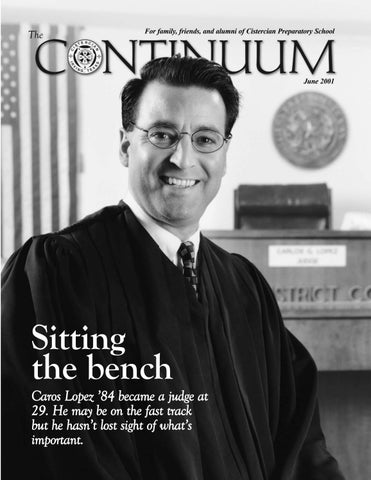
Sitting the bench
Caros Lopez ’84 became a judge at 29. He may be on the fast track but he hasn’t lost sight of what’s important.
Letter from the Headmaster
Dear Cistercian Families, Friends, and Alumni,
Photo by Jim Reisch
Reunions Weekend marked a fitting end to a wonderful school year. Traditionally held the first full weekend of June, the event brought together alumni and alumni parents from the first graduating class, Class of 1970, through the most recent. Former classmates and friends met for a golf tournament on Friday, a picnic on the Upper Field on Saturday, major reunion parties on Saturday evening, and a Mass on Sunday followed by a brunch hosted by the school. The Weekend was a fitting conclusion to the school year because it manifested so concretely two elements of a Cistercian education: community and the common practice of our faith. The major reunions drew alumni back to Cistercian from around the country. In some cases, the graduates had not visited the school or their teachers since they graduated. More than one alumnus remarked that he felt as if he were returning home. Home, we all hope, is a young person’s most lasting experience of life in a community. It is where — even after years of absence and change — you still belong; you are still in “familiar” surroundings, the surroundings of your family. Upon their return, alumni found a new lunchroom, track and library, but the faces of favorite teachers and the search for academic excellence in Cistercian’s centuries-old tradition made even these new facilities seem “familiar.” On the heels of Reunion weekend, it is fitting that an alumnus grace the cover of the The Continuum. The story of Carlos Lopez ’84 is one of astonishing legal success — Carlos has been a judge since he was 29. But what may be more remarkable is his determination to share his time in the community and his commitment to fight for what is fair. The second feature revolves around our central mission, preparing students for the college of their choice. The process of gaining acceptance to and paying for college, however, has grown more daunting each year. We share with you how students and their families are facing these challenges with the help of Cistercian’s experienced college-counseling team. As another Reunions Weekend passes, it reminds us that we must measure the “success” of Cistercian’s students and alumni in personal terms — how well a student uses his talents, how much he contributes to his community, how fully he responds to God’s grace. I hope this issue of The Continuum inspires you to continue seeking success in these terms.
Fr. Peter Verhalen ‘73 Headmaster
2
The CONTINUUM
In this issue.. . CISTERCIAN PREPARATORY SCHOOL
ADMINISTRATION Rev. Peter Verhalen ’73 Headmaster
Rev. Bernard Marton Assistant Headmaster College Counselor
F
E
A
T
U
R
E
Carlos Lopez ’84 sits tall on the bench
S 6
Whether he is rendering a decision from the bench in a complex case or conveying his enthusiasm for the legal process to disadvantaged students or framing a window for Habitat for Humanity or even getting “down and dirty” in a pickup soccer game, Judge Lopez demonstrates “the common touch.”
Mr. Rodney J. Walter Administrative Assistant Director of Transportation
Mr. Greg Novinski ’81 Dean of Students
Mr. Robert J. Haaser Director of Admissions
Mr. Matthew P. Walter ’86 Director of Development and Alumni Relations
Mr. Danny Lee Director of Athletics
Mr. R. Kevin Spencer ’85 President, Cistercian Alumni Association
The thick and the thin of applying to colleges
8
Daniel McSwain was looking for a Catholic school with small classes and a strong political science department. He also needed a scholarship. Help came from Cistercian’s experienced college counselors. Then a surprising envelope arrived in his mail box.
EDITORIAL STAFF Mr. Matthew P. Walter ’86 Editor
Mr. Tom B. Pruit Copy Editor
Mrs. Sally L. Cook Assistant Copy Editor
D E P A R T M E N T S Letter from the Headmaster . . . . . . . . . . . . . . . . . . . . . . . . . . . . . . . . . . . . . . . 2 School News . . . . . . . . . . . . . . . . . . . . . . . . . . . . . . . . . . . . . . . . . . . . . . . . . . 4 Sports News . . . . . . . . . . . . . . . . . . . . . . . . . . . . . . . . . . . . . . . . . . . . . . . . . 15 Class Notes . . . . . . . . . . . . . . . . . . . . . . . . . . . . . . . . . . . . . . . . . . . . . . . . . . 16 Calendar . . . . . . . . . . . . . . . . . . . . . . . . . . . . . . . . . . . . . . . . . . . . . . . . . . . . 20 Alumni Notes . . . . . . . . . . . . . . . . . . . . . . . . . . . . . . . . . . . . . . . . . . . . . . . . 20 Cover photography by Jim Reisch Cistercian Preparatory School was founded with the aim of preparing talented boys for the colleges of their choice by challenging their minds with excellent academic programs, molding their character through the values of Catholic education, and offering them guidance with both understanding and discipline. Cistercian Preparatory School does not discriminate on the basis of race, color, national or ethnic origin in the administration of its educational practices, admissions, scholarship programs, and athletic and other school administered programs.
June 2001
3
School News COMMUNITY SERVICE
Pruit & Parker win honor for special dance The Association for Retarded Citizens (ARC) presented Dr. Tom B. Pruit and Mr. Tim Parker with the “2001 Award of Excellence” on May 4. The two Cistercian teachers were honored for their role in organizing dances for the Down’s Syndrome Guild of Dallas held at Cistercian and hosted by students from Cistercian, Ursuline, and Hockaday. “I wish the entire Cistercian student body could receive this award,” said Dr. Pruit. “Tim
and I just organized it. The boys, plus their counterparts at Ursuline and Hockaday, provided the fun, the care, and the genuine courtesy. They made us proud.” The award recognizes individuals in the community who make significant contributions to improve the quality of life for people with mental retardation and developmental disabilities.
Trevor Turner ’02 and two friends signal their luck with the ladies at the Down’s Syndrome Guild of Dallas held at Cistercian and hosted by students from Cistercian, Ursuline, and Hockaday.
CLASS ‘01
for more than just their class year. Fr. Roch’s raucous bunch proved peerless when it comes to standardized tests, scoring an average of 1425 on their SATs (714 verbal, 711 math). Nine members of the class were named
High test scores are hallmark of these seniors The Class of ‘01 may be remembered as Number One
College travel plans lean to the East Number of seniors matriculating by state
National Merit Scholars. AP scores were equally as impressive as the Class of ‘01 took a total of 120 tests and scored an average of 4.1. Seven received full college scholarships and two received appointments to the United States Military Academy. For a complete listing of colleges attended by the Class of ’01, see the box at left. WHAT A RUN
Quiz Bowlers take state and whip the Aggies
Traveling in groups to ... UT-Austin* . . . . . . . . . . 5 Texas A&M** . . . . . . . . 5 Notre Dame . . . . . . . . . 5 University of the South 3 SMU . . . . . . . . . . . . . . . 3 Austin College . . . . . . . 2 Stanford . . . . . . . . . . . . 2 West Point . . . . . . . . . . 2 * Three are Plan II ** Two are Honors Program
4
Traveling solo to ... Columbia Emory Franklin W. Olin Georgetown Loyola (NO) Middlebury Rice
SW Texas State Trinity U. of Florida U. of Missouri U. of Pennsylvania U. of Virginia Washington & Lee
In April, three seniors ended their phenomenal record in Quiz Bowl competitions with a state title. With the help of John Davies ’04, Andrew Gregg ’01, Chris Edgemon ’01, and David Daly ’01 took first place in the 2001 Texas State Challenge Quiz Bowl Tournament at Sam Houston State University in Huntsville, TX. Cistercian’s victory gives the team the privilege of representing the Lone Star State at the Panasonic National Challenge Championships, which will be held June 23 27 at Disney World, Orlando, Florida. The top three teams at the Panasonic tournament The CONTINUUM
School News.d and their coaches take home valuable scholarships and other awards. Earlier in the month, the Quiz Bowl team took the North Texas Area Quiz Bowl League championship. In March, the team competed in the UT-sponsored Reveille-Bevo Quiz Bowl Tournament that includes teams from state high schools and colleges. Cistercian took first place over second-place Texas A&M. For the uninitiated, Quiz Bowl competitions test academic skills across the entire spectrum of the high school curriculum.
2001 COMMENCEMENT EXERCISES
Speeches emphasize gratitude “Though we thank those here tonight who helped us get where we are, it would be incredible folly to forget the master who gave us our gold talents. We owe it to God and to the world that He created to use our talents to benefit as many of our fellow men as possible.” — Mike Keljo ’01, Valedictorian “Now our time is up, and we're being forced to leave, a class of young men, a class of friends who have achieved much more than just maintaining high test scores. We leave knowing without a doubt that there was no better place we could have been.” — Ed Brophy ’01, Salutatorian
ACADEMICS
Spring full of triumphs Cistercian students did not spend the spring smelling the roses. In Spanish, French, and Math, students earned honors in a variety of competitions.
Ten were recognized for their work on the National Spanish Exam, three freshman, three sophomores, one junior, and three seniors. Approximately 80,000 stu-
N O T E WO RT H Y Four faculty members will not be returning to Cistercian next year. Murry Gans leaves after 16 years of teaching Biology I (Form V), Biology II (Form VIII), and science electives. He also taught a popular Civil War elective. His wife, Saranne Gans, will continue to serve as Cistercian’s Head Librarian. Ten-year veteran Dr. Cheryl Huff taught math to Forms II and V. Spanish Department Head Dr. Monica Navarro spent three years at Cistercian, teaching Forms V-VIII. James Sorrel taught Spanish to Forms V-VIII for two years. Cistercian's Dr. Richard Newcomb, head of the Math Department, was honored with the Coach of the Year Award at the Mandelbrot competition this spring. Uniforms are making a comeback. Starting in the fall, students in Forms V-VII will have to tighten up their sartorial act and wear white knit or button-down shirts and khakis (no more large pockets). Rob Kowalski will be phased into the college counseling team next year. In time, he will take the place of Bob Haaser who will concentrate on his duies as Form Master and director of admissions. Kowalski’s duties will be to teach students how to research colleges and narrow their choices before meeting with Fr. Bernard.
June 2001
dents nationwide take this test of reading and listening comprehension. Not to be outdone, Cistercian French students fared well on the National French Contest, a 60-minute examination produced by the American Association of Teachers of French. Ten placed including two freshman (John Davies ’04 won first place), two sophomores, and six juniors. In April, the Cistercian “mathletes” began a string of impressive accomplishments. In the grueling, four-month Mandelbrot competition, the varsity placed first in Texas among all schools, fourth in the nation among schools under 500 students, and seventeenth in the nation among all schools. The junior varsity also placed first in Texas among all schools, fifth in the nation among schools under 500 students, and seventeenth overall. In MATHCOUNTS, a nationwide middle school program, Cistercian is beginning to make its mark. For
the first time, a Cistercian student (Arthur Yang ’05) finished in the top ten at State. The team of eighth graders finished with a ranking of number 17 in the state. SHAKESPEARE
Summer fun for parents and students Phyllis Carr, mother of Alex ’94 and Phillip ’99, once again
is putting together a summer Shakespeare program for alumni, parents and friends of Cistercian. The July 3 event marks opening night of Shakespeare’s The Tempest with the Dallas Shakespeare Festival. The program begins at 7:30 pm at Samuell-Grand Park in East Dallas. Fr. Gregory Schweers will introduce the two and a half hour play. Students from the Class of ’02 will provide community service at this performance by helping with various preshow activities. 5
Sitting the bench Wise beyond his years, Carlos Lopez ’84 brings a distinct sense of what’s important to the 116th District Court, and to the community.
I
BY TOM PRUIT
N TO KILL A MOCKINGBIRD ATTICUS FINCH ends his defense of Tom Robinson with a tribute to the power of law in a democratic society: “…there is one way in this country in which all men are created equal-there is one human institution which makes a pauper the equal of a Rockefeller, the stupid man the equal of an Einstein…That institution is a court…Our courts have their faults, as does any human institution, but in this country the courts are the great levelers, and in our courts all men are created equal.” Such a statement gives eloquent expression to the belief that motivates the best members of the legal profession and of the judiciary. It expresses not only the creed but also the practice of Carlos Lopez ’84, judge of the 116th District Court in Dallas County. Whether he is rendering a decision from the bench in a complex case or conveying his enthusiasm for the legal process to disadvantaged students or framing a window for Habitat for Humanity or even getting “down and dirty” in a pick-up soccer game, Lopez demonstrates “the common touch.” He is a man whose compassion for “all sorts and conditions of men” runs deep and whose own life exhibits time and again his belief that all men are created equal. Lopez is perhaps the lone Cistercian alumnus who “sits the bench.” He was appointed to the 116th Judicial District Court last September by then Governor Bush to fill a term that expires at the end of 2002. The district courts (376 in Texas, 37 in Dallas County) are considered the state trial courts of broadest jurisdiction over both civil and criminal matters; as such they are the top rung of the trial court “ladder.” In more densely populated areas such as Dallas County, the district courts further specialize in either criminal, civil or family law. Judge Lopez’s 116th District Court is one of 13 courts in Dallas specializing in civil law. Prior to his appointment to the district court, Lopez had served as a judge in the Dallas County Court of Law. Appointed in 1996 when he was only 29, Lopez was the youngest Hispanic ever to sit on the bench in a county court of law. (He may also be the youngest Hispanic ever to sit on the bench in the state district court). Yet, despite his youth, he earned a 90 percent positive rating in the Bar Poll results of 6
Presiding Judges in Dallas County Civil Courts. Now in his mid-thirties, Lopez already has amassed nearly a decade of experience as an attorney and judge. “Carlos has certainly excelled as a judge; just look at his rapid advancement to the District Court as proof of that,” observes Jay Hartnett ’83. “It is a pleasure to appear in his court. Carlos has displayed an in-depth knowledge of the law and always conducts himself in a very professional manner.” The road to the bench, however, was a meandering one, one that began with his entrance into SMU as a “pre-med.” After his sophomore year-and two years of struggle, he came to realize that “medical courses just weren’t something that came natural to me” and decided to “do the unthinkable: switch majors!” He is still grateful for the fact that when he approached his parents with his decision, they were very supportive: “Just do whatever will make you happy”-and he did. “I always had a knack for numbers and formulas so I decided to enroll in several Econ courses, taking them in the summer after sophomore year so I could see how I liked something other than medicine and could avoid falling a semester behind after changing majors.” He found that he liked the courses very much and went on to get a degree in Economics (with a minor in anthropology). Meanwhile he knew he was not yet through with school and was attempting to decide whether he wanted to pursue an MBA or a law degree when Jay Hartnett, who was then attending law school at SMU, gave him a sage piece of advice, “Look, you can always go into business with a law degree, but you can’t become a lawyer with a business degree.” He entered SMU Law School on a partial scholarship in the fall of 1988. In his third year of law school Lopez took a litigation course and knew that this was “it,” and was informed by his instructors that “if you want significant courtroom experience early on in your career, there was only one place — the D.A.’s office.” After graduation, Lopez landed a job in Houston, in the Harris County D.A.’s office because, unlike Dallas County, Harris would accept resumes from law school graduates before they had passed the bar exam. “The interview was a very formal, structured, nerve-wrackThe CONTINUUM
ing process, but fortunately I was hired as a ‘pre-commit,’ which means that I was one of those whom they didn’t want to lose to competing employers. All I then had to do was pass the bar exam. I spent the summer of 1991 studying for the exam, took it in August, moved to Houston in September, and was actually in the courtroom a month later when I got the call that I had passed the exam. What a relief!” “I began my career in earnest and though I loved my work, I knew that if the right opportunity arose, I would seize the chance to return to Dallas.” In the spring of 1992, just such an opportunity arose. Lopez interviewed with Dallas County District Attorney John Vance. “We immediately ‘hit it off’ and, upon conclusion of the interview, he offered me a job. I think the fact that I was already a prosecutor had a lot to do with his decision.” After two years at the Dallas D.A.’s Office, Lopez felt he had gained the courtroom experience he had been looking for and began thinking about what he might want to do next. “I hadn’t gone to the D.A.’s Office to forge a career in criminal law but because I wanted to get into litigation.” It was at this point that he began to see that his interest in civil litigation was leading him toward an interest in the bench. He left the D.A.’s Office to join Dean & Associates, a small law firm dedicated to public policy and administrative law. “I was hired in April of 1994 and it turned out to be a very good match: the public policy aspect of the work allowed me to continue my political involvements as well.” Those “involvements” then led, after two very satisfying years with Dean & Associates, to his appointment in July of 1996 to the judgeship of County Court at Law No. 2. “I was 29 years old and had a lot to learn about being a judge, but thanks to my courtroom experience at the D.A.’s office, to a lot of hard work, and to the grace of God, I got the hang of serving on the bench fairly quickly and have greatly enjoyed it ever since.” Younger brother Alex Lopez ’89, who is himself practicing law in Corpus Christi, thinks that maybe there’s more to it than just experience and hard work. “A trait of a good lawyer is the ability to look at a set of facts and quickly distinguish the important issues that merit further consideration from the issues that do not. My brother, first as a lawyer and now as a judge, has always had that trait. I think that is a major reason for his great success.” For now at least the last step for Lopez began last August when he heard that Judge Martin Richter, who sat on the 116th District Court, had been appointed to the Court of Appeals, leaving his judgeship vacant. Lopez sought and received an interview with then Governor Bush for the vacancy and in June 2001
September heard of his appointment. He began work as District Judge on September 18, 2000. Judge Lopez describes his judicial philosophy as belonging to the school of those who believe in “judicial restraint.” “I believe it is the Judiciary’s role to apply the law as it is written by the legislative body, and to interpret the law in cases where it may be ambiguous. It is not the role of the Judiciary to effectively rewrite the laws that they may not agree with. If a judge does not like a law, he should do the same thing that all other citizens do: write his legislator!” When asked about those cases argued before his court that he found particularly interesting or challenging, he replied, “That’s a little difficult, because I think you learn something from every case that you’re involved with. Photos by Jim Reisch I just presided over the COC vs. CompUSA case which made national headlines since it was the first major business litigation dispute arising out of cross-border business dealings in the post-NAFTA era. It was very challenging, but I can’t say much more since the case is pending appeal.” Later this summer Judge Lopez will hear the case involving a suit brought by the singer Lee Ann Rimes against her father and former agent. For Lopez, even in his everbusier schedule, there is always time to give back to the community; such commitment serves as a constant reminder to him that “we are all citizens and we owe each other a basic respect and consideration regardless of our economic status, political views or cultural differences.” For Judge Lopez that means pitching in and lending a helping hand whether it be through Habitat for Humanity or an elementary school. “It is always rewarding to give something back, and, at least with Habitat for Humanity, I get a little exercise thrown into the bargain. You can’t beat that.” “I am very happy to report that his being a judge doesn’t appear to have gone to his head,” said brother Alex. “My brother doesn’t fall into the stereotype of the pompous, elitist judge who likes to hear himself talk. To his old friends and classmates he is still known affectionately as ‘Los.’Also, before I moved to Corpus Christi, he and I had begun playing pick up soccer games on Saturdays in a park in Dallas. Now maybe I just missed them, but as far as I could see, there weren’t any other County Judges out there running around getting dirty playing with and against total strangers on those Saturday mornings. But that’s my brother. We are, however, still in dispute about who really is the better soccer player.” Men like Carlos Lopez give men like Atticus Finch good reason to place hope for equal justice in the courts. 7
The McSwains receive a thick envelope from Notre Dame. Clockwise from top: Brian ’03, Robert, Daniel ’01, and Connie.
8
The CONTINUUM
T H R O U G H
THICK &
THIN Selecting, applying to, paying for, and gaining acceptance to college isn’t what it used to be. It takes a team of counselors, parents, plus a dedicated student to make it work.
“W
STORY BY DAVID STEWART ’74 • PHOTOGRAPHY BY JIM REISCH
EATHER’S GOING TO BE A factor,” said Peter Graham ’02, reflecting on issues he’ll give serious consideration when selecting a college. “I am not set on one place but I am leaning toward small schools.” With less than a year before a final decision will be made, he doesn’t appear overly concerned. But he admitted, “I have no clue what’s going to happen.” “It’s a real eye-opener,” explained Sue Graham, Peter’s mom. “It’s a different world today. It’s not good enough for these boys just to go to college; we want them to go to the best college for them. And the schools are so selective.” Indeed, the numbers applying to the top colleges continue to soar each year, making acceptances tougher than ever to come by. At many top-tier schools, nine out of 10 applicants are rejected. For those who are accepted, there’s the tuition hurdle. The cost for many of the top private institutions hovers around $40,000 per year. Like all the parents of this year’s junior class, the Grahams were briefed in April on the college application process. And the juniors met with Fr. Bernard individually in the spring to share their preliminary college selections. “I feel comfortable that if Peter has a question, Fr. Bernard will be able to answer it,” Mrs. Graham said. With 20 years of experience as Cistercian’s college counselor, it is easy to see why parents have confidence in him. For most of those years, Fr. Bernard also held down the post of Headmaster in addition to his Form Master and teaching chores.
June 2001
“It was rather handy serving in the capacity of both Headmaster and college counselor,” Fr. Bernard recalled. “Should college admissions officials point out a weakness in the curriculum, I could say, ‘I can fix that.’” Fr. Bernard brings great energy to his job, plus a razor sharp memory, maniacal record keeping, and a quiet confidence that rubs off on those he advises. (When asked about where Cistercian boys go to college, Fr. Bernard is fond of answering, “Wherever they’d like to go.”) Despite all of his years of experience, Fr. Bernard continues to seek out ways to facilitate the college counseling process. Just this spring, he published the latest edition of the “Manual for College Applications,” now a one-inch-thick tome devoted to every aspect of the college application/selection process. In addition to sound advice on selecting and applying to colleges, charts illustrate the admission tendencies of every college Cistercian students have applied to over the past five years. Armed with his GPA and SAT scores, a student can refer to hundreds of schools and determine his chances. Fr. Bernard also has modified his advice on when to begin work on the essay part of the applications. In light of the college-level courses seniors take during the first semester, he now suggests that students begin work on their essays during the summer before they’re caught in the grind. For the most part, however, the college counseling process hasn’t changed much in the past decade. The Form Master introduces the concept of college counseling to his class freshman year. During the first semester of the sophomore year, Fr. Bernard details application procedures, the universe of colleges (e.g., just how many colleges are out there 9
“Meeting with Fr. Bernard helped a lot. He stressed what colleges were going to see in me and evaluated my chances based on my grades, tests, and extracurricular activities.” — Daniel McSwain ’01 and the number to which Cistercian students apply), and admissions criteria for some well-known schools. “Somehow,” Fr. Bernard said, “half the students come away with the impression that they can get into any college. The other half leaves thinking they can’t get in anywhere. Of course, neither conclusion is correct.” During the second semester, sophomores fall into the capable hands of Mr. Bob Haaser, who served as Form Master of the Class of ’92 and who shepherded three of his own children onto college (including Bobby Haaser ’91). “My job is to prepare students so that when they meet with Fr. Bernard in the latter half of their junior year, they are able to talk intelligently about what they are looking for in a college,” said Mr. Haaser. College counseling is a sideline Mr. Haaser 10
juggles along with his duties as The Grahams look over colDirector of Admissions, Form lege catalogs at their kitchen table. Peter ’02 is Master (Class of ‘06), and Social surrounded by parents Joe Studies teacher (IV, VII). and Sue. “I encourage sophomores and juniors to investigate colleges,” he said. “I also recommend they begin visiting colleges in their sophomore year. They may feel awkward about it initially, but they need to build up a base of information and perceptions over a period of time to start narrowing down their choices.” THE PREPARATION
“L
ife isn’t fair,” Mr. Haaser tells sophomores when he introduces the process of selecting (and being selected by) a college. This lesson hits home when the students research a list of the nation’s top 40 colleges. The lofty admission standards and sky-high tuition fees of these institutions never fail to amaze the boys. Having shaken the complacency of the sophomores with the top 40 list, he re-builds the confidence of the juniors by identifying a number of second-tier schools, state schools, and solid Texas schools. With this set of schools, the students learn of schools where admission requirements and tuition fees are within reason. “I want to expose them to the full range of schools,” Mr. Haaser said. “We want them to understand that there are a lot of good choices that can be made from the top tier down to the The CONTINUUM
more reasonably priced schools.” The exercises also illustrate that — beyond admissions requirements and tuition fees — there are many factors to consider: academic strengths, social life, size, and location, to name a few. To reinforce this lesson, Mr. Haaser recommends the boys expand their research from books to campuses. “Mr. Haaser gave us very sound advice in Bryan’s sophomore year,” remembered Susan Madole, mother of Bryan Madole ’99. “He said, ‘Start practicing the process of looking at colleges. Look at small, medium, and large. Look at urban and rural. You can start right here in the Metroplex, with schools like UD, SMU, TCU, and UTA.’” After a visit to the University of Texas in Austin, the University of Dallas, and SMU, Madole concluded SMU represented the right size school. He also found he wanted an urban setting. “This exercise was so useful for us,” Mrs. Madole emphasized. “It was a non-threatening way to narrow the focus. And it saved us a lot of money in airfares.” “It also helped to make our trip to visit colleges during Bryan’s junior year just great. We really got to talk. It was a very enjoyable time together,” Mrs. Madole recalled. “After a number of visits,” Mr. Haaser explained, “the student and his family begin to identify the factors they like and don’t like. Gut feelings can become really important. I tell students this is not just a place you will go to school; it is the place where you will live for four years.” The third step in Mr. Haaser’s program is to meet individually with the students and help them craft a preliminary list of about ten strong contenders. Mr. Haaser expects this list to reflect the boy’s interests (e.g., possible major), his book research, and the perceptions accumulated through college visits. Mr. Haaser avoids dismissing any of the student’s choices but frequently will make a suggestion. Each list must include at least one safe school (i.e., within reach both academically and economically). The remaining schools on the list may fall into either the reality or dream categories. Once the student and Mr. Haaser finalize this list, the student moves on to complete his research on each of the schools, including strengths and weaknesses. “Now,” said Mr. Haaser, “the students are ready to talk to the master, Fr. Bernard.” June 2001
NARROWING IT DOWN
W
HEN DANIEL McSWAIN ’01 SAT DOWN with Fr. Bernard last spring, his list largely reflected a desire for a relatively small catholic school (e.g., the University of Dallas and Boston College). But there were exceptions. Texas A&M, where his stepbrothers had attended and where McSwain had visited often, stood out in this respect. The school and its traditions had made a huge impression. The University of Virginia also made the list because Daniel had heard good things from UVA sophomore Steven Reinemund ’99. The list was rounded out with a selection from left field, the University of California at Berkeley. McSwain explained to Fr. Bernard his concerns about high tuition fees; he hoped to find a school that would offer him a scholarship. “Meeting with Fr. Bernard helped a lot,” McSwain said. “He helped me form a general idea of the type of school I was looking for. He stressed what colleges were going to see in me and evaluated my chances based on my grades, tests, and extracurricular activities.” A few weeks after his meeting with Fr. Bernard in the spring, McSwain’s portfolio of extracurricular activities grew significantly when he was elected president of the student government. During their fall meeting, Fr. Bernard reassessed his chances of earning a scholarship. In addition to his 3.23 GPA (3.7 when weighted for honors courses), McSwain demonstrated a committed, outgoing personality through a variety of extracurricular activities. Beyond the student government work, he was involved with the Informer, Exodus, and founded the Liturgical Committee. He participated in the 30-hour Famine. He volunteered as a big brother, with Scottish Rite Hospital, and for Habitat for Humanity. Athletic exploits included soccer and tennis. Fr. Bernard struck the University of California at Berkeley from McSwain’s list and added Georgetown and Notre Dame. Fr. Bernard also felt that there was a good chance Providence College in Rhode Island might make him an offer, so it was added to the list. Now the time had come to travel to Fr. Bernard has served as Cistercian’s senior college counselor for 20 years. He is holding the “Manual for College Applications,” a one-inch tome containing statistics and hints to help students and parents.
11
a campus or two to take a closer look at the top candidates. College visits can be a wonderful time for parents and their college-bound young man but it is no vacation. Fr. Bernard and Mr. Haaser suggest that students sleep in a dorm, attend classes, eat in the cafeteria, and take notes. “I recommend they take notes on each campus. After visiting more than a few, it can be difficult to remember what you liked about each one,” Fr. Bernard said. It also is recommended that students pick up a copy of the school paper and ask students what they like and don’t like (most are brutally honest). The Grahams went on their first trip to visit colleges over spring break this past March. “I felt a lot of comfort after the college visits,” said Mrs. Graham. “I began to get a feel for the campuses that would make a good environment for my son and those that were supportive academically.” “But there were a few campuses I wouldn’t feel as comfortable with,” she said. “Families have to consider the politics of the campus,” said Janet Bucher, mother of Russell Bucher ’99 who attends the University of Chicago. “I call it the ‘nose ring factor,’” said Mrs. Bucher, who knows a little something about the college counseling business, having served as a college counselor for The Hockaday School for 15 years. “The question is how many nose rings do you want in the student population?” The Northrup family pondered such concerns as Robert
Northrup ’00 sought out a small liberal arts college.
“Robert looked high and low for a small liberal arts college,” explained Robert’s father, James “Chip” Northrup. “They are the last bastion of a quality undergraduate degree since virtually all the major universities employ teaching assistants to teach undergrads. There are virtually no small liberal arts colleges in Texas, with the exception of Austin College and Southwestern in Georgetown.” Wesleyan sat atop Northrup’s list, which he considered to be a preppy, “little Ivy League” school. During their visit, Fr. Bernard suggested that Northrup consider some other small liberal arts colleges, including Middlebury, Pomona, and a lesserknown school in Ohio called Kenyon. “After one visit to Wesleyan,” recalled Mr. Northrup, “Robert found that it was the most politically correct school on the East Coast. As a liberal Cistercian senior, he would be the most conservative freshman on campus.” “A New York Times story showed that Wesleyan was admitting not on merit, but on how politically correct the student was. The article cited a less than mediocre street kid from Brooklyn who was admitted on account of being a ‘scrapper,’” said Mr. Northrup. While Wesleyan was seeking out cultural diversity, the Northrups were searching for a more comfortable campus. Kenyon, which features a world famous writing program and a movie-set campus amidst rolling farmland, succeeded where Wesleyan had failed. Sometimes, it is hard to put a finger on why one campus ranks over another. It can be just a gut feeling. On the plane ride home from a visit to Providence College, Connie McSwain asked her son how he felt. She wasn’t sold on the campus; she hoped he felt the same way. “I liked the students who showed me around,” McSwain said. “The campus is a lot like UD.” “Why don’t you go to UD?” asked his mother. “I want to get away from 114.” “Close your eyes and think about A&M,” she suggested. “How does it compare with that?” “Well the facilities are not nearly so modern. Considering my other options,” he concluded, “I don’t think Providence is one of my favorites.”
F
THE PANIC
ALL SENIOR YEAR CAN SEEM LIKE AN ENDLESS stream of college-level course work, extracurricular activities, social events, and, oh yes, college applications. “We felt like we were behind the eight ball during the fall semester,” remembered Susan Madole. “We were overwhelmed.” “It can be confusing and intimidating,” said Jim Reisch, Cistercian’s photography teacher and father of Jon ’98, Dan ’01, and Kit ’04. Some applications require as many as three Kati Ferenczi and Bob Haaser essays. There may be some support Fr. Bernard in college material that a student can counseling. Mrs. Ferenczi “cut and paste” but much of checks each application for it must be original. accuracy. Mr. Haaser helps Combined with the toughest students begin investigating coursework Cistercian has colleges during their sophoto offer, the fall can seem more and junior years
12
The CONTINUUM
like a non-stop, full-court press. Daniel McSwain was swimming upstream for more than one reason. “It was totally chaotic because of my student government responsibilities,” McSwain said. In addition, McSwain was applying to seven schools rather than the normal four or five. The good news was that this would improve his chances of securing a full scholarship. The bad news was that McSwain would have to write 15 essays for these seven applications, then four more for scholarship applications. “I wrote most of the essays late at night right before the deadline,” explained McSwain. Although Fr. Bernard now recommends that students write their essays over the summer, they can do so only if they know to what colleges they’ll be applying. McSwain added three selections after his fall meeting with Fr. Bernard. Then there’s human nature. “It would surprise me if any more than two or three wrote their essays over the summer. They were the most industrious people,” McSwain said. “It’s a great idea in theory but …” Most college essay questions seek out the “real person.” Problem is, most boys are not accustomed to writing about themselves. “Girls find it easier to talk about themselves,” said Janet Bucher. At Hockaday, the college counseling program includes regular “personal writing.” In addition, Bucher recommends that her students keep a journal during the summer. The idea is to focus the girls on what distinguishes them from others. Those entries will become important fodder for their college essays. The most succinct piece of advice Mrs. Bucher gives her students is, “Write for a 24-year-old admissions officer who is reading your application at 2 a.m.” That, after all, is the reality. The Reisch family received similar advice when they visited an open house at Texas A&M several years ago for son Jon.
“The people who read the applications told us why some applications catch their attention,” Reisch said. “They suggested students send in specific examples of the types of activities that make them different from other applicants.” The message: applicants need to “package” the student’s extracurricular activities to present their accomplishments in a persuasive fashion. Fr. Bernard recalled a visit to Stanford in which an applicant asked if he would like to see her videotape. She had competed in the Olympics in the luge. But, Mrs. Bucher said, “It has to look like a 17-year-old produced it.” She warned against using consultants to produce slick presentations. “I have seen portfolios bound in leather, 8 x 10 glossies. Admissions officers are bright. They know what the work of a 17-year-old looks like.” Few possess a keener appreciation of the work of 17-yearolds than Cistercian’s Kati Ferenczi. For eleven years, she has served as the funnel through which nearly 200 applications flow each year. Over the years, there have some ususual cases. She remembered one family in which the father simply had his secretary complete the applications. When she asked another student what schools his applications were destined for, he could not tell her. “My mom filled them out,” he explained. “Sometimes Fr. Bernard and I just shake our heads and laugh, often out of disbelief,” Mrs. Ferenczi said. Some applications barely make the deadline. One student — taken by surprise that his application for early decision was rejected — had to complete his backup applications in a mad rush. Late in the afternoon of the December 15th deadline, Mrs. Ferenczi heard banging on her window as she was collecting her things to go home for Christmas break. The student was holding a stack of applications and beseeching her to process them.
College visits can be a wonderful time but it is no vacation. Fr. Bernard and Mr. Haaser suggest that students sleep in a dorm, attend classes, eat in the cafeteria, and take notes.
THE VIEW FROM THE IVORY TOWERS “Every college in the nation would like to have a prominent place on the Cistercian Senior Profile*. The greatest fear a college can have is not being included annually in this most impressive publication.” — Jay Evans, Director of Admissions, Austin College * The Cistercian Senior Profile is a four-page pamphlet published every year that lists every college at which Cistercians students matriculate over a five-year period. It also describes the curriculum and notes standardized test results.
June 2001
June 2001
“I’d evaluate Cistercian as one of the top high schools in the country. It’s a strong school that prepares its students very well. I don’t think that Cistercian students have a very difficult time adjusting to the Notre Dame curriculum. I can’t remember a weak student applying from Cistercian.” — Cynthia Santana, Asst. Director, Office of Admissions, Univeristy of Notre Dame
“Cistercian is known at Stanford to be a very special school that produces very special graduates. Not only are Cistercian alumni at Stanford extraordinarily well prepared academically, they come to Stanford with a strong sense of self and an uncommon commitment to others. These values are well matched to our values at Stanford.” — Jim Montoya, Vice Provost and former Dean of Admissions, Stanford University
13
“I knew next to nothing about Notre Dame. I hadn’t even visited Notre Dame. I worried about making the wrong decision.”
“We try to let the boys know that they cannot wait until the last minute but many still do,” she said. Mrs. Ferenczi checks all essential information, verifies that all components of the applications are present, completes the general school information, and maintains a file on each boy. Fr. Bernard then writes the college counselor’s recommendation and generates the — transcript. When returned to her, Mrs. Ferenczi rechecks the application and all its components, mails the application, and records the date of mailing. All this she does in addition to handling the school’s accounts payable, accounts receivable, and payroll. Around deadline time (e.g., Dec. 1, Dec. 15, and Jan. 1), Mrs. Ferenczi and Fr. Bernard can be rather harried. So are teachers who have been asked to write recommendations. “The quality of the teacher recommendations from Cistercian is among the best in Metroplex,” said Mrs. Bucher. “It comes from the fact they know the kids better than any school in the area. They are so supportive and they write very persuasive, important recommendations.” “One admissions official commented on one of the letters he had received on Daniel,” remembered Mrs. McSwain. “He said that the teachers had spoken very highly of him. The teachers at Cistercian go the extra mile for each boy. They can get personal because they know the boys so well.”
I
DECISION TIME
T WAS ALREADY SHAPING UP TO BE A VERY hectic day when, in mid morning, Daniel McSwain received a call from his mom at school. With the prom that evening, McSwain was awash in details as he tended to his final duties as student government president. McSwain also was a bit tired, having stayed up late the night before reviewing his college decision, which was due in three days. During the course of his deliberations, at about 10:30 pm, a representative of the Notre Dame Club of Dallas called to offer a university-endowed scholarship for $10,000. It wasn’t going to be nearly enough to cover the tuition at Notre Dame. That sealed it. McSwain decided to stay close to home and to take the full scholarship to Texas A&M offered to him by the Terry Foundation. Between morning classes, he informed teachers and classmates about his decision to become an Aggie. “Daniel,” his mother said urgently over the phone, “I think you should come home for lunch. I talked with the people at Notre Dame this morning and they said they sent something several days ago. It should arrive in today’s mail.” By the time McSwain arrived, the mail already had been delivered. His mother was holding the letter from Notre Dame. The university was offering him a need-based scholarship of $27,000 a year. “He was mortified,” said Mrs. McSwain. “He didn’t know what to do.” “Somehow I knew I was going to Notre Dame as soon as my mom told me about the scholarship,” McSwain said. “But I was 14
overwhelmed, stressed, and very worried, mostly about the prom.” As he had time to ponder the decision later that weekend, he weighed the two options. “I knew A&M. I knew next to nothing about Notre Dame,” he said. “I hadn’t even visited Notre Dame. I worried about making the wrong decision.” A&M, McSwain would room Daniel McSwain withAthis best friend from Cistercian, be surrounded by other classmates, remain close to home, and enjoy the traditions his stepbrothers had introduced to him. “But Notre Dame was what I really wanted: a small student body, a strong political science department, and small classes,” McSwain explained. “In the end, those factors outweighed my desire to stay close to home. That was the hardest part of the decision.” At decision time, the college counselor and teachers can advise, but it is the family — each with their unique set of factors — that must decide. Tuition fees and scholarships frequently play a major role in the final decision. Andrew Gregg ’01, for example, was accepted to Harvard University but opted to take a full scholarship to the University of the South at Sewanee as a Benedict Scholar. (In all, seven members of the Class of ’01 received full scholarships and two received appointments to the United States Military Academy.) “At Cistercian we admit students from a range of cultural and economic backgrounds by design. The Cistercian fathers dictate this,” said Mr. Haaser, who is very familiar with the policy as director of admissions. “We understand that tuitions and scholarships will play a major role by the time the boys choose a college. It is part of the reality that we try to convey to the boys early in the college counseling process.” “I remember one situation where the parents told their son that they could manage the tuition at the University of Pennsylvania where he had been accepted,” said Mr. Haaser. “They felt like their son had earned the right to go there and they were prepared to make the necessary sacrifices. He told them, ‘I am sorry but I am not going to put that burden on you.’ He took a scholarship to UT Plan II.” Nearly half of this year’s graduating seniors chose schools in Texas (see page 5). Most of those students earned 29 transferrable credit hours or almost an entire year of college expense. Outside of Texas, school policies are more difficult to pin down although many colleges outside the state, including Stanford, accept all the credits. How can we expect the likes of Daniel McSwain to fare at college? Statistics show that GPAs for Cistercian students at the top schools typically drop a little when compared with their high school averages. Meanwhile GPAs for students at all other schools rise above their Cistercian averages. “It’s hard leaving Cistercian,” McSwain said. “It’s been everything to me for the last eight years. I will miss the routine, the teachers, and my friends. Classes are over but I still feel drawn there.” In the fall, McSwain and four classmates will become part of another tradition, one with a golden dome. “Daniel knows that he has been blessed,” said Mrs. McSwain. “It is up to him to use this opportunity. I am confident he will.” The CONTINUUM
Sports News.d
Baseballers fall to FWCD in SPC II Championship Photo by Peter Graham
A young Hawk baseball team entered the 2001 campaign with the weight of a Division II title to defend. “We were real young,” said Coach Mark Gray. “We started four sophomores and one freshman.” Due to heavy rains and some home field problems, the title defense began on the road where the Hawks played their first 16 games. After charging to an 8-2 start, the road caught up with the weary Hawks who lost their next six, evening their record as they headed into conference play. At the SPC South Zone, the Hawks met their match in Houston Episcopal, St. Mary's Hall and St. Stephens, going 0-3 and settling for a seed in the Division II tournament. The team bounced back well from this tough weekend to win their next three games behind the clutch pitching of Anthony Perone ’01, Michael West '02,
Second baseman Patric Turner ’02 fires the ball to first base.
and Patric Turner ’02. At SPC, the Hawks faced ESD in the opening round winning 12-4 behind the hitting of Clint Bodein ’01 and Tyler Wolf ’01. The second round game ended with a 7-2 victory over a very good Tulsa Holland Hall team, sending the Hawks to the Division II championship game for the second year in a row. In the championship game, the Hawks fell to a strong Fort Worth Country Day team. “Our bats went cold on us and we came up short,” Coach Gray said of the 6-1 defeat to the Falcons. “But just getting back to the championship game was an accomplishment this young team can be proud of.” “We will miss Anthony [Perone] who was our top pitcher and leading hitter. He’s going to walk on at West Point,” Gray said.
SPRING RECAP Tennis team lands SPC I berth The tennis team, captained by Daniel McSwain ’01 and Chris Fronda ’01, led a team of sophomores and juniors to
Photo by Peter Graham
the first SPC Division 1 berth in Cistercian history. The Hawks went 1-2 in the SPC I tournament. Cistercian beat ESD, Andrew Riela ’04 a team that is quickly becoming a practices his nemesis. The Hawks narrowly lost serve. to St. Stephen's, one of the most respected teams in the conference. Team members want to extend their fondest wishes to their coach and mentor Johnny West who is getting married.
Tyler Wolf ’01 wins first Hillary Award The 2001 Upper School Athletic Banquet featured the presentation of the very first Hillary Award, honoring Tom Hillary who coached at Cistercian for 16 years.
June 2001
“We had been kicking around ideas for a possible award, as a tribute to Coach,” said Dan Lee, athletic director. “Fr. Peter liked the idea. We felt like it should given only to a senior because of the importance Coach placed on senior leadership,” Lee said. The remaining criteria reflect the traits that Coach Hillary emphasized as Cistercian’s athletic director and varsity football coach. The award reads: “This award is presented to a senior who best exemplifies the traits and characteristics demonstrated and held in high regard by Coach Tom Hillary. The winner will be a student-athlete who has participated in multiple varsity sports at a high level, demonstrated class, sportsmanship, leadership and character in victory as well as defeat, and has maintained a high level of academic achievement.” Tyler Wolf, a four-sport letterman (football, basketball, track, and baseball) who served as captain of the football and basketball team, won the award. “In Tyler, we have the perfect candidate for the first Hillary Award,” Lee said. Recipients of the Hawk Award, which is presented to seniors who letter in three or more sports, included: David Aird ’01, Jordan Bethea ’01, Ed Broph ’0y ’01, Adam Harris ’01, Rich Novak ’01, Brett Sudderth ’01, and Tyler Wolf ’01.
15
ISTERCIAN
CALENDAR
CISTERCIAN PREPARATORY SCHOOL ONE CISTERCIAN ROAD IRVING, TX 75039-4599
PAID
Permit No. 281 Irving, Texas
August 10 Black & White Scrimmage 22 Opening Ceremonies 31 Alumni Parents football game
Non-Profit Organization U.S. Postage
RETURN SERVICE REQUESTED
September 26 Fall Open House 28 Homecoming
November 29 Private School
Classic (basketball tournament)
December 20 Ring Ceremony 22 Alumni Casino Night
Address corrections Your address is important to us! Please send your change of address to the Development Office at 972-554-2291 or mwalter@cistercian.org as soon as possible so we can send publications to you in a timely manner. Thanks for your help!
Alumni
Golf tournament brings together boosters and alumni On April 16, 2001, the First Annual Cistercian Booster Club the low gross and the three lowest net scores were also awarded and Alumni Association Golf Tournament debuted at Hackberry prizes. A weekend getaway to Austin’s Barton Creek Resort was Creek Country Club in Las Colinas. auctioned off to cap off the day’s activity. More than 70 alumni, current parents “The Association is glad to have been and friends of the school enjoyed a perable to team up with the Booster Club to fect afternoon for golf. As lunch was put on this event. It should become one being prepared by the Club, players of the premier events of the year for our warmed up on the driving range, honed membership. We look forward to helptheir putting skills, and took part in a ing it grow to its maximum capacity of simple, yet challenging putting contest. 144 players and to increasing the tournaPromptly at 1 pm, each foursome took ment proceeds year after year,” said its place for a shotgun start. Kevin Spencer ’85, president of the The beautifully manicured course, Cistercian Alumni Association. played from the blue tees, provided just Victor Arias, Booster Club president, enough challenge for the scratch golfer was quick to thank current parent Jim and just enough forgiveness for the Truitt for all his efforts in making the weekend warrior. Approximately 4 and tournament a reality. He also expressed Parents Marshall Payne, Jim Tuitt (tournaa half hours later, players worked their tremendous gratitude to all the players ment organizer), and Jere Thompson ’74 way back to the clubhouse ballroom to and the tournament sponsors. Through enjoy the festivities. enjoy appetizers while club officials taltheir generosity, proceeds from the tourlied the scores. nament totaled over $9,000. Plans are already underway to make next year’s tournament, Winners of the longest drive and closest to the pin contests scheduled for April 1, 2002, even better. were announced, each receiving a gift certificate. Teams posting 20