Explore Contemporary Aesthetics VOLUME 6 Recent Artwork by Eleonor Andersson • Natali Antonovich • Ana Maria Bărbos • Eleanor Barreau • Irene Cabasa • Marcus Cederberg • Christiaan • M.DebArt • Maria Isabel De Lince • Du Hualin • Patrick Egger • Anthony Emerton • Xavier Froissart • Tanya Golodynska • Glenn Gordon • James Gucwa • Ronna S. Harris • Muhammad Amdad Hossain • Vanessa Jongebloet • Sumin Joo • Tünde Kácsor • Oleg Kedria • Jonathan Morgan • Steve Negrón • Dorothea Ney • Alexandrea Nicholas-Jennings • Leo Novoro • Stefano Paradiso • Federico Pisciotta • Jeannette M Rein • Oto Rimele • Pia Scheuer • Christa Schmid-Ehrlinger • Sclocco • Jason Shih • Margi Smith • Tahara Mio • Leo Van Hullebusch • Hans van Wingerden • Gary Wagner • Wang Yuanlong • Liba Waring Stambollion • Xiaojin Yu
Curated & Edited by Circle Foundation for the Arts
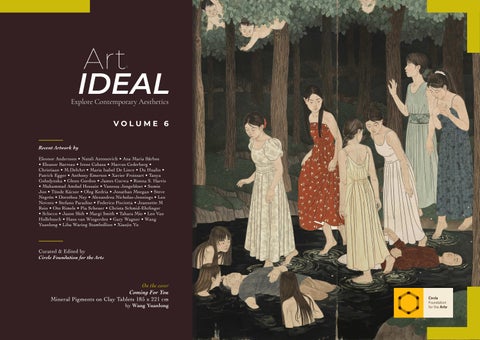
On the cover Coming For You Mineral Pigments on Clay Tablets 185 x 221 cm by Wang Yuanlong
2026 Circle Foundation for the Arts Front Cover
Wang Yuanlong
Coming For You Mineral Pigments on Clay Tablets 185 x 221 cm
Back Cover
Patrick Egger
Jour Blanc Sur Les Drus Acrylic on Canvas 60 x 80 cm
Designed & Published in France Distributed Internationally All Rights Reserved ® No part of this publication may be reproduced, stored in retrieval systems, or transmitted in any form or any means, electronic, mechanical, photocopying or otherwise, without written permission of the publisher and copyright holders. ® Copyright: Circle Foundation For the Arts Press info@circle-arts.com ISBN: 979-10-980264-1-6 CFA Press, France Dedicated to Art
Art IDEAL v.6
FEATURED ARTISTS ELEONOR ANDERSSON NATALI ANTONOVICH ANA MARIA BĂRBOS ELEANOR BARREAU IRENE CABASA MARCUS CEDERBERG CHRISTIAAN M.DEBART MARIA ISABEL DE LINCE DU HUALIN PATRICK EGGER
ANTHONY EMERTON XAVIER FROISSART TANYA GOLODYNSKA GLENN GORDON JAMES GUCWA RONNA S. HARRIS MUHAMMAD AMDAD HOSSAIN VANESSA JONGEBLOET SUMIN JOO TÜNDE KÁCSOR
OLEG KEDRIA JONATHAN MORGAN STEVE NEGRÓN DOROTHEA NEY ALEXANDREA NICHOLASJENNINGS LEO NOVORO STEFANO PARADISO FEDERICO PISCIOTTA JEANNETTE M REIN OTO RIMELE PIA SCHEUER
CHRISTA SCHMID-EHRLINGER SCLOCCO JASON SHIH MARGI SMITH TAHARA MIO LEO VAN HULLEBUSCH HANS VAN WINGERDEN GARY WAGNER WANG YUANLONG LIBA WARING STAMBOLLION XIAOJIN YU
Index ◊ Art IDEAL 6 ⌇ 5
Meet the Curator
Born in 1986 in Athens, Greece, Myrina Tunberg Georgiou spent her childhood on the island of Crete. After completing high school, she moved to Athens, pursuing studies at the National University of Greece, Dept. of Methodology, History, and Theory of Sciences. Relocating to Santa Barbara, California, she completed Studio Art studies at SBCC. During her time in Santa Barbara, Myrina found deep inspiration in the teachings of Ed Inks, sculptor and Professor who served as Department Chair. This encounter propelled her to delve deeper, leading her to pursue further education in Art History and Studio Art. She obtained a Bachelor of Fine Art in Design & Technology from the San Francisco Art Institute. Myrina became an active member of the San Francisco Bay Area art community, working alongside various art institutions, museums, and galleries. In 2011, she co-founded Kitsch Gallery, an experimental art space situated in the vibrant Mission District of San Francisco. Within this unique establishment, Myrina co-directed a multitude of visual and sound art exhibits, fostering an environment that housed 12 artist studios and a gallery space.
In 2012, Myrina relocated to Paris, France, for a freelance design career, working for American and French galleries, art institutions and publishing houses. Since 2014, she has made her home in Lyon, France, embracing the city’s rich artistic heritage and cultural milieu. Drawing from her extensive experience working in galleries and art institutions, Myrina’s vision crystallized in 2017 when she founded Circle Foundation for the Arts. Motivated by the diversity of artistic practices and perspectives within contemporary art, Circle serves as a platform to showcase the work of remarkable artists from around the globe. Guided by her belief in the vital role of art and culture in shaping our social and political landscapes, she designs & curates projects and exhibitions, publishes books and magazines, and has collaborated with and provided consultation for over 8,500 artists to date. Myrina continues to advocate for the importance of art, focusing on building opportunities for artists to sustain and develop their vital work. Through her dedication, she seeks to ensure that artistic voices are supported, heard, and celebrated across boundaries and cultures.
6 ⌇ Art IDEAL v. ◊ Meet The Curator
CURATOR’S NOTE
Beauty as a form of resistance We live in challenging times. Conflict, division, environmental uncertainty and an endless stream of information have become part of the background of everyday life. While curating this sixth volume of Art IDEAL, I found myself returning to a deceptively simple question:What place does beauty have in a world like this? My answer is: perhaps a more important one than ever. Beauty can sometimes be treated with suspicion in contemporary art, as though seriousness must necessarily be difficult, confrontational or bleak. I have never believed that. Beauty does not require us to look away from what is difficult. It can exist alongside grief, vulnerability, uncertainty and loss. It can even make us look at these things more closely. The artists gathered in this volume reminded me of this repeatedly. Here, beauty is not a single aesthetic. It appears in the monumental stillness of a mountain and in the intricate
structure of a flower; in the human body and in landscapes transformed almost into abstraction. It emerges through light, colour, material, gesture and extraordinary craftsmanship. At other moments it is found somewhere less comfortable: in fractured surfaces, environmental vulnerability, memory, mortality, psychological tension and the traces that experience leaves behind. Again and again, these artists ask us to look more carefully. Marcus Cederberg removes visual noise until an ordinary architectural moment becomes extraordinary. Pia Scheuer changes our perspective until the Earth itself appears to be making abstractions. Ronna S. Harris looks so closely at the natural world that observation becomes a way of recognizing its value and vulnerability. Ana Maria Bărbos allows a trace, a texture or a barely perceived form to carry the weight of memory. Gary Wagner returns to landscapes knowing that changing light means no place can ever truly be seen twice.
Others find beauty precisely where we might not expect it. Wang Yuanlong places exquisite technique beside images of danger and mortality. Muhammad Amdad Hossain photographs communities living with environmental pressure while preserving the individuality and dignity of the people before his camera. Vanessa Jongebloet allows illumination to move across surfaces that appear cracked and damaged. Eleanor Barreau lets tenderness coexist with discomfort and nostalgia with loss. And elsewhere there is joy, colour, humour and wonder: mythological figures misbehave, light escapes the physical boundaries of a painting, imaginary worlds extend beyond the frame, and Tanya Golodynska’s flowers are permitted to be unapologetically beautiful. Perhaps this is why I have come to think about beauty as a form of resistance. Not beauty as perfection, decoration or escape, but beauty as an insistence on remaining attentive.
Curator’s Note ◊ Art IDEAL 6 ⌇ 7
A resistance to indifference, cynicism, disposability and the constant pressure to move on to the next image, the next headline, the next distraction. To stop and make something carefully is an act of attention. To stop and truly look at it is another. Art cannot solve the problems of the world, and I would never ask it to. But the world we inhabit is also shaped by what we choose to make, preserve, value and share with one another. Every artist in these pages has chosen, in a different way, to add something to it. When we collectively strive to create more beauty, more thoughtfulness, more imagination and more care, I believe that makes a difference. For Volume 6 of Art IDEAL, I choose beauty.
Myrina Tunberg Georgiou Curator & Editor
Circle Foundation for the Arts®
Sclocco b. 1989, Italy Lives in Toronto, Canada
“My work explores gender fluidity and social dynamics through figures that resist fixed identity. I am drawn to historical references not as nostalgia, but as living systems that continue to shape how we inhabit our bodies and relate to one another. I use structure to inform how figures occupy space, while painting allows me to undo rigidity, introducing vulnerability, fluidity, and fracture.” Fabrizio Sclocco belongs to a generation rediscovering the physical and imaginative possibilities of painting. His bodies fold into one another, multiply limbs and lose their boundaries, shifting easily between intimacy, absurdity and humour. Exposed linen, loose drawing and unexpected color give the paintings an immediacy that feels confident rather than overly resolved. There is wit in the improbable anatomies and entangled bodies, but also considerable tenderness. Questions of gender, identity and human connection emerge naturally through these encounters without being burdened by explanation. His architectural background provides an intriguing counterpoint: structure is clearly understood, then playfully bent, interrupted and reorganized. In a culture saturated with disposable digital imagery, Sclocco’s paintings feel especially refreshing. They embrace precisely what the screen cannot offer: materiality, imperfection, touch and the freedom of a body, and a painting, not to behave exactly as expected.
Sclocco • Anatomies of Intimacy 8 ⌇ Art IDEAL 6
How To Put Your Arms Around Me Oil on Linen 36 x 48 in. Sclocco ◊ Art IDEAL 6 ⌇ 9
Get A Sofa, I Am Coming Over Oil on Linen 48 x 36 in. Sclocco ◊ Art IDEAL 6 ⌇ 10
Can’t Wait To Hug Everyone Oil on Canvas 36 x 48 in. Sclocco ◊ Art IDEAL 6 ⌇ 11
Circle Foundation for the Arts®
Steve Negrón b. United States Lives in Italy
Steve Negrón’s paintings feel like myths that have survived into the present and picked up some questionable habits along the way. Elegant, elongated figures drink cocktails, quarrel, flirt, drown, ride improbable horses and wander through landscapes where classical temples, domestic furniture and enormous curling seas coexist without explanation. The humour is immediate, but there is usually something darker underneath it. Negrón has a wonderful instinct for narrative without becoming illustrative. Each painting appears to contain a story, yet we arrive somewhere in the middle and are left to reconstruct what happened. His muted, worked surfaces give these strange scenes the patina of something old, while the behaviour of his characters remains recognizably contemporary. Myth, social comedy and private drama become difficult to separate. Italy has clearly provided Negrón with a rich new vocabulary of temples, volcanoes and Mediterranean archetypes, but he refuses to treat any of it as sacred. That irreverence is precisely what makes the work convincing. The past is not preserved behind glass. In Negrón’s world it is still drinking, misbehaving, falling in love and making the same mistakes all over again.
Steve Negrón • Mythology Behaving Badly 12 ⌇ Art IDEAL 6
Happy Hour With The Daughters Of Erebus Acrylic on Wood Panel 50 x 50 cm Steve Negrón ◊ Art IDEAL 6 ⌇ 13
The Drowned Lover Acrylic on Wood Panel 35 x 40 cm Steve Negrón ◊ Art IDEAL 6 ⌇ 14
Messenger, II Acrylic on Wood Panel 35 x 40 cm Steve Negrón ◊ Art IDEAL 6 ⌇ 15
Art Of The Earth #2, 2026 Aerial Fine Art Photography Series: Art of the Earth. Location: Carmarthen Bay, Llanelli, Wales, United Kingdom. Capture: Drone photograph. Process: Original pixels, carefully interpreted and color graded. Pia Scheuer ◊ Art IDEAL 6 ⌇ 16
Circle Foundation for the Arts®
Pia Scheuer b. 1969, Finland Lives in Scherzingen, Switzerland
“Nature is the artist. I am the observer who reveals what is hidden. Water, wind, ice and time sculpt the Earth, creating fleeting compositions before transforming them again. Using only the camera’s original pixels, I interpret and color grade what is already there, not altering reality but discovering the extraordinary that has always been present. An invitation to slow down and look at the world a little differently.” Pia Scheuer’s aerial photographs reveal how quickly landscape can become abstraction when familiar perspective disappears. Rivers, shorelines, ice and sediment turn into lines, fields and organic shapes whose scale is initially difficult to determine. The images can resemble painting while remaining entirely grounded in observed terrain. The drone is important here not simply as technology, but as a way of seeing. Scheuer uses altitude to expose structures created by natural processes that are difficult or impossible to perceive from the ground. Her decision to work from the camera’s original pixels also keeps the practice tied to discovery rather than digital invention. There is an appealing reversal in Scheuer’s description of nature as the artist and herself as observer. Her contribution lies in recognizing the fleeting composition, choosing its boundaries and interpreting its color without overwhelming what she found. The resulting photographs make the familiar Earth look unexpectedly unfamiliar.
Pia Scheuer • From Another Perspective 17 ⌇ Art IDEAL 6
Circle Foundation for the Arts®
Wang Yuanlong b.2002, China Lives in Beijing, China
“I have long been drawn to the solemn beauty of ancient Chinese murals and Western religious paintings. In my own work, I use classical mural techniques and dark backgrounds to create a mysterious, historical atmosphere. By incorporating mythological stories and classic archetypes as metaphors, I explore the meaning and value of human life. My hope is that my art will touch the heart, reveal truth, and inspire goodness.” Wang Yuanlong draws on the solemn visual language of traditional Chinese mural painting while placing it in a distinctly contemporary psychological space. Finely controlled line, subdued color and dark, flattened grounds give his scenes an almost timeless stillness, even as their subjects are charged with danger and uncertainty. Bodies drift through water, figures confront fire, and children appear mysteriously among the trees. The imagery is narrative, but never quite explains itself. His engagement with ancient Chinese murals and Western religious painting goes beyond quotation. Their symbolism and ceremonial gravity become a framework for examining mortality, vulnerability and the value of human life. Particularly striking is the tension between the exquisite discipline of Wang’s technique and the disturbing events it contains. Beauty and threat occupy the same space, giving these remarkably assured paintings a haunting quality that lingers beyond their narratives.
Wang Yuanlong • At the Edge of the Living 18 ⌇ Art IDEAL 6
Coming For You Mineral Pigments on Clay Tablets 185 x 221 cm Wang Yuanlong ◊ Art IDEAL 6 ⌇ 19
Leave Me Not Mineral Pigments on Clay Tablets 81 x 65 cm Wang Yuanlong ◊ Art IDEAL 6 ⌇ 20
The Imprint Of Death Mineral Pigments on Clay Tablets 49 x 105 cm Wang Yuanlong ◊ Art IDEAL 6 ⌇ 21
Circle Foundation for the Arts®
Jason Shih b. 1972, Taiwan Lives in Taoyuan City, Taiwan
“As a professional sculptor, I like to experience the taste of life through perceptual observation in subtle moments, and I am drawn to the ever-changing possibilities of forms within poetic, imaginary space. For me, artistic creation is a way of sharing the moods and stories found in daily life.” Jason Shih’s sculpture begins with a contradiction. A material associated with weight, resistance and permanence is made to behave as though it were liquid. In these sweeping forms, mass stretches, folds and opens into space, producing silhouettes that seem caught somewhere between an object and a gesture. Shih’s long engagement with metal is evident in the confidence of these transitions. There is considerable technical control behind surfaces that appear effortless, particularly where narrow supports expand into broad cantilevered forms or openings are carved through the body of the sculpture. Yet the engineering never becomes the point. What matters is the sensation of movement it makes possible. The polished blue surface adds another ambiguity. It can suggest water, sky, industrial design or even something biological without settling into any one association. This openness fits Shih’s interest in the small observations and moods of everyday life. Rather than fixing those experiences into narratives, he gives them physical form: buoyant, aerodynamic and unexpectedly alive.
Jason Shih • An Argument with Gravity 22 ⌇ Art IDEAL 6
Continuous Transforming In Time Painted ABS 90 x 32 x 36 cm Jason Shih ◊ Art IDEAL 6 ⌇ 23
Ocean View Archival Print on 210 gsm Matte Fine Art Paper 50 x 70 cm
Look The Ocean Archival Print on 210 gsm Matte Fine Art Paper 50 x 70 cm
Marcus Cederberg ◊ Art IDEAL 6 ⌇ 24
Circle Foundation for the Arts®
Marcus Cederberg b. 1965, Sweden Lives in Sweden
“My images are visual pauses in a hectic world. They explore the meeting point between architecture, color and silence. I aim to capture moments where the everyday becomes graphic, poetic and timeless.” Marcus Cederberg has an acute eye for how very little information a photograph actually needs. A wall, a window, a small human figure or a sharply defined block of color can be enough. By stripping away visual noise, he turns ordinary architectural situations into compositions that sit somewhere between photography, abstraction and graphic design. Negative space is crucial to this work. Cederberg frequently gives the smallest element in the frame an unexpectedly large visual role precisely because so much has been removed around it. Scale, placement and color become highly deliberate, and humour occasionally enters through a tiny detail or an unlikely coincidence. The apparent simplicity of these photographs should not be confused with ease. Minimalism leaves little room for weak decisions. Cederberg’s precision, timing and ability to recognize order within everyday surroundings give the work its distinctive clarity.
Marcus Cederberg • The Intelligence of Less 25 ⌇ Art IDEAL 6
Circle Foundation for the Arts®
Muhammad Amdad Hossain b. 1999, Bangladesh Lives in Chattogram, Bangladesh
“My work explores the fragile relationship between people and water in coastal Bangladesh. I document communities living with floods, salinity, and environmental change, focusing on resilience, dignity, and adaptation. Moving between documentary truth and fine-art stillness, I seek quiet, symbolic moments that reflect survival in vulnerable landscapes and the strength that endures within them.” Muhammad Amdad Hossain belongs to a vital generation of photographers reclaiming the representation of their own communities from the conventions of the outsider’s gaze. South Asia has long attracted foreign photographers drawn to its visual intensity, social contrasts, and environmental extremes. Hossain offers something fundamentally different: the perspective of an artist for whom Bangladesh is not an exotic subject encountered from outside, but a lived and deeply understood reality. This proximity is evident in the remarkable balance of intimacy and formal control throughout his photography. Human figures retain their individuality even when seen within vast landscapes or surrounded by the material evidence of environmental and economic pressure. Hossain has a particularly strong instinct for composition, using aerial viewpoints, pattern, scale, and concentrated areas of color to create images that are immediately arresting without allowing their aesthetic beauty to overwhelm their human content. His photographs sit productively between documentary photography and contemporary visual art. They communicate difficult realities with directness, yet resist reducing people to symbols of hardship. Instead, Hossain brings attention to ordinary gestures, labor, endurance, and presence. This combination of social proximity and sophisticated image-making gives his practice its authority. The result is photography that bears witness while allowing the people and places before his camera to retain their complexity and dignity.
Muhammad Amdad Hossain • Living with Water 26 ⌇ Art IDEAL 6
Fatigue Sleep Photography 60 x 40 cm Muhammad Amdad Hossain ◊ Art IDEAL 6 ⌇ 27
Water Collection Photography 60 x 40 cm Muhammad Amdad Hossain ◊ Art IDEAL 6 ⌇ 28
Floodbound Island Photography 60 x 40 cm Muhammad Amdad Hossain ◊ Art IDEAL 6 ⌇ 29
Infinity Oil on Canvas 100 x 140 cm Tanya Golodynska ◊ Art IDEAL 6 ⌇ 30
Circle Foundation for the Arts®
Tanya Golodynska b. Ukraine Lives in Ukraine
“I transform floral motifs into meditative reflections on emotion, presence and inner energy. Working primarily in largescale oil painting, I balance precision with expressive freedom, exploring the delicate strength found in nature. Flowers inspire me with their resilience and fleeting beauty, reminding us to slow down and appreciate the present moment. Through my work, I invite viewers into a space of calm, contemplation and emotional connection.” Tanya Golodynska’s floral paintings are unapologetically beautiful. Working at large scale and with an extraordinary degree of technical control, she renders each petal through subtle shifts of light, translucency and color. The realism is remarkable, approaching photography at first glance, yet closer inspection reveals the patient construction of the image through paint. In these densely layered dahlias, repetition becomes almost hypnotic, drawing the eye from the soft outer petals toward increasingly intricate centres. There is also something distinctly feminine in Golodynska’s treatment of the floral subject, not as decoration, but as an expression of strength through delicacy. Her restrained palette of ivory, blush, cream and muted rose gives the painting an unusual luminosity and serenity. Flowers have a long and complex history in painting, but Golodynska approaches them with impressive contemporary precision. The technical achievement is admirable, but it is the tenderness of her observation that prevents virtuosity from becoming merely an end in itself
Tanya Golodynska • Flowers at Full Volume 31 ⌇ Art IDEAL 6
Circle Foundation for the Arts®
Irene Cabasa b.Sydney, Australia Lives in Sydney, Australia
“My practice explores expressive movement, layered surfaces and intuitive storytelling. Through a process that embraces spontaneity and experimentation, I create works reflecting the complexity of human experience and the emotional landscapes that shape us. Drawing inspiration from emotion, identity, resilience and the beauty found within chaos, my paintings invite viewers to engage with both the seen and the felt. The interplay of texture, color and gesture becomes a visual language through which personal narratives and universal emotions can coexist.” Irene Cabasa’s abstraction is physical and immediate. Paint accumulates through gesture, texture and layering, creating surfaces where movement is often more important than recognizable imagery. Her strongest passages emerge when contrasting marks are allowed to coexist: areas of density beside openness, controlled decisions beside spontaneous ones. Personal experience gives this formal language additional weight. Ideas of vulnerability, endurance and transformation are not illustrated literally, but are worked into the construction of the paintings themselves. Layers cover earlier layers without completely erasing them, allowing traces of what came before to remain visible. Cabasa is still developing her abstract language, and that sense of exploration suits the work. Rather than forcing the paintings toward predetermined conclusions, she allows process to remain visible. This gives them an emotional directness and leaves useful space for further experimentation.
Irene Cabasa • What the Surface Remembers 32 ⌇ Art IDEAL 6
Sacred Feminine, 2020 Acrylic on Canvas 30.5 x 30.5 cm Irene Cabasa ◊ Art IDEAL 6 ⌇ 33
Forest of Fontainebleau Oil on Canvas 116 x 89 cm Leo Novoro ◊ Art IDEAL 6 ⌇ 34
Circle Foundation for the Arts®
Leo Novoro b. Russian Federation Lives in France
Leo Novoro’s practice is unusually broad, moving between conceptual imagery, portraiture, mosaic and traditional landscape painting. In his landscapes, that breadth gives way to close observation. The Fontainebleau forest is approached through the particular character of its terrain: mature pines, exposed rock, fallen branches and dense vegetation are individually described while remaining part of a convincing natural whole. There is considerable attention to the way light moves through the forest. Rather than relying on a single dramatic focal point, Novoro builds the scene through smaller shifts in color and illumination across bark, stone and undergrowth. The fallen tree in the foreground is especially effective, creating a strong diagonal that leads the eye into the deeper, cooler areas of the woods. The painting reflects an artist comfortable with patient observation and traditional technique. Novoro does not idealize the forest by removing its irregularities. Broken branches, tangled growth and uneven ground are essential to the image, giving this landscape the specificity of a place genuinely studied rather than reconstructed from a generic idea of nature.
Leo Novoro • Into the Living Forest 35 ⌇ Art IDEAL 6
Circle Foundation for the Arts®
Dorothea Ney b. Berlin, Germany Lives in Pecos, New Mexico
“As an Abstract Expressionist painter, I work with acrylics, oils, cold wax, pigments and crayons on canvas or wood. I take my inspiration from nature, from my gardens, flowers and different color groupings that strike me, as well as from astrology and mythology. Most of all, I see the world as an energetic construct which we are constantly creating. I translate the beauty and energy of the natural world into compositions of color and movement.” Dorothea Ney approaches abstraction as a way of translating the energy she perceives in the world around her. Gardens, flowers and unexpected relationships of color provide a starting point, but recognizable forms quickly give way to sweeping gestures, layered surfaces and passages of intense color. The paintings suggest nature without attempting to describe it. Her combination of acrylic, oil, cold wax, pigment and crayon gives the surfaces a particularly active character. Dense areas meet transparent passages, while drawn lines interrupt broader movements of paint. There is a sense of growth and accumulation, as though the composition has developed organically rather than according to a predetermined structure. Ney’s interests in astrology and mythology extend this idea beyond the visible landscape. She describes the world as an energetic construct that we are constantly creating, and this is perhaps the clearest way into her work. Nature becomes not something to reproduce, but a source of movement, color and interconnected energy.
Dorothea Ney • The World as Energy 36 ⌇ Art IDEAL 6
Release 2 Oil color, cold wax and pigments on cradled wood Dorothea Ney ◊ Art IDEAL 6 ⌇ 37
Natans Archival Pigment Print on Fine Art Paper 100 x 70 cm Stefano Paradiso ◊ Art IDEAL 6 ⌇ 38
Circle Foundation for the Arts®
Stefano Paradiso b. 1969, Italy Lives between Trieste / Rome, Italy and Paris, France
“Coming from cinema, I approach photography as a process of subtraction, condensing narrative into a single silent image. Through analogue black-and-white photography, darkroom experimentation and hand-coated Washi paper, I explore the hidden presence within objects, places and traces of humanity. Influenced by Eastern art, my work seeks not to describe reality, but to evoke memory, energy and time.” Stefano Paradiso approaches photography through subtraction. After more than thirty years working in cinematography, where meaning unfolds through sequences of images, his photographic practice moves in the opposite direction: narrative is compressed into a single, quiet frame. Plants, landscapes, objects and traces of human presence become carriers of memory rather than subjects to be simply described. His analogue process is central to this language. Large-format negatives, darkroom experimentation and hand-coated Washi paper introduce irregularity, texture and physical presence. The influence of Japanese and Chinese visual traditions is equally apparent in his sensitivity to emptiness, restraint and the expressive possibilities of what is left unresolved. Paradiso is interested in what an image can evoke without explaining. Forms emerge, disappear or hover between recognition and abstraction, giving the photographs a quality closer to recollection than documentation. Time, memory and presence are felt precisely through what he chooses not to reveal.
Stefano Paradiso • What Remains Unsaid 39 ⌇ Art IDEAL 6
Circle Foundation for the Arts®
Natali Antonovich b. 1965, Belarus Lives in Tervuren, Belgium
“My works are designed for curious people, people with a cosmic attitude and those looking for a key to reading the superreal. They are also for those for whom the uniqueness of the human being, the soul and our connection with Earth and Heaven are important.” Natali Antonovich is not afraid of difficult territory: love, mortality, the soul, the cosmos, the possibility of realities beyond the immediately visible. She describes her work as mystical and fantastic realism, which is useful because neither “Surrealism” nor “symbolism” quite captures its particular mixture of narrative, fantasy and spiritual inquiry. Her paintings often behave like fragments from stories whose beginnings and endings we have missed. Human figures, animals, celestial imagery and symbolic objects meet in improbable circumstances, yet Antonovich paints them with enough conviction that the strange begins to acquire its own logic. There is something literary about this approach; she herself compares the experience to entering a novel, play or poem.
Natali Antonovich • A Private Cosmology 40 ⌇ Art IDEAL 6
Melody Of Love Cardboard and Pastel 40 x 30 cm
Natali Antonovich ◊ Art IDEAL 6 ⌇ 41
Circle Foundation for the Arts®
Ana Maria Bărbos b. 1968, Romania Lives in Ploiești, Romania
“‘Memory of Air’ emerged from years of hearing birds before seeing them. My paintings explore air as a living space where presence appears and disappears. Working with layered acrylic on jute canvas, I allow the material to preserve traces and speak about the fragility of existence without illustrating it directly.” Ana Maria Bărbos has developed a subtle language around nature, memory and perception, often working on coarse jute whose visible weave becomes an active part of the painting. Pale blues, greys and chalky whites accumulate in thin, worked layers, while recognizable forms appear only faintly before dissolving again. There is a beautiful tension between the physical presence of the material and the elusive quality of what is represented. Birds, air and the natural world provide recurring points of departure, but Bărbos is less concerned with describing nature than with capturing the experience of sensing it. Her restraint is one of the practice’s greatest strengths. A trace or partially perceived form can carry more weight than a fully articulated image. Through this economy, Bărbos creates paintings that feel quiet without feeling empty, allowing fragility, absence and memory to remain suspended just beneath the surface.
Ana Maria Bărbos • At the Edge of Visibility 42 ⌇ Art IDEAL 6
Listening To Air Acrylic on Jute Canvas 100 x 100 cm
Field Of Breath Acrylic on Jute Canvas 100 x 100 cm
Ana Maria Bărbos ◊ Art IDEAL 6 ⌇ 43
Circle Foundation for the Arts®
Tünde Kácsor b. 1973, Hungary Lives in Rácalmás, Hungary
“My painting centres on time experienced in nature and a state of “simple, pure presence.” My landscapes do not depict specific places, but inner spaces where the constancy of change becomes perceptible. The creative process is intuitive: paint, material and chance shape the image, to which I respond with attentive awareness.” Tünde Kácsor’s landscapes occupy a compelling space between the observed and the imagined. Water, stone, ice and distant horizons remain recognizable, yet her layered surfaces loosen them from geography. Turquoise passages emerge through dark, eroded textures; scraped and dispersed paint gives the terrain a sense of having been shaped over time rather than simply depicted. This balance of chance and attentive intervention is central to Kácsor’s increasingly assured visual language. After more than twenty-five years of making art, her recent practice has gained international recognition alongside exhibitions in Hungary, including selection for the 2026 XXI Táblaképfestészeti Biennálé. What stays with us, however, is the work itself: expansive, elemental landscapes that make stillness feel remarkably alive.
Tünde Kácsor • Landscapes of Inner Stillness 44 ⌇ Art IDEAL 6
Correlation 1, 2024 Acrylic on Fiberboard 70 x 100 cm Tünde Kácsor ◊ Art IDEAL 6 ⌇ 45
Circle Foundation for the Arts®
Vanessa Jongebloet b. 1969, Netherlands Lives in Châteldon, France
“My work is a meditation on what it means to be human, to long, to wonder and to find something luminous in the dark.” The cracks come first. Vanessa Jongebloet works on deliberately fractured surfaces that can resemble walls, archaeological fragments or frescoes weathered over centuries. It is an effective contradiction: newly made paintings arrive already carrying the appearance of age. This surface gives particular resonance to her two principal bodies of work. Ancient Light considers illumination across human and natural history, while Longing turns toward elemental human needs such as shelter, faith, connection and belonging. The subjects are expansive, but the distressed ground prevents them from becoming overly polished or ethereal. Light has to travel across something damaged. Jongebloet is self-taught, and there is an independence in the way she combines abstraction, symbolism and material experiment without worrying too much about where one category ends and another begins. Her statement speaks of finding something luminous in darkness. The cracked surfaces make that idea physical: illumination becomes most visible precisely because the ground around it is imperfect
Vanessa Jongebloet • Ancient Light 46 ⌇ Art IDEAL 6
Ancient Light - Fishing on the Yangtse River Mixed Media and Oil on Canvas 77 x 55 x 1 cm
Ancient Light - Matins Mixed Media and Oil on Canvas 55 x 39 x 1 cm
Vanessa Jongebloet ◊ Art IDEAL 6 ⌇ 47
DU HUALIN b. 1962, China Lives in Shenzhen, China
“Decades of professional design practice kept me away from painting, yet also made me cherish and miss it all the more. As time goes by, I have never forgotten my original aspiration. The moment has come for me to pick up the paintbrush again. I have been away from my hometown, the rural countryside of western China, for several decades. It left the deepest memories in my heart, memories that will never fade. I hold sincere affection and deep attachment to my homeland. The paintbrush, regained after years of absence, is the ultimate spiritual sustenance of my life story. For I deeply love that land: profound, solemn and beautifully rugged.”
48 ⌇ Art IDEAL 6
Light Of The Earth Oil on Linen 70 x 70 cm
Noon Oil on Linen 70 x 70 cm
Du Hualin’s return to painting after decades in professional design gives his work an unusual combination of discipline and emotional immediacy. His rural subjects are rooted in memories of western China, but they avoid becoming simple exercises in nostalgia. The land, architecture and people are treated with a gravity that reflects the distance of someone returning imaginatively to a place that has remained important throughout his life. His design background is evident in the strength of the compositions. Figures and structures are clearly organized,
yet the paint itself has a physical presence that keeps the images from feeling overly controlled.
Du Hualin • The Long Way Home
Earth colors and rugged surfaces reinforce the character of the environments he depicts. There is something compelling about an established designer returning to the medium with which his creative life began. For Du, painting functions as both observation and recovery, allowing personal memory to become the basis for a broader reflection on place, belonging and the passage of time.
My Father Oil on Linen 60 x 50 cm
Autumn Harvest Oil on Linen 70 x 70 cm
Du Hualin ◊ Art IDEAL 6 ⌇ 49
Eleonor Andersson b. United States Lives in United States
Eleonor Andersson approaches portraiture as something more psychologically charged than likeness. Her figures are beautifully rendered yet subtly unsettled, with familiar bodies interrupted by surreal elements, softened edges and shifts in perception. There is a particular sensitivity in the way she handles oil paint, moving between precise observation and areas that seem to dissolve into memory or sensation.
Andersson’s practice centres on portraiture, Surrealism and psychological realism. Her work probes the ways we inhabit the human body and mind, exploring how different visual strategies can express this universal yet deeply subjective experience. Positioned at the intersection of fine art and psychology, Andersson’s work unites these disciplines to investigate the psyche and the complex interplay between physical and mental states.
Soft Focus Oil on Canvas 16 x 20 in. 50 ⌇ Art IDEAL 6
Eleonor Andersson • The Inner Life of the Figure
Her parallel studies in psychology and art therapy give meaningful context to this practice without defining it. Andersson is developing a visual language in which technical skill and psychological inquiry reinforce one another. Already a two-time Circle Foundation Artist of the Year finalist and recipient of the Boynes Artist Award in Surrealism, she is an emerging painter whose work feels both thoughtful and distinctly her own.
Xavier Froissart b. 1951, France Lives in Cormot-Vauchignon, France
Xavier Froissart has spent years returning to Babel, and it is easy to understand why the subject continues to sustain his imagination. Cities, towers and monumental structures rise from invented landscapes as though belonging to civilizations whose histories have been lost. Some appear unfinished; others could equally be ruins. His command of perspective makes these impossible environments physically persuasive. Architecture becomes the protagonist, dwarfing human scale and suggesting entire societies through what they have constructed rather than through direct narrative. Froissart’s experience across painting, mural work and three-dimensional design is evident in this spatial confidence.
“To make the invisible visible.” Xavier Froissart was Circle Foudation’s Artist of the Year 2025/6.
There is no need to decide whether we are looking at a remote past or an imagined future. That uncertainty is precisely where these paintings become interesting. Construction and collapse, aspiration and impermanence occupy the same speculative world.
Fragments Oil on Canvas 50 x 50 cm
Xavier Froissart • Between Construction and Collapse
Art IDEAL 6 ⌇ 51
James Gucwa b. United States Lives in Pinetop, United States
James Gucwa has spent decades painting a disappearing piece of American visual culture: vintage neon signs, motels, diners and theatres. His photorealistic technique transforms these once-commercial objects into striking records of the American roadside, preserving their saturated color, extravagant typography and unmistakable character. His wider practice, which spans large-scale historical murals, public commissions and an expanding range of subjects, reveals an artist with both considerable technical range and a longstanding interest in American imagery.
52 ⌇ Art IDEAL 6
No Lifeguard On Duty Oil on Canvas 54 x 68 in. NFS
James Gucwa • King Neon
Ronna S. Harris b. United States Lives in Boone / Crescent City, USA
Master American painter, Ronna S. Harris brings extraordinary patience and sensitivity to the act of looking. Her paintings draw us into environments that might otherwise pass unnoticed, transforming moving water, tangled vegetation, reflected light and the accumulated traces of changing seasons into remarkably intricate visual fields. Her command of realism is impressive, but technical precision is never the endpoint. Harris uses observation to reveal complexity: surfaces shift between clarity and abstraction, reflections destabilize what we think we see, and seemingly ordinary fragments of nature become immersive worlds in themselves.
“My creative theme is internal perspective. My goal is to transform the viewer into another realm: a world of intimacy and exploration. At first glance, they are just narrative examples of painting. The narrative conveys my concern about issues that affect our contemporary society, particularly man’s impact on our environment, causing climate change. My paintings are chosen images of observations to symbolize this dialogue. They are all my intimate vision of life.”
This depth of attention carries particular significance within a practice concerned with environmental change and humanity’s increasingly fragile relationship with the natural world. Harris brings decades of sustained artistic inquiry to these questions, including 35 years as Associate Professor of Art at Tulane University, an extensive exhibition history, and representation in several American museum collections. There is both maturity and urgency in her work. Harris reminds us that careful observation can itself be meaningful: to look closely is to recognize value, vulnerability and beauty. Her paintings reward that same attention from the viewer, revealing new passages and relationships over time and demonstrating the enduring strength of a deeply accomplished painter. Rube’s Creek After Helene Oil on Canvas 5 x 3 ft.
Ronna S. Harris • Where the World Reveals Itself
Art IDEAL 6 ⌇ 53
Patrick Egger b. 1957, Switzerland Lives in Les Marécottes, Switzerland
“I paint landscapes in a figurative style, bordering on hyperrealism. But while remaining faithful to what is visible, I strive to be in harmony with a feeling that I seek to magnify in order to convey it. This search for powerful emotions takes place through the staging of contrasting atmospheres, playing with light and shadow while combining precision and poetry.”
54 ⌇ Art IDEAL 6
Jour Blanc Sur Les Drus (Whiteout On Les Drus) Acrylic on Canvas 60 x 80 CHF3,400
Ultimes Rayons Sur Le Cervin (Last Rays On The Matterhorn) Acrylic on Canvas 60 x 80 CHF 3,400
Patrick Egger paints mountains with the understanding of someone who has spent a lifetime observing them. Trained as a forestry engineer and raised amid the landscapes of the Swiss Jura, he brings both intimate knowledge and genuine reverence to the natural world. His remarkable precision establishes the physical presence of rock, snow and atmosphere, while dramatic shifts of light move the work beyond straightforward realism.
Living in the Mont Blanc massif has clearly sharpened this dialogue between observation and emotion. Egger is particularly skilled at capturing those fleeting moments when weather and light transform a familiar landscape into something monumental. His growing record of international awards confirms the strength of a practice in which technical discipline and poetic sensitivity meet. These are landscapes that invite awe, but also silence: nature rendered with grandeur, patience and deep respect.
Patrick Egger • In the Presence of Mountains
Le Lac Blanc (The White Lake) Acrylic on Canvas 80 x 60 CHF 3,400 Patrick Egger ◊ Art IDEAL 6 ⌇ 55
Maria Isabel De Lince b. 1939, Colombia Lives in Bogotá, Colombia
“My work is a message to the world. It is born from the spirit and expressed through the universal language of art, as are peace, harmony, beauty, happiness and love. Painting is my way of speaking to humanity to convey a deeper awareness of itself and the universe that surrounds it. I aspire for those who contemplate my creations, no matter where they are, to perceive the vibration of spirituality and peace that inhabits them.”
Agua Te Amamos (Water, We Love You) Oil on Linen 96 x 140 cm
There is something profoundly spiritual in Maria Isabel De Lince’s approach to painting. Light, color and atmosphere seem to extend beyond the visible world, creating spaces that feel suspended somewhere between earth and the divine. Her luminous palette and softly dissolving forms give the work an almost weightless quality, inviting contemplation rather than demanding interpretation. For De Lince, art is inseparable from a belief in beauty, harmony, peace and our connection to something greater than ourselves. This conviction has sustained a long practice shaped by formal studies and mentorship under respected Colombian masters including David Manzur. Exhibited across Colombia, the United States, Europe and Asia, her paintings retain an intimate sincerity. They offer the viewer a moment of stillness and, perhaps, the possibility of feeling a little closer to God. 56 ⌇ Art IDEAL 6
Maria Isabel De Lince • Closer to God
M.DebArt b.Tropea, Italy Lives in Rome, Italy
Maria De Bartolis’ portraits begin with likeness, but their real strength lies in the sense of individual presence she creates. Working in pastel, she builds skin, light and expression through carefully layered color, achieving remarkable realism without losing the softness and immediacy particular to the medium. Her attention repeatedly returns to the eyes, where technical precision gives way to something more instinctive and human.
“Through the art of portraiture, I celebrate the beauty, uniqueness and value of every human being. My research focuses on the face and, in particular, the gaze. I use pastels to build layers of color and achieve a realistic and vibrant rendering of skin and detail. My aim is to establish an intimate connection between the painted subject and the observer, encouraging them to stop, look beyond the surface and recognize the profound humanity that resides in each of us.”
Self-taught and deeply committed to portraiture, Maria De Bartolis approaches each face as the visible trace of a life already lived. There is dignity in this perspective. Rather than idealizing her subjects, she asks us to spend time with their individuality. Her work reminds us that a face is never simply a face: it carries experience, vulnerability, character and stories we may never fully know.
Uno Sguardo Sull’Oltre (A Glimpse Beyond) Pastel on Paper 30 x 44 cm
Maria De Bartolis • The Stories We Carry
Art IDEAL 6 ⌇ 57
Eleanor Barreau b. United Kingdom Lives in London, United Kingdom
Eleanor Barreau’s paintings capture the way memory actually behaves: fragmented, selective and constantly rearranging itself. Figures, gestures, objects and flashes of color accumulate across the surface, creating compositions that feel simultaneously intimate and restless. Her confident handling of the human figure anchors this complexity, while repetition and overlap suggest different moments occupying the same psychological space.
“I am interested in how memories are not fixed records but living narratives. When we revisit significant memories, they shift and change each time we recall them. Memories help us create stories that make sense of ourselves, and we often understand them through the narrative that suits us at the time.The paintings explore the idea of pain existing within tenderness and nostalgia as both a wound and a form of connection. Fragments of experience sit alongside one another, merging and overlapping.”
With an MA in Painting from the Royal College of Art and a practice spanning fine art, stage design, murals and album artwork, Barreau brings an assured visual intelligence to these layered narratives. What makes the work particularly compelling is its emotional ambiguity. Tenderness can coexist with discomfort; celebration with loneliness; nostalgia with loss. Rather than resolving these contradictions, Barreau allows them to remain beautifully entangled, much like memory itself..
Past Lives Acrylic on Canvas 100 x 70 cm 58 ⌇ Art IDEAL 6
Eleanor Barreau • Past Lives, Present Tense
Xiaojin Yu b. 1975, China Lives in California, United States
Born in Chongqing and now working in California, Yu draws naturally from more than one visual tradition without allowing either to dominate. Layering and removing paint becomes a language of time itself, giving her images the character of objects carrying their own histories. Since committing fully to painting in 2017, she has developed a distinctive practice that finds beauty not in perfect preservation, but in the traces that experience leaves behind.
“Whether it is the joy of new life or the tears of reminiscing, they are all traces of life. I hope to present them through painting, with different colors, emotions and artistic expressions. This series combines Chinese ink line painting, Western oil painting and the mottled colors of Chinese grotto art. Through the layering, removal and re-layering of multiple layers of oil paint, it creates a sense of traversing history, prompting further reflections on the diversity of life.”
Xiaojin Yu’s paintings have the compelling quality of something remembered rather than simply observed. Figures, flowers and familiar interiors emerge through richly worked surfaces, while passages of color appear worn, veiled or recovered. Her technique brings together the linear sensitivity of Chinese ink painting, the material depth of oil, and the weathered chromatic beauty she associates with ancient Chinese grotto art.
Fragrance Oil 20 x 16 in.
Xiaojin Yu • The Surface of Time
Art IDEAL 6 ⌇ 59
Anthony Emerton b. 1952, United Kingdom Lives in Ruislip, United Kingdom
Anthony Emerton has reduced his recent paintings to an unusually strict vocabulary: two linear elements and an oval. This self-imposed limitation is precisely what gives the work its tension. With so few components available, placement, proportion, interval and scale become highly consequential, and apparently minor adjustments can alter the balance of the entire composition.
“My present paintings share a common structure, each having two linear elements and one oval form, all infinitely variable. I am concerned primarily with composition, taking particular care with the juxtaposition of these elements. The whole painting must be in balance, so that even the slightest change would disrupt the composition and symmetry. I begin with a small drawing, which is then accurately enlarged onto the canvas.”
His earlier experience as a sculptor is relevant to the way these forms occupy space. The canvas is not treated simply as a surface to be filled; emptiness has structural importance, and each element establishes a relationship with the boundaries and with the other forms around it. The precision of Emerton’s preparatory process reinforces this sense of deliberate construction. After decades of moving between different visual languages, this radical reduction feels purposeful rather than restrictive. Emerton tests how much variation can exist within a fixed system, finding complexity through proportion and placement rather than through an abundance of imagery. Green ZZY Acrylic on Canvas 84 x 61 cm
60 ⌇ Art IDEAL 6
Anthony Emerton • Two Lines and an Oval
Glenn Gordon
For Glenn Gordon, color is not simply applied to a composition; it is the force that determines it. His abstract paintings develop through layered brushwork, shifting relationships of light, rhythm and movement, allowing the image to emerge through the act of painting itself. The resulting works are bold and energetic, yet there is also an underlying sense of balance that keeps their intensity controlled.
b. Washington, D.C., United States Lives in Palm Beach, United States
“My goal is not to fill in the blanks of a line drawing when I paint; the colors decide what the composition will be. The goal is to catch the moment.”
Gordon’s relationship with art began remarkably early, developing through years of drawing, painting and sculpting before becoming a lifelong practice spanning more than five decades. That history is felt in the confidence with which he allows intuition to guide structure. Rather than illustrating a predetermined idea, Gordon gives color the freedom to lead, capturing something immediate, emotional and alive. Alchemist Acrylic on Canvas 30 x 40 in.
Glenn Gordon • Let Color Decide
Art IDEAL 6 ⌇ 61
Oleg Kedria b. 1968, Ukraine Lives in Detroit, United States
Oleg Kedria gives physical form to the tension between permanence and fragility. Bronze, stainless steel and crystal are shaped with a sculptor’s respect for classical traditions, yet fragmentation, polished surfaces and contemporary silhouettes move the work decisively into the present. Solid material can appear unexpectedly vulnerable, while fractured forms retain an unmistakable sense of strength. Across more than three decades, Kedria has developed a practice ranging from intimate sculpture to monumental public commissions. His technical command allows symbolism to remain direct without becoming overly literal: the human form becomes a vessel for endurance, transformation and the persistence of the spirit. Exhibited internationally and represented in public and private collections, Kedria brings together craftsmanship and emotional clarity to create sculpture with both physical presence and lasting resonance.
“My sculptures explore the balance between strength and vulnerability, drawing inspiration from classical sculpture and timeless symbolism. Working in bronze, stainless steel and crystal, I combine traditional craftsmanship with contemporary expression. Warrior’s Shadow reflects the resilience of the human spirit, where fragmented form becomes a symbol of perseverance, inner strength and transformation. Through my work, I seek to create timeless sculptures that inspire reflection.”
Warrior’s Shadow, 2018 Bronze, Patina, base Quartz, Limited Edition of 15 62 ⌇ Art IDEAL 6
Oleg Kedria • What Remains Unbroken
Sumin Joo Lives in United States
Sumin Joo creates environments that feel as though they continue far beyond what we are permitted to see. Color, light and composition establish not only a location but a mood, giving her digital landscapes the narrative richness of places with histories, inhabitants and stories of their own. The balance between recognizable natural forms and imaginative invention makes these worlds immediately inviting while preserving a sense of discovery.
“My work explores immersive worlds where environment and story shape one another. Inspired by culture, color, nature, and imagined landscapes, I create digital paintings that evoke atmosphere, emotion, and a strong sense of place. Through thoughtful composition and visual storytelling, I design environments that feel both familiar and fantastical, inviting viewers to imagine the stories beyond the frame. My goal is to create worlds that spark curiosity and emotional connection.”
Trained at ArtCenter College of Design and working in visual development and background art for animation and entertainment, Joo brings strong technical discipline to her atmospheric approach. Yet it is her sensitivity to place that distinguishes the work. Rather than treating the environment as a backdrop, she makes it an active presence, capable of carrying emotion, suggesting narrative and awakening our curiosity about what might exist just beyond the frame.
Out Of The Canvas Digital Media 12 x 18 in.
Sumin Joo • Worlds Beyond the Frame
Art IDEAL 6 ⌇ 63
Jonathan Morgan b. 1974, United States Lives in Mountain Green, USA
Jonathan Morgan’s sculpture embraces drama without restraint. The human figure twists, reaches and extends through sweeping, almost Baroque forms, creating a powerful interplay of movement, beauty and theatricality. Elaborate folds and intricate surfaces amplify the gesture of the body, while strong contrasts between weight and suspension give the work a sense of being caught at the most intense moment of an unfolding scene.
“I create sculpture to make spaces feel different- to bring beauty, presence, and a sense of connection into the environments where we live. My work often uses the human form to explore transformation, openness, and the quite process of becoming. I’m drawn to the idea that art can do more than decorate a room; it can change the emotional tone of a space, invite reflection, and create moments of stillness and recognition between people. Art can do so much more for us than we realize.”
Morgan’s process begins with heightened emotion, and that intensity remains visible in the finished sculpture. Yet beneath the spectacle is considerable sensitivity to anatomy, balance and form. His figures can appear vulnerable and heroic at once, transforming inner states into expansive physical gestures. This combination of emotional force, intricate craftsmanship and unapologetic theatricality gives Morgan’s sculpture its distinctive presence: work designed not merely to occupy space, but to command and transform it.
Eclipse Bronze 35 x 25 x 10 in.
64 ⌇ Art IDEAL 6
Jonathan Morgan • The Beauty of Transformation
Alexandrea Nicholas -Jennings Alexandrea Nicholas-Jennings brings the discipline of classical portraiture into a world that is theatrical, strange and unmistakably personal. Her technical command gives extraordinary credibility to the imagined scenes she constructs: figures are precisely observed, animals become psychological characters, and familiar references to Alice in Wonderland are transformed through an autobiographical lens. Rich color and meticulous detail heighten the tension between fantasy and lived experience.
b. Fonthill, Canada Lives in Toronto, Canada
“The people who enter and occasionally exit my life feed my imagination and become the reimagined characters in my Wonderland. They inspire and assist me in telling my colorful tale of falling down the rabbit hole, the catalyst for my autobiographical series Alex in Wonderland. This ongoing series inspects the self as I strive to live a life of autonomy, introspection and self-actualisation, one chapter at a time in oil paint.”
Behind this visual playfulness is an accomplished painter with substantial classical training and growing international recognition, including distinction from the Portrait Society of America and the ARC Salon. Nicholas-Jennings uses that foundation not as a constraint, but as a platform for invention. Her Wonderland becomes a space for examining identity, loss, autonomy and transformation, where virtuoso painting and deeply personal storytelling meet with remarkable confidence.
The Caucus Race Oil on Panel 36 x 48 in.
Alexandrea Nicholas-Jennings • Painting Her Own Wonderland
Art IDEAL 6 ⌇ 65
Jeannette M Rein b. Australia Lives in Western Australia
“Evolving from a strong connection to the natural world, my work is evident in wooden forms crafted from indigenous timbers. These objects cannot be replicated by any mechanical process; they require a human hand and human intuition. The basis of my practice is to stretch the known, imagine and create new possibilities for wood, and communicate the imperishable and untouchable spirit of living things.”
66 ⌇ Art IDEAL 6
Mirabilis Swan Valley Woollybush 75 x 23 x 24 cm
At first glance, the forms seem discovered rather than constructed: something marine, botanical or perhaps belonging to an unfamiliar species. Look closer, however, and Jeannette M Rein’s extraordinary manipulation of wood becomes apparent. Indigenous timbers are carved, pierced, layered and extended into intricate structures that appear to unfurl through space. Grain, bark and natural imperfections remain integral to the sculpture, creating a constant dialogue between the material’s original life and the new form it has assumed.
Jeannette M Rein • The Spirit of the Wood
Decades of experimentation across sculpture, jewellery and public art have given Rein an exceptional understanding of what wood can do. Her work, held in collections including the Art Gallery of Western Australia and The Center for Art in Wood, combines technical ingenuity with a deep sensitivity to nature. Rein does not impose herself upon the material so much as collaborate with it, revealing possibilities that feel simultaneously improbable and entirely organic.
Starfish Laminated Snotty Gobble 47 x 43 x 22 cm Jeannette M Rein ◊ Art IDEAL 6 ⌇ 67
Hans van Wingerden b. 1950, Netherlands Lives in s-Hertogenbosch, Netherlands
“My work has spread into many fields over the past 50 years of my art practice, partly from a need to better understand visual possibilities and partly from a need to highlight personal expression. I started as a realist, during the period when photographic realism was emerging, and achieved success with this work. Over time, however, my practice expanded as I continued to investigate different forms of visual expression.”
68 ⌇ Art IDEAL 6
Structure For The Dharma (Three Gunas), 2025 Oil on Canvas 1 x 85 x 90 and 1 x 80 x 90 cm
Since the mid-1990s, Hans van Wingerden’s practice has taken an increasingly conceptual approach to the contradictions of contemporary life. Familiar images and symbols are borrowed, displaced and recombined, creating new associations that interrupt their original meanings. Painting remains important, but his visual vocabulary extends to electronics, LEDs and salvaged neon, including material recovered from abandoned factory buildings during the 1990s.
Hans van Wingerden • No Single Way of Seeing
Central to this work is an attraction to opposing forces. Van Wingerden frequently uses the diptych to place contrasting forms, ideas or meanings into direct conversation, allowing tension rather than resolution to drive the work. This exchange of polarities reflects his critical view of a world shaped by profound disparities between appearance and reality, justice and injustice, authenticity and illusion. Rather than offering answers, his work asks us to examine the systems of images and ideas through which these contradictions become normalized.
Tahara Mio b. Japan Lives in Kawasaki, Japan
Figures and animals seem to appear and disappear within Tahara Mio’s delicate surfaces, suspended between memory, imagination and lived experience. Pale veils of color are interrupted by expressive marks and fragments of recognizable form, giving the paintings an unusual sense of intimacy. Nothing feels fixed. Instead, the imagery seems to surface gradually, like recollections whose emotional presence remains stronger than their details.
“My paintings are a diary of my life. My father told me when I was little, “Don’t say that. The world is a competition.” Yes, I live in a competitive society. I prefer a world of harmony with others to the pursuit of ego. I would be happy if my paintings bring peace to the hearts of those who see them.”
Behind this softness is a carefully developed visual language. Tahara’s childhood connection to nature and her grandmother’s painting shaped her sensitivity to living things, while her professional experience in architectural design introduced a contrasting awareness of structure and composition. These influences meet in paintings that balance freedom with quiet order. In a world often driven by competition, Tahara proposes something deliberately different: tenderness, coexistence and the possibility of harmony.
Home With Me, 2026 Mixed media on Canvas 53 x 45 x 2 cm
Tahara Mio • A Gentler World
Art IDEAL 6 ⌇ 69
Oto Rimele b. 1962, Slovenia Lives in Maribor, Slovenia
Oto Rimele has spent nearly twenty-five years pushing painting beyond the limits of its physical surface. His restrained objects appear almost austere, yet their simplicity conceals something remarkably active: color applied to hidden edges and reverse surfaces escapes onto the surrounding architecture as reflected light. Wall, object, shadow and illumination become inseparable parts of the work, changing continually with the conditions of the space.
Photo by Mike Crawford
“I am a painter of light, but I do not depict light in my luminary painterly objects. I create actual, present light which, as a living, kinetic part of the artistic message, has the function of addressing and communicating with the viewer. I regard my painting compositions as light generators and light catchers because they vividly generate images and radiate color, which becomes a kinetic presence of the sublime. They trigger the viewer’s ability to expand sensory perception.”
Rimele’s achievement lies in making something as immaterial as light function as a genuine painterly medium. A recipient of Slovenia’s prestigious Prešeren Fund Award, he brings together the discipline of geometric abstraction with an almost spiritual sensitivity to perception. There is no excess here. A few precisely calibrated elements are enough to make color seem to hover beyond matter, turning painting into an experience that is spatial, luminous and quietly sublime.
Conjunction Of Joy (15 Nov. At 3:30 PM, Detail) Paint, Canvas and Wooden Substructure 224 x 26.5 x 7 cm 70 ⌇ Art IDEAL 6
Oto Rimele • A Color You Cannot Touch
Christiaan
His background in graphic design remains visible in the underlying control of the compositions, but the paintings resist the precision that profession once demanded. Surfaces are scraped, layered and disturbed; passages of muted earth color can suddenly be cut by electric pink, cobalt or violet. Living in the French countryside has clearly sharpened his sensitivity to landscape, yet these are not paintings of place. They operate closer to memory, where color, weather and light survive after the details have disappeared.
b. 1943, Netherlands Lives in Urval, France
“Using palette knife, brush and other creative tools, I create vibrant and abstract worlds. Inspired by the beauty of nature, the joy of painting and the free expression of my imagination, I strive to make the colors explode from the canvas. A new world that I love to share with others.” C 69 Acrylic on Canvas 140 x 140 cm
C 106 Acrylic on Canvas 100 x 100 cm
Christiaan’s paintings thrive on the moment when control gives way to discovery. Dense passages of violet, crimson and earth tones collide with luminous blues, yellows and flashes of unexpected color, while scraped, layered and broken surfaces give the compositions a restless physical energy. There are echoes of landscape, weather and changing light, but nothing settles into fixed representation.
Christiaan • When Color Takes Over
Art IDEAL 6 ⌇ 71
Leo Van Hullebusch b. 1940, Belgium Lives in Ekeren, Belgium
Stil - Leven (Still Life) Oil on Canvas 136 x 63
LeoVan Hullebusch has spent a lifetime drawing, painting and learning from the traditions of art while steadily developing a visual language of his own. Figurative painting and portraiture form the foundation of his practice, yet Surrealism introduces an element of surprise: familiar subjects can shift into unexpected narratives, often touched by the artist’s characteristic humor and playfulness.
72 ⌇ Art IDEAL 6
Leo Van Hullebusch • A Life in Images
Born in Belgium in 1940, Van Hullebusch brings an unusually broad knowledge of artistic craft to his work. His experience extends from oil, acrylic, watercolor and ink to fresco, icon painting, gilding, mosaics and restoration. Decades of working from the human figure, studying earlier masters and exhibiting internationally have given him considerable technical fluency. Yet technique remains a means rather than an end. At the heart of his practice is storytelling, curiosity and the pleasure of allowing imagination to disrupt the familiar.
Stappenteller (Pedometer) Oil on Canvas 80 x 60 Leo Van Hullebusch ◊ Art IDEAL 6 ⌇ 73
Gary Wagner b. 1950, United States Lives in Medford, Oregon, USA
“Seascapes and landscapes are my studio, where shifting light and seasons continually reshape what I see. I return to familiar places to discover something new each time. Working in black and white simplifies each scene to its essential forms and tones, revealing its character and mood. Through photography, I aim to capture both the beauty of nature and my personal connection to it, inviting others to experience these moments in a deeper, more meaningful way.”
Clouded Summit Photography 40 x 50 cm
For more than four decades, Gary Wagner has returned to the landscape with the understanding that no place is ever truly seen twice. Weather shifts, seasons pass and light continually redraws the terrain. His decision to work exclusively in black and white strips away the distraction of color, bringing attention instead to structure, texture, atmosphere and the subtle tonal relationships that give a place its character. Wagner’s photographs reveal a patient and disciplined eye, shaped by formal photographic training and years spent observing landscapes across the United States and abroad. His images are not simply records of beautiful places. Through careful composition and a remarkable sensitivity to light, familiar elements of land and sea become contemplative studies of form and presence. Nature is reduced to its essentials, yet somehow feels richer for it. 74 ⌇ Art IDEAL 6
Gary Wagner • The Essential Landscape
Sweeping Curve Photography 40 x 50 cm Gary Wagner ◊ Art IDEAL 6 ⌇ 75
Erinnerung Landschaft 3 (Memory Landscape 3) India Ink and Acrylic on Canvas 100 x 100 cm €7,500
Christa Schmid-Ehrlinger ◊ Art IDEAL 6 ⌇ 76
Fin D’Été (Late Summer) Acrylic on Canvas 100 x 100 cm €7,500
Circle Foundation for the Arts®
Christa Schmid-Ehrlinger b.Germany Lives in Schwäbisch Hall, Germany
For me, “searching” is at the heart of my artistic work, which I see as an exploratory approach in the context of connection and combination. In this process, the material finds its idea and the idea finds the material. In linking lines, colors and shapes, one “something” transforms into another “something.” As I immerse myself in the work process, I experience, in a metaphorical way, contexts of meaning and life that take shape in my works in a minimalist, abstract style related to craftsmanship. Christa Schmid-Ehrlinger has built her practice around an idea that remains deliberately unresolved: searching. Across her abstractions, lines wander, forms gather and dissolve, and color can shift from near-monochrome restraint to exuberant intensity. The paintings resist a single reading. Instead, fragments seem continually on the verge of becoming something recognizable before returning to abstraction, giving the viewer space to make their own associations. Working as a freelance artist since 1996, Schmid-Ehrlinger brings decades of experimentation and study to this openness. Her international exhibition history and repeated distinctions, including Circle Foundation for the Arts Juror’s Choice Awards, reflect a sustained and evolving practice. Particularly compelling is the breadth of her visual language: sparse or abundant, quiet or chromatically charged, the work remains connected by an exploratory instinct in which material, gesture and idea are allowed to discover one another.
Christa Schmid-Ehrlinger • The Art of Searching 77 ⌇ Art IDEAL 6
Circle Foundation for the Arts®
Margi Smith b. 1959, United States Lives in Boxford, United States
“My work is based in a deep emotional connection that is intentional, original and inspired. It is my way of giving form to what has lived quietly beneath the surface: memory, emotion and the unspoken experiences that shape us over time. My goal is that viewers don’t just see my story; they feel their own. I believe in the power of art to reflect what is hidden and to spark a connection so deeply human that it allows for recognition, release and, ultimately, transformation.” Margi Smith’s abstractions are driven less by predetermined composition than by the accumulation and release of feeling. Color, gesture and layered surfaces become a means of bringing difficult-to-name experiences into view, allowing a painting to develop through intuition, physical movement and the willingness to take creative risks. Smith returned seriously to painting in 2008 after a career in advertising, reconnecting with an artistic foundation established during her studies at Skidmore College. That return has developed into a committed practice now represented by galleries in Massachusetts and South Carolina. What gives her work its resonance is the balance between the personal and the open-ended. The emotions may begin with Smith’s own memories, but abstraction leaves them unresolved enough for viewers to recognize something of their own experience within them.
Margi Smith • The Memory of a Mark 78 ⌇ Art IDEAL 6
Playtime Acrylic on Canvas 20 x 20 in. Margi Smith ◊ Art IDEAL 6 ⌇ 79
Circle Foundation for the Arts®
Federico Pisciotta b.Rome, Italy Lives in Fara in Sabina, Italy
“In my work, I inhabit the tension between reality and digital simulation. Within my projects, the light of silicon turns into flesh and the pixel regains a body through the slow tempo of the gesture. It is a short circuit where the echo of the Renaissance meets the aesthetics of social media and video games. This material layering reinstates the human dimension into the visual stream, transforming the canvas into a theatre of identity where viewers reflect their own restlessness.” Federico Pisciotta stages a sharp encounter between two image cultures separated by centuries. The composure, rich surfaces and carefully constructed poses of classical portraiture meet smartphones, selfies and the visual codes of contemporary digital life. The collision is witty, but it is more than parody. By translating the speed and artificiality of screen culture into the slow, physical language of oil painting, Pisciotta asks what happens to identity when seeing and being seen increasingly take place through devices. Trained at the Academy of Fine Arts in Rome, Pisciotta has developed this dialogue between painting and technology over decades of practice. His technical command allows historical references to feel convincing before unexpected contemporary details destabilize them. Humor draws us in, but beneath it lies a perceptive examination of selfimage, performance and our increasingly complicated relationship with the screen.
Federico Pisciotta • Old Masters, New Mirrors 80 ⌇ Art IDEAL 6
La Dame Sans Hermine (The Lady Without An Ermine), 2026 Oil on Canvas 150 x 100 cm Federico Pisciotta ◊ Art IDEAL 6 ⌇ 81
Liba Waring Stambollion b. 1963, United States Lives in Paris, France
For more than three decades, Liba Waring Stambollion has treated imagination as a territory worth exploring seriously. Her richly constructed paintings bring together portraiture, dream imagery, archetypal symbols and decorative detail in scenes that feel simultaneously personal and mythic. Saturated color, elaborate pattern and unexpected juxtapositions give the work a theatrical abundance, while recognizable individuals remain at the emotional centre of these imagined worlds.
“For more than three decades, my artistic practice has explored the intersection of mysticism, dreams, archetypes and the unseen worlds that shape our experience of life. This painting is of a Chicago DJ who commissioned a portrait. It is based on a dream he had in which his grandchildren continued his musical legacy. My teacher is Love, my politics are Love, my religion is Love.”
Stambollion’s own life has crossed cultures and disciplines, from Southeast Asia and the United States to Paris, where she has lived since 1993. Painting sits within a wider practice encompassing writing, curating, design and her international Dreams and Divinities project. Across these pursuits runs a consistent belief in art as a means of connection. The mystical in her work is not an escape from ordinary life, but a way of revealing the dreams, relationships and invisible forces already woven through it.
Doodle Diptych Oil on Canvas 150 x 50 cm 82 ⌇ Art IDEAL 6
Liba Waring Stambollion • Where Biography Becomes Myth
Richard’s Dream Oil on Canvas 200 x 80 cm Liba Waring Stambollion ◊ Art IDEAL 6 ⌇ 83
Explore Contemporary Aesthetics VOLUME 6 Recent Artwork by Eleonor Andersson • Natali Antonovich • Ana Maria Bărbos • Eleanor Barreau • Irene Cabasa • Marcus Cederberg • Christiaan • M.DebArt • Maria Isabel De Lince • Du Hualin • Patrick Egger • Anthony Emerton • Xavier Froissart • Tanya Golodynska • Glenn Gordon • James Gucwa • Ronna S. Harris • Muhammad Amdad Hossain • Vanessa Jongebloet • Sumin Joo • Tünde Kácsor • Oleg Kedria • Jonathan Morgan • Steve Negrón • Dorothea Ney • Alexandrea Nicholas-Jennings • Leo Novoro • Stefano Paradiso • Federico Pisciotta • Jeannette M Rein • Oto Rimele • Pia Scheuer • Christa Schmid-Ehrlinger • Sclocco • Jason Shih • Margi Smith • Tahara Mio • Leo Van Hullebusch • Hans van Wingerden • Gary Wagner • Wang Yuanlong • Liba Waring Stambollion • Xiaojin Yu
Curated & Edited by Circle Foundation for the Arts
< Cover Image Jour Blanc Sur Les Drus Acrylic on Canvas 60 x 80 cm by Patrick Egger