The Journal of the Canadian Institute of Quantity Surveyors
Le Journal de l’Institut canadien des économistes en construction

The Journal of the Canadian Institute of Quantity Surveyors
Le Journal de l’Institut canadien des économistes en construction





To promote the professional status of Institute members by establishing and maintaining high standards and ethics, and fostering excellence through education and the interchange of knowledge and partnership with industry stakeholders.
Canadian Institute of Quantity Surveyors (CIQS)
Markham, ON info@ciqs.org
CIQS EDITORIAL TEAM
Chief Executive Officer
Sheila Lennon, CAE ceo@ciqs.org
Assistant Editors
Kelsey Wright, Director - Certification & Membership kwright@ciqs.org
CIQS BOARD OF DIRECTORS
Chair Tammy Stockley, PQS(F) Vice-Chair Seán Hollywood, PQS
Directors
Ajibola Soboyejo, PQS
David Dooks, PQS(F)
Ibrahim Oladapo, PQS
Eugene Shkor, CEC
George Abraham Collaparambil, PQS
Ryan Hendricks, PQS
Janaka Ruwanpura, PQS
Marc Brown, PQS
Mykola Pulnyev, PQS
Observer, Board Wendy Hobbs, PQS(F) Observer, YQS Brandon Roy, CEC
Statements of fact and opinion contained within this journal are those of the authors, including subject matter experts. CIQS assumes no responsibility or liability for the content of such fact and opinion, nor do they represent the official policy of CIQS.
1200 Portage Avenue, Suite 200 Winnipeg, MB R3G 0T5
T. 204-975-0415
F. 204-947-2047 www.naylor.com
Publisher Darryl Lazarenko
Content Mark Burridge
Layout Amit Kumar Singh
©2026 Naylor (Canada) Inc. All rights reserved. The contents of this publication may not be reproduced, in whole or in part, without the prior written consent of the publisher.
PUBLISHED MARCH 2026/CIQ-Q0126
Canadian Publication Mail Agreement #40064978
COVER IMAGE: ISTOCK.COM/KANAWATTH
The Journal of the Canadian Institute of Quantity Surveyors Le Journal de l’Institut canadien des économistes en construction
Why Adaptation is now a QS Imperative.
08 A LIFECYCLE PERSPECTIVE AND THE LEADERSHIP ROLE OF THE QUANTITY SURVEYING PROFESSION
Productivity is not a single issue, it is the cumulative outcome of how projects are led, planned, procured, managed, and resourced. Five interconnected domains consistently emerge as the dominant drivers of productivity performance across projects.
12
PROJECT PROFILE: TORONTO UNDERWATER TRANSMISSION PROJECT
Ontario is advancing a first-of-its-kind highvoltage underwater transmission line that will connect the Darlington Nuclear Generating Station area to downtown and eastern Toronto via Lake Ontario, significantly increasing capacity and resilience for the province’s largest load centre.
16 EXPERT CONSTRUCTION ECONOMICS SUPPORT WILL HELP CANADA BUILD SMARTER
In particular, infrastructure is being positioned as a tool to increase domestic economic capacity, competitiveness, and long-term stability in Canada.
18 PROMPT PAYMENT AND ADJUDICATION IN ONTARIO
Two elements of the current framework are proving especially consequential: the treatment of proper invoices and the expanded role of adjudication.
04 Chair’s Message
05 Message de la présidente du conseil
06 Message from the CEO

20 HOW TO BUILD AND OPERATE A SMALL ISP NETWORK
Launching a small ISP (Internet Service Provider) requires a meticulous balance of engineering and customer-centric operations.
22 KEY CHANGES TO THE CONSTRUCTION MANAGEMENT MODEL IN CCDC-5B
While the changes range from payment obligations, safety and expanded limitation of liability provisions, there are noteworthy changes with respect to pre-construction and construction services, schedules and owner’s rights to terminate the agreement.
24
GRID DECARBONIZATION ACROSS CANADA
For capital planning, the key implication is that owners should avoid binary and instead adopt a pathway that is robust under multiple scenarios — accounting for equipment end-of-life timing, regulatory milestones, grid constraints, and expected grid decarbonization-of-life timing, regulatory milestones, grid constraints, and expected grid decarbonization.
07 Message de la directrice générale
27 New Designation Holders
27 Index to Advertisers

Tammy Stockley, Professional Quantity Surveyor (Fellow) Chair, CIQS/CIQS Board Director
n these challenging times marked by geopolitical uncertainty and trade barriers, Canadians continue to demonstrate leadership through kindness, collaboration, and compassion. Pursuing new trade agreements with European and Asian partners, while strengthening internal trade corridors across Canada, is increasingly critical to our economic resilience.
Public investment in infrastructure and housing is at historic levels. Federal, provincial, and municipal governments are committing billions toward transit, housing, water systems, roads, and net zero infrastructure. To ensure these investments deliver lasting value for taxpayers and communities, professional expertise in cost planning, risk management, and project governance is essential.
The CIQS upholds the highest standards of professional and ethical conduct among its members. Our National Standards and member licensing agreements reflect integrity, accountability, and expertise delivered by our Professional Quantity Surveyors (PQS) and Construction Estimator Certified (CEC) Members. Through proactive advocacy and ongoing engagement with policymakers at all levels of government, the CIQS demonstrates a collaborative path forward that reinforces the value of our brand and professional involvement.
The CIQS webinar on “Trade Wars: What Tariffs Mean for CIQS Members and Exploring Solutions” achieved one of our highest registration turnouts. This strong commitment demonstrates that trade-related challenges remain highly relevant and impactful for our
members, a year after they were first implemented.
The CIQS is expanding its advocacy efforts beyond Ottawa. Through local government outreach and Provincial Engagement Days, our members can connect directly with provincial policymakers to share cost management expertise related to infrastructure and housing. These initiatives help ensure that provinces and municipalities, which deliver a large share of public works, are aware of our professional services and can effectively leverage quantity surveying expertise.
CIQS participation in the Canadian Association of Municipal Administrators tradeshow provides opportunities for members to engage in advocacy initiatives and promote the profession. By educating procurement officials and project stakeholders, we demonstrate how our members deliver measurable value and maximize returns on public investment.
The CIQS is the voice for Canada’s Construction Economists. By sharing insights, participating in advocacy initiatives, and serving on advisory committees, members help advance the profession while strengthening and promoting the best practice competencies and expertise we offer.
When Members are engaged early in public sector projects, directly rather than as a subconsultant to a prime, they serve as critical cost stewards, delivering strong financial returns on public dollars and more effective project outcomes.
We understand the full value and breadth of services we contribute as trusted assets to public projects. At every level of government, accountability can be strengthened and CIQS members are uniquely positioned to support this by:
• Developing robust cost estimates to inform capital planning
• Facilitating transparent analysis to support infrastructure funding decisions
• Advising on procurement evaluation criteria to maximize value and encourage completive bids
• Providing accurate cost forecasting and benchmarking
• Managing lifecycle costs
• Identifying and mitigating risk
• Ensuring realistic budgets and financial feasibility during project planning Governments face growing pressure to deliver public infrastructure that is cost effective, sustainable, and delivered on time.
Seize the opportunity to become involved as a CIQS Ambassador. The role offers meaningful professional development, expanded networks, and the chance to actively support and advance our profession. ■
Tammy Stockley, PQS(F), MRICS, GSC, AET
Tammy began her career in Quantity Surveying in 1992 after graduating from Architectural Engineering Technology in St. John’s NL. Her professional career roles evolved from cost planner, cost consultant, senior cost consultant, associate, associate director, and to director in her current employment position.
Tammy Stockley, Économiste en construction agréé « Fellow » Présidente de l’ICÉC/membre du conseil d’administration de l’ICÉC
n ces temps difficiles marqués par l’incertitude géopolitique et les barrières commerciales, les Canadiens et Canadiennes continuent de faire preuve de dynamisme à travers leur bienveillance, leur esprit de collaboration et leur compassion. La conclusion de nouveaux accords commerciaux avec des partenaires européens et asiatiques, de même que le renforcement des corridors commerciaux intérieurs à l’échelle du Canada, devient de plus en plus essentielle à notre résilience économique.
Les investissements publics dans les infrastructures et le logement atteignent des niveaux historiques. Les gouvernements fédéral, provinciaux et municipaux investissent des milliards de dollars dans les transports en commun, le logement, les réseaux d’eau, les routes et les infrastructures de carboneutralité. Pour que ces investissements puissent avoir une valeur durable pour les contribuables et les communautés, ils doivent disposer d’une expertise professionnelle en matière de planification des coûts, de gestion des risques et de gouvernance des projets.
L’ICÉC veille à ce que ses membres respectent les normes les plus élevées en matière de conduite professionnelle et de déontologie. Nos Normes nationales et les accords de licence de nos membres reflètent l’intégrité, la responsabilité et l’expertise de nos membres économistes en construction agréés (ÉCA) et estimateurs en construction certifiés (ECC). Par un plaidoyer proactif et à une mobilisation continue des décideurs politiques à
tous les ordres de gouvernement, l’ICÉC démontre une voie collaborative qui renforce la valeur de notre marque et de notre engagement professionnel. Le webinaire de l’ICÉC sur « Les guerres commerciales : l’impact des tarifs douaniers pour les membres du ICÉC et les solutions à explorer » a enregistré l’un de nos taux d’inscription les plus élevés. Cet engagement fort démontre que cette question commerciale reste extrêmement pertinente et qu’elle a une incidence sur nos membres, un an après sa mise en œuvre.
Appel à l’action
L’ICÉC élargit ses efforts de plaidoyer au-delà d’Ottawa. Grâce à la sensibilisation des collectivités locales et aux journées de mobilisation provinciale, nos membres peuvent entrer directement en contact avec les décideurs au niveau provincial pour partager leur expertise en matière de gestion des coûts liés à l’infrastructure et au logement. Ces initiatives permettent de s’assurer que les provinces et les municipalités, qui réalisent une grande partie des travaux publics, connaissent nos services professionnels et qu’elles peuvent tirer parti de l’expertise en économie en construction.
La participation de l’ICÉC au salon de l’Association canadienne des administrateurs municipaux permet aux membres de s’engager dans des initiatives de défense de plaidoyer et de promouvoir la profession. En éduquant les responsables des marchés publics et les parties prenantes des projets, nous montrons comment nos membres apportent une
valeur mesurable et maximisent le retour sur investissement public.
L’ICÉC est le porte-parole des économistes en construction au Canada. En partageant leurs idées, en participant à des initiatives de plaidoyer et en siégeant à des comités de consultation, les membres contribuent à faire progresser la profession tout en renforçant et en promouvant les compétences et l’expertise que nous offrons en matière de bonnes pratiques.
Pourquoi les gouvernements devraient-ils embaucher des membres de l’ICÉC ?
Lorsque les membres sont mobilisés dès les premières étapes des projets du secteur public, et ce, à titre de conseillers directs plutôt qu’en sous-traitance auprès d’un consultant principal, ils jouent un rôle essentiel dans la gestion des coûts, assurant une forte rentabilité financière pour les fonds publics et des résultats de projet plus efficaces.
Nous comprenons toute la valeur et l’étendue des services que nous apportons en tant qu’atout de confiance aux projets publics. La responsabilité peut être renforcée à tous les niveaux du gouvernement. Les membres de l’ICÉC sont particulièrement bien placés pour soutenir cette démarche à travers les actions suivantes :
• Élaboration d’estimations de coûts fiables pour étayer la planification des investissements ;
• Facilitation d’une analyse transparente pour soutenir les décisions de financement des infrastructures ; Suite à la page 27

Sheila Lennon, CAE Chief Executive Officer, CIQS
s the voice for Canada’s construction economists, we understand that the role of quantity surveyors grows evermore critical, and complex, due to rapid technological advancement, shifting construction markets, and unprecedented infrastructure investments across Canada. The power of a CIQS membership is our network which, when properly cultivated and leveraged — through event participation, certification, and engagement on chapter and national committees — distinguishes exceptional practices from merely keeping pace within the profession.
• Fewer interprovincial trade barriers, changing building codes, updated construction methods.
• Major Projects Office, Buy Canadian Policy, significant government investment in infrastructure projects and renewable energy.
• Fickle tariff rules and volatile trade dynamics affecting material cost, creating unprecedented estimating and forecasting challenges.
• Government regulatory changes around carbon accounting, green building standards, Artificial Intelligence-driven cost databases, and blockchain-based contract management.
The construction industry is experiencing transformative changes that demand continuous professional adaptation. Isolation is not a viable option for the quantity surveyor looking to adapt to these new complexities.
Building a professional network where knowledge-sharing is recommended and promoted, experiences are shared openly, and collective wisdom promotes shared success for everyone, gains them a competitive advantage in the profession.
As CIQS members continue to learn from each other through participation at Institute events and webinars, or by engaging as committee members or Ambassadors, Members position themselves where they can contribute their own expertise while learning from others.
For example, when major industrial projects introduce novel procurement models or contact structures, professionals who engage with their peers can gain deeper insight on similar projects by learning from others. Such knowledge-sharing becomes exponentially more valuable as GenAI drives changes to the parameters and expectation of construction economics on what seems like a daily basis. Individuals connected to active professional networks — such as the CIQS — benefit from shared experiences and collaborative problem-solving to help them serve their clients or employers more effectively.
Maintaining a technical certification such as the Professional Quantity Surveyor (PQS) or Construction Estimator Certified (CEC) builds a strong foundation for staying current on industry changes and challenges, policy updates, and to be an active
participant in the broader community of construction economists.
Take the Federal government’s “Buy Canadian Policy” as an example. It was introduced “to protect, build, and transform Canadian industries.” Those who actively engage with the professional network accessed with a CIQS membership can connect with colleagues from across the country, and learn from their experiences as the industry navigates the new procurement frameworks and learns how to prioritize the procurement of Canadian materials, supplies and content on federal projects, while maintaining the bottom line.
The strength of our association stems from the quality and engagement of our network. The CIQS brings together industry professionals from diverse areas of the profession, such as institutional, industrial, residential, infrastructure, government, and academia. It spans geographic regions across the globe, offering members the opportunity to learn about market conditions, regulatory approaches and practice innovations both internationally and across Canada.
Building effective networks requires a commitment from not just individuals, but employers; they need to view association involvement as core professional infrastructure instead of an extracurricular activity. Firms that allocate time for their staff to participate on Institute committees, attend conferences and
Continued on page 19
Sheila Lennon, ÉCA Directrice générale, ICÉC
n tant que porte-parole des économistes en construction au Canada, nous savons que le rôle des économistes en construction devient de plus en plus essentiel et complexe sous l’effet de l’évolution rapide des technologies, des mutations des marchés de la construction et des investissements sans précédent dans les infrastructures au sein du Canada. La valeur de l’adhésion à l’ICÉC tient avant tout à la force de notre réseau.
Lorsqu’il est entretenu et pleinement mis à profit par la participation aux événements, l’obtention de certifications et la mobilisation au sein des comités des chapitres et des instances nationales, ce réseau permet de distinguer les pratiques d’excellence de celles qui se limitent à suivre le rythme de la profession.
L’évolution du Paysage de la Construction
• Réduction des barrières commerciales interprovinciales, modification des codes du bâtiment, modernisation des méthodes de construction ;
• Bureau des grands projets, politique « Achetez canadien », investissements publics importants dans les projets d’infrastructure et les énergies renouvelables ;
• Des règles tarifaires inconstantes et une dynamique commerciale volatile affectant le coût des matériaux, ce qui crée des défis sans précédent en matière d’estimation et de prévision ;
• Changements réglementaires gouvernementaux touchant la comptabilisation du carbone, les
normes de construction écologique, les bases de données de coûts fondées sur l’intelligence artificielle et la gestion des contrats reposant sur la technologie de la chaîne de blocs. Le secteur de la construction connaît des transformations profondes qui exigent une adaptation professionnelle continue. L’isolement n’est pas une option viable pour l’économiste en construction souhaitant s’adapter à ces nouvelles complexités. La construction d’un réseau professionnel où le partage des connaissances est encouragé et valorisé, où les expériences sont partagées ouvertement et où l’intelligence collective favorise la réussite de toutes et tous constitue un avantage concurrentiel au sein de la profession. À mesure que les membres de l’ICÉC poursuivent leur apprentissage mutuel en participant aux événements et aux webinaires de l’Institut ou en s’engageant en tant que membres de comités ou ambassadeurs, les membres se placent dans une position qui leur permet à la fois de contribuer par leur propre expertise et d’apprendre des autres.
Par exemple, lorsque de grands projets industriels introduisent de nouveaux modèles d’approvisionnement ou de nouvelles structures contractuelles, les professionnels qui communiquent avec leurs pairs peuvent acquérir une connaissance plus approfondie de projets similaires en tirant parti de l’expérience d’autrui. Ce partage des connaissances gagne une valeur exponentielle à mesure que l’IA générative modifie, presque
quotidiennement, les paramètres et les attentes en matière d’économie de la construction. Les personnes raccordées à des réseaux professionnels actifs, comme celui de l’ICÉC, bénéficient d’expériences partagées et d’une résolution collaborative des problèmes, ce qui leur permet de mieux servir leurs clients et leurs employeurs.
Le Développement Professionnel comme Impératif Stratégique
Le maintien d’une certification technique telle qu’économiste en construction agréé (ÉCA) ou estimateur en construction certifié (ECC) constitue une base solide pour rester à jour quant aux évolutions et aux enjeux du secteur et aux mises à jour des politiques, tout en permettant une participation active à la communauté plus large des économistes en construction.
À titre d’exemple, la politique fédérale « Achetez canadien » a été mise en place afin de « protéger, bâtir et transformer les industries stratégiques canadiennes ». Les personnes qui s’impliquent activement dans le réseau professionnel accessible par une adhésion à l’ICÉC peuvent entrer en contact avec des collègues de l’ensemble du pays et apprendre de leurs expériences, alors que le secteur s’adapte aux nouveaux cadres d’approvisionnement et apprend à prioriser l’approvisionnement en matériaux, fournitures et contenu canadiens pour les projets fédéraux, tout en maintenant la rentabilité. Suite à la page 19
By Janaka Ruwanpura, PQS, Ph.D., P.Eng., FCAE, MRICS, NAC
For decades, construction productivity has been discussed as a site-level problem, often framed around labour efficiency, supervision, or trade performance. While these factors matter, this narrow lens obscures a more fundamental truth: productivity outcomes on site are largely shaped by decisions made long before construction begins.
The construction industry does not suffer from a lack of effort or commitment. Instead, productivity challenges persist because projects are conceived, structured, and delivered within fragmented systems that dilute accountability, misalign incentives, and defer critical decisions until it is too late. Improving productivity therefore requires a systemic, lifecycle-based approach, rather than isolated fixes at the execution stage.
From this perspective, productivity is not a single issue, it is the cumulative outcome of how projects are led,
1. Vision, Leadership, and Project Alignment
Productivity begins with clarity. Projects that lack a clearly articulated and consistently communicated vision tend to fragment quickly. Owners, designers, contractors, and trade partners may each pursue rational objectives, but when those objectives are not aligned, inefficiency becomes inevitable.
Unclear success criteria, inconsistent leadership, and weak continuity from concept to completion result in assumptions replacing intent. These misalignments rarely remain abstract; they materialize as scope disputes, rework, design drift, and lost momentum on site.
Productivity thrives when leadership is continuous, accountability is explicit, and the project’s purpose, beyond cost and schedule, is understood at every level of the delivery chain.
2.
inadequate constructability reviews, and rushed procurement processes transfer uncertainty directly into construction. When design intent is unclear or untested, field teams are forced to interpret, adapt, and redesign under time pressure, an inherently inefficient process.
Similarly, procurement decisions that prioritize speed or lowest price over capability and readiness often compromise execution quality. Productivity improves when projects enter construction with mature designs, validated budgets, realistic timelines, and delivery teams selected through transparent, value-based processes.
Contracts are not neutral instruments; they shape behaviour. Commercial arrangements that overemphasize risk transfer, discourage collaboration, or delay payment inevitably push teams into

Conversely, clear scope definition, fair risk allocation, timely payment mechanisms, and performance-aligned incentives foster cooperation and shared problem-solving. Productivity improves when contracts reinforce, not undermine, the behaviours required for efficient delivery.
Execution matters, but it does not operate in isolation.
Even well-planned projects can lose productivity through poor coordination, delayed information flow, ineffective supervision, or weak integration of materials, equipment, and digital tools. Site productivity depends on maintaining workflow, minimizing interruptions, and enabling timely decision-making.
Effective site management integrates planning, coordination, quality control, logistics, and technology into a coherent operating system. When these elements function together, non-productive time is reduced and performance variability narrows.
Construction productivity is ultimately delivered by people.
Worker performance is influenced not only by skill and experience, but also by morale, fatigue, communication quality, and working conditions. Persistent labour shortages, limited mentorship pipelines, and compressed schedules place additional strain on the workforce.
Importantly, site teams are often asked to compensate for upstream
through proper planning, stable resourcing, clear communication, and sustained investment in skills development.
Against this backdrop, the Quantity Surveying profession is uniquely positioned to lead a more effective productivity agenda.
Quantity Surveyors operate at the intersection of cost, scope, risk, value, and governance, across the full project lifecycle. Unlike discipline-specific roles, QSs possess the systems perspective required to connect early decisions with downstream outcomes. Following are the strategic contributions of the QS profession to enhance productivity.
1. Lifecycle Cost Leadership
QSs can reframe project decisions around whole-life value rather than lowest initial cost, aligning capital investment with operational performance and productivity outcomes.
2. Front-End Readiness and Risk Intelligence
Through early cost planning, risk analysis, and constructability-informed estimating, QSs help ensure projects are realistically scoped and financially viable before commitments are made.
3. Commercial Alignment and Fair Risk Allocation
QSs play a critical role in shaping contracts, evaluating risk transfer, and advising on procurement strategies that balance accountability with collaboration. Performance Measurement and Transparency
By establishing clear cost and productivity benchmarks, QSs enable evidence-based decision-making throughout execution, rather than retrospective analysis after problems occur. Advocacy and Workforce Development
As trusted advisors to clients and policymakers, QSs can
champion investments in training, streamlined approvals, and workforce development, addressing structural constraints that suppress productivity across the industry.
Call to Leadership
Improving construction productivity does not require revolutionary tools or technologies. It requires clarity of purpose, disciplined planning, aligned incentives, competent management, and a supported workforce, applied consistently across the project lifecycle.
The Quantity Surveying profession has both the mandate and the capability to lead this shift. By advocating for systemic reform, elevating lifecycle thinking, and guiding projects toward better-aligned decisions, QSs can help move the productivity conversation from blame to solutions.
The CIQS continues to advocate for strategic policy reforms and investments aimed at boosting labour productivity in construction, including streamlining approval processes and investing in training programs to address skilled labor shortages. The Institute could also play a vital role in advancing this agenda, through policy advocacy, professional leadership, and a continued commitment to strengthening the foundations of productive, sustainable construction.
The path to higher productivity is not found solely on site. It is built, deliberately and collaboratively, long before the first shovel breaks ground. ■

Janaka Ruwanpura is a Professor of Project Management at the Schulich School of Engineering, University of Calgary, where he has served as Vice-Provost and Associate Vice-President Research (International) for 11 years and Canada Research Chair in Project Management Systems for 6 years. He is a Fellow of the Canadian Academy of Engineering and the US Academy of Construction. His expertise includes risk management, simulation analysis, productivity improvement and global engagement.

By Brandon Roy, BA, CEC, GSC
omplacency kills…”
We’ve all heard that saying before. Or its close cousin:
“It’s always been done this way.” Both reflect the same truth — if you stagnate in business, you fail. This can apply to entrepreneurs (60+% of small businesses fail within 5 years) or major corporations (remember Blackberry at the height of the smartphone revolution), and to teams within companies, especially in industries that typically resist change.
Every January we all look at the past year and make our new year’s resolutions. A resolution to improve
ourselves, build habits that lead to success, and set a direction for the year ahead. But personal resolutions only go so far — our workplaces need that same level of reflection and intentional improvement. As professionals, we need to be continuously growing and improving our skills (think CIQS CPD) as well as adapting to ever changing economic conditions.
This year my team and I took that idea to the micro level. We spent a couple days reviewing our previous year and, more specifically, our recent project closings. We looked not only at what went well but also at the misses or near misses.
We dug into the details of our closing methodology. Did we give the team enough time to understand each other’s projects to ensure that they could perform competently on the day of closing? Did we vet the trades that were pricing to ensure we were confident in the numbers we were receiving? Was our closing sheet structured clearly enough to avoid gaps or misunderstandings?
The results were mixed. We performed well in many areas and saw strong outcomes. So why change anything? Because even with success, we identified technical issues that created opportunities
for mistakes. These stemmed from a new system we introduced — one that made sense conceptually but proved cumbersome on larger projects
And that’s okay. We tested something new, measured the results, and adapted. That’s the scientific method in action. It’s also how we avoid complacency: by continually experimenting, reviewing, and refining.
We are in a prime position going into 2026 to embrace change and adapt to the changing economic landscape. The global economy is shifting; we are seeing tensions rising between once amicable trading partners and new trade partnerships forming. This has required our industry to shift and adapt to the changes, identifying new market solutions, new material suppliers, and being cognizant of the impact of these changes on our current and future projects, amicable trading partners and new trade partnerships forming. This has required our industry to shift and adapt to the changes, identifying new market solutions, new material suppliers, and being cognizant of the impact of these changes on our current and future projects.
As Quantity Surveyors and Construction Estimator Certified professionals, we are ideally positioned to provide the necessary guidance and professional aptitude to help the Canadian construction market succeed in the current market — as long as we don’t get complacent — and adapt to the changes.
We need to explore new markets, products, and methodologies. We need to implement and utilize emerging technologies. We need to test, measure, and adapt based on the results. We mustn’t be afraid to try something new and potentially fail; not everything we try will ultimately succeed. However, we must be willing to try and to approach all of this with the sound, evidence-backed decision making that has made the QS profession a mainstay in construction industries the world over. Adaptation isn’t just internal housekeeping — it directly strengthens the accuracy,
predictability, and value of the advice we provide to clients, who rely on us to navigate uncertainty with confidence.- backed decision making that has made the QS profession a mainstay in construction industries the world over.
Our profession has never been more essential, and those who embrace change will shape the future of Canada’s construction landscape. ■



Relevant Experience in project monitoring relative to the position




Brandon Roy is a Senior Estimator with a general contractor in Ontario. He has a diverse portfolio spanning all sectors of construction in commercial, design-build industrial, institutional, Long-Term Care and Multi Family Residential. Brandon holds a Bachelor of Arts, History degree with a minor in Classical Military Tactics from Wilfrid Laurier University and a Construction Estimator Certificate from Conestoga College.


Strong communications skills


management skills Be working towards (or have interest in) RICS and CIQS memberships Working understanding of procurement methods











By Shane McKernan, PQS, GSC, B.Tech
Project: Toronto Third Line
Underwater Transmission Project
Location: Submerged route in Lake Ontario, near Bowmanville/Clarington area, to downtown and eastern Toronto, Ontario
Owner/Developer(s): Province of Ontario, through the Ministry of Energy and Mines; Independent Electricity System Operator (IESO) as system planner & procurement lead
Delivery/Procurement:
Competitive transmission procurement led by IESO, design-build partner not yet selected
Stats:
• Capacity
m Up to 900 megawatts (MW) of additional transmission capacity into Toronto
• Cost
m Latest estimated capital cost: $1.5 billion
• Schedule
m Development, construction, and commissioning expected to take roughly 7–10 years from approval, with a target in-service date around 2034–2037
• Notes
m First high voltage underwater transmission line in Ontario’s history
m Designed to deliver enough power to support roughly 285,000–900,000 new homes and major job creating commercial growth in Toronto
m Directly taps Ontario’s expanding nuclear and clean generation fleet at Darlington, including refurbished units and future small modular reactors
m Improves reliability and resilience by diversifying supply paths and hardening the grid against extreme weather, floods, and ice storms
m Frees up scarce urban land by shifting a major transmission corridor offshore, reducing
conflicts with housing, transit, and other critical infrastructure
m Procured through Ontario’s first IESO led competitive transmission process, intended to lower lifecycle cost and attract specialized underwater cable expertise
m Builds on established Canadian experience with submarine lines in Atlantic Canada, while representing Ontario’s first domestic “home grown” high voltage underwater network asset
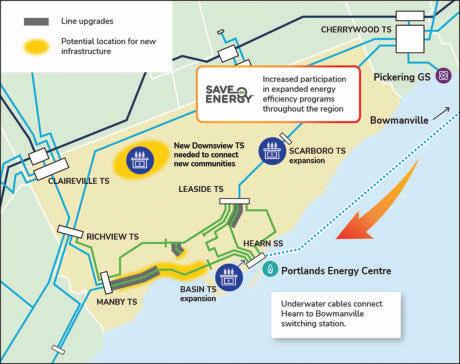
Ontario is advancing a first-of-its-kind high-voltage underwater transmission line that will connect the Darlington Nuclear Generating Station area to downtown and eastern Toronto via Lake Ontario, significantly increasing capacity and resilience for the province’s largest load centre.
The Toronto Third Line Underwater Transmission Project stems from the IESO’s regional planning work, which concluded that existing corridors into Toronto cannot accommodate forecast growth in housing, transit, and commercial development. Without new supply paths, the city would face constraints on major investments and electrification, undermining economic competitiveness and climate goals. The line is designed to bring up to 900 MW
of additional clean power from the Darlington hub, where Ontario is investing heavily in refurbished reactors and future small modular reactors. This provides both firm capacity and operational flexibility while keeping system emissions relatively low.
Conceptually, the project consists of a high-voltage cable system installed on or beneath the bed of Lake Ontario between the Darlington area and landing points serving downtown and eastern Toronto. Using an underwater route avoids the land-use conflicts and visual impacts of new overhead lines in a dense urban region. The cable will be engineered to withstand long-term immersion, lakebed conditions, and seasonal lake dynamics, drawing on experience from other Canadian submarine links in Atlantic Canada. Once in service, the line will diversify bulk supply paths into Toronto and reduce reliance on a limited set of existing overhead corridors that are more exposed to storm-related risks.
Ontario has directed the IESO to use a competitive transmission procurement to select the proponent responsible for design, financing, construction, and operation of the asset under regulated arrangements. This is Ontario’s first large transmission project to follow such a competitive route
and is expected to attract specialized underwater cable and major-project expertise. Environmental approvals will focus on lakebed disturbance, aquatic habitat, shoreline interfaces, and coordination with existing infrastructure, with Indigenous and municipal engagement forming a key part of the process. Overall, development, construction, and commissioning are expected to span roughly 7–10 years, targeting an in-service date in the mid-2030s to align with Toronto’s rapid load growth and housing objectives. ■
Photo Sources:
https://www.ebmag.com/ontarios-first-underwa ter-transmission-line-coming-to-toronto/ https://www.insidehalton.com/news/ontario-unde rwater-transmission-line/article_bb277d11-fc8e-5 81d-9fce-eb8a81e36b33.html
Article Sources:
1. Ontario government news release https://news.ontario.ca/en/ release/1006901/ontario-focused-oneconomy-by-approving-new-torontotransmission-line
2. CBC News Toronto
https://www.cbc.ca/news/canada/toronto/ toronto-power-expansion-project-9.7036808
3. Water Canada
https://www.watercanada.net/ontarioapproves-1-5-billion-underwatertransmission-line/
4. Renew Canada
https://www.renewcanada.net/provinceapproves-building-of-new-underwatertoronto-transmission-line/
5. CityNews Toronto
https://toronto.citynews.ca/2026/01/07/fordgovernment-to-build-underwater-electricityline-to-power-toronto-for-2-decades/
6. Link2Build
https://www.link2build.ca/news/ articles/2026/january/province-approvesplan-to-build-underwater-electricitytransmission-line/
7. Ontario Environmental Registry https://ero.ontario.ca/notice/026-0019

Shane McKernan is the Director of Preconstruction for Axiom Builders, based out of Vancouver, BC. With over seventeen years of experience, Shane’s a seasoned construction professional specializing in cost consulting & project management. Shane was the Past President of the CIQS — BC Chapter, where he served for 10 years and is a current Assistant to the Construction Economist editor.
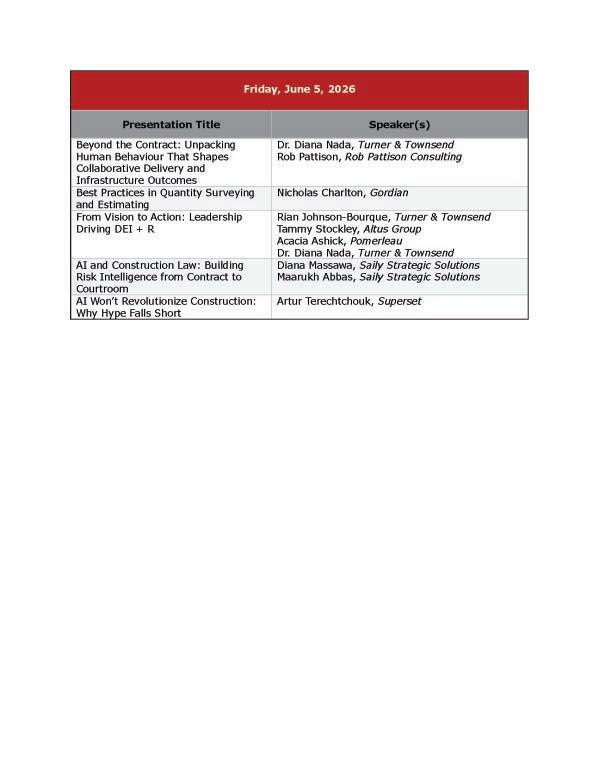
The CIQS is getting ready to host Congress in Charlottetown, Prince Edward Island from June 4-6. Join us at the Delta Prince Edward where industry professionals will share their knowledge on topics such construction law, artificial intelligence, leadership, and construction contracts, to name a few.
Charlottetown, the birthplace of Confederation, is hailed as a foodie haven, a cultural capital, and a favourite coastal hangout. With the

from March 4, 2026 to May 4, 2026.
from March 4, 2026 to May 4, 2026.
Lobster season happens twice a year. The Spring season from May-June and the Fall season from mid-August to mid-October.
No matter where you are, the nearest beach is a maximum of 15 minutes by car.
Learn more about the Congress Program, speakers, registration fees, host city, sponsorship opportunities, and accommodations at www.ciqs.org/congress Regular Pricing in Effect until March 3, 2026
Don’t forget! Last day to register and book your accommodations is May 8, 2026. Contact Kelsey at congress@ciqs.org if you have any questions.
from March 4, 2026 to May 4, 2026.
from March 4, 2026 to May 4, 2026.


By Lydia Houck, Senior Advisor, First Lake Solutions
Canada is navigating an unpredictable global landscape. Trade volatility, supply chain disruption, and shifting geopolitical dynamics are forcing governments to rethink how they plan, fund, and deliver programs. In particular, infrastructure is being positioned as a tool to increase domestic economic capacity, competitiveness, and long-term stability in Canada. This moment is significant. As governments expand the scale and scope of public investment, disciplined,
evidence-based cost and feasibility insights are more important than ever.
Initiatives like the Buy Canadian procurement program, the National Infrastructure Assessment and trade-enabling infrastructure investments point to a deliberate, nationally coordinated approach to growth. They also signal rising expectations for what public infrastructure must deliver, not just in terms of outcomes, but also credibility, value for money, and execution. The challenge is whether these
ambitions can be delivered at speed and scale in a market that is constrained by labour availability, price volatility, and procurement risk.
Policies to accelerate housing supply, strengthen domestic sourcing, and expand trade infrastructure carry cost and risk implications that must be addressed early and monitored regularly. Choices around project scope, procurement, and timing are directly shaped by market conditions.
This is where CIQS members’ expertise matters most. Use of cost intelligence before budgets are finalized, procurement paths are set, and public expectations established, is essential. The public requires clearer articulation of trade-offs, so feasibility remains aligned with policy goals.
• National initiatives like Build Canada Homes, Build Communities Strong, and the Major Projects Office will require governments to think beyond individual projects toward program-level sequencing, prioritization, and trade-off management.
• The National Infrastructure Assessment will achieve its intended impact only if its findings translate into executable priorities grounded in realistic assumptions about cost, capacity, and market response.
• Buy Canadian initiatives must balance local considerations and value for money to ensure efficient life-cycle planning and project delivery on time and on budget.
PQSs and CECs play a central role in navigating these trade-offs. Closer collaboration between governments and construction economists is essential to ensuring infrastructure investments deliver on their promise.
For governments, this means embedding construction economists into program design, procurement frameworks, and project governance, treating their expertise as a strategic input rather than a downstream check. For CIQS members, this means articulating how realistic costing, benchmarking, and lifecycle thinking enable better decision-making and reduce avoidable risk.
Canada’s infrastructure challenge is no longer about whether to invest; it is about how to deliver on investments in a constrained and volatile system. At this scale and complexity, construction economics is not optional. It is essential to ensuring public infrastructure dollars deliver lasting value for Canadians.
The CIQS is advancing this momentum to ensure construction economics is at the heart of Canada’s infrastructure agenda. In the coming months, the Institute will submit recommendations, engage with federal officials, and contribute to policy discussions in Ottawa to show how the expertise of its members drives smarter, more resilient infrastructure from coast to coast to coast. ■

Lydia Houck is a Senior Advisor with First Lake Solutions, where she helps clients advance solutions to complex policy challenges through strategic, research-driven advocacy. She hails from Nova Scotia, where she spent several years as the Executive Director of the largest non-profit association by membership in Atlantic Canada. Prior to her current role, she served as a policy advisor to Canada’s Minister of Housing, Infrastructure and Communities. Lydia holds a Master of Political Management from Carleton University.
By Sahil Shoor, Partner, Gowling WLG
Ontario’s prompt payment and adjudication regime is no longer a developing experiment. It is now embedded in day-to-day project administration, with practical consequences for owners, contractors, and subcontractors alike. Two elements of the current framework are proving especially consequential: the treatment of proper invoices and the expanded role of adjudication. Together, they reinforce a system that rewards procedural discipline and early dispute engagement.
The prompt payment regime continues to turn on the concept of a “proper invoice,” but the margin for administrative flexibility has narrowed. Invoice recipients have seven days to deliver written notice identifying deficiencies and specifying what is required to remedy them. If that deadline is missed, the invoice is deemed to be a proper invoice, and statutory payment timelines are triggered.
This is a significant shift in risk. Informal feedback, partial responses, or internal delays no longer protect the recipient’s position. Silence has consequences.
The definition of a proper invoice also now includes information

reasonably required by the owner’s accounts payable system. This balances competing interests. Owners are entitled to insist on information genuinely needed to process payment, but those requirements must be reasonable and consistently applied. Ad hoc or opaque demands are unlikely to withstand scrutiny.
For owners and upper-tier contractors, this places a premium on clear, documented invoice requirements and reliable internal review processes. For contractors and subcontractors, it reinforces the importance of submitting complete, well-structured invoices that anticipate payor system needs. The regime does not favour one side over another, but it does penalise inattention.
Ontario’s adjudication framework has evolved beyond a narrow focus on payment disputes. Parties now have greater flexibility and a wider range of issues that can be addressed on an interim basis.
The ability to appoint private adjudicators, subject to ODACC qualification standards, allows parties to select decision-makers with appropriate technical or commercial expertise. While this can improve efficiency and decision quality, it also requires early agreement on fees and process, which should not be overlooked.
More importantly, the scope of adjudicable issues has expanded.
Adjudicators may now determine matters reasonably necessary to resolve the dispute before them, including disputes over scope of work, changes in contract price, and extensions of time. This reflects a recognition that payment disputes are often symptoms of broader contractual disagreements.
Procedural clarity has also improved. Parties may raise jurisdictional objections where appropriate, and there is a defined window to correct errors or oversights in a determination. Adjudication remains an interim process, but it is a more robust and reliable one.
The timeframe to commence adjudication has also been extended to 90 days following completion or abandonment, aligning more closely with lien timelines and reducing pressure to lien solely as a protective measure.
Continued from page 6
chapter meetings, gain a competitive edge as professionals who actively engage with the association, acquiring knowledge that translates from abstract theory into practical experience.
LE POUVOIR DE…
Suite de la page 7
Bâtir l’effet Réseau
La force de notre association repose sur la qualité et la mobilisation de son réseau. L’ICÉC réunit des professionnels provenant de divers secteurs de la profession, notamment les secteurs institutionnel, industriel, résidentiel, des infrastructures, gouvernemental et universitaire. L’ICÉC couvre des régions géographiques du monde entier, offrant aux membres l’occasion de s’informer sur les conditions du marché, les approches réglementaires et les innovations en matière de pratiques, tant à l’international qu’au Canada.
For owners, the regime demands consistency, timely invoice review, and realistic internal requirements. For contractors and subcontractors, it rewards compliance, documentation, and early use of adjudication where disputes affect cash flow or progress. For all participants, the message is clear: Ontario’s framework prioritises process and early resolution. Those who adapt accordingly will find it predictable. Those who do not may find that delay now carries a price. ■

Sahil Shoor is a partner in Gowling WLG’s Disputes practice, with a focused construction and infrastructure practice that sits at the intersection of disputes and project delivery. He acts as litigation counsel in high-value,
technically complex construction and infrastructure disputes and as project counsel to owners, developers, contractors, and consultants on risk allocation, contract strategy, and claims management throughout the project lifecycle, with a particular emphasis on positioning projects and disputes to succeed across claims, adjudication, arbitration, and enforcement. He maintains a national practice focused on the sectors that underpin Canada’s built environment, including commercial construction, real estate development, infrastructure and civil works, power and energy, and major public-private partnership and transit projects. He helps clients make early, defensible decisions that shape outcomes before disputes crystallize and, when claims do arise, advances and defends them through the full range of project dispute resolution mechanisms.
The Collaborative Imperative
As the voice for Canada’s construction economists, we affirm that our collective strength emerges from individual contribution. The power of our network is the power we build
together, one shared insight, one collaborative project, one professional relationship at a time. In an industry defined by change, this collaborative foundation may be our most sustainable competitive advantage. ■
La mise en place de réseaux efficaces nécessite un engagement non seulement de la part des individus, mais aussi des employeurs, qui doivent considérer la participation à l’association comme une infrastructure professionnelle essentielle plutôt que comme une activité périphérique. Les entreprises qui accordent à leur personnel du temps pour participer aux comités de l’Institut ou pour assister aux conférences et aux réunions des chapitres acquièrent un avantage concurrentiel, car les professionnels qui s’investissent activement auprès de l’association obtiennent des connaissances qui se traduisent
concrètement, passant de la théorie à la pratique.
L’impératif de la Collaboration
En tant que porte-parole des économistes en construction du Canada, nous affirmons que notre force collective découle de la contribution individuelle. La valeur de notre réseau est celle que nous bâtissons ensemble, à travers chaque partage de connaissances, chaque projet collaboratif et chaque relation professionnelle. Dans un secteur défini par le changement, cette base collaborative pourrait bien constituer notre avantage concurrentiel le plus durable. ■
By Sharib Maradukhel, PQS, MRICS, CET
Launching a small ISP (Internet Service Provider) requires a meticulous balance of engineering and customer-centric operations. Our analysis focuses on three core components that form the backbone of a successful deployment: designing a resilient network infrastructure, choosing the right hardware products, and establishing reliable network services with unwavering technical support.
1. Drawing the Blueprint: Your Network’s Foundation
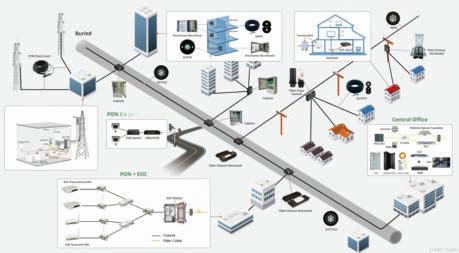
Think of your network infrastructure as the roadmap for your entire operation. A well-designed plan from the start determines your coverage, service quality, and how easily you can expand in the future. It all boils down to two main parts: the high-speed highways (the backbone) and the local streets that connect to homes (the access network).
The High-Speed Highways: Your Backbone Network
This is the core pipeline that carries massive amounts of data and connects your users to the global internet. For a small ISP, you have a couple of smart options:
• Fiber Optic Backbone: The gold standard. It uses light to transmit data, offering incredible speed and reliability. It’s perfect for dense urban or business areas. A great tip for small ISPs is to lease existing “dark fiber” from larger providers instead of laying your own cable — a huge cost saver.
• Wireless Backbone: Ideal for rugged terrain or areas where digging is too expensive. Technologies like microwave or satellite links can be set up faster and for less money upfront, though they generally can’t match fiber’s ultimate speed and capacity.
This is the final leg of the journey, getting the internet from your backbone to the user’s door. The choice here often depends on the geography and your budget.
• FTTH (Fiber to the Home): The dream for speed lovers. You run a fiber optic cable directly to each home or office, delivering top-tier performance and reliability. It’s a bigger initial investment but is unbeatable for satisfying heavy-demand areas.
• FTTB (Fiber to the Building) + Ethernet: A very practical compromise for apartments and office buildings. You run fiber to the building’s basement or communications room and then use Ethernet cables to connect individual units. It’s more cost-effective than FTTH while still offering great speeds.
• Wireless Access (4G/5G, Wi-Fi): Your best friend in rural or hard-to-wire locations. By setting up base stations, you can cover a wide area without trenching cables. Fixed Wireless Access (FWA) is a popular and affordable way to get started.
(POPs)
A POP is a local connection point that bridges your backbone and your customers. Strategically placing these in central locations or local data centers is key. The goal is to keep the path from your user to the internet as short as possible for a snappy experience. It’s also wise to build in redundancy here, so if one POP has an issue, traffic can be rerouted to keep everyone online.

To give your customers the full internet, you need to connect to larger networks. This means establishing relationships with big telecom providers or connecting to Internet Exchange Points (IXPs). Most small ISPs start by leasing bandwidth through these larger gateways to get their customers connected globally.
Building a reliable network is like building a house — you need a strong foundation and quality materials. The hardware you choose directly impacts your network’s stability and speed.
These are the heavy lifters at the heart of your network.
• Core Routers: The network’s central brain. They direct massive data streams between your backbone and local access points. Look for a robust, high-performance router that won’t buckle under pressure.
• Edge Routers & Switches: The crucial links to your customers. Edge routers need to be versatile and fast to avoid bottlenecks, while switches act like neighborhood traffic directors, efficiently sending data to the right local user.
The Information Superhighway:
Fiber Optic Gear For FTTH, you’ll need specialized equipment.
• OLT (Optical Line Terminal): The command center for your fiber network, located in your central office. It takes in high-speed data and distributes it to all your users.
• ONU/ONT (Optical Network Unit/ Terminal): The small box at the customer’s home. It translates the light signals from the fiber into a standard internet connection for their router.
• Fiber Jumpers & Modules: The essential cables and connectors. Don’t cut corners here — high-quality components minimize signal loss and ensure a stable connection.
For wireless services, you’ll need:
• Wireless Base Stations: These are the towers or small cells that broadcast the signal to your subscribers.
• Wireless CPE: The antenna unit the customer gets. It locks onto your signal and provides an Ethernet connection for their home network.
This is what your customers interact with daily.
• For Home Users: A modern Wi-Fi router or gateway is key. To ensure they get the speeds you’re providing, offer devices that support the latest standards like Wi-Fi 6.
• For Businesses: They need pro-grade gear. Look for routers that can handle multiple internet lines for backup, include built-in VPNs, and offer advanced security features.
3. Network Services and Technical Support
Running an Internet Service Provider (ISP) successfully depends not only on infrastructure and network design but also on reliable support systems and well-structured services. These ensure network stability, quick issue resolution, and a better experience for end users.
ISPs are responsible for distributing IP addresses. To do this, they typically apply for an Autonomous System Number (ASN) and request IPv4 and IPv6 address blocks from regional internet registries such as APNIC. Tools like IP Address Management (IPAM) systems are commonly used to automate address assignment, maintain records, and simplify overall address tracking.
To maintain network health, ISPs deploy monitoring platforms such as Zabbix, Nagios, or SolarWinds. These tools allow administrators to track device status and data flows in real time. Protocols like SNMP are useful for identifying potential failures early and addressing them before they escalate.
For deeper insight, technologies like NetFlow provide traffic analysis, helping ISPs pinpoint high-demand applications, detect bottlenecks, and optimize routing to improve efficiency. Smaller providers can especially benefit from this data to fine-tune performance.
chat, and on-site assistance, so that customers can resolve connectivity problems quickly and conveniently.
Effective fault-handling strategies involve creating rapid-response procedures and backup solutions to minimize downtime during equipment or service failures. Keeping spare hardware and maintaining contingency plans ensures services are restored swiftly in case of unexpected outages.
The above content provides a preliminary discussion on the three key areas of building a small ISP network: network infrastructure design, equipment and hardware products, and network services and technical support. ■

Round-the-clock customer service is critical for user satisfaction. ISPs usually provide multiple support channels, including phone, email, live
With over 18 years of experience and a solid background in Electrical Engineering (BEng, MSc), Sharib Maradukhel is an Associate Director at Altus, specializing in cost planning and management for various sectors, including institutional, data centers, and large transit projects. Certified (MRICS, PQS, GSC, CET), Sharib has a proven track record in cost control, project delivery, and change management throughout the project lifecycle, focusing on value-driven solutions and project success from concept to completion.
By Alex Valova, BA (Hon.), LLB, LLM

Construction management contracts have increased in popularity in Canada, particularly on more complex projects. They are based on the principles that underpin the Construction Manager at Risk project delivery method, which is meant to allow for more efficient, cost effective and collaborative approach between owners and contractors.
Although parties are free to create their own construction management contracts to suit their needs, a commonly used form of this type of
contract comes from the Canadian Construction Documents Committee based in Ottawa. The CCDC-5B Construction Management Contract for Services and Construction has been around for over a decade and was updated in 2025. While the changes range from payment obligations, safety and expanded limitation of liability provisions, there are noteworthy changes with respect to pre-construction and construction services, schedules and owner’s rights to terminate the agreement.
Arguably one of the cornerstones of construction management contracts is the involvement of the construction manager from the design phase. This is particularly important when an owner has a design idea in mind but is looking to the expertise of the construction manager to develop that idea into a tenable and constructible design. The appeal is obvious for the construction manager to be involved in the design phase. However, this intended collaborative approach
services include various items such as changes, tracking project risks, schedules and dealing with cost controls.
GC 7.1.8 is a new section which allows an owner to terminate the agreement if the owner is unable
working in-house for a large Toronto based construction company. Alex has also worked on the owner side on a new major transit project in Toronto.
By Ayo Daniel Abiola, P.Eng, PQS, CDP
It’s been noted that buildings can only meaningfully decarbonize if the grid supplying their energy is clean. In practice however, the emissions benefit of electrification of buildings is correlated with its grid emissions intensity, and Canada’s electricity mix is uneven across provinces. Nationally, Canada’s electricity is already comparatively low- emitting, with ~80% non- GHG emitting generation.
For capital planning, the key implication is that owners should avoid binary decisions (“electrify now” vs. “wait”) and instead adopt a pathway that is robust under multiple scenarios — accounting for equipment end- of-life timing, regulatory milestones, grid constraints, and expected grid decarbonization. Federal policy direction is explicit: the Clean Electricity Regulations (finalized December 2024) limit electricity-sector emissions with an intensity standard of 65 t/GWh beginning in 2035 and reaching net-zero by 2050, supporting a transition consistent with Canada’s economy-wide net-zero target1.
Building policies are shifting from voluntary programs to mandatory reporting and performance limits. Vancouver’s program establishes clear compliance timing: reporting is phased in for existing large commercial
buildings, and from 2026, certain large office and retail buildings must meet GHG intensity limits. Toronto has implemented mandatory reporting through a by-law effective January 1, 2024, with buildings ≥4,645 m² reporting since July 2024 and buildings ≥929 m² required to report from July 2025. The city is developing Building Emissions Performance Standards, with a proposed by-law expected to be presented to Council in 2027.
At the national level, the National Energy Code of Canada for Buildings (NECB) 2025 introduces energy efficiency requirements for alterations to existing buildings and expands its environmental objective to address greenhouse gas emissions, providing a harmonized framework jurisdictions may adopt and enforce. For QSs, these signals increase the value of early baseline assessment and compliance -aligned capital planning — particularly before major renewal scopes trigger additional requirements. Building elements like MEP systems and envelope are long-life assets. “Like -for-like” fossil replacements at end- of-life can lock in operational emissions and increase exposure to future policy tightening and retrofit disruption. Electrification — or electrification-ready design — can improve optionality: as grids decarbonize, operational emissions may decline over time without another major replacement event. From
a QS perspective, this should be evaluated through lifecycle cost, risk, and sequencing, not simple payback. Where immediate electrification is constrained (capacity, service upgrades, timing), design strategies that reduce future change costs (space allocation, electrical provisions, distribution planning) can help avoid stranded capital1
Deep energy efficiency measures (envelope, airtightness, windows, lighting, controls, commissioning) reduce energy demand regardless of the carbon intensity of supplied electricity. For QS-led cost planning, the additional value is that load reduction can decrease future equipment sizing and associated electrical upgrades, improving feasibility and reducing installed cost. Efficiency-first sequencing can also reduce heat pump capacity and improve performance, lowering total project risk.
Market participants increasingly treat emissions performance as part of transition risk (financing, leasing, due diligence). A widely used framework is CRREM (Carbon Risk Real Estate Monitor), which provides science -based decarbonization pathways and can identify when a building’s emissions intensity exceeds a pathway — often described as “stranding” risk.
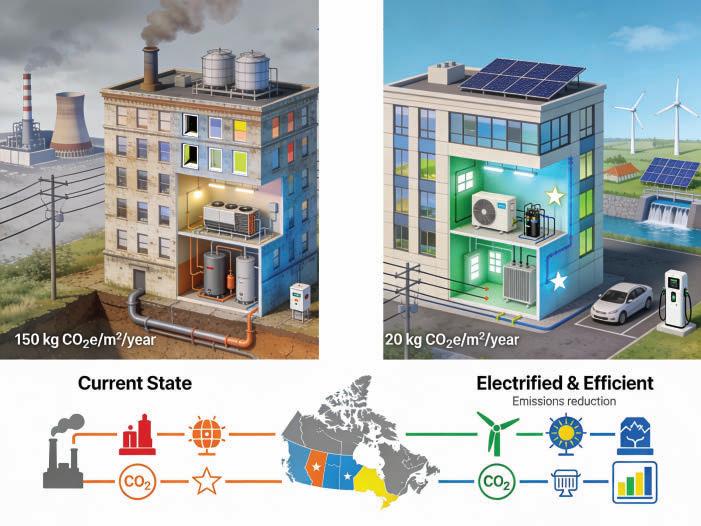
While reported “green premia” and “brown discounts” vary by asset class, geography, and methodology, evidence syntheses consistently identify statistically significant relationships between sustainability attributes and outcomes such as rents, values, and leasing performance — though the ranges are not uniform and should not be assumed without market-specific data. For QSs and clients, the practical takeaway is to treat decarbonization as both an operating cost issue and a liquidity/refinancing risk issue, especially for institutional portfolios and assets exposed to tightening disclosure requirements.
Earlier action does not mean immediate comprehensive retrofit in all cases. A phased approach is often the
most prudent pathway when grounded in constraints and intervention points:
• Grid or connection constraints: Some projects face service upgrade limitations, capacity restrictions, or multi-year utility lead times. In these circumstances, proceeding with envelope and “no -regret” efficiency while sequencing electrification to feasible interconnection timelines reduces risk and preserves momentum. Federal policy emphasizes maintaining reliability while transitioning the sector, reinforcing the practical need for staged implementation1.
• Planned capital works: Where a building has redevelopment, major renewal, or program upgrades within 2–5 years, bundling decarbonization within that scope can reduce mobilization costs and avoid rework.
• Capital constraints: Where upfront funding is limited, define a pathway that starts with operational optimization and targeted efficiency, then aligns major mechanical interventions to end-of-life replacement. The key distinction is between sequenced implementation with defined milestones and indefinite delay with unbounded compliance and value risk.
A practical approach should be repeatable and compatible with cost planning and procurement: Step 1 — Establish the baseline: Quantify current energy use and emissions; document envelope condition; assess mechanical remaining useful life; identify near-term capital obligations; and compile available benchmarking/reporting data.
Step 2 — Identify no-regret measures: Prioritize measures with benefits across scenarios: recommissioning, controls optimization, targeted envelope improvements, heat recovery opportunities, and demand reduction strategies that reduce required system sizes.
Step 3 — Model scenarios (cost + carbon + compliance): Develop options such as:
(a) efficiency-first with electrification at end- of-life.
(b) partial electrification/hybrid interim strategies.
(c) electrification-ready design pending capacity upgrades. Tie each scenario to regulatory milestones (reporting and performance limits where applicable) and expected grid decarbonization pathways.
Step 4 — Integrate lifecycle cost with transition and compliance risk: Evaluate CAPEX, OPEX, renewal timing, and potential compliance/penalty exposure. Where relevant, incorporate transition risk benchmarking using recognized tools (e.g., CRREM pathways), especially for assets subject to institutional due diligence.
Step 5 — Build a sequenced capital plan: Align interventions to equipment end- of-life, planned alterations, utility timelines, and procurement capacity.
Use the plan to avoid stranded cost (e.g., replacing a system likely to be superseded within a short interval) and to support financing, approvals, and tender strategy.
Grid carbon intensity affects near-term emissions outcomes, but it does not negate the value of action. Canada’s electricity is already predominantly non- GHG emitting nationally, and federal regulations are designed to reduce electricity-sector emissions further on a pathway to net-zero by 2050. Concurrently, municipalities are establishing reporting and performance milestones, and national codes are strengthening requirements affecting alterations to existing buildings.
For most owners, the lowest-risk approach is a sequenced pathway: implement no -regret efficiency measures now, coordinate major mechanical electrification with end- of-life cycles and feasible electrical upgrades, and use integrated carbon- cost analysis to align capital planning with compliance timelines and long-term asset value protection.
“This article provides general guidance only and does not constitute legal, financial or engineering advice.”
Hirsch, Jens, Maximilian Spanner, and Sven Bienert. “The carbon risk real estate monitor — Developing a framework for science-based decarbonizing and reducing stranding risks within the commercial real estate sector.” Journal of Sustainable Real Estate 11.1 (2019): 174-190. ■

Ayo Daniel Abiola, P.Eng, PQS is the manager of Hanscomb’s Saskatchewan office and is a seasoned Mechanical Quantity Surveyor. Combining his expertise as both a Professional Engineer and a Quantity Surveyor, Ayo effectively balances cost, sustainability, and performance in new construction and renovation projects across Canada. Ayo is an ASHRAE Certified Decarbonization Professional (CDP) and a recognized expert in sustainable infrastructure. He has trained over 350 public and private sector professionals in system analysis methods for sustainability planning. He is licensed to practice engineering in Ontario and Saskatchewan and is deeply committed to environmentally responsible and cost-effective building solutions. Ayo lives in Regina, Saskatchewan.

Congratulations to the Following Designation Holders who have Qualified as a PQS or CEC:
CIQS – British Columbia
Adebola Matthew Adeyera, PQS
Erica Gravidez, CEC
Jordan Robert Dawson, CEC
Matthew Jonathan Szczesny, CEC
Michael Kristian Bernier, CEC
Mike Jackson, PQS
Sohee Lee, CEC
Terrence Halliday, PQS
CIQS – Maritimes
Ahmed Eid, PQS
Kiniovo Michael Orode, PQS
Qi Liu, CEC
CIQS – Members at Large
Swetha Madhuri Vinjamuri, CEC
Zaheer Mohamed Kalam, PQS
CIQS – Ontario
Akalya Pragash, CEC
Carol Natalia Aponte Velandia, CEC
Chi Chung Wong, CEC
Chi Ho Tsang, CEC
Damilola Illerioluwa Akintunde, PQS
Damon Liu, PQS
Hammed Adedamola Bello, PQS
Harini Darshika Samaraweera, CEC
Jayaweera Arachchige Tilani Malsha Perera, PQS
Manu Sinha, PQS
Mohammad Lotfi Moghaddam, CEC
Mohammadreza Abedini, CEC
Nandar Maung Maung, CEC
Nikhil Francis, CEC
Petro Karanzha, CEC
Sagar Maka, CEC
Shahriar Baybordi, CEC
PROPOSITION DE VALEUR…
Suite de la page 5
• Prestation de conseils sur les critères d’évaluation des marchés publics afin de maximiser la valeur et d’encourager les propositions complémentaires ;
• Prestation de prévisions de coûts et d’analyses comparatives précises ;
• Gestion des coûts du cycle de vie ;
• Identification et atténuation des risques ;
• Mise en place de budgets réalistes et la faisabilité financière lors de la planification des projets.
Les gouvernements sont de plus en plus contraints de mettre en place des infrastructures publiques rentables et durables qui sont livrées dans les délais.
Profitez de cette occasion de vous impliquer en tant qu’ambassadeur de l’ICÉC. Ce rôle offre un développement professionnel significatif, des réseaux élargis et la possibilité de soutenir activement notre profession et de la faire progresser. ■
Tomas Joaquin Robiou Genao, CEC
Zain Ghaffur, PQS
CIQS – Prairies and NWT
Amrinder Singh, CEC
Brian Wilkins, CEC
Chi Man So, CEC
Derek Dent, CEC
Iyad Al Hasan, CEC
Nathan Randall Bartley, CEC
Sharon Lisseth Gelvez, CEC
Udara Dilranga De Silva Agampodi, CEC
CIQS – Québec
Mouad Chraibi, CEC
Nathalie Raad, PQS
Olesksandr Pokolodniy, CEC
Tammy Stockley, ÉCA(F), MRICS, CSO, AET
Tammy a débuté sa carrière en économie en construction en 1992 après avoir obtenu son diplôme de technologie des études techniques à St. John’s en Terre-Neuve-et-Labrador. Au cours de sa carrière professionnelle, elle a occupé les rôles de planificatrice des coûts, consultante en coûts, consultante principale en coûts, associée et directrice associée, avant son poste actuel de directrice.