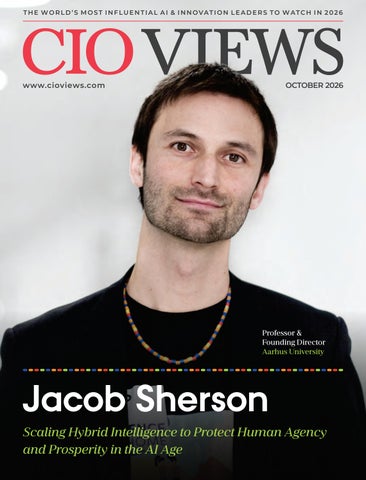
T H E W O R L D ’ S M O ST I N F LU E N T I A L A I & I N N OVAT I O N L E A D E R S TO W ATC H I N 2 0 2 6
www.cioviews.com
OCTOBER 2026
FROM THE EDITOR
Where Intelligence Meets Influence
T
he future is more and more influenced by leaders who perceive opportunity rather than disruption. Today's world sees how a new generation of innovators uses artificial intelligence and innovative technologies to transform the way companies operate and evolve. While such leaders are not limited to the development of innovative solutions alone, they also help to rethink the way productivity, creativity, and potential of a person should be perceived. What makes these leaders unique is their ability to combine their ambitious goals with the strategic vision that allows for achieving significant results through innovation. In a constantly changing digital environment, such leaders help organizations to close the gap between possible and actual transformation that they undergo. The decisions made by these innovators today will shape the industries, economies, and societies of the future. Whether it is the creation of a new business model or acceleration of the process of solving complex problems at scale, the contributions of these leaders transform the competitive landscape. Moreover, these innovators inspire the culture of innovation that challenges all existing limits. In the rapidly changing world, these are the leaders who set the tone of the future. At CIO Views, we honor these empowering leaders by dedicating this issue titled “The World's Most Influential AI & Innovation Leaders to Watch in 2026” to them. Featuring as the cover story, we have covered the successful & motivating journey of Jacob Sherson, Professor MSO, Founding Director of Aarhus University. We have also included the inspiring stories of Martin Reniere, CEO and Founder of Nuvoola AI; Kathy Leake, CEO of Crux Intelligence; Peter Malcom King, CEO of GLS Group; and D r . Blessing Mudavanhu, CEO of CBZ Holdings. CIO Views is a business magazine that mainly focuses on business leaders, their journey, views on current economic states, and all other relevant subjects that refer to the business world. Our goal is to be a leading source of information dedicated to providing our readers with detailed perspectives and views of successful business leaders who are transforming the business outlook and redefining their goals. With exclusive editions on various industries like software, education, healthcare, technology, real estate, and many more, CIO Views is driven to promote excellence in the world of business. Happy Reading! Mousmi
Mousmi N.
EDITORIAL QUERIES editor@cioviews.com
COMMENTS Send comments and suggestions to info@cioviews.com
JOIN THE COMMUNITY
/cioviews
“THE VOICE OF MODERN BUSINESS LEADERSHIP.”
P H O T O C O PY P O L I C Y No written permission is necessary to make up to 25 photocopies of one CIO Views article as long as they are for local organizational use only. At the end of each article or item, add the words: Originally published in (volume/year) issue of CIO Views, copyright 2026 CIO Views. Reprinted/Used with permission. If you would like to reproduce more than what’s described above or if your copies aren’t for local organization use, send your request to info@cioviews.com.
LEADERSHIP. INNOVATION. LEGACY.
COVER STORY
10.
Jacob Sherson
CONTENTS
22.
Martin Reniere
28.
Kathy Leake
34.
Peter Malcom King
40.
Dr. Blessing Mudavanhu
C OV E R S T O RY
Nothing guarantees that the jobs AI removes will be replaced. New ones appear only if human skills evolve at close to the speed of the technology, and almost no company, school or government is organized for that. Jacob Sherson, Founding Director of Center for Hybrid Intelligence (https://hi-infinity.ai/), Aarhus University, argues that hybrid intelligence - prioritizing human expertise alongside AI rather than automating it away - is the only operational alternative that balances competitiveness with future desirability. He urges leaders to choose their future before choosing their technology, to move at the speed of the transition rather than the planning cycle, and to build psychologically safe co-creation. Educational institutions, he argues, must radically rethink their role in this shift.
10 | OCTOBER 2026
CIO VIEWS | 11
C OV E R S T O RY
From Curiosity to Impact, Asking a Bigger Why Jacob's personal journey is about realizing what needs to be done and when. His curiosity spans physics, human minds, and society. “I'm especially interested in the mechanisms we're seeing play out now, as AI is introduced into large-scale economic systems, and how those forces can lead us to either a much better world or a much worse one,” he says. He defines success as a journey - making a dent, creating real impact along a pathway toward truly changing things for the better. Jacob has gradually pieced together what it would take for humanity to become hybrid intelligent, always stepping back to ask bigger “why” questions about what underlies technology development and societal impact. “Working in AI design, creativity and psychology, and organisational design and macroeconomics has given me pieces of the puzzle to answering some of the bigger questions for humanity,” he reflects.
Rethinking Expertise in the Age of AI To understand hybrid intelligence, Jacob says one must first know what it is not. A society betting entirely on AI agents taking over workflows eliminates expertise. The more work an agent does independently, the harder it becomes for professionals to review or correct its output. Hybrid intelligence takes a different approach. “What are the invariants, the foundations of a good society?” Jacob asks, noting that the root of a good society is that humans remain economically valuable through work. “We don't believe that a future of universal basic income, where technology has taken over all work, is a good outcome for humanity. This is not only an ethical argument, but a strategic choice to strengthen human expertise and the collective agency of Humanity. We strive for our hybrid intelligence approach to outcompete AI-first organizations that rely on commoditized algorithms, offering no lasting advantage.”
Jacob explains that hybrid organizations have a deeper edge in competitiveness, revenue, employee happiness, and innovation. What's difficult to replicate is building psychological safety where employees reveal vulnerabilities and potential and operationalizing that expertise as a foundation for better human-AI interactions. It is commonly stated that in an AI-saturated economy, Human Touch will become a scarce and thereby valuable resource. Hybrid Intelligence is constructed to ensure that it becomes substantial and not just a fringe niche, 1% of the economy.
12 | OCTOBER 2026
The Speed of Change Is Deceiving Us All Having trained thousands of business leaders and spoken with politicians, Jacob laments their lack of vision for what their company or society should look like five years from now. “They fail to recognize how fast this transformation is happening. Even the most radical reports, predicting twenty percent unemployment, are understated,” he cautions. “When change comes fast, society won't have time to co-evolve. We urgently need to do something radically different.” Jacob warns that an exponentially learning, recursively selfimproving technology will accelerate the pace of transformation, with no guarantee of new jobs. “Those jobs can only exist if we evolve our skills at nearly the same speed as AI,” he argues, advocating for urgency and a mission-oriented mindset as market forces accelerate toward an agentic automation-first mindset that offers no long-term positive outcomes for employees, organizations, or nations.
CIO VIEWS | 13
C OV E R S T O RY
Protecting Human Value in a Zero-Cost World Jacob champions human-centered AI with both high automation and high human control. Hybrid intelligence harnesses the best of both worlds; the hybrid intelligence manifesto (https://hi-infinity.ai/) affirms it's more than a technical exercise. It involves hundreds of researchers and practitioners from diverse fields such as computer science, creativity, psychology, organizational design, and macroeconomics to construct a holistic solution to the development of hybrid intelligent technical systems, organisational models and marketplaces. “Creating deeply rooted human-AI interactions requires organizational psychological safety, so experts feel safe revealing insecurities, tricks, and tacit knowledge. However, much AI-research underappreciates how deeply this challenge is rooted in social sciences and management,” he observes.
Jacob is reframing hybrid intelligence from interface to impact, driven by co-creation across employees, leaders, and customers. “We are building an HI market place where it's best for everyone if that marketplace evolves.” Roughly fifty percent of the global economy is spent on things you could buy cheaper elsewhere. AI may lead to an abundant, zero-cost society, but in that race to the bottom - the “Ryanair economy” - price competition leaves no room for human distinction. Jacob argues for market signaling where people buy for intangibles like relationships, innovation, and trust. “That marketplace has potential, but needs to be curated, protected, and grown. Otherwise, it may collapse into a Netflix-style model where production cost nears zero, and that dynamic plays out in every business,” he cautions.
Jacob's biggest challenge lies in the interconnectedness of his vision. Hybrid intelligence has to work at four levels at once, and each fails alone: interfaces where the expert learns more than the system does; organizations safe enough that experts share their tacit knowledge; markets that pay for visible judgment; and education that keeps the expertise pipeline full. Making all four move simultaneously, at a global scale and pace, is a coordination problem before it is a technical one.
trust with the remaining employees. AI-first businesses compete on price, hybrid intelligence builds competitive advantage through differentiation and allows leaders to see market entrants as co-creators of a shared reputation for quality. Compared to a cost leader, other companies can build a narrative of enhanced value together - like Rolex and Omega jointly sustaining the idea that a watch is worth more than the accurate timekeeping now available for almost nothing.
It is also why, as a social entrepreneur, his hardest task is explaining hybrid intelligence in fifteen seconds. "A singlelevel answer is exactly the failure mode," he says.
Beyond easier differentiation, adopters of hybrid intelligence benefit from cross-sector concept-validation. If it proves superior in marketing or emergency rooms, that trust carries over to other fields. “This is social entrepreneurship: scaling that approach so everyone benefits,” Jacob emphasizes.
While AI makes workflows more efficient, competitiveness erodes when everyone does the same, and firing staff destroys
14 | OCTOBER 2026
For executives lured by the commercial gains of becoming AI-first, Jacob highlights the following scenario. “An AI-first company cuts costs by thirty percent and sees margins rise. Six months later, everyone else does the same. Prices drop, and they're back to square one, earning no more but facing fiercer competition. That's the subtlety of the AI-first model,” he explains. Citing Klarna, which cut around 700 support roles and froze hiring after going AI-first, then brought human agents back when service quality fell, Jacob warns that cutting costs can sacrifice innovation. “When employees no longer see you as a leader who has their well-being in mind, every attempt to capitalize on human strengths becomes much harder.” 99% of the companies he works with are not cost leaders but have other reasons customers prefer them. “If you want to play-to-win, craft a strategy that amplifies those strengths and builds on differentiations, rather than stripping them away and betting on being the first mover in an AI-first business,” he advises.
As AI-first companies become more automatable, they become less distinguishable and more vulnerable to being outcompeted by tech giants. “It's brittle logic to bet on AI agents and data as your main differentiator, because not many can be the biggest,” Jacob cautions. “The biggest risk is being swallowed by the tech giants that own the models that made your company successful. No matter how big you are, the tech giants are always bigger, and at some point they will want to verticalize: own their value chain - and that's you!”
CIO VIEWS | 15
Bridging Disciplines, Inspiring Real-World Change After an unconventional journey through physics, creativity research, cognitive science, innovation, and management, Jacob chose to try to combine these skills and insights as a societal entrepreneur. He counts among his biggest achievements the ability to surprise, scare, and inspire executives of major companies to pursue strategies that run counter to mainstream consultancy advice. “They put their trust in me, seeing the reason and the richness of our analysis and arguments. That's something I'm truly proud of.” Jacob engages with the world, not from an ivory tower, but with a different mindset, giving 100s of talks and workshops. Through his action research, he doesn't just learn from the
world; he inspires it and uses it as a lab to sharpen his ideas. He gains insights from organizations, but his main goal is to synthesize insights and guide change-makers across the globe. He bridges disciplines to help leaders craft workflows that blend science and design, building psychological safety and enthusiasm in the workplace. He rapidly learns across macroeconomics, HR, and IS through expert dialogue to sharpen a framework for hybrid intelligence. The manifesto project consolidates these insights to pinpoint the challenges that stand in the way of a hybrid intelligent society.
16 | OCTOBER 2026
C OV E R S T O RY
Trust, Strategy, and the AI-First Cliff Jacob links psychological safety to profitability. Empathetic leadership soothes employee concerns about the future, but a strategic case for preserving expertise creates more durable trust. “My company would be foolish to fully automate or throw away all our hard-earned expertise. That's why you should trust that we're not going to adopt an AI-first strategy.” When employees hear business logic, not just emotion, trust becomes more sustainable. He applies the same logic to politics, noting that Europe must stop relying on regulation alone. “We need to formulate a
vision of a competitive future,” he says, pointing to Denmark's wind turbine revolution as a model. “We built wind turbines in the 1970s and made the whole world move toward a green economy. That's exactly the kind of macroinnovation we need to see again, except that this time we need to succeed in two years rather than 40 years!” Jacob's job is to warn the world that it's racing toward an AIfirst cliff. “We're not saying slow down. We're saying speed up and go in another direction. Regulation alone will not save Europe if the rest of the world out-innovates it.”
Preparing Future Generations for an AI-Saturated Economy Jacob's work also focuses on what unions and educational institutions must do. Without change, entry-level hiring will decline because new graduates lack expertise. “AI can replace most textbook knowledge. That's a future generation disaster waiting to happen, but it can be prevented.” Educational institutions must create societal disruptors, faster movers, and innovators of hybrid intelligence. Students should spend their years practicing with state-of-the-art tools,
simulating workflows, and developing innovation mindsets, graduating with experiential knowledge the marketplace needs and rewards. “Where traditional organizations can be slow at adopting technology, learning institutions need to be much faster, bringing their students out ahead of the curve instead of behind it,” Jacob concludes.
CIO VIEWS | 17
One Vision, Many Hats
Defining the Future We Actually Want
For Jacob, balancing his roles as researcher, innovator, and educator comes down to putting them all under one vision. “All the distinct projects I take on and the roles I have are pieces of the same puzzle: a better future for Humanity.” This clarity extends to his family. He recently took his four children to a panel debate. “That was one of my proud moments, seeing them look up at me, realizing that the times I'm busy are for a reason - that I'm inspiring people to make a change.” Jacob's impact is most visible through the leaders he inspires, high-level CEOs who transform multi-milliondollar businesses affecting thousands of employees. “We do that ten times or a hundred times, and then their success in turn inspires another dozen each - that's a huge impact, and we're on track to achieving it.”
Jacob's long-term vision is not about predicting technology, but defining the kind of future we want. “What's a good marketplace? What's a good future?” he asks. “At its core, humans must have the power to decide their own destiny. Only when human expertise remains crucial for value generation do we preserve the link between labor, democracy, and voting rights.” He argues that the future agency of humanity should not lie in the hands of a few tech companies, but with billions of workers who have jobs, vote, and have the power to organize. Universal basic income is not a solution. “If everyone's on UBI, they're living on charity from whoever has the power to give out the money, which would ultimately be the tech companies. That's not a future we want.” Instead, Jacob envisions companies generating their own profits through AI-driven innovation, while educational institutions produce students ready to innovate with a mindset of positive, chaotic disruption.
18 | OCTOBER 2026
C OV E R S T O RY
Embrace the Pace, Build the Vision Jacob's advice to aspiring leaders and researchers: Don't abandon long-term plans or education, but assess realistically which forces will reshape your profession in six to eighteen months, rather than being an ostrich saying we can't predict it, so let's not discuss it.
Once leaders agree on that profitable pathway, they can decide what AI to build and innovations to pursue, ensuring harmony between what's good for employees, organizations, and society. If everyone starts moving in lockstep around that plan, we can together create a good society.
Then get concrete. Map where judgment lives in your workflows before automating anything. Pair every automation with a decision about what the freed-up time is for, taken before it ships. Train experts to decompose problems rather than replacing them with orchestrators. Coconstruct what your profession looks like in a future that is both economically viable and human-centered.
“The question is whether we want that AI-first society where everyone has lost their jobs. For most people, the answer would be no. Hybrid intelligence is the pathway to realize a different vision,” Jacob emphasizes.
Automate With Purpose, Not Fear Hybrid intelligence is often mistaken for being anti-AI or anti-automation, but Jacob clarifies otherwise. A hybrid intelligent organization has become really good at automating, but in a very specific way. Automation is never run as a technology project; it's always a co-creation project with employees. A conversational agent flags what could be automated, and domain experts verify and validate it before pushing the button.
Crucially, every automation is paired with a conversation about how freed-up time will be used, ensuring that the employee has pathways to create more value than before. “Every automation should deterministically push employees higher up the value chain,” Jacob insists. “Before starting, they envision whether the outcome is more desirable and more profitable.”
Conclusion Jacob Sherson's vision is clear: the future belongs not to those who automate the fastest, but to those who elevate human expertise alongside AI. By grounding his work in psychological safety, employee co-creation, and competitiveness through strategic differentiation, he offers a compelling alternative to the race toward full automation. His message is urgent but hopeful - speed up, change direction, and build a future where humans remain indispensable. Hybrid intelligence, as he sees it, is not just a business model; it's a pathway to a better, more equitable society.
CIO VIEWS | 19
Martin Reniere CEO & Founder - Nuvoola AI
On the Path to Automating the Most Mundane Tasks and Increasing Operational Efficiencies
T
he next stage of digital transformation is AI transformation. To stay ahead of the competition, businesses are eager to invest in AI technology. According to Andrew Ng, a globally recognized leader in AI (Artificial Intelligence) (CoFounder of Coursera), AI transformation is a process that might take two to three years, but businesses can begin to benefit from it in as little as six to twelve months.
competitiveness of businesses worldwide.”
Before businesses can begin their AI transformation, they must first undergo digital transformation since, in most cases, the deployment of AI solutions requires the utilization of digital processes and digital data for training.
The CEO of Nuvoola AI
"By helping to speed up decisionmaking, reduce cycle-times, and improve operations, AI is having a significant impact on the efficiency and
Through automation and real-time visibility, Nuvoola's AI-based SaaS solutions enhance operational effectiveness. Martin Reniere, Founder and CEO of Nuvoola AI, states that the company transforms video, voice, and data into actionable intelligence with business solutions tailored to the supply chain, transport, and logistics industries.
Martin's primary duties at Nuvoola include formulating and communicating the company's vision, designing the strategic plan, directing the product roadmap, and developing the team. Martin is a visionary leader who can see the future of Nuvoola and then inspires and drives his team to make that dream a reality. To do this, each team member
22 | OCTOBER 2026
CIO VIEWS | 23
and transform companies, mostly in the supply chain and logistics industry. Martin claims that Nuvoola's expansion of its ability to identify objects in challenging environments and digits in the wild is when the company first gained notoriety in the AI sector. It utilized pre-existing video streams and connected with other data sources to obtain insightful data that would help organizations: 1. Gain real-time visibility 2. Get detailed, accurate, and digitized logs of entries and exits 3. Measure the fluidity of their operations with KPIs 4. Transform their operations must have the authority to implement the strategic plan at the organizational, team, and individual levels.
up with new ideas. This has resulted in a company that is constantly evolving and one that customers can trust to do the right thing for them.
Martin works with a group of senior directors to make sure the business's operations—from finance to sales and marketing to product delivery—perform well overall. He genuinely values innovation and customer happiness, thus he likes the chance to take part in client demos to remain in touch with them and understand their requirements. He says, "Only if we understand our customers' reality and upcoming challenges can we identify the best way to innovate and ensure we have a major impact on their operations."
Inception Story
According to Martin, Nuvoola has always been a company that values innovation, excellence, teamwork, and communication. It's the team that helps nurture a culture of innovation and integrity. He believes that they are strongly encouraged to spend time learning, educating themselves, and brainstorming; this is how they come
The first focus of Nuvoola's expertise when it initially began in 2017, was on business cloud services. Then in 2019, Nuvoola made a significant shift in focus after seeing an opportunity to use AI to quicken enterprises' digital transition. The group decided to make significant investments in R&D, creating AI assets and exclusive intellectual property. Martin states, "We built a powerful AI engine that is industryagnostic and able to learn and execute commands on its own, and we named it LUKE. LUKE is an acronym that stands for Learn, Understand, Know, and Execute. It's at the heart of everything we do." The business's ability to assist organizations in automating many of the more tedious operations has enabled workers to devote more time to strategic goals. The ultimate objective is to improve 24 | OCTOBER 2026
Unlike its rivals, Nuvoola's solutions work in tandem with the current IT infrastructure. It fills in visibility gaps in the supply chain and enhances communication across the various management systems. For instance, AGD Verchères was searching for a creative way to improve operating effectiveness in its yard while maintaining sight of everything that entered and exited the facility. Additionally, they didn't want to undergo a significant operational shift but still needed the technology to assist them with asset management. Prior to automating the shipping container inventory on the site, Nuvoola digitalized their asset inventory and processes. Nuvoola quickly and conveniently collects all the identity details regarding containers, vehicles, and trailers entering and leaving the facility using a high-resolution camera connected to the 5G network and a self-serve kiosk for drivers to check-in. Thanks to this, AGD Verchères was able to see the assets that belonged to their clients
and were kept in their storage area. AGD Verchères was able to improve operational visibility by showing realtime data on a dashboard with the help of Nuvoola's technology. This makes it easier to analyze important performance indicators and allows for more informed decision-making. Coping with Market Challenges One of the biggest challenges Nuvoola faced was the way the world had evolved and was impacted by remote work, people having less inperson interaction, and the resulting labour shortage in all industries. It committed internal resources to developing a safer access system that could automatically screen clients and workers without the need for staff. Martin claims that the group created these self-serve kiosks for senior living facilities, office buildings, public buildings, and other places where a lot of people enter and exit. The creation and implementation of the self-serve kiosks allowed Nuvoola to gain a lot of knowledge. With the expertise obtained, the company developed IGOR, an outdoor selfserve kiosk that automates gate operations for supply chain businesses and port terminals. By focusing on a different market sector with a more pressing need, Nuvoola was able to accelerate its success. The company has seen exponential growth since its inception. Inclusive Offerings All of Nuvoola's products are built on the Learn, Understand, Know, and Execute (LUKE) online cloud platform. It is an AI-based decision engine and a data-driven framework. The LUKE AI framework is broken
down into a central AI hub (the "brain" which continuously learns, orchestrates thought processes and actions) and its key modules (acting like senses and limbs). "Unlike its competitors, Nuvoola's solutions complement existing IT systems. We bridge the gaps in supply chain visibility and improve operations between the different management systems." The LUKE platform connects with current sensors, systems, and devices as well as deep neural networks (DNNs) from third parties that it may use for specific post-analysis. Because LUKE is flexible, more AI capabilities, data analytics, and visualization tools may be added. Different variations of LUKE are being used in the following sectors: Ÿ LUKE AI for Manufacturing and Distribution Centers (MDC) – A yard visibility solution that is based on a distributed computer architecture called EDGE (on premises) computing which CIO VIEWS | 25
processes data at the edge of the network, close to the source of the data. It is thus possible to minimize the bandwidth requirements between sensors and data centers by performing analysis as close as possible to the data sources, with the advantage of reducing latency. Easily integrated with existing camera infrastructure, LUKE AI for MDC uses computer vision to digitize and centralize real-time information such as truck arrivals and departures, trailer and container numbers, as well as purchase orders. Ÿ Automated Gate Operation Solution – IGOR, its interactive self-serve kiosk that is installed at the gate, automates driver and vehicle identification. Using the powerful capabilities of LUKE, drivers can quickly and easily identify themselves without the need for employees to get involved. The kiosks can interact with drivers, telling them where to go once they are identified. This reduces check-in time while
Ÿ providing secure access to the site, all without the need for someone to be present at each gate. Ÿ LUKE AI for Order Management – Developed as a custom solution for JRV Distribution, this product complements the suite of solutions for distribution centers. Users can connect to LUKE AI to place orders. The distribution center receives the order, and their ERP is automatically updated along with the clients' ERP. Orders can be tracked in LUKE from the moment they are received to the moment they reach their destination. Ÿ LUKE AI for Inventory Management – A fully digitized process to track inventory and reorder parts and items that may be running low. An order can be made by simply scanning the code on the box where the item is stored. LUKE AI uses Order Management to place the order. Both ERPs are updated and the client as well as the distributor can follow and track the order. Ÿ Operation Performance Center for Ports – A SaaS solution that is comprised of three distinct sets of advanced analytics related to visibility, fluidity, and resilience. The visibility module integrates multiple sources of data and processes them to provide a complete view of information, such as daily throughput, railcar volume, cargo volume, and more. Real-time performance is then monitored with a fluidity dashboard that provides detailed insights on things like gateway cycle time, outbound time, average time spent by location or commodity, and more.
Finally, the resilience module uses predictive analytics to alert ports about potential disruptions and their impacts on business. This is done thanks to a wide variety of data including A6 and A6A forms from CBSA, and data from the ports operations and Transport Canada. These analyses improve the ability to react to disruptive events and to recover from them without significant impact on operations and customer timelines. Ÿ Rail Shipment Visibility – Using cameras, its rail shipment visibility solution detects and classifies the type of wagon as well as the containers' type and ID number to create a detailed emanifest. Ÿ Transport of Dangerous Goods – This solution recognizes placards of dangerous goods at high and low speeds to provide visibility and compliance information on the trucks transporting dangerous goods. It can provide information such as speed and directions. Leading Competition in Artificial Intelligence Martin and the crew always strive to keep one step ahead of the competition. The team regularly conducts competitive analyses to see what new products the company's rivals are releasing and what new features may be added to their own solutions. Martin also likes talking with both current and future clients to learn more about the difficulties they are experiencing and the changes they would want to see. This enables Nuvoola to develop better solutions and maintain an edge over rivals.
26 | OCTOBER 2026
Coping with the Advanced Landscape of AI The role of AI in the supply chain is quickly developing in order to address the growing number of difficulties the sector is experiencing. AI is becoming a more crucial tool for the optimization of supply chain and logistics operations as more companies use IoT platforms and data-intensive software, allowing them to become more visible, flexible, and predictable. AI is having a huge influence on the productivity and competitiveness of organizations all over the world by assisting in the acceleration of decision-making, the reduction of cycle times, and the improvement of operations. The supply chain and logistics industry may anticipate that AI will play an increasingly bigger role in the years to come. With its ability to optimize operations and improve performance, AI is destined to become a key component of successful businesses worldwide. Nuvoola is contributing to this change by offering solutions that bridge the gaps in visibility and streamline operations. This helps businesses become more efficient by saving time and allowing resources to focus on other priorities. Motivation Behind the Achievements Martin believes that the creation of the first AI-powered self-serve kiosk with a lift mechanism is the greatest recent accomplishment. The kiosk, which is installed at the gate, can determine if an approaching vehicle is a car or a truck and will alter its height appropriately. He continues by saying that the Nuvoola intelligent self-serve kiosk automates vehicle and driver identification. The
CIO VIEWS | 27
Kathy Leake CEO - Crux Intelligence
Leading by Vision to Put AI in the Hands of Every Business User
I
ncreasing the participation of women in crucial technical AI jobs necessitates more than simple recruitment efforts; it also necessitates building an inclusive culture and providing access to and opportunities for development and promotion. Today, enterprises across sectors confront a fundamental impediment to achieving their AI goals: talent. Many firms are stepping up their AI recruiting while attempting to broaden their talent sources due to a lack of critical AI expertise. The need for AI appears to be increasing, with artificial intelligence specialists being the highest-rising occupation in the United States in the next few years. Despite the increasing need for AI, at least one skill pool that may assist corporations in achieving their AI
goals has gone virtually untapped—women. However, according to a 2020 World Economic Forum study, women make up just 26% of data and AI roles in the workforce, while the Stanford Institute for Human-Centered AI's 2021 AI Index Report indicated that women make up only 16% of tenure-track academics concentrating on AI internationally. For a long time, there has been continuous and unchanging gender diversity in AI. Diversity of work experience is essential for a successful AI team, and some interviewees' businesses value qualities and aptitudes above specific skill sets when recruiting for AI employment. This might pave the way for women from a variety of professional backgrounds to enter the field of artificial intelligence.
28 | OCTOBER 2026
CIO VIEWS | 29
advancements. For enterprise, truly democratizing access to data and decision making is next generation.
Led by Kathy Leake, Crux Intelligence is a powerful AI-based business intelligence platform founded in 2019. It helps clients make seamless decisions rapidly by providing intuitive access to all of their available data. With Crux Intelligence, Kathy states her vision to "put artificial intelligence in the hands of every business user." Kathy has established four technological companies from the ground up, with a combined revenue of $60MM. Artificial intelligence, machine learning, probabilistic modelling, and big data methods were essential IP for all four companies. She has obtained $55 million in venture funding to-date and has experienced every stage in a company's life-
cycle (from ideation to scaling up, M&A, Exits & raising capital). As a serial entrepreneur, Kathy has always pushed the boundaries of establishing companies that are next generation technology. All her companies sit at the nexus of how data can drive business decisions. Given how much data has completely transformed the business world, Kathy's companies are all on the cutting edge of innovation. Crux Intelligence Being an artificial intelligence platform on mobile and offering solutions to important business issues in natural language are both cutting-edge industry 30 | OCTOBER 2026
Crux Intelligence is an artificial intelligence firm that puts AI in the hands of every business user. Crux Intelligence was created as a mobile-first platform to give curated, on-demand insights available anytime, anywhere. It assists in answering the "why" behind many of the most important business concerns. Crux Intelligence, which is automated and always on, provides agile insights without requiring human input or inquiries. Crux Intelligence provides a smooth, highperformance user experience by leveraging natural language processing and natural language generation via powerful voice search features. Key differentiators are making business intelligence pervasive and available in real-time. "We empower business users to make critical business decisions anytime and anywhere," says Kathy. Building successful businesses requires a diverse workforce. The staff at Crux Intelligence not only mentors but also employs women. Data scientists, machine learning professionals, and artificial intelligence engineers account for 38% of its workforce (while “big tech” averages at ~25%). Views on Life and Work Kathy believes one can only balance 3 (or so) things really well at the same time. Right now, for Kathy, those are family, career, and health. She adds, "Knowing that at any given time in your life that is
the reality. Cut yourself a break and don't try and "do it all" at the same time. "Doing it all" is a fallacy that leads to disappointment, exhaustion, and unhappiness." Kathy shares that she didn't have a specific career goal growing up, per se. The only thing she knew was that she wanted to travel the world and visit the sites of ancient cultures. She used to pour over books about the Pyramids, Machu Picchu, Easter Island, etc., and dream of going. Kathy recalls, "Back then, I had no idea how I was going to pay for it – but since then, I have travelled to 65 countries around the world." I never want to live with regret.” Her advice for aspiring businesswomen is to become an entrepreneur much earlier, be kind to yourself, and make life decisions based on being true to your internal compass. Success for Kathy! Kathy believes that the concept of success is unique and particular to each individual. Certain sorts of successes whether material and/or the optics of "success" that are highly valued in society often lead people astray. Her internal driving force has always been to shut out the cacophony of what others expect her to be or the route that society believes she should take. She says, "I don't let other people's projections of doubts upon me cloud my judgment." I trust myself to know what's right for me." She further adds that learning how
to bounce back from setbacks or outright failure is the true test of knowing what you are really made of. She believes that resilience and persistence are mandatory characteristics for becoming a successful entrepreneur.
CIO VIEWS | 31
Peter Malcolm King CEO - GLS Group
A Seasoned Business Executive with Extensive Experience in Strategic Consulting, Energy Trading, and Commercial Success
W
hile numerous leadership styles may be effective in managing a company or organization, there are specific leadership skills that can have a profound impact. For a business to realize success, its leader must embody traits such as passion, determination, and the necessary knowledge and expertise to accomplish long-term objectives. Visionary leaders possess these fundamental qualities and more. They possess an extraordinary capability to envision a company's future and motivate employees to adopt a unified vision. By fostering discipline and innovation, visionary leaders cultivate enhanced productivity, which is advantageous to the business as a whole. With over two decades of professional experience across a multitude of sectors, including strategic business consulting, energy commodities trading, shipping operations, international development,
and policy formulation, Mr. Peter Malcom King is a highly experienced and knowledgeable leader. He has held senior internal and external consultant roles for a range of esteemed organizations in Europe, the United States, and Africa. Currently the CEO of GLS Group, Mr. King is the primary strategist and leads the commercial team. He is responsible for maintaining a robust commercial pipeline, managing stakeholder and investor relationships, and driving the overall success of the organization. GLS GROUP GLS Group is a premier provider of comprehensive logistics services in the Mano River Union, offering innovative solutions to clients that create mutual benefits and are in line with responsible business practices and social responsibility. By leveraging the team's expertise
34 | OCTOBER 2026
CIO VIEWS | 35
to inform decision- making, GLS Group enables clients to make informed choices that maximize the social and environmental impact while promoting sustainability. GLS Group is a leading provider of comprehensive and integrated logistics services within the Mano River Union. With a wealth of experience in a variety of industries, including oil and gas, mining, construction, agriculture, forestry, and shipping, the company provides tailored solutions to its diverse array of clients. GLS Group collaborates with entities such as APM Terminals (Port Operator), CMA CGM (shipping), ArcelorMittal (iron ore mining), LonestarcellMTN (telecoms), Total (oil and gas), UNDP/WFP (development aid), CICA Motors (automotive), and
Bridge Academies (education) to optimize performance and efficiency, reduce costs, eliminate downtime, and stimulate growth. Through its proactive and pragmatic approach to each project, combined with risk assessment, security, and contingency planning, GLS Group is uniquely positioned to deliver effective services. Over the past five years, GLS and its partners have invested more than US$25 million in infrastructure projects, such as the Roberts Air Cargo Logistics Centre and the Inland Storage & Distribution Facility in Liberia. The company's next five-year strategic plan is to expand its logistics and transport infrastructure assets by approximately US$200 million. GLS has already invested heavily in various pipeline infrastructure 36 | OCTOBER 2026
projects, including an inland port project in Guinea, a multi- purpose logistics park in Alaro City, Lagos, and an export container handling facility in Liberia, totaling over US$75 million. These projects have been made possible through the company's partnerships with renowned Development Finance Institutions (DFIs), such as IFC and InfraCo Africa, and its strong relationships with leading commercial banks. Instilling Values in Workplace GLS Group's values are centred around the 6 Ps: people, performance, profitability, professionalism, passion, and productivity. GLS has invested significantly in capacity development and competence building. As a company, GLS continues to create
synergies with global leaders in their field and has made learning new skills the core of their people development strategy. GLS places a strong emphasis on professionalism, passion, and productivity and strives to maintain high standards in these areas to ensure the best possible outcomes for their clients. Collaborating with clients to achieve sustainable outcomes is an essential step towards building long- term relationships and creating mutual benefits. It also shows a commitment to responsible business practices and social responsibility. By influencing the decision-making process, the GLS team helps clients make informed choices that promote sustainability and maximize their social and environmental impact. Making failures the first step to success Mr. King's philosophy on success is straightforward: whatever one chooses to pursue, do it with exceptional dedication. He believes that success is all about making a difference and approaching things differently than others. Throughout his career spanning over twenty-five years, Mr. King has learned valuable lessons, including the importance of trusting his instincts and making quick decisions. He has also faced various challenges, such as a lack of support from peers and family, illiquidity, bureaucratic bottlenecks, and poorly trained human resources. However, Mr. King considers overcoming the fear of failure to be the most significant challenge. He believes that by embracing innermost fears, one can become unstoppable in his or her pursuit of success. GLS Group's values are centred around the 6 Ps: people, performance, profitability, professionalism, passion,
and productivity. GLS has invested significantly in capacity development and competence building, creating synergies with global leaders in their field and making learning new skills the core of their people development strategy. The company places a strong emphasis on professionalism, passion, and productivity, striving to maintain high standards in these areas to ensure the best possible outcomes for their clients. GLS also collaborates with clients to achieve sustainable outcomes, demonstrating a commitment to responsible business CIO VIEWS | 37
practices and social responsibility. By influencing the decision-making process, GLS helps clients make informed choices that promote sustainability and maximize their social and environmental impact. Moreover, Mr. King's philosophy on success is that whatever one chooses to pursue, do it with exceptional dedication, making quick decisions and embracing innermost fears in order to become unstoppable in their pursuit of success.
Humble Beginnings After obtaining his university education, Mr. King embarked spent his early career in Nigeria before relocating to Europe for advance studies and career development. Determined to become a successful entrepreneur in Africa, he gathered invaluable experience from working in telecoms, business consulting, commodities, and oil and gas industries. In 2012, he returned to Liberia to found GLS, with the vision of becoming a leading integrated logistics solutions provider in West Africa. He affirms, "We are aiming to accomplish this goal by utilizing our local knowledge, expertise, and global network to provide our customers with the highest quality of service and solutions." Mr. King is currently the Chairman of several corporate boards, such as GLS Offshore Holdings, GLS NAS (a joint venture with NAS Kuwait, having acquired Menzies Aviation recently), and Liberia Inland Storage & Distribution Services Company, a joint venture between GLS Group and
InfraCo Africa (a subsidiary of the Private Infrastructure Development Group). He holds a degree in Microbiology, as well as an e-MBA from the CWC School of Energy in London, UK. Day to Day Life Mr. King starts his day at 8 a.m. after breakfast and school runs. He reviews emails before attending a series of meetings with key staff, working until 6 p.m. Mr. King considers himself to be a maverick, someone who is unconventional and independentminded. His wife Vanessa helps him maintain a healthy work-life balance, although it can be difficult to keep work from encroaching on his personal life. He makes an effort to spend quality time with his family, driven by the ambition to be the best at all he does and give his best effort to anything worth pursuing. Message for Young Minds Mr. King's future plans for GLS are to become a listed company on a leading
38 | OCTOBER 2026
European exchange and the most widely recognized logistics company in Africa. His message to aspiring leaders is to work hard, stay focused, travel often, read a lot, and build a great network of friends. He asserts, "We must realize that our continent has the best and brightest minds but yet we burdened by poverty. We must invest not only in ourselves but, more importantly, in the next generation. By doing this, we ensure the next generation is equipped with the required life skills to excel. Discipline is key." Mr. King's goal is to develop fearless young leaders to continue the good work we have started and to ensure, we (Africans) not only change the narrative but owned it”.
Dr. Blessing Mudavanhu CEO - CBZ Holdings
A Gifted Mathematician Bringing Change through Prolific Leadership
M
any business leaders find their business direction over the course of time by maximizing their opportunities. Dr. Blessing Mudavanhu, Chief Executive Officer of CBZ Holdings Limited is one who had always focused on academics, which saw him complete his Mathematics Ph.D. qualification with flying colors. He had not considered getting into the business world. However, while treading the journey, he ended up being in business, and ever since that, he has never looked back. He shares, “I have come to appreciate that the best learning experiences are when change takes place unexpectedly or unplanned. These times have taught me to be clear about my objectives, be professional, and fight to provide platforms where people respect each other and build trust for the greater good.” For Dr. Blessing, one of his greatest achievement will always be obtaining the Fulbright Scholarship that helped him fulfill his dream of attaining his Mathematics Ph.D. qualification. Comprehensive services and values of CBZ Holdings Limited
CBZ Holdings Limited is a renowned African investment company for the last four decades. Commencing its operations in Zimbabwe, it has been listed on the Zimbabwe Stock Exchange and is one of the leading institutions in the country. Ever since its inception, CBZ Holdings has built an wide-ranging portfolio of businesses that encompass Banking, Short and Long Term Insurance, Asset Management, Property Investments, and Agriculture. Besides this, the company also has an offshore investment arm based in Mauritius as part of its regionalization strategy. He adds, “We have 9 subsidiaries called CBZ Bank, CBZ Capital, Datvest, CBZ Life, CBZ Agro-Yield, CBZ Risk Advisory, CBZ Properties, CBZ Insurance, and CBZ Red Sphere Finance.” CBZ Holdings consists of 4 main clusters as part of its portfolio of businesses namely, Banking, Investments, Insurance, and Agriculture. These are designed to make sure that all complementary businesses are grouped together and their synergies are exploited well. Dr. Blessing says, “With this, many significant synergies have been unlocked both within each cluster of business as well as between the clusters themselves. These synergies and efficiencies
40 | OCTOBER 2026
CIO VIEWS | 41
have been further enhanced by the CBZ Group's digital strategy, which has seen significant investment being made into computer systems as well as connectivity throughout the group.”
Keeping such customer-centric views, he states that the company is still driven by the commitment and dedication to serve the wide-ranging interests of communities at large.
Moreover, a plethora of client-facing platforms have been designed, implemented, and launched that have further enriched the business efficiency.
Further, he adds, “At CBZ Holdings, we will continue to play a distinguished and catalytic role in furthering the Zimbabwean Government's distinct socio-economic policies, which seek to transform the Zimbabwean economy by encouraging the economic participation of entrepreneurial businesses that form the backbone of the economy” Also, they aim to open new opportunities for all the existing as well as upcoming entrepreneurs, and sectors of the economy.
There are six core values of CBZ Holdings Limited that make the company stand apart from its competitors. All of them are explained below: Ÿ Ÿ Ÿ Ÿ Ÿ Ÿ
Integrity Focusing on Customer's Needs Focusing on Staff's Needs Thriving in Product Innovation Defining Corporate Citizenship Working as a Big Team
Vision for CBZ Holdings Limited Talking about the vision for the company, he shares, “My vision for the company is to provide our customers with a dynamic, integrated financial service offering which we will scale up for growth in the coming years and to provide our shareholders with a profitable business.” Stating Peter Drucker's words, he strongly believes “Quality in a service or product is not what you put into it. It is what the customer gets out of it.” Thus, he gives utmost importance to proffering the best to the customers so that they can derive the most value from their products/service.
Life at CBZ Holdings Limited At CBZ Holdings Limited, Dr. Blessing has a pivotal role in handling the different business aspects of the company. He helps in shaping change and driving the business into the future. For this, he mainly provides direction, inspiration, and guidance to the employees so that they can harness their inner potential and talents and aid in channeling the growth of the company in a better way. He is also responsible for building teams that strive hard to achieve the common goal of expanding business and reach the next level of business. As the Executive director, he knows the right tactics to make his fellow staff understand the vision and make the right moves to derive growth in the best way.
42 | OCTOBER 2026
Maintaining good health is crucial to keep the brain functioning meticulously throughout the day. He adds, “I run a lot in the early mornings. This gives me the opportunity to start my days early and to use the time to plan and organize my day.” Being an avid reader, he devotes most of his time to reading as much as he can. The future roadmap of CBZ Holdings Limited Being in an ever-changing world, Dr. Blessing says, “Our goal as a business is to ensure we are part of that momentum of change and digitize our financial services offerings so that they impart convenience to all the clients.” He follows Steve Cannon's words, “Customer experience better be at the top of your list when it comes to priorities in your organization. Customer experience is the new marketing.” Thus, the entire company wants to attain its goal of creating a broad portfolio of businesses that become market leaders and are also capable of generating sustainable earnings, an attractive dividend yield, and long-term capital growth. He further shares that all of them must be based on sound business principles and deliver good financial results that will ultimately transform the lives of people. In a nutshell, he plans to make a difference in their communities, both internally and, externally.
CAPTURING THE SUC
BUSINESS
Read some awesome inspiring insights from the experts of the business worlds!
CCESS JOURNEY OF
LEADERS
SUBSCRIBE NOW J O I N U S